
Tag Archives for " productivity "

Great Tips For Truly Effective Time Management
You may feel that time slips through your fingers like sand; however, you are not the only person who feels this way.
Everyone has the same time, but some use it more wisely.
This article will help you to better manage your time.
Read on for great time management tips.

Use a timer.
When you aren’t able to focus, set a timer for a limited time.
For example, set a timer for work time and then take a break.
Plan in Advance
A good time management practice is to do things one day in advance.
If you can, be sure you start working on what you need to do tomorrow before the day arrives.
As your day ends, create tomorrow’s to-do list.
In this way, you will be well prepared for the challenges of the day.
Don’t Waste Time
Do not waste your time during the day.
Estimate the amount of time each task will take, and set a completion time.
This can help you improve your time management.
As you cultivate good time-management skills, you may start to find gaps of free time in your day.
You can either employ these “bonus hours” to work on new tasks or take personal time to rest and relax.
Take Review of Your Time
Begin each day by reviewing your schedule and making any necessary modifications.
When you have a clear picture of the tasks you want to accomplish at the start of each day, your days will be more productive.
Think over the day and make sure you have enough time.
If effectively managing time is a problem for you, try to analyze what the results of your present work process are.
Try to determine why, for example, you leave many tasks unfinished.
To use your time efficiently, you need to identify what you are doing right and the things you’re doing wrong.
Planning a day ahead will help you un-stress.
This is accomplished via a detailed plan of action or a to-do list for the next day.
Doing this allows you to feel more relaxed and not rushed, leaving plenty of energy left over for the following day.

Prioritize Your Tasks
Take care of the most important items on your list first.
Often, we waste time performing tasks of little consequence. I
f you prioritize everything, you can use your energy getting important things done.
Make your list of tasks that need to be done and prioritize them.
Be Smart in Time Management
When you find yourself managing your time poorly, consider for a moment how you’re putting your time to use.
Use your time in a smart way.
Check your messages at designated times only.
By paying attention to these items right away, you’re getting distracted from the task at hand.
Prepare Your Schedule in the Morning
Take time to plan the day each morning.
Grab a writing utensil and paper to jot down what you plan to do that day and the amount of time you plan to take to finish each item.
This will help you plan your day efficiently.
Avoid Interruptions
Unless you really have to do so, it’s not good to answer the phone, instant messages, or text while you’re busy with other things.
Every time you are interrupted, it gets harder to refocus on the subject at hand.
Once you have finished what you were doing, then you can reply to texts or return phone calls.
Staying on task can really improve your life.
Don’t get distracted by other things that pop up during a single task.
You may find that others try to have you work at a different time before you have finished your task.
Do not let them do this.
Focus on a Single Task
Complete your current task before beginning another task.
Be aware that it really is not possible to do everything you want to do.
In fact, it’s almost impossible.
Chances are, most of your results are produced by a small percentage of our thoughts.
Finish as much as you can but try to remain realistic about what you can accomplish.
Conclusion
When you put these tips to good use, you will notice how much more successful your day is.
The more organized your day is, the easier it will be to get through everything you want to attend to.
Use these tips to create change.

5 Tips for Effective Time Management at the Office
Many people today find it challenging to manage their time properly.
When you squander your time, you may not leave enough hours in the day for the tasks that are important to you.
The important things in your life may get pushed to the side if you spend too much time on other projects.

When it comes to managing your time wisely, calendars are a necessity!
You may prefer a printed calendar you can write on.
Electronic calendars are also very valuable to have.
No matter the method you choose, a calendar will help you organize your tasks and effectively manage your time.
If you seem to always be a step or two behind, pay more attention to deadlines.
If you procrastinate, your schedule will suffer.
By keeping on top of deadlines and appointment times, you will not have to leave important matters unattended to take care of things you have put off.

#1. Wisely allocate your time.
Consider how much time you have for each task and set a time to complete them. This can help you focus and to limit wasted time.
If you end up with extra free time, spend it on yourself or doing other tasks you are behind on.
Organize your schedule effectively for better time management.
By beginning each day with a realistic set of tasks to accomplish, you stand a good chance of succeeding.
Be sure you haven’t penciled in too much.

#2. If you’re finding it difficult to manage your time, concentrate on smaller tasks.
People don’t get things done on time when they multi-task.
Doing too many things at once leaves you flustered and exhausted, which means quality suffers! Breathe, relax and focus intently on one project until it’s done, then move on to the next.

#3. Practice prioritization throughout the day.
Sometimes, meaningless tasks can get in the way of your day.
Making sure that you do the most important tasks early when you’re most energized allows you to easily get through each day.
List the task facing you on a particular day.
Give some thought to how important each one of them is, and start with the most vital ones first.

#4. Learn to say no.
Someone who lacks the ability to say “no” is more likely to experience undue stress.
Evaluate your schedule if you find that you are often overbooked.
Can you get someone else to do this task?
If there is, it might be a good idea to ask for some help from family and friends.

#5. Close the door to your office when you need to really buckle down and get work done.
When your door is wide open, people think they can ask questions and discuss their problems.
Simply shutting the door provides you with a bit of privacy.
People will be aware that you’re busy and you can get more done.

It is not good to waste time. This rings true when looking for time off to relax.
Learn how to successfully manage time so that you can have a more stress-free life.
Follow the tips above to manage your time better and enjoy life a little more.

5 Ways to Better Manage Your Time
Do you often wish you had more time?
Do you feel like there are not enough in a day to complete everything?
If that’s a yes, getting better at time management can be very important for you.
Use these suggestions to help get you started.
#1. Use Calendar for Time Management
Calendars are a great way to manage time.
Many people like to use paper calendars that can be written on.
Other people prefer the versatility that a calendar on a computer or phone offers.
No matter what you use, a calendar can keep tasks organized so that you can effectively manage your time.
 #2. Respect Deadlines
Make yourself aware of deadlines if you find yourself late.
If you know that a deadline is coming, you may end up shuffling priorities and falling behind on other things.
By keeping on top of deadlines and appointment times, you will not have to leave important matters unattended to take care of things you have put off.
 #3. Learn Time Allocation
For proper time management, you should do your best to allocate time properly.
Consider how long each item will take and when you expect it to be done.
In this way, you can improve the quality of your life by managing your time wisely.
If you wind up with some extra time, take a breather and relax a bit!
 #4. List Your Tasks for a Day To Manage Your Time
Start a day by getting your schedule out and filling in blanks that may be in it.
If you know what you need to do as your day begins, the chances are better that you’ll achieve your goals.
Review your list carefully every day and make certain you have not put too much onto your list.
 #5. Include Interruptions in Your Time Management Schedule
When you are making a daily schedule, be sure to include time for interruptions.
If you don’t allow for unexpected things, you could mess up your day.
You won’t lose track of what you’re doing if you learn to expect the interruptions.
 This advice should help you to manage your time better.
Since time is so precious, never waste a minute of it.
Use your time efficiently to accomplish more throughout your life.

25 PowerPoint Presentation Ideas to Level-Up Your Next Talk
Ninety percent of the anxiety people feel before sacrificing an appearance comes from not feeling devised.
Adding a PowerPoint presentation to your talk and spending the time to create and practice it can increase your confidence and help get your message across to your audience.
Well-designed PowerPoint presentations give life to your talk by adding a visual aspect that people can connect with. The etched text, photos, visuals, graphs, icons, and more butter what you are saying.
Both you and your audience wish that your PowerPoint presentation should be to the point, and efficient.
25 PowerPoint Presentation Ideas to Level-Up Your Next Talk
Here are 25 PowerPoint presentation tips to assist you to reach your next representation your best one.

1. Plan Ahead
Planning onward gives you the time you need to look for quality photos, create infographics that streamline any data you are presenting, and decide on the best pigments, typefaces, and themes that will connect with your audience.
Begin planning your PowerPoint presentation suggestions as you are planning your talk.
However, do not create your slips until after your talk is fine-tuned and ready.
Instead, jot down ideas of visuals, floors, videos, and demos you may want to include in your presentation.
Your presentation slithers will come together as you develop your talk. The suggestions will come to you as you keep your slide presentation in the back of your mind.
Once your talk is written and revised and you are happy with it, establish your slides to complement and help reach the goals and targets of your talk.

2. Choose a Consistent Theme
Using a consistent theme for each of your slips forms a connection throughout your entire presentation for the audience and constructs your content more memorable.
That symbolizes using the same color scheme, typefaces, formatting, icons, logos, and each type of personas and background throughout your presentation.
While it’s important to stay consistent, you do still, however, want to alternate slide layouts to prevent your audience from predicting exactly what’s next and possibly tuning out your presentation.
This makes a shiny look to your creative present and forms it easier for your audience to focus on the content instead of being disconcerted by slides that don’t seem to relate to each other.
A quick and easy way to create a consistent theme for your presentation is to use Powerpoint templates.
PowerPoint has dozens of representation templates you can choose from within the app. You can also access many more templates online for a fee.
PowerPoint presentation templates include shades, typefaces, layouts, background forms, consequences, and sometimes content that let you begin creating your slips immediately.
Or, you can start with a blank slip and make your own theme.
3. Use Bullet Points
When you use bullet places on your slips, it lets your audience visualize crucial points from your verbal production. It also gives you speaking cues, in case you lose your train of thought.
Bullet spots should be short and easy to scan. As a general rule, keep your bullets to four per slither and eight words per missile point.
This will keep your audience involved with you and what you are saying instead of reading your slips and caroling you out.
Your talk is the main event, and your PowerPoint presentation is there to complement what you are saying. Your moves shouldn’t do the talking for you.
Use bullet points to list the main points and highlight important information that you want your audience to remember.
4. Choose Easy to Read Text
Use text that is pleasant to look at and easy for your gathering to read when you are giving your presentation. Font styles such as Arial, Times New Roman, or Helvetica are simple and easy to read.
If you want to use fancier text, save it for bigger headlines in your presentation. And recollect being consistent across your slides.
Make your typeface big enough to be read easily in a large room. A typeface length of 30-point or higher is optimal.
Avoid backgrounds and typefaces that are complementary colors. For example, red and dark green are complementary colors, so a red typeface on a light-green background would be very hard on the eyes.
Dark text on a light background, or vice versa, has the best visibility.
Play around with daring, underscore, italics, and shades for included emphasis on keywords or terms. Use these features strategically — instead of overusing them — to help your gathering places great importance on what you want them to gain from your presentation.
5. Keep It Simple
Avoid ” busy” moves. There is no need to have fancy borders or too many portraits, gifs, or livings in your PowerPoint presentation. Too much to watch on one move can be distracting.
Limit yourself to what is most essential for the audience to understand your message.
As a general rule of thumb, try to include simply one feeling per slide. This will likely mean you’ll have more moves, but it will help your audience follow along and increase their understanding.
One boast that PowerPoint presentations volunteer is modulations, such as fading out of one slip and into the next or moving paroles across the slide. The rule of thumb here is simple changes are the best. This keeps the focus on your talk and not on your PowerPoint presentation.
Consider making some slips only a photo with no text at all. One statement or term on a slip can make it stand out so your audience knows it is important.
When using infographics, preserve paroles to a minimum and verbally explain the graphic. Use amounts, percentages, icons, or small-time phrases to name each one of the purposes of your infographic instead of sentences.
6. Add Inspiring Quotes

Use an inspirational repeat related to your word when you want the audience to remember a key point.
Quoting a phrase spoken by a respected or important person can give credibility and friendliness to your message.
Inspirational mentions likewise help specified the climate and manner of your presentation. They can provide encouragement, appease nerves, lend humor, and give your audience ideas they can use to make improvements.
Since quotes are usually abruptly, they are easy to remember. Use them to help your audience take action or press home the central theme of your presentation.
7. Personalize Your Presentation Slides
One of the most important elements of writing a good talk is to know your audience. The same principle applies to crying your PowerPoint presentation.
To help you craft an innovative present, choice images, hues, themes, and so on that would appeal to your audience and avoid anything that would trigger the opposite effect.
This expects experimenting your gathering. Get to know what is important to them and what their background is. Knowing age, gender, educational status, vocation alternative are helpful. What events have they had that are related to your presentation?
Personalize your PowerPoint presentation to the expectations and tastes of your audience.
In the same regard, contribute your identity to the presentation as appropriate. Sharing personal experiences assistants the gathering connect with you and improve rely on — and therefore connect with your message
8. Browse PowerPoint Templates and Themes
Some PowerPoint templates focusing on a specific industry, topic, or theme. Search the web for some examples of PowerPoint ideas in your battleground and browse the choices and templates available to see if one will reverberate best with your audience.
Within the PowerPoint app, you can search for keywords, such as education, business, boasts, wandering, healthcare, medical, biography, and many other topics related to your talk. Use these lecture templates to your advantage to create crisp, clean, engaging slides.
Along with PowerPoint ideas and templates, you can also access ready-made themes. These are comprised of background and mutually reinforcing fonts and graphics.
As you are searching for a demonstration template, browse PowerPoint’s charts, charts, and infographics available through the app. These are contained within certain presentation templates to give you customizable layouts for plots, tables, timelines, and more that you can use to make your data come alive.

9. Consider PowerPoint Alternatives
If you don’t have PowerPoint, you don’t have to worry. Unless you already have Microsoft Office, you will have to pay to get PowerPoint; but you have alternatives. You even have free options that can help you become great presentations.
Canva is a photo editing tool that forms professional-looking gives. Its free form includes plenty of typefaces and filters to easily create strong, engaging, custom introductions. Canva gives you access to hundreds of design templates and gives you the ability to customize your presentations to your exact specifications.
Google Slides is another free PowerPoint alternative. It offers many of the same peculiarities as PowerPoint, including templates, changes, animations, and inserting likeness, videos, and documents. It is also compatible with PowerPoint if you want to create in Google Slides but present or share using PowerPoint.
Prezi is another strong introduction option that has a free version. Try its templates or start from a space slate. One of its own unique aspects is the ability to record videos, generate intends, and realize infographics with the Prezi online editor.
10. Offer Quality Over Quantity
Don’t waste your audience’s time with fluff and rigmarole. Use your moves for quality information materials and exclusively use them to enhance your presentation.
Less is more. The more words and fluff on a slip, the more chances your audience will have to tune out. You don’t want that.
Limit your slides to the most important points of your talk and slips that will help bring clarity to what you are saying.
11. Fade In and Out of Your Slides
When the content on your slide is not important to what you are saying, fade to colors. This helps your audience focus their attention on you and not get lost in your slides.
It helps to remember that your talk is the point, not your slides.
One of the PowerPoint presentation ideas to consider is to use a slip to introduce a topic, then fade out while you are elaborating on it.
It is best to choose a presentation remote that has a black screen button. Not all remotes do. This feature gives you a fade to a pitch-black screen with the simple click of a button so transition periods are smooth, clean, and not distracting.
12. Engage Instead of Reading
Stay involved with your audience by defying the temptation to read from your slip. Practicing your PowerPoint presentation in advance will make this easy.
Your presentation should help to supplement what you have to say and cater emphasis on your key points.
Elaborate on the information contained within your slips instead of reading them word for word. Keeping your missile spots short will help ensure you engage instead of reading.
With each missile extent or main idea, you can elaborate by telling an interesting story, generating two examples, telling a joke, or doing a demonstration.
Even if you have an inspirational paraphrase, memorize the quote so that you are maintaining eye contact with your audience instead of gazing at your slide. This will help the audience connect with your and your meaning even more.
13. Show One Bullet Point at a Time
One of the most effective PowerPoint presentation ideas is to reveal one bullet part at a time to your gathering.
This helps your audience stay on track with your talk and not read ahead, be lost, or miss a point.
To be able to do this, learn how to use the software and your remote so you are eligible to smoothly advanced from one missile point to the next.
As you set up your PowerPoint slips, you will access the Custom Animation feature then chose an Entrance Effect. Then, when you are presenting, you will be able to show one missile quality at a time to match with what you are currently talking about.
14. Bring Your Own Hardware
It is best practice to bring your own laptop or design that you want to use to give your presentation. That route you are familiar with it and you will not run the risk of having compatible hardware at your venue.
Just make sure you have prepared how to connect your invention to the AV equipment at the place you will be giving your talk. For example, do it is necessary to have a USB or RBG cable, iPhone dongle, or other hardware to present your slithers? If so, deliver it along.

Also, have a backup of your presentation just in case something goes wrong at the last minute with your hardware. Put your backup on a USB flash drive, transmit it to yourself by email, use Dropbox or Google Drive, or add it as a document on your phone.
Ask ahead of time what gear will be held in the venue. This helps you know what to expect while also creating your design and backup of your presentation in case they are needed. Preparation assists pacify your nerves and ensuring your presentation goes on without a hitch.
15. Invest In a Remote Control
Chances are you will not have a tech crew, so you’ll need to advance your slides on your own.
Invest in the remote control so you can be away from your device to control your PowerPoint presentation. This helps the audience places great importance on you and be participating in you instead of watching you from behind your device.
It is essential to learn your remote, by practicing with it often ahead of time. Memorize by suggestion where the buttons are so you are not incessantly looking at it, which is distracting to the audience.
Choose a remote that is compatible with Windows PCs if you are using PowerPoint instead of an alternative. Be able to use a PowerPoint remote app that you can download onto your iPhone or Android phone if this is more convenient for you.
Wireless remotes are best since they allow you the freedom to move around the stage and engage with the audience.
Using a remote with a laser will allow you to point to specific parts of your slides. Red is a common laser hue, while off-color, and violet is also alternatives.
Green is the most powerful color and may be best for huge lecture venues. Be sure not to inadvertently moment the laser at a person as it may cause damage to the eyes.
16. Ask a Question
Asking a question during your talk engages your audience so they are actively thinking and involved in what you are presenting.
Use questions at tactical objects in your presentation to capture their courtesy and attraction them into your talk.
Devote a slither to write out issues and questions, and then pause to give the audience time to think about it. You may want them to keep the answer to themselves or ask questions voluntaries to share theirs out loud and promote discussion.

A successful public speaking strategy is to make a bold affirmation and then ask a question. For example, you are able to state that” Most parties are not well understood the 5 causes of climate change impacts,” and then request,” Are you one of these parties?”
Instead of starting out with a listing of causes, posing this issue firstly passes the audience an opportunity to think about the topic. They will likely be more interested in what you have to say next and be able to personalize your word to themselves.
17. Choose the Best Images
The human brain can process portraits 60,000 periods faster than it treats written text. Adding likeness to your slides is one of the most effective PowerPoint presentation ideas.
But make sure your likeness is high quality. They must be in focus, high resolving, and pleasant to look at.
You can access numerous high-quality epitomes online that are free to use. Many PowerPoint templates also include photos related to the theme of the presentation.
Choose pictures, instances, or graphics that are both pleasing to the eye and on topic. A random photo of a cute kitten has a sickening price, but if it is off-topic it will attract your audience away from your word. You want your audience to remember your content, not an unrelated slide.
One PowerPoint presentation suggestion you can try is to replenish your slip with an image and then included short bullet points over it. If you do, make sure your text font is easily visible on top of the image.
18. Engage With Video
Most people retain report better when they watch a video over-read text.
In fact, 94% of marketers say video helps people understand their product or service better. And 87% say it increases their return on investment.
PowerPoint and other slither performance alternatives allow you to add a video to make a most creative presentation.

Keep your video suddenly to make it more involving. It is best to communicate your plan in a video that ranges from less than a time to no more than three minutes.
Add a video to your PowerPoint presentation from YouTube, by pasting in an embed system from another location, or uploading a video from your computer.
You can also add a screen recording when you want to demonstrate something to your audience. Add an animated gif as an alternative to a stationary photograph.
For best accessibility, a significant PowerPoint presentation thought is to add captions to your video. You can do this directly in PowerPoint by using the Video Tools Playback feature.
19. Call On Your Leadership Skills
The purpose of your talk is to improve the lives of your audience in some way. You will either want to motivate, induce, inform, influence, or entertain them.
The same qualities that induce you a good lead construct you a dynamic public speaker.
Become familiar with these skills and develop them. Some of the top characteristics of good governors in my own experience are imagination, heroism, soundness, humility, sharpness, and clear communication.

As you establish, rehearse, and present your talk and your PowerPoint presentation, use these leadership sciences to have a positive effect on your audience and reach the goal of your talk.
20. Make Your PowerPoint Presentation Actionable
Provide something at the end of your presentation that your gathering can do immediately to take any decision.
This is the exclamation point at the end of your talk. It is where you wrap everything up and create everything together.
Ending your presentation with a thank you slide may leave some gathering members wondering what to do next.
Instead, tell them directly.
What can your audience do when they walk out of the room to throw what they learned into action? In other words, what was the goal of your talk?
To help you craft your call to action, put yourself in the shoes of your audience and expect,” What’s in it for me ?”
Make your call to action clear, specific, and easy to follow. Write it on a slither so the audience can both see and hear it.
21. Develop Excellent Virtual Presentation Skills

Virtual talks are increasingly popular and even necessary in many circumstances now.
The benefits of giving a virtual presentation include availability, you can reach a wider audience, it is often more cost-effective than in-person proposals, and the gathering readily has handouts, connections, resources for taking action.
It is likely you will give a PowerPoint presentation virtually. Prepare yourself to give an effective presentation by preparing and practicing ahead of time.
Get used to talking into the camera instead of looking at your screen. In that mode, the onlookers perceive that you are seeing see contact with them, which is important.
Ask someone to assist you with the technical aspects of the presentation if you can. They can represent you aware of questions and solve any issues that come up so you can concentrate on engaging with the audience.
22. Harness the Power of Infographics
Infographics simplify complex topics. A directory of statistics may seem dry, but when put into an infographic, your audience is able to visualize the concept more easily.
Infographics also afford a visual representation of what you are explaining. They help you make an innovative presentation that welfares your audience.
Create infographics by expanding those contained in PowerPoint templates or applying Canva, Google Slides, Piktochart, easel.ly, and other infographic tools.
23. Look at Your Audience
As I have mentioned, glance at your slide when needed, but never read your slide.
Communicate with your audience and build a relationship with them by maintaining attention contact.
Keep the focus on your word, not your slides.
This takes practice but is essential to keep your audience committed and establish a rapport with them.
Before you start speaking, look at your audience and establish seeing contact with various gathering members. As you are speaking, maintain seeing contact with one person for three to five seconds instead of letting your eyes dart around the room.
Be sure to look at all audience members as well. Focus your eyes on the left, right, middle, front, and back of the chamber. This will help all participants know they are important and included in your presentation.
24. Pause
Avoid rushing your talk or your PowerPoint presentation. No one wants to be chided or was just talking to. They want to feel as though they are having a dialogue as much as possible.
Using a deliberate breather between slithers, bullet times in a slide, or your talk, in general, facilitates capturing the attention of your gathering.
It likewise allows your message to sink in and leaves them more time to think about what you’ve said. An interrupt gives your audience time to read your slip and process it.
Taking time to pause allays your nerves and helps your audience relate to you.
Use a pause to provide emphasis to a part “you’re ever” forming, like a punctuation mark at the end of a convict does.
It is especially important to pause when you are transitioning from one topic or moving to another. It facilitates the gathering transition in their thoughts as well.
25. Practice, Practice, Practice
Preparation is the key to dedicating an effective presentation. About 35% of parties affording a representation pattern it for at least an hour. Another 44% waste anywhere from three to eight hours practicing their presentation to make sure it is polished and states are prepared.
To effectively rehearsal your PowerPoint presentation, write an ended synopsis of your talk in missile detail. Don’t write it word for word, but write it out as missile objects.
Next, dictate your talk into an express record-keeper or cell phone, and then listen to it. It’s amazing how much different it reverberates when you hear your own voice.
You’ll see styles that you could have presented differently. Sometimes exactly changing the order of stages increases their impact.
Practicing your presentation helps you increase confidence and lower nervousness, decrease nervousness, or overcome your fear of public speaking.
Engage Your Audience With These PowerPoint Presentation Ideas
With these 25 PowerPoint presentation ideas, you can reach inventive appearances that are engaging, help you meet the goal of your presentation, and benefit the lives of your gathering members.
For more virtual public speaking tips-off, download my free steer that will help you build a strong online presence as well as motivate and induce others.
Source: briantracy.com

Time Management Tips That Will Make You a Productivity Master
Success in almost everything involves hour administration. It seems like there aren’t enough hours in the working day to get everything that you need to do fulfilled, but if you want to achieve much more than others in a shorter amount of season, you must improve how you succeed that time.
What is Time Management?
Time management refers to how you schedule and coordinate your time for different activities. There are many different implements, and techniques to help you get more be done in order to little time.
Here are some time management tips that will help you organize and manage the 24 hours in your period as efficiently as possible.
Learn more age control gratuities from my free Productivity Webinar.
The Importance of Time Management
Time is your most precious resource. It is the most valuable thing you have. It is perishable, it is irreplaceable, and it cannot be saved. It is impossible to be reallocated from activities of lower appreciate to activities of higher value.
All work asks the time.
The exceeding ordinance of taking a moment to think about your time before you waste it will begin to improve your personal hour management and increase productivity immediately.
I used to think that time management was only a business tool, like a calculator or a cell phone.
It was something that you used to increase productivity and eventually be paid more funds. Then I learned that time administration is not a peripheral task or knowledge. It is the core skill upon which everything else in animation depends.

” Look upon time handling as a vehicle that can take you from wherever you are today, to where you are want to be in the future .”- Brian Tracy
” Look upon time administration as a vehicle that can take you from wherever you are today, to where you are want to be in the future .”- Brian Tracy
Eat That Frog!
“The first thing you do each morning is to eat a live frog.”- Mark Twain
Mark Twain once said that if the first thing you do each morning is to eat that frog, you can go through the day with the contentment of knowing that that is probably the worse thing that is going to happen to you the working day long.
Your “frog” is your biggest, main task, the one you are most likely to procrastinate on if you don’t do something about it.
If you have to eat two frogs, gobble the ugliest one first. This is another way of saying that if you have two important tasks before you, start with the biggest, hardest, and main tasks first.
Discipline yourself to begin immediately and then to persist until the project is complete before you go on to something else.
If You Have To Eat A Live Frog At All, It Doesn’t Pay To Sit And Look At It For Very Long
The key to reaching high levels of time management, concert, and productivity is to develop the lifelong habit of tackling your major duty first thing each morning.
You must develop the routine of “eating your frog” before you do anything else and without taking too much time to think about it.
Successful, effective beings are those who launch instantly into their major projects and then discipline themselves to work steadily and single-mindedly until those assignments are complete.
“Failure to execute” is one of the biggest problems in organizations today. Many beings disoriented act with accomplishment. They talk constantly, impound endless sessions, and manufacture wonderful plans, but in the final analysis, no one does the job and gets the results required.
There Are No Shortcuts
Practice is the key to mastering any skill.
Fortunately, your psyche is like a muscle. It grows greatest and most capable with exploit. With rehearse, you can learn any action or develop any habit that you consider either advantageous or necessary.
What is your “frog? ” What is the one task that you loathe doing every day? Once you have chosen your “frog” make it a garb to wake up every morning and do that duty first.
Learn more season management tips from my free Kickstart Your Productivity Webinar.
How to Manage Time Effectively
In order to make more funds, you must learn how to manage time effectively. There are two major sources of value in the world of work today. The first is time and the second is knowledge.
Today, the meter is the currency of modern business. By using these 5 proficiencies to manage your time, you will put yourself on the fast track to success.
1. Develop A Sense Of Urgency
The most important measure of time is rushed. The most important quality that you can develop with regard to time management is a “sense of urgency.”
A sense of urgency is the habit of moving fast when the opportunity presents itself to you. Develop a bias for war. Fast tempo is essential to success. All successful beings not only work hard, hard, hard-handed, but they work fast, fast, fast!
2. Stop Procrastinating
Procrastination is not only the bandit of an hour; it is the thief of a lifetime. You must develop the time management habit of moving speedily when something to be necessary. You are to establish an honor for rush and dependability.
As a general rule, small-scale duties should be used immediately, as soon as they show. This attire of taking action swiftly will enable you to get through an enormous amount of work in an epoch. It will make you a reputation for being the kind of person to give tasks to when a person needs them done quickly.
3. Work In Real-Time
Whenever possible, do your work in “real-time, ” as soon as it comes up. Stay focused and do it now. It is amazing how much age you can waste by picking up a task and looking at it or starting it, and then putting it down and coming back to it again and again.
General Time Management Skills
The preparation that you prepare in the night for the working day onward will have an enormous effect on how successful you are. Here are some general time management sciences that anyone can do that will help you get more done.
1. Ever Think On Paper
Take a piece of paper and write down everything you intend to do. Include everything, even your plans to eat a healthy lunch and workout, train dinner for you and your family, every detail.
Then organize the piece of paper by asking yourself: “If I was only able to do one thing on this list today, which one thing would it be? ”
And if I could only do two things which would be the second and the third? And then when you start first thing in the morning, start off with number one, and punishment yourself to work only on number 1 until it’s terminated. Then move on to number two.
2. Avoid Distractions Like Email and Media
Checking your email in the morning prepares going off track altogether too easy. It began with precisely one email, and before you know it, you’re several hours into your day and you still haven’t started on your number one task.
Keep your phone away from you or off to avoid distractions from your most important task.
3. Make Your List Of Written Tasks The Night Before
The final lane for you to make sure you have a productive next day is to make this list of goals and exercises the nighttime before.
Your ability to make good projects before you act is a measure of your overall fitness. The better program you have, the easier it is for you to overcome procrastination, to is starting and then to keep going.
By writing down your goals before you go to sleep, you will think about the things you need to do and mentally prepare yourself to do them before you even wake up the next morning.
When you plan each day in advance, coordinate your inventory by priority, and stick with your project, the work will go faster and smoother than ever before. You will feel most powerful and competent. You will get more done, faster than you thought possible. Eventually, you will become unstoppable.

Time Management Tool: Make a To-Do-List Make a To-Do-List for Every Day
When you consider the appropriate means that helpful planning can be in increasing your productivity and execution, it is amazing how few people practice it every single day. And strategy is really quite simple to do. All you need is a piece of paper and a pen.
The most sophisticated technology, day management apps are based on the same principle. Making a register is one of the best time management tools you can develop.
Make Your To-Do-Lists a Habit
Always work from a directory. When something new comes up, included it to the list before you do it. You can increase your productivity and output by 25% or more from the first day that you begin working systematically from a list.
Make out your directory the nighttime before, at the end of the workday. Move everything that you have not yet attained onto your listing for the coming day and then add everything that you have to do the next day.
When you do it your list the night or the nighttime before, your subconscious mind works on your directory all darkness long while you sleep. Often you will wake up with great ideas and penetrations that you can use to get your job done faster and better than you had initially thought.
The more season you take to do written listings of everything “you’ve got to” do, in advance, the more effective and efficient you will be.
Types of To-Do-Lists
There are different lists that you need for different purposes. First, you should create a master list on which you write down everything you can think of that you want to do sometime in the future. This is the place where you capture every plan that comes to or every new task or responsibility that comes up. You can then sort out the items later.
Second, you should have a monthly list that you even out following the adjournment of the month for the month onward. This may contain pieces assigned from your ruler list.
Third, you should have a weekly list where you plan your entire week in advance. This is a list that is under construction as you go through the current week.
Finally, you transfer components from your monthly and weekly schedules onto your daily list. These are the specific activities that you are going to accomplish that day.
Check Off Your Completed Tasks
As you work through the day, tick off the items on your directory as you accomplish them. Project activities give you a visual picture of accomplishment. It generates a feeling of success and onward motion. Seeing yourself driving progressively through your directory motivates and invigorates you. It develops your self-esteem and self-respect. Steady, visible progress propels you forward and helps you to overcome procrastination.

Time Management Tools for The Office
One of the great time management gratuities is to work from a clean desk, and in an unionized workspace. Merely as an excellent cook scavenges up the entire kitchen before and after cooking, you should organize your workspace altogether before you begin your work.
1. Organize Your Desktop
Put all of your reports away in the proper records, both physical and online. Keep your computer desktop scavenged. If you cannot see your screensaver, there is too much on your screen.
Many parties believe that they drive more efficiently in a messy work environment with a cluttered table. Nonetheless, every study that has been done with these beings shows that when they are forced to clean up their work environment so that they have only one task in front of them, their productivity redoubles and triples, often overnight.
2. How To Organize Your Desk With Proper Supply
Get organized and stay unionized. Make sure your office supplies and materials are fully stocked and available at hand. You will find that nothing is more destructive to efficiency and effectiveness than having to start an errand and then stop, and then start again, for lack of proper preparation or supplies.
People who work with cluttered desks are found to spend an enormous amount of each working day looking for the materials they need among the clutter around them. Psychologically, the display of a cluttered desk or part supports visual subconscious feedback that reinforces your perception that you are disorganized.
It should contribute to continual distraction as your eyes and your attention dart from component to item, and back again.
Learn more experience administration tips from my free Kickstart Your Productivity Webinar .
Time Management Tools for Email
Keep your inbox scavenge and unionized. If you don’t need an email, delete it. Pick a couple seasons during the day to answer all of your emails at once. Don’t only provide answers as they come.
There are some people who are slaves to their email. They have a bell that goes off each time a brand-new message comes in, whatever they are doing they turn immediately to their inbox to check it.
In effect, they “switch tasks” and then return to what it was they were doing, immediately losing momentum, clarity, and output on their most important tasks.
You will be much more productive if you set out time to answer all of your emails at once than to answer them each as they come.
Rebuttal All of Your Emails at the Same Time
When answering emails, bundle them all together and do them at the same time. Don’t answer them as they come in. Do all your similar assignments at the same time rather than doing a little bit now and a little bit later.
Batching your projects simply signifies doing the same things at the same time. There exists a “learning curve” in everything you do. When you accomplish a series of same or identical undertakings all in a row, the learning curve enables you to reduce the time required to complete each task by as much as 80 percentage by the time you end the fifth same task.
Deter Your Emails Short and Sweet
You should make a decision not to allow your inbox to control your life, like the tush wagging the dog. Instead, self-discipline yourself to use your email as a business tool. Make your responses quick and to the point.
If your responses are quick, it will free up more time to get through more emails and make all correspondence easier to read.
Make Email Folders
If you manage multiple email addresses on one chronicle, create a filter and name for each account. This lane you will know what emails are personal and which ones are business referred. You can save personal themes for later without having to read through them. This will leave you with your more important tasks.
Check Your Email Twice a Day
Manage your email only twice a date or less. Even better, leave your email off on the weekends and spend more time with your family and friends, and in your personal activities.
Check it once in the morning after you have been at work for a few cases hours, reaction any brand-new emails you may have. This will free up your morning for the main thing you have to do for the day.
Check it once more in the late afternoon after lunch. After that, leave it alone until tomorrow and focus on all of the other work that you have to get done.
Some of the most productive people I know have an automatic response to their email. It says something like, “I only answer my email twice an era because of my busy schedule. If you have sent me an email, I will get back to you as soon as I possibly can. If this is an emergency, bawl this number and speak to this person.”

” Resist turn or upward delegating. Don’t let others hand the job back to you .”- Time Management Tip by Brian Tracy
How to Manage Time Better
There are three cores in which people expand their era- dialogues, beliefs, and actions. How you are managing your time within each of those categories will determine how successful you are in life. No amount of money or riches can get back lost and consumed time.
Learning how to manage time better is crucial to leading a fulfilled life and successful career.
Start to evaluate how you are spending time by hindering a record of what is requiring the most time and notice in your daytime to day life.
Determining which assignment asks “the world’s largest” hour is the first step in constructing a plan to be more productive.
How Can I Draw Better Use of My Time?
Depending on “what you’re doing”, time can fly by or it can crawl by. Although you may be busy throughout the day, that does not equate to productivity. By managing time more wisely, you will minimize the time you squander in a date and increase your productivity.
Create a list of the most important tasks and allot time for each task. Holding yourself to the allotted time will provide a foreseeable aim and maintain your vitality and productivity. Structuring in occasional bursts is very necessary.
Working past the extent of your max will leave you unmotivated and less productive. Eliminate tasks that are unnecessary and require you to invest a lot of time. Find shorter replacements to the tasks that are essential to your daylight but are not on the top register of tasks.
Having a clear goal, organized time to work, and determined time to decompress will prepare you happier and will help you manage your time more wisely.
Time Management Tips to Avoid
It is important that you never trust luck when you plan a project. Hope is not a strategy. Remember the words of Napoleon, when he was asked if he believed in luck. He said, “Yes, I believe in luck. I believe in bad luck. And I believe that I will always have it, so I plan accordingly.”
There are four main questions in time management. Each of them can be avoided by taking the time to think carefully before starting on a new project.
1. Not Allowing Enough Time
The first is not allowing enough time to complete a multi-task job. This is the primary reason why projects fail and people’s occupations get sidetracked or torpedoed. They hope for the best, trust to luck, and don’t allow a sufficient cushion of time to complete every step of the project. As an outcome, the project fails.
2. Assuming the Best
The second trouble is assuming that everything will work out all right.
“Errant presuppositions lie at root causes of every failure.”- Alex McKenzie
Never assume that everything will work out all right. Assume that you are going to have questions. Allow yourself sufficient time and resources to solve those problems and keep the project on schedule.
3. Rushing at the Demise
The third problem in time management is when you end up rushing at the end. When you rush to complete a project, because you have run out of time or money, you almost invariably reach mistakes and do poor quality work that you have to go back and correct later.
It actually takes less time to finish a project accurately if you work at it gradually and steadily and do it properly in the first place.
4. Trying to Do Several Things at Once
The fourth difficulty in project management is trying to do various things at once, and you culminate up doing good-for-nothing well. You either take on too much at a time, including too many responsibilities yourself, or you assign too many responsibilities to other parties.
In either example, various parts of the project fall through the cracks, and sometimes all the effort is lost. Do things one at a time, and do each thing well before moving to the next task.
Time Management Prioritization Techniques
The more thought you invest into setting priorities before you begin a project, the faster you will get the important things done. The more important and valuable the exercise is to you, the more motivated you are to overcome procrastination and open yourself to the job. Try these prioritization techniques.
“The first law of success is concentration- to bend all the forces to one point, and to go immediately to that degree, searching neither to the right or to the left.”- William Matthews
Time Management Tool: The ABCDE Method
The ABCDE Method is a potent priority-setting technique that you can use every day. This proficiency is so simple and effective that it can form you one of the most efficient and effective people in your study. The ABCDE listing is a to-do inventory on steroids when it comes to learning how to prioritize.
The power of this proficiency lies in its clarity because it’s so action-oriented.
Here’s how it operates: You begin with a roll of everything you have to do for the coming day. Think on paper. Once you have a list of all of the tasks you must complete, start the ABCDE method.
“A” Items Are Most Important
An A component is defined as something that is very important. This is something that you must do.
This is a task for which there can be serious consequences if you fail to do it. Significances such as not calling a key patron or not finishing a report for your boss that she needs for an upcoming card meeting.
These are the frogs of your life.
If you have more than one “A” task, you prioritize these tasks by writing -A1, -A2, -A3, and so on in front of each item. Your -A1 task is your biggest, ugliest frog of all.
“B” Components Only Have Minor Consequences
A B item is defined as a duty that you should do. But it only has mild consequences.
These are the tadpoles of your work life. This means that someone may be unhappy or inconvenienced if you don’t do it, but it is nowhere as important as an A project. Returning immaterial telephone content or re-examining your email would be a B task.
The rule is that you should never do a B task when there is an A undertaking left to ruin. You should never be distracted by a tadpole when there is a big frog sitting there remaining to be eaten.
“C” Tasks Have No Repercussion
A-C duty is something that would be nice to do, but for which there is a lack of consequences at all, whether you do it or not.
C undertakings include phoning a friend, having coffee or lunch with a coworker, or accomplishing some personal business during work hours. This sort of activity has no effect at all on your work life.
As a rule, you can never end a C task when there are B or A duties left undone.
“D” For Delegate
A D activity is something that you can delegate to someone else.
The rule is that you should representative everything that you possibly have been able to other people. This frees up more era for you to engage in your A works. Your A enterprises and their ending, largely establish the entire trend of your career.
“E” For Eliminate
An E work is something that you are able to eliminate altogether.
After all, you can only get your time under control if you stop doing things that are no longer necessary for you to do.
The key to making this ABCDE Method work is for you to now discipline yourself to start immediately on your “-A1” project. Stay at it until it is complete. Use your firmnes to get going on this one job, the single most important task you could possibly be doing.
Eat the whole frog and don’t stop until it’s finished completely.
Spend Your Time On Valuable Activities
Your ability to think through and analyze your worklist to determine your “-A1” undertaking is the springboard to higher levels of accomplishment. It also should contribute to greater self-esteem, self-respect, and personal pride.
When you develop the habit of focusing on your “-A1, ” you will start getting more done than other people around you.
Make a rule for yourself to never do anything that isn’t on your directory. If a new chore or project comes up, write it down on your listing and set national priorities for it before you start work on it.
If you react and respond to the nonstop requisitions on your time, you will rapidly lose control of your date. You end up spending most of your time on activities of low-pitched or no value.
Review your work list right now and introduce an A, B, C, D, or E next to each task or activity. Select your -A1 activity or project and begin on it immediately. Discipline yourself to do nothing else until this one job is complete. It will become one of the appropriate time management tools you can use.
Time management demeanors are very much a matter of choice 😛 TAGEND
You choose to be efficient or you choose to be disorganized. You choose to focus and concentrate on your highest-value undertakings, or you choose to spend your time on activities which is likely to contribute little significance to your life. You choose to be positive or you choose to be negative.
And you are always free to choose your quality of life.
The starting point of overcoming your previous programming, and eliminating the mental blocks to occasion administration, is for you to make a clear, definitive decision to become excellent at the space you use your time.
Your aim should be to manage your time so well that beings look up to you and use you as a role model for their own task habits.
Here are four mental workouts that you can use to increase productivity and planned yourself for peak performance to improve your entire life.
Time Management for Work-Life Balance
Finding a work-life balance is hugely important. You must be able to balance your vocation and your residence being. Time management is a great way to better achieve this. Here are four time management tips-off for work-life balance.
1. Use Positive Affirmations
My first tip-off is to harness the influence of positive affirmations. Positivity will change your quality of life and is the first of these methods for programming your subconscious mind is “positive self-talk, ” or the use of positive affirmations.
These are mysteries that you deliver from your self-conscious mind to your subconscious mind. Positive affirmations are announcements that you either say out loud or say to yourself with the feeling and interest that drives the words into your subconscious mind as new operating instructions.
Begin by repeating this positive affirmation over and over to yourself.
“I am excellent at hour control! I am excellent at hour control! ”
Any command or positive affirmation repeated time and again in a spirit of religion, adoption, and idea, will eventually be accepted by your subconscious mind. My favorite epoch management affirmation is this 😛 TAGEND
“I use my hour well. I use my hour well. I use my age well.”
You will then find that your external demeanors will start to reflect your internal programming to improve your work-life balance and quality of life.
2. Use Visualization To Program Your Subconscious Mind
The second proficiency that you can use to program your subconscious mind is through visualization. Mental paintings most immediately influence your subconscious mind. In self-image psychology, the person you see is the person you will be through positive affirmations. Begin to see yourself as well organized, efficient and effective in time management.
Recall and recreate remembers and pictures of yourself when you were performing at your best. Think of an hour when you were working efficiently and effectively, and going through an enormous amount of labor. Play this picture of yourself over and over again on the screen of your mind.
3. Relax, And Meditate
The third-era management method is simple. First, you sit or lie in a quiet plaza where you can be completely alone in the stillness. Through positive affirmations, imagine yourself going through an important upcoming experience, such as a gathering, an introduction, a negotiation, or even an appointment that would improve your work-life balance and your quality of life.
As you sit or lie entirely tightened, create a picture of the coming occurrence and see it unfolding perfectly in every respect. See yourself as tranquil, positive, joyous, and in complete control. See the other parties doing and saying exactly what you would want them to do if the situation was perfect.
Here is a simple meditation technique my friend Jack Canfield uses to quiet his recollection which is slightly different 😛 TAGEND
Find a quiet target, close your eyes, and focus on slowing down your breathing Reproduce a betterment message or phrase Move into a nation of quiet Imagine yourself surrounded by an orbit of light-footed
4. Imagine You Are Excellent At Time Management
The fourth mental proficiency is to imagine that you are already excellent at day administration. Imagine that you have been selected for a role in a movie or stagecoach play.
In this character, you are to act the part of a person who is extremely well organized in every respect. As you go through your daily life, imagine you are an actor who is playing this part, who is already very good at time management. Act as if you are already applying your time efficiently and well.
Pretend that you are an expert in personal efficiency and time management. When you claim that you are excellent in time management, eventually specific actions, which come under your direct authority, will develop the mindset or the creed in your subconscious mind.
People resolve, time and again, to get serious about time management by sharpening, preparing better priorities, and overcoming procrastination. They intend to get serious about time management sometime, but regrettably, “the road to hell is paved with good intentions.”
Time Management Motivation
For you to develop a sufficient desire to develop time management and organizational knowledge, you must be intensely motivated by the benefits you feel you will enjoy. You must miss the research results naughtily enough to overcome the natural inertia that prevents you from doing things the same old-fashioned way.
If everyone agrees that excellent time management is a beneficial skill, why is it that so few people can be described as “well organized, effective and efficient? ” Over the years, I have found that many people have ideas about occasion control that are simply not true.
Here is the key: Structure and coordinate everything that you perhaps can.
Think ahead, plan for contingencies, prepare thoroughly, and focus on specific arises. Merely then can you be completely tightened and spontaneous when the situation changes?
The better organized you are in the factors that are under your command, the greater freedom and flexibility you have to quickly make changes whenever they are necessary.
Do you have any time management techniques that you swear by? Leave a comment below.

Source: briantracy.com

How to Keep Your Marketing Team Together Using Calendar Apps
To manage my projects, I work with a team of five people, including myself. It’s not a big team, but it took us time to set up an effective marketing routine among the 5 of us.
Every month we take on a series of tasks for our brand, working to increase exposure, solidify social presence, enhance the authority and generate leads that become conversions.
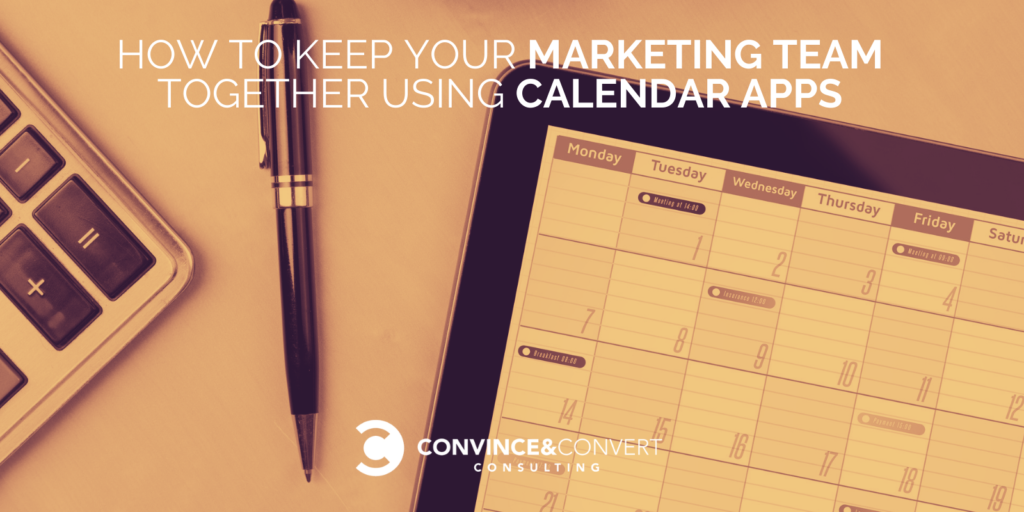
This is difficult, not only the tasks we set for ourselves but also coordination among five people, three of whom live outside of the country and three who handle matters on a local and national level.
Add to this struggle the recurring need to include other people into the mix. We have premium members with whom we need to schedule support calls, #vcbuzz hosts with whom we need to coordinate weekly Twitter chats, and influencers and partners with whom we need to meet.
We have been through every possible productivity tool, team management platform, and task manager known to man. We sat through demos of major SaaS solutions that offer task management features and even got their help in setup.
It wasn’t until we had been working together more than a year that things finally clicked into place. Which calendar apps actually worked for our ragtag team of global misfits?
Google Calendar App and Emails Notifications
You see, it came down to simple convenience. Having these fancy platforms would work for a while, but it was a hassle. No one used them for any other work, and they didn’t want to stop using what they had been using before.
Some of my team used Evernote, Trello, or Producteev. I use Zenkit. Getting on a whole other dashboard just for our projects and being unable to integrate them into our wider ones made it a chore that no one wanted to deal with.
Google Calendars and emails became the most effective solution for us. It was not only easy to integrate into different platforms but also familiar in that we already used both tools on a daily basis. They were easy to sync up on any device and could be shared and worked on with others.
Different calendars could be made, and mass emails could be sent with a record of the conversation.
To this day, we use this combo for our task list and conversations, which includes links to event announcements and necessary pending items on the to-do list in emails.
First, you will need to create a dedicated calendar for your in-team tasks and meetings. Once it is created, you can grab your link by:
- Clicking on “Settings” in the top-right
- Selecting your new calendar in the list
- Clicking “Access permissions”
- Setting your calendar to “Public”
- Clicking the “Get sharable link” button and copy your link from there
Once you share this link with your team members, friends, and community, they will see your newly added events without you having to manually notify anyone.
From there:
Step One – Create Event
To create an event in Google Calendars, sign in to your account and go to the main Calendars page. There will be a big button that says “Create”. This is where you can put your event details (name, date, involved people, etc.).

The event name should be something relevant, such as the project name, and then add events in there.
What makes this convenient is that you can choose to see only that calendar by clicking on the little arrow on each individual calendar. That will show you events related only to that set.
Step Two – Double Check Details
In the popup that appears when you choose to create an event, you will be able to select your details. These include name, date, time, location, description, who is invited/has to be notified, who can make changes to the event, and if/when it repeats.
One of the most important tasks is to double-check these details before sending the notification! While it might not seem like a huge deal, you can send a notification to everyone signed up for the event when you make a change). Be cautious though, since it gets annoying really quickly if multiple changed events are going to your email. Trust me.
Step Three – Use Your Link Everywhere
Finally, you need to hyperlink the event entry in your emails. This is pretty self-explanatory.
Following the link will take them to the Google Calendar entry or will allow them to add it to their own calendar by clicking on one of the button options. They will find all of the information you included there.
Depending on your event, there may be different places you may want to include your link, for example:
- Embed your calendar on your master page. If you have an internal page that you use for cross-team updates, you can embed your whole calendar there. This is what we did on our Twitter chat page.
- The beauty of this method is that you need to do that once: The embedded calendar will update itself.
Import Google Calendar events to your Facebook page using this Zapier integration to alert your fans or team members of each newly added event. - Include your calendar link in your email signature. This will automatically update everyone who receives your email. You can use these email signature examples to set up yours, so it is highly informative, yet usable.

You can add your calendar link to your email signature using the “HTML” app from the “Add-ons” tab inside the WiseStamp dashboard
All in all, Google Calendar is free, extremely flexible, and easily integrate into other Google products including my favorite one, Google Spreadsheets, which makes it my preferred scheduling solution.
ContentCal and Campaign Calendar
While Google Calendar is great for all kinds of scheduling and organizing workflow, we had to find another app for content and social media marketing.
When you work with remote employees, you are facing two main problems:
- Keeping everyone on track and productive.
- Keeping everyone motivated (It is too easy to focus on your current tasks and never look out of the box when you are isolated from the rest of the team).
I think we have solved both of these problems with ContentCal, a collaborative social media sharing platform that unites your whole team around building up your brand-owned channels.

ContentCal is pretty lightweight: There aren’t hundreds of task management and reporting features to manipulate. But it does its job very well, without taking lots of time on set-up and training.
- Add your team members as contributors (can contribute social media updates) or managers (can edit and publish).
- Create a system where every team member is responsible for their own piece (for example, if someone is working on a chat schedule, they are tasked with publicizing and promoting each event).

Once set, your calendar will build itself with everyone participating on a daily basis.
Furthermore, you can schedule upcoming campaigns for your whole team to see what’s coming. Each campaign can have a brief, and your team members also can contribute to it to share their research results and ideas.
Campaign briefs are minimal, but they work great for storing ideas and organizing your upcoming plans:

Use campaign briefs to put down your ideas for keywords, assets, etc.
It’s Easy!
I am in love with these calendar apps, and, of course, we all use email. So using these apps for task management, team management, marketing, and audience reach makes perfect sense. Add in the fact that both are free, and you have a powerful reason to give it a try.
The post How to Keep Your Marketing Team Together Using Calendar Apps appeared first on Content Marketing Consulting and Social Media Strategy.
Source: convinceandconvert.com

The Counterintuitive Motivation Hack That You Are Missing
Humans are always looking forward to that spark to get us moving when we’re stuck. We know what we need to do but we are fighting ourselves to actually do it. Plus, it’s an easy out not to follow through on our commitments to ourselves,” I’m just not motivated .”

We may check Instagram for some workout videos, Youtube for motivational pronunciations, or read an article much like this to get us traveling.
It may work rarely, but in the majority of cases, you’ll simply be staring at your screen instead and pushing it off for another day.
The problem with relying on motivation to get moving is this feeling is fleeting and incompatible.
It’s great when we feel aligned with our goals, and we can harness it, but if we don’t have it, it’s not very useful to wait until that feeling returns as it can be quite a while.
Solving Motivation Problem
There are two parts to solving this motive problem :
1. Addressing what is getting in accordance with the rules
When we’re feeling lethargic or unmotivated, there’s usually something else happening in our lives that influences the practice we think about achieving our goals.
It may be that we’re feeling emphasized, overwhelmed, or uneasy, and we’re spending a lot of time trying to put out fervors and allowing other tasks to take priority.

The practice of meditation, mindfulness, and breathwork is essential to be in a better mindset to deal with these challenges more effectively.
This mindset allows us to save our vigor and are still in a calculated, tranquilize cognitive state.
A lack of motivation is likely to be disguised as a deeper-rooted psychological pain such as shame, guilt, temper, or displeasure.
When we are feeling emotionally heavy and headaches, it makes every area of our life more difficult.
Let’s examine these feelings that we have about ourselves and the world and their tales.
We will be able to identify what’s true or merely manufacturing.
The more truth and clarity “were having”, the lighter and clearer we feel, and this is the energy of reason and drive.
Being too focused on the outcome takes away from our intention to give to the process.
We tend to get too far ahead of ourselves and attach ourselves to the result, and when we don’t see the feedback we want, our motive declines.
A more useful approach is to follow the day-by-day strategies required to obtain the end goal.
This approach allows us to give more proximity and awareness to what we can influence daily, establishing it more manageable and more straightforward.
Success is not a linear journey; there are ups and downs, but we will get there faster and easier if we stick to the process.
” I hate every minute of training. But I said, don’t quit. Suffer now and live the rest of your life as an endorse .”- Muhammad Ali
To recap, here is what impacts our motivating :
- Problems and challenges show up in our lives that are taking away our time, vitality, and drive.
- A heavy emotional state and the fib we tell ourselves about it, which continues us deposited.
- Focused too much on the outcome instead of the process required to achieve it.
The second area to solving this motivational question is not needing motivation at all but reining a much more powerful strategy instead.
2. Creating force
The more action we take, the more impetus “were having”, the more momentum we have, the more motivated we are.
It does require us to overcome the initial fight of extending ourselves and breaking out of our solace zone. Still, the more frequently we do it, the easier this process becomes.

The positive feedback loop-the-loops power is that positive action leads to positive results, which leads to positive feelings( motivating ).
The snowball accomplishes constructs and picks up rapidity, and once it starts, it’s hard to slow down.
What can transgress the momentum and gave us back is currently considering the wrong things.
The human psyche is the cable for negativity, so we tend to focus, and vitality on something that we recognize isn’t going well.
We can lose sight of the small prevails and victories along the way.
Momentum shows itself by journaling and self-reflective-based employment.
This process forms stronger associations with the amendments and gradations we are taking, even if it hasn’t shown itself in a tangible arise hitherto.
Systematically generating momentum takes us back to separating ourselves from the outcome, and instead focusing on the process.
” Motivated people always find the best way. Unmotivated parties will ever find a way not to .”- Ed Latimore
Striving for perfection or the” all or nothing” attitude is one of the most ineffective ways to create momentum.
What often happens is that once we “mess up,” we tell ourselves we will start over next week or another arbitrary date.
This hertz of being consistently inconsistent continues again and again.
We need to understand that we will screw up from time to time, things will happen beyond our see, and we have to pick up where we left off.

This perspective will ultimately build achieving our goals faster, easier, and more delightful.
We can create more reason and momentum in “people’s lives” through these practical strategies.
Still, it’s also important to understand that the continued practice of commitment to our goals and hunger required us to take instance over how we may currently feel at the moment.
Source: addicted2success.com

Best Workflow Management Software
Workflow management software takes chaos and organizes it into a clear roadmap that helps you achieve your work goals in less time and with better results.
It gives you a much better idea about how all the moving parts of your business are working together (or not).
Zoom out to get the big picture, or drill down into the individual interactions that make up your larger work processes.

Disclosure: This content is reader-supported, which means if you click on some of our links that we may earn a commission.
Quickly identify bottlenecks and opportunities for automation.
Increase the speed of your business’s processes without making people work harder.
Find efficiencies instead of cracking the whip.
To help you find a workflow management solution that fits with your business, I’m taking a close look at the most popular options.
After in-depth reviews of my top picks, you’ll find a short buyer’s guide to help you make your decision.
Best Workflow Management Software
#1 – ClickUp Review — The Best For Versatile Workflow Management
ClickUp is a powerful workflow management system that makes sure every part of your workflow can be streamlined and optimized for efficiency and speed.
That’s why it’s my top recommendation for almost everyone.
Companies like Google, Airbnb, Uber, and Nike are all optimized for a seamless work process with the ability to plug into over 1,000 integrations.
With ClickUp, you won’t only manage your workflow.
It’s customizable enough to also manage your projects all from one place with tools like:
- Resource management
- Goal tracking and reminders
- Email and chat features
- Complex or simple spreadsheets
- Third-party app integration
- Strategy management
With the ability to create chat views, table views, timeline views, or mind maps, you can always be sure your team is staying on top of each work task and their progress in a way that makes work easier for them.
Because of its setup, ClickUp allows you to save a lot of time by linking all project tasks, email, comments, or wikis together and allowing you to view your projects however you want, and automating recurring work tasks.
The tool is equipped for bigger and more complex workflow management, as well as for small businesses that want to get a handle on their growing workflow systems.
If you’re switching to ClickUp from another workflow management system, it is super easy to automatically migrate all your work and project information with the import feature.
One of the best parts of using such a versatile workflow manager is their price point.
You can start using the system in a matter of seconds by signing up for a free account.
You’ll immediately get 100 MB of space with unlimited members and unlimited tasks.
The paid plan is only $5 per user, and you get access to unlimited storage, integrations, calendar tools, guests, portfolios, boards, and custom fields.
If you’re managing a growing team, you have the option of negotiating a price point per user or team size once you fill out a quick form and send them a short proposal.
All in all, ClickUp’s versatility goes far.
That’s why more than 100,000 teams use it and why I’d recommend it to just about everyone.
Start your free account with ClickUp here and use it to optimize every aspect of your workflow.
#2 – Monday.com Review — The Best For Remote Teams
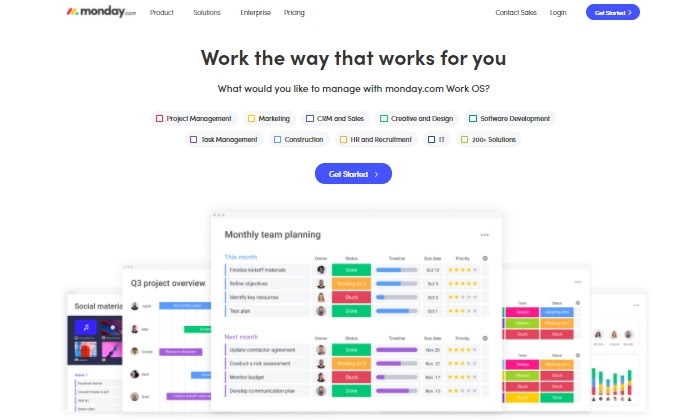
If you manage a growing remote team, Monday.com is the workflow solution that seamlessly brings everyone together.
It’s an excellent workflow system used by BBC Studios, NBC, Discovery Channel, Hulu, Cocacola, Deezer, and 100,000 other teams to ensure they’re effectively managing every step of their workflow processes with onsite and offsite team members.
With Monday.com, it’s easy to collaborate with your team from anywhere in the world by aligning work progress, video chats, and plenty of synced calendars to make sure you’re always meeting collaborative work deadlines.
You can easily start organizing tasks and automating workflows with templated daily team tasks, knowledge libraries, remote team requests, employee statuses, and one-on-one meetings.
Of course, if none of these templates will do it for you, you can start from scratch and build your own any time with their vast array of tools.
Some Monday.com features that are great for remote workflow management are:
- Weekly schedules
- A meetings board with updates and recaps
- Zoom integrations to record meetings
- Local time zone tracking for each team member
- Workload and work capacity maps for any given project
- The ability to create contingency plans from project data
Monday.com charges per seat based on the tier you want access to, and each of them comes with an extensive list of features.
The tiers start at three seats each, and you can save money if you choose to go with an annual plan.
Here’s a quick breakdown of each level:
- Basic: $8 a user per month starting at three seats
- Standard: $10 a user per month starting at three seats
- Pro: $16 a user per month starting at three seatsEnterprise: Contact them for more information
If you’d like to test drive Monday.com first, you can get started with their free trial here.
#3 – Wrike Review — The Best For Creative Teams
Wrike is a dynamic workflow management system built for creative teams.
Repetitive admin tasks and reiterations can be the bane of any creative team trying to ship great work.
Wrike makes it easy to streamline all your tasks in one place to ensure both productivity and speed.
With Wrike, you can manage incoming creative requests throughout their entire lifecycle with customizable forms, templates, briefs, and markup tools, so you always know the progress on each job.
For instance, Wrike’s approval tool makes it easy for anyone to leave clear project feedback on deliverables with comments for specific images, videos, or documents.
You can check who is working on any project whenever you need it and create a more streamlined intake system for work requests by creating one formal point of contact for each work project.
This makes it easy to finish projects that require multiple reviews and revisions.
Some of their best features for creative workflow management are:
- Project approval templates
- Project scheduling
- Task assignment
- Daily marketing operations management
- Drag-and-drop dashboards
Wrike is free for up to five users and includes 2 GBs of space, along with tools like spreadsheet view, task management, file sharing, and basic integrations.
You can take advantage of a free trial and see how you like it. Once you’re ready to choose a paid plan, the main plans are:
- Free: Up to 5 users with a shared tasks list for small teams
- Professional: Up to 15 users at $9.80 per user per month with full project planning and collaboration
- Business: Up to 200 users at $24.80 per user per month with work management customization and reporting
- Enterprise: Unlimited users, contact their team for custom pricing for the most comprehensive solution
Wrike also offers plans that cater specifically to marketing/creative teams and professional services teams.
Both of these categories have a free trial and unlisted pricing.
While Wrike does get meticulous with its pricing and feature breakdown, it ensures that you get the best plan for your specific creative workflow needs.
I recommend you check out their pricing page for a full list of features to get more familiar with what’s included.
But first, you can try out Wrike free for 14 days here.
#4 – Trello Review — The Best Free Workflow Management Software

If you’re on a budget, Trello’s workflow system can get you on the right track for free for up to 10 boards per team.
Millions of users are already using Trello and their organized dashboards to prioritize and automate daily tasks and projects.
With it, you can create boards and name them, add your tasks and team, and then add specific details to each card like due dates, work briefs, checklists, attachments, and comments.
Trello works great as a simple workflow manager for smaller teams geared for growth and efficiency without shelling out a ton on work software expenses.
It is a Kanban board style layout and is especially popular for people who like very visual tasks and workflow management.
As mentioned, Trello is free for up to 10 boards per team, with unlimited cards and lists and a 10 MB per file attachment limit.
If you love their free version so much that you want to go with a paid plan, you can choose from two options:
- Business Class: $9.99 per user per month
- Enterprise: Contact sales
Get started with Trello with a free demo here and use their easy boards feature to begin organizing your workflow.
#5 – Smartsheet Review — The Best For IT and Operations

Smartsheet makes for excellent workflow management software in IT and operations teams.
Generally, the two things you need when working in IT management are consistency and speed.
Smartsheets deliver on this by allowing you to quickly adapt and archive projects, coordinate data center migrations, and even set up automated alerts and approvals to save you time.
Smartsheets enables collaboration across teams and gives you control access to resources.
They bring it all together on an easy-to-use dashboard with plenty of reporting capabilities.
Smartsheets offers a free 30-day trial.
For the paid plans, they break down their pricing tiers into four categories.
These include individual, business, enterprise, or premier.
To learn their prices, you’ll have to contact them first.
I recommend visiting their price page to get a feel for what features and capabilities you get with each tier from their exhaustive list of features.
You can also watch a demo of the tool.
Try Smartsheet free for 30 days and start creating better workflows for your team today.
What I Looked at to Find the Best Workflow Management Software
The more complex your process to finish work and reach deadlines becomes, the more likely you are to need efficient workflow software to help you get the job done.
First, you want to take stock of your current workflow system regarding what it’s lacking and what is already working well.
This way, you can choose a workflow solution that’ll integrate with your work style and more accurately solve your issues.
To start, ask yourself a few simple questions:
- Is your team scrambling to know what work was assigned to who at the last minute?
- Did your Excel spreadsheet get too complex to automate your work processes efficiently?
- Is there repeatable work that could be streamlined more effectively to save you time and resources?
- Is your team too overwhelmed to turn in great work because there isn’t a supportive framework to help them through their work process?
- Are there current limits that could be removed for more efficient work delivery or completion?
Workflow management and project management systems are often confused as the same thing because they share a lot of the same tools and processes.
However, there is a difference.
Workflow management systems exist to manage and maintain ongoing work processes within a business.
In contrast, project management systems are used to start and finish individual business projects as efficiently as possible.
So, a project management system can exist within a workflow management system while the workflow management system takes care of the bigger picture and recurring work processes in your overall business.
It becomes more understandable once you dive into the world of workflow management software and what it has to offer.
Once you know the distinction and made sure a workflow management system is what you’re looking for, here are additional specifications to think about when choosing a workflow system that makes the most sense for your business.
Team Structure
Your team’s size and planning for growth matter when you’re trying to choose a workflow tool.
Why?
Workflow management tools tend to charge by user.
This can be a deciding factor in which system you select due to budgeting constraints.
The more users you add to a system, the more you’ll be paying per month.
If you don’t have to deal with a complex team structure, you might not need workflow software with all the bells and whistles that a larger business might find more useful.
Sometimes, more functionality doesn’t mean it’s better for your needs.
Think about a few things as you move forward: Are there different departments that’ll need to communicate with each other frequently to greenlight work processes and projects?
Are your teams adaptable to new software, or are there new API integrations you’ll need to make?
The simpler your team structures, the simpler your workflow system can be.
This also often means less of a learning curve.
Tasks and Workflow Complexity
What tasks need the most comprehensive management?
This can differ by niche, meaning you might need some features specifically designed for your industry and the value you create.
Some workflow systems are more equipped to deliver specific tasks than others.
This can be done with anything ranging from:
- Dashboard reporting
- Gantt charts
- Document sharing and collaboration
- Scheduling software
- Task assignments and sign-offs
- Work status reportsIntegrations with third-party software
- Kanban boards
- Advanced data analysis
- Scrum work management boards
Communication Style
Communicating effectively with the appropriate workflow system will eliminate possible bottlenecks that slow down your growth.
With open API and integration features, your workflow system can be a seamless communication tool amongst each team member.
This way, you can quickly review and respond to related emails, review project feedback, make corrections and comments, use team chat or message boards, and make sure changes to scheduling or project direction are accessible to each team member as part of your daily workflow.
If tons of communication isn’t how you handle business, and you have a more straightforward workflow management approach, you can always adjust your processes with a more customizable system.
Workflow Views
An additional factor to think about is workflow views and how you choose to organize the information, processes, and tasks you input.
Effective workflow management software gives you different ways of managing and viewing tasks and workflows.
To illustrate, a Gantt chart view, a graphical organization of a project or process, can help you simplify complex workflows.
Kanban boards make viewing workflows easier and more manageable as you move cards from one chronological board to another.
A scrum board breaks down work processes into sprints and can be ordered into horizontal and vertical lanes.
Looking for a workflow management system with the flexibility in preferred style makes your team’s life easier and may make your work processes faster.
Summary
Choosing the best workflow management software for you depends on a lot of variables.
But you can easily start weeding out what won’t work by outlining what your workflow needs are in terms of niche, workflow needs, and team size.
Which of my top picks best aligns with your needs?
5 Best Workflow Management Software
- ClickUp – Best for versatile workflow management
- Monday.com – Best for remote teams
- Wrike – Best for creative teams
- Trello – Best free workflow management tool
- Smartsheet – Best for IT and operations
I’d recommend ClickUp and Monday.com for almost anyone. ClickUp is the most versatile system to work with. It has a stellar price point, can be easy to use once you get over a slight learning curve, and it’s highly customizable for just about any workflow management need imaginable.
Monday.com is ideal for remote teams and collaboration, which is needed now more than ever.
If you have more specific workflow needs for your given industry, use this guide to learn how to choose the right workflow management software for your company’s needs.
Source: feedproxy.google.com

Tips And Tricks On Making The Most Of Your Time
Time is money, especially in today’s busy world. If you do not know how to manage your time, you won’t have enough time for what is really important. If work consumes the majority of your time, your personal life is sure to suffer.

Keep the deadlines that you set in mind at all times.
If deadlines always creep up on you, it has the potential to throw your whole day off. But if you make deliberate progress every day for tasks with a deadline, you’ll do better work and feel more relaxed.
Make an honest assessment of where your time is best spent.
Think over each task and how long it will take and then tell yourself what time that task should be done by. This will go a long way toward time management and improving your quality of life. If you find yourself with surprise pockets of free time, apply them towards enjoying yourself or catching up on anything you’re behind on.
Each day should start with a schedule.
 If you know what you need to do as your day begins, the chances are better that you’ll achieve your goals. Check the agenda carefully to make sure you aren’t overbooked.
Focus on specific tasks if time management is hard for you.
People who multitask end up lowering their quality of work. Trying to complete all your tasks at one time will simply exhaust you and leave you feeling like there’s not enough time to finish anything. Make sure to take breaks in between each task.
If you are having trouble with time management, step back, and look at how you are going about things. Are you able to focus? If not, why? To achieve wise time management, you must determine your present level of productivity.

If you’re finding time management difficult, plan your days in advance. This can be through a future to-do list done at the end of a workday or a more in-depth plan of action. It will help you to stop worrying about it and start the new day ready to go.
Practice prioritization throughout each day.
If you’re not careful, you can spend the bulk of your time dealing with matters that aren’t ultimately important. Put strong effort into tasks that really need to get done. Consider keeping a list of every task you hope to get done, and then organize them by the level of importance.
Think about the way you use your time now.
Consider the wisest use of your time. Check your messages on a regular schedule – not every time one comes in. When you fall into these interruptions, you won’t get your tasks done.
First thing in the morning, think about what you need to accomplish for the day. Use some paper and a pen to determine what you are going to do, and how long you’ll do it. Having a schedule every day will allow you to use your time better.
Do not hesitate to shut the door to your office if necessary in order to get more work done. An open door tends to invite folks in to chat. Signal your need for privacy by closing your door. People realize that you need to concentrate in order to finish your tasks on time.

Unless it is absolutely necessary for you to do so, don’t answer the phone, a text message, or instant message when you’re doing something else. It’s going to prove difficult to refocus on your initial task after the interruption concludes. Just let things go to voicemail, and return calls or take care of texts once you have a free moment.
Keep your focus on the task at hand.
Don’t get distracted with items that interrupt your tasks. People often hand you more tasks when you’re still not done with one and demand you to finish the new one first. Don’t enable this hijacking of your time. Finish your task before you take on more of them.
Time is not something that should be wasted.

This is even more so when the time wasted eats into your ability to rest and relax. Proper time management is critical if you would like to live a great life. Use what you’ve just learned to get what you want out of life.

The Guide to Staying Motivated While Working Alone
Working alone at home might sound like a nightmare to some, but as a fully signed-up introvert, working alone at home is an absolute dream.

No energy-draining small talk, no boisterous distractions, exactly peace, and quiet to complete deep and focused make. Well not quite.
Working alone at home has more challenges than you might expect. Boredom, lack of focus, and shortage of motivation to name a few.
Maintaining Motivation while Working Alone
When you start working for yourself, you swiftly realize that one of the biggest problems you face isn’t the job itself.
Maintaining your motivating poses a potentially massive difficulty. Much of that difficulty stems from working alone, rather than in a traditional office giving.
There is also the challenge of biding focused on the task at hand. With no boss or boss ogling over your shoulder, social media can confuse or cat videos end you.
But the greatest problem by far is a simple lack of reason. There doesn’t seem to be a pressing need to finish this project right now, doing it far too easy to put it off until later.
Left unchecked, a lack of motivation can paralyze the act you are trying to accomplish. Over the past few years, I’ve developed a few go-to tactics to improve my lone cultivating motivation.
Here are some of the tools I’ve used to stay motivated and on-task.
Stay Motivated While Working Alone
These first few tips focus on using different nips in your personal work schedule to provide some diversity and maintain your focus.
1. Include short breaks

My eye doctor formerly told me that for every 20 minutes of staring at a computer screen, you should look away and focus on something across the room for 20 seconds.
This gives your eyes a chance to reset. Do something similar with the rest of your mas; don’t simply look across the room, stroll, jog, or run across the room.
Give your form a smash, and try to reset your thoughts. If you don’t have the subject to take regular interruptions, use an app to remind you.
2. Block out an afternoon for social activities and networking

Set aside one afternoon a week for your social life. Friday afternoon works best for me. If you feel guilty about not working, think of it as a chance to network.
Either way, be sure to spend this section of duration with other parties. Socialize and network.
3. View your personal plan as your work schedule
A 9-to-5 occupation necessitates get up each morning, preparing for the day, leaving the house, and commuting to your workplace. In other texts, it requires going to work.
You just wanted to recreate the same rhythm at home. You may not actually need to leave your house in order to work but try to stick with the schedule.
Filling the old-fashioned professional timeslot with your brand-new undertaking helps to keep you motivated – you can’t clock out early!
Stay Focused While Working Alone
These next few tips are little things you can do to trick yourself into staying focused!
1. Music

This tip may sound cliche, but try listening to an upbeat hymn loudly whenever you feel unmotivated. It’s a simple trick, but an astonishingly effective one!
2. Have somewhere else to work for a change of scenery
When procrastination laid in, sometimes a quick alter of view is all you need. If you work at home, going to your favorite coffeehouse can be a huge help.
Other freelancers I know have even gone so far as to hire office space outside the home, and rotate between the two to help stay on-task.
3. Love what you do

This is arguably the most critical point on the whole list. If you don’t cherish what you do, it will be hard to keep yourself motivated- especially long-term.
Sure, you may be able to push on through sheer pressure of will for a while, but sooner or later you’ll lose motivation solely.
Do something you genuinely experience, and you’ll find it much simpler to stick with it for the long haul.
Industry-related Gratuities while Working Alone
These last few gratuities are Industry-related!
1. Make sure you have fun activities
Not all of your work projects will be fun, but fight to make at least a couple of the fun. These might even be personal side projects, not especially related to your main job.
Or they might be in the same general land, but not your specific focus.
2. Attend industry happens a couple of times a year

Nearly every imaginable manufacture has an organizing body of some kind. Find the neighborhood branch, and use it to keep tabs on industry-related affairs.
Attend some meetings, system, and maybe even glean some new gratuities and ploys from manufacture insiders.
3. Schedule at least one call a week to learn something within your industry
View this as an opportunity for personal improvement. At least once a week, try to learn something new about your manufacture.
For me, this might symbolize calling a new implement provider to demonstrate their contraptions. Whatever your industry, try to expand your horizons a little bit every week.
You’ll learn new methods and realize brand-new alliances at the same time.
These gratuities worked for me, hopefully, some of them will assist you out as well.
Above all, strive to enjoy what you do, stick to a “work schedule, ” and look for opportunities for constant self-improvement.
With those ideas in mind, you’ll find staying motivated much easier to do alone or in a group!
Source: addicted2success.com