
Tag Archives for " work "

Prioritizing Team Connection During a Pandemic
According to the 2021 State of Marketing report, 75% percent of marketers say the pandemic has permanently shifted how they collaborate and communicate at work. Now whether this is good or bad is what I would like to share and discuss with you.
In life, I naturally chose the positive side of things and live my life as a glass-half-full type. I temper my optimism with a healthy dose of realism too – nobody benefits from toxic positivity.
Even through the pandemic, I’ve primarily been choosing to see the small upsides of the situation, although some days that’s been tough (even for me). (Multiple rounds of home school quarantine, anyone?)
So, let’s take a look at the positive impact that the pandemic has had on team alignment.
Remote Work: Forging a Culture of Connection
C&C has been a virtual firm since Jay Baer founded it in 2008. We’ve had team members from NYC to LA, Portland to Orlando and many stops in between for the last 13 years.
We thrive in a work from home arrangement, across multiple time zones, while only seeing each other in person ONCE per year.
We’ve all entered the C&C family knowing this setup and while some folded right into the work-in-your-slippers mentality, others had a more steep learning curve on self-discipline ahead.

One commonality across the decade and more while we’ve been WFH is that we each still crave and seek out connection with our coworkers. We have slack-style chats, personal text threads, and monthly virtual happy hours.
Even across the miles, pandemic or not, we have established a culture of connection. It takes intention and effort to keep that connection, but each team member wouldn’t be here without it.
The Intersection of Professional and Personal
We recently conducted research with Ascend2 on team alignment and I was shocked in the best way possible. The stat that struck me the most was: 76% of our respondents are strongly integrated or totally integrated.
To me, the word “integrated” has importance here. Has the perception of “integrated” changed with the pandemic? In my past corporate experience, integration equated to one hour a week around a conference table where an agenda was followed and updates went in order.

It ended up sounding like Charlie Brown’s mom “waaaa, whaaaa, wa, waaaaaa, wa, wa.”
Now, through the broader application of work from home, for better or for worse, everyone is literally IN each other’s home via video conference.
What used to be possibly a passing “hi” in the hallway is now an introduction of a child who enters the frame or an apology for a pet barking as the doorbell rings.
We have all been forced to integrate into one another’s home settings.
75% percent of marketers say the pandemic has permanently shifted how they collaborate and communicate at work.Click To Tweet
We have seen a new side of coworkers. We have met more of their life outside of the office, and have all been impacted at the same time by a global change in how we work, shop, visit and view our health.

This intersection of our personal and professional lives has never existed as collectively before, and I truly believe for many teams it increases their integration with each other for the better.
Empathy Brought On By The New Normal
The humanity of team members has become more tangible in this new world. With COVID involved, people are more empathetic towards each other. We all had to adjust our lives at home and at work.
Every organization has been forced to “figure it out” – figure out how to communicate, connect and keep working among office shutdowns. Each person has had to reconfigure their home into a workspace at some point in the last 18 months. And we did it.

What I appreciate very much is that working from home can often give a deeper understanding of each other’s ability to relate and integrate.
We witnessed how each of us managed our at-home work space and new outside interruptions during a history-making, life-altering pandemic.
I understand that our culture here at C&C is different and special. But I have heard from many clients that they are proud of their team, that working from home is going to continue because they are being successful and the alignment of the goals is better than before.
Prioritize Your Team’s Connection
We’ve evolved from a question of “how do you integrate two teams” to optimizing and using technology to increase integration with other teams in the organization.
In my pre-pandemic work life, we discussed things like “lunch and learns” and “ride alongs” as well as “mutual goal setting meetings” around team alignment.

Now we are finding much more common ground among us and a more genuine “how are you?” and “is everyone healthy” has a new meaning to mankind – therefore bringing us together and teams together.
If this sounds like Utopia to you – a foreign space that is nowhere close to the reality of your professional experience – I’ll offer some advice.
What I am describing is not fictional or only associated with our wonderful C&C team. There are hundreds of open positions at organizations who are aligned in goals, believe in a people-first culture, and support connection. I urge you to seek them.

If you lead an organization, you must be the model. You owe it to your staff to connect and align them as well. You owe it to them to be genuine and carve out time for 1:1 and team interaction.
The world is still hurting and keeping your best team members connected and not feeling alone, will increase your productivity and success by more than your bottom line.
If you are wanting this type of connection among your team but are unsure how to make it happen, our team would be happy to help.
The post-Prioritizing Team Connection During a Pandemic appeared first on Content Marketing Consulting and Social Media Strategy.
Source: convinceandconvert.com

Fuel Marketing Transformation with Team Alignment
The Pain Points of Misaligned Teams
Anyone who’s worked on a team knows what it feels like to be part of a team that isn’t aligned, and this can have a real impact on your ability to make strategic improvements. Does this sound familiar?
- Your organization has invested in and developed strategy after strategy, but none of them are sticking; execution is a real challenge.
- Teams aren’t working well together and the silos between teams are cementing into territories that are heavily guarded – resource and information sharing is forced, rather than the norm.
- Leaders keep getting feedback from their teams that they need more headcount to do the work.
- Team members aren’t bringing their best – no breakthrough creative ideas, less innovative problem solving, fewer examples of working “above and beyond.”
- It seems like team members don’t enjoy coming to work – there are complaints that the day-to-day work is frustrating, a total grind, or unmotivating.
- Teams are experiencing high turnover from people that seemed at least moderately satisfied at work.
I imagine you’re nodding your head and also feeling a growing apprehension about the big plans you have for the coming year.
For many of you, a new strategy, campaign, or initiative is on the horizon and success is the only acceptable outcome. You’ve likely tried implementing change in the past with less-than-ideal results.
The issue is likely a mix of individual motivations, team culture, tools, and resource gaps that internal leaders are having difficulty parsing out and addressing.
But there is a better way: when team members actually trust their team, know-how to point out flaws, and learn from each other to co-create the strategy, inevitably objections and silos dissolve, enthusiasm skyrockets and entrepreneurial thinking abounds.
Team Alignment is a Predictor of Success
This just in: Leading business researchers have discovered a revolutionary new approach that makes any business more profitable. It reduces costs and increases productivity and profitability. It increases lead quality, pipeline velocity, leads to happier customers, and more repeat business.
Companies using this approach also have more satisfied employees, are willing to work harder (often for less money!), and have higher overall employee retention. It has no hard costs and you can do it internally, with resources you already have. Are you interested?
Any business leader would be negligent not to at least open that link and try to figure out if it was too good to be true.
When they come to realize the research was conducted by Google, Harvard Business School, and dozens of reputable sources consistently since the mid-1990’s you’d expect that they’d be adding this new approach to the very top of their to-do lists and retraining managers to incorporate the findings.

Team alignment, and its the underlying foundation of psychological safety, is not something that should be relegated to HR or written off as “soft skills.”
In almost two decades of writing and overseeing strategic marketing transformations, I can say with confidence that team alignment is the number one indicator of whether a new initiative will succeed or fail.
Unfortunately, it’s also a topic many leaders would rather gloss over when they get ready for a big strategic change – they want action plans, not “warm and fuzzy” team alignment plans. I’ve had pushback more than once from clients who would prefer we “stay in our lane” and just focus on research, metrics, and action plans.
Research Shows Aligned Teams Are Critical

When you ask most business leaders about team alignment and psychological safety, they often point to the HR department, mumble something about the culture, and shrug their shoulders. This is too bad because the research is clear:
- Companies that successfully align sales and marketing retain 36% more customers, generate 32% higher revenue and achieve 38% higher win rates. (Source: Ascend Ebook)
- A study of 1,000 professionals across a range of industries found teams with cross-functional collaboration and an openwork style are 60% more likely to achieve more, faster. Plus, they’re 80% more likely to report high emotional well-being. (Source: Ascend2)
- More than half (54%) of employees say they’re willing to stay at a company longer than what’s in their best interest due to a strong sense of community. (Source: Ascend2)
- Google’s “Project Aristotle,” explored over 250 team-level variables, found that psychological safety is the most critical factor and a prerequisite to enabling successful teams. (Google, 2015). Team psychological safety is a shared belief that people feel safe about the interpersonal risks that arise concerning their behaviors in a team context (Edmondson, 2018).
- Despite the importance of psychological safety, only 47% of employees across the world described their workplaces as psychologically safe (Ipsos, 2012).
What’s Team Alignment and Psychological Safety?
Team alignment can feel hard to pin down if you’re new to the topic but here’s a simple definition: team alignment is the team’s ability to work together and learn from each other.
As researchers have tried to study and measure this trait, they have settled on the term “psychological safety” and defined it as having four key domains or areas that can be assessed:
- Attitude to risk & failure: does the team see failure as a necessary byproduct of growth and innovation? Or is it punished and avoided at all costs?
- Open conversation: do team members feel comfortable expressing concerns and reservations as they work together? Can they learn from one another and hear constructive feedback in the spirit it is intended for?
- Willingness to help: Does the team have a spirit of being “in this together” and do they easily pick up slack for the benefit of the whole? Does this shake out fairly or do some team members take advantage of others?
- Inclusivity: Does the teamwork hard to ensure all perspectives are represented, even from those who are not always first to speak?
Roadmap for Successful Change
Let me give you the shortcut formula to planning your success. Every single business transformation comes down to two simple questions:
- What exactly do we need to do differently?
- Who is going to do it?
The first item is your strategy, and companies are always paying for more and better strategies. Unfortunately, all too often they completely ignore the second item, assuming that once the WHAT and HOW are clear, the WHO will fall into place.

A plan can be strategically sound, backed by data, and make perfect sense on paper but that doesn’t mean the team will get on board. Considerations like who gets credit, who will benefit from less work or more resources, job security and perception of rank, and how success is measured all inherently affect the buy-in for any new plan.
STEP 1: Strategic Alignment – What exactly do we need to do differently?
- Define what you’re trying to achieve, clearly, concretely, with metrics.
- Link the change to a larger organizational vision
- Specifically define the change: current state, target state, the gap, and what is NOT changing.
- Identify past lessons learned. What has been tried before and how did it go?
It’s worth noting that most teams are pretty good at step one, but they stop there.
STEP 2: Stakeholder Analysis & Team Alignment – Who is going to do it?
- Ensure the team agrees on the problem and its urgency
- Confirm the team believes change is possible in this setting.
- Ask whether the team has the time, energy, and willingness to change. (Change fatigue is real!)
- Uncover whether each individual believes they can personally succeed with this change
Team Alignment In The Wild
For the last couple of years, Convince & Convert has worked with a large national association ($1.7B in revenue, 38 million members) on a wide variety of marketing initiatives. One change, in particular, was in process when we started working together, and the outcome was anything but certain.
A new project management system was intended to be a centralized place for updates and tracking, intended to increase collaboration, reduce meetings, and allow workloads to be distributed more evenly across the team.

Unfortunately, team adoption of the new tool was low and falling farther – the grumbling was increasing over time. Leaders in charge of its success were struggling to come up with a way forward. Confidential interviews with individual team members uncovered some real and specific challenges, both with the actual tool and how the change was communicated.
Owners of the tool went back to developers to overhaul the tool and improve functionality, and are in the middle of a much more successful rollout with an enthusiastic reception from previously reluctant team members.
Setting Up New Norms
In another example, a nationally-recognized, top-50 university we worked with was struggling after some changes to the marketing team organizational chart and reporting structure. Two teams that had previously been independent were combined, but the merger was not a smooth one.
Assessments of the team showed that each smaller team felt psychologically safe to communicate openly. However, when the teams combined to collaborate, that index score went way down. The norms of each smaller team were different.

They needed to be revisited to openly agree on what type of feedback was preferred, how to run meetings, and a number of other patterns that develop almost without noticing but need to be identified, agreed upon and communicated to new team members.
Once new norms were established, the teams were able to work together fluidly and begin finding the synergy that was intended with the original combining of teams.
“What’s in it for me?”
It’s important to dig in here and get curious to understand team strengths, weaknesses, passions, and drains. This often means closed-door confidential sessions where team members have a safe space to talk about their ambitions and concerns, what skills they do or don’t possess, and where they might like to grow.
The effort is not the same for everyone; work to understand perceived effort with perspective taking, empathy, mentoring, coaching.
Smart leaders understand that all change in responsibilities comes with a power shift across a team. When changes are on the horizon, the first question everyone wants to be answered is, “how will this impact me and my job?”
- Who on the team will have to learn new skills?
- Whose job might be in jeopardy after the change?
- What new resources will various team members get? How do I get my share of the pie?
- Will the extra responsibilities be rewarded fairly?
- If the new work sounds fun, can I get rid of some old tasks I hate?
…and dozens more
Answering these questions in advance, equitably, and with your individual skills and goals in mind is the core job of a great manager. Allowing the team to negotiate among themselves, speaking honestly about their strengths and weaknesses, skills they have or want to develop, and how they’d like to see the change unfold is the gold standard.
How Does Your Team Rank?
These areas are so critical to navigating change, and more and more of our clients are interested in getting better, not just at the “what should we do to innovate?” question but also understanding the people and motivations that will make or break the strategic plans they’ve laid out.

A seven-question assessment that takes under 3 minutes can help teams understand their ability to bring new ideas and challenge each other, essential qualities of a successful organizational change process.
Benchmarking the team’s score and growth over time can provide tangible, actionable goals for managers and teams to work towards. The Convince & Convert team has strategists trained to conduct these assessments and facilitate improved team alignment, and we’d love to help your team on the next stage of your journey.
The post Fuel Marketing Transformation with Team Alignment appeared first on Content Marketing Consulting and Social Media Strategy.
Source: convinceandconvert.com

How to Change Careers
The fast-paced nature of today’s society has changed, and still continues to change, the way in which we live our daily lives. Everything from the method we browse to the way we communicate has changed.
We now live in a world where people can communicate with each other from all regions of the world at any time. This huge shift has also trickled down to the working world. Whether you’re in your office, sitting on your couch, or are on top of a mountain, we’ve officially entered a new era of communications, life, and the method we work.
Because of this stupendous displacement, staff members shall be voluntarily ceasing their jobs at record counts. According to data statistics from the Bureau of Labor and Statistics, 20.2 million people left their employers from May to September 2021.
Truth is, parties convert, accommodate, move on, lose interest, amplify view, and transform priorities. And as the world modifies, many have realized the job you chose at 20 is no longer able be the job you still affection doing at 40.
You may be considering a midlife career reform, and I am here to tell you that it’s okay if you are- It’s completely normal.
If you’re wondering how to change careers successfully to start doing what you love, you’ve come to the right place.
Identify areas of opportunity and improve your success. With Brian Tracy’s Personal Development Plan Template!
Why change professions?
There could be many grounds you consider making a career change 😛 TAGEND
- You are likely to be outgrown your current career or gained interest in something new.
- You may have decided that you want to do more for yourself.
- You just wanted to reach more funds.
- You may simply only crave a conversion.
Regardless of your reason, making a career change can sometimes seem like a daunting assignment. If you’ve ever felt accentuated about how to make a career change, though, don’t worry. It doesn’t have to be as scary as you think.
Here, I will provide some helpful job alteration advice and answer your questions on how to make a career change in “the world’s largest” seamless room possible.
When is the Best Time to Change Careers?
You can consult with 100 people about when the best time to make a career change is, and they could give you 100 different, apparently remedy, reactions. But the only person that will have the right answer is you.
Truth is, there is no right time or age to change vocations!
The best is necessary to do so is whenever you see it best for your life and your goals. The best job change admonition at this moment would be to follow your gut.
Doing so may not come as a big epiphanic time but as a gradual culmination of feelings that item you in a new direction.
Though it may not be entirely obvious when the right time is for you, there are key minutes in animation that make it easier to see the new pathways opening up for you.
Here are some of those instants 😛 TAGEND
You’ve Entered a New Stage of Life
Everyone can recount the pivotal moments in “people’s lives”. From graduating college and moving out of their hometown to having children and even just waking up one morning choose they want to try something new we experience substantial incidents that score the entrance into a new theatre of our lives.
These times allow us to be introspective, to figure out what it is we really want to pursue. They push us to molten our cozy blankets and transform them into something new.
A new alumnus, for example, may decide to utilize their degree to pursue a career in finance and climb the corporate ladder.
A new father-god may consider taking a coding boot camp in hopes of finding a business that will help him supply more for his growing family.
These new stagecoaches in the living act as catalysts to all kinds of change and are excellent epochs to re-assess your own personal and professional journey.
You no longer enjoy what you currently do
If you feel exasperated or unmotivated about the task you do on a daily basis, you may be due for a vocation change.
There’s a rationale for these feelings are arising. Let’s say you went to college to become an accountant, but after 10 years in the field crunching multitudes the working day, you begin to feel undid and unhappy in your role.
The feeling draws you uncomfortable, and you try to push it down because leaving the job now would feel like a sunk cost. You consider all the work you’ve done and how far you’ve come, but it still doesn’t feel like enough.
These awkward feelings are asking you to look inwards, to realign with your true purpose and goals. You spend most of your time acting, so it’s important to feel passionate about what you’re doing.
Now let’s say you’ve ever had an interest in writing, but never sought it because you were worried you wouldn’t make it.
Now, after 10 years of crunching numbers, you are dreaming of pursuing a vocation in writing. You are understanding now how essential it is to enjoy your work, and that in itself is enough reason for a professional change.

Your mental/ physical health is taking a toll
Work can, no doubt, be traumatic. There are seasons where you think to yourself, “work moves me anxious.”
While an ordinary about of traumatic is healthy and motivates you to be productive, high levels of constant stress may take a toll on your physical and mental health.
Studies have shown that workplace stress is a strong risk factor that can lead to cardiovascular disease, heart attack, and stroke. It too leads to adverse effects on workers’ mental health issues, increasing the risk of anxiety, burnout, and depression.
Stressed employees are more likely to engage in self-destructive actions, such as smoking, substance abuse, and unhealthy eating patterns.
If you’re noticing that the stress you feel at work outweighs your amusement of the job, it may be time to consider how to make a career change.
You Want More for Yourself
Whether you’re not aligning with the company culture or looking to earn more coins, sometimes the desire to change occupations stems from simply missing more for yourself.
Joblist’s Midlife Career Crisis survey reports on the five conducting reasonableness parties reform professions 😛 TAGEND
- Better Pay: 47%
- Too Stressful: 39%
- Better Work-Life Balance: 37%
- Wanted a New Challenge: 25%
- No Longer Passionate About Field: 23%
Staying in the same job forever may seem honorable, but if you’re not learning and being challenged in that job then what is the point?
If you feel like a modification would result in more happiness, so why not give it a try?
How to Change Careers- Step By Step Guide
No question the above reasons you have for was intended to make a career change, there are steps you should follow in order to do so in the least traumatic and most seamless route possible.
Recognize What You Do and Do NOT Like About Your Current Career
When making a career change, it’s very important to understand what alters you’re hoping to see in your new career. This is an opportunity for you to consider the qualities that have turned you off from your current career.
You can create a pro and con list about your current job. In this practice, you can be clear about the elements you hope to repeat and the elements you hope to avoid in your brand-new job. While all business has its ups and downs, it’s important to recognize what your personal priorities are in your brand-new career.
For example, a con for your current job is that it may not be paying you all the best, but a pro is that you like your coworkers. Now you know that when looking forward to a new business, you should search for opportunities that provide better salaries and have a positive business culture.
Be 100% Absolutely convinced the Career You DO Want
The grass may seem greener on the other side, but in reality, the grass is greenest where you see it.
That doesn’t mean you should stay put and suffer at an occupation you don’t experience; it means that you should find something that wishes to and experience putting endeavor into. This may require getting your hands grimy, but it will be worth it in the end.
This requires you to do some investigation. If you already have an idea about what your next job move is likely to be, focus on learning more about it. Ask trusted friends, households, and your system of colleagues in that field for their feedback.
Their honest feedback and personal experiences will help you assess the extent to which you could see yourself in that career.
Additionally, you can work on mock undertakings from that occupation to ensure that you actually enjoy the task. This can turn your belief into truth.
Create an action plan to follow through on your goals
When considering making a career change, you spend a substantial amount of season thinking and dreaming about what it will be like. When you ultimately decide you want to do it, having a plan in place will turn your dreams into reality.
Creating a step-by-step plan will retain you motivated and help hold you accountable for your goals. Here are some enormous ways to be prepared when the time comes 😛 TAGEND
Make sure your deal letters and resumes are updated to reflect your current role Keep your social media profiles cleanse and work-friendly Start identifying errands you’d be interested in doing Research germinating companionships you’d like to work for
If you need more jobs to mutate admonition, check out my 7 tips-off for procuring a new job.
Create a fund
In addition to your action plan, it’s important to create a budget for your business alter. Your career change will hopefully bring in more cash flow, but you want to ensure you’re prepared for anything.
Transitioning between occupations may be a drawn-out process, so you want to create a budget that helps you stay on track to continue providing for yourself while sought for your next incredible opportunity.
Budget out your activities, monthly memberships, and other expenses to see what can be adjusted during the transition period, if necessary.
If your budget is close-fisted, consider staying in your current job until you have another in the pipeline. It may require some extra work for a while, but you will feel a little anxious about making a career change if you feel cozy financially.
Get as much experience in your paragon brand-new job route as is practicable
Looking for a new career takes time and many of us do not have the luxury of putting our current career on hold while looking for another one.
Though it will require extra work, this is when you should consider using your free time to hone in on developing your knowledge for your brand-new profession. This could mean getting certifications, taking directions, and reading brand-new software that will help prepare you for the new role.
Stir an elegant and humble change
When you’ve lastly experienced your brand-new job and plan on leaving your current role, make sure your exit is an elegant one to avoid burning bridges and devastating relationships that could be beneficial to you in the future.
Express gratitude for the experience you’ve had, even though they are the only thing you can say you learned from your age-old occupation is what you didn’t like.
You never know who you will interact with again in the future, or what attachments you may need to lean on. When it comes time to move on, give your current company enough time to find a replacement and offer to help them transition your persona.
Then, when beginning your new business, be open and welcoming to new people, advice, and feedback. This is your opportunity to make a great impression and hit the ground running.
If you’re looking for implements to help you with your job vary, check out my Personal Development Plan Template. You can be utilized it as a reference to help you achieve your goals and optimize your success.
Source: briantracy.com

Find the Right B2B Influencer or KOL for Your Brand
B2B KOL and influencer programs are a topic of nearly every conversation these days. Our friend Lee Oden at TopRank Marketing conducted a survey in early 2021 about the use of B2B influencer marketing and found these incredible stats, along with many others.

- 74% of marketers agree that influencer marketing improves customer and prospect experience with the brand
- 63% of marketers agree that marketing would have better results if it included a B2B influencer marketing program
From our view, we don’t see that trend slowing down anytime soon.
Influencer vs. KOL
Some may say it’s merely semantics but the word “influencer” infers a YouTube or TikTok celebrity smiling big to schill their use of the latest teeth whitener and the term, “key opinion leader” (KOL)” is emerging as the preferred term for B2B partnerships.

Key Opinion Leaders are what the B2B community is looking for, right? These partnerships are MUCH less about “buy now!” and more about learning something new from a trusted source or having a brand experience where sales are the last metric to be measured as the success of a partnership.
At Convince & Convert, we’ve concepted, recruited, created and managed dozens of KOL programs for clients over the years. Almost every project revolves around helping the audience gain insights or perspectives from KOLs in their area of expertise and not about direct sales.
This is the case in our most recent work with Cisco to source and creates short-length video series and blog posts for their partner marketing platform.
Over the course of the program, we’ve built relationships with our KOL’s and the partner audience at Cisco has also built affinity and trust in the knowledge they bring each month.
Not a week goes by that our own Jay Baer isn’t approached to be a KOL for various brands and contribute his thought leadership, marketing prowess, and digital personality to a campaign or brand platform.
Other C&C team members including Zontee Hou, Mary Nice, Daniel Lemin and Jenny Magic also get asked to contribute content as a KOL around digital marketing strategy and customer experience.
Working on both sides of the KOL programming has given us unique insights about how to make a program successful and what matters when negotiating a rate.
How to Approach KOL Selection
TopRank’s survey found that “39% of marketers say their top challenge with influencer marketing is that the process is too manual” and we couldn’t agree more! Our clients look to us to take out that manual work for them and deliver KOL results with as minimal extra work as possible.
Having perspective on what content creation and campaigns need from both a brand and a KOL perspective has given us a unique angle when working with KOL engagements.
Sourcing B2B KOLs for Your Brand:
We use our network of contacts as well as subscribe to several software platforms which support our discovery and vetting of potential KOLs.
Software platforms we currently use include:
– Social media marketing analytics with advanced competitive analysis, SEO, social reporting, and content marketing tools.
– Helps PR and marketing teams monitor media coverage across both news and social media and enhance brand management.
– Crawls tens of millions of social and web profiles to find what (and who) your audience reads, listens to, watches, follows, shares, and talks.
– Specialises in providing influencer marketing software and supporting professional services to help brands scale their influencer programs.
Once we have our starting list we make KOL dossiers that outline each potential KOL, the reach, content types, audience profile and other interesting information about the individual.
The dossiers bring the KOLs to life, similar to how personas would in a marketing plan as well. It allows our clients to see and relate to potential KOLs much more so than a spreadsheet of text.
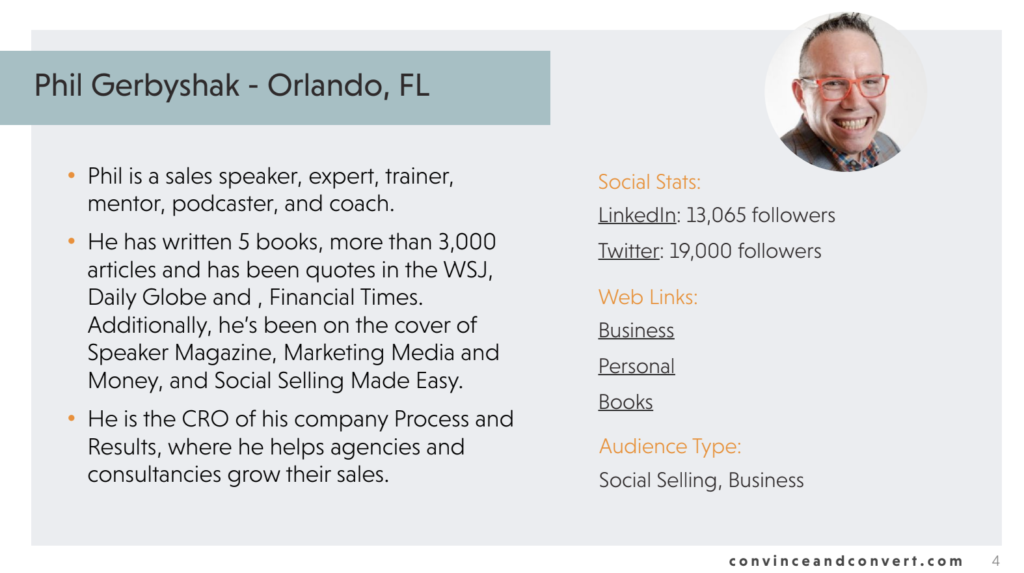
This takes the work the software provides for surfacing potential KOLs and overlays actual manual review and research from one of our team members.
(We visit each KOLs page, watch multiple pieces of content on all channels, review other brands they may work with, assess quality and style of content produced and confirm audience reach numbers from the software).
We like to research 2-3x the number of final KOLs our client is targeting so that we have provided a solid look at the opportunities and competition (or not) in a category. From the set of dossiers, we narrow in on our top individuals to pursue.
Selecting B2B KOLs:
Now comes the educated guesstimate part of this work.
Each of the KOLs will have different levels of compensation, preferred channels to activate and affiliation with our client.
Before we pick up the email or phone to approach a KOL we hyper study the following parts of our dossier:
From there we work on a payment range we believe to be equitable based on the work request and experience.
KOL Payment: The Wild West
Some of you may know I worked with Jay in the early 2000s at an ad agency in Phoenix. In those early days, I would place the online media for our clients. One such campaign was for a client who created and sold koozies.
Their koozies had suction cups on them so that the gel coat on your boat wouldn’t get ruined as you enjoyed an ice-cold beverage while cruising around the lake.
As media kits and banner ads overall were few and far between, we would literally search the web for sites we thought would be a good fit and call (on a desk phone!) the owner or main contact of the site.
(see: title of Webmaster) We’d start with an offer of a hundred dollars and see how it landed to know if we completely offended them or had just made a great deal, working our way down the list of potential banner placements.
And even in 2021, B2B KOL negotiations feel a lot similar but certainly more than a few hundred dollars.
We took this question to our friends at Onalytica, the biggest B2B influencer database. With a platform like theirs, it is easier to negotiate and process payment for a KOL, but it still requires conversation and a fair bit of guesstimation.
Each individual person and set of content pieces come with their own negotiations. Valuing the relationship and offering a fair and equitable rate will go much farther in B2B KOL partnerships than budget savings.
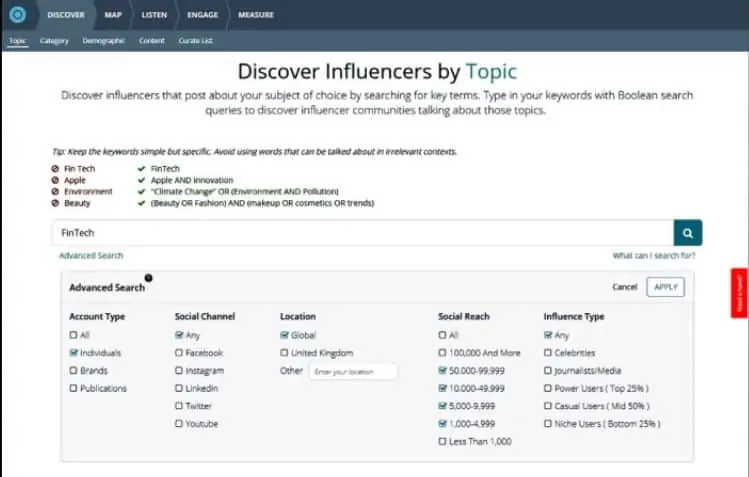
Onalytica platform
The Good News For Finding B2B KOLs
Lucky for all of us, rate cards and reports in the area are increasing, giving at least a clue or a starting point to custom negotiations with KOL’s of interest.
Even for Convince & Convert, we’ve worked on a general rate card in the form of our media kit for the types of content we regularly create for clients.

It takes into consideration the expertise our collective team brings to any KOL engagement.
As we work on behalf of clients to strategize and plan their KOL engagements, we use our rate card as the barometer for gauging the starting offers and rate negotiations with the KOLs selected.
A recent report by Intellifluence included more than 1200 influencers asking them about compensation expectations for mainstream pieces of content. And while the influencers included were likely working with more B2C than B2B brands, we found these areas to universally apply:
- Cash is preferred. “Nearly 70% of those surveyed said they liked to get paid in cash and in the product.” For B2B marketers – particularly MarTech brands, think about how you can sweeten your offer or enhance the relationship with a KOL by offering a license, upgrade or similar in addition to direct payment.
- Particularly for C&C clients, video is a common content type in our KOL programs. In the Intellifluence survey, influencers wanted brands to realize how much pre-work goes into creating a quality video.
For B2B marketers, when you are working with KOLs acknowledge that the hard work is in the prep and polish of a video. While the output may be only a few minutes of finished content, a worthwhile KOL will spend time to plan, script, and use quality equipment to shoot the video.
One area we tend to do for our clients is we do the post-production work – asking a KOL to send us clean video and we add any captions, logos and bumpers to the final cut. This works well because most of our KOL interactions are part of multi-episode shows.
Frequently Asked Questions:
QA: 1
What type of content (webinar, blog post, social post, etc) would be a fit not only for our client campaign but also fits with the KOLs style and audience set?
We have repeatedly found that when we approach a partner KOL with a specific ask or deliverable they are increasingly able to agree or negotiate the contract more quickly.
Giving them something thoughtful to react to goes a long way in the negotiation process.
QA: 2
How large does this KOLs audience reach? (followers, average engagement, etc) How key is their audience to establishing our objectives?
An exercise in quantity vs. quality if you will: Depending on the goal for the campaign, one or the other could sway the amount of negotiation you are willing to engage in.
Although leaning toward B2C, this recent Intellifluence survey has some starting points on price per post expectations and by channel direct from influencers which is a must-read.
QA: 3
Which other brands does this KOL work with or represent? How do those brands affect or overlap our client’s brand?
Usually, we work with 6-10 KOL’s at a time and are creating an episodic type show for our client. Explaining the overall campaign and creative direction the KOL is part of also provides context and company, increasing the knowledge of the outcome for the KOL helps to gain trust, especially for new relationships.
Working with B2B KOLs is a Work in Progress
Someday we’ll have the “ultimate pricing guide to B2B KOL engagements” but until that is created, we’d break it down to building a relationship with your KOLs is key and fair compensation and clear deliverables go a long way in a long term partnership.
The post Find the Right B2B Influencer or KOL for Your Brand appeared first on Content Marketing Consulting and Social Media Strategy.
Source: convinceandconvert.com

Get The Most From Your Day: Time Management Tips
Are you overwhelmed most of the time?
Does your day seem too short?
Do you think about how others get things done?
If this is the case, you have found just the right article to help you with time management.
The following concepts can help.

Set up your work a day ahead of time.
If you can, plan out the day’s tasks the day before.
Getting a list together to do what you have to do the next day is a smart way to end the day.
With your activities planned, you’ll feel that it is easy to dive right into your tasks.
Take Advantage of Calendar
If you are looking to manage time effectively, take full advantage of a calendar.
Some people prefer physical paper calendars they can mark up.
Other people enjoy using an electronic calendar that they can use with a computer or their phones.
It really doesn’t matter which type of calendar you choose, since either can be used to organize your tasks and promote better time management.

Pay Attention to Deadlines
If you seem to always be a step or two behind, pay more attention to deadlines.
You can get behind on things if you find out a deadline is coming up.
If you try to stay on track, you’re going to find that you don’t have to let one task go so you can hurry to finish something else.
Allocate your time as wisely as possible.
Consider the length of each task and allow yourself a certain amount of time to complete it.
You can really improve your stress management through better use of your time.
When you have a few minutes to spare, do a task or simply take a break.
Review Your Schedule
Start every day by reviewing your schedule and making any adjustments that need to be made to it.
If you start the day knowing what you expect or need to get done, you have a better chance of reaching your goals.
Be sure to examine each day carefully to be sure you don’t have too much on your plate.

Focus on Productivity
Look at your current levels of productivity to see which areas could use improvement through time management skills.
If you find it difficult to concentrate on your tasks until they are done, ask yourself why.
Identify your weaknesses and improve them immediately.
Plan your day in advance.
Pre-planning can reduce your stress and help you feel more organized.
When doing this, your mind is more relaxed and you can easily deal with time pressure the following day.
Learn to say no.
Many people suffer from too much stress because they simply do not know when to say no to a request.
If you don’t have a lot of time to do something, check your schedule.
Is it possible to share your responsibilities?
If you see any, don’t be afraid to ask family and friends for a little help.

List the Tasks
Plan the tasks you want to accomplish each day.
Use pen and paper to create a list of things to do for the day and the amount of time to allocate for each task.
A daily schedule allows you to use your time wisely.
Schedule Management
Consider your schedule.
Is there anything that can be removed?
Are you handling some jobs that other people (co-workers, friends, or relatives) could do better?
It is important to learn how to delegate.
After you hand off the responsibility for something to another individual, truly wash your hands of the task and move on to something else.
Stay focused on what you are doing until it’s done.
Don’t become distracted when things happen while you are working on a task.
Sometimes others interfere with your workflow by giving you things to do while you are engaged in another task.
Nip that in the bud.
Complete one task before doing the next one.

Set Realistic Goals
Remember, you really cannot get everything done.
It is almost impossible to accomplish this.
You spend far more time thinking about plans than actually executing them.
Do what you can, but set realistic expectations.
Prioritize the Tasks
To help get tasks completed in a more timely manner, create a priority list with the tasks of the highest priority at the top.
When you finish each task, check it off the list.
If you are unable to remember everything, take a copy with you.
Sign up for a time management class offered locally.
These classes will teach you all about time management.
Often companies will offer classes to help workers better manage their job tasks.
If you aren’t offered these classes at your work location, look online for cyber classes or check out your local library.

List each task by its value to you.
This will help you organize your day.
Make sure that you list them by order of importance.
List those first on the schedule.
Then you’ll be able to work on down to the things that aren’t as important.
Do you find yourself losing your grip on time?
If so, begin organizing your space.
If you are spending too much time each day looking for things, it can result in many wasted hours every week!
Organize your daily essentials into a designated space.
This organized work area will save you both time and aggravation.
Use Promodoro Method
The Pomodoro method might be something worth considering.
This method dictates that you work for 25-minute intervals followed by five-minute breaks.
This helps you to reduce stress.
Additionally, you will be able to work at optimum efficiency, accomplish more and have more time for yourself.

Finally,
Time management can help you breathe easily again.
The suggestions you just read will help you to gain control of your time and free you to focus your attention on the really important things in your life.
Practice time management properly, and your life will become better.

2 Things You Need to Know: How to Hack Motivation With Avoidance and Approach Goals
Motivation is a sneaky beast. It can hide in plain sight, and it can express itself when we least expect it. Motivation (and its frequent companion inspiration) can often elude us for days, weeks, or years, only to jump out in an instant with such force that we drop everything in order to capture it before we lose the moment.
Oftentimes, these random “attacks of motivation” happen with little warning, when we are least prepared to take advantage of them. For instance, how many of you have had a moment of clarity or have felt motivated to act on some idea while in the shower?
How many of you have perhaps had a similar feeling when going for a run or driving to work? Motivation can come at any time and in any way. Unfortunately, the very randomness keeps us from being able to act effectively to get more done. So what do we do to take hold of our lives and guide our own sources of motivation?
To get more done in less time, we need to understand the power of two types of motivation. Once we explore each of these types of motivation, we must learn to set goals around both to create positive feedback loops. This will make it easier for us to develop stronger motivational habits and take control of what motivates us.
Types of Motivations
While there are many ways to define motivation, today I will focus on two types: avoidance and approach motivation. The way we will define both types of motivation provides an in-depth look into how we see the world, and ultimately how successful we will be in it.
1. What is avoidance motivation?
Avoidance motivation is part of what makes us human, and it is integral to our survival. This type of motivation helps us avoid negative experiences across psychological, physical, and social boundaries. It’s what told us to run away from saber-toothed tigers or to not dive into shark-infested waters looking for food.

Clearly, avoidance is a good way of staying safe in a world of unknowns. Unsure about what your boss thinks about your last project? It’s best not to ask to avoid disappointment or emotional trauma. Considering whether to apply for a job in another country? Best to avoid it in case you like the culture.
Unfortunately, avoidance motivation often has negative consequences. It makes us more likely to avoid tasks that we know rationally will be positive experiences for us. It makes us avoid going for that big promotion we aren’t necessarily qualified for. It makes us not get on that airplane to travel to that new country and experience that new culture.
“Press forward. Do not stop, do not linger in your journey, but strive for the mark set before you.” — George Whitefield
2. What is approach motivation?
Approach motivation is any type of motivation that drives action and forward progress towards a certain outcome or activity. It’s what pushes the nerdy high school kid to talk to their crush in the hallway. It’s what drives the explorer to see what the view looks like from the top of the tallest mountain.
It’s the itch the traveler gets when they go too long without taking a trip. It’s what inspired humans to explore outer space. Rather than avoiding certain activities, approach motivation drives individuals to explore and become more productive in their day-to-day existence.

When we consider approach motivation, the most often cited examples relate to feelings of opportunity, fulfillment, and exploration. When you see an opportunity to achieve some goal that falls along Maslow’s Hierarchy of Needs, you are more likely to take action.
When you see the opportunity to grow your pool of resources, that may motivate you to take action (strengthening your ability to provide food and shelter to yourself and your family). Similarly, you may see the opportunity to gain recognition or acclaim through appearing on television or writing a blog post.
This feeds your ability to achieve self-fulfillment, belonging and perhaps even self-actualization.
“Don’t watch the clock; do what it does. Keep going.” — Sam Levenson
So how do we take this information and action? How do we make it useful on a day-to-day basis?
The best way to leverage the lessons of approach and avoidance motivation is to set goals that align with each type of motivation.
Take the following approach to help guide you on the path to taking control of what motivates you:
First, understand the difference between avoidance and approach goals. Most people will find that they tend to avoid activities that are unpleasant to them, all the while approaching those activities that are most enjoyable or fulfilling.
Let’s think of approach goals as positive (i.e. finishing a project ahead of schedule, finding a new job) and avoidance goals as negative (i.e. avoiding drinking too much, avoiding talking in public).
Avoidance goals are goals for reducing, avoiding or eliminating undesired outcomes. While these goals are powerful, they are often harder to accomplish. You may want to cut down the number of sweets you eat each day, the number of cigarettes you smoke, the total time you spend watching Netflix.
These types of goals work, sometimes, but they are much more likely to stick if you spin them to an approach goal with a positive spin.
Approach goals aim to guide someone to reach or maintain the desired outcome. People are more likely to commit to completing tasks and taking part in activities that are positioned in a positive light. Approach goals become more potent motivational goals because they focus on action and activity around what can be done to reach a goal.
If you want to get better at setting and following through on your personal and career goals, make a point of creating both approaches and avoiding goals and be aware of the subtle differences between both.
Do you have any approach or avoidance goals that have been particularly challenging to reach? Would love to hear about them!
Source: addicted2success.com