
Tag Archives for " webinars "

How to Increase Webinar Registrants
In many cases, we’ve seen how a well-produced and delivered webinar can move prospects off the fence to become new customers as well as help measure their intent to purchase as a result of attending the webinar. In this post, we’re going to share my most important lessons learned for increasing webinar registrants and attendees.

Even as we head close to post-pandemic times, webinars continue to be an invaluable content marketing tool for companies to attract and engage with prospects as well as retain existing customers to become your advocates.
They allow you to tell a story beyond sound bites with real business outcomes.
Over the last 12 years, we have produced, delivered, and moderated hundreds of webinars across a wide canvas of B2B industries.
In many cases, we’ve seen how a well-produced and delivered webinar can move prospects off the fence to become new customers as well as help measure their intent to purchase as a result of attending the webinar.
In this post, we’re going to share my most important lessons learned for increasing webinar registrants and attendees.
Before You Begin

First, in order to effectively attract your webinar audience, you must understand that most registrants and attendees are not “sales-ready” at this point.
Instead, they are on a journey to become better informed and better educated.
They don’t want to feel like they are attending a sales pitch, or that you are asking them to attend one.
They want to know how you can solve their problems.
To attract an audience, it is your challenge to:
- Identify their challenges and pain points.
- Determine how you can help them solve their challenge.
- Effectively communicate this before and during the webinar—in your email invitations, on your registration landing page, and through your speakers and slides.
In this way, attendees can eventually become your customers and future advocates.
How to Increase Webinar Registrants
Now let’s get into more specifics on how you can plan and ensure you attract your desired audience
1. Choose a Relevant Topic
Is your topic a “must-have” that will educate the audience on how to overcome a pain point or demonstrate how they will achieve better outcomes?

People won’t register if it’s not specific or if it doesn’t provide content that will help them overcome a vexing challenge.
Remember, people buy when they are in pain and have money to solve it.
A great example of a relevant topic comes from a recent case study webinar covering a large automobile dealership.
The dealership, using an innovative software solution, increased new vehicle gross profits and sales by discussing their challenges, options to solving these challenges, methodology used, business outcomes, lessons learned, and how to get started.
The webinar, titled Conquest Case Study:
How Performance Toyota Increased new Vehicle Gross Profits and Sales, addressed a real pain point for automobile dealers; it attracted about 600 influencers and decision-makers!

This resulted in over 180 leads, of which 30 were closed, resulting in over $400,000 in annual incremental revenue.
An example of some other must-have topics that have proven to be very successful in attracting an audience is described below.
(By the way, two of these led to a million-dollar sale—can you guess which ones they are?)
- “Case Study: How Merck is Using Virtual Team Building to Increase Performance”
- “How Active Rehab Protocols Reduce Post-Operative Recovery Time”
- “Smarter Streets: Case Studies for Cities and Utilities – Learn How the City of Baltimore and Washington Gas Reduced Costs”
- “Separating the Contenders from the Pretenders in the World of Oil Water Separation”
- “Culture Shock: Shake-Up Your Company, Your Store, Your People, and Sales Increases Will Follow”
2. Use Industry Disruption to Your Advantage
Industries in turmoil, or ones dealing with confusion and change, are ripe for attending a webinar to learn how to overcome these challenges.

Webinars that address these issues do very well in attracting their audiences. All of the examples above, in one way or another, were dealing with disruption from industry changes of markets, standards, or legal compliance shifts.
For example, we continue to see a very strong audience acquisition outcome in sectors dealing with disruption, such as Aerospace, Automotive, Healthcare, and Life Sciences.
These industries continually attract between 250 and 950 registrants, with attendance ratios above 50%, that retain over 80% of the peak audience well into the start of the live Q/A panel.
3. Develop an Audience Profile That Aligns With Your Topic and Value Proposition
Start with asking yourself, “If I received an invitation to my webinar, is the value proposition clear enough that I’d want to attend?”

Create a list of priorities of which industries, markets, or types of buyers would most benefit from this topic that also aligns with your desired business outcomes.
For example, beyond identifying these five key demographics (industries, job titles, job levels, revenue thresholds, and geographies), keep refining which job titles and functions your webinar would appeal to the most.
We did a webinar for a company that specializes in providing light-curable materials (LCMs) and wanted to educate the audience on the business benefits of using these LCMs to reduce costs, improve safety, and increase energy savings.
By refining the demographics, we not only identified 10 top industries, but we were also able to determine the job titles most ripe to learn about why LCMs provide advantages over traditional methods.
It would have been easy to simply target titles with manufacturing or engineering in them, but we would have not aligned the topic and value proposition to the right persona.
4. Consider External Thought Leaders as Speakers
The credibility of a webinar significantly increases when at least one of the speakers is not affiliated with the company sponsoring the webinar.

A thought leader or third-party expert is critical in attracting an audience.
During the webinar, they can call upon real-life examples to educate the audience, as well as share trends and opportunities to overcome key challenges.
Done right, real thought leaders will inspire attendees who are interested in learning more to contact the webinar sponsor after the webinar.
We did a webinar for a very well-known brand that chose their sales vice president as one of the presenters along with an internal engineer, and it fell flat.
While they were knowledgeable, lacking a credible third-party speaker made the event sound like a corporate sales pitch.
When an industry analyst, editor, or thought leader unaffiliated with the webinar sponsor is involved, it will appear less like a sales pitch and motivate people to register and attend.
5. Gather and Mine Actionable Life Cycle Intelligence
Any project, initiative, or event has three critical success factors that must be managed and monitored throughout its life cycle to meet or exceed your commercial outcomes:
- A proven, deadline-driven methodology.
- A set of ever-evolving best practices.
- Appropriate metrics or KPIs (key performance indicators) to benchmark and predict outcomes before, during, and after the event.
What gets measured, gets done.
Key email and webinar performance metrics can tell you if you’re on track to meet your goals.
If you’re not, they’ll help you diagnose what mid-course changes need to be made long before you meet your virtual audience.

Knowing your email delivery rates provides insight into how well your lists are performing, revealing any differences between the number sent and the number delivered.
Open rates provide insight into the effectiveness of your topic and subject lines.
Unsubscribe rates tell you whether or not you are addressing the right audience demographics.
Your best early indicator of webinar success is comparing how many people are registering to those that actually click on the registration page (your click-through rate).
It will predict with uncanny accuracy what type of registration and attendance you can expect.
A CTR above 25% is a strong indicator your message is resonating.

A low-performing CTR, in the teens, might indicate problems with your landing page appeal, as well as your overall messaging and value proposition.
Other life cycle intelligence to collect includes demographic information—which industries, job titles/functions, and geographies are registering—as well as what sources, such as email marketing or social media, are driving registrations.
Perhaps the most important intelligence you can gather is simply asking people when they register, “What do you want to learn from this webinar?”
It’s better to learn this before they show up on webinar day, as it helps validate the messaging and deliverables you promised to cover in the invitation.
More importantly, you can share this information with your speakers to make sure they align their presentation with the interests of the audience.
(And these are only the webinar performance metrics to look at before the webinar! There are many other metrics that are used during and after the webinar that I plan to cover in my next post.)
While these lessons only scratch the surface, following them will ensure you meet and exceed your commercial goals while adding value to your audience.
Good content marketing is about making your attendees more intelligent, so they can make more informed decisions and choose you as their vendor or partner.
Conclusion:
Finally, there are two important confessions to remember:
The first is that your attendees are on a journey—resist the temptation to sell during the webinar.
The time to sell is after the webinar is over, as you can use all of the life cycle intelligence and metrics collected before, during, and after the webinar to determine who is sales-ready, who needs more is nurturing, and who is not a fit.
The second confession is that producing a webinar has a lot of moving parts, and setting the stage for a smooth webinar production is critical for success.
As many webinars as we’ve produced, we know that while planning and managing a webinar is time-consuming, taking shortcuts is not an option. If you fail to plan, you plan to fail.
Here’s to your webinar success!
The post How to Increase Webinar Registrants appeared first on Content Marketing Consulting and Social Media Strategy.
Source: convinceandconvert.com

How to Create a Successful Influencer Marketing Campaign Using Webinars
Webinars are an invaluable content marketing product designed to bring in high-quality leads for your sales team.
For most Convince & Convert readers, it is almost common knowledge that webinars are an invaluable content marketing product designed to bring in high-quality leads for your sales team.
However, there’s a certain mystique surrounding webinars:
- Should they be high-end in terms of production value to convey equivalence in professionalism to the product itself?
- Should they be low-fi recordings with off-the-cuff experts to provide a behind-the-scenes look on how to truly win with the product?
- Should they be pre-recorded and scripted?
- Should they be a question-and-answer free-for-all?
How should a company go about creating an effective webinar?

Like all mediums, webinars are complex, and the right answer depends heavily on the product and team using them.
For initial setup, the following guide on how to create a webinar is instructive in determining a rough format.
Once the rough format is decided on, a company can decide on how to ensure the webinar is effective by touching on the relevant psychological triggers necessary to induce the end purchase.
However, there are some gaps in the overall setup process, which this article hopes to augment.
Namely, a company needs to be cognizant of who is being targeted and how best to influence those people.
Then, how to make sure they are aware of the campaign in the first place.
Stay on target

When it comes to psychological triggers of purchase, you first need to have a much deeper understanding of who exactly you’re trying to influence.
Take into account the various cultural, social, personal, and psychological factors that might come into the purchasing decision, but also the decision to click the initial registration button and to show up.
Without delving too deep into this piece of the puzzle, consider where your target audience is located.
- Are they going to be available to join your webinar when it’s scheduled? If the product being sold is designed for their job, normal work hours make sense. If it is a side hustle, consider kicking it off after 5 pm or so.
- Are there language considerations? If the target audience is of a radically different socioeconomic status, consider the platform and minimum technical requirements for the webinar to make it as frictionless as possible.
- What’s the age range of the audience? Is the product geared towards an older audience? Younger? Hip, casual, conservative, professional?
- Why is the audience joining you? Is it to learn? Is it out of motivation to succeed, or even fear?
Once the various sociological and psychological profiling is complete to the point of having a more solid grasp of exactly who the target market is, a company can devote resources to find the ideal influencers to make it a success.
Enter influencers
To dispel the obvious myths, influencers are not just about Kim K and her sisters hawking the latest facial cream on Instagram.
While that is still an absurdly successful use case, every marketing medium and product combination can benefit from the right influencers.
It’s just a matter of choosing the right influencer type for the campaign.
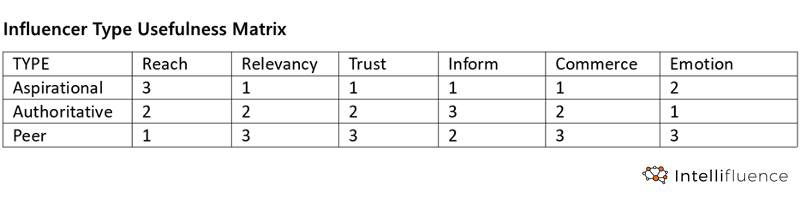
The influencer type usefulness matrix from Intellifluence
Influencers can generally be bucketed into three main categories:
- Aspirational. For ease of definition, aspirational can be thought of as the Kim K celebrity example above.
- Authoritative. These influencers are key for webinars. Authoritative influencers are the trusted subject matter experts, even in a narrowly defined field.
- Peer. Peer influencers would be akin to your colleagues and industry peers, from the B2B perspective.
Why do we care so much about authoritative influencers for your webinar campaign?
Using the usefulness matrix above, we can determine what influence type is best suited for the sociological and psychological profiling work performed earlier on the target audience.
Reach matters.
Of course, but given the educational nature of webinars, the ability to inform in a trusted and relevant manner that is geared towards commerce is the winning combination.
Peer influencers also rate quite highly, which we can layer on in a later step.
For example, Jay Baer hosts webinars for Convince & Convert’s client, SharpSpring.
Jay is an authoritative influencer in marketing and marketing technology, and also helps drive registrations for virtual events through email, social, and word-of-mouth marketing.


Jay is an authoritative influencer who hosts and presents webinars for clients.
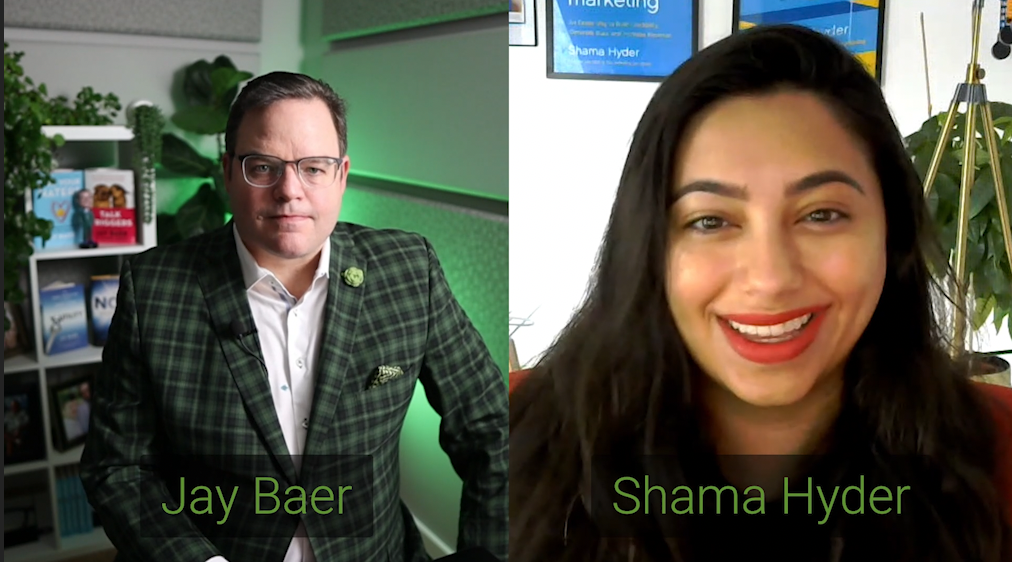
Jay also brings together additional authoritative influencers like Shama Hyder.
How to use authoritative influencers on your webinar
Pay them!

The article could have been as short as that previous sentence and still would not have been a waste of a company’s time.
If a company can pay a renowned expert in its field to host a webinar on how they have had success using YOUR product, you’ll make sales.
If you can’t get authorities, you can incentivize some walkthroughs from existing customers to prospective customers, aggregating the peer signal.
Host, co-host, or syndicate?
In the short example above, the recommendation is to pay the expert to host a webinar for his audience and followers regarding how to use your product as the expert sees fit, co-hosted with you for co-citation proximity (this is the leeching authority trick).
As a follow-up step, syndicate the webinar out to your prospective audience via email with the ability to participate in a follow-up company-hosted webinar series where your sales staff interact in more of a Q&A nature.
Since trust has already been established with tacit expert approval, the subsequent webinars can move deeper into the sales channel.
Bring on the wolf pack
In the penultimate stage of the process, the goal is to result in multiple prospective customer touches and funnel starts.
Use an on-going webinar series to keep people in the funnel

One simple way to do this is by recording an ongoing webinar series for those prospective customers, using your top product users as the weekly/monthly/quarterly experts.
This series is recorded and then syndicated through the following authoritative channels: YouTube and blogs.
As these peer-level users are already in love with your product, you can comp their usage of it as compensation in many cases.
Famed influence professor Cialdini would refer to this as unity: the desire to remain in the wolf pack.
Encourage peer influencers to promote your webinar
This can be as simple as pushing for peer influencers to share the webinar signup details over Twitter and Facebook, utilizing a series of relevant hashtags and a brief personal story of why they’ll be attending the webinar.
Make this easy for them by providing a standard promotional copy in a Google Doc.
Drive registrations with email
Another overlooked influencer syndication method is e-mail. Convince & Convert is great at email marketing with Jay’s personal updates that seamlessly interweave a narrative with a branded goal.
When a relevant email influencer is used to connect their audience with your upcoming webinar, wonderful things can happen, which is why companies like Intellifluence are willing to throw money at such influencers.
They can drive amazing signups!
Get some press
Finally, to tie the entire webinar campaign neatly with an influencer bow, consider running a targeted press relations campaign to extend your perceived authority on the subject and garner some additional eyeballs to your work.
The goal of this step is not to submit a generic PR Newswire report and hope for the best.
For the best results, target the journalists that have actively written on your industry and/or on webinar marketing in the past.
You are now doing something amazing, which their audience could benefit from knowing about.
Become the expert

If you’re just starting out in your content marketing journey and this entire process seems daunting, don’t despair.
You can become that authority yourself by taking the initial step and writing on the B2B subject matters you know about.
In due time, you’ll be the expert being paid to share your thoughts on a webinar.
The post How to Create a Successful Influencer Marketing Campaign Using Webinars appeared first on Content Marketing Consulting and Social Media Strategy.
Source: convinceandconvert.com