Tag Archives for " voices in ai "

Voices in AI - Naveen Rao

Voices in AI – Episode 79: A Conversation with Naveen Rao

About this Episode

Episode 79 of Voices in AI features host Byron Reese and Naveen Rao discussing intelligence, the mind, consciousness, AI, and what the day-to-day looks like at Intel.

Byron and Naveen also delve into the implications of an AI future.

Visit www.VoicesinAI.com to listen to this one-hour podcast or read the full transcript.

Transcript Excerpt

Q-Byron Reese:

This is Voices in AI brought to you by GigaOm, and I’m Byron Reese.

Today I’m excited that our guest is Naveen Rao.

He is the Corporate VP and General Manager of the Artificial Intelligence Products Group at Intel.

He holds a Bachelor of Science in Electrical Engineering from Duke and a Ph.D. in Neuroscience from Brown University.

Welcome to the show, Naveen.

A-Naveen Rao:

Thank you. Glad to be here.

Q-1:

You’re going to give me a great answer to my standard opening question, which is: What is intelligence?

A-1:

That is a great question. It really doesn’t have an agreed-upon answer.

My version of this is about potential and capability.

What I see as an intelligent system is a system that is capable of decomposing structure within data.

By my definition, I would call a newborn human baby intelligent, because the potential is there, but the system is not yet trained with real experience.

I think that’s different than other definitions, where we talk about the phenomenology of intelligence, where you can categorize things, and all of this.

I think that’s where the outcropping of having actually learned the inherent structure of the world is.

AI Tech

Q-2:

So, in what sense by that definition is artificial intelligence actually artificial?

Is it artificial because we built it, or is it artificial because it’s not real intelligence?

It’s like artificial turf; it just looks like intelligence.

A-2:

No. I think it’s artificial because we built it. That’s all.

There’s nothing artificial about it.

The term intelligence doesn’t have to be on biological mush, it can be implemented on any kind of substrate.

In fact, there’s even research on how slime mold, actually…

Artificial Intelligence

Q-3:

Right. It can work mazes…

A-3:

… can solve computational problems, Yeah.


Q-4:

How does it do that, by the way? That’s really a pretty staggering thing.

A-4:

There’s a concept that we call gradients. Gradients are just how information gets more crystalized.

If I feel like I’m going to learn something by going in one direction, that direction is the gradient.

It’s sort of a pointer in the way I should go.

That can exist in the chemical world as well, and things like slime mold actually use chemical gradients that translate into information processing and actually learn the dynamics of a system.

Our neurons do that. Deep neural networks do that in a computer system.

They’re all based on something similar at one level.

AI System in Robot

Q-5:

So, let’s talk about the nematode worm for a minute.

A-5:

Okay.


Q-6:

You’ve got this worm, the most successful creature on the planet.

Seventy percent of all animals are nematode worms.

He’s got 302 neurons and exhibits certain kinds of complex behavior.

There have been a bunch of people in the OpenWorm Project, who spent 20 years trying to model those 302 neurons in a computer, just to get it to duplicate what the nematode does.

Even among them, they say: “We’re not even sure if this is possible.”

So, why are we having such a hard time with such a simple thing as a nematode worm?

Neural System

A-6:

Well, I think this is a bit of a fallacy of reductive thinking here, that, “Hey, if I can understand the 302 neurons, then I can understand the 86 billion neurons in the human brain.”

I think that fallacy falls apart because there are different emergent properties that happen when we go from one size system to another.

It’s like running a company of 50 people is not the same as running a company of 50,000. It’s very different.


Q-7:

But, to jump in there… my question wasn’t, “Why doesn’t the nematode worm tell us something about human intelligence?”

My question was simply, “Why don’t we understand how a nematode worm works?”


A-7:

Right. I was going to get to that. I think there are a few reasons for that.

One is, the interaction of any complex system – hundreds of elements – is extremely complicated.

There’s a concept in physics called the three-body problem, where if I have two pool balls on a pool table, I can actually 100 percent predict where the balls will end up if I know the initial state and I know how much energy I’m injecting when I hit one of the balls in one direction with a certain force.

If you make that three, I cannot do that in a closed-form system.

I have to simulate steps along the way.

That is called a three-body problem, and it’s computationally intractable to compute that.

So, you can imagine when it gets to 302, it gets even more difficult.

And what we see in big systems like in mammalian brains, where we have billions of neurons, and 300 neurons, is that you actually have pockets of closely interacting pieces in a big brain that interact at a higher level.

That’s what I was getting at when I talked about these emergent properties.

So, you still have that 302-body problem, if you will, in a big brain as you do in a small brain.

That complexity hasn’t gone away, even though it seemingly is a much simpler system.

The interaction between 302 different things, even when you know precisely how each one of them is connected, is just a very complex matter.

If you try to model all the interactions and you’re off by just a little bit on any one of those things, the entire system may not work.

That’s why we don’t understand it, because you can’t characterize every piece of this, like every synapse… you can’t mathematically characterize it.

And if you don’t get it perfect, you won’t get a system that functions properly.

Human Brain & Neuron Model

Q-8:

So, do you say that suggesting by extension that the Human Brain Project in Europe, which really is… You’re laughing and nodding.

What’s your take on that?

A-8:

I am not a fan of the Human Brain Project for this exact reason.

The complexity of the system is just incredibly high, and if you’re off by one tiny parameter, by a tiny little amount, it’s sort of like the butterfly effect.

It can have huge consequences on the operation of the system, and you really haven’t learned anything.

All you’ve learned how to do is model some micro dynamics of a system.

You haven’t really gotten any true understanding of how the system really works.

Data Warehouse

Q-9:

You know, I had a guest on the show, Nova Spivack, who said that a single neuron may turn out to be as complicated as a supercomputer, and it may even operate down at the Planck level.

It’s an incredibly complex thing.

A-9:

Yeah.


Q-10:

Is that possible?

A-10:

It is a physical system – a physical device.

One could argue the same thing about a single transistor as well.

We engineer these things to act within certain bounds… and I believe the brain actually takes advantage of that as well.

So, a neuron… to completely, accurately describe everything a neuron is doing, you’re absolutely right.

It could take a supercomputer to do so, but we don’t necessarily need to abstract a supercomputer’s worth of value from each neuron.

I think that’s a fallacy.

There are lots of nonlinear effects and all this kind of crazy stuff that are happening that really aren’t useful to the overall function of the brain.

Just like an individual neuron can do very complicated things, when we put a whole bunch of [transistors] together to build a processor, we’re exploiting one piece of the way that transistor behaves to make that processor work.

We’re not exploiting everything in the realm of possibility that the transistor can do.

Q-11:

We’re going to get to artificial intelligence in a minute.

It’s always great to have a neuroscientist on the show.

So, we have these brains, and you said they exhibit emergent properties.

Emergence is of course the phenomenon where the whole of something takes on characteristics that none of the components have. And it’s often thought of in two variants.

One is weak emergence, where once you see the emergent behavior, with enough study you can kind of reverse engineer… “Ah, I see why that happened.”

And one is a much more controversial idea of strong emergence that may not be discernible.

The emergent property may not be derivable from the component.

Do you think human intelligence is a weak emergent property, or do you believe in strong emergence?


AQ-11:

I do in some ways believe in strong emergence.

Let me give you the subtlety of that.

I don’t necessarily think it can be analytically solved because the system is so complex.

What I do believe is that you can characterize the system within certain bounds.

It’s much like how a human may solve a problem like playing chess.

We don’t actually pre-compute every possibility.

We don’t do that sort of a brute force kind of thing.

But we do come up with heuristics that are accurate most of the time.

And I think the same thing is true with the bounds of a very complex system like the brain.

We can come up with bounds of these emergent properties that are accurate 95 percent of the time, but we won’t be accurate 100 percent of the time.

It’s not going to be as beautiful as some of the physics we have that can describe the world.

In fact, even physics might fall into this category as well.

So, I guess the short answer to your question is: I do believe in strong emergence that will never actually 100 percent describe…

Prepare your mind

Q-12:

But, do you think fundamentally intelligence could, given an infinitely large computer, be understood in a reductionist format?

Or is there some break-in cause and effect along the way, where it would be literally impossible?

Are you saying it’s practically impossible or literally impossible?


AQ-12:

…To understand the whole system top to bottom, from the emerging…?


Q-13:

Well, to start with, this is a neuron.

AQ-13:

Yeah.


Q-14:

And it does this, and you put 86 billion together and voilà, you have Naveen Rao.

AQ-14:

I think it’s literally impossible.


Q-15:

Okay, I’ll go with that. That’s interesting. Why is it literally impossible?

AQ-15:

Because the complexity is just too high, and the amount of energy and effort required to get to that level of understanding is many orders of magnitude more complicated than what you’re trying to understand.


Q-16:

So now, let’s talk about the mind for a minute.

We talked about the brain, which is physics. To use a definition that most people I think wouldn’t have trouble with, I’m going to call the mind all the capabilities of the brain that seem a little beyond what three pounds of goo should be able to do… like creativity and a sense of humor.

Your liver presumably doesn’t have a sense of humor, but your brain does.

So where do you think the mind comes from?

Or are you going to just say it’s an emergent property?

AQ-16:

I do kind of say it’s an emergent property, but it’s not just an emergent property.

It’s an emergent property that is actually the coordination of the physics of our brain – the way the brain itself works – and the environment.

I don’t believe that a mind exists without the world.

You know, a newborn baby, I called intelligent because it has the potential to decompose the world and find meaningful structure within it in which it can act.

But if it doesn’t actually do that, it doesn’t have a mind. You can see that… if you had kids yourself.

I actually had a newborn while I was studying neuroscience, and it was actually quite interesting to see.

I don’t think a newborn baby is really quite sentient yet.

That sort of emerges over time as the system interacts with the real world.

So, I think the mind is an emergent property of the brain plus environments interacting.


Listen to this one-hour episode or read the full transcript at www.VoicesinAI.com


Byron explores issues around artificial intelligence and conscious computers in his new book The Fourth Age: Smart Robots, Conscious Computers, and the Future of Humanity.

Source: gigaom.com

Voices in AI – Episode 69: A Conversation with Raj Minhas

About this Episode

Episode 69 of Voices in AI features host Byron Reese and Dr. Raj Minhas talk about AI, AGI, and machine learning.

They also delve into explainability and other quandaries AI is presenting. Raj Minhas has a Ph.D. and MS in Electrical and Computer Engineering from the University of Toronto, with his BE from Delhi University.

Raj is also the Vice President and Director of the Interactive and Analytics Laboratory at PARC.

Visit www.VoicesinAI.com to listen to this one-hour podcast or read the full transcript.

Transcript Excerpt

Byron Reese: This is Voices in AI, brought to you by GigaOm, I’m Byron Reese. Today I’m excited that our guest is Raj Minhas, who is Vice President and the Director of Interactive and Analytics Laboratory at PARC, which we used to call Xerox PARC. Raj earned his Ph.D. and MS in Electrical and Computer Engineering from the University of Toronto, and his BE from Delhi University. He has eight patents and six patent-pending applications. Welcome to the show, Raj!

Raj Minhas: Thank you for having me.

I like to start off, just asking a really simple question, or what seems like a very simple question: what is artificial intelligence?

Okay, I’ll try to give you two answers.

One is a flip response, which is if you tell me what is intelligence, I’ll tell you what is artificial intelligence, but that’s not very useful, so I’ll try to give you my functional definition.

I think of artificial intelligence as the ability to automate cognitive tasks that we humans do, so that includes the ability to process information, make decisions based on that, learn from that information, at a high level.

That functional definition is useful enough for me.


Well, I’ll engage on each of those, if you’ll just permit me. I think even given a definition of intelligence that everyone agreed on, which doesn’t exist, artificial is still ambiguous. Do you think of it as artificial in the sense that artificial turf really isn’t grass, so it’s not really intelligence, it just looks like intelligence? Or, is it simply artificial because we made it, but it really is intelligent?

It’s the latter.

So if we can agree on what intelligence is, then artificial intelligence to me would be the classical definition of artificial intelligence, which is re-creating that outside the human body.

So re-creating that by ourselves, it may not be re-created in the way it is created in our minds, in the way humans or other animals do it, but, it’s re-created in that it achieves the same purpose, it’s able to reason in the same way, it’s able to perceive the world, it’s able to do problem-solving in that way.

So without getting necessarily bogged down by what is the mechanism by which we have intelligence, and does that mechanism need to be the same; artificial intelligence to me would be re-creating that – the ability of that.


Fair enough, so I’ll just ask you one more question along these lines. So, using your ability to automate cognitive tasks, let me give you four or five things, and you tell me if they’re AI. AlphaGo?

Yes.

And then a step down from that, a calculator?

Sure, a primitive form of AI.

A step down from that: an abacus?

Abacus, sure, but it involves humans in the operation of it, but maybe it’s on that boundary where it’s partially automated, but yes.

What about an assembly line?

Sure, so I think…

And then I would say my last one which is a cat food dish that refills itself when it’s empty? And if you say yes to that…

All of those things to me are intelligent, but some of those are very rudimentary, and not, so, for example, you look at animals.

On one end of the scale are humans, they can do a variety of tasks that other animals cannot, and on the other end of the spectrum, you may have very simple organisms, single-celled or mammals, they may do things that I would find intelligent, they may be simply responding to stimuli, and that intelligence may be very much encoded.

They may not have the ability to learn, so they may not have all aspects of intelligence, but I think this is where it gets really hard to say what is intelligence.

Which is my flip response.

If you say: what is intelligence?

I can say I’m trying to automate that by artificial intelligence, so, if you were to include in your definition of intelligence, which I do, that ability to do math implies intelligence, then by automating that with an abacus is a way of artificially doing that, right?

You have been doing it in your head using whatever mechanism is in there, you’re trying to do that artificially.

So it is a very hard question that seems so simple, but, at some point, in order to be logically consistent, you have to say yes, if that’s what I mean, that’s what I mean, even though the examples can get very trivial.


Well, I guess then, and this really is the last question along those lines: what, if everything falls under your definition, then what’s different now? What’s changed? I mean a word that means everything means nothing, right?

That is part of the problem, but I think what is becoming more and more different is, the kinds of things you’re able to do, right?

So we are able to reason now artificially in ways that we were not able to before.

Even if you take the narrower definition that people tend to use which is around machine learning, they’re able to use that to perceive the world in ways in which we were not able to before, and so, what is changing is that ability to do more and more of those things, without relying on a person necessarily at the point of doing them.

We still rely on people to build those systems to teach them how to do those things, but we are able to automate a lot of that.

Obviously artificial intelligence to me is more than machine learning where you show something a lot of data and it learns just for a function because it includes the ability to reason about things, to be able to say, “I want to create a system that does X, and how do I do it?”

So can you reason about models, and come to some way of putting them together and composing them to achieve that task?

Listen to this one-hour episode or read the full transcript at www.VoicesinAI.com

Source: Voices in AI – Episode 69: A Conversation with Raj Minhas – Gigaom

Data Management

Voices in AI – Episode 55: A Conversation with Rob High

About this Episode

Episode 55 of Voices in AI features host Byron Reese and Rob High talking about IBM Watson and the history and future of AI. Rob High is an IBM fellow, VP, and Chief Technical Officer at IBM Watson.

Visit www.VoicesinAI.com to listen to this one-hour podcast or read the full transcript.

Transcript Excerpt

Q: 1

Byron Reese: This is Voices in AI, brought to you by GigaOm. I’m Byron Reese. August 12th, 1981.

That was the day IBM released the IBM PC and who could have imagined what that would lead to? Who would’ve ever thought, from that vantage point, of our world today?

Who could’ve imagined that eventually you would have one on every desktop and then they would all be connected?

Who would have guessed that through those connections, trillions of dollars of wealth would be created?

All the companies, you know, that you see in the news every day from eBay to Amazon to Google to Baidu to Alibaba, all of them have, in one way or the other, as the seed of their genesis, that moment on August 12th, 1981.

Now the interesting thing about that date, August of ‘81, that’s kind of getting ready to begin the school year, the end of the summer.

And it so happens that our guest, Rob High graduated from UC Santa Cruz in 1981, so he graduated about the same time, just a few months before this PC device was released.

And he went and joined up with IBM. And for the last 36/37 years, he has been involved in that organization affecting what they’re doing, watching it all happen, and if you think about it, what a journey that must be.

If you ever pay your respects to Elvis Presley and see his tombstone, you’ll see it says, “He became a living legend in his own time.” Now, I’ll be the first to say that’s a little redundant, right?

He was either a living legend or a legend in his own time. That being said, if there’s anybody who can be said to be a living legend in his own time, it’s our guest today.

It’s Rob High. He is an IBM fellow, he is a VP at IBM, he is the Chief Technical Officer at IBM Watson and he is with us today. Welcome to the show, Rob!

Rob High: Yeah, thank you very much. I appreciate the references but somehow I think my kids would consider those accolades to be a little, probably, you know, not accurate.

AI-ML-Robotics Technologies

Q: 2

Well, but from a factual standpoint, you joined IBM in 1981 when the PC was brand new.

Yeah – I’ve really been honored with having the opportunity to work on some really interesting problems over the years.

And with that honor has come to the responsibility to bring value to those problems, to the solutions we have for those problems.

And for that, I’ve always been well-recognized. So I do appreciate you bringing that up. In fact, it really is more than just any one person in this world that makes changes meaningful.

Data Management Strategy

Q: 3

Well, so walk me back to that. Don’t worry, this isn’t going to be a stroll down memory lane, but I’m curious.

In 1981, IBM was of course immense, as immense as it is now and the PC had to be a kind of tiny part of that at that moment in time.

It was new. When did your personal trajectory intercept with that or did it ever?

Had you always been on the bigger system side of IBM?

No, actually. It was almost immediate.

Probably was, I don’t know the exact number, but probably I was pretty close to the first one hundred or two hundred people that ordered a PC when it got announced.

In fact, the first thing I did at IBM was to take the PC into work and show my colleagues what the potential was.

I was just doing simple, silly things at the time, but I wanted to make an impression that this really was going to change the way that we were thinking about our roles at work and what technology was going to do to help change our trajectory there.

So, no, I actually had the privilege of being there at the very beginning.

I won’t say that I had the foresight to recognize its utility but I certainly appreciated it and I think that to some extent, my own career followed the trajectory of change that has occurred similar to what PCs did to us back then.

In other areas as well: including web computing, and service orientation, now cloud computing, and of course cognitive computing.

Machine Learning and AI

And so, walk me through that, and then let’s jump into Watson. So, walk me through the path you went through as this whole drama of the computer age unfolded around you.

Where did you go from point to point to point through that and end up where you are now?

Listen to this one-hour episode or read the full transcript at www.VoicesinAI.com


Byron explores issues around artificial intelligence and conscious computers in his new book The Fourth Age: Smart Robots, Conscious Computers, and the Future of Humanity.


Source: gigaom.com

AR & VR

Interview with Jay Iorio

Jay Iorio is a technology strategist for the IEEE Standards Association, specializing in the emerging technologies of virtual worlds and 3D interfaces. In addition to being a machine-animatographer, Iorio manages IEEE Island in Second Life and has done extensive building and environment creation in Second Life and OpenSimulator.

What follows is an interview between Jay Iorio and Byron Reese, author of the book The Fourth Age: Smart Robots, Conscious Computers, and the Future of HumanityThey discuss artificial intelligence and virtual and augmented reality.


Q-A: 1

Byron Reese: Synthetic reality, is that a term that you use internally, and is that something we’re going to hear more about as a class or concept? Or is that just useful in your line of work?

Jay Iorio: That’s sort of a term that I use internally in my own mind, it doesn’t really come from anywhere.

I’m trying to think of a term that includes all of the illusory technologies: virtual reality, augmented reality, everything along the Milgram spectrum and the technologies that also contribute to that.

So that it doesn’t just become a playback mechanism; that in fact, it becomes a part of the interaction with the physical space and with other people and so forth.

So I would say that specifically what I’m talking about is AR (augmented reality) in the context of a sensor network, in the context of what we’re calling the internet of things (IoT) so that the street becomes aware, it becomes aware that you’re there.

It knows your history, knows what you bought. It knows, because of biometric devices, for example, it knows your blood sugar. It’s monitoring your gait, it’s inferring a lot about… from the data that it’s picking up in you, from you in real time.

Integrating that with the physical world, so that the augmented reality becomes the display for this highly intelligent system, this adaptive system. You and I could walk down the same street in Austin for example and see very different things.

Not even getting into it… “I don’t like that style of architecture,” it’s going to occlude that from my vision or changed into mid-century modern or something. But content, the traditional streams that we’re used to now, the electronic streams and so forth could be integrated into the built environment.

So that in a sense it looks like your personalized desktop, it still looks like Fourth Street, but it’s your Fourth Street and this would be a fairly powerful AI system that was continually feeding you information that it thought you wanted, correcting for it and so forth.

It could dim street signage; it could change things. It could do the hospital thing of following blue for “To Obstetrics.” You know it could give you guidance or the more conventional uses for AR if you can call them conventional.

But, I think where it really comes alive is that it starts to anticipate, like a lot of online systems are starting to do today. But I think we’re seeing just the foothills of a mountain range. They’re trying to predict your commercial behavior.

They’re trying to predict what you like. They’re trying to learn more about you and that can… everybody focuses on the possible negatives of that and the invasiveness but there are also enormous positives to it and there are ways that you know we can guide that development.

I think the street becomes in a sense a personal valet. The city becomes a response instead of an inert collection of buildings. It becomes a part of your body, in a sense an extension of your body.

If it knows your blood sugar is a certain way, it will dim the lights for the doughnut shop, or well you know, you could take it to an extreme where in a sense it becomes an illusion that’s based on reality. But it’s such an enhanced illusion that in a sense it’s almost approaching virtual reality.

Q-A: 2

So that’s all like kind of science fiction sounding stuff right from where we are today. Where I call my airline and say my frequent flyer number and it doesn’t get it right. What time frame are you talking about to have that experience of the world?

Well, I mean we know it isn’t going to happen on one Monday morning. So we’re already seeing pieces of it the way…

Q-A: 3

No. But, to get that fulfilled vision of the environment that I am in is all around me. Everything I see and touch and feel is somehow enlivened by this technology.

I think the first step is going to be the mainstreaming of full vision AR.

Q-A: 4

Let’s start with that step, what does that mean? Full vision AR?

I would say that a big step forward from the existing ones. You take the meta visor for example or the hollow lens, something like that. I think that’s probably the latest we’ve got right now and it’s not bad.

But, I think there are discoveries in the pipeline that are really reducing it to this, and it could be contact lenses, ultimately it could be implanted.

Q-A: 5

When you say this, you mean your glasses?

My glasses, yes I’m sorry.

Virtual Try on glasses

Virtual Try on glasses

Q-A: 6

That’s all right and you’re talking about the new ones that are coming out from… Are you referring to any specific product?

Well, I know that, I think it’s Intel.

Q-A: 7

Do you think that’s going to be projected on your eye? You’re going to see it as in the lens or -?

That I don’t know. I’m going to leave that to the engineers you know that I think that it could well be…

Q-A: 8

So someday you get a pair of glasses or head contacts that convey that information to you through a means we don’t have down yet, and you think that that’s going to be the first step, that you’ll have the blank slate as it were?

The first step I think will be to take what we currently do on our smartphones and extend it to that realm. So basically the selling point is that it’s hands-free. It’s full-time, it’s always there. It will get rid of this 2018 gesture.

I think that will… the phone is sort of an interim step. It wasn’t intended as an interim step. It wasn’t intended to be used the way it’s being used now. You know this is everybody’s computer at this point and I don’t think anybody thought that 10 years ago.

Q-A: 9

I wonder if people still do that thing with their thumb and pinky when they’re you know when they’re doing the phone thing because it like doesn’t make any sense.

Like when will the banana be displaced as the comedic substitute for the telephone? I guess it would become something, anyway keep going.

It’s true. It’s like the fact that you can’t hang upon it.

Q-A: 10

I know, I remember in the second Spidermanmovie with Tobey Maguire, there’s a scene where the villain’s talking to somebody and hangs up. And he hears a dial tone and immediately it was just jarring to me, like you know you don’t hear when, somebody hangs up their cellphone. There is no dial tone.

That’s right yeah.

Q-A: 11

It’s like they had to have some audio indicator that there was no longer a person on the other end because otherwise, you’re like “hello, hello?”

The drama has been removed from the phone.

Q-A: 12

I know, so keep going. The first step is it takes over what our phones do.

I think so and I know people who work in AR and a few artists who actually do, be public spectacles with AR.  And you know the problem is you have to hold your phone up, but the real problem is discovery; you have to know that it’s there in the first place.

And I think that AR explodes when you no longer have to discover it when it’s just there and then the further step of when it’s feeding you. It isn’t giving us all the same stuff.

It knows that you like modern art and so it’s feeding you that, the public art becomes much more harmonious with what you like and so forth.

Q-A: 13

Do you have shared experiences then anymore?

It’s a good question.

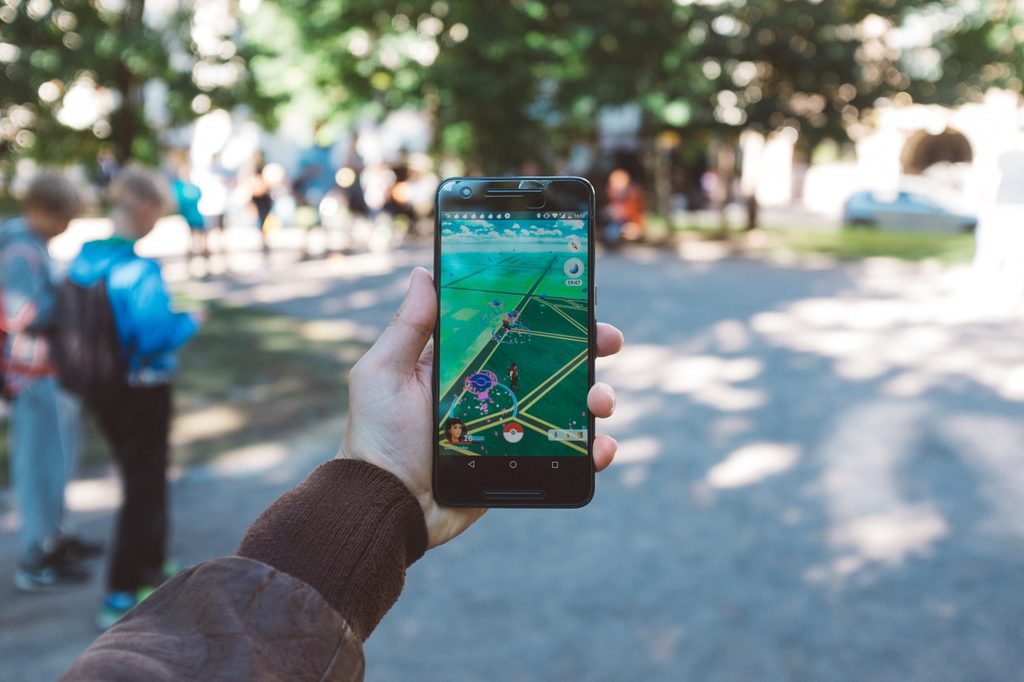
Person playing Pokemon

Q-A: 14

And, is that not an isolating technology? When we go for a walk down the street and I see Art Deco and you see something else?

It is ironic that this ultra-connectivity technology, this web of technologies could… It’s most easily used to do exactly what you’re saying which is to give us exactly what we want.

And that is the ethical issue that I’m most focused on which is the needs of people, we want what we want. We want to be comfortable. We want certain things; we want to get what we want.

The commercial marketplace wants to give it to us and live only to those impulses. I think we’ll end up with what you’re talking about.

Which is a lot of sort of gated communities, a more insular way of looking at life so that you’re getting everything you like, but you don’t really understand other people.

You’re not experiencing the real city as you walk down the street. You’re experiencing an illusion that’s coming largely from your own mind and behavior.

So one of the issues I’d really like to address, not necessarily today, won’t be solved today, but over the long term what I’m looking at is: how you introduce randomness, serendipity, happy accidents, the kinds of things that in a very structured world like the one I’m describing, that stuff tends to either be filtered out or predictable.

Q-A: 15

Presumably, the algorithms would be good enough that it says: “I’m going to find what we both have in common and then we can have a shared experience that we both [like], and it may not be your favorite or my favorite, but the music, the song that’s playing is at least something we both like.”

That’s right. I mean what I’m afraid of losing in that environment, is, I live in in Los Angeles. I used to live in New York City, I like big cities.

I like the craziness of them, I like the fact that every day you’re going to experience something that you never have predicted and you might not have wanted, I’ll hear musicians playing a genre that if anybody asked me the day before… it’s “I really don’t like that stuff, it’s not for me.”

And then I find myself stopping and listening and then as a musician, I find myself being influenced by a genre I never… This to me is the beauty of the cities, that you ride in a subway as unpleasant as it can be.

You’re constantly confronting the full humanity and I think there’s something very humanizing about that. It makes you more open-minded, makes you realize that not everybody believes the way you do.

And you know, you even see a primitive version of it on Facebook, for example, where the illusion is created to an extent that the world is much more like you than it really is.

That you’re confronting all the whole fake news idea. But basically the idea that you’re being presented with content that that makes you feel good about what you already believe.

And I’m disturbed by that. I think that’s very destructive.

Q-A: 16

I have a policy that I don’t read any book I agree with. I’m serious because it’s like I spend that time and then I get to the end I’m like yeah, that’s just what I thought.

So I literally only read things that…so I’m an optimist about the future, so I only read pessimistic views and so forth.

So, let me ask you a question. Let’s say we get some form of AI that is… we won’t even say whether it’s an AGI or whether it’s conscious or anything like that. But, it gets Siri or some equivalent technology.

It’s so good that it laughs at your jokes and tells you things and you converse with it and all of that, and you regard it as a friend. Maybe it manifests in a robot that’s vaguely humanoid, I don’t know.

And let’s say that those become your best friends, and then you know then you find one that’s your spouse and then you just deal with those all day and you never deal with another person.

Because those people never let you down and always like… why is that bad?

I mean at the human level you say doesn’t sound… but why is that bad?

Why not just live that life around people that make you feel good about yourself and tell jokes you like?

And you had all the stuff in common, why deal with other people?

Well, we do that to an extent already, and even before any of these electronic tools we found communities and you always want to hang out with people that you know you have a similar worldview, where you get each other’s jokes and so forth.

So you’re not constantly arguing about basic assumptions. But there’s a difference I think between in the analog world, knowing that I’m living and hanging out with a community of people, like-minded people.

You know, we’re all in the ballpark but being aware that right across that highway are people who don’t share any of our assumptions.

And we really look at the world quite differently. So is it a good thing or a bad thing to be aware of them and to have to interact with them? I think, with no evidence, but I think it’s a good thing to interact with people you disagree with.

Warrier AI Robot

Q-A: 17

Well, that’s people’s gut reaction, but try, and I heard your caveat with no evidence, but try to justify it.

If you don’t encounter things you don’t like, it’s like a muscle that doesn’t encounter resistance. It never develops.

It requires friction, I think, for humans because I think that’s the way we’ve evolved is that we evolved in a very complex diverse society and we have to find our way through that and our identity I think is constructed.

We construct our identity based largely on how we see ourselves in the midst of that. So it might not be bad, it might just lead to humans who are less able to handle diverse opinions, new ideas, and inventions.

They might be less tolerant of eccentricity, of artists, of people who by nature, inventors and artists, people who break the mold.

If you’re so accustomed to the world being exactly as you like, it might be very difficult for you to accept a revolutionary concept or a work of art that’s startling and offensive maybe at first.

But you grow by accepting those things and incorporating them into your identity. So I would say that it’s good to throw a lot of stuff at people and let them sort it out.

Q-A: 18

Say here, you get these two robots to choose from: you know this one is exactly like what you want, this one however has body odor and tells offensive jokes that that just really offend you at every level and you really should pick that one.

Well it’s sort of the movie Herford example, you know this is your perfect companion, and because she was intelligent, she evolved to grow to him and so forth just like a human would.

I’m not saying necessarily surround yourself with the obnoxious or what you find uncomfortable. On the other hand, don’t surround yourself necessarily with everybody who agrees with you all the time.

It leads to intellectual inflexibility and cultural inflexibility.

Q-A: 19

Do you think human evolution has ended now because the strong don’t necessarily survive any better than the weak, and the intelligent don’t necessarily reproduce more or have higher survival rates than the less [intelligent]?

Is human evolution over and the only betterment we’re going to have now is through machines?

I don’t think so. I think that humans as organisms continue to evolve. I think that the strongest is not the physically strongest, because any tiger could knock a weightlifter out.

I mean compared to other species, we’re very weak. I would say if you interpret strength for humans as having the characteristics of harmonizing society, cooperativeness, collaboration and so forth,

I would see those as the human strengths and I would see those as having as very refined evolutions of our temperaments. Human strength is not individual despite our mythology.

Yes, inventors come up with ideas, yes, artists come up with ideas and so forth. And those tend to happen individually, but the real changes tend to happen with a lot of people collaborating, some of whom don’t even know they’re collaborating but they’re participating in a movement.

So I would say that the highest point of human evolution is something like empathy, understanding of people who are very different and so forth, that’s human strength.

And I would say that is something that’s what allows us to survive, not our physical strength. We don’t really have any physical strength to speak of.

Q-A: 20

So your contention is that ethical, I mean that empathetic, people with empathy will reproduce more than people without it over the long run?

I don’t think though, there are too many issues with reproduction. I don’t think that will be the case, but the numbers don’t necessarily dictate the influence that has on society.

Q-A: 21

So let’s get back to our narrative. We have our cellphone [that] has migrated to a hands-free device that we can effortlessly interact with, and you assume that people want to do that based on how they’re willing… it is true that taking the elevator up here I noticed everybody whipped out their phone.

It’s like “What am I going to do for the next thirty-four stories of elevator time? I’ve got to pass this time some way.”

And so your contention is that there is a latent desire for that because people want to have it on 24/7?

I think so. I think that if I had to come up with a one-gut justification for this, it would be, and I know this is not visual, but I’m making the gesture of playing with your phone with two thumbs.

That is the fact that I think it’s an obsession with me. I go into a crowd in an airport a hotel and I count the people who are using phones and the ones who aren’t, and it’s always over 50% of people who are like this.

Especially if you consider it, count the laptops. So there’s a need, it could be an obsession, it could be… who knows where it’s coming from.

But there is definitely a need to look at this thing all day and who wouldn’t rather strap it to their head and have it be full fidelity and high definition and overlays that don’t look cartoonish, that actually look like they’re fixed and integrated with the environment and so forth.

And be able to do all the things you can do on your phone. You get your mail, your messages, you take photographs and whatever.

Girls busy on smartphones-mobiles

Q-A: 22

I have been to North Korea several times and there is no internet. There is no cell phone reception, there is nothing.

And I find that the most isolating aspect of it all… like you know I cuddle up to like the warmth of this thing that’s… it’s almost like, I don’t know, I feel untethered and adrift when I don’t have it.

And I wonder did it awaken something in me because I wouldn’t have felt that way when I was younger because I didn’t have the device?

Or did it change me, did it somehow weaken me, that now I need it?

Or did it awaken this latent desire to want to be connected to a world of information?

What do you think?

I think we might have a lot of latent desires that technology hasn’t given us an avenue for and this is one of them. When I was a kid, there was no such thing as email so being without it… so what?

You wouldn’t even have been able to explain to me what this phone does. You know, I mean you’d have to explain the internet. You have to explain all the protocols, it’s an amazing amount of history that we’ve got in our pockets.

So we didn’t know in the 15th Century, would people have been doing this? Yeah. I think they would have. I think it’s human. I think that you’ve got a little device here that is magical. It carries… it’s your portal to the world.

It’s a computer that you can carry on you. It makes me wonder what other technologies could evolve that show that we have other desires that aren’t being met or that we could become addicted to. I mean, it’s not the right word, but habituated to, it becomes essential.

Q-A: 23

Why would you make that distinction between habituation versus addiction?

Well, because I think of addiction as a drug, but it’s really the same thing yeah it is…

Q-A: 24

Because I have withdrawal symptoms if I’m cut off from it.

That’s true and in fact, we’ve seen in the last year that some Facebook original designers have started to come clean and talk about how that is deliberately, addictively designed.

That’s not surprising in a way, it’s, I mean from Facebook’s standpoint you want to keep people using it and that’s where the information about people comes from and so forth.

So it’s understandable, but you know we have become addicted to something that is actually very useful. I guess that’s my reluctance to use the word addiction. I think of addiction as something bad, but you could be addicted to something good too I suppose.

Q-A: 24

So we have our device and now we transport into the future, and you said the street is aware and I assume you mean that colloquially not literally the street is not conscious.

The street couldn’t really be conscious but the sense, the sensors and the interaction between the sensors and the databases and that there’s a whole web of intelligence I guess you could call it, that will create the illusion that in a sense, I think that the city is responding.

That building changed because of something I bought. My health changed and so that facade looks different, the artwork looks different.

It’s something now to make me feel more relaxed because it knows I’m very nervous and it knows that I have a heart condition or the opposite, or what have you.

The city could become your doctor for most things. It’s constantly diagnosing you. It’s looking at your heart rate continuously, you know an automated vehicle could show up on the sidewalk when you think you’re having indigestion, and it realizes that you’re having a heart attack, so it takes you immediately to the hospital.

And starts treating you as soon as it comes in contact with you. I mean the healthcare benefits are just staggering over the next generation.

Q-A: 25

So you’re an ethicist and you think about the ethics of all of this stuff?

I’m an amateur ethicist.

Q-A: 26

Fair enough. I don’t know how you go pro… Regardless, tell me some ethical considerations that we may not have thought about, or we had that you want to weigh in on, so what sorts of questions are outstanding?

I’m going to avoid AI by itself because that becomes, well in a way I can’t avoid AI because this whole thing is basically run on machine learning.

I would say that the biggest ethical concern I have at this point is that this amazing collection of technologies not be used to de-nature the human experience. Not to make it seem as though life is simpler than it is.

There are no people I dislike. There are no people with political views I disagree with. There are no genres of music or movies that I don’t like. I’m not exposed to any of that and it makes me happy.

That I find to be a very dangerous thing. It leads to the fabric coming apart I think. So that’s one of my concerns.

The commercial motivation of a lot of the AI, Facebook and Google and so forth, is potentially problematic because there are other values in society that are more conducive to holding the fabric together, appreciating other people’s experiences and points of view and so forth. You know that are not…

Q-A: 27

Fair enough. So let’s take the first one of those two, that somehow is bubbling… goes to a whole new dimension where it isn’t just “Here are suggested stories for you.”

But people and all experiences contrary to your current preferences are off-limits, and you say that pulls the fabric apart because it dissolves the community.

I don’t have any reason at all to empathize with you because you had absolutely nothing in common with me.  Is that how you’re seeing it?

Something like that. Everybody I know disagrees with you, so how could you possibly be right? Do you know?

As opposed to: there are lots of people with a range of points of view and they very idiosyncratically… and sometimes they’re full of contradictions and so forth.

And I think to become a full member of the community, you have to sort of appreciate the messiness of people.

And a lot of these technologies are naturally inclined, I think, to shave off the messiness and to make it seem like it’s a lot more, you know…

Q-A: 28

So run both scenarios. Run the worst case and then tell me why that’s not going to happen?

The worst-case would be if it were used, I think if a system like this were used in a society where there was no tradition of democratic values.

I think that’s very dangerous because then your primary motivation becomes efficiency and that’s not a very good way to organize society, I don’t think. Society is inherently inefficient and the freer people are, the less efficient it is.

Efficiency is never really the goal of a democratic republic. But an authoritarian State with these technologies could create an extremely obedient population that would govern itself in a sense.

They would not need to be censored, they would not need to be told that this was inappropriate or so they would know better.

They would know that. They would behave. And that might lead to industrial efficiency but it doesn’t lead to human freedom or any kind of society that I think any of us would feel comfortable living in.

I think that’s a natural tendency especially in certain countries where it’s basically a way to enhance authority. That’s one scenario and that could happen here.

That’s a very portable model that doesn’t necessarily apply to China or the Gulf States or other states they might be thinking of it. It could apply to Western Europe, it could apply to North America.

The temptation is going to be high to assert authority through a system like this I think.

On the other hand, it can be incredibly liberating for people, first from a health care standpoint. It basically puts you in your doctors’ hands all the time.

You’re constantly being watched and assuming that this does it in a secure fashion that people are comfortable with. If recreation, entertainment, being exposed to different locations in a physically utterly believable way: travel, education, just one field after another.

There’s hardly a field that isn’t revolutionized by this kind of thing. And very positively it really takes the resources and it expands them very open to people. Everybody becomes empowered in a certain way, but I think that takes guidance in the development of these systems.

And those are the kinds of questions I’m trying to raise with software developers, for example, of people working on these technologies.

Think of how you can push towards the second scenario instead of the first scenario, and it’s a difficult thing, and it might actually go contrary to some of them, you know the commercial needs of developing AI and mixed reality and so forth.

So it’s not easy and there’s no obvious answer. It could go in a lot of different directions.

Robot in Wars

Q-A: 29

It’s interesting because as I sit here I think about it: There’s a whole different mindset that says “the great thing about these technologies is they let you find your tribe. You are not alone.

There are people like you and these technologies will let you find and have community with those like you whether they’re/it’s spread all over the world.

They may be older and they may be this and then maybe that, and you will find your place.”

But you are describing tribalism in a really kind of dystopian sense like where would you…?

That’s a really good point, it’s one of the paradoxes of these technologies, that they’re very liberatory but they’re potentially restrictive.

And the tribal mentality I mean that’s a fantastic thing about… well the Internet itself is the ability basically to form communities without respect to geography as you say, age, & any demographic considerations and that’s fantastic, that’s unprecedented.

It’s a matter of degree, I think. You know I’m heavily involved with people who are interested in the various things I’m interested in and so forth. But just as you try to read books that you disagree with, I try to find people that I disagree with.

I try to emphasize that these tribes are not the world for me, even if I want to make them that. There is an incredibly diverse population out there and once you wrap your head around that, I think if you end up actually dealing with your tribe in a more intelligent way.

Do you know what I mean there? That the more you see of human diversity the better it is, even when you’re in a group that’s heavily circumscribed by interest or one factor or another. So there are tribal utopias and tribal dystopias.

I think it’s almost a sliding scale. But I think what changes the utopian to a dystopia is that you realize that this isn’t the sum total. You don’t become satisfied by living in a world that’s just like you – as tempting as that is.

Personal Savings

Q-A: 30

I wonder though if there is such a world. If I’m really into banks shaped like pigs, and I find the Bank shaped like Pig society and I connect with 19 other people. They’re not going to agree with me about anything else.

And so there aren’t all bubbles just one or two dimensional and people are so rich and multi-dimensional that there’s really no way to completely… I mean you can isolate yourself from people who have vastly different economic situations than you who live in abject poverty in another part of the world, but that already happens.

So how is this any different than I live in a neighborhood and everybody in my neighborhood is, to your point, in some way very similar to me. They’ve all chosen to live there and afford a house of that kind and so forth.

But on the other hand, not at all like me. And so how are you saying technology says “oh no, you’re finding your own clones. And when you find your own clones you’ll completely cut off the rest of the world.”

That’s a good point. I think in the physical world we actually do that; you know the people in your neighborhood for example.

You have a lot in common as you say, you also have a lot that you disagree with, but if you’re digitally creating communities it might be one of those things where you’re focusing on the similarities to the point where you really want a homogeneous community.

It gives you more tools to eliminate the pieces you don’t want. I’m not saying that that’s necessarily going to happen, but you look at Facebook, which is very primitive compared to what we’re talking about. It’s still on a screen.

It’s still basically text-based. You know it’s really, we think of it as current, but when you’re talking about this stuff, it’s not really. It’s an old-fashioned system in a way and even that, even with text, which is very abstract, it still manages to convince people to focus strictly on the things they have in common.

It pulls you away, I mean you know the effects that it has on public discussion of politics, for example, people are looking for it. Again what you said about reading books that you don’t agree with, you’re looking to confirm and when you confirm, suddenly you’re right.

It isn’t just my opinion, it becomes more difficult to compromise with people. So you know we see it happening in that world and yes, within groups on Facebook or in digital groups, you’ll find differences.

But they tend to get very narrowcast. You know this is a worldview, kind of, that is shared by the group.

So it makes it easier to craft a group, but that same impulse is going to be there and maybe one of the solutions is to belong to a lot of different groups so that they overlap and don’t narrowcast your identity in a sense.

Don’t think that, “well I’m this and this and therefore these [are] the only people I deal with.” Because believe me with this and this, you’re going to find a lot of people that disagree with you, it’s just – people are complicated.

So anything that we can do to encourage that, what would be the word, “heterogenization” I guess. That sort of throwing surprises in there. Surprises I think are good for people especially intellectual surprises.

Q-A: 31

One in every 10 of your friends on Facebook should be randomly assigned to you.

You know I’ve never heard that but some, something like that or something. I mean often we get that with relatives.

Q-A: 32

Yeah, that crazy Uncle Eddie, who comes to the cook-out… So let’s talk about your second concern the commercial factors and you’ve alluded to, your concern that the incentives are, with Facebook, to make the technology sticky.

But I think you probably mean something much more philosophical or broader or maybe not. Tell me the dystopian narrative of how the forces of free enterprise make a dystopia using these technologies?

Well, it’s another one of those paradoxes is that the marketplace that exists is, to a large extent responsible for these technologies that are being developed. At the same time, the motivation of the individual companies,

I mean take Google and Facebook for example, and their motivation is to gather data about us and sell it to advertisers. There are other models that would be possible, but that’s the one that the marketplace naturally leads to.

I mean if I were running Google I’d be doing the same thing, it’s almost unavoidable. So it’s useful to know what information is being gathered for what purposes, how it’s integrated with other information for what purposes and so on.

I think that the commercial motivation is to give people what they want and it’s very hard to sell castor oil to people. You know you’re going to say, “well this product you should buy because this app you’re not going to like it but it’s good for you,” nobody’ going to buy that.

So there has to be, you know, some built-in incentive too. I think really what we have to do is replicate the real world more fully.

So thirty years from now, when a virtual environment becomes indistinguishable from a physical world, a lot of these problems might disappear because you kind of embrace the values of a diverse civilization and you imprint that.

I don’t think that’s what the companies are doing right now. I think they’re saying, “well we need to gather data because this is… the accumulation of data is really our business model.”

So that’s a fundamental conflict I think in a utopian vision of these technologies is that I would argue to the corporations that are doing this, that ultimately there’s greater profitability and greater adoption and less pushback.

If you do the right thing, leaving that undefined for the moment, but if you don’t necessarily… without exploitation, you get a lot more buying into this system.

You get people who really throw themselves into it with more security, for example, less hack-ability. So yeah there is and I’m not picking on a market system, because any governmental system, any economic system is going to bring its own slant to how they do things.

Q-A: 33

Do you think that life can, because you just said something, I’m still back at “when these systems become indistinguishable from reality?” And it seems implicit in that some machine learning does a very simple thing.

It studies the past and assumes the static world and the future is going to be like the past and it looks for patterns in the past and it projects those into the future. Do you think everything about our existence came [from] human creativity?

You know I look at a Banksy piece of graffiti and I think, “Could a machine learning system have studied anything in the past and produced that?” So if not, everything can be learned that way. Can a world be built that is therefore indistinguishable from this world?

I think large parts of it can be made indistinguishable. I mean certainly this environment that this conference downstairs, you know South by Southwest, could be made virtual and it could be just as immersive as it is now.

The problem comes with the invention, with people who with artisans, inventors, creators, people who don’t do what was done yesterday, people who break the pattern. And I’m wondering about a future form of AI that is able to do that.

I don’t know how it would. I think a lot of that is biologically rooted, I think there is an urge in a person to create that’s very hard, and creation involves doing something that hasn’t been done before, not completely divorced from reality.

It has to be familiar, but it has to be, it has to break certain rules of the past. Major changes, all of these inventions really involve a deviation from what happened last week. So that’s a piece, the creative piece that is still I think in the realm of humans.

AI-ML-Robotics Technologies

Q-A: 33

Let me pose another question to you. This is something I’m mulling about as we speak, and I would love to get your thoughts on it.

So I often have a narrative that goes like this: If you want to teach a computer to tell the difference between the dog and cat, you need X-million images labeled dog and X-million labeled cat and it does it all.

And then I say, you know the interesting thing is, people can be trained on a sample size of one. So if I take that stuffed animal which you’ve never seen before and I said okay find it in these twenty photos.

And sometimes it’s upside-down. Sometimes it’s covered in peanut butter. Sometimes it’s underwater or sometimes it’s frozen in a block of ice. You’re like: “it’s there, it’s there” and we call that transfer learning.

We don’t know how we do it. We don’t know how to teach computers to do it. So but then people say “aha” here’s the part I want your thoughts on: “You have a lifetime of experience of seeing things that are smeared with substances and perhaps frozen in glass and all of that.”

And that seems to be the answer, and then I say, “Ha-ha, you don’t have to show a five-year-old a million cats. You can show a five-year-old three cats and they can pick cats out, and they don’t have a lifetime of experiencing things like cats.”

But then they see the Manx, it doesn’t have a tail, and they say “oh it’s a cat without a tail,” like they know that. And that’s a little kid who hasn’t lived a life of absorbing all of this thing.

So the two-part question as they say part one is how do you think that child gets trained on such a small amount of data, and second, could the answer be it’s the same way that birds in isolation know how to build a nest?

Somehow that is encoded in us in a way that we don’t even understand how that would happen?

My answer to both of them is, I don’t know. And that’s really interesting speculation on that, the birds. Part B, why do children, why can children do that?

I don’t know. There are certain things that the human brain, the human mind does that I don’t know how you would code.

Q-A: 34

Are you saying I don’t know how you would code it or I don’t know if that can be coded?

I don’t know if it can be coded.

Q-A: 35

Interesting, so you might be one of those people who says general intelligence may not be possible.

I go both ways on that one. I think there are certain things that we do, metaphor, analogy, seeing relationships, intuition, certain very human ways of thinking, I don’t know how much of that can be systematized.

Q-A: 36

So the counter-argument, the one I hear all the time is you are a machine, your brain is a machine, your brain is subject to the laws of physics that can therefore be modeled in a machine and therefore it can do everything human can do. I mean that’s the logic is that…

Yeah, I have trouble, I understand the point of that, I think it’s reductive. I think that a machine is something that humans create and we didn’t create this, a machine we understand.

This we didn’t. This grew. This evolved. This is full of mysteries and un-examinable pieces. We don’t know why we come up with what we come up with. What motivates an inventor to come up with something?

Well, okay he has an idea, but there’s more than that. Is he proving that high school teacher wrong? Is he showing his dad, “yes I can do this?” There are all kinds of personal things that they might not even know they’re motivated by, that are, that requires being alive.

  • If there’s no sexuality if there’s no desire if there’s no irrationality, how can you be fully human?
  • And if you want general intelligence on that level, do you have to program a simulation of that in there?
  • Does it have to believe that it’s alive? Does it have to believe that it’s mortal? Does human life have the same… if we live to 200, how valuable would human life be? Isn’t the preciousness of it, that it’s finite?  It is all too short that it follows an arc.
  • Does a machine have to have that same physiological basis?
  • How much of this is rooted in our existence as creatures?
  • Does it have to think it is?
  • Does it have to be really human and alive in order to do the kinds of things that we think of as quintessentially human, like great music or invent smartphones or build cities?

It isn’t just that you know you can do it and you know how to do it, you have to want to do it, and it has to consume your life. Are you willing to do that? Well why a machine would do that where’s this motivation coming from? I only have five years to live…  you know what I mean, how can a machine know that? I want to attract a certain person to me. Does a machine want to do that? It has no need for that, no understanding…? So a lot of this stuff is very squishy human stuff that is evolved. And I think that if you’re going to get general intelligence you might have to grow it. Because if you have something that’s alive, it has a sense of self in a way. It has a sense of survival. It knows it’s going to die in a certain way.

Leadership

Q-A: 37

Well interestingly, life is an incredibly low bar, and I think the only reason you can say computer viruses aren’t alive, is because… and it’s interesting because life doesn’t have a consensus definition.

Death doesn’t have one. Intelligence doesn’t have one. Creativity doesn’t have one, which either means to me that we don’t know what they are, or the term itself is meaningless. I don’t know which of those.

But life is a really low bar because…  the reason we don’t say computer viruses are not alive is simply that they’re non-biological and right now most definitions require biology.

But a virus we generally regard to be alive, a bacterium we do, and yet those don’t have any of those. You’re talking about something more than being alive, right, you’re talking about consciousness?

Consciousness, although well, consciousness let’s say in silicon as opposed to consciousness in some wet petri dish that’s actually grown tissue, for example.

Let’s say you have the same kind of general intelligence imbued in both of those. I think the one that’s alive is going to get you closer to a replication of the physical world that we know.

Q-A: 38

Do you think humans are unique in our level of consciousness?

On this planet? I think that’s impossible to know. I can’t put myself in the head of a macaque. You know I don’t know. I suspect that every living creature has a sense of itself, in the sense that…

Decision Making


A tree?

Yeah, a tree can’t move but it will turn to face the Sun, it will respond to the environment. An animal definitely will avoid the threat, fire.

Q-A: 39

We derive the notion of human rights and enact laws against animal abuse because we feel that they are entities, that they can feel, that they have a self.

If you say a tree has that, have you not undermined the basis by which you say humans have human rights?

No, I would say that a plant, I know this is going to sound arbitrary. A plant is probably in a different category.

I would say that, in fact, I would say a lizard is probably in a different category you know. I hate to be species-ist but you know I think that we’re talking about higher mammals pretty much. And as inferred from their behavior: complex, social structures and so forth. Trees don’t do that.

Q-A: 40

Isn’t it fascinating that up until the ‘90s the conventional wisdom among veterinarians was that animals don’t feel pain?

Really?

Kind hearted Australian

Sure and they operated open-heart surgeries on babies in the 90s without anesthesia because they said they can’t feel pain either.

And the theory goes that if you take a Paramecium and you poke it with something, it moves away and you don’t infer it has a nervous system and it felt that.

And yet and so they say that’s all the dog that gets cut has, and that’s up until the 1990s, that was a standard of belief that animals didn’t feel pain.

You could I mean if you were willing to accept that logic you could also accept human surgery without you know I mean there’s no clear line there.

Q-A: 41

No, I’m not advocating that position…

I know you’re not.

Humbleness

It’s interesting to think that the problem… I think it was a position argued in part from convenience by people who use animals or raise animals and so forth. Because if they can’t feel pain then they don’t, you know…

Yeah, then who cares. We know dogs feel pain. Can they create sophisticated societies? No.

Q-A: 42

I use the very example in a book I have coming up shortly about this time my dog was running and jumped over this water faucet and tore her leg open. And she yelped and yelped and I said I wrote you know nobody could convince me my dog did not feel pain.

But you noticed the way I described it that she seemed to feel pain because I do have no way of knowing. That’s the oldest philosophical question on the books is you don’t know what anybody else feels or they exist or anything.

It’s intractable, and the reason it interests me is that I’m deeply interested in whether computers can become conscious and more interested in how we would know if they were.

So I would like that to be my last question for you. How would you know if a computer was conscious?

If I had to pin it down to one thing?

Q-A: 43

Well no. The computer says, “I am the world’s first conscious computer.” What do you say to it?

I would say “make me laugh.” You know let’s say do something that’s human and irrational.

Q-A: 44

Yeah, the net plays a recording of flatulence…

Okay, but that’s…

Q-A: 45

But you did it, you did it. It made you laugh.

Well, the description of the machine doing that made me laugh. But if the machine actually did that I’d say, “that’s not funny.”

It has to do something. Write a song. Do something that hasn’t been done before. If you’re just basing it on what happened last week, then I can be tricked and to believe that.

Q-A: 46

So you know they had these programs that write beatnik poetry. You know the dog sat on the step, bark, bark, eleven is an odd number indeed.

You know write stuff like that, and they would say “well nobody’s ever written that poem before” and you’re like well there is a reason for that.

They feed Bach into it and use machine learning to make Bach-ish. I think you can’t trick a musician, but the musicians are like “that’s kind of like Bach.”

And so neither of those come anywhere near close to passing your bar I assume, and yet…

They didn’t invent it. That would be if the robot came up and played like Jimi Hendrix. I’d say that’s pretty good, but if he came up with that in 1967, that’s a whole different thing.

You know it’s interesting because we are recording this on the anniversary of the tournament between Alpha Go and Lee Sedol. And there was a move, move 37 in game 3 that people say was a creative move.

It was a move that no human would have seen to make. Even Alpha Go said… Lee described it as people started talking about Alpha Go’s creativity on that day and subsequent to that they have systems that train themselves.

So there’s no training on human games and there was one that trained itself to play chess, and what it’s doing are things no chess player would do.

In one game it won, it sacrificed a queen and then a bishop in two consecutive minutes and won the game to secure a position. It hid a queen way back in one corner and people describe it as alien chess because it’s the first thing that wasn’t trained on this huge corpus of chess games we have. So is that getting near it?

It’s getting near it, that’s doing what a really creative person does which is to take the basic elements and not impose any of the preconceptions on top of it, sort of look at it fresh.

Q-A: 47

The question I ask is, is that creativity? Or is that something that looks like creativity, or is there a difference between those two statements? That would be my last question for you.

That’s a hard one to say. You can imitate creativity by creating Bach-like music. Chess I’m not sure falls into the same category or a sophisticated game, Go or something.

Because there is a certain set of possibilities, whereas in the arts, for example, or in invention there really isn’t. I mean, there are physical restrictions, but aside from that, it can go anywhere, and although it seems like I’m splitting hairs basically…

Q-A: 48

These are hard. The challenge with languages that we’ve never had to – we’ve always been able to have a kind of colloquial understanding of all these concepts.

Because we never had to say, “well how would you know if a computer could think?” How would you know that?

Because the words just aren’t equipped for it, the language therefore I think limits our ability to imagine it.

But what a fascinating hour it has been. I could go on for another hour but I won’t subject you to that. Thank you so much for this.

It’s my pleasure.

Source: gigaom.com

Erixon

Interview with Christof Koch

Christof Koch is an American neuroscientist, best known for his work on the neural basis of consciousness. He is the President and Chief Scientific Officer of the Allen Institute for Brain Science in Seattle, and from 1986 to 2013 he was a professor at California Institute of Technology (Caltech).

Koch has published extensively, and his most recent book is Consciousness: Confessions of a Romantic Reductionist.

What follows is an interview between Christof Koch and Byron Reese, publisher of GigaOm, and author of the new book The Fourth Age: Smart Robots, Conscious Computers, and the Future of Humanity. They discuss artificial intelligence, consciousness and the brain.


Q: 1

Byron Reese: So people often say, “We don’t know what consciousness is,” but that’s not really true. We know exactly what it is. The debate is around how it comes about, correct?

Christof Koch: Correct.


Q: 2

So, what is it?

It’s my experience, it’s the feeling of life itself, it’s my pain my pleasure my hopes, my aspirations, my fears, all of that is consciousness.

Brain-Intelligence-consciousness

Q: 3

And it’s described as the last major scientific question that we know neither how to ask nor what the answer would look like, but I assume you disagree with that?

I disagree with some of that, it’s one of the two or three big questions, being: Why is there anything at all? What’s the origin of life, and yes how does consciousness arrive out of matter?


Q: 4

And what would that answer look like, because people often point to some part of the brain or some aspect of it and say, “that’s where it comes from,” but how would you put into words why it comes about?

It’s a very good question. So, having the answer to which bits and pieces of the brain are important for consciousness is critical to understand what happens in the emergency room when you have a patient who is heavily brain damaged, but you have no idea whether she is actually there, was anybody home.

It’s going to be of immense practical importance and clinical importance for babies or for anencephalic babies, or at the end of life, but of course, that doesn’t answer the question.

What is it about this particular bit, piece of the brain that gives rise to consciousness, and so finding what we need, we need a fundamental theory of consciousness that tells us what type of physical system, whether evolved or artificial, what type of physical system under what conditions can give rise to feelings because those feelings aren’t there?

If you look at the fundamental theories of physics, quantum mechanics and general relativity, there’s no consciousness there. If you look at the periodic table of chemistry, there’s no consciousness there.

If you look at the endless ATGC chart of our genes, there’s no consciousness there. Yet every morning we wake up to a world full of sounds and sights and smells and pains and pleasures. So that’s the challenge: how physics ultimately gives rise to conscious sensations.

Human Brain & Neuron Model

Q: 5

Or, some might say, “whether physics give rise to it?”

Well, physics does give rise to it in the sense that my brain is a piece of furniture of the universe. It’s subject to the same physical laws as everything else. There isn’t a magical type of law that only applies to brains but doesn’t apply to anything else, so somehow physical systems or at least a subset of physical system gives rise to consciousness.

The classical answer, at least in the West, was forever, for a very very long time, there’s a special substance, the thinking substance, res cognitions, or people today call it the soul, and only certain types of systems have it and only humans have the soul, and the soul somehow mediates the mind.

But of course we [say], sort of logically, that’s not very coherent, there’s no empirical evidence for it… how would this soul interact with the brain, where’s the soul supposed to be, where does it come from, where’s it going to, it’s all incoherent, although of course the majority of people still believe in some version of this.

But as scientists, as philosophers, we know better. There isn’t any such soul, so it comes back to the question, “What is it about the physics of the world that gives rise to feelings, to sensations, to experience?”


Q: 6

Well, I want to tackle that head-on in just a moment, but, let’s start with you, because you’ve been dealing with this question for a long time, and it’s fair to say, your understanding of it has evolved over time.

Can you walk through, like the very first time you thought about this? As far back as you remember, and then what you thought and what the early theories you offered up, and how you have evolved those over time?

Sure, so I grew up in a devout Roman Catholic family, and I was devout and then, of course, you grow up to believe there’s this soul, the real Christof, is sort of this spirit that’s hovering over the waters of my brain, and every now and then, that soul touches the waters of my brain, makes me do things, and then when I’m thinking about, for instance, whether I should sin or not, this absolute freedom to choose one or the other and then my soul does one thing or the other, but then, this was on Sundays.

Then during the day and the rest of the week, I taught science, I thought about the world in scientific terms, and then you’re left… well wait a minute, you begin to think about more detail and that just can’t work. Because, most importantly, where is the soul?

How does it interact with a brain, and so then you begin to think about scientific solutions? And then I encountered, years later, Francis Crick, the co-discoverer of DNA, and he and I started up this very fruitful collaboration, where we wanted to take the problem of consciousness away from pure philosophy where it’s vested over the past 2,000 years, which is great you’ve had some of the smartest people of humanity, but they haven’t really advanced the field that much, to take it into an empirical operation that we scientists can work on.

And so we came up with this idea of the neuronal colleagues of consciousness. It’s a fairly obvious thing; it’s the idea is that, whenever I’m conscious of something, whether it’s your face, for instance, I see your face or hear your voice, or I have a pain or I have a memory, there must be some mechanism in my brain, we know it’s not the heart, we know it’s in the brain, there must be some mechanism in the brain that’s responsible for that.

And it’s a 2-way communication between this mechanism and my feelings in the sense that I artificially activate this neuronal colleague of consciousness or abbreviated as NCC. If I trigger it for example, by an electrode that I put into the brain, and say doing brain surgery, I should get that person, even though there isn’t anybody out there, but I still see a face.

Or conversely, if this part of the brain gets removed by a stroke or a virus or a bullet or something, I shouldn’t be able to have this person anymore.

Now also this is a big scientific empirical program that’s going on in many places throughout the world, where people are trying to look for these neural colleagues of consciousness in the brain.

But then, of course, somebody pointed out to me, he asked me a very simple question, said, “Well in principle, if your program has run its course and then 50 years later we know exactly that every time you activate these neurons in this particular model, projecting to this other part of the brain, you become conscious.”

How’s that different from the cards cranial gland, because famously 80 years ago, they said well the place where the brain needs to have this spooky stuff, this cognitive stuff, is the cranial gland, and today we all laugh at it, right?

Well, how is that different from saying, “well it’s made up of 5 neons that oscillate at 40 hertz?” It’s just much more detailed because ultimately it seems like magic.

Why should activity in these neurons give rise to conscious sensation, and at that point, I really thought, well what we need, we need a fundamental theory that tells us, independent of which mechanism, tells us what is it about anyone mechanism that can give rise to consciousness? And so here we are, 20 years later.

Prepare your mind-Brain

Q: 7

And so talk about IIT?

So the most promising theory of consciousness in my personal opinion, and in the opinion of many of the observers of the field, is this integrated information theory, due to this Italian-American psychiatrist and neuroscientist, Giulio Tononi.

And it starts by saying, “Well what is a conscious experience? A conscious experience exists for itself – in other words, it doesn’t depend on anybody else, doesn’t depend on my parents or you or any observer – it just exists for itself. It has particular properties, it’s very definite, either I have a conscious experience or I don’t have a conscious experience.

It’s one, it’s only one at any given point in time, and it has parts, like, if I look out at the world, I can see you over here, over there something else, and there’s an above and below and a close by and a far away, and all those notions of space and other sensory qualities.

And so then let’s look for a physical mechanism, or first an abstract mathematical formulation of such a magnitude that instantiates these key properties of consciousness. And so the theory says that ultimately, consciousness is its causal power of the system upon itself.

So let me unpack that a little bit. Well firstly, let me repeat it. So the idea is that consciousness ultimately is the ability of any system, like my brain, to influence its immediate future, and to be influenced by its imminent past, it has causal power.

Not upon others, that’s what physics has. If I have an electric charge, I’ve attraction or repulsion of other things, but it’s power upon itself. The brain’s a very complex system, and its current state, influences its previous state and its past state influences its current state.

And the claim is that any system that has internal causal power, feels like something from the inside. Physics tells us how objects appear from the outside, and this thing, intrinsic cause-effect power, tells us what it feels to be that system from the inside.

So physics describes the world from the outside perspective, from the third-person perspective of an observer.

Integrated information cause and effect power tell me what it is to be a system from the inside, and the theory has this number called phi, that tells you how conscious the system is, how much intrinsic cause and effect power it has, how irreducible it is, that’s another way of looking at it.

Consciousness is a property of a whole, and how much that whole is a whole, how much it is reducible, that’s quantified by this number phi.

If phi is zero, you don’t exist, there’s no consciousness, the system doesn’t exist as a whole. The bigger the phi, the more conscious the system is, and the theory delivers, at least in principle for any system, whether it’s a brain or computer chip or a molehill, an ant, anything else, it says, in principle, you can determine, it gives a recipe algorithm, how you can determine for a particular system, in a particular state, whether it’s conscious and how much it’s conscious by computing the phi. So that’s where we are today.


Q: 8

So it’s a form of panpsychism?

One of the consequences of integrated information is, that it says consciousness is much more widespread than we’d like to believe.

It is probably present in most the metazoa, most animals, it may even be present even a very simple system like a bacterium may feel like something, that’s what it says, that a single paramecium for instance, right, single protozoa, single bacteria is already a very complicated system, vastly more complicated than anybody’s every simulated, right?

We don’t have a single simulation today, in the world, of a single cell at the molecular level, but it’s way too complex for us to do right now, but the theory says yes, even this simple system feels like a tiny bit…


Q: 9

What about non-biological systems though?

In principle the theory is agnostic. It just talks about causal power, so any system that has causal power upon itself, is in principle, conscious.


Q: 10

So is the sun conscious?

Well, okay so that’s a very good question. The sun is not conscious I believe, at the level of the sun, because, so consciousness really requires… It says that the system has to be integrated and highly differentiated as a whole; so the system has to be able to influence its whole.

The sun is so big that it’s very difficult to understand how propagations within the sun would exceed any time more than a few millimeters, given the magnetic hypo dynamics of the corona atmosphere of the sun.

So any system, you can always ask the question, is that as a whole conscious, as many people have asked in the West and in Eastern tradition. The sun is unlikely to be conscious, just like, for example, a sandhill, is very unlikely to be conscious, because if you look at the individual sand particles, they only interact with each other over very, very short distances.

You don’t have two sand particles that ever, let’s say, an inch apart, they don’t interact anymore, only very, very weakly.

Just like, for instance, you and me, you’re conscious, I’m conscious, there isn’t something that’s right now, that feels to be a Byron-Christof, although we do interact, right, we clearly talk to each other, your brain has a particular amount of integrated information.

My brain has a particular amount of integrated information. There is a tiny bit of integrated information among us, but the theory says, the only systems that are conscious, are local maximum.

It’s like many physical systems, it has this extreme on principle, it said, “only a system that has maximum cause-effect power is conscious.”

Therefore, the integrated information within my brain is much more tightly integrated given the massive interconnection within my brain, and the very few bits that we exchange sort of every second, given the speed of verbal communication.

So that’s why you’re conscious, I’m conscious, but there isn’t an uber consciousness, there isn’t a gestalt that sort of consists of you and me.


Q: 11

But, do you have a sense, if you were a betting man, that while you extend this order of consciousness to all of these systems, are humans somehow more conscious than an ant?

Yes, there’s no question…


Q: 12

So what is it about humans, in fact, could you name something that hypothetically could be more conscious than a human?

Yes, in principle you can imagine other physical systems…


Q: 13

No, I mean something in the real world? And what is it about us, back to this, “What’s special about us that gives us supercharged consciousness? Because our brain isn’t that much different than an ape brain…

But it’s bigger.


Q: 14

Right, but only by percent.

Well by a factor of three. But just size… in terms of local interactions, we haven’t done enough microanatomy, to be able to see… is a little grain of ape brain really fundamentally different from a little bit and piece of the human brain? Certainly by size…


Q: 15

But then the Beluga whale would be more conscious than us?

Well, so that is one of the challenges, we look at brains of some mammalian, that made it back to the sea, their brain is indeed bigger than us and it may be, it’s very difficult to know right now, but it may be that at some sense, they may be more conscious of their environment than us, but they haven’t developed the ability to talk about it in the way we have, so it’s very difficult for us to test that right now.

But that’s not impossible. But it’s an important question, ultimately you can test.

Swimming fish school

Q: 16

It just feels like you have a world full of all these objects…

These conscious entities, yes indeed. The universe is partly filled with conscious entities.


Q: 17

But somehow we appear, and I understand your caveat that that might not actually be the case, but we appear to be the most conscious thing.

Well because we are eloquent.

Obstacle

Right.

And other animals, by and large, are not nearly as eloquent. My dog, I can communicate with my dog, but only in a limited way, you know I know the position of his back, how he wags his tail, his ears, etc., but it’s low grade… and also my dog doesn’t have an affect representation of Charles Darwin, or evolution or god or something like that.

So yes, by and large, it appears to be, at least on planet earth, that it’s not unlikely that we are the most, homo sapiens is the most conscious creature around. We live in a world with other conscious entities.

Now, this is not the usual belief. The majority of the planet’s population believes that there are lots of other conscious minds.

It’s only really in the West, that we have this belief in human exceptionalism, and somehow we are radically different from anything else in nature. It’s not a universal belief.


Q: 18

No, but I guess one would say, if you compare our DNA to an ape, as an example, the amount that’s different is very small.

Correct.


Q: 19

And of the stuff that’s different, a bunch of that may not manifest itself. It may not do anything, and that the amount of code different between us and an ape is trivially small, and yet, an ape isn’t 99% as conscious as I am, or at least it doesn’t feel that way to me.

We remember the code that’s in our DNA, which is only 30 MBs, if you compress it, not a lot, and as you pointed out, it’s more or less the same in an ape, in fact, it’s more or less the same in some mammals.

But let’s not totally confuse the amount of information in the blueprint, with the actual information in the final organism as a whole.


Q: 20

I’ve heard an older interview of yours where you were asked if the internet was conscious. And you said, “it may have some amount of consciousness,” would you update that answer?

Well, in the meantime, the internet has got a whole lot more complex of course, I don’t see any behavioral evidence of consciousness.

So, it has a very different architecture, it’s no point to point, it has packet switching, so it’s quite different from the way our brain is, so it’s not easy to actually estimate how conscious it is. Right now, I’d probably say it’s not very, based on what I know about it today, but I may be wrong, and it certainly could change in the future.

Because if you think about it, certainly in terms of its component, the internet has vastly more transistors, the internet taken as a whole, it has 10 billion nodes… each of those nodes has 10 to 11 transistors, so if you look at it as a whole, it’s bigger than a single human brain, but it’s wired up and interconnected on many different ways, and connectivity, — this is what integrated information tells us: the way components are wired up really makes all the difference, so if you take the same components, but you wire them up randomly or even the wrong ways you might get very little consciousness, it really matters.


Q: 21

What about the Gaia hypothesis, do you think that the Earth and all of its systems, if they function as a whole, if they are self-regulating to some degree, then it’s influencing itself and so could the Earth as a whole be conscious, and all of its living systems?

Unlikely, for the same reason, integrated information says always consciousness, it’s a local maximum of intrinsic cause and effect power. In fact, this criticism has been made by the American philosopher John Searle.

He said, “Well, IT seems to predict that all Americans, that America is conscious as a whole, there are 310 million Americans, each one of them is conscious, at least when they’re not sleeping, etc.

And therefore, how do you rule out that there isn’t America as a conscious entity? Well, the theory has a very simple principle, local cause-effect maximum, you’re conscious, I’m conscious, but unless I do some interesting technology, we can return to that point in a little bit, there isn’t anything that it is like to be unique, right now there isn’t…

There are four of us in this room, there isn’t a group consciousness, there isn’t anything that feels like to be the group of the four of us sitting around here, nor is there anything like to be America.


Q: 22

So, what would be your criticism of the old Chinese nation problem, where it says, “you take a country like China, one billion-plus people and you give everybody a phone book, and they can call each other and relay messages to each other, and that eventually…”

Okay, let’s get to something much more concrete, I find it more interesting… Let’s take a technology, let’s call it bridging, brain bridging, okay? Let’s say brain bridging allows me directly with some future technology to wire up some of my neurons to some of your neurons.

Okay, so let’s do that in the visual thing. So now my visual brain has access to some of what you see, so for instance I now see a ghostly image of what I see across the usual world, and now I sort of ghostly super-impose, I see a little bit of what you see, right now you’re looking at me, so I see me ghostly reflected.

However, the theory says, until the integrated information between the system or your brain/my brain, and the spring bridging, increase the above-integrated information with my brain or within your brain.

There’s still you, and there’s still me. You are still a conscious entity with your own memory and I’m still a conscious entity, Christof. Now, I keep on increasing the bandwidth of this brain bridge.

At some point the theory makes a very clear prediction: when the integrated information in this new system, that has now 2 brains exceeds the integrated information in either your or my brain, at that point I will die, Christof will die, Byron will die and there will be a new entity, a new single entity that consists of you and me.

It’ll be a single thing, it’ll be a single mind that has some of your memories and some of my memories, it’ll have 2 brains, 4 hemispheres, 4 eyes, 4 ears.

And you know what, the inverse has happened in surgery, it’s called split-brain, because in split-brain what I do, I take a normal brain, I mean they’re not normal, they’re not healthy, but for the sake of argument, let’s assume it’s a normal brain, I cut it in the midline where there are 200 million fibers across the corpus callosum that link the 200 million fibers that link the left brain with the right brain, I cut it, and what’s the empirical evidence?

I have two minds inside one skull, so here I’m just saying, “Well let’s just do it using technology, we built a sort of artificial corpus callosum between your brain and my brain.”

And so, in principle, there will be this technology, that allows us, maybe even in large groups, to merge, we can take all these four people here, we can interconnect us using this brain bridging, and then there will truly be a single mind.

Now that’s a cool prediction. And you can probably start doing that in mice in the next 10 years or so. It’s a very specific prediction of the theory.

That’s the advantage, once you go from philosophy to very concrete theories, you can test them and then you can think about technology to implement and test them.

Think about two lovers, think about Tristan and Isolde, right? Who sings in Tristan and Isolde opera… they don’t want to be Tristan/ Isolde anymore, they want to be this single entity, right, so in the act of love-making, you’re still, that’s the tragedy of our life, you’re still always you, and she’s always she, no matter how close you are, even though your bodies interpenetrate, you’re still you and she’s still here, but with this technology, you would overcome that, there would be only a single mind.

Now I don’t know how it would feel, you might also get all sorts of pathologies because your brain has always been your brain, and my brain is always my brain and suddenly there’s this new thing, you could probably get what you get in split-brain, that one body does something different from the other body, these conflicts that you see in split-brain, after the operation, this so-called “alien hand syndrome”…

But at least conceptually, this is what the theory predicts.

Q: 23

I’ll ask you one more hypothetical on things whether they’re conscious or not, what about plants, how would you apply IIT to a tree?

It’s a very good question. I don’t know the answer. I’ve thought a little bit about it, of course, there are now people who claim that plants, flowers, and trees have much more complex information processing going on, at a slower scale.

They clearly didn’t evolve to move around, they clearly don’t act on the timescale of seconds. It may well be possible that at least some non-animal organisms like plants, also that it feels like something to be them, that’s what consciousness is, it feels like something to be you, we can’t rule it out.

Now our intuition says, “Well that’s ridiculous,” but our intuition also says, “The planet can’t be round, because people obviously would fall off,” people have used this argument for hundreds of years, but the person on the antipode is going to fall off the planet.

So we know planets can’t be round, “we know whales are fish, they smell like fish, they’re in the water, they’re not mammals.” So we’ve all sorts of intuition that then science tells us, well actually these intuitions are wrong.


Q: 24

So let’s think through the ethical implications of that, if people are conscious, and because people are conscious they can feel pain, and because they can feel pain, we deem that they have certain rights.

You can’t abuse animals because, of course up until recently people didn’t believe animals necessarily could feel pain, up until the nineties. And so, we say “no, no,” you can’t abuse animals, because animals can feel pain.

Well according to you, everything can… well not everything, but almost everything can feel pain.

Does that (a) imply everything has some right not to be hurt, does a tree have some right not to be cut down; and part (b), does it not undermine the very notion of human rights, because if we’re just another conscious thing, and everything else, and whales may be more so and fish may be, and this may be and that may be, then there really isn’t anything wrong with torturing people or what have you, because everything’s conscious, of course, everything.

Okay, the first point, I don’t know, having consciousness doesn’t automatically imply that you have the capability to feel pain, to experience pain.

Consciousness just, could maybe be all they have are pleasure centers, for them, the entire life is just a ride of pleasures, just one orgasm after the other, so our theory of having consciousness is not the same as having a conscious experience of pain. Pain is a subset of conscious experience.

Second of all, even as humans, we have rights, but then of course, very often those rights clash. “Thou shall not kill.” But there’s capital punishment, and there’s abortion, and then there is homicide, and then there is war, where I can legally kill other people, right?

So, these rights are always a tradeoff, as are other rights, and the same thing with consciousness yes. It’s no question that certainly all mammals are conscious, right?

Birds are conscious, most of the complex fish are conscious, and so one consequence is maybe we shouldn’t eat it.

So ever since I had this realization, I don’t eat the flesh of creatures anymore, for that very reason. Now once again, it’s a tradeoff, okay, I’m not going to starve to death if there’s a piece of dead flesh, of steak that I could eat to survive, and so it is a trade-off.

But given that we have choices, I think we should act on those choices, and yes, if it’s true, the moral circle becomes larger, but this has happened over the last 2,000 years.

The moral circle of life, the people accorded special privileges, first only used to be Greek men, alright, and then we extended it to some other men around the periphery of the Mediterranean, and then we thought about women, and then we thought about African Americans, and Africans and people who look, at least superficially, very different from us.

Right now, as you may well know, there’s a movement to accord at least great apes certain rights, because, yes they are our cousins, our distant cousins. And yes we shouldn’t hunt them and eat them for bushmeat.


Q: 25

That’s maybe addressing a slightly different question I’m asking. I’m saying, if the circle eventually becomes everything, then the circle becomes meaningless right? If it’s like, “no, no, you can’t eat plants either, and then you can’t cut a sheet of paper or…”

No, no, because the theory says, not every object is conscious, most certainly not. A sheet of paper for example, the interactions…


Q: 26

Not a sheet of paper, I shouldn’t have said that one, but you extended it to plants…

A big question is, it’s the difference between having one cell that’s highly complex and conscious, versus is the plant a whole?

That’s a question you have to ask. Is the tree, the oak tree, as a whole, is it conscious as a whole, or are there bits and pieces of it? That makes a big difference, I assume we don’t know, I haven’t looked at the structure, I don’t know.

AI-ML-Robotics Technologies

Q: 27

Fair enough, but the argument is, you speed up the plant growing and finding sunlight, and it sure looks like animal movement…

Yeah but a movement by itself, we know in patients, we know when you’re sleepwalking you can do all sorts of complex behavior, without the patient necessarily being conscious, so it’s a complicated question.


Q: 28

You made a really sweeping statement just a second ago, you said, “all mammals are conscious, and birds and fish.” How do you know that, or how do you have a high degree of confidence in that?

Very good question, so, two things have happened, historically over the last hundred years, (a) we’ve realized, the continuity of all brain structures, we believe it’s a brain that gives rise to consciousness, not the heart.

If you look at the brains of all mammals, I mean I’ve done this at my institute, my institute has 330 people that are experts in the neuron anatomy of the mouse brain and human brain, I’ve shown them, one after the other, cells, brain cells, they’ve come from a human brain and a mouse brain, each one a slide on the screen.

And I asked them, I moved the scale bar because the human brain is roughly 3 times bigger in width than the mouse brain, I remove the scale, each one I asked, “tell me, guess.” And they had this photo app, they had this app on their phone, “is it human or mouse?”

People were entranced. Why? Because the individual components are so similar across whether it’s a mouse, a dog, or monkey, or a human, it all looks the same, we have more of it, but as you point out, a whale has even more of it.

So the hardware’s very similar. [Secondly,] behavior with the exception of speech, (but of course not all humans speak, there are people who are mute, there are babies, and early childhood that doesn’t speak, there are people in faith that don’t speak.

But speech at least in normal human adults is different from other creatures). But there are all these other complex behaviors: empathy, lying, there are higher-order theories, there are complex bees for example, who’ve been shown to recognize individual beehive owners.

Bees have this very complicated way how they choose their hybrid, you think how long it takes you to choose a house, you can look at how a bee colony sends out these scouts and they have this very complicated dance to try to find an agreement, so we realize there’s lots of complex behavior out there in the world.

Thirdly, we’ve decided, at least scientists and philosophers have, that consciousness is probably not just at the apex of information processing.

So it’s not just what it used to be, so high-level awareness that I know I’m going to die and I can talk about it, but consciousness is also those low-level things like seeing, like feeling, like having pain.

And those state that the associated behavior and the associated underlying neural hardware that we find in many many many other creatures.

And therefore today, most people who think about questions of consciousness, believe consciousness is much more widespread than we used to think.

AI-Artificial Intelligence Benefits & Risks

Q: 29

Let’s talk a little bit about the brain and work that way. So let’s talk straight with the nematode worm… 302 neurons in its brain.

We’ve spent 20 years trying to build a model of it, and even the people involved in it, say that that may not… they don’t know if they can do it. Do you think…

Embarrassing isn’t it?


Well is it, or is it not beautiful? That life, so my question to you is this, you just chose to say, “because our neuron looks like a mouse neuron, ergo, mice are conscious.”

No, no, no, it’s not quite that. Our brain is very similar to a mouse brain, our behavior is rather similar, and therefore it’s much more likely that they also have similar states, not identical, much less complex, but similar states of pain and pleasure and seeing and hearing that I have.

I find no reason to… there’s no objective reason to think otherwise, because otherwise, you have to say, “Well we have something special, but I don’t know what that special is. I don’t find it in the underlying hardware.”

So, and this of course what Rene Descartes did famously, he said, “When your carriage hits a dog and the dog yells, it’s just a machine acting out, there’s no conscious sensation.” Clearly, he wasn’t a dog owner, right?

We believe, I mean, I don’t know a single dog owner who doesn’t believe his dog can be happy or excited or sad or depressed or in pain. Well, those are all conscious sensations. Why do we say that?

Well, because we interact with them, we live with them, we realize they have very complex behavior that’s not so different from ours.

They can be jealous, they can be happy, the same thing that your kids are jealous of each other sometimes, or happy, so we see the great similarities of cause and divide across species. We’re all nature’s children.


Q: 30

So, back to the nematode worm, our understanding of how 300, and I think 2 of them float off on their own, so how 300 neurons come together and form complex behavior, such as finding food, finding a mate. I mean they’re the most successful creatures on the planet. 70% of all animals are nematode worms.

They out survive us.


Yeah, so my question is to you, first of all, could a neuron actually be as complicated as a supercomputer?  Could it be operating on the Planck scale, with such incredible nuance to say… well I’ll leave the question there?

Why is the nematode worm so intractable so far, and why do we not understand better how neurons operate, and could a neuron be as complicated as a supercomputer?

Right, okay so three very different questions, let’s start with neurons, any cell. As I mentioned before, right now we do not have a molecular-level model of an entire cell.

There’s not a single group that has such a model, just of a single cell, no matter what cell that is, nematode cell, human cell, some people are trying to do that. The Allen Institute for Cell Science is trying to do that, but we aren’t there yet, right? Why?

Because we still don’t have the knowledge and the raw computational ability, but more importantly, the knowledge to try and model all of that, right? That’s just a practical limitation. We’re making progress, but it’s slow.

You’re right very unbalancing for my science, brain science. We do not have a general-purpose model of a creature that only has 1000 cells, 302 of which are neurons. We’re getting there, I mean we understand many many things about the nematode, but we’re still not there yet, so, my science still has a long way to go.

So it’s difficult, what else is new about the world, research is difficult. Look, per unit, per gram or pound, the brain is the most complex organ in the known universe. It’s the most complex piece of highly organized matter in the universe, right?

And I think that’s related to the fact it’s also conscious because it is so complex, it is also conscious, so yes it is a challenge to our current methods, we’re making progress but it is, and remains the biggest challenge we have in science.


Q: 31

It’s interesting though because in the argument I heard earlier, you said, “People used to say there’s something special about humans.”

We don’t know what that is, dualism breaks down because of this problem. Therefore, there isn’t anything. Let’s look for a purely scientific answer… you come to some theory, but, and I’m in with all of that, but then, you say, “We look at a cell, we don’t understand how the cell works…”

In detail…

Artificial-Intelligence-AI

Right, and therefore, and we’re fine knowing there are just certain things we don’t know about it.

Right now.


But we didn’t take that about the specialness of humans. Look, there’s something special about us, everybody knows that, everybody knows that there’s a difference between a person and a paramecium, everybody knows.

And we just don’t know what it is yet, and we’re fine with that for now, but you say, “No, no, we have now concluded there is nothing special about us, let’s go figure out an alternate explanation.”

Well depends on what you mean “special” about us. Clearly, there are many things that are special about us. As I said, we’re the only ones who are eloquent. I’ve never had a conversation with my dog, nor with a worm.

We have, for example, a capability of language, that’s enabled us to build these cultures and to build everything around us. So there’s no question we’re special.

What you’re saying, we are special, or what people want to hear, that we are special, we somehow avoid the laws of science or we have something going above and beyond the laws of science.

Anybody else in the universe has to follow the laws of physics, but somehow humans are exempt from them, they’re this special deal, they have this special deal called a soul.

We don’t know what it is, we don’t know how it interacts with the rest of the world; but somehow, and that’s what makes us unique. Sure I can believe that, that’s a great belief, makes me special, but I don’t see any particular evidence for it.

No, we are different in all sorts of ways, but we’re not different in that way, we are subject to the same laws of physics as any other thing inside the universe.


Q: 32

So you mention language. I’m just curious, this is a one-off question. You think it’s interesting that of all the animals that have learned to sign, that none have ever asked a question, does that have any meaning to it?

I don’t know.


Because that would imply perhaps, they’re not conscious, because they can’t conceive that there’s something that knows something that they don’t.

Well, you say this as a fact. So, you’re sure that no gorilla has ever asked a question to another gorilla?


Q: 33

Correct, the one potential exception is, Alex the grey parrot may have asked what color he was, maybe. Other than that, no gorilla has ever asked.

I’m not sure I would take that at face value, but even if it’s true, so let’s just say for the sake of argument, yes. We seem to have vastly more self-consciousness than other creatures.

You know if the other creatures do have some simple level of self-consciousness, a dog has simple self-consciousness, my dog never smells his own poop, but he always spends a lot of time smelling other dog’s poop, so clearly, he can make the difference, between self and somebody else.

But yeah, my dog isn’t going to sit there and ask questions, because his brain just doesn’t have that sort of complexity.


Q: 34

Back to the notion “You and I don’t have anything between us that makes us one entity.”  Do you think that a beehive, or an anthill that exhibits complex behavior in excess in any of them, do they have an emergent consciousness as a whole?

So that’s a very good question. I don’t know. Again you have to compare the complexity within a bee brain, so a bee is roughly one million neurons, their circuit density is 10 times higher than our circuit density because they evolved to fly, so they have to be on very tight weight mass constraints of the sorts that we aren’t as terrestrial animals, and nobody’s fully reconstructed a bee brain yet, although they’re doing it for flying.

So question is, given the complexity of what’s in the bee strain and the communication, the wiggle dance they do to communicate, what’s the tradeoff there? I mean it’s a purely empirical question that can be asked. Right now my feeling is probably not, but I may well be wrong.

Migrating Flight of a Flock of Birds

Q: 35

Do you know the wasps that do the shimmering thing, they make this big spinning pinwheel, and they spin so quickly there’s no wasp who says “oh he just flared his wings, therefore it’s my turn, and then the next one, that somehow…?

Look you have these beautiful, what are they called ruminations, there’s these beautiful, you can see it on the web, these movies of birds, and flocks of birds that execute these incredible flight maneuvers, highly synchronized.

Are they one conscious entity? Again, you have to look at the brains and you have to look at the amount of communication among the individual organs. You can look at North Korean military parades, right?

It’s amazing the precision with which you get 100,000 Koreans to do these highly choreographed [maneuvers]. But they’re not conscious as a whole because the information they exchange is much much lower than the massive information.

Once again, you have 200 million fibers just between your left brain and your right brain, but those are all good questions that you could ask and that have answers once you have a fundamental theory of consciousness.


Q: 36

So let’s go from the brain to the mind. So, I’ve looked hard to find the definition of the mind that everybody can kind of agree on. And my working definition will be: it’s the set of attributes that we have, some abilities that we have, that don’t seem, at first glance, to be something that mere matter could do.

Like, I have a sense of humor, my liver may not have a sense of humor, my liver may not be conscious of the way my brain is. So, where do you think the mind, under that definition, where do you think all these abilities come from?

Do you think they’re inherently emergent properties? Or are they just things we haven’t kind of sort through? Where does a sense of humor come from when no individual cell has a sense of humor?

It’s a property of the whole, it’s the property of your brain as a whole, it’s not a property of individual cells, we know this is true of many… I take a car, I look at the many individual components of a car, they don’t drive, they don’t do the same what a car does, but you put all these things together as a whole, and then the whole can do things that the individual parts can’t.

Birds Flying in a Group

Q: 37

Emergence, so do you believe that strong emergence exists? Do you believe you can always derive the behavior from like if you studied cells long enough, you would say “I understand where a sense of humor comes from now?”

No, for that you need a theory of consciousness if you’re really referring to the conscious mind, to the mind, as many aspects are unconscious. I think about the maiden name of my grandmother.

I have no idea, how my brain, how my mind comes up with the name Shaw. I don’t know how it works, so that’s all unconscious.

The conscious mind you need a theory of consciousness, you, not just a theory of cells, not just the physics of it, but you also need to explain how the conscious mind has a sense of humor because that’s the property of a conscious mind.

Or maybe doesn’t have a sense of humor, depending on who it is, emerges from. Yeah, so it’s what you refer to as strong emergence.


And so strong emergence…

But it’s not magical you understand that?


Well, that’s a word you’ve used a few times. And it’s because as you said at the very beginning, there’s nothing magic about us. But I think people who believe that strong emergence is possible to believe it’s a scientific process.

But, a lot of people say, “No, you can’t say that for something to take on properties that none of its components have, and you cannot derive those properties. Until eternity passes away, you can study those individual components and not figure out how that comes about.

Yes, you need to solve a problem that Aristotle was one of the first who wrote about it, the parts, the relations among the parts, and the whole. Yes, you need a theory that describes what a whole is, the whole system.

An integrated information theory is an example of such a theory that thinks about parts and how the parts come together to define a whole. Without such a theory, yes you would be lost, I agree with you, but it’s not magical.

What I meant was that, once you have such a theory, then you can understand it step-by-step. You can understand… you can predict which systems are whole and which systems are not whole.

You can predict which system properties are essential for wholeness and which ones are not. So in that sense, it’s a physical theory. It’s a lawful set of rules.


Q: 38

Well how can IIT be disprove it?

It can be disproved in a number of ways. So it says that the neural colleague of consciousness is the maxim of cause and effect. In principle, it gives you a way exactly how to test it, how to measure it.

In fact, now there was this recent series of articles in neurological journals where people tested one implication of information theory and built a conscious meter, built a simple device where you probe the brain with these magnetic pulses when you are asleep or anesthetized or you go to an emergency room, critical care facility where you have people who may be in a vegetative state, or maybe in a more conscious state, maybe there’s a little bit of consciousness there, or maybe they are conscious but they can’t tell you because they’re so grievously injured.

So integrated information derived a simple measure called perturbational complexity index, where you look at the EEG in response to these magnetic pulses where you can tell this patient is probably unconscious based on the response of his brain, and this person probably is likely to be conscious, so it’s one of the consequences.

So there are ways you can test it. It is a scientific theory; it may be wrong. It is a scientific theory.


Q: 39

Did you read about the man in South Africa who was in a coma for some amount of time, then he woke up and he was still locked in, but he was completely awake? And the thing is that every day he was left at this facility, they assumed he wasn’t conscious.

And so they played Barney all day long, and he came to abhor Barney so much he used all of his mental energy just to figure out what time it was every day, just so he would know when Barney was going to be over.

And he said even to this day, he can look at a shadow on a wall and tell what time it is. So you believe that we’ll soon be able to put a device on somebody like that, saying “No, he’s fully awake, he’s fully abhorring Barney as we speak right now.”

I just came back the last two days I attended a meeting of emergency room medicine, coma, and consciousness, and there we were for 2 days, we heard what is the current criteria, how can we judge these patients?

They are very very difficult patients to treat because ultimately you’re never fully sure given the state of technology today. But yes in principle, and it looks like even in practice, at least according to these papers, the last test was 211 patients, that we might soon have such a conscious meter.

There are several larger-scale clinical trials trying to test this across a large clinical population. There are thousands of these patients worldwide like Terry Schiavo was one of them, where it was controversial because there was this dispute between the parents and the then-husband.

Honey Bee Hive-Artificial

Q: 40

So, I’m curious about whether all these things are conscious, for two reasons. One we discussed, because it has, as you’ve said, implications for how you treat them.

But the other one is, because if you don’t know if a tree’s conscious, you may not be able to know if a computer’s conscious, and so being able to figure out something as alien as the sun or Gaia or a tree or a porpoise is conscious, how would we know if a computer was?

That’s the penultimate question I want to ask, how would you know if a computer was conscious?

Very good question, so first we need to make it perfectly clear because people always get this wrong: there is artificial intelligence, narrow or broad, and we’re slowly getting there, that is totally separate from the question of artificial consciousness.

In other words, you can perfectly well imagine a supercomputer, superhuman intelligence, but it absolutely feels like nothing. And so most of all the computers today are of that ilk, and most will agree with that statement.

So, we have to dissociate intelligence from consciousness. Historically, until this unique moment in time, we’ve always lived in a situation where if you wanted something done, you wanted a ditch done, you wanted a war fought, you wanted your tax to be done, you employed a person and the person was conscious.

But now we are living in this world where you might have things that dig ditches, fight wars and do taxes that are just algorithms. They’re not conscious. However, of course, this does raise the question, under what conditions can you create artificial feelings.

When is your iPhone actually going to feel like something? When is your iPhone actually going to see, as compared to taking a picture and putting a box around it and saying, “This is mum’s face,” which it can do today?

So once again you need a theory of that. You can’t just go by the behavior because there’s no question, in the fullness of time, we will get all the movies and all the TV shows, Westworld, etc.

We’re going to live in a world where things behave like us. We will experience the world in 10 or 20 years where Siri talks to you in a voice that you cannot distinguish at all anymore from a human secretary.

Instead, he or she will have perfect poise, be perfectly calm, laugh at every one of your jokes. So how do we know she’s conscious? For that, you need a fundamental theory, and this particular fundamental theory of integrated information says you cannot compute consciousness.

Consciousness is not a special property of an algorithm, because your brain isn’t an algorithm. Your brain is a physical machine: it has an exterior, it has cognitive powers, both on the outside, it can talk, it can move things about and it has intrinsic cause-effect power, and that’s what consciousness is.

So if you want human-level consciousness, you have to build a machine in the likeness of man. You have to build what’s called a neuromorphic computer. You have to build a computer whose architecture at the level of the metal, at the level of the gate, mimics the architecture of the brain, and some people are trying to do that.


Q: 41

The Human Brain Project in Europe

For instance, let me give you an example that’s very easy for scientists. So I have a friend, she’s an astrophysicist, so she writes down the Einstein equations of general relativity, and she can predict on her laptop, on her computer, there’s a black hole at the center of our galaxy.

It’s a big black hole with a billion solar masses that sucks up all the… it bends gravity so much that not even light can escape. But funny enough, she doesn’t get sucked into her laptop that runs that, why not?

Why it’s simulating all correctly, all the effects of gravity, yet it doesn’t have any effect on its environment. Well isn’t that funny, why not? Because it doesn’t have the causal power of gravity.

It can simulate, it can compute the effect the gravity has, but it can’t emulate it, can’t physically instantiate the cause and effect of gravity (same thing).

Consciousness ultimately isn’t about the causal power, it’s not about simulation, it’s not about computation, and so unless you do that, you can build a zombie; you will be able to build zombies that claim they’re conscious, but they don’t feel like anything.


Q: 42

Well, that is a great place to leave it. What a fascinating discussion and I want to thank you for sharing your time.

Thank you very much, Byron. That was most enjoyable, and this is part of the IEEE Tech Fisherman series at South by Southwest.


Source: gigaom.com

School

Interview with Dean Kamen

Dean Kamen is an engineer, inventor, and businessman. He holds hundreds of U.S. and foreign patents, many of them for medical devices including the iBOTTM mobility device, the first wearable infusion pump, the first wearable insulin pump for diabetics. He is perhaps best known for his invention of the Segway® Human Transporter.

He founded DEKA Research & Development Corporation as well as FIRST (For Inspiration and Recognition of Science and Technology), a global organization dedicated to helping young people understand and enjoy science and technology.

Kamen has received many awards including the National Medal of Technology in 2000, the Lemelson-MIT Prize in 2002, and he was inducted into the National Inventors Hall of Fame in May 2005.

What follows is an interview between Dean Kamen and Byron Reese, publisher of GigaOm, and author of the new book The Fourth Age: Smart Robots, Conscious Computers, and the Future of Humanity. They discuss artificial intelligence and future technology, and their impact on jobs, education, innovation.


QA: 1

Byron Reese: I want to start off by saying this show is about artificial intelligence. Let’s just start with that piece of technology.

When people say, “Well what is it?” or “How should I feel about it?” What would you say?

Dean Kamen: I think the first thing people should do is not be afraid of putting those words together. The word ‘artificial’ to some people sounds bad. You don’t want to have artificial stuff in your food. You don’t want artificial stuff elsewhere.

And the word ‘intelligence’ means very different things to very different people. So, putting those two words together makes a mess of language and thought.

But I would say to maybe make it a more constructive conversation, we can say that people, for the first few thousand years after we climbed out of the primordial ooze, would try to build things with their hands, which would get pretty tough I guess.

And then somebody invented the first tool: a hammer or a shovel. Ok, those were artificial muscles. Then we, through the industrial revolution, created things substantially more capable than the shovel, like a bulldozer.

And it eliminated all those jobs of those ditch diggers — because one bulldozer could do the job of a thousand ditch diggers. I’d call a bulldozer artificial muscle. And it probably gave you a thousand to one — or more — leverage over what you could do with your back-breaking work.

But it didn’t eliminate jobs, because when you didn’t have a bulldozer, you might spend a whole life digging a hole big enough to make a house. Once you had a bulldozer, you didn’t eliminate the careers for a thousand people that might dig a hole.

You created the plausible possibility of paving, for instance, North America with a superhighway system.

So as we developed more artificial muscle, we built more and more things because we could, from roads to skyscrapers.

And those people that somehow believe that as we use computers or computing technologies to eliminate the work that people used to do that’s drudgery or boring work, the idea that we’re going to eliminate jobs is equally silly as saying the bulldozer eliminated a career.

No, it eliminated the horrible work that nobody wanted to do and gave people time to do way more magnificent things.

So I will call out artificial intelligence as the ability of the engineering community to move its capability to amplify not what your muscles used to do by building us the industrial revolution, but by amplifying what your thinking and problem-solving capabilities are because you’ve added the equivalent of an electronic bulldozer to eliminate the bulldozer, did something to the shovel, and the computer did something to the adding machine.

In each case, it opens up new opportunities to do more and more great stuff and to more and more young people, especially if they develop the skill sets to use these tools. And I hope they do it through my first robotics competition.

I hope that more and more young people see “artificial intelligence” as nothing more than saying, I don’t do back-breaking physical work due to the industrial revolution, I won’t be doing boring mental work due to artificial intelligence. I’ll leverage these technologies to build a better future and more capable career for myself. And that’s what it is.


QA: 2

Anybody who listens to the Voices in AI show knows I agree with every word you’ve just said. But the arguments that are sometimes brought against that viewpoint, believe me, I hear them a lot.

The first one is that, well, the change that is coming is going to come so fast, that it’s going to be severely disrupting. Do you think that there’s any merit to that?

I think every major change that has been wrought by technology permeates two things through the culture that’s experiencing it. To the pessimist, it brings fear, because people don’t like change. To the optimists, it brings excitement.

I’m sure when those first machines were made that could knit so quickly that all the people that knew how to make cloth by hand were terrified by the textile industry. I am again sure that the industrial revolution and steam engines and locomotives terrified all the people that were doing things that existed without the leverage of those technologies.

And I’m sure equally that other people saw those technologies as opportunities to do more and better things for themselves and their community in the world. So, I think you are right.

There are certainly lots of people that are appropriately concerned that the skill sets they now have are going to be displaced by more efficient, more cost-effective, maybe more accurate, more reliable, more stable systems, all lumped into something we call artificial intelligence.

But those very same people ought to say, if I learn about these systems, I learn how to use them, design them, develop them, deploy them, it will give me opportunities to advance my career and my sights about the future, and be part of something that’s bigger and better than the past. That’s called innovation, that’s called progress.

I think it comes down in every generation to the fact that as the world changes, you have a choice. You can be on that bus, or you could be off that bus, and if you embrace technology, you have the opportunity to be on a bus that’s moving further and moving faster.

Now having said that, by the way, you get on to a bus that’s bigger, heavier, and faster-moving than the one that you used to have and the scale of the impact of the accidents that can be caused are terrifying. But, again, this is not a new problem.

I’m sure the first tools that we made, using a rock as a hammer, can help you build something. Using the first hammer, you could break your thumb. Figuring out how to control fire, gave us the capability to stay warm and cook our food, and have light at night. It also gave us the capability to burn down our houses.

So, there is no technology that has only upside. In fact, I’d argue that the more potential upside that any new technology has, the more it can amplify what we do, by definition, it is just an amplifier. It’s not good, it’s not bad, it’s not immoral, it’s amoral. It’s an amplifier. It can help us do more good better; it can help people with nefarious goals do worse, or better.

And we need to deal with that. I think one way we deal with that is when we start teaching kids at an ever-earlier age about the power of technology, they also have to be taught not to use it as a weapon but to use it as a tool and not to simply do what you can do with technology, but to focus our efforts and do what we should with technology.

And to kids that are lucky enough, that have the privilege to have access to advanced technologies, they should understand that with every privilege comes responsibility.

I know in this country everybody runs around, saying “I’ve got my rights because of the Bill of Rights.” Well, maybe the founding fathers should have put right next to the Bill of Rights, the bill of responsibilities. Those people with capability need to use it wisely and prudently and help the rest.

So to those people that now claim the next big evolution in technology, which isn’t about amplifying muscles, it’s amplifying brains, it is going to be terrifying. I’m sure they were terrified by the locomotive, by the sewing machine.

I think smart people have to recognize that there’s always a risk when things change, and we need to continue to make sure that the changes net us all out to be in a better place, and we use those changes responsibly.


QA: 3

And then the second concern people have, and I think it’s one you share as well, is, do people have the education to do the jobs of the future?  Talk a little bit about that, and what you’re doing in that regard.

So, now you hit one where I think there is a problem, but again, in any rapidly changing environment, where you displace the status quo, some people fall out of the bottom. I think we now have the changes happening not at what was typically the worker base in most industries, but these are changes that affect everything.

And what is called white collared jobs or professional jobs are going to be potentially hugely impacted, and for some people in a negative way by ‘artificial intelligence’ because it was those white-collar or professional jobs that required a lot of sophisticated thinking that now might be displaced by programs that can get to better results more quickly than the manual process of thinking was capable of doing, even a decade ago.

So I started this program called FIRST, for inspiration and recognition of Science and Technology, a few decades ago recognizing that the jobs of the future are going to need kids that have a much more sophisticated skillset as they get through even their junior high school and high school years to be ready for these career options.

And the rate of change in the skill sets that will be necessary to have really interesting, exciting career opportunities over the next decade or two, is going to require a major change in our education system.

Keeping kids lined up in rows, having them memorize facts that used to be important, because if you didn’t know it, where were you going to find it? [is an obsolete approach].

Now, every kid in the country is carrying around on his or her belt every fact known to man, in a very well-organized way to find those facts.

So, education should no longer be giving you the disciplines and the toolsets that you used to need to go become a factory worker, learn how to follow instructions, learn how to do the same repetitive thing over and over again.

Education has to now be a much more sophisticated process of giving kids the toolsets and the understanding of how, for instance, to use ‘artificial intelligence,’ how to leverage the fact that information is now virtually free and what they need is to learn how to be systems innovators that add innovative ways for taking all this information and creating new opportunities to solve old problems.

And that’s what I tried to do in the FIRST community and that’s what I think schools need to quickly embrace so that school, as we knew it, can remain relevant to kids and it could be worth them spending so much of their lives in these locations.


QA: 4

Well, put a little flesh on the bones. How would you do schools?

Well, one of the things I’ve urged every school in this country to do, is incorporate the FIRST program. I mean, we’ve known now for decades that kids will sit in class and for 45 minutes once a week do phonics or spelling, but then every day during the season, every day after school, for three hours they practice [sports], whether it’s the football season, or the baseball season, or the basketball season, or soccer.

Kids, in a free country, you get the best of what you celebrate, and we have great programs that turn kids into great athletes because they put more time and effort and passion into that than they do in ‘academic’ stuff.

We justify all of that, by the way, putting so much into our physical school environment, whether it’s the parquet floors on the basketball court or the side lawns for the football and baseball.

We justify sports even though kids run the risk of being physically hurt. We justify it, almost exclusively by saying it’s critical that kids at an early age learn teamwork, and learn how to work together, compete in a positive way.

Well, really, if teamwork is all that important, why when they do it in the classroom, do we still call it cheating?

So I said look, we have a model that works, that gets kids inspired. It’s called sports. What if we could take that kind of model, that kind of essentially…a program that’s an interactive project base like building a sports team, what if we could take that model, but make the content not bouncing a ball or kicking a ball or throwing.

What if we could make the content developing the muscle hanging between their ears? What if we could create an opportunity within the school environment where kids could all participate in something where unlike in the other sport, every kid on a first-team could turn pro.

There simply aren’t millions of jobs in the NBA, the NFL, or Hollywood.

There are millions of not just jobs, but there are millions of career opportunities to create whole new industries that you and I haven’t even conceived of yet, that will be created by, and available to the next generation of kids that understand technology, that understands how to work together, that understand how to stand on the shoulders of the giants that have delivered, e.g., microprocessors that have essentially now made computation free and memory are essentially free, and the speed and the power of these devices have now turned them all into commodities.

We need kids that know how to leverage those commodities to solve the world’s problems, to create the new industries, and I think schools should be giving kids the toolset and the environment to do that, and I think rather than line them up with twenty, or thirty-year-old textbooks were science to them is putting pins in a frog, I think FIRST has the real potential to change the environment and the culture in schools to turn them into places where kids are excited to participate and come away with opportunities to create careers that they wouldn’t have imagined without FIRST.


QA: 5

So, take a step back just for the readers who may not be familiar with it. Describe what FIRST is.

FIRST, well the name stands for, For Inspiration and Recognition of Science and Technology. Notice the word ‘education’ isn’t in there.

The same way as the word ‘education’ isn’t in little league baseball. I said look, let’s create an institution that we can offer to schools, that will give kids kits and parts, cutting edge technologies, almost exclusively donated by massive, fantastic corporate supporters we have across the country, across every industry, to give kids access to the most cutting-edge technologies, and software development tools.

Let them take those kits or parts into their school and in a very exciting competitive short intense season, like any other sporting season, the schools will have these FIRST kits working between the kids, the teachers, the parents and the magic is the outside mentors from my 3700 corporate sponsors, pretty much every high tech company in this country and in the world now, embraces us because they need these kids more than these kids need them.

So, it’s a win, win, win for everybody.

The kids win, the teachers win, the parents win, the companies win, but basically FIRST is a program that brings together all of these different entities and says, we’re going to not give you quizzes and tests, but we’re going to give you this aspirational, extracurricular activity during which you learn how to do programming, how do you do electrical engineering, mechanical engineering, systems, controls, teamwork, build your company, build your little team, get it out there, go compete in these tournaments.

And again, you could say it’s all about teaching kids how to build robots, but I’ve been saying for years, we have never started FIRST… the goal was never to figure out how to get to use robots as the output product that we measure.

What we’ve now shortened it out to, is hey, everybody, we are not using kids to build robots. That would be slave labor. We are not using kids to build robots. We are using robots to build kids.

We are using these robots as an example to kids of what happens when you give people a sophisticated tactical challenge of an open-ended set of tools and inspire them to just try to do it.

There are no answers in the back of the book, there’s no one right way to do it. We’re not asking you to recall what we told you yesterday, that you took notes on when you were sitting in your classroom.

We’re saying, there is this problem. And every different school is going to get the same kit of parts, and you’re all going to have six or eight weeks to turn that kit of parts into an operating system.

And you’re going to put it out on that playing field, our playing fields are smaller than a basketball court, and you’re going to go head-on in battles in a double-elimination tournament against other kids and other schools that had other ideas on what’s the best way to accomplish this goal.

And in the end, again, [there are] no quizzes, no tests. It brings the school band, brings the mascots, brings the cheerleaders, let’s go celebrate what we’ve all accomplished.

Let’s go celebrate the creativity we’ve demonstrated, let’s go celebrate what we’ve learned about science and technology and engineering and problem-solving.

It went from twenty-three teams the first year we did it, to this year, we have over 61,000 schools from 83 countries, will be represented back here in Texas at the end of next month at the World Championship and then a couple of days later, because it was so big, we couldn’t get everybody here, a couple of days later we will do the second half of our World Championship, in Detroit, with thousands of these teams.

The passion that you see in these kids lets you know that despite all the crummy news we’re always hearing about technology — we’re running out of water and food, and the polar caps are melting and the environment is being… You know, news typically loves to make a spotlight around big problems — these kids just beam when you talk to them about these problems.

They are showing self-confidence and their ability to innovate and their ability to deal with these issues in a positive way, and it renews your confidence, that, while the world has gotten better and better at being negative and pessimistic if you give kids the right tools and the right mentorship, and first, if you inspire them, to recognize science and technology, you can walk away from our events believing that the future is going to be better than the past.


QA: 6

And how much of your time does all of that take?

Well, if I’m awake I’m working, so I probably work a normal forty or fifty or sixty-hour week in my day job. I have 500 engineers and in our day job, we design lots of critical systems for medical needs.

Let’s talk about DEKA. Let’s do that. You started it in 1982, it’s in New Hampshire, it’s focused on R & D.

Yeah, DEKA mostly does the front-end development of what we’d like to do, which takes advanced technologies as they get developed and come to scale, and then figure out how to apply them into a world where most people don’t apply them.

As processors got better and better, and faster and faster, you had ever more realistic violence on video games. Well, that’s great because we can do it, it’s easy.

But, once these big processors and faster processors and lower power processors got developed, we said, could we use those to make a better dialysis machine, one that might actually be so capable of monitoring itself through artificial intelligence that patients could do life support at home in their own bedroom.

It’s more comfortable, there’s more dignity, it’s lower cost,  it’s better outcomes. So, we didn’t invent microprocessors or sensors, or lithium batteries or solid-state gyros, or things like iBots and Segways.

We are a company of systems integrators.

We’re always looking at the world and saying, what new technologies have been developed, because some industry sees a need for huge amounts of them, whether it’s the gaming industry, or the defense industry, or the automotive industry, and we look at those technologies and say, now that they exist, could we system integrate them to make a better, simpler, smaller wearable drug delivery system, so somebody isn’t tied to a hospital.

Or, can we make an iBot so that a paraplegic or a quadriplegic who hasn’t been able to look somebody in the eye, or go up a curb or a flight of stairs since their accident, or whatever [has mobility again].

Can we give them back that capability by bringing these technologies to the field of human health? And I now have 500 engineers working on various projects to do that. Just a couple of weeks ago, we put a pair of prosthetic arms on a guy that had lost both of his arms. This guy was bilateral without arms.


QA: 7

Is this the Luke?

This is the Luke Arm.

Do you hold it above your head?

Yes, you sure can. And each one of the Luke Arms gives somebody substantially more capability than they had frankly with a plastic stick with the hook on the end of it, that they’d been using now for decades.

But as I said a couple of weeks ago, with a lot of support from the Veterans Administration and DARPA and the military, we ended up putting onto a guy for the first time ever a pair of our prosthetic arms, and within a very short time, this guy stands up in front of frankly our Senator, they had to see it in New Hampshire, and he spreads both of his arms and looks at her and says, I’m ambidextrous now.

And it was a great moment. So, I have a lot of engineers, as I said about 500 technical people in Manchester. We work mostly on systems to improve health care.


QA: 8

So, how does that work? In a way, you’ve done a fantastic job of systematizing the productization of technology through innovation. How do you go all the way from “we know how to do this really cool thing,” to “and there’s a business here?”

How do you do that, because usually things get handed off multiple times and different people have different skillsets, but you kind of do both ends of it, and how have you managed to do that?

So, I mean technically I guess it was specifically, I’m really not an engineer. I studied physics, I love mathematics and logic. I have, I think some of the best engineers in the world in each of the disciplines you need to do these very multi-disciplinary projects that we do.

We need mechanical engineers and electrical engineers, and systems engineers and controls engineers, but to your point, in most companies, they’re very vertical, and then they hand it off to a manufacturing group and then they hand it off to sales and marketing.

And at DEKA, we’re a little bit different from that, and we look at the whole problem from end to end, and say, “Look, let’s be good systems integrators and let’s figure out how to take all the stuff that really did take, in many cases, decades to develop core technologies, but now that they’re here and they’re ready, let’s figure out how we can,– across all the engineering disciplines that would be necessary to do it, — create a new class of solution to an old problem.”

The most exciting one we’re doing right now and hopefully we’re going to get a lot of support from IEEE for this one is we were just given at the end of the last administration, $80 million by the Department of Defense with the specific goal of, ok let’s take all those miracles happening in med schools and research labs, called regenerative medicine, let’s take those Petri dishes and roller bottles which have these little miracles in them and bring it to scale were 400,000 people that are right now waiting for a liver or a kidney or a lung are going to get one before, frankly, they die waiting.

And the researchers that have literally broken down the problem of understanding life, how does a liver be a liver, how does a kidney do what it does, how does a pancreas make insulin.

They know the answers to these questions, but they’re doing it in laboratory-scale environments and we said, I am as unlikely tomorrow to wake up and suddenly understand all the cellular biologies as they are unlikely tomorrow to wake up and say, oh, verification, validation, process control, regulatory standards.

These things aren’t going to jump out of these roller bottles and Petri dishes and suddenly become an industry themselves.  We need standards. We need the expertise and scale of companies that know how to make a prototype and make lots and lots of them, and if what we’re making lots and lots of are human organs, and human tissue, man you better get it right, because you’re putting it in somebody.

So, we said, look, as systems integrators, we think we can bring together probably dozens of them. We ended up bringing more than 80 companies: engineering companies, and manufacturing companies. In fact, there’s only one giant company I know who has the name ‘automation’ in their name, Rockwell Automation.

Well, we went to Rockwell and their Chairman, Blake Moret, said, “Dean, I’ll not only support you, but I’ll also join [your] board” of this new entity called Advanced Regenerative Manufacturing Institute.

He kind of sat there and said, we, like anybody else, don’t know a whole lot about manufacturing whole human organs, because nobody has ever done it, but Dean, if you can bring the medical community and these researchers, and these guys that have or will win the Nobel Prize for their contributions to medicine if you can bring those guys to the table, and you at that table can bring your systems integrators and the rest of the engineering industry.

And people that understand artificial intelligence and robotics, and if we can bring, for instance, IEEE and ASME, and NIST, the National Institute of Standards and Technology all together, so that when we show up at the Food and Drug Administration (FDA), and say, trust us, this is a real organ, it needs a standard; we know what the quality is, we can make these things, and make them safe, and we can make them in volume and we can make them affordable, that’s what Army is going to do.

And if it succeeds we will create a new industry, and that industry will be able to start supplying spare parts to humans and assure them of a higher quality of life than we now can offer people who find out their kidneys failed and we put them on dialysis.

I built a lot of dialysis equipment. We are very proud that we’re helping to keep these people alive while they wait for a cure, but you wouldn’t want to be on dialysis, trust me.

We make lots of stuff to keep people going, but how much better could it be, if instead of keeping them alive with chronic treatment, how much better would it be if we could cure their condition.

Somebody suffering from Macular Degeneration and they’re sitting there saying, I see less and less, and soon I’m not going to see at all. And maybe it’s your Mom or your Dad, what would it be like to say, oh, we’ll go to this place and they’ll give you a new eye.

What would it be like to see that little kid that has to take insulin three times a day and say, oh, we’re going to give you a new pancreas?

Imagine a world where you can safely and reliably replace organs that have stopped working in people and give them a new way to start. That’s what Army’s going to do.


QA: 9

You say “if” it works, but it isn’t going to be a binary outcome, right? Some things will work, and some things won’t.

Fair enough. When I said, “if it works,” I didn’t mean that there is any chance whatsoever that we won’t eventually do it.

Right.

I should have said, “We’re doing this now, going down this path that we’ve created, and what I’ve promised a whole lot of people, is that within five years there’ll be at least some evidence of some of these things that have gotten far enough that they’re actually now meeting realistic clinical needs.”

Certainly, we’re not going to wake up one day and be able to do double click and say, send me a liver, send me a kidney. That’s not going to happen digitally, instantly.

We’ll start with simple things. Maybe it won’t be whole organs. It’ll be cells, it’ll be pieces of tissue, it’ll be cartilage, it’ll be skin, it’ll be bone, and then it will grow, no pun intended, into full organs, and in some cases those full organs, we will integrate the process again, not that we invented, but we know very well now that in a laboratory environment, we can take cells from an individual and through a very, very elegant process, turn them into what are called IPSCs, Induced pluripotent stem cells.

We could take a cell from your body because all the cells in your body have the same information, [but] then why did one of them become an eyeball and one of them become a toenail? Well, they got differentiated.

But what if we could get a cell out of you and say, we’re going to put it back to what it looked like when you were an embryo. And what if we could take that cell from you and put it into a structure that would manufacture on a 3D printer that wants to be a kidney or a liver.

And what if I could make these IPSC cells from you and that cell essentially can grow up to be whatever it wants. It could be a liver cell, it could be a hepatocyte, it could be an Islet cell, and it could make insulin.

What if we could, through the engineering capabilities, grow the physical structure and at the same time, develop a scalable process to take your cells and at just the right moment, coming down a ‘manufacturing line,’ take those cells from you, put them into this organ that we just grew, have those cells become a fully operating organ of that type, a liver, a lung, or a kidney, have it in a sterile environment, essentially delivered to the surgical suite, where the first time a human touched this manufactured product, it gets taken and it’s assembled back into you replacing the defective one, in the same way, you take your car to the dealership and they take the old noisy cracked muffler off and put on a new muffler or a new started motor, or a new generator.

You’ve got this whole beautiful car, but if those spark plugs don’t work, the car is useless. If that starter motor won’t crank, the car is useless. Well, you’ve got this whole beautiful car, we have learned a long time ago to figure out how to replace the one or two parts that needed to be replaced to make the whole car work again.

What if we could do that for you, and if we did it by putting an organ back in you that was built from your own cells, and it won’t be rejected? You won’t need to spend the rest of your life taking immunosuppressive drugs to prevent it from being rejected, which gives you a higher quality of life, a lower-cost medical system. Everybody wins.

So, my “if,” was not if that could be done. My if, as if our plan and the support we’re getting from the government, from researchers, from the engineering community, from the standards community, from NIST, from IEEE, from the FDA…if all of those things come together to create what might be the most sophisticated, vertically integrated, manufacturing process the world has ever seen, we could transform medicine in two ways.

We could give people a way better quality of life, and we will dramatically lower the costs that right now look like they’re going to bankrupt this country unless we come up with some great innovations.


QA: 10

Another thing I guess DEKA’s been working on that we’re interested in, is computer vision.

Yes.

Can you talk a little bit about that?

Sure. As an example of two places where we’re in desperate need of better computer vision, in this Army advanced regenerative manufacturing, we’re trying to manufacture organs, but those organs have had some of their sub-components, cells, literally cells, we’ve got to be able to see where they are, how are they moving, how are they duplicated, where are they putting themselves.

So, if we could create an environment in which some of the systems we’re developing to bring these things out of the laboratory don’t need a postdoc sitting glued to a microscope and manually doing things.

What if we could automate through vision systems, some of the processes of monitoring and controlling the manufacture of things that have components that are literally smaller than human cells? That would be a huge win for us and we’re working on that.

And another place we want great vision systems is, I’m excited to say, we just got our next generation of iBot approved through the Food and Drug Administration and we’ve proven that’s it’s a very safe, reliable system to keep a person standing up.

But just like anybody that stands up, you and I, if we’re not paying attention, we could trip, we can slip, we can step into that pothole, we miss that curb, and then we fall down.

Well, what if we could add to our iBot systems that allow us to do the local mapping to make sure that the device is even safer when the person that’s using it isn’t paying attention.

What if we could help prevent some of those slips and trips? So, now the computer vision has gotten to where the actual cameras are so small and so inexpensive and require so little power consumption. I mean everybody is walking around, and now on their smartphone they have a camera that has a super high resolution, can operate in very low light, it’s very small, it’s very low powered.

What if we now integrate that with again, some of the very sophisticated software that can look at images coming through these cameras and help us map the environment and make sure that what we’re doing is safe?

So, I think vision systems, because the hardware has gotten so much better and smaller and cheaper, and because the algorithms to take the data coming out of these cameras has gotten so much better, whether it’s a simple camera or a lidar system or an ultrasonic system, or some combination of all sorts of others, giving machines the capability to interact with the outside world that they’re in, and gather data in real-time without physical locations and things are going hugely improve the capability of machines to do things we’d like them to do.

Hence, the self-driving car.


QA: 11

And last question. You’re clearly an optimistic person about the future in a world that is full of people who aren’t. How are you seeing things differently than people who are more down on the future?

Well, I just think the world works like this: you never solve a problem until you can identify and define it. So naturally as we’ve gotten better and better with technology, we’re able to define more and more problems. That could be depressing to people. To me, it’s just a transition stage. Now that we’ve identified that problem, let’s go about solving it.

So there are those people that look at the world, and now ironically through technology, through those satellite images, we can see that, wow, we’re impacting the environment, we can prove to ourselves the polar caps are melting.

We can take tests now that say, “Wow, you’re predisposed that you will have Parkinson’s disease” or “You will have Alzheimer’s,” and we develop more and more tools to help define problems. That’s always the first step.

So people see those tools, and they get obsessed with…oh my gosh, I’m going to have this disease or that disease. But an optimist says, oh, now that I’ve defined that problem, I’ll put some grey matter to it; I’m going to solve that problem.

I’m sure sixty or seventy or eighty years ago, when they figured out, oh my gosh, Polio, this virus, it’s gone through the country and it’s just wreaking havoc. My grandparents were terrified that this disease would come and what if their kids got Polio.

And then somebody figured out how to invent the iron lung so that if the Polio extended past your legs it would get up to your lungs which normally killed you.

Then people, those pessimists, those guys that know how to extrapolate into the future are probably the same guys that are telling us that our health care system is going to bankrupt the country.

They probably sat there and said, wait a minute, what if a few million kids next year get Polio and it gets so bad they need an iron lung.

Well, it used to be as tragic as that; they would just die. But now, I’m sure they would have extrapolated in the next ten years, half the population of America is going to be kept alive lying in an iron lung and the other half of the population is going to be stuck to take care of them and we’ll all be bankrupt.

Because they looked at the current state of data, the current state of what we knew, the current state of the problem. But they didn’t say, oh, don’t worry, in about ten years this visionary guy named Jonas Salk is going to come along, he’s going to realize that if you take the virus, kill it and then scratch it under somebody’s skin, they not only will not need an iron lung, they won’t even need the little things on the…they’ll never get Polio.

And kids today are not only not afraid of Polio, but they also don’t know Polio, it’s gone, it’s over. And it didn’t bankrupt the country. It’s about the cheapest thing you can do. Kids are born; they get a bunch of vaccines, Smallpox, Polio.

So I think the people today that are similar to the ones that must have been worried back then about that problem, will always see the cost of everything and the value of nothing.

They will always see this insurmountable set of problems and I’ve heard as a very young person that phrase, well every problem represents an opportunity.

I think we are surrounded by merely insurmountable opportunities and I think smart people will dice up those problems, those opportunities into different pieces and if we can create an army, a large enough army of young kids…

Back to FIRST, if we can create millions of kids that can spread themselves across all these opportunities, the generation of people alive today as the pessimists about health care, global warming, you name it, that generation of pessimists is going to see the next generation of smart, passionate kids, one by one, say, oh, well we’ve eliminated this problem on the global warming, we’ve eliminated this health care problem, we’ve now just created a vaccine against this cancer or Alzheimer’s or that.

Or, we’ve just figured out a way to make new organs for this, so you won’t need dialysis. I think the smart optimistic kids with the right toolsets will always stay one step ahead and in this constant race that we have in our society between the fear of catastrophe and the opportunity of success, the kids that are focused, that are optimistic, that work hard, that embrace technology will be the kids that make sure in that race between catastrophe and success we will succeed.

And we will succeed if we invest in these kids and if we have policies that allow us to embrace innovation, and I’m hoping that our government leaders, our industry leaders, our parents, our schools, and most of all our kids will embrace innovation, will embrace hard work, will take reasonable risks and create a better world in the future, as has happened in every generation since we climbed out of the primordial ooze.


QA: 12

Well, what a fantastic message and thank you for sharing it with our audience and thank you for taking the time.

You’re very welcome.

Source: gigaom.com