
Tag Archives for " video marketing "

How to Use Video Marketing for Lead Generation
According to forecasts, 2022 is the year where online videos will make up more than 82% of all consumer internet traffic—putting platforms like YouTube, TikTok, Instagram at the center of any marketing strategy.
But how can you use video marketing to generate highly qualified leads or even hit a given marketing goal?
In this article, you will learn how to turn your video content into a lead-generating asset and make the most of it.

Turn Your Video Content Into a Lead-Generation Asset
Although 74% of B2B marketers believe that video converts better than any other type of content, many companies still struggle to harness the potential of video marketing.
In a study, Wistia found that only 22% of B2B brands use video content for lead generation purposes. So, one can assume that the other 78% are not doing it because they either have no idea how or are doing it the wrong way.
Actually, if you want to generate leads using video content, it makes sense to turn your videos into a lead-generating asset before expecting any results, especially if you are in the B2B space.
Think about it, while dancing cat videos can generate results in a B2C context, it won’t cut it if you’re selling products to businesses.
Here are two lead-generating assets you’ll need to leverage to get results:
- On-site knowledge base.
- Video course (Can be onsite, offsite, or both).
The first type of asset is gated, while the second type is not—especially since its purpose is to engage viewers.
A great example of an on-site knowledge base is the Hubspot Academy, home to much free gated content curated by Hubspot.

On the other hand, Yoast is a perfect example of a brand that leverages on-site and off-site video courses on its site and Udemy.
The Benefits of Your Lead-Generating Assets
The first benefit of planning your video marketing strategy around a lead-generating asset is that it allows you and your entire marketing team to have a 360-degree view of how to direct your video creation efforts.

The second benefit is that these assets can be used to fuel the top and middle of your sales cycle. As a result, your website will get more engagement and traffic from people who simply want to be informed or make informed purchase decisions.
The third benefit is that, when gated, your video content can help you collect email addresses—which can help you turn some visitors into leads and ultimately into customers.
Note that regardless of whether it is off-site or on-site, your lead-generating asset will still generate results. For example, if you host courses on Coursera or CXL, you can tap into the audience engaging with your courses on these platforms and win new leads.
Things To Consider When Creating Lead Generating Assets
VA video content that acts as a lead generation asset must contain several things to be effective.

It must be based on a popular search query.
As controversial as it may sound, leads are a byproduct of web traffic. Think about it, before you can convert a visitor into a lead, you need to have visitors first. That’s why it’s essential to choose a keyword that has a search intent—this way, your video can rank and generate traffic on its own.
It must be aligned with the products you sell.
According to a study, most of the 1,000 most frequently searched prompts on search engines are how-to questions. Meaning that your audience/viewership has a gazillion problems, and they expect you to help them find solutions. So make sure your videos cover problems your product solves and position yourself as the ideal solution.
It should not be too specific.
An Ipsos’ study on advertising found that both visual and written content wear out. This means that if you don’t diversify your video content, it will wear out—and lose engagement. You’ll want to add fresh videos regularly to re-engage your current viewers, which a super-specific topic won’t give you the flexibility to do.
It must be relatable.
Not only does your video content need to align with your overall brand values, but it also needs to be relatable from the viewers’ perspective. So instead of going heavy on brand awareness, try to double down on brand affinity. Think about it—just because someone knows your brand doesn’t necessarily mean they will buy your product.
Adobe is a perfect case study to illustrate the above criteria. They have a course on Photoshop on their website and Udemy. Each course requires the use of Photoshop, which is an Adobe product.
When you search for the Photoshop course, you will find that the course on Udemy ranks first and the one on adobe.com ranks second.
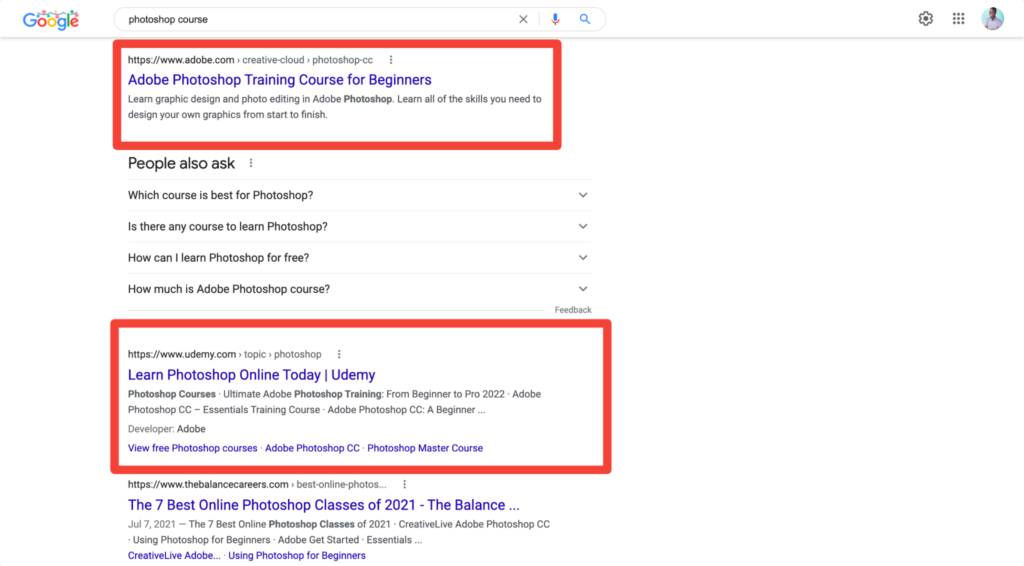
Plus, Photoshop is a vast topic, so Adobe can keep adding content as they create it.
Now that you know what makes a great lead-generating video content, here are some types of videos you can leverage to get optimal results.
Choose The Right Video Type to Fuel Your Marketing Strategy
Below are three types of videos you can leverage to generate more leads.
Influencer-backed videos
CXL and Fullfunnel.io are perfect examples of companies that put influencer-driven video content into action.
CXL partners with experts (influencers) to produce free and paid courses and often webinars.
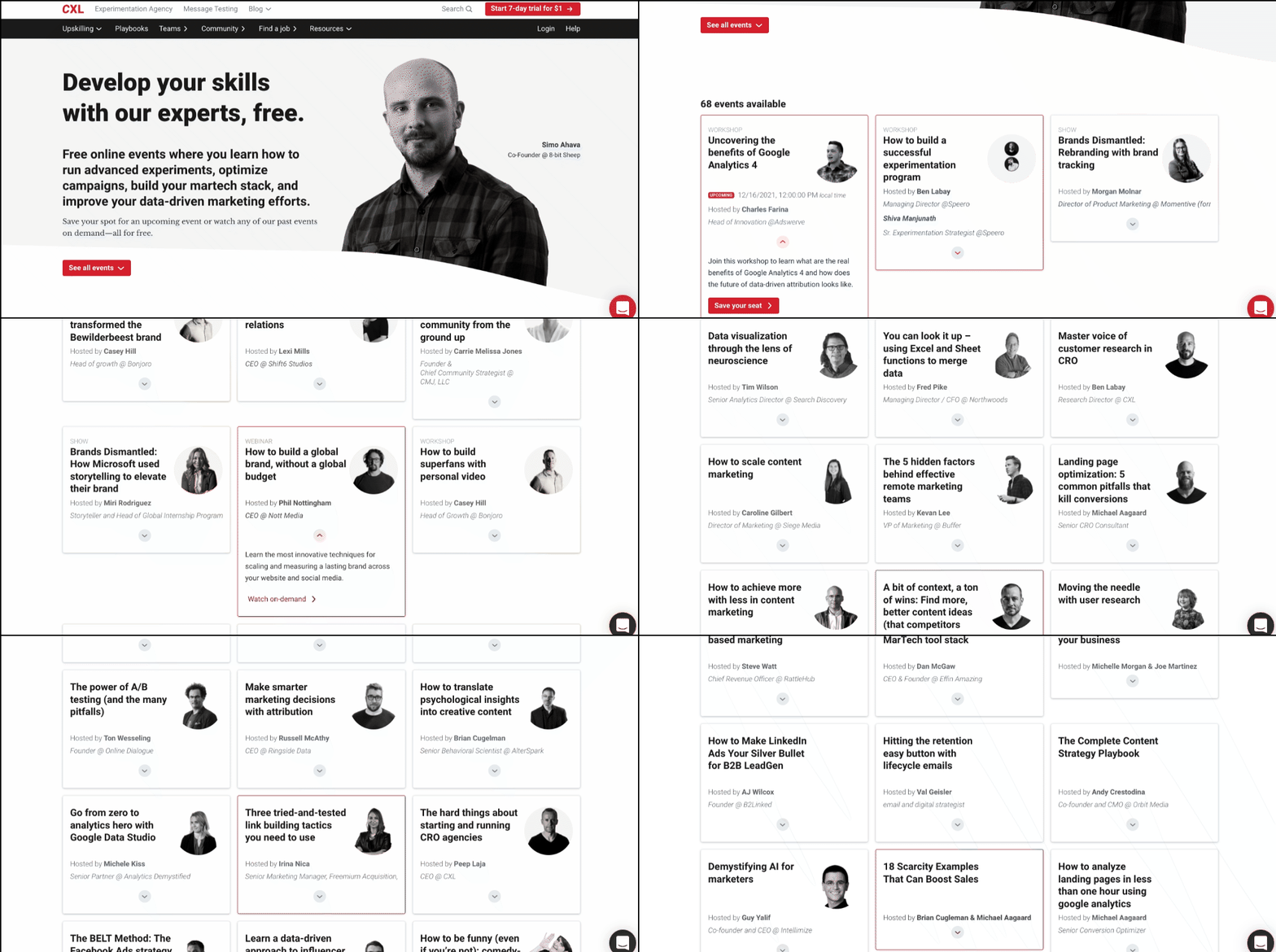
You don’t have to pay to watch these videos, but if you want to get a sneak peek or access these courses, you have to opt-in with your email addresses and names. CXL uses this video marketing strategy to fuel its courses’ subscribers base.
Andrei Zinkevich and Vladimir Blagojević from Fullfunnel.io use the same strategy except that their content is free to access and does not require opt-in.
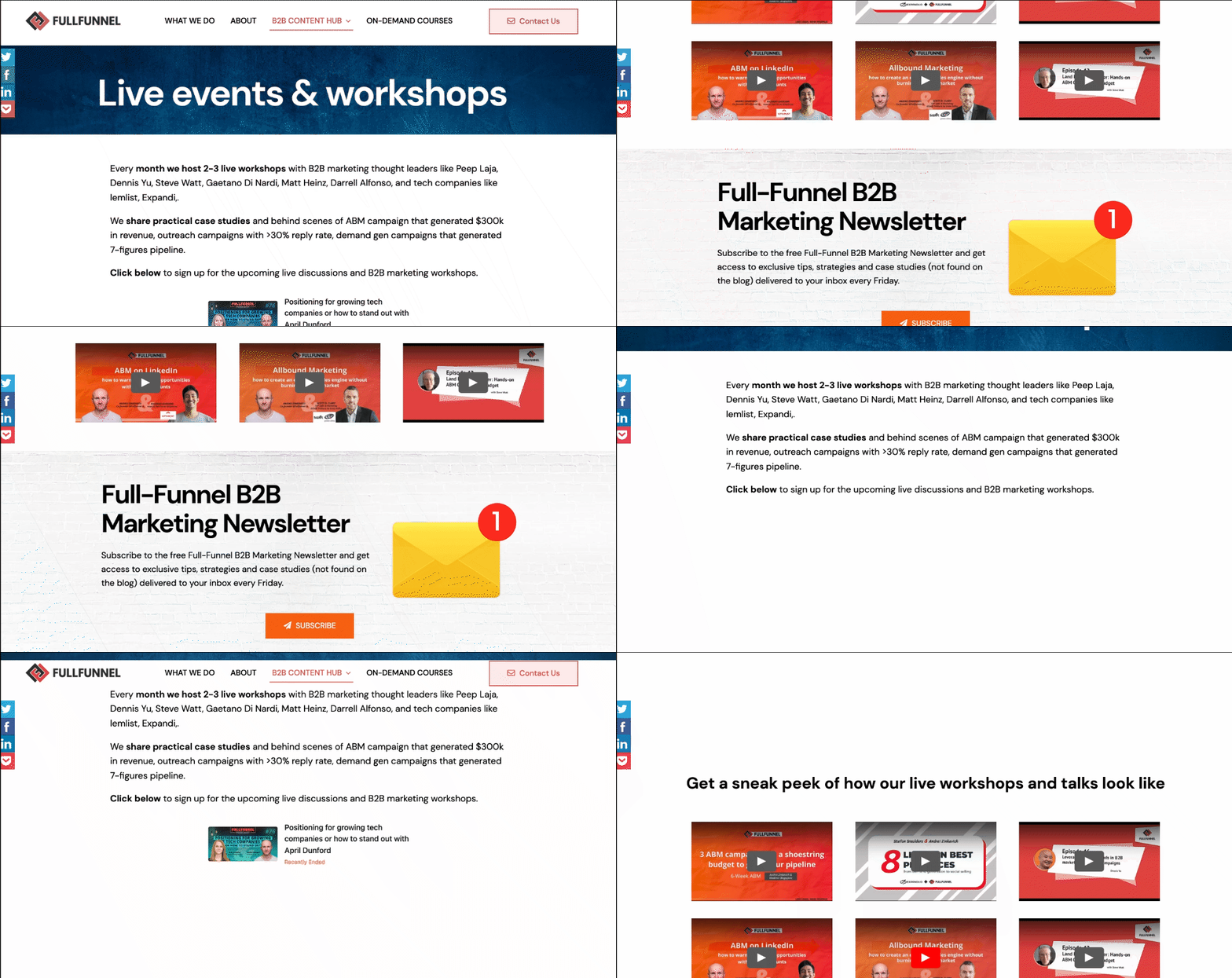
On the other hand, the end goal of their webinars is to build awareness, help viewers solve their problems, and position Fullfunnel.io’s services as the ideal solution to viewers’ problems. So far, this strategy has helped them grow the demand for their service.
The beauty of this type of video content is that it lets you tap into the fan base and authority of guest influencers to fill your lead pipeline before and after the video sessions. It’s the ideal way to educate, engage, and convert leads—all at the same time.
Demo videos
Whether you are selling a SaaS product or any other solution to B2B brands, chances are you are already leveraging demo videos.
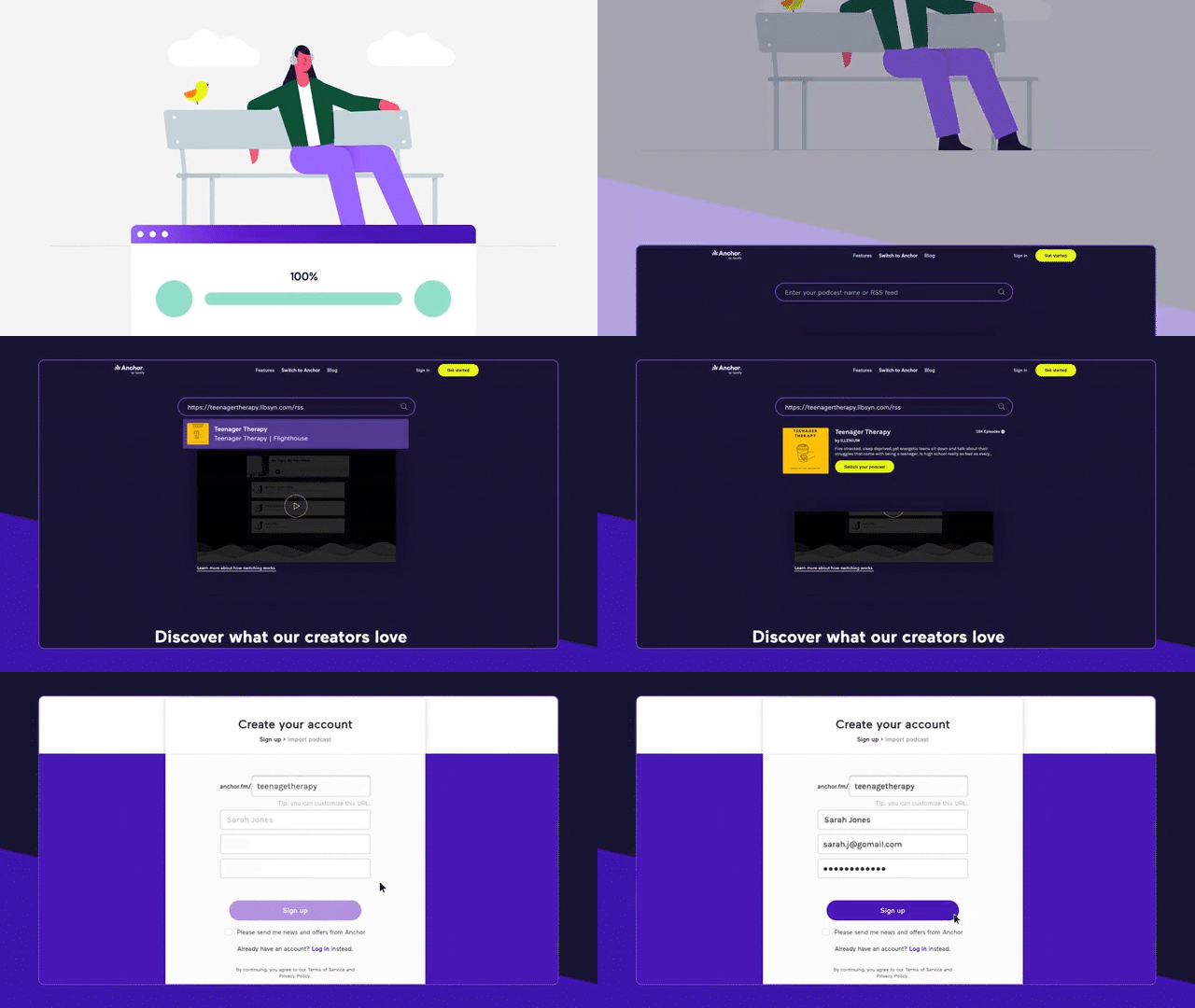
Demo videos, contrary to popular belief, make significant content assets. For example, Wistia uses demo videos to educate their audience and as a channel to make a query (place a form or even include a CTA at the end of the video). And Vidi uses them as a FAQ to clarify user questions and engage them even more.
Salesforce is another example of companies that leverage demo videos as lead-generating assets. Salesforce gates each of its product demos so that visitors have to exchange information before they can access the company’s resources.
Testimonial videos
Ninety-two percent of consumers trust a brand that someone has recommended to them, even if it’s a stranger. Couple that with the fact that people trust testimonial videos more than traditional text-based testimonials.

By inviting your established users to create video content (testimonial videos) to recount their experience using your product, your soon-to-be customers and prospects will have a more objective idea of the value proposition of your product.
Testimonial videos are also a type of user-generated content that allows companies to move prospects quickly through their sales cycle and accelerate the buying decision. In fact, these types of videos add credibility—it’s not just you saying what can be done; it’s actual users showing how they benefit from your product.
Repurpose Your Video Content to Suit All Your Marketing Channels
Creating and editing a video takes a lot of time, so there’s no reason to use it only once.
Here’s what Michael Pirone, co-founder of Vidico, has to say about it.
“You can leverage many distribution channels to get the word out about your videos and your product. Spend time getting to know your target audience and share your videos where they will have the most impact.”
Ways to make your videos work as a marketing flywheel
Here are three ways to make your videos work as a marketing flywheel.
1. Repurpose video on your blog.
A study showed that videos are 50 times more likely to appear on the first page of Google than text results. So by posting your videos on your blogs like Neil Patel and CoSchedule do, you’re more likely to rank and engage your audience.
2. Add a full transcript next to your video.
Doing transcripts for your videos has two benefits. The first is that transcripts attract search engines with relevant keywords, which in itself is a ranking factor.

The second is that transcripts provide an opportunity for backlinks and internal linking. Without text, there is none of that. The other advantage is that visitors who don’t want to watch the whole video can still browse the transcript.
You can also put your transcripts together and turn them into gated downloadable content.
3. Create short videos.
In this age of TikTok and Instagram, short-form video is KING. However, not every B2B brand has its audience on TikTok. In this case, you can share these videos on LinkedIn. A great example of this is Chris Walker of Refine Labs.

His short videos on Linkedin get thousands of views and serve as an awareness and nurturing campaign for Refine Labs.
The post How to Use Video Marketing for Lead Generation appeared first on Content Marketing Consulting and Social Media Strategy.
Source: convinceandconvert.com

5 Rules of Cost-Effective Video Marketing
By now, nearly everyone agrees that video is the premiere medium for effective content marketing.
You can find statistics galore back up that claim—including some jaw-dropping numbers from information hub 50Wheel.
According to their report, ninety-one percent of marketers say that video provided ROI in 2020!

Disclosure: This content is reader-supported, which means if you click on some of our links that we may earn a commission.
But just because you think video is great doesn’t automatically make it an effective part of your marketing mix.
That takes work—and planning.
So, here are some helpful guidelines, whether you’re just getting started or trying to pivot your inbound marketing or social media strategy.
5 Rules of Cost-Effective Video Marketing
Rule #1 – Video isn’t as expensive as you think it is.
If you’re a small business, a startup, or simply an author or an expert with ideas to share, you’ll experience extreme sticker shock when exploring video.
The cost of traditional video production starts at around $1,000 per finished minute!
There are good reasons for this, like the cost of a camera crew and studio space, but it’s still a huge deterrent.
The traditional video production model required plenty of travel time and some pretty expensive gear.
Either a film crew went to your location, or the principals had to go to a recording studio.
Both added significant costs.
Fortunately, the smartphone changed all that.
Cameras on mobile devices have improved exponentially—to the point where they are now a normal part of professional, feature film production.


For marketing teams, this means the need for a big crew is no longer paramount.
Everyone has a production-capable camera in their pocket.
It’s true that managing huge video files on smartphones is a pain, and that recording livestreams on Zoom is problematic over Wi-Fi.
However, there are great solutions for remote capture—temporarily storing high-quality footage on devices before uploading it for editing.
Some even allow a director to guide the sessions remotely and turn your smartphone or tablet into a teleprompter!
With remote capture, even when you add decent lights, microphones, lenses, and other basic gear, the basic video cost-per-finished-minute has dropped by about fifty percent!
That means even small businesses and startups can realistically consider video as the primary medium of a sustained, integrated, inbound marketing strategy.
Rule #2 – DIY video isn’t as affordable (or effective) as you think it is.
After reading the above, some will conclude that, in order to “do video,” all they need is a decent phone or tablet, and some accessories.
While the DIY approach is admirable, it has drawbacks.
First, there’s a steep learning curve and a lot of other tasks competing for your time.
Good video requires a story concept, a measurable objective, and the time and expertise to edit and publish each video to the appropriate channels.

If you assign a video to a member of your marketing team, be prepared to have them give up other tasks—or else hire more staff.
Second, there are just too many different kinds of videos to do them all well. (See Rule #4.)
Doing a simple vlog by yourself is pretty easy.
Creating effective lead-gen videos—not so much.
Finally, DIY is hard to sustain.
Like all good inbound marketing, video has to be done over the long haul in order to be effective.
That means adding fresh content—especially at the top and middle levels of the sales funnel.
Rule #3 – Always consider SEO, formatting, and platform selection.
The way we design and produce video has changed, but the rules for making videos visible to market-qualified prospects have not.
Even if your video is engaging and compelling, merely posting it isn’t enough.
Applying real-world SEO to video content means more than using keywords in the title and description.
Video also should not stand alone.

The best results will happen when both video and written content are integrated with each other—and both coordinated with your overall SEO and marketing funnel strategy.
Even though the cost of video has dropped, it’s always a good idea to optimize it for multiple venues.
That means planning ways to “recycle” existing content and knowing how to format it for different platforms and social media feeds.
Finally, there are so many video-friendly platforms to choose from that one must be careful not to get spread too thin.
Pick a social media platform whose age and income demographics best fit your target market.
Deliver video content as a regular part of an email drip campaign or e-newsletter.
Above all, select a hosting environment that offers the best balance of search-friendliness and interactivity.
Rule #4 – Not all videos are the same!
There are lots of questions and arguments about how long a marketing video should be—given the attention spans of supposedly typical web users.
These are not the right questions to ask.
Of course, a video should always be engaging, and not just in the first few moments, but first, it has to be the right kind of video.

For example, a brand video used at the top of the funnel is totally different from an animated explainer, a recorded demo, or an interactive solution video.
In other words, there are many different types of video to consider, so marketers should always avoid the “one size fits all” generalization.
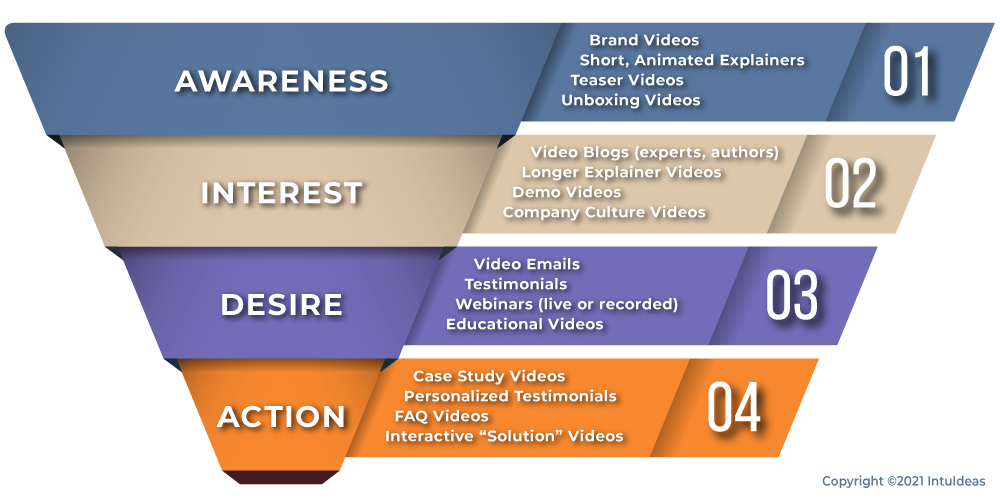
Each type has different technical and design requirements and an optimal place in the sales funnel.
A successful marketing funnel has a simple requirement.
Every piece of content should give qualified leads a legitimate reason and a means to explore further, commit to your solution, and continue towards a decision.
Video is the ideal medium for accomplishing that, but only if produced and implemented to do so.
Rule #5 – Done right, video marketing has a substantial ROI.
Most marketing pros know the old quote, “Half the money I spend on advertising is wasted; the trouble is I don’t know which half.”
Video marketing is not a guarantee or a panacea.
However, if done correctly, video provides a clearer opportunity than most online media to realize a return on investment.

By definition, a good video is engaging.
It is cognitively easier to experience. The viewer can be immersed in the story without having to read and interpret words on a page.
It also fulfills the basic requirement of all good marketing: “Show me; don’t tell me.”
Above all, with the right amount of interactivity, the video gives the user the power to choose, making their interaction with your brand direct, immediate, and consequential.
Anyone can add a “buy now” button or SEO keywords to a marketing video.
But not everyone can use video to create a compelling story—one that solves a genuine need—guiding qualified buyers into a lasting relationship with your brand.
The post 5 Rules of Cost-Effective Video Marketing appeared first on Content Marketing Consulting and Social Media Strategy.
Source: convinceandconvert.com

How to Create a Content Calendar for Your YouTube Strategy
In the world of social media marketing—planning needs to become your best friend if you want to find the success you’re looking for.
We’re not talking about just getting tons of followers… we’re talking about those YouTube videos that make SALES.

And the only way to make those sales is to publish the videos that drive viewers to your landing pages.
That’s where your content calendar comes in.
If you don’t have a content calendar, you’re going to find yourself confused and unsure of what’s on your plate really quickly.
This strategy might work for a little bit but after a while, you’re going to realize that scalable strategies are where  it’s at.
Having a content calendar is going to give you a roadmap of what’s on your plate this month and when you should be promoting what offer.
It’s going to be one of the biggest reasons you’re getting more than followers, you’re making SALES!
And isn’t that why we’re making YouTube videos in the first place?
So let’s dive into how you can create a content calendar for your YouTube strategy that makes your life as a business owner, agency, or marketer sooo much easier.
5 Steps to Create YouTube Content Calendar
Here are the 5 steps to create your YouTube content calendar.

#1: Choose your upload schedule
How often are you going to upload videos?
There are a lot of different schedules you can choose for your YouTube strategy, and there isn’t necessarily one right answer.
It just depends on your industry and your team.
For example, a YouTube vlogger can’t expect to get much pay-off from uploading one video a month.
For their industry, viewers want to have constant contact with their favorite vloggers and they’ll want to see them as much as possible.
Uploading 3 videos per week is a good start for a vlogger.

On the other hand, if you’re an agency owner posting about marketing strategies—you can post one GREAT video per week.
Or, if you’re feeling like an overachiever, you can post 3 times a week.
That brings us to the second part of choosing your schedule: your team.
If you are a one-person show, make sure your YouTube schedule is realistic.
For example, if you need to do all of the work within your agency and shoot, edit, and upload 3x YouTube videos a week—that might lead to biting off more than you can chew.
If you have a 10-person team and you know that between two of your team members they could handle a posting schedule like this, then green light your way to a 3x per week posting schedule.
Decide what schedule works best for your industry and your team and then decide what days your videos are going to live.
It could be every Tuesday, or every Monday, Wednesday, and Friday.
Whatever works best for your audience and your schedule.

#2: Choose the topics you’ll make your videos about
Bet you weren’t surprised to see this task on your content calendar to-do list.
That’s right, the second thing you need to create a content calendar is…content.

Sit down and figure out what content works best for your audience right now.
You’re going to want to come up with as many content topics as you need to create videos per month (and maybe a few extras in case one topic doesn’t end up working out).
For example, if you’re posting 1 video per week each month you need 4-6 content ideas.
You can either come up with all of these ideas in one brainstorming session each month or come up with 12+ ideas at once so you have 3 months of content ready to film.
But WHERE do you find content topics that your audience will be interested in watching?

- Quora: Search for questions related to your industry and create videos that answer those questions
- AnswerThePublic: Search for your industry and look for questions you can answer in your videos
- Ask your customers: Send out surveys on what content your customers want from you and look through customer feedback for questions that come up often
- Facebook groups: Read through Facebook group posts related to your industry to see what your customer avatar is struggling with
- YouTube: Search YouTube to see what content is doing really well in your niche and figure out how you can make what they have even better
With your upload schedule and content topics in hand, it’s time to whip out your upcoming product launches, promotions, and offers to make sure your content is in line with what you’re selling at the time.
#3: Put your product launches, promotions, and new offers in your calendar


If you’re wondering where your YouTube video topic ideas went—we’ll come back to them in the next step.
First, we want to make sure your upcoming product launches, promotions, and new offers are in your calendar so we know when you’re going to need your content to support certain products or services you offer.
This is the time to put everything in your calendar on the DAY that it is going to launch.
You want to have the day your new product is launching, the day you’re going to announce a new promotion, and the day you’re going to talk about a new offer.
It’s important that you have each of these dates because we’re going to work your YouTube videos around these promotions so that your content feeds into everything you’re running at that time.
#4: Put your YouTube video content ideas into your calendar

Alright, now for the part that you probably thought was coming first in this article—putting your YouTube content in your calendar.
Now that you have all of your launches, promotions, and offers in your calendar it’s easy to tell what content topic should go live each week.
For example, if we’re running a promotion on our Social Media Mastery Course in the middle of the month, we want to post a social media marketing-related YouTube video that week so we get more traffic to that offer.
See what we’re doing here?
Your YouTube strategy isn’t just there for views and followers, you want to be using YouTube as an asset to getting more sales in your business.
By pairing your YouTube content calendar with your promotions calendar you’re creating a cohesive calendar that fits together like peanut butter and jelly. 
#5: Choose the dates you’ll promote your YouTube videos

Last but not least, your content calendar needs to have the dates that you’ll be promoting your YouTube content as well.
For example, if your schedule is to post YouTube videos on Tuesdays, then you’ll want to be promoting that video on Monday and Tuesday each week.
On Monday you’ll talk about how it’s going to be live tomorrow and ask your audience to turn their post notifications on so they know when your video is live on YouTubeOn Tuesday, you’ll be reminding your audience that your video just went live and giving them the link to check it out
You want these dates in your calendar so you can SEE what you’re promoting and on what day.
This means that when it’s time to promote a video, you’re not stumbling to get your promotional assets together—you’re good to go and can sail smoothly through the day.
The reason content calendars exist is to make our lives as content creators easier.
Use a YouTube content calendar to fit your YouTube strategy into your entire marketing strategy and to make sure you stay on track with your uploading schedule.
The post How to Create a Content Calendar for Your YouTube Strategy appeared first on DigitalMarketer.
Source: digitalmarketer.com

The 5 Most Important Metrics to Track Your YouTube Growth
YouTube is the second most used search engine in the world, second to Google.
That means that there’s a pretty big (okay—HUGE) chance that your customers are watching YouTube.
They’re using the video platform to find entertainment and education.
Depending on your business, your YouTube strategy probably involves a little bit of both.
For example, we love teaching about email campaigns to boost conversions… while one of our managers wears a flamingo shirt.
But, what’s a YouTube channel without a strategy?
A very bold idea.
While we love bold ideas, we love strategy just as much.
What do all great strategies have? METRICS!
Metrics tell us when we’re doing well and when we’re doing badly.
They’re our lighthouse when we’re at sea trying to find the mystical land of Traffic and Conversions.
5 Metrics to Track Your Growth on YouTube
If you’re looking to grow your YouTube channel, here are the 5 most important metrics to track your growth.
NOTE: The first 4 metrics can be tracked in your YouTube analytics. The last metric can be tracked with a link tracker.
#1: Watch Time
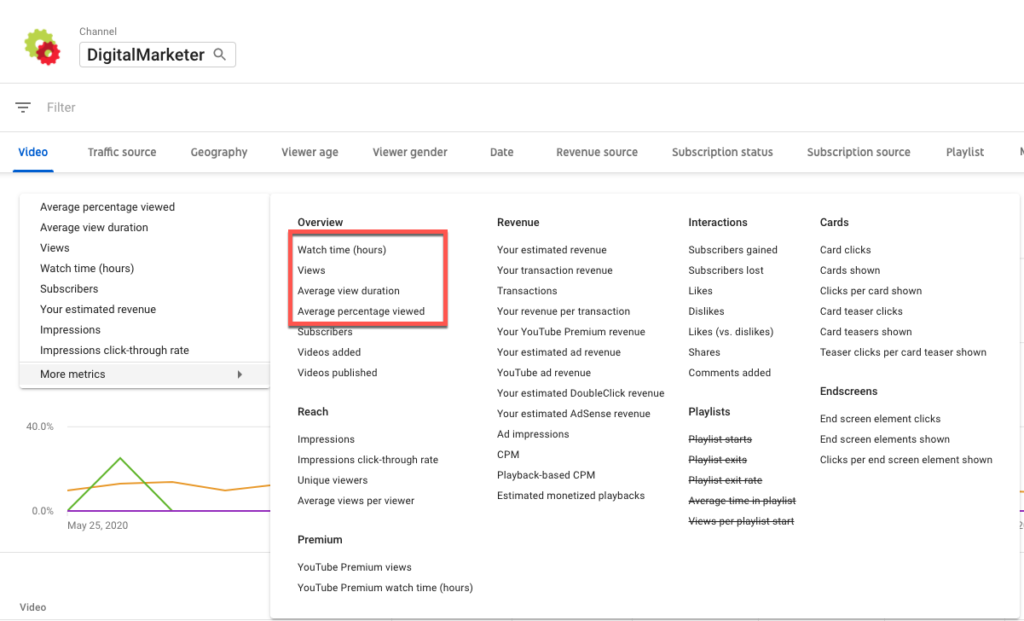
Watch time is the amount of a video somebody watches.
On YouTube, they’ll average your watch time for each video and tell you in your analytics.
Don’t be scared if you find that your watch time isn’t 100% for every video.
This is kind of like getting a 100% conversion rate—you’re going to have to be so perfectly niched that you create the holy grail of marketing success.
That can happen… but don’t short yourself if it doesn’t.
Watch time is an extremely important metric for your YouTube growth because it’s telling you how well your content is answering your viewer’s problems.
If viewers don’t feel like they’re getting what they were promised in your title and thumbnail, they’re going to click off of your video.
On the reverse, if they feel like you’re educating them and keeping their attention—you’re going to have great watch time metrics.
For example, if we noticed that our watch time was lower than 40% for a video, we’d start to really evaluate that video’s template and see what needs to be done to improve that watch time.
Maybe our introduction was too long or the amount of time spent talking about the topic of the video wasn’t concise enough, and viewers decided to go elsewhere.
We’re always going to aim for an above 40% watch time on each video we publish and use the videos that perform well to show us what general template to follow with future videos.
#2: Impressions Click-Through Rate
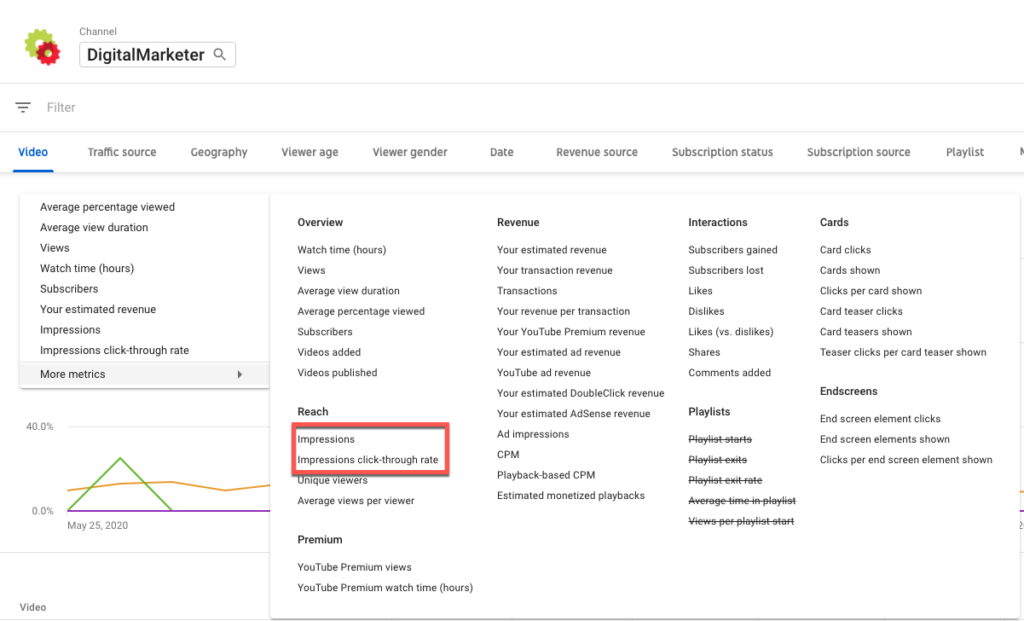
Impressions click-through rate tells you how often a video is being clicked.
You can equate it to the click-through rate (CTR) of a Facebook ad.
For every set amount of people who saw your video in their feed, how many clicked to watch it?
When your videos get a high CTR, you did something really well.
That could be that your title nailed your customer avatar’s pain point and your thumbnail was eye-catching and had the right information on it.
As most YouTube stars would tell you—it’s all in the thumbnail.
Changing your thumbnail can have drastic effects on your CTR.
If you’re constantly seeing a less than 5% CTR on YouTube, start to change the creative of your thumbnails to see if you can improve them.
For your videos performing well, take note of their thumbnails and titles and how you can replicate that in the future.
Remember, your metrics are here to show you the way… let them guide you.
#3: Most Popular Videos
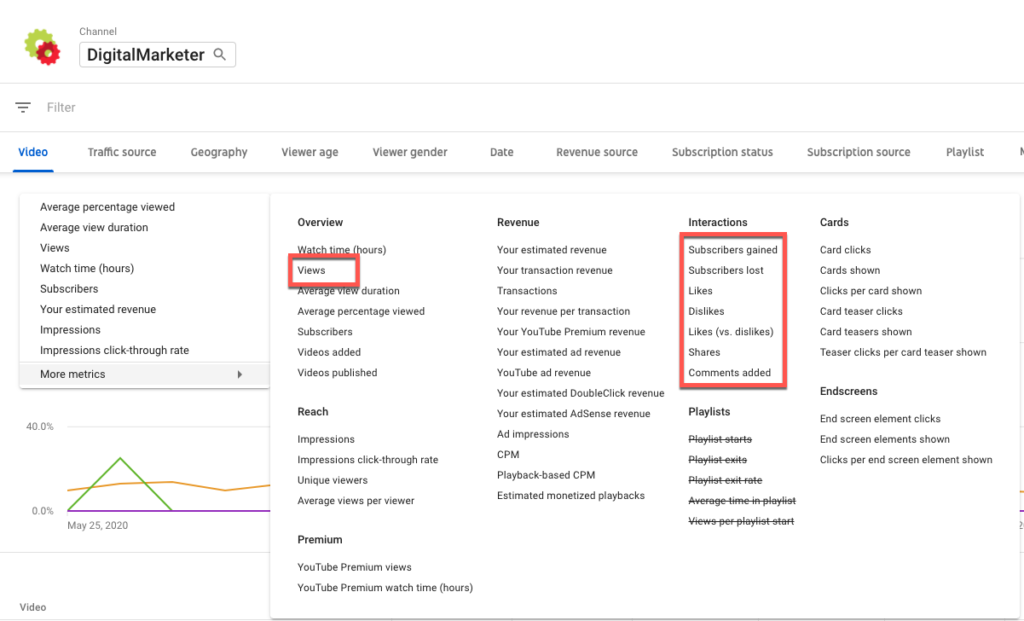
You’ll find your most popular videos by going to your YouTube page and clicking on the filter option, and choosing “Most Popular.”
This will show you your most popular videos in descending order, so you can see what videos are carrying the weight for the rest of the team.
This metric is going to help grow your YouTube channel by being a direct line of communication between yourself and your customer avatar.
What content that you created are they LOVING… and how can you create more of it?
Another bonus about this metric is that you can also see what your competition’s most popular videos are.
This will give you more content ideas as well as validate what content your viewers want to see.
If they have a similar audience to yours, you know that your audience also probably wants to see that content.
#4: Audience Information
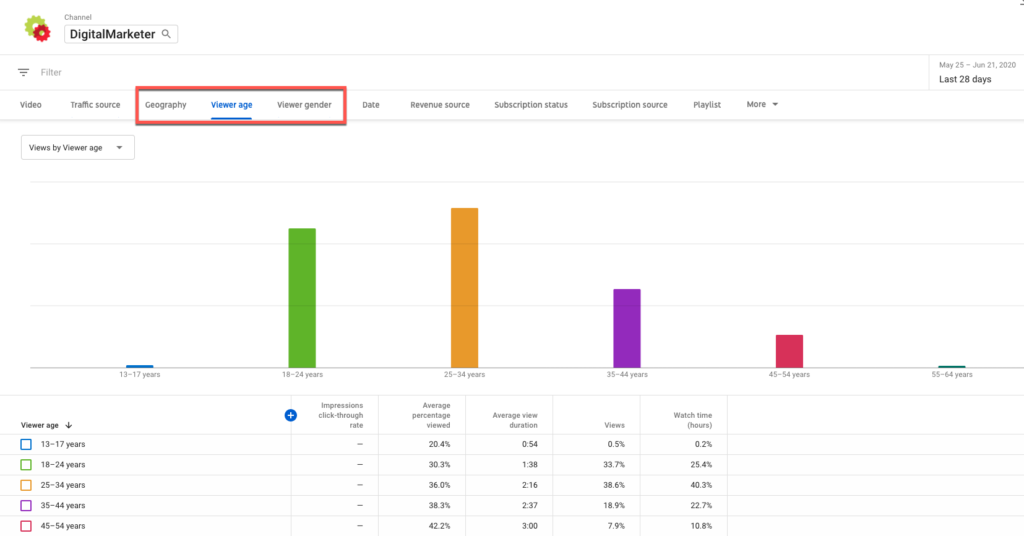
Audience information is essential knowledge for anybody trying to grow a social media following or business.
Knowing your audience is key to creating the content they want—and to making sure you’re creating content for the right people.
There are 2 metrics to look at here, the first is your internal traffic sources.
This tells you how many viewers came to your video by having it suggested to them, by finding it through YouTube search, by choosing it on your channel, etc.
The second is to look at your external traffic sources.
How many viewers came from a Google search, Facebook, a website, or a link in an email they received?
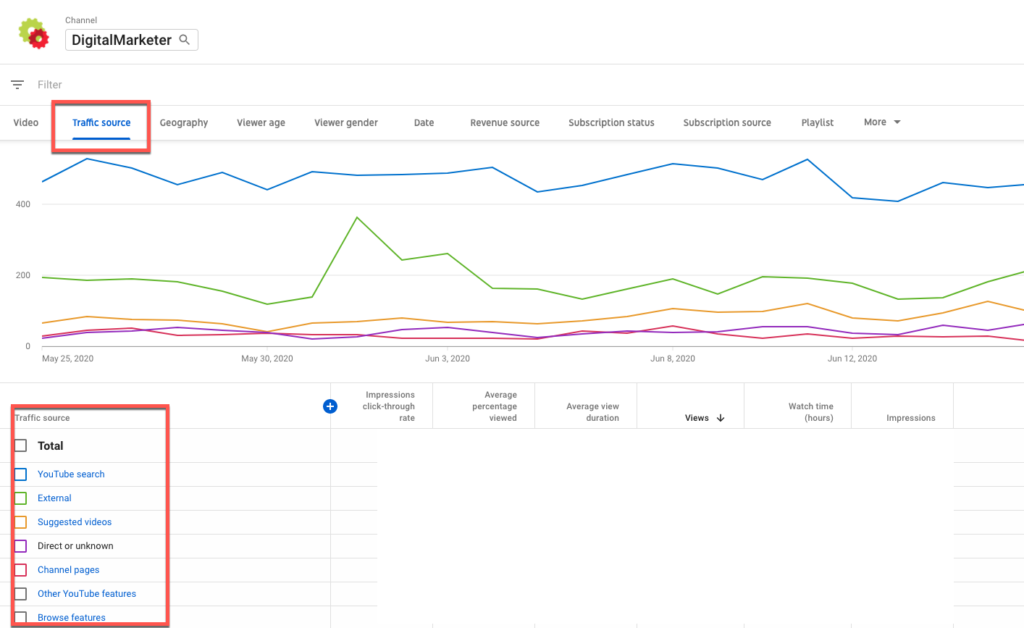
Knowing these metrics tells you where your audience is coming from, and what you’re doing right or wrong.
For example, if you’re seeing that a lot of your views are coming from YouTube search—you’re doing a great job at creating videos that your customer avatar is specifically looking for.
If you’re sending an email blast to 100,000 people every week with your recent YouTube video and you’re not seeing any sources coming from email—your email subscribers aren’t taking the bait in your email to watch your videos.
If it’s important that they watch them, it’s time to create a new strategy.
#5: Actions Per Video
Actions per video are the number of viewers who clicked the link that you asked or told them about in the video.
This is the only YouTube metric that can’t be tracked with YouTube analytics—but it is so important to make sure you’re paying attention to it.
Having one million views on a YouTube video is great, but if nobody clicked through to your lead magnet, then how successful was that video?
For example, you may have a video that is one of your least popular videos, but it has a 15% CTR for your call to action.
While the video title or thumbnail isn’t meeting the needs of an average viewer, your call to action is.
This tells you that how you framed your call to action or the offer you created for that video is really good.
You should try and do that again.
To track this, you’d use a link tracker to see how many viewers clicked the link you placed on the video or in your description (or both!).
Then, you’re going to see how many people viewed the video. Divide the number of viewers who clicked by the total number of viewers and multiply by 100 to get your link’s CTR for the video.
Your YouTube metrics are going to be your lighthouse, guiding you towards building your following and growing the awareness, subscribers, and customers of your business.
Use these metrics to grow your YouTube channel and sail smoothly into the port of the mystical land of Traffic and Conversions.
We’ll see you there.
The post The 5 Most Important Metrics to Track Your YouTube Growth appeared first on DigitalMarketer.
Source: digitalmarketer.com

13 Great Instagram Video Ad Examples
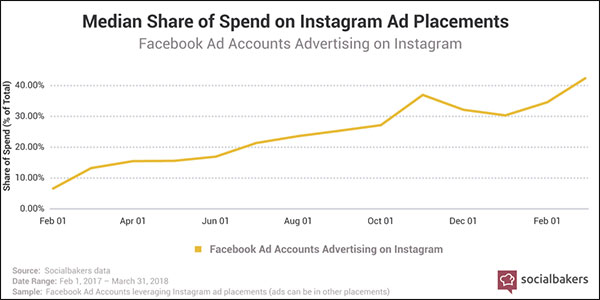
Instagram ads are blowing up. To give you a better idea of what I mean by “blowing up,” the average portion of Facebook ad budgets going to Instagram ads grew from under 10% to more than 40% in just over a year:
And, as we all know, video has been growing by leaps and bounds for years now.
So, when you combine the 2—Instagram plus video ads—what you get is a recipe for online success.
Right?
Well, yes… as long as your ad does its job of grabbing the viewer’s attention and then communicating a clear benefit and a compelling call-to-action.
If you can figure out how to do all that in 60 seconds or less, you might just have found the key to effective selling on Instagram.
So how do you create a great video ad?
I’m not here to give you a one-size-fits-all formula, because frankly, I don’t think there is one.
Different businesses and different products will be best served by different approaches and ad strategies.
But what I can do is give you a few great Instagram video ad examples to inspire your next Instagram marketing campaign.
13 Instagram Video Ads Example
Here are 13 Instagram video ads from companies that are doing a great job of grabbing people’s attention and communicating the value of their product or service in a compelling way.
Instagram Video Ad Example #1
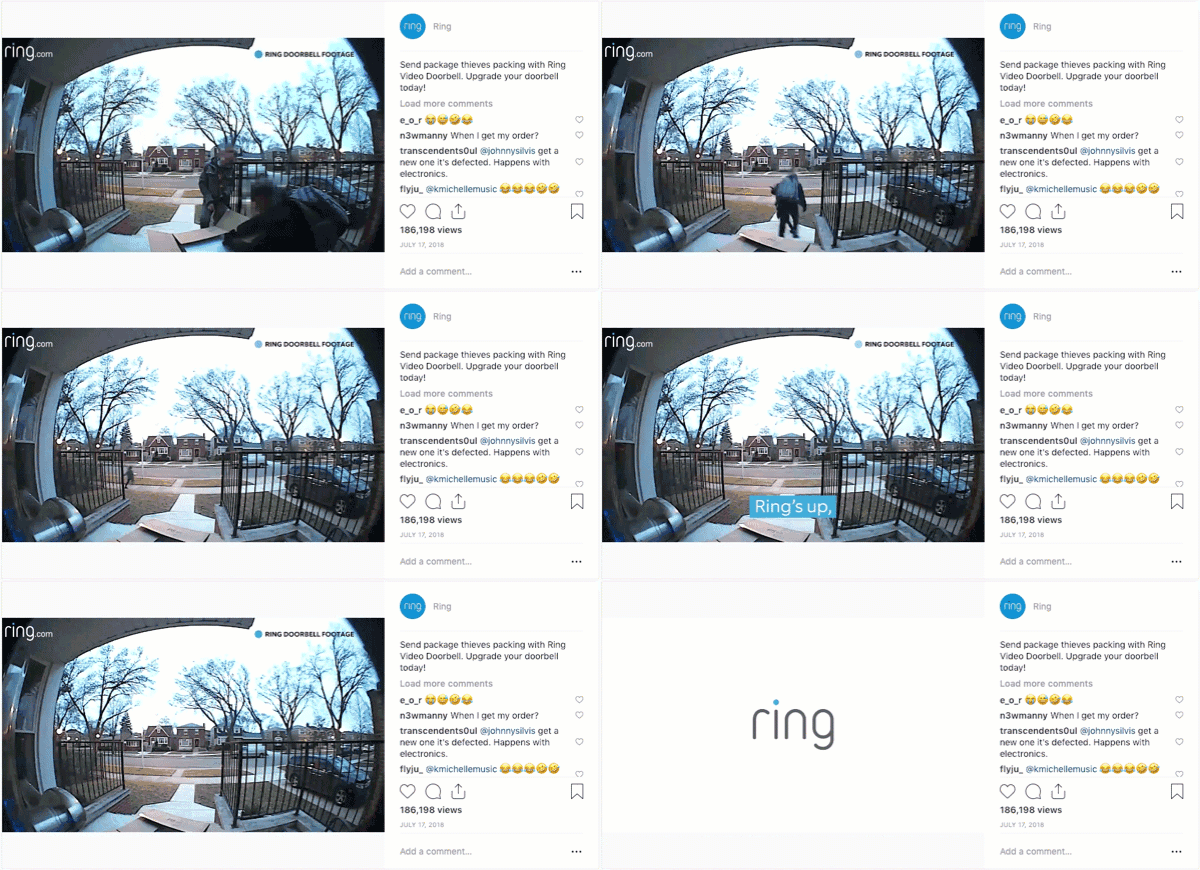
What Makes This Ad Great:
This video ad for Ring hits on a real and frightening issue for a lot of people, and for that reason, it will instantly resonate with anyone who’s ever had a package stolen. (I know I have.)
It’s also a fantastic example of “show, don’t tell.” Instead of just telling you what Ring can do, they show the product in action through a dramatic scene.
Who wouldn’t want to be able to scare would-be burglars off their doorstep?
Instagram Video Ad Example #2

What Makes This Ad Great:
Two athletes ranging from a hot-air balloon, doing tricks with a soccer ball hundreds of feet up in the air?
This ad has a great concept that demands your attention.
Add in the fact that it’s filmed with a GoPro, and you can almost feel your stomach starting to lurch.
Under Armour actually partnered with GoPro for this ad, and the combination works great for both brands.
Instagram Video Ad Example #3

What Makes This Ad Great:
The FeetUp didn’t do anything fancy with this ad: they just showed their product in action.
And when you have an innovative new product targeting a passionate audience, sometimes that’s all you need.
Especially when that product lends itself to a visual demonstration, like the FeetUp Trainer.
Any yogi who has trouble with handstands will instantly recognize how this product can help improve their practice.
Instagram Video Ad Example #4

What Makes This Ad Great:
Here’s another example of a cool product being demonstrated visually.
In just a few seconds,
Helios shows you how easy it is to create an illuminated wall that’s both creative and functional.
Doesn’t it just make you want one?
Instagram Video Ad Example #5

What Makes This Ad Great:
This video ad from Freshly grabs your attention with a question that many of us can identify with: “Too busy to eat healthily?”
Then the ad effectively juxtaposes benefit-driven copy with quick videos showing you how easy it is to eat smart with Freshly.
Finally, the ad gives a sneak-peek at all the meal options available and ends with an attractive promo: 6 meals for $6.50 each during your first week.
Instagram Video Ad Example #6

What Makes This Ad Great:
This simple video ad from Stitch Fix catches your eye with fast-moving images displaying great-looking outfits for different situations: day at the office, weekend getaway, watching the game, and more.
Then it lists 3 big benefits that set it apart from competitors: no subscriptions, free shipping & returns, and an extra discount if you purchase all the items in your delivery.
(NOTE: Need a helping hand with your digital marketing efforts?
Or maybe you just want proven, actionable marketing tools, tactics, and templates to implement in your business?
Check out the latest deal from DigitalMarketer, and you will be on your way to helping your business grow.
Instagram Video Ad Example #7

What Makes This Ad Great:
Here’s another video ad that, while simple, communicates a strong benefit in just a couple of seconds.
The copy is equally straightforward: “Want to go somewhere?
Take an Uber.
An easy way to go from one place to another.”
The unspoken message behind this simple ad is just how easy it is to grab an Uber.
Instagram Video Ad Example #8

What Makes This Ad Great:
This ad from Square is a great example of a stylized video demonstrating how easy their product is to use.
The video shows just 4 simple steps: slide, click, tap, paid.
Notice how the brightly colored background helps it to stand out in the feed.
(RELATED: Episode 182: Top Facebook and Instagram Predictions for 2019)
Instagram Video Ad Example #9

What Makes This Ad Great:
Speaking of bright background colors that pop—could anything stand out more than this big yellow ad?
Eczema Honey follows a 2-step strategy here: first, grab your attention with a bold color.
Second, build credibility by shuffling through 5-star reviews from satisfied customers.
The result is a simple ad that’s surprisingly effective.
Instagram Video Ad Example #10

What Makes This Ad Great:
This video ad has a homemade look to it, which helps to make it feel less like an ad and more like an organic video your friend might post.
Lull shows a couple having a great time unwrapping their mattress, communicating just how easy it is to set up and enjoy your new bed.
One thing they could have done to improve this ad?
Include captions. As you can see from the GIF above, there’s no way to hear the voiceover if the sound is off.
Instagram Video Ad Example #11

What Makes This Ad Great:
This ad gives you a tantalizing glimpse of some unique living spaces.
Most people have never considered living in a yurt, but after seeing these picturesque homes you might just be tempted.
(Scroll through the comments if you don’t believe me.)
Hidden in this simple ad is an unspoken message: you can find any sort of house imaginable on Zillow.
Instagram Video Ad Example #12

What Makes This Ad Great:
This colorful ad catches your eye with a long list of travel destinations.
The music is upbeat and catchy and really reinforces the tropical destination theme.
This is also a great example of using location targeting to deliver a highly relevant ad to people in a specific area.
Instagram Video Ad Example #13

What Makes This Ad Great:
How do you stand out in a crowded market? Wolf and Shepherd show us one way with this video ad: use your product to provide a dramatic demonstration.
Running with the bulls while wearing a pair of dress shoes sounds borderline crazy, but it sure does help set Wolf and Shepherd above the pack. (Or should I say, above the herd?)
(NOTE: Need a helping hand with your digital marketing efforts?
Or maybe you just want proven, actionable marketing tools, tactics, and templates to implement in your business?
Check out the latest deal from DigitalMarketer, and you will be on your way to helping your business grow.
The post 13 Great Instagram Video Ad Examples appeared first on DigitalMarketer.
Source: digitalmarketer.com