
Tag Archives for " URL "

How to Use Vanity URLs for Paid Ads
Whether you aren’t sure what the heck a vanity URL is or are just trying to figure out how to use them, you are in the right place.

You’ve probably heard the popular 70s song, “You’re so vain, you probably think this URL is about you…don’t you, don’t you?” OK, Carly Simon probably wasn’t singing about vanity URLs.
While they aren’t as catchy as that song, vanity web addresses are something you need to be paying attention to, especially when it comes to paid ads.
Whether you aren’t sure what the heck a vanity URL is or are just trying to figure out how to use them, you are in the right place.
Here’s what you need to know to leverage them to increase clicks and drive conversions for your paid ads.
What is a Vanity URL, and How Are They Used for Paid Ad Campaigns?
A vanity URL is a custom URL that is pronounceable, branded, or otherwise memorable.
They might contain a keyword that you are optimizing for, a brand or product name, or any other phrase that makes sense for the campaign.
These URLs can be used as your main URL, but they are commonly used to redirect users to another site or page.
For example, a vanity URL could be used on a paid ad to direct users to a landing page or on a billboard to drive traffic online.

Learn how to do a successful Paid Ad Campaign.
Vanity URLs Vs. Domain URLs for Paid Search
Vanity URLs should not be confused with domain URLs, especially in paid search.
Here is the difference: A domain URL is your actual URL, for example, neilpatel.com.
A vanity URL is a branded or otherwise memorable URL that redirects to the actual URL you want to send ad clicks to.
Why use a vanity URL over a domain URL? These URLs can include any information you want, including calls to action, keywords, or, really, anything else.
Let’s say, for example, you were creating an ad for Ubersuggest, our SEO tool. The domain URL for Ubersuggest is: https://neilpatel.com/ubersuggest/.
Rather than using the domain URL, you use something like: neilpatel.com/FreeSEOHelp.
Why does this matter in paid search? That small change could be just the push a viewer needs to click on your ad.
There are several benefits to using vanity URLs, which we’ll cover in a moment. First, let’s look at what vanity URLs look like in practice.
Vanity URL Examples for Paid Ads
Vanity URLs may sound like a small change. With so many SEO strategies out there, it might not feel like they are worth the effort.
Let’s take a look at vanity URLs in the wild so you can see the difference they make.
Here’s an ad on Facebook from Couch Console, a new couch accessory. They created an ad to promote their Kickstarter campaign.
Take a look at the URL:
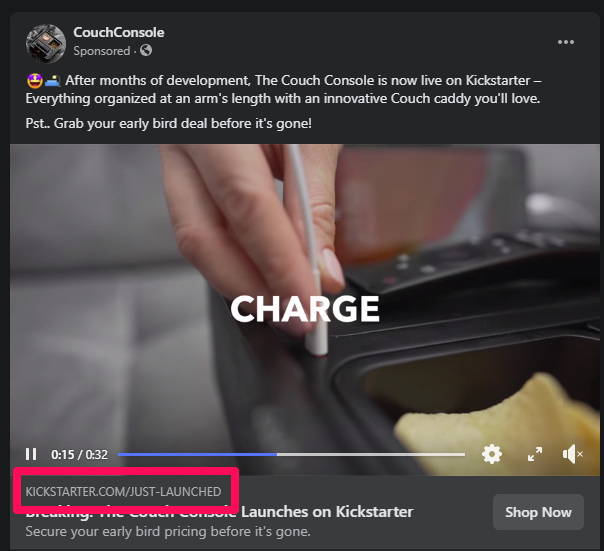
It shows the URL goes to Kickstarter and highlights something they want you to know—their campaign just launched. It’s new and exciting, something you want to be a part of.
Now, here’s the actual URL it redirects you to:
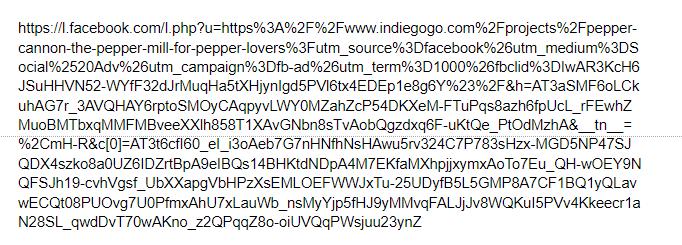
It’s longer and a lot less intriguing, right?
Here’s another example from Tom’s Interesting Finds. The URL in the paid ad is “indigogo.com/popular.”
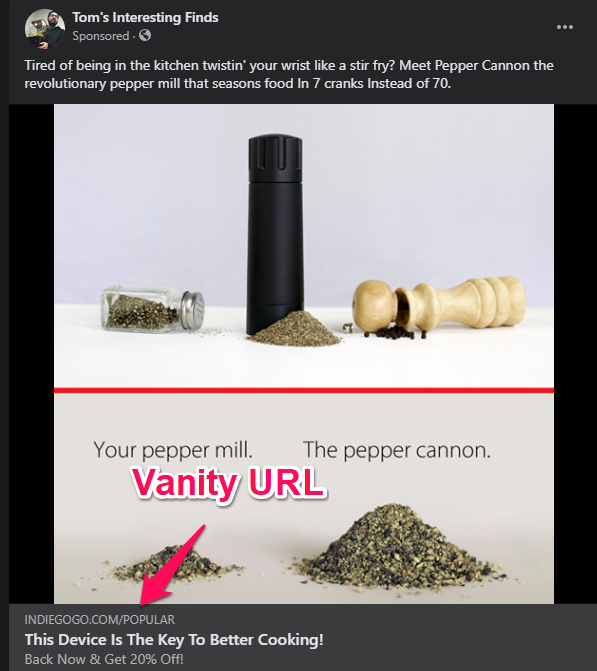
Here’s the URL it redirects you to:
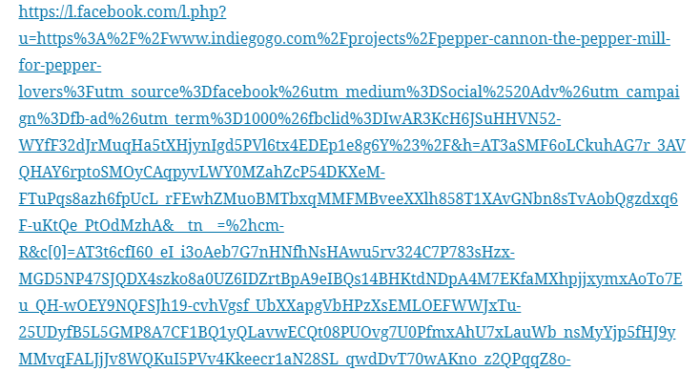
No one would ever remember 14 lines of random letters. It also doesn’t tell you anything about where the link will take you.
The vanity URL is cleaner, it shows people where they are headed and it gives them an idea of what they’ll find when they get there.
Why Are Vanity URLs Important?
The most obvious benefit of using customized, vanity links is they are shorter, which looks nicer, especially in paid ads. That inspires trust and avoids showing users the tracking parameters.
You might think, most people just click on the link, so it doesn’t really matter what the link looks like.
Well, there are several other benefits of using vanity URLs, including:
Increase Click-Through Rates:
Users like to know where they are headed when they click a link. URLs that include brand names or memorable terms increase trust, and can increase click-through rates by as much as 39 percent.
Builds Trust:
Untrustworthy sites may share weird links that lead to spam sites or viruses. A clean, readable link inspires trust.
Easier to Remember and Share:
Vanity URLs are shorter and include words or phrases that are easy to remember. No one is going to remember a long string of random letters and numbers, but they can recall a short and snappy URL like mypodcast.listennow.com.
Makes Tracking Easier:
Knowing where your traffic is coming from is crucial for understanding how ads perform. Custom URLs allow you to easily track where traffic originates and keep customer data, such as a coupon code or cookies. Plus, not all paid ads are online—you can track print ad traffic as well.
What’s the Effect of Vanity URLs on SEO?
Vanity URLs look nicer, increase click-through rates, and improve tracking. What about SEO, though? Can they give you a leg up in Google rankings?
They can.
Backlinko analyzed more than 11.5 million Google search results and found that shorter URLs have a small ranking advantage.
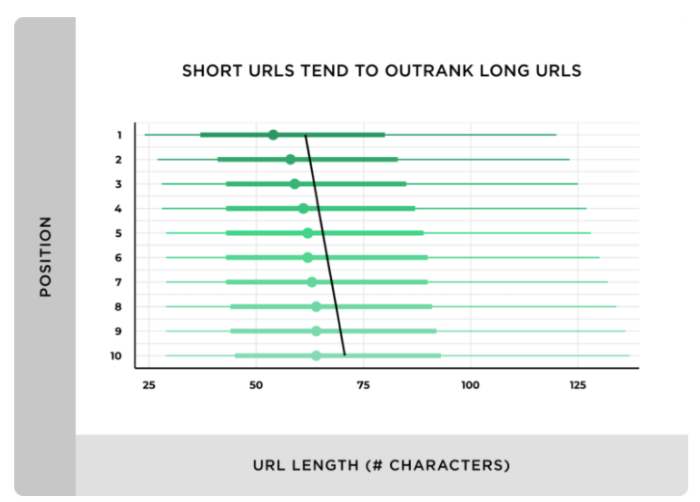
In fact, they found that URLs that rank No. 1 in Google tend to be nearly 10 characters shorter than URLs that rank No. 10.
Now, it’s unclear why shorter URLs rank better—it could be that they tend to have a higher click-through rate or that shorter URLs help Google understand what your page is about. After all, correlation doesn’t always mean causation.
What is clear, however, is that shorter URLs can give you a slight SEO bump.
Here’s another SEO benefit:
Using keywords in URLs is a ranking factor. It is a small factor, but it can count.
Keep in mind, these benefits are very slight. However, in the highly competitive digital landscape, these small bumps can help you outrank your competition.
Just make sure all your other SEO strategies are in place. A keyword-rich, vanity URL won’t make up for poor optimization, thin, content, or a slow loading time.
How to Create a Vanity URL for PPC Ads on Search Engines
Now that you understand the benefits of customized URLs, let’s talk about how to create them. The simplest way is to actually create the URL on your website and use a redirect to send users to the right pages.
The problem is there are multiple types of redirects.
In general, you’ll want to use a 301 redirect, which is permanent. This tells Google that the link should always go to the page that you are redirecting.
However, there is an easier way than creating a 301 redirect yourself.
The easiest way to create a vanity URL is to use a URL shortening tool. Tools like Cutt.ly make it easy to create shortened URLs.
Head to the Cutt.ly homepage, paste in your link and the tool will deliver a much shorter URL:
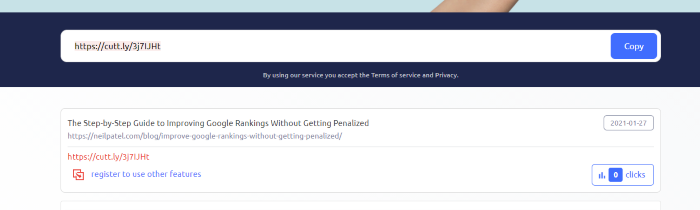
That link is shorter, but it doesn’t give the user any information, which ruins the point.
However, if you sign up for a paid account, you get access to branded URLs, which you can use to set up vanity URLs.
A similar tool is Rebrandly, which creates custom URLs and takes care of the redirects as well.
Here’s an easy step-by-step guide to using vanity URLs for paid ads:
- Create a custom URL, either using the tools above or on your own website.
- Set up the redirect from your vanity link to the final destination.
- This could be a landing page, checkout page, or even product page.
- Add the custom URL to your search ad.
That’s it!
There is one rule to be aware of: Google Ads only allow you to use vanity URLs that match your root domain. For example, you could use www.neilpatel.com/ListenToMyPodcast but not www.listentoneilspodcast.com.
However, if you are in the pharmaceutical industry, search engines limit your ability to use vanity links. If that impacts your business, you can learn more about it on the Google website.
How to Create Vanity URLs for Your Paid Social Media Ads
Paid social media ads can also benefit from vanity URLs for many of the same reasons. They can inspire trust and are much easier to remember.
How do you create them?
You may remember a time when Facebook used to let you edit the display URL on ads directly. You could even use them to create CTAs, which was pretty useful.
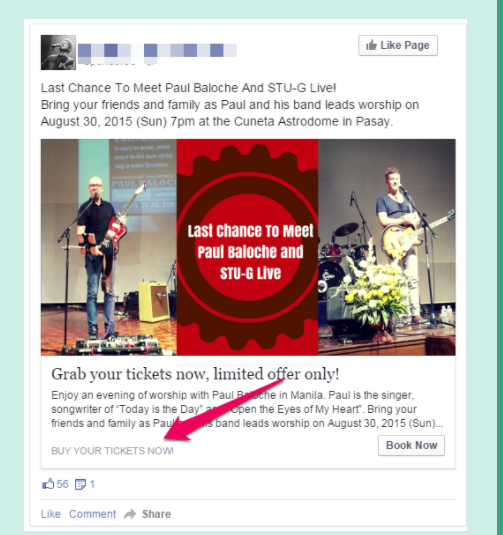
Unfortunately, that is no longer an option.
If you want to use them in social media ads, you’ll need to use the same process as above.
Use a tool to create the URL or create one on your own site, redirect the URL, and then add the custom URL to your ad.
Best Practices for Vanity URLs Used in Paid Marketing Campaigns
Vanity URLs can improve the user experience, streamline tracking, and help you achieve your paid ad goals.
However, to improve your chances of success, you need to make sure you follow vanity link best practices.
Keep It Short:
Shorter URLs are easier to understand. Plus, many ad platforms limit the number of URL characters they display, so longer URLs might not even show up on ads.
Keep It Simple:
Use descriptive language and full words to describe the content users can expect. The point isn’t just to make the links shorter (though that is helpful!) but also to help users feel secure about clicking your link.
Capitalize the First Letter of Each Word:
You’ve probably seen hashtags that don’t quite work out (#susanalbumparty comes to mind.) Unfortunately, stringing together words can result in less-than-ideal word combinations. Capitalizing the letters will help users read your URL. For example- www.neilpatel.com/ReadMyBook is easier to read than www.neilpatel.com/readmybook.
Avoid Dashes:
Dashes are standard in URLs, however, you want to avoid them for vanity URLs. They make the URL longer and people are unlikely to remember to type them in.
Use Keywords When Possible:
Keywords offer a slight rankings boost, but they also make it easier for users to understand your page’s purpose. If it makes sense, use a keyword that helps users understand where the ad will take them.
When creating your vanity link, remember that less is more. Your goal is to create an easy-to-read URL, so don’t overcomplicate it. If you plan to use them regularly, consider using a standard structure, such as keyword then product, to make it easier to organize and track metrics.
Conclusion
When it comes to paid ads, competition is fierce. If you are struggling to drive clicks and make sales, make sure you aren’t making these PPC mistakes before using custom URLs.
Vanity URLs are a small but mighty strategy that can build trust, increase clicks, and drive more conversions. They only take a few minutes to set up and may just give you that edge you’ve been looking for.
However, they won’t make up for poorly optimized paid ads, so make sure to A/B test your ads as well.
Have you used vanity URLs before?
Did they help improve your PPC ROI?
The post How to Use Vanity URLs for Paid Ads appeared first on Neil Patel.
Source: feedproxy.google.com

WWW vs. Non-WWW URL | Which One Is Better for SEO?
When launching a new website, there are some things that seem unimportant at first, but turn out to really be an issue later on. One of them is the WWW vs. Non-WWW issue.
When you first think about it, it doesn’t sound like much of a deal.
You might not even care at all about it.
When you first research it, you’ll probably learn around the web that it doesn’t really matter for SEO.
However, if you start digging deeper, you’ll discover a lot of things you didn’t know.
So did I, so follow this journey to understand once and for all why this hassle about which one is better.

While the truth is that it doesn’t directly matter whether your domain is WWW or Non-WWW for SEO, it can impact it very slightly.
That’s because it can potentially impact performance (although in a very slight way) and performance impacts UX, which ultimately impacts SEO.
Short History of the WWW
There’s something about the WWW that you probably haven’t thought of.
fact that it’s actually a subdomain.
However, because it has become so popular, people almost forgot that.
You see, the World Wide Web (www) isn’t the only thing on the internet.
You also have mail, SMTP, POP, FTP, and other important functions that are all run under specific subdomains.
Back in the day when the internet was not so popular and e-mail was the actual thing, a web server would have the domain name alias of WWW assigned to it, just like any other protocol.
Over time, the web became the most popular thing on the internet. (Google also kind of took control of it).
People would type the URLs manually, often excluding the WWW.
Webmasters caught on to this and started using the Non-WWW domain as the preferred variant.
This could be an issue for webmasters as Google sees http://www.example.com and http://example.com as two separate entities, therefore creating duplicate content issues.
However, most websites now correctly 301 redirect the unused version to the preferred one.
You should also note that through 301s, some of the link equity is lost, so it’s always better if you get all your backlinks pointing to the preferred version.
Pros & Cons of WWW and Non-WWW
Both the WWW and Non-WWW versions have their upsides and downsides.
Let’s outline them so that you can quickly decide which one you think is best.
Interestingly, there are 2 websites dedicated to this issue, which I will list soon enough.
WWW Pros and Cons
WWW has been the standard for many, many years.
Many people still associate www with websites.
However, these are not the pros. Not by far.
You see, because of how the web works, WWW allows you to do some really cool things.
First, it allows you to set some cookies only for that particular www subdomain.
Cookies get passed in a hierarchical way.

This means that if you set a cookie for www.domain.com it will be passed to thing.www.domain.com and another.thing.www.domain.com and so on.
You’ve guessed it: if you set a cookie for domain.com, it gets passed to all the subdomains.
Usually, the domain level cookies are important ones that you would use anyway, like session IDs and tracking scripts.
However, if you want to host your images on a subdomain to remove unnecessary cookies, you won’t be able to do so by setting a cookie to the root domain.
Using WWW ensures that you only send the cookies to the WWW version, leaving any other subdomains, such as static.domain.com or img.domain.com cookie-free.
Secondly, a subdomain is more flexible, at least DNS-wise.
That means you’ll be able to use CDNs (Content Delivery Networks) a lot easier.
As for cons, we could say that WWW is kind of ancient.
Eventually, the web will probably adapt to using the non-WWW with full potential, but it might take a while.
I mean, who knows, maybe at some point we won’t even use URLs anymore.
But for now, the technology is still relying on old protocols and www is not likely to go away very soon due to its vast and efficient uses.
You can read more about the pros of using www on https://www.yes-www.org.
Non-WWW Pros and Cons
If you don’t use WWW, you get a prettier and shorter domain.
Shorter domains have been associated with higher rankings, but that could only be a correlation.
Also, if you won’t use any cookies or if your cookies are anyway required everywhere (including images), then you will save bandwidth as there are 4 more bytes of data to be sent (www are 3 and the 4th is the dot before your domain name).
You could also say that the domain is easier to remember, spell, type, and tell.
This isn’t an issue with direct traffic, as there are 301s that always take the user to the good version, but it can leak link juice through the redirects.
Ideally, all the backlinks should go to only one version instead of always slipping into two.
This applies regardless of whether you use WWW or not.
The cons are basically the opposite of what the pros are for the WWW version:
Firstly, you can’t restrict root cookies only to the root domain, as they will always get passed on to all subdomains.
However, most blogs and websites host images on the same domain anyway so the cookies get sent either way.
Secondly, it will be harder to get a CDN to work, as you will not be able to set a CNAME record for your root/naked domain without messing up other things like FTP and Mail.
Apparently, using a non-www version can also be less secure, however, this is only applicable if you don’t use HTTPS and secure cookies.
If you want to see the pros of a non-www web page, go to https://dropwww.com/why.
As you can see, the reasons to drop WWW are a little more puerile.
They don’t get into the technical issues at all. It seems like the reasons to keep WWW are rather stronger.
Don’t rush to decide. Not yet! Read the next section and you’ll understand why.
So which one is better?
“Ok, from what I can tell it seems like we’re better off using the WWW.
It spares us of all the hassle.“
True. As a matter of fact, I can’t really think of a big website that doesn’t use WWW.
Well, there are workarounds.
Although WWW seems like the best option, there are workarounds that make Non-WWW just as good.
We all like workarounds, especially when we really, really want to get to that result, don’t we?
If you’re set in your head that you really want to go for the naked domain, then don’t worry.
There are ways.
First, you could use a completely separate domain for hosting your static content.
Yahoo mentions this in its guidelines.
For example, they use yimg.com to host their static content.
The downside is, obviously, that you have to pay $8.99 per year for another domain.
Not really a downside.
Also, if you really want to go for a CDN without using WWW, it’s possible.
There are CDNs out there that have found workarounds by using some techniques called CNAME Flattening, ANAME or alias records.
You can read more about these techniques here.
Cloudflare, for example, uses CNAME Flattening and it is a perfectly viable option to use CNDs without WWW in your domain.
Considering all the workarounds available these days, choosing between www and non-www is more and more a matter of preference.
Does it matter for SEO?
In short, (directly) no. From an SEO perspective, it doesn’t make a difference whether you use WWW or not in front of your domain name.
What’s important is that you have a preferred version and redirect all others to that one.
Make sure that you take all the versions into account.
If you also consider things like HTTPS and /index.php, you get around 8 possible combinations that should all be pointing to a single location.
Google’s officials kind of said the same thing.
However, the answer is very nuanced:
Minimal SEO implications, IMO. It’s a brand decision, in part, and audience (-savvy) decision, in part. On a new site, shouldn’t impact SEO.
— Dr. Pete Meyers (@dr_pete) August 3, 2017
Minimal implications don’t really mean NO implications.
Yadayada what?
So on an older site, it could impact SEO?
Well… If you think about it… there are some things that could slightly influence the SEO in the long run, mainly related to performance.
As you know, Google really takes User Experience into consideration when it comes to ranking websites.
And users very much like speed.
So the faster a site is, the better it will usually rank.
Both CDNs and Cookie-less static resource loading are speed-related improvements.
For smaller websites, it doesn’t really matter. As explained above, there are two main reasons why WWW still stands out:
- You can set static.yourdomain.com as your cookie-less static resource loader.
This will slightly improve the speed of your site.
However, quantified with thousands of images and billions of hits and requests, it does add up quite substantially.
- You can add a CNAME record without any issues, therefore making it easier to connect to CDNs and distribute your content faster around the Globe.
However, if you’re only targeting your local market, CDN’s don’t really make a difference.
If you have a small site, you probably don’t have a ton of images and also not very many cookies.
In the end, it’s pretty much a matter of speed.
With today’s servers and internet connections, a couple of cookies won’t make a difference in speed but they can make a difference in price depending on your bandwidth limits.
It adds up over time, you know?
If they were to be compared, the speed is pretty much the same in many cases.
Take a look at this comparison between our site and our competitor Moz.
Although they also run without WWW, they host their images on a separate, cookie-less domain and distribute static content such as images and scripts through a CDN.
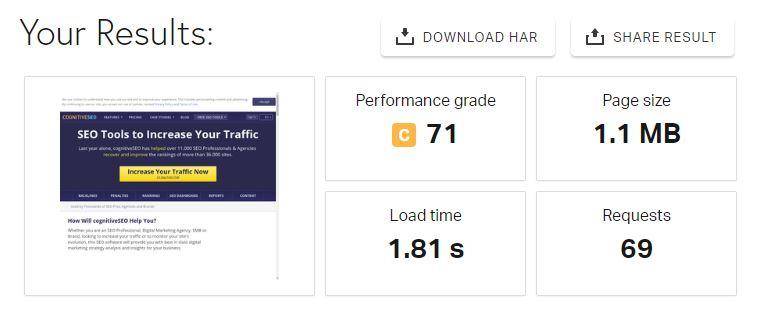
cognitiveSEO results
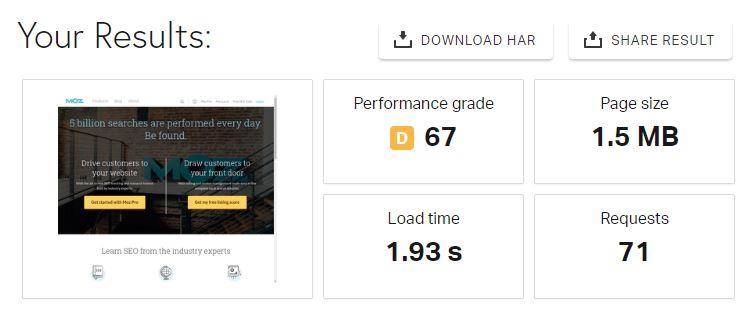
Moz results
They use a CDN that hosts their images on a cookie-less domain.
The results? Not very different from us.
We don’t use a CDN and don’t host our images on a cookie-less domain.
What Should You Choose
The answer is pretty simple.
If you’re a blogger and don’t plan on becoming the biggest site in the world, it doesn’t really matter.
Just go with whatever you like.
If you really like the www version, feel free to choose it.
You’ll get the benefit of having shorter and prettier URLs, which is always good for starters.
If you’ll ever need to go CDN or cookie-less for static resources, you can just use the workarounds.
They aren’t any more complicated and also not a big expense.
However, if you’re planning on launching a very big website with potentially thousands of images and a lot of traffic, then it’s probably better to listen to your developers and go with the WWW version.
It will make things a lot easier in the long run.
Remember:
if you’ve already set the preferred version and Google has indexed it, stick to it!
Unless the website has been published 2 days ago and only has 1 page, it’s not worth going through all the hassle and risks your rankings just to switch to www or non-www.
Just make sure your 301s are in order and keep focusing on the most important things, like publishing and distributing great content.
If you have already published your website and search engines have already indexed it, then stick to the already chosen version!
Conclusion
In the end, it’s pretty clear that WWW is the easier choice if you want to take advantage of easy CDN implementation, more flexible DNS options, and limiting cookies to only one place.
However, as the internet evolves, it gets easier and easier to ignore the WWW and host your site directly on the root domain.
This makes its URL shorter.
For SEO at least, it’s a matter of preference. I’d say go for the WWW if you don’t really know what you’re doing at all, as it will keep things simple.
However, if you really like your domain naked (just like your motorcycles and your women) then know that there are workarounds that can easily solve your problems.
Which version do you prefer?
And for those that don’t use the WWW, did you even encounter the issues I’ve mentioned above?
Let us know in the comments section, we’re very curious!
The post WWW vs. Non-WWW URL | Which One Is Better for SEO? appeared first on SEO Blog | cognitiveSEO Blog on SEO Tactics & Strategies.
Source: cognitiveseo.com