
Tag Archives for " trends "

Using the Google Search Trends 2021 Report to Generate Content Ideas
As marketers, we’re constantly attuned to Google’s ever-changing algorithm, keeping an eye toward shifts in prioritization and SERPs.
Google is pretty good at equipping users (and businesses) with information about what it considers important by providing resources like their search engine optimization (SEO) guides and the annual Search Trends report.
The Google Search Trends report can be an incredible asset that allows you to dig into users’ search habits and gain access to a steady stream of content ideas.
In this blog, we’ll unpack how to mine the Google Search Trends report for content gold to flesh out your content calendar into 2022 and beyond.

What Is the Google Search Trends Report?
Published each year, the Google Search Trends report aggregates the highest-ranking terms for the year.
Curious readers—or those of us looking for content ideas—can visit the mini-site to explore search volume through several lenses.
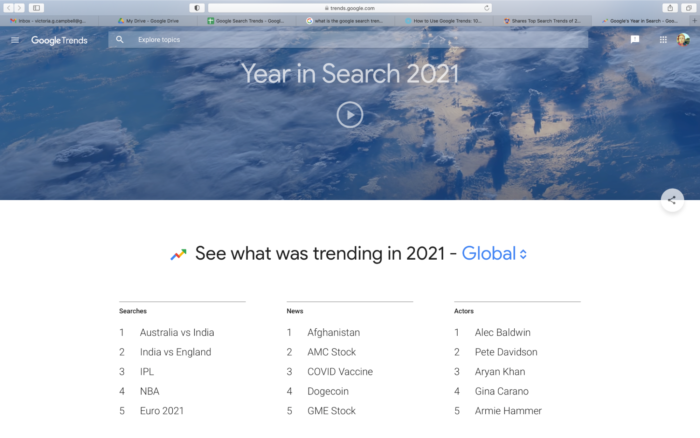
You can break it down by region and then a topic, including categories like actors, TV shows, sports teams, songs, and many more.
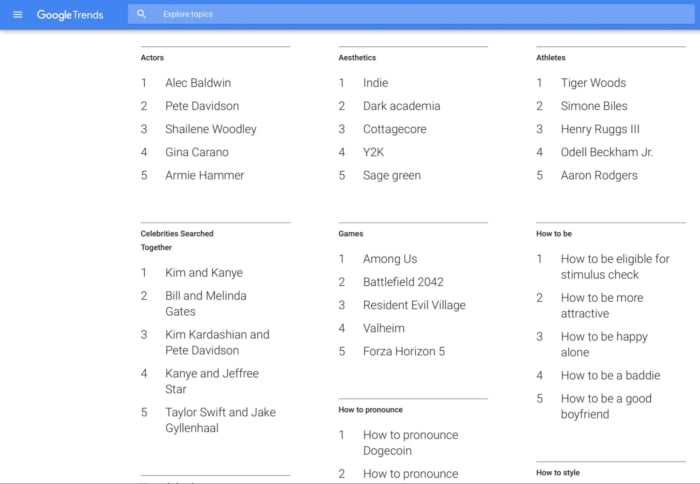
While this report can certainly generate year-end nostalgia, it also offers a unique perspective into the terms that gained the most search volume and traction in the last year.
For marketers, that data can be gold.
Top Trends from the 2021 Google Search Trends Report
Regardless of what region you’re researching, you’ll find a common theme in this year’s report: perseverance.
2021 saw searchers looking for “how to heal” and “how to be hopeful.” This theme resonated in more concrete searches as well with high volume searches including, “how to start a business in 2021” and “how to get a job in 2021.”
Entertainment was another balm in a complicated year. We looked to Google for distraction and clarification, typing in searches like “Squid Game” and “Amanda Gorman.”

Here are a few other Google Search Trends that got a lot of attention around the globe this year:
- Australia vs India
- India vs England
- IPL
- NBA
- Euro 2021
- Copa América
- India vs New Zealand
- T20 World Cup
- Squid Game
- DMX
In the United States, here’s what users were most interested in overall:
- NBA
- DMX
- Gabby Petito
- Kyle Rittenhouse
- Brian Laundrie
- Mega Millions
- AMC Stock
- Stimulus Check
- Georgia Senate Race
- Squid Game
While these searches can entertain, they can also inform your content strategy, by helping you create content that users are likely to be interested in.
How to Use the Search Trends Report to Generate Content Ideas
Struggling to come up with fresh, new content ideas? I’m no stranger to the frustration that comes with this.
Using Google Search Trends, you can determine what topics users are interested in, increasing engagement while building relationships and goodwill.
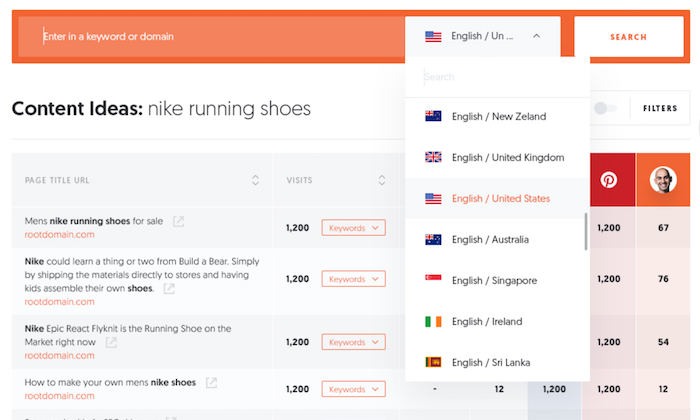
Below, I’ll break down the five best strategies for harnessing the insights associated with the search trends report to generate content ideas.
1. Use Popular Search Terms and Find a Unique Angle to Cover the Topic
While a blog post about the permanence of the cottage come aesthetic might be popular, this topic may not align with your brand. However, also topping the aesthetics search list is “sage green,” a topic that might be related to more industries.
Whether you’re a small boutique or a landscaping company, you can take advantage of this particularly high-volume query and build out a content plan to address it.
Sage green might not be in your wheelhouse.
If that’s the case, look for other search terms that might meet your audience’s interest in some way.

This part of the Search Trends reports breaks down searches by different topics, including:
- culture
- economy
- entertainment
- environment
- health and wellness
- news and events
- philanthropy
- representation sports
“How to maintain mental health” was searched more than ever in 2021—most industries could leverage that to provide mental health advice and tips to their audience. For example, I might write about how to maintain mental health as a remote digital marketer or how to help your remote team maintain their mental health.
By aligning your audience’s interest with a popular search query, you not only increase the visibility of your content, you also offer your existing and would-be audience a fresh perspective within your industry.
2. Search for Topics Using the Search Bar
Suppose you’re curious about the search visibility behind a certain query. In that case, you can use the Google Search Trends report to explore how much a specific term resonates, as well as related queries and terms.
For example, we searched “digital marketing.”
In addition to highlighting the term’s prominence, the report also offers tons of valuable detail. We could build a content strategy with a pretty solid idea of what type of content will and won’t resonate from this one search.
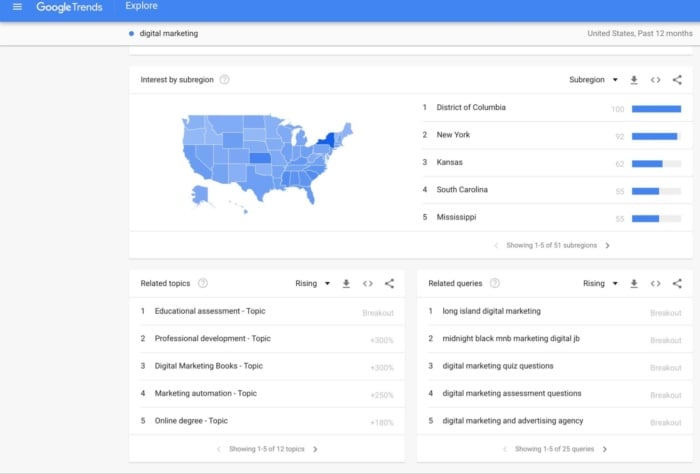
In the “related topics” section, I see terms like education assessment and professional development, which means a list of digital marketing courses or training might do well.
Search the name of your industry and the main key terms you target and see what content ideas pop up.
3. Use the Google Trends Report to Find Topics that Appeal to Gen Z
In 2019, Gen Z officially outnumbered millennials, tallying 32.2 percent of the world’s population.

Even more impactful, Gen Z makes up over 40 percent of U.S. consumers.
Consider this: a third of the world’s population is Gen Z. You’re doing your brand a huge disservice if you don’t consider how to speak to this massive, tech-empowered group.
After you’ve identified topics you know resonate through your search bar exploration, how can you ensure your content resonates with this unique group?
The answer is pretty straightforward.
Your content needs to be more interactive and appealing.
Here’s how to do that:
Create More Interactive Content
The more opportunities audience members have to interact with your content, the more likely they will.

By incorporating interactive elements, you encourage action. Next time you’re planning content, consider including a poll, stickers, or slider that allows your audience to truly engage with your brand.
Personalize Your Messages
Gen Z grew up amid a time of increased personalization. In fact, they’ve come to expect it. Be sure that you use every personalization opportunity to reach this coveted demographic.
Time-Sensitive
Fear of missing out, or FOMO, is still very much a thing. Take advantage of this fear by incorporating time-sensitive offers into your content, forcing your audience members to take action or miss out on a one-day-only deal.
Make Your Content More Visually Appealing
It’s no secret that Gen Zers flock to platforms like Instagram and TikTok, home to bite-sized video content. Take advantage of this content preference by drawing inspiration from the short, visually appealing videos that spread like wildfire.
4. Create Content Around Topics You’re Passionate About
It’s always easier to create compelling content around topics that resonate with you. As you peruse the 2021 Google Search Trends, keep an eye toward topics that resonate personally with both you and your brand identity.
Start by looking at the major search terms in each main topic I listed out above. Let’s say you work or own a coaching business and are looking for more topic ideas.

A quick look at popular “culture” topics shows us doom scrolling is the most popular topic in the culture section. How can you use that to your advantage? By matching it to your brand identity.
As a coach, you might write about how to avoid doom scrolling, how doom scrolling impacts your job search, or create a challenge to encourage your followers to stop doom scrolling and improve their mental health (which was another popular search term, as you might recall!)
After identifying high-performing topics, create a content plan to address them. Will you create blog posts, ebooks, or courses? Can you use these ideas in other areas of your marketing, like paid ads?
5. Identify New Niches
If you’re searching for a new niche, Google Search Trends is a great way to identify rapidly-expanding niches that may have content gaps you can fill.
To see search growth for a particular topic, simply set your search duration to “2003 to present,” so you can see long-term traffic on the topic.

This can also help you see when topics are most popular in a specific year, allowing you to plan your content publication around timeframes when Google users are historically searching for specific terms each year.
For example, topics around “fly fishing” tend to peak in the summer, when the weather’s nice. Tips for Black Friday marketing tend to peak in late November, as you might have guessed.
Frequently Asked Questions About the Google Search Trends 2021 Report
What is the most searched thing on Google in 2021?
Globally, the highest-volume search term was “Australia vs India.” In the United States, the most searched term in 2021 was “NBA.”
How do you find what is trending on Google?
Google releases its year-end search trend report once a year. In these pages, you’ll find the highest-volume search phrases in a variety of different categories, as well as through a geographical lens.
Throughout the remainder of the year, you can visit Google trends to see what the world is searching for.
How can you capitalize on search trends in marketing?
You can use search trends to power your content plan, perform keyword research, find seasonal trends, optimize your SEO strategy for video, and find related terms to outperform your competitors.
What are the search trends for late 2021?
The most popular search trends for late 2021 include mammography, why people are quitting their jobs, back to work bonus, potluck, small business Saturday, and how to become a volunteer firefighter.
Conclusion: Google Search Trends 2021 Report
The Google Search Trends report provides a nostalgic look at the year in review, with pop culture topics like Squid Game and news stories like the disappearance of Gabby Petito. However, they’ve also given us a tool we need to gain greater visibility into search patterns.
By mining these trends for insights into search patterns and behavior, you can create a content plan that speaks to the topics users care about.
The uses of the Google Search Trends report go beyond content ideas. You can also perform in-depth keyword research, use popular trends in your ad copy, and find new niches to target.
As you wade into your 2022 content planning, keep an eye toward the information Google has generously handed over—your click-through rate (CTR) will thank you.
What’s the most useful thing you’ve learned from the Google Search Trends report?
Source: neilpatel.com

6 MarTech Trends in 2021 and Beyond
Are you hoping to identify MarTech trends that can help your campaigns be more effective and run more smoothly?
As our marketing capabilities evolve, so do the tools we use to measure our successes and how we achieve that success.
In this blog, we unpack the six biggest MarTech trends looming over the marketing industry and how you can use them to your advantage.

Disclosure: This content is reader-supported, which means if you click on some of our links that we may earn a commission.
What Is MarTech?
Marketing technology, or MarTech, as it is more commonly known, refers to software and platforms that help individuals or organizations achieve marketing goals.
This term is very inclusive, covering everything from email templates to data analytics.
While every individual, agency, or company has unique MarTech needs, the constantly-growing field is making great leaps to fill any open niche.
Over the past twenty years, the field has seen truly exponential growth.
Today, being a marketer doesn’t necessarily mean you have to be incredibly tech-savvy, but it does mean that you need to understand the benefits of tools that can improve your strategy and help you reach your goals.
Your competitors are likely using MarTech to help their campaigns succeed.
If you’re not looking toward how you can automate, optimize, and ideate your campaigns through MarTech, it’s time to start.
Examples of MarTech
As we mentioned above, MarTech is a very wide umbrella.
However, some forms of MarTech are more common than others.
These include:
Email Marketing

With more than 50 percent of survey respondents copping to checking their email in excess of ten times a day, it’s no wonder that email marketing is an easy way to try to reach your target audience.
While the operative word in that sentence was try, marketing automation tools can get you that much closer to your goals.
To reach them, you need tools and platforms that not only disseminate your emails but provide in-depth analytics that gives you a real-time view of reader practices and interactions.
As email marketing continues to grow and evolve, the demand for personalization in this medium will also continue to grow.
Marketers should use automation and AI to deploy targeted emails engineered to attract a particular audience segment.
To achieve successful personalization, use data to assess customer habits and preferences for each audience segment and then craft corresponding templates.
Then your MarTech tool can do the rest.
Content Management
While managing your website content used to be a time-consuming, exhaustive process that took hours of coding, new marketing technology has automated cumbersome processes, allowing marketers to dedicate time to other important pursuits.
Content management systems (CMS) have evolved over the years, now equipped with the capabilities to develop the following kinds of websites (along with many others):
- social networking
- blogging platform
- static website
- news
- online store
Predicted to achieve a compound annual growth rate (CAGR) of 16.7 percent, as CMS capabilities grow, so will collaboration and planning tools that unite workflows to allow complete management of content from creative to back-end development.
Data Analytics
Today, marketers can harness the power of data analytics to gain an understanding of customer preferences and behaviors—including how they shop, where they spend their time, and how they discover new offerings—as well as market trends.
MarTech tools that allow marketers to dive deep into these data sets are invaluable, as they provide never-before-seen maps of how consumers operate online.
By tracking online behaviors, marketers gain a deeper understanding of their customers.
As MarTech data tools become even more intuitive, marketers will have even more visibility of customer journeys, following them from initial interest to final purchase.
These insights will be captured through cookies and CTR, among other trackers.
As the tools become more refined, so will understanding of consumer behavior, allowing marketers to readjust their strategies.
6 MarTech Trends
To help you decide which MarTech offerings you want to add to your stack, we broke down the six biggest trends that are likely to impact both the MarTech world and the marketing world well beyond this year.
1. Increased Spending on Analytics
If you’re tempted to bypass adding an intuitive analytics tool to your MarTech stack, don’t.
These tools can help you gain a better understanding of nearly every aspect of your marketing campaigns, from buyer behaviors to conversion rates.
In fact, researchers expect marketing analytics budgets to grow by 61 percent over the next three years.

That’s huge.
You don’t want to miss out on getting in early on a tool that can quite literally change the way you see your business.
Some of the many benefits of marketing analytics tools include:
- viewing real-time, comprehensive outcomes of marketing efforts across channels
- improving lead generation through actionable insights
- gaining insights into customer behavior and preferences
- using predictive analytics to enable your business to be proactive rather than reactive
2. Higher Emphasis on Personalization
We nodded a bit toward the importance and growing prevalence of personalization in marketing campaigns.
In short, this strategy means delivering individualized content to audience members.
This personalized route builds a connection with consumers, treating them as individuals rather than a mass market.
Some common (and growing) opportunities for personalization include:
- targeted emails
- custom video messages
- product recommendations
- social media
In the coming years, this prevalence will only grow, and marketers who don’t use tools to aid them in personalization will fall behind.
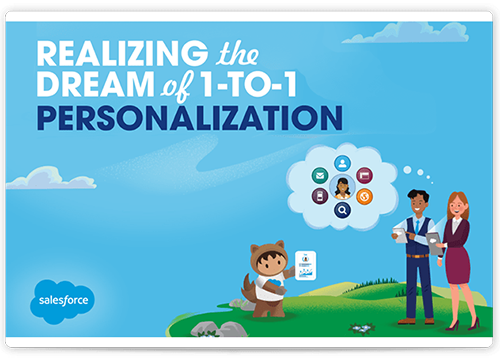
In fact, 99 percent of marketers claim personalization helps advance customer relationships, and 44 percent of consumers say they would be willing to switch to a brand that better personalized its marketing material.
If you’re not taking advantage of learning more about your would-be customers through tools and data, you’re missing out—not only on reaching customers more strategically but also on building relationships.
3. Transition Away From Third-Party Cookies
If you’re an advertiser or marketer who has relied heavily on third-party cookies, you may be in for a bit of a shock.
In 2020, Google announced its plan to phase out third-party cookies within two years.
With Google Chrome composing almost 65 percent of the web browsing market according to StatCounter’s data below, this move will have a dramatic impact on how marketers gather data.
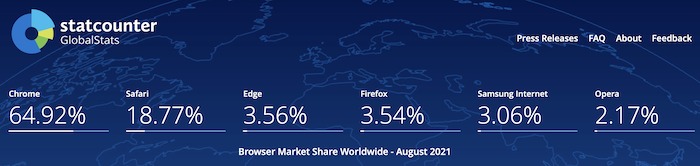
If in the past, you relied on information from cookies to gain an understanding of consumer behavior and identity, you’re going to need to recalibrate your strategy.
Recently, Adobe found two in five brands are not prepared to transition away from cookies, indicating businesses do not have a strategy for gathering consumer data post-cookie.
After the transition is final, marketers will no longer be able to capture individual consumer data.
To prepare for this future, digital marketers must align with the trend of personalization to reach and understand their intended consumers.
4. Higher Need for Data Privacy and Security
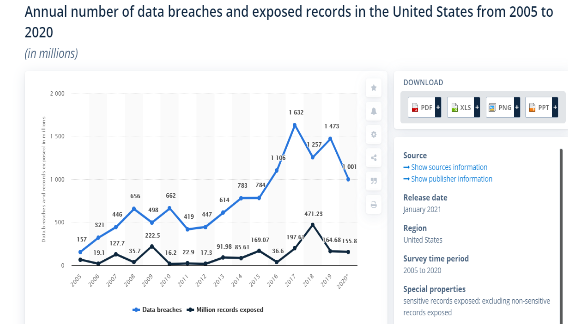
If you’ve been keeping an eye on the news, you know that data breaches are on the rise.
The United States alone has seen data breaches grow from 660 annually to over a thousand within the past decade, according to Statista.
If you think this number doesn’t apply to you, think again.
Your website and consumer data are among your business’ most valuable assets.
You need to protect them from malicious attacks at all costs.
5. Increased Importance of Campaign Automation Tools

Marketing automation can make every aspect of your marketing campaign easy.
By using these tools, you reduce time spent, error, and unnecessary cost.
We’re not the only ones who think this way: The marketing automation market is primed to grow 8.55 percent annually, with 51 percent of companies already taking advantage of these tools.
- Time-saving: With tools that automate time-consuming processes like project management, all members of your team will rejoice in the sheer amount of time they can reclaim after implementing these tools.
- More effective spend: By pinpointing processes that devour valuable time and treating them with automation software, you can use your budget much more effectively, saving both time and money.
- Scalability: MarTech automation tools scale with you.
If you’ve got a big vision for your organization, these tools fit your business needs for today and tomorrow.
- Concrete measures of success: We’ve talked about the importance of data and metrics a lot in this article.
All MarTech automation tools come with data insights that allow you to track everything from productivity to campaign spend.
As you assess your organization’s needs, look at how marketing automation tools simplify your processes and streamline campaign creation.
The benefits of marketing analytics tools include:
6. Growing Importance of Direct Mail
Thought direct mail was dead?
Think again: Forty-two percent of direct mail recipients engage with your send either through reading or scanning.
Further, 73 percent of Americans prefer direct mail marketing, as it allows them to read the piece at their leisure rather than forcing immediate consumption.
This year and beyond, you should reassess your organization’s direct mail strategy to see if there are new (or overlooked) avenues for you to contact your prospects directly through their physical mailbox, according to Who’s Mailing What:
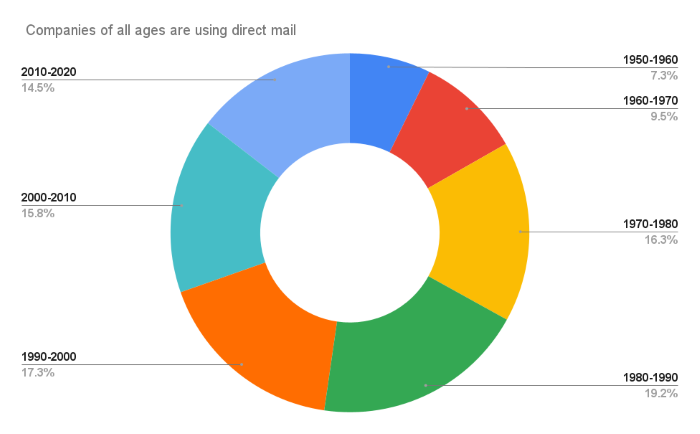
Outside of the above statistics, benefits of direct mail include:
- opportunities for personalization
- builds familiarity and trust
- easy to track
- complements your digital campaign
- cost-effective
MarTech Frequently Asked Questions
FAQ: 1
What Is MarTech?
Marketing technology, or MarTech, as it is more commonly known, refers to software and platforms that help individuals or organizations achieve marketing goals.
This term is very inclusive, covering everything from email templates to data analytics.
FAQ: 2
Is MarTech a Good Investment for My Business?
Yes. With MarTech making up 30 percent of North American marketers’ business budget, you would be well-advised to take advantage of marketing automation tools and platforms that can help you take your campaigns to the next level.
FAQ: 3
What MarTech Trends Will Dominate the Market?
While there is a slew of MarTech trends that reshape the market year after year, we can confidently report that these six trends will be game-changers in the MarTech world:
- increased spending on analytics
- higher emphasis on personalization
- the transition away from third-party cookies
- increased need for data privacy and security
- the increased importance of campaign automation tools
- the growing importance of direct mail
FAQ: 4
Is Direct Mail Still a Good Marketing Strategy?
In a word, yes. Direct mail is still an extremely effective marketing strategy.
While there’s a lot of conversation around digital marketing, this classic mode of reaching potential customers is as effective as ever.
Want proof? Forty-two percent of direct mail recipients actually read what you’re sending them.
Compare that to your average email clickthrough rate (CTR), and you’ll understand the true, measurable value of direct mail.
MarTech 2021 Trends: Conclusion
As marketing needs and customer predilections continue to change, so will the tools we use to meet them.
However, the six marketing trends outlined in this post are here to stay.
To help your organization grow with these MarTech trends, be sure to invest in software that can help you achieve all of your marketing goals.
Tools are meant to be used—be sure you’re taking advantage of them to outmaneuver your competitors.
What’s your prediction for the biggest marketing trend in 2021 and beyond?
Source: feedproxy.google.com

Social Media Trends You Need to Know in 2021
It’s that time of year again — time to review the social media trends we expect to shape the upcoming year. Let’s dive in now to our annual list of social media trends to watch in 2021, according to the Convince & Convert social media consulting team:

Companies Will Need to Address Social Media Team Burnout
“On one hand, many social teams have been elated to finally be seen as a vital part of their organizations because higher-ups have recognized just how valuable social media has been for communicating in real-time through COVID-19 and other major crises.
On the other hand, social teams are burning out with having to be always on with social customer care (which also includes being the target of a lot of misplaced vitriol) and also having to be the first to communicate through a lot of shifting situations and serious crises, in addition to dealing with all of the personal hardships that come with living through a pandemic.
Social media burnout has been a huge topic with a lot of Social Pros podcast guests over the last few months. I’ve also heard the concern from our clients in higher education.
In fact, according to Sprout Social, ‘88% of social marketers [in higher ed] say the pandemic has made their work much harder, and nearly half don’t have adequate support or resources to manage their mental health. Checks out.”

Anna Hrach, Strategist
Fee-based Fan Communities Will Grow
“Many businesses continue to suffer from a lack of organic reach in social media. Concurrently, consumers are increasingly gravitating toward smaller, more intimate topical communities (see the rise of Facebook Groups popularity as an example).
Simultaneously, 2020 saw a big move in the direct-to-consumer space, both in terms of e-commerce (as evidenced by Instagram shopping), and content (look at the explosive growth of OnlyFans and similar).
In 2021, we’ll see these trends converge, and brands will begin to adopt fee-based communities that give superfans exclusive access to content, exclusive products, and more.
This is the post-modern version of the Membership Club, and will give smart brands the ability to build advocacy and word-of-mouth among core customers who are willing to pay a small monthly fee to interact with one another, and the business.”

Jay Baer, Founder, Convince & Convert
Building Trust Through Content Delivered By and Featuring Humans
“Sure, for a long time, people have talked about the erosion of trust in brands, but never before have brands had to face it more head-on than 2020.
It should become the default that content is carried by human beings — whether that is influencers, your employees, or other subject-matter experts.
People don’t just need to trust because it feels good; people have to put their every action and every purchase through a filter of safety and economic impact.
It’s time to up-level content — not necessarily in production value, but in human connection. Is it harder? Yes. Is it the right thing to do? Yes.”

Mary Nice, Strategist
The Rise and Resurgence of Private Groups and Platforms
“As noise increases on social media, many are looking to customize their experiences by joining private groups and forums based on causes and personal interests.
There has been a rise in the number of Facebook Groups and membership, and Instagram is now seeing the use of its Threads or sharing Stories with specific friends.
Many people are also going to or returning to private and semi-private online forums for education, entertainment, networking, and mutual interest.”

Christin Kardos, Community Manager
Influencers Will Become Vital in B2B, not Just B2C
“According to the 11th Annual B2B Content Marketing Benchmarks, Budgets, and Trends report from CMI/MarketingProfs, 89% of B2B marketers use social media for content distribution, but only 24% used Media/Influencer relations.
It’s no surprise that in the last decade, social media has become an extremely fragmented and noisy place, and therefore, brands both in B2B and B2C will find that their dollars go further when they collaborate with individuals whom their audience trusts.
Whether these are macro-influencers or micro-influencers, co-creating content that comes from these trusted voices will help brands to break through the noise AND reach broader audiences.”

Zontee Hou, Co-lead, Consulting
Socially-conscious Values Extend to Imagery as Well
“Nearly 80% of people globally have said it isn’t enough to have people of various ethnicities, backgrounds, and appearances in advertising but that they expect companies to do a better job at capturing people’s true lifestyles and cultures, according to new research by Getty Images.
Searches have increased year-over-year for ‘diversity’ (up 133%), ‘culture’ (up 115%), ‘real people’ (up 115%) and ‘inclusion’ (up 126%).
From May to June alone, customer searches for diverse images increased by 200%, and searches for images around unity and equality increased by 500%, trends that are believed to be intensified due to anti-racism protests.
Side note: our client, AARP, partnered with Getty to create more authentic images of people 50+.”

Jenny Magic, Marketing Strategist
Social Media Is Part of Everyone’s Job
“Social media has been a core part of the business for more than a decade. Long gone are the days where ‘playing on that Facebook thing’ was only supposed to happen on lunch breaks.
In the age of coronavirus, social media has become more important than ever to business survival and success.
Your employees are your greatest social media assets. In fact, 45% of consumers are more likely to research a product or service when a brand’s employees post about that product or service.
Social media skill sets go beyond marketing and communications roles. They are less frequently required but especially needed, in customer service, HR, sales, and research.
Even in roles without direct ties to content, messaging, design, lead gen, sales, or service, we’re still asking employees to be good at social media to power our internal advocacy efforts.
Employee advocacy programs continue to be a top trend because their success to humanize a brand and amplify storytelling is undeniable at scale.
Businesses must provide social media policy guidelines and resources for their employees to master social media skills, as this technology is more akin to email than VR in today’s business world.”

Lauren Teague, Strategist
Use of User-generated Content Grows
“User-generated content has become an increasingly reliable social media marketing tactic. Brands and consumers find this type of content more authentic and trustworthy.
A majority of users trust UGC when it comes to influencing their buying decisions, and people want to see real-life experiences.
We will see a surge in UGC content this year through platforms such as TikTok and Instagram.”

Leanna Pham, Brand Marketing Intern
Questions About Any of These Social Media Trends? Ask a Convince & Convert Strategist!
Simply fill out the form below to request a no-cost consultation with a strategist on our team. We’d love to get to know you.
The post-Social Media Trends You Need to Know in 2021 appeared first on Content Marketing Consulting and Social Media Strategy.
Source: convinceandconvert.com