
Tag Archives for " their "

Find the Right B2B Influencer or KOL for Your Brand
B2B KOL and influencer programs are a topic of nearly every conversation these days. Our friend Lee Oden at TopRank Marketing conducted a survey in early 2021 about the use of B2B influencer marketing and found these incredible stats, along with many others.
- 74% of marketers agree that influencer marketing improves customer and prospect experience with the brand
- 63% of marketers agree that marketing would have better results if it included a B2B influencer marketing program
From our view, we don’t see that trend slowing down anytime soon.
Influencer vs. KOL
Some may say it’s merely semantics but the word “influencer” infers a YouTube or TikTok celebrity smiling big to schill their use of the latest teeth whitener and the term, “key opinion leader” (KOL)” is emerging as the preferred term for B2B partnerships.

Key Opinion Leaders are what the B2B community is looking for, right? These partnerships are MUCH less about “buy now!” and more about learning something new from a trusted source or having a brand experience where sales are the last metric to be measured as the success of a partnership.
At Convince & Convert, we’ve concepted, recruited, created and managed dozens of KOL programs for clients over the years. Almost every project revolves around helping the audience gain insights or perspectives from KOLs in their area of expertise and not about direct sales.
This is the case in our most recent work with Cisco to source and creates short-length video series and blog posts for their partner marketing platform.
Over the course of the program, we’ve built relationships with our KOL’s and the partner audience at Cisco has also built affinity and trust in the knowledge they bring each month.
Not a week goes by that our own Jay Baer isn’t approached to be a KOL for various brands and contribute his thought leadership, marketing prowess, and digital personality to a campaign or brand platform.
Other C&C team members including Zontee Hou, Mary Nice, Daniel Lemin and Jenny Magic also get asked to contribute content as a KOL around digital marketing strategy and customer experience.
Working on both sides of the KOL programming has given us unique insights about how to make a program successful and what matters when negotiating a rate.
How to Approach KOL Selection
TopRank’s survey found that “39% of marketers say their top challenge with influencer marketing is that the process is too manual” and we couldn’t agree more! Our clients look to us to take out that manual work for them and deliver KOL results with as minimal extra work as possible.
Having perspective on what content creation and campaigns need from both a brand and a KOL perspective has given us a unique angle when working with KOL engagements.
Sourcing B2B KOLs for Your Brand:
We use our network of contacts as well as subscribe to several software platforms which support our discovery and vetting of potential KOLs.
Software platforms we currently use include:
– Social media marketing analytics with advanced competitive analysis, SEO, social reporting, and content marketing tools.
– Helps PR and marketing teams monitor media coverage across both news and social media and enhance brand management.
– Crawls tens of millions of social and web profiles to find what (and who) your audience reads, listens to, watches, follows, shares, and talks.
– Specialises in providing influencer marketing software and supporting professional services to help brands scale their influencer programs.
Once we have our starting list we make KOL dossiers that outline each potential KOL, the reach, content types, audience profile and other interesting information about the individual.
The dossiers bring the KOLs to life, similar to how personas would in a marketing plan as well. It allows our clients to see and relate to potential KOLs much more so than a spreadsheet of text.
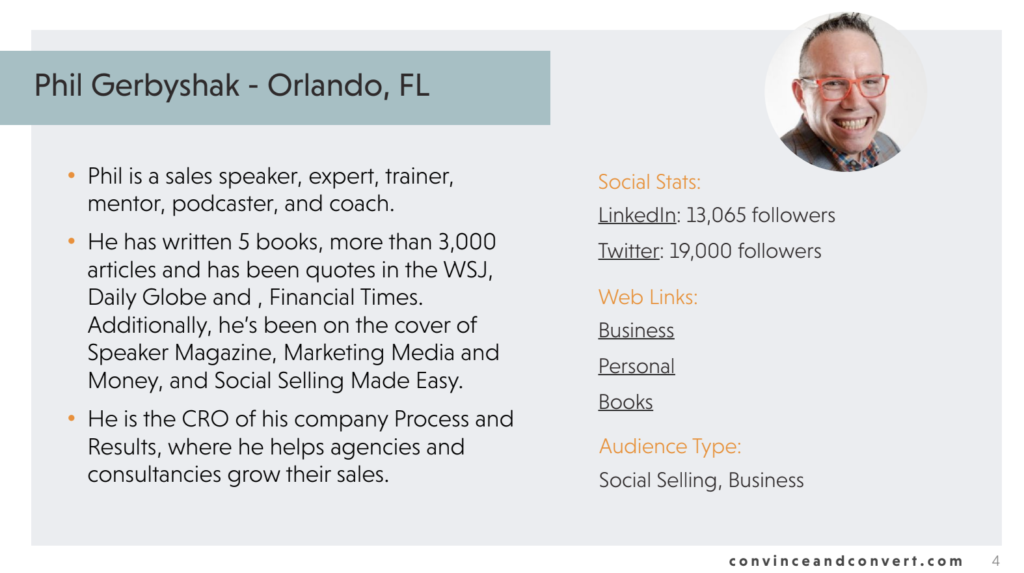
This takes the work the software provides for surfacing potential KOLs and overlays actual manual review and research from one of our team members.
(We visit each KOLs page, watch multiple pieces of content on all channels, review other brands they may work with, assess quality and style of content produced and confirm audience reach numbers from the software).
We like to research 2-3x the number of final KOLs our client is targeting so that we have provided a solid look at the opportunities and competition (or not) in a category. From the set of dossiers, we narrow in on our top individuals to pursue.
Selecting B2B KOLs:
Now comes the educated guesstimate part of this work.
Each of the KOLs will have different levels of compensation, preferred channels to activate and affiliation with our client.
Before we pick up the email or phone to approach a KOL we hyper study the following parts of our dossier:
From there we work on a payment range we believe to be equitable based on the work request and experience.
KOL Payment: The Wild West
Some of you may know I worked with Jay in the early 2000s at an ad agency in Phoenix. In those early days, I would place the online media for our clients. One such campaign was for a client who created and sold koozies.
Their koozies had suction cups on them so that the gel coat on your boat wouldn’t get ruined as you enjoyed an ice-cold beverage while cruising around the lake.
As media kits and banner ads overall were few and far between, we would literally search the web for sites we thought would be a good fit and call (on a desk phone!) the owner or main contact of the site.
(see: title of Webmaster) We’d start with an offer of a hundred dollars and see how it landed to know if we completely offended them or had just made a great deal, working our way down the list of potential banner placements.
And even in 2021, B2B KOL negotiations feel a lot similar but certainly more than a few hundred dollars.
We took this question to our friends at Onalytica, the biggest B2B influencer database. With a platform like theirs, it is easier to negotiate and process payment for a KOL, but it still requires conversation and a fair bit of guesstimation.
Each individual person and set of content pieces come with their own negotiations. Valuing the relationship and offering a fair and equitable rate will go much farther in B2B KOL partnerships than budget savings.
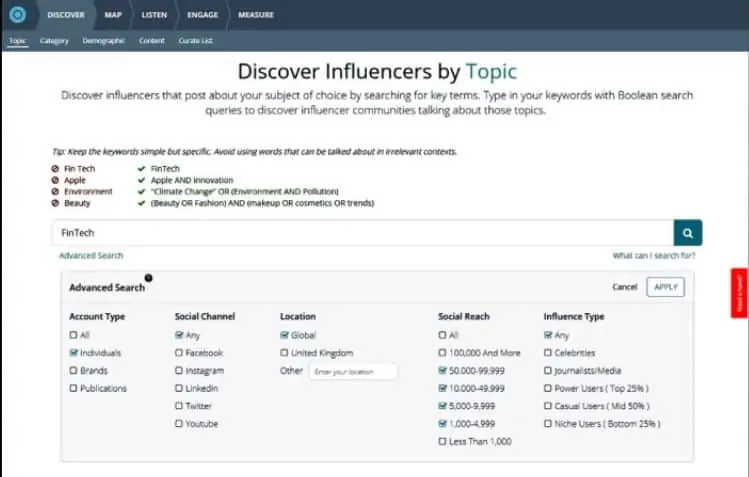
Onalytica platform
The Good News For Finding B2B KOLs
Lucky for all of us, rate cards and reports in the area are increasing, giving at least a clue or a starting point to custom negotiations with KOL’s of interest.
Even for Convince & Convert, we’ve worked on a general rate card in the form of our media kit for the types of content we regularly create for clients.

It takes into consideration the expertise our collective team brings to any KOL engagement.
As we work on behalf of clients to strategize and plan their KOL engagements, we use our rate card as the barometer for gauging the starting offers and rate negotiations with the KOLs selected.
A recent report by Intellifluence included more than 1200 influencers asking them about compensation expectations for mainstream pieces of content. And while the influencers included were likely working with more B2C than B2B brands, we found these areas to universally apply:
- Cash is preferred. “Nearly 70% of those surveyed said they liked to get paid in cash and in the product.” For B2B marketers – particularly MarTech brands, think about how you can sweeten your offer or enhance the relationship with a KOL by offering a license, upgrade or similar in addition to direct payment.
- Particularly for C&C clients, video is a common content type in our KOL programs. In the Intellifluence survey, influencers wanted brands to realize how much pre-work goes into creating a quality video.
For B2B marketers, when you are working with KOLs acknowledge that the hard work is in the prep and polish of a video. While the output may be only a few minutes of finished content, a worthwhile KOL will spend time to plan, script, and use quality equipment to shoot the video.
One area we tend to do for our clients is we do the post-production work – asking a KOL to send us clean video and we add any captions, logos and bumpers to the final cut. This works well because most of our KOL interactions are part of multi-episode shows.
Frequently Asked Questions:
QA: 1
What type of content (webinar, blog post, social post, etc) would be a fit not only for our client campaign but also fits with the KOLs style and audience set?
We have repeatedly found that when we approach a partner KOL with a specific ask or deliverable they are increasingly able to agree or negotiate the contract more quickly.
Giving them something thoughtful to react to goes a long way in the negotiation process.
QA: 2
How large does this KOLs audience reach? (followers, average engagement, etc) How key is their audience to establishing our objectives?
An exercise in quantity vs. quality if you will: Depending on the goal for the campaign, one or the other could sway the amount of negotiation you are willing to engage in.
Although leaning toward B2C, this recent Intellifluence survey has some starting points on price per post expectations and by channel direct from influencers which is a must-read.
QA: 3
Which other brands does this KOL work with or represent? How do those brands affect or overlap our client’s brand?
Usually, we work with 6-10 KOL’s at a time and are creating an episodic type show for our client. Explaining the overall campaign and creative direction the KOL is part of also provides context and company, increasing the knowledge of the outcome for the KOL helps to gain trust, especially for new relationships.
Working with B2B KOLs is a Work in Progress
Someday we’ll have the “ultimate pricing guide to B2B KOL engagements” but until that is created, we’d break it down to building a relationship with your KOLs is key and fair compensation and clear deliverables go a long way in a long term partnership.
The post Find the Right B2B Influencer or KOL for Your Brand appeared first on Content Marketing Consulting and Social Media Strategy.
Source: convinceandconvert.com

4 Spectacular Site Traffic Sources That’ll Help You Move Beyond Google
Until a few years ago, every online business owner used to start their media marketing campaign solely by keeping the ‘big daddy’ in mind.
It was the chief source of exposure – the number one search engine traffic source that helped websites get visitors.
It was the most visited website on the internet, dwarfing every other site.
A whole new industry was created to optimize business websites as per this big daddy’s requirements.
Until one day when a new media marketing era started that made people socialize online.
These new social media platforms also became a breeding ground for publishers to attract eyeballs to their content and to try and attract direct traffic from those sources.
The ‘big daddy’ is Google.

If you’ve started a website to get online exposure, then you must have read a couple of articles on search engine optimization (SEO).
You might have achieved great search engine traffic results from Google.
However, you shouldn’t put all your eggs in one basket.

Diversifying your website traffic sources will ensure that your business does not tank in the wake of a single Google algorithmic update.
Algorithm Impacts
Consider Andrew, who lost 80 percent of his website traffic to Trollingmotors.net with the release of the Penguin update.
It was after this loss of direct traffic he realized the risk of relying solely on Google for customers.

Don’t you dread being in a similar situation, losing all your web traffic because Google decides to change the game?
SEO Game

Building traffic from Google requires consistent effort for 3 months or more.
You need to target long-tail keywords, build authoritative backlinks and optimize your website pages for Google.
Not to mention the dominance of the click-throughs received by the top 3 spots in Google.
If you aren’t in the top 6, don’t expect more than 4 percent of clicks to your website.
And if you aren’t on the first page, you can almost abandon thinking about organic traffic, direct traffic and any other kind of web traffic from Google.
If you’re not on the first two pages,
you aren’t getting any visibility.
I don’t think I need to tell you the difficulty in ranking in the top 3 spots for keywords that have good search volume.
The hard-hitting reality is most businesses fail to rank for their targeted commercial keywords and don’t get intended results from SEO.
Are you willing to build a more sustainable and robust source of organic traffic for your website?
Then let’s roll with five alternative search engines besides Googles that drive traffic your way.

5 Alternatives that Drive Traffic Your Way
1. Capture Emails of Those Cold First-time Visitors
Email is the first and probably the best social channel for conversing with your audience.
It commands the daily attention of most people, drives engagement and accelerates business results.

The email has a high conversion rate and that outperforms search and social media by far.
But effective email return traffic rise does not happen overnight. It starts from your previous efforts and snowballs.
I’ve been able to increase my email traffic consistently since I’ve prepared my blog to capture new leads as part of my marketing campaign.
How to Increase Direct Traffic from Email Campaigns?
Would you like to know the 3 basic steps to increase direct traffic from your email campaigns?
Prepare a lead magnet like a free eBook or an email course that interests your visitors.
As an example, I offer free courses to learn SEO, CRO, and more.
You can also offer a swipe file like Digital Marketer.
It generated 28,507 subscribers in 45 days.
If you want to considerably boost your conversions and reduce your bounce rate, then you’ll need to put in extra effort and prepare a content upgrade for at least your most popular posts.
It can lift your conversions by a whopping 785 percent in one day.
So what are content upgrades?
They’re generally bonus resources.
If you don’t have the time to create more content, a simple checklist will do. The idea is to help the visitor take the first step after reading your article.
Setup lead capturing tools on your website
Marketing technology has come a long way.
You can do much more than simply adding an opt-in form in the right sidebar of your blog (that typically has less than a 1 percent conversion rate).
I would recommend that you experiment with slide-up, left sidebar sign-up forums, hello bars, and other tools.
A controversial, but extremely effective tool that deserves special mention is the popup or banner ad.
Popups can literally take your sign-ups through the roof.
But, if they’re so effective, then what’s the roadblock that may prevent you from using them?
They’re annoying and equate to a bad user experience which will contribute to a higher bounce rate.
You need to test triggering them at the appropriate time.
Your audience might like to spend 30 seconds on your website before they give you their email.
Your visitors should not feel intruded on or tricked into giving their email.
Don’t show the popups and banner ads repeatedly to a visitor after he has shown disinterest in giving you his email.
I would advise you to use an improved pop-up technology that decreases pop-up annoyance.
Properly onboard your new subscribers
The welcome email is your first point of contact with the subscriber.
Don’t waste the opportunity to add value and impress them early in your relationship with them.
So what can you deliver in your first email?
Ask the ‘number one’ problem that your subscriber is facing.
This encourages interaction and lays a strong foundation for your association with them.
(Optional but recommended) – Test your email subject lines
Only after they open your emails will you get the chance to engage with your audience.
Churning of readers is fairly common.
MailChimp found that average click-throughs last only 3.5 percent after the 100th email campaign for the users that last (as compared with 5 percent open rate for the first campaign).
Tweaking your subject lines can make all the difference in increasing your open rates and getting more engagement.
2. Write High-quality Guest Posts for Authority Blogs
Guest Posting has already been written off by Google.
I’ve seen bloggers derive tremendous referral traffic and build complete businesses from guest posting referral traffic.
It’s awesome to get organic traffic this way.
It’s such great exposure that I’ve guest posted regularly at likes of Entrepreneur, Search Engine Journal, HubSpot and Forbes.
Here are five tips to get good results and potential direct traffic from guest posting.
1. Understand the publication
Before sending a guest post pitch, get a feel for the type of content published in the publication.
Only then will you be able to think of post ideas that add value to their audience.
All bloggers are seeking valuable content to be shared on social media and to improve their own search engine traffic – you need to be able to add to this.
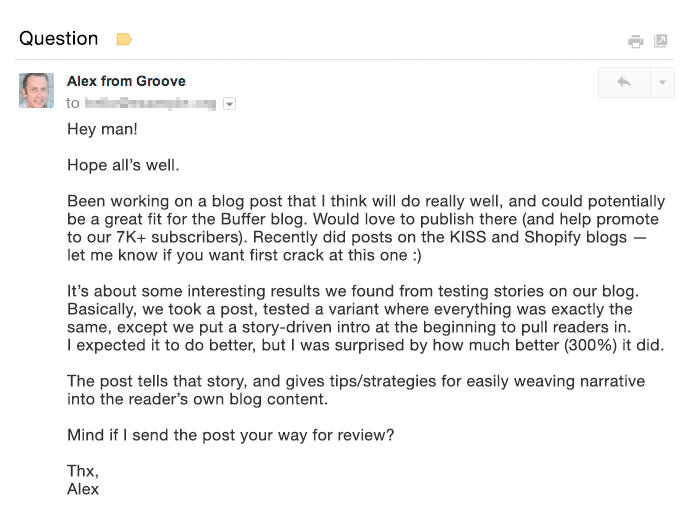
A great pitch puts the target blog’s audience first and proves why you’re the right fit for guest posting on their blog.
Want an example?
Then look at the email by Alex from GrooveHQ below.
2. Aim to get published on the biggest blogs where your target audience hangs around (not necessarily in your industry).
I received 0 conversions from some industry blogs (although they drive considerable organic traffic).
Yet I received a total of 16 conversions (lower visitor volume but high-converting direct traffic) from Entrepreneur Magazine and Inc.
3. If you’re short on time, rely on quality rather than quantity.
By putting in 18 hours to write an awesomely detailed guest post at HuffPo, Ramit Sethi was able to drive 100,000 visitors to his website. This would have had exceptional results not only for his search engine traffic but also for his social media traffic.
Compare that with a quickly written guest post that brought just a few hundred visitors for 1.5 hours of Ramit’s time.
4. Try to squeeze as many quality guest posts into your content production time as possible.
I’ve personally found that organic traffic is spread out from guest posts and adds up only over time.
5. Finally, spend extra time to create a content upgrade for your guest posts.
A content upgrade can have a tremendous impact on the number of emails you’ll collect.
Giles Thomas earned 408 subscribers from a single guest post by offering an upgrade.
3. Interview an Influencer or Get Interviewed by a High-traffic Website
Have you heard of the Four Hour Work Week author Tim Ferriss?
Right now, a staple content type that he serves his audience is his podcast.
He interviews world-class performers who share their wisdom on a plethora of subjects on Tim’s show and he is loved across social media.
Do Tim’s followers like the show?
Well, the show has surpassed 50,000,000 downloads.
And is the #1 business podcast on all of iTunes on most days.
Be it video or audio, interviews are inherently conversational, dynamic, and engaging.
The best part:t’s a win-win for both parties.
The interviewer gets exposure to the new audience while the interviewee gets to serve new engaging and authoritative content to his website visitors.
If you interview an industry influencer, you can request that they share the interview with their followers on social media.
Think of the organic traffic you will drive from hundreds of thousands of their social media followers.
As an example look at the engagement received by a past interview of Derek Sivers on the Tim Ferriss Show. Derek tweeted the show’s link to his 283K followers.
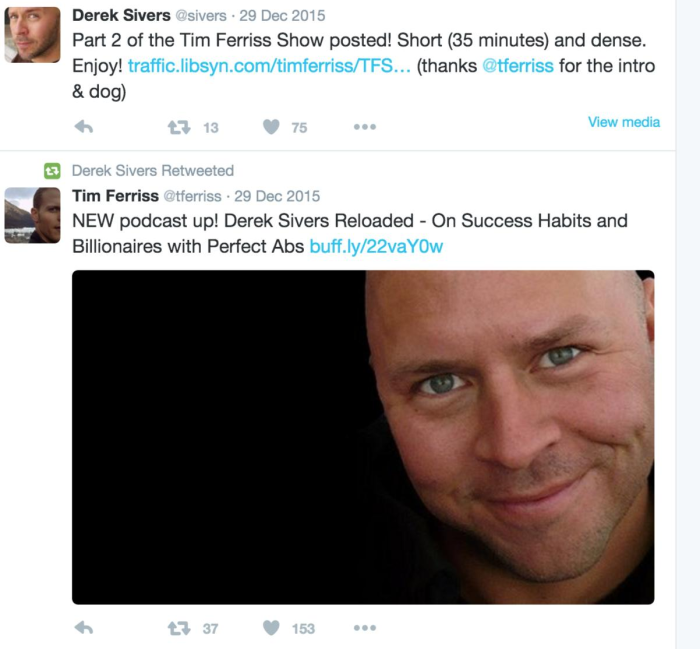
It won’t hurt that you’ll also start a relationship with the influencer through such an interview.
Similarly getting interviewed by a high-authority website can bring you a huge amount of search engine traffic.
Getting interviewed by YourStory brought Harsh Agrawal 35,000+ views on his blog, Shoutmeloud, in a single day.
That was his highest search engine traffic source for the blog (having 600,000+ visitors/month).
Since interviews offer consolidated value, they serve as a lead generation source for your brand for a long period.
Just think of the number of bloggers you discovered through their interviews on YouTube and other high authority websites.
If you’ve got a really interesting story to share, you can also consider doing a Reddit AMA.
Mateen got 2000 pageviews from doing this AMA on earning $85,000 in profit by selling TeeSpring shirts/hoodies. He also increased his average daily visitors.
You can also answer questions from journalists at HARO by signing up as a source.
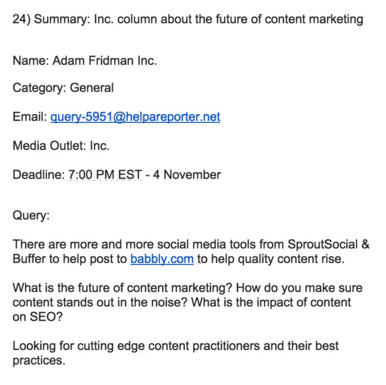
Christopher from Snappa saw this query on the future of content marketing from Inc Magazine on HARO.
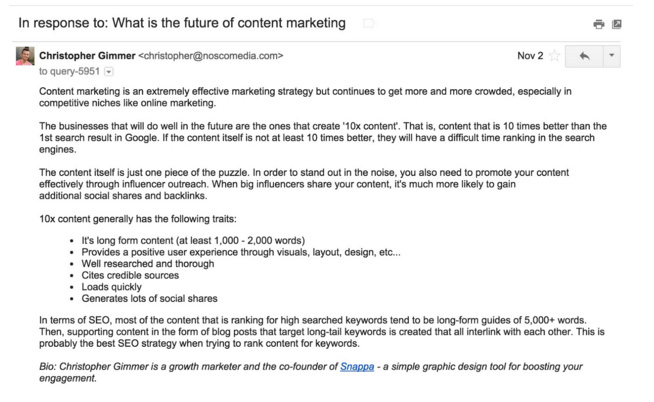
He quickly sent a detailed reply.
This earned him a mention in Inc a few weeks later.
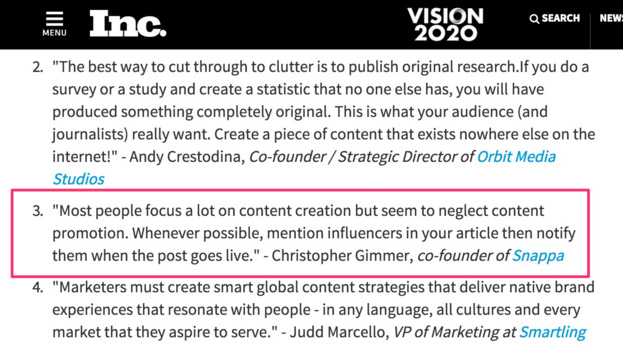
HARO is a great strategy to get a brand mention on authority news websites like Entrepreneur and Inc.
Those backlinks will sweetly lift your reputation in the eyes of Google, driving your search engine traffic up, and boosting your marketing campaign.
4. Invest in Facebook Ads
I know a paid strategy might raise a few eyebrows when it comes to the idea of organic traffic.
Inbound marketers generally don’t like to pay for play in the form of banner ads or other pricey methods.
If you’re one of those, you might be frustrated with the declining organic Facebook reach.
If you’re having only a handful of fans on your Facebook page, then you will not get good results from your organic traffic reach.
So you’ll need to invest in Facebook Ads.
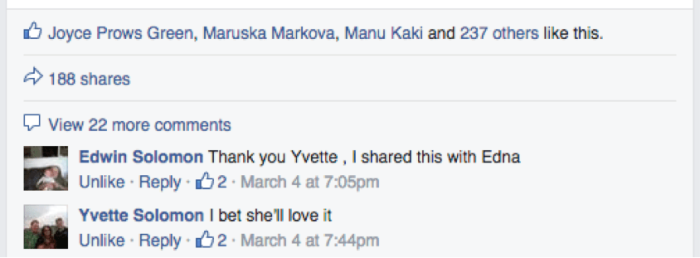
A US accounting firm (having 156 likes) didn’t get good engagement on their posts. Just a couple of likes.

After spending $20 on Facebook Ads they started getting great interaction. Look at the interaction on the post in two months.
Sparing some cash for running Facebook Ads can tremendously accelerate your email list growth (one of the best repeat traffic sources for your website).
Because there are very specific demographic targeting options available. You can also A/B test various images and text in your banner ads.
Let me share another case study to show you the kind of results you can achieve.
Matthew Woodward spent around $600 on Facebook Ads running two campaigns.
His cost per lead in running both campaigns was under 80 cents.
The ROI from running the campaign was over 2500 percent.
Aren’t the results incredible?
If you don’t want to splurge and spend $500, then even $5 a day can get you great results.
Mary earned 532 new subscribers in 43 days of running Facebook Ads.
The total amount she paid was just $227.05.
If you want to drive more traffic to your blog, then you can choose your most engaged Facebook posts and boost them to extend your reach.
You can even use Facebook Video Ads and add a CTA to drive traffic back to your website.
For native videos on Facebook, Mike Gingerich found anywhere between a 30 percent to 200 percent increase in engagement and reach compared with other types of posts.
Conclusion
Google’s algorithmic updates are unpredictable.
Relying solely on SEO to rope in traffic and customers can kill your business.
So experiment with traffic sources other than Google.
If you put in the necessary steps, you can also reap the benefits like others whose case studies I shared with you in this article.
Have you experimented with any of the above traffic sources and achieved good business growth?
How did you boost your direct traffic? I would love to hear your insights in the comments.
Source: neilpatel.com

Customer Journey Mapping for Audience-Centric Content
One of the questions we hear from our clients most often is, “How do we get from ‘one-size-fits-all’ to personalized content?” And we have a clear answer: Customer Journey Mapping.
What Is Customer Journey Mapping?
Customer Journey Mapping (also known as Journey Mapping or Audience Journeys, or a dozen other variations) is simply the process of understanding the path your specific target audience segments take, from the moment they become aware of their problem until they (ideally) know and love your brand.
More specifically, customer journey maps clearly outline how each of your target audience’s needs, actions, and mindsets evolve through critical make-or-break decision points along their path.
Journey mapping works for both B2B and B2C scenarios, but it important to note that they are most valuable when evaluating longer-term purchases or relationship-building marketing strategies.
It is less useful to build journey maps for quick one-off purchases where customers are unlikely to build brand loyalty.
So, where to begin?
Why Is Customer Journey Mapping Important?
Your prospective customers are faced with a mountain of choices and content.
When they’re making a decision about whether to engage with a brand, customers—in every demographic, B2B, B2C, and across industries—are overwhelmingly signaling that they prefer personalized messaging that is relevant to their needs.
As Convince & Convert founder Jay Baer says, “To be someone’s favorite, you need to be hyper-relevant.”
One of the easiest ways to boost content marketing relevancy is through personalization. If you’re not already personalizing, you’re probably falling behind.
With the increasing demand for contextual, personalized content as well as the new opportunities for delivering that content using ABM and targeted social advertising, understanding the specific needs and concerns of each audience segment has never been more important.
You can’t personalize for a group you haven’t defined.
Journey maps help improve the customer experience by ensuring you’re considering their full experience as you design the interaction, and they help drive customer-centered decisions, as your team aligns business goals with the customer’s goals, and measures marketing performance based on the ease and effectiveness the customer experiences.
How to Create a Customer Journey Map
Building a Customer Journey Map involves defining five key elements:
- Audience Personas
- Decision Journey Stages
- Audience Mindset (thoughts, feelings, and top questions)
- Touchpoints & Key Actions
- Ideal Response & Content Opportunities
1. Audience Personas
Though creating audience personas are a separate task and not specifically part of the customer journey process, it’s essential to ensure you truly understand your audience before you begin.
Audience Personas should be based on research (even just talking with your customer service team is a great start), and they should group clusters of individuals together based on their needs and attitudes, not demographics.
Here’s more on How to Build Attitudinal Personas for Effective Audience Segmentation.
2. Decision Journey
The decision journey identifies the key steps an individual takes to reach their goal; this is often referenced by marketing teams to outline useful touchpoints at each stage of the decision. Typical stages of the decision journey include:
- Trigger/Desire: realizing they have a problem to solve
- Awareness: becoming aware of your type of solution
- Consideration: adding your brand to the list of possible solutions to evaluate
- Evaluation: comparing the possible solutions
- Purchase: committing to your product or services
- Loyalty: purchasing again and/or telling others about their positive experience.
Customize these stages for your own efforts. For example, a higher ed marketing team might choose to rename these stages:
- Desire
- Awareness
- Consideration
- Application
- Enrollment
- Ambassador
3. Persona Mindset & Top Questions
Next, it’s important to layer on the emotional mindset of this persona at each stage, and then define the questions or objections keeping them from taking that action.
However, almost none of the decisions customers make fit perfectly into a linear decision journey.
There are always emotions that affect a customer’s ability to reach their goal and speed up or slow down their progress.
Identifying the mindset of the audience at each step helps us consider the types of content and level of reassurance they need from us at any given moment.
Make sure that your decision journey includes not just rational steps, but also what they’re thinking, feeling, and needing at each stage.
The mindset analysis takes into account elements like their mood at this stage, how their feeling about the problem and our brand or brand category, trusted advisors they might look to for advice or inspiration, their experience or confidence level, and sense of urgency to solve the problem.
This is also a great place to document their questions and objections:
- What is keeping them from taking the next step in solving this problem?
- Which of your web pages is most visited?
- Which content assets get the most engagement?
- What frequently asked questions does your sales or support team find themselves fielding over and over?
A great tool to brainstorm these is an empathy map, developed as part of the Gamestorming human-centered design kit from XPLANE.
This is a useful exercise to solicit input from across your sales, customer support, and marketing teams to help identify the key identifiers along the journey.
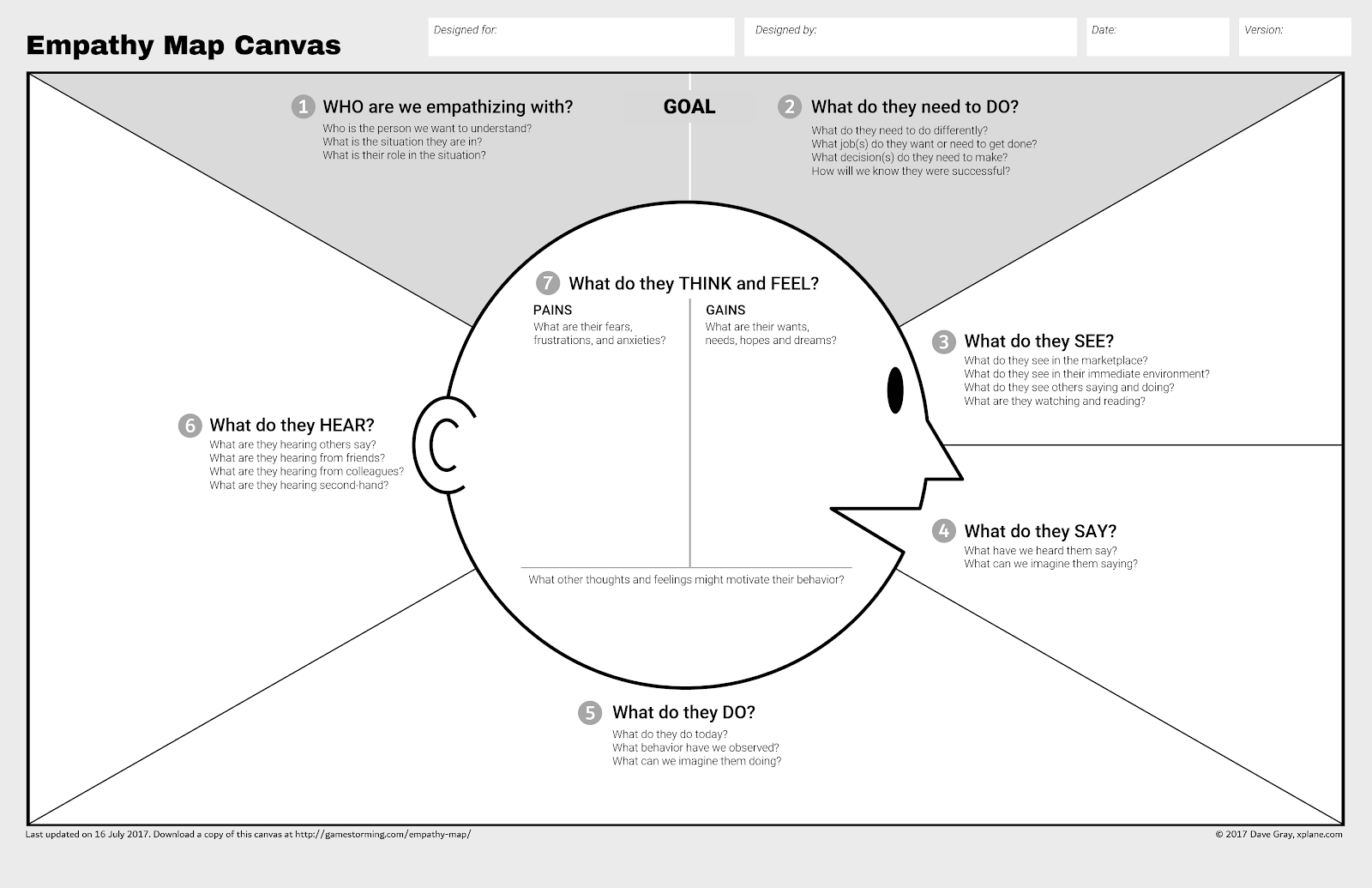
The empathy map canvas is a great tool to brainstorm the mindset of your audience.
It was developed as part of the Gamestorming human-centered design kit from XPLANE.
This is a useful exercise to solicit input from across your sales, customer support, and marketing teams to help identify the key identifiers along the journey.
3. Key Actions & Touchpoints
Ok, we know who we’re talking to, and what they’re going through as they try and solve this challenge.
The next question is what do we want them to DO and HOW are we going to encourage them to take that action. What is the most useful step they can take, and what opportunities will we have to interact with them?
Thinking about what they most need to do next at the same moment that we consider questions like, “will they are on our email list at this point?
What search terms will they be using at this stage? Is the sales team already reaching out to them at this point?
It’s important to document all the touchpoints they might get from your company all in one place to build sales and marketing alignment and ensure we’re working toward the same goals.
Understanding what actions to watch for help keep the focus on the right call to action at each step of the funnel.
4. Ideal Response and Content Opportunities
This is all about finding the most important message: what is the one thing we can say to help them get over the objection and take the next key action?
Specify an ideal response to them at each of these steps and list content you already have or plan to create to meet those needs.
From there, defining our ideal response and most important message to encourage that key action leads to clear content opportunities.
At this point, you have a really useful journey map to begin evaluating your content marketing strategy.
- Do we have most of these questions covered?
- Are these key actions from the journey map aligned with the calls to action on our website?
- What stages of the journey have we done a great job with, and where are the gaps?
Some teams use their personas, journey stages, and key action goals as a way to tag content assets, and then run reports to identify which stages are underserved.
The post Customer Journey Mapping for Audience-Centric Content appeared first on Content Marketing Consulting and Social Media Strategy.
Source: convinceandconvert.com

Social Media Trends You Need to Know in 2021
It’s that time of year again — time to review the social media trends we expect to shape the upcoming year. Let’s dive in now to our annual list of social media trends to watch in 2021, according to the Convince & Convert social media consulting team:
Companies Will Need to Address Social Media Team Burnout
“On one hand, many social teams have been elated to finally be seen as a vital part of their organizations because higher-ups have recognized just how valuable social media has been for communicating in real-time through COVID-19 and other major crises.
On the other hand, social teams are burning out with having to be always on with social customer care (which also includes being the target of a lot of misplaced vitriol) and also having to be the first to communicate through a lot of shifting situations and serious crises, in addition to dealing with all of the personal hardships that come with living through a pandemic.
Social media burnout has been a huge topic with a lot of Social Pros podcast guests over the last few months. I’ve also heard the concern from our clients in higher education.
In fact, according to Sprout Social, ‘88% of social marketers [in higher ed] say the pandemic has made their work much harder, and nearly half don’t have adequate support or resources to manage their mental health. Checks out.”

Anna Hrach, Strategist
Fee-based Fan Communities Will Grow
“Many businesses continue to suffer from a lack of organic reach in social media. Concurrently, consumers are increasingly gravitating toward smaller, more intimate topical communities (see the rise of Facebook Groups popularity as an example).
Simultaneously, 2020 saw a big move in the direct-to-consumer space, both in terms of e-commerce (as evidenced by Instagram shopping), and content (look at the explosive growth of OnlyFans and similar).
In 2021, we’ll see these trends converge, and brands will begin to adopt fee-based communities that give superfans exclusive access to content, exclusive products, and more.
This is the post-modern version of the Membership Club, and will give smart brands the ability to build advocacy and word-of-mouth among core customers who are willing to pay a small monthly fee to interact with one another, and the business.”

Jay Baer, Founder, Convince & Convert
Building Trust Through Content Delivered By and Featuring Humans
“Sure, for a long time, people have talked about the erosion of trust in brands, but never before have brands had to face it more head-on than 2020.
It should become the default that content is carried by human beings — whether that is influencers, your employees, or other subject-matter experts.
People don’t just need to trust because it feels good; people have to put their every action and every purchase through a filter of safety and economic impact.
It’s time to up-level content — not necessarily in production value, but in human connection. Is it harder? Yes. Is it the right thing to do? Yes.”

Mary Nice, Strategist
The Rise and Resurgence of Private Groups and Platforms
“As noise increases on social media, many are looking to customize their experiences by joining private groups and forums based on causes and personal interests.
There has been a rise in the number of Facebook Groups and membership, and Instagram is now seeing the use of its Threads or sharing Stories with specific friends.
Many people are also going to or returning to private and semi-private online forums for education, entertainment, networking, and mutual interest.”

Christin Kardos, Community Manager
Influencers Will Become Vital in B2B, not Just B2C
“According to the 11th Annual B2B Content Marketing Benchmarks, Budgets, and Trends report from CMI/MarketingProfs, 89% of B2B marketers use social media for content distribution, but only 24% used Media/Influencer relations.
It’s no surprise that in the last decade, social media has become an extremely fragmented and noisy place, and therefore, brands both in B2B and B2C will find that their dollars go further when they collaborate with individuals whom their audience trusts.
Whether these are macro-influencers or micro-influencers, co-creating content that comes from these trusted voices will help brands to break through the noise AND reach broader audiences.”

Zontee Hou, Co-lead, Consulting
Socially-conscious Values Extend to Imagery as Well
“Nearly 80% of people globally have said it isn’t enough to have people of various ethnicities, backgrounds, and appearances in advertising but that they expect companies to do a better job at capturing people’s true lifestyles and cultures, according to new research by Getty Images.
Searches have increased year-over-year for ‘diversity’ (up 133%), ‘culture’ (up 115%), ‘real people’ (up 115%) and ‘inclusion’ (up 126%).
From May to June alone, customer searches for diverse images increased by 200%, and searches for images around unity and equality increased by 500%, trends that are believed to be intensified due to anti-racism protests.
Side note: our client, AARP, partnered with Getty to create more authentic images of people 50+.”

Jenny Magic, Marketing Strategist
Social Media Is Part of Everyone’s Job
“Social media has been a core part of the business for more than a decade. Long gone are the days where ‘playing on that Facebook thing’ was only supposed to happen on lunch breaks.
In the age of coronavirus, social media has become more important than ever to business survival and success.
Your employees are your greatest social media assets. In fact, 45% of consumers are more likely to research a product or service when a brand’s employees post about that product or service.
Social media skill sets go beyond marketing and communications roles. They are less frequently required but especially needed, in customer service, HR, sales, and research.
Even in roles without direct ties to content, messaging, design, lead gen, sales, or service, we’re still asking employees to be good at social media to power our internal advocacy efforts.
Employee advocacy programs continue to be a top trend because their success to humanize a brand and amplify storytelling is undeniable at scale.
Businesses must provide social media policy guidelines and resources for their employees to master social media skills, as this technology is more akin to email than VR in today’s business world.”

Lauren Teague, Strategist
Use of User-generated Content Grows
“User-generated content has become an increasingly reliable social media marketing tactic. Brands and consumers find this type of content more authentic and trustworthy.
A majority of users trust UGC when it comes to influencing their buying decisions, and people want to see real-life experiences.
We will see a surge in UGC content this year through platforms such as TikTok and Instagram.”

Leanna Pham, Brand Marketing Intern
Questions About Any of These Social Media Trends? Ask a Convince & Convert Strategist!
Simply fill out the form below to request a no-cost consultation with a strategist on our team. We’d love to get to know you.
The post-Social Media Trends You Need to Know in 2021 appeared first on Content Marketing Consulting and Social Media Strategy.
Source: convinceandconvert.com

Marketing Automation Consulting
Marketing automation is often viewed as a nice-to-have option, something that could be helpful. Marketing automation isn’t an extra; it’s a component that’s an essential part of your marketing.

Why aren’t more companies using marketing automation?
A recent survey from Liana Technologies found that 60 percent of respondents said they didn’t know how to use marketing automation. They listed a lack of know-how as the main reason they weren’t adopting marketing automation campaigns.
Half of those surveyed also listed a lack of strategy or personnel as yet another reason they weren’t moving forward with marketing automation.
As you can see from the research, these companies need marketing automation consulting.
10 Ways a Marketing Automation Consultant Can Help Grow Your Business
Marketing automation is often viewed as a nice-to-have option, something that could be helpful but really isn’t all that necessary for companies looking to grow. Marketing automation isn’t an extra; it’s a component that’s an essential part of your marketing.
This isn’t always as clear until you breakdown the benefits that come with marketing automation.
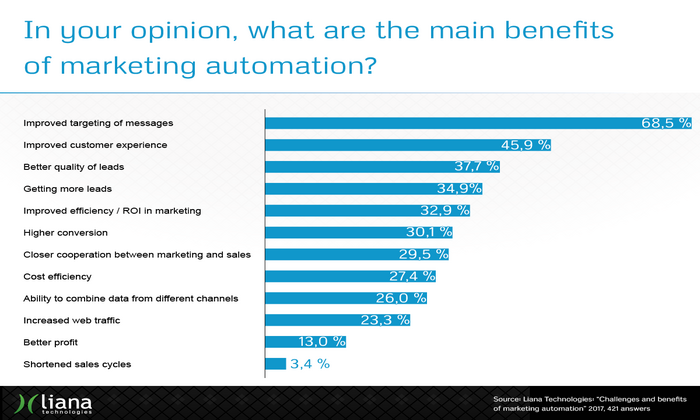
Here are ten ways a marketing automation consultant can help you grow your business.
1 – More targeted marketing:
Many companies force their customers into the same marketing funnel. They’re not focused on optimizing their funnel based on the buyer’s journey, so most of their prospects fall out of their marketing funnel. A marketing automation consultant helps you segment and target your customers properly.
A good consultant will help you identify customers who are ready to buy, leads that need to be nurtured, and leads you can disqualify.
2 – Improve customer experiences:
According to Salesforce, 76 percent of consumers expect you to understand their needs and expectations. Another 84 percent said, “being treated like a person, not a number” is essential to earning their business. Marketing automation helps you achieve this at scale, so you’re able to provide the one-on-one attention and personalization customers expect.
3 – Increased traffic:
Big companies have embraced analytics, but most don’t know how to use their data. Most don’t have a data-driven culture, so it’s difficult for many organizations to have confidence in their marketing decisions. This isn’t just big companies, though; it’s most companies in general.
This means it’s harder for companies to identify the traffic sources working well versus those that aren’t. With marketing automation tools like lead scoring and lead nurturing, you can identify your best performing traffic sources.
4 – Higher quality leads:
When customers go through the same funnels, without segmentation, lead quality suffers. Your marketing automation consultant should help you outline the buyer’s journey and segment customers based on their place in the funnel. Doing this increases lead quality as customers are pre-qualified before and after they convert. This keeps the quality of the leads sent to sales high.
5 – More leads:
Once you’ve identified the list of marketing automation tools and workflows you need to generate high-quality leads, you can use those same automation tools to scale your lead generation campaigns. Your marketing automation consultant will help you increase lead production, using the lessons learned from your smaller campaigns. You’ll know which traffic sources perform best, how to improve lead quality.
6 – Increased conversion rates:
One of the hidden benefits of marketing automation is that the benefits are cumulative. Your marketing automation consultant will show you how to combine the strategy, tactics, workflows, and tools you’ve put together into a single system. Each component, when optimized, should produce increased conversion rates consistently in your campaigns over time.
7 – Increased ROI:
As your conversion rates increase, your ROI will continue to grow. A great marketing automation consultant will show you how to maintain your ROI as you continue to scale. You should see more revenue with less spend consistently over time.
8 – Reduced expenses:
As metrics like your return on ad spend (ROAS) and your conversion rate improves, you should see a decrease in costs (e.g., cost per lead, cost per action, customer acquisition costs). Your marketing automation consultant should monitor your returns and expenses, ensuring that both are moving in the right direction.
9 – Data sharing between marketing channels:
Your marketing automation stack should provide your team with the right data analysis tools. If you use analysis tools like Cyfe or Power BI, you’ll want to make sure that your team has access to data across marketing channels; your consultant should help you set this up, so your team has need-to-know access to data.
Doing this will reduce operational silos, keeping everyone in your team on the same page; no more fights between sales and marketing for control.
10 – Shorter sales cycles:
Let’s say you’ve received two sets of leads. Set A has customers who are ready to buy now. They’ve done their homework, and they’ve decided your company is the best fit.
Set B has interested customers; they won’t be ready to decide for another three to six months. Set A has a shorter sales cycle — your consultant helps you find and segment these customers as they come into your funnel.
These benefits aren’t random one-offs; they’re outcomes your business needs to grow. The problem with growth is scaling. As you grow, it gets harder to manage all of this manually.
How to Get Started With a Marketing Automation Consultant
Your marketing automation consultant should be a specialist with deep expertise in automation. They should also have experience across a broad range of marketing disciplines and channels, including:
- Advertising (display, content, etc.)
- Analytics
- Branding
- Content
- Direct response
- Market research
- Mobile
- Sales
- Search (organic and paid)
Websites (e.g., conversion rate optimization, usability, etc.)
If you’re ready to get started with a marketing automation consultant, there are a few things you’ll need to prepare ahead of time.
Upfront preparation makes it easier to get started; your consultant doesn’t have to waste a lot of time (and your money) getting you up to speed.
Both of you will be able to jump in right away.
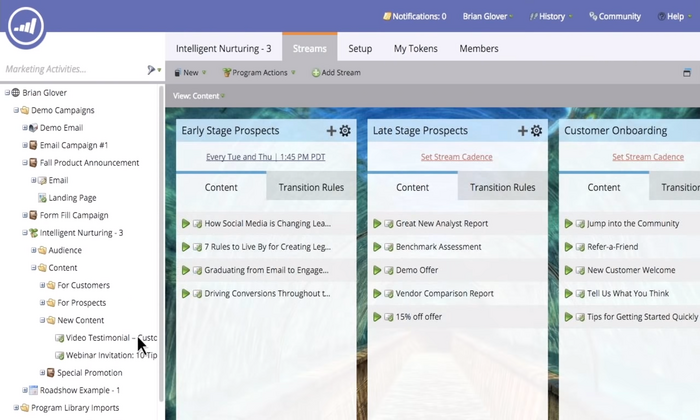
You’ll want to make sure that you have a list of:
Goals, KPIs, and objectives:
For example, this could include a list of tools you’d like to integrate into your technology stack, as well as how you’d like these tools to perform.
This could also provide your consultant with information on the specific outcomes you’d like to see due to automation (e.g., a 7 percent increase in productivity, shorter sales cycles, less double entry, improved utilization rates, etc.).
The tools and resources you’re using:
You’ll want to make a list of the tools and resources you’re already using. Collect additional information on the number of users for each software, tool, or subscription. Make note of any API keys and special instructions. Also include a list of the software, tools, and resources you’d like to use.
Decision-makers and influencers:
If you’re part of a team, you may find that some people aren’t all that excited to share their data. Others are interested in working with your consultant to automate essential marketing tasks.
Sharing a list of decision-makers and influencers with your consultant makes their job easier. Right from the beginning, they know where everyone stands and who to talk to if they need help getting everyone on the same page.
Obstacles and challenges:
You’ll want to outline the list of barriers and challenges that may prevent you from achieving the goals and objectives you’ve listed above. Maybe some of the services you use don’t offer an API or integrate with third-party services like Zapier. Maybe some of the tools in your list are outdated, or they’re unsupported legacy options (i.e., legacy software running on Windows XP).
Policies and procedures:
If your company has specific policies, procedures, or guidelines for software purchases, you’ll want to share that with your consultant as well. You want to let your consultant know what’s allowed, required, forbidden, and unacceptable. You want to set your consultant up for success by giving them a clear set of guidelines to follow; this helps your company grow.
Strengths and weaknesses:
This step is uncomfortable but it’s also important; if your team, division, or company has problems in a specific area, spell that out for your consultant as clearly as possible.
Does it take your company a long time to make important decisions? Is your organization good at finding great employees and contractors?
Give your consultant a brief overview of your strengths and weaknesses. Getting people on board is easier when you know what you’re working with.
Sharing this information upfront makes automation smooth and efficient.
If you’ve already answered these questions for your consultant, they’re able to focus their attention on helping you automate your marketing campaigns, projects, and tasks.

Measuring the ROI of Marketing Automation Consulting Services
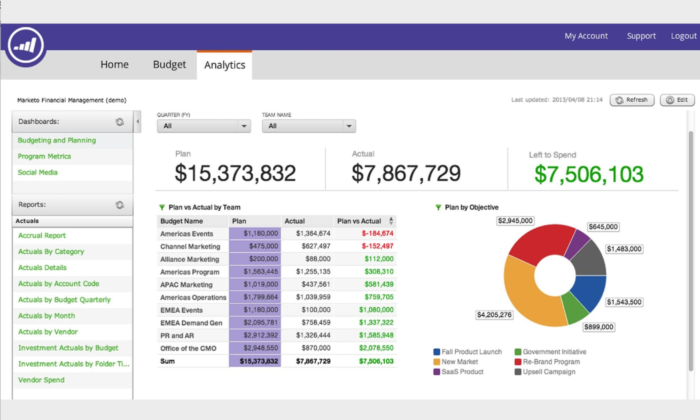
In general, consultants aren’t big on measuring ROI, but they should be. It’s reasonable to expect the same from your marketing automation consultant. If you’ve done the upfront work I’ve mentioned already, you should have everything you need to measure the ROI ahead of time.
Remember the list of goals, KPIs, and objectives you wrote down earlier?
Your consultant should be able to help you refine your goals and objectives. If you haven’t already, you want to add some specificity to these goals. You’ll want to add specific numbers, facts. or figures to these goals. Use these figures as a general guide — you want to discuss these with your consultant making sure they’re realistic and achievable.
Here are a few examples you can use:
- Increase productivity becomes — Increase our marketing team’s productivity by 16 percent
- Improve lead quality becomes — Use lead scoring to achieve a 6 percent lift in marketing qualified lead volume
- Identify top-performing marketing channels becomes — Identify top-performing marketing channels by automating URL tagging for all current and future marketing campaigns
- Decrease customer acquisition costs become — Reduce customer acquisition costs on Google ads by a minimum of 11 percent
Measuring your ROI is pretty straightforward if you have a clear idea of your campaign goals and objectives. The easier it is for you to list a starting point, the easier it will be for your consultant to help you reach your goals and objectives.
4 Point Checklist For Finding the Right Marketing Automation Consultant
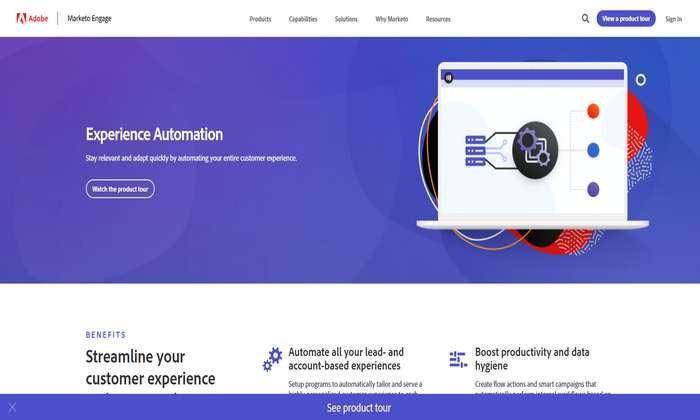
Choosing the right marketing automation consultant is simple if you’ve prepared ahead of time. From there, you can screen consultants the same way you would for any other consultant or professional.
First, you outline your process, listing your goals and objectives, your current technology stack, decision-makers, influencers, etc. Second, you filter your providers through your process, ensuring each candidate meets the criteria you’ve set.
Here’s a shortlist of the criteria you can use to evaluate your consultants.
They understand digital marketing.
The best marketing automation consultants are marketers themselves. The ideal candidate is a marketing veteran who’s managed marketing campaigns from beginning to end throughout their career. You’re looking for someone who got their start as a marketer.
They understand your business.
Your marketing automation consultant should have an in-depth knowledge of your business — how it works, what you need, mistakes to avoid, etc. If you’re managing a retail or ecommerce company, your consultant should have experience managing marketing campaigns for retail or e-commerce companies. You’re looking for someone who has a native understanding of your business.
They’re data-driven.
Marketing automation requires a mix of art and science. You’ll need someone who loves to read through data but is skilled enough to explain it to the people on your team who aren’t data-driven. The ideal consultant can tell stories with data and helping your team make important decisions.
They’re proactive and knowledgeable.
When it comes to automation, you shouldn’t be as knowledgeable as your consultant. They should be able to make recommendations and connections you weren’t even thinking of. They should be able to help you automate your campaigns in new ways; to increase your productivity by customizing your marketing stack.
This checklist is pretty simple.
A great marketing automation consultant should be able to handle everything we’ve covered so far comfortably. They should be able to break things down for you, showing you how to improve your plan, refine your goals and objectives, and add to your technology stack.
They should be asking questions.
If they’re good at what they do, they’ll have some questions and requirements of their own.
Conclusion
While many organizations are switching to marketing automation, most don’t have a clear plan they can follow. Companies list a lack of know-how, strategy, or personnel as the reasons why they weren’t completely on board with marketing automation.
That’s changing fast, though.
More companies are investing in marketing automation. They’re taking the time to implement a strategy for their business. Marketing automation isn’t an extra; it’s a component that’s an essential part of your marketing, especially as your company grows.
With the right consultant and a clear strategy, you’ll have the people, process, and technology you need to grow your business quickly.
The post Marketing Automation Consulting appeared first on Neil Patel.
Source: feedproxy.google.com