
Tag Archives for " teams "

Struggling With Customer Acquisition?: Fix This One Alignment Issue
You are struggling to hit your acquisition targets—the marketing team is bringing in lots of hot leads but the sales team is struggling to convert them. Yet your marketing team is an award-winning one and your sales team is world cup worthy.
Where is the problem with your customer acquisition strategy? And what can be done about it?
Let’s dig a little deeper to understand what is making your team of A-players struggle to hit your acquisition goals?

Why Does Your Customer Acquisition Strategy Seem Broken?
There are many reasons why your customer acquisition strategy may not be working. But deep down, it’s due to one thing: the misalignment between your sales and marketing team.
Here’s how it translates into the organization.
Gap 1: Your sales and marketing teams are working on different funnels
In most companies, the marketing and sales teams work separately. Too often, marketers know too little about the customers and their dealings with the sales team.
SDRs work on cold emails and cold call random people, and marketers run campaigns to their target persona. As a result, each of these departments ends up creating an acquisition funnel based on the persona they have identified as their ideal customer profile.

This strategy is still used by many companies, even by some industry leaders, and it enables them to fuel their year-over-year growth.
Now, I bet you’re wondering what the problem is since this strategy seems to work.

Well, a study by the International Data Corporation revealed that B2B companies’ inability to align marketing and sales teams around the right workflows and technologies costs them about 10% or more of revenue per year.
In fact, when your sales and marketing departments function as standalone departments, efforts are put into tasks that are not very productive. For example, one study found that 50% of sales time is wasted on unproductive prospecting—either chasing unqualified leads or trying to convert leads that aren’t yet warmed up.
Another consequence of sales and marketing teams working with different funnels is a lack of understanding of the Ideal Customer Profile to target. For example, a lead that the marketing team deems qualified may be seen as unqualified by the sales team. A study by ReachForce showed that sales reps ignore 50% of marketing leads.

Other studies have shown that 60-70% of B2B content created is never used. In most instances, this is because the topic is irrelevant to the buyer’s audience.
As you take it a step ahead, you realize that if the marketing team and the sales team worked together, it would have been easier for them to determine what content the marketing team should produce for lead nurturing and how to use it to warm leads.
Gap 2: Your sales and marketing teams are chasing different results
How can you achieve a shared goal if each team measures its success in different ways?
For clarity purposes, let’s assume you have a SaaS, and your annual goal is to grow sign-ups by 45+ percent.
Now imagine that the sales teams measured their success based on new free trial accounts, closed deals, and upsells. Meanwhile, marketing teams measured their success on lead quantity, quality, and brand awareness.
In this particular case, saying that you will fall short of your annual goal is just an understatement.
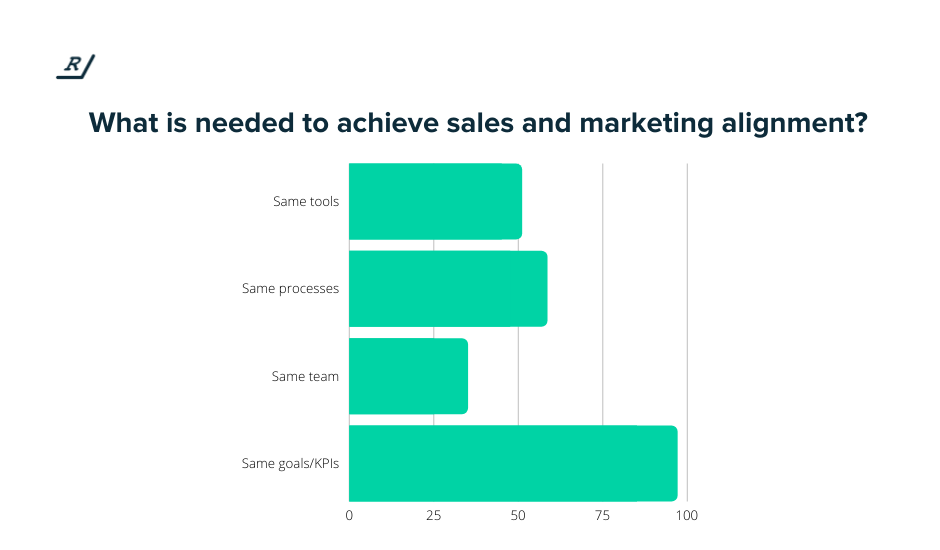
If there was alignment between the two teams, they would have agreed on what a quality lead means for the company and what is the average number of leads marketing needs to bring in before sales convert X amount of users.
If, for example, the metric shows that the sales team needs 15 leads to close 5 deals and that each of these leads should be SaaS companies with teams of 50 to 300, the marketing team will know where to focus their efforts and what to do in order to reach the common goal.
Similarly, the sales team will know better how not to fall short of the 5 out of 15 deals closed.
Why Aligning Sales and Marketing Is The Only Way to Fix Your Customer Acquisition Strategy
So with the gaps identified, it has become increasingly clear that the solution to bridging the gap is to align your sales and marketing teams.
Here are some reasons why.
It helps keep business to customer communications consistent
It happens more often than you think—the sales team calls the product one thing, but the marketing team uses another term to describe the same product.
For example, the sales team calls it a “Chatbot,” while the marketing team calls it a “Conversational Marketing Platform.”
Here is another example. The marketing team talks about “Collaborative Growth Platform”, while the sales team talks about “CRM”.
Admittedly, this can be confusing for potential and even existing customers, and it’s a living example of mismatched messaging.

Not surprisingly, it can cost you your first good impression and, as a result, a prospect may be less likely to trust you.
In fact, 21% of B2B marketers cite “giving the prospect a bad first impression of our company” as one of the most damaging factors resulting from misaligned marketing and sales.
That’s why one of the biggest benefits of aligning sales and marketing teams is consistent messaging.
The messaging used by your marketing team can now warm up prospects and set them up for the sales team to further reinforce those same messages. If the marketing message strikes a chord, the sales team can use it to close more business.
Failing this, you may end up with a siloed message, which can lead to a very confusing and inconsistent journey for your prospect.
21% of B2B marketers cite “giving the prospect a bad first impression of our company” as one of the most damaging factors resulting from misaligned marketing and sales.Click To Tweet
If your prospects think they’re getting one thing based on what marketing is saying when the sales team is selling them something completely different, it will definitely hurt your bottom line.
So it’s important to make sure your message is consistent and relevant to your entire customer journey.
It creates a single customer journey
We discussed earlier that the foundation of the sales-marketing relationship is the conversion funnel.
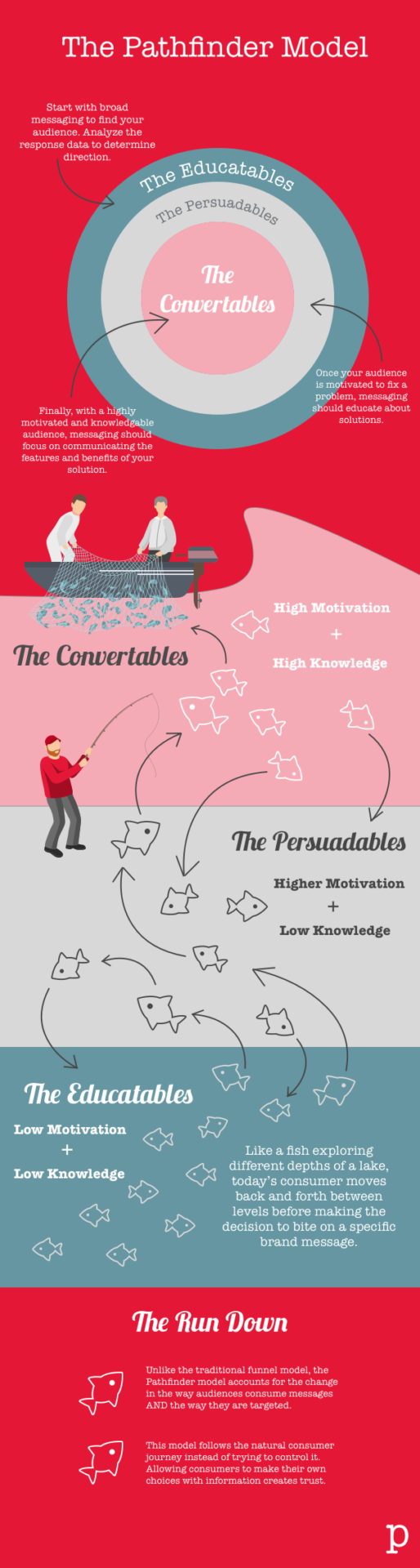
So when it comes to getting everyone on the same page, the best place to start is to get them to agree on the structure of the entire customer journey.
By doing so, you save your prospects from having a single branded customer experience instead of separate siloed experiences.

As a result, everything is tied together as an experience—from the awareness stage at the top of the customer journey funnel to the brand loyalty stage.
It fosters a “marketing first” approach
Each department plays its own tune when your sales and marketing teams are misaligned. In such scenarios, prospects are less likely to respond positively to a cold outreach if they’ve never heard of you, and that can harm your reputation and your chances of closing the deal later on.
If both teams are aligned, it encourages a “marketing first” approach—meaning that marketers find prospects who have a specific problem and create content to help them solve that problem.
It all starts with the marketing team warming up and nurturing new leads by creating informational content about the product and selling the features and benefits by creating transactional content to fuel conversion.
Then, when the potential customer prepares to make a decision, the sales team can take it from where the marketing left and close the deal.
It leads to a better way of assessing results
By aligning your sales and marketing teams with a common goal and the same KPIs, you have a great chance to see the synergy behind their work and analyze how your organization is stacking up in both sales and marketing.
In addition, you will be able to detect the shortcomings of your customer acquisition funnel and adjust not only certain parts but the whole funnel.
The post Struggling With Customer Acquisition?: Fix This One Alignment Issue appeared first on Content Marketing Consulting and Social Media Strategy.
Source: convinceandconvert.com

Fuel Marketing Transformation with Team Alignment
The Pain Points of Misaligned Teams
Anyone who’s worked on a team knows what it feels like to be part of a team that isn’t aligned, and this can have a real impact on your ability to make strategic improvements. Does this sound familiar?
- Your organization has invested in and developed strategy after strategy, but none of them are sticking; execution is a real challenge.
- Teams aren’t working well together and the silos between teams are cementing into territories that are heavily guarded – resource and information sharing is forced, rather than the norm.
- Leaders keep getting feedback from their teams that they need more headcount to do the work.
- Team members aren’t bringing their best – no breakthrough creative ideas, less innovative problem solving, fewer examples of working “above and beyond.”
- It seems like team members don’t enjoy coming to work – there are complaints that the day-to-day work is frustrating, a total grind, or unmotivating.
- Teams are experiencing high turnover from people that seemed at least moderately satisfied at work.
I imagine you’re nodding your head and also feeling a growing apprehension about the big plans you have for the coming year.

For many of you, a new strategy, campaign, or initiative is on the horizon and success is the only acceptable outcome. You’ve likely tried implementing change in the past with less-than-ideal results.
The issue is likely a mix of individual motivations, team culture, tools, and resource gaps that internal leaders are having difficulty parsing out and addressing.
But there is a better way: when team members actually trust their team, know-how to point out flaws, and learn from each other to co-create the strategy, inevitably objections and silos dissolve, enthusiasm skyrockets and entrepreneurial thinking abounds.
Team Alignment is a Predictor of Success
This just in: Leading business researchers have discovered a revolutionary new approach that makes any business more profitable. It reduces costs and increases productivity and profitability. It increases lead quality, pipeline velocity, leads to happier customers, and more repeat business.
Companies using this approach also have more satisfied employees, are willing to work harder (often for less money!), and have higher overall employee retention. It has no hard costs and you can do it internally, with resources you already have. Are you interested?
Any business leader would be negligent not to at least open that link and try to figure out if it was too good to be true.
When they come to realize the research was conducted by Google, Harvard Business School, and dozens of reputable sources consistently since the mid-1990’s you’d expect that they’d be adding this new approach to the very top of their to-do lists and retraining managers to incorporate the findings.

Team alignment, and its the underlying foundation of psychological safety, is not something that should be relegated to HR or written off as “soft skills.”
In almost two decades of writing and overseeing strategic marketing transformations, I can say with confidence that team alignment is the number one indicator of whether a new initiative will succeed or fail.
Unfortunately, it’s also a topic many leaders would rather gloss over when they get ready for a big strategic change – they want action plans, not “warm and fuzzy” team alignment plans. I’ve had pushback more than once from clients who would prefer we “stay in our lane” and just focus on research, metrics, and action plans.
Research Shows Aligned Teams Are Critical

When you ask most business leaders about team alignment and psychological safety, they often point to the HR department, mumble something about the culture, and shrug their shoulders. This is too bad because the research is clear:
- Companies that successfully align sales and marketing retain 36% more customers, generate 32% higher revenue and achieve 38% higher win rates. (Source: Ascend Ebook)
- A study of 1,000 professionals across a range of industries found teams with cross-functional collaboration and an openwork style are 60% more likely to achieve more, faster. Plus, they’re 80% more likely to report high emotional well-being. (Source: Ascend2)
- More than half (54%) of employees say they’re willing to stay at a company longer than what’s in their best interest due to a strong sense of community. (Source: Ascend2)
- Google’s “Project Aristotle,” explored over 250 team-level variables, found that psychological safety is the most critical factor and a prerequisite to enabling successful teams. (Google, 2015). Team psychological safety is a shared belief that people feel safe about the interpersonal risks that arise concerning their behaviors in a team context (Edmondson, 2018).
- Despite the importance of psychological safety, only 47% of employees across the world described their workplaces as psychologically safe (Ipsos, 2012).
What’s Team Alignment and Psychological Safety?
Team alignment can feel hard to pin down if you’re new to the topic but here’s a simple definition: team alignment is the team’s ability to work together and learn from each other.

As researchers have tried to study and measure this trait, they have settled on the term “psychological safety” and defined it as having four key domains or areas that can be assessed:
- Attitude to risk & failure: does the team see failure as a necessary byproduct of growth and innovation? Or is it punished and avoided at all costs?
- Open conversation: do team members feel comfortable expressing concerns and reservations as they work together? Can they learn from one another and hear constructive feedback in the spirit it is intended for?
- Willingness to help: Does the team have a spirit of being “in this together” and do they easily pick up slack for the benefit of the whole? Does this shake out fairly or do some team members take advantage of others?
- Inclusivity: Does the teamwork hard to ensure all perspectives are represented, even from those who are not always first to speak?
Roadmap for Successful Change
Let me give you the shortcut formula to planning your success. Every single business transformation comes down to two simple questions:
- What exactly do we need to do differently?
- Who is going to do it?
The first item is your strategy, and companies are always paying for more and better strategies. Unfortunately, all too often they completely ignore the second item, assuming that once the WHAT and HOW are clear, the WHO will fall into place.

A plan can be strategically sound, backed by data, and make perfect sense on paper but that doesn’t mean the team will get on board. Considerations like who gets credit, who will benefit from less work or more resources, job security and perception of rank, and how success is measured all inherently affect the buy-in for any new plan.
STEP 1: Strategic Alignment – What exactly do we need to do differently?
- Define what you’re trying to achieve, clearly, concretely, with metrics.
- Link the change to a larger organizational vision
- Specifically define the change: current state, target state, the gap, and what is NOT changing.
- Identify past lessons learned. What has been tried before and how did it go?
It’s worth noting that most teams are pretty good at step one, but they stop there.
STEP 2: Stakeholder Analysis & Team Alignment – Who is going to do it?
- Ensure the team agrees on the problem and its urgency
- Confirm the team believes change is possible in this setting.
- Ask whether the team has the time, energy, and willingness to change. (Change fatigue is real!)
- Uncover whether each individual believes they can personally succeed with this change
Team Alignment In The Wild
For the last couple of years, Convince & Convert has worked with a large national association ($1.7B in revenue, 38 million members) on a wide variety of marketing initiatives. One change, in particular, was in process when we started working together, and the outcome was anything but certain.
A new project management system was intended to be a centralized place for updates and tracking, intended to increase collaboration, reduce meetings, and allow workloads to be distributed more evenly across the team.

Unfortunately, team adoption of the new tool was low and falling farther – the grumbling was increasing over time. Leaders in charge of its success were struggling to come up with a way forward. Confidential interviews with individual team members uncovered some real and specific challenges, both with the actual tool and how the change was communicated.
Owners of the tool went back to developers to overhaul the tool and improve functionality, and are in the middle of a much more successful rollout with an enthusiastic reception from previously reluctant team members.
Setting Up New Norms
In another example, a nationally-recognized, top-50 university we worked with was struggling after some changes to the marketing team organizational chart and reporting structure. Two teams that had previously been independent were combined, but the merger was not a smooth one.
Assessments of the team showed that each smaller team felt psychologically safe to communicate openly. However, when the teams combined to collaborate, that index score went way down. The norms of each smaller team were different.

They needed to be revisited to openly agree on what type of feedback was preferred, how to run meetings, and a number of other patterns that develop almost without noticing but need to be identified, agreed upon and communicated to new team members.
Once new norms were established, the teams were able to work together fluidly and begin finding the synergy that was intended with the original combining of teams.
“What’s in it for me?”
It’s important to dig in here and get curious to understand team strengths, weaknesses, passions, and drains. This often means closed-door confidential sessions where team members have a safe space to talk about their ambitions and concerns, what skills they do or don’t possess, and where they might like to grow.

The effort is not the same for everyone; work to understand perceived effort with perspective taking, empathy, mentoring, coaching.
Smart leaders understand that all change in responsibilities comes with a power shift across a team. When changes are on the horizon, the first question everyone wants to be answered is, “how will this impact me and my job?”
- Who on the team will have to learn new skills?
- Whose job might be in jeopardy after the change?
- What new resources will various team members get? How do I get my share of the pie?
- Will the extra responsibilities be rewarded fairly?
- If the new work sounds fun, can I get rid of some old tasks I hate?
…and dozens more
Answering these questions in advance, equitably, and with your individual skills and goals in mind is the core job of a great manager. Allowing the team to negotiate among themselves, speaking honestly about their strengths and weaknesses, skills they have or want to develop, and how they’d like to see the change unfold is the gold standard.
How Does Your Team Rank?
These areas are so critical to navigating change, and more and more of our clients are interested in getting better, not just at the “what should we do to innovate?” question but also understanding the people and motivations that will make or break the strategic plans they’ve laid out.

A seven-question assessment that takes under 3 minutes can help teams understand their ability to bring new ideas and challenge each other, essential qualities of a successful organizational change process.
Benchmarking the team’s score and growth over time can provide tangible, actionable goals for managers and teams to work towards. The Convince & Convert team has strategists trained to conduct these assessments and facilitate improved team alignment, and we’d love to help your team on the next stage of your journey.
The post Fuel Marketing Transformation with Team Alignment appeared first on Content Marketing Consulting and Social Media Strategy.
Source: convinceandconvert.com

How to Align Your SEO and Sales Teams
Have you figured out your marketing strategy for 2022 yet?
Here’s a great idea for you: Embrace collaborative marketing. Aligning your different teams is likely to open up many new opportunities for your business.
According to the recent research by Convince and Convert and Ascend2, 50% of marketers claim that integrating marketing and sales teams has proved to be very successful at achieving strategic goals.

This is huge.
Here’s how to align two of your most isolated teams: Sales and SEO.
Foster Content Marketing Collaboration
All marketing is driven by content and that includes SEO and sales. For both teams, content is fundamental. Without content, there are no rankings or sales:
- Google relies on content to identify if a page is relevant to a search query and if it satisfies a searcher’s intent. Relevancy and search intent are two key ranking signals.
- In sales, content is the most important driving force behind buyers’ journey. Content can directly impact purchasing decisions, as many studies confirm.
According to Forbes, more than 60% of B2B buyers say they are able to make their purchase decision exclusively based on digital content, without talking to sales reps or going through demos.
So why is there such a huge disconnect between SEO and sales content? Why do these two content strategies often exist separately without informing or helping each other?
“Content is King” has long been a marketing buzz phrase, especially in the B2B industry. However content is only King if it enables sales.

Too often there’s a discrepancy between those producing content and organizational teams who are trying to leverage it.
The resulting problem is two-fold:
- Sales reps lack the right content they can use to effectively engage with prospects
- SEO content creators lack sales reps’ insight which would enable them to create content that addresses the real struggles of their target audience.
Ways to Integrate SEO and Sales
Content can be the driving source for removing your organizational silos and encouraging cross-team collaboration.

How can SEO and content marketing teams collaborate on creating an integrated content strategy?
- Encourage the two teams to brainstorm on content ideas together
- Let the customer support and sales teams keep a shareable record of questions your actual customers are asking them. Any of those can and should be content ideas for the SEO team to research in terms of demand (search volume) and difficulty.
- Foster creativity from both of the teams: What are their thoughts on content promotion opportunities.
- Do they have any viral content ideas?
- Let both the teams explore further opportunities. For example, let your SEO team figure out ways to reuse sales enablement content for ESP purposes. Many of those sales demos can be used as public content that can target all kinds of long-tail ranking opportunities.
Help Them Understand Your Customers Better
When you work on traffic numbers all day, it is too easy to forget that there are real people behind those numbers.
Both SEO and sales team have unique access to valuable insights on who is your business’s target customer and how to serve them better:
- Sales teams talk to your current and future customers on a daily basis. They know their struggles and what they are looking to solve. Sharing this information with the SEO team will empower your SEO strategy with more data your competitors have no access to.
- Your SEO team knows exactly what your customers are searching for and which questions they are asking. They know the demand behind each search term and they can report on how your competitors are targeting each search query.
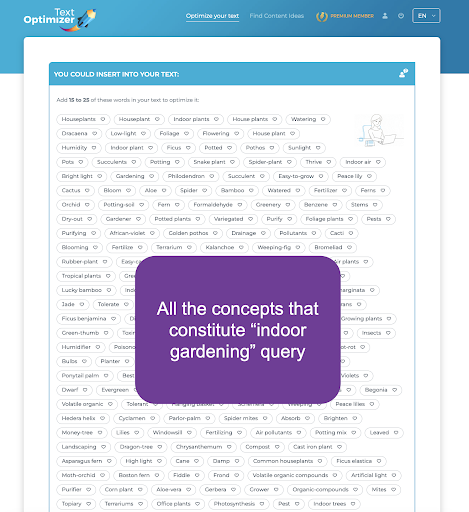
Text Optimizer allows you to better understand concepts behind any search query and help you find the ways to meet your customers’ needs easier:
Share Your Web Analytics Insights
Let the SEO team share their web analytics insights: What are the effective paths that bring those leads through the site down the conversion funnel? What works best in terms of engaging your site visitors and turning them into leads?
All of that information will help your sales team focus on what works best and nail their lead generation and onboarding strategy.
Encourage your SEO team to create custom analytics dashboards and hold regular meetings to give. This will give your sales team access to web analytics data they can understand.
Google Analytics is the first option that comes to mind. But there are also web traffic statistics solutions offered by your hosting provider, as well as many Google Analytics alternatives.
Whatagraph is an easy way to create custom reports that are delivered weekly and are very easy to understand even for a non-technical person:
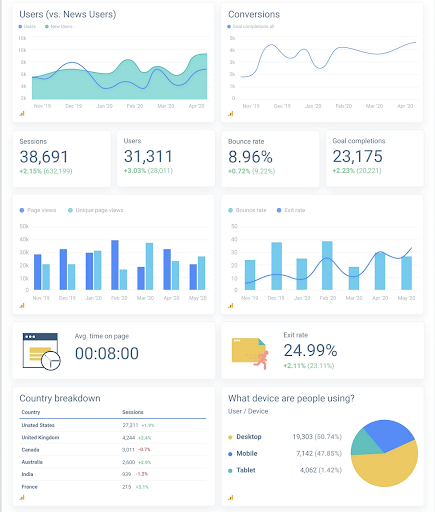
You can also integrate your web analytics into your website dashboard using these templates to let your whole company access it at any time.
Open up More Business Opportunities
The cross-team collaboration will likely discover more unexpected opportunities for you and your business. For example, letting your sales team access your SEO data may help them identify industry gaps and define your product’s unique value proposition.
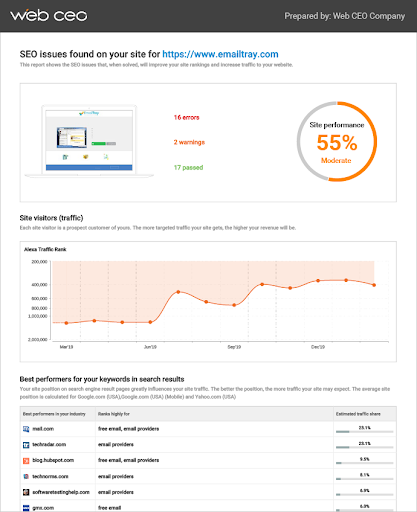
You can also discover new product or service opportunities. For example, this SEO lead generation tool can help you expand your services pretty easily.
Widgets like this help integrate SEO into the sales process in the most efficient way.
Conclusion
The power of cross-team collaboration is almost limitless. SEO and Sales collaboration can give you that competitive advantage your business needs. By combining numbers with actual sales experience, you can empower both teams.

The concept of unified communications has become even more important for business survival after COVID hit and many teams moved to work from home.

Finding more ways to let your (remote) teams keep in touch and collaborate is more important than ever.
Hopefully, the above ideas would come useful!
The post How to Align Your SEO and Sales Teams appeared first on Content Marketing Consulting and Social Media Strategy.
Source: convinceandconvert.com

6 Ways to Integrate SEO Across Teams
When I started in digital marketing, I splattered meta-data and keywords into content like Pollock. I am not proud of this because not only does this date me, but it is also horrifically against best practices as we see them today. If you ever read anything along the lines of “California vacation lovers and those who love California vacations? For the best California vacation, look no further than these California vacations,” I send my deepest apologies.
Fast forward 20 years, I’m now happy to say that organic SEO best practices have dramatically improved, both for the marketer and the end-user. As we move into 2022, it’s more important than ever to remember search does not take place in a silo. It should be a thoughtful, integrated strategy running across the complete customer experience.

6 Keyways to Integrate SEO Across Your Organization
Not sure how to integrate SEO? We have six key ways to de-silo your search integration across your organization when it comes to working with search engine optimization teams, agencies, or practitioners.
#1. Search Meets Research, Personas, and the Audience Journey

Search traffic provides a treasure trove of qualitative and quantitative information about your audiences’ needs, vernacular, attitudes, and more.
- Do people talk about your travel product by saying “vacation” or “trip”?
- Do high school students looking for information about their college of the chosen search for “ASU”, “Arizona State”, or “Arizona State University”?
- When searching for enterprise software, do your customers say “platform,” “tool,” or “technology”?
Using search data helps you discern what will resonate best with your audience. Couple this with surveys, stakeholder interviews, and digital data and you have a solid (and quantifiable) foundation for your personas and audience journeys.
When search teams share high-level keyword information across the organization, it can help support everything from media relations to product development to recruitment and beyond.
#2. Integrate SEO and UX

According to “SEO For Everyone” authors Rebekah Baggs & Chris Corak, search and user experience teams shouldn’t be kept on separate tasks (or quite frequently within separate silos). These practitioners or teams often have some of the same goals in mind: ensure the site is easy to find, navigate, use, and enjoy. Although, they may approach the process of getting to the end goal differently.
Don’t let the idea of The One Perfect Keyword create tunnel vision—you want to be looking at the bigger, more nuanced picture. An improved user experience means people stay on the page longer, interacting further with your site, not clicking the back button, revisiting the site anew, and sharing your content—all boons for SEO. The better the overall site experience (think UX, load times, mobile navigation, et al.), the more likely you’ll reach the coveted top ten in SERP.
– Baggs & Corak
#3. Search and….. the Offsite Experience?

During my Britney-and-Justin-era SEO days, I didn’t anticipate I’d be planning for SEO even before the site experience began.
Today Google wants you to stay on Google.
Don’t let the idea of The One Perfect Keyword create tunnel vision—you want to be looking at the bigger, more nuanced picture. Click To Tweet
It is now critical that search marketers consider how their content is presented, consumed, and shared even before the user gets to their site. Examples of this include maps, movie listings, local listings, and product descriptions.
As top search results provide answers via the SERP itself, search marketers and content creators need to button up content, images, and calls to action even before a user steps foot on your site.
#4. Search and Social
One of my favorite mash-ups over the years has been searching and social. It’s interesting to find how to search keywords and activities on your site overlap with social engagement conversions and customer care. This isn’t revealed through a pretty Venn diagram.
This typically looks like a psychologist blot experiment with various overlaps in bizarre and unpredictable ways.
As the great resignation continues and teams have more and more to do (with fewer resources, patience, and stamina), one way to offset that workload is figuring out ways to collaborate, leverage each other’s expertise, and do more together, outside of the SEO silo.
Top social sites for search engine optimization (and content distribution, amplification, and atomization too!) include LinkedIn, Pinterest, Medium, Twitter, and Meta (the artist formerly known as Facebook).
According to Pinterest, 444 million people globally come to Pinterest every month to get inspired. Last year, 88% of Pinterest users purchased a product as a result of their New Year’s Resolutions.
#5. SEO, Meet Creative and Content

Content marketers and writers need to ensure content is not just “me me me” or “product product product” copy.
What questions does your audience need answering? In what cadence? Where? Why? How (video vs text vs app, for example)? I can promise with 99% accuracy it’s not, “why are these SaaS tool features so yummy?”
Creativity is critical too. According to Google’s John Mueller:
Sometimes those small differences do play a role in regards to how people perceive your website. If, for example, you have something that is on a financial topic and people come to you and say, “well, your information is okay but it’s presented in a way that looks very amateurish,” – then that could reflect how your website is perceived. And in the long run could reflect something that is visible in search as well.
Poor design can lead to high bounce rates and short time on site, adversely impacting ratings. Search marketers working on their 2022 goal or to-do list might consider adding “meet with the creative team” (over coffee or cocktails works!)
For a goldmine of additional insights from Google’s John Mueller Bookmark This: 57 SEO Insights
#6. SEO and Video

With YouTube continuing to dominate as a primary search engine, optimizing videos for SEO should be on your radar as well. Videos should mirror your search keywords, be thoughtfully optimized, and mirror the sophistication of your brand, both from a creative and UX perspective.
Keep your eye on:
- Channel trailer, featured video, and channel sections
- Channel name, description, and site links
- Profile picture, banner image, and video watermark
- SRT Files,Tags, & Hashtags
- Titles and headlines for thumbnails
Now’s The Time To Integrate SEO
To help phase your efforts, begin by learning what terms and topics your audience is searching for, build content focusing on those phrases and issues, and use the research to understand the highest interest levels. Focus your content initiatives on those first.
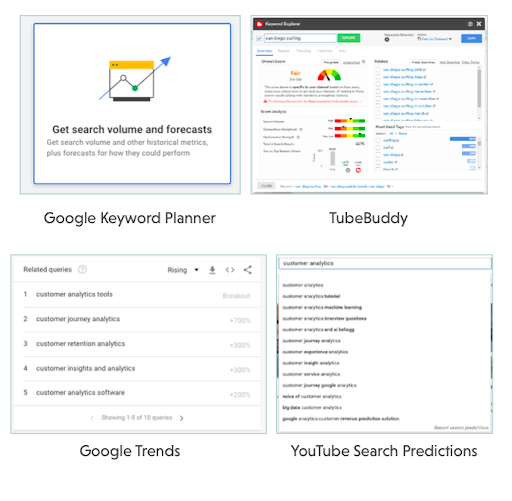
In addition, tools like TubeBuddy, Google Keyword Planner, Google Trends, and YouTube Search Predictions will help you learn what is working – and what’s not as you integrate SEO.
The post 6 Ways to Integrate SEO Across Teams appeared first on Content Marketing Consulting and Social Media Strategy.
Source: convinceandconvert.com