
Tag Archives for " strategy "

9 Digital Marketing Tips for the Holidays
Black Friday, Cyber Monday, Super Saturday—the holiday season doesn’t lack shopping days. Add those to the traditional boost in consumer spending that occurs in the run-up to the holidays, and you have a recipe for a record sales quarter.
However, a bumper festive season doesn’t happen by accident. A comprehensive and thoughtfully crafted digital marketing strategy is necessary to make those sales rack up.
That’s why today, I will run through my top digital marketing tips for the holidays. By the end of this article, you’ll have an arsenal of strategies you can execute to make your physical or metaphorical cash register sing.
Why the Holidays Are the Best Time for Digital Marketing Success
Online shopping will be just as pivotal for consumers this festive season as last year. In 2020, online retail sales during the holiday period totaled $186 billion, and Cyber Monday was the biggest online shopping day in U.S. history. This year, the five days between Thanksgiving and Cyber Monday are projected to increase by 14 percent compared to 2020.

The sheer demand for online shopping makes the holiday period one of the best times to launch a new digital marketing strategy, but competition between brands also makes an effective strategy necessary.
It’s important to present a strong digital campaign given the potential propensity for consumers to seek out the kind of in-store events they missed out on in 2020. Research shows that while 70 percent of consumers report their shopping journey involves online touchpoints, only 14 percent of U.S. shoppers say they won’t shop in-store at all this season.
9 Digital Marketing Holiday Tips
OK, enough background information. Use these nine digital marketing holiday tips to guarantee a holly-jolly holiday season.
1. Start Early and Have a Plan
The best holiday digital marketing plans start months before the festive season. To put it another way: If you haven’t already started planning your strategy, start now.
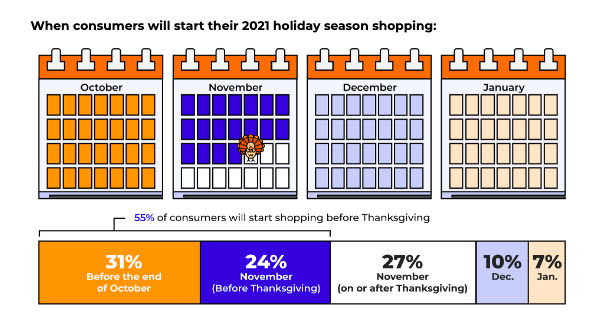
By the time you’re reading this, most consumers will already have started shopping. It’s estimated that 31 percent of U.S. consumers will start their shopping in October or earlier, and 55 percent will start before Thanksgiving.
Whenever you start, making a plan is crucial. Try to wing it during the holiday season, and you’ll be outperformed by competitors who have had their campaigns set up and scheduled months in advance.
Planning your strategy doesn’t have to be complicated.
Start by outlining the goals you want to achieve and the tactics you plan on using. Next, list all the assets you need to design and the marketing funnels you need to build. Finally, create a realistic timeline backward from the day you want to launch.
Breaking your holiday digital marketing campaign up in this way will help show you exactly how much work needs to be done and how to make the best use of your time.
Most important of all, don’t freak out if you haven’t started planning yet. There’s still plenty of time to create a killer digital marketing plan. Focus on the shopping days that are still ahead of you and identify one or two effective strategies to put all of your efforts into.
2. Host a Contest
The holidays are a time for gift-giving, so what better way to get into the spirit of the season than by hosting a giveaway contest.

Not only is a contest a great way to give back to your consumers, but it’s also a fantastic way to drum up brand awareness, grow your social following, and build your email list. You can even use your contest to tease the holiday shopping deals and events you have coming up.
The great thing about hosting a contest online is that it’s quick, easy, and cheap to set up. You don’t even need to give away something extravagant to get people excited. A free product is all it takes to get your campaign going.
3. Use Paid Campaigns to Increase Awareness
While I’ll always believe SEO should have a prominent place in any marketing campaign, the time-sensitive nature of the holiday season makes PPC ads essential.
Run awareness-based campaigns on every major paid ad channel. I’d recommend Google, Facebook, and Instagram at a minimum, but feel free to advertise on any channel you think is appropriate for your audience.

Be thoughtful with your budget. Specifically, you’ll want to make sure you spread your budget across the entire holiday season. While it’s tempting to front-load your budget and catch shoppers as early as possible, consumers may not be ready to purchase at the start of November.
There are a couple of strategies you’ll need to implement to be sure of this.
First, account for higher costs the closer you get to Christmas. Since retailers know that consumers are much more likely to make purchases the later it gets in the season, CPCs become more expensive, too.
Second, get rid of any campaigns that aren’t performing by the end of November. That way, you can save your budget for campaigns that convert.
4. Use Promotions but Use Them Carefully
Promotions and discounts are something of a double-edged sword. On the one hand, they are a great way to drive traffic and increase conversion rates. At the same time, they have the potential to devalue your brand—especially at a time when rampant consumerism is so closely linked to environmental damage.
In response, many brands have been distancing themselves from heavy discounts and Black Friday deals. Outdoor retail brand REI is closing its doors for the sixth year in a row and paying staff to take the day off and spend time with their family. Clothing brand Allbirds is raising prices on Black Friday and Cyber Monday, then donating the additional money to Mother Nature and matching it with their contribution.

You don’t have to go that far, but you should use offers and discounts with caution.
Rather than trying to compete on price when consumers are looking for as much value as possible, why not deliver value in another way? Free shipping, gifts, and other rewards are a great way to retain brand value while offering the discounts holiday shoppers are eager for.
Another way to make discounts more meaningful is to limit them to existing customers. With this strategy, there’s no risk of devaluing your brand in the eyes of new customers, while rewarding existing customers for being loyal. What’s more, it’s much cheaper to retain a customer than acquire a new one, and a generous promotion may be enough to stop them from shopping with competitors over the holiday.
5. Create Holiday Gift Sets
If you’re looking for a way to increase conversions and boost your average order value (AOV), try bundling your products into holiday gift sets and selling them at a discount. Product bundles are particularly popular in the run-up to Christmas when shoppers are searching for the perfect gift.

Bundling is particularly common with health and beauty products, but there’s no reason it shouldn’t work in other sectors, too. For example, a yoga e-commerce store could bundle a yoga mat, block, carrier bag, and pair of leggings. A pet store could bundle dog food, a bed, and a collar. Whatever you sell, there’s almost certainly potential to bundle several products together.
Don’t just guess which products will work well together. Harness the power of data and dive into your inventory analytics to see which products have been most popular and which are most frequently purchased together.
Of course, you don’t have to only include your best sellers. Bundling is a great way to sell less popular products that may not do so well on their own.
6. Create Laser-Targeted Email Campaigns
Email marketing generates on average $36 for every $1 spent, making it the highest returning marketing channel. It’s a no-brainer to include email in your digital marketing strategy.

Unfortunately, nearly every other brand includes it in their strategy, too.
That’s right; it’s not just you who gets bombarded with offers during the holidays. From November onwards, everyone’s inboxes start overflowing with Black Friday deals, special offers, and holiday greetings.
Not sending emails isn’t an option. If you don’t catch your audience’s attention, your competitors will. Your job is to make your emails stand out in a sea of sales messages.
Your secret weapons? Segmentation and personalization.
That’s not to say your subject line and email copy aren’t. You’ll have to nail those, too. You’ll also want to make sure emails are optimized for mobile.
There’s only so much you can optimize, however. When you send your email shouldn’t be one of them. There’s no shortage of statistics telling you the best time to send an email. The trouble is your competitors are reading the same articles, too, so forget best practices for a moment and stagger emails as much as possible throughout the day.
7. Be Socially Responsible
Customers are prioritizing corporate social responsibility more than ever. More than three-quarters of them are motivated to purchase from companies that work to make the world better, according to research by AFLAC.

That means practicing social responsibility—whether that’s donating a portion of your profits to charity, creating environmentally-friendly products, or something else entirely—isn’t just the ethical thing to do. It makes business sense, too.
If you’re new to corporate social responsibility, start by supporting causes that align with your brand. For instance, it makes sense for a pet store to support a dog shelter, or a gardening brand to support an environmental nonprofit.
In both cases, customers will want to support the charity and may go out of their way to shop with your brand over a competitor. It’s also just nice to give back to something you care about. Tis the season for giving, after all.
Whatever causes you to support, remember to be genuine. Your customers aren’t fools, and they’ll quickly be able to tell the difference between a company that is committed to being responsible and one that is greenwashing.
8. Try New Platforms
Ever been tempted to run a campaign on TikTok or Instagram Live? Don’t wait for the New Year to make a change; try a new marketing channel this holiday season.
While it can be reassuring to stick to the channels you know, there’s no guarantee they’ll be as effective as they always have been. The move away from Facebook’s suite of apps towards newer platforms, in particular, is well documented.

Launching a campaign on a new platform may seem daunting, but if you treat it like an experiment, then it doesn’t matter if you fail. Better still, there’s every possibility you’ll hit it out of the park and uncover a profitable platform you can advertise on for years to come.
9. Make a Plan for Long-Term Success
My last holiday marketing tip doesn’t technically involve the holidays at all. It’s about how to squeeze as much return as possible from all the money you invest into holiday marketing throughout the rest of the year.
If your brand awareness ads are successful, you’re going to have a lot of people visiting your site. Hopefully, most of them will make a purchase. If they don’t, you’ll want to find ways of targeting them throughout the rest of the year to make sure that initial ad spend wasn’t wasted.

One of the best ways to do this without getting visitors to sign up for a mailing list is through retargeting ads.
With retargeting ads on Google and Facebook’s ad network, you only serve ads to people who have previously visited your site. This is an incredibly cost-effective ad strategy and one of the best ways to keep your brand top of mind well into the New Year.
Digital Marketing Holiday Tips: Frequently Asked Questions
Why is holiday marketing important?
Consumer spending is high during the holidays, but so is competition between brands. A holiday marketing strategy can help your business boost sales and increase market share.
What makes a great holiday marketing strategy?
A great holiday marketing strategy is well-targeted, highly personalized, and focused on driving as many conversions as possible.
How can I increase sales during holidays?
A digital marketing strategy is one of the best and most cost-effective ways to increase sales during the holiday season.
Digital Marketing Holiday Tips Conclusion
The holiday season is rife with opportunity, and there’s no shortage of digital marketing strategies you can use to make 2021 your best season ever. It’s all about putting together a campaign that works for your brand.
Start by implementing one or two of the strategies I’ve listed above, then make sure you’re doing everything you can to improve your conversions. Finally, learn how you can keep your sales high after the holiday spike.
Which digital marketing tip are you going to use first?
Source: neilpatel.com

How to Avoid Failure in Account-Based Marketing
Did you know B2B marketers who report the most success from their digital activities in 2021 are more likely to be engaged in account-based marketing (ABM)? Only 16% of B2B marketers who describe their digital marketing efforts as “somewhat successful” have a measurable ABM program in place.
That number is reduced to 6% for those who say their digital strategy is unsuccessful at achieving goals set for the program. Check out this and other trends in our State of B2B Digital Marketing report.
Disclosure: This content is reader-supported, which means if you click on some of our links that we may earn a commission.
What Sets Successful ABM Strategies Apart From Those That Fail?
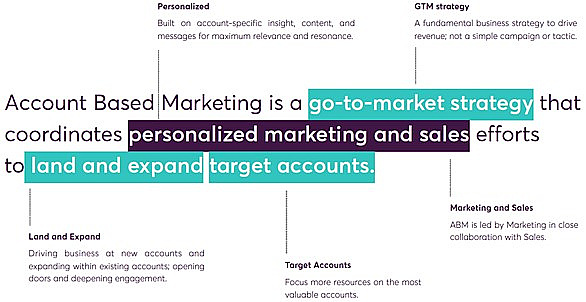
To start, ABM requires a different planning approach than more traditional B2B marketing methods.
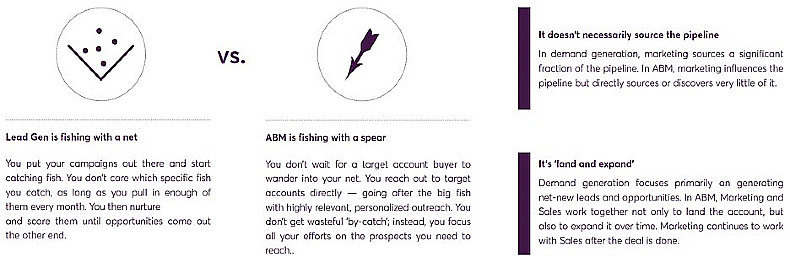
The focus shifts away from driving lead volume and relies on a multi-channel content strategy for key accounts’ aimed at influencers and decision-makers for more personalized experiences.
ABM is based on different performance indicators that favor looking at high quality engagement indicators.
These engagement indicators aim at accelerating your pipeline velocity and increasing the overall account value versus quantity and cost per lead metrics.
To avoid account-based marketing failure, start your ABM plans by first defining your target account list and audience segmentation:
Targeting:
To develop a shortlist of high-value accounts, take a look at your customer data and develop your version of a 360-degree view of attributes that include things like: industry, size of the organization, growth stage, revenue, etc.
Determine which characteristics drive the most value for your company.
Analyze that list against other information that gauges interest and engagement with your product, including things like website visits, account tenure, intent data from search engines as well as any other relevant relationship health metrics.
Don’t try to boil the ocean — there is no reason to convert your entire organization to an ABM model.
Once you have your best-fit customers identified, you’ll be in a position to put together a list of prospect organizations with similar attributes.
Don’t try to boil the ocean — there is no reason to convert your entire organization to an ABM model.
Most successful teams are able to identify a few key prospects for an ABM strategy with some focusing on larger deals with more complexity and influential internal stakeholders.
Audience Segmentation:
ABM targets are generally composed of a few audience segments that consider both the industry and the individual’s role within the target organization, as well as the purchase process.
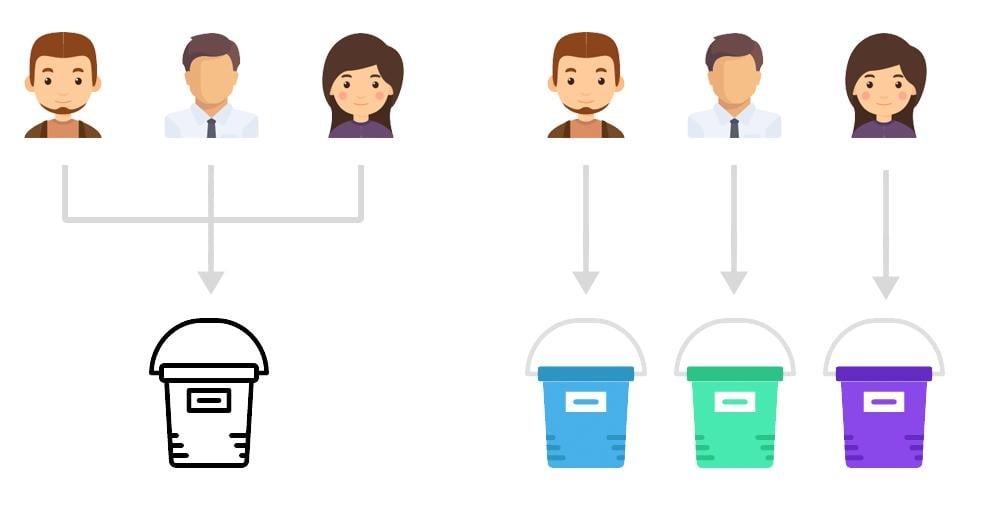
The aim is to deliver personalized content that speaks to the pain points of that particular individual in order to drive meaningful engagement that can lead to a sale.
For example, if your company provides IT infrastructure support to small and mid-size companies, someone in a day-to-day operations role would be interested in a downloadable eBook with how-tos for server protection against new security threats, versus the CFO.
However, a whitepaper on managing costs of ongoing threats to information security may prove more effective for the C-Suite or individuals with a senior-level finance role.
Once you have a shortlist of target accounts with audience segmentation, you can then build your content strategy with multi-channel campaigns.
Consider incorporating tactics for:
- website personalization,
- email, direct mail,
- direct sales outreach,
- digital ads,
- sponsored content, etc.,
with engagement triggers that indicate when and how to advance the customer in the sales process.
Sales and Marketing Alignment:
Successful ABM marketers are aligned in lockstep with their sales organizations.
Ever since the invention of email marketing in the early 2000s, driving lead volume has been easy, but the lead quality has suffered.
ABM forces strategic alignment between marketing and sales in order to shorten the sales cycle and drive quality growth not just lead volume.
How to Avoid Failure In ABM
- Pay close attention to triggers that move a customer forward in the sales cycle, and how well marketing engagement metrics are aligning with both sales activities and business outcomes.
Provide ongoing training for sales teams on available content, how it’s performing, and to solicit feedback. - Understand which accounts sales teams care most about on an ongoing basis.
Apply a test and learn approach that includes dedicating some of your marketing budgets to your ABM target account list. - Activate sales teams by indicating which account to take action on next, what engagement signals the account is showing, and the action to take on those signals.
- Abandon the traditional marketing funnel for measurement purposes. Using the same lead analytics associated with lead volume and lead quality can make ABM efforts seem ineffective when performing well.
- Focus on conversion metrics for your ABM pipeline compared with other sales pipelines for your organization, including sales cycle duration. For most teams, this will include ensuring you have executive buy-in as well as dedicated resources for creating new reports for ABM performance.
Stay Focused On Your High-Quality Target Accounts
Earlier this year, 43% of B2B marketers said they had a measurable ABM strategy in place — how many will be successful?
ABM strategies typically require investments in content creation and new reporting dashboards in order to create multi-channel campaigns for each audience segment within your target accounts.
To justify the resource investment and set your team up for success, be sure to focus your team’s efforts on a shortlist of high-value accounts.
The post How to Avoid Failure in Account-Based Marketing appeared first on Content Marketing Consulting and Social Media Strategy.
Source: convinceandconvert.com

How to Create an Editorial Calendar That Will Streamline Your Content Strategy
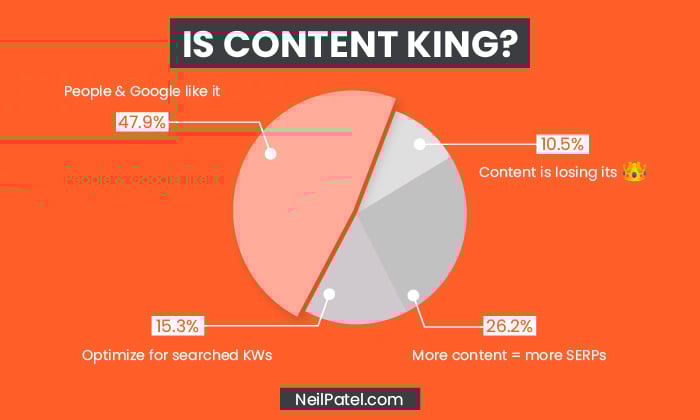
According to Bill Gates, “Content is King.” That was true in 1996, and it continues to be true today.
As consumers become savvier, content continues to play a vital role in educating and converting consumers.
However, not all marketers understand how to implement a content strategy correctly.
When you don’t start with the basics, you could be making content production more complicated than necessary.
To be successful, your content plan must be actionable, and you need to publish content consistently.
That’s where an editorial calendar comes in.
We’re going to cover the basics, including how to create and manage your editorial calendar, and how it can help your content strategy grow.
4 Reasons to Use an Editorial Calendar
An editorial calendar enables content publishers to plan, create, publish, and promote their content in an organized manner.
Many bloggers and businesses use editorial or content calendars to streamline content production.
In many ways, an editorial calendar is a lifesaver for creatives and business owners.
Whether you’re a blogger, freelance writer, business owner, or creative director at a marketing firm, an editorial content calendar can help you stay on track and keep you sane—while ensuring a consistent flow of content.
Others use an editorial calendar to improve focus because an organized approach can also limit writer’s block and keep content evergreen.
There are other ways you can benefit from an editorial content calendar, including:

1. Better Organization and Delegation
With an editorial calendar, you can see articles that need writing at a glance.
From there, you can delegate the articles to your writing team, ready for them to get to work.
No more scrambling to send writers topics at the last minute or wondering if you’ll even get around to writing this month.
With a calendar, it’s all right in front of you.
Ultimately, this level of organization saves time, keeps the content coming, and ensures every member of your content creation team knows what they’re doing.
2. Improved Planning
The better you plan your articles, the better the writing tends to be.
When you know what you want to write, you don’t waste time with last-minute research or trying to find the sources you need to support your article.
In fact, some consider planning to be more important than the content production itself.
Planning content is essential for:
- Creating the kind of content most suited to your audience.
- Writing the in-depth content your audience wants—and needs Publishing exactly when and where your customers hang out.
3. Helps Achieve Your Goals

Your editorial calendar is part of your content strategy.
Ideally, you’ve developed your content strategy around the goals you’re trying to achieve with your product, your blog, or your company overall.
An editorial content calendar assists in goal achievement by:
- Allowing you to meet critical milestones.
- Helping with promotional activities.
- Reaching new leads and making fresh conversions.
- Getting more newsletter sign-ups.Building awareness of your brand.
Whatever your goals are for your business, your editorial calendar has a vital role in allowing you to achieve them.
4. Sticking to Deadlines
According to Mark Twain, “deadlines are the greatest source of inspiration.”
However, that doesn’t mean you want to do a rush job.
To avoid rushing content creation, every team member needs to be clear on their deadlines to keep reaching your goals and your audience engaged.
Further, keeping up with these deadlines is especially important when you’re publishing new content that’s a part of your business strategy.
For example, if you are publishing blogs to support a new launch or annual sale.

How to Create an Editorial Calendar
Don’t let the thought of creating an editorial calendar stress you out—I promise it’s not that complicated once you create a plan.
This next section takes you through how to create an effective calendar, step-by-step.
This is just an outline, so feel free to adjust these steps to meet the needs of your business.
1. Determine Which Tools to Use
Your first step is deciding which tools to use.
This varies from team to team, and content managers may need a combination of tools for best results.
If you want free options for getting started, Google Docs, Excel, or Trello are popular choices.
For paid tools, there are several worth considering, including:
- Airtable
- Asana
- Monday
- BrightPod
Airtable, Asana, and HubSpot offer free content calendar templates to get you started, and there are plenty of others available, too.
Whichever tool you use, make sure it meets everyone’s needs.
As Buffer’s editorial director, Ash Read, told HubSpot:
“[your] editorial calendar should be a resource for your whole team, not just content creators.”
2. Create a Content Backlog
Next, you need to create a content backlog.
This is just a list of content ideas for easy viewing and lets you track your ideas for posts.
You could use Google Sheets or Excel for this, or one of the free templates mentioned, like Asana.
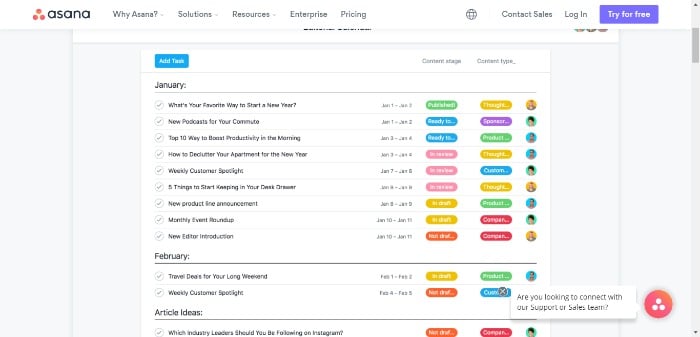
Whichever you go with, your chosen tool should allow you to create a clear, organized list.
Just remember, it’s OK to stray from your list.
Not every idea will end up as an entire post, and sometimes changing your content strategy is essential for keeping up with new trends or thinking of a new angle.
Create your sheet, then start adding a few headings like:
- title
- assigned author
- project status
- publication date
Other headings you could use are:
- Special dates and anniversaries.
- Themes and distribution channels.
- Trending topics/new launches relevant to your niche.
- Seasonal content and key sales dates.
For instance, Black Friday, where you may want to ramp up content production.
3. Develop Your Content Strategy
Don’t overthink your content strategy.
There’s a simple way of making sure your content strategy covers all the bases, and as long as you keep these parts in mind, you won’t go wrong.
First, outline steps such as how much content you want to produce a month, what topics you want to cover, and your ideal customers.
Then add strategic steps, such as managing your existing content and goal tracking.
These might include:
Define your goals:
For example, growing your mailing list or attracting new customers.
Understand your customers:
Which social media sites do your audience use?
Which content types do they prefer/respond to?
What are their pain points, and how can your products/services solve them?
Analyze your competition:
You can use a tool like Ubersuggest, which has a free and paid version to see which keywords competitors are targeting.
Positioning:
What makes your business unique, and how do you stand out in your marketplace?
You could do this in a few ways, like specializing in a targeted niche or telling your brand’s story.
Ask yourself how the content you’re creating can achieve this.
Estimate your budget:
How much is your content strategy going to cost you, and how can you maximize your ROI?
Measure your KPIs so you know your content is getting results:

For example, if you’re aiming to build brand awareness, an increase in shares and views will show you’re heading in the right direction.
4. Schedule the First Month
Many of us produce content at the last minute or create it whenever we have spare time.
If you’re looking for a less stressful (and more effective) approach, schedule your content in advance.
A month is usually enough, but you could schedule up to six weeks.
You can use Google Calendar for this.
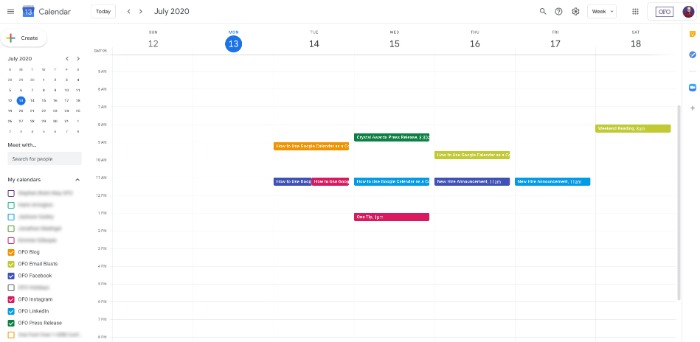
Add each step of your process, and make sure to give yourself plenty of time.
So, you might create a due date on the first Monday to write your outlines, then schedule one article a week to be written, two days for editing, set a publish date, then schedule it into your social media sharing calendar.
The process will vary based on how much content you produce and how many people are on your team, but I strongly recommend breaking each piece of content into more manageable steps.
5. Move Articles Into Production
When you’re in the full swing of producing content, it’s easy to let pieces slip through the cracks, especially if you have multiple people working on the project.
Creating a Trello account can keep you on track.
The first step in using your Trello account for content production is to decide what stages each article will need to go through.
What you need is up to you, but here are some suggestions for your Trello cards:
- assign to writer
- writing in progress ready for edits
- ready for uploading and scheduling
Alternatively, you could make it more complex and add additional steps like:
- final edits
- SEO audits
- published
Then your Trello cards might look something like this:

6. Build Your Content Queue
If you’re just starting with an editorial calendar, you need to get a few articles ready for publication.
Choose a schedule that suits you, but a forward-looking schedule of 4-6 weeks works well for most teams.
That sounds like a lot of work, but you can approach the task in two ways.
First, you could spend a few weeks writing content until you have a volume of work to publish.
However, this method isn’t suitable for everyone, unless you’ve got a team of writers to help you.
Another way is to spend a few months creating extra content every day, which is doable for most content producers.

7. Continually Optimize Your Process
So far, we’ve covered how to get your content production off the ground.
However, you can’t set it and forget it.
Over time, you might find there are bottlenecks in your processes or that certain tools don’t fit your needs.
Make sure to check in with your team regularly to ensure the editorial process you’ve created is working for everyone.
Common areas to review include:
- your schedule and the tools you’re using
- the volume of content you’re storing
- the time between stages the metrics you track
Over time, you’ll get a better understanding of whether the tools you’re working at are suitable for your team and whether the amount of articles you’re publishing is helping your business grow.
FAQs About Editorial Calendars
Why do I need an editorial calendar?
An organized approach to content production reduces time and helps you publish better quality content.
From ideation and writing to publishing and promotion, an editorial calendar helps streamline every part of the process.
Do I need paid tools to create an editorial calendar?
Not unless you want to. Free tools like Trello and Google Docs are fine, but there are also paid options like Asana available.
What headings should I include on an editorial calendar?
Not everyone’s calendar looks the same, but most marketers include titles, publication dates, and the article writer’s name.
Once you’ve added in the most obvious headings, write in the titles that work for your specific needs.
What’s the difference between an editorial calendar and a content calendar?
These terms are often used interchangeably.
However, an editorial calendar generally outlines each step of the process, while a content calendar usually covers one aspect—such as when posts are published or shared to social media.
Summary of Editorial Calendar Guide
An editorial content calendar is a must-have for any content marketer or small business looking to make the most of content production.
It helps you stay focused on your goals and produce high-quality content consistently.

Although it sounds like a lot of work, setting up a calendar isn’t difficult and allows you to seamlessly produce evergreen content while making the most of seasonal trends.
How do you use an editorial calendar?
Tell us below.
Source: neilpatel.com

B2B Content Marketing Measurement Tips for 2021 (Statistics & Research)
“If a tree falls in a forest and no one is around to hear it, does it make a sound?” is a philosophical thought that can be adapted to B2B content marketing as well.

“If I create great B2B content but can’t measure it, did it make an impact?” is the question marketers ask regularly.
What is the impact?
Am I capturing all the impact?
How can I optimize performance?
Measuring the impact of content marketing allows B2B marketers to optimize campaigns for better engagement and more effectively attribute ROI.
But what are the strategies, tactics, and trends behind measuring content marketing performance for B2B marketers?
To help answer these questions on measuring B2B content performance, Ascend2 and KoMarketing Associates fielded the Measuring Content Marketing Performance Survey between February 17 – 25, 2021. 193 B2B marketing professionals participated in the survey.
The research looks at what B2B marketers are doing to measure content marketing performance.
The survey findings are available in the research report, Measuring Content Marketing Performance: A B2B Marketer’s Perspective.
The key findings from the research on measuring B2B content marketing performance.
Here are key findings from the research on measuring B2B content marketing performance.
1. Determining ROI is the top challenge for B2B marketers when it comes to measuring content marketing performance.
Measuring return-on-investment (ROI) of content marketing is critical to optimizing a strategy, but nearly half (46%) of B2B marketing professionals consider determining ROI to be a top challenge when it comes to measuring content marketing performance.
44% of B2B marketers also face a lack of budget and resources necessary to effectively measure strategic success.

Determining ROI, the lack of budget/resources and insufficient data are the top 3 challenges of measuring content marketing performance.
Why is it so difficult to determine ROI?
The math is simple: revenue generated by content, divided by cost (production cost + distribution cost).
But for B2B marketers, how do you calculate the revenue generated?
Do you assign a revenue number for every lead generated?
Do you look at overall sales revenue?
How much did your content marketing impact a sale?
How do you value activities like email clicks, shares, page views, average time on page, etc.?
How do you track the metrics you need and convert them to a dollar amount that can do into an ROI calculation?
Here’s how to overcome the challenge of determining ROI:
- Outline a strategy of what metrics you need to track
- Figure out what technology you need to track those metrics
- Pul pull together the data into an easy-to-use analytical tool
- Decide how you will assign value/revenue to your metrics
- Track your costs.
Start simple and build as you learn from the data you collect.
2. 66% of B2B marketers find it difficult to measure the performance of a content marketing strategy.
Two-thirds (66%) of B2B marketers find it difficult to measure the performance of a content marketing strategy compared to one-third (34%) who find it to be either moderately or extremely easy.
57% describe this difficulty as moderate, while another quarter (25%) of those surveyed report that gauging the effectiveness of content marketing is moderately easy.
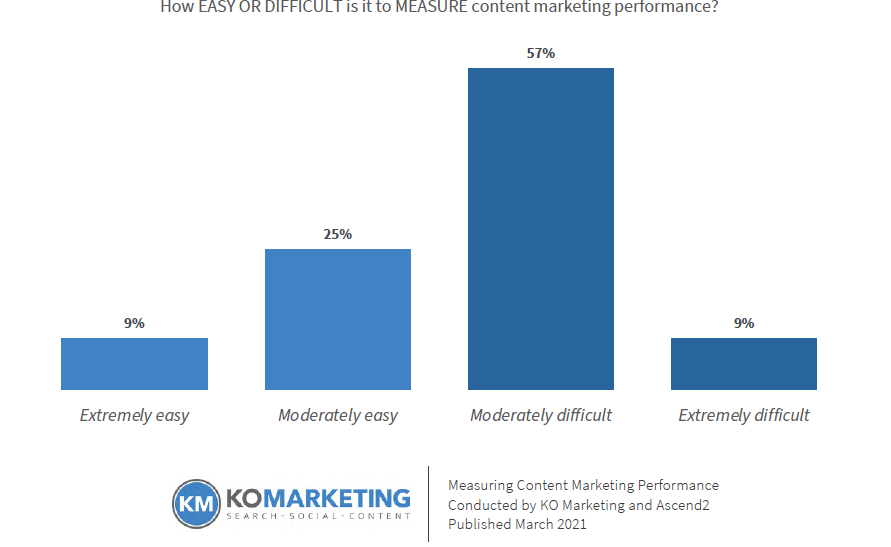
57% of B2B marketers find it moderately difficult to measure content marketing performance.
Don’t give up on your need to measure content marketing performance.
Content marketing is an investment that impacts your business strategy, branding management, audience engagement, and thought leadership.
We can all find cases on how content marketing made a significant impact on a major deal, reduced selling costs, or expanded your brand influence.
It may be difficult, but it is important to find consistent ways to measure and show the impact on your leadership team.
2. 37% of B2B marketers are using 3-5 tools for measuring content marketing performance.
Content marketing typically involves utilizing a wide range of channels across an overall marketing strategy.
One in five (21%) of B2B marketers report using six or more tools to measure content marketing performance.
Another 37% of those surveyed say they use between three and five tools, and 29% are measuring performance with two tools or less.
Marketing leaders need to embrace technology.
A strong stack of technology gives you more information about your audience, your clients (individuals or companies), and the impact of your campaigns.
Technology also allows you to be more efficient, organized, and agile as you track performance and report performance to the team.
4. Analytics tools, CRM systems, and marketing automation solutions are the most important tools for measuring content marketing performance.
Which types of tools are B2B marketers finding to be most effective for measuring content marketing performance?
Over half (53%) of those surveyed put analytics tools at the top of the list.
Customer Relationship Management (CRM) systems and marketing automation technologies are also critical to overall success according to 38% and 34% of B2B marketers, respectively.
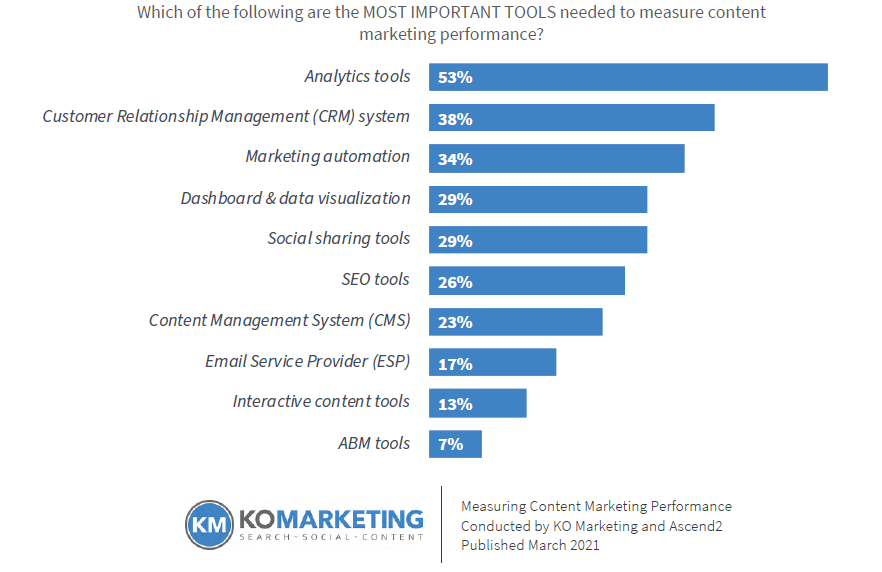
Analytics tools, CRM systems, and marketing automation solutions are the most important tools for measuring content marketing performance, according to B2B marketers.
Content marketing is data-driven.
Start with a solid setup of your Google Analytics.
Focus on four key areas:
- traffic,
- navigation,
- organic search,
- and conversions.
5. Conversion rate is the most important content marketing measurement metric, according to 50% of B2B marketers.
About half of B2B marketers agree that conversion rate (50%) and website traffic (46%) are among the most important metrics to consider when measuring the overall performance of a content marketing strategy.
Engagement on social media channels is also ranked high on the list of important metrics for 39% of those surveyed.
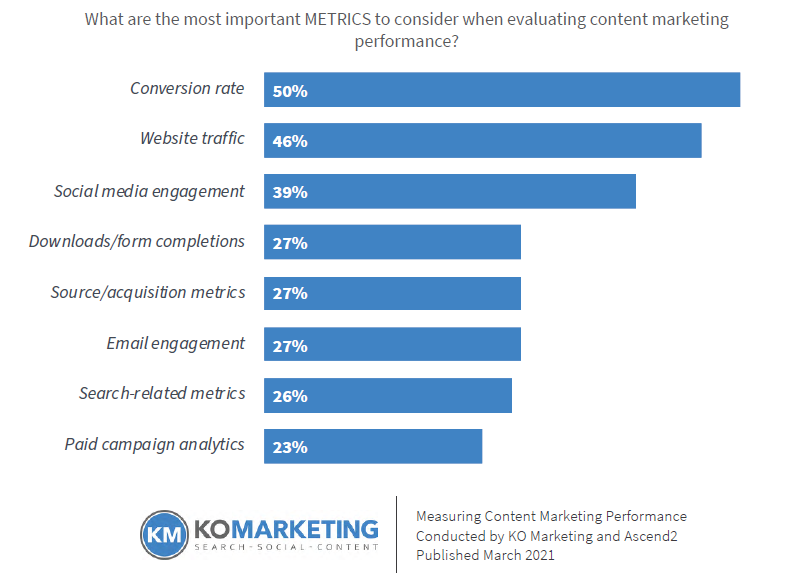
Conversion rate, website traffic, and social media engagement are the top 3 most important metrics, according to B2B marketers.
Don’t guess about the performance of your content marketing; instead, identify the data that matters most to your success.
Track and analyze performance to identify trends and adjust your strategy based on your findings.
Marketing optimization is never complete; it is an ongoing process.
Final Thoughts
Content marketing is essential to successful B2B marketing, so measuring performance is a priority.
Download Measuring Content Marketing Performance: A B2B Marketer’s Perspective for research-based strategies, tactics, and trends for B2B content marketing in the year ahead.
The post B2B Content Marketing Measurement Tips for 2021 (Statistics & Research) appeared first on Content Marketing Consulting and Social Media Strategy.
Source: convinceandconvert.com

Your Whole Website is Part of Your Content Marketing Strategy
It’s almost inevitable. We sign on a new client who is looking to create an amazing content strategy.
We have a kickoff call and they tell us, “Yeah, we just launched a new website and now we’re ready to really dive into our content marketing strategy.”
My heart sinks.
They just launched a new site, and now they are thinking of a content strategy.
It’s like going fishing.
The content strategy of new thought leadership is the bait, but then the hooks and poles that are the rest of the website are afterthoughts.
For so long, we’ve focused on blog and video content as being the pillars of content marketing.
The thing is, they’re not.
Your website — the information architecture that makes up your entire navigation and user flows — is essential to your content marketing success.

If the navigational systems on your website don’t make sense and are not optimized for search, you could risk losing out on potential traffic and conversions.
Without hooks and fishing poles, you’re not going to catch any fish, no matter how many you feed with your bait.
Discover the strategy behind information architecture, and how you can optimize your site for more user engagement and inbound traffic.
Your Content Strategy Starts with Your IA
Before you can write and publish any content on your site, you first need to understand the type of content that will entice your target audience – and how you’ll organize it.
That’s where your information architecture (IA) comes into play.
This is simply how your site’s visitors will find the content they need and complete actions (conversions) on your site.
Your IA controls the ways your content is:
- Organized within the navigation bar
- Labeled in breadcrumbs and other links
- Navigated from various other pages
- Searched for by users

“When we set up our new site, we knew that we wanted it to be optimized for search and conversions from the beginning,” says Nick Phillips, co-founder of Kids Art Box, a subscription box service, “The key to doing this was to start with a solid information architecture.”
Is IA the same as UX?
Information architecture and user experience are similar in that they are both tools to create a positive experience for visitors to your site.
However, IA needs to be established before a UX designer can start creating pages.
Content strategists generate a website’s IA into sitemaps.
Then, a UX designer can utilize that plan during their website creation process.
As a team, marketers and web designers can build an enjoyable and easy-to-use architecture for their users.
The goal is to make it as easy as possible to navigate through your site.
Businesses everywhere can benefit from strategizing their site’s information architecture.
If users visit your site and can’t find the information they’re looking for, they’ll most likely leave and find their solution with one of your competitors.
This can impact the bounce rate on your site, leave a negative experience with the user in how they see your brand, and most importantly, result in a lost opportunity for a new customer.
How the Sales Funnel Should Fuel Your Site Structure
Understanding the sales funnel and how potential customers move through that process is crucial to designing the information architecture on your site.
Your IA represents the solutions you have to offer customers, which Google and users will consider pretty far down the funnel.

When users visit the main pages on your site (such as product or services pages), their intent is most likely to make some kind of buying action – whether it’s to actually buy something online or to fill out a lead form.
These pages will often have high conversion rates. However, you must focus your content on the right type of keywords – those that are closer to the buying stage rather than the thought leadership stage. You need the right hooks.
Your actual blog and owned media content will mostly be focused on thought leadership topics.
It will provide people who are higher up in the funnel with useful information they can use to narrow what they’re looking for.
To come up with blog ideas, consider topics that are specific to your niche, something that a repeat customer would like to know.
This can include tips on how to use the products you sell or news that is specific to your industry.
Marrying this thought leadership with the actual pages on your site and understanding how they interact can help you identify the paths of least resistance.
Figure out where your visitors are in the sales funnel and provide content that matches their intent.
When you have this in mind, you can present calls to action and other navigation to hook them and guide them through the journey.
Your goal is to discover what it takes for someone high up in the funnel to read a blog post, stop by more pages, and then be encouraged to say, “Yeah, I’m ready to buy.”
“Tightly knitting together new thought leadership with existing, optimized product/services pages are essential to the success of a content marketing strategy,” says Melissa Dreyer, Director of Marketing at STANLEY Access Technologies,

“Without these two components working together, you could end up with a lot of traffic, but not a lot of conversions.”
Tips for Presenting an Organized Site
Information architecture may seem complicated, but it’s easier to put together than you think.
You just have to consider what makes the most sense when organizing the pages on your site.

Consider these tips to help you start building your site’s IA:
- Keep it simple. You want the process of navigating your site to be easy and straightforward. Don’t add unnecessary distractions that keep your users from finding the button you want them to click, the form you want them to fill, or most importantly, the answer to their query.
- Simplicity goes for the navigation bar, too. Keep your navbar simple and not overcrowded. A good rule of thumb is to keep the main navigation under seven items. Your page groupings should make sense and relate to one another, like service offerings or information about the company.
- Be strategic about internal linking. Invite your site visitors to learn more or take a step toward a conversion by presenting them with links to click through to product and service pages or your Contact Us page. These hooks can take people from “just browsing” to consideration pretty quickly.
- Research your industry. Take a look at your competitors to find out what the industry standards are for presenting and organizing your content.
Phillips states, “Our site started from ground zero, and in just a few months we’re already ranking in the top 10 for a number of competitive keywords we thought would take a year or more to rank for.
The research and effort put into the IA paid off very quickly.”
Please, Please Start Your Content Strategy with Your IA
To make your business more visible online and more successful with customers, you must begin with a strong marketing strategy.
When you put careful thought into your content strategy – starting with your information architecture – you can not only make an impact by delivering real value to your industry, but you can also catch a lot of new business – which was always the point, right?
The post Your Whole Website is Part of Your Content Marketing Strategy appeared first on Content Marketing Consulting and Social Media Strategy.
Source: convinceandconvert.com

How a Business Strategy Will Revolutionize the Way You Build Your Website Homepage
Bringing your business strategy into your homepage is that next-level touch that you get to have that your competition doesn’t.

When was the last time you brought your business strategy into your website design? If the answer is never, we get it.
As marketers and business owners, we don’t bring business strategy into our websites.
We bring customer avatar pain points, strategic calls to action, and hero images that draw the reader’s attention to our shiny CTA buttons.
It’s tempting to think this is the best way to create a website. If the experience is designed for our customer avatar—why would we bring our business strategy into it?
In a few minutes, you’re going to have a lightbulb shining brightly over your head.
You’re going to say, “Ohhhhhhhhh,” hit CTRL + T to open another tab and take a scroll through your website with tons of new ideas as to how you can make it better.
We’re not talking a little better either. We’re talking about the difference between an iPhone 5 and an iPhone 11.
Bringing your business strategy into your homepage is that next-level touch that you get to have that your competition doesn’t.
And that sounds pretty sweet, doesn’t it?
The 5 Key Elements of a Business Strategy
Frank Cowell, CEO of Digitopia and DigitalMarketer Legacy Certified Partner, recently visited the DM office stage to explain why business strategy is an essential part of a great website homepage.
Based on 5 key elements of a business strategy, he can integrate these strategies into a homepage in a way that attracts the right audience and shows them why you’re the solution to their problem.
As Frank mentions in his Certified Partner Training Day session, these are far from the only elements of your business strategy.
You need to be strategizing as a business owner or marketer, but these are the 5 key elements that can really help you create that top-tier homepage.
Here are Frank’s 5 key elements of a business strategy and how you can use them to create your best website homepage yet.
Element #1: Purpose
Why does your business exist?

Sorry to send you into an existential crisis. Unfortunately, it had to be done.
Before we can start building your website homepage, we have to know why it even exists in the first place.
To be clear, we’re not asking you to go full-Zappos on us and let us know that you’re here to make the world a better place.
Frank doesn’t require you to figure out your “higher calling”—all you need to do is figure out why your target audience cares that you exist.
If you’re Tom’s shoes, your audience does care that you have a higher calling to give a pair of shoes to someone in need for every pair sold.
In that case, you can use that on your website homepage (and we’re sure Tom’s does).
But, if your business isn’t focused on something like that, then all you need is to curate a mini Mission Statement.
This Mission Statement should be “big enough” that it never needs to change.
This means that you could leave this copywritten as-is for years to come because it still encompasses what your company does and why.
A key part of figuring out your purpose is knowing that it’s not the actual labor you do—it’s the outcome you create. Use this formula to create a purpose:
“At [BRAND], we exist to help/empower/take/etc. [HIGH-LEVEL WHO] [BIGGEST OUTCOME].”
Here are a few examples of what a purpose looks like:
- “At ACME, we exist to help dental practice owners increase awareness and demand.”
- “At ACME, we exist to help manufacturers create highly safe workplaces.”
- “At ACME, we exist to help CPA firms triple their revenue.”
- “At ACME, we exist to help Fathers become Dad of the Year.”
In DigitalMarketer’s CEO Ryan Deiss’ High-Converting Homepage Insider Training, he gave us the harsh truth.
Your above-the-fold content gets 84% of the attention of your website. Below-the-fold content gets the remaining 16%. Kind of stings a little when you think about how long and how much you paid for that below-the-fold content, huh?
That’s why we need the above-the-fold content to be perfect. Perfect in this case means that it has a core message.
As Ryan explains in his training, that core message has to start with clarifying your audience.
That’s exactly what you do with Frank’s mini Mission Statement.
Make it clear what your purpose is by creating a mini Mission Statement that shows website visitors who you serve and what outcomes you create.
Element #2: Passion
What will you be the best in the world at?
 Don’t be scared. We know that we just sent you into a mini mid-life crisis in the last section and now we’re telling you that you need to be the best in the world at what you do.
Frank wouldn’t ask this of us if he didn’t know with certainty that we were capable of it.
In Frank’s Certified Partner training, he explains how your passion turns you into the best in the world at what you do.
Specifically, it shows you what slice of the industry you are lasering in on.
Let’s clear something up first. Niche is often confused with a target market segment.
That’s not what we’re talking about.
We’re talking about your niche in terms of the segment of your industry that you focus on and excel in helping.
For example, at DigitalMarketer we don’t help you with your marketing—we help you with your digital marketing.
A furniture store is part of the furniture industry, but a luxury furniture store is a segment of that industry.
Cars an industry, but racing-inspired sports cars are a segment of that industry.
When you’re creating the copy for this section of your homepage, you need to write it for your audience’s awareness level.
Audiences have different awareness levels depending on how familiar they are with your business. Ryan calls these levels of awareness the Homepage Lifecycle Phases.
A brand-new company’s homepage should look entirely different than a 20-year old company’s homepage.
Yes, that means you should not be crafting your homepage to look like Apple’s. You need to be creating it based on your audience’s level of awareness.
There are 4 phases of the Homepage Lifecycle:
- Phase 1: Problem Aware (the customer knows they have a problem)
- Phase 2: Solution Aware (the customer is evaluating which solution is best for them)
- Phase 3: Product Aware (people already know your product)
- Phase 4: Most Aware (people know exactly what you sell and who you are)
At each phase of the Homepage Lifecycle, your audience needs something different from you.
- Phase 1: Hope
- Phase 2: Clarity
- Phase 3: Assurance
- Phase 4: Novelty
As you nail down what you’re the best in the world at in your business strategy, you’re going to bring that to your homepage and translate it based on what phase of the Homepage Lifecycle your business is in. (Hint: Chances are you’re in Phase 1 or Phase 2)
Element #3: Differentiation
How are you different from other options?

In your business strategy, you’ve narrowed down your competitive edge. Why does somebody want to buy your product over a similar product?
You need to show your customers how you’re different on your homepage.
As Frank puts it, “What is the unique way that you deliver your Passion?”
Frank does a great job of explaining this concept in four words:
Avoid selling the commodity.
When you sell the commodity (and just that), you don’t differentiate yourself.
You have to sell the commodity differently. For example, Frank shows how we’ve done this at DigitalMarketer.
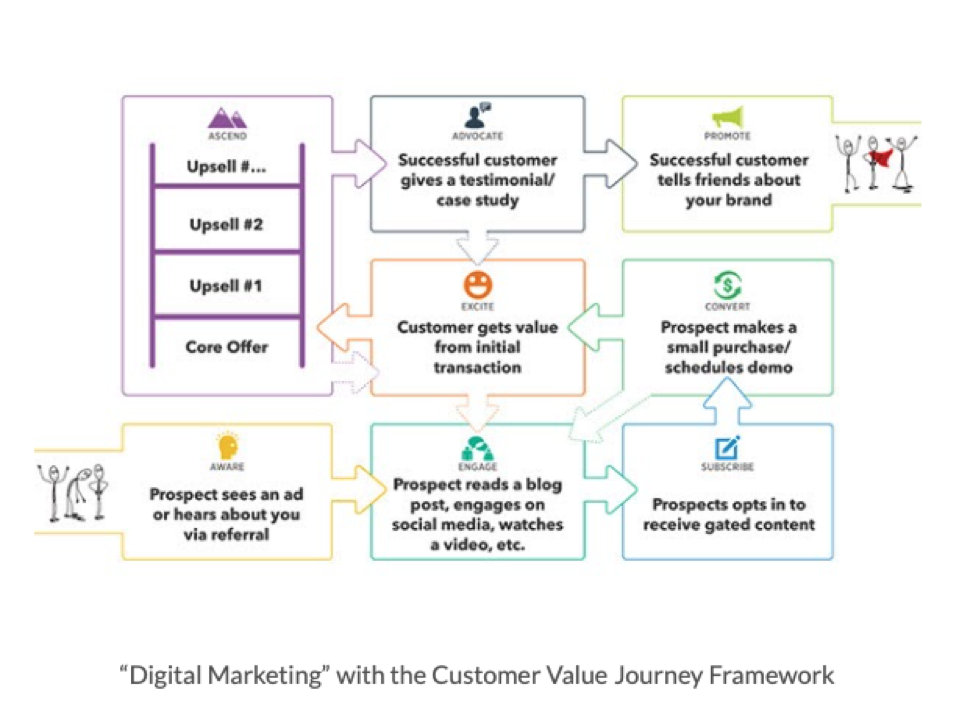
You’re familiar with the Customer Value Journey, the 8-stage process of taking a stranger and turning them into a raving fan of your brand.
We’ve used the Customer Value Journey to set ourselves apart with how we deliver digital marketing (the commodity).
Here are two more examples of differentiation at work from Frank:
- “Business Management Consulting” with the Entrepreneurial Operating System (EOS)
- “Accounting Services” with the Profit First Method
We love differentiating ourselves because it makes our lives better. Yep, better.
When you differentiate yourself with your own process, you find clients who want to hire you for *your* way of doing things.
This means you avoid the people who want to micro-manage or aren’t ready to let someone else run the show.
Anyone who hires you or buys your products wants to do it because of your unique way of delivering them—which helps you have a more seamless client or customer experience.
Element #4: Promises
What can your customers count on when doing business with you?

Aside from your differentiators as your competitive edge, the promises you make to your customer avatar are part of your business strategy.
They’re the cherry on top that makes you an obvious option for their business.
The key to curating a great promise is by placing yourself at the top or near the top with it.
Here’s what Frank means by that: don’t promise to have a fast response rate, have the quickest response rate in the industry.
By being the fastest, most successful, most luxurious, etc. you create an impact.
You set yourself apart from competitors with similar products.
Add this on top of your differentiator and your business becomes its own pillar within your industry (not an ivy trying to crawl up someone else’s established pillar).
Your promise(s) will be your winning attributes or top 3 features and benefits.
As Frank says, these are often born from the things customers despise about companies like yours.
Follow this template for creating your promise:
“When you choose ACME, we will [PROMISE] so [BENEFIT].”
Here are some examples from Frank of promises:
- “ACME—Fastest Response, Real-Time Analytics, and Best Warranty.
- “When you choose ACME, we‘ll respond to every request within two business hours so you won’t be kept from moving the project forward.”
- “When you choose ACME, you’ll have 24/7 access to a real-time analytics dashboard so you’ll always know exactly where your campaign’s performance stands.”
- “When you choose ACME, you’ll get a three-year warranty so that you can rest assured that your investment will last.”
Element #5: Focus
How will you ensure you maximize your Differentiation and Promises so that they help you establish marketplace dominance?

Here’s when things start to simplify. Frank teaches Verne Harnish’s “One Phrase Strategy” that says, “If you can’t state your strategy in one sentence, you ain’t got it.”
This is where your business strategy starts to help you make all of your decisions moving forward (including how strategically create your homepage).
All decisions must go through this lens of focus.
- Should we develop this new product?
- Should we acquire this company?
- Should we take on this project?
- Is this the right team structure?
- Is everyone in the right seat?
- Is your homepage maximizing your Differentiation and Promises?
Frank shows us a few great examples of companies who live by their differentiators and promises.
Southwest:
Makes their differentiator that there are no first-class tickets and promises to use the time they get back from not having to separately board first-class passengers to take off on time.
Ikea:
Their differentiator is their easy-to-build furniture and their promise is that because it’s flat-packed you’ll be able to get it from Ikea to your home easily.
Did we turn that lightbulb above-your-head on yet?
At this point, it should be shining so bright the competition notices it and thinks, “Uh oh, we’re in trouble.”
Using Frank’s 5 elements of a great business strategy, you’ll be able to craft a homepage that suits your audience perfectly.
Not only will you call them out for the specific problem they face (that you solve), but you’ll meet them exactly where they are (problem or solution aware).
And that’s the key to revolutionizing your website homepage.
The post How a Business Strategy Will Revolutionize the Way You Build Your Website Homepage appeared first on DigitalMarketer.
Source: digitalmarketer.com

4 Things You NEED to Build the Perfect Twitter Strategy
Twitter isn’t as straightforward as Facebook, Instagram, and other social media platforms don’t mean it’s not worth your time. On the contrary, there’s a lot of specialized marketing that you can do on Twitter that can’t be replicated anywhere else.

In the marketing community, Twitter is often undervalued.
Twitter’s platform doesn’t necessarily fit with conventional marketing. As robust of an ad platform as other social media sites like Facebook, YouTube, and Instagram are, Twitter is built entirely differently.
The lesser emphasis on paid media, the character limit for tweets, and the short content lifespan makes even your best tweets come and go in only a few hours. On the surface, it’s understandable why some marketers look at Twitter and say, “this isn’t worth my time.”
But the truth of the matter is that they are probably using Twitter wrong.
Just because Twitter isn’t as straightforward as Facebook, Instagram, and other social media platforms don’t mean it’s not worth your time. On the contrary, there’s a lot of specialized marketing that you can do on Twitter that can’t be replicated anywhere else.
While other social media platforms flaunt their built-in paid advertising platforms, Twitter recognizes it’s not necessarily built for that. Although you can do paid advertising on Twitter, it’s a space much better suited for organic advertising through brand awareness and outreach.
Unlike other platforms, Twitter is the best platform to turn your followers into raving fans. You’re not focusing on selling with paid media, you’re focusing on making people fall in love with your brand. And when you approach Twitter with that mindset, you can start to understand how effective it can be.
It can be a fine line to walk, but we’re here to help you turn your Twitter into one of the best tools at your disposal. There are some things that anyone can do to make sure they’re using Twitter effectively for their business.
4 Rules for Twitter Marketing Strategy
Use these 4 rules to create the perfect Twitter marketing strategy that will produce results.
1. Developing a Brand Voice is Extremely Important
On Twitter, more than any other social media platform, developing a strong, distinct brand voice is a necessity. Because all of your posts are confined to 240 characters (and potentially an image or video), having a recognizable brand voice is a thing that will make people remember your business. In the Twitter world, there’s no better example of this than Wendy’s.

Wendy’s is extremely well-known on Twitter for its snarky, humorous tone. They are popular because they’ve found a way to make fast food funny, which makes their tweets super engaging. They also tend to get into Twitter feuds with other brands, which just makes them all the funnier.

They also use that same tone to do a pretty good job at advertising their deals. A 14-word tweet that got 2,000 replies and over 23,000 combined likes and retweets? The average tweet typically gets a combined 1696 retweets and likes. It’s pretty evident that Wendy’s is doing something right on Twitter.

Because of their tone, people like Wendy’s brand. People identify with it and odds are they will end up going to get food at Wendy’s. Wendy’s is using their Twitter account to make a massive impression on potential consumers. And it can all be traced to the fact that people like their brand voice.
Your brand voice doesn’t have to be identical to Wendy’s—humor is important to be successful on Twitter, but you can always develop a brand voice that’s dorkier and more heartfelt instead of snarky and sarcastic. Whatever the case, you need to find a voice that will work for your business, and then you need to stick with it.
If you need help finding your brand voice, the best thing you can do is think of what personality you want your business to have. You can go read your blog posts and newsletters for a little guidance on the personality your brand already has because it’s best if your copy is consistent across all of your platforms.
Then, once you have a brand voice picked out, you can start using it to build your reputation on Twitter.
2. Engagement is Your Number 1 Goal
When you’re crafting your brand voice on Twitter, remember this: engagement is by far your number 1 goal.
Not follows. Not sales.
Engagement.
Some of your tweets should be informative, but a lot of them should be entirely focused on generating interaction. Whether it comes in the form of retweets, likes, or replies, you want people to interact with your top-notch tweets. Again, the best thing you can do on Twitter is built awareness for your brand or business.
In many ways, you can think of Twitter as a platform where your main goal to stand out. The more you stand out, the more likely it is you’ll go viral.
The more viral the tweet, and the more engagement you get, the more likely it is to end up on the feed of your Customer Avatar. And although the viral tweets usually only circulate for roughly 12 to 24 hours, you can reach tons of people in that time.
Sometimes it’s as simple as tweeting something really funny that people will want to respond to, but there are plenty of trends on Twitter that you can do to encourage responses from people. Here’s an example of one we did.

This tweet is simply prompting people to respond, and we got great engagement on it. It makes people happy to be a part of the conversation, and it also helps them remember who we are. It gets them familiar with our brand, which we can then hopefully turn them into subscribers or customers after some more good content.
But if you aren’t having success with Tweets that are actively prompting people to respond, then really funny content is your next best bet. There are so many different ways to do this, but here’s one of my favorite examples.

Netflix tweeted this right before the Royal Wedding in 2018, and to say it did well would be an understatement.
Long story short: don’t track your Twitter success based on how many sales you generate directly from the platform. If you make some sales, then that’s the cherry on top of the sundae. But the most important thing for your Twitter marketing strategy is engagement.
If you need some ideas on content, Twitter has you covered. Here’s a month’s worth of tweet ideas straight from the company itself.
3. Visuals Are Essential
Visual elements need to be a part of your Twitter marketing strategy, just like they need to be a part of your other social marketing strategies. It just makes your posts better, more digestible, and most importantly, memorable.
As far as videos are concerned, 70% of consumers shared a brand’s video on Twitter in 2020. And even Twitter thinks that creating a consistent visual brand is one of the best things businesses can do on their platform.
Not all images are created equal, though, so there are a few rules and best practices when it comes to incorporating visual elements into your Twitter strategy:
4. Avoid using stock photos as images
This is probably the most important rule. Stock photos don’t stand out, and even a simple picture of someone on your staff can produce way better results. This is a hand-picked example from Twitter of what a simple, but engaging, the photo looks like:

These pictures go way beyond what stock pictures can do, and they can also communicate things about their brand without having to say one word. At least in Alphalete’s case, an athletic clothing brand, it communicated that their brand is for people who are serious about fitness. It also made me want to buy their product way more!
Use templates to keep a consistent visual appeal to your photos
Similar to your brand voice, people like consistency in your images. If you throw lots of images at your consumers that are out of the ordinary, they may react negatively.
Use bright and engaging colors
This is the most effective way to catch the eyes of scrollers. Bright yellow and green are way more effective for generating engagement than gray and black.
Use illustrations
This is a trend that’s become increasingly popular, and it’s because it can help make your brand feel more authentic and accessible. Illustrations can help you emulate any emotion, so they’re a useful tool to have.
This doesn’t mean every single tweet needs a visual element, but a visual element can help carry a tweet whenever you need it.
Remember to Move People from Twitter to Your Website
Getting people to interact with you is your number one goal on Twitter. But what’s next?
You need to have a plan in place to get Twitter users from your Twitter page to your website or landing page.
Think of it in terms of your marketing funnel. The entire purpose of having a Twitter is to get people interested in your business so they’ll potentially become a customer later on. And, unlike other social media platforms, it’s basically impossible for anyone to actually make a purchase of any kind directly on Twitter’s platform.
That means you shouldn’t sell to them right from the start. The Customer Value Journey is important, even on Twitter. A simple tweet with a link that someone can use to sign up for your newsletter is a good start.
It can be linked to your blog posts that can at least get people to go to your website and read what you have to say. But once you get them past those milestones, then you can start focusing on selling to them.
The best thing you can do with your Twitter is getting people more familiar with your brand. Just remember that the easier you make it for people to get from Twitter to your website, or the more incentive you give them to do that, the more likely it is that you will sell to them down the road.
Think of Twitter as an art. There is no hard-set formula for guaranteed success—it takes a lot of creativity and trial and error. But when you figure out how to drive engagement on Twitter, you’ll be able to generate more leads than ever before.
And, if you do it right, they’ll already be raving fans.
The post 4 Things You NEED to Build the Perfect Twitter Strategy appeared first on DigitalMarketer.
Source: digitalmarketer.com

5 Tips for Selecting Marketing Technology, Based on Research
For marketers, technology alone is not the solution to achieving marketing goals, but when you understand your goals and implement the right marketing technology to meet your goals, it is the perfect combination to generate the results you need to succeed.
Effective marketing technologies should extend the capabilities of the team and the strategy behind them.
B2B marketers are faced with the lofty challenge of determining which tools will align best with their needs while integrating seamlessly into an existing mar-tech stack to ensure optimal performance.
But how are B2B marketers up-leveling their marketing technology to meet business goals?
Ascend2, in partnership with RollWorks, surveyed 145 B2B marketing professionals, and here are a few research insights and key takeaways from the research study, Marketing Technology Implementation from the B2B Perspective.
Insight #1: Think Efficiency
B2B marketing professionals know that their tech stack is only as good as the data that flows through it. High-quality data empowers B2B marketers to make informed decisions that will drive a positive impact on their bottom line.
That’s why 41% of those surveyed set out to improve data quality when implementing marketing technology.
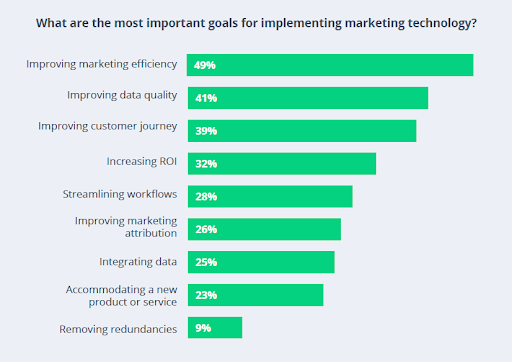
The most important goals for implementing marketing technology, according to B2B marketers
Key Takeaway: If your mar-tech goal is efficiency, consider an account-based approach. Account-based marketing (ABM) means taking a fit-first approach to B2B marketing, ensuring you’re only targeting the accounts with the highest likelihood to buy.
Research shows that 94% of marketers find ABM successful at achieving their primary objectives. The more targeting you become in identifying your best audience, the more you can improve efficiency in your overall programs.
Insight #2: Think Strategically
Carrying out a strategy for implementing marketing technology as well as determining what technologies align best with the needs of their business are both top challenges reported by 43% of marketers for B2B businesses.
Over one-third (37%) of B2Bs surveyed also feel constrained by budgets allotted for technology.
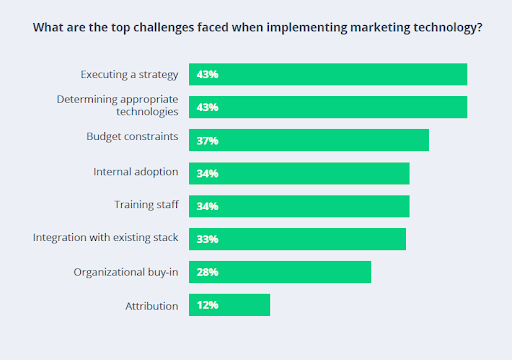
The biggest challenges when implementing marketing technology
Key Takeaway: If your biggest challenge is in execution, find tools that are easy to adopt and that integrate well with other technologies in your stack. Choosing the right tools is tough, but making sure your mar-tech vendors have great onboarding and customer success experiences will ensure you can execute your full strategy.
Successful companies identify a specific marketing challenge, develop a strategy, integrate various technologies to meet the challenge, and measure results to validate success.
Insight #3: Top Considerations: Think Ease of Use
When evaluating new marketing technologies, what is most important for B2B marketers to consider? An easy-to-implement and utilize tool enables marketing teams to execute efforts more efficiently.
Nearly half (47%) of B2Bs surveyed agree that ease-of-use is a top priority when it comes to new marketing technologies.
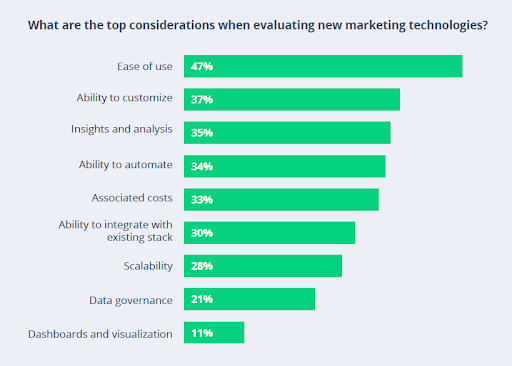
These are the top considerations when evaluating new mar-tech for B2B marketing
Key Takeaway: Above all, B2B marketing technology needs to be user-friendly and customizable. You’ll want to look for tools that allow you to build and measure your programs the way that makes the most sense for your business.
If you want to target specific accounts, the good news is that technology to support your strategy is not exclusively for enterprise companies with large budgets—now, small and mid-size companies have access to account-based tools that are fast, affordable, and customizable.
Insight #4: Think Growth
From the B2B perspective, budgets for implementing new marketing technology are trending up in the year ahead.
59% of marketers working for B2B companies expect a moderate increase in budgets dedicated to implementing new mar-tech new year, while one-in-five B2B marketers expect a significant increase.
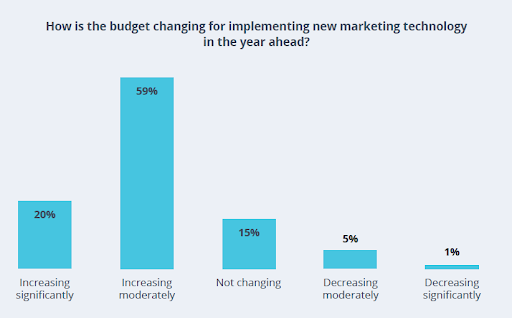
This is how budgets are changing for mar-tech implementation in 2021
Key Takeaway: While 2020 was a rollercoaster of a year, mar-tech is coming out strong. To meet the demands of the coming year, expect to see B2B marketers rethink and expand their tech stacks to get in front of their audience in new, creative ways.
And the data shows that budgets are increasing to support continued investment.
Insight #5: Think Real-Time
For B2B marketers, having real-time data allows for the prioritization of campaigns and efforts that are most likely to drive meaningful results.
43% of B2B marketers report that real-time marketing will have the most impact on their overall marketing strategy in the year ahead.
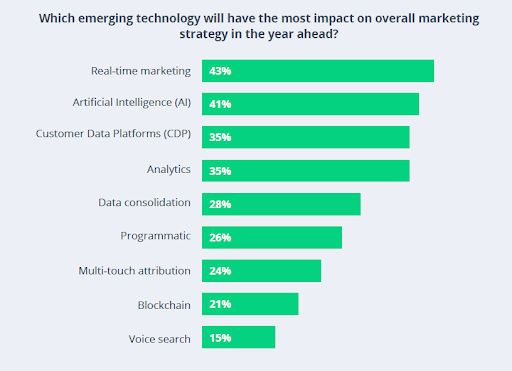
Emerging marketing technology for 2021
Key Takeaway: Real-time marketing and AI leading the pack, revealing B2B marketers are hyper-aware that reaching the right audience, at the right time, with the right message requires smart technology.
Both are key in ABM technology, with the power to help marketers in areas like identifying companies that are the best fit for their solutions, knowing when sales should reach out, and saving budget when serving them with the right message—all key components to a winning B2B marketing strategy in 2021.
Final Thoughts
What marketing technology tools are you planning to implement in the year ahead? How will you ensure the optimal performance of the tools you implement? What marketing strategy are you most excited to test?
You can download the entire Marketing Technology Implementation from the B2B Perspective Report for more data, tips, and strategies to plan, implement, and optimize your marketing technology implementation plan this year.
The post 5 Tips for Selecting Marketing Technology, Based on Research appeared first on Content Marketing Consulting and Social Media Strategy.
Source: convinceandconvert.com

B2B Content Marketing Research for 2021: Key Takeaways and Trends
Here are seven key takeaways from this B2B content marketing research report that I believe is important to keep in mind as you plan for 2021 and even 2022.
At Convince & Convert, one of my roles as head of the strategy is to make sure that everything we recommend to our clients is grounded in sound research and a firm understanding of what is happening right now with our clients and their industries.
To that end, we are constantly reading and summarizing reports for our own team.
One of my favorite annual reports is from our friends at the Content Marketing Institute and MarketingProfs, their annual B2B Content Marketing Benchmarks, Budgets, and Trends report.
This year, it’s more important than ever because the ground has shifted under all of our feet, and understanding the world we face during Covid and into 2021 is absolutely vital.
(Full disclosure: I’ve often worked with CMI and MarketingProfs as a speaker, and MarketingProfs is a former client of my company Media Volery, but I’d write about this report anyway because it’s essential information.)
Key Takeaways from the B2B Content Marketing Research Report
Here are seven key takeaways from this B2B content marketing research report that I believe is important to keep in mind as you plan for 2021 and even 2022.
1. Everyone is adapting to this major upheaval.
It’s no surprise that, of those with content marketing strategies, seven in 10 B2B marketers surveyed said they have experienced a major or moderate impact on their content marketing strategies.

As B2B marketers, we have to keep in mind that our customers’ customers are also adapting, so this is a critical time to change our tactics and help our customers adapt to the new reality that their end customers are facing.
If you can provide value to your customers in the B2B space at this time and guide them in how to get more out of their marketing and sales dollars, they’ll not only be grateful, but they’ll be more likely to stick around.
2. There will likely be a lasting ripple effect as B2B marketers adapt.
Of the marketers who have made adjustments, 66% said they have had to make both short- and long-term adjustments.
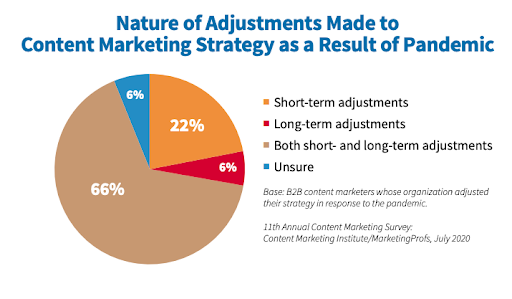
For B2B content marketers, it’s important to lean into the uncertainty that our customers are experiencing. Acknowledge their fear and confusion by providing resources to speak to their challenges.
Produce content that helps them plan short term and/or breaks down their thinking into quarters, so it’s digestible.
3. Are B2B marketers missing the opportunity to target changing motivations?
According to the study, the majority of content marketing changes that B2B organizations made in response to the pandemic related to changes in “targeting/messaging strategy”, the “editorial calendar,” and “content distribution/promotion strategy”—all focused on the operations of content marketing.
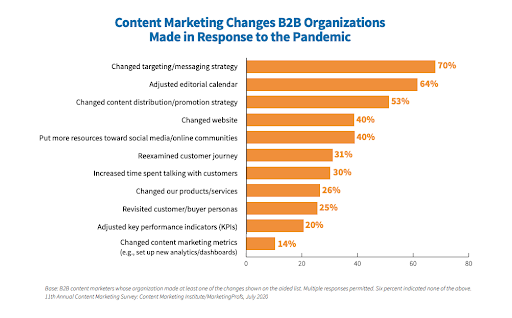
Interestingly, only a quarter of those surveyed indicated that they revisited customer/buyer personas, and less than a third (31%) said they reexamined their customer journeys.
In my opinion, this could be a major missed opportunity, considering that many businesses have shifted how they buy and what they prioritize during this time.
In fact, our own Jay Baer says, “This is the greatest opportunity you will ever have in your business life-time to create new customers.”
Understanding your audience during these times, their journey, and their mindsets will be critical to success. If your competitors aren’t investing there, now is the time for you to get this right.
4. Youtility is essential, now more than ever.
Of those who reported “extremely” or “very successful” content marketing during the last 12 months, 83% of them attributed this success to “the value our content provides.”
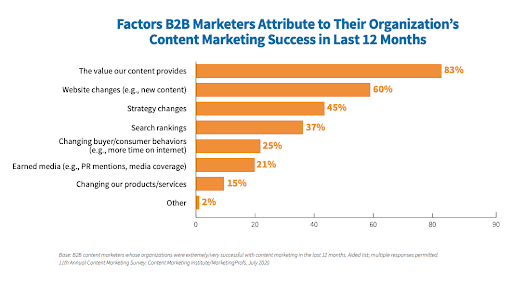
Jay Baer published his seminal book on “marketing so helpful that people would pay for it,” Youtility in 2013, but its lessons are even more important in this current environment because of everything we’ve talked about above.
Your existing customers are more willing to make a change than ever, but so are your prospective customers. So this means that you must build trust with them, so they’ll want to work with you at the end of the day.
5. Paid is here to stay.
According to the report, “72% of B2B marketers said their organization used paid content distribution channels (vs. 84% last year) in the last 12 months. However, the percentage of those using each paid channel increased over last year.”
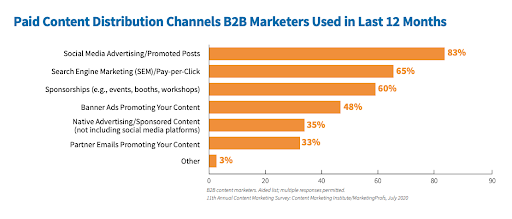
What we believe is that as in-person events go by the wayside, more B2B companies will need to invest in influencer work. In the last seven months, we’ve seen an uptick in companies that want to work with us on their B2B influencer strategies and programs.
6. Outsourcing and partnerships are vital for content marketers.
A whopping 86% of B2B marketers who outsource at least one activity say they outsource (some form of) content creation, far and away from the largest percentage. The next item is content distribution at 30%.
However, the real challenge is “finding partners with adequate topic expertise.” As you can see from this chart, 69% say that their challenge is finding partners with adequate topic expertise.
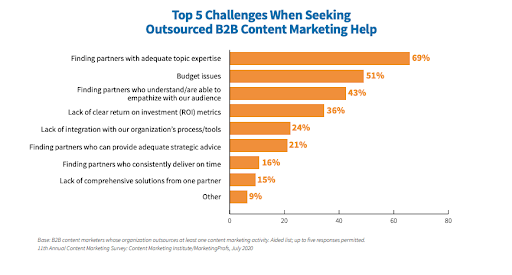
This is another reason to work with B2B influencers—because oftentimes, they can be topical experts.
We’ve recently worked with SharpSpring, a sales and marketing platform that includes CRM and automation capabilities, to launch their Agency Acceleration Series, which features a variety of experts who influence and are trusted by agency owners.
It’s a good example of a program that both showcases expertise and provides a ton of Youtility.
7. Mastering atomization is going to be key.
As you can see from the chart, companies are willing to spend on content creation and website enhancements, but not so much on staffing/human resources.
Plus, as we’ve seen from the previous chart, we know that “topic expertise” and “budget” are the top issues. So what should we make of the disconnect?

As always, firms are trying to do more with less. That’s not a surprise. But it does mean that creating a content atomization pipeline is a pressing need.
By doing so, we’re taking one piece of content and breaking it into many more pieces of content that can get eyeballs in a variety of places.
Doing more with the content we’re creating will help maximize not only our content but also help make our budgets more efficient.
Beyond Benchmarks to Actions
I hope you’ll take the time to review the B2B Content Marketing Benchmarks, Budgets, and Trends report in full.
It is because there are a ton of other interesting numbers in there, but beyond getting an understanding of how your current approach compares to other content marketers, use this report (and other reports like it).
It will help you to identify the places where you have the opportunity to take a step back, pivot, and invest time or energy in the areas that will make the biggest differences to your business and to your customers.
We must shake ourselves out of the status quo and make our B2B brands as useful to our customers as possible if we are going to be around for the next annual report.
The post B2B Content Marketing Research for 2021: Key Takeaways and Trends appeared first on Content Marketing Consulting and Social Media Strategy.
Source: convinceandconvert.com

How to Grow Your Local Business During Uncertain Times
No doubt this is a hard time to grow a local business. Coronavirus has likely forced you to make big changes to the way you operate. It’s almost certainly hit your bottom line too.

However, it’s still absolutely possible to grow your local business at a time like this. You just have to be smart about it. In this article, I’ll talk you through how to do that. First, though, here’s a bit of detail on why this is such a challenging time for businesses like yours.
The Effects of the COVID-19 Pandemic on Local Businesses
You’re probably sick of reading and hearing the word “unprecedented.” I know I am. Unfortunately, it’s just the best word to describe the current climate for local businesses.
By the end of March, 32 states had locked down in response to the pandemic. Two in five small businesses across the US had temporarily closed by this point, with nearly all of those closures due to COVID-19.
Closing your doors has big financial implications. It is concerning that the vast majority of local businesses aren’t in a position to handle even short-term pressure on their earnings, with around four-fifths only having up to two months of cash available to pay their expenses.

Because of this, it’s hardly surprising that the number of active business owners in the US plummeted by 3.3 million (or 22%) in the two months from February to April alone. That’s the largest drop on record, and it affected practically every industry.
Luckily, if you have access to the right strategies (like local promotions) and tools (such as messaging services like Podium), you may still be able to grow your business even in these uncertain times.
Six Strategies to Grow Your Business During the Age of Coronavirus
The pandemic might have affected your business growth in any number of ways. Maybe you’ve been forced to shutter your store(s) for a certain amount of time. Maybe your customers are buying less at the moment. Or maybe the industry you’re in means you’ve barely even got a “product” to sell, like cinemas and travel companies.
Whatever the case, if you’re going to grow your local business in the current climate, you need to adapt. Here are tips on how to do it:
1. Use the Right Tools
I know what you’re thinking: “I’m already worried about cash flow, now this guy’s telling me to invest in a bunch of tools!” Well, what if I told you that by choosing the right tools (some of which are free, by the way), you massively increase your chances of growing your local business?
You likely know that there are thousands of tools designed to drive small business growth, but I’ve focused on the areas where you can really shift the dial:
Issue: Customer Messaging
There are so many benefits to improving your communications with existing and potential customers.
You can generate more reviews, which act as a trust factor and make your business more credible. You can collect payments faster and with less hassle. You can issue more timely (and more effective) reminders, reducing the chances of no-shows.

To solve your customer messaging you can use a tool like Podium. Here’s how I use it:
Set up one inbox to rule them all:
What’s the biggest barrier to better communications? Trying to keep track of all your different platforms. Customers could be messaging you via Facebook, Twitter, phone, and your website (and maybe a bunch of others, too). Podium brings all those communications together in one place, ensuring you never miss a message.
Connect remotely with website visitors:
Ever wish you could get closer to the people on your website? Find out what stops them from buying or converting there and then? With Podium, you can. Add live chat to your site and every time they ask a question, they’ll automatically move to a text conversation, so you’re no longer tied to your computer (and nor are they).
Enable on-the-go customer service:
You likely don’t have a dedicated customer service team. In fact, you might be your whole customer service team. So what happens when you’re not at your desk or in the store? Stuff gets missed! Podium allows you to text quick responses when you’re out and about, so you never leave anyone hanging.
Chat face-to-face: Texting is great.
But sometimes it’s just not the best way to respond to a customer or prospect. Maybe they’ve got a complex question or require a nuanced response that’s hard to tap out on your phone’s keypad.

Podium offers video chat software that makes connecting remotely with customers as easy as sending a text.
Send your customers a link and you can be video chatting in seconds, making it super simple to show details, answer questions, and share your screen.
Create tailored promotions:
Say you own a coffee shop. You run a loyalty program and you’ve captured your best customers’ email addresses and phone numbers. Wouldn’t it be great if you could quickly send those customers targeted promotions? Maybe offer them a deal on a new single-origin coffee you’ve just started stocking? You can do that as well.
Provide to-the-minute advice and updates:
There are a lot of variables in the world right now. Customers might want to know how busy you are at a certain time, or what measures you’ve put in place during the pandemic. Or they might have product-specific questions.
A customer messaging platform makes it easier for you to respond in real-time.
Oh and an easy way to get started is to just sign up for a free Podium account.
Issue: Scheduling Meetings
No one likes scheduling meetings at the best of times. Throw coronavirus into the mix and it becomes even more of a challenge. Should it be in-person or remote? Which platform should we use? What date and time work best?

Meeting Scheduler Tools are designed to handle the legwork for you. One of the best is Arrangr, which reserves tentative meeting times, automatically frees up untaken slots, and can even suggest the ideal location for all parties.
Another great option is Calendly. Integrating directly with your Google or Office 365 calendar, it gives you a personalized URL that allows customers to see your availability and schedule their preferred meeting time. Best of all, there’s a basic free plan available.
Issue: Email Automation
You can’t grow a local business at a time like this without doing some marketing.
Unfortunately, you likely don’t have time to build and execute complex campaigns.
That’s why you need email automation software! One of the most popular tools, Mailchimp, helps you send effective email marketing communications at scale. In fact, Mailchimp claims to boost open rates by 93% and click rates by 174% compared to the average bulk email.
Customer Relationship Management
Your customer relationships have never been more valuable than they are right now, so you need to manage them effectively. To do that, you need to invest in a customer relationship management (CRM) tool.
There are a bunch of CRMs aimed at local businesses, but HubSpot Sales Hub is one of the most popular. It’s loaded with sales engagement tools, pricing functionality to help you deliver complex quotes, and analytics software to measure what’s working (and what isn’t).
2. Improve Your Digital Marketing Strategy
In more “normal” times, you might not put a lot of thought into your marketing. Maybe you just write the occasional social post or send a couple of email promotions a month.
During times of uncertainty, that just won’t cut it. People have a lot on their minds right now, so that one baseball gif you tweeted isn’t going to have much impact.
You need a proper digital marketing strategy.

Let me give you an example: you sell business supplies to other local businesses.
Because you’re small and local, your big differentiator is your flexibility and bespoke approach. You can source whatever product your customer needs, your delivery times are rapid, and you’re easy to reach. That’s the sort of stuff you talk about in your marketing emails.
Well, wouldn’t it be good if you made that the foundation for a whole campaign?
Maybe you create a bunch of case studies and testimonials that show your unique selling point, (USPs), in action. You build a mailing list of local firms you’d love to do business with and drip-feed your content to those prospects.
Because you’ve built a whole strategy, you know the best times to reach those prospects, the platforms they use, and the sort of messaging that resonates with them.
That approach helps you strike up a conversation, which ultimately means you may close more deals.
3. Make Your Google My Business Profile Shine
Want people to see your name when they search on Google for businesses like yours? If you’re reading this article, I’m guessing you do, and that means you need a (good) Google My Business profile.
Setting up a free profile makes it more likely that your business shows up in relevant searches, along with useful information like:
- The type of service you offer
- Your opening times
- Your address
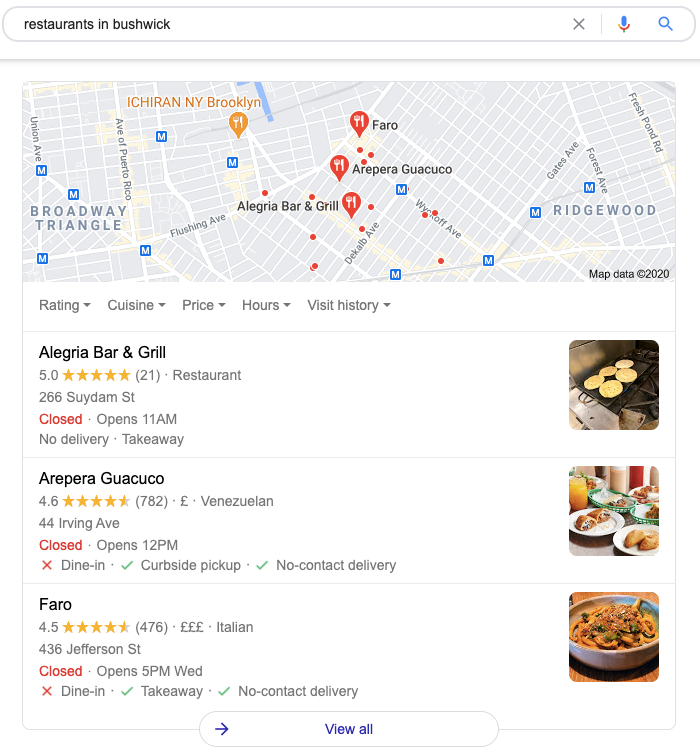
Once you’ve set it up, optimize your Google My Business profile by:
- Ensuring your information is accurate and comprehensive
- Sharing business updates, like new opening hours or product launches
- Asking customers for Google reviews (and responding to them)
On that last point, I know it can be hard persuading customers to review your business. They’re busy. They don’t want to spend their valuable time seeking out your Google My Business profile or Facebook Business Page.
Podium makes it a lot easier, helping you provide social proof that demonstrates your brand can be trusted. Text customers asking them for a review and they’ll be linked straight to your Facebook, Google, and Tripadvisor pages, so there’s hardly any clicks (and hardly any work) for them.
That’s why Podium has powered more than 15 million business reviews for its users.
4. Create and Execute a Local Paid Marketing Strategy
Sometimes it takes money to make money. If you’re serious about growing your local business right now, you’ll want to consider investing in some sort of paid activity.
Google Ads can be super effective for smaller firms, especially web-based businesses targeting online traffic and/or conversions. Local keyword phrases like “lawyers near me,” or “realtor in Denver,” are typically a lot less competitive than broader, non-geographic terms like “realtor.”
That means you could get a lot of visibility and clicks with a relatively small outlay.
In addition to Google Ads, consider advertising on social platforms like Facebook and LinkedIn. Social ads are less intention-based than paid search because your audience isn’t actively looking for the thing you’re advertising.
However, ads on social media often cost less than Google Ads. For instance, if you’re a law firm, you’re paying on average $10.96 per click on Google Ads, but on Facebook, that figure drops to just $1.32.
5. Use Analytics to Track and Improve Site Performance
When times are hard, you need to squeeze every last dollar from your potential customers. Analytics software (like Google Analytics) can help you do that by allowing you to identify trends, plan new strategies, and measure the results of your current efforts.
Let’s say you’re a mechanic. You’ve just added a page to your site to promote a special offer on new tires. A month later, you click into Google Analytics and see that a bunch of people have landed on that page, but your conversion rate is low.
You compare it to other, similar pages on your site. They’re performing much better. Now you know there’s a problem, such as:
- Your current offer is priced too high
- Your new page isn’t engaging or persuasive enough
- You don’t make it easy enough for customers to convert, so they leave
- You don’t provide enough detail about the offer
By comparing against better-performing pages, you can tweak your approach and improve results.
6. Conduct Local Community Promotions
Now isn’t a good time to invite hundreds of people to a big party. But there are definitely opportunities for community engagement. You just need to get a little creative.
Say you’ve opened a new store in a location you haven’t served before. Maybe you target properties within a certain zip code, or on certain streets, with a special offer that encourages customers to visit your store.
Perhaps in the age of social distancing, you’ve introduced a new takeout service. Why not give customers in your area 10% off their first promotion, or combine it with a loyalty scheme? Tailor your offer to what your customers want right now, then promote it on Facebook, in the local press, via email marketing, or through direct mail.
7. Optimize Your Social Media Accounts
There are dozens of social platforms out there, but when it comes to growing a local business, you want to focus on those that give you the best reach, like:
FacebookTwitterInstagramLinkedInPinterestYouTubeTumblr
Finding the right platform will depend on the type of business you run. On a basic level, if you’re B2B, LinkedIn’s likely your best channel. Otherwise, almost everyone is on Facebook, but if your product is highly visual you might see more success on Instagram, Pinterest, or YouTube.
Whichever platform(s) you choose, you need to identify some tactics that ultimately help you sell more, like:
- Showcasing and/or auctioning your products on Facebook
- LiveStarting conversations with new prospects in LinkedIn Groups
- Setting up Instagram Shopping so people can browse your products in photos and videos while in-app
Conclusion
Growing a local business is never easy, and it’s certainly a whole lot harder right now.
However, if you’ve set up your own business, you’re likely comfortable with hustling for results. You’re naturally entrepreneurial and you’re driven to make this work.
Combine that attitude with the right growth strategies, and execute them effectively, and there’s no reason why you can’t come out of the pandemic in a stronger position.
What plans have you put in place to grow your business? How’s it going for you so far?
The post How to Grow Your Local Business During Uncertain Times appeared first on Neil Patel.
Source: feedproxy.google.com