
Tag Archives for " #Storytelling "

8 Visual Storytelling Tools and How They’ll Help Your Content Marketing
Storytelling and visuals are two of the most powerful tools content marketers have. Both can help get ideas across more effectively and increase engagement. Combining these two elements—well, that’s a recipe for success.

How can marketers go about creating a successful visual story?
Luckily, there are plenty of tools available to help you take a marketing yarn and weave it into a beautiful visual.
8 Visual Storytelling Tools
Here are eight visual storytelling tools we love for weaving visual content into the content marketing mix.
1. Canva
Canva is the visual content and storytelling tool we use most often at Convince & Convert.
It empowers marketers to easily create beautiful designs and animations without any technical or design expertise.
We use it for creating blog graphics (like the one above), infographics, social media graphics, and more.
For important templates, I like to work with a graphic designer or team (we use Lightboard.io, big fans! hi Devin & Heather  ) to come up with beautiful, functional templates in Canva that we can use over and over again.
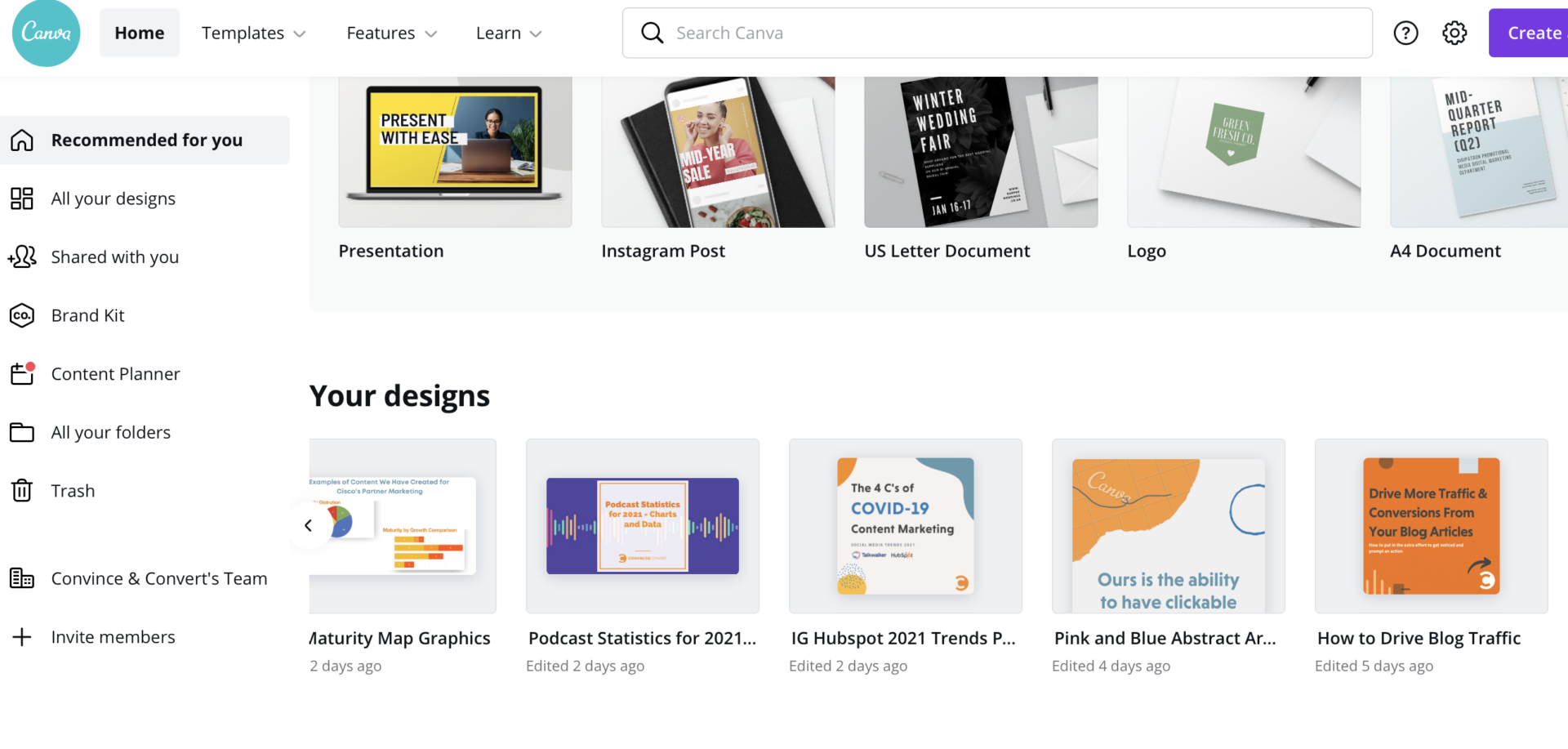
Here’s a peek into our Canva account at Convince & Convert.
We use Canva to create blog graphics, social media graphics, infographics, and more.
Canva even gives you access to images, fonts, icons, and photo filters, so you don’t have to go looking for stuff to add to your design, although I use iStock to access a wider selection of photos and illustrations.
Because visual content performs so well on social media, being able to create it is crucial for marketers.
Here’s are a few examples of the type of visual content you can create for social media with Canva.

Happy #NationalPetDay from our furry friends at C&C! 
 pic.twitter.com/F22wItRjrg
— Convince & Convert (@convince) April 11, 2021
2. Ceros
Ceros is an interactive content platform that makes it easy for marketers—or anyone, really—to create infographics, e-books, and websites without the need for coding knowledge.

It enables you to create aesthetically pleasing designs easily, animate them, and input features like social media plug-ins and pop-ups.
It also includes access to a catalog of fonts and icons.
Here’s an example of interactive content created in Ceros: The State of Hiring in the COVID Economy.
With Ceros, the team at 24 Seven was able to take research on hiring and turn it into an interactive report.
Study after study shows that interactive content engages users more than static content, and with a solution like Ceros, you can take your static research or copy-based content and insert it into one of their templates for a more engaging user experience.
3. Prezi
If you’re looking for an amazing way to create gorgeous, engaging presentations for webinars, meetings, and other events you should check out Prezi.

The company offers a number of sleek templates to which you can add text, images, audio, and more.
You can then easily share and present your creation.
You could use Prezi for your next big meeting or try using it to create an interactive video for your website.
We’re big fans of Prezi here at Convince & Convert, and last year, Jay Baer presented a webinar (created in Prezi) on “How to Unsuck Your B2B Webinars” with Brian Fanzo and our friends at Prezi.
If you’re creating webinars, you need to check them out.

Watch “How to Unsuck Your B2B Webinars” and see Prezi in action now.
4. Infogram
Infographics are a fantastic way to organize information visually. Users love them. They make text easy to digest and tend to get shared a lot on social media.

Infogram is a tool that makes designing your own interactive infographics a simple process. You can also make cool charts and maps by using one of Infogram’s themes.
Here’s an example of an interactive infographic about the Deepwater Horizon Oil Spill — it takes a look at what has happened in the ten years since the spill.
5. Uberflip
Uberflip helps content marketers create engaging content and keep it all organized.

It features tools for creating interactive flipbooks, infographics, white papers, and more, as well as an attractive home for all your content.
Uberflip also includes tools for adding in things like calls to action and social media buttons.
There’s even a place where marketers can manage all their content and receive insights about it.
6. Loupe
If you’ve got a bunch of photos from a company event or some other function and want to share them with your customers, try using Loupe to help you present them in an interesting way.
Loupe lets you make a collage of your photos in a custom shape, send them in a card, or even look for photos in a Where’s Waldo-inspired game.
Here’s an example made with Loupe of the Apple logo made up of a collage of photos.
Sharing your photos in a creative way like this can make your content more interesting and help develop a strong brand identity.

7. WordArt
WordArt is more or less what it sounds like. It’s a website that lets you make art out of words.

All you have to do is copy and paste words from, say, your latest blog posts and choose a shape, and you’ll get a cool-looking shape made up of the words you uploaded.
You could use this to visually sum up a piece of text, but there’s another benefit: The words used most often appear largest, which can give you some helpful hints when optimizing for search engines.
Here’s an example of a visual made with WordArt that features the words “Michael Jordan,” “basket,” and “NBA.” You might have guessed this already, but it’s also shaped like a basketball.
8. Visage
If you want to easily design your own graphics and still have the possibility of working with a graphic designer, you might want to try out Visage.

This company offers an easy-to-use tool that allows a team to collaboratively design and edit visual content.
The company also has graphic designers on staff that you can work with on your projects.
Here’s a cool infographic like the ones Visage helps design.
It looks at the Beatles and breaks down stats like their biggest hits, who wrote most of their songs, and what words they include most often in their lyrics.
Wrapping It Up
Visuals and storytelling are two of the biggest assets marketers have.
Taking advantage of the various tools that are available to help you create visual stories can make a huge difference in your marketing campaigns.
Try out these 8 examples, and feel free to scour the internet for more helpful resources.
This post was originally written by Kayla Matthews in 2017 and updated by Megan Leap in 2021.
The post 8 Visual Storytelling Tools and How They’ll Help Your Content Marketing appeared first on Content Marketing Consulting and Social Media Strategy.
Source: convinceandconvert.com

How to Position Yourself in Your Customer Story
When it comes to sales, using a story is your best strategy.

Humans love stories— particularly when they’re interesting, engaging, and memorable. That’s why the people who sell with the story have so much success: they take their sales pitch from an informational seminar to an immersive experience that their potential customers love.
Donald Miller, the Founder & CEO of StoryBrand is not only an expert on selling with a story but also one of the trailblazers of the strategy. As he discussed in his recent DigitalMarketer workshop, the StoryBrand method works because it appeals to customers in so many ways, from entertainment to understanding, and even to survival.
And, in all of those different ways, the same result happens: your customer actually listens to what you have to say.
When you create a story about someone, especially one where they are the main character, they tend to listen. They tend to react. And, most importantly, they tend to buy.
There’s just one common problem that the storytellers have with this approach, and it can be summed up into one simple question…
“Where do I fit into all of this?”

Your customer is undoubtedly the main character and hero of the story. You need to illustrate the narrative arc that sees them overcoming adversity and accomplishing their goals. But, if they’re the hero of the story, then how do you need to position yourself?
What Role do You Play in The Story?
In your customer’s story, you are the guide.

The guide is the person that helps the main character overcome their challenges. They are characters like Yoda, Dumbledore, and Mr. Miyagi. They are the ones that are fondly remembered, but not the ones hoisting their hands in the air in victory at the end of the book or movie.
The guide’s role is critically important in almost every story because they are the ones that make the hero’s transformation possible. Without the guide, the hero wouldn’t be able to overcome obstacles and achieve their goals.
Just like Luke Skywalker wouldn’t be able to defeat the Sith without Yoda’s help, your customer won’t be able to achieve their goals without your products and expertise.
So, even though you play an integral part, you are not the hero in the story. And, when you are framing your customer’s story, it’s important to remember that for a couple of reasons…
You should never position yourself as the hero because it’s the hero who is ill-equipped to achieve their goals on their own. Only until the guide shows up and gives them the tools that they need can they truly achieve greatness.
You don’t want to be the character that can’t manage to achieve their goals on their own, you want to be the one that helps the main character finally reach success.
The other reason is this:
You don’t want 2 heroes in a story because it weakens the story’s impact on your customer. By introducing 2 heroes, and thereby 2 narrative arcs, your story and your customer’s story become totally different (and muddled).
So as much as you want to succeed, you need your customer to succeed even more. Invite your customer into a story, one where they defy the odds and win the day. Talk to your customer about their goals and wishes, not your own. Put your customer first in everything you do.
Then, once your customer understands and begins on the path toward success, you will also succeed in the process. Don’t focus on your own wants and needs. Do nothing but be helpful, and then stand back and watch the pieces fall into place.
If you can manage to do that, then you won’t ever have to worry about your own personal success. It’ll just happen on its own.
How to Establish Yourself as the Guide
Now that you understand the role that you’re supposed to play, you now have to understand how to actually play it. We talked about it broadly, but let’s get more specific.
To truly position yourself as the guide, you have to show that you are the person who can help your customer accomplish their goals. To do that, you have to exhibit empathy and authority.

In the case of empathy, you have to show your customer that you actually care. You should make them understand that not only do you feel bad that they are going through a problem with their business, but that you think it’s borderline unfair that they are having to experience it in the first place.
If you can show that you actually care about your customer’s problem (and helping them solve it), then they will be significantly more inclined to have you help them fix it.
In the case of authority, you essentially need to demonstrate your competency. You need to prove that this isn’t the first time that you’ve helped a customer solve a problem and achieve their goals.
By showing to your customer that you are equipped to help them solve their problems and that you have a track record of success, you are going to sell them on you as the solution to their problems.
You’re going to establish trust, which is a necessary component of any business relationship.
Crafting your Brand Script
Empathy and authority are the two parts of the equation when it comes to your specific role as the guide in your brand “script.” It’s also important to note that they aren’t exclusive to each other. If you can only establish one of either empathy and authority, then your whole positioning plan will fall apart.
You need to establish both empathy and authority and, when talking to your customer, you ideally need to do it in one or two sentences. If you can quickly establish both of those things, then you’re going to have an enormous amount of success.
So, what that really means is you need to plan ahead. You need to attempt to anticipate what kind of problem your customer is going to have. That way you can integrate the skeleton of your statement of authority and empathy into your brand script, and then fill it in with the specifics when they become known to you.

Once you have that statement strong and clear, then you will have effectively set the framework to position yourself as the guide. Then you can focus on making sure the rest of the parts of your customer’s story fall into place. You can worry about filling out the rest of your brand script.
Just remember that, no matter how important it is, where you fit in your customer’s story is only one piece of a very large puzzle. If you want to learn more about the StoryBrand process and learn how to finish your customer story, check out Donald Miller’s workshop.
Wrap-Up
By positioning yourself as the guide in your customer story, you play an integral part in their success without detracting from the fact that it’s their success, not yours.
You want your customer to be able to turn to you in their time of need so you can help them solve their problems, and the best way to do that is by showing them that not only are you capable, but you also care.
Once your customer believes that, you can effectively help them achieve the success that they envision for themselves.
And, in the process, you’re going to get paid.
Then, once your customer is happy and their story is fulfilled, you can move on to the next one and repeat the process. What could be better than that?
The post How to Position Yourself in Your Customer Story appeared first on DigitalMarketer.
Source: digitalmarketer.com