
Tag Archives for " search "

Using the Google Search Trends 2021 Report to Generate Content Ideas
As marketers, we’re constantly attuned to Google’s ever-changing algorithm, keeping an eye toward shifts in prioritization and SERPs.
Google is pretty good at equipping users (and businesses) with information about what it considers important by providing resources like their search engine optimization (SEO) guides and the annual Search Trends report.
The Google Search Trends report can be an incredible asset that allows you to dig into users’ search habits and gain access to a steady stream of content ideas.
In this blog, we’ll unpack how to mine the Google Search Trends report for content gold to flesh out your content calendar into 2022 and beyond.

What Is the Google Search Trends Report?
Published each year, the Google Search Trends report aggregates the highest-ranking terms for the year.
Curious readers—or those of us looking for content ideas—can visit the mini-site to explore search volume through several lenses.
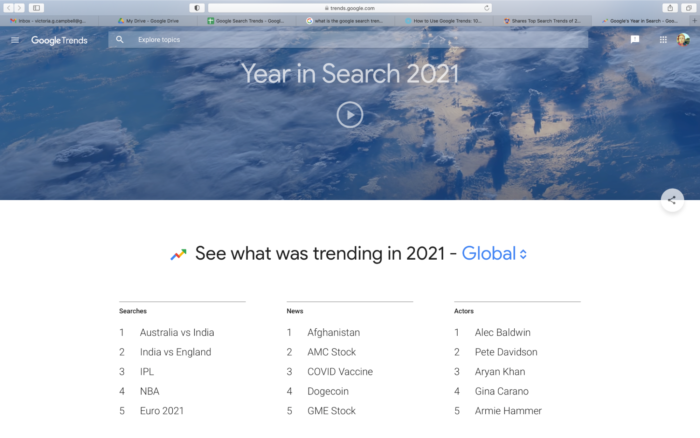
You can break it down by region and then a topic, including categories like actors, TV shows, sports teams, songs, and many more.
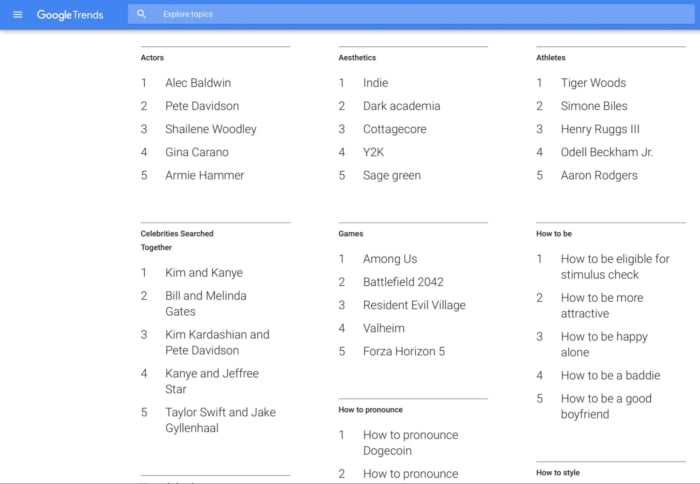
While this report can certainly generate year-end nostalgia, it also offers a unique perspective into the terms that gained the most search volume and traction in the last year.
For marketers, that data can be gold.
Top Trends from the 2021 Google Search Trends Report
Regardless of what region you’re researching, you’ll find a common theme in this year’s report: perseverance.
2021 saw searchers looking for “how to heal” and “how to be hopeful.” This theme resonated in more concrete searches as well with high volume searches including, “how to start a business in 2021” and “how to get a job in 2021.”
Entertainment was another balm in a complicated year. We looked to Google for distraction and clarification, typing in searches like “Squid Game” and “Amanda Gorman.”

Here are a few other Google Search Trends that got a lot of attention around the globe this year:
- Australia vs India
- India vs England
- IPL
- NBA
- Euro 2021
- Copa América
- India vs New Zealand
- T20 World Cup
- Squid Game
- DMX
In the United States, here’s what users were most interested in overall:
- NBA
- DMX
- Gabby Petito
- Kyle Rittenhouse
- Brian Laundrie
- Mega Millions
- AMC Stock
- Stimulus Check
- Georgia Senate Race
- Squid Game
While these searches can entertain, they can also inform your content strategy, by helping you create content that users are likely to be interested in.
How to Use the Search Trends Report to Generate Content Ideas
Struggling to come up with fresh, new content ideas? I’m no stranger to the frustration that comes with this.
Using Google Search Trends, you can determine what topics users are interested in, increasing engagement while building relationships and goodwill.
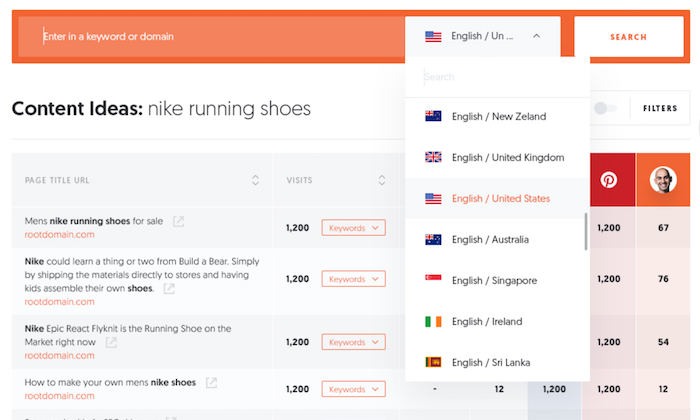
Below, I’ll break down the five best strategies for harnessing the insights associated with the search trends report to generate content ideas.
1. Use Popular Search Terms and Find a Unique Angle to Cover the Topic
While a blog post about the permanence of the cottage come aesthetic might be popular, this topic may not align with your brand. However, also topping the aesthetics search list is “sage green,” a topic that might be related to more industries.
Whether you’re a small boutique or a landscaping company, you can take advantage of this particularly high-volume query and build out a content plan to address it.
Sage green might not be in your wheelhouse.
If that’s the case, look for other search terms that might meet your audience’s interest in some way.

This part of the Search Trends reports breaks down searches by different topics, including:
- culture
- economy
- entertainment
- environment
- health and wellness
- news and events
- philanthropy
- representation sports
“How to maintain mental health” was searched more than ever in 2021—most industries could leverage that to provide mental health advice and tips to their audience. For example, I might write about how to maintain mental health as a remote digital marketer or how to help your remote team maintain their mental health.
By aligning your audience’s interest with a popular search query, you not only increase the visibility of your content, you also offer your existing and would-be audience a fresh perspective within your industry.
2. Search for Topics Using the Search Bar
Suppose you’re curious about the search visibility behind a certain query. In that case, you can use the Google Search Trends report to explore how much a specific term resonates, as well as related queries and terms.
For example, we searched “digital marketing.”
In addition to highlighting the term’s prominence, the report also offers tons of valuable detail. We could build a content strategy with a pretty solid idea of what type of content will and won’t resonate from this one search.
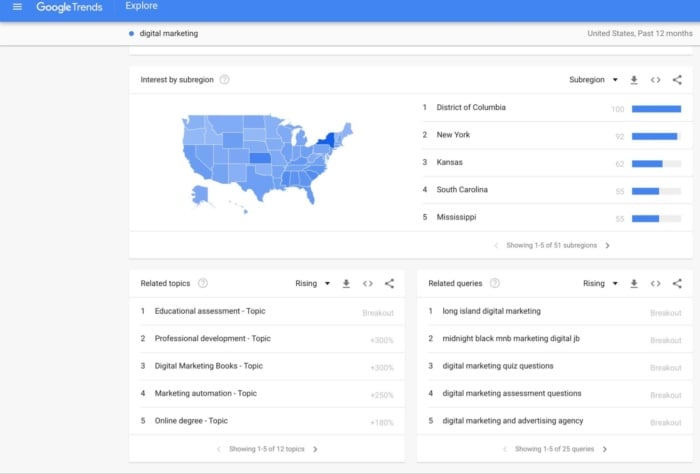
In the “related topics” section, I see terms like education assessment and professional development, which means a list of digital marketing courses or training might do well.
Search the name of your industry and the main key terms you target and see what content ideas pop up.
3. Use the Google Trends Report to Find Topics that Appeal to Gen Z
In 2019, Gen Z officially outnumbered millennials, tallying 32.2 percent of the world’s population.

Even more impactful, Gen Z makes up over 40 percent of U.S. consumers.
Consider this: a third of the world’s population is Gen Z. You’re doing your brand a huge disservice if you don’t consider how to speak to this massive, tech-empowered group.
After you’ve identified topics you know resonate through your search bar exploration, how can you ensure your content resonates with this unique group?
The answer is pretty straightforward.
Your content needs to be more interactive and appealing.
Here’s how to do that:
Create More Interactive Content
The more opportunities audience members have to interact with your content, the more likely they will.

By incorporating interactive elements, you encourage action. Next time you’re planning content, consider including a poll, stickers, or slider that allows your audience to truly engage with your brand.
Personalize Your Messages
Gen Z grew up amid a time of increased personalization. In fact, they’ve come to expect it. Be sure that you use every personalization opportunity to reach this coveted demographic.
Time-Sensitive
Fear of missing out, or FOMO, is still very much a thing. Take advantage of this fear by incorporating time-sensitive offers into your content, forcing your audience members to take action or miss out on a one-day-only deal.
Make Your Content More Visually Appealing
It’s no secret that Gen Zers flock to platforms like Instagram and TikTok, home to bite-sized video content. Take advantage of this content preference by drawing inspiration from the short, visually appealing videos that spread like wildfire.
4. Create Content Around Topics You’re Passionate About
It’s always easier to create compelling content around topics that resonate with you. As you peruse the 2021 Google Search Trends, keep an eye toward topics that resonate personally with both you and your brand identity.
Start by looking at the major search terms in each main topic I listed out above. Let’s say you work or own a coaching business and are looking for more topic ideas.

A quick look at popular “culture” topics shows us doom scrolling is the most popular topic in the culture section. How can you use that to your advantage? By matching it to your brand identity.
As a coach, you might write about how to avoid doom scrolling, how doom scrolling impacts your job search, or create a challenge to encourage your followers to stop doom scrolling and improve their mental health (which was another popular search term, as you might recall!)
After identifying high-performing topics, create a content plan to address them. Will you create blog posts, ebooks, or courses? Can you use these ideas in other areas of your marketing, like paid ads?
5. Identify New Niches
If you’re searching for a new niche, Google Search Trends is a great way to identify rapidly-expanding niches that may have content gaps you can fill.
To see search growth for a particular topic, simply set your search duration to “2003 to present,” so you can see long-term traffic on the topic.

This can also help you see when topics are most popular in a specific year, allowing you to plan your content publication around timeframes when Google users are historically searching for specific terms each year.
For example, topics around “fly fishing” tend to peak in the summer, when the weather’s nice. Tips for Black Friday marketing tend to peak in late November, as you might have guessed.
Frequently Asked Questions About the Google Search Trends 2021 Report
What is the most searched thing on Google in 2021?
Globally, the highest-volume search term was “Australia vs India.” In the United States, the most searched term in 2021 was “NBA.”
How do you find what is trending on Google?
Google releases its year-end search trend report once a year. In these pages, you’ll find the highest-volume search phrases in a variety of different categories, as well as through a geographical lens.
Throughout the remainder of the year, you can visit Google trends to see what the world is searching for.
How can you capitalize on search trends in marketing?
You can use search trends to power your content plan, perform keyword research, find seasonal trends, optimize your SEO strategy for video, and find related terms to outperform your competitors.
What are the search trends for late 2021?
The most popular search trends for late 2021 include mammography, why people are quitting their jobs, back to work bonus, potluck, small business Saturday, and how to become a volunteer firefighter.
Conclusion: Google Search Trends 2021 Report
The Google Search Trends report provides a nostalgic look at the year in review, with pop culture topics like Squid Game and news stories like the disappearance of Gabby Petito. However, they’ve also given us a tool we need to gain greater visibility into search patterns.
By mining these trends for insights into search patterns and behavior, you can create a content plan that speaks to the topics users care about.
The uses of the Google Search Trends report go beyond content ideas. You can also perform in-depth keyword research, use popular trends in your ad copy, and find new niches to target.
As you wade into your 2022 content planning, keep an eye toward the information Google has generously handed over—your click-through rate (CTR) will thank you.
What’s the most useful thing you’ve learned from the Google Search Trends report?
Source: neilpatel.com

SEO for a New Site: Checklist
Starting SEO for a new site is overwhelming, especially if you haven’t done it dozens of times already.
In fact, the process can be quite intimidating, as there are so many technical tasks involved.
SEO for a new site is one of those most intimidating tasks new site owners tend to shy away from and set aside.
SEO for a New Site: Checklist
Here’s a guide that will make it doable for you:
1. Don’t Take Your Domain Name Lightly
Spend some time on this step: Your domain name will hardly have any direct impact on your organic search visibility but it will be important for your brand name recognizability.
What doesn’t matter for SEO:
- Domain age (when it was registered)
- Exact-match keywords in the domain name
- Top-level domain (as long as it is not a regional/localized TLD), i.e. don’t stress if you cannot find a .com domain.
What does matter for SEO:
- Domain meaning: Its topical associations. A good domain can get more people to click your snippet when they search
- Domain length: Too long or hyphenated domains may look spammy and hurt your brand.
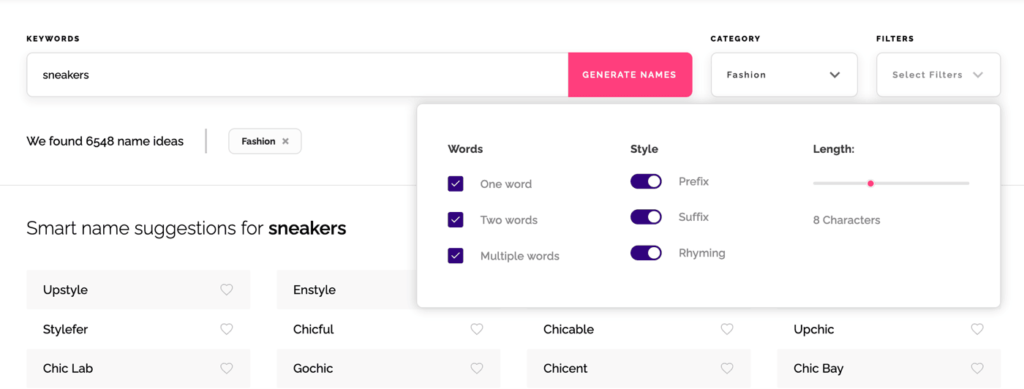
With all of that in mind, take your time. Picking a domain is a huge decision. Use this business name generator that discovers some snappy names with meaning. You can also set how long your name should be and which category it should fall under:
Once you have your domain, search Google for your name to make sure there are no existing brands in your niche that you’ll have a problem overcoming in branded search.
2. Use WordPress
WordPress is the easiest platform to set up a site. And it is also incredibly SEO-friendly and flexible.

No other content management platform has so many years of fine-tuning and such a rich directory of plugins. You can do just about anything with WordPress without having to code anything.
WordPress is free, most plugins are free or freemium, and all it takes is a few-click installation on most hosting providers.
WordPress also doesn’t require a lot of optimizing, especially at the beginning. All it takes:
- Choose a theme. Unlike your domain name, this will be easy to change down the road, so focus on the theme being lightweight rather than pretty. Here are a few fastest themes out there
- Enable HTTPS: Here’s a detailed guide on doing that on WordPress
- Set your permalinks to “Post name” and choose your time zone in “General Settings”
- Publish some fundamental content to give search engines something to crawl. More on this below:
3. Set up Your E-A-T Right Away
The first thing you can do when launching a new site is to start with Lorem ipsum text on your fundamental pages: About us, Contact, Privacy Policy, etc.
Those types of pages convince your first visitors that you are a trusted business to deal with and send quality signals to Google.
Make sure your E-A-T is set up well:
- Your foundation pages (About us, Terms of Service, Contact us, etc.)
- Your website security information (how is your visitors’ privacy protected?)
- Basic facts about your business
- Some social proof from beta testers or first product buyers
- Your author bylines detailing why they have expertise on a topic
- Links to your social media profiles
- More importantly, your service or product pages. What is it you are selling?
Ensure your service pages are as descriptive as possible. In order to achieve that, try adding not just text but also some videos that demonstrate the key benefits of your products or services.

Also, since the majority of visitors prefer watching videos with sound off, make it convenient for them by adding subtitles, so that they can get to the meat of the matter even without having to listen to them.
You want your first visitors as well as search engines to know right away!
4. Start with the Least Competitive Search Queries
One of the biggest challenges of optimizing SEO for a new site is that you have no unique data to rely on.
Any data that you are going to use at this point is public, so you have zero competitive advantage unless you get really smart and creative.
When launching SEO for a brand new site, you need at least This content targeting definitive search queries at a minimum:
- Pages describing your services/products: These will target high-intent queries
- Initial content putting your products in the educational courses: What are those problems your products help solve? These could also be use cases.
#2 is where you can focus on less competitive search queries to start generating some organic search traffic earlier and send those visitors to your key “money” pages.
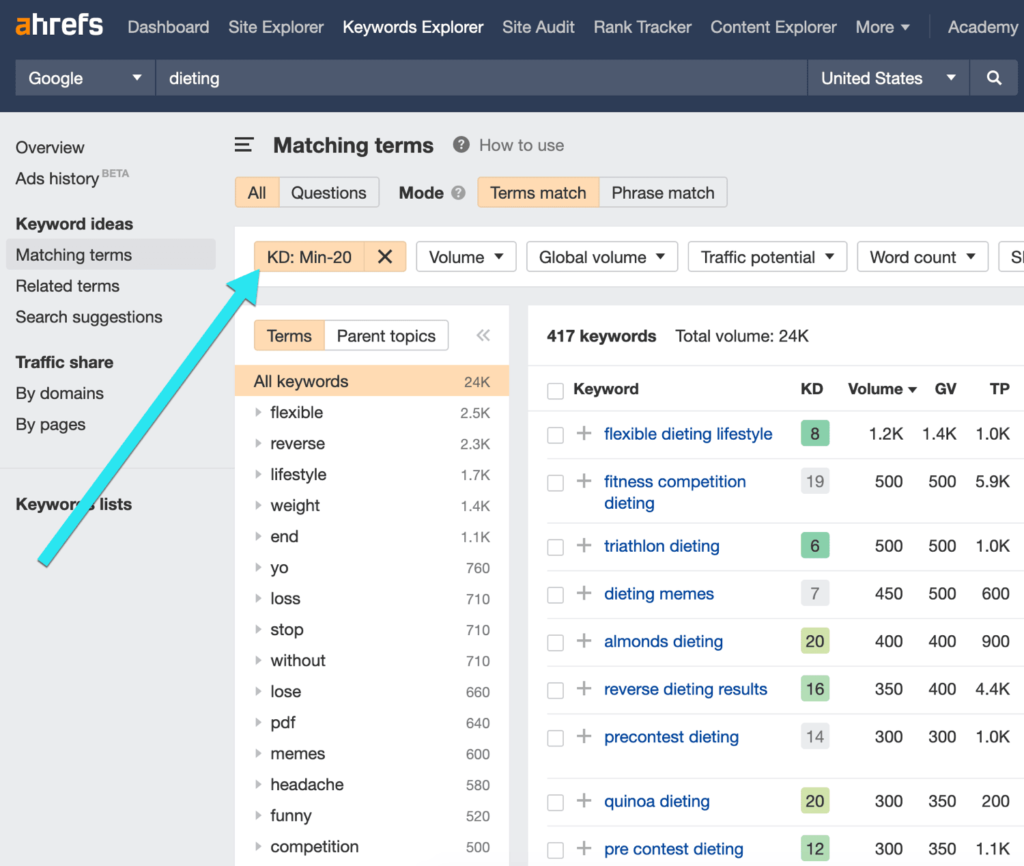
Ahrefs is a great tool to find those low-hanging-fruit keywords to target when starting a new site. The platform offers a “Difficulty” metric that shows how difficult it will be to rank for each keyword on page 1.
For a brand new site, you may want your keyword “difficulty” to be no higher than 20. For that you will need to create a filter inside the Keyword Explorer:
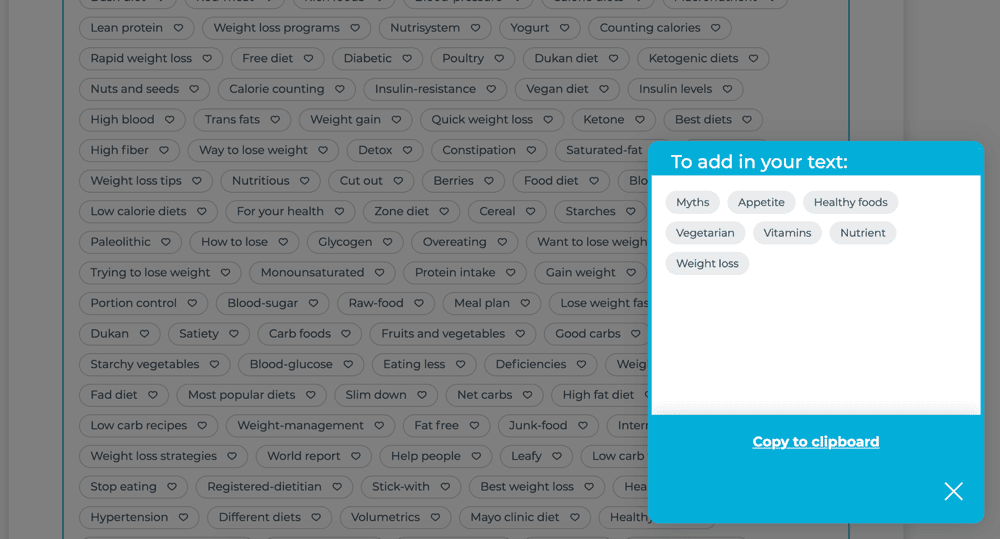
When creating your content, use Text Optimizer to build semantically relevant context and include related concepts:
5. Start Monitoring Your Progress
You want to start collecting your site’s data as early as possible. This will help you get ahead of your competition by utilizing your own data and making more informed decisions. You don’t have to do lots of web tracking systems.

These three will be enough:
- Google Analytics
- Facebook Pixel (especially if you are starting an ecommerce site and planning to use retargeting ads down the road)
- Google Search Console: Google will start collecting data about you as soon as they discover you but things like sitemaps may speed things up.
6. Focus on Content-to-Content Links
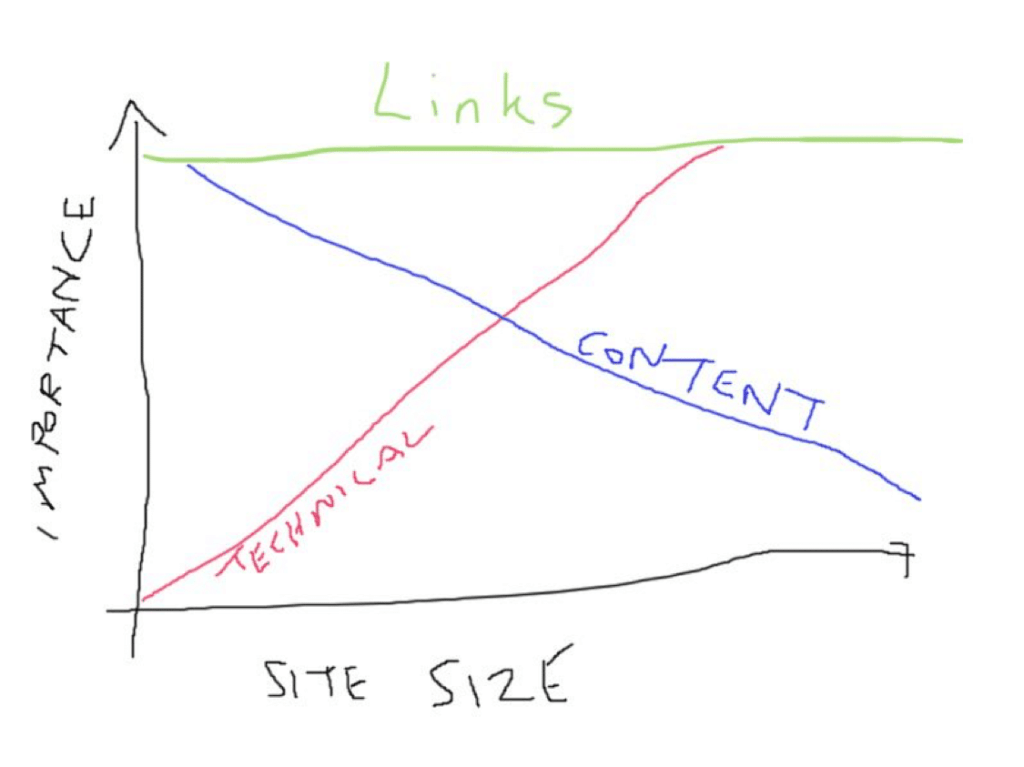
Links will help your site get discovered by Google as well as start growing its credibility. No site should be launched without a smart link acquisition strategy.
Links are still key to organic search visibility, so there’s no search engine optimization strategy without links.
Self-serving link building is a risky tactic that can bury your website in penalties and filters, and the risk is even higher for new sites that have no good record with Google.
With that in mind, don’t be in a hurry and try to avoid any link acquisition tactics where you can control the anchor text of the link.
There are a few powerful and safe link building tactics, and most of them come down to one process:
- You create useful and truly unique content assets. (e.g. an original study)
- You reach out to media publications for them to consider covering it.
It takes time and effort but you just cannot put a price on contacts you’ll be building underway. Make sure you build strong relationships with all the publishers that chose to link to your content. Every further outreach campaign will be easier from there.
Your New Site Is On Its Way to Ranking
SEO for a new site is mostly about building a foundation. You don’t have to do everything perfectly when starting a site. You just need to lay a good foundation to start collecting data and expanding.
SEO takes time, so whatever you do, don’t expect fast results. Google needs to start crawling your site and forming your opinion about your content before they know it is worth showing up for its users.
The post SEO for a New Site: Checklist appeared first on Content Marketing Consulting and Social Media Strategy.
Source: convinceandconvert.com

6 Ways to Integrate SEO Across Teams
When I started in digital marketing, I splattered meta-data and keywords into content like Pollock. I am not proud of this because not only does this date me, but it is also horrifically against best practices as we see them today. If you ever read anything along the lines of “California vacation lovers and those who love California vacations? For the best California vacation, look no further than these California vacations,” I send my deepest apologies.
Fast forward 20 years, I’m now happy to say that organic SEO best practices have dramatically improved, both for the marketer and the end-user. As we move into 2022, it’s more important than ever to remember search does not take place in a silo. It should be a thoughtful, integrated strategy running across the complete customer experience.
6 Keyways to Integrate SEO Across Your Organization
Not sure how to integrate SEO? We have six key ways to de-silo your search integration across your organization when it comes to working with search engine optimization teams, agencies, or practitioners.
#1. Search Meets Research, Personas, and the Audience Journey

Search traffic provides a treasure trove of qualitative and quantitative information about your audiences’ needs, vernacular, attitudes, and more.
- Do people talk about your travel product by saying “vacation” or “trip”?
- Do high school students looking for information about their college of the chosen search for “ASU”, “Arizona State”, or “Arizona State University”?
- When searching for enterprise software, do your customers say “platform,” “tool,” or “technology”?
Using search data helps you discern what will resonate best with your audience. Couple this with surveys, stakeholder interviews, and digital data and you have a solid (and quantifiable) foundation for your personas and audience journeys.
When search teams share high-level keyword information across the organization, it can help support everything from media relations to product development to recruitment and beyond.
#2. Integrate SEO and UX
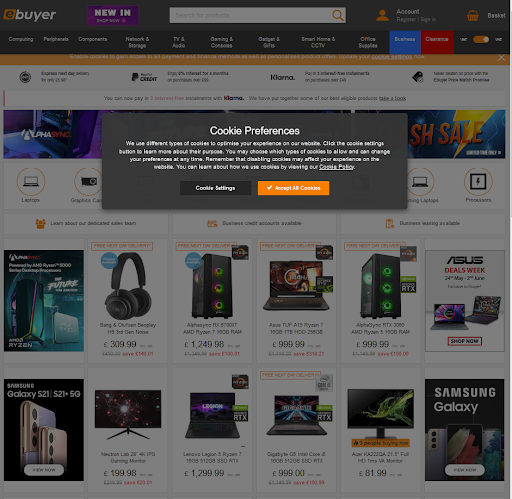
According to “SEO For Everyone” authors Rebekah Baggs & Chris Corak, search and user experience teams shouldn’t be kept on separate tasks (or quite frequently within separate silos). These practitioners or teams often have some of the same goals in mind: ensure the site is easy to find, navigate, use, and enjoy. Although, they may approach the process of getting to the end goal differently.
Don’t let the idea of The One Perfect Keyword create tunnel vision—you want to be looking at the bigger, more nuanced picture. An improved user experience means people stay on the page longer, interacting further with your site, not clicking the back button, revisiting the site anew, and sharing your content—all boons for SEO. The better the overall site experience (think UX, load times, mobile navigation, et al.), the more likely you’ll reach the coveted top ten in SERP.
– Baggs & Corak
#3. Search and….. the Offsite Experience?

During my Britney-and-Justin-era SEO days, I didn’t anticipate I’d be planning for SEO even before the site experience began.
Today Google wants you to stay on Google.
Don’t let the idea of The One Perfect Keyword create tunnel vision—you want to be looking at the bigger, more nuanced picture. Click To Tweet
It is now critical that search marketers consider how their content is presented, consumed, and shared even before the user gets to their site. Examples of this include maps, movie listings, local listings, and product descriptions.
As top search results provide answers via the SERP itself, search marketers and content creators need to button up content, images, and calls to action even before a user steps foot on your site.
#4. Search and Social
One of my favorite mash-ups over the years has been searching and social. It’s interesting to find how to search keywords and activities on your site overlap with social engagement conversions and customer care. This isn’t revealed through a pretty Venn diagram.
This typically looks like a psychologist blot experiment with various overlaps in bizarre and unpredictable ways.

As the great resignation continues and teams have more and more to do (with fewer resources, patience, and stamina), one way to offset that workload is figuring out ways to collaborate, leverage each other’s expertise, and do more together, outside of the SEO silo.
Top social sites for search engine optimization (and content distribution, amplification, and atomization too!) include LinkedIn, Pinterest, Medium, Twitter, and Meta (the artist formerly known as Facebook).
According to Pinterest, 444 million people globally come to Pinterest every month to get inspired. Last year, 88% of Pinterest users purchased a product as a result of their New Year’s Resolutions.
#5. SEO, Meet Creative and Content

Content marketers and writers need to ensure content is not just “me me me” or “product product product” copy.
What questions does your audience need answering? In what cadence? Where? Why? How (video vs text vs app, for example)? I can promise with 99% accuracy it’s not, “why are these SaaS tool features so yummy?”
Creativity is critical too. According to Google’s John Mueller:
Sometimes those small differences do play a role in regards to how people perceive your website. If, for example, you have something that is on a financial topic and people come to you and say, “well, your information is okay but it’s presented in a way that looks very amateurish,” – then that could reflect how your website is perceived. And in the long run could reflect something that is visible in search as well.
Poor design can lead to high bounce rates and short time on site, adversely impacting ratings. Search marketers working on their 2022 goal or to-do list might consider adding “meet with the creative team” (over coffee or cocktails works!)
For a goldmine of additional insights from Google’s John Mueller Bookmark This: 57 SEO Insights
#6. SEO and Video

With YouTube continuing to dominate as a primary search engine, optimizing videos for SEO should be on your radar as well. Videos should mirror your search keywords, be thoughtfully optimized, and mirror the sophistication of your brand, both from a creative and UX perspective.
Keep your eye on:
- Channel trailer, featured video, and channel sections
- Channel name, description, and site links
- Profile picture, banner image, and video watermark
- SRT Files,Tags, & Hashtags
- Titles and headlines for thumbnails
Now’s The Time To Integrate SEO
To help phase your efforts, begin by learning what terms and topics your audience is searching for, build content focusing on those phrases and issues, and use the research to understand the highest interest levels. Focus your content initiatives on those first.
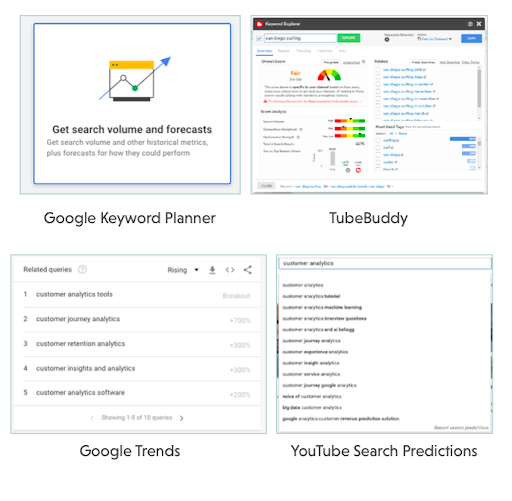
In addition, tools like TubeBuddy, Google Keyword Planner, Google Trends, and YouTube Search Predictions will help you learn what is working – and what’s not as you integrate SEO.
The post 6 Ways to Integrate SEO Across Teams appeared first on Content Marketing Consulting and Social Media Strategy.
Source: convinceandconvert.com

SEO Trends for 2022: How to Get on Top of Google Search
SEO is one of the youngest marketing disciplines out there, and it’s also incredibly fast-paced. It looks almost nothing like what it did when we started.
While the fundamental principle remains the same — SEO is about making websites easy to find and understand — the tactics involved are very different than they were 15, 5, and even 1 year ago
So what are the most important SEO trends for 2022 and how can you implement them?
SEO Trends for 2022
Here’s what you should know for 2022, as well as key steps for implementing these trends and tactics.
SEO Trend #1: SERP Marketing and Content Diversification
For years now, Google has been taking steps to become a destination, not just a discovery project. With knowledge graphs, quick answers, and interactive and visual results, Google is building an ultimate resource that can give comprehensive answers to any query.
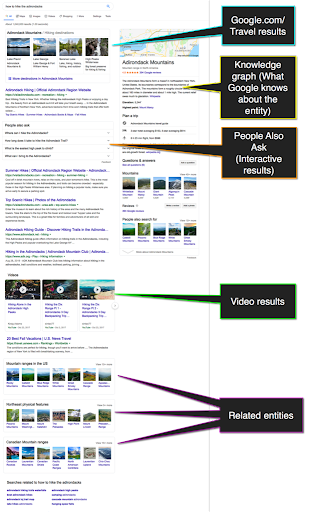
Within one search result page, we see:
- Google.com/Travel suggestions
- Knowledge graph (that includes maps, user reviews, basic facts, etc.)
- Related videos (This search element is interactive because you can scroll through the carousel to see more videos)
- “People Also Ask” results (This box is also interactive: You can click any question to read answers and expand follow-up questions. Interestingly, a question you click determines the topic of further questions that appear. I find this quite eye-opening.)
- The visual results including more similar destinations, related searches, and more
- Organic “text” results which are somehow lost in-between
This is where the concept of “SERP marketing” lies: You need to stop focusing on organic listings and start optimizing for all the other search elements, including videos, images and “quick-answer” sections (“People Also Ask” and featured snippets).
You need to take each individual search result page as a whole to achieve brand visibility there.
How to Dominate Google with SERP Marketing
There’s a lot to be done to create an effective SERP Marketing campaign. Here are some steps to get you started:
Analyze Your Current Opportunities
At IMN, we are building an ultimate SERP marketing tool that helps you determine all-important content formats that need to be created to dominate your target queries:

The tool uses your current rankings to show where you are missing out. Use this tool to understand your current opportunities better and optimize for those.
Set Up Content Collaboration Strategy
Content diversification brings in both challenges and opportunities. On the one hand, you need to continually come up with quality content assets in various formats, which is incredibly hard to scale. On the other hand, you get to leverage more mediums and try more tools and tactics, which is pretty awesome.
Content collaboration is the tactic that can solve many issues and empower your marketing with more benefits, including natural backlinks, trust and shares. And the good news is there are great projects that help you build contacts to co-create content and scale it.
Of course, unified communication is a big part of it, especially post-covid when most companies have moved to remote operations.
BizSwipe is one example that allows you to easily build B2B connections for content co-creation and marketing collaboration. You can use advanced filters and easy connection tools to find partners and influencers who can help you diversify your content strategy:

Organize Your Strategy Using an Editorial Calendar
For content collaboration and co-marketing opportunities, consider using an editorial calendar solution that will help you organize your campaigns.
ContentCal is a marketing collaboration platform that can help you organize your omnichannel content marketing strategy and boost its effectiveness:
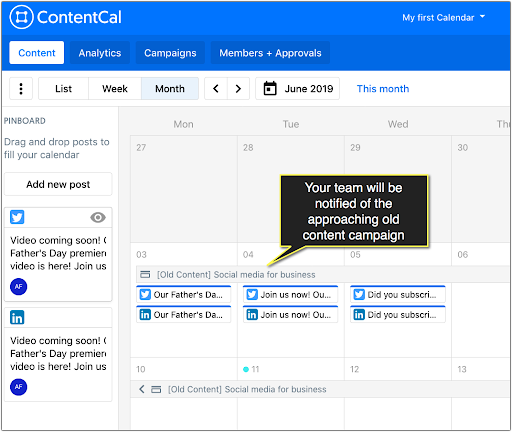
Use its “Content Campaigns” feature to schedule your upcoming content assets and put all the ideas, goals, and tasks in each campaign brief.
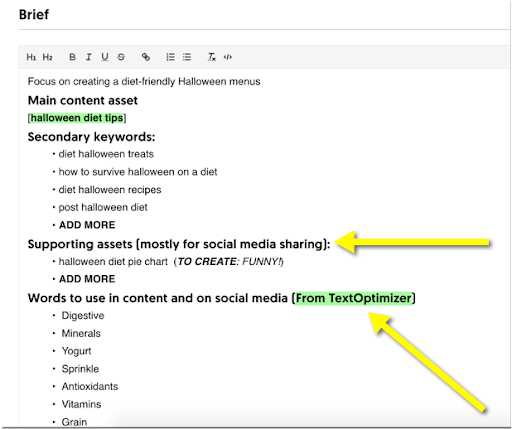
Creating a central dashboard for all your content plans to be visible for your whole team is key to a consistent and effective content strategy. With ContentCal each team member responsible for a single piece of the puzzle will be able to see and contribute to the whole picture.
At the end of the day, content diversification lies at the foundation of omnichannel marketing that has multiple benefits (including cross-device compatibility, smoother shopping experience, creation of more marketing channels, and more). So you may want to start working on it whether you are worried about your search visibility or not.
SEO Trend #2: Rich Results
Google search results are becoming increasingly richer and more interactive.
The good news is that this gives SEOs a competitive advantage over those website owners who are not keeping up with Google’s moves.
As an example, here’s what FAQPage schema looks like in search results once you implement it:
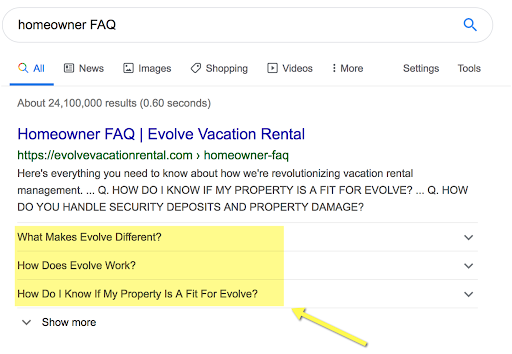
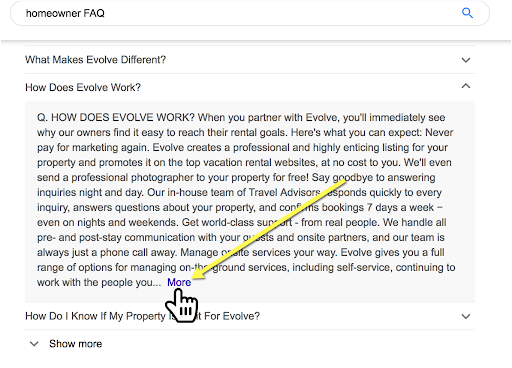
This search snippet is interactive — you can click any question to unfold the answer, and from there, even get to the site for more answers:
How to Implement Structured Data
There are many tools, plugins, and solutions, allowing any website owner to implement structured markup with no technical knowledge required.
Check out a few options:
- Here are free Schema markup generators and how to use each one
- Here are WordPress plugins that support Schema
SEO Trend #3: Mobile and Voice Search
Voice search is no longer a trend. It is a habit. Most of us are routinely asking questions to a mobile device or a smart speaker. It is something that has become part of our lives.
Obviously, mobile search is going strong, and we have many sources to confirm that, including:
Back in 2015, Google revealed that more people were using mobile search than desktop search in 10 countries, including the US and Japan
In 2018, more than half of website traffic in the US was coming from mobile devices
Last year consumers spent three and a half hours a day on their mobile devices
Google switched its priorities by introducing the Mobile-First Index, which means that Google predominantly uses the mobile version of a page for indexing and ranking. In other words, if your page doesn’t look good on a mobile device, or if the mobile version has less content, you may lose rankings in both mobile and desktop search results.
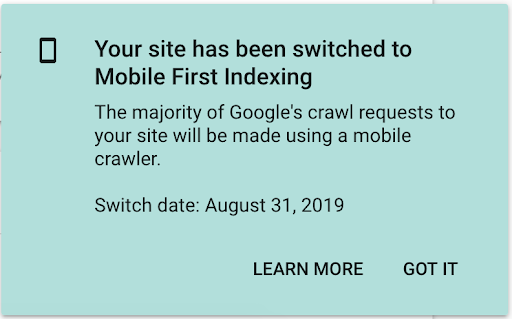
Given that mobile device users often use voice search to find answers while on the go, it is safe to assume that voice search is getting popular, and these two trends are very well connected:
- Both mobile and voice users are likely to be looking for answers while in the middle of the task (so they need clear, concise answers right away)
- In both of the cases, the top result (which is often the featured snippet) is really what matters. So we are competing for the top result now, versus the top 5 positions as we did a few years ago
How to Optimize Your Site for Mobile and Voice Search
- Obviously, make your site mobile-friendly and fast (page speed is important!)
- Adapt your content strategy to catch those featured snippet opportunities to outrank your competitors. Mobile users seldom have time to scroll, and with voice search, there’s only one result being read to the user. This makes featured snippet optimization incredibly essential for your online visibility — you are either there or nowhere.
There’s a lot to featured snippet optimization (which deserves a whole separate article which I already did), but it all comes down to:
- Researching current featured snippets for your important queries (and learning from them)
- Structuring your content with H2-H3 subheadings that address questions behind queries triggering featured snippets
- Provide quick, concise answers (no longer than 90 characters) below each subhead for Google to grab and feature.
If you include these steps in your writing guidelines for your content creators to use, you are halfway there:
- Use this writing checklist that includes both of the above (and more useful) guidelines
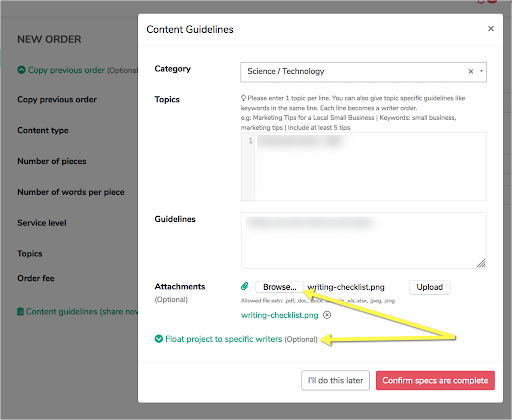
- Scale your content creation process using Narrato to build a team of content creators that do a good job following those guidelines.
The beauty of this platform is that it matches you to the most suitable writers automatically. After some time, you have a solid team that knows your requirements and creates content fast. In an era when you need a lot of content, and you need it fast, this is a life-saver:
SEO Trend #4: Semantic Search and Intent Optimization
Google moved away from exact-matching keyword optimization years ago, yet our industry is somewhat slow to keep up. These days, Google doesn’t use the actual string of words that are being typed in the search box. Instead, it looks at the query context and analyzes the possible search intent to deliver results.
You can see this all around the SERPs and even in Google Suggest results. I wrote a detailed article on semantic search, and here’s one of the examples from it:
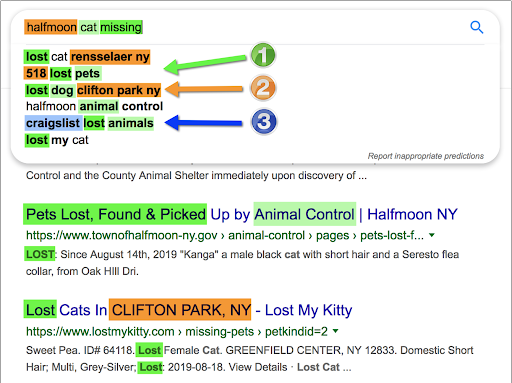
Notice how Google interprets the query on the fly to realize:
- You may have lost your cat, but you may be interested in pet and animal control centers, not just cat facilities
- Your cat may have gone missing in the town of Halfmoon but it has legs, so chances are you may be able to find the cat in the nearby towns, including Clifton Park and Rensselaer
- You may also post on Craigslist or search there in case someone already found it—which is an absolutely awesome idea!
What does this tell us?
Google has got very good at understanding searcher intent, and old-school content creation methods that focus on a single keyword string don’t work.
We need to create content that solves problems. That’s what Google is after, and so are our potential customers.
How to Optimize Content for Semantic Search and Search Intent
Simply Searching Google to get an idea of how it is interpreting a query is a great first step. Do the same type of research I did with that cat missing query. Look for other ways Google is trying to solve the problem for the user.
Using semantic research tools is another good idea. Text Optimizer is an intent optimization platform that helps you cluster any search query into related concepts and entities. It uses Google’s search snippets to come up with ideas to expand your initial copy to provide more solutions and meet Google’s and its users’ needs:
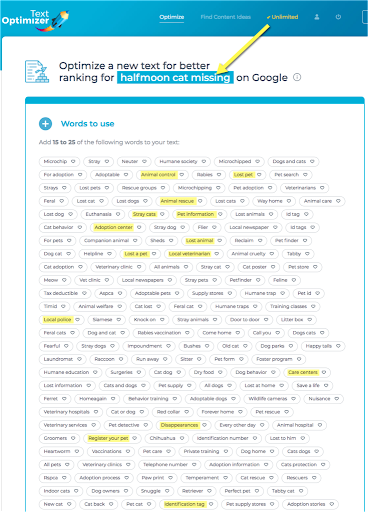
Based on semantic research, it will even help you build sentences based on common co-occurrence analysis of the terms you select:

If you are using a remote team of content writers or Narrato, it is a good idea to run TextOptimizer before creating your assignment and provide your writers with the list of concepts to cover.
SEO Trend #5: The Power of E-A-T vs Domain Names
For years, SEO has relied on a low-hanging fruit: The power of a chosen domain name:
- Keywords in domains names did wonder to your rankings
- Domain age and previously accumulated authority did wonder to your rankings
Both of those signals were pretty easy to fake: You could invest into buying a well-established domain or buy a keyword-rich domain name by sacrificing its “brandability”.
These days, your domain name has no direct impact on your rankings. Thanks to its smarter algorithm and knowledge graph, Google can tell if there’s a real entity behind the domain and determine each page EAT (Expertise, Authoritativeness, Trustworthiness).
The road to higher rankings is no longer fast or predictable. You need to keep building an established brand, work on your trustability and collective authorship. Your domain name is still important but mostly indirectly: How memorable is it and how easy is it to associate your business with your niche?
Generating a business name is more important than finding a keyword-rich domain name. Building a strong brand and becoming an entity is more important than finding an established domain name. Page experience signals are more important than clicks. It’s all about focusing on real metrics now!
Now, You Are Ready to Rock 2022
SEO is moving fast — it is a very exciting industry to be in. From the earlier days on, those people who were fast to “get it” found themselves ahead of slower-moving competitors. Use the tools and tips above to get ahead of yours in 2022 and beyond!
The post SEO Trends for 2022: How to Get on Top of Google Search appeared first on Content Marketing Consulting and Social Media Strategy.
Source: convinceandconvert.com

4 Spectacular Site Traffic Sources That’ll Help You Move Beyond Google
Until a few years ago, every online business owner used to start their media marketing campaign solely by keeping the ‘big daddy’ in mind.
It was the chief source of exposure – the number one search engine traffic source that helped websites get visitors.
It was the most visited website on the internet, dwarfing every other site.
A whole new industry was created to optimize business websites as per this big daddy’s requirements.
Until one day when a new media marketing era started that made people socialize online.
These new social media platforms also became a breeding ground for publishers to attract eyeballs to their content and to try and attract direct traffic from those sources.
The ‘big daddy’ is Google.

If you’ve started a website to get online exposure, then you must have read a couple of articles on search engine optimization (SEO).
You might have achieved great search engine traffic results from Google.
However, you shouldn’t put all your eggs in one basket.

Diversifying your website traffic sources will ensure that your business does not tank in the wake of a single Google algorithmic update.
Algorithm Impacts
Consider Andrew, who lost 80 percent of his website traffic to Trollingmotors.net with the release of the Penguin update.
It was after this loss of direct traffic he realized the risk of relying solely on Google for customers.
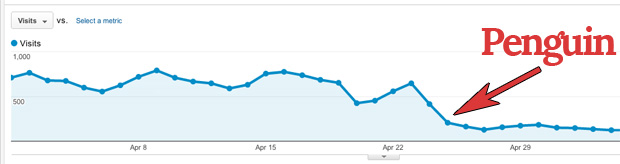
Don’t you dread being in a similar situation, losing all your web traffic because Google decides to change the game?
SEO Game

Building traffic from Google requires consistent effort for 3 months or more.
You need to target long-tail keywords, build authoritative backlinks and optimize your website pages for Google.
Not to mention the dominance of the click-throughs received by the top 3 spots in Google.
If you aren’t in the top 6, don’t expect more than 4 percent of clicks to your website.
And if you aren’t on the first page, you can almost abandon thinking about organic traffic, direct traffic and any other kind of web traffic from Google.
If you’re not on the first two pages,
you aren’t getting any visibility.
I don’t think I need to tell you the difficulty in ranking in the top 3 spots for keywords that have good search volume.
The hard-hitting reality is most businesses fail to rank for their targeted commercial keywords and don’t get intended results from SEO.
Are you willing to build a more sustainable and robust source of organic traffic for your website?
Then let’s roll with five alternative search engines besides Googles that drive traffic your way.

5 Alternatives that Drive Traffic Your Way
1. Capture Emails of Those Cold First-time Visitors
Email is the first and probably the best social channel for conversing with your audience.
It commands the daily attention of most people, drives engagement and accelerates business results.

The email has a high conversion rate and that outperforms search and social media by far.
But effective email return traffic rise does not happen overnight. It starts from your previous efforts and snowballs.
I’ve been able to increase my email traffic consistently since I’ve prepared my blog to capture new leads as part of my marketing campaign.
How to Increase Direct Traffic from Email Campaigns?
Would you like to know the 3 basic steps to increase direct traffic from your email campaigns?
Prepare a lead magnet like a free eBook or an email course that interests your visitors.
As an example, I offer free courses to learn SEO, CRO, and more.
You can also offer a swipe file like Digital Marketer.
It generated 28,507 subscribers in 45 days.
If you want to considerably boost your conversions and reduce your bounce rate, then you’ll need to put in extra effort and prepare a content upgrade for at least your most popular posts.
It can lift your conversions by a whopping 785 percent in one day.
So what are content upgrades?
They’re generally bonus resources.
If you don’t have the time to create more content, a simple checklist will do. The idea is to help the visitor take the first step after reading your article.
Setup lead capturing tools on your website
Marketing technology has come a long way.
You can do much more than simply adding an opt-in form in the right sidebar of your blog (that typically has less than a 1 percent conversion rate).
I would recommend that you experiment with slide-up, left sidebar sign-up forums, hello bars, and other tools.
A controversial, but extremely effective tool that deserves special mention is the popup or banner ad.
Popups can literally take your sign-ups through the roof.
But, if they’re so effective, then what’s the roadblock that may prevent you from using them?
They’re annoying and equate to a bad user experience which will contribute to a higher bounce rate.
You need to test triggering them at the appropriate time.
Your audience might like to spend 30 seconds on your website before they give you their email.
Your visitors should not feel intruded on or tricked into giving their email.
Don’t show the popups and banner ads repeatedly to a visitor after he has shown disinterest in giving you his email.
I would advise you to use an improved pop-up technology that decreases pop-up annoyance.
Properly onboard your new subscribers
The welcome email is your first point of contact with the subscriber.
Don’t waste the opportunity to add value and impress them early in your relationship with them.
So what can you deliver in your first email?
Ask the ‘number one’ problem that your subscriber is facing.
This encourages interaction and lays a strong foundation for your association with them.
(Optional but recommended) – Test your email subject lines
Only after they open your emails will you get the chance to engage with your audience.
Churning of readers is fairly common.
MailChimp found that average click-throughs last only 3.5 percent after the 100th email campaign for the users that last (as compared with 5 percent open rate for the first campaign).
Tweaking your subject lines can make all the difference in increasing your open rates and getting more engagement.
2. Write High-quality Guest Posts for Authority Blogs
Guest Posting has already been written off by Google.
I’ve seen bloggers derive tremendous referral traffic and build complete businesses from guest posting referral traffic.
It’s awesome to get organic traffic this way.
It’s such great exposure that I’ve guest posted regularly at likes of Entrepreneur, Search Engine Journal, HubSpot and Forbes.
Here are five tips to get good results and potential direct traffic from guest posting.
1. Understand the publication
Before sending a guest post pitch, get a feel for the type of content published in the publication.
Only then will you be able to think of post ideas that add value to their audience.
All bloggers are seeking valuable content to be shared on social media and to improve their own search engine traffic – you need to be able to add to this.
A great pitch puts the target blog’s audience first and proves why you’re the right fit for guest posting on their blog.
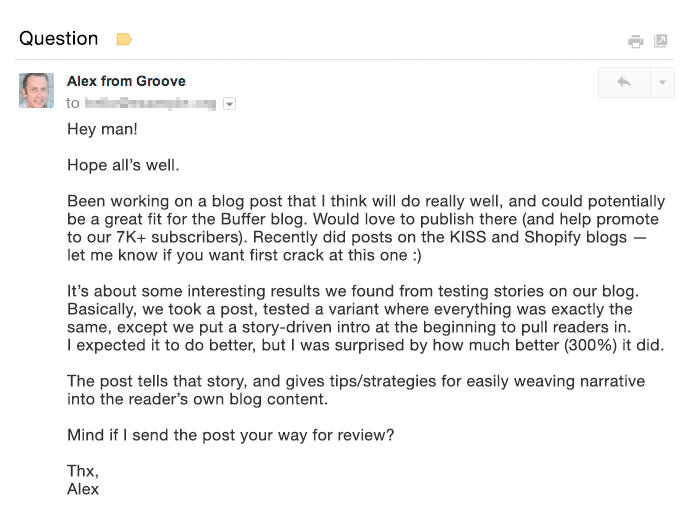
Want an example?
Then look at the email by Alex from GrooveHQ below.
2. Aim to get published on the biggest blogs where your target audience hangs around (not necessarily in your industry).
I received 0 conversions from some industry blogs (although they drive considerable organic traffic).
Yet I received a total of 16 conversions (lower visitor volume but high-converting direct traffic) from Entrepreneur Magazine and Inc.
3. If you’re short on time, rely on quality rather than quantity.
By putting in 18 hours to write an awesomely detailed guest post at HuffPo, Ramit Sethi was able to drive 100,000 visitors to his website. This would have had exceptional results not only for his search engine traffic but also for his social media traffic.
Compare that with a quickly written guest post that brought just a few hundred visitors for 1.5 hours of Ramit’s time.
4. Try to squeeze as many quality guest posts into your content production time as possible.
I’ve personally found that organic traffic is spread out from guest posts and adds up only over time.
5. Finally, spend extra time to create a content upgrade for your guest posts.
A content upgrade can have a tremendous impact on the number of emails you’ll collect.
Giles Thomas earned 408 subscribers from a single guest post by offering an upgrade.
3. Interview an Influencer or Get Interviewed by a High-traffic Website
Have you heard of the Four Hour Work Week author Tim Ferriss?
Right now, a staple content type that he serves his audience is his podcast.
He interviews world-class performers who share their wisdom on a plethora of subjects on Tim’s show and he is loved across social media.
Do Tim’s followers like the show?
Well, the show has surpassed 50,000,000 downloads.
And is the #1 business podcast on all of iTunes on most days.
Be it video or audio, interviews are inherently conversational, dynamic, and engaging.
The best part:t’s a win-win for both parties.
The interviewer gets exposure to the new audience while the interviewee gets to serve new engaging and authoritative content to his website visitors.
If you interview an industry influencer, you can request that they share the interview with their followers on social media.
Think of the organic traffic you will drive from hundreds of thousands of their social media followers.
As an example look at the engagement received by a past interview of Derek Sivers on the Tim Ferriss Show. Derek tweeted the show’s link to his 283K followers.

It won’t hurt that you’ll also start a relationship with the influencer through such an interview.
Similarly getting interviewed by a high-authority website can bring you a huge amount of search engine traffic.
Getting interviewed by YourStory brought Harsh Agrawal 35,000+ views on his blog, Shoutmeloud, in a single day.
That was his highest search engine traffic source for the blog (having 600,000+ visitors/month).
Since interviews offer consolidated value, they serve as a lead generation source for your brand for a long period.
Just think of the number of bloggers you discovered through their interviews on YouTube and other high authority websites.
If you’ve got a really interesting story to share, you can also consider doing a Reddit AMA.
Mateen got 2000 pageviews from doing this AMA on earning $85,000 in profit by selling TeeSpring shirts/hoodies. He also increased his average daily visitors.
You can also answer questions from journalists at HARO by signing up as a source.
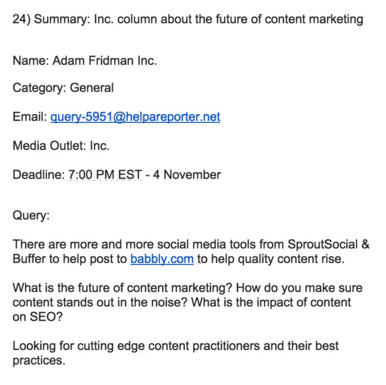
Christopher from Snappa saw this query on the future of content marketing from Inc Magazine on HARO.
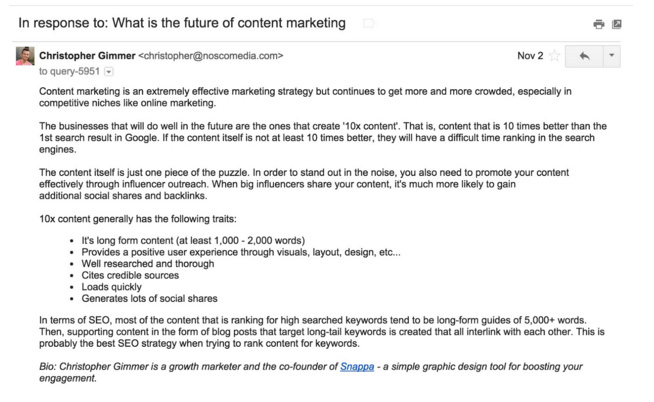
He quickly sent a detailed reply.
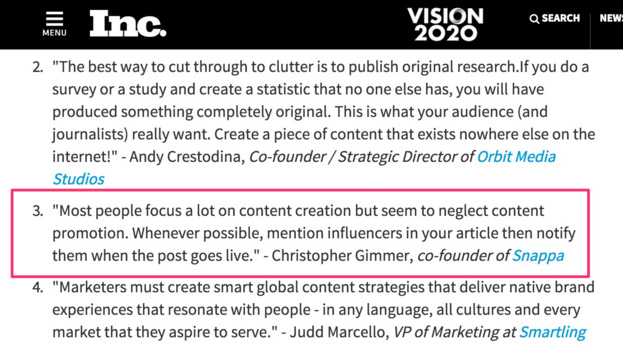
This earned him a mention in Inc a few weeks later.
HARO is a great strategy to get a brand mention on authority news websites like Entrepreneur and Inc.
Those backlinks will sweetly lift your reputation in the eyes of Google, driving your search engine traffic up, and boosting your marketing campaign.
4. Invest in Facebook Ads
I know a paid strategy might raise a few eyebrows when it comes to the idea of organic traffic.
Inbound marketers generally don’t like to pay for play in the form of banner ads or other pricey methods.
If you’re one of those, you might be frustrated with the declining organic Facebook reach.
If you’re having only a handful of fans on your Facebook page, then you will not get good results from your organic traffic reach.
So you’ll need to invest in Facebook Ads.
A US accounting firm (having 156 likes) didn’t get good engagement on their posts. Just a couple of likes.

After spending $20 on Facebook Ads they started getting great interaction. Look at the interaction on the post in two months.

Sparing some cash for running Facebook Ads can tremendously accelerate your email list growth (one of the best repeat traffic sources for your website).
Because there are very specific demographic targeting options available. You can also A/B test various images and text in your banner ads.
Let me share another case study to show you the kind of results you can achieve.
Matthew Woodward spent around $600 on Facebook Ads running two campaigns.
His cost per lead in running both campaigns was under 80 cents.
The ROI from running the campaign was over 2500 percent.
Aren’t the results incredible?
If you don’t want to splurge and spend $500, then even $5 a day can get you great results.
Mary earned 532 new subscribers in 43 days of running Facebook Ads.
The total amount she paid was just $227.05.
If you want to drive more traffic to your blog, then you can choose your most engaged Facebook posts and boost them to extend your reach.
You can even use Facebook Video Ads and add a CTA to drive traffic back to your website.
For native videos on Facebook, Mike Gingerich found anywhere between a 30 percent to 200 percent increase in engagement and reach compared with other types of posts.
Conclusion
Google’s algorithmic updates are unpredictable.
Relying solely on SEO to rope in traffic and customers can kill your business.
So experiment with traffic sources other than Google.
If you put in the necessary steps, you can also reap the benefits like others whose case studies I shared with you in this article.
Have you experimented with any of the above traffic sources and achieved good business growth?
How did you boost your direct traffic? I would love to hear your insights in the comments.
Source: neilpatel.com

How to Use Semantic Search for Paid Ad Campaign Copy
Semantic search isn’t only for organic traffic; it’s for paid search as well.
Understanding the difference between broad and exact match search is important, but semantics is all about the search intent behind a query.
Google is focusing a lot more on search intent and keyword variants.
Knowing the correlation between intent and semantics can help you narrow down to the perfect audience.

How Does Semantic Search Work?
What is semantics, and how does it apply to search?
Semantics focuses on the search intent of a keyword and the thoughts and feelings that the person has as they search that keyword.
It’s a complicated subject, and there isn’t a “black and white” set of steps to follow.
A lot of context and concept is behind every search query, and many SEOs overlook this by thinking basic keyword research will solve all their problems.

When it comes to semantics for paid campaigns, we’re talking about incorrect spelling, plurals, variants, synonyms, and other related words and phrases pertaining to the search word.
If we understand what semantics is, we can understand how it impacts paid search.
The goal of every advertiser on Google is to gain visibility for as many applicable keywords as possible.
The problem is, no matter how much keyword research you put in on Ubersuggest, Ahrefs, and SEMrush, you’ll never find all the keywords that people in your target audience are searching.
This is where semantics come in.
Google uses semantics in broad and phrase search to help find a wider range of searches and triggers that will match user intent and display your ad.
Exact Match Vs. Broad Match in Semantic Search
To understand semantics, it’s important to know the difference between exact and broad match in Google ads. An exact match requires the searcher to input the exact keyword you’ve chosen to display your ad on.
For example, if you used the exact match “wedding cakes,” the person searching must enter some of the following keywords into Google to display your ad:
- wedding cakes
- white wedding cakes
- chocolate wedding cakes
- cheap wedding cakes
- and so on
These are exact match keywords because they contain the phrase exactly as-is.
As a result, this type of advertising doesn’t use semantics because it doesn’t allow the flexibility necessary to locate related phrases with the same search intent.
Here’s another example: If someone searches for “cakes for weddings” or “weding cakes,” your ad may not display because Google thinks it doesn’t match your intention.
Even though the search intent is the same, you’re not using semantics in your advertising and may experience a higher CPC because you’re targeting a much narrower audience than necessary.
Using Semantics for Paid Vs. Organic Search
When it comes to organic search, many SEOs and site owners like to find every slight permutation of a keyword and include it somewhere in their content.
At one time, this was the best strategy.

However, with the RankBrain update, Google started to implement machine learning and AI to understand the search intent and context of the search rather than rewarding the people stacking as many exact match keywords into their content as possible.
The goal is to make the process of finding information on Google as natural and conversational as possible.
For example, if you asked a friend, “Who is the richest person in the world?” they might respond, Jeff Bezos.
If you then asked, “Who has the most money in the world?” the answer would be the same, correct?
This factor should apply to Google search as well.
Just because two people ask the same question differently doesn’t mean they should receive two different sets of search results.
The question has the same intent, and the query demands the same answer.
If we apply this to organic search, it would tell us that we don’t need to worry so much about getting every single variation of the keyword because Google will identify the similarities and help us rank for all the keywords with the same intent.
On a different note, Google’s machine learning is using your habits as a searcher too.
After searching for the richest person in the world on Google, I searched “most money” to see what that would bring.
The number-one result on Google was still relevant to my original search.
Since I didn’t click through to anything, Google is still scrambling to find an answer to my query.
Why Should You Use Semantics for Paid Search?

Google released data that tells us how important semantics are for paid search. Approximately 15 percent of daily searches are new searches that they’ve never seen before.
If those 15 percent of searches have never entered Google’s database before, how could anyone ever pick them up using keyword research or competitive analysis?
You can’t.
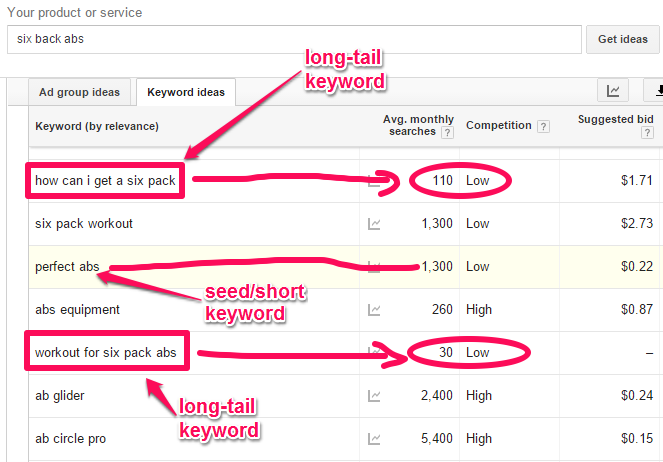
When it comes to long-tail keywords, the goal is to grab as many of those as possible.
However, thousands and thousands of search phrases never hit the keyword research phase because they yield no traffic, and most people would never include a keyword with no traffic in their content.
Unless Google does it for you.
This factor has become ever prevalent with the rise of voice search as well.
Voice commands are much more common today than they were when released in 2011.
Twenty-seven percent of the population uses voice search on their phones.
It’s also believed that 62 percent of individuals would make a purchase using voice technology on their smart home device.
We all know that people do not speak the way they search on Google. Semantics play a major role in Google’s ability to take a voice search and translate it into accurate results.
3 Steps to Use Semantic Search for Paid Ads
What can you do to capitalize on semantics?
By now, we see the importance of semantics for paid search, but what should you do to ensure you’re reaching as much of your audience as possible?
Worry Less About Keywords for Semantics
We should all worry less about creating content around keywords and instead create content around topics.
The goal is to cover a topic as in-depth as possible, and the keywords will come naturally.
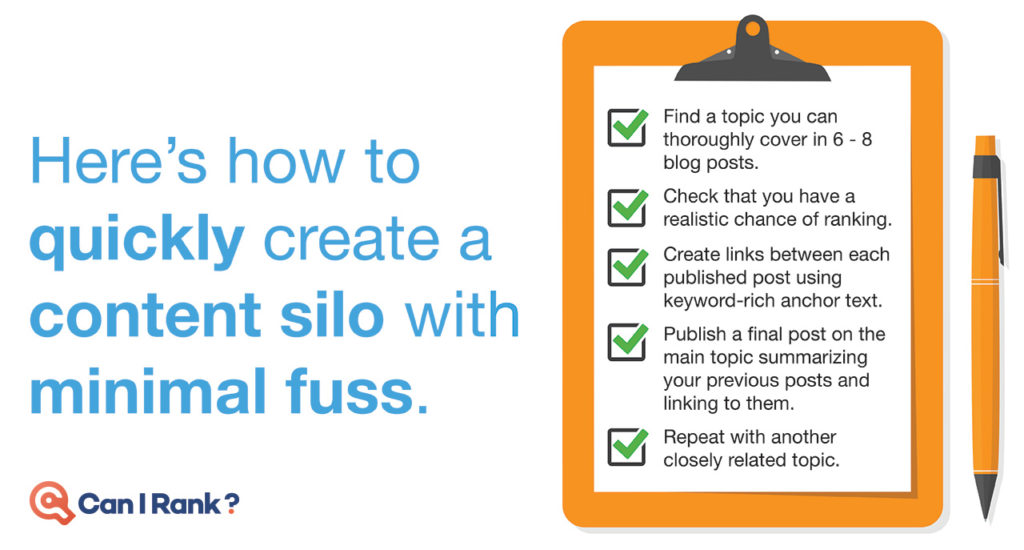
A lot of SEOs talk about “silos” and “clusters.”
These two strategies help you build out content in a way that increases site relevancy and boosts authority.
By doing this, you’re showing Google that you’re an expert on the subject, and it should give you precedence over your competition. 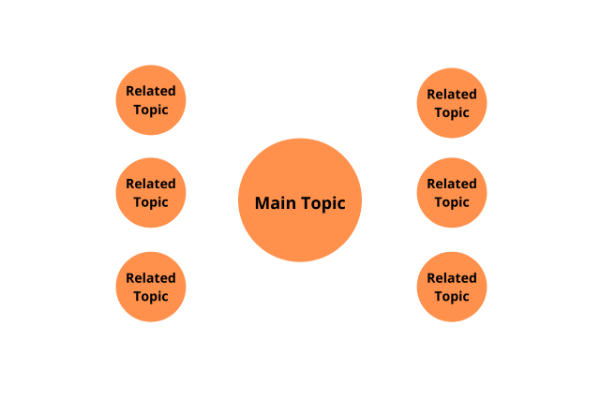
Focus More on Intent
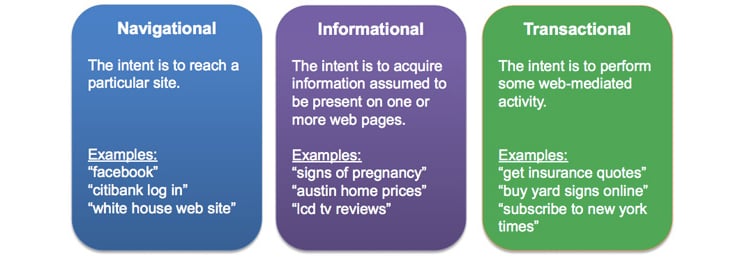
I’m always preaching the importance of search intent, but this has become Google’s bread and butter.
It makes it more difficult for SEOs to game the system by stacking a bunch of keywords in their content.
When choosing keywords for a paid search, you want to focus on the thought behind the keyword and target the intent.
Think about the queries that lead people to your website.
- What are they trying to do when they come to your site?
- Are people there to learn something?
- Purchase something? Inquire about something?
Once you’ve determined that, you’ll want to find keywords matching that intent. 
In this image, the keyword “best deals on iPhones” has a different search intent than “best iPhones,” pictured below.
While they both contain a similar phrase, the person searching is trying to accomplish different things.
Someone searching for deals is already in buy mode; they want to buy an iPhone and are looking for good deals.
Someone searching for the best iPhones may not have settled on the phone yet.
They want to research brands, quality, read reviews, and learn more before making a purchase.
These two individuals are at different steps in the buying process.
Understanding this can help get more people to your site and may even decrease your bounce rate because they’ll get more of what they bargained for when they land.
Don’t Ignore User Experience When It Comes to Semantics


With the release of Core Web Vitals, we know that Google is paying attention to the on-site experience.
Factors such as loading speed, load delay, and page layout are important.
Focus is shifting away from advertisers and affiliates and turning to the users.
Google doesn’t care about how well you understand SEO and how many hours you spent on keyword research.
All they care about is that people get what they want on your site.
If you’re giving people what they want, Google will reward you.
If you’re not, they’ll reward your competition.
For many years, site owners pumped out sub-par keyword-loaded content built to rank but ignored the people searching for those keywords.
That won’t cut it anymore.
Work on improving your page speed, optimizing your site for mobile, and pay attention to bounce rate and session duration.
These are all indicators of whether or not you’re choosing the right keywords and targeting the right audience.
If you find that certain paid ad keywords have a higher bounce rate, it could mean you don’t have the right search intent.
Semantic advertising isn’t all about verbiage; it’s also about relevancy.
You could have the best offer in the world, but it won’t mean anything if your site doesn’t function properly.
Measuring the Success of Your Paid Search Campaign Using Semantics
How can you measure the success of semantic search in paid ads?
The most important metric you’ll want to track is the success of individual broad-match keywords.
By finding out which words Google’s AI is displaying your ad for, you can determine whether you should continue advertising for that broad-match keyword.
For example, if you’re advertising a site that sells iPhone cases, and you find that your audience’s search intent doesn’t align with the phrases your ad is displaying for, you might want to readjust or target something different altogether.
Two other metrics that can tell you a lot about the success of your campaign are the bounce rate and average time on the page.
If you’re targeting the right audience and bringing the right people onto your page, they’ll likely stay a while.
If you have a 90 percent bounce rate and an average time on a page of less than a minute, chances are people are landing on your site, not liking what they see, and going somewhere else.
This could be a sign of a deeper on-site issue, but for this example, you might want to make sure you’re sending the right people through.
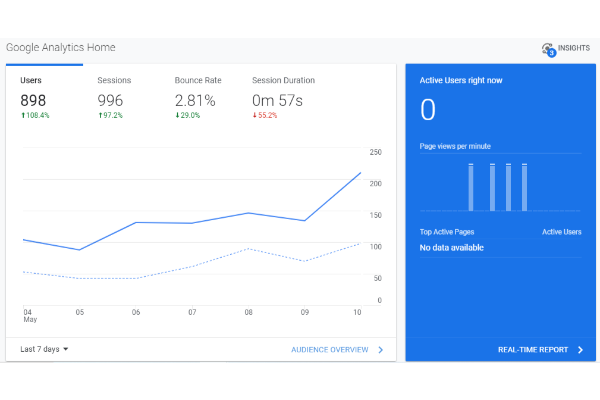
You can use tools like Google Analytics or the Google Ad dashboard to explore this data.
Conclusion
Much of this article will be great news for many of you.
It means you don’t have to lose your mind on hours of keyword research anymore.
By using broad matches and focusing on intent, you could pick up all the relevant keywords without having to identify them manually.
If you need a little more help, we can walk you through the steps necessary to get your campaign up and running.
The paid ad space is constantly changing and adapting to the digital environment, and we all have to jump aboard and roll with the changes.
If we don’t, we risk letting our competition get ahead while paying more per click and receiving lower-quality click-throughs.
Be sure to keep semantics in mind as you set up your paid campaigns and really think about what the individual is trying to accomplish when they type a phrase into Google.
How have you used semantics to narrow down on your target audience?
Source: neilpatel.com

Why Is My Organic Traffic Down? Here Are 4 Things to Check
Before you rush to find a new agency to try and figure out what happened, here are 4 ways to diagnose a decline in organic traffic.
Do you see a negative trend in your Google Analytics account?
Are you wondering why your organic traffic is down?
Is this time to panic?
Not necessarily.
Before you rush to find a new agency to try and figure out what happened, here are 4 ways to diagnose a decline in organic traffic.
First Things First: Which Page is Declining in Traffic?
So you see some unfortunate trends on your overall Google Analytics reports.
How to tell what exactly is being affected?
For that:
- Login to your Google Analytics account and click Acquisition -> All Traffic -> Channels -> There select “Organic Search”
- Select the time range (if the trend is most recent, the 7-day time frame would work best)
- Check the box that reads “Compare” to and keep the “Previous period” option there intact
- Click to “Landing Page” and scroll through the results
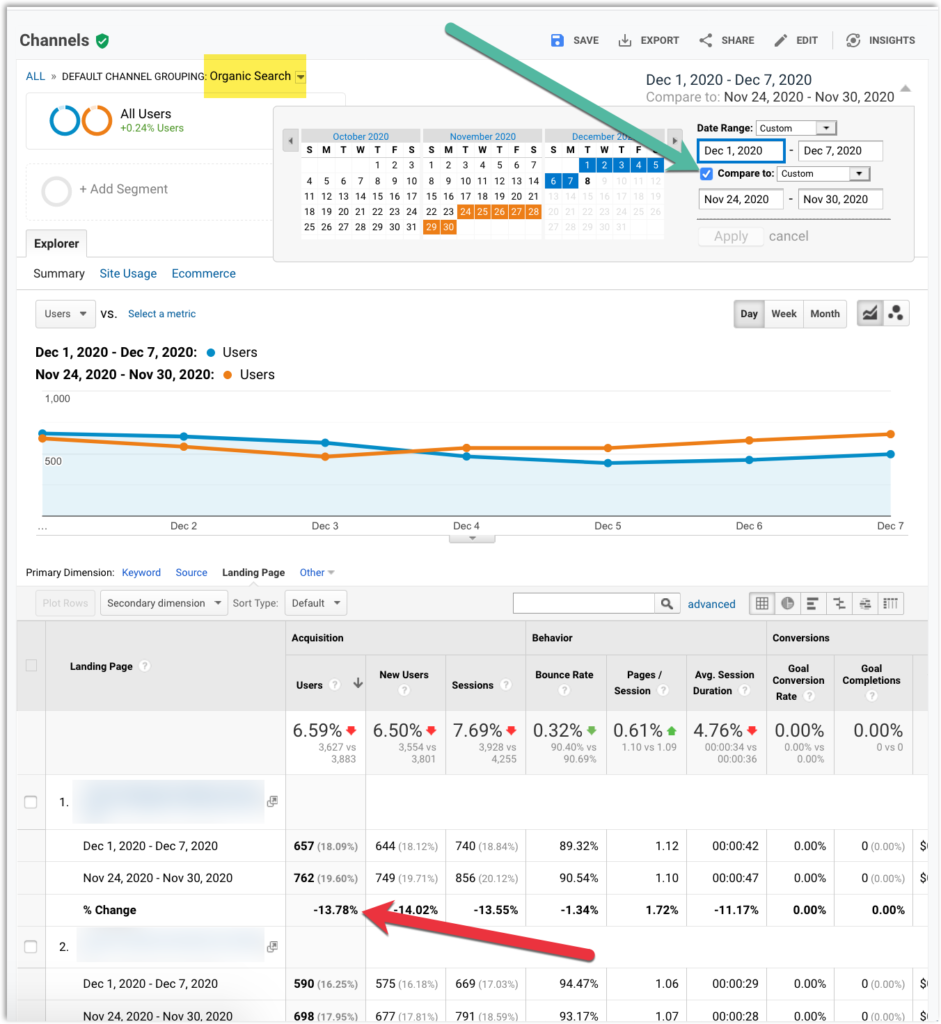
Now that you know which page needs your attention, go ahead and run some checks.
1. Check Which Search Queries Have Been Impacted
Google’s Search Console will be able to help you identify your most impacted search queries:
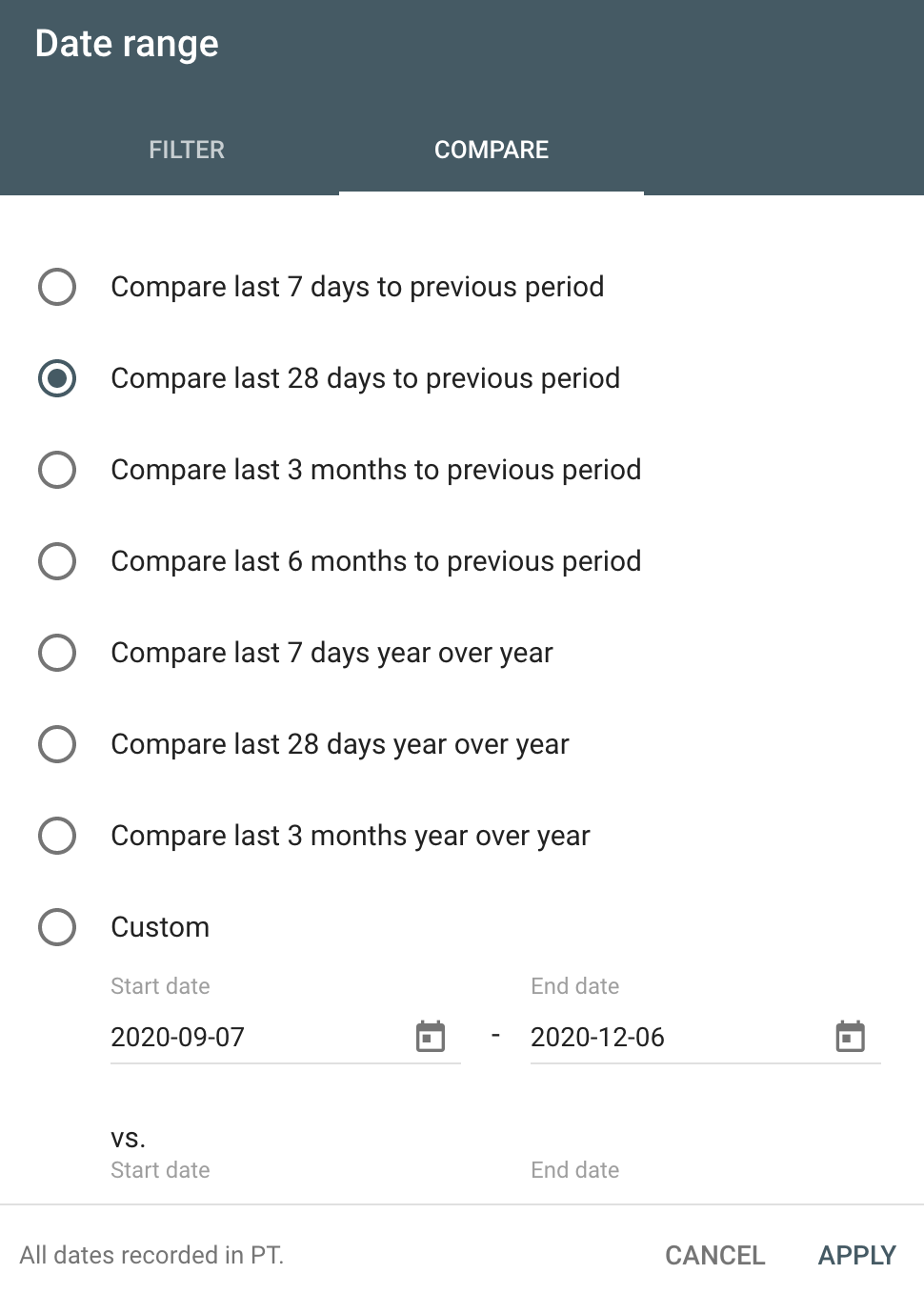
- Login to your Google Search Console account and proceed to the “Performance” report
- There, again, select the timeframe and choose to compare it to the previous period:
Next:
- Click the “Pages” tab and click the page you identified in step #1 above
- Go back to the “Queries” tab and sort by “Difference”
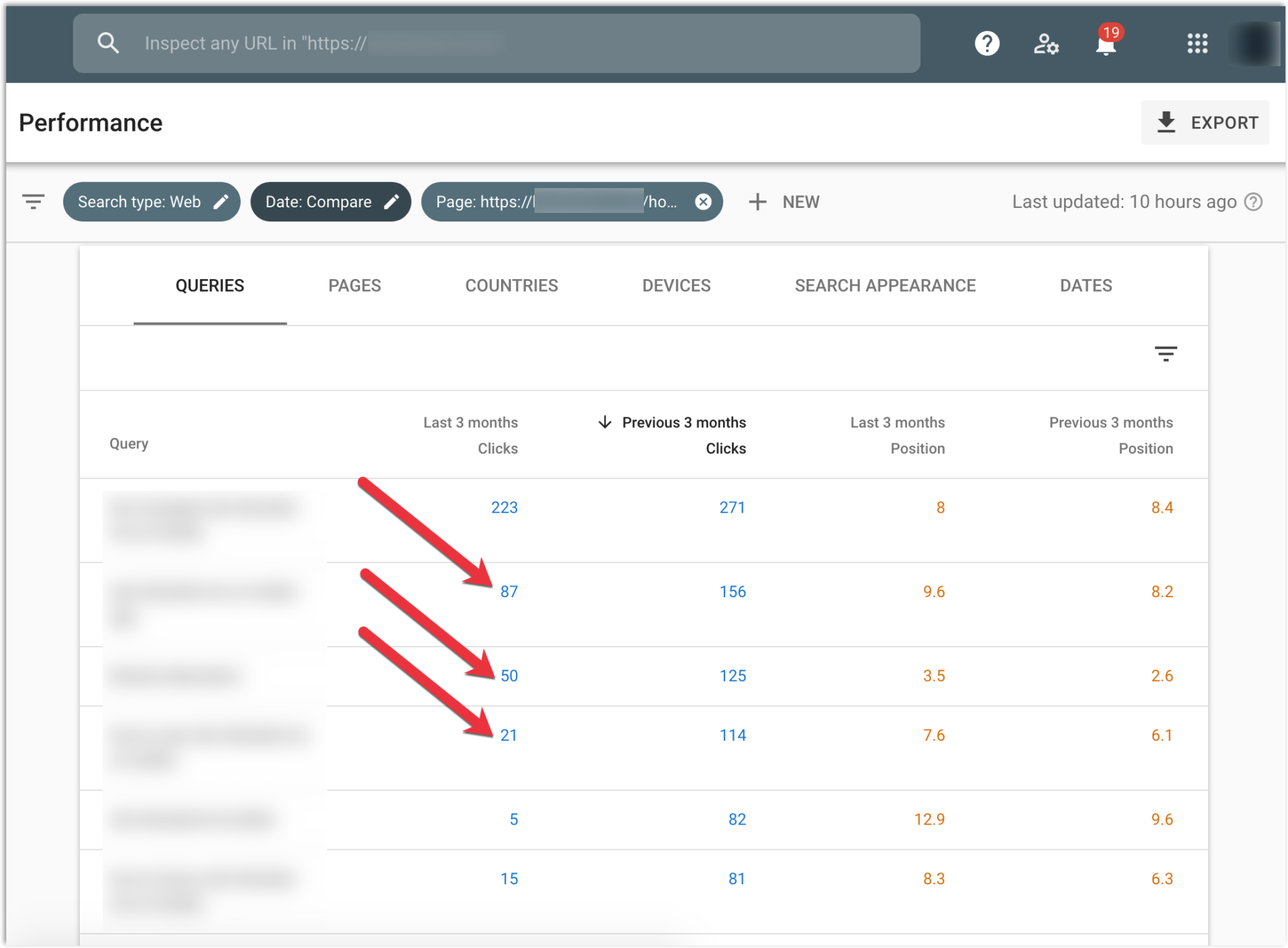
You only want to pay attention to your top 10 rankings, as nothing else was driving many clicks, so you can also sort results by the number of clicks the page was generating during the previous period.
This task would be much easier if you were tracking your most important search queries.
In that case, it would just take one click to your tracked #1 positions.
Site Checker does a good job saving your time here:

2. Check SERPs Changes
The good news is you are not alone.
There are at least 9 more pages ranking for that query as well as many other search features that may start stealing your clicks.
So next steps are:
Search for the identified query on Google.
Is there a new search element you didn’t see before?
Examples of click-stealing search elements include featured snippets, image, and video carousels, etc.
Don’t forget to search on both mobile and desktop devices.
Check the recent SERP movements.
Again, a solid rank monitoring solution should come with a comprehensive SERP monitoring feature.
Here’s one Site Checker is equipped with:
SpyFu comes with that feature as well, so if you were not tracking your keyword check if SpyFu has records for it:
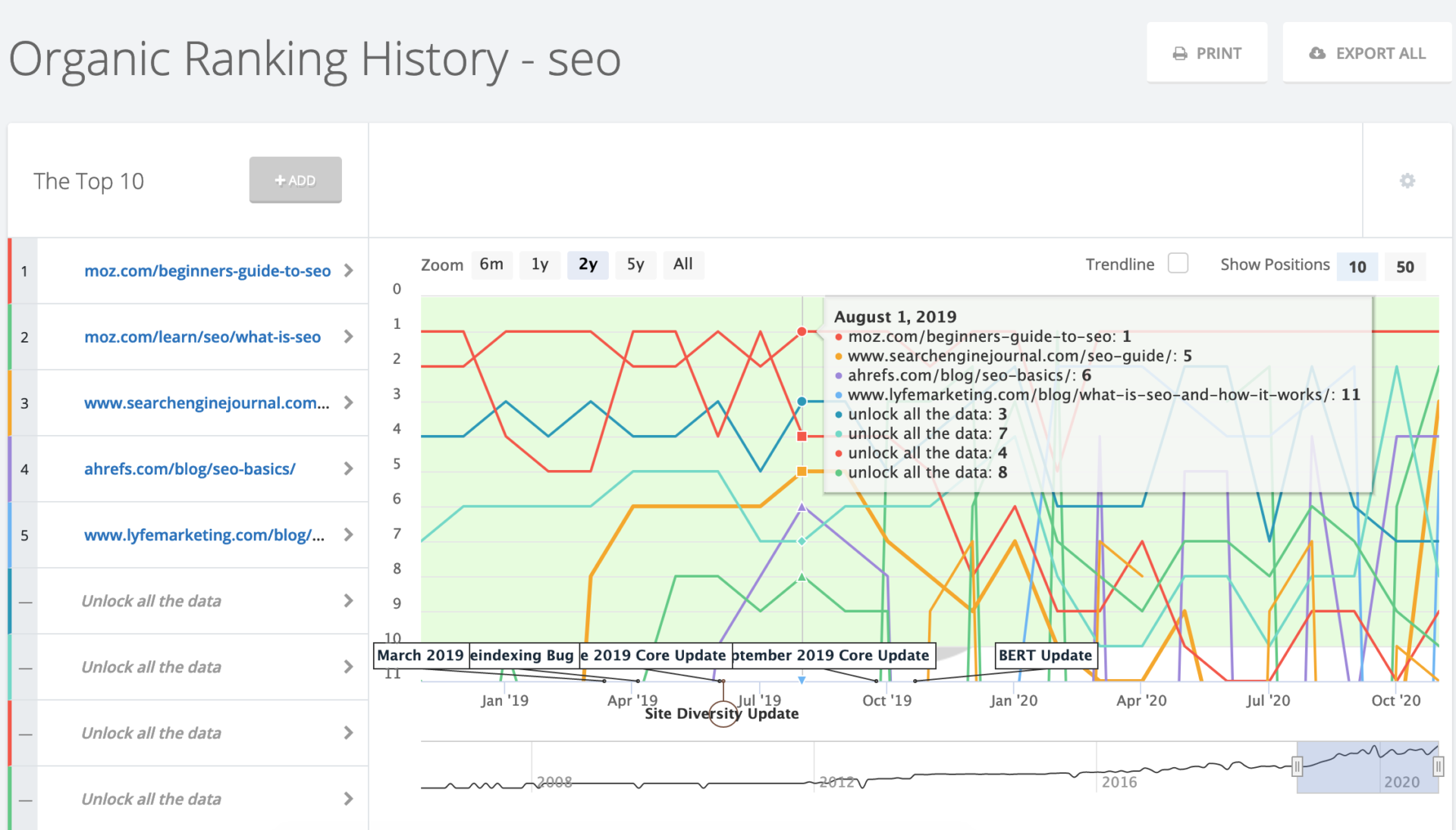
If you notice a competing page that is confidently moving up, check it out.
Is there link-building or content tactics that may be moving the needle?
3. Check If Anyone Else Is Experiencing Anything Similar
Are you alone in seeing some unusual organic traffic fluctuations?
A few quick resources to check here are:
Barry does an awesome job monitoring all the active discussions across SEO forums and on Twitter.
If there’s anything going on, you will definitely see him reporting here within hours.
Barry’s Twitter account @rustybrick is another source to watch as sometimes he shares stuff on Twitter that didn’t yet make it to his blog.
Knowing that there’s an update going on will help you understand whether it is anything that needs an immediate fix.
If there’s a global update going on, you will need to give it some time.
Things take time to stabilize, and there’s never anything urgent.
4. Audit Your Content
First things first: Is the information outdated?
In many cases, this is the first thing to look at.
Can it be expanded?
As Google is moving to seek better answers to more specific questions, it is always a good idea to edit your content to cover more related angles, questions, and concepts.
More importantly, is the page doing a good job satisfying a searcher’s intent?
Keyword intent optimization will boost both organic rankings and conversions, so it is a must when auditing content that is losing rankings.
Commercial (or purchasing) intent is something you need to look out for. Lior Krolewicz of Yael Consulting explains purchasing intent as:
a measurement of the likelihood that a given individual will be purchasing specific goods or services at some point in the future.
Optimizing for what your potential site user intends to do on that page is crucial.
To help you expand your copy as well as optimize for search intent, use Text Optimizer.
The tool uses semantic analysis to help you discover related concepts and entities to be covered in your content for it to do a better job to address a target query:
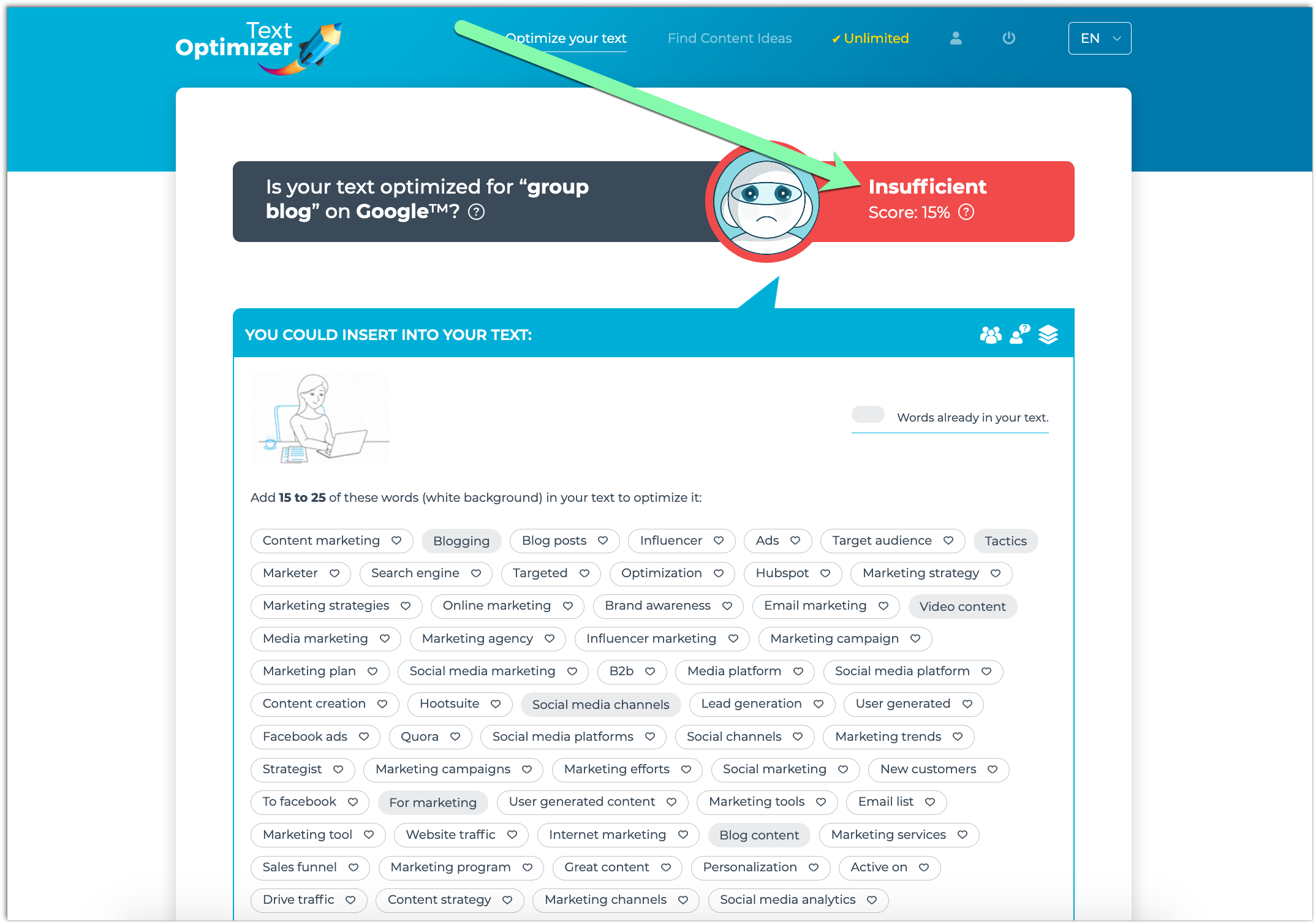
To start, run your current content through Text Optimizer and see your current score.
Aim for a score of 60 and higher for better results.
Also, make sure your grammar is always perfect.
There are a lot of tools that can help to see your errors, illogical constrictions and make your speech smooth.
Conclusion
Organic traffic fluctuations are normal and need to always be expected, so really the most important tip here is “Stay calm”.
Once you notice something going on, give it a couple of days and then look into that.
Auditing traffic declines can be done at home, so save yourself some time and money and look into that using the steps above.
The post Why Is My Organic Traffic Down? Here Are 4 Things to Check appeared first on Content Marketing Consulting and Social Media Strategy.
Source: convinceandconvert.com

10 Free Google Tools All Content Marketers Should Use
It doesn’t matter if you’re a content marketing beginner or have many years of experience under your belt, this post could change your approach.

If you consider yourself a content marketing professional, there’s a good chance you already use Google tools that will make your life easier.
But regardless of how much experience you have and the results you’ve achieved in the past, you know there are always new ways to boost your performance.
Social media, just the right keyword tool, Google’s Keyword Planner, honing your search term — these things can all have a big impact on your volume and your success as a content marketing pro.
Many people look at Google and see nothing more than a search engine. While there’s nothing wrong with wanting to see your website at the top of the search engine giant’s results, you can’t ignore the process for reaching this goal.
When it comes to content marketing, the tools you use, and the strategies you employ will greatly impact the end result.
It doesn’t matter if you’re a content marketing beginner or have many years of experience under your belt, this post could change your approach.
Below, I’ll discuss 10 free Google tools that all content marketers should use.
You may not use all of these tools, and some might not suit your marketing strategy. Even so, I’m confident that you’ll find one or two that can alter your approach for the better.
10 Free Google Tools that All Content Marketers Should Use
1. Google AdWords: Keyword Planner
Are you seeking a tool that helps you find and target the best keywords for your business?
While there are many to choose from, the Google Keyword Planner remains one of the best ways to conduct keyword research.
There’s a lot to like about this free tool, including the fact that it’s extremely simple to use.
As a content marketer, you should always be searching for keywords that can give your website or a particular blog post a boost.
My top suggestion for using this keyword tool is simple: experiment, experiment, and then experiment some more.
The more searches you run, the more you’ll understand how the tool works. Also, multiple searches give you a better idea of which keywords the best suit your site.
For example, “content marketing” may be your primary keyword. In a perfect world, you’d rank at the top of Google for this term.
However, you know that this will be difficult. You also know that there are long-tail terms that can increase your search results.
This tool helps you uncover these terms. Check out this screenshot:
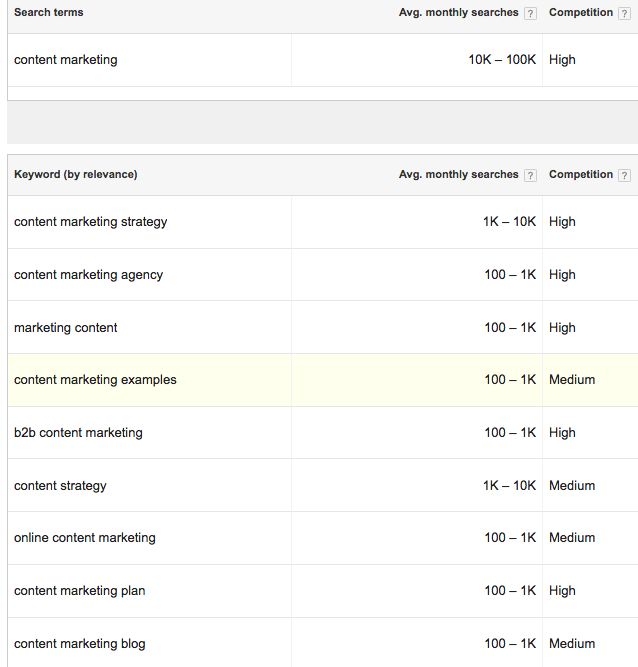
With this in mind, you now have a better idea of what to do next. Maybe you find that “b2b content marketing” is a keyword that makes sense for a future blog post.
At that point, you can plug the term, in as your primary keyword, to dig up even more long-tail ideas.
Even though Google Keyword Planner appears to be nothing more than a basic tool, it does everything right for content marketers who want to uncover keywords that can improve the bottom line: the search result it delivers.
Pro tip: If you want more information, try a dedicated keyword planner like my tool Ubersuggest.
2. Google Analytics
What goals have you set for your content marketing strategy?
If you don’t know the answer to this question, now’s the time to take a step back and reassess your situation.
If you’ve already set a few goals, there’s a good chance that many of them are based on search engine results and related statistics. If so, you need to become familiar with the inner workings of Google Analytics.
No two people use Google Analytics in the same manner. But, there are several things to keep in mind if you’re a content marketing professional.
To start, you can use this tool to get an instant snapshot of your performance over a particular period of time.

This alone will give you a clear idea of whether or not you’re on track to achieving your goals.
From here, you have the ability to dig deeper for more data.
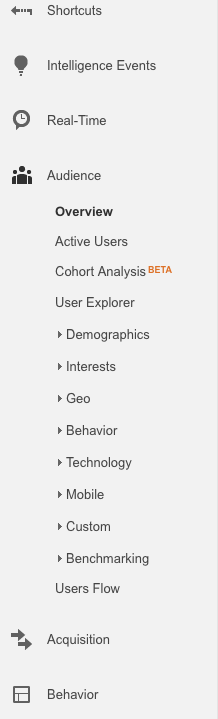
As you click-through to each section, you’ll find yourself digging deeper and deeper. For example, I always enjoy checking out my top pages for a particular time period.
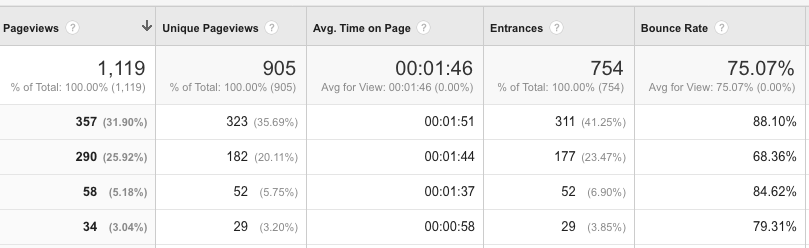
This gives me a clear idea of what’s working and what isn’t, in regards to topic selection, the type of content that I’m providing, and whether readers are sticking around to see what I have to say.
The more you use Google Analytics, the easier it is to focus your time on the data that has the biggest impact on your site.
3. Google Search Console
Similar in many ways to Google Analytics, the time you spend with this free tool is never a waste.
There’s so much to learn from the Google Search Console. You could soon find yourself spending hours combing through data.
In addition to reviewing your site’s overall health, there are several other things you can do with this tool.
My favorites are all listed under the Search Traffic drop-down:
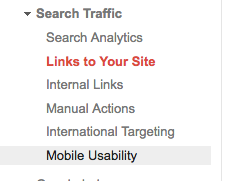
For example, Search Analytics allows you to quickly analyze your performance on Google Search.

If you’ve ever wondered how your keywords are performing, you can click the Position box to learn more. This will show you the average position for all of the keywords that appear in Google Search.

Content marketers should become familiar with everything the Google Search Console can do for them. Even if you only use it to track a few key metrics, it’s well worth it in the long run.
4. Google Trends
Do you find it difficult to continually generate fresh ideas for your blog and other content marketing opportunities?
There’s no denying the fact that the search engine giant’s Keyword Planner provides hundreds of keywords related to your business and industry. Even so, this isn’t always good enough, when it comes to creating compelling content. In other words? You need another way to perform keyword research.
This is why I make it a habit of checking Google Trends when I’m brainstorming new blog ideas.
With this tool, you can explore any topic to see what’s trending. You can also view “stories trending now,” to see if there’s anything that matches your industry and the approach that you want to take.
For example, the upcoming World Cup is sure to be a hot topic.
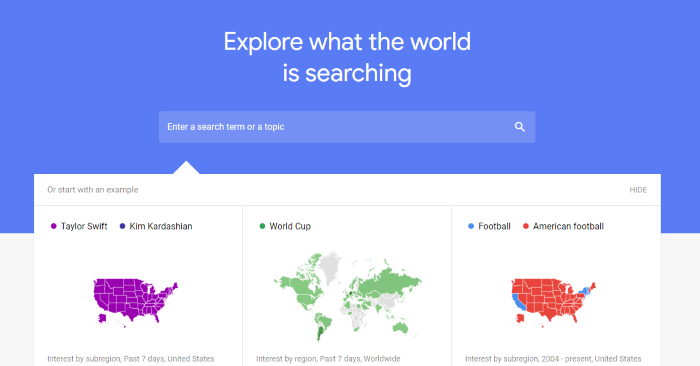
Is there a way to tie this into your blog or other content marketing efforts?
If you write about sports, you know there’ll be plenty of information to keep you busy. But, even if you don’t, you can use Google Trends to help you get creative.
Sticking with the example above, maybe you could write a blog post entitled: “How the World Cup is Using Marketing to Drive Views.”
With this title, you’re providing your audience with targeted information, while harnessing the power of a trending topic. It’s the best of both worlds.
You don’t need any experience or much time to use this tool. Simply type in your topic and review what Google spits out. From there, let your creative juices point you in the right direction.
5. Google Sheets
Content marketers need a system for recording and tracking data. Furthermore, there may be times when you want to share this information with other team members.
I’ve found Google Sheets to be one of the simplest and most efficient ways to record data, track changes, and collaborate with others.
Here’s an example. I’m often asked about the best way to track email outreach campaigns. While there are many software tools for this, some of which provide a high level of features, some people don’t want to part with the money.
While Google Sheets may not offer the exact same functionality as these tools, it’s still one of the best ways to remain organized. It still has plenty of advanced features, such as the ability to create pivot tables and sort data.
As long as you’re on-board with the idea of regularly updating your spreadsheet, it’s powerful enough to have a positive impact on your content marketing efforts.
Pro tip: you can also use Google Sheets to create a to-do list, which is something most content marketers heavily rely on. Even with a basic list, you’ll always have a clear idea of what you need to accomplish.
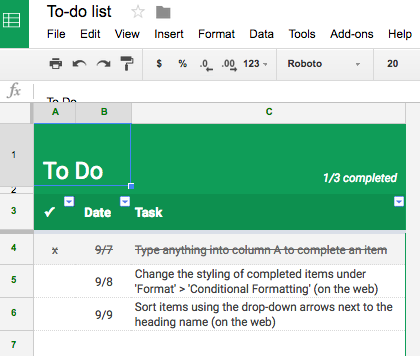
6. Google Alerts
Google Alerts is a Google tool that makes it easy to monitor the web for brand mentions, interesting new content, and news. Then, Google sends you an email once a day or once a week — your preference — with a notification if keywords you are interested in are mentioned.
In short, Google Alerts makes it easier to stay on top of news and new content without spending hours a day on social media.
For example, I could set a Google Alert for my name:
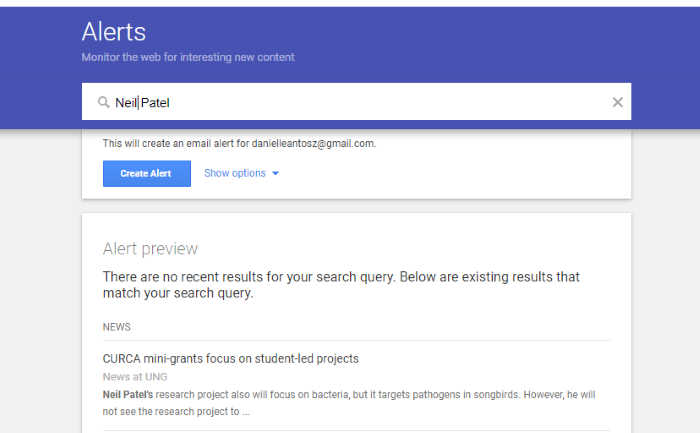
As a content marketer, I suggest setting alerts for:
Your brand name Your personal name Key industry terms Major competitors
These alerts will help you see new trends fast and might even give you some great content to share on your social media channels.
7. Gmail
A big part of content marketing is getting in touch and staying in touch with a variety of contacts.
There will be times when you spend hours sharing a new blog post with influencers in your space. Since email is one of the best ways of doing so, you better be comfortable with the application you’re using.
Gmail has long been my favorite email client, thanks in large part to the built-in functionality. That being said, there’s more to it than meets the eye.
I use a variety of plugins to ensure that my Gmail account does exactly what I need. For example, WiseStamp helps me to create a custom signature. Along with this, I use FollowUp.cc, so that I never forget to follow-up on an important email related to my content marketing efforts.
You don’t have to use Gmail as your email provider, but I strongly suggest giving it a second look, if you’re open to making a change.
With so many plugins to choose from, you should be able to customize your inbox to meet your every need as a content marketer. This alone can save you quite a bit of time and money.
Pro tip: Even if you prefer another email provider for daily communication with coworkers and clients, you can still use a Gmail account to carry out many aspects of your content marketing strategy.
8. Google My Business
For some companies, GMB isn’t a big deal. For others, such as local businesses, this is not something you don’t want to overlook.
With Google My Business, you can easily get a free business listing on Google. Better yet, this allows you to provide a variety of information, including, but not limited to, your phone number, address, and business category.
The benefits of using Google My Business include:
- The opportunity to get your business in front of customers interested in what you have to offer.
- People can learn more about your company, based on the information that you provide.
- Use images to show how your company is unique.
- Show off customer reviews.
Remember, there is more to content marketing than producing high quality blog posts.
Think about the word “content” for a second. Anything you write about your company and/or anything you can share with others can be a big part of your content marketing plan.
Since Google My Business listings are front and center in the search results, you probably want to use this as part of your content marketing strategy.

9. Google Docs
If you stay current with my blog, you know I do my best to publish new posts as often as possible.
There’s a lot that goes into creating high-quality blog posts, so I’m always seeking new ways to improve my efficiency.
While I’ve used many tools over the years, to improve efficiency, Google Docs remains one of my favorites. Not only is it free, but it’s extremely simple to use. On top of this, there are tons of features and plugins to experiment with.
Here are some of the things that Google Docs as I work through the creation of a blog post:
- Checks for spelling errors.
- Provides an accurate word count.
- Allows me to easily insert screenshots.
- Makes it simple to share the document with the rest of my team, such as my editor.
As you know, a big part of content marketing is content creation. If you’re doing a lot of writing, make sure you’re 100% comfortable with the tool that you’re using.
There are other options out there, such a Microsoft Word, but Google Docs has been my top choice for many years.

10. Google Calendar
How do you organize your day, as it relates to content marketing? What steps do you take to ensure that you’re maximizing the use of your time?
Google Calendar is one of the top organization tools among marketing professionals. It doesn’t have all of the features included in some of the paid tools, but it provides more than enough to keep you on track at all times.
Here are some of the ways that I like to use this free tool:
- Create events for important marketing tasks.
- Share my availability with team members.
- Better understand “open spots” in my schedule, as this allows me to make the most of each day.
I don’t use Google Calendar as often as some of the other tools on this list, but it has definitely improved the way I organize my day.
As somebody who understands the demands placed on a marketing professional, I suggest looking into what Google Calendar offers. It may improve the way that you operate.
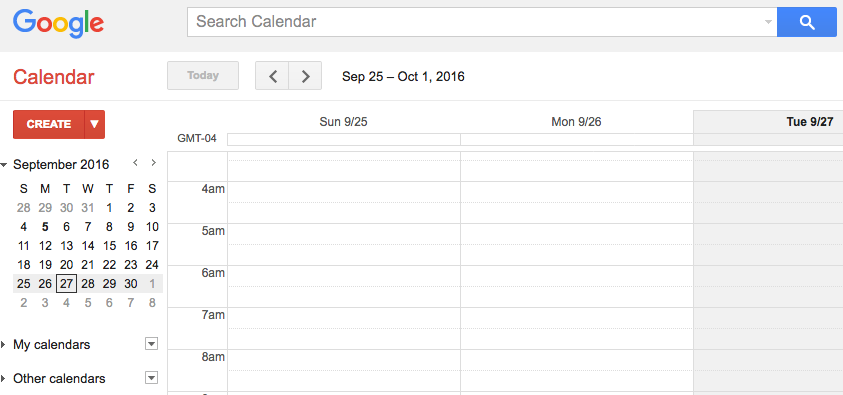
Conclusion
With only 42 percent of B2B marketers claiming they have a sophisticated content marketing strategy, it goes without saying that there’s always room for improvement, from keyword research that can boost your search volume to using long-tail keywords in your blog posts.
Personally, I enjoy every tool developed by Google. Some are more effective and powerful than others, but each one deserves a second look.
Have you used any of these free Google tools to improve your content marketing efforts? Share your thoughts in the comment section below.
The post 10 Free Google Tools All Content Marketers Should Use appeared first on Neil Patel.
Source: feedproxy.google.com

5 Data-Driven Content Marketing Tips You Need to Use Now
These days, marketers have access to powerful competitive research tools that reveal almost everything about competitors’ marketing tactics: what search keywords they focus on, how they build links, and even how much traffic they are able to generate.
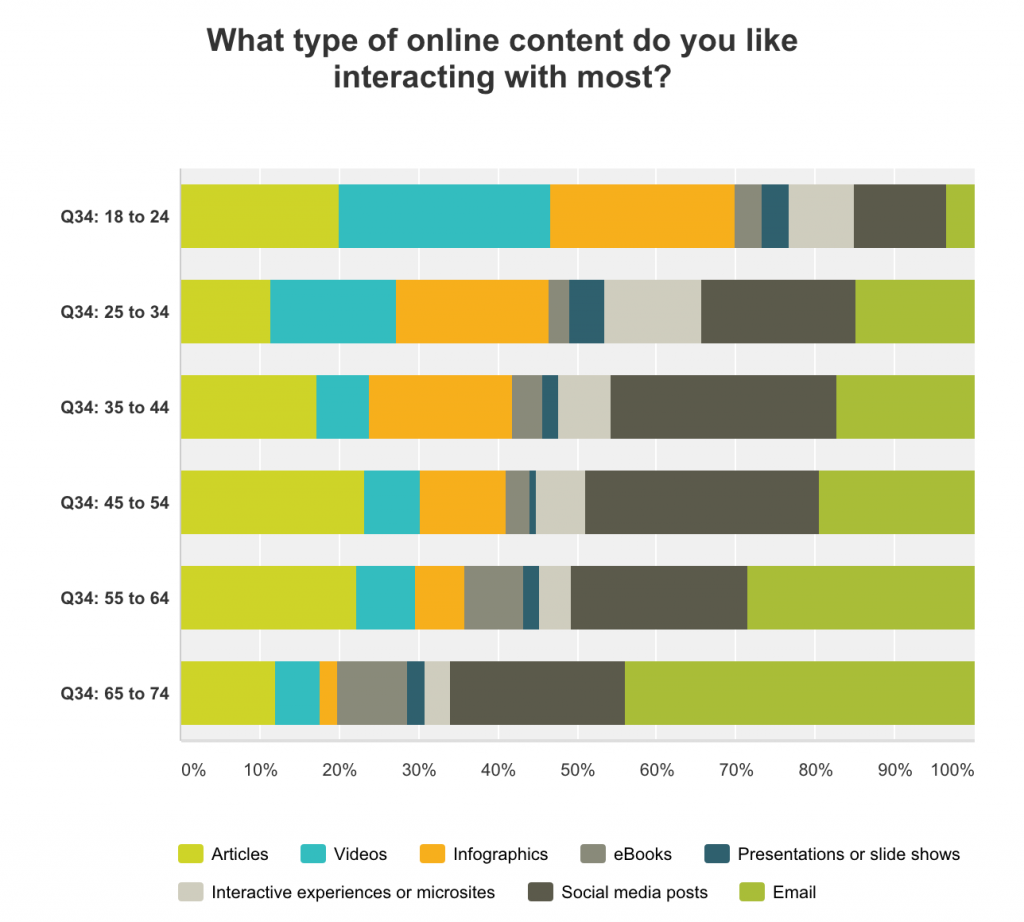
The bad news is there’s an opposite side of that coin: your competitors have the same amount of insight.
In other words, you and your competitors are operating based on the publicly available data, which makes it even tougher to succeed.
As we all know, a smart approach to content marketing is a data-driven approach.
Yet, the smartest approach to marketing is to prioritize your own data —something no one else has.
Instead of going after your competitors and trying to emulate their success, use your own data and let them follow in your footsteps.
5 Types of Internet Data to Create Content Strategy
Here are five types of internal data that will help you create a unique, effective SEO and content marketing strategy that puts you ahead of your competition.
1. Create an effective dashboard to consolidate different data points
I am a self-proclaimed control freak, so the first step in setting up any strategy is always getting organized.
If you are a marketer dealing with large websites (or many large websites), as well as numerous paid and social channels for promoting your owned media assets and sales touchpoints, it is important to aggregate multiple data sources to capture unique patterns and insights.
However, the more data you have, the harder it is to make sense of it.
This is where AI-enhanced business intelligence solutions like Sisense come into play, allowing marketers to consolidate, visualize, analyze and report on data from multiple sources.
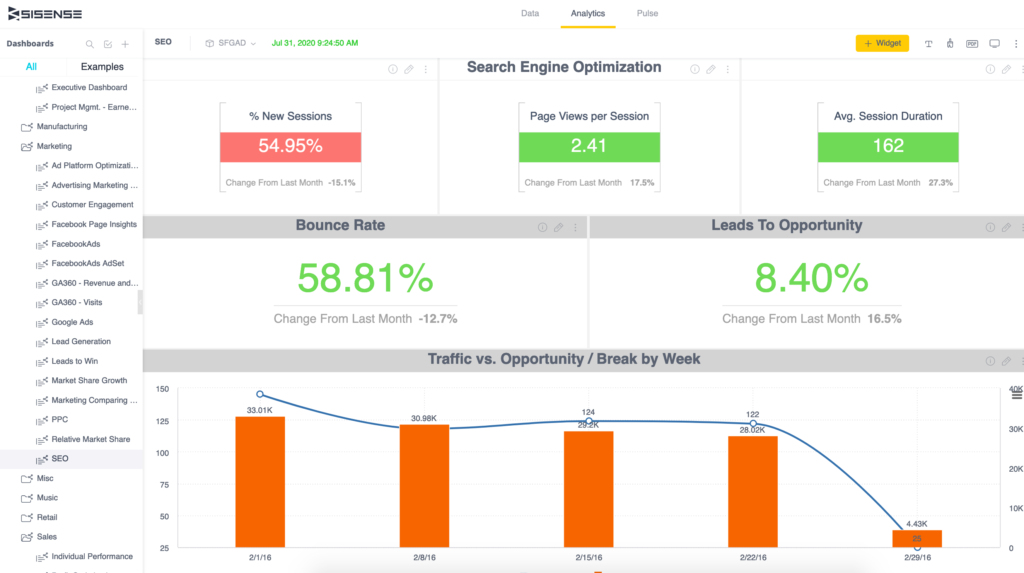
Consolidate, visualize, analyze and report on data from multiple sources with solutions like Sisense.
In addition, Sisense allows you to create your own custom data reporting apps that you can embed as analytics dashboards and interactive reports for internal use — or even as part of the value you offer to external stakeholders.
Once you create your dashboard, decide what kind of data you should be monitoring in order to create a better-performing content marketing strategy.
Here’s where you can start…
2. Update your best-converting content
In most cases, around 20%-30% of any website’s content is responsible for 70%-80% of its traffic.
And that is ok.
Generally speaking, it may be wiser to get your best-performing content to perform even better than fruitlessly trying to get your weaker content to start delivering results.
At the very least, optimizing your best-performing content is actually the lower-hanging opportunity not to miss.
Finteza is a web analytics suite with a strong focus on conversion monitoring.
You can set up multiple events you want to be tracked on your site to evaluate your content performance.
Finteza helps you identify content that does the best job converting your readers into buyers or subscribers.
Select your primary event you want tracking on your page.
Click the “Pages” report, which will be sorted based on how well it converts your site visitors.
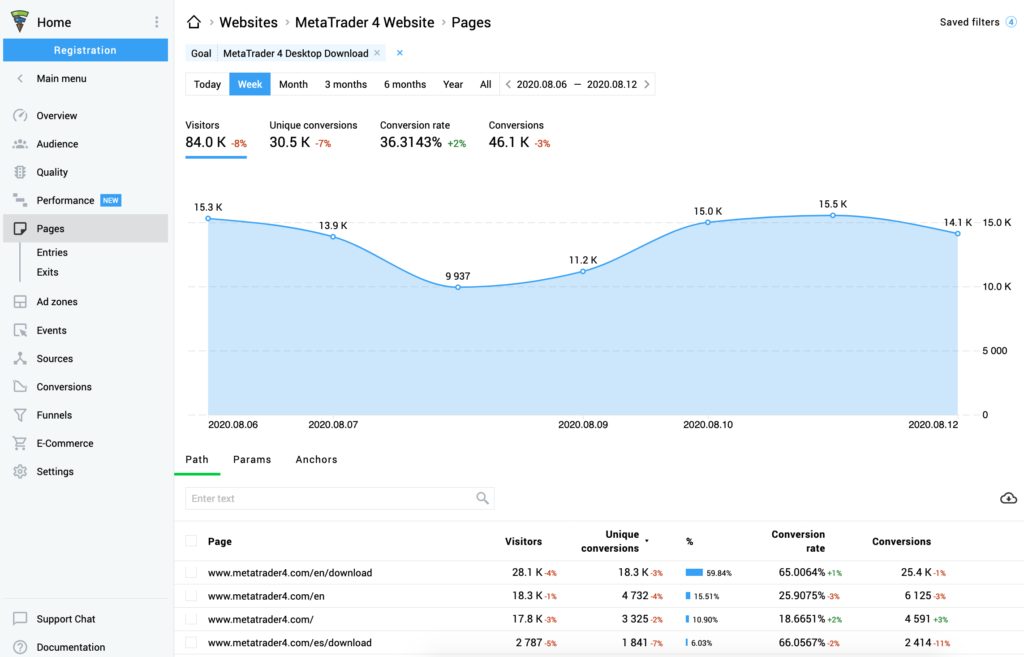
With Finteza, you can see the page that does the best job converting your site visitors—these are the pages you want to focus on ranking higher.
3. Monitor your site internal search
While your Google rankings are publicly known (thanks to all the smart competitive intelligence tools out there), your internal site search is your own data source no one else has access to.
And yet, it is one of the most under-utilized data sources out there, with few publishers paying attention to what their readers are searching for.
Your internal site search is like a map of everything your target audience wants and whether your site satisfies their needs, especially if you are using the right tools.
Google Analytics offers a robust on-site search analytics option which also comes for free.
There are also a variety of WordPress plugins that enhance your site search functionality as well as report on what is being searched and how the search results seem to satisfy the site users.
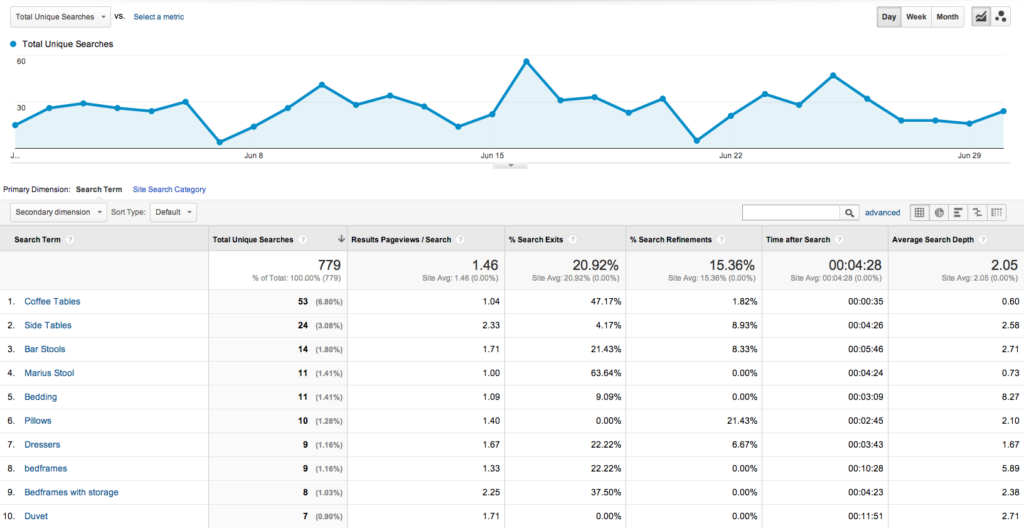
Screenshot source: Internal Site Search Optimization: Best Practices for Your Site (which is also a great guide to bookmark)
4. Re-optimize for your most clicked keywords
Approximately half of Google’s search results are comprehensive and interactive enough for users never to click elsewhere.
In other words, Google’s SERPs are sending fewer and fewer clicks to publishers.
Yet, Google remains the most effective traffic source out there. According to various case studies, organic search optimization can bring about a massive increase in ROI.
ClickMatix, an Internet Marketing agency based in Melbourne, cites an average of 30% increase in revenue and up to 150% increase in conversions within about 6 months after implementing an SEO strategy.
Your SEO strategy should be all about targeting rankings that send clicks.
This means that not all rankings are worth fighting for.
But how do we know if a particular search query is going to generate traffic until we actually get our page to rank there?
The first step is to make publicly available data into account (search volume and more).
The next step is to review SERPs prior to optimizing for them.
In many cases, as a searcher, you can tell whether another user would feel compelled to scroll down and click organic listings.
For example, in the case below, the need to scroll beyond the first image results is very slim.
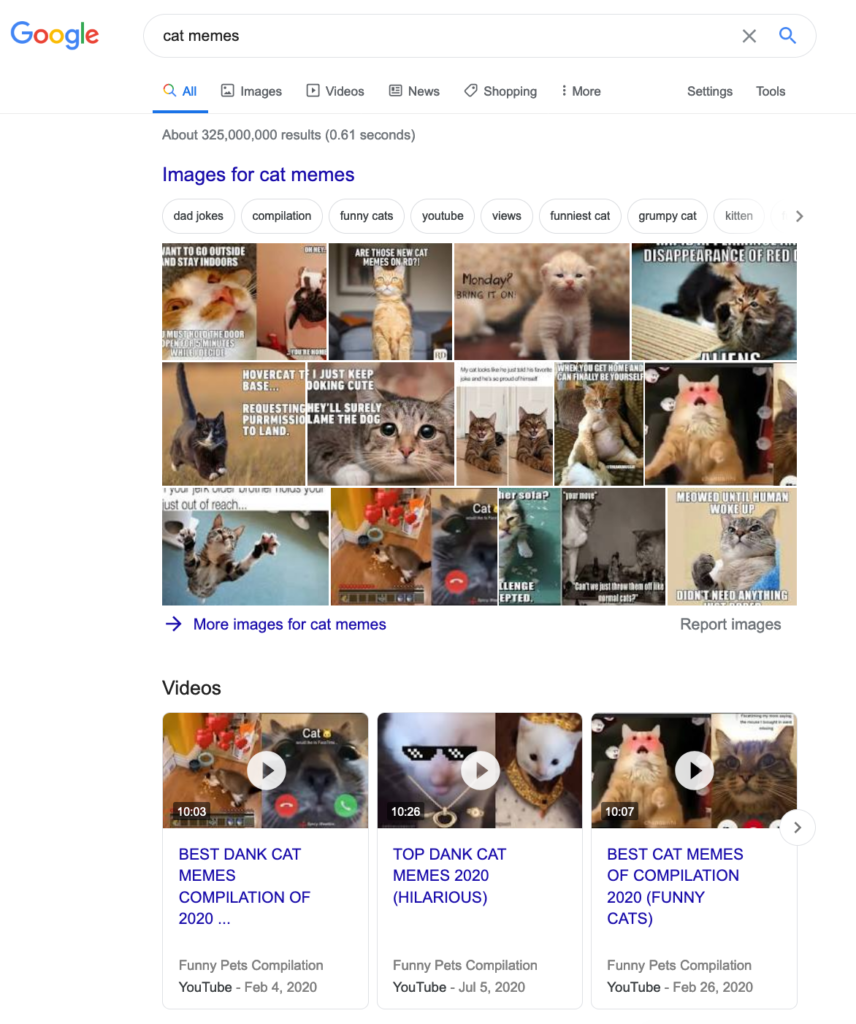
There’s no need to scroll beyond this view.
But your most reliable source of data is — again — yours.
Google’s Search Console allows you to identify search queries that send you clicks — even when your page isn’t normally ranking #1.
These are rankings you want to rank higher for. If you are getting clicks when you rank #3 or lower, rest assured the traffic will be much better when you rank #1-#2.
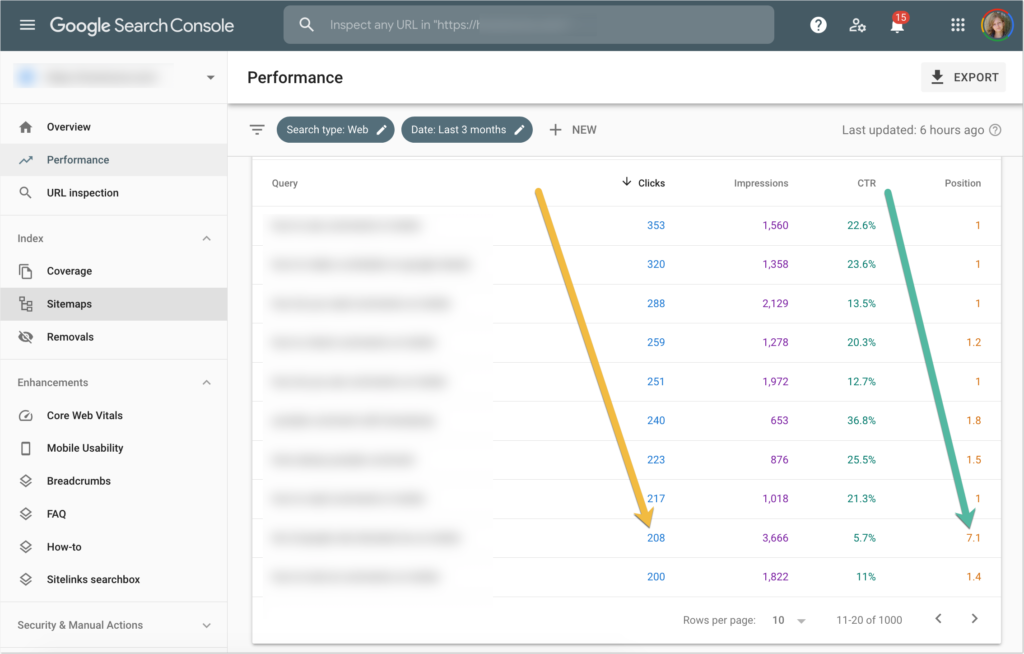
Look at your keywords with the highest click-through rates in Google Search Console, and identify the search queries that send you clicks, even when your page isn’t at position #1.
5. Create content to address your branded search queries
Finally, check to see how your future and current customers are searching for your own brand — this will give you a lot of insight into how they perceive it.
Are searchers having trouble navigating your site or finding some particular information?
Do they search for reviews?
Are there any negative terms (scam, bad, etc.) that happen to be searched alongside your brand?
Again, Google’s Search Console gives you access to that data. Make sure to use the “Query” filter to narrow search queries to those including your brand name.
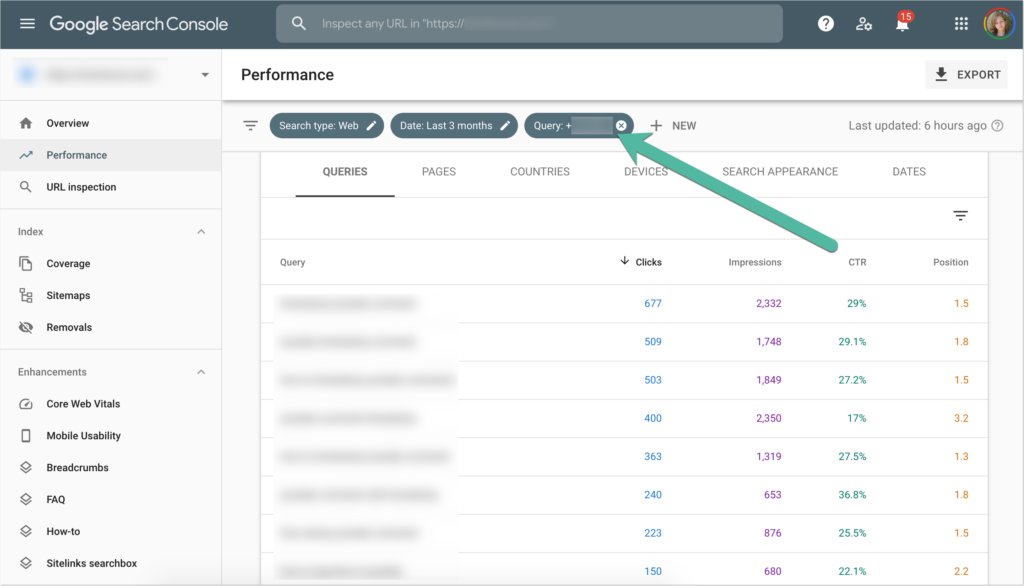
In Google Search Console, filter by query and review your branded search queries.
Conclusion
These days, content marketers have access to more data than they care to use, which is unfortunate because knowing which data to use and how to use may put you ahead of your competition.
Hopefully, the tools and ideas above will get you started!
The post 5 Data-Driven Content Marketing Tips You Need to Use Now appeared first on Content Marketing Consulting and Social Media Strategy.
Source: convinceandconvert.com

The Future of Content Marketing: It’s Not What You Think
Have you heard the saying, “content is king?”
Well, of course, you have. But creating more content won’t necessarily get you more search traffic.
You’ve heard people like me mention stats like the average piece of content that ranks on page one of Google contains 1,890 words.
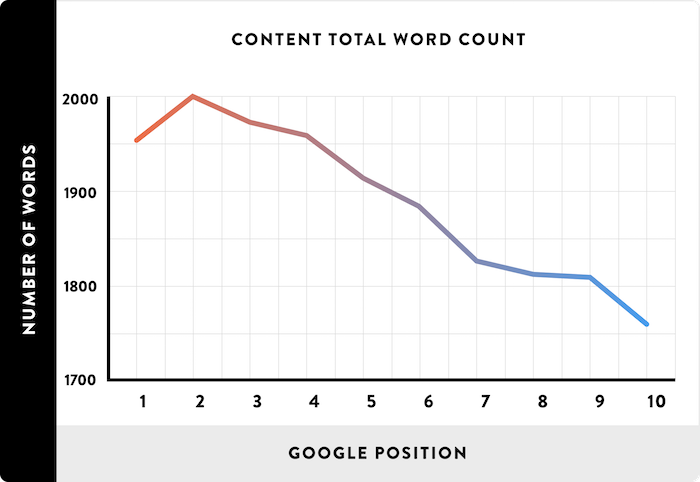
But that doesn’t mean writing in-depth content that is 1,890 words will automatically get you more search traffic.
It just means that the average web page on page 1 contains that many words.
I bet you are going through the scenario below…
You keep writing content but, for some reason, you aren’t getting the amount of search traffic that you would like to be getting.
Don’t worry, I know what you are going through, and I will tell you the solution.
But first, let’s go over how content marketing is changing.
Over 440 million blogs exist
The latest stat I could find on the web is that there are currently 440 million blogs.
But if you consider Medium and Tumblr (and other similar sites), that number is surely over a billion because just Tumblr alone has over 400 million blogs.
So, what does that mean for you?
Because there are so many blogs, it’s going to be hard to drive awareness.
There are roughly 7.5 billion people on this earth and the number of blogs is growing faster than the population.
So, if you assume there are roughly 1 billion blogs, that means there is one blog for every 7 and a half people.
That’s way too many blogs!
So why should someone read yours instead of the others?
Why doesn’t content marketing work as well as it used to?
Because there are so many blogs, you have tons of competition.
Whatever you are thinking of blogging about, the chances are there is already someone (or tons of people!) already blogging about it. Seriously!
Even if you are planning to write about news and current events, the chances are some other blog is going to beat you to the story… even if it is by an hour (or a few minutes).
With there only being so many popular keywords that people search for, there are now more websites competing to reach the top of the rankings.
Currently, Ubersuggest is tracking 619,718,788 keywords globally.
During the last 30 days, only 24,593,402 of them generated over 10,000 searches.
And no matter what popular term you are going after, you are going to have a lot of competition.
For example, I rank on page 1 for the term “SEO” (at least in the United States).
But I am competing with a lot of sites… 581 million to be exact!
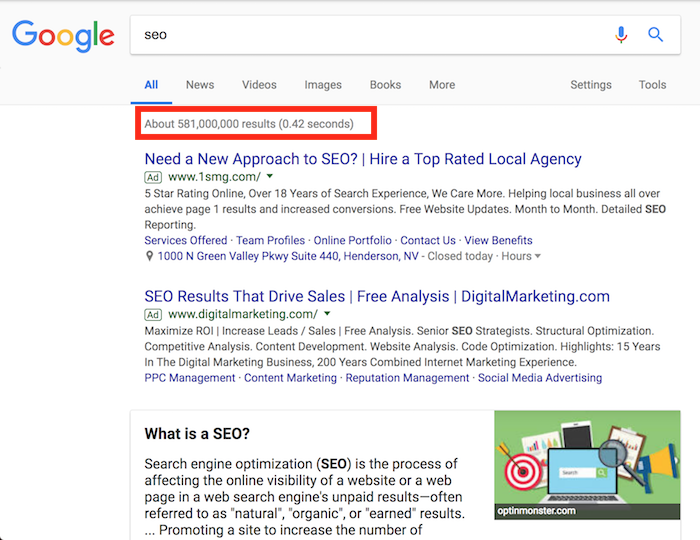
If you want to go after one of those 24,593,402 keywords, you are going to face a lot of competition.
Sure, you can also get a lot of traffic from long-tail phrases, but even those are getting more competitive over time.
How does your content strategy need to change?
As I mentioned above, whatever you are writing about, chances are someone is already writing about it.
When I started my first blog, Pronet Advertising (which no longer exists), the first post I wrote was called, “Winning the Search Engine Marketing War.” It was 412 words long, contained no images, and had no links. But that was way back in 2005 and content marketing was much different back then.
If I published it today, it would do terrible. Back then I didn’t have a personal brand, no one knew who I was, and the post still did pretty well.
Heck, the standard social channels like Facebook weren’t even being used by marketers.
Do you want to know why it did well? Because it was new.
Back then, people never read a post about winning the search engine marketing war.
It was fresh and people wanted to know more.
The fact that it was short didn’t matter.
Now, when you publish new content, there is a good chance that people have already read something similar.
Because of that, why would they want to link to your piece or even share it?
Even worse, only 8 out of 10 people read headlines but only 2 out of 10 will click through.
That means people feel your content isn’t interesting or that they already know a lot about the subject matter of your content.
In other words, if you don’t write something new and amazing, it won’t do well.
It doesn’t matter if you made your content 1,890 words, bought some social shares, or weaseled your way into a few backlinks… no one will care if it isn’t something original and unique.
Just look at the search phrase “SEO tips.” There are 3,630,000 web pages competing for that term.
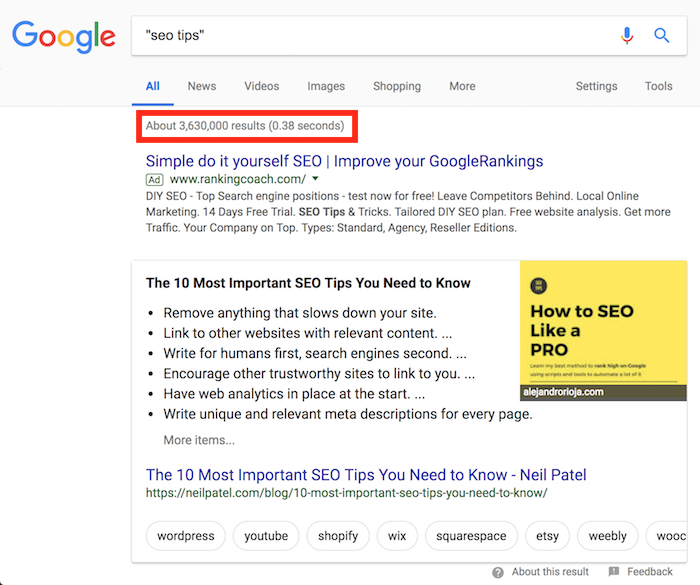
And almost everyone who ranks for that term is writing about the same old stuff. The only difference is how many tips they are including in their article.

How do you write new content that’s fresh?
You need to share life experiences. Your life is unique.
If you can tie your personal experiences into your content, you’ll do much better.
If I look at my most popular posts on NeilPatel.com over the last 12 months, here they are in order:
- My New SEO Strategy: Blog Less, Spend More on Technology
- My New SEO Tool: Ubersuggest 2.0
- Everything I Taught You About SEO Was Wrong
- We Analyzed 5,860,631,392 Articles From 64 Countries. Here’s What Facebook Loves!
- I Wish I Never Built a Personal Brand
- The Most Vital SEO Strategy I Learned Came From a Google Employee
- Why Content Marketing Works for Me and Not You
The Advanced SEO Formula That Helped Me Rank For 477,000 Keywords - Do you notice a pattern?
They aren’t generic posts like “10 ways to double your search traffic” or “how to rank on Google”… each post contains something new… which you already know.
But what else?
If you look at all of those posts, I wrote them more recently.
They don’t rank as high on Google compared to some of the posts I wrote earlier this year (or in previous years), yet they are still the most popular ones because they are unique.
Whether it is data that people haven’t seen before or something based on a personal experience that people can learn from, the articles that are unique and can only be written by you will perform the best.
In other words, you have to be original to get loved.
Not just by Google, but by people.
So how do you write unique content that contains data and has personalized stories?
Here are some ideas:
Buzzsumo
If you put in a keyword related to your industry, it will show you all of the popular posts.
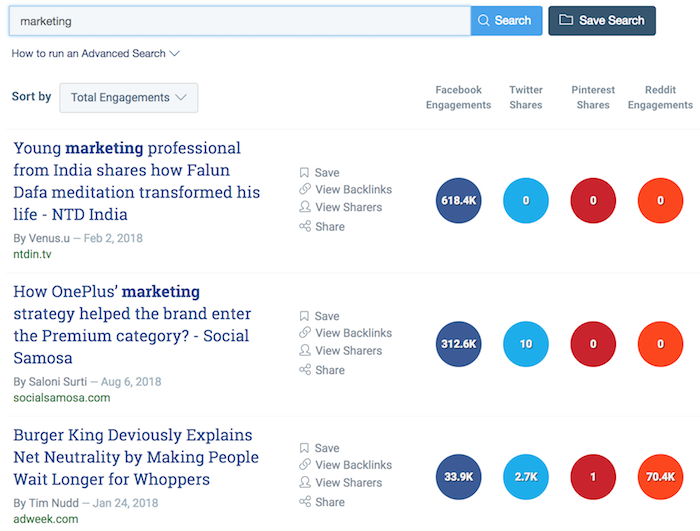
Avoid writing another “copycat” article. If you have a unique perspective on any one of those topics and it is something that the industry hasn’t seen, there is a good chance it will do well.
But it can’t be another copycat article that talks about the same old things that have been talked about a thousand times before.
My favorite part about Buzzsumo is that it will show you what’s popular during certain time frames.
You can adjust your search to the last month, year, 5 years, or any time range to see how people’s preferences have changed over time.
By using this feature, you will get a better understanding of where the market is moving and how you need to adapt.
Google Trends
This simple tool shows you what’s hot right now. Literally at this very second.
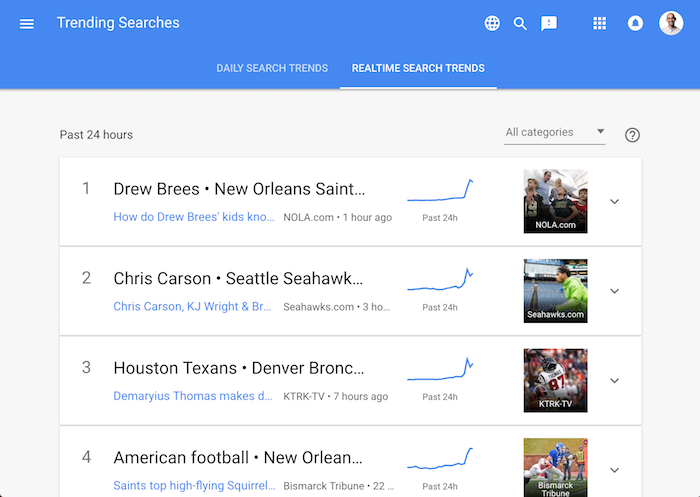
You can even filter the real-time trends per industry.
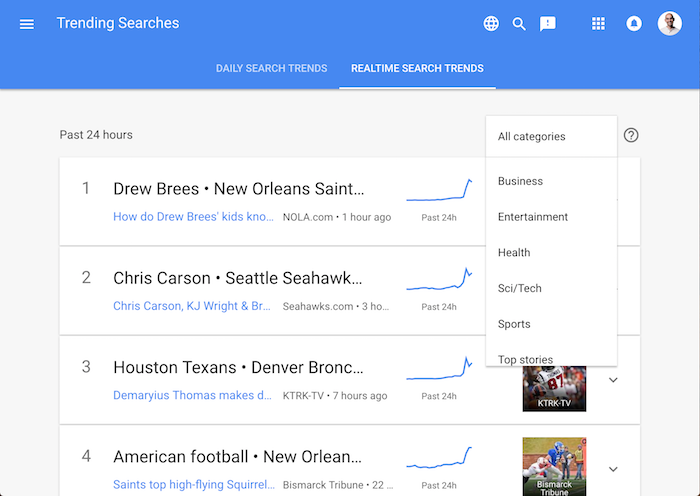
Or you can see what’s been popular for the day as well as the number of searches performed.
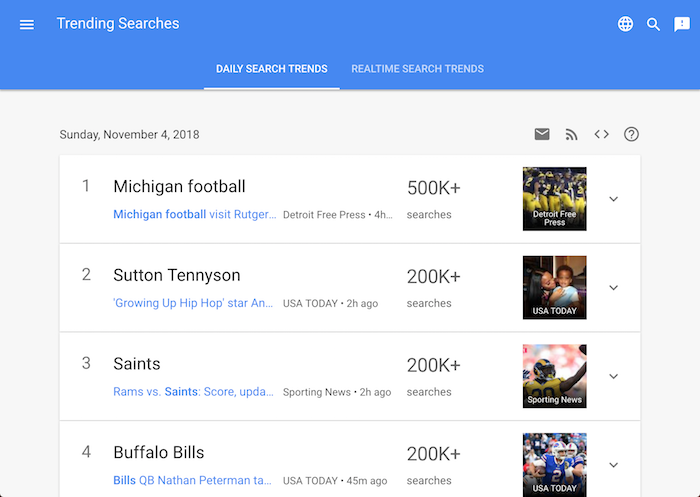
And, of course, you can use Google Trends for any country. The above screenshots are for the United States.
If you have a unique perspective on any of these trends or data, you should consider riding the wave and creating a blog post as soon as possible.
Beware, a lot of people use this tactic and the majority of the traffic will be taken up by popular news sites.
But if you have a personal experience or data related to the trend or topic then you can do really well.
SurveyMonkey
If you already have some readers, the easiest way to come up with unique topic ideas that they will love is to just ask them for advice.
For example, why not create a free survey using SurveyMonkey and ask your readers questions like “what would you like me to blog about” or “what would you like to learn” or “what’s the biggest problem I can help you solve?”
Asking questions like these ones should give you great ideas.
When surveying, make sure you get over 30 responses.
The more the better because you can use their text analysis feature to see what the majority of your readers are interested in.
Problogger Job Board
If you are interested in using data and research within your posts to make them unique, consider hiring someone from the Problogger Job Board.
That’s what I do.
If you already have data, you can find someone on Problogger to help crunch everything and give you golden nuggets for your post.
Or if you don’t, they can gather research from all over the web and come up with something unique.
I found some researchers that are amazing at what they do.
They hit up the tool companies within my space, ask them for data, and then come up with interesting insights that deliver value to my readers.
In exchange, the tool companies get free press, which helps them, and, in most cases, they will also share and promote your post.
A good example of this is the post I wrote on Hummingbird.
It has a ton of unique data points, and I mentioned the companies that helped me gather the data.
But other people have generic content and do well…
Yes, there are tons of blogs with generic content that rank well.
But here is the thing, their content is either old, in which they were one of the firsts to cover the topic, or they have high authority.
When high authority sites like Huffington Post and Entrepreneur write generic content, it ranks because they already have lots of brand queries, backlinks, and social shares.
If you have over 20,000 brand queries per month (you can see how many you have in Google Search Console)…
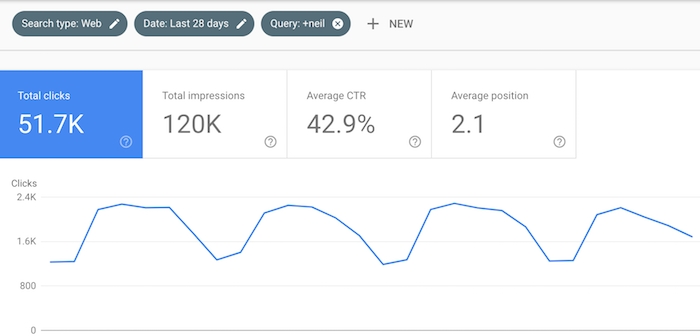
…and you have also had a domain authority of over 60, you’ll see some results if you write generic content.
I still don’t recommend going the generic route (a lesson I have learned from my own personal experience), but if that’s what you want then make sure you at least meet those rough guidelines.
At least that is what I found you need for the most competitive industries going after the English market.
If you don’t have the authority or any brand queries, you can still do well with generic “copycat” content, but you would have to focus on international regions.
There is way too much content for Google to choose from in English.
But that’s not the case in Hindi or Portuguese.
If you are open to expanding internationally, follow the tips in this post as it will help you pick the right regions to tackle first.
Conclusion
I hope I didn’t discourage you from leveraging content marketing.
It’s still an amazing tactic that has helped me generate 1,864,246 unique visitors a month.
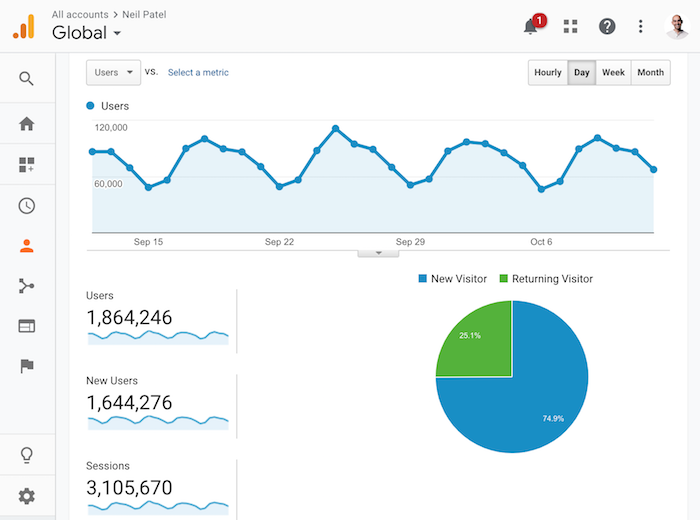
Sure, I’ve been doing this for some years now, but NeilPatel.com is one of the newer search blogs compared to sites like Moz or Search Engine Land yet I was still able to do well.
This is especially true over the last year where I saw most of my growth.
And the big strategy I shifted towards was to start writing personalized content… content that contains my life experiences and stories that can’t be copied or created anywhere else.
Even if you are new to your industry, you can still reference other people’s experiences or tie in lessons you learned from your past as some of those things are still relevant today.
If you can’t do that, resort to using data. People love reading about new trends and strategies as long as you have new data to back up your claims.
So, are you going to write fresh, new content versus regurgitating the same old information again?
The post The Future of Content Marketing: It’s Not What You Think appeared first on Neil Patel.
Source: feedproxy.google.com