
Tag Archives for " research "

4 Insights on Digital Transformation and The State of MarTech [ Research ]
The backbone of digital transformation is the technology that we use. Technology to find customers, attract customers, engage customers, and make a sale. Everything that happens in marketing and sales includes technology to help us be more efficient and effective in what we do.
Today, marketers have access to endless streams of data and countless tools specifically created to enable business development. For marketing professionals, the evolving landscape isn’t always an easy one to navigate. Mountains of data can be helpful if used correctly, or it can create a disjointed picture of the customer, misaligned goals, and a rocky path to revenue growth.
How are marketers using technology to transform their marketing programs and pave the way to better results?
The State of MarTech, a new research study by Ascend2 and SharpSpring, surveyed 187 marketing professionals to find out how they are using technology to get better results.
Here are a few of the findings:
Finding #1: Generating truly relevant leads and attribution are the most commonly reported challenges faced by marketers when it comes to the success of their digital strategy.
The study also found that 76% of marketers feel that they are missing opportunities for revenue growth as a result of challenges like lead quality and marketing attribution.
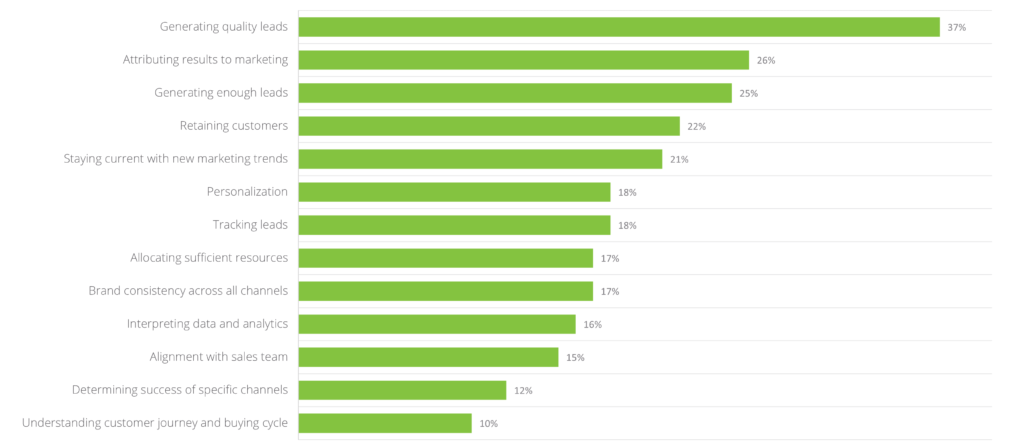
Digital Transformation Tip: Over one-quarter of marketers are having difficulty attributing campaign results to marketing efforts.
Attribution can transform a good marketing strategy into a game-changer for your business by letting you know which campaigns drive conversions, so you can invest in the efforts that work best. This is also the key to identifying your quality leads.
Marketing technology should allow you to set up a multi-touch attribution model in a few simple steps.
- Identify the attribution model you want to follow (first-touch, last-touch, linear, U-shaped, etc.).
- Track your campaigns.
- Set up your conversion goals.
- Build custom reports with multi-touch attribution.
The research finds that too many technology tools are not always better. 44% of marketing teams are using 4 or more tools to execute their strategy but are still facing major challenges.
To overcome challenges like attribution and quality leads, don’t look for more tools but instead look for tools that have built-in features, like attribution tracking.
Finding #2: It is time for marketing professionals to fix the data problem.
Marketers aren’t thrilled with the way their tools and technology are working to support their strategy. Marketing tools received an average ranking of a 6 out of 10 (that’s almost a failing grade!).
Research reveals that the technology is capable of fixing the problem but a strategic and systematic approach is necessary. Here is a closer look.
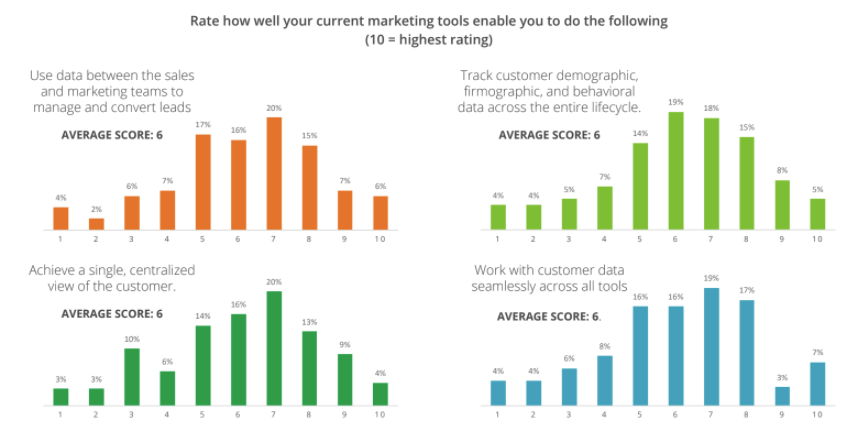
Digital Transformation Tip: 59% of marketers feel that they DO NOT have the data they need to feel confident about which marketing campaigns are working and which are not.
By leveraging behavioral, demographic, and firmographic information, you can give customers content that’s suited to their interests and activities – without lifting a finger.
And since every customer interaction provides additional insight, your brand experience becomes increasingly relevant across channels. Visitors feel understood, which ultimately incentivizes them to return.
Getting your sales and marketing automation platform in sync is the key to having a score that is 8, 9, or 10 (best-in-class). Consolidating your sales and marketing platforms makes it easier to eliminate data silos, clean your data, and make data-driven decisions.
Finding #3: The Solution – Consolidate and integrate tools and technologies.
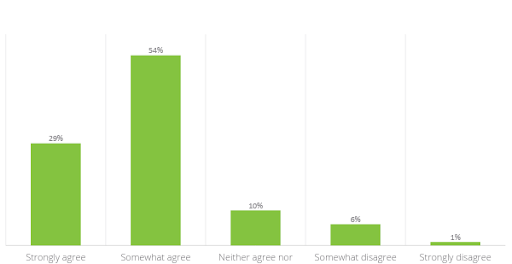
83% of marketers agree that consolidating tools in their marketing and sales technology stacks would increase productivity and efficiency.
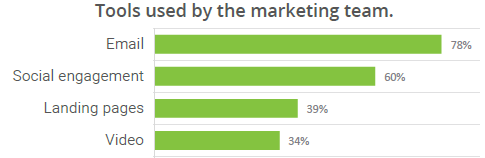
The report provides a comprehensive list of tools used by the marketing team and the sales team. Here are the top four tools for each.
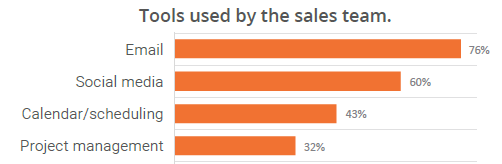
Digital Transformation Tip: Running with a lean technology stack can reduce operational silos and enable better end-to-end visibility of prospects and customers.
Consolidating tools can also decrease the time it takes to solve issues, significantly reduce costs, simplify forecasting and tracking KPIs, and streamline the training of staff members.
Finding #4: Current status of integration of marketing and sales technologies.
Consolidating tools alone might help with overall efficiency, but integrating technologies (ideally into a single platform) will centralize customer data and drive measurable results. 51% of marketers are only partially integrated or use manual processes between tools.
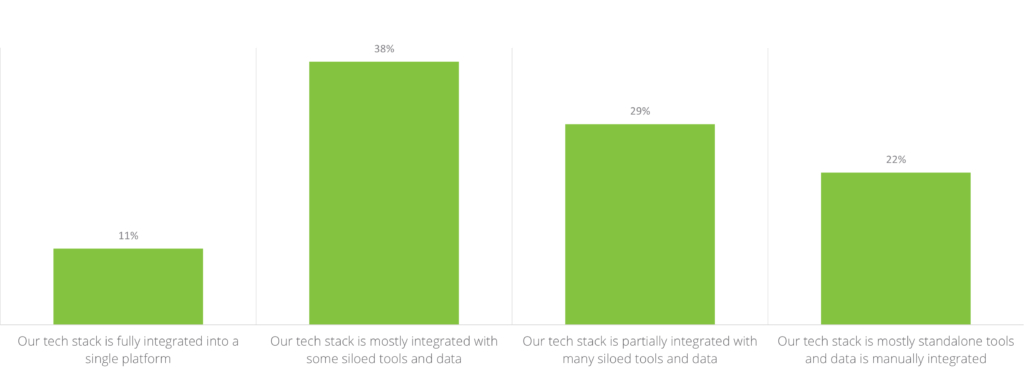
Digital Transformation Tip: A deep dive into the research found that the most successful marketers are 118% more likely to be fully integrated. This group develops a plan to align marketing and sales, and the integration of technology allows the plan to become a reality.
Conclusion
Adopting an all-in-one revenue growth platform is the next phase of digital transformation. The ability to use technology to align marketing and sales so you can optimize your entire funnel, with a holistic view of channels, campaigns, prospects, and customers.
McKinsey calls it “full-funnel marketing” and says that one key benefit in “Linking KPIs between channels and stages of the funnel to actual business results, such as conversions or leads, allows companies to better understand the real impact of their marketing and then create messages that will elicit the best responses.”
For more research on digital transformation, download the 18-page State of MarTech report.
The post 4 Insights on Digital Transformation and The State of MarTech [ Research ] appeared first on Content Marketing Consulting and Social Media Strategy.
Source: convinceandconvert.com

The State of B2B Digital Marketing: 5 Findings That Will Influence Your Next Steps [2021 Research]
B2B marketers have had a lot of ups and downs in the past year, so smart and data-driven adjustments to their digital marketing plans are critical to upcoming success. Advancements in technology, data, and digital channels have created an enormous opportunity for B2B companies to innovate and grow like never before.

Disclosure: This content is reader-supported, which means if you click on some of our links that we may earn a commission.
But to make strategic changes and to develop the best marketing plan, it is critical to have current research and data to support your next steps.
In May 2021, research firm Ascend2 and digital marketing agency Wpromote surveyed 258 B2B marketing professionals in the U.S. to find out what critical shifts in the digital strategy they are using to drive more success in the year ahead.
Findings from the Research Study and How the Findings Impact You
Here are a few findings from the research study and how the findings impact you.
Finding #1: Customer connection is everything.
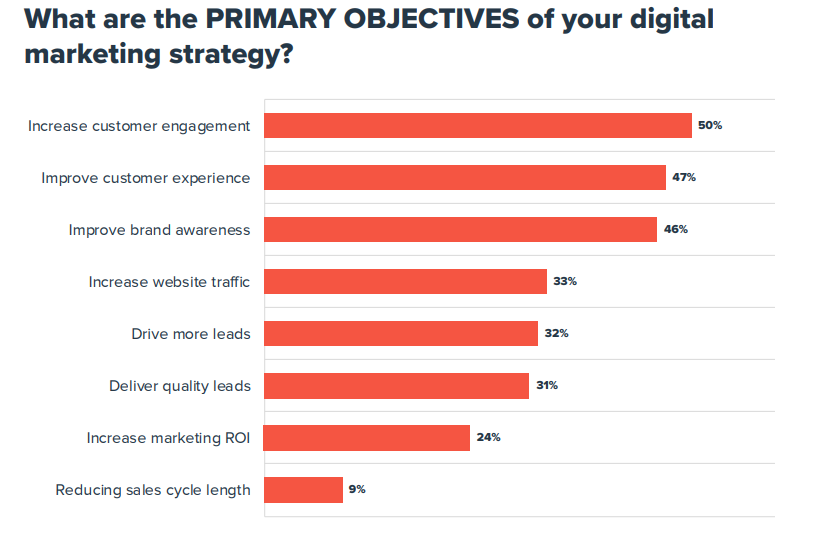
The most important objective for B2B marketers is increasing customer engagement, improving customer experience, and improving brand awareness.
As the digital marketing landscape continues to evolve, marketers have recognized that customers are no longer satisfied with the B2B status quo; instead, they are investing in building a more personalized and experience-driven approach.
An engaging, exceptional customer experience is fast becoming a non-negotiable part of a B2B digital marketing strategy.
Finding #2: Don’t overlook these digital marketing trends.
2020 presented a particular conundrum for B2B organizations: as traditional marketing strategies like conferences and networking-focused events became impossible, B2B marketers needed to find new ways to reach potential customers.
So it’s no surprise that brands embraced new social platforms, virtual events, and influencer marketing strategies that can open the door to new opportunities to drive brand awareness and grow new audiences.
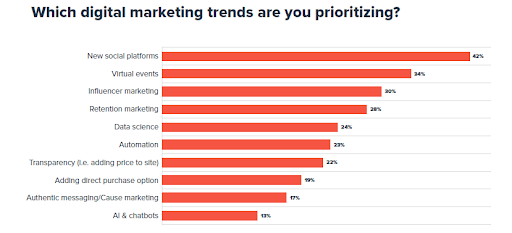
Tip: The top three marketing trends (new social platforms, virtual events, influencer marketing) are more effective when you develop a strategic plan for how all three can work together.
For example, finding the top influencers in your industry that also have a strong following on the new social platforms you are targeting will help you optimize your top priorities.
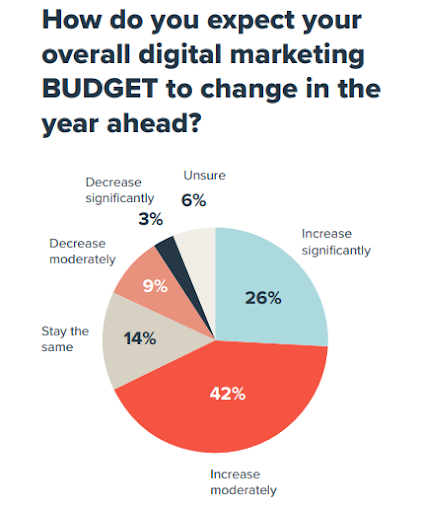
Finding #3: Budgets are going up.
B2B companies have historically underspent on digital, but that is changing.
2020 forced B2B brands to invest in their digital capabilities, including necessary tech and tactics (social platforms, virtual events, influencer marketing, etc.) and that trend looks likely to continue.
Overall, 68% of B2B marketers expect an increase in digital budget in the coming months.
Tip: A large portion of the marketing budget is going to marketing technology.
What will executives expect as they increase marketing technology budgets?
An integrated plan from marketing:
- How will technologies work together to meet specific goals and impact core business objectives?
- Mapping investments to specific strategies, like customer engagement, customer journey, data quality, etc.
- Collaboration between departments to get the most out of tech investments.
Finding #4: Large companies struggle to prioritize quality over quantity.
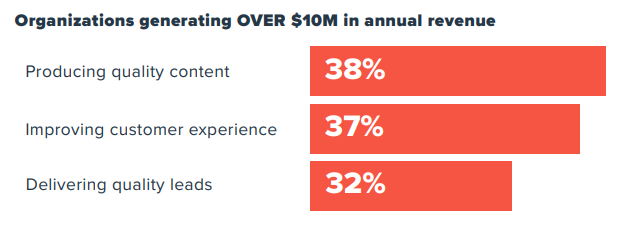
Producing quality content, improving customer experience, and delivering quality leads are the top challenges for companies with annual revenue of more than $10M last year.
As organizations grow, priorities change—and so do the challenges facing marketers.
Smaller B2B companies are much more focused on the bottom of the funnel, but larger companies are more focused on marketing strategies associated with moving up the funnel, pointing to quality content, and improving customer experience.

Finding #5: ABM could be a game-changer.
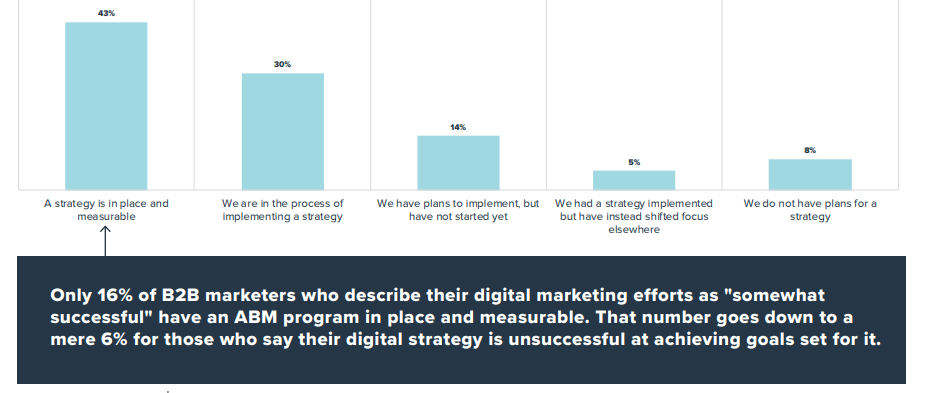
B2B marketers who reported the most success from their digital strategies are more likely to have an Account-Based Marketing (ABM) strategy in place.
ABM campaigns can cultivate engagement and drive conversion for high-value accounts by deploying targeted content and experiences.
With the success that marketers are experiencing with ABM, expect ABM to continue to grow in the coming year.
Tip: Advanced segmentation is the key to ABM’s success and the ability to deliver a better customer experience.
Better segmentation can improve the performance of sales teams, emails, content programs, and ABM campaigns because every touchpoint is more focused and informative.
Final Thoughts
Download The State of B2B Digital Marketing for data and insights on trends for B2B technology, data, channels, and more.
The post The State of B2B Digital Marketing: 5 Findings That Will Influence Your Next Steps [2021 Research] appeared first on Content Marketing Consulting and Social Media Strategy.
Source: convinceandconvert.com

How B2B Marketers Are Using Intent Data – Research and Charts
Intent data. It’s not just another piece of jargon to add to your B2B dictionary. In fact, according to research from Ascend2, RollWorks, and Bombora, 97% of B2B marketers believe that intent data will give brands a competitive advantage in the year ahead.

What is intent data?
Intent data is dynamic, account-level data that signals interest in a business category or specific products and services.
Intent data is based on content consumption of users across the web (also known as 3rd-party intent), or it can be based on direct interaction with company properties such as a website (also known as 1st party intent data or engagement data).
It can be used to identify interested prospects and reach them with contextually relevant and personalized messaging.
Intent data can also be used to understand your open opportunities or existing customers better and move them through the conversion, retention, and expansion funnel.
How are B2B marketers using intent data?
B2B marketers have more information at their fingertips than ever before, but how are they using intent data now to position their brand ahead of the competition?
Ascend2, in partnership with Rollworks and Bombora, surveyed 126 B2B marketing professionals, and here are a few research insights and key takeaways from the research study, The B2B Perspective on Using Intent Data.
Insight #1: B2B Marketers Are Using Intent Data to Target New Accounts
B2B marketers are adopting the use of intent data with prospecting efforts in mind.
Identifying new accounts to target, aligning their sales and marketing efforts, and prioritizing accounts for prospecting are at the top of the list of primary goals according to 56%, 51%, and 38% of B2B marketers, respectively.
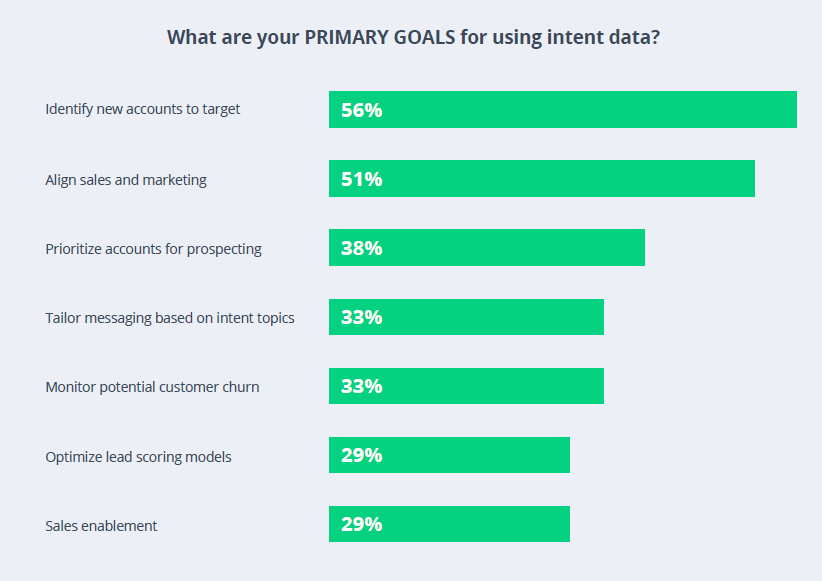
Identifying new target accounts and aligning sales and marketing are the top goals for using intent data.
Key Takeaway:
If your martech goal is efficiency, consider an account-based approach.
Account-based marketing (ABM) means taking a fit-first approach to B2B marketing, ensuring you’re only targeting the accounts with the highest likelihood to buy.
Research shows that 94% of marketers find ABM successful at achieving their primary objectives.
The more targeting you become in identifying your best audience, the more you can improve efficiency in your overall programs.
Insight #2: Accurate and Actionable Intent Data Is a Challenge
For 56% of B2B marketers, data quality is a major challenge when using intent signals, and half of those surveyed report having trouble making intent data actionable.
Having a strategy in place to capitalize on intent data allows marketers to more successfully run targeted content and ad campaigns, better enable the sales team and drive more revenue.
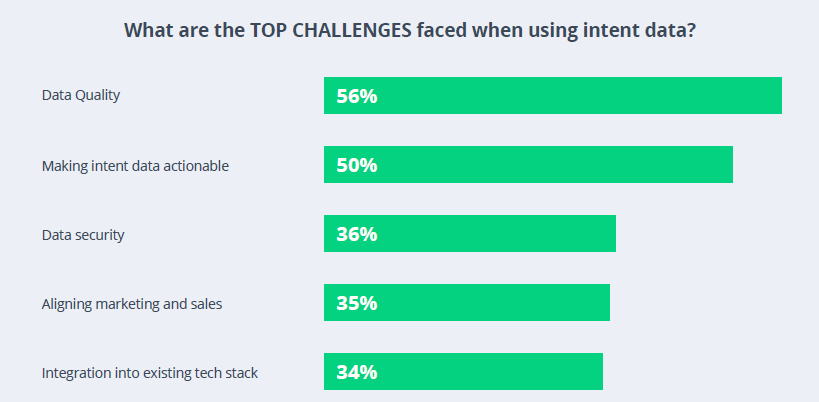
Data quality, making intent data actionable, and data security are the top 3 challenges B2B marketers face when using intent data.
Key Takeaway:
Intent data can be seamlessly into ABM platforms, allowing for effortless implementation.
This enables marketers to quickly take action on insights and drive account growth at scale.
Insight #3: Data Quality and Source of Data Are Key
When adding an intent solution to a technology stack, it is crucial for marketers to first evaluate goals to better define what they need.
This prevents bloating a tech stack and paying for unnecessary tools.
Over two-thirds (67%) of marketers are most concerned with the quality of data being delivered from an intent data solution, while 44% report that the source of data is of utmost importance.
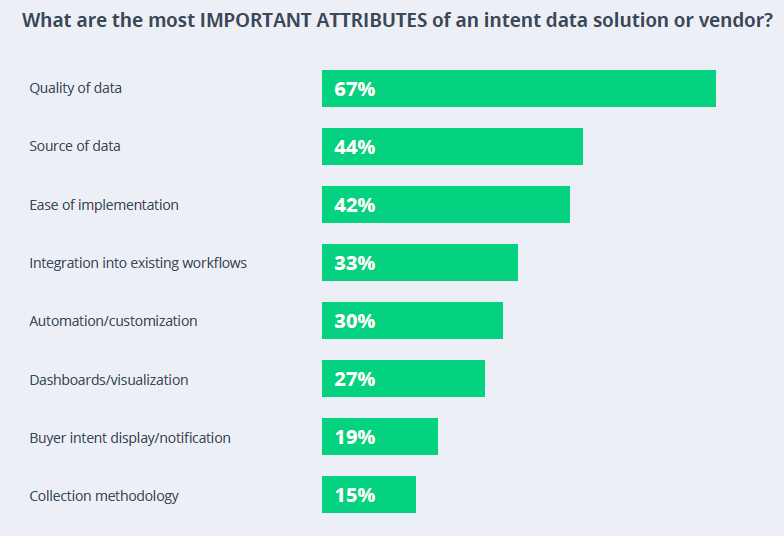
Quality of data, source of data, and ease of implementation are the top 3 most important attributes B2B marketers look for when selecting an intent data vendor.
Key Takeaway:
Above all, B2B marketing technology needs to be user-friendly and customizable.
You’ll want to look for tools that allow you to build and measure your programs the way that makes the most sense for your business.
If you want to target specific accounts, the good news is that technology to support your strategy is not exclusively for enterprise companies with large budgets—now, small and mid-size companies have access to account-based tools that are fast, affordable, and customizable.
Insight #4: B2B Marketers Are Using Intent Data for Personalization and Targeting
Intent data gives marketers the ability to leverage personalization across various channels.
About half of B2B marketers report that delivering targeted ad content (52%) and personalization efforts (49%) are the most actionable ways to use intent data.
From ad copy to landing pages to the subject line in sales outreach, intent data can fuel many areas of sales and marketing.

Delivering targeted ad content, personalization, and account-based initiatives are the top 3 ways B2B marketers are leveraging intent data.
Key Takeaway:
The more you know about what your accounts are looking for, the easier it is to reach them with the right offer.
That’s where intent data can help inform digital advertising personalization for key accounts based on topics they’re surging on.
You can also segment these accounts into subsets audiences to reach them with personalized ads catered to their surging topics.
Not only are you able to find accounts with intent, but you can now speak to them just right.
You can download the entire The B2B Perspective on Using Intent Data for more data, tips, and strategies to plan, implement and optimize your intent data plans this year.
The post How B2B Marketers Are Using Intent Data – Research and Charts appeared first on Content Marketing Consulting and Social Media Strategy.
Source: convinceandconvert.com

Programmatic Advertising: What It Is and Tips to Get Started
Programmatic advertising is the process of using technology to automate the buying and selling of online advertising. It is a real-time buying process of ads, and it is extremely effective.
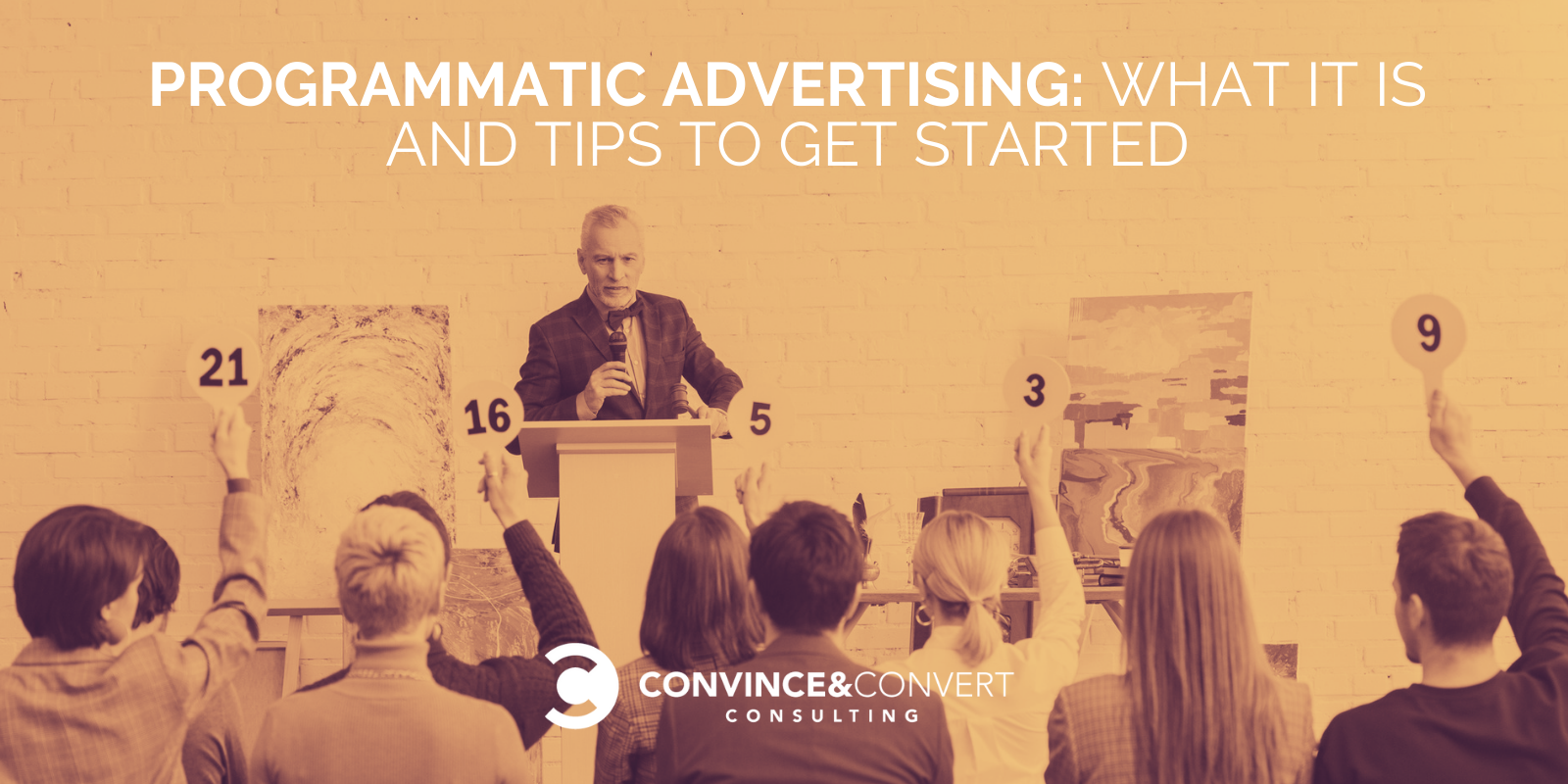
Have you ever been to a public auction or estate sale? I’ve done it and it is a lot of fun. You find the item you want, the auctioneer starts the bidding process, and you start to bid. The bidding goes back and forth until someone is the high bidder and takes home the prize.
At a public auction, the bidding process may take a few minutes. But in the digital age, the bidding can take a fraction of a second.
What is programmatic advertising?
Programmatic advertising is the process of using technology to automate the buying and selling of online advertising. It is a real-time buying process of ads, and it is extremely effective.
With advancements in the online ad-buying process, small and mid-size businesses (SMB)s now have access to tools that give them the ability to harness the power of data and apply it systematically to increase conversions from online ads.
How are small and mid-size businesses are using programmatic advertising?
To help answer that question, Ascend2 and Perfect Audience joined together to field a survey and published the findings in a report titled The State of Programmatic Advertising from the Small and Mid-Size Business Perspective. The survey was fielded in June 2020 and a total of 213 marketing professionals from businesses with fewer than 500 employees participated in the survey.
Here are a few noteworthy findings from the research study and some practical strategies and tips on how to apply the research to influence your marketing programs.
#1: Programmatic Advertising Budgets Are Increasing
Programmatic advertising can stretch often limited ad budgets further than traditional options. Despite uncertainty across many industries, about two-thirds (65%) of marketers report expecting an increase in budget for programmatic advertising in the months ahead.

How programmatic budgets are changing
Quick Tip from the Research: Programmatic advertising is based on real-time bidding, allowing for a faster, more efficient, and less expensive advertising experience. Given the built-in benefits of programmatic, it isn’t surprising that budgets are increasing when most marketing budgets are decreasing during the COVID-19 economic crisis.
#2: Start Your Programmatic Advertising Program with the End in Mind
What are the primary objectives of your programmatic advertising program?
For results-driven small and mid-size businesses, a well-executed programmatic advertising program provides a channel for increasing their bottom line with maximum efficiency. Driving sales and generating leads are top priorities when executing an online ad-buying program for 57% and 48% of SMB marketers surveyed, respectively.
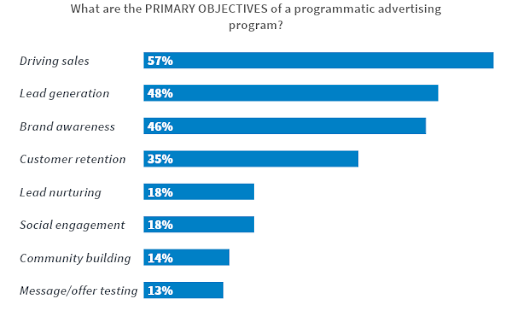
Objectives of a programmatic advertising program
Quick Tip from the Research: When determining your primary objectives, you must define the purpose of your campaign. Campaigns should have a single objective (drive sales, generate leads, brand awareness), and each objective requires a specific strategy. Each program requires a unique ad set, landing page, call-to-action, and metrics to measure success.
#3: Programmatic Advertising Is Challenging (but worth it)
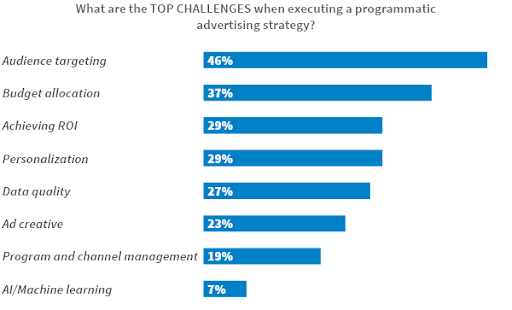
Serving the right ad, to the right person, at the right time requires an enormous amount of data, tracking, and technology. That is why 46% of small and mid-size businesses report that audience targeting is a top challenge when it comes to programmatic advertising. Allocating enough budget to execute their strategy is also an obstacle for 37% of those surveyed.
Programmatic advertising challenges
Quick Tip from the Research: Follow the ROI and data to find your best audience to target. Did you know that with Facebook and Google you can only reach half of your audience?
Programmatic advertising platforms will help you reach the other half of your audience. The webinar, Retargeting Beyond Facebook and Google, provides additional information on how to reach a larger target audience.
#4: Audience Targeting is the Most Effective Tactic for a Programmatic Advertising Program
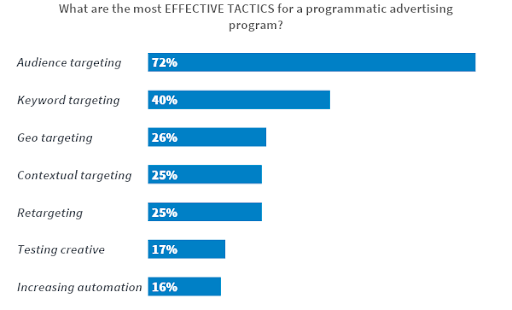
A powerful targeting solution is critical to the success of a programmatic advertising strategy. Audience targeting is considered the most effective tactic for a programmatic advertising program to a 72% majority of small and mid-size business marketers. Keyword targeting is also a tactic that 40% of those surveyed have experienced success with.
Quick Tips from the Research: Don’t overlook the success of retargeting. The average CTR for retargeting ads is 0.7% compared to 0.007% for display ads. Retargeting is serving ads to customers after they leave your website. It allows you to show your visitors relevant ads when they visit other sites.
Here are a few of the benefits of retargeting:
Higher brand lift: Four weeks after implementing a retargeting campaign, marketers found an average increase of 1046% in searches for branded terms. The performance was more than twice as effective as audience targeting without retargeting.
Improved click-through and conversion rates:
- Three out of five viewers notice and consider ads they’ve previously seen at another source (eMarketer).
- Retargeting has a click-through rate that’s 10 times higher than a typical ad (Wishpond).
- Visitors who are retargeted are also 43% more likely to convert than those who aren’t. (Criteo)
Better value for money than other advertising methods:
- 91% of marketers who’ve used retargeting find it to perform the same or better than search, email, or display (IAB)
- 91% of marketers who’ve used retargeting find it to perform the same or better than search, email, or display click To Tweet
#5: Return on Investment (ROI) Is the Most Important Metric of a Programmatic Advertising Program
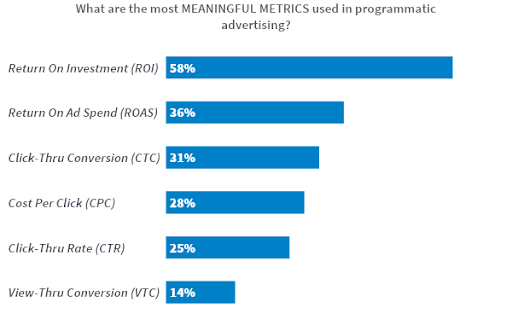
Measuring the impact of advertising campaigns is critical to optimizing a programmatic strategy. Return on Investing (ROI) and Return of Ad Spend (ROAS) is the most meaningful metrics for tracking success according to 58% and 36% of those marketers working with businesses with up to 500 employees.
QUICK TIP from the Research: What is the difference between ROI and ROAS? ROAS is a subset of ROI and tells you if an ad campaign is working. ROI tells you if your entire program or department is profitable. Here is a video that provides more detail on the differences between ROI and ROAS (start at minute 2:55 of the video).
Here is a link to the entire report, The State of Programmatic Advertising from the Small and Mid-Size Business Perspective.
The post Programmatic Advertising: What It Is and Tips to Get Started appeared first on Content Marketing Consulting and Social Media Strategy.
Source: convinceandconvert.com