
Tag Archives for " program "

How to Make Social Advocacy Part of Your Employees’ Daily Routine
Your employees each have a morning ritual. Grab a cup of coffee. Scroll through Facebook’s News Feed. Respond to emails. Dial into a conference call. Start the workday.
What if your company could become a part of employees’ daily routines? What if there was a way for you to use this downtime to inform others and increase brand awareness?
Welcome employee social advocacy! By tapping into a daily habit that already exists, you can create social advocacy and amplify your marketing efforts.
According to a 2016 survey from Bambu by Sprout Social, seven in ten employees are using social media at work. Blocking popular networks and monitoring browsing history isn’t going to stop anyone from checking Facebook—especially when 11 percent of those surveyed admitted to using social media during bathroom breaks.
Instead of trying to fight a habit that’s already ingrained in your workplace culture, embrace it! Encourage your employees to use their time on social to speak on your brand’s behalf. By outlining the individual benefits, identifying existing champions, and educating and empowering employees, you can strategically build a powerful advocacy program.
Answering the Question: What’s In It for Me?
One of the biggest hurdles in getting people involved in an advocacy program is convincing them that there’s a personal benefit. Before you introduce a formal or informal program, you need to answer the frequently asked question, “What’s in it for me?”.
The best way to do this is by not only communicating but also demonstrating the benefits of sharing company content on social.
Collect and share testimonials from sales representatives who have seen an increase in revenue by sharing curated content. Who has had success at positioning themselves as thought leaders within the marketplace? Identify a new employee who learned about the position through a social post.
If these use cases aren’t applicable, try surveying engaged employees to learn what they think is most valuable.

Additionally, you need to demystify the idea using social media at work negatively impacts productivity. Believe it or not, four in five people believe that.
Sure, there’s always going to be the 10 percent of surveyed employees who spend over two hours on social. However, a vast majority spend less than an hour scrolling through their feeds.
You may want your employees to hit the ground running sharing your awesome content, but that may not happen right away. What’s most important, initially, is that your employees are reading the information you’re posting. You want them to experience a more transparent and forthcoming workplace.
Identifying and Educating Existing Internal Advocates
Do a quick search on Instagram of your office location and a Twitter query of your branded hashtag. These employees are your initial allies and should be the first group of stakeholders you bring into your employee advocacy initiatives.
That’s what Katie Gear, Area E-Commerce Marketing Manager for Hyatt hotels in Chicago, Indianapolis, and Cincinnati, did when she first launched her advocacy efforts. Gear spoke with Sprout Social’s Community Outreach Manager, Sarah Nagel, about how she scaled her program and identified its first participants.
“Harness employees who are already sharing. Create a more meaningful conversation with their employer, and keep the dialogue they’re already participating in more open-ended,” Gear told Nagel.
Gear identified these brand advocates by searching social and approaching directors in sales and marketing. She asked them who from their teams would be a good fit. 54 percent of those surveyed responded that they don’t have a lot of guidance on how to use social media to advocate for their company.

To address this, Gear followed up by hosting informal social media 101 classes for Instagram, Facebook, and Twitter.
“The courses help them understand what I’m doing with the content and what I look for—and what content works best on what channel,” Gear told Nagel.
So, first, identify and then educate existing internal advocates to help you implement a more effective employee advocacy program. Leverage this highly engaged focus group for feedback. Lean on their insights to help revise your efforts before rolling it out to a larger audience.
Empowering Your Employees
Participants in your program shouldn’t view engaging with company news and relevant content as extra work—otherwise, they won’t opt-in.

In fact, 53 percent of employees surveyed don’t think that the marketing team makes it easy for them to advocate for the company on social media. Don’t make engaging with your brand more cumbersome than it needs to be.
Along with internal education on social media best practices, you need to streamline the sharing process and provide your employees with all the tools they need to be the best advocates possible.
When you’re sharing social content with your team, try this:
- Accompany each post with suggested social messaging per each popular network.
- Include a note with each piece of content that tells why what you’re sharing is important and who the internal stakeholders involved with the initiatives are.
- If you’re citing a third-party source, make sure you’re highlighting a reputable publication.
- Make sure that you’re asking your team members to share content and information that they think would resonate with all of the company’s employees or a departmental audience. Employee engagement, just like social media, should be a two-way dialogue.
Quantifying Employee Advocacy Success
Strategizing and implementing an employee advocacy program takes time and resources. Be sure that you’ll be able to measure the impact of your efforts. Adding UTM codes to the end of each piece of owned content you share with employees will make it easy to track, measure, and benchmark.
Some of the same social metrics you apply to your marketing efforts can be applied to your advocacy initiatives.

Keep in mind that those surveyed were 16 times more likely to read a social media post from a friend than from a brand. 81 percent of participants went as far as saying they would rather see a friend’s social post than a brand’s post.
Keep a close eye on your efforts, and continue to use the data and anecdotal feedback you receive to revise and refresh your program.
Cheers to Your Advocacy Leaders!
As your program gains momentum, your employees will see that advocating on social media isn’t as confusing or hard as they may think. Be sure to start out with a proper framework and approach. Getting your employees to incorporate advocacy into their daily routines can be a seamless and mutually beneficial process.

This post was originally written by Andrew Caravella and updated by Michelle Saunders in 2021.
The post How to Make Social Advocacy Part of Your Employees’ Daily Routine appeared first on Content Marketing Consulting and Social Media Strategy.
Source: convinceandconvert.com

How to Set up The Amazon Associates Affiliate Program to Earn Website Revenue
Affiliate marketing is a way for online publishers (including bloggers) to make passive income by recommending products and services they love.
Amazon Associates is one of the most trusted affiliate marketing platforms where anyone can start an income stream from the comfort of their home.
Like most methods, this takes plenty of strategizing and hard work.
Once you get the hang of the basics, however, it’s relatively easy to monetize your content. Here is how to get started and drive revenue with Amazon Associates.

Point of Sale
How Does the Amazon Associates Affiliate Program Work?
The Amazon Associates Affiliate Program is an affiliate program that’s free for creators to use. As a blogger, YouTuber, or another content creator, you can insert links to products from Amazon into your posts to encourage people to click and buy.
Amazon explains the process in three simple steps:
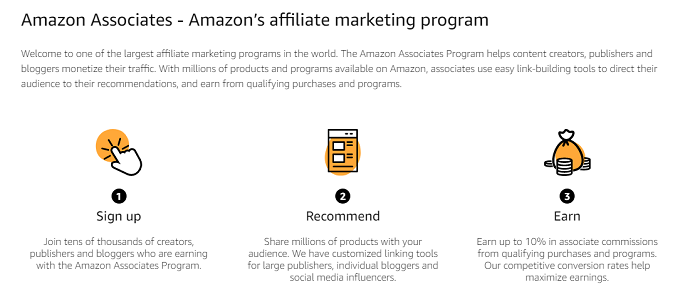
When someone uses your unique affiliate link to buy something from Amazon, you get a small revenue cut via referral fees.
You can take advantage of this by leveraging your audience’s attention.
If you’re already a big influencer, you can encourage your large following to buy from your links by posting promotional content.
However, you don’t need to be a massive influencer to make some money from Amazon Associates. Content creators of any size can make some additional cash by creating enticing work and including affiliate links in it. Just make the products look irresistible!
No matter what, make sure the products line up with your content and brand message. You don’t want to lose your audience’s interest.
These affiliate marketing techniques, among others, can help creators generate passive income streams.
Things to Keep in Mind About the Amazon Associates Program
While the Amazon Associates process is relatively straightforward, there are some essential things to keep in mind before you get started.
These reminders may help keep you out of legal and financial trouble while ensuring you have the right resources to build a successful affiliate marketing business.
1. Not All Commissions Are Equal
The Amazon Associates program operates on a commission basis, but not all commissions (also known as “referral fees”) are worth the same amount.
The official Amazon Associates page created the pay scale table below. It shows luxury items, like designer watches, bags, and perfumes, offer a 10 percent commission. Meanwhile, toys, furniture, business supplies, musical instruments, and other lifestyle items pay a 3 percent commission.
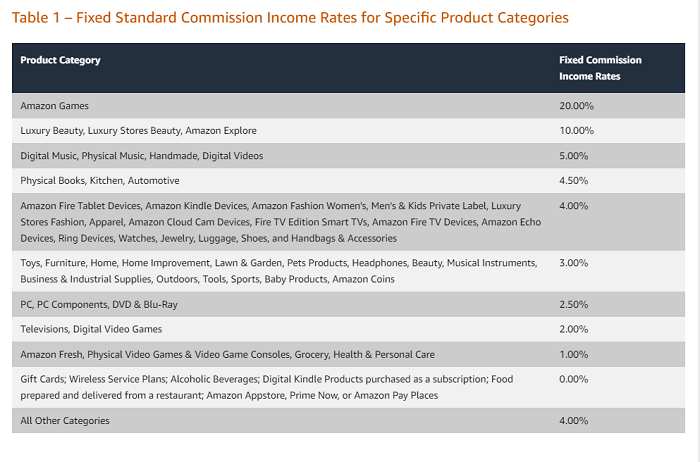
If someone buys a $1,000 luxury product from your Amazon Associates affiliate link, you get $100. If someone buys a $1,000 musical instrument with your Amazon Associates affiliate link, you get $30.
Though this difference is enormous, don’t be tempted only to sell high-commission products. For example, if you run a website where you talk about musical instruments but throw in a link to luxury shoes, your audience may be thrown off, and your content quality could decrease.
If you can find high-commission products for your page, that’s great! If not, smaller amounts add up.
For example, that $100 commission is worth just over three $30 commissions. People looking for your content are more likely to want relevant products. Are they more likely to buy the unrelated item or the one that fits naturally with your content?
2. You Must Disclose Affiliate Earnings
It can be tempting to hide links in your content and earn referral fees without telling your audience—you don’t want to seem “too salesy,” after all. However, not only is this unethical but it’s also frowned upon by Amazon.
Perhaps more importantly, it’s a U.S. Federal Trade Commission (FTC) requirement: Creators must specify if the links on the page earn them revenue.
This can look something like this:

Or this:

3. You Can’t Promote Controversial Products or Make Fake Claims
While you’re allowed to use affiliate links with almost any Amazon product, there are some limitations. For example, you can’t promote sexually explicit, obscene, violent, or illegal products. Make sure anything you promote is legitimate before adding the link.
You also may not make misleading, overly promissory, or false claims in your content.
This is particularly important when recommending health and beauty products. Avoid exaggerating benefits and give ample information about side effects and other warnings.
On a relevant note: Don’t promote products you don’t believe in. While it may be hard to prove you were intentionally misleading, you could end up losing audience members if everyone hates what you’re trying to sell—particularly if the downsides are obvious.
What Are the Pros and Cons of the Amazon Associates Affiliate Program?
The Amazon Associates program offers a great way to monetize your content and promote products you love. That said, it comes with both pros and cons.
Pros of Using Amazon Associates Program
There are several benefits to using Amazon Associates over other platforms. Here’s why you should consider this platform.
Amazon Is a Well-known Brand
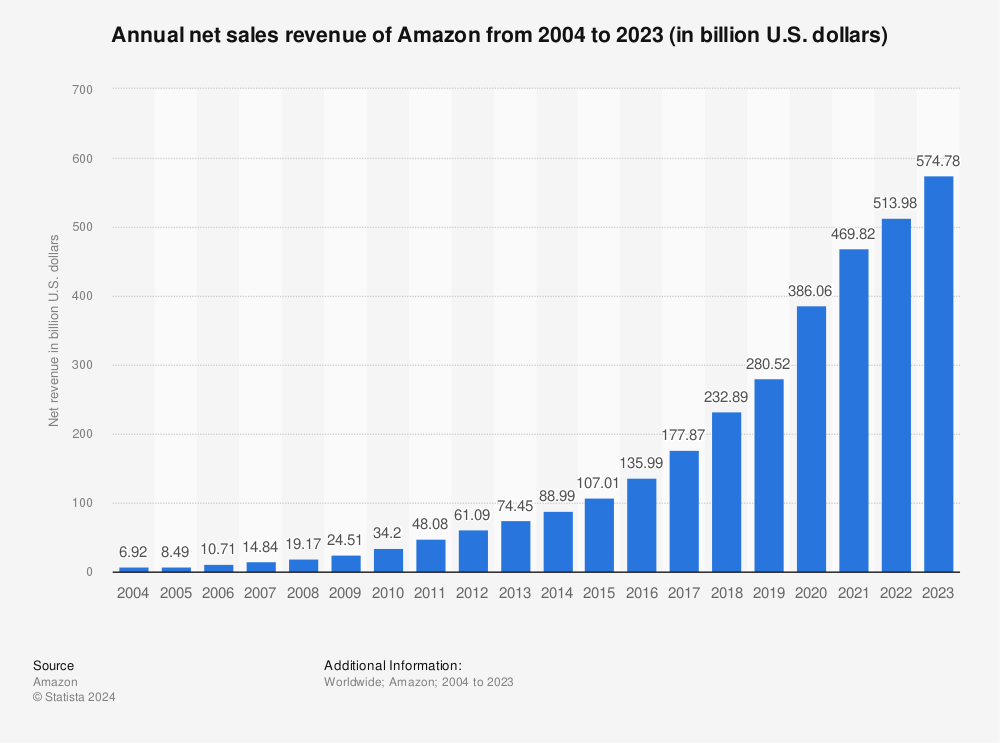
Amazon has millions of shoppers, many of whom are regular customers. You can leverage this by using Amazon affiliate links to recommend trending or relevant products from this mega-popular e-commerce site.
Amazon Has a Lot of Variety
Amazon is estimated to sell more than 12 million products, so you have plenty to choose from. Whether you are an automotive blogger or a fashion influencer, you can find products that work with your content and audience’s interest.
Make Money by Recommending Products
Do you enjoy recommending new products to friends and relatives? Then you’d enjoy working with the Amazon Associates Affiliate program. You earn referral fees just for recommending products you already love (or know your readers would love).
There Are No Minimum Requirements to Get Started
Most programs have qualifications for using affiliate links, but the Amazon Associates Affiliate program has no minimum requirements. You can apply for an Amazon Associates account with any number of social media followers and web traffic.
Cons of Using Amazon Associates Program
Amazon Associates isn’t the only affiliate program on the market. Is it the right choice for you? Here are a few cons to keep in mind before diving in.
Amazon Associates Offers Low Commission Rates
While it’s easy to use the Amazon Associates Affiliate program, it offers comparatively low commission rates. You generally shouldn’t expect to make a living out of affiliate marketing alone anyway, but it’s even more challenging at these rates.
In fact, you may not even be able to cover your website hosting fees, let alone any marketing costs, using affiliate links alone. Therefore, plan accordingly and make sure your content continues to be excellent.
Buy in 24 Hours or No Commission Rule
Sometimes users may like a product you recommend. Maybe they’ll visit Amazon and check out the item but don’t buy it immediately.
Unfortunately, this becomes a problem for content creators using Amazon affiliate links. The user who clicks on your affiliate link must buy the product within 24 hours for you to qualify for referral fees. If they buy it later, you won’t earn any money, even if they put it in their cart via your link.
Amazon Associates Program Doesn’t Support PayPal Payments
Many creators use PayPal for sending and receiving money. Unfortunately, the Amazon Associates Affiliate program doesn’t send out money via PayPal. This alienates a large user base who depend on PayPal to obtain foreign currency in their local accounts.
How to Set Up the Amazon Associates Affiliate Program
Now that you understand how the Amazon Associates Affiliate program works and the pros and cons of using it, let’s go through the steps required to set up an affiliate account with an Amazon Associates ID.
Start a Blog, YouTube Channel, or Other Content Setup
You need a place to post affiliate links, so create a blog or a media channel. This doesn’t need to be fancy—just somewhere you can publish content and build an audience.
Sign Up With Amazon Associates
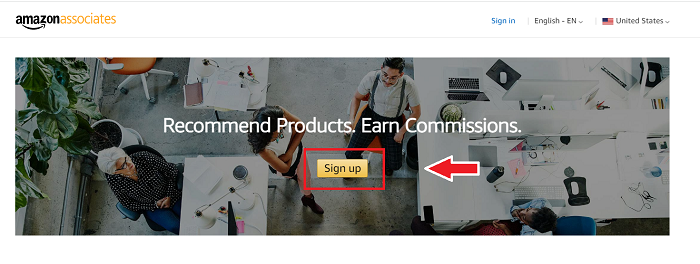
Visit the Amazon Associates Affiliate program homepage and click the sign-up button to get started.
Fill Out Your Profile Information
Provide basic details like your name, address, website details, and other information necessary to set up a preliminary account.
Explain Your Marketing Strategies
You need a plan for how you’ll market the products to earn commissions. That’s why you’ll be asked for this information when filling in your account details.
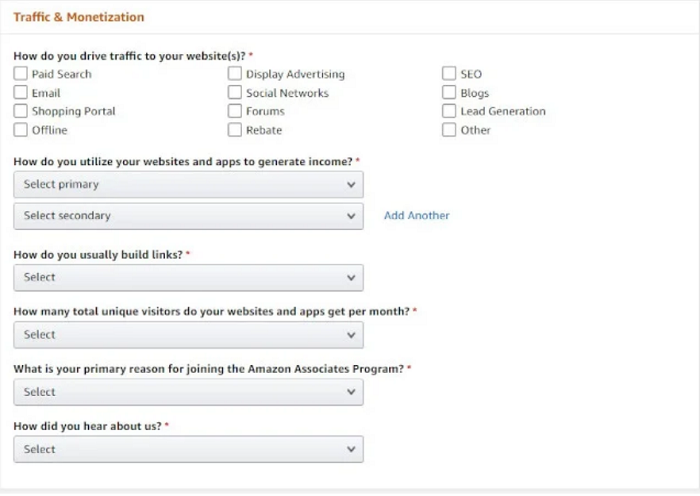
The questions are pretty straightforward and aim to narrow down your marketing strategies. Try to answer these as accurately as possible to increase your chances of approval.
Enter Your Payment Details
Once the basics of your account are set up, you come to the payments section. Here, you enter information about how you wish to get paid.
You may set this up later. If you’re in a hurry, you can skip this section and move forward with the account setup. However, I recommend doing this immediately so you can start making money as soon as your account is approved.
Start Using and Promoting Affiliate Links
Once your account is approved, head over to the dashboard and start using affiliate links for the products you love.
I recommend working on a couple of trial links to see how it works. Share them with your friends and acquaintances to see how it appears to a third person.
Once you’re satisfied with the aesthetics and practicalities of the process, you’re ready to start promoting your affiliate links officially.

Share them on social media, invite your friends to buy their favorite products through your links, and, most importantly, create engaging content to find new users and sell the products to them.
Frequently Asked Questions About the Amazon Associates Program
What are the requirements to be an Amazon affiliate?
The Amazon Associates Affiliate program does not have minimum follower or traffic requirements to set up an account. Instead, you only need to follow basic rules like adding an affiliate disclosure to your website and not promoting prohibited products.
How can I do affiliate marketing with no money?
Setting up an Amazon Associates account is free. You can also start a free blog on free-to-use platforms like WordPress and Medium.
How do Amazon affiliates get traffic?
Amazon Associate users get traffic by creating and promoting excellent content. They generate interest through social media, newsletters, or guest blog posts, and they also promote their content on different mediums and at networking events.
Can I promote Amazon affiliate links on Facebook?
Both Amazon and Facebook’s policies allow users to use affiliate links on Facebook. Therefore, you can add affiliate links in content posts on your feed to interest readers you’re already connected with.
Amazon Associates Affiliate Program Conclusion
The Amazon Associates Affiliate program is a reasonably straightforward way to set up a passive income stream. The best part is that anyone can do it from anywhere, with few geographic and financial restrictions.
Users can start a home-based business at zero cost using a free blog and a free Amazon Associates account. This makes this affiliate program a valuable option for creators who don’t have a lot of business capital but have great content and the drive to succeed.
Amazon has structured its affiliate program to be as effortless as possible, so even beginners can get started with the program with little to no help.
Even if you do get stuck somewhere, you have access to a large community of hundreds of thousands of users who’ve been through this process and may be willing to help you out.
Whether you’ve been creating content for years or are new to the world of earning income via online content, you can set up an Amazon Associates Affiliate Program account and start making some extra money.
Just make sure your content is consistently excellent and work hard to build your audience. Digital marketing is key in this, as an audience doesn’t just appear, no matter how fantastic your content is.
With some elbow grease, you could find yourself making enough passive income to continue building a successful online business via the Amazon Associates Affiliate Program.
What types of products do you think you could sell using Amazon Affiliate links?
Source: neilpatel.com

Programmatic Advertising: What It Is and Tips to Get Started
Programmatic advertising is the process of using technology to automate the buying and selling of online advertising. It is a real-time buying process of ads, and it is extremely effective.
Have you ever been to a public auction or estate sale? I’ve done it and it is a lot of fun. You find the item you want, the auctioneer starts the bidding process, and you start to bid. The bidding goes back and forth until someone is the high bidder and takes home the prize.
At a public auction, the bidding process may take a few minutes. But in the digital age, the bidding can take a fraction of a second.
What is programmatic advertising?
Programmatic advertising is the process of using technology to automate the buying and selling of online advertising. It is a real-time buying process of ads, and it is extremely effective.
With advancements in the online ad-buying process, small and mid-size businesses (SMB)s now have access to tools that give them the ability to harness the power of data and apply it systematically to increase conversions from online ads.
How are small and mid-size businesses are using programmatic advertising?
To help answer that question, Ascend2 and Perfect Audience joined together to field a survey and published the findings in a report titled The State of Programmatic Advertising from the Small and Mid-Size Business Perspective. The survey was fielded in June 2020 and a total of 213 marketing professionals from businesses with fewer than 500 employees participated in the survey.
Here are a few noteworthy findings from the research study and some practical strategies and tips on how to apply the research to influence your marketing programs.
#1: Programmatic Advertising Budgets Are Increasing
Programmatic advertising can stretch often limited ad budgets further than traditional options. Despite uncertainty across many industries, about two-thirds (65%) of marketers report expecting an increase in budget for programmatic advertising in the months ahead.

How programmatic budgets are changing
Quick Tip from the Research: Programmatic advertising is based on real-time bidding, allowing for a faster, more efficient, and less expensive advertising experience. Given the built-in benefits of programmatic, it isn’t surprising that budgets are increasing when most marketing budgets are decreasing during the COVID-19 economic crisis.
#2: Start Your Programmatic Advertising Program with the End in Mind
What are the primary objectives of your programmatic advertising program?
For results-driven small and mid-size businesses, a well-executed programmatic advertising program provides a channel for increasing their bottom line with maximum efficiency. Driving sales and generating leads are top priorities when executing an online ad-buying program for 57% and 48% of SMB marketers surveyed, respectively.
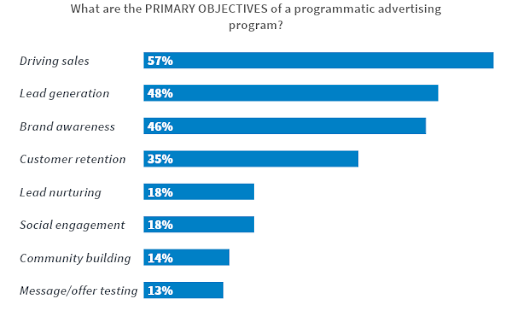
Objectives of a programmatic advertising program
Quick Tip from the Research: When determining your primary objectives, you must define the purpose of your campaign. Campaigns should have a single objective (drive sales, generate leads, brand awareness), and each objective requires a specific strategy. Each program requires a unique ad set, landing page, call-to-action, and metrics to measure success.
#3: Programmatic Advertising Is Challenging (but worth it)
Serving the right ad, to the right person, at the right time requires an enormous amount of data, tracking, and technology. That is why 46% of small and mid-size businesses report that audience targeting is a top challenge when it comes to programmatic advertising. Allocating enough budget to execute their strategy is also an obstacle for 37% of those surveyed.
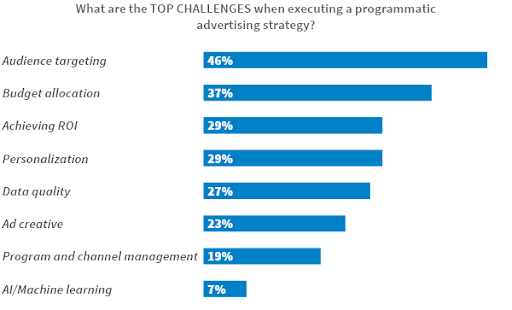
Programmatic advertising challenges
Quick Tip from the Research: Follow the ROI and data to find your best audience to target. Did you know that with Facebook and Google you can only reach half of your audience?
Programmatic advertising platforms will help you reach the other half of your audience. The webinar, Retargeting Beyond Facebook and Google, provides additional information on how to reach a larger target audience.
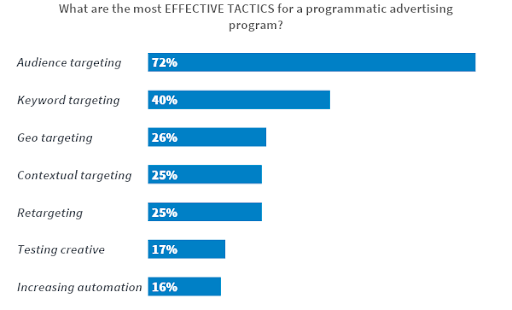
#4: Audience Targeting is the Most Effective Tactic for a Programmatic Advertising Program
A powerful targeting solution is critical to the success of a programmatic advertising strategy. Audience targeting is considered the most effective tactic for a programmatic advertising program to a 72% majority of small and mid-size business marketers. Keyword targeting is also a tactic that 40% of those surveyed have experienced success with.
Quick Tips from the Research: Don’t overlook the success of retargeting. The average CTR for retargeting ads is 0.7% compared to 0.007% for display ads. Retargeting is serving ads to customers after they leave your website. It allows you to show your visitors relevant ads when they visit other sites.
Here are a few of the benefits of retargeting:
Higher brand lift: Four weeks after implementing a retargeting campaign, marketers found an average increase of 1046% in searches for branded terms. The performance was more than twice as effective as audience targeting without retargeting.
Improved click-through and conversion rates:
- Three out of five viewers notice and consider ads they’ve previously seen at another source (eMarketer).
- Retargeting has a click-through rate that’s 10 times higher than a typical ad (Wishpond).
- Visitors who are retargeted are also 43% more likely to convert than those who aren’t. (Criteo)
Better value for money than other advertising methods:
- 91% of marketers who’ve used retargeting find it to perform the same or better than search, email, or display (IAB)
- 91% of marketers who’ve used retargeting find it to perform the same or better than search, email, or display click To Tweet
#5: Return on Investment (ROI) Is the Most Important Metric of a Programmatic Advertising Program
Measuring the impact of advertising campaigns is critical to optimizing a programmatic strategy. Return on Investing (ROI) and Return of Ad Spend (ROAS) is the most meaningful metrics for tracking success according to 58% and 36% of those marketers working with businesses with up to 500 employees.
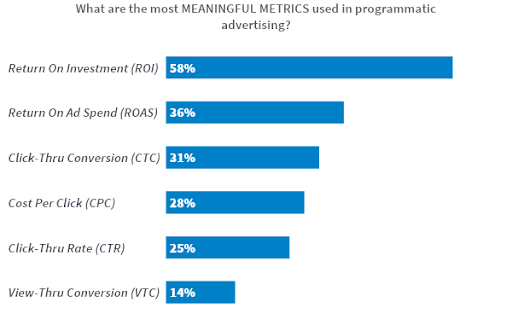
QUICK TIP from the Research: What is the difference between ROI and ROAS? ROAS is a subset of ROI and tells you if an ad campaign is working. ROI tells you if your entire program or department is profitable. Here is a video that provides more detail on the differences between ROI and ROAS (start at minute 2:55 of the video).
Here is a link to the entire report, The State of Programmatic Advertising from the Small and Mid-Size Business Perspective.
The post Programmatic Advertising: What It Is and Tips to Get Started appeared first on Content Marketing Consulting and Social Media Strategy.
Source: convinceandconvert.com