
Tag Archives for " podcast marketing "

Podcast Statistics for 2021 – Charts and Data
Podcast awareness and listening continue to rise in the United States, driven by an explosion in new podcast programming, the pandemic, and consumer adoption of “smart speakers” like Amazon Echo and Google Home devices.
2021 podcast statistics from Edison Research and Triton Digital have recently released as part of the annual study: The Infinite Dial.
This study is now in its 23rd year and is widely regarded as the finest research on audio habits and podcasting available anywhere.
I strongly encourage you to download the entire study (no cost) as it contains substantially more insights than I’ve summarized here.
Download The Infinite Dial 2021 report now.
Podcast Statistics
Note that this research surveyed Americans 12 years of age and older.
78% of Americans are Now Familiar with Podcasting
This is approximately 222 million people and an increase of 10 million in one year — a 4.72% increase.
57% of Americans Have Listened to a Podcast
This is up from 55% in 2020 and 51% in 2019.
This indicates that roughly three-quarters of the people who are familiar with podcasts have actually listened to one.
Podcast Listeners Have Grown 29.5% in 3 Years
In 2018, 44% of Americans 12 or older had listened to a podcast, compared to 57% in 2021.

% of Americans who have ever listened to a podcast: 2018-2021
41% of Americans Listen to Podcasts Monthly
In 2021, 116 million people listen to a podcast monthly.
Monthly Podcast Listeners Have Grown 61.5% in 3 Years
In 2018, 26% of Americans 12 or older listened to podcasts monthly, compared to 41% in 2021.
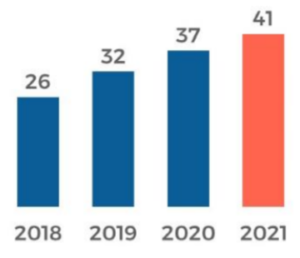
% of Americans who listen to podcasts monthly: 2018-2021
More than half of Americans Ages 12-34 Listen to Podcasts Monthly
As of 2021, 56% of all Americans, 12-34, listen to at least one podcast per month, compared to 49% in 2020.
Monthly Podcast Listening Growing Fastest Among Older Americans
From 2020 to 2021, the percentage of Americans ages 55+ who listen to podcasts monthly increased by 18%.
At present, more than one-quarter of all 55+ consumers in the United States are listening to podcasts a month.
Each Week, More Americans Listen to Podcasts Than Have Netflix Accounts
In 2021, 28% or 80 million Americans are weekly podcast listeners.

There are now 10 million more weekly podcast listeners than the 69 million Netflix account owners in the U.S.
This could indicate the start of a shift from video to audio media.
Weekly Podcast Listeners Tune in an Average of 8 Podcasts per Week
On average, podcast fans listen to 8 podcasts during the course of a week.
This average is skewed somewhat, however, by hard-core podcast devotees.
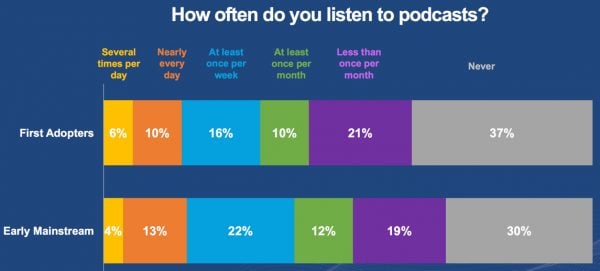
40% of weekly podcast listeners consume 1-3 podcasts per week, but 19% listen to 11 or more podcasts!
Overall, more listeners are listening to more podcasts per week as compared to 2020 in which 51% of listeners listened to only 1-3 podcasts per week.
Almost a Quarter More Americans Now Have “Smart Speakers” in Their Homes
Led by Amazon, growth in smart speaker ownership has been significant.
Smart speaker ownership overall increased by 22% between 2020 and 2021.
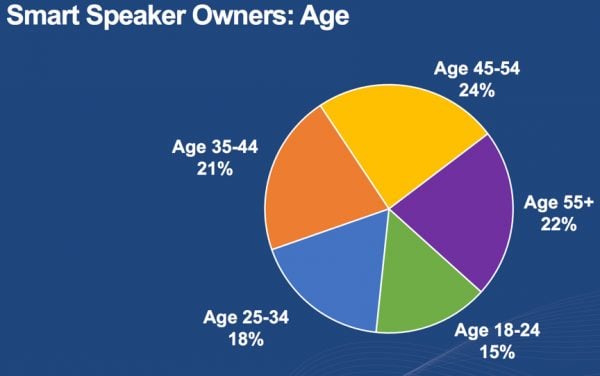
This increase in smart speakers is giving owners more opportunities to listen to podcasts at home.
As the pandemic continues, sales for at-home entertainment devices like smart speakers increased from last year.
Podcasting has become a strong form of media in the United States with listenership increasing in all age groups and the diversity of listeners also increasing.
Listeners also consume more podcasts than ever before possible due to the need for at-home entertainment during the pandemic.
Nevertheless, podcasts have become an important part of media today.

Podcast listening is continuing to soar.
These 2021 podcast statistics demonstrated that we are not yet at “peak podcast”, at least in terms of consumption.
Please do download all of The Infinite Dial from Edison Research and Triton Digital, as there are many more statistics and charts worth your attention.
The post Podcast Statistics for 2021 – Charts and Data appeared first on Content Marketing Consulting and Social Media Strategy.
Source: convinceandconvert.com

5 Ways to Market Your Podcast (And Get More Subscribers)
It’s pretty clear right now that podcasts aren’t going anywhere, anytime soon.
With Spotify willing to spend a rumored $100 million to secure the infamous Joe Rogan Experience, they’re betting BIG (seriously… huge) on podcasts sticking around. 
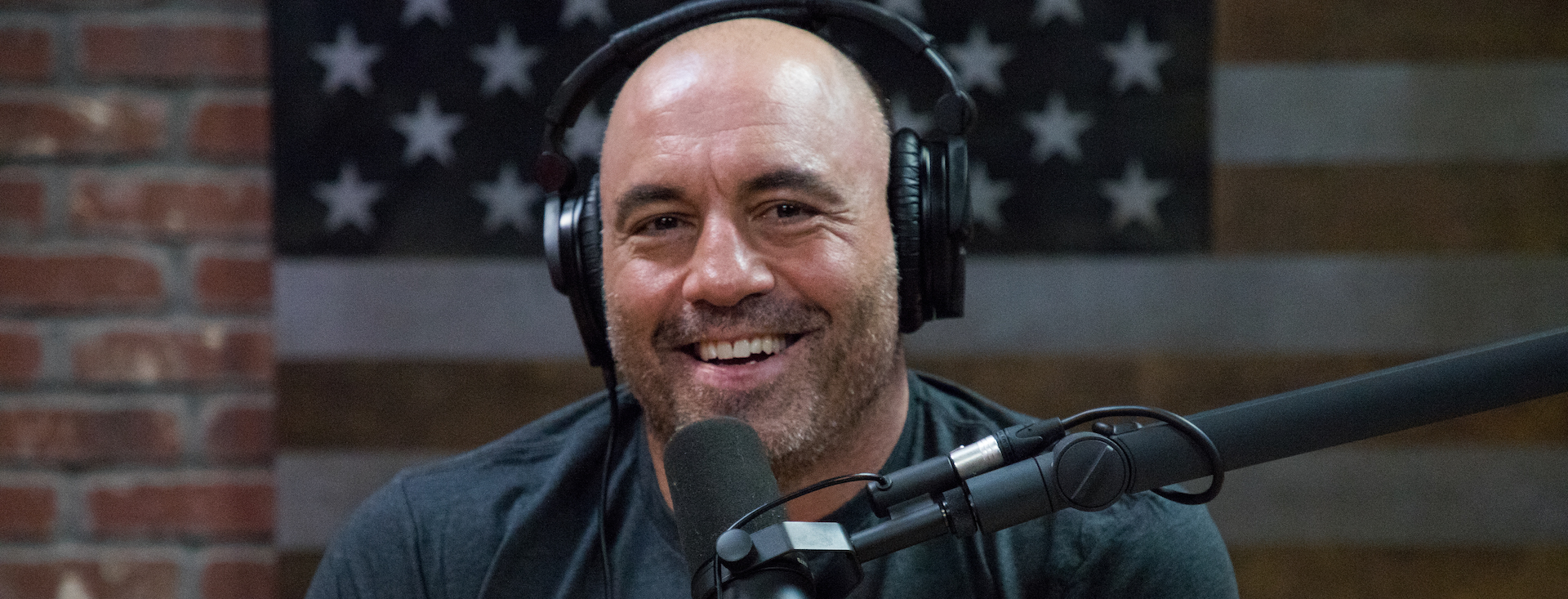
The good news is you don’t need millions of downloads like Rogan to create a successful podcast.
You can have tens, hundreds, or thousands of listeners and be able to create sustainable lead generation for your business or partner with the right sponsors for who you know you can land conversions.
But, where do you start?
If you have a podcast already and you’re wondering how you can get more subscribers, or your brand new and you need to start from zero—we’ll show you how to market your podcast so you can reach more listeners.
5 Ways to Market Your Podcast
Here are 5 ways to market your podcast and get more subscribers.
#1: Interview people with engaged audiences
This is a strategy you’re probably familiar with.
There’s a reason so many podcasts are built on the interview-style model.
Interviewing somebody with an audience puts your content in front of new faces.
It’s one of the most popular ways to grow your subscribers.
The key to collaborating with influencers in your industry is to make sure they have an engaged audience.
If someone has 10,000 Instagram followers that they can share their interview with, and you see that their posts are averaging 500-1,000 like each—this is a really good person to collaborate with.
They have a super-engaged audience (5–10%) which shows the potential for a high conversion rate too.
When they tell their followers about their interview with you, they’re going to be interested in listening… which means they’ll pop over to your podcast.
Let’s make something clear though—you’re not just interviewing people because of their audience.
You want to bring people on your show who make sense based on the topics you talk about.
If someone has a tiny following (or no following) but they’re going to give your audience golden nugget after golden nugget of awesome information… bring them on!
But just be aware that you’ll have to do the promotions for that episode, but we’ll talk about how to do that below.
#2: Create timely episodes
Did Elon Musk just tweet something crazy (again)?
Let’s say your podcast is based on interviewing entrepreneurs, this is a great time to record an episode talking about what Elon tweeted and what your thoughts and your guest’s thoughts are on it.

Creating timely podcast episodes makes people want to listen to that content now.
You won’t get saved in their “Listen to Later” folder, which we all know can become a black hole.
People will want to listen to that content right away so they can stay up to speed on what’s going on.
There’s a lot of potential for creating podcast episodes that are timely, here are some marketing examples that you can steal:
- Algorithm changes
- Facebook news
- Amazon news
- New Facebook tools
- New industry trends
- Strategies working right now
To stay on top of what’s happening in your industry, go to the top player’s Twitter profiles and opt-in to get notifications when they tweet something new.
When somebody tweets something that you know is going to be big news, get a podcast scheduled so you can talk about it.
#3: Make video snippets to share on social media
Think of these video snippets like the appetizer before your podcast dinner.
You want people to get a taste of how good the food is going to be—and start to get super excited for dinner to be served.
In this case, dinner is your podcast episode and the appetizers are the video snippets you’ll tease it with.
Using video snippets to market your podcast doesn’t require an awesome podcast hosting setup.
You just need a decent amount of light and a camera (you can even use your iPhone) to record the video.
If you’re having Zoom interviews, you can record your screen.
Then take snippets from that episode and post them on Instagram, Facebook, Twitter, LinkedIn…wherever you are growing your audience.
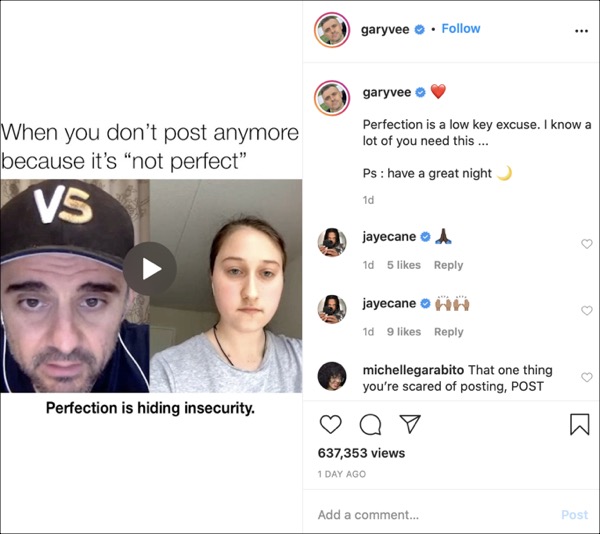
Here’s what each snippet should have:
- Title above video
- Captions on the video
- A 1–2-minute conversation that ends in a complete thought
A quick explanation on that last part “the complete thought”: Don’t end this video with a cliffhanger that makes people feel like they watched your content and didn’t get what was promised.
Make sure to deliver on the promise made in the headline.
Here’s an example from Gary Vee on what this video snippet could look like:
#4: Make sharable content based on your episodes
Marketing your podcast doesn’t have to only be your job—you can get your subscribers to help.
Whether that’s making memes that they think are funny and want to share, inspiration quotes, educational video snippets, etc.
You can post these to your Instagram stories, feed, Twitter feed, or LinkedIn to create FOMO around the content of your episode.
You can make memes on Imgflip or just write content above an image or video.
Here’s an example of how Morning Brew created a meme based on the content in their business newsletter (this got 1 million impressions…plus, check out the view count):

#5: Promote episodes regularly on social media
Just because an episode is a few months old doesn’t mean you can’t keep talking about it.
Using social media, you can continue the conversation you had on your podcast episode for the indefinite future.
For example, you can pop on to Instagram stories and talk about something that was mentioned in the podcast. Then you can say,
“I went way more in-depth on why Mars really isn’t Elon’s soul dog and how to figure out what yours is on Episode 8 of my podcast.
I’ll put a link to that episode in my bio if you want to listen to the episode and find out what YOUR soul dog is.”
And of course, you’ll be promoting your new episodes each time they come out.
Here are a few ways to get people excited to listen:
- Tease content before the episode comes out (you can use your video snippet)
- Show behind the scenes of you recording the podcast
- Talk about upcoming guests instead of just announcing you interviewed them (similar to BTS)
- Ask listeners to give you fun facts or ask for shout outs
Marketing your podcast is just like marketing a service or product—you need to put it in front of the right audience.
We know your podcast is awesome and people want to listen to it.
Now it’s time to execute the strategies that will get you more subscribers.
The post 5 Ways to Market Your Podcast (And Get More Subscribers) appeared first on DigitalMarketer.
Source: digitalmarketer.com

Is a Podcast Right for Your Business? (5 Questions to Ask Before You Start a Podcast)
It happens to all of us—we’re listening to a kickass podcast episode from another business and we have an epiphany…
Why don’t I do this?!
Been there done that (so much so that we have 2 podcasts).

Podcasts are great—really, really great—way to reach your customers, show your expertise and create more content that builds a relationship between your customers and your business.
We’re all for podcasts, but that doesn’t mean every business necessarily needs one.
Some industries work perfectly for podcasts while others might be a huge miss.
Before you spend time and money on creating the ultimate podcast studio and reaching your audience, ask yourself these 5 questions.
5 Questions to Ask Before You Start a Podcast
#1: Will Your Podcast Help You Reach More Customers?

Just like with any type of content you’re thinking about creating you want to make sure it’s something your customers even want.
While a huge majority of consumers are interested in listening to podcasts, the question is—are they interested in a podcast from you?
If you feel like they are… then that’s a green light to move forward to the next question.
If you’re already wondering if they would be, it doesn’t mean you can’t create a podcast.
You just may need to get creative on the traditional model.
For example, Macy’s could host a podcast where they have a famous fashionista interview other famous people in the fashion industry. While their consumer isn’t going to be overly excited for a podcast on the backend of Macy’s business model, they’ll definitely be interested to hear from fashion leaders. Don’t be afraid to get creative!
#2: Can You Show Your Expertise Via Podcast?

For most businesses, the answer to this question is yes, but for a select few this might be a bit harder.
We’re not mosaic painting experts, but it might be hard to showcase your expertise as an artist using only words (we’re definitely open to being proved wrong here though  ).
).
To make sure a podcast is right for your business, you want to figure out how you’re going to be able to showcase your expertise within each episode.
For example, that could be by interviewing experts, talking solo about industry topics, or even explaining how you’ve been doing something that others in your niche would want to do as well.
These are all ways to show your expertise.
#3: Can You Tie Your Podcast Back to Your Product?

At the end of the podcasting day, your podcast has to serve a purpose.
More than likely, that purpose is to create awareness around your products.
When you’re thinking of creating a podcast, you need to think of the end goal.
If you want to increase sales, what does your podcast need to be about that would tie perfectly back to your product?
For example, at DigitalMarketer we have the Perpetual Traffic podcast and The DigitalMarketer Podcast that talk about marketing strategies and interview experts.
These topics fit perfectly with our membership courses and workshops as well as our annual live event, so it makes sense to have them.
#4: Can You Commit to Sticking to It And Being Consistent?

Sporadic podcast uploads don’t drive a huge subscribership.
Just like other mediums of content (blogs, videos, social media posts, etc.) you can’t just hit publish once every few weeks. You’ll need a schedule to show people that you’re consistent and they can expect to hear from you every day, week, two weeks, etc.
Tell your subscribers, listeners and everyone else what days they can expect to get your newest episode and build an editorial calendar around it.
Create a podcast schedule and make sure you stick to it!
#5: What Would Be the Best Possible ROI from Your Podcast, and Can You Get That With Less of an Investment?
And the most important question of all—is podcasting worth the investment for your business?
This a tough metric to nail down as podcasting is generally pretty difficult to pinpoint conversions through.
But, you can look at the time and money investment it will take to start and maintain your podcast and ask yourself, “Could we put this money elsewhere and get a better return on our investment?”

For example, let’s say you’re willing to put $1,000 towards your podcast but you’ve also never run social media ads.
A business owner might ask themselves if they should hold off on the podcast and put their $1,000 into social media ads so they could get a clear ROI.
Once their ads are converting, then they can decide if now is a better time to start a podcast.
Podcasting can have a great ROI on your business, especially in the first few stages of the Customer Value Journey.
But, that doesn’t mean it’s the best move (right now!) for all businesses.
Use these 5 questions to confidently choose, or not choose, to start your podcast.
The post Is a Podcast Right for Your Business? (5 Questions to Ask Before You Start a Podcast) appeared first on DigitalMarketer.
Source: digitalmarketer.com

7 Must-Haves for Starting a Podcast
Let us be the first to welcome you to the truly wonderful world of podcasting.
Seriously.
We love podcasts so much that we have 2 of them (and one of them has over 4 million downloads). 
When we first started podcasting, we did it with hope in our eyes.
We knew that it wasn’t necessarily the most easy-to-track way to promote ourselves—but we knew that it could work.
And it did.

Now that we’ve launched 2 successful shows, we’re going to show you the essentials of starting your own podcast.
You don’t need a huge budget or listenership to start your podcast.
You just need to know who you’re doing it for, what you’re going to talk about, and a few pieces of tech and software to pull it all together.
7 Must-Haves for Starting a Podcast
Here are the 7 must-haves for starting a podcast.
#1: Ideal Listener
Your ideal listener is your customer avatar.
They’re the person you ideally want listening to your show and who you’re going to curate your content around.
For example, Tim Ferriss’s ideal listener is somebody who wants to improve themselves by listening to how others are eating, exercising, doing business, and pushing their mental limits.

This person is also going to be interested in Tim’s other products, like his books Tools of Titans, 4-Hour Workweek, and Tribe of Mentors.
For The DigitalMarketer Podcast, our ideal listeners are marketers, agency owners, and business owners who want to learn from successful marketers and entrepreneurs as to how they can improve their business.
This is also the DigitalMarketer customer avatar, which means all of our listeners are also leads that we can talk to about our products (as necessary).
To figure out who your ideal listener is, you can fill out the Customer Avatar Worksheet which will help you with the next podcast must-have: your description.
#2: Podcast Description
Without surprise, your podcast description is going to describe your podcast.
What can listeners expect and who can they expect it from?
For example, here’s the description for the Perpetual Traffic podcast as it’s seen on Spotify.
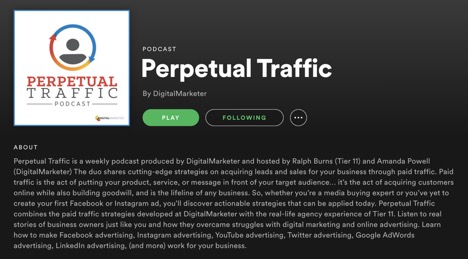
Here’s a checklist of things to include in your podcast description:
 How often you publish a new episode
Who is hosting it
What industry you talk about
Who gets value from your podcast
#3: Podcast Cover Art

Podcast cover art is the image that will appear when somebody searches or listens to your podcast.
Your cover art is essentially the logo of your podcast—you want something that when people see it, they immediately think of you.
There are several options for creating podcast cover art from choosing just graphics or deciding to make it a photo of yourself.
For example, here’s our podcast, Perpetual Traffic’s cover art that’s a graphic:
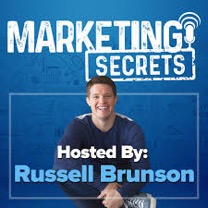
And here’s the cover art for The Marketing Secrets Show by Russel Brunson that features a photo of Russel:
There is no right or wrong when it comes to creating your podcast cover art. Just make sure that it’s on brand.
#4: RSS Feed
Your RSS feed is how you’ll post your podcast to be heard by your listeners.
This RSS feed will either be on your own website or through a podcasting platform that you choose to host your podcast through.
For example, you can post the audio directly to your website and have that link to iTunes, Stitcher, TuneIn, etc. OR, you can use a platform like Libsyn to upload your audio and have your RSS feed through them.
There is no right or wrong choice here.
We suggest doing research on different podcast hosting platforms to see if there is one that suits your needs and is a better option than hosting on your own website.
At DigitalMarketer, we host our podcast through Libsyn and use a Smart Player to make the audio accessible on the show notes of each episode.
#5: Microphone
Alright, now that we’ve gone over the parts of your podcast that will be seen and heard from others, it’s time for the stuff that only you really see: the tech.
As a new podcaster, you do not need to spend a hefty amount of money on a state-of-the-art microphone.

A good starter microphone is the Audio-Technica ATR2100 USB.
It’s about $100 and it has a USB connector so you can record audio directly to your computer.
Since this is a handheld microphone, make sure you’re getting a stand and clasp for it as well (which should be included when you purchase it).
With your cool new mic, you’ll want to find a quiet place to record your episodes.
Since the audio is the make-all-be-all of your podcast, you want to make sure there isn’t distracting background noise or weird echoes from recording in an empty room.
Make sure to run a few audio tests before recording your entire episode so you know it sounds  .
.
#6: Audio Editor
The second tech that only you’ll see is your audio editor.
This isn’t a total necessity if you just want to record yourself talking and aren’t worried about editing out your pauses or “ums,” but if you want to take your podcast to the next level you can use the audio editing software.
If you’re on a budget, you can easily use iMovie or Garageband. Both of these come free on Apple computers.
You can record your audio using Garageband and edit it inside of Garageband or export it into iMovie to edit depending on which platform you’re most comfortable with.
Once you’re ready to go to the next step, you can use platforms like Logic Pro X and Descript to edit your audio.

#7: A (Mini) Marketing Strategy
Ah, and now it’s time to get people to listen to your podcast.
While we’re CERTAIN that your podcast is awesome, it can be hard to get the word out about it if you don’t already have a big audience.
Here are a few quick tips for marketing your podcast:
- Invite guests to be interviewed: This will put your podcast in front of their audience and help you get more exposure
- Be a guest on other people’s podcast: As a guest on someone else’s podcast, you’re being exposed to their audience and can show them why they would want to come over and listen to your episodes
- Take your episodes and turn them into articles: You can post these articles on your website, Medium, or Quora with a sentence at the bottom that says, “Originally posted as Episode 6 of the Brand New Podcast, listen here for more tips on marketing your podcast.
- ”Promote in Facebook groups, forums, subreddits, etc.: While promoting is usually banned in these groups, if you provide enough value in your answers and posts you’ll be able to mention your podcast without making moderators mad
- Advertise in newsletters: Find the newsletters that your ideal listener is subscribed to and ask if you can have an ad spot in one of the upcoming emails
And that’s pretty much everything you need to get started with your own podcast.
It shouldn’t cost you a huge amount of money and you don’t need a huge following to get started.
You do need to be willing to figure out exactly who your ideal listener is, what content they’re going to care about, and how you’re going to get your show in front of more people.
Remember, every podcaster started somewhere (even Joe Rogan).
The post 7 Must-Haves for Starting a Podcast appeared first on DigitalMarketer.
Source: digitalmarketer.com