
Tag Archives for " Paid Marketing "

How to Utilize Chatbots in Tandem With a PPC Campaign
Have you thought about incorporating the AI magic of chatbots with the wide net of a PPC ad campaign? Combining these two strategies can add a boost to your next digital marketing campaign.
To ensure a successful PPC campaign, you have to start with the end in mind.
- Where do you want people to go once they’ve seen your ad and shown some interest?
- Do you want to make a sale or provide information?
You also need to consider what they want to learn about you and how you can help them find all the information they want.
That’s where chatbots come in.
What Are Chatbots?
Chatbots are a type of artificial intelligence (AI) created to answer customer questions.
They’re capable of answering basic or common questions, sending people to pages answering their questions, looking up orders, and more.
You can program your bot to escalate a customer to a real person if needed as well.
Most people think to look for chatbots in the lower right-hand corner of a company’s website.
The button may say something like “chat now” or “support,” like the one on Imperfect Foods’ website:
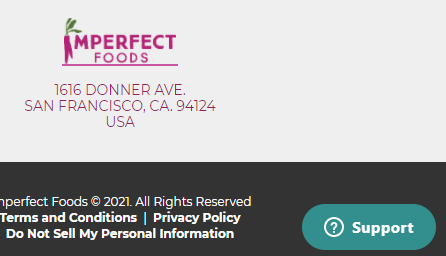
However, you can also set them up on Facebook Messenger and some other social media sites.
Chatbots can become very interactive, depending on the platform and the script.
Also, you can check in with them however often you want and follow up with prospects when needed.
Functionalities vary widely, but however you incorporate bots, they can be a powerful, real-time player in your digital marketing strategy, buttressing your PPC campaign with interactivity and deepened brand awareness.
5 Ways to Use Chatbots During a PPC Campaign
The great thing about adding chatbots to your PPC campaign strategy is the flexibility they bring.
No matter your business, sales goals, or individual PPC campaign goals, chatbots can become your right-hand person when you can’t be there for every click-through.
Here are five things they can do to help your customers while freeing you and your team up to focus on the big picture.
1. Answer User FAQs Immediately
We’ve all seen PPC ads, and chances are you’ve clicked on at least one because it intrigued you enough to want to learn more about what was in the content you saw.
- Was your curiosity satisfied immediately?
- Or did you have to dig for the information promised by the ad?
Save your prospective customer the trouble and have a chatbot ready to answer their questions.
When a user clicks the PPC ad, your chatbot can appear on the page and ask if they have any questions.
Through a series of scripts, you can help prospective customers learn more about you and find the products or services they need.
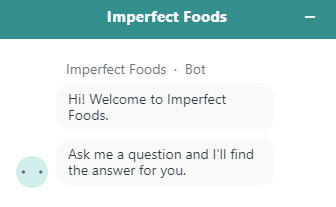
Going back to the Imperfect Foods example, if you’re a first-time visitor, it simply tells you to ask it a question.
However, if you’re a returning user, it knows why you probably clicked on the chat function: You forgot your password.
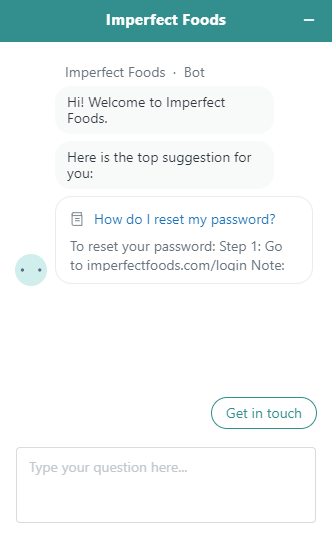
If that’s not knowing what your audience is going to ask, I don’t know what is.
2. Forge a Connection

People like to make a connection with real people behind a brand.
A chatbot is, by definition, a bot—not an actual person.
However, even when companies tell consumers they’re talking to a bot, something fascinating tends to happen.
According to Psychology Today, “When interacting with chatbots, our brain is led to believe that it is chatting with another human being.”
Further, since they are always there, ready to help, people can feel a real personal connection with them.
(So, be sure to program your bot’s voice to fit in with your brand story!)
This can improve brand awareness and encourage people to continue that connection by following you on social media or coming back to your website when they need your products or services.
It could also help with immediate sales. Getting emotions involved in your marketing can improve your leads and conversions.
People like feeling supported. When they come to your website and don’t have to poke around to get their questions answered and find the resources they’re looking for, they’re likely to feel better about the experience.
3. Direct Users to the Right Landing Pages, Product Pages, or Resources
As you create your PPC campaign, the reality is you can’t guess what every person is shopping for.
While you should create a targeted landing page or ensure your PPC ads take users to the right place, sometimes miscommunications between customer intent and where they land can occur.
How can you keep users from landing on your page, then immediately bouncing if they don’t see exactly what they need?
A chatbot can showcase your entire inventory or website content from any page your customer lands on.
You can use them to ask users what they’re looking for and direct them to the corresponding page or resource.
4. Learn More About Your Target Audience
PPC ad campaigns only tell you so much about who is clicking.
You can gather specific metrics from analytics, but those are often demographic stats from which you would have to deduce motivations or needs.
- What is your target market looking for?
- How can you help meet them where they are?
- Why not use a chatbot to actually ask them?
In an on-brand tone, you could have your chatbot pop up with a specific question to start a conversation.
Even if a customer chooses not to buy or comes back later, that chatbot conversation can help you uncover valuable information about your target market.
As the PPC campaign continues, you can look for patterns.
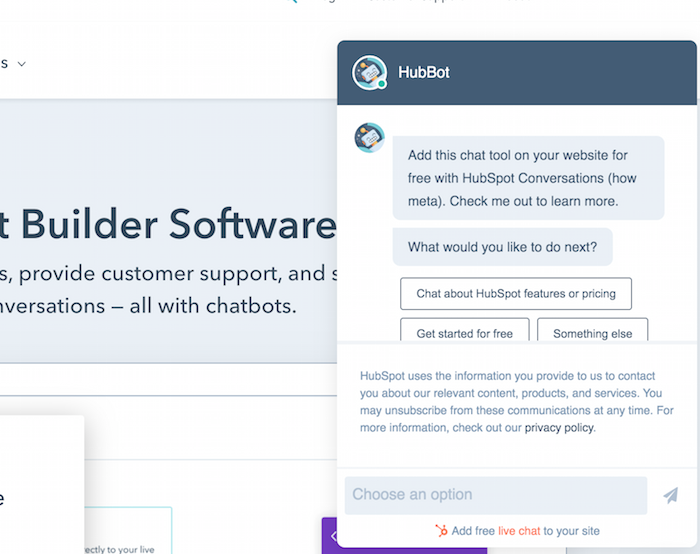
For example, HubSpot uses chatbots on their pages to ask the user what they want to do next.
HubSpot employees can review those conversations later to learn about what their viewers are looking for.
5. Improve Brand Awareness
Whether your PPC campaign is introducing potential customers to your brand for the first time, debuting a new product or service, or keeping your brand at the forefront of your target market’s mind, chatbot integration can help to improve your brand awareness.
From the first pop-up welcome or introduction message to the answers to questions, chatbots can be designed to show brand personality.
This can be as simple as just using vernacular specific to your brand and how your customers talk.
If your brand is casual, perhaps a chat could start with “Howdy!”
If your voice is more formal, something like “How may I assist you today?” could be more appropriate.
You can also incorporate any characters or mascots you use in your branding to be the “face” of the chatbot.
Generally, people logically know they aren’t talking to a real person and are okay with that.
However, it’s much more fun and feels more personal if they get to talk to a character associated with your company, thereby potentially improving their experience with your brand.

Evaluating the Success of Your PPC Chatbot Strategy
Before you can dive into the metrics and measure whether your chatbot PPC campaign is working, you need to define success for yourself.
What are you trying to accomplish with this campaign?
Success metrics could include:
- higher sales of a particular product or service
- more visitors to your website
- an increase in followers on a social media platform
- additional sign-ups for your newsletter
- heightened awareness of your brand offerings
When you know what defines success for this campaign, you can look at the right metrics to understand what’s working and what you can improve upon.
With the PPC campaign as a whole, one of the primary data points you can look at is click-throughs.
With chatbots, though, there is an added component: Interaction.
The conversations between chatbots and users allow you to answer questions like:
- How often are people using your chatbot?
- How long are the interactions?
- What sorts of things are users searching for?
- Which conversations turn into conversions?
The information you learn from your chatbots in your PPC campaign can help you:
- optimize campaigns for what buyers want based on common queries
- create content reflecting what buyers ask
- update inventory based on what buyers are looking for
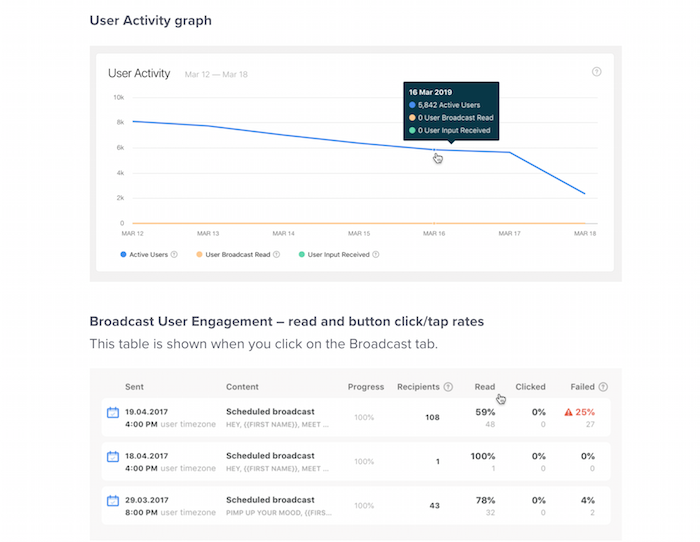
Here are two examples of how Chatfuel shares its chatbot metrics. Users can explore engagement through these dashboards. Most chatbot platforms have similar metric dashboards.
Chatbots for PPC Campaigns FAQs
Q: How do I get people to use my chatbot?
A: Your chatbot on your PPC campaign’s landing page needs to be obvious, popping up soon after a user clicks your link.
To encourage interaction, program your chatbot to welcome the user and ask them a question.
Q: What is the best chatbot platform?
A: The best chatbot platform for PPC campaigns is one you can seamlessly integrate onto the landing page where people click to.
This varies by your needs, but HubSpot’s Chatbot Builder, ManyChat, and Chatfuel may be worth checking out.

Q: How expensive is it to set up a chatbot?
A: Chatbot pricing depends on the provider and features you choose.
Many offer free trials or a free basic level, with prices going up after your trial or as you add additional options.
Q: How can I make my chatbot interesting?
A: Give your chatbots a personality in line with your brand.
Make the bot feel like a real person, even if you’re upfront about being a bot, so the user feels connected to your brand.
The bot should introduce itself, ask questions, and provide relevant information to customers as they interact.
Chatbots Conclusion
Using chatbots in tandem with PPC campaigns can make your prospective customers feel “seen,” help them learn more about your brand, and potentially increase conversions thanks to the help they give.
Setting up a chatbot on the landing page of your PPC campaign can put your brand’s features, options, benefits, and customizations at your customers’ fingertips from the get-go.
The chatbots your PPC campaigns introduce users to can also teach you more about what your customers want.
Then, you can use that data to create future digital marketing campaigns specific to their needs.
How are you going to incorporate chatbots into your next PPC campaign?
Source: neilpatel.com

How to Choose The Right PPC Agency
But year after year, global ad spend across every major PPC channel is growing even higher. And this explosive growth isn’t happening for no reason. It’s happening because PPC works.
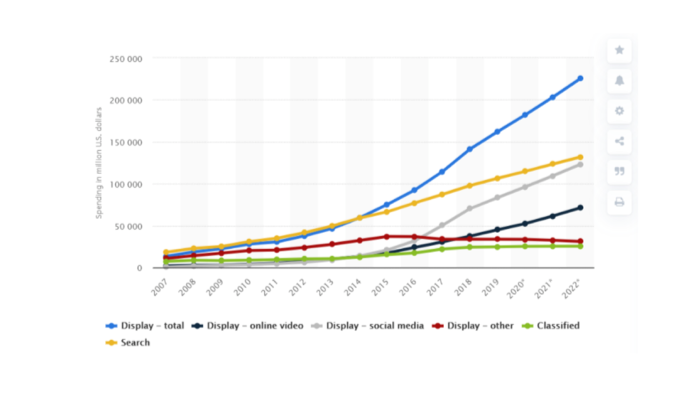
Source: Statistica
In 2017, PPC advertisers invested over $10 billion dollars.
If you stacked that many $100 dollar bills on top of each other, you’d have a nearly seven-mile tall tower of money. So, that’s a TON of money.
But year after year, global ad spend across every major PPC channel is growing even higher.
And this explosive growth isn’t happening for no reason.
It’s happening because PPC works.
It’s the classic “spend money to make money” model.
From social media to paid search, PPC is a smart way to see quick results.
But that’s only true if you know what you’re doing.
Which… is where an experienced PPC agency comes in.
They spend countless hours experimenting and learning everything there is to know so you don’t have to.
So if you’re looking to hire an agency to create and manage your PPC campaigns but aren’t sure where to start, you’re in the right place.
In this article, I cover:
- What to look for in a PPC agency
- How to work with them for maximum results
- Steps to finding the right agency
- My top five recommendations
Let’s dive in!
Know your goals and desired outcomes
PPC campaigns exist for a wide variety of reasons.
And it’s crucial to have a clear picture of what you hope to achieve before you go through the process of finding the right PPC agency.
Without this essential set of information, you’ll have a hard time making an educated decision.
So before you get started, sit down with your team and set clear goals and expectations.
There aren’t any right or wrong answers, but it’s good to understand this from the get-go.
Your goals may include:
- Adding more qualified leads to your automated sales funnel
- Selling more of a specific product or category of products
- Increasing the number of visitors to a landing page
- Building awareness for your brand
Right now, you need to set an overall goal for your next campaign.
Understanding your expectations makes it easier to communicate what you’re after and ensures everyone’s on the same page.
The idea is to reach a high-level agreement on why you want to hire a PPC agency.
You should also consider the level of participation you want to have throughout the process.
Do you want to be super hands-on, or are you hoping for someone to completely take over?
Lastly, don’t worry about the finer details just yet.
You can work through the specific metrics and KPIs you want to measure later when you actually sit down with your new PPC partner.
7 characteristics that make a great PPC agency
Now you have a crystal clear picture of your goals, expectations, and level of participation. So it’s time to start talking about what characteristics to look for.
Not all PPC agencies are equal. Some excel at specific advertising types, while others specialize in creating excellent customer experiences across every platform.
One isn’t necessarily better than the other, but it ultimately depends on what you’re looking for.
So use these characteristics as a baseline for creating a list of viable options.
They’ll help you narrow your choices down to those PPC agencies that are worth every penny.
From there, you can sit down with them before making a final decision.
Let’s get started!
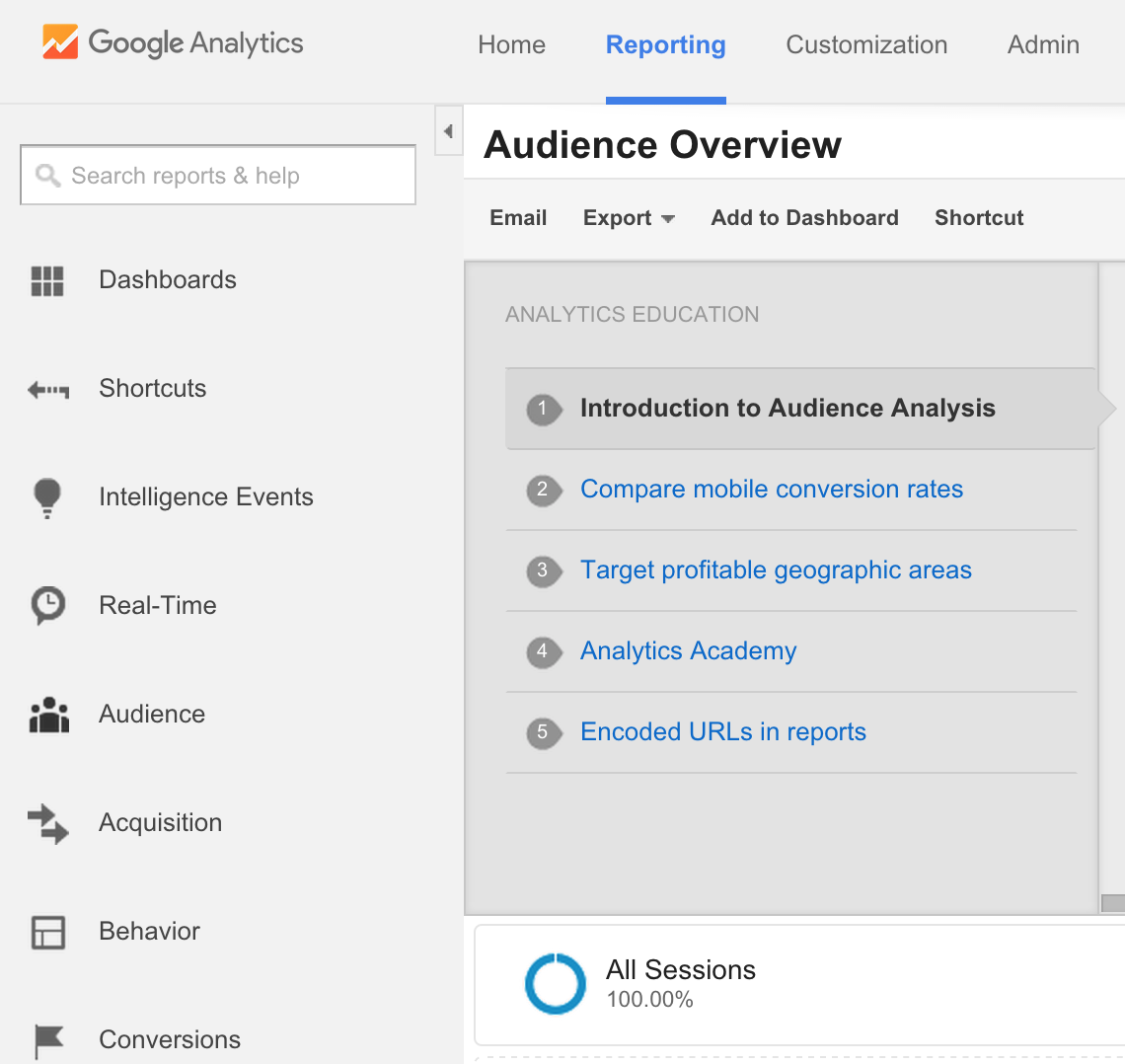
1. They value data, analytics, and results
PPC is an exciting form of digital marketing because you can directly tie revenue generated to ad spend.
So data and analytics are crucial to the success of future campaigns.
The best PPC agencies understand how to use numbers to strategize new ideas that improve your overall ROI.
They use what they already know and what they learn about your target market to develop high-yield campaigns.
Furthermore, they also understand the importance of collecting as much information as possible as well as sharing that data with you.
If it’s not clear on their website, be sure to ask questions to help you gauge this before working together.
You can ask things like:
- What tools do you use to measure essential PPC metrics?
- Will you actively share data and results with us?
- Do I have independent access to analytics and reporting?
- Is a full analytics report included with your offer? If so, what do you include in those reports?
2. Strategic partnerships and first-party data sources
The longer you’re in business, and the more campaigns you run, the more first-party data you gather about your specific audience and how they behave.
But the best PPC agencies have an extensive database of their own first-party data as well.
Furthermore, they know how to use it to predict your audience’s buying behavior based on similar industries and past clients.
And they may also connect with first-party data sources to tap into their pool of information as well.
Aside from data, smart agencies partner with leading search and social media platforms.
Partners are the first to know about new changes and updates.
This means they’re ahead of the game when things change.
Which… seems to happen by the second.
So, these strategic partnerships give PPC agencies in-depth insight non-partners don’t have.
Look for indications of this on their website or ask about it if you’re unsure.
3. Knowledge of local search
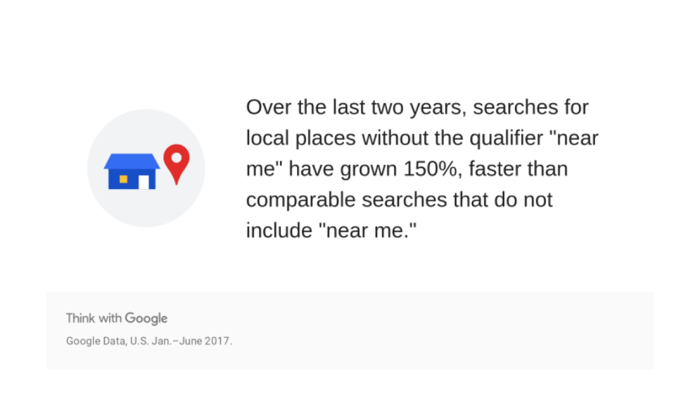
82% of smartphone users turn to search engines to find businesses close to them.
They use phrases like “near me” to decide where to eat lunch, go shopping, and find entertainment, among other things as well.
Furthermore, 76% of those searches lead to an in-store visit on the same day.
Source: Think With Google
So, local search isn’t something your business can afford to ignore if you want to drive foot traffic to a physical location.
Whether you use your business to sell products or meet with clients, it’s crucial to show up in search results at the right time.
Make sure to choose an agency with a strong knowledge of local search (both paid and organic).
You may not be able to find this information on their website, so be sure to ask questions.
During your first call, it may help to ask things like:
- How do you approach local paid search objectives?
- Can you share any local PPC results you’ve produced for similar businesses?
- We want to reach our local community. Can you tell me a bit about how that works?
- How do you measure the success of location-based keywords?
- Do you use bid modifiers for location-specific queries?
4. Strong mobile optimization capabilities
Mobile devices account for over half (53%) of clicks on search ads.
The era of designing creatives and writing copy for desktop first… is over.
It’s more important than ever before for PPC ads to be easily accessible on devices of all sizes.
And the world of mobile optimization is tricky, especially when combined with ever-changing search and social algorithms.
So it’s crucial to hire a PPC agency that knows how to tackle this transition to on-the-go browsing.
Some agencies may highlight this as a feature on their website, while others may not.
So be sure to ask questions during your initial phone calls to ensure they know their stuff.
To gauge this, you can ask things like:
- Can you share any mobile-specific results for previous campaigns? What’re your thoughts on designing PPC ads for mobile rather than desktop?
- Do you provide mobile-optimized copy and display ads, or suggestions to improve them?
- Do you leverage bid modifiers for mobile devices?
5. They focus on the right PPC channels
Whether you’re interested in search, social, programmatic, shopping, or multi-channel PPC campaigns, it’s essential to find a PPC agency specializing in the platforms you want to use.
There’s no right or wrong marketing channel. But it does depend on your end goal.
Some agencies may only manage search campaigns while others may consult, design, and manage paid social media campaigns.
No two campaigns are alike, nor are two PPC agencies.
So first, you have to understand what you’re looking for.
- What channels are you considering?
- Do you need help with design or ad copy as well?
- Maybe you want a collaborative project, or perhaps you prefer entirely hands-off.
Decide what you need and expect from a PPC agency and use that to guide your decision.
Be sure to sare your expectations and goals during your first meeting to ensure they’re a good fit.
6. Impeccable keyword research
The quickest way to see a return on your investment is by targeting commercial-intent (transactional) keywords.
People searching for things like “Buy iPhone X” or “best web hosting services” are ready to buy.
But making more money isn’t the only goal behind PPC advertising.
Maybe you want to grow your email list to add more leads into your sales funnel.
Or raise brand awareness.
Or drive traffic to help increase ad revenue.
Regardless of the end goal, your PPC agency must understand your campaign’s purpose and help you choose appropriate keywords to target.
This isn’t something you can usually find on their website.
So you’ll have to do some digging.
Here are some great questions to ask during your first call:
- How do you decide what keywords to focus on?
- What keyword research tools do you use?
- Can you tell us about your keyword strategy for a similar business?
- What metrics do you use to decide if a keyword is performing well?
7. Well-versed in all things digital marketing
PPC advertising doesn’t exist in a vacuum.
It’s usually a small piece of a broader digital marketing strategy.
And the best PPC agencies know this and work to create effective campaigns and PPC strategies to support your high-level business goals.
Sure, PPC requires strong keywords that target the right audiences.
But it goes much further than that as well.
Great agencies understand the big picture and oftentimes can help improve other pieces of your digital marketing system because they’re great marketers themselves.
How to work with a PPC agency
Now you know what to look for in a PPC agency.
But if you’ve never worked with one before, you may feel unsure of what to expect going into your new partnership.
And there are several things you can do as a client to enhance the overall experience.
Doing these things helps put both your business and your agency in a strong position for success.
Set clear goals and communicate your expectations
We talked about this briefly at the beginning of this article, but I want to come back to it again because it’s so important.
Your goals and expectations set the stage for the rest of your partnership.
It’s critical to understand your goals and communicate them with your PPC agency.
The best agencies use your goals and expectations to develop a strategic plan that works well for both of you.
So if you’re hesitant or unsure of what you’re after, sit down with your team and revisit this.
And make sure you know how to communicate what you want.
Gather and share data from past campaigns
Any first-party data you have can significantly impact the outcome of future campaigns.
Think back to previous partnerships or campaigns you’ve run and gather that information into a clean and easy-to-understand report.
Then, share it with your agency.
Hard data is the best way for them to learn more about your audience’s attributes and behaviors as well as what worked, what didn’t, and why.
This way, they don’t have to reinvent the wheel or start their research from scratch.
Choose one point of contact
To avoid confusion, choose one central point of contact for communications from your agency.
This ensures there are no miscommunications or wasted time from several people managing that relationship.
You can certainly have a team working on the project but limit communications to one person.
It also helps simplify things for your agency as well.
They always know who to talk to, and they don’t have to worry about waiting too long for your response.
Be prepared for advice and suggestions
PPC agencies are excellent at what they do, so it’s essential to listen to their advice and suggestions.
This could be advice on improving your home page for conversions or redesigning landing pages to increase sales.
Perhaps it’s a suggestion to improve your ad copy or headline.
Always remember they’re the experts, and you hired them for a reason — they know their stuff. So take the time to listen and keep an open mind throughout the process.
Ask all the questions you need to ask
There’s no such thing as a stupid question. And there’s no such thing as too many questions, either.
If you’re unsure or confused about anything, the best thing to do is ask.
There’s nothing wrong with not knowing, but there is something wrong with not asking about it.
This helps you learn, and it also helps clear up any confusion about the project.
You can rest easy every day, understanding the hows and whys of your campaign.
How to find the right PPC agency for you
There are hundreds (if not more) of PPC agencies to choose from.
And choosing the right one is often the hardest part of getting started.
But the best PPC agencies for you specialize in the types of campaigns you’re interested in.
They should also have in-depth knowledge of your specific industry.
These characteristics combined help pave the way for the best results.
It may also help to make a list of your expectations and requirements before starting your search.
From there, list the companies you’re considering. Be sure to include:
- Their specialty areas
- What makes them stand out to you
- Why they seem like a good fit
- Pricing if it’s available online
- Any negatives about their business
Then you can use your requirements and expectations to cross off agencies that don’t match what you need.
Lastly, schedule a call with the remaining agencies on your list.
This is your chance to interview them just as much as it’s their chance to interview you.
So ask all your questions and take notes throughout the meeting so you can come back to them when making a final decision.
The 5 top PPC agencies
Now you know what to look for, what to expect, and how to decide.
Here are my top PPC agency recommendations for different business types and sizes to kick off your search.
1. Neil Patel Digital — Best multi-channel PPC company
At NPDigital, we leverage our first-party data and search partners to create multi-channel campaigns designed to meet potential customers wherever they hang out online.
Furthermore, we focus on using data to design an excellent customer experience regardless of how and where they interact with your brand.
And now more than ever, consumers are researching before they buy.
We care about giving shoppers the content and information they need to make informed decisions, all while helping you conquer your PPC goals.
From paid search and social media to Amazon and shopping ads, your PPC campaigns are in good hands.
2. Loud Mouth Media — Best small agency in the UK
Hiring a partner close to your time zone can have a massive impact on the type of communication you have as well as how long it takes to get a response.
If you’re in Europe or the UK, Loud Mouth Media is an excellent small PPC agency serving big clients like Volvo and BBC, as well as small businesses around the world.
And there’s a reason Loud Mouth Media’s won the “Best Small PPC Agency” in the UK two years in a row — they’re phenomenal at what they do.
With the data and results to back it up.
Plus, they’re Google, Bing, and Facebook partners, so Loud Mouth Media is an excellent choice if you’re interested in those channels.
3. Stryde — Best for eCommerce and B2C businesses
If you’re a B2C business or running an eCommerce store, Stryde is a superb choice because they specialize in eCommerce digital marketing for businesses of all sizes.
Furthermore, the B2B and B2C industries couldn’t’ be more different when it comes to PPC.
And there’s no one better to strategize and manage your product-focused campaigns than an agency that solely works with eCommerce and B2C businesses.
Plus, they have an extensive portfolio of case studies that prove they’re great at what they do.
4. KlientBoost — Best for landing page design + management services
PPC ads drive traffic, and landing pages (typically) convert that traffic into revenue or leads.
So it’s no surprise that landing page design and optimization are crucial to successful PPC campaigns regardless of your industry and business type.
If you don’t have an in-house designer or struggle with creating conversion-focused landing pages, KlientBoost is an excellent PPC partner for your business.
Aside from PPC and social media management, they also specialize in designing new landing pages and optimizing existing ones to help you reach and exceed your PPC goals.
Their in-house team of designers and developers is ready to help you craft excellent customer experiences from their first click to their last.
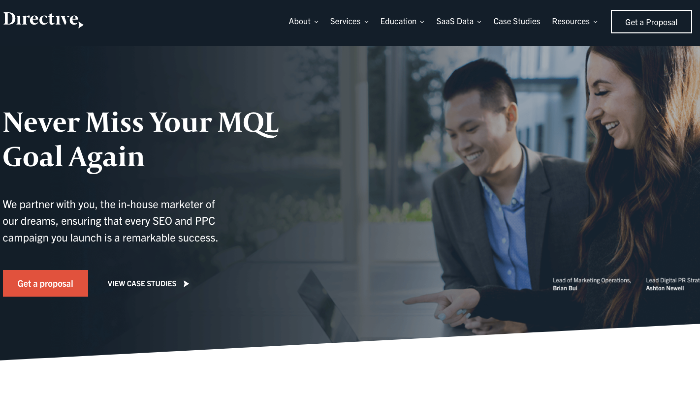
5. Directive Consulting — Best for SaaS and B2B businesses
B2B businesses and SaaS tools face their own set of unique challenges when it comes to PPC campaigns.
After all, you’re targeting other businesses… not individuals.
So you need a PPC strategist and partner that understands how to overcome those challenges.
Directive Consulting specializes in helping software companies conquer every marketing channel from paid search and shopping ads to SEO and CRO.
Whether you’re looking solely for PPC or interested in an entire digital marketing plan from one of the top agencies around, Directive is a fantastic choice.
Plus, they offer digital marketing education, and they have a pool of first-party SaaS data you can tap into.
You + the right agency = reliable results
Choosing the best PPC agency for your business is just as important as crafting the perfect copy, designing eye-catching creatives, and publishing conversion-focused landing pages.
There’s no doubt you have a powerful message and life-changing products for the right audience.
Plus, you owe it to them to put it in front of them when they need it.
The right PPC agency helps you do just that while helping you generate more leads, make more money, and get more eyes on your brand.
It’s a win-win for everyone involved.
The good news is that you now know what to look for throughout the process.
So next time you’re looking for your dream PPC agency, use the tips, tricks, and characteristics we talked about.
And remember: an excellent PPC partner and reliable results can make a world of difference for your business.
You deserve it and your customers do too.
What do you look for when hiring a PPC agency?
The post How to Choose The Right PPC Agency appeared first on Neil Patel.
Source: neilpatel.com

The First Step in Creating Video Ads That Sell
If you’ve been spending a little extra time on YouTube lately (we’re just as guilty as you are), you may have noticed a few really good video ads that made you think, “I kinda want to buy that.”
As business owners and marketers, we’re a hard sell.
If one of Superman’s superpowers is X-ray vision—ours is seeing right through lead magnets and funnels.
We’ll happily buy products and services that make our life easier…but you’re going to have to really sell it right.
That’s why these video ads that stop us in our tracks (even when all we wanted to do was watch our chosen video) make us extraaa impressed.
What did they do that was so good?
When a video ad can show us what our lives are like before and after we use the product or service, that’s when our ears perk up.
It all comes back to take us from our Before State (pre-product) to our After State, (post-product).
How to Figure Out Your Audience’s Before State
At DigitalMarketer, we call the state that somebody was in prior to buying your product/service the Before State.
This is the state where somebody wants a solution so much that they’re daydreaming all day about it.
This Before State describes the problem that somebody is facing, so you can figure out the solution they’re looking for.
When you see a video ad that makes you think—” That’s exactly the problem that I’m having!
And wait… that’s also the solution I’m looking for!” This is what the video ad did.
It described your problem and showed you the solution.
And that’s how Billy Gene is creating video ads that sell.
In his The Pain Process Worksheet, he figures out who he’s targeting, their 3 greatest paints, and the solution to each of these pain points.
Here’s Billy Gene’s Pain Process Worksheet:
(NOTE: Download the worksheet for FREE here!)
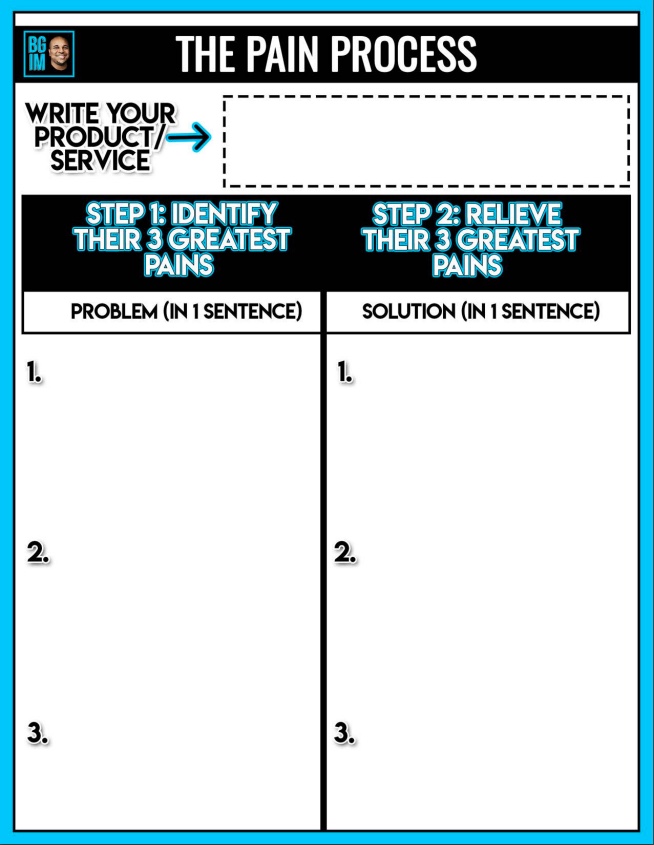
To figure out your audience’s Before State and the problems that they’re facing, you want to ask questions like:
- What problem do they have?
- How does it make them feel?
- What’s their average day look like with this problem?
Once you’ve figured out the problem, then you can figure out the solution to that problem.
How to Figure Out Their After State
Now that we know the problem that our customer avatar is facing without our product or service, we can build the bridge between the problem and the solution.
When this problem goes away—how does their life improve?
For each of the 3 problems that you listed in the left-hand column of Billy Gene’s Pain Process Worksheet, you’ll write the correlating solution in the right-hand column.
This solution is going to be the change this customer wants in their life from buying a product or service.
To figure out what this solution looks like, ask yourself questions like:
- What does my customer have now that they’re using my product or service?
- How do they feel now that they don’t have this pain anymore?
- What does their average day look like without this pain point?
And now, we can bring it all together.
When you’re making your video ad, this is the starting point to making sure that your ad relates to and interests your customer avatar.
By speaking to their pain points you show how well you know the struggle they’re going through.
By finding what it would be like to have that pain point relief, you show them why they should take you up on your offer.
For every customer that you have, fill out The Pain Process Worksheet so you know that your video ads are going to sell. Remember, define their problem and connect it to the solution.
That way you can create video ads that impress even expert marketers.
The post The First Step in Creating Video Ads That Sell appeared first on DigitalMarketer.
Source: digitalmarketer.com

Using Google Adsense To Profit From Your Blog
A critical piece of any online presence, these days, is to start a blog.
Many opportunities can follow from creating a successful blog.
Running A Blog can help to build a small business, or it can give a voice to your personal opinions and actually become your career.
Read the following article to learn some running blog tips.

Be Restrained
Do not overuse Adsense ads, plug-ins, images, or keywords.
Doing this will raise a red flag on search engines and cancel out your hard work.
Your writing tone should be natural, and the words should flow smoothly.
Making comments on other blogs in your niche is a good way of getting new visitors to your own blog.
Google Reader is a great way to organize and manage other interesting but related blogs.
Read your favorite blogs and comment on them regularly.
Make sure your comments have value but don’t hesitate to comment if you have something to say.
No Plagiarism
Don’t ever copy things from the web.
Plagiarism will ruin your credibility among your readers as well as your peers and can also result in legal action against you.
Know that there are many successful bloggers out there who are not professional writers.
There is no need to plagiarize, just be yourself and show your passion for your topic.

Make Blog Unique
Find ways to make your blog stand out among the common crowd.
Unique content is key to attracting return readers.
Adding information that is hard to find will have the same results.
Post content about a unique experience or hobby.
Explain how certain popular technologies work.
You need to give readers a reason to visit your blog if they are searching for information.
Be sure to use images when you’re making posts.
Use Images in Blogging
Many people say that a picture is worth 1000 words.
This saying holds true, even in the blogosphere.
Images are capable of conveying much more than mere words.
Because of this, use images wherever appropriate in your blog.

Use Lists
Incorporate lists into your blog.
Lists can often be important, whether you are sharing a recipe or explaining the steps to assemble a gas grill.
Readers are naturally drawn to lists, which summarize the most important part of a blog quickly and succinctly.
Build Relationship with Audience
Be patient when trying to build a readership.
Blog traffic builds slowly.
Not everyone will be aware of your blog immediately.
There also won’t be much for people to read until you have built up a good backlog of content.

Create Blog Content
You create more content as time goes on which will draw more and more readers.
Don’t just write one paragraph after another off the top of your head when creating blog entries.
You should always research the material for your blog.
Just writing for the sake of writing will lead to failure.
Your content is the most important way to succeed.
Conclusion
You should have a better concept of writing a blog and the ways it’s used to grow businesses, make money or enhance online reputations.
Make sure you understand everything from this article to make sure you didn’t skip over anything.