
Tag Archives for " most "

Customer Journey Mapping for Audience-Centric Content
One of the questions we hear from our clients most often is, “How do we get from ‘one-size-fits-all’ to personalized content?” And we have a clear answer: Customer Journey Mapping.
What Is Customer Journey Mapping?
Customer Journey Mapping (also known as Journey Mapping or Audience Journeys, or a dozen other variations) is simply the process of understanding the path your specific target audience segments take, from the moment they become aware of their problem until they (ideally) know and love your brand.
More specifically, customer journey maps clearly outline how each of your target audience’s needs, actions, and mindsets evolve through critical make-or-break decision points along their path.
Journey mapping works for both B2B and B2C scenarios, but it important to note that they are most valuable when evaluating longer-term purchases or relationship-building marketing strategies.
It is less useful to build journey maps for quick one-off purchases where customers are unlikely to build brand loyalty.
So, where to begin?
Why Is Customer Journey Mapping Important?
Your prospective customers are faced with a mountain of choices and content.
When they’re making a decision about whether to engage with a brand, customers—in every demographic, B2B, B2C, and across industries—are overwhelmingly signaling that they prefer personalized messaging that is relevant to their needs.
As Convince & Convert founder Jay Baer says, “To be someone’s favorite, you need to be hyper-relevant.”
One of the easiest ways to boost content marketing relevancy is through personalization. If you’re not already personalizing, you’re probably falling behind.
With the increasing demand for contextual, personalized content as well as the new opportunities for delivering that content using ABM and targeted social advertising, understanding the specific needs and concerns of each audience segment has never been more important.
You can’t personalize for a group you haven’t defined.
Journey maps help improve the customer experience by ensuring you’re considering their full experience as you design the interaction, and they help drive customer-centered decisions, as your team aligns business goals with the customer’s goals, and measures marketing performance based on the ease and effectiveness the customer experiences.
How to Create a Customer Journey Map
Building a Customer Journey Map involves defining five key elements:
- Audience Personas
- Decision Journey Stages
- Audience Mindset (thoughts, feelings, and top questions)
- Touchpoints & Key Actions
- Ideal Response & Content Opportunities
1. Audience Personas
Though creating audience personas are a separate task and not specifically part of the customer journey process, it’s essential to ensure you truly understand your audience before you begin.
Audience Personas should be based on research (even just talking with your customer service team is a great start), and they should group clusters of individuals together based on their needs and attitudes, not demographics.
Here’s more on How to Build Attitudinal Personas for Effective Audience Segmentation.
2. Decision Journey
The decision journey identifies the key steps an individual takes to reach their goal; this is often referenced by marketing teams to outline useful touchpoints at each stage of the decision. Typical stages of the decision journey include:
- Trigger/Desire: realizing they have a problem to solve
- Awareness: becoming aware of your type of solution
- Consideration: adding your brand to the list of possible solutions to evaluate
- Evaluation: comparing the possible solutions
- Purchase: committing to your product or services
- Loyalty: purchasing again and/or telling others about their positive experience.
Customize these stages for your own efforts. For example, a higher ed marketing team might choose to rename these stages:
- Desire
- Awareness
- Consideration
- Application
- Enrollment
- Ambassador
3. Persona Mindset & Top Questions
Next, it’s important to layer on the emotional mindset of this persona at each stage, and then define the questions or objections keeping them from taking that action.
However, almost none of the decisions customers make fit perfectly into a linear decision journey.
There are always emotions that affect a customer’s ability to reach their goal and speed up or slow down their progress.
Identifying the mindset of the audience at each step helps us consider the types of content and level of reassurance they need from us at any given moment.
Make sure that your decision journey includes not just rational steps, but also what they’re thinking, feeling, and needing at each stage.
The mindset analysis takes into account elements like their mood at this stage, how their feeling about the problem and our brand or brand category, trusted advisors they might look to for advice or inspiration, their experience or confidence level, and sense of urgency to solve the problem.
This is also a great place to document their questions and objections:
- What is keeping them from taking the next step in solving this problem?
- Which of your web pages is most visited?
- Which content assets get the most engagement?
- What frequently asked questions does your sales or support team find themselves fielding over and over?
A great tool to brainstorm these is an empathy map, developed as part of the Gamestorming human-centered design kit from XPLANE.
This is a useful exercise to solicit input from across your sales, customer support, and marketing teams to help identify the key identifiers along the journey.
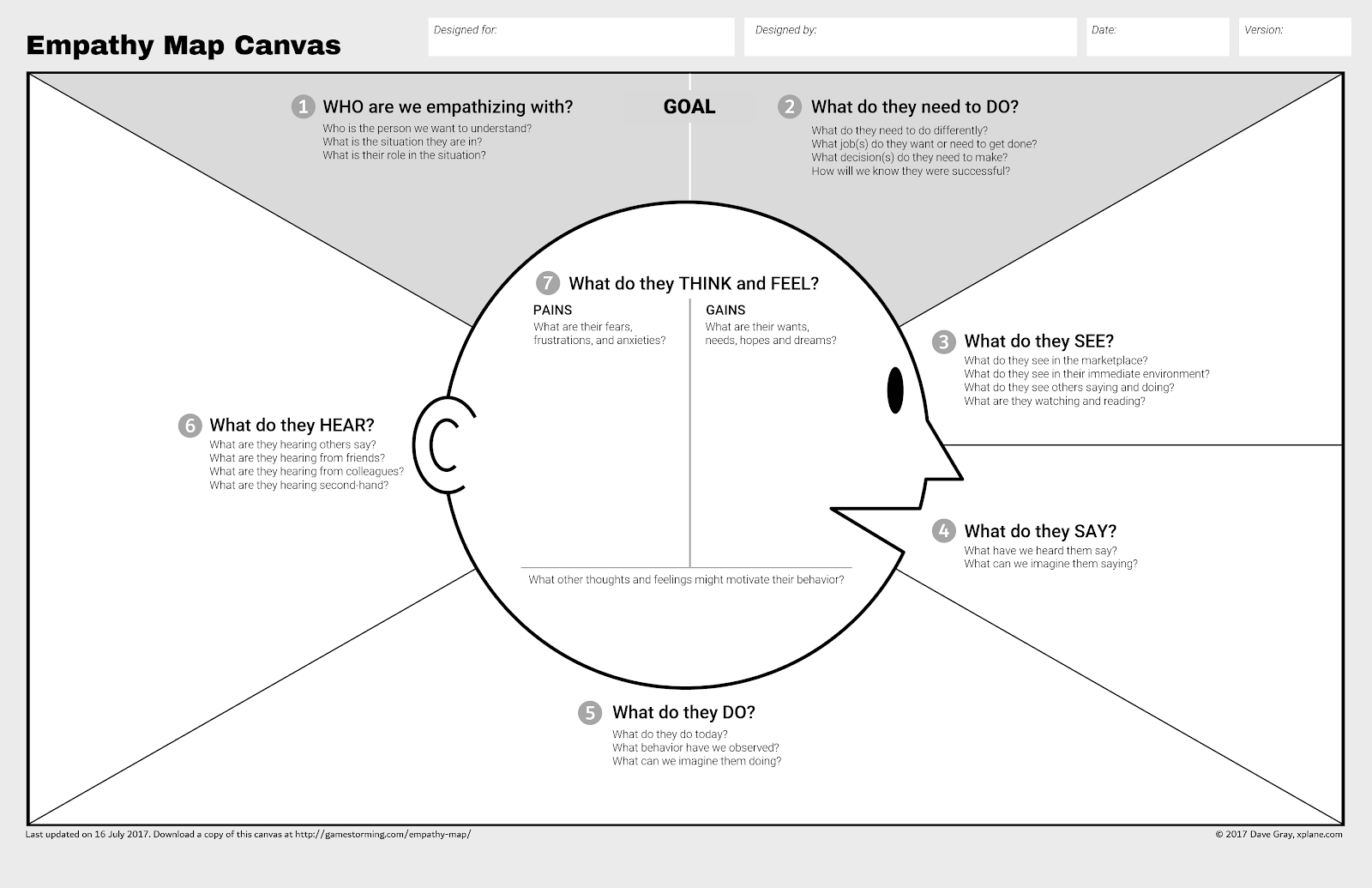
The empathy map canvas is a great tool to brainstorm the mindset of your audience.
It was developed as part of the Gamestorming human-centered design kit from XPLANE.
This is a useful exercise to solicit input from across your sales, customer support, and marketing teams to help identify the key identifiers along the journey.
3. Key Actions & Touchpoints
Ok, we know who we’re talking to, and what they’re going through as they try and solve this challenge.
The next question is what do we want them to DO and HOW are we going to encourage them to take that action. What is the most useful step they can take, and what opportunities will we have to interact with them?
Thinking about what they most need to do next at the same moment that we consider questions like, “will they are on our email list at this point?
What search terms will they be using at this stage? Is the sales team already reaching out to them at this point?
It’s important to document all the touchpoints they might get from your company all in one place to build sales and marketing alignment and ensure we’re working toward the same goals.
Understanding what actions to watch for help keep the focus on the right call to action at each step of the funnel.
4. Ideal Response and Content Opportunities
This is all about finding the most important message: what is the one thing we can say to help them get over the objection and take the next key action?
Specify an ideal response to them at each of these steps and list content you already have or plan to create to meet those needs.
From there, defining our ideal response and most important message to encourage that key action leads to clear content opportunities.
At this point, you have a really useful journey map to begin evaluating your content marketing strategy.
- Do we have most of these questions covered?
- Are these key actions from the journey map aligned with the calls to action on our website?
- What stages of the journey have we done a great job with, and where are the gaps?
Some teams use their personas, journey stages, and key action goals as a way to tag content assets, and then run reports to identify which stages are underserved.
The post Customer Journey Mapping for Audience-Centric Content appeared first on Content Marketing Consulting and Social Media Strategy.
Source: convinceandconvert.com

4 Noteworthy Lead Conversion Trends: Research and Charts
Considerable shifts in the way businesses operate are leading marketers to re-examine the way they approach lead generation. Building meaningful connections with buyers is now a critical part of generating and nurturing leads that convert.

With a myriad of marketing tactics at our disposal, cool marketing technology that can track performance and automate campaigns, and countless strategies and processes to optimize marketing, sometimes we can’t see the forest for the trees.
For many marketers, we think in terms of leads (impersonal, just a number) and not relationships (personal and real). Sometimes we miss the obvious: successful marketers build relationships.
We must remember that a lead is a real person, and to be a successful marketer, we need to build a relationship with prospects.
A new research study by Ascend2 is Building Relationships for Lead Conversion. The survey was fielded the week of June 8, 2020, and a total of 263 marketing professionals participated.
Considerable shifts in the way businesses operate are leading marketers to re-examine the way they approach lead generation.
Building meaningful connections with buyers is now a critical part of generating and nurturing leads that convert.
How are marketers building relationships for maximum lead generation and conversion?
Here are a few noteworthy findings from the Asend2 research study, as well as insight from marketing professionals.
1. Marketers are struggling to generate enough relationships as they shift marketing efforts to more digital-forward initiatives.
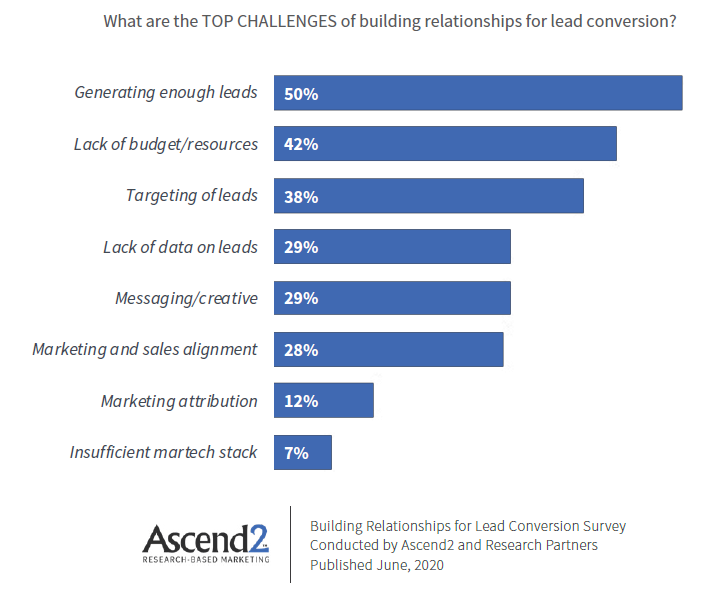
Half (50%) of marketing professionals report struggling to generate enough relationships as they shift marketing efforts to more digital-forward initiatives.
Building meaningful relationships with new and existing leads requires appropriate allocation of budget and resources, which 42% of marketers report is a top challenge for lead generation success.
Top Challenges of Building Relationships for Lead Conversion

Jeff Haws, Senior Marketing Manager, MessageGears
How can you generate stronger relationships?
An important first step is to know more about your ideal audience and give them something of value based on their needs.
Jeff Haws, Senior Marketing Manager at MessageGears, explains, “one of the keys to effectively building relationships is to identify your ideal audience and tailor your messaging and targeting to them.
Eliminate as much noise as possible by developing a laser focus on those people who will benefit the most from your unique value, and make sure marketing and sales are on the same page about who those people are.”
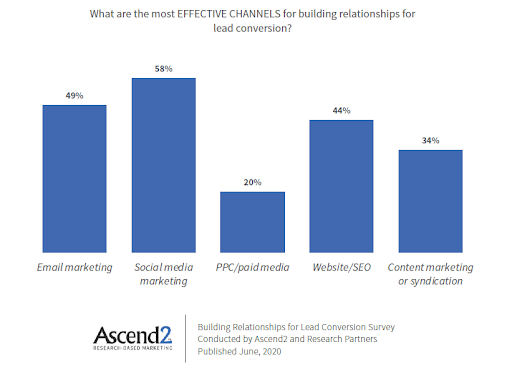
2. Social media, email marketing, and website/SEO lead the way as the most effective channels for building relationships for lead conversion.
Social media (58%), email marketing (49%), and website/SEO (44%) lead the way as the most effective channels for building relationships for lead conversion.
Developing an overall strategy of how all of your marketing tactics connect and work together as part of the customer journey is an important step to building stronger relationships.
Most Effective Channels for Lead Conversion

Mike Grehan, CMO & Managing Director, Acronym
It is helpful to consider the customer journey when looking at channels.
The customer journey is the complete sum of experiences that customers go through when interacting with your company and brand. Where does the journey start?
Where does the journey end?
According to Mike Grehan, CMO & Managing Director at Acronym, “the customer journey most frequently starts with search and very often ends with the search.
Many brands are loaded with content for the transactional part but seem to lack content for the early stage.
This is why SEO is still so important. Well-crafted and optimized content for answering questions and solving problems creates brand affinity much earlier instead of trying to battle for attention at the checkout.”
3. Content in video format is most effective at building relationships to generate leads that convert.
When building loyalty and trust with an audience to build relationships, creating and distributing content is essential.
Forty-one percent (41%) of marketing professionals agree that content in video format is most effective at building relationships to generate leads that convert.
Educational content types such as webinars and original research are also effective, according to 36% of those surveyed.
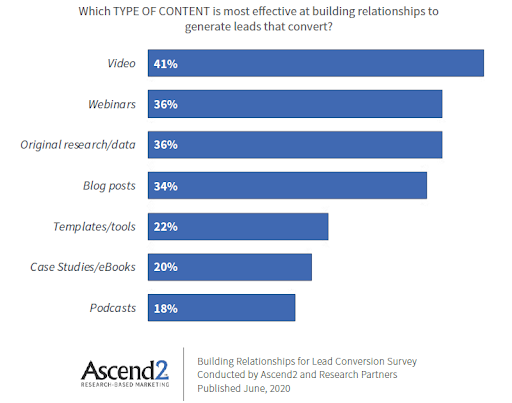
Most Effective Content Types for Lead Conversion

Rameez Ghayas Usmani, Digital Marketing Executive, PureVPN
There are many format options to consider.
Rameez Ghayas Usmani, Digital Marketing Executive at PureVPN explains, “written content is undoubtedly useful, but today, visual materials such as infographics or videos are outperforming for marketing and relationship building purposes, and they will continue to be one of the most frequently used marketing strategies for 2020.”
Dan Bailey, President at WikiLawn shares another content strategy. “Our lead generation strategies now focus on providing free, high-value content as part of a sales funnel.
We create articles, videos, and other content, and put that content behind a landing page where the user has to enter their email address to get access.
We run Facebook ads to direct people to this landing page, and once they’re on our list, we continue to build a relationship with them.”
4. Lead generation budgets are being redirected to social media and website/SEO improvement.
Many marketing dollars previously allocated to in-person events and direct marketing efforts are being redirected.
Over half of marketers say that much of their lead generation budgets will be attached to social media (54%) and website or SEO improvement (51%).
Another 44% report that email or automation will account for a significant amount of budget in the year ahead.
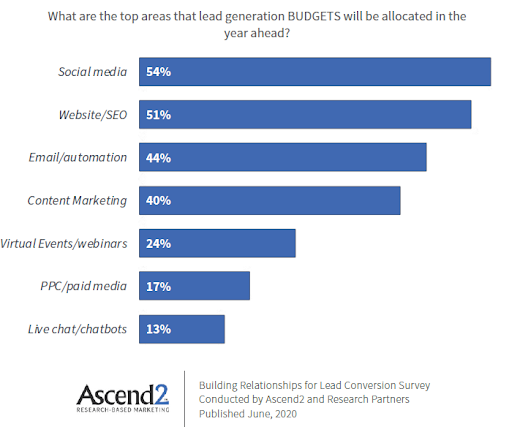
How Lead Generation Budgets Will Be Allocated
Building relationships is especially challenging right now with the cancellation of live events and employees working remotely. How can you replace that face-to-face experience?

Joaquim Miro, Chief Growth Officer, Hoppin’ World
Joaquim Miro, Chief Growth Officer at Hoppin’ World, said that “being able to be face-to-face with a prospect is always the best way to convert them into a client.
Therefore, looking for options that allow this to happen remotely is an important next step.”
Use technology to do virtually what you would do in person: train, give guided tours, have Q&A sessions, and more.
Be creative to build a relationship with your prospects and don’t let challenges stand in your way.
How are companies reallocating their budget?
Quincy Smith, Founder of ESL Authority, reveals how his organization is shifting budgets. “We’ve reallocated our in-person budget (previously used for job fairs, campus visits, etc) into online retargeting,” said Quincy.
He continued, “we’ve always had significant organic traffic, but are only now attempting to retarget it given that we cannot do much in person.
So far it’s very much trial and error, we’ve done paid ads before but not for this purpose so we’re still testing messaging, platforms, and imagery.”

Sunny Ashley, CEO, Autoshipinvoice
Sunny Ashley, CEO at Autoshipinvoice, has moved the bulk of its marketing budget and efforts to SEO and content marketing.
Sunny explains, “there are 3 main reasons why:
- 1. SEO can be done relatively cheaply, for the cost of time and labor in writing content.
- 2. SEO best practices are ever-evolving; this means there is always something new to learn. Since marketing now has more time and flexibility without the need to plan for physical events, now is the time to try new SEO techniques and experiments.
- 3. SEO takes time. If direct marketing methods aren’t as effective right now while our customers have less budget, now is a great time to build a catalog of content that will grow in influence over the coming months. As business begins to return closer to normal, our SEO efforts will hopefully be peaking.”
Joaquim, Quincy, and Sunny are all finding ways to understand their target audience, reallocate the budget based on what is working, and focusing on building relationships that convert.
Conclusion
Building relationships takes time. Marketers need to listen to their prospects, analyze the data, test new tactics and strategies, optimize existing tactics and strategies, and be flexible and agile in what they do to build relationships that convert.
Here is a link where you can download the entire report, Building Relationships for Lead Conversion.
The post 4 Noteworthy Lead Conversion Trends: Research and Charts appeared first on Content Marketing Consulting and Social Media Strategy.
Source: convinceandconvert.com