
Tag Archives for " ML "

How Does Scaled Data Labelling Work With Marketing?
Data labeling turns raw data into useful information that can then be utilized for optimized marketing. However, turning raw data into labeled data takes time. When done internally by humans, this can be costly and inefficient.
The good news is data labeling is scalable when you work with the right data labeling software. You can decrease overall costs while improving efficiency and machine learning processes with the right platform on your side.
Of course, how you use this labeled data is just as important as how it’s done. That’s why this article will delve into the many uses of data labeling for marketing and some platforms you should consider using to get the most out of your data.

What Is Data Labeling?
Data labeling is the process of analyzing raw data and labeling it to provide context to machine learning software, algorithms, and end-users. For example, analyzing a photograph and labeling it with the contents of the image.
There are different types of data labeling, including:
- image
- video
- audio
- text
Data labeling is used in various industries, including healthcare, finance, research, automotive, and technology. With the growth of artificial intelligence (AI) technology, data labeling has also become integral to marketing.
How Does Data Labeling Work?
To better understand data labeling, you should know it’s a continuing process between humans and machine algorithms. The task is usually completed by a combination of software, processes, and people. The raw data is analyzed and then labeled based on context. The context is determined by the company’s or industry’s needs.
The context is then used to train and develop machine learning algorithms. The initial labeling allows human analysts to select the appropriate variables for the machine learning algorithm to use for future predictions. The more context you provide, the better the AI can learn. This will help to deliver better algorithm results in the future.
Speaking of the algorithm, this is an ambiguous term that refers to any self-defined set of instructions built to solve a problem. The options for an algorithm are seemingly endless, though needs will vary by industry. A few examples of common algorithms include search query results and sort and filter features on an e-commerce website.
5 Uses for Data Labeling in Marketing
Data labeling is common in industries that rely heavily on top-of-the-line technology, such as healthcare and finance. As machine learning becomes a more common tool for marketers, though, the need for data labeling will increase. Here are five uses for data labeling in marketing that you may not have considered before.
1. Increase Personalization
According to Statista, 90 percent of consumers find marketing personalization very or somewhat appealing. As such, marketers need to personalize the experience from start to finish. Marketing campaigns, social posts, ad copy, and website flow are all included in that process.
Personalization is a way of tailoring a service or product to fit a market demographic. It’s possible to use data labeling to achieve this.
For example, an algorithm can be built to categorize creative assets for various segments of your target audience. An example of this would be utilizing facial recognition on images or video assets so you can deliver that asset to an audience who identifies with those characteristics.
You can also use personalization to improve search query results, provide personalized product recommendations, and enhance product attributes for improved categorization.
2. Optimize Prices
There are numerous data sources to consider for analysis. To get ahead of the competition, consider analyzing competitor creatives in campaigns and advertisements.
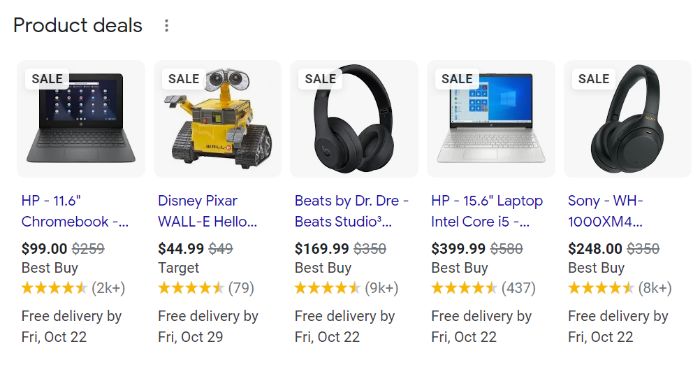
With the help of data labeling, you can train specialized software to recognize, analyze, and categorize competitor raw data. For price optimization, this will largely be text and images. With this data in hand, you can make price decisions based on data-backed industry trends.
For example, learn when your competitors run a campaign on social media to keep track of seasonal trends. You can even create an algorithm to analyze competitors’ digital ad flyers daily or weekly. While you may not always use this data for immediate decisions, you can always use it to inform future campaigns.
3. Analyze Customer Reviews
With more consumers purchasing online than ever before, customer reviews have never been more important. In fact, 93 percent of consumers say their purchase decisions were largely influenced by online reviews.
With scaled data labeling, you can train your algorithm to analyze customer review sentiments. That’s right, data labeling can do more than just categorize data based on keywords. With the right data model, you can teach it to connect the dots and give sentiment scores to each review you receive.
According to ReviewTrackers, 94 percent of consumers say a bad review has convinced them to avoid a business. With a sentiment analysis algorithm, you can find out about and respond to negative reviews almost immediately. This can help to ease consumer concerns.
4. Categorize User-Generated Content
Is it really any surprise that consumers trust other consumers more than the brands they buy? That’s why 51 percent of consumers trust user images over brand creatives, according to a survey by Olapic and Cite Research.
How can brands use this to their advantage? By relying on user-generated content (UGC). User-generated content can be used on your website, in email campaigns, and on social media.
By utilizing a data labeling service, your algorithm can effectively categorize this content for use. This means determining which campaigns, social media platforms, and website page the different types of content belong to.
For example, an image showing a home brand’s coffee table styled in a customer’s living room should end up on a related category page, like tables or living room decor. The algorithm can even be trained to identify which product exactly matches the one in the image so it can be used on the product display page.
5. Enhance Product Offerings and Availability
You can’t market what you don’t have, which is why product assortment and availability are so important to effective marketing campaigns. How can you fill assortment gaps and ensure availability for specific campaigns? With a properly trained machine learning algorithm, of course.
Using data labeling and annotation services, you can determine gaps in your own offering and availability based on an analysis of competitor assortment. With an algorithm developed to crawl and scrape data from competitors, you can save time while also increasing your potential for profit.
5 Data Labeling Services
1. Datasaur
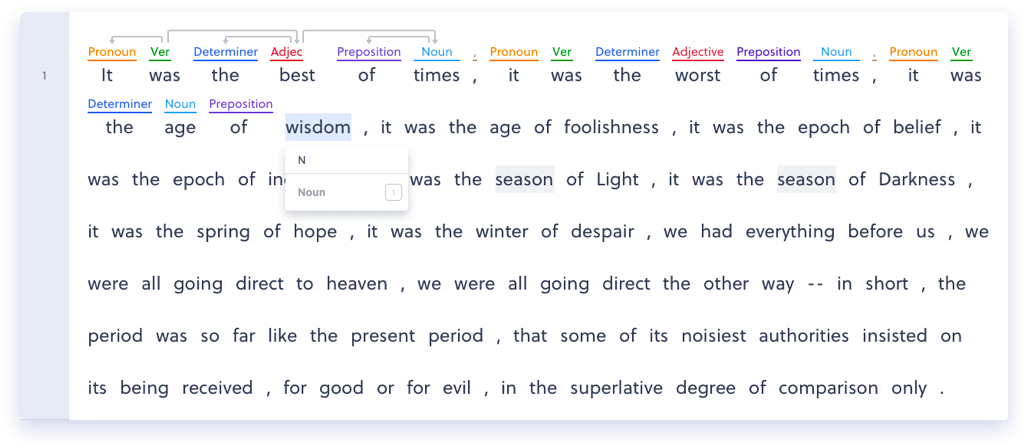
If you’re looking for software specializing in data labeling, then consider Datasaur. With dozens of clients across many industries, Datasaur has the expertise you need.
A few key features to consider are automated intelligence, workflow management, and data privacy. With automated intelligence and workflow management, Datasaur handles data analysis and categorization from end to end. It does so efficiently by quickly culling any data that requires more advanced (i.e., human) analysis and working through the rest.
While Datasaur doesn’t list prices on their website, they do have three plans to choose from:
- Free: up to 5,000 labels per month
- Growth: up to 100,000 labels per month
- Enterprise: unlimited labels
With a free plan to start, you can test out the software while also knowing that scaling is possible.
2. Isahit

With brands like L’Oreal and Sodexo as clients, Isahit has certainly made a name for itself in the data labeling industry. Built on a platform of agility, transparency, and scalability, Isahit offers in-depth data analysis and labeling services for businesses of all kinds.
As a French-based company, Isahit prices are in Euros. Isahit offers four plans, including:
- Basic: €185 per month
- Priority: €255 per month
- Gold: €331.67 per month
- Residency: €630 per month
Isahit also provides a custom plan option to meet your company’s unique needs.
3. Datax
The manual work required for building an effective AI model can be more than most companies can handle internally. Datax handles the entire process including data labeling, AI model customization and validation, and business process automation.
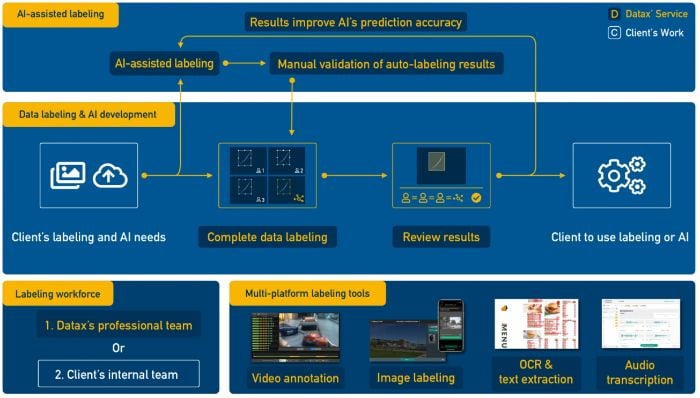
Datax doesn’t include pricing on their website. You can fill out their contact form to receive a customized quote.
4. Dataloop

With services like an annotation platform, data management, and production pipelines, Dataloop is an end-to-end solution for numerous industries including e-commerce.
When it comes to data labeling, Dataloop offers a suite of data annotation tools to help you produce highly accurate datasets. A combination of AI model and human analysis, these tools include:
- automatic annotation
- video annotation
- workforce management
- data QA and verification
- integrated labeling services.
Dataloop doesn’t have prices or plans on its website. You can request a demo to learn more about the software and speak with a sales representative.
5. Labelbox
With many data labeling platforms to choose from, it can be hard to find the best one for your needs. Labelbox is one such platform, though its list of clients and even its own Academic Program makes it stand out.
Labelbox offers services to various industries, including government, retail, insurance, and e-commerce. Its services include annotation, diagnostics, and prioritization.
The software platform has three plans:
- Free: Access to the full editor suite, rate-limited API access, and up to 10,000 annotations per month.
- Pro: Everything is Free plus unlimited API access, unlimited team access, and customer support.
- Enterprise: Everything in Pro plus model-assisted labeling, advanced queue customization, and premium customer support.
Frequently Asked Questions About Data Labeling
What techniques exist for data labeling?
Data labeling techniques are split into two categories, automated and manual. Automated labeling includes semi-supervised learning and transfers learning while manual labeling includes internal (i.e., in-house) and external (i.e., outsourced) labeling.
What should I look for when choosing a data labeling platform?
Whether you only need data annotation services or full end-to-end support, you should look for a platform with positive reviews, strong communication skills, and an established presence in the e-commerce industry.
What are the security risks of outsourcing data labeling?
There are always inherent risks associated with outsourcing data labeling, including the potential exposure of sensitive data. Your data is only as secure as the service you choose, which is why a proper vetting process is necessary.
How do I know when it’s time to scale and hire a data labeling service?
There comes a time when internal data labeling solutions become inefficient and the cost-benefit curve begins to decline. While only your team can determine when this occurs, a few signs it’s time to scale and hire a data labeling service include high employee burnout, an increase in data inaccuracy, and the constant need to hire new analysts.
Data Labeling Conclusion
As your business grows, so too do its needs. If your marketing efforts utilize machine learning in any way, then the time spent to build, train, and maintain this AI will increase, too. That is why marketers should consider investing in data labeling software from the beginning.
Data labeling software like the options listed above enables marketers to continue to grow their datasets to feed to the machine learning algorithm.
This ensures a smarter algorithm that requires less human input over time. Just a few ways marketers can then use this machine learning include increased personalization, optimized pricing, and enhanced product offerings and availability.
Which use for data labeling in marketing would you like to implement first?
Source: feedproxy.google.com

Speed and Scale: Advanced Analytics with Machine Learning
Artificial Intelligence and Machine Learning (ML) can turn massive amounts of data into deep insights that drive revenue and decrease costs. But ML’s not an island – in fact, it’s carried out most successfully when paired with advanced analytics.

To facilitate the best analytics work, enterprises need the right platforms and tools to load data, prepare it, ensure high quality and integrate with corporate data governance processes.
How can you get all that working harmoniously, especially in the cloud?
It takes the right tools, strategy, and workflow, but it can be done.

Join us for this free 1-hour webinar, from GigaOm Research, to find out how.
The webinar features GigaOm analyst Andrew Brust, Deepsha Menghani, Product Marketing Manager at Microsoft, and Mark Balkenende, Director Technical Product Marketing at Talend.
In this 1-hour webinar, you will learn how:
- Data analytics, data quality, and data governance can be tightly intertwined with data science
- Technologies like Apache Spark can serve both your data engineering and machine learning needs
- Cloud services can be combined with open-source software and analytics ecosystem tools for maximum benefit

Register now to join GigaOm Research, Microsoft, and Talend for this free expert webinar.
Who Should Attend:
- CIOs
- CTOs
- Chief Data Officers
- Data Scientists
- Data Engineers
- Data Stewards
- Analytics professionals
Source: gigaom.com

AI Operations: It Can’t Be Just an Afterthought
In the worlds of machine learning (ML) and deep learning (DL), operations and deployment is a subject that often falls by the wayside.
And the split reality between everyday on-premises Artificial Intelligence (AI) work and the industry’s fascination with more aspirational cloud-based AI work only makes matters worse.

Reasons to use AI
For the adoption of AI/ML/DL to be actionable for Enterprise customers, the full spectrum of on-premises and cloud-based work needs to be accommodated.
Deployment and operations across environments need to be consistent.
On-premises provisioning and deployment should feel cloud-like in ease-of-use, and hybrid scenarios need to be handled robustly.
Installation and management of frameworks and models need to be handled too.
Join us for this free 1-hour webinar, from GigaOm Research, to explore these matters.

The Webinar features GigaOm analyst Andrew Brust and special guests, Adnan Khaleel from Dell EMC, and Professor Sambit Bhattacharya of Fayetteville State University, a customer of Bright Computing.
This webinar is sponsored by Dell EMC, NVIDIA, and Bright Computing.
In this 1-hour webinar, attendees discover:
- How cross-premises AI deployment is both necessary and achievable
- What “AI Ops” looks like today, and where it’s going
- The sweet spot of ML/DL training workloads between the data center and cloud
Register now to join GigaOm Research and Dell EMC for this free expert webinar.
Who Should Attend:
- CIOs
- CTOs
- Chief Data Officers
- Data Scientists
- IT/Data Center specialists
- DevOps professionals
Source: gigaom.com

Master Data Management Joins the Machine Learning Party
In a normal master data management (MDM) project, a current state business process flow is built, followed by a future state business process flow that incorporates master data management.
The current state is usually ugly as it has been built piecemeal over time and represents something so onerous that the company is finally willing to do something about it and inject master data management into the process.
Many obvious improvements to process come out of this exercise and the future state is usually quite streamlined, which is one of the benefits of MDM.
I present today that these future state processes are seldom as optimized as they could be.
Consider the following snippet, supposedly part of an optimized future state.

This leaves in the process four people to manually look at the product, do their (unspecified) thing and (hopefully) pass it along, but possibly send it backwards to an upstream participant based on nothing evident in particular.
The challenge for MDM is to optimize the flow. I suggest that many of the “approval jails” in business process workflow are ripe for reengineering.
What criteria are used? It’s probably based on data that will now be in MDM.
If training data for machine learning (ML) is available, not only can we recreate past decisions to automate future decisions, we can look at the results of those decisions and take past outcomes and actually create decisions in the process that should have been made and actually do them, speeding up the flow and improving the quality by an order of magnitude.
This concept of thinking ahead and automating decisions extends to other kinds of steps in a business flow that involve data entry, including survivorship determination.
As with acceptance & rejection, data entry is also highly predictable, whether it is a selection from a drop-down or free-form entry. Again, with training data and backtesting, probable contributions at that step can be manifested and either automatically entered or provided as default for approval.
The latter approach can be used while growing a comfort level.
Manual, human-scale processes, are ripe for the picking and it’s really a dereliction of duty to “do” MDM without significantly streamlining processes, much of which is done by eliminating the manual.
As data volumes mount, it is often the only way to not watch process time increase over time. At the least, prioritizing stewardship activities or routing activities to specific stewards based on an ML interpretation of past results (quality, quantity) is required.
This approach is paramount to having timely, data-infused processes.
As a modular and scalable trusted analytics foundational element, the IBM Unified Governance & Integration platform incorporates advanced machine learning capabilities into MDM processes, simplifying the user experience and adding cognitive capabilities.
Machine learning can also discover master data by looking at actual usage patterns. ML can source, suggest or utilize external data that would aid in the goal of business processes.
Another important part of MDM is data quality (DQ). ML’s ability to recommend and/or apply DQ to data, in or out of MDM, is coming on strong.
Name-identity reconciliation is a specific example but generally, ML can look downstream of processes to see the chaos created by data lacking full DQ and start applying the rules to the data upstream.
IBM InfoSphere Master Data Management utilizes machine learning to speed the data discovery, mapping, quality and import processes.
In the last post (link), I postulated that blockchain would impact MDM tremendously. In this post, it’s machine learning affecting MDM. (Don’t get me started on graph technology).
Welcome to the new center of the data universe.
MDM is about to undergo a revolution.
Products will look much different in 5 years.
Make sure your vendor is committed to the MDM journey with machine learning.
Source: gigaom.com