
Tag Archives for " marketing technology "

4 Insights on Digital Transformation and The State of MarTech [ Research ]
The backbone of digital transformation is the technology that we use. Technology to find customers, attract customers, engage customers, and make a sale. Everything that happens in marketing and sales includes technology to help us be more efficient and effective in what we do.
Today, marketers have access to endless streams of data and countless tools specifically created to enable business development. For marketing professionals, the evolving landscape isn’t always an easy one to navigate. Mountains of data can be helpful if used correctly, or it can create a disjointed picture of the customer, misaligned goals, and a rocky path to revenue growth.
How are marketers using technology to transform their marketing programs and pave the way to better results?
The State of MarTech, a new research study by Ascend2 and SharpSpring, surveyed 187 marketing professionals to find out how they are using technology to get better results.
Here are a few of the findings:
Finding #1: Generating truly relevant leads and attribution are the most commonly reported challenges faced by marketers when it comes to the success of their digital strategy.
The study also found that 76% of marketers feel that they are missing opportunities for revenue growth as a result of challenges like lead quality and marketing attribution.
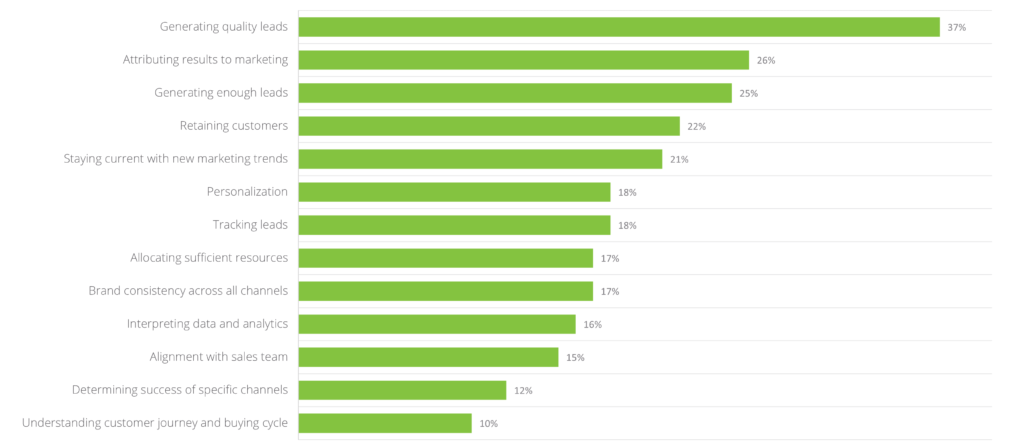
Digital Transformation Tip: Over one-quarter of marketers are having difficulty attributing campaign results to marketing efforts.
Attribution can transform a good marketing strategy into a game-changer for your business by letting you know which campaigns drive conversions, so you can invest in the efforts that work best. This is also the key to identifying your quality leads.
Marketing technology should allow you to set up a multi-touch attribution model in a few simple steps.
- Identify the attribution model you want to follow (first-touch, last-touch, linear, U-shaped, etc.).
- Track your campaigns.
- Set up your conversion goals.
- Build custom reports with multi-touch attribution.
The research finds that too many technology tools are not always better. 44% of marketing teams are using 4 or more tools to execute their strategy but are still facing major challenges.
To overcome challenges like attribution and quality leads, don’t look for more tools but instead look for tools that have built-in features, like attribution tracking.
Finding #2: It is time for marketing professionals to fix the data problem.
Marketers aren’t thrilled with the way their tools and technology are working to support their strategy. Marketing tools received an average ranking of a 6 out of 10 (that’s almost a failing grade!).
Research reveals that the technology is capable of fixing the problem but a strategic and systematic approach is necessary. Here is a closer look.
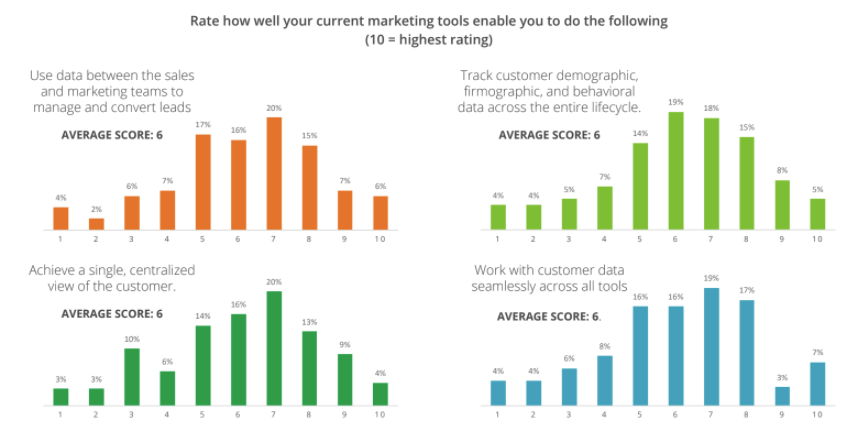
Digital Transformation Tip: 59% of marketers feel that they DO NOT have the data they need to feel confident about which marketing campaigns are working and which are not.
By leveraging behavioral, demographic, and firmographic information, you can give customers content that’s suited to their interests and activities – without lifting a finger.
And since every customer interaction provides additional insight, your brand experience becomes increasingly relevant across channels. Visitors feel understood, which ultimately incentivizes them to return.
Getting your sales and marketing automation platform in sync is the key to having a score that is 8, 9, or 10 (best-in-class). Consolidating your sales and marketing platforms makes it easier to eliminate data silos, clean your data, and make data-driven decisions.
Finding #3: The Solution – Consolidate and integrate tools and technologies.
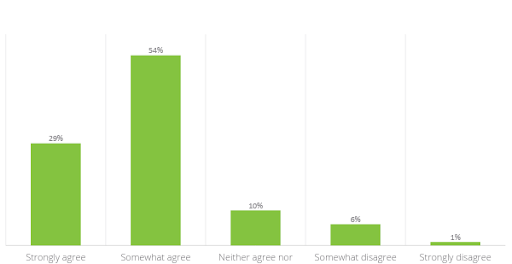
83% of marketers agree that consolidating tools in their marketing and sales technology stacks would increase productivity and efficiency.
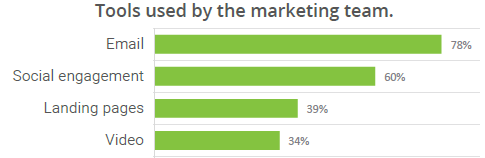
The report provides a comprehensive list of tools used by the marketing team and the sales team. Here are the top four tools for each.
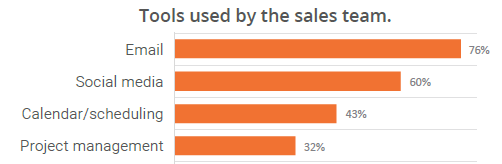
Digital Transformation Tip: Running with a lean technology stack can reduce operational silos and enable better end-to-end visibility of prospects and customers.
Consolidating tools can also decrease the time it takes to solve issues, significantly reduce costs, simplify forecasting and tracking KPIs, and streamline the training of staff members.
Finding #4: Current status of integration of marketing and sales technologies.
Consolidating tools alone might help with overall efficiency, but integrating technologies (ideally into a single platform) will centralize customer data and drive measurable results. 51% of marketers are only partially integrated or use manual processes between tools.
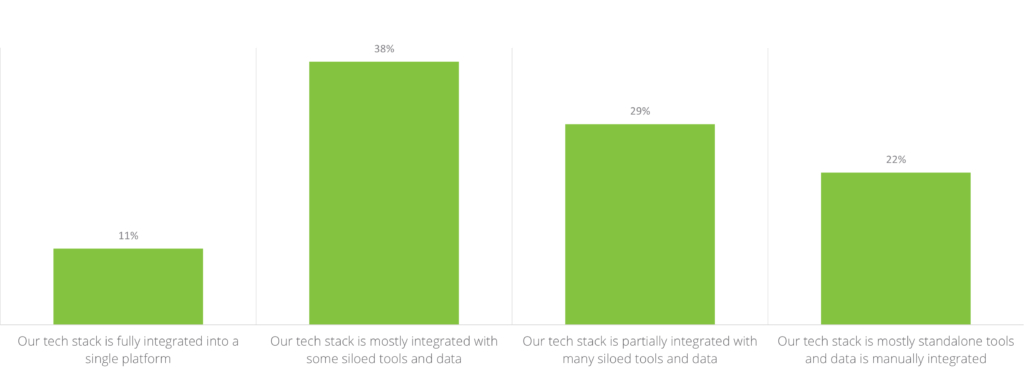
Digital Transformation Tip: A deep dive into the research found that the most successful marketers are 118% more likely to be fully integrated. This group develops a plan to align marketing and sales, and the integration of technology allows the plan to become a reality.
Conclusion
Adopting an all-in-one revenue growth platform is the next phase of digital transformation. The ability to use technology to align marketing and sales so you can optimize your entire funnel, with a holistic view of channels, campaigns, prospects, and customers.
McKinsey calls it “full-funnel marketing” and says that one key benefit in “Linking KPIs between channels and stages of the funnel to actual business results, such as conversions or leads, allows companies to better understand the real impact of their marketing and then create messages that will elicit the best responses.”
For more research on digital transformation, download the 18-page State of MarTech report.
The post 4 Insights on Digital Transformation and The State of MarTech [ Research ] appeared first on Content Marketing Consulting and Social Media Strategy.
Source: convinceandconvert.com

6 MarTech Trends in 2021 and Beyond
Are you hoping to identify MarTech trends that can help your campaigns be more effective and run more smoothly?
As our marketing capabilities evolve, so do the tools we use to measure our successes and how we achieve that success.
In this blog, we unpack the six biggest MarTech trends looming over the marketing industry and how you can use them to your advantage.

Disclosure: This content is reader-supported, which means if you click on some of our links that we may earn a commission.
What Is MarTech?
Marketing technology, or MarTech, as it is more commonly known, refers to software and platforms that help individuals or organizations achieve marketing goals.
This term is very inclusive, covering everything from email templates to data analytics.
While every individual, agency, or company has unique MarTech needs, the constantly-growing field is making great leaps to fill any open niche.
Over the past twenty years, the field has seen truly exponential growth.
Today, being a marketer doesn’t necessarily mean you have to be incredibly tech-savvy, but it does mean that you need to understand the benefits of tools that can improve your strategy and help you reach your goals.
Your competitors are likely using MarTech to help their campaigns succeed.
If you’re not looking toward how you can automate, optimize, and ideate your campaigns through MarTech, it’s time to start.
Examples of MarTech
As we mentioned above, MarTech is a very wide umbrella.
However, some forms of MarTech are more common than others.
These include:
Email Marketing

With more than 50 percent of survey respondents copping to checking their email in excess of ten times a day, it’s no wonder that email marketing is an easy way to try to reach your target audience.
While the operative word in that sentence was try, marketing automation tools can get you that much closer to your goals.
To reach them, you need tools and platforms that not only disseminate your emails but provide in-depth analytics that gives you a real-time view of reader practices and interactions.
As email marketing continues to grow and evolve, the demand for personalization in this medium will also continue to grow.
Marketers should use automation and AI to deploy targeted emails engineered to attract a particular audience segment.
To achieve successful personalization, use data to assess customer habits and preferences for each audience segment and then craft corresponding templates.
Then your MarTech tool can do the rest.
Content Management
While managing your website content used to be a time-consuming, exhaustive process that took hours of coding, new marketing technology has automated cumbersome processes, allowing marketers to dedicate time to other important pursuits.
Content management systems (CMS) have evolved over the years, now equipped with the capabilities to develop the following kinds of websites (along with many others):
- social networking
- blogging platform
- static website
- news
- online store
Predicted to achieve a compound annual growth rate (CAGR) of 16.7 percent, as CMS capabilities grow, so will collaboration and planning tools that unite workflows to allow complete management of content from creative to back-end development.
Data Analytics
Today, marketers can harness the power of data analytics to gain an understanding of customer preferences and behaviors—including how they shop, where they spend their time, and how they discover new offerings—as well as market trends.
MarTech tools that allow marketers to dive deep into these data sets are invaluable, as they provide never-before-seen maps of how consumers operate online.
By tracking online behaviors, marketers gain a deeper understanding of their customers.
As MarTech data tools become even more intuitive, marketers will have even more visibility of customer journeys, following them from initial interest to final purchase.
These insights will be captured through cookies and CTR, among other trackers.
As the tools become more refined, so will understanding of consumer behavior, allowing marketers to readjust their strategies.
6 MarTech Trends
To help you decide which MarTech offerings you want to add to your stack, we broke down the six biggest trends that are likely to impact both the MarTech world and the marketing world well beyond this year.
1. Increased Spending on Analytics
If you’re tempted to bypass adding an intuitive analytics tool to your MarTech stack, don’t.
These tools can help you gain a better understanding of nearly every aspect of your marketing campaigns, from buyer behaviors to conversion rates.
In fact, researchers expect marketing analytics budgets to grow by 61 percent over the next three years.

That’s huge.
You don’t want to miss out on getting in early on a tool that can quite literally change the way you see your business.
Some of the many benefits of marketing analytics tools include:
- viewing real-time, comprehensive outcomes of marketing efforts across channels
- improving lead generation through actionable insights
- gaining insights into customer behavior and preferences
- using predictive analytics to enable your business to be proactive rather than reactive
2. Higher Emphasis on Personalization
We nodded a bit toward the importance and growing prevalence of personalization in marketing campaigns.
In short, this strategy means delivering individualized content to audience members.
This personalized route builds a connection with consumers, treating them as individuals rather than a mass market.
Some common (and growing) opportunities for personalization include:
- targeted emails
- custom video messages
- product recommendations
- social media
In the coming years, this prevalence will only grow, and marketers who don’t use tools to aid them in personalization will fall behind.
In fact, 99 percent of marketers claim personalization helps advance customer relationships, and 44 percent of consumers say they would be willing to switch to a brand that better personalized its marketing material.
If you’re not taking advantage of learning more about your would-be customers through tools and data, you’re missing out—not only on reaching customers more strategically but also on building relationships.
3. Transition Away From Third-Party Cookies
If you’re an advertiser or marketer who has relied heavily on third-party cookies, you may be in for a bit of a shock.
In 2020, Google announced its plan to phase out third-party cookies within two years.
With Google Chrome composing almost 65 percent of the web browsing market according to StatCounter’s data below, this move will have a dramatic impact on how marketers gather data.
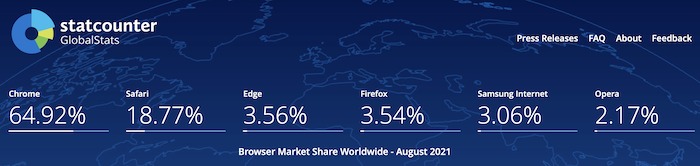
If in the past, you relied on information from cookies to gain an understanding of consumer behavior and identity, you’re going to need to recalibrate your strategy.
Recently, Adobe found two in five brands are not prepared to transition away from cookies, indicating businesses do not have a strategy for gathering consumer data post-cookie.
After the transition is final, marketers will no longer be able to capture individual consumer data.
To prepare for this future, digital marketers must align with the trend of personalization to reach and understand their intended consumers.
4. Higher Need for Data Privacy and Security
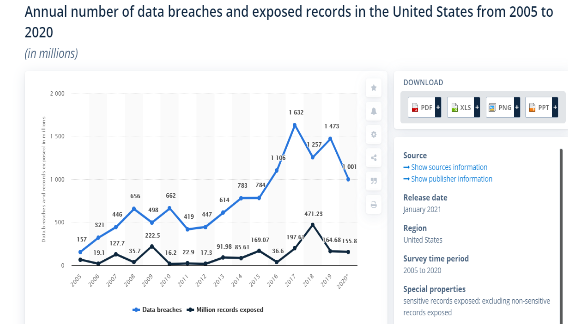
If you’ve been keeping an eye on the news, you know that data breaches are on the rise.
The United States alone has seen data breaches grow from 660 annually to over a thousand within the past decade, according to Statista.
If you think this number doesn’t apply to you, think again.
Your website and consumer data are among your business’ most valuable assets.
You need to protect them from malicious attacks at all costs.
5. Increased Importance of Campaign Automation Tools

Marketing automation can make every aspect of your marketing campaign easy.
By using these tools, you reduce time spent, error, and unnecessary cost.
We’re not the only ones who think this way: The marketing automation market is primed to grow 8.55 percent annually, with 51 percent of companies already taking advantage of these tools.
- Time-saving: With tools that automate time-consuming processes like project management, all members of your team will rejoice in the sheer amount of time they can reclaim after implementing these tools.
- More effective spend: By pinpointing processes that devour valuable time and treating them with automation software, you can use your budget much more effectively, saving both time and money.
- Scalability: MarTech automation tools scale with you.
If you’ve got a big vision for your organization, these tools fit your business needs for today and tomorrow.
- Concrete measures of success: We’ve talked about the importance of data and metrics a lot in this article.
All MarTech automation tools come with data insights that allow you to track everything from productivity to campaign spend.
As you assess your organization’s needs, look at how marketing automation tools simplify your processes and streamline campaign creation.
The benefits of marketing analytics tools include:
6. Growing Importance of Direct Mail
Thought direct mail was dead?
Think again: Forty-two percent of direct mail recipients engage with your send either through reading or scanning.
Further, 73 percent of Americans prefer direct mail marketing, as it allows them to read the piece at their leisure rather than forcing immediate consumption.
This year and beyond, you should reassess your organization’s direct mail strategy to see if there are new (or overlooked) avenues for you to contact your prospects directly through their physical mailbox, according to Who’s Mailing What:
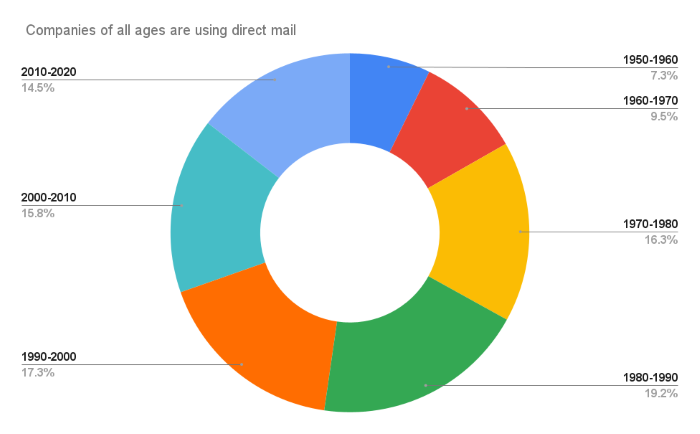
Outside of the above statistics, benefits of direct mail include:
- opportunities for personalization
- builds familiarity and trust
- easy to track
- complements your digital campaign
- cost-effective
MarTech Frequently Asked Questions
FAQ: 1
What Is MarTech?
Marketing technology, or MarTech, as it is more commonly known, refers to software and platforms that help individuals or organizations achieve marketing goals.
This term is very inclusive, covering everything from email templates to data analytics.
FAQ: 2
Is MarTech a Good Investment for My Business?
Yes. With MarTech making up 30 percent of North American marketers’ business budget, you would be well-advised to take advantage of marketing automation tools and platforms that can help you take your campaigns to the next level.
FAQ: 3
What MarTech Trends Will Dominate the Market?
While there is a slew of MarTech trends that reshape the market year after year, we can confidently report that these six trends will be game-changers in the MarTech world:
- increased spending on analytics
- higher emphasis on personalization
- the transition away from third-party cookies
- increased need for data privacy and security
- the increased importance of campaign automation tools
- the growing importance of direct mail
FAQ: 4
Is Direct Mail Still a Good Marketing Strategy?
In a word, yes. Direct mail is still an extremely effective marketing strategy.
While there’s a lot of conversation around digital marketing, this classic mode of reaching potential customers is as effective as ever.
Want proof? Forty-two percent of direct mail recipients actually read what you’re sending them.
Compare that to your average email clickthrough rate (CTR), and you’ll understand the true, measurable value of direct mail.
MarTech 2021 Trends: Conclusion
As marketing needs and customer predilections continue to change, so will the tools we use to meet them.
However, the six marketing trends outlined in this post are here to stay.
To help your organization grow with these MarTech trends, be sure to invest in software that can help you achieve all of your marketing goals.
Tools are meant to be used—be sure you’re taking advantage of them to outmaneuver your competitors.
What’s your prediction for the biggest marketing trend in 2021 and beyond?
Source: feedproxy.google.com

5 Tips for Selecting Marketing Technology, Based on Research
For marketers, technology alone is not the solution to achieving marketing goals, but when you understand your goals and implement the right marketing technology to meet your goals, it is the perfect combination to generate the results you need to succeed.

Effective marketing technologies should extend the capabilities of the team and the strategy behind them.
B2B marketers are faced with the lofty challenge of determining which tools will align best with their needs while integrating seamlessly into an existing mar-tech stack to ensure optimal performance.
But how are B2B marketers up-leveling their marketing technology to meet business goals?
Ascend2, in partnership with RollWorks, surveyed 145 B2B marketing professionals, and here are a few research insights and key takeaways from the research study, Marketing Technology Implementation from the B2B Perspective.
Insight #1: Think Efficiency
B2B marketing professionals know that their tech stack is only as good as the data that flows through it. High-quality data empowers B2B marketers to make informed decisions that will drive a positive impact on their bottom line.
That’s why 41% of those surveyed set out to improve data quality when implementing marketing technology.
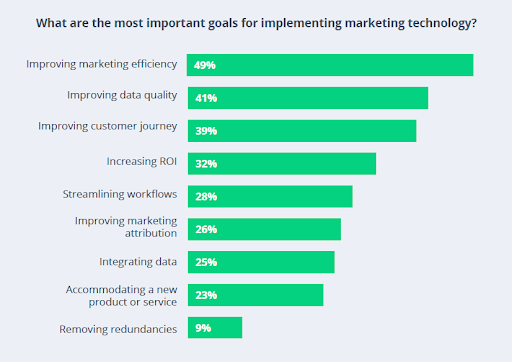
The most important goals for implementing marketing technology, according to B2B marketers
Key Takeaway: If your mar-tech goal is efficiency, consider an account-based approach. Account-based marketing (ABM) means taking a fit-first approach to B2B marketing, ensuring you’re only targeting the accounts with the highest likelihood to buy.
Research shows that 94% of marketers find ABM successful at achieving their primary objectives. The more targeting you become in identifying your best audience, the more you can improve efficiency in your overall programs.
Insight #2: Think Strategically
Carrying out a strategy for implementing marketing technology as well as determining what technologies align best with the needs of their business are both top challenges reported by 43% of marketers for B2B businesses.
Over one-third (37%) of B2Bs surveyed also feel constrained by budgets allotted for technology.
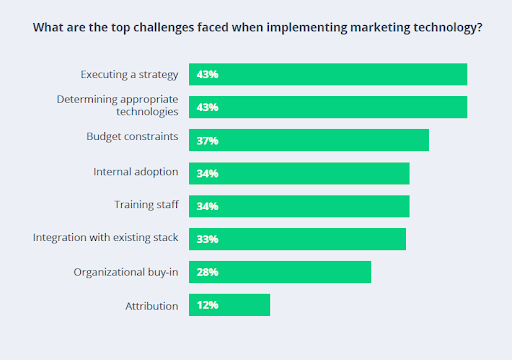
The biggest challenges when implementing marketing technology
Key Takeaway: If your biggest challenge is in execution, find tools that are easy to adopt and that integrate well with other technologies in your stack. Choosing the right tools is tough, but making sure your mar-tech vendors have great onboarding and customer success experiences will ensure you can execute your full strategy.
Successful companies identify a specific marketing challenge, develop a strategy, integrate various technologies to meet the challenge, and measure results to validate success.
Insight #3: Top Considerations: Think Ease of Use
When evaluating new marketing technologies, what is most important for B2B marketers to consider? An easy-to-implement and utilize tool enables marketing teams to execute efforts more efficiently.
Nearly half (47%) of B2Bs surveyed agree that ease-of-use is a top priority when it comes to new marketing technologies.
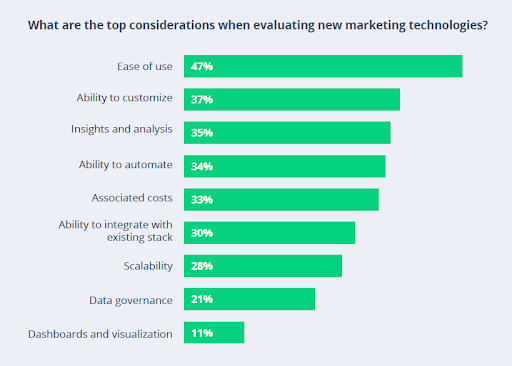
These are the top considerations when evaluating new mar-tech for B2B marketing
Key Takeaway: Above all, B2B marketing technology needs to be user-friendly and customizable. You’ll want to look for tools that allow you to build and measure your programs the way that makes the most sense for your business.
If you want to target specific accounts, the good news is that technology to support your strategy is not exclusively for enterprise companies with large budgets—now, small and mid-size companies have access to account-based tools that are fast, affordable, and customizable.
Insight #4: Think Growth
From the B2B perspective, budgets for implementing new marketing technology are trending up in the year ahead.
59% of marketers working for B2B companies expect a moderate increase in budgets dedicated to implementing new mar-tech new year, while one-in-five B2B marketers expect a significant increase.
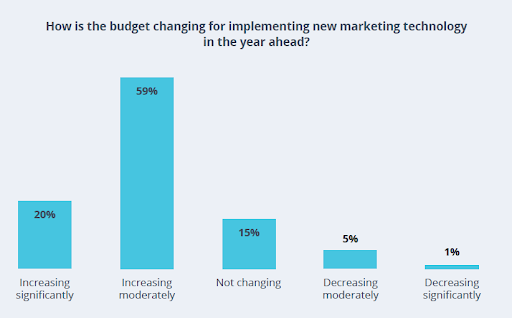
This is how budgets are changing for mar-tech implementation in 2021
Key Takeaway: While 2020 was a rollercoaster of a year, mar-tech is coming out strong. To meet the demands of the coming year, expect to see B2B marketers rethink and expand their tech stacks to get in front of their audience in new, creative ways.
And the data shows that budgets are increasing to support continued investment.
Insight #5: Think Real-Time
For B2B marketers, having real-time data allows for the prioritization of campaigns and efforts that are most likely to drive meaningful results.
43% of B2B marketers report that real-time marketing will have the most impact on their overall marketing strategy in the year ahead.
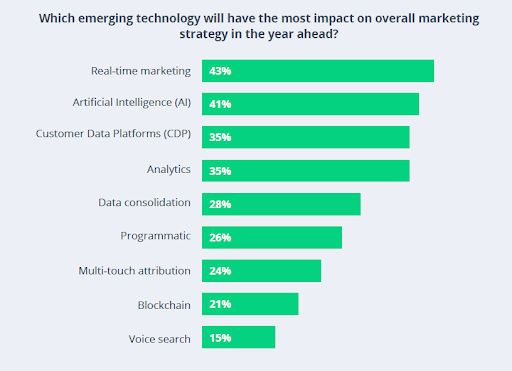
Emerging marketing technology for 2021
Key Takeaway: Real-time marketing and AI leading the pack, revealing B2B marketers are hyper-aware that reaching the right audience, at the right time, with the right message requires smart technology.
Both are key in ABM technology, with the power to help marketers in areas like identifying companies that are the best fit for their solutions, knowing when sales should reach out, and saving budget when serving them with the right message—all key components to a winning B2B marketing strategy in 2021.
Final Thoughts
What marketing technology tools are you planning to implement in the year ahead? How will you ensure the optimal performance of the tools you implement? What marketing strategy are you most excited to test?
You can download the entire Marketing Technology Implementation from the B2B Perspective Report for more data, tips, and strategies to plan, implement, and optimize your marketing technology implementation plan this year.
The post 5 Tips for Selecting Marketing Technology, Based on Research appeared first on Content Marketing Consulting and Social Media Strategy.
Source: convinceandconvert.com