
Tag Archives for " marketing automation "

The 5 Best Marketing Automation Companies of 2021
Don’t just look for a marketing automation tool, find a marketing automation company (agency) that can help you with everything.

You could get a marketing automation tool and try to figure it out yourself.
Or you could get a marketing automation company to do everything.
Look, marketing automation gets crazy complicated.
Lead routing, lead tracking, campaign measurement, all the emails, and landing pages, lead nurturing, dozens of segmentation lists, it goes on and on.
Not to mention a deep integration with your CRM which has to work flawlessly.
Your entire marketing program depends on getting marketing automation right.
The best sales teams already work with top Salesforce partners to get everything set up from the beginning.
It’s about time that marketing teams followed their example.
Don’t just look for a marketing automation tool, find a marketing automation company (agency) that can help you with everything.
The 5 Best Marketing Automation Companies
Some of us in that marketing automation companies are:
- Neil Patel Digital – Best for Content Marketing Automation
- LeadMD – Best for Tech Stack Integration
- CS2 Marketing – Best for On-call Marketing Operations
- Bluewolf – Best for Salesforce Automation
- Perkuto – Best for Marketo Automation
Let’s dive into each.
#1 Neil Patel Digital – Best for Content Marketing Automation
If there’s one digital advertising channel that cuts across all others, including automation, it has to be content marketing.
I’m not here to remind you that content is king. You already know!
Even with marketing automation, content marketing drives everything. You need the right content in the right emails to keep leads moving down the funnel.
Tons of billion-dollar startups have built their sales and marketing process around content. And it works beautifully.
And it’s an area my team at Neil Patel Digital shines the brightest.
How?
We’ve rolled out content programs for the entire sales cycle across many Fortune 500 brands.
I truly believe we’re one of the best companies at content, period.
If you’d like content marketing and marketing automation working together seamlessly, we should chat.
#2 LeadMD – Best for Tech Stack Integration
Marketing automation frees you (and relevant people on your team) from mundane tasks.
For example, say someone signs up to download a whitepaper on your landing page.
They fill out the form fields, your CRM collects this data, creates tags based on the info provided, and segments them into relevant email lists.
That email sequence could include 180 days or branching email logic based on their actions and sales stage.
For this to work well, you’ll need tight integrations between your:
- Marketing automation tool
- CRM tool
- Landing page tool
- Software trials and accounts
- Ecommerce accounts
- Subscription settings
- Customer support toolsDeduplication tools
And dozens of small tools that impact your users.
If that sounds like a lot, that’s because it is.
These systems get extremely complicated very quickly.
You’ll need a team that knows how to get everything working together. One broken link in the chain could dump thousands of leads by accident, costing you hundreds of thousands of dollars. I’ve seen it happen countless times.
LeadMD specializes in setting up these types of integrations:
LeadMD is the go-to marketing automation company for integrating your tech stack.
If you feel really good about the rest of your marketing strategy and just need help with getting all the infrastructure working correctly, reach out to them.
#3 CS2 Marketing – Best for On-call Marketing Operations
Once you get your marketing automation fully implemented, that’s not the end.
New marketing operations projects come up all the time.
A hot new campaign needs to get added to your automation. Sales want to tweak the lead scoring or MQL definition. IT changes one of your tools and you need to re-implement that part of the stack.
Lots of projects (large and small) will come up.
One option is to hire a full-time marketing operations person. That’ll easily cost $100K fully loaded with benefits, taxes, and marketing rate compensation.
Or you can find a marketing automation company that specializes in scaling up and down as you need them.
That’s exactly what Cs2 Marketing does.
First, you can sign up for a contract to get ongoing consulting. This is super valuable to make sure you’re not accidentally lighting your whole marketing stack on fire.
Then, when you have a project some up, they have a whole team that can execute it for you.
This is perfect for mid-size companies that need to keep every dollar focused on customer acquisition for as long as possible.
#4 Bluewolf – Best for Salesforce Automation
I’m going to say something controversial.
Oftentimes, how your marketing automation tool integrates with Salesforce is more important than the marketing tool itself.
After all, your business lives and dies on your CRM, which is usually Salesforce.
One way to get everything working right is to work backwards. Get your CRM dialed, then force your marketing automation tool to work the same way.
So before jumping into a deep marketing automation tool implementation, consider getting a top CRM agency to help with Salesforce.
For this, check out Bluewolf.
Bluewolf is an IBM company, and that alone speaks volumes about this agency’s reputation. They mostly serve enterprise brands and are prepared to handle anything that you can throw at them.
Bluewolf is also global. They have about 24 offices spread across different continents.
#5 Perkuto – Best for Marketo Automation
Marketo is one powerful tool. If you’re already using it and want to go really deep with your implementation, check out Perkuto:
You could say that Perkuto is THE top-most Marketo expert, having achieved the “Marketo Engage” status and works with a team of over 50 marketing automation strategists and hardcore engineers.
If it can be done in Marketro, Perkuto can make it happen.
I’d definitely reach out to them if you have a Marketo implementation that’s gone haywire and you need serious expertise to fix it all. In those cases, you want a top expert to get you back on track. They’re worth every penny.

Learn Thoroughly about Marketing Automation
5 Characteristics That Make a Great Marketing Automation Company
When looking at marketing automation companies, what should you prioritize?
What are the red flags?
What signs tell you that someone is one of the best?
I start by looking for these characteristics.
1. ROI Before Tech
Some engineers and infrastructure folks love tech for tech’s sake.
Not all, but some do.
In marketing, that’s super dangerous.
You need a marketing automation implementation that generates real ROI. You spend $X. It needs to generate more than $X. That’s the whole point of marketing.
Otherwise, it’s just a waste of time.
When looking at marketing automation companies, they should have an extreme focus on driving ROI. It should be the lens that they filter every recommendation.
Even better, they should talk about revenue growth and ROI naturally. You shouldn’t feel like you have to push them here.
2. Experience With Companies Bigger Than You
When working with any marketing automation company, make sure you’re not the biggest customer.
The last thing you want is for a vendor to patch your implementation together because it’s the first time they’re handled your complex use-case.
You don’t want the marketing automation company to learn on your dime. Your implementation will suffer. Tech debt will pile up and you’ll end up paying to fix it later.
Ask the company for case studies and a list of clients in a similar industry as you. Many of them should be larger. If not, treat it as a red flag.
3. Deep Experience With Your Marketing Tech Stack
In any marketing automation tool, there are dozens of different ways to set up any workflow or feature.
You don’t want it to just work, You want it set up so it has that perfect balance between scalability and flexibility.
That’s not easy to do.
To know what option is best, it takes a lot of trial and error with every tool. And experience across dozens of clients and implementations.
So even if a marketing automation company has a ton of experience, make sure they have experience with your marketing tech stack.
Otherwise, keep looking.
4. Expensive
A marketing automation (and CRM) implementation is one area you do not want to cut corners.
We’re talking about foundational infrastructure that routes every lead of your business.
Any leaks mean you’ll lose serious money.
And since these systems get extremely complicated, it’s easy for stuff to fall through the cracks.
So when you’re shopping around with different companies, look at low prices as a red flag. The experienced folks will know their value and charge accordingly.
Spend the money to get your marketing automation set up correctly. It’ll instantly pay for itself.
5. A Desire to Coach
As you start talking with companies, the best ones will have an innate desire to coach you and your team.
Even if they handle 100% of the initial implementation, they know that your team needs to manage and operate it all.
Communicating best practices, guiding your team, and empathetic coaching will make sure that your implementation stays clean for years to come.
On any given call, you should feel like you’re learning. That’s a good sign they’ll continue to coach your team throughout the entire implementation.
What to Expect from a Great Marketing Automation Company
Once you start to reach out to marketing automation companies, expect to go through these steps.
1. Filling out the contact form
Since marketing automation projects are major rollouts, expect an in-depth sales process before getting started.
The marketing automation also needs to do a deep dive on your needs before being able to come up with even a general price range.
Look for the contact form of their website and use that to get started.
2. The discovery call
After filling out the contact form, you should receive a reply pretty quickly.
Any great team will be crazy responsive to any new prospects. Expect a reply within 24 hours.
If you don’t get a reply, that might be a sign that you’re a poor fit for that company. For example, the companies that specialize in enterprise clients will probably ignore smaller startups that need a basic implementation for a marketing team of 2-3 people. It’s just too small for them. In these cases, they typically don’t respond at all.
So if you don’t get a response and you’re a smaller company, look for folks that feature clients on their site that are closer to your size.
Once you get a reply, you’ll usually get asked to jump on a discovery call. There won’t be much pitching on this call. Instead, the marketing automation company will want to learn as much about you as possible. They’ll ask you things like:
- BudgetTimelinesYour marketing tech stack
- Company size
- Key stakeholders
- Hard requirements for the project
I recommend that you sit down and come up with clear answers to these items before the discovery call. That will keep the process moving quickly.
The clearer you can be with the partner, the more likely they’ll be able to deliver what you want.
3. The Proposal
Depending on the complexity of your implementation, you might have several calls to scope out the full project.
Once everything has been clarified, expect to get a proposal that breaks down the full cost, timelines, and deliverables of the project.
If you wince at the price, it’s probably in the right range. Implementation fees for CRMs and marketing automation tools are pretty high.
One other thing, really double and triple check all the requirements with your team. Look for holes and items that you missed in the spec. Changing requirements later will get really difficult. Best to get any changes added to the proposal now.
Also, ask the company how they handle mid-project scope changes in the event that it happens. Usually, they’ll have an hourly rate that they charge for any additional work.
4. Sign and get started
Once you’re ready, sign the proposals and get the project going.
After everything is signed, the marketing automation company usually takes the lead. As long as you’re responsive on your side, things usually stay moving without you having to push on them.
The initial process usually starts with:
- Introductions to the whole implementation team
- A kick-off call
- Scheduling for regular check-ins
- Calls with internal experts to go through all details
Are the Top Marketing Automation Companies Worth it?
I believe so.
Any serious marketing team will need a fully operational marketing automation tool.
And marketing automation tools have gotten so complicated that it’s unwise to muddle through them yourself.
You want an experienced team to roll out your tool the right way. It costs a lot more upfront but it’ll save you a ton of money in the long run.
I was speaking to a VP of Marketing the other day. He worked at a top-tier marketing team, managing hundreds of thousands of leads. He turned to me and said “You know, the other day, we discovered 100,000 leads that got lost in our marketing automation tool. They were just sitting there. For like a year.”
That’s nuts! Think of all the lost revenue.
And it happens all the time.
Look around, reach out to a few experts in this space, and get it done right.
The post The 5 Best Marketing Automation Companies of 2021 appeared first on Neil Patel.
Source: feedproxy.google.com

How to Choose The Right Marketing Automation Agency
Choosing the right marketing automation agency partner will save you a ton of time and get you a lot more leads. That’s exactly what I’ll walk you through in this article.
If you visit the websites of Salesforce, Marketo, HubSpot other top marketing automation tools, what would you see?
Lofty promises to grow revenue, get more leads and make your prospects happier.
I wish it was that simple.
These tools have a ton of power but no one gets that benefit right after they sign up. It takes a ton of work to set up and manage these tools correctly.
Having the right agency to help you wield that power to set up a lead generation machine for your business.
Choosing the right marketing automation agency partner will save you a ton of time and get you a lot more leads.
That’s exactly what I’ll walk you through in this article.
So how do you know if a marketing automation agency is a good idea?
Know Your Goals & Desired Outcomes
One of the best ways to avoid marketing automation failures is to plan ahead of time.
What do you want to achieve with marketing automation?
By setting a good goal, you’ll have a much easier time picking the right agency. And they’ll be more successful.
Let’s explore some examples.
Example #1: Get the right content to the right people
Imagine for a moment that you visit the pricing page of a software product after clicking through from a content piece sent to you via email.
Five minutes in, you’re scrolling through the various pricing tiers, not sure what plan to purchase.
Still confused and undecided, you decide to take your leave. But just when you wanted to exit the page, a pop-up covers the pricing page.
It has a message that reads:
“Don’t know which plan to choose? Read our FREE guide on what each plan gets you.”
You go ahead and open the guide, read it, and finally decide on what plan to choose. However, other events take your time and you forget to complete your purchase at that time.
The next day, you receive an email notification from that company. It reads:
“Hey [insert your name], ready to choose a plan now? See how [a competitor in your/the same industry] used our tool to increase sales by 31%.”
You loved what you read, and go on to finally make that purchase.
That’s an example of marketing automation using great content to pull people down the funnel instead of pushing them.
At each step, the exact right content hits the prospect at the exact right time. And it happens automatically without anyone of your team triggering it.
Setting up campaigns like this can have a dramatic impact on moving prospects down your funnel.
Example #2: Keeping your data clean for consistent follow-up
Let’s say your business keeps growing.
Now you’re getting leads from everywhere. Phone calls, email, demo request forms, social media, events, partners, it goes on and on.
Even worse, leads from the same company start coming in on different places.
Without the right tool and data management, different sales reps will follow up with different people. That’s a recipe for losing a deal unless your team stays coordinated.
The right marketing automation tool with the right setup will help you maintain control. It’s the only way to keep your close rates high.
But even when you know what you’re after, you’ll still find dozens of agencies vying for your business.
So, what characteristics should you look out for when choosing one?
6 Characteristics That Make a Great Marketing Automation Agency
1. Do they have an area of specialization?
Exceptional marketing automation agencies usually have an area of expertise.
As you saw in the second example above, some only partner with companies to install, implement, or optimize automation on Marketo Cloud, Salesforce, and others.
Others can hack different tech stacks together for companies on a budget.
You’ll also find some specializing in training and working closely with in-house marketing teams to achieve set marketing automation goals.
Who you choose to work with depends on your needs, so an essential characteristic to look out for is whether the agency specializes in that area.
For instance, at Neil Patel Digital, content marketing drives our automation programs.
We start by getting the engaging content to the right people at the right time.
2. Do they have in-house, diversified experts?
Marketing automation requires a ton of different skills in order to do right.
At the very least, you’ll need:
- Deep experience with the tools themselves
- Lead generation
- Copywriting
- Content marketing
- Specific channel expertise (social, events, paid, SEO, etc)
- Sales operations knowledge for smooth handoffs
- Funnel design
- Lead nurturing
And that’s just the beginning. Whoever you’re working with, make sure they have strong enough skills in all these areas.
3. Do they offer relevant, related services?
Marketing automation isn’t a growth silver bullet.
It makes a huge impact when it plugs seamlessly into all your other marketing channels and campaigns.
If you really need serious results from your marketing automation, I’d look at agencies that have deep experience beyond marketing automation itself.
Take my agency, Neil Patel Digital, for instance.
Although we help clients with marketing automation, we offer related services like programmatic marketing, data analytics, and others. In addition to the core marketing services, you’d expect from a top-tier online marketing agency.
Why is this helpful?
Getting your entire funnel and brand to work consistently across every touchpoint has massive leverage.
4. Do they have a clients’ portfolio(s)?
This one needs no explanation.
All experienced marketing automation agencies have a host of past and existing clients in their portfolio.
Look for similar clients to yourself in order to decide whether the agency is a good fit.
5. Do they have real customer testimonials?
How past clients feel about working with a marketing automation agency is an essential characteristic to look for before you partner with one.
And you’ll find this in their customer testimonials.
Just by going through the testimonials and case studies on an agency’s site, you can tell if they’re worth the fee.
6. Do they have a great company culture?
Most companies omit this characteristic when ticking the criteria for choosing an agency of any kind.
You shouldn’t!
It is important that you work with an agency whose company culture aligns with your business values, as most marketing automation partnerships are usually long-term.
This ensures that the marketing automation systems, funnels, and campaigns will align with the way you do business. Then you won’t have to rip everything out later.
When marketing agency projects truly fail, it’s usually a culture mismatch with the client.
How to work with a Marketing Automation Company?
Let’s look at the steps you can take to ensure a smooth working relationship with any agency you choose.
1. Filling an inquiry form
Filling an inquiry form is usually the first step towards showing your interest to work with a marketing automation agency.
It’s usually really easy to find on the agency’s website.
2. Prepare for a discovery call
Expect the discovery call to be much more detailed than calls for other marketing projects.
Marketing automation serves as the backbone to your lead funnel. It touches every campaign, multiple divisions in your company, and isn’t easy to see from the outside.
So any good marketing automation agency will want to spend a lot of time here to understand where you’re currently at.
Only then will they have any chance of helping you get to your future goals.
3. Expect unique, strategic recommendations
Excellent marketing automation companies take what you told them when filling their inquiry form and over the discovery call as the foundation for conducting further research.
The goal of this research is usually to gain more clarity about your needs and to make strategic marketing automation recommendations unique to your needs.
Most companies would send these recommendations via email or hop on another call to discuss it over with you.
4. A proposal or work contract
Followed by the unique, strategic MA recommendations you should expect in the process of partnering with an agency is a proposal or contract.
This document outlines and details what your company would get working with them. It also states the cost implications and other requirements for working together.
5. Official client onboarding
A lot of mutual understanding is needed to ensure you get the most out of a working relationship with a marketing automation agency.
You may need to invest in tech stacks, re-examine your business and marketing strategy, or retrain your staff.
To ensure both parties are aligned on the job to be done and the responsibilities each party must perform to ensure everything works out well, prepare your team for an official client onboarding.
What Do You Get from a Great Right Marketing Automation Agency?
When you choose a marketing automation agency, you’ll:
- Align your marketing processes with your marketing strategy
- Pick the right marketing tech stack
- Generate more leads and move leads down your funnel more efficiently
- Have the data you need to optimize your funnel for better conversions
The 5 Best Marketing Automation Companies
We reviewed and profiled the top marketing automation companies based on their areas of specialization.
#1 Neil Patel Digital – Best for Content Marketing Automation
A core goal of marketing automation is to deliver the right content to the right people just when they need it, whether that is on social media or email sequence.
Irrespective of your MA set up, content is the foundation for so many parts of your funnel. At every stage, buyers are looking for helpful content in order to make better decisions.
Not only must you create excellent content, but you also need to deliver the right content to the right person at the right time..
For my team at Neil Patel Digital, that’s our specialty:
As you know, I practice what I preach.
I’ve built and managed enormous content machines for countless businesses over the years. And the majority of them have been automated. My team and I know exactly how to get the most out of every piece of content for every step of a funnel.
You can talk to my team about content marketing automation here.
#2 LeadMD – Best for Tech Stack Integration
For marketing automation to free you and your team from mundane tasks, you must integrate the right tech stack.
And this is one area LeadMD comes highly recommended due to their expertise of setting up complicated marketing infrastructure and aligning it to your strategy,
.
LeadMD is one of the most reputable marketing automation companies. And their integration expertise has earned clients like IBM and eBay.
#3 CS2 Marketing – Best for Marketing Data Operations
Cs2 Marketing earns its place on our top list of marketing automation because of its experience, leveraging the power of data to power essential automated marketing campaigns.
And dozens of the top tech brands trust CS2 Marketing for its expertise, using data operations to drive automated marketing processes and business.
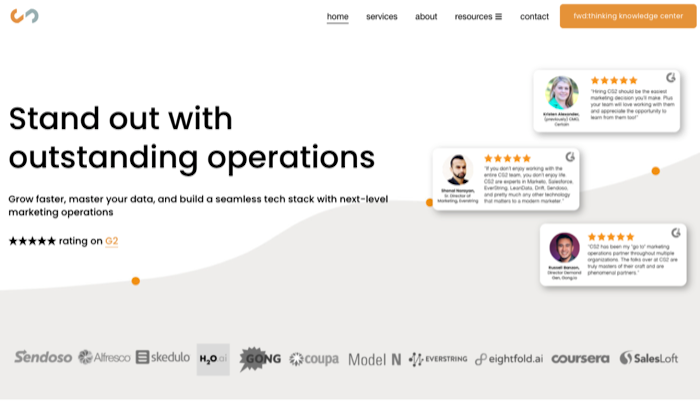
CS2 Marketing has generated more than $1 billion in pipeline revenue for its clients.
#4 Bluewolf – Best for Salesforce Automation
Bluewolf is our recommended marketing automation agency for marketing automation on Salesforce:
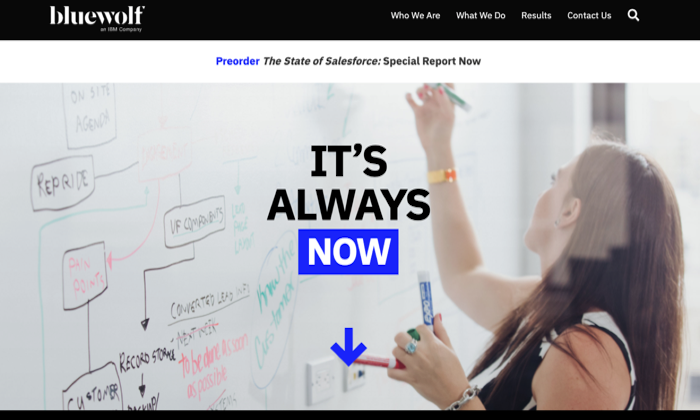
Marketing automation isn’t just about your MA tool, everything has to work perfectly with your CRM. You’ll need experts that know how to integrate the two.
Bluewolf’s clients include T-Mobile, IBM, Autodesk, and others.
#5 Perkuto – Best for Marketo Automation
Perkuto is the leading agency for Marketo. If you need to get ultra fancy with your Marketo implementation, reach out to them.
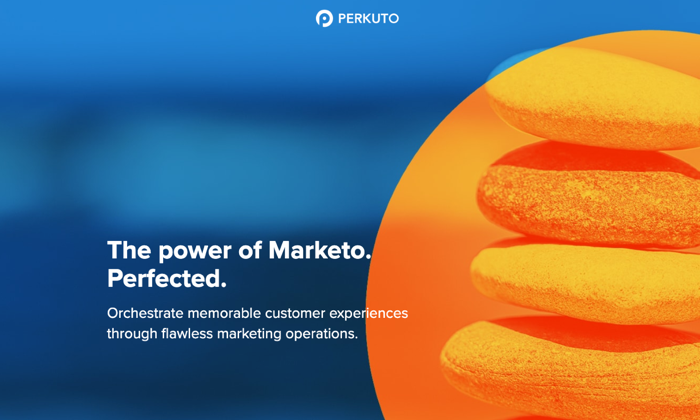
Perkuto’s team of over 50 automation strategists, marketers, and hardcore engineers help companies make the most of their Marketo implementation.
Reach out to specialists like Perkuto if:
- You have an extremely complicated funnel to implement
- Internal teams or agencies have botched a previous install that you need to untangle
- Other agencies have previously failed at wrangling your funnels
What’s most important when choosing a marketing automation agency?
It depends on your needs.
Do you need help implementing or optimizing your marketing automation tech stack?
Choose an agency with experience in working with your tech stack of choice.
Do you have challenges making sense of your marketing touchpoints?
Then go with a marketing automation agency specializing in data operations.
Do you want to get the absolute best ROI from every dollar invested in marketing automation?
Then work with an agency that has deep experience across marketing channels, knows how to get the entire marketing funnel working together, and will use marketing automation to accelerate the marketing KPIs for your entire company.
The post How to Choose The Right Marketing Automation Agency appeared first on Neil Patel.
Source: neilpatel.com

How to Implement Marketing Automation
Finally, the implementation journey is about to begin. But you are not ready. There is a lot that can and should be done before anyone starts loading software onto servers (or, in the cloud)!
This is the final installment of our three-part series delving into the process for selection and preparation for CRM + marketing automation implementation.
Part 1 of 3: How to Choose a Marketing Automation Platform
Part 2 of 3: How to Collect the Right Data to Boost Your Marketing
Finally, the implementation journey is about to begin. But you are not ready. There is a lot that can and should be done before anyone starts loading software onto servers (or, in the cloud)!
In the first two parts of this series, we covered a lot of steps and processes to identify and select CRM + marketing automation, the importance of data and data integrity, and even how to rethink CTAs. Let’s dive into the next part.
The most important part of marketing automation implementation is content.
It would be nice if we could just tell the CRM/MA integration team to throw the switch and turn it on, but there is actually a huge chasm that still has to be mapped and crossed. It may be easy for some and daunting for others. It’s called “content.”
We’re making the assumption that somewhere during the implementation process, you’ve mapped out all the lead types, the journey maps, the possible interactions, the rules and conditional logic being applied to those interactions, and the tracking.
Once that is all done (it never really is, but work with me), there is one major matter the CRM/MA provider or third-party integrator cannot do. And that’s to catalog and probably create new, compelling content the whole system will rely on.
Where does mapping your content fall in the overall marketing automation implementation process?
Mapping your content should happen right at the beginning. It may seem odd to hold off mentioning it until part 3 of this series, but I wanted to lay the foundation first.
The process we prescribe can actually begin even during the CRM/MA evaluation process because regardless of what platform or tools are ultimately selected, the content will still be required.
Think back to part one of this series, where we identified the Four Pillars of Nurture Program Success. Content is one of those essential pillars.
We use another 4-step process to map out a content plan to identify what we have, what we need, priorities, and how we’re going to develop the missing parts.
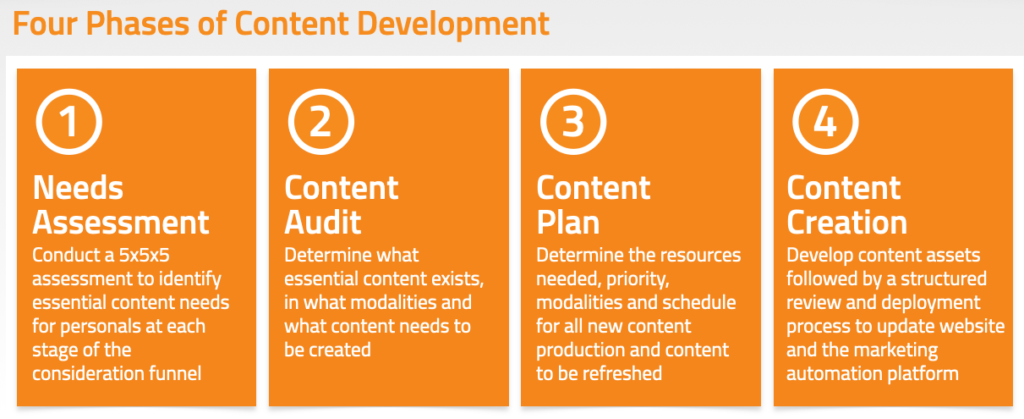
The first part of the process is to perform a content audit based on what we call the 5x5x5 content needs assessment. In summary, the 5x5x5 approach is:
- Determine the number of personas (assume 5 for the math here)
- Determine the number of stages in your consideration funnel (again, assume 5 for the math here, which works in most cases)
- Determine the 5 key questions at each stage that must be answered in order to move the prospect further down the consideration funnel.
5 x 5 x 5 = 125, which is approximately how many content marketing topics you’ll need to cover—just to address the known and inferred customer needs. But don’t despair; much of that content is likely a dual purpose, and some probably already exist.
Next, perform a content audit to identify the gaps between the 5x5x5 and the existing content library. The outcome isn’t always a binary, “Yes we have that covered” vs., “No we don’t have that content.”
The particular piece of content is often buried, needs to be updated, it’s in the wrong modality, or needs to be cobbled together from several disparate sources. Even if the core content is there for a particular piece of content, it often needs work. That takes time and resources.
When the content is blatantly missing, that’s actually the golden opportunity—a blank slate—to create what we really want and need to be highly relevant to the audience. This typically requires some combination of internal and external people skilled in:
- Content creation, copy or script writing and story-telling
- Graphic design, including, motion graphics
- Videography and editing
- Audio recording and editing
- Brand management and oversight
- Possibly gamification, assessments, online calculators, product selectors, and other interactive content assets
- And maybe even legal review.
This necessitates a content calendar to organize the workflow of what content will be produced, in what order, and on what schedule. You can Learn How to Build a Content Calendar (plus a free downloadable template) to get started.
Clearly, content is as important as any of the other pillars for overall project success. Yet, it’s probably the most under-prioritized from a workload and timeframe standpoint.
Some companies and organizations will have much or most of this buttoned-up—they already have their content-creation machines running at full speed and high quality. Others will be starting from nearly zero.
In those cases, we often recommend turning to contract or freelancers to help with the heavy lifting.
With all the content creation and production being done, is there anything else to do?
Of course, there is. No initial CRM + MA launch is flawless once activated. No content library is perfect.
Ramp up your A/B testing and interval testing. The never-ending next step is ongoing optimization based on performance metrics. That’s where we get to see the return on all this investment in time and money and be sure, people within your organization will be looking for a positive ROI.
That topic will have to wait for another series. There are so many interesting ways to look at soft engagements, hard conversions, deciding which KPIs really matter, assisted conversion and attribution models, and the big one — educating the executive team and managing their expectations.
If that sounds daunting, is it even worth doing?
That really depends. It’s a smart question to answer upfront. A bit of not-too-complex math will usually give us an answer and a likely timeframe. It all comes down to total investment, volume projections, short-term revenue and customer LTV, and the expectations for break-even and ROI.
Those variables are different for every company or organization. There’s no viable substitute for not doing the math upfront, or even reassessing where you are now in your current CRM+MA journey.
The entire marketing automation/CRM selection and implementation process can be overwhelming. But it really is a linear process with a few concurrent initiatives running at the same time, A good plan, enough people, and the right people, greatly improve the likelihood for a successful outcome.
The post How to Implement Marketing Automation appeared first on Content Marketing Consulting and Social Media Strategy.
Source: convinceandconvert.com

Best Marketing Automation Software
From enterprise-grade solutions to the most affordable options, my team and I have researched, tested, and used just about every software you can imagine. And I can honestly say… that’s not an exaggeration.
Disclosure: This content is reader-supported, which means if you click on some of our links that we may earn a commission.
Marketing campaigns get more complex by the day.
Which… is great news for the consumer experience but a nightmare for you as a marketing manager handling thousands of moving parts (and countless employees) on a daily basis.
To put it lightly, there’s a lot going on behind the scenes.
Especially complex technical challenges that most consumers and employees will never see or fully understand.
But thankfully more and more automation tools are popping up to make your life a bit easier.
However, that means choosing the best marketing automation software for your business and team is harder than its ever been.
From enterprise-grade solutions to the most affordable options, my team and I have researched, tested, and used just about every software you can imagine. And I can honestly say… that’s not an exaggeration.
But the good news is that I narrowed it down to my top six recommendations, reviewed them, and developed an all-inclusive list of what to consider when making your final decision.
The top 6 options for marketing automation software
- Freshmarketer – best for small to midsize businesses
- Pardot by Salesforce – best for B2B companies
- ActiveCampaign – best for email marketing automation
- Acoustic – best for enterprise multi-channel marketing automation
- HubSpot – best for sales, customer service, and marketing automation
- Act-On – best for marketing agencies
How to choose the best marketing automation software for you
I stand behind all of my top recommendations. However, choosing the right one for you isn’t always easy because it depends on various factors.
So, before we dive in, let’s talk about how to narrow things down and find the best marketing automation software for your business.
Type of business
B2B businesses have different marketing needs than D2C companies.
Furthermore, marketing agencies present a new set of marketing automation challenges. Because of that, specialized software may be necessary to meet your specific needs at a reasonable price point.
The size of your business matters too. Large companies run complex, massive-scale campaigns and have bigger pockets. So, small business tools aren’t a good match.
However, smaller companies will probably find enterprise-grade features confusing and wildly out of budget, which is why those small business tools exist in the first place.
So, pay attention to who the software is built for when making your final decision.
Number of contacts
Most pricing plans depend on the number of contacts or leads you have. The larger your list, the more you need to pay to maintain it and stay in touch with them.
If you have tens or hundreds of thousands of contacts, enterprise-grade solutions are probably more cost-effective. However, that’s not the case if you have a few hundred or even a few thousand leads on your list.
Just be sure to keep this in mind and remember that specific plans may limit the maximum number of contacts you can have.
And if you hit those limits, you’ll need to upgrade to a higher plan or pay an extra fee.
Your marketing channels
Different marketing automation software supports various marketing channels.
And there’s no one-size-fits-all solution.
From SMS and email marketing to social media and push notifications, it’s crucial to choose a software that handles everything you need.
Smaller businesses with simple campaigns may not utilize a wide range of channels and can get away using a more affordable tool.
However, large businesses with complex campaigns spanning numerous channels need something more robust to manage all the moving parts.
Furthermore, some software includes varying channels in different pricing tiers. So, you may start on one level and need to move up to gain access to more marketing channels. Or you may need to move to (or integrate) a new tool altogether.
It may help to map out your upcoming campaigns and decide which channels you plan to use.
Automation features
Automation is at the heart of every tool on this list. But some offer more advanced automation features than others.
Do you need to score leads and prospects? Maybe you want to combine SMS, email marketing, and Facebook ads in the same customer journey. Or perhaps you need the ability to send hyper-targeted emails on autopilot.
Regardless of the complexity of your campaigns, don’t forget to consider:
- Split A/B testing
- Automated email campaigns
- Event and website tracking
- Contact management
- Visual customer journey mapping
- Automated segmentation and personalization
- Prospect and lead scoring
- Dynamic content
- Transactional emails
- AI-powered recommendations
- Action and logic-based triggers
- Reporting and analytics
You may not need all of them, and some tools don’t include them. So it’s critical to understand what you need (and don’t need) before making your decision.
Additional features
It’s not uncommon for marketing automation software to include a handful of features typically found in a CRM tool, like live chat or customer support capabilities.
Before making a final decision, it’s essential to understand which additional features you need to fill the gap between marketing and sales or customer service.
You may already have these systems in place. So, you won’t need these additional features. But if you don’t, you might be able to save money, hassle, and time by choosing software that includes everything you’re missing under one roof.
Hubspot is an excellent example of this.
It includes customer service, sales, and marketing automation tools in a centralized location to streamline data movement and foster automation across your entire business.
The different types of marketing automation software
Marketing comes in all shapes, sizes, and complexities.
From physical mailers and print campaigns to social media and email marketing, the best marketing automation software helps you build, automate, and optimize all types of marketing campaigns.
Marketing automation software is often confused with customer relationship management (CRM). However, the two aren’t the same or interchangeable.
CRM software focuses on sales activities, while marketing automation software focuses on marketing tasks. Going further, marketing automation software is for generating, nurturing, and qualifying leads.
On the other hand, CRM software is to close the sale and foster communications or relationships after the sale.
In a perfect world, the two systems play well together and create a seamless flow of data from your marketing team to your sales team.
Taking things further, there are numerous subsets of marketing automation software, including:
- Email marketing
- Social media marketing
- Advertising management
- SMS marketing
- Live chat
Each different tool is powerful on its own. But true marketing automation software lets you create and optimize customer journeys across marketing platforms for varying complexity campaigns.
Examples of Marketing Automation Software in the Market
#1 – Freshmarketer Review — The best marketing automation software for small to midsize businesses
Around here, we’re big fans of Freshworks (if you couldn’t tell).
Freshmarketer is their intelligent marketing automation platform built to help small to midsize businesses save time, attract the right people, nurture their audiences, and make more money.
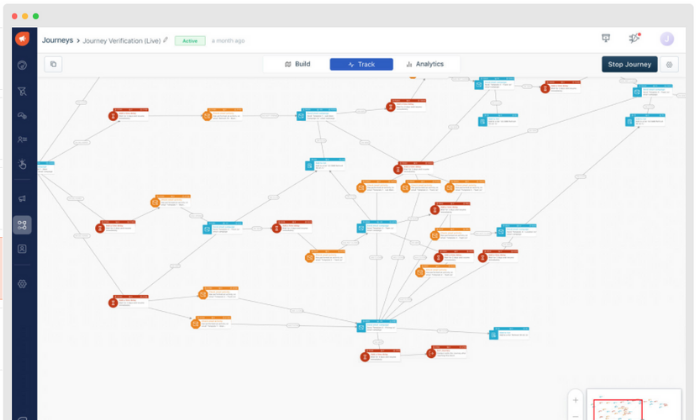
It’s my #1 recommendation for most users—and for a good reason.
From awareness to retention, you get all the automation features you need to gain more leads, turn those leads into customers, and keep those customers around for life. All while doing less work with better results.
Plus, you don’t need any technical skills or a dedicated support team to get started. And it takes about a minute to get up and running.
You also get access to incredible features like:
- Email campaigns and contact management
- Visual drag and drop customer journey builder
- Website, form, and offline event tracking
- Conversion rate optimization toolsA/B and split testing
- Advanced personalizationDynamic heat maps
- Audience segmentationReal-time funnel analytics
Furthermore, the software seamlessly integrates with Freshworks’ other tools, so it’s an excellent choice if you currently use or plan to use any of their business software.
You can try Freshmarketer on their limited free forever plan or a 21-day free trial of their paid plans, which are incredibly affordable and accessible for businesses of all sizes. However, they depend on the number of contacts you have, so keep that in mind.
Their plans include:
- Sprout — Free for up to 500 contacts with limited features
- Garden — $49 per month for 1,000 contacts (ideal for growing teams)Estate — $99 per month for 1,000 contacts (best for large teams)
Just remember the cost for each plan goes up after you max out your 1,000 contacts.
#2 – Pardot by Salesforce Review — The best marketing automation software for B2B businesses
As a B2B business, you market to other companies, which presents a unique set of marketing challenges. As such, you need a marketing automation tool built for the job.
Pardot exists to help B2B companies build relationships and turn those relationships into revenue. Plus, it’s a fantastic marketing automation software built around the world’s #1 CRM.
So, you know you’re in good hands.
From lead generation to sales alignment, the software offers a wide range of features, including:
- Dynamic content and data-based personalization
- Lead-nurturing email automation
- Prospect and lead scoring
- Visual multi-part automation creator
- Advanced segmentation
- Landing page builder
- Smart forms + drag and drop builder
- Social media scheduling, profiling, and analytics
- Lead activity tracking
- Campaign performance reporting
- Lifecycle and funnel reporting
- Pardot Einstein for lead and behavior scoring
Furthermore, over 2.8+ million worldwide users rely on Pardot for their marketing automation needs, making it one of the most popular platforms on this list.
But it is a bit expensive, so it’s best suited for larger businesses. Their paid plans include:
- Growth — $1,250/month for up to 10,000 contacts and basic features
- Plus — $2,500/month for up to 10,000 contacts with deeper automation + analytics
- Advanced — $4,000/month for up to 10,000 contacts with AI and all features
- Premium — $15,000/month for up to 75,000 contacts with supercharge features
They also offer a few add-ons that come free in the Premium plan. Those add-ons include Salesforce Engage ($50/user per month), Analytics Plus ($3,000/month), and Engagement History ($300/year).
All plans and add-ons are billed on an annual basis.
#3 – ActiveCampaign Review — The best for email marketing automation
Email is one of the most important aspects of digital marketing. All the tools on this list include email marketing in one form or another, but ActiveCampaign specializes in it.
So, it’s an excellent option if you want to hone in and focus on improving your email marketing strategy. It’s also a super affordable tool that includes numerous automation features for leads anywhere in your funnel.
With that said, they also offer omnichannel automation, including instant messaging and SMS, live chat, and Facebook.
So, you’re not limited to just email marketing automation with ActiveCampaign.
Their most popular features cover leads at every point in the funnel, including:
- Engage – Automation maps, site tracking, and subscription forms
- Nurture – List segmenting, dynamic/predictive content, and event tracking
- Convert – Contact and lead scoring, split actions, and win probabilities
- Support – Predictive sending, SMS, A/B split testing, and ecommerce
You can also set up numerous types of emails like autoresponders, targeted or triggered emails, broadcasts, scheduled emails, and automated funnels.
And you can design those emails using their intuitive drag and drop designer, or start from one of their 25+ pre-made mobile-responsive design templates.
Whether you’re just getting started or interested in scaling and optimizing your email marketing strategy, ActiveCampaign is an excellent choice. They offer everything you need to capture, nurture, and close leads at scale.
ActiveCampaign offers four plans, with the price of each starting at:
- Lite — $9 per month with up to three users
- Plus — $49 per month with up to 25 users
- Professional — $129 per month with up to 50 users
- Enterprise — $229 per month with unlimited users
Each tier includes more advanced features, and pricing is based on the size of your list, starting for up to 500 contacts.
So, keep in mind that you will have to pay more than the prices above as your list grows.
#4 – Acoustic Review — The best enterprise-grade multi-channel marketing automation software
Acoustic offers an array of marketing automation products for centralized cross-platform multi-channel marketing. From personalization and email campaigns to web content management and experience management, they offer something for everyone.
Acoustic Campaign is their marketing automation tool, encompassing mobile apps, push notifications, SMS, group chats, social media, ads, email, print campaigns, and more.
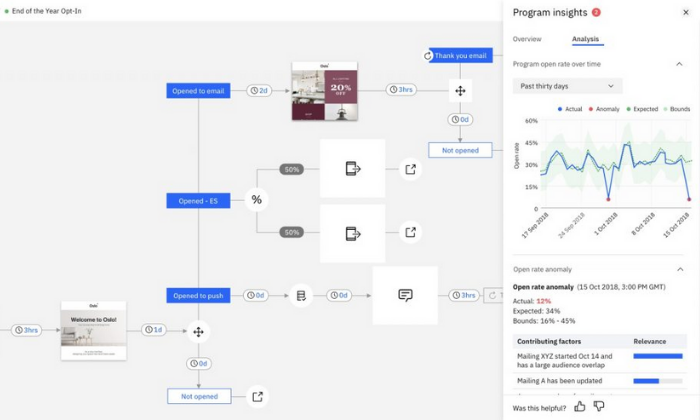
You can also combine this with Acoustic Personalization and Acoustic Analytics for a powerful combination of campaign management, data, and using that data to deliver the right message at the right time.
With Acoustic Campaign, you get access to powerful features, including:
- Drag and drop campaign builder
- Action, logic, and AI-recommended triggers
- Seamless mobile and digital channel campaigns
- Lead management and scoring
- Split A/B testing
- Customer journey mapping
- Planning and budgeting
- One-to-one ads and lookalike audiences
- Advanced personalization
- Reporting and analytics
Furthermore, they have a community forum where you can publicly ask questions. They also provide an online academy packed full of educational videos and training so you can get the most of your custom automation package.
Note: Acoustic is built for moderate to large volume campaigns with countless moving parts. So, it’s perfect for businesses managing complicated campaigns across numerous channels.
But it’s overkill for a lot of businesses and anyone running single-channel campaigns.
Pricing isn’t available online, and you have to schedule a consultation to learn more. So, keep in mind that you won’t be able to sign up and get started immediately.
#5 – Hubspot Review — The best sales, customer service, and marketing automation software
If you’re looking for an easy way to automate your sales, customer service, and marketing processes, Hubspot Growth Suite is an excellent and affordable solution.
And the best part? Hubspot goes beyond automating your business processes. It also helps integrate and optimize different departments in one centralized location, thus streamlining your entire business’s workflow.
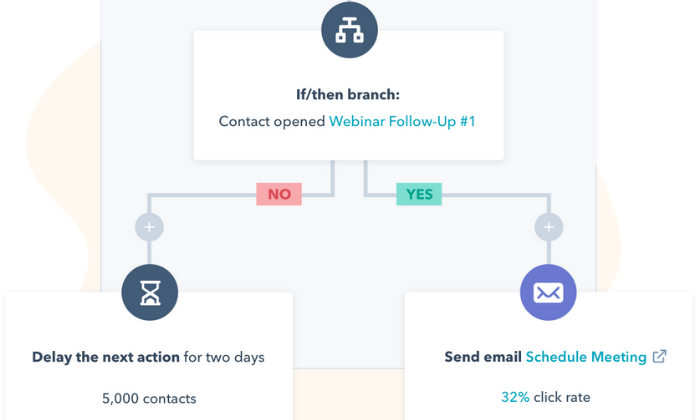
This means teams don’t have to jump from software to software to get the information they need, and you can automate the data transfer process from one team to the next.
However, their marketing automation capabilities are powerful on their own, with features like:
- Blog post and SEO planning
- Ad tracking and management
- Social media management
- AI-powered live chat
- Email marketing
- Forms and landing pages
- Revenue attribution reporting
- Visual workflow builder
- Account-based marketingA/B split testing
- Predictive lead scoring
Hubspot offers basic features, like emails, landing pages, forms, and live chat capabilities for unlimited users absolutely free. So, you can try it out without spending a penny.
Alternatively, you can sign up for a free demo to see all of their advanced features in action.
The Growth Suite (sales, marketing, CRM, and customer service) starts at $50 per month for two users and up to 1,000 contacts, making it extremely affordable for most businesses.
But they also have advanced plans for larger and more complex campaigns, including:
- Professional — $1,275 per month for advanced features
- Enterprise — $4,200 per month for all features
Each 1,000 contacts after your initial 1,000 cost $16.67 per month. And you can add more users to your sales and service hubs for $8.33 per user/month.
Plus, if you’re a current member or alumni of Hubspot’s approved incubator, accelerator, or Venture Capital partners with a round of Series A funding under your belt, you can get up to 90% off your first year.
#6 – Act-On Review — The best marketing automation software for marketing agencies
As a marketing agency, you handle marketing campaigns for several clients (if not hundreds of them) at any given time. As such, you need marketing automation software with the ability to manage everything, including your own marketing campaigns, in one place.
And Act-On offers the perfect solution.
Their scalable software features unique child and parent campaign capabilities, meaning you can easily manage and handle all of your client accounts from a single Act-On login.
Plus, you can completely brand and customize everything to deliver custom reports to clients in just a few clicks.
With Act-On, you can learn more about your clients’ audiences to personalize and tailor their message to match. Not only does this make their life easier, but it also means your team can work less to produce better results.
When you sign up, you get access to powerful marketing features, including:
- Automated engagement programs
- Website and landing page tracking
- Customer/prospect scoring
- Behavior and demographic segmentation
- Pre-built email, form, and landing page templates
- Interactive reporting dashboards
Plus, you can build custom real-time analytic dashboards for internal and external use, so you and your clients always know what’s going on.
Furthermore, you can use this information to improve customer ROI, build better technology stacks, and optimize entire marketing campaigns on behalf of your clients. From lead gathering and nurturing to transferring contact information to sales, you’re in good hands.
Sign up for a free demo to learn more and get started today!
Wrapping things up
Freshmarketer is my top recommendation for most businesses. It’s built for small to midsize companies interested in automating their marketing processes to grow their businesses and save time.
Plus, it’s affordable, easy to use, and packed full of powerful automation features.
However, it’s not the perfect solution for everyone. So, don’t forget to use the criteria we talked about as you sort through finding the best marketing automation software for you and your team.
What are your favorite marketing automation tools?
The post, Best Marketing Automation Software appeared first on Neil Patel.
Source: feedproxy.google.com

How to Choose and Implement a Marketing Automation Platform
This is the first in a three-part series delving into the process for selection and preparation for CRM + Marketing Automation implementation.
Let’s start with the basics and define what marketing automation and CRM is.
What is CRM?
Customer Relationship Management (CRM) usually refers to the database of records for prospects and/or customers. They come in many varieties and specialized versions, so we use the term generically.

What are Marketing Automation and CRM?
Marketing Automation (MA) refers to the suite of tools and capabilities that allow for automated, triggered events including email, text messaging, variable content, lead scoring, conditional logic rules, communication workflows, etc.
These two sets of capabilities, (CRM + MA) can reside in one all-encompassing platform or two (or more) systems that exchange data bi-directionally.
There is no one-size-fits-all solution.
That’s part of the challenge in selecting the best systems(s) for your specific needs.
The combination of a CRM system or database of records and a process to automate marketing messages enables you to communicate based on individuals’ attributes, reactions, engagement, and channel preferences.
It is a long way of saying, “Speak with individuals as individuals in ways that are most relevant to each of them.”

There is a key principle that everyone in the decision-making process needs to be aware of.
It’s analogous to the four pillars holding up the roof to the whole CRM + Marketing Automation process.
It looks like this:
Management has to be clear and committed to all four pillars to achieve success.
The Four Pillars of Nurture Program Success
It looks like this:
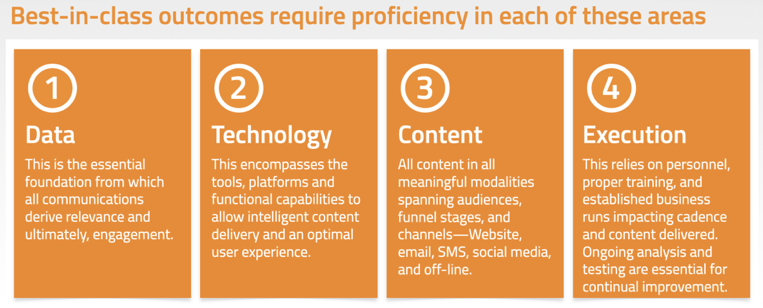
Take a close look at that.
If you remove or even short-change any one of those pillars, the whole marketing automation is doomed to a sub-optimal outcome.
This is to become the lifeblood of most organizations’ sales funnel and revenue.
This is not the place to cut corners.
Management has to be clear and committed to all four pillars to achieve success.
I can write a whole post just on data, and that’s super important. I’ll hold off on that for the second installment in this series.
The most important thing to remember when undertaking a CRM + MA upgrade is probably what not to do.

How to Consolidate and Improve the Entire CRM and Marketing Automation Process
For those who have some sort of system and tools cobbled together, where does one begin to consolidate and improve the whole process?
First, let’s agree we are talking about improving the whole process for everyone: the prospects/recipients, the marketers, the tacticians, and the management.
When done correctly, everyone wins.
The most important thing to remember when undertaking a CRM + MA upgrade is probably what not to do.
Do NOT go out and start looking at demos of different systems.
They all have shiny, whiz-bang demos and colorful charts and seemingly simply drag and drop GUIs, but that’s the wrong way to go about an evaluation.
In fact, Trust Radius lists 130 individual Marketing Autonomation platforms!
There’s no way anyone has the time to demo a meaningful number of those.

The Best Way to Demo Marketing Automation Solutions
The correct way to demo marketing automation platforms — the way that is far more likely to yield a successful outcome — is to do this:
- Document your current capabilities, breakpoints, shortcomings, and limitations (this is your current state)
- Document the features and functionality you want to have in the future (future-state). It’s ok to stretch a bit here; you may not get everything you can dream of, but still, look forward a few years.
This list of future-state capabilities should be comprehensive, but not necessarily exhaustive. More on that in a moment.

How to Evaluate Marketing Automation Solutions
Step 1: Add to your list of Features and Functional Requirements interview questions, including:
- The number of reviews and cumulative rating score (G2, Trust Radius, Capterra)
- Company size, number of employees, and how many are in customer service
- Capitalization structure (VC funded, latest round, privately help, publicly-traded, etc.)
- Implementation time
- On-boarding process: does it include data migration?
- The underlying database product (Microsoft Dynamics, Oracle, Salesforce, or proprietary?)
- Are there specialized products for your particular industry? (e.g., higher education, homebuilders, non-profits and fundraising, etc.)
- And don’t worry about pricing at this stage. Don’t even bring it up. (More on that below)
Step 2: Next, filter through the list of candidate CRM + MA packages and develop a short-list of no more than 10.

Step 3: With these 10 candidates, initiate the sales process with each, by:
- Scheduling a call with their sales rep to confirm if it is a candidate for your particular business
- Send over your list of functional requirements asking them to check the boxes and fill in any notes or explanations
- Schedule your first of two demos, 90 minutes (it’s impossible to do an adequate job in less time, and there will need to be a second demo when you get down to your final two or three).
Step 4: Evaluate the Solutions Internally for a Minimum of 3-4 Weeks
Now, this is going to take some time.
n our experience, it’ll take two full weeks minimum to go through the dialog, checklists, scheduling the demos, follow-up questions, etc.
And you probably can’t get 6-10 done within a two-week time frame if you and your team already have day jobs.
So candidly, plan on a minimum of 3-4 weeks.
Once you get to this stage of analysis, we’ve got some good processes that help streamline things.
We built out a feature and functionality set of criteria and applied it against each candidate platform.
Contact us and I’m happy to share those; it just doesn’t make for good reading here.

How to Choose Your Marketing Automation Solution
Once you get the shortlist down to 1 or 2 candidates, then what?
If it’s down to a list of one, your job is really simple.
Anything more than one, and you’ll have to dig a bit deeper and tease out the differentiators.
There are probably no non-starters by this stage, or they wouldn’t be on the final list.
This is where talking with reference customers and price negotiations come in.
And pricing models vary greatly.
You should be prepared for multiple licenses, user fees including admins, marketers, clerks, or whatever they each name their seat and access level licenses, and some might even be a fixed rate.
We always ask for a fee structure covering each of the first three years.
Year one is always the most expensive because migration and implementation services are usually all rolled up in that first year.
So, three years gives a better look at the annual cost of ownership.
And it is a negotiation point.
That the best reason to have at least two in your final list of candidates.
Part Two of this series: How to Collect the Right Data to Boost Your Marketing
We delve deeper into the importance of data, the four categories of data, and how this will cause you to rethink your CTAs and webforms!
Part Three of this series: How to Implement Marketing Automation
The implementation journey is about to begin. But you are not ready. There is a lot that can and should be done before anyone starts loading software onto servers! (or, in the cloud)
The post How to Choose and Implement a Marketing Automation Platform appeared first on Content Marketing Consulting and Social Media Strategy.
Source: convinceandconvert.com

How to Choose a Marketing Automation Platform
One of the initiatives I work on with our clients here at Convince & Convert is marketing automation vendor selection. Based on our experience in this space, here is the process we use to choose the best marketing automation platform for your business.
This is the first in a three-part series delving into the process for selection and preparation for CRM + Marketing Automation implementation.
Let’s start with the basics and define what marketing automation and CRM is.
What is CRM?
Customer Relationship Management (CRM) usually refers to the database of records for prospects and/or customers.
They come in many varieties and specialized versions, so we use the term generically.
What is marketing automation?
Marketing Automation (MA) refers to the suite of tools and capabilities that allow for automated, triggered events including email, text messaging, variable content, lead scoring, conditional logic rules, communication workflows, etc.
These two sets of capabilities, (CRM + MA) can reside in one all-encompassing platform or two (or more) systems that exchange data bi-directionally.
There is no one-size-fits-all solution.
That’s part of the challenge in selecting the best systems(s) for your specific needs.
The combination of a CRM system or database of records and a process to automate marketing messages enables you to communicate based on individuals’ attributes, reactions, engagement, and channel preferences.
That is a long way of saying, “Speak with individuals as individuals in ways that are most relevant to each of them.”
There is a key principle that everyone in the decision-making process needs to be aware of.
It’s analogous to the four pillars holding up the roof to the whole CRM + Marketing Automation process. It looks like this:
Management has to be clear and committed to all four pillars to achieve success.
The Four Pillars of Nurture Program Success
Take a close look at that.
If you remove or even short-change any one of those pillars, the whole marketing automation is doomed to a sub-optimal outcome.
This is to become the lifeblood of most organizations’ sales funnel and revenue.
This is not the place to cut corners. Management has to be clear and committed to all four pillars to achieve success.
I can write a whole post just on data, and that’s super important.
I’ll hold off on that for the second installment in this series.
The most important thing to remember when undertaking a CRM + MA upgrade is probably what not to do.
How to Consolidate and Improve the Entire CRM and Marketing Automation Process
For those who have some sort of system and tools cobbled together, where does one begin to consolidate improve the whole process?
First, let’s agree we are talking about improving the whole process for everyone: the prospects/recipients, the marketers, the tacticians, and the management.
When done correctly, everyone wins.
The most important thing to remember when undertaking a CRM + MA upgrade is probably what not to do.
Do NOT go out and start looking at demos of different systems.
They all have shiny, whiz-bang demos and colorful charts and seemingly simply drag and drop GUIs, but that’s the wrong way to go about an evaluation.
In fact, Trust Radius lists 130 individual Marketing Autonomation platforms!
There’s no way anyone has the time to demo a meaningful number of those.
The Best Way to Demo Marketing Automation Solutions
The correct way to demo marketing automation platforms — the way that is far more likely to yield a successful outcome — is to do this:
- Document your current capabilities, breakpoints, shortcomings, and limitations (this is your current state)
- Document the features and functionality you want to have in the future (future-state). It’s ok to stretch a bit here; you may not get everything you can dream of, but still, look forward a few years.
This list of future-state capabilities should be comprehensive, but not necessarily exhaustive.
More on that in a moment.
How to Evaluate Marketing Automation Solutions
Step 1: Add to your list of Features and Functional Requirements interview questions, including:
- The number of reviews and cumulative rating score (G2, Trust Radius, Capterra)
- Company size, number of employees, and how many are in customer service
- Capitalization structure (VC funder, latest round, privately help, publicly-traded, etc.)
- Implementation time
- On-boarding process: does it include data migration?
- The underlying database product (Microsoft Dynamics, Oracle, Salesforce, or proprietary?)
- Are there specialized products for your particular industry? (e.g., higher education, homebuilders, non-profits and fundraising, etc.)
And don’t worry about pricing at this stage.
Don’t even bring it up. (More on that below)
Step 2: Next, filter through the list of candidate CRM + MA packages and develop a short-list of no more than 10.
Step 3: With these 10 candidates, initiate the sales process with each, by:
- Scheduling a call with their sales rep to confirm if it is a candidate for your particular business
- Send over your list of functional requirements asking them to check the boxes and fill in any note or explanations
- Schedule your first of two demos, 90 minutes (it’s impossible to do an adequate job in less time, and there will need to be a second demo when you get down to your final two or three).
Step 4: Evaluate the Solutions Internally for a Minimum of 3-4 Weeks
Now, this is going to take some time. In our experience, it’ll take two full weeks minimum to go through the dialog, checklists, scheduling the demos, follow-up questions, etc.
And you probably can’t get 6-10 done within a two-week time frame if you and your team already have day jobs.
So candidly, plan on a minimum of 3-4 weeks.
I’ve kind of glossed over some of the process details about how to compile all the gathered information into a side-by-side comparison chart, but that’s detail stuff.
Once someone gets into that stage of analysis, we’ve got some good processes that help streamline things.
I’m happy to share those; it just doesn’t make for good interview material.
How to Choose Your Marketing Automation Solution
Once you get the shortlist down to 1 or 2 candidates, then what?
If it’s down to a list of one, your job is really simple.
Anything more than one, and you’ll have to dig a bit deeper and tease out the differentiators.
There are probably no non-starters by this stage, or they wouldn’t be on the final list.
This is where talking with reference customers and price negotiations come in.
And pricing models vary greatly.
You should be prepared for multiple licenses, user fees including admins, marketers, clerks, or whatever they each name their seat and access level licenses, and some might even be a fixed rate.
We always ask for a fee structure covering each of the first three years.
Year one is always the most expensive because migration and implementation services are usually all rolled up in that first year.
So, three years gives a better look at the annual cost of ownership.
And it is a negotiation point.
That the best reason to have at least two in your final list of candidates.
In Part Two of this series:
We delve deeper into the importance of data, the four categories of data, and how this will cause you to rethink your CTAs and webforms!
In Part Three of this series:
The implementation journey is about to begin. But you are not ready.
There is a lot that can and should be done before anyone starts loading software onto servers! (or, in the cloud)
The post How to Choose a Marketing Automation Platform appeared first on Content Marketing Consulting and Social Media Strategy.
Source: convinceandconvert.com