
Tag Archives for " marketers "

A Marketer’s Guide to the Metaverse
Technology is ever-changing and, because of that, so is marketing. The evolution of the metaverse is just one recent development in the world of technology, but one that will have a huge impact on the human experience as we know it.
While digital marketing has seen many advances over the last few decades, the metaverse is one that has stumped many companies and marketers. How can they use the metaverse to their advantage so they aren’t stuck in the dark ages?

In this post, I’ll introduce the metaverse. This will include a breakdown of what it means and a look at both its current and future states. I’ll then introduce the various ways marketers can expect to use the metaverse in the years to come, as well as how they can get their foot in the door.
What Is the Metaverse?
The metaverse as envisioned by Matthew Ball, a venture capitalist and writer, and later on Zuckerburg, is “an expansive network of persistent, real-time rendered 3D worlds and simulations.”
Put more simply, the metaverse is a currently hypothetical version of the internet that supports online 3-D virtual environments. This is done through personal computing (a current example is an online game Second Life), virtual reality headsets, and augmented reality headsets.

That’s not to say that elements of the metaverse don’t exist currently. There are games like Roblox and Fortnite that form the basis for what many consider to be the future of the metaverse. More specifically, virtual avatars who can interact with their virtual environment, and other players. They can also purchase merchandise in-game, such as clothing and decorative accessories, to personalize the experience.
Metaverse and NFT: How Are They Related?
An NFT, or non-fungible token, is anything digital that cannot be replaced as it doesn’t have a tangible value. The most common forms of NFT today are digital art like animations. However, within the metaverse, an NFT can become so much more.
According to Morgan Stanley, the multinational investment bank, NFTs have the potential to become a $56 billion market by 2030. How? All thanks to the demand the metaverse will create.
With the increase in virtual avatars, the demand for virtual fashion will skyrocket. The need to personalize oneself within the digital space is undeniable and fashion is one of the easiest ways to do so. Just look at the success of markets found on Fortnite and Roblox, virtual games with an avatar.
How Will the Metaverse Impact Marketing?
If you haven’t considered how the metaverse will impact marketing, then you’re already behind the curve. The metaverse isn’t an “if” but a “when.” That is, it’s an inevitability. The metaverse will impact marketing in many ways, some of which you can begin to implement now.
Virtual Reality
Virtual reality isn’t new. In fact, it’s been around in one variation or another for decades. Of course, it’s improved leaps in bounds in recent years, and it will continue to do so in the years to come.
From product development to the sale of existing products or services, virtual reality enables you to bring your customers into the fold. They can play an active role in all stages of the process. Who says “no” to free product research?

Even more, many customers will seek out such opportunities as opposed to hiding from them like they do with online advertisements. The generations coming of age now and in the next 15 years, largely Generations Z and Alpha will feel more at home within these environments than any other generation before them.
Augmented Reality
Unlike virtual reality which takes over your vision, augmented reality just adds elements to it. Think of “smart glasses” or the popular mobile game Pokemon Go. These devices take note of your surrounding environment and then enhance it by adding images, animations, or data over the top of it.
Where does marketing come in? From trying on a pair of glasses or a dress to test driving a new car, augmented reality brings the shopping experience to another level. In an augmented environment, your customers can interact with your products without leaving their homes.

Even in-store experiences will benefit from the metaverse, however. Since augmented reality is an overlay on the real-life environment, you can use it in stores to share in-depth information, display additional features and use cases, etc. Think of it as a parallel marketing experience.
Branding in The Metaverse
As the metaverse grows, so too will branding and advertising opportunities. Including virtual message boards, billboards, merchandise, and even the virtual clothing avatars wear.
NFTs will play a big role, too. With the ability to personalize avatars and spaces like “homes” and storefronts, you can create branded virtual content for your customers. This enables you to break into merchandising spaces you don’t currently work in, such as virtual apparel and digital art.
According to the Chief Metaverse Officer of Futures Intelligence Group, Cathy Hackl, it’s not so easy as going “direct-to-avatar.” That is, breaking onto the scene isn’t so simple as creating a virtual version of your merchandise.
This is especially true for brands that don’t sell apparel, art, or other things easy to digitize. Brands have done it, though. Just look at Chipotle and even Gucci.

Virtual Popups
Popup shops are a common occurrence for businesses of all sizes. Whether it’s products or services you’re selling, a virtual popup gives you the opportunity to share your brand on a larger scale.
Similar to an in-person popup, a virtual popup is a chance to network, advertise, and sell your products and services.

Whereas popups in a physical location may limit attendance (both due to space and travel required), a virtual popup helps you to reach a larger audience.
The virtual location will not only benefit attendance numbers, but it will also have less impact on the bottom line. With a decreased need for employee travel and lodgings, and no need to rent out physical space, you can cut costs and perhaps even decrease the end price for users.
Virtual Training or Classes
With so many live streaming and pre-recorded video platforms, virtual training and classes are already a big part of the corporate world.
While many virtual pieces of training and classes will likely continue in their current form, the metaverse creates a space for them to expand.
Bringing real-world classes to virtual headsets worldwide, the growth opportunities are endless. Just imagine a virtual reality training course on your product or a use case walkthrough for your services. You can even use it for product demonstrations with potential customers or troubleshooting sessions with your current clientele.
Beyond marketing efforts, you can even use virtual classes for in-house onboarding and training. Emergency preparedness, diversity and inclusion, new employee orientation, and more.
Metaverse Events
In this post-COVID world, it’s easy to imagine the continued need for virtual meeting spaces. From family get-togethers to concerts to non-profit galas, the metaverse has no limits on who you can meet up with and when.
A recent example of such an event was the Lil Nas X concert that took place within the virtual world of Roblox.

With events like this becoming more popular, especially with Generations Z and Alpha, metaverse events won’t just be a tool you can use but a necessity. As your target audience changes, so too will your marketing efforts. This is just one example of how the metaverse will play a role.
You don’t want to wait until these types of events become popular before you hop on the bandwagon. You should consider hosting your own virtual event, whether through virtual reality or augmented reality, soon. There are even consulting agencies that can help you to host such events.
Metaverse in Marketing: Frequently Asked Questions
What is the Metaverse?
The Metaverse is a digital universe where users interact with the computer-generated reality and other users. It’s a digital life, for all intents and purposes, that includes components such as virtual reality and personal computing.
Why should marketers care about the metaverse?
As a second life for users, the metaverse provides an opportunity for marketers to reach their audiences in a new dimension. The metaverse expands the digital footprint of customers so as to provide a whole new look into their actions and behaviors.
How could businesses monetize the metaverse?
From opportunities to brand digital merchandise to offering virtual classes and popup events, businesses can monetize the metaverse in the same ways they can monetize their real-world counterparts.
What companies are in the metaverse?
While we speak of the metaverse in its future state, there are companies that contribute to its existence both now and in the future. Just a few companies currently “in” the metaverse are Facebook (Meta), Niantic, Epic Games, and Apple.
How can my company prepare for the future of marketing in the metaverse?
The metaverse, in its simplest, is a virtual community. With community is the need for connection. Companies can prepare for the future of marketing in the metaverse by taking steps towards building that connection. For now, this includes opening new commerce stores on Instagram Shop and Facebook Shop and even creating AR advertisements.
Conclusion: Metaverse for Marketers
The metaverse as imagined by the likes of Matthew Ball and Mark Zuckerberg is still years away. Digital marketers shouldn’t sit on the sidelines waiting until that time has come. Instead, they should use these next few years to prepare for opportunities to come.
There are ways that marketers can get ahead of the curve, including investing in virtual reality and augmented reality advertising. There are also e-commerce platforms, like Instagram Shop and Facebook Shop, that offer a glimpse into the future of the metaverse and what it has in store.
What step will you take to get your company started in the metaverse?
Source: neilpatel.com

Distribution Channels: What They Are, Types, & Examples
Have you defined the distribution channels that will be used by your company?
If not, it’s time.
In short, distribution channels determine the path goods will take from the manufacturer to the final consumer.
Thus, they have a direct impact on sales.
There are many types, formats, and levels of distribution channels.
The first step is to understand each of them.
To help you with this task, this page will go over the main things you need to know about distribution channels:
- what distribution channels are?
- the three types of distribution channels
- three distribution methods
- distribution levels
- the main intermediaries
- how to define them
What Are Distribution Channels?
Distribution channels are the path products take from their initial manufacturing stage to selling them to consumers.
The main goal of these channels is to make goods available to final consumers in sales outlets as soon as possible.
Distribution channels directly impact a company’s sales, so you want to make them as efficient as possible.
The Three Types of Distribution Channels
There are three ways to make sure a product gets to the final consumer.
1. Direct Channels

With direct channels, the company is fully responsible for delivering products to consumers.
Goods do not go through intermediaries before reaching their final destination.
This model gives manufacturers total control over the distribution channel.
This is the case with people who do catalog sales, for example.
Since the manufacturer alone is responsible for delivering products, this channel generally makes it impossible to have a high number of customers.
At the same time, it’s possible to offer lower prices, since the company does not have to pay commission to intermediaries.
2. Indirect Channels

With indirect channels, products are delivered by intermediaries, not by the sellers.
Who are these intermediaries?
They could be wholesalers, retailers, distributors, or brokers, for example.
In this case, manufacturers do not have total control over distribution channels.
The benefit is that this makes it possible to sell larger volumes and sell to a range of customers.
However, products have higher prices due to the commissions paid to intermediaries.
3. Hybrid Channels
Hybrid channels are a mix of direct and indirect channels.
In this model, the manufacturer has a partnership with intermediaries, but it still takes control when it comes to contact with customers.
One example is brands that promote products online but don’t deliver them directly to customers.

Instead, they nominate authorized distributors.
Three Methods for Distribution Channels
There are three different delivery methods for distribution.
Basically, they concern about who will be allowed to sell your products.
1. Exclusive Distribution
With exclusive distribution, intermediaries take the company’s products to specific sales outlets.
This is usually done by a sales representative.
This means that only exclusive retail outlets will be able to sell the items to consumers.
Depending on the quality of the product, this is a great strategy not only for manufacturers but also for the retail outlets or chain stores selected.
2. Selective Distribution
With selective distribution, the company allows sales to a specific group of intermediaries who are responsible for selling items to final customers.
An important factor in how successful this strategy will be is the reputation of the intermediaries since they have a direct impact on the company’s performance.
In this case, the intermediary becomes the real consultant for consumers, answering questions and recommending appropriate products for their needs.
3. Intensive Distribution
In intensive distribution, the manufacturer tries to place their product in as many sales outlets as possible.
The manufacturers themselves, sales teams, and commercial representatives are all involved in this method.
They are responsible for distributing products to sales outlets.
This distribution method is generally used by manufacturers of low-cost products with a high frequency of consumption.
Distribution Channel Levels
Besides the types and methods of distribution channels, they may also operate on different levels.
Their levels represent the distance between the manufacturer and the final consumer.
Level 0 Distribution Channel
At this level, there is a close and direct relationship between the manufacturer and the client.
For the company, the costs of the relationship with the consumer are higher.
Level 1 Distribution Channel
In level 1, the manufacturer sells the products to the distributor, who might sell them to consumers via retailers or wholesalers.
The distributor keeps some of the rights to the product, but not all.
The distributor is also responsible for the costs of sales and transportation to sales outlets.
Level 2 Distribution Channel
Level 2 is similar to level 1.
The difference is that in this case, the distributor delivers products only to retailers, who sell them to consumers.
Level 3 Distribution Channel
Level 3 channels are a traditional distribution model.
The product’s journey from the manufacturer involves the distributor, retailer, and customer.
The costs relative to sales and marketing are divided between the parties.
The advantage of this model is that it’s possible to reach a larger number of consumers.
On the other hand, products have a higher price because of the operational costs of all the parties involved.
The Nine Main Intermediaries in Distribution Channels
After finding out more about operation details, it’s time to see who are the main intermediaries who take products to consumers.
1. Retailers
Retailers are intermediaries used frequently by companies.
Examples include supermarkets, pharmacies, restaurants, and bars.
Each of these types of businesses has full sales rights.
Generally, product prices are higher in retailers.
2. Wholesalers
Wholesalers are intermediaries that buy and resell products to retailers.
Wholesalers sell to those who are going to put products in their own stores.
These intermediaries generally don’t sell small quantities to final consumers, though there are exceptions, like supermarkets that sell in the wholesale model.
Prices are lower because sales involve large quantities.
3. Distributors
Distributors sell, store, and offer technical support to retailers and wholesalers.
Their operations are focused on specific regions.
4. Agents
Agents are legal entities hired to sell a company’s goods to final consumers and are paid a commission for their sales.
In this case, the relationships between intermediaries and companies are for the long term.
5. Brokers
Brokers are also hired to sell and receive a commission.
The difference between agents and brokers is that brokers have short term relationships with the company.
That’s the case with real estate agents and insurance brokers, for example.
6. The Internet
To those who sell tech and software, the internet itself works as the intermediary of the distribution channel.
The consumer only has to download the material to have access to it.
E-commerce companies also use the internet as a distribution intermediary.
7. Sales Teams
A company can also have its own sales team who are responsible for selling goods or services.
There is also the possibility of creating more than one team to sell to various segments and audiences if the company has a wide range of products.
8. Resellers
Resellers are companies or people who buy from manufacturers or retailers to later sell to consumers in retail.
9. Catalog
Catalog sales, as the name indicates, is when a salesperson is connected to a company and sells its products using a magazine.
Salespeople in this model also usually earn a commission for their sales.
This type of sales is common in the beauty segment, with brands like Avon and the Brazilian Natura.
Reverse Distribution Channel
Now you know the types and methods available for products to reach customers.
But what happens when consumers need to return items to manufacturers?
Consumers need to rely on reverse distribution if they receive defective products or need to return clothes or shoes they bought online that don’t fit.
In this case, the consumer is responsible for returning the items and needs to find information from the manufacturer about how to do this.
Usually, consumers find information about returns on the site for the product.
How to Define Distribution Channels for Your Product
Now you know the different types of distribution channels and intermediaries.
But all this is of no use if you don’t know how to select the appropriate channel for your company.
Next up are seven essential tips to help you make this decision.
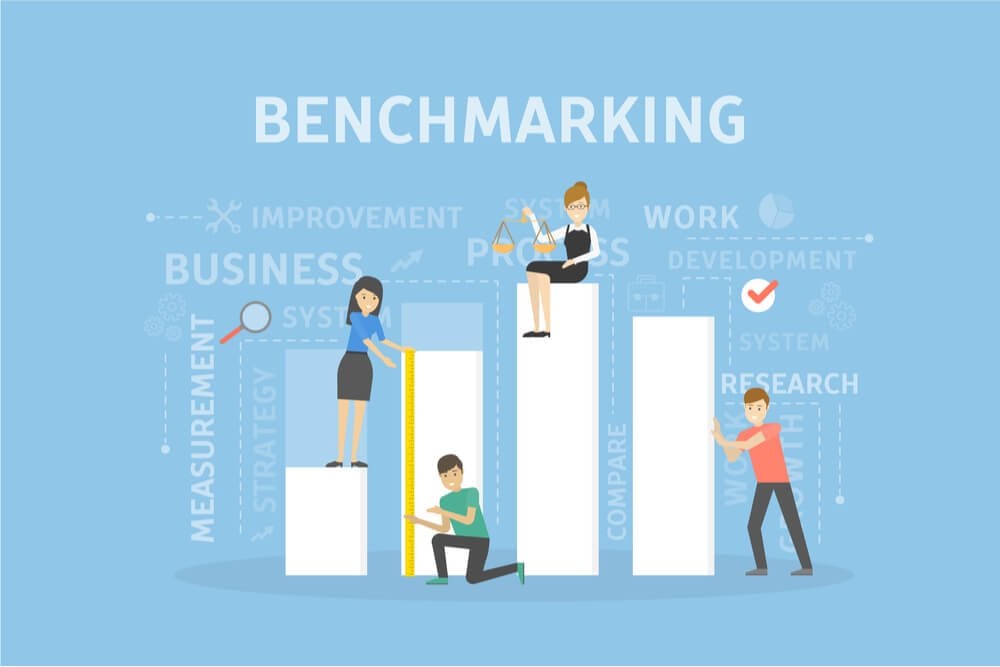
1. Benchmarking
First, you must look at your competitors to find the best practices they adopt.
This kind of mapping is known as benchmarking.
The idea is to figure out how your competitors are distributing their products and adopt a similar model.
2. Project Review
So you have mapped out best practices in the market and identified solutions that could work for your business.
Great.
The next step is to review the project/channel you created.
Check if there are errors and how processes may be optimized and adapt the project to the needs and characteristics of the type of sales you make.
3. Costs and Benefits
When we talk about distribution channels, one important factor is the cost associated with them.
Always look for the best cost-benefit ratio.
To do this, it is not enough to have a vague idea of the costs.
You must record all costs and analyze if the benefits of the channel you selected are worth it.
4. Company’s Daily Routine
Another relevant factor is the business’ routine.
What are the projects, processes, and activities in your business?
The distribution channel must be aligned with all these details.
Otherwise, you might have logistics problems that result in product delays that damage your relationship with customers.
5. Market Potential
Before selecting a channel, you should also consider the market potential of intermediaries.
After all, unless you choose to use direct channels, they will also be responsible for sales results.
Analyze intermediaries’ market participation, reputation, and performance to only then try to select the most appropriate option.
6. Logistics
Consider logistical questions like:
- How will products be transported?
- Is there security for when the products are in transit and/or where they are stored?
- Where will goods be stored?
- What will be the delivery time, on average?
Considering all stages of logistics is crucial to avoid problems taking goods to sales outlets.
7. Location
Finally, consider the location of intermediaries, whether they are resellers, retailers, wholesalers, or distributors.
After all, your product must be sold in the region where your target audience is, especially if you supply a specific niche of the market.
Managing Distribution Channels
How should you manage your company’s distribution channels? This is usually the responsibility of marketing departments.
To do it, it’s essential to monitor key performance indicators (KPIs).
Carry out regular assessments of reports with metrics and indicators related to distribution processes.
Monitor sales indicators, for example, analyzing the performance of each channel the company uses.
Also, carry out satisfaction surveys with consumers, especially when customers are dissatisfied with the selection and availability of goods or when sales volume is below expectations.
Examples of Distribution Channels

Before concluding this reading, how about we get to know two examples from great companies?
Coca-Cola’s Distribution Channels

The largest soft drink manufacturer in the world uses different sales channels with franchisers, distributors, and retailers.
For example, soft drinks get to different retailers thanks to distributors.
This includes bars, restaurants, and supermarkets, which sell directly to final consumers.
Natura’s Distribution Channels

Cosmetics brand Natura basically uses catalog distribution, though today there are sales outlets as well.
The company has a network of consultants that sell to consumers using magazines showing the products.
Distribution Channels Conclusion
Are you ready to define and manage distribution channels for your company?
Follow the steps I mentioned in this article, from benchmarking to sales outlet analysis.
Consider the cost-benefit ratio of each channel.
And regardless of your choice, always monitor indicators and metrics.
This analysis makes it possible to check the efficiency of the distribution channel so you can optimize it constantly.
Did you like the tips in this article?
Leave a comment with your opinion or any questions you may have.
Source: neilpatel.com

How Marketers Are Optimizing Their Email Marketing, According to Research
When most marketers consider how to optimize their email program, they think about how to write compelling copy and calls-to-action (CTAs). Yes, copy and CTAs are important. But there is more that marketers need to consider as they work to optimize their email program.

Email marketing has been evolving for decades and still remains one of the most actionable touchpoints along the customer journey today.
But how are marketers optimizing their email strategy to keep audiences engaged despite flooding inboxes?
To help answer this question, Ascend2 and various research partners fielded the Email Marketing Optimization Survey, and a total of 298 marketing professionals participated.
Here are a few noteworthy insights from the Asend2 research study:
What Is Email Optimization?
Email optimization is all the activities that can be measured that improve the email relationship with your audience and increase conversion rates and ROI.
Maybe the best way to look at email optimization is to look at the most difficult challenges that marketers encounter when trying to optimize their email campaigns.
The importance of keeping email subscribers engaged with relevant and valuable content cannot be understated, as it topped the list of challenges.
That same relevant and valuable content, when aligned with best practices in email data privacy, will help you overcome the second challenge on the list, reducing SPAM complaints.
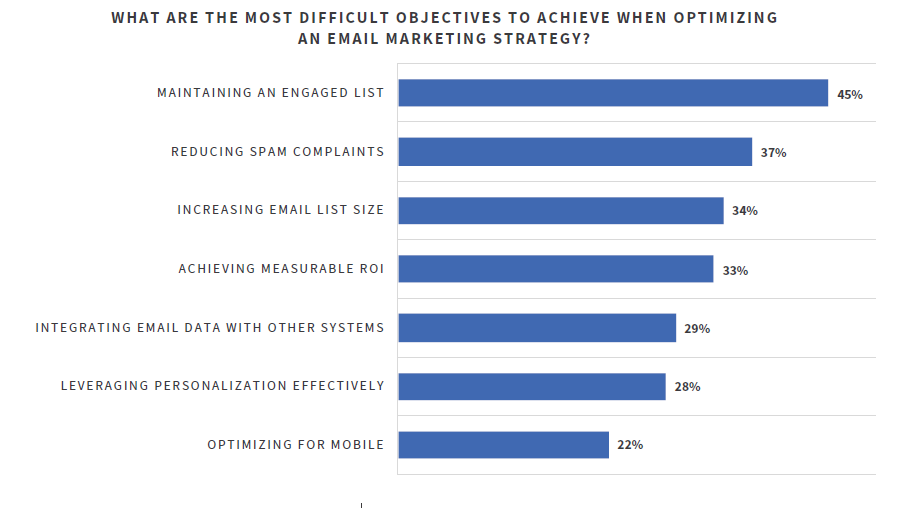
Maintaining an engaged email list is the #1 most difficult objective for email optimization, according to marketers.

Get the Fundamentals Right First
Email optimization starts before an email is sent.
Pre-deployment email testing is critical to delivering high-quality, engaging campaigns.
Design, deliverability, subject lines, subscriber verification, accessibility, sender reputation/SPAM score, HTML validation, and device/email client display are all important items to optimize before you hit send.
The best email copy and call-to-action (CTA) is guaranteed to produce a 0% conversion rate to the people that don’t receive it.
Also, if the design hinders a reader from reading the email, that will dramatically reduce your conversion rate.

Design is the most important attribute to test for email marketing optimization, according to marketers.
Take the time to set up a process and have the tools in place to review your emails before they are sent to get immediate positive results from your email optimization program.
Focus for Improvement
It is safe to say that if you want to improve any marketing campaign, it starts with the quality of your data.
For email, quality data allows marketers to deliver more personalization and targeted content to subscribers.
Quality data allows you to segment your list and, as a result, you can write more specific copy and targeted CTAs.
Also, your automation campaigns become more targeted, and even the types of content that you deliver are based on data and not random.
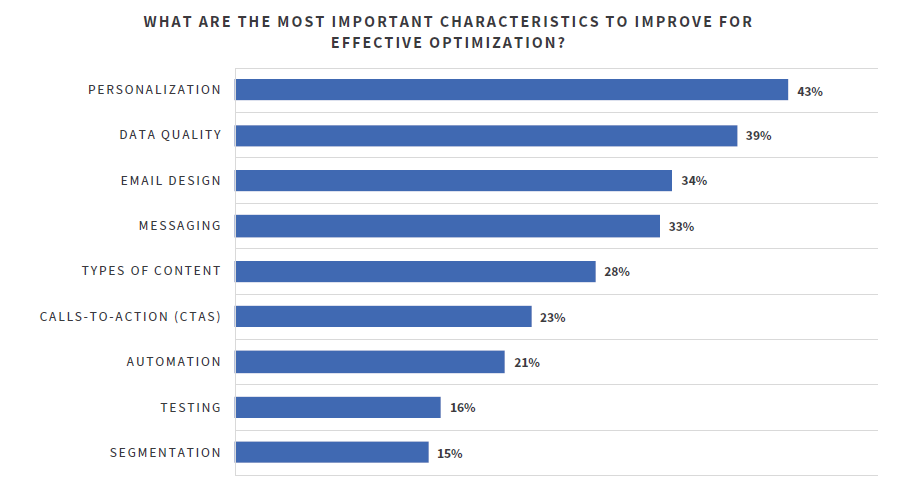
Personalization is the most important characteristic to improve for effective email optimization.
How to Handle Email Inactivity
So you’ve optimized your email campaigns, and some subscribers are still not engaging with you (how dare they!).
How long should a subscriber be inactive before removing them from an email marketing list?
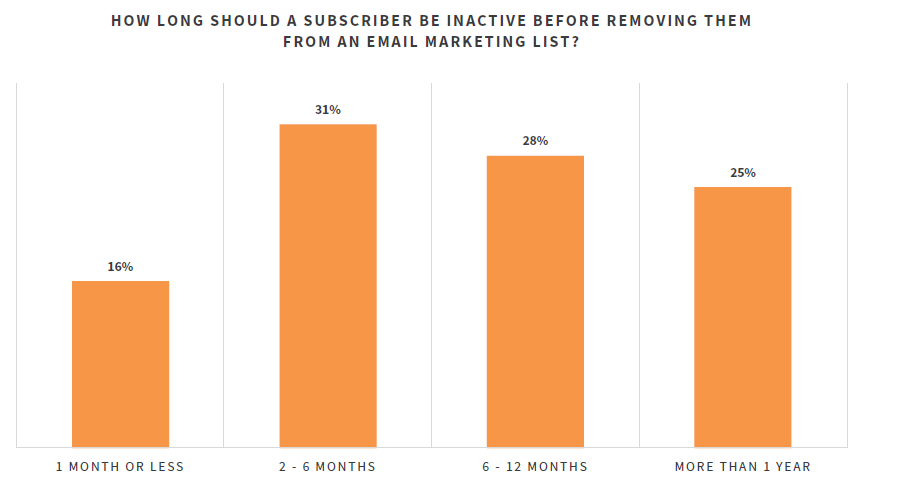
Subscribers who have been inactive for 2-6 months should be removed from email lists, according to 31% of marketers.
If you are doing all the best practices with data quality, pre-launch fundamentals, copy, CTAs, personalization, segmentation, and testing, and subscribers are not engaging with you, it’s important to set up a regular process to remove them from your list.
Remember, the goal is not your list size, so when subscribers tell you that they are not interested in you sending them emails by inactivity, believe them.

You can download the entire Email Marketing Optimization Survey Summary Report for more data, tips, and strategies to keep audiences engaged despite flooded inboxes.
The post How Marketers Are Optimizing Their Email Marketing, According to Research appeared first on Content Marketing Consulting and Social Media Strategy.
Source: convinceandconvert.com

15 Useful Clubhouse Tools to Help Your Marketing
The clubhouse is an interesting app that acts as a combination of podcasting, Facebook Messenger, and Snapchat mixed into one.
This audio-based platform is growing dramatically. In fact, the app has more than 228,000 reviews and a 4.9-star rating on the App Store.
If you’re looking for a unique way to reach a highly targeted audience through the use of audio, this could be your avenue.
In this article, I’m covering the most useful Clubhouse tools to make your marketing efforts simpler and more effective.
Why Should You Use the Clubhouse App for Marketing?
The Clubhouse app puts a unique spin on social networking by restricting communication to nothing more than audio.
You also need to know how to get a Clubhouse invite, which essentially requires you to reach out on social media and get your name out there.
It creates a bit of exclusivity that makes it all the more rewarding when you finally make it onto the platform.
If you receive a Clubhouse app invite, you’ll be able to join chat rooms covering a wide variety of topics ranging from SEO to commercial plumbing.
Once you join a room, you’ll be able to sit back and listen or raise your hand and try to get into the conversation.
As you get more and more involved in the community, you’ll have the opportunity to become a moderator or even create your own room and invite your followers in to listen to what you have to say.
As you can probably tell, there’s marketing potential here.
Like Twitch and Snapchat, the conversations you have on the platform are gone once the chat ends.
This presents a unique opportunity for you to bring people in and potentially operate the social network like a live webinar.
One big plus is that a camera isn’t a feature of the platform, so you don’t have to worry about being seen on screen.
The platform is similar to podcasting, which has grown by 29.5 percent in the last three years.
The clubhouse is more engaging than podcasting, though, because it allows listeners to comment and get involved in real-time, whereas most people listen to recordings of podcasts.
15 Marketing Clubhouse Tools
In this section, we will discuss some of the specific Clubhouse tools you can use to create a memorable experience on the platform.
As marketers, our goal is to draw attention to ourselves and as much of it as possible.
These tools make listening more enjoyable for your followers and keep them coming back.
1. Humans on Clubhouse

If you’re coming to the platform with a specific goal in mind, you might want to use Humans on Clubhouse.
This tool offers 1:1 connections to anyone within a particular niche.
Whether you’re trying to network, build a following, or find an influencer, this Clubhouse tool can help you.
Once you’ve identified someone you’d like to connect with, you can reach out to them and hopefully determine how a networking relationship could be mutually beneficial.
From there, you can host events together, piggyback on each other’s audience, and more.
2. Clubhype
A big downside to the Clubhouse platform, in general, is how challenging it can be to get the word out.
Since the platform is kept relatively exclusive, there are extra steps you’ll want to take to ensure everyone knows you’re hosting an event.

Clubhype makes this easy.
This Clubhouse tool allows you to enter your Clubhouse link, and it generates a sleek and attractive preview image you can share to social media.
The image contains the date and time of the event, the title, and all the important members included in the event.
Let’s say you secured a great guest in your event.
You’ll want to share it with your social media to get as many people into the event as possible to hear what the VIP has to say.
3. ClubLink
The goal of all Clubhouse tools is to make lives easier for you and anyone you want to join your event.
ClubLink is another tool that helps create an attractive preview you can share on social media to get people to join.
One unique feature is that it optimizes the time zone based on the host, so you won’t have to convert anything or worry about missing a session.
Clublink also has multiple sharing options based on the platform you’re sharing it on.
No matter if you’re using Twitter, Facebook, or Instagram, the tool makes it simple for you to create an attention-grabbing preview to get more viewers to join your event.

4. Find Clubhouse
This tool is similar to Humans on Clubhouse, but instead, it helps you find specific clubs based on topics you’re interested in.
From a marketing standpoint, it would be good to use this in the beginning so you can find groups that relate to your business and could help you find listeners who may want to join your club as well.
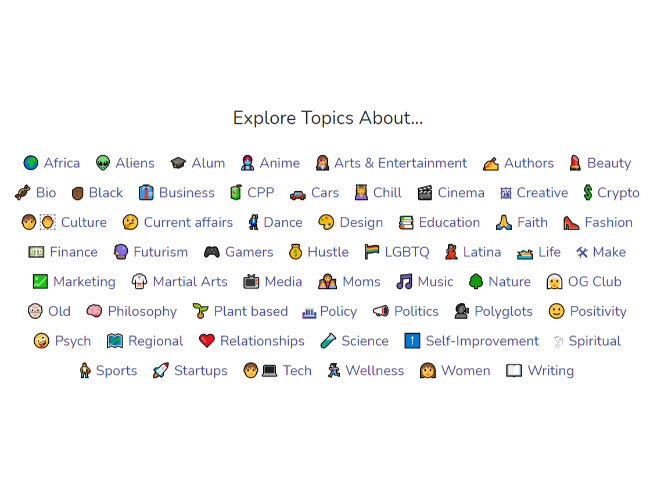
There are tons of different ways to search, and they even promote clubs based on how much they’re trending.
All you need to do is go over to the Find Clubhouse site and search based on your interests.
From there, you can join clubs, see what the moderators are doing, and get ideas for how you’ll start to create your own audience.
5. Ask Clubhouse
Next on the list of Clubhouse tools is something that makes it easier for you to engage with your audience.
If you’ve ever hosted a live event, you know how challenging it is to address all the questions as they’re pouring in.

Ask Clubhouse helps you do this by creating a board where people can ask their questions, and you can address them later on in the event or even at a later date.
Best of all, you’ll answer the questions so everyone else can hear, which reduces the need to answer the same question over and over again.
6. Clubpad
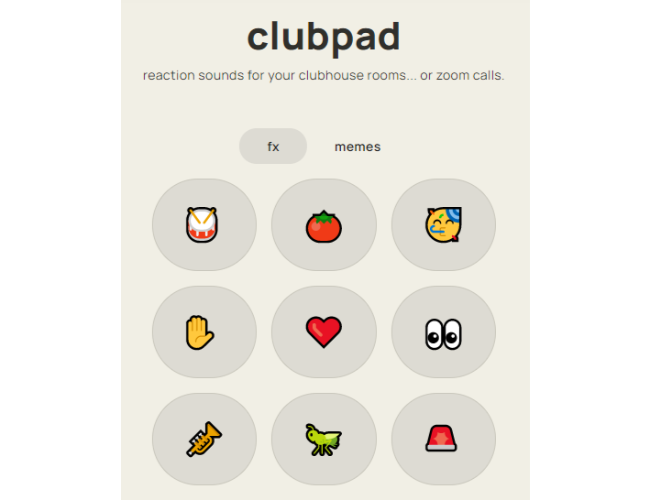
A huge part of creating an inviting and fun environment in Clubhouse is being able to engage and entertain your audience.
When there isn’t any video, people rely strictly on your audio to keep them engaged.
Adding little sound effects to make things funnier and more interesting could help keep people aware and awake.
While these types of Clubhouse tools might not seem like a big deal, it’s the little things that make a difference.
If you’re using Clubpad and have a competitor in the same niche who isn’t, maybe that’ll be your advantage.
7. Clubhouse Glow
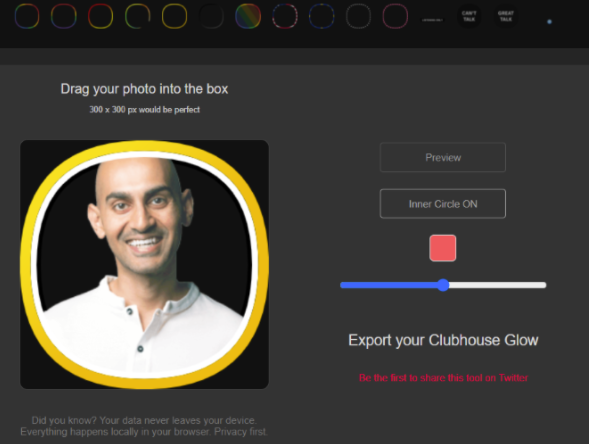
This is a simple tool that allows you to create a color ring or filter over your Clubhouse avatar.
Why would you want to do that?
Why not?
Generating attention and being able to stand out in a room is an important aspect of marketing.
Clubhouse Glow can help differentiate you from the rest of the crowd by adding a nice visual effect to your avatar.
8. Clubhouse Bio Builder

Clubhouse Bio Builder is an iOS app that helps you format text, choose the font, and create the most enticing bio possible.
People are going to read your bio before joining your club, so you’ll want to make sure you’ve written the best bio possible as well. (Another tool coming on this later!)
Using the bio builder, you can use bold, italic, and emojis in your bio to draw more eyeballs to the text and help your profile stand out.
It’s simple, easy to use, and a great way to get more people to notice you.
9. Clubhouse Avatar Maker

The avatar maker is another tool that helps you put a ring around your profile photo.
With this one, you can choose from a variety of different templates based on where you’re promoting yourself, your personality, your niche, and your personal preferences.
It makes setting up your profile easier so you can spend more time focusing on your content.
10. Crofile

Crofile is similar to a couple of the previous Clubhouse tools, but it has a unique spin.
You select your photo, choose from preset customization options, and add a status to your photo as well. You can put on there that you’re working on something, you’re away, or that you’re busy.
Once you’ve customized your photo to your liking, you can save it and upload it to Clubhouse.
11. Comet Events
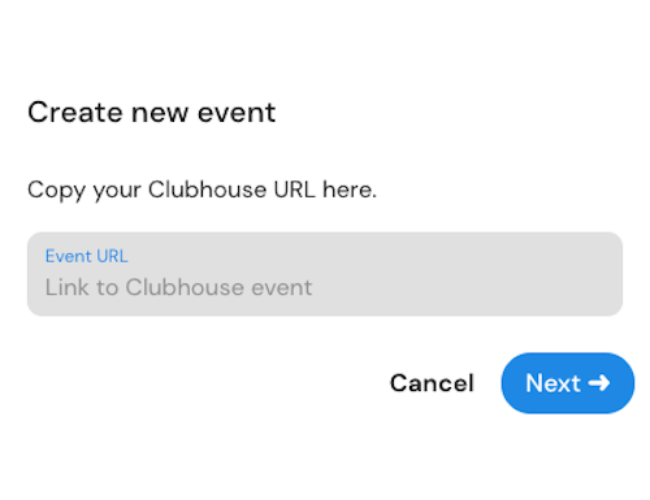
This is a powerful event management tool that helps you measure the results of your rooms in Clubhouse.
You can start with a free account by simply entering your email address.
From there, you’ll be able to take the link of all your events in Clubhouse and create a new Comet link where you can track all the data.
The only catch here is that you need to share the link specifically within Comet Events so it can keep track of everyone who RSVPs for the event.
If you share the original Clubhouse link and people sign up, that data won’t be tracked, and you’ll have an inaccurate number.
This tool is helpful especially if you’re planning based on the total audience or doing a giveaway, and you need to know exactly how many people are planning to join the event.
12. Host Notes

Host Notes is another event management system to make it easier for people to RSVP and join your events.
One important key to remember in marketing is that you need to make it as easy as possible for people.
If you create too many hoops to jump through, most people will simply back out and never move onto the next step.
Host Notes allows you to create sharable links and attach resources from the conversation during the event.
13. Clubhouse DB

This Clubhouse analytics tool lets you get a bird’s eye view of the most popular users and clubs based on how many followers they have and when they registered.
If you’re trying to find ways to grow your club, this tool may help you because you can join other clubs, identify what they’re doing differently, and then start implementing that yourself.
14. CH Bio Generator
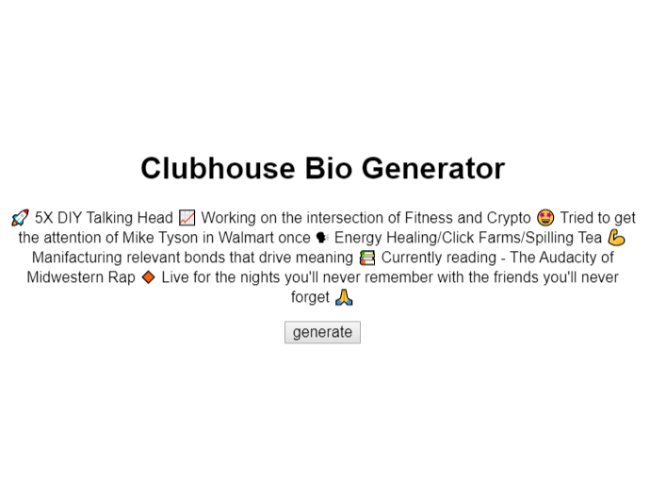
Even if you’re a writer or content marketer, writing bios is not something anyone likes to do.
Many of us don’t like to talk about ourselves or tell everyone what we do, what we’ve accomplished, or why they should listen to us.
Why not have someone else write it for you or use a tool that generates a personalized bio?
CH Bio Generator takes a lot of the thinking out of the process by using templates to make it easier for you to write your bio.
Keep in mind that the bio is one of the most important ways to get discovered on the platform, so you’ll want to make sure you have a good one.
This Clubhouse tool can help you.
15. Rooms of Clubhouse
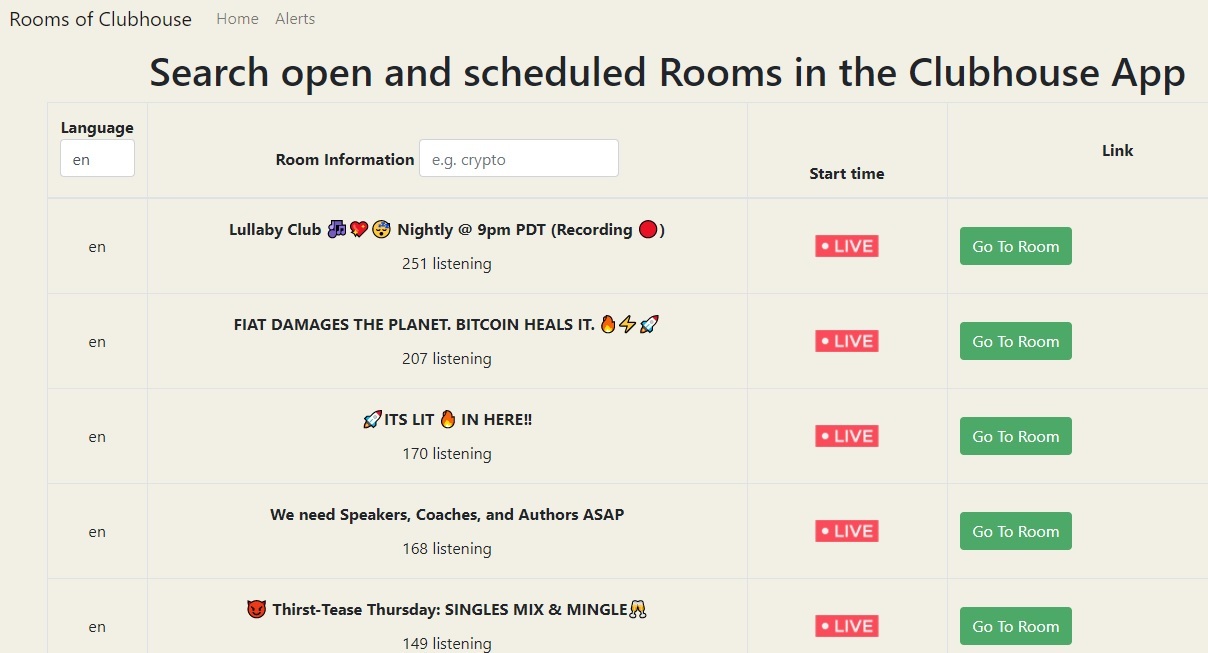
Rooms of Clubhouse is similar to Humans of Clubhouse.
The tool helps you search based on topics and keywords to find rooms with events scheduled or currently happening.
The database is somewhat limited, but it will probably progress over time.
While this tool is especially helpful for users trying to find information, it can also help you as a marketer find similar groups and people to reach out to for collaborations.
15 Clubhouse Tools to Test
If you’re looking to reach a unique audience, these Clubhouse tools can help.
Humans on Clubhouse
Make 1:1 connections with people in your niche.
Clubhype
Enter your Clubhouse link, and it generates a sleek and attractive preview image you can share to social media.
Clublink
Create an attractive preview you can share on social media to get people to join.
Find Clubhouse
Search for clubs related to your interests, see what moderators are doing, and more.
Ask Clubhouse
Engage with your audience by creating a board where people can easily ask questions.
Clubpad
Add reaction sounds to your clubhouse rooms to increase engagement.
Clubhouse Glow
Create a color ring or filter over your Clubhouse avatar to grab attention.
Clubhouse Bio Builder
Add bold, italic, and emojis in your bio to draw more eyeballs to the text and help your profile stand out.
Clubhouse Avatar Maker
Choose from a variety of different templates to add personality to your avatar.
Crofile
Select your photo, choose from preset customization options, and add a status to your photo as well
Comet Events
Track Clubhouse event metrics and create beautiful event landing pages.
Host Notes
An event management tool that creates sharable links and attaches resources from the conversation during the event.
Clubhouse DB
Get a bird’s eye view of the most popular users and clubs based on how many followers they have and when they registered
CH Bio Generator
Easily create top-notch bios with this template-based bio generator.
Rooms of Clubhouse
Search by topics and keywords to find rooms with events scheduled or currently happening
Conclusion
Social media marketing still has plenty of potentials.
With new platforms like Clubhouse emerging every day, it doesn’t look like it’s slowing down.
If you’re trying to reach a highly targeted audience, the platform makes it easy to narrow down and find exactly that.
You can use some of these Clubhouse tools to make your life even easier.
Are you in Clubhouse? What tools have you used to help your marketing on the platform?
Source: neilpatel.com

4 Questions To Make Sure You’re Creating Consistent Copy Across All Platforms
Marketing is like being a well-paid juggler—you’ve got social media in one hand, marketing in another, and somewhere above you is your content strategy.
And that’s just to name a few of the marketing channels you’ve got on your plate. With all of these platforms, it can start to get really hard to keep your copy consistent.

We all know how important copy is—it’s the thing that defines your brand and moves prospects through the Customer Value Journey.
But what happens if someone reads your copy on social media, opts-in for your offer, and is met with totally different copy? 
Leads won’t be able to get past the “trust factor” that’s essential for them to trust you enough to buy a service or product from your business.
Just like any other relationship in our lives, the customer-to-business relationship requires consistency.
5 questions to make sure you’re creating consistent copy across the platforms
Here are 5 questions to make sure you’re creating consistent copy across all of your platforms.
Question #1: Does this copy abide by my brand guidelines?
Your brand guidelines are the blueprint of your brand.
They’re going to help you figure out what’s a “Yay!” and what’s a “Nay…” in your copy.
Brand guidelines are going to be a huuuuge (serious emphasis on the huge here) help to keeping your copy on brand, especially if you have a larger team.

Think of them as the SOP for writing your copy and content.
If your copy doesn’t check every mark that it needs to on your brand guidelines then it’s going to create inconsistency across your platforms and funnels.
Use this checklist to make your life easier—if the copy can check every brand guideline on that list, green light it!
If not… ask yourself—what needs to be changed?
Question #2: Would my customers expect this from me?
Your copy is your brand voice. After engaging with your business on social media, through your articles, or your emails your prospects are going to be used to hearing a specific voice from you (ahem, think of your brand guidelines).

They want to keep hearing that voice…not unexpectedly read or hear a new brand voice.
If your brand voice is always fun and playful, but you come out of nowhere with a call to action that’s formal and professional, your prospects are going to be confused—and a confused person never buys.
In a confused state, your lead is feeling hesitant.
By reading or hearing a copy that they would expect from you, your leads are in a confident state—and a confident state does buy.
Question #3: Would my customers recognize me if I took away my branding?
Let’s take away your brand colors, fonts, and images…can your customers still see you?
This might be tough for some brands, but it’ll help you make sure your branding is consistent from socials to products.
If the only thing holding your branding together is your color palette and fonts—there’s a big problem. While this stuff is all icing on the marketing cake, your copy is the actual cake. 

If your copy is so on point that without any other clues about your brand your followers, subscribers, and customers can tell it’s you, you’ve nailed it.
You’ve made a delicious cake that people want to bite into…and you’ve added the icing on top that makes people even more excited to grab their fork.
Question #4: Does this fit in with my other copy?
Every brand has a different way of asking their followers to engage with their content, their website visitors to subscribe to their newsletter, or their subscribers to click on the offer.

Each time you write copy for a new offer you want to look at it in the context of the copy you’ve written for your other offers.
Is your new copy so far off that your customers are going to feel like they don’t know you as well as they thought they did?
A new copy should fit in well with the other copies that are already Live right now.
This isn’t to say that you can’t A/B test your copy and do something totally left-field—as long as it’s still coming from the same field.
Think of this in the context of your brand colors…if you usually brand with a medium-color green but you want to highlight something with a lighter green, that makes sense.
Your leads and customers aren’t going to be totally off-put.
But, if you decide to scratch the green and go with yellow…they’re going to be asking—is this *insert your company name’s* website?
Use these questions to make sure your copy is consistent from the first touchpoint all the way through to the day your customer buys your highest ticket offer.
This consistency is what your relationship is built on—so make it a strong foundation.

The post 4 Questions To Make Sure You’re Creating Consistent Copy Across All Platforms appeared first on DigitalMarketer.
Source: digitalmarketer.com

SEO Updates Marketers Need to Know About for Q1 of 2021
We’re halfway through 2021 (yeah… we can’t believe it either), and a lot of unexpected change has happened already this year.
But there was one VERY expected change that happened recently—that’s the Google algorithm update.
The May 2021 Core Update followed the January 2021 Core Update.
This time around, Google seems to be drilling deeper into what quality content really is and how they can work their algorithm around it.

Quality content has been Google’s mission for quite some time now, but a few searches as a Google user can show you that they’re not always hitting the mark.
Cue the algorithm to make mysterious changes we’ll spend the next few months trying to figure out. 
Since we don’t have direct intel from the Google SEO team, we’re going to go over these core updates based on what we’re seeing in the SEO world.
3 Updates Marketers Need to Know about SEO in Q1
Here are the 3 updates marketers need to know about SEO in Q1.
#1: Your Pages Need to Have A Clear Focus

If you want your pages to rank—you need to cut the fluff.
This Google Core Update seems to be hyper-focused on pages that are… hyper-focused.
What’s been working really well at DigitalMarketer is having articles dedicated to pillar posts like Everything You Need To Know About Digital Advertising and Everything You Need To Know About Content Marketing.
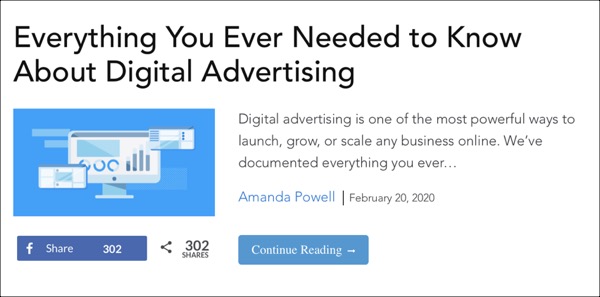
To the SEO bots, these pages have one purpose: create long-form content that ranks for a keyword (ex. Digital marketing, content marketing).
The longer the content, the more time people spend reading, the higher our page duration time, and the lower our bounce rate.
The Google bots are happy, and we can breathe a sigh of relief.
Even MORE importantly, these pages also have a purpose for our readers.
Seeing the high page duration and low bounce rate on these pages is great because it tells us our readers are liking what they’re reading.
We want to use these pillar posts to build brand awareness, create engagement, and turn readers into subscribers so website visitors move through the Customer Value Journey.
We’ll venture to guess this is why these pillar posts are working so well for us right now.
As Google keeps honing in on the ever-changing answer to “What IS great content?” we’re just as focused on creating great content for our readers.
Win, win baby. 
#2: Quality Is Starting to Outrank Authority

Quality content is cool… what’s even cooler is when quality content outranks similar content from an authority website.
This SEO update is exciting for marketers and businesses who geek out on publishing high-quality content.
You don’t have to be Forbes or HuffPost to get that first-page ranking anymore… you just need to write something really good (and get a decent amount of traffic to it).
This new update is definitely a viable reason as to why the pillar posts we mentioned above have been doing so well in the search results.
Humblebrag: they are quality content.
Readers love them.
Google loves that readers love them.
Google ranks them.
We can outrank pages that we used to struggle with before.
The May 2021 Core Update is giving websites with smaller audiences a chance to rank in a way that wasn’t available before.
While website authority definitely still exists, it seems like they’re experimenting with giving opportunities to smaller websites.
As long as small websites are willing to put the work into creating better content than what already exists, this update is attempting to level the playing field in hopes of connecting readers with the best content for their search.
#3: High-Quality Backlinks Continue Their Reign

A strategy that seems to have survived SEO updates after the update is backlinking.
In the May 2021 Core Update—we’re still seeing backlinks holding their weight.
This is probably why your inbox still pings with new requests for backlinks and it’s definitely one of the main reasons HEY’s new email platform found such a passionate audience. 
Backlinks create a strong link profile… this is SEO talk for all of the links on other websites that link back to your website.
A strong link profile has links from high authority websites.
A weak link profile doesn’t have a lot of backlinks.
These backlinks are like the customer testimonials you read before buying your fancy coffee machine a few weeks after you realized we weren’t going back to the office anytime soon.
It was a 10/10 purchase (because caffeine…) and a huge part of the reason you bought it was because of the awesome reviews.
When Google sees that YOU have a lot of “reviews” (aka backlinks) from other websites to yours, they deem you trustworthy.
If other websites are going to be talking about you, and especially if high authority websites are going to shout you out—Google can feel confident that you know your stuff.
While backlinks certainly aren’t a new strategy in SEO, it’s interesting to see them still holding their weight after all these years.
We wish we could say, here’s EXACTLY what Google did in their May 2021 Core Updates, but we haven’t been able to figure out how to spend a spy fly into their SEO office… yet (we’re kidding Google, we swear!!!).
We’ll just consider ourselves lucky that Google lets us know these changes are coming so we can get ready for whatever they throw our way.
And we’re excited to see you taking SEO action alongside us.
The post SEO Updates Marketers Need to Know About for Q3 of 2020 appeared first on DigitalMarketer.
Source: digitalmarketer.com

Subconscious Selling: Your Customers Won’t Buy Without These 3 Elements
Your customers are social, plugged-in, and savvy.
Selling to them (even with high-impact direct response) isn’t easy. Which is why today, I’m giving you some contrary advice…
Stop focusing on features and benefits. Stop hyping up your copy. Instead, sell your product on a subconscious level, and you’ll have customers drooling with desire before they know what hit them.
Keep reading and I’ll give you 3 ways to do just that. Plug these essential elements into your marketing to drive customer sales naturally and easily.
1. Social Proof
Think benefits sell? Think again. To sell your product, you need to build trust. Seth Godin says it well:
Without trust, marketers know that there are no sales. Trust means the prospect believes not only that the product being sold will actually solve his problems, but that if for some reason it doesn’t, the company will make good on its reputation of performance.
Today’s consumers assume marketers are trying to take advantage of them, so it’s important to establish credibility in all your marketing. But here’s the thing: You don’t actually have to prove you’re trustworthy if you can show that other people already trust you.
This concept, called social proof, was made popular by Robert Cialdini in his book, Influence. In it, he explains that we “view a behavior as more correct in a given situation to the degree that we see others performing it.”
To see how powerful this concept is, we have to take a quick dive into biology.
In 1992, scientist Giacomo Rizzolatti noticed that monkeys’ brains would fire not only when they performed an action, but when they saw someone else perform that action too. He later discovered the same tendency in humans.
Sell your product on a subconscious level, and you’ll have customers drooling with desire before they know what hit them.
This phenomenon, dubbed “mirror neurons,” explains why you laugh when everyone else in a meeting laughs (even if you didn’t hear the joke), and why you wince when someone falls or hold your breath when your kids are learning to swim underwater. It also explains why, when you see an actor dressed in the newest fashion, you want to wear something similar.
When you see them getting second glances, your brain starts firing as if you were getting those looks. And your subconscious brain tells you that you’ll be just as sexy and successful if you wear the same type of clothes.
As Martin Lindstrom says in his book Buy-ology, “It’s as though you’ve just bought an image, an attitude, or both.”
What This Means for Marketers
Social proof isn’t just smart marketing, it’s a mandate if you want more customer sales. And it’s as easy as showing other people enjoying or benefiting from your products. While there’s no limit to the number of ways you can do this, 3 come immediately to mind.
a. Case Studies
Share stories of real people using and enjoying your product. How you tell the story doesn’t matter: use written case studies, videos, and interviews. What’s important is that you show how your product or services are helping people reach their goals.
The secret to powerful case studies is this: site real numbers and specific details. Notice the headline in this case study for LinkedSelling. It doesn’t site “massive growth” or “impressive returns.” It spells out “400% ROI.”

b. Endorsements & Testimonials
Make it a regular practice to ask customers for a testimonial. Then use them liberally to sell your product.
Ideally, you’ll collect enough to create a “Reviews” page. This one, from Boom! by Cindy Joseph, starts off with text reviews…

…followed by a collage of images showing how well the product works on real women:

When you get a testimonial from someone with celebrity status—either because their name or the company they work for is easily recognizable—by all means, feature it. On Single Grain, this testimonial by the Director of Marketing for Amazon Alexa carries weight because we believe anyone who works for Amazon knows their stuff.

As you can see, when other people show confidence in you—especially if it’s someone well-respected by your community—it’s easier for others to trust you too. That makes it easy to push people off the fence and increase customer sales.
c. Customer Logos
Another way to communicate trust is to pull back the curtains a bit and let prospects see who else uses your product. When they see brands they respect on the list, you gain instant credibility.
For example, this impressive list shows you how many big brands trust Single Grain.

Notice the link to “view case studies” prominently displayed below the graphic. This makes it easy for prospects to get even more details about how Single Grain works.
PRO TIP: Any time you can add specifics to your marketing, you boost your credibility. So turn all general statements into specifics by adding precise numbers, brand names, and facts.
2. Scarcity
Cialdini calls this “The Rule of the Few.” He says:
The idea of potential loss plays a large role in human decision making. In fact, people seem to be more motivated by the thought of losing something than by the thought of gaining something of equal value.
As soon as you hear something is off-limits, you want it.
It’s true. As soon as you hear something is off-limits, you want it. If a book is going out of print, you want to buy it. And if a product is only available until midnight tonight—even if you don’t need it right away—you’re inclined to buy it… just in case.
That’s how scarcity drives customer sales. It makes you aware that you might miss out if you don’t take action.
What This Means for Marketers
Consider Black Friday offers that promote just 100 electronics at 75% off or an 80% discount only till 10 am The fact that the offer is limited drives people to stand in line for hours before the store opens or to physically wrestle with one another for the prize.
How can you do this in your digital marketing? Check out this email from DigitalMarketer’s Founder and CEO, Ryan Deiss:

Ryan is a master at leveraging scarcity in his marketing. Look at how he piles it on in this email:
- There’s a “special link” that gives you a discount. “Special” makes you believe it’s not available to everyone, which creates a feeling of exclusivity.
- The discount is only available through Monday at midnight. So there’s a time limit pushing you to respond now.
- Seats sell out every year. If you don’t act quickly, you could miss your chance to attend.
- And if you don’t honestly believe the event will sell out, you might be motivated by the “best seats” reference. Again, a bit of exclusivity makes you feel you might miss something if you don’t click through and buy your ticket.
Scarcity can be achieved through limited inventory, a deadline, or making something only available on certain dates or times. You can use it in emails to make people click through, in your sales pages to make people take action, and as a value-add offer before or after purchase.
PRO TIP: Any time you can reduce or reverse risk, you’ll improve response rates. Absorb as much of the risk as possible with a strong guarantee, lengthy trial period, or ridiculously low price.
3. Sensory Language
Deep in your brain’s temporal lobe is an almond-shaped cluster of neurons that some experts call your lizard brain. Known as the amygdala, this primitive part of your brain is both pre-verbal and pre-logical. So it can trigger action before you have time to think about it.
Neuromarketers also call it a “buying brain,” because pushing its buttons leads to a Buy Now response that’s almost instinctive. Here’s how Dr. A. K. Pradeep says it in his book The Buying Brain:
The basic lesson is that human brains process much of their sensory input subconsciously.
Our senses are taking in about 11 million bits of information every second.
Our thinking brains—that part of thinking in which we are aware of thinking—can only process, at best, 40 bits of information per second.
The subconscious level of the brain is where elements that are essential to marketing success such as initial product interest, purchase, intent, and brand loyalty are formed, and where they reside.
In other words, spark desire by connecting with people’s primitive brains, and you can generate a buying response without manipulating anyone. People want to buy without knowing why.
The result? More customer sales.
What This Means for Marketers
Research shows that mirror neurons (that’s the monkey-see-monkey-do thing we talked about a few minutes ago) can be stimulated by reading as well as observing. For example, read this:
Yawn.
Just reading the word makes you want to yawn.
That’s especially good news because you can’t pump smells and velvety softness over the internet. But you can stimulate the subconscious with sensory words.
Engaging the buying brain is as simple as tickling the five senses in your writing. Sight is easy (pictures). But you can also evoke scents, touch, sounds, and taste. Let me show you what I mean in this example from Lawrence Bernstein.

“Like the windows in a store” creates a mental image. (I visualize a big display window with mannequins in high-fashion dresses.)
“Created on the fly” gives you a sense of speed or motion.
Circled words—melt, explosive, verbal dynamite—are sensory. You can see, feel, or hear them.
He could also have said something like this:
- “Pepper your writing with these irresistible words and your prospects will feel compelled to buy.” (Taste)
- “Build a rock-solid foundation for your sales pitches by using words that hit hard as nails.” (Touch)
Now notice how naturally these words fit into the copy. Sensory writing is nothing more than good writing. It reads naturally and isn’t likely to be perceived as hype or manipulation. But it excites people’s primitive brains and makes them more likely to respond.
PRO TIP: After you’ve written your sales page, go through it to find places where sensory language could be added naturally. In particular, replace being verbs (is, was, are) with active verbs and make sure you help people see themselves using your product.
Selling to the Subconscious
Your customers may love to buy, but they don’t want to be sold.
Your customers may love to buy, but they don’t want to be sold. Your job, then, is to sell your product to the subconscious brain, so you trigger desire before they know what hit them.
Fortunately, it’s easy if you sprinkle your sales copy with social proof and sensory language, then mix in an element of scarcity.
Before you know it, you’ll have people drooling over your products without ever knowing why.
(NOTE: Want more clicks from Facebook, Twitter, and your own blog? Copy and paste these 72 proven headline formulas and get more clicks to your content now. Plus, get 3 simple hacks to optimize any headline in 12 seconds or less. Learn more now.)

The post Subconscious Selling: Your Customers Won’t Buy Without These 3 Elements appeared first on DigitalMarketer.
Source: digitalmarketer.com