
Tag Archives for " Local SEO "

Are Web Directories Still Relevant for SEO in 2022?
Web Directories have been the norm for the world wide web and for search engine optimization for a long time. But are they still relevant in this age of advanced AI Google Updates?
Well, as Head of Web SPAM at Google John Mueller said, “in general, no”.
But the keywords in that answer are “in general”.
That’s the usual answer we get from John and, as much as we’d like to say we will dissect it, the truth is that we can only be speculating and interpreting things based on our own knowledge and experience.

Let’s jump to it and find out whether web directories are still useful for SEO in 2022.
What Are Web Directories Really?
In order to better understand why directories work or not in 2022, we have to create a background for them. Like an introduction.
Most people probably think of directories as just sites that list other sites. While that’s true, the reality is that they’re much more.
Before modern search engines, such as Google, web directories were THE INTERNET.

Why Web Directories Were Created
In the very early days of the internet, only a few people had websites.
Internet connections were uncommon and there wasn’t much profit to be made out of it.
Still, different websites emerged, in different niches.
However, you had to actually remember the domain names in order to access those websites, as there was no Google.
But, as the internet grew, more websites started showing up.
Soon enough, people couldn’t remember all those names.
But some clever guys from Yahoo! had the brilliant idea to store the best website into something they called a web directory.
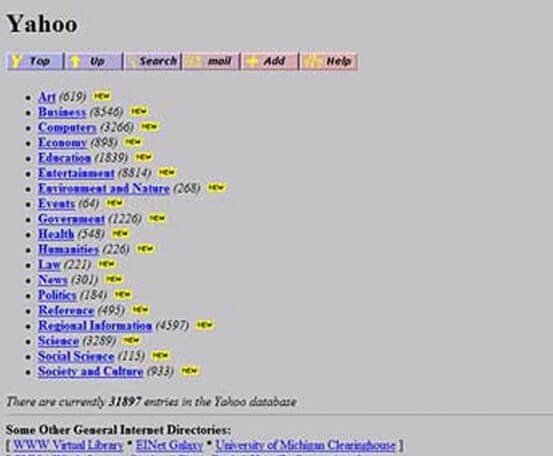
At first, only a few websites were listed, the most ‘popular’ ones or the ones that they thought were worthy of being listed.
This way, you would only have to remember one website (Yahoo!) if you wanted to find all the other good sites.
At first, the sites were listed alphabetically but, as the number grew, they started getting listed under categories and subcategories.
This way it was easier for users to find what they needed.
Web directories made money out of selling advertising space or boosting certain results in exchange for a fee.
Why Web Directories Died
Unfortunately, when the number of sites started getting way too high, people soon realized it wasn’t so convenient to browse through all those categories.
It would take too much time and, ultimately, the best results were mixed up with the less good ones.
This is how search engines appeared. It was by far more convenient to type in a keyword and get a list of top results than to browse through categories trying to figure out which website is the best.

The search engines worked on algorithms, just as they do now (although not as complex).
Depending on the keywords in the title and other factors, some sites would rank better than others.
Yahoo! had its own search engine.
However, it is no secret that Google took the lead because of its improved algorithm, but this isn’t the only reason why Google eventually took the lead.
Yahoo! was a giant back then, in the days of Yahoo! Mail, News, Answers, and Messenger, but a number of bad decisions made them fade out.
The Web Directory Legacy
Even though web directories dropped dramatically in popularity, people still used them.
But not for what they were supposed to use them.
As much as people say that web directories are still useful, the truth is that people have been using them merely for link building and online marketing for a long time.
I’m 25 now and I’ve been using a computer since I was 6.
My first contact with the internet was in 2002 and I can’t recall ever browsing on a web directory.
I remember Yahoo! and Google.
I remember ODC, DC++, and other popular hubs.
I remember Floppy disks with drivers.
But I don’t remember web directories.
In fact, my first contact with web directories was back in 2013, when I first started learning about SEO.
I had probably ended up on similar websites before, but not solely for searching a specific website.
Although the truth was that web directories weren’t of interest to the general public, new web directories kept popping up.
There were, of course, useful directories, such as business listings (Yellow Pages), which people visited if they wanted to search for a particular business (name, phone, address, legal details, etc.).
There were also niche directories, which only listed websites in a particular field.
Those might have got some organic traffic and potential customers when people searched for things like “list of XYZ websites”.
But the truth is that most of the time, web directories were only there because links brought better rankings.
People found ways to get listed on as many directories as they could, therefore destroying the purpose of a directory.
Even paid directories were full of SPAM.
Fees were usually low, ranging from $5 to $20 if you wanted to get a listing on the homepage.
However, most of the time that wouldn’t bring much more traffic to your site, since most of the users visiting web directories were SEOs trying to build links.
I’m not afraid to say that I only visited web directories for link-building purposes.
Everybody was doing it and it worked.
It was easy and convenient.
But the question is… do they still work now?
Do Web Directories Still Work for SEO in 2022?
In a local SEO social media group, somebody tried to prove a point by showing us a #1 result for a keyword, claiming that he had only built 2 directory links to that page and it’s now #1.
He was trying to attack us “white hats” that always state web directories don’t work when, in fact, he had proof that they do.
The only problem was the keyword he was ranking for had virtually 0 searches and the competition was basically inexistent.
Did the web directory links actually help him to rank better in Google’s search results?
Probably… Did he prove any points?
Definitely not.
Web Directories probably still have a small impact on your rankings, just like any other site that links to you and passes Page Rank.
However, because they’ve been abused as an SEO tactic over the years, Google penalizes people that use web directories.
With the rise of Penguin 4.0, many of them are probably ignored.
Or, as John Mueller (the current Head of Web SPAM @ Google) said: generally no. —John
Bu that answer can be interpreted in very many ways.
Let’s see first why web directories got such a bad reputation in SEO.
Web Directories’ Main Issues for SEO
I’ve already discussed how web directories don’t really provide much value as users don’t really use them for anything other than SEO.
However, the story doesn’t end there:
Web directories got spammy & tricky:
As people always want the quick way, they started automating processes.
With more automation, more SPAM came along.
These types of things are inconvenient for Google because they waste a lot of resources.
Don’t you just hate spam comments? I know I do.
Google eventually figured out that the best way to deal with this was to penalize people that would use directories as a way of improving their rankings.
So when important updates such as Penguin started to roll out, web directories had the perfect opportunity to make money.
Although some websites were listed for free, now that Google was penalizing websites for spammy link profiles, some web directories asked for removal fees.
Web directories are not managed anymore: Even if you do find a good web directory, chances are that nobody is going to answer you.
A couple of years ago, I was in the process of building links for someone.
Advertorials were too expensive for his budget and all their competitors had directory links.
Without exception.
They ranked well, so I thought I’d better try it at least.
After a few days of effort, it was pretty clear that it won’t work.
Not because Google penalized me or anything, but because the directory sites either had errors on their submission forms or nobody replied/approved my sites.
Since they don’t make as much money as they used to, people have stopped putting effort into managing them.
Web directories are not efficient:
Even if you manage to get some business directory listings, they will probably have a very little impact, if not none at all.
Your time is better spent creating content and engaging with your audience. 1-2 links won’t help at all and scaling this is risky and can result in penalties.
Google penalizes you:
Of course, the biggest issue with web directories these days is that your website can get penalized if it tries to trick the Google algorithms.
Building links in mass, be it through web directories, blog commenting, article submission, guest posting, you name it, is risky and can get your site in trouble.
Now I’m not saying that you’re going to be penalized if you submit your site to a directory.
By all means, if you find an interesting site that also happens to have a list of other interesting sites, go for it!
But it’s a good idea to check their background a little bit.
What’s their domain authority?
Is their backlink profile spammy?
Are they linking to quality websites or a bunch of phishing potholes full of malware?
In other words, does that website bring any value at all to the internet or for any users?
Is it in any way relevant to your site?
If the answer is no, then you should definitely stay away from it.
Local SEO & Directory Listings
When it comes to local, it’s probably the only field where people actually still visit renowned “directories” to find a good location.
For example, Google My Business is considered to be a web business directory.
To some extent, it is.
It lists businesses. However, it’s turning more and more into a search engine itself.
The rankings are done based on algorithms.
Local Search Listings | Google My Business
People do browse and look for reviews, but most of them just stick with the top businesses (the ones that get listed first by Google My Business on local search and Google Maps) because they are, usually, the best results.
When it comes to local SEO, it does help if your NAP details (name, address, phone) are listed on multiple websites.
However, title, distance from the user, and reviews probably play a more important role.
The key thing with NAP is consistency.
Google might have some issues if you keep having a mixture of different names, phones, and addresses all over the place.
However, let’s all be honest that citations here and there aren’t the keys to local search SEO success.
It’s not that they don’t help (they do, you get brand visibility) but whenever you have a citation, you should accompany it with a backlink.
Local business directories are a great start.
For example, you might find sites such as “yourcitynews.xyz” that has a section called “Great Locations in Our City”.
If you can list your local business there, that’s great because the relevancy comes from the local orientation of the website itself.
Most news will be about your city, which means your business should be there to rank better in that particular city.
If you can’t find a local business directory, you can also find these types of backlink opportunities with BrandMentions.
This tool monitor when your name/brand is mentioned on the web.
You can then engage with people and build relationships (and also ask for a backlink in case they haven’t made one).
Directories That Are Still Good
Now obviously you’re probably asking “Hey, where can I still find good web directories if all are bad?”
Well… there are some. This isn’t really the purpose of this article, but I’ll only list a few so that you get an idea of how modern, useful web directories actually look like.
White Hat SEOs will probably jump and say “How can you recommend profile link building or any sort of web directory link?”

The keyword here is RELEVANCY.
If the listing is relevant to your site, it is going to help you.
I don’t want you to take “web directories are bad” for granted and miss an opportunity that might actually be helpful to you.
Many search engine optimization experts react badly to blog commenting or forum posts because they know it doesn’t work.
However, blog comments are still the fuel of blogs.
Forums are still popular in industries such as music, automotive, health, and even fashion.
Matthew Woodward built an award-winning blog and much of his direct and organic traffic was thanks to the posts he made in the BlackHat Forums.
Just don’t spam.
Be relevant.
Be useful.
An example of good directories was the local sites that might have listings.
I can’t really give a specific example, but I hope you get the point.
If they have an active social media account, post from time to time, and bring in some traffic, you can try to list your local business there.
It all comes down to relevancy.
Is the listing relevant to your scope/niche?
If yes, go for it!
Here I can give a specific example.
SoundCloud is a directory for musicians, for example.
If you’re a musician, you can get a profile backlink from your SoundCloud profile.
Another similar example is last.fm.
Is this spammy? It could be if you just create a profile and leave it like that.
But if you’re a musician, maybe it also makes sense to post on your SoundCloud account from time to time, build an audience there and actually send some traffic to your site through that link and maybe even get some potential customers.
Other good local listing sites are Yelp or maybe Yellow Pages.
Although Google has heavily bashed them because they’re evil, it’s still a good place to list your business.
Why Do We Still Have Web Directories?
Most businesses, such as Moz or Yahoo, have closed their directories (Dmoz and Yahoo Directory).
The truth is probably that the web is still full of directories because of low maintenance costs (hosting and domain).
Many directories if not all lack moderators (which actually cost money), but still probably make some small amounts of revenue from advertising.
This whole article idea started from us observing these weird anchor texts such as “.2523765 yourdomain.com” in our tool for multiple clients.
You might see these anchor texts in your cognitiveSEO dashboard as well.
They’re generated by The Globe network, a sort of directory that crawls and indexes websites by simply linking to them on pages that contain thousands of external links.
The network is owned by Ascio Technologies Inc (a domain registrar).
Luckily, I’ve looked at their backlink profile and they also have the spammy anchor texts, so at least it’s fair.
Their model is different.
They want to sell the entire network of sites for millions of dollars.
They present it as some sort of worldwide web, the most visited site on the planet (which obviously, it isn’t).
I’m not sure how old this thing is or how it started, but there’s a BlackHat Forum thread about the network where you can read more about this.
Should You Disavow Directory Links?
One thing that people rush in to do is disavow links that they think Google might consider spammy or that might get their websites penalized.
This is an entire topic to discuss and I really recommend that you read my article about disavowing links.
However, just to give you a short answer, in general, it’s a good idea not to play with the disavow tool unless you’re sure your site has been penalized and you have isolated the reason to be the link profile after you’ve checked and excluded everything else.
For example, most of The Globe network, the site I’ve mentioned above, isn’t even indexed in Google, so it doesn’t really make any sense disavowing those links, since Google already doesn’t count those links in any way.
Conclusion
Generally, you should avoid them, but sometimes web directory submissions might be useful, especially when it comes to local businesses and local SEO.
Before you submit your links, make sure that the online directory is relevant to your niche and has a good link profile.
What do you think about web directory submissions?
Have you ever used them?
Do you still use them?
Do they still work?
Let us know in the comments section (but be careful with the links if you’re a WhiteHat SEO as you might get penalized!)
The post Are Web Directories Still Relevant for SEO in 2022? appeared first on SEO Blog | cognitiveSEO Blog on SEO Tactics & Strategies.
Source: cognitiveseo.com

11 Local SEO Myths Debunked Once and For All
Local SEO myths – what a tangled topic to discuss. You might get caught on the subject and start feeling intimidated thinking of the high amount of work you must do to rank in local SEO. Which, obviously, is unreal. Don’t get us wrong: it’s difficult indeed, but far from impossible.
In the local SEO arena, there are always new things to discover that can help your business get new customers, improve your visibility and get more local searches. Let’s bury all the local SEO myths and misleading strategies. Today, we’ll get this topic straight once and for all.

We’ll catch up on the top local SEO myths that must disappear forever because they can get your website flushed down. 11 is my lucky number and what better way to save your website than using the right amount of information, following instructions and taking advantage of a bit of luck?
- Claiming Your Website in Google Is a Surefire Way to Boost Your SEO
- Google Displays All the Information from GMB Dashboard
- Deleting Your Listing in Google My Business Will Remove It from Google
- You Don’t Need Backlinks If You Have Citations
- Citation Won’t Help Your Business in Any Way
- Nobody Reads Reviews Anymore
- Lots of Google+ Posts and Followers Will Improve My Rankings
- Content Is Good Only for Organic Search and Not Local Search
- Optimizing for Location Keywords Will Skyrocket Your Ranks in Local Search
- Meta Descriptions Are Important for Ranking
- Social Media is Useless for Local SEO
I really wish these myths died, not just for local SEO but also for SEO in general. We’ll make the first steps now, by taking them into consideration and learn the right way to do local SEO.
Researchers showed that people search for local businesses online. 97% of consumers looked online for local businesses in 2017, with 12% looking for a local business online every day says a report from BrightLocal.
1. Claiming Your Website in Google Is a Surefire Way to Boost Your SEO
Claiming your website in GoogleMyBusiness can bring lots of benefits. But, on the other hand, it is misleading to say that claiming your website in GMB can skyrocket your local rankings. This action has lots of other benefits. It can not assure you of high rankings.
What it can do instead, is generate traffic to your site and social accounts, target local clients to your offline location, get higher visibility on Google search and maps.
Listing your business in Google can help you increase your local rankings, but there are lots of other steps you need to take to say it will definitely bring a higher position.
Google’s guidelines explicitly tell you what you need to do in order to help your website rank in local search, but that is not a guaranty if you don’t do it right.
One of the most important aspects to keep in mind is to keep improved information about your business and have:
- Accurate business information regarding NAP (Name, Address, Phone Number);
- Updated working hours (make sure you select the dates when your office is closed, such as national days or celebrations);
- Correct coordinates to your location;
- True pictures of your product and services;
- Responses to your reviews to show to your clients you value their opinions and want to build a relationship.
In the era when everybody stays with the mobile phone in their hand, it is stupid not to take advantage of that behavior and get your store into users’ attention by claiming your website in GMB.
Imagine you go to Madrid, you visited Santiago Bernabeu and what to eat something. It’s your first time in the city, don’t know much, you speak a different language.
How do you find a place? By foot, it could be tricky and difficult because you don’t know which way to go.
At that moment you can search on maps “restaurants near you”. The easiest and most effective way to find a place where you could eat. You can get lots of recommendations:
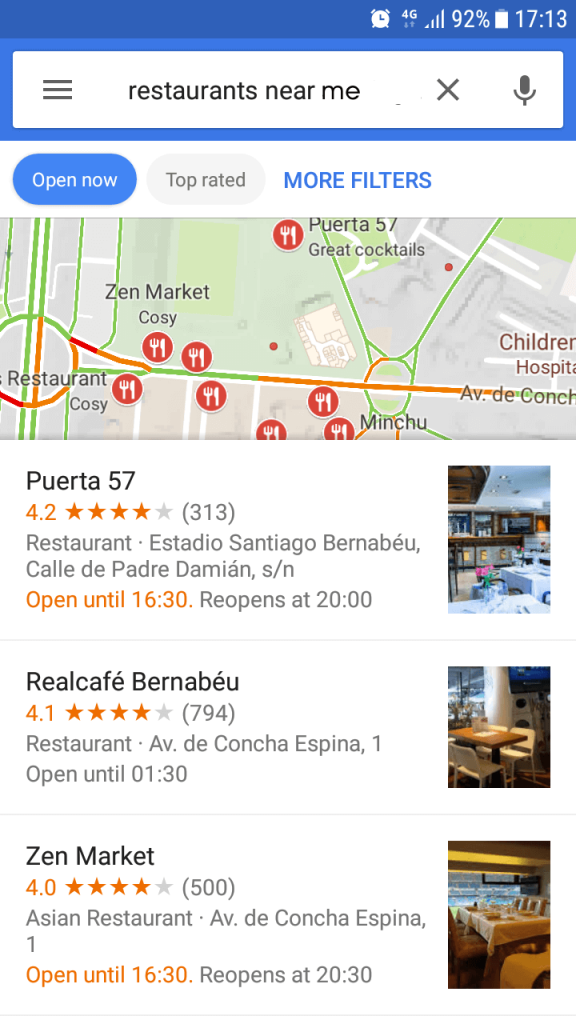
Look on that list and find the restaurants pinned on the map to get an idea of their location. Then choose the one you like, see distance, see opening hours and then get directions:
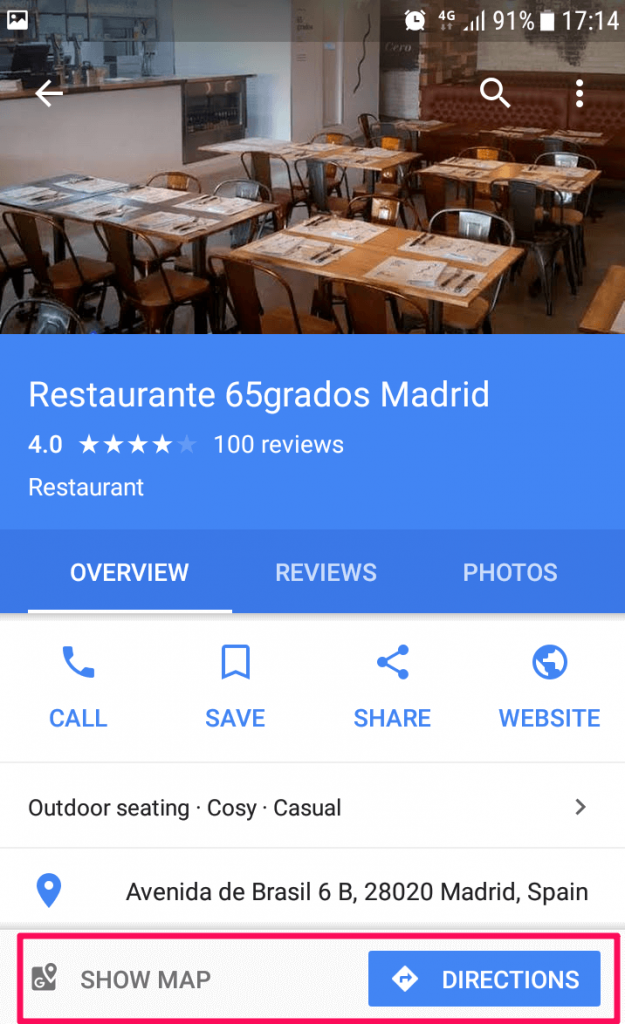
The bottom line is that claiming your website in Google is not a surefire way to boost your SEO. Besides claiming it, you have a lot of information that you need to add and there are a lot of factors that can influence the local rankings.
Listing your business in Google can bring you lots of other benefits, such as targeting local clients offline and generating organic traffic to your online website and social media accounts, increasing visibility on Google search and maps, building trustful relationships, creating awareness, and so much more.
Google’s documentation explains that there is a possibility to improve your local rankings but IF and ONLY IF you follow the recommendations expressed there. Relevance, distance, and prominence are the factors Google uses in this case.
There isn’t a 100% guarantee that even if you follow them you could skyrocket your rankings. Nothing can give you that assurance.
2. Google Displays All the Information from GMB Dashboard
Business owners have the option to add a lot of information and whatever they want in GMB, starting with contact information, pictures, posts, and so on.
Below you can see how the dashboard looks like for an account and what sort of data you can put there.
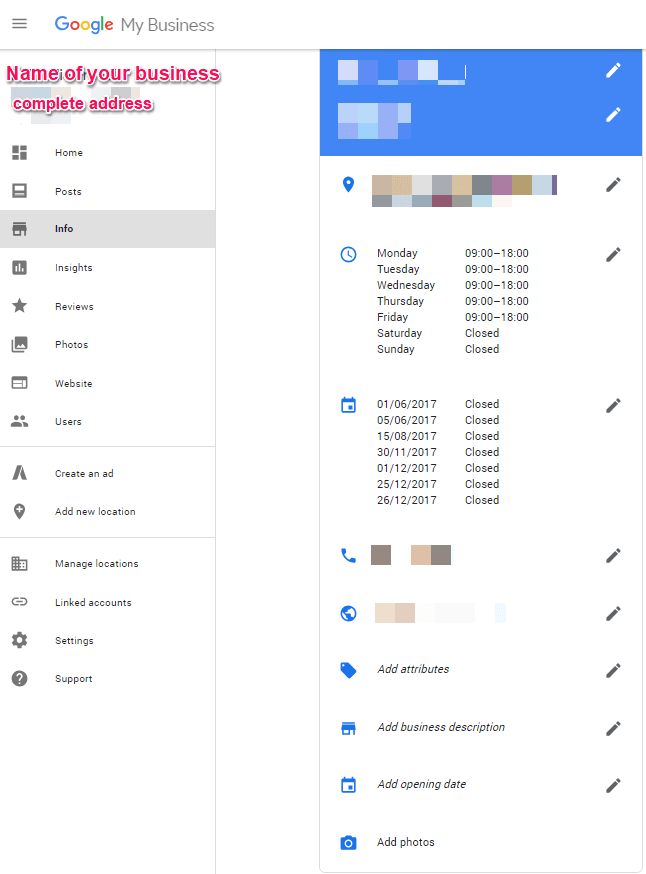
You might think that Google displays all the information you add to Google My Business, but that’s not entirely true. Let’s demystify this myth:
Google displays whatever information from the GMB dashboard. Moreover, there were multiple situations when business owners complained online that their business hours were changed.
That happened because Google collects information about a listing from multiple sources. Google verifies the listings from GMB and gathers data from the business website, the edits made on Google maps, and lots of other third-party sources.
In the situation below, the verification team from Google wasn’t able to properly read the business hours listed on the business website.
And on top of all, there is the option that somebody else edited your listing. Now, anyone can edit a listing and it doesn’t even have to be registered.
Even the competitors can edit your listing, but that doesn’t mean it will necessarily be approved if Google sees it is not relevant.
3. Deleting Your Listing in Google My Business Will Remove It from Google
Another myth that started to grow is believing that if you delete your listing in GMB it will remove it from Google, too.
This started by the time duplicates began to appear. Since there are duplicate listings, it is only natural for business owners to get rid of them.
Below you can see an example of a duplicate listing.
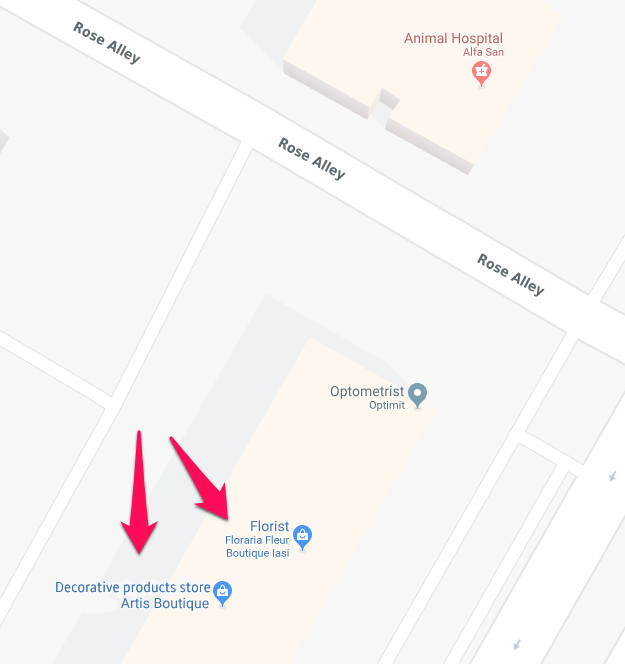
They both have the same address, one of them has contact information and photos, while the other has nothing. The explanation, in this case, is simple.
At this specific address was Artis Boutique, then they moved and another florist took its place: Fleur Boutique.
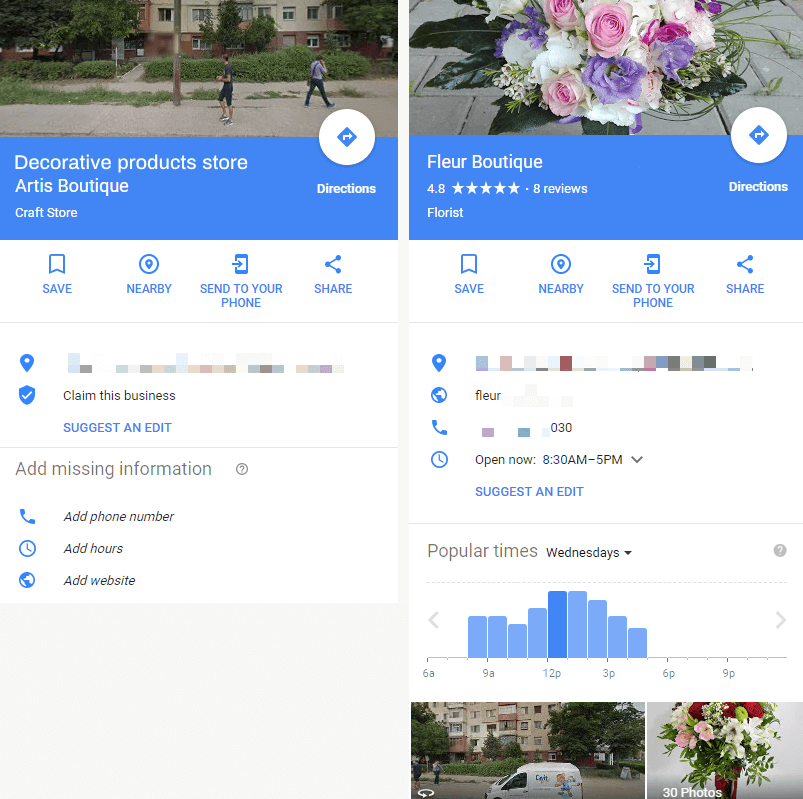
As you can see, the first listing is not verified, it doesn’t have an owner because you can see the message: Claim this business.
The common practice when finding a duplicate listing is for the owner to claim it and then delete it. The fact is that if you want to delete a listing, you get a misleading message:
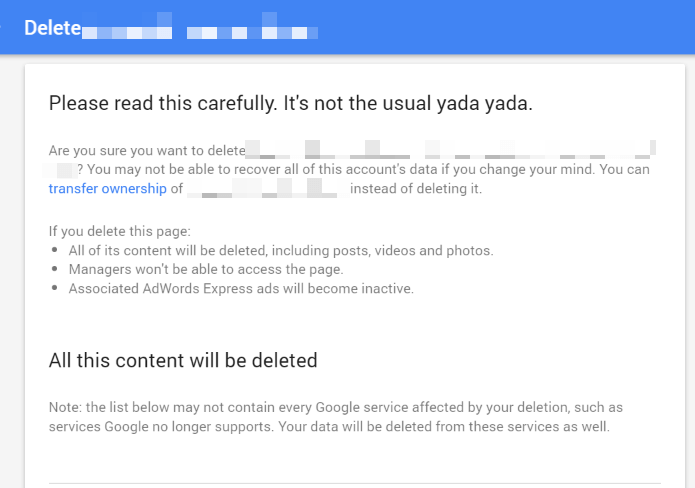
The message says that it will delete all the photos and videos and every piece of content there is about that listing on Google Maps. What will actually happen is making that listing unverified.
The problem started with this spooky message, and people thought that if you delete your listing in GMB it will automatically and irreversibly delete it from Google as well. *myth alert*
If you chose to delete your listing from GMB, it will continue to exist in Google maps and can rank, but only if you no longer want to manage it.
4. You Don’t Need Backlinks If You Have Citations
Citations are mentions of your company’s NAP (name, address, and phone). There are people who say and think you don’t need backlinks if you have citations or that if you have too many citations is enough.
Thousands of opinions exist upon the fact that citations are the most valuable factor for ranking locally.
A lot of people focus mostly on citations instead of links. That’s why you see lots of directories cluttered with a bunch of lists of businesses.
Lots of people preach NAP consistency in the wrong way and then end up asking why aren’t they ranking locally.
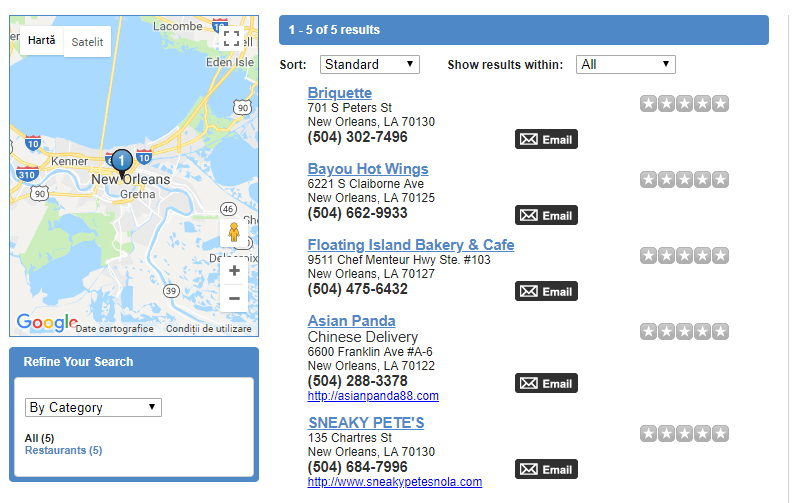
Spoiler alert: Yellow pages are no longer a hit!
If your strategy focuses more on citations instead of links, you can’t build authority for your website. Citations are important for your business, but so are the backlinks.
Arguably, an even more relevant aspect is the top 3 rankings factors in Google.
Let’s all remember them: content, links, and RankBrain so links must be important in the local ranking too, besides relevance and other local search ranking factors mentioned before, such as relevance, distance, and prominence.
Garry Grant, founder at SEOinc explains the importance of links in organic ranking:
Linking has always been one of, if not the biggest ranking factor when it comes to organic search results.
Having authoritative and high domain authority links increase a sites backlink profile/authority and provide huge ranking benefit, especially if the referring domains are directly relevant to the product or service.

Garry Grant
Founder of SEOinc
So, let’s all agree that citation has so little to do with local rankings now, that you shouldn’t focus your strategy entirely on it.
By building hundreds of citations without bringing any value through your content and building high domain authority you won’t rank high in SERP.
5. Citation Won’t Help Your Business in Any Way
On the other side, there are those people who think citations won’t help their business in local SEO and can’t boost the rankings in search engines.
If you want to get lots of calls, if that is an important goal for your business, then and only then you can use citations more often.
Steve Napier, a freelance SEO consultant, explains the value brought by citations and how Google uses them in future verification processes:
Google uses citations to verify the accuracy of the contact details in their local business listings too, as listing addresses or phone numbers that are out of date, incorrect or falsified, look bad on them and cause people to question the reliability of their search results.

Steve Napier
Freelance SEO consultant at SEOmark
Citations might not bring so much traffic to your website, but it can drive visibility to your business. For example, if you have a new business, people will find value in the fact you are listed on multiple sites and you exist online and can track you easily.
Darren Shaw, Founder of Whitespark, points out very well the process of using citations in your local SEO strategy:
Citations are considered part of the foundational basics when it comes to local search. Once you have completed your citations you can move on to other areas like link building, engagement, content creation, and reputation management.

Darren Shaw
Founder of Whitespark
6. Nobody Reads Reviews Anymore
If you managed to stay with us until now, I must reward your patience and your curiosity with another myth that started to be trusted by lots of people.
It goes something like this: nobody reads reviews anymore, they can’t be trusted and there are lots of subjective opinions. That’s not entirely true and I’ll start with a few studies to help you understand the role of business and product reviews.
Previously, researchers have shown that people read reviews and on top of that, they trust them. 85% of consumers trust online reviews as much as personal recommendations according to a study by BrightLocal.
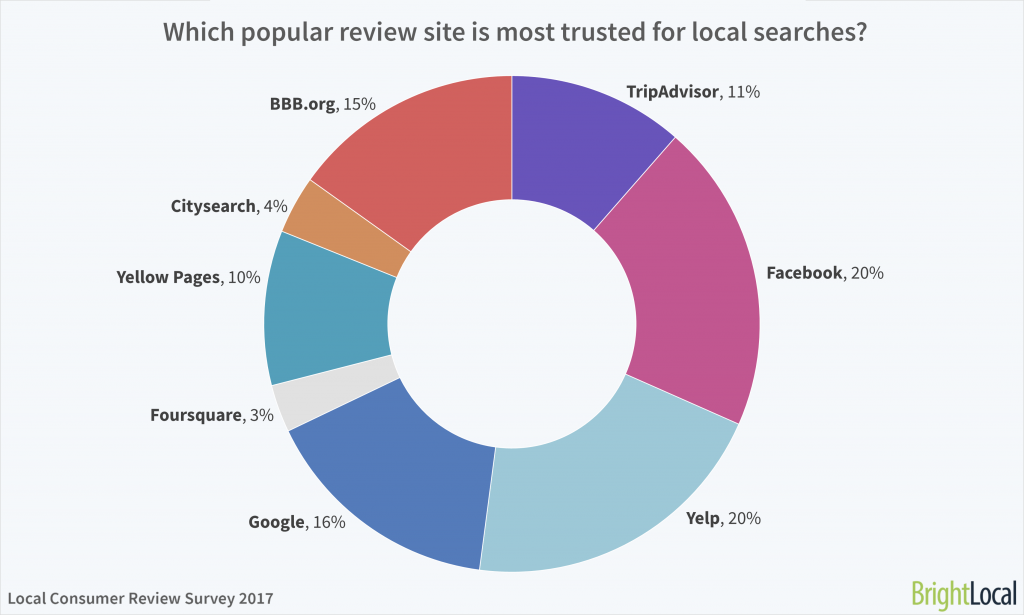
Source: brightlocal.com
Reputation is a strong indicator for helping clients to chose a local business. 93% of consumers read local reviews to decide if a business is good or not, which means only 7% don’t.
That is a percentage you can’t avoid. All these researchers make it easier for us to debunk the myth.
In 2017, LocalSEO Guide performed research with the University of California, Irvine, and PlacesScout and analyzed lots of rankings factors in local search. It turns out that reviews are an explicit ranking factor and Google confirmed it.
Reviews are obviously a driving factor of ranking in Google My Business pack results – Local SEO Guide.
Also, reviews can make it easier for clients to find you, but that is only half of the battle, as Marcus Miller, the founder of Bowlerhat, points out.
When we consider a page of search engine results there will be 20 or so other businesses listed on that page. So the consumer has plenty of options.
The key to winning the online marketing battle is to consider not only visibility through SEO, PPC, or other digital marketing but to also consider reputation typically through online reviews, case studies, and testimonials.

Marcus Miller
Founder of Bowlerhat
People are still reading reviews and he explains the benefits of having business reviews:
You should always make your business the obvious choice. Have more reviews. And have the best reviews. Then, when a prospect is comparing you to several other potential suppliers you are already the favorite before you begin your engagement.
And there are other benefits to having great reviews including being able to charge a good price for your services rather than simply having to compete on price.
Marcus Miller
Founder of Bowlerhat
As the results showed and experts pointed numerous times, reviews have a high correlation with local rankings. And besides that, a positive impact on conversions, buying decisions, online reputation.
7. Lots of Google+ Posts and Followers Will Improve My Rankings
We all heard this rumor once and started following it, foolishly: if you publish lots of Google posts and you have a large number of followers, it will definitely improve your local rankings.
Don’t get yourself fooled. We only trust the results. So, that being said, let me tell you what I’ve discovered over the years.
In our day-to-day business, we’ve searched for lots of things.
For the sake of our experiment, we searched on Google for a bunch of famous brands with and without the location next to it and we didn’t even find the Google plus account in the results.
Let’s take National Geographic, for example. The Google+ page has 15.840 followers. That’s a lot, right?
Well, if we search for the exact brand name on Google, we won’t find the page amongst the results. This is weird because all the other social accounts are there (Youtube, Facebook, Twitter).
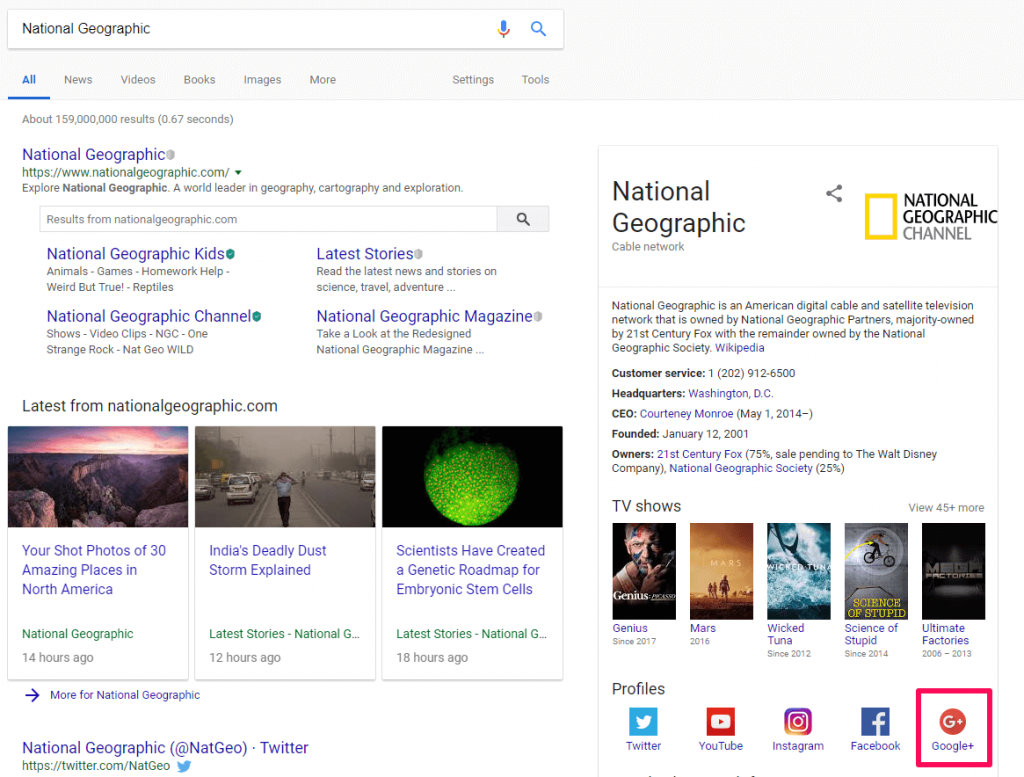
The interesting part though is the fact that the Google plus icon is on the Google search right side business information box.
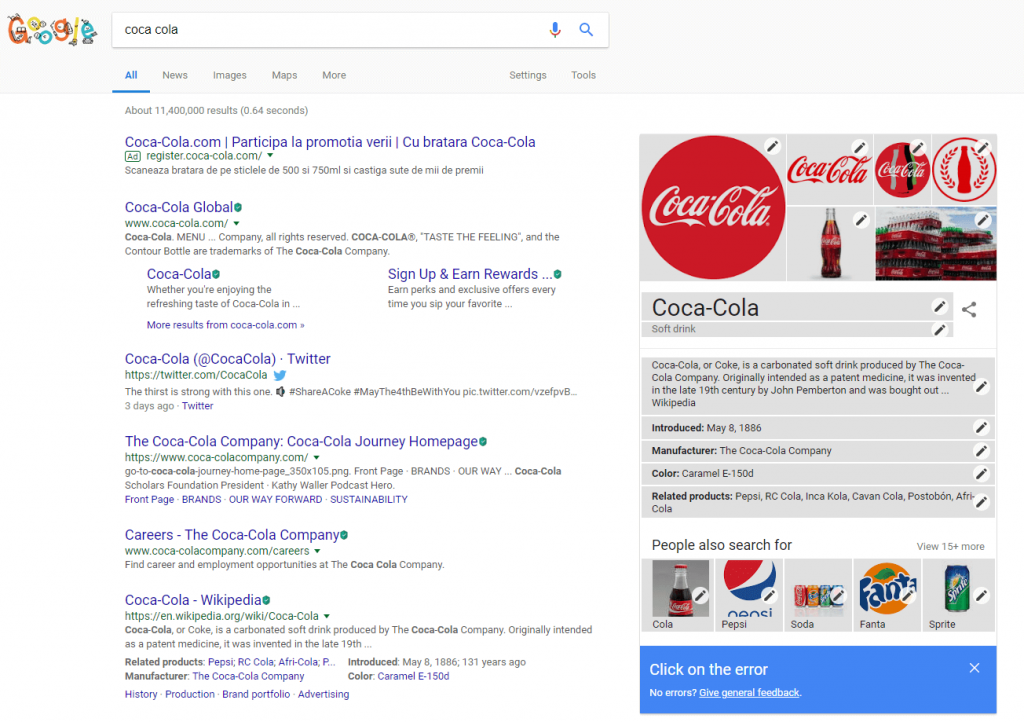
We’ve replicated the same procedure on google.com for lots of other brands, such as Coca-Cola, Mcdonals (New York), Mercedes Benz (Kansas City) and also cognitiveSEO, of course.
For some of them, we didn’t even see the icon on the right snippet box, as represented in the picture above.
Some time ago, if you performed a search for a brand name, the Google + account appeared in organic results and even on local results.
That has changed in the meantime and, on top of that, Google doesn’t include a link to your G+ in the local pack. For the moment, you have the option to merge GoogleMyBusiness with your account to avoid duplicating G+ accounts.
So what’s the point of having lots of posts if not even your brand name appears in the results?!
Bottom line, if you have lots of Google+ posts and followers, most probably you won’t improve your search engine rankings.
But that doesn’t mean it is irrelevant to have a Google + page. On the contrary, by having a popular and active G+ account, you can improve your social visibility. You can optimize your presence online.
Having a Google + business page will complement your brand, by offering a complete profile and making it trustful to leads, local customers, and loyal clients.
8. Content Is Good Only for Organic Search and Not Local Search
I’ve heard this a couple of times and I forced myself to think that people who said that were joking and didn’t believe it. But they were serious.
I don’t know who started this myth, but I got to tell they did a pretty good job (not) making people think content is good only for organic search and not local search.
My questions on the matter: Why would things be different? And why content is not good for local search?!
I mentioned before, and I will do it again: content is a ranking factor in Google, therefore content is good, not to mention highly valuable for organic search AND for local search as well. Myth debunked!
Quality content will always be appreciated, especially if you describe your store and where can people find it, the products or services they can find at your location and lots of other local information. Content marketers should know better what I’m talking about.
Due to the increasingly localized nature of search results, it’s important that your content sends the right signals to search engines and human users to let them know that your website is relevant to them within their specific geographic area.

9. Optimizing for Location Keywords Will Skyrocket Your Ranks in Local Search
Location keywords can be helpful if you know how to use them, but nothing will skyrocket your local rankings if your location doesn’t have engagement or prominence, which are two major local ranking factors.
Now that you understood the idea, let me tell you how you could use local keywords optimization to your advantage to send the right signals. It starts the moment you perform keyword research.
You can either select a keyword that has the name of the location in it or doesn’t. There are tools, such as the Keyword Tool and Content Assistant that can be extremely helpful in your content optimization process.
Let me give you an example. You want to optimize your content for real estate school and your business is located in Chicago. In this particular situation, you have two options:
- If you want to target only the people in Chicago and not other cities in Illinois, my recommendation would be to choose the “real estate school” and set the local tracking.
- In case you want to target other cities besides Chicago, you should choose the option to track “real estate school in Chicago”.
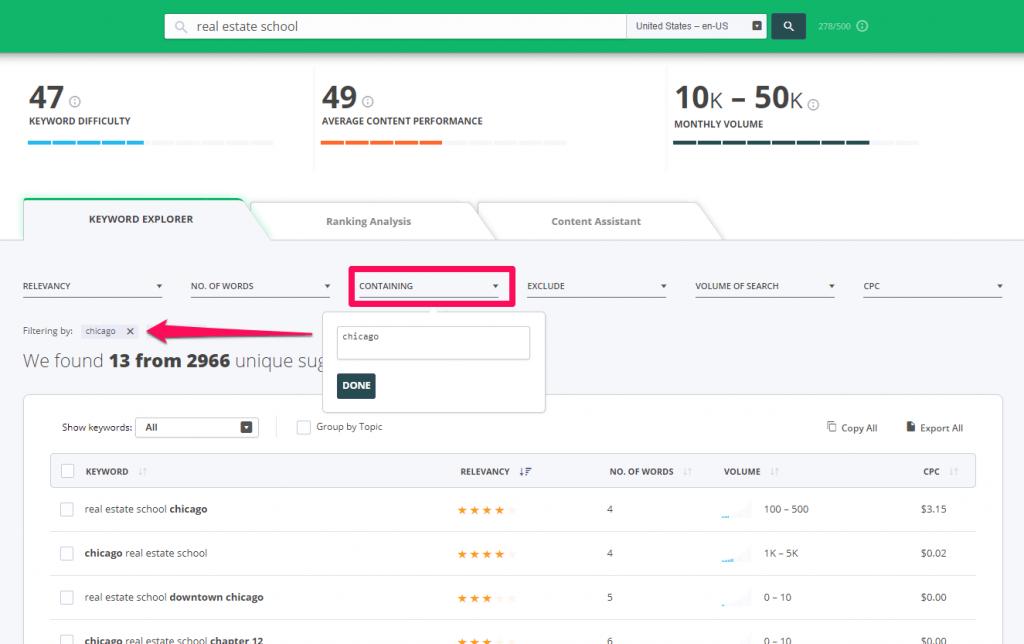
But a better choice would be to optimize your content for multiple keywords. In this case, it is quite simple because your case chose the first keyword: “real estate school” and the second one “real estate school in Chicago”, to have a better chance to rank in a higher geographical area.
10. Meta Descriptions Are Important for Ranking
There was a time when SEO meant focus keywords in the title, URL, content, meta descriptions, and alt descriptions, but SEO has evolved since then.
Now there are lots of other factors that are important. Not to mention that local SEO has gained more value and influenced a lot more rankings.
If somebody from New Jersey could see a top 10 page for dog food, somebody else from Dubai could see an entirely different top 10 page for the same query.
You can write whatever you want in your meta description, it doesn’t influence your local ranking, that’s because Google will choose from your content what is relevant for a query and not specifically what you wrote.
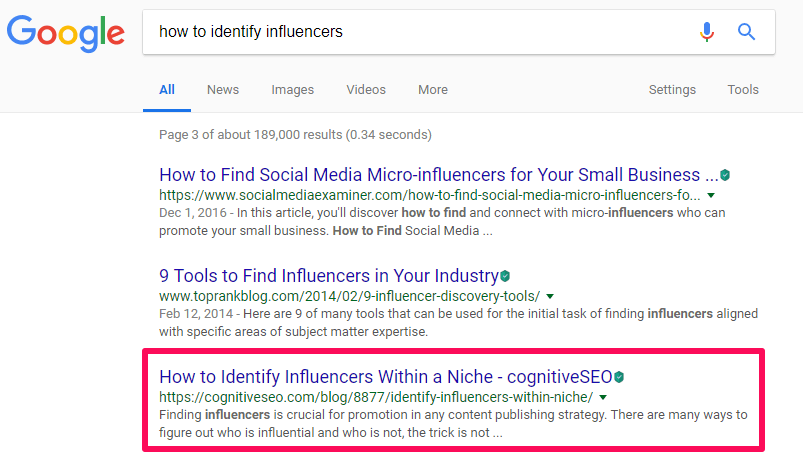
Let’s take the next example. We have an article that is called: How to Identify Influencers Within a Niche, which is optimized for multiple keyword formations.
First, we searched for “how to identify influencers” and you can see below the meta description for this query:
Secondly, we searched for “niche influencers” and we got different results:
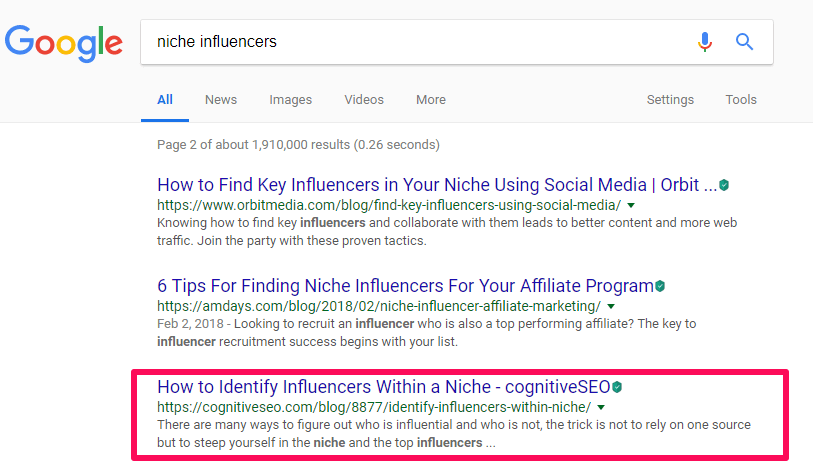
The interesting part of this experiment is that neither of these two meta descriptions was the one we had written. This is the original snippet:
Finding who is influential is crucial for promotion in any content publishing strategy.
Long story short, meta descriptions don’t matter so much for ranking locally or more, but that doesn’t mean you shouldn’t use them.
Well-written meta descriptions can have a high influence on a page and can increase conversions.
11. Social Media is Useless for Local SEO
This myth started to gain more weight over time, to my despair. I am guessing it was started by people who don’t use Social Media personally, don’t know or understand the value of it.
If you’re not using Social Media, then you are missing out on lots of opportunities for your business. Being active and having a social account shows to your audience the “human” part of your business.
We’ve talked multiples times regarding the influence of the social signal on SEO and we say every time that a strong presence on social networks is correlated with better rankings.
This basically debunks the myth and tells everyone that an active profile on social media can positively influence your business on a local side for sure.
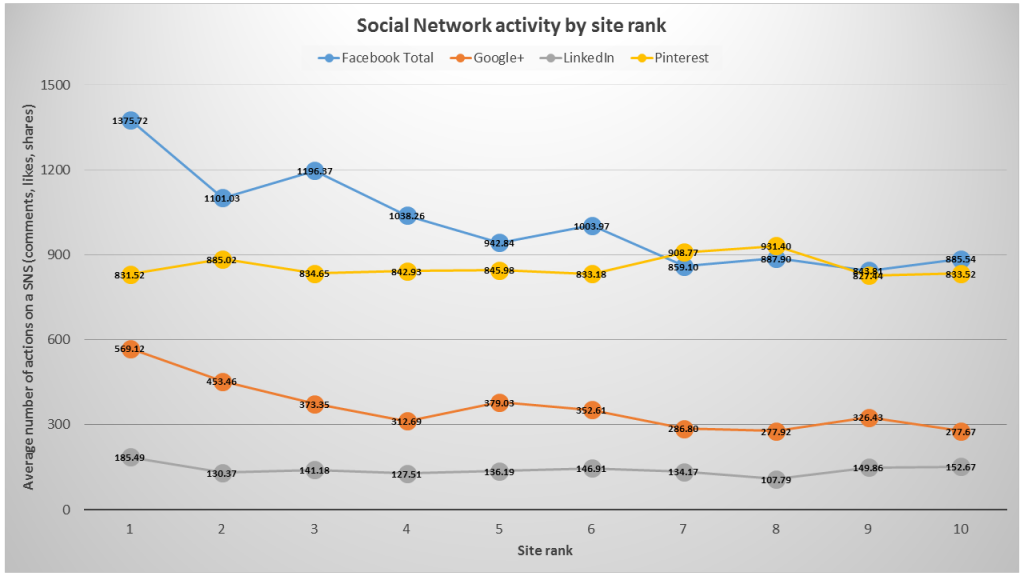
You must be careful what you post, the frequency; create engagement by responding to comments; follow other pages and create a relationship with other brands; make sponsored ads to boost visibility.
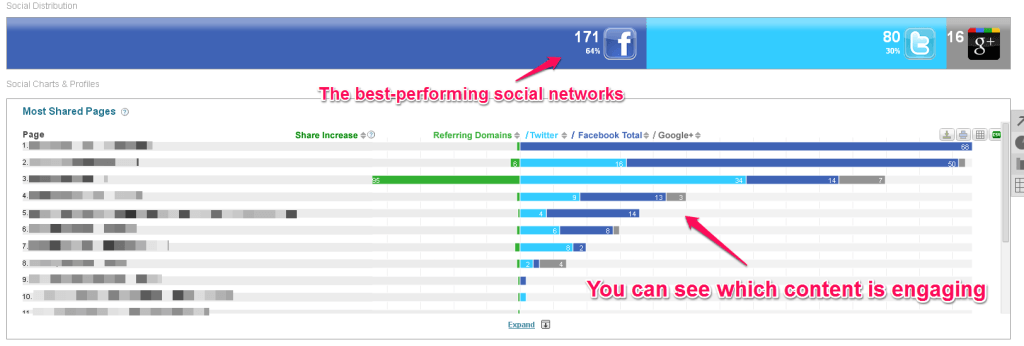
For new ideas, you can look at your top competitors and see what type of posts they have on each social account and which get the higher traction. cognitiveSEO has a module named Social Visibility, where you can compare your website with other competitors and see their best-performing social networks and which content is more engaging.
Conclusion
There are so many misconceptions over the internet with lots of opinions floating around the local SEO topic, that my head started spinning.
I saw there’s a problem regarding this topic and thought of making a list of all the myths that exist, but writing about the ones that are believed by more people.
I hope I made things clearer for people who are struggling to gain traction in their local search results.
There are 3 things you should always consider when tackling the local SEO: NAP citations, local reviews and claiming your business on Google My Business plus lots of other practices you should stay away from.
Search engines can be your friend, but if don’t know how to talk to them and feed them with the right information to explain what your intentions are, they won’t be friends with you/your website.
The post 11 Local SEO Myths Debunked Once and For All appeared first on SEO Blog | cognitiveSEO Blog on SEO Tactics & Strategies.
Source: cognitiveseo.com