
Tag Archives for " Link building "

Do Links from Guest Posts Even Work? Here’s What We Learned from Analyzing 1,091 Sites That Accept Guest Posts.
It’s frowned upon to build links through guest posts.
If you do, they should be nofollowed and ideally you should be guest posting for brand awareness and referral traffic.
Even though that’s what I follow, it doesn’t mean others do.
Plus, I get hundreds of emails a day asking me if I accept guest posts, hence I know it’s still a popular link building method (although I ignore all those emails).
What Kind of Sites Did We Analyze?
First off, not all blogs accept guest posts. So, if a blog didn’t accept a guest post, we clearly didn’t include it in our study.
Second, we looked at sites that clearly labeled content as a guest post or as a post written by a guest author or guest contributor.
Third, we looked at sites that used dofollow links in the guest posts (even though they should have been nofollowed) to see if they had an impact on rankings.
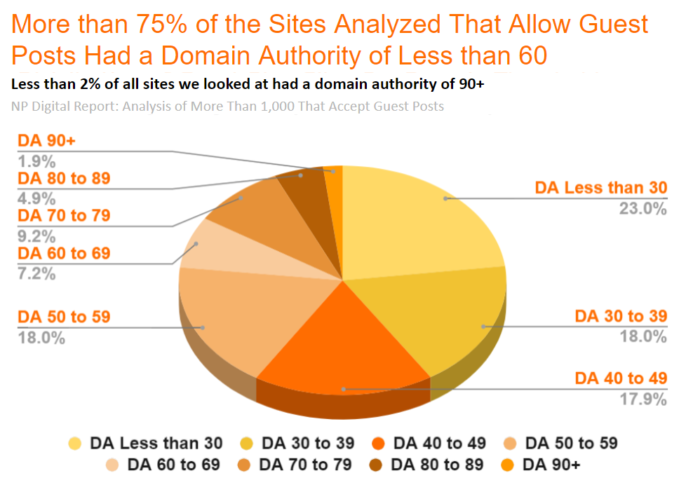
As you can see from the graph above, we looked at sites across different domain authority levels. We wanted to see what impact it had on whether a guest post received traction or not.
We also looked at sites with varied traffic ranges to see where posts might perform best.
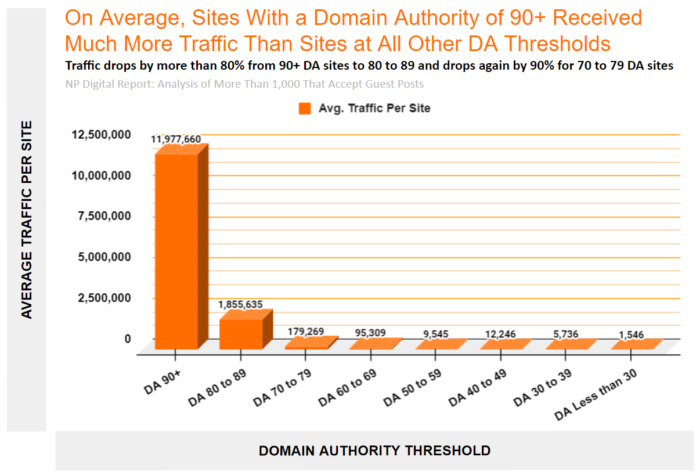
As you can see, targeting sites with a domain authority above 90 will likely lead to more traffic. At the same time, those are also the sites that will be hardest to get links from.
So, What Did We Learn?
The short answer: guest posts links kind of work and kind of don’t.

I know that isn’t a clear answer, but it is if you read the rest of the post. Because there are certain types of guest post links that work and there are others that don’t.
Here are some more insights…
Too Many External Links Is Bad
Some guest posting sites link out a lot.
Some don’t link out too much.
Although you shouldn’t be focusing on how many times you do or don’t link out, you should be focusing on providing the best user experience to your audience. If that means including a relevant link to another site in your article, by all means link out.
If it doesn’t make sense, then you shouldn’t.
Look at this chart.
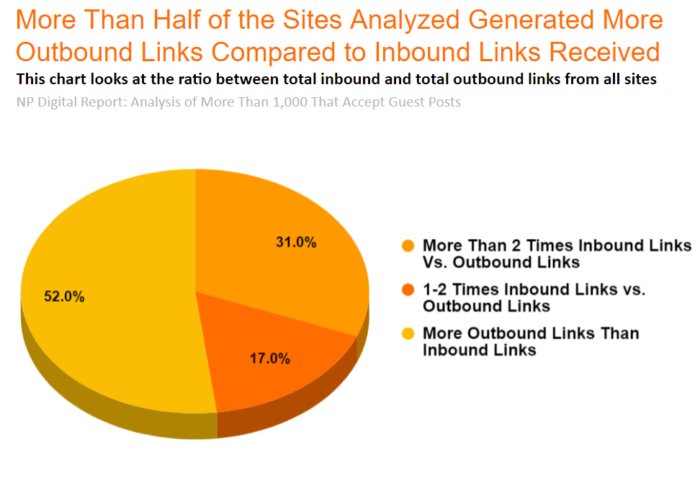
Now, it’s hard to know for sure if a link received from a guest blog site with more outbound links than inbound links is effective since websites don’t just have 1 backlink. Most websites can have hundreds and, in some cases, millions of them.
Just look at my site NeilPatel.com. Sadly some spammy websites link to me (scrapper sites) and some high authority websites link to me. It’s hard to know for sure what the impact a spammy site link has on my rankings compared to the ones received from high domain authority sites.
Instead, what we could do is look at the number of keywords a guest posting site ranks for. In theory, the more keywords a site ranks for, the better they are since they are liked by Google. I would think that a link from them would be more favorable.
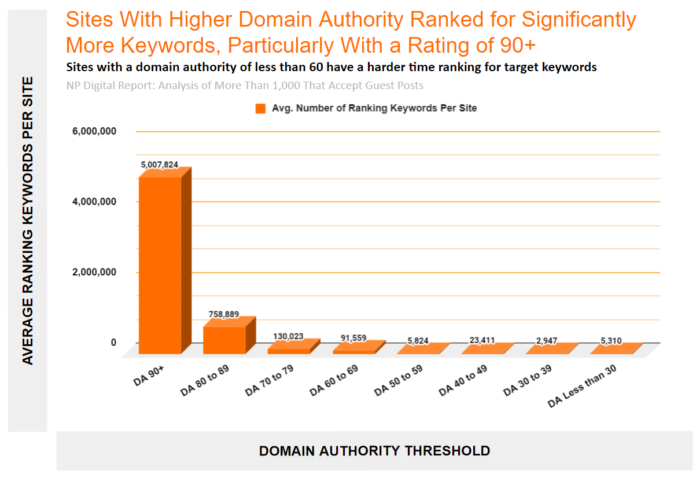
What you’ll notice is, generally speaking, the higher domain authority a site has, the more keywords it ranks for. But we already knew that.
When looking at the domain authority range from 0 to 59, you’ll notice that there isn’t a consistent upward trend. That’s because many of the domains from our analysis in this range tended to be sites that were expired or bought-out and are mainly used for guest posting purposes.
Even more interesting. The guest posting sites that had more external links than inbound links all had a domain authority of less than 60.
From this one insight, someone could infer that you should aim to get links from sites who have more inbound links than external links. As in, sites that have higher domain authority.
You should also avoid guest posting sites that exist for the sole purpose of linking out to other sites. These can be considered spam links.
The Right Links Help
From all of the guest posting sites we analyzed, we found 14 businesses who were exclusively receiving links from some of the sites we looked at. From these 14 businesses, six of them only received links from guest posting sites with a domain authority of less than 60.
In other words, they didn’t have links from any other sites.
So, we dove into their rankings and traffic.
What’s funny is that these six businesses had little to no rankings or traffic.
Let’s look at the number of page 1 Google rankings they had.
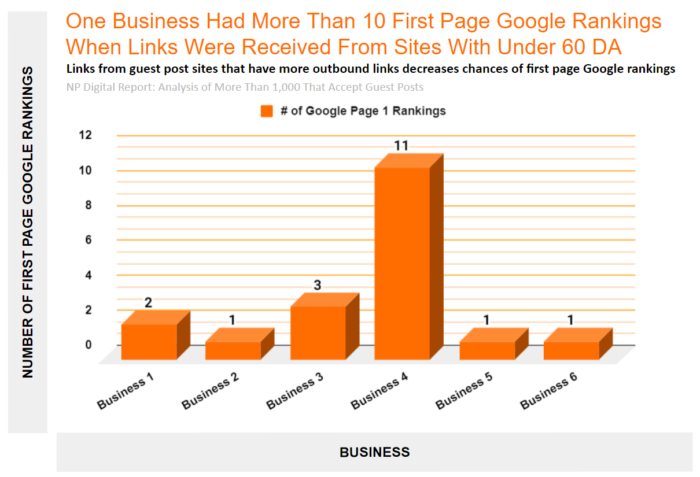
Since these six businesses only received links from spammy guest posting sites, we know that each of those sites had more outbound than inbound links. It’s clear that those sites didn’t really serve a purpose other than for guest posting.
The remaining 8 businesses we looked at also had links from spammy guest posting sites but also received links from more legitimate sources too. As in, guest posting sites that had more inbound links than outbound links.
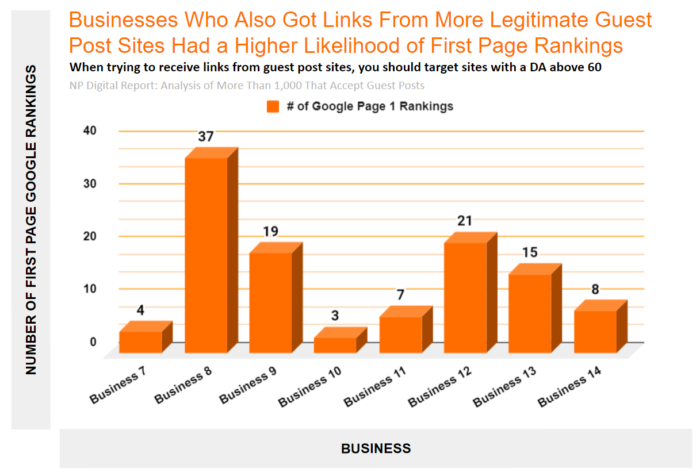
The businesses that built links from the spammy guest posting sites had, on average, 3.16 page 1 rankings on Google. On the other hand, businesses that also built links from the higher quality guest posting sites as well had, on average, 14.25 page 1 rankings on Google.
Keep in mind some industries are easier to rank for than others and some keywords drive less traffic than others, so not all page 1 rankings are created equal.
At the same time, this trend shows that if you target links from higher quality guest post sites, there is a better chance of ranking on the first page.
Conclusion: Do Links From Guest Posts Work?
When I originally said guest posting links can or can’t help it’s because the quality of the link really matters.
When you get links from spammy sites, as in sites whose sole purpose is to link out and don’t get as many links coming in, search engines know this. If this is a practice you have been doing, don’t expect your rankings to go up as much.
On the flip side, if you generate links from higher quality guest post sites, you are going to be much better off.
The goal of this post was to figure out if links from guest posts really help and now we know the answer. However, if you’re going to build links from guest posts than they should be nofollowed and you should be doing it primarily for branding and referral traffic purposes.
Source: neilpatel.com

How Backlinks from Different Page Locations Are Worth More (Or Less): Not All Backlinks Are Created Equal
If you want to get found online, you need a strong backlink profile.
The problem? Not all backlinks are created equal.
Links from high-quality, relevant sites are far more valuable than links from random sites in another industry. Links from spam sites can actually hurt your website.
How do you make the most of your backlinks? You need to pay close attention to the factors that impact backlink value.
Here is what you need to know to make the most of backlinks.
What Are Backlinks?
Backlinks are links from an external site to your website. For example, if I link to a source about how to protect your app from security issues, that creates a backlink to that website.
If another site links to your site, you receive a backlink.
For a long time, getting as many backlinks as possible was a core component of SEO. Google viewed backlinks as “votes” and rewarded sites with lots of backlinks with higher rankings.
Eventually, however, businesses began to use black-hat strategies to build backlinks. For example, paying sites to add links, buying links from shady sites, adding comments to other blogs with links to own site, or building networks of sites that are all linked to each other.
Google got wise to these strategies and issued an update that made it much harder to get away with building poor-quality backlinks. It released a number of backlink guidelines that marketers should follow and also released another update targeting spammy links in June of 2021.

How Do Backlinks Affect SEO?
As mentioned above, Google views links as votes. The more sites that “vote” for your site (meaning link to pages on your site), the more valuable and relevant Google assumes your pages and site are.
In fact, backlinks are one of several hundred factors Google considers when deciding where to rank a website in its search results.
Here’s why: A backlink to your website means another site found your content engaging, interesting, or educational. So much so that they decided to share it with their audience. Google assumes that means your content is valuable to users, and is more likely to share your content with searchers.
However, there isn’t much you can do to impact how many links another site puts on its pages. Just keep it in mind when considering which links are most valuable for your website’s SEO.
If many trusted sites link to yours, Google knows your site has great content that users will want to read. As a result, you’re more likely to rank high in the SERPs.
What Makes a Backlink Valuable?
More backlinks isn’t always better.
If you use link schemes or other black or gray hat SEO practices, Google will punish you with lower rankings or even manual action. What makes a backlink more valuable than another?
1. Location and Number of Links on a Page
Did you know that where a link is located on a page can impact backlink value? Sounds weird, right?
Well, Google considers the first link on a page to be the most valuable, which means it gets more of the benefits of having a backlink. In addition, the more links on a page, the less link value each link has.
In practice, this means that if your link is the only backlink on a page, you’ll see more SEO benefits than if your link is at the bottom of a page and is one of twenty other links.

2. Dofollow Vs. Nofollow Backlinks
Dofollow links are your basic backlinks. When the website owners don’t fiddle with the HTML surrounding the link, the link will always be a dofollow.
Dofollow links tell Google the linking website trusts your domain, which can help your rankings.
Nofollow links, on the other hand, look like this in HTML:

Nofollow links tell Google that this link should not pass on value (sometimes called link juice).
In other words, nofollow links still take someone from Website A to Website B, but they won’t help Website B’s rankings.

Why do sites use nofollow links? Because linking to low-quality or low-domain authority websites can hurt the link-hosting website’s rankings. Also, Google doesn’t allow you to pay for links, so some sites use nofollow links on sponsored posts.
Don’t assume nofollow links are a complete waste of time. In fact, they really help generate traffic to your website and increase the visibility of your business despite their unhelpful SEO influence.
3. Domain Authority and Page Authority
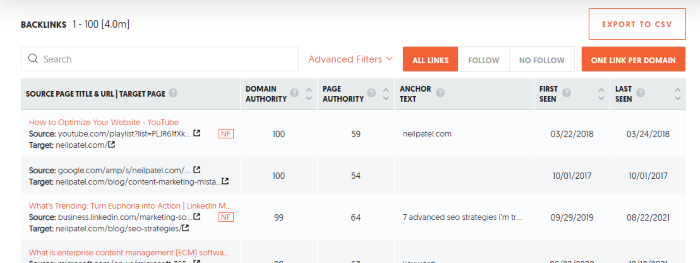
DA, or domain authority, is a metric created by Moz that predicts how likely a website is to rank well in the search engines. Scores range from one to 100, with higher numbers meaning the site is more valuable and more trusted.

Page authority is the same metric, but for a specific page on a website.
It isn’t an exact science, and it isn’t a metric Google came up with—Moz did. However, it does use machine learning to get a pretty decent idea of how well a site will rank.
What does this mean for your backlinks? If a site with a higher domain authority or page authority links to your site, Google will assume your site is more trustworthy, too. That’s a good thing!
Think of it like vouching for a friend to get a job. If you are a dedicated worker and recommend someone else, your boss is likely to assume they can be trusted to work hard, too.
TL;DR: Links from high-domain authority pages are more valuable.
You can find the domain authority of sites using Moz’s domain analysis tool.
Or, you can use Ubersuggest to run a backlink analysis on your site, and we’ll share all the domain authority and page authority metrics in one place.
4. Relevant Sites and Pages
Relevancy matters when it comes to recommendations. Let’s say you wanted to buy a new snowblower. You look around the internet and find two articles that review the top snow blowers—one is from a hardware store, and the other is from a food blogger.
Which one would you trust? You’re likely wondering what a food blogger really knows about snow blowers, right? The hardware store, on the other hand, probably sells snowblowers and talks about them to customers on a regular basis. There is a good chance they know what they’re talking about.
Google also considers relevancy when deciding how valuable a backlink is. For example, a link from a digital marketing publication or a publisher like Forbes to my site is worth more than a link from a plumber.
In general, links from irrelevant sites won’t hurt your website (unless they are spam sites!), but links from other industry websites do carry more value.
5. Quality of Other Links on the Website
It’s not just the domain authority that impacts backlink value. The quality of every other backlink on the referring domain can impact the value of a link too.
It doesn’t sound fair, does it? You can’t control what someone else does on their site. While that is true, there is a reason for this.
Let’s pretend that you receive a backlink from a website with high domain authority. Your ranking goes up, traffic is pouring in, and you feel like the SEO pro you are.

Then one day, the website that gave you that precious backlink becomes a spam site. They publish low-quality content and link to a bunch of spam sites.
It’s no longer a high-quality site in Google’s eyes, which means that link has lost its value. In other words, pages that link to spam websites devalue all other links that they host.
It’s important to evaluate the websites you get backlinks from. That will help you avoid harmful URL relationships. Make sure they are trustworthy and do their own link evaluating when choosing which links to include so that your website won’t be at risk.
Also, never buy links from websites. Even sites that seem legitimate will likely get caught by Google at some point, and your site may suffer the consequences.
6. Anchor Text
Anchor text is the text that is highlighted and often underlined that you click on to follow a link, like this.
If the site that links to your website uses anchor text that is closely related to the content on that page, Google will assume the link is more useful to users and, therefore, assigns it more value. As a result, Google made anchor text a ranking factor.
Let’s look at an example from Yoast’s website. I’ve highlighted the anchor text:
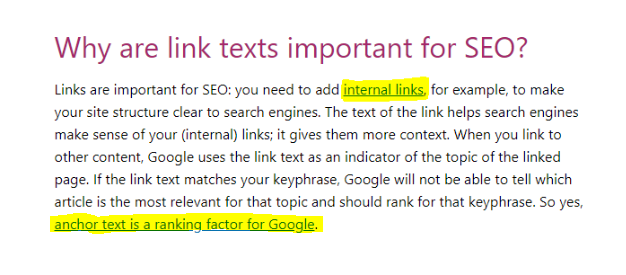
The anchor text for internal links goes to a page about, as you might expect, internal links. Because the anchor text uses the keyword the linked page targets, that link is more valuable than if they used anchor text like “click here.”
Pro tip: This applies to internal links, too. Make sure to use relevant anchor text when linking to other pages on your own website.
Frequently Asked Questions About Backlink Value
How do I identify valuable backlinks?
Backlinks that come from high-quality, relevant sites are the most valuable. Look for the following links and pay attention to other sites they link to. All of these factors impact backlink value.
What’s the easiest way to get valuable backlinks?
The easiest way to build backlinks is to create highly-valuable content that other sites will want to link to. This is often called link attracting, versus link building. Other strategies include looking for broken links on sites and asking them to replace them with yours, guest posting, creating infographics, and creating new data.
What types of backlinks are valuable?
The most valuable backlinks are dofollow links from trusted sites related to your industry with high domain authority.
How much are backlinks worth?
You can’t put a dollar amount on backlinks. However, a solid backlink profile can improve your search engine ranking, drive traffic, and increase your revenue. In that sense, they are priceless.
What is the difference between backlinks and internal links?
Backlinks are links from other websites that point to your site. Internal links are links that point from one page on your site to another. Both have SEO value, but backlinks are usually harder to get and, therefore, considered more valuable.
What do I do if I have a bunch of low-quality backlinks pointing to my site?
In most cases, Google can spot poor-quality backlinks and will ignore them. If you think they are impacting your site (or if you get a manual penalty), you can use Google’s Disavow tool to tell them to ignore those links.
Backlink Value Conclusion
Backlinks are a cornerstone of SEO. However, not all backlinks deliver the same value. Links that are higher on a page or from pages with a higher DA will help your website rank better in Google’s search results.
You can use this information to build higher-quality backlinks. Get it right, and your site can see a flood of traffic and conversions.
Do you consider backlink value when building links? Why or why not?
Source: neilpatel.com

How to Increase Your Website Traffic Without SEO
SEO can be a brilliant strategy to increase your website traffic but it isn’t always enough.
Imagine you rely on SEO for all your traffic. What happens when the Google algorithm changes? You risk losing potential customers!
Disclosure: This content is reader-supported, which means if you click on some of our links that we may earn a commission.
That’s why diversifying your methods of increasing web traffic can offer better results.
If you have multiple traffic sources, changing algorithms won’t completely halt your business.
You will have a toolkit full of optimization strategies to keep your business running.
Diversifying your web traffic can also be helpful in cases where there’s little scope for search engine optimization (for example, podcasts).
In this post, we’re going to look at effective strategies to grow your website traffic without SEO so you’re never left stranded by algorithm changes again.
We’ll also look at practical tips you can start using right now, so you can get back in the game if your traffic has been low for a while.
Why Should You Try to Grow Traffic Without SEO?
You can generate substantial traffic from SEO alone, but not all traffic is equal. High-quality traffic (that includes users more likely to convert) offers better ROI, so you need to prioritize it.
Plus, if you aren’t an SEO expert, you may want to focus on other strategies to grow your website traffic efficiently.
This doesn’t mean you completely ignore SEO. All websites, irrespective of their niche, must follow the best SEO practices to avoid being penalized by Google and to ensure the site gets indexed.
Top Strategies to Increase Website Traffic Without SEO
The strategies we’ll discuss below can be a helpful addition to a pre-existing SEO plan.
1. Content Marketing
If you have been reading about digital marketing for a while, you must have heard the term “content marketing.”
In simple words, it’s a way to organically advertise your brand through high-quality content.
Content marketing strategies often include blog posts, podcast episodes, infographics,
YouTube videos, downloadable PDFs, etc.
For instance, Toggl, a time tracking software company frequently uploads informative blog posts and research data about productivity, work-life, and career.
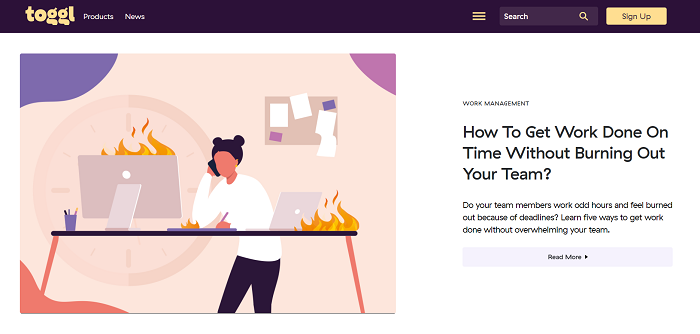
This attracts users interested in time management, productivity, and wellbeing in the workplace.
When they read Toggl’s blog, they eventually discover Toggl’s time tracking app, among its other productivity tools.
Some of these users convert, helping Toggl increase their website traffic and ROI.
Content marketing isn’t limited to blog posts.
If you connect better through audio, you can try launching a podcast or host a webinar.
Nowadays, most social media apps let you post a variety of content formats including photos, audio clips, long-form text, and videos.
You can experiment with one or more of these formats to see what works best for your audience.
2. Paid Ads
Content marketing is beneficial but it can take a lot of money, especially if you’re paying established writers to create original, well-researched posts for you.
Most of these projects also take weeks or months to show results, which isn’t a practical timeline for many businesses.
If you want quicker results with a budget you can control, why not try paid ads?
Seven in ten Americans use social media today.
That’s more than two-thirds of the population.
Think about the possibilities!
Paid ads can instantly generate hundreds, if not thousands, of clicks to your website.
Plus, with new advertising and social media platforms appearing and innovating regularly, getting your ads in front of the right people is becoming easier than ever.
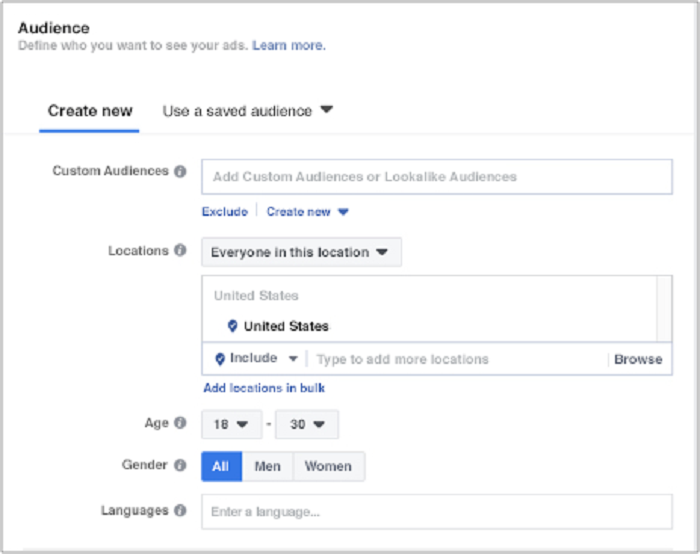
For example, Facebook offers detailed customer personas and multiple targeting options so you can put your business in front of your target customers without wasting a lot of money on mass advertising.
However, you don’t have to stick to the largest platforms for effective advertising.
In fact, advertising on lesser-known platforms whose audience aligns with your products can be more effective in the long run.
For example, if your ideal customer includes teens who enjoy memes and weird stories, you’d have much better results by advertising on Reddit, rather than Facebook or YouTube.
Another option is dating apps.
If your brand is focused on relationships or if you’re targeting young singles, advertising on dating apps like Tinder can help you find your target customers faster.

If you’re worried paid ads will take a lot of money, remember, you don’t need to spend $1,000 on your first day.
Test the waters with $5-$10 a day and see what happens.
Do that for a week, just to learn how different media platforms work.
3. Social Media Strategies
One of the best ways to increase your website traffic is to meet your customers where they like to hang out.
Like we discussed earlier, almost everyone is using social media today.
Ramping up your social media marketing efforts can help you reach new users, develop brand awareness and increase website traffic.
How to gain website traffic through social media?
When it comes to social media, you can’t just barge into “conversations” and ask people to buy something from you or to visit your website.
Think about how you’d present your brand in real life when you meet an individual for the first time.
Would you immediately talk sales in their face?
How about providing details about your product/service without introducing yourself first?
Remember, users, visit their preferred social media platforms for entertainment, not for being sold to.
To make sure your efforts are well-received, you need to provide value first and develop positive relationships with your potential “followers.”
You can do this by sharing informative posts like How-Tos, or posting fun photos of your employees, like this post from Casper.

I wrote a detailed guide to increasing social media followers and boosting engagement.
Here’s a summary of the top options to help you grow your website traffic.
- Join relevant Facebook groups
- Share helpful articles/videos in these groups
- Post updates about your company’s latest products host contests and giveaways
- Leave thoughtful comments on user-generated content
4. Link Building Strategies
When marketing teams talk about SEO, link building frequently comes to mind.
When reputable websites link to your content, the algorithm favors your website and increases its rank on the search page.
Sounds helpful, but that’s not all.
Did you know link building can help you increase web traffic without relying on SEO?
Link building for brand awareness is a process where you focus your strategies on expanding your reach, putting your content in front of new users, and generating conversations around your brand.
This is more than just a casual backlink in a blog post.
Link building for brand awareness takes more planning and resources, but the investment is worth the high-quality leads you’ll get.
Here are some tips for developing effective link building strategies to increase website traffic:
- Engage with your audience: Create interesting, shareable posts and encourage your followers to respond and share your content.
- Work with PRs: Recruit efficient PRs to help generate brand awareness and distribute your story to your desired audience.
- Guest blog intentionally: Choose unique publications that align with your readers’ key interests and post guest blogs on their page.
5. Interact With Other Blogs
Guest blogging is an effective traffic-driving strategy aimed at leveraging somebody else’s audience to widen your brand’s reach.

Think about it: Somebody in your niche has a large, engaged following.
Imagine if you could put your content in front of them.
How much traffic could you drive to your website!
Why would someone publish your work?
Probably because you’re good at what you do.
Everyone is looking for high-quality content.
If you can provide a well-researched, helpful post for free, people are often open to publishing it on their website.
After all, it’s benefiting their audience at zero cost.
Why would you give precious content away for free?
It’ll help you gain access to hundreds, if not thousands of new users, many of whom could become long-term customers.
It’s a win-win situation, but you have to be careful how you approach it.
Start by searching for blogs and media publications that publish content relevant to your business.
For example, if you run a recruiting company, publish content on business blogs read by people interested in the latest recruiting practices.
If you want to find blogs in your industry that are accepting guest posts, use the following search queries to see more specific results:
- name of your niche + “write for us”
- name of your niche + “submit guest post”
- name of your niche + “sites that accept guest posts”
- write guest article + ‘name of your niche” + blog
Solvid provides a comprehensive list of places accepting guest blogs:
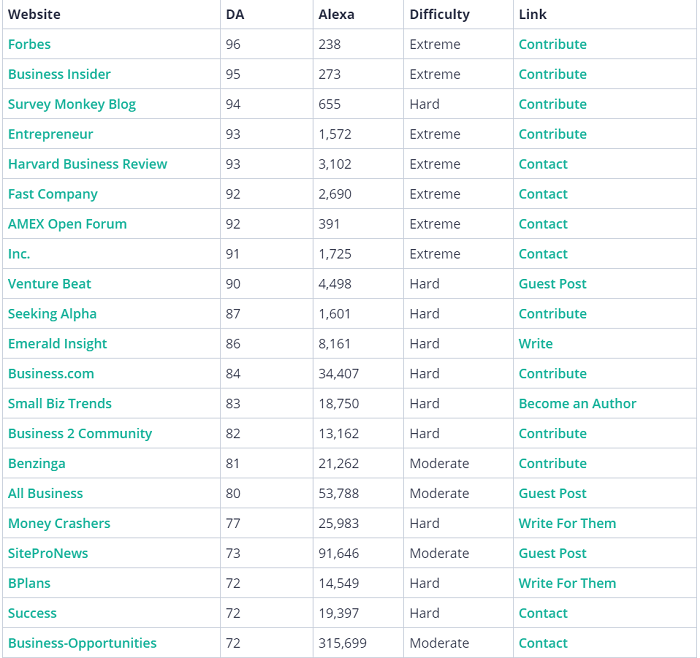
In addition, research online biographies of specific companies and bloggers.
More often than not, their web profiles contain a handy list of sites where they’ve been invited to guest post.
That’s a plethora of most fitting guest blog opportunities presented to you on a silver platter.
Then, send a request.
Most websites will have publication guidelines you can follow.
Follow these instructions carefully to increase your chances of publication.
There’s also the option of using blog comments as a way to generate traffic to your site.
In the past, I have managed to generate $25,000 as a result of 249 comments.

How exactly do you go about using comments to generate traffic?
When leaving a comment, make sure you are adding something worthwhile to the discussion.
There is no use in leaving comments like “Awesome post!” or “Nice website!”
If someone posts a question, make sure you take the time to answer thoughtfully.
This showcases your expertise in the given niche and will encourage someone reading to click on your name and be taken through to your site.
If you read an article on a subject you don’t know very well, it would be imprudent to voice your own thoughts as fact.
In this situation, you should simply ask questions.
Then the website owner would be able to elaborate more on complex topics or complicated sections.
If you’re knowledgeable about a subject, feel free to contribute (e.g., suggest something, recommend a solution, answer a question).
If you’re a novice, it’s best to ask questions.
Powerful questions can bring you website traffic by encouraging blog readers to check you out.
Avoid embedding links in your comments.
It comes off as a wretched attempt to plant your flag on someone’s lawn.
It’s okay to use your website’s link in the URL field when entering your name and email address, but your comment needs to add to the conversation or challenge an idea without lazy attempts at driving traffic to your blog.
Refrain from using the name of your business as your “commenting name.”
Use your actual full name instead.
Using a random or fake name is a missed opportunity to build strong branding because your brand actually starts with your name.
In fact, failing to use your full name will reduce your chances of the website owner approving your comment.
6. Email Marketing
If you read a few posts on digital marketing, email marketing would be mentioned in most of them.
That’s because it’s still one of the most efficient ways to increase website traffic.
One study suggests email generates $36 for every $1 spent, offering a shocking 3,600 percent ROI.
What more could you ask for?

Email marketing lets you reach potential customers directly.
It’s an ideal platform for building long-term relationships for improved customer loyalty.
You can post questions, ask for feedback, introduce soft sales, and persuade customers for the “big buy.”
Here are some tips for effective email marketing to increase website traffic:
- Be real: Share stories, post-behind-the-scenes content, and solicit original user-generated content.
- Offer value: Just like content marketing needs a high value to convert readers, emails and newsletters must provide value before they make an ask.
- Include all your links: Make it easy to read and share your post. Include links to your social media profiles, latest blog posts, and sales page in every email you send.
7. Provide Excellent Customer Service and Ask Customers to Review Your Brand
Ramping up your social media marketing efforts to increase website traffic is useless if you offer poor customer service.
According to a survey, 42 percent of customers said they bought more after pleasant customer service experiences.
Think about it: Users make complaints on social media, you offer a prompt and polite response.
What happens?
The person starts respecting your brand.
Even when users complain privately via email, it’s important to offer the best possible service so they come back for more.
How can you offer great customer service?
- reply promptly
- offer as many suggestions for customer problems as possible apologize when you make a mistake and offer coupons/refunds
If you consistently provide great customer service, you can request users to review your brand.
Platforms like Trustpilot and Yelp can be great for building positive reviews.
Many users consult these websites before making a purchase decision, so having a solid profile can help improve your reputation.
Increase Website Traffic Without SEO Frequently Asked Questions
FAQ: 1
Is it possible to increase website traffic without SEO?
Yes. You can use a combination of social media marketing strategies and content marketing techniques to increase website traffic without SEO.
FAQ: 2
Are there ways to increase website traffic for free?
Guest blogging, posting on social media, and requesting user-generated content are some of the most effective ways to increase website traffic for free.
FAQ: 3
Can I increase website traffic through marketing without an agency?
You can use techniques like guest blogging and content marketing to engage audiences without relying on any agency.
FAQ: 4
What’s the best strategy to increase website traffic quickly?
Working on improving your social media strategies can help you connect with new users, develop brand awareness and drive organic traffic relatively fast.
Increase Website Traffic Without SEO Conclusion
You shouldn’t only rely on search engines to increase website traffic.
Algorithm changes and SEO techniques become outdated quickly.
The strategies we discussed today can help you create a comprehensive digital marketing plan to increase website traffic effectively.

Whether you use one of these tactics in isolation, or you use all of them together, they can transform the way you attract customers.
Which traffic-driving strategy will you try today?
Source: neilpatel.com

The Easiest Way to Build Links
Link building sucks.
It’s time-consuming and hard.
But as an SEO, you have no choice but to build links… assuming you want to rank on Google.
So, today I am announcing a new Ubersuggest feature, that makes link building faster and easier.
Here’s how…
What is the easiest way to get links?
What if you could only focus your link-building efforts on sites that are highly likely to link to you?
Sounds great right…
Well, you can.
Just think of it this way… what are the sites that are most likely to link back to you?
It’s actually the ones that link to your competitors.
For example, if there were 300 sites that linked to 4 of your competitors, but they don’t link to you yet, reaching out to those 300 sites should create a large chunk of new backlinks for you.
Because if they are willing to link to your competition, they usually won’t mind linking to you as well.
On the flip side, if there are sites that don’t link to you or any of your competitors if you hit them up, then chances are, they will ignore you and not link to you.
So how do find these easy link opportunities?
Introducing Backlink Opportunities by Ubersuggest
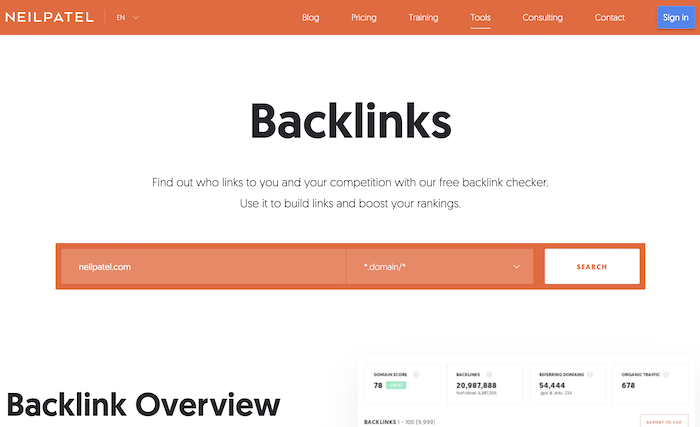
I want you to first go here. Then type in your URL and click on “search”.
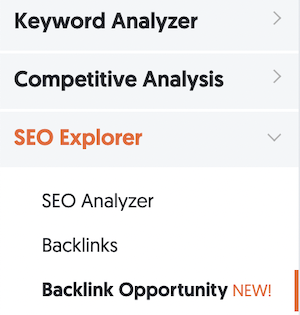
In the left-hand navigation click on “Backlink Opportunity”.
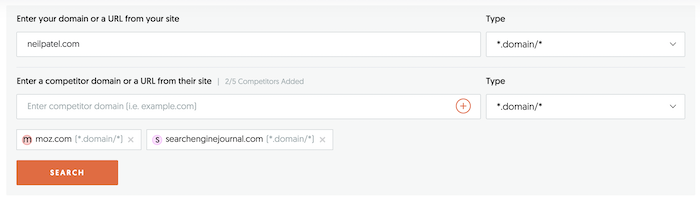
In this report make sure you put your URL at the top and enter in a few of your popular competitors.
As you can see, I put in Moz and Search Engine Journal.
Make sure you click the “+” button when adding each of your competitors and then hit “search”.
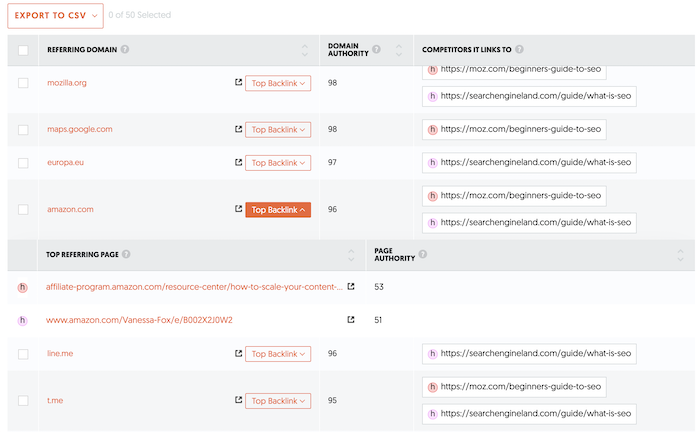
Within seconds you’ll see a report of who links to your competitors, but not you.
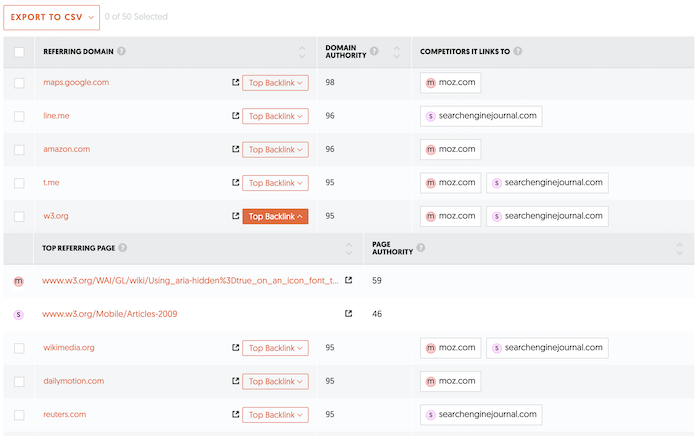
You’ll then want to drill down on each domain to see the exact URL that links to your competitors.
Some of the links may not be a good fit, such as the Google Maps page linking to Moz… unless you have a physical office location.
But others, such as the W3.org site, could be a great opportunity.
Wait, it gets better
The example above shows you all of the people that link to your competitors but not you.
But it is on a domain level.
With link building, it’s easier to get links when you have a similar blog post to your competition.
For example, let’s say I Google the term “SEO”. Here’s what I see on Google.
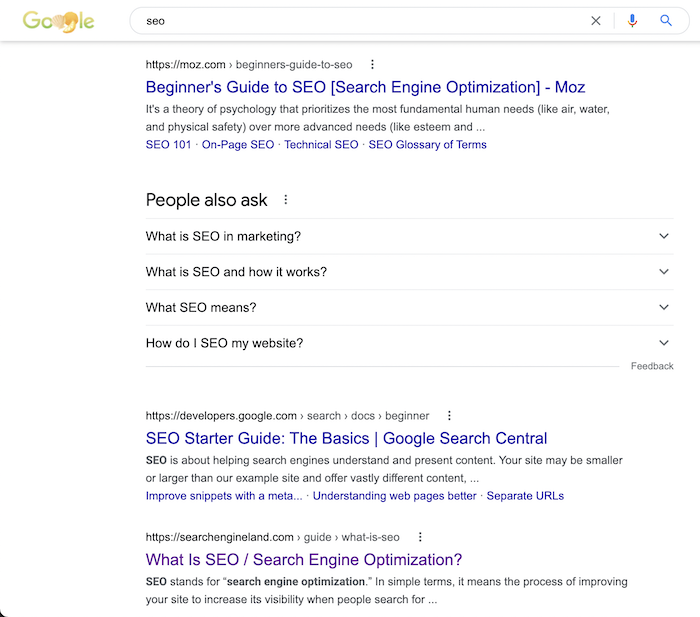
Both Moz and Search Engine Land rank above me.
I can take the exact URLs that rank above me and put them into the Backlink Opportunity report.
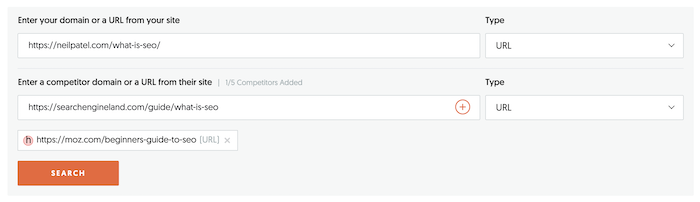
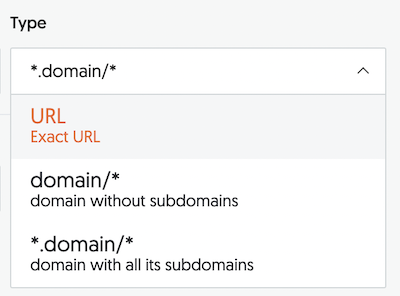
When adding competing URLs to the Backlink Opportunity report, you’ll want to select “URL” instead of “Domain” so you can see who links that specific URL.
This is important because Moz and Search Engine Land may have articles around topics that I don’t cover.
But their articles on SEO that rank above me are about SEO basics.
And the article I have that ranks below them is on SEO basics.
For that reason, it is highly relevant to see who links to the pages that rank above me because there is a good shot, I can convince one of those sites to link to me.
Sending out the email
Once you have a list of sites you want to outreach to, you are probably wondering… “how do I figure out who to email”, right?
Using Hunter.io you can get the email address for any site for free.
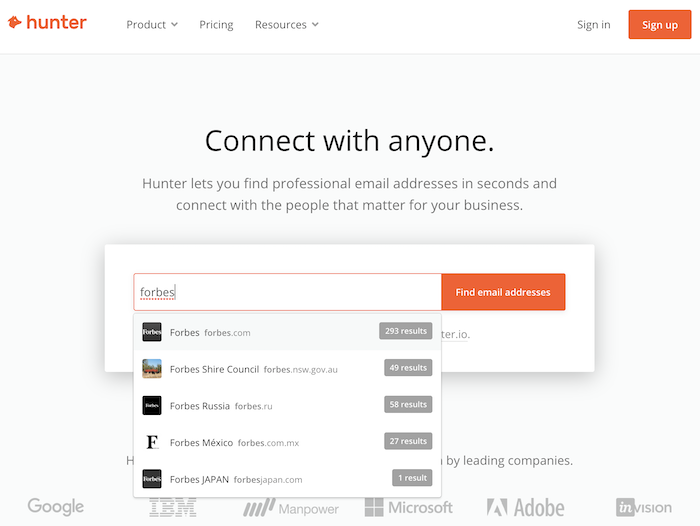
Once you have a person’s email, send them a custom email.
For example, for the people who link to Moz’s SEO beginner guide and Search Engine Land’s beginner’s article, I may send something like this…
Hey John,
You already know SEO is changing fast, hence you wrote an article on up-and-coming SEO trends.
But one thing I noticed is you didn’t talk much about AI and how it is going to impact SEO.
And the articles you linked to on Moz and Search Engine Land don’t cover that either.
Yet at conferences, it’s one of the buzzing topics that everyone is curious about.
I actually have a few examples of the use of AI in SEO here [insert link].
If you think it’s valuable feel free and add it to your site. 🙂
Thought it would help your readers.
Cheers,
Neil Patel
PS: By the way, I just shared one of your articles on Twitter… you can check it out here.
My outreach emails are very custom. Using generic outreach emails doesn’t work too well with link building.
When I send out 100 emails based on opportunities from the Backlink Opportunity report, I aim for at least 15% of the sites to link back to me.
Keep in mind I am specifically using the report to see who links to similar competing articles that rank higher than me on Google. It’s very specific, but that is why it works.
Conclusion
If you haven’t, go here and put in your URL. Try out the Backlink Opportunity report and tell me what you think.
Start off by seeing who links to your competition and hit up those sites one by one to see if they are willing to link to you.
It works… just reach out to 10 sites and day and do it for a month. You will see results.
So, what do you think about this new report?
Source: feedproxy.google.com

How to Dominate Google in 2021
Here’s the four-step SEO strategy that will help you dominate Google rankings in 2021:
SEO is becoming harder and harder.
It takes longer to rank and you have to spend more money to get results.
The reality is, you can’t wait forever to get results, and you have no choice but to leverage SEO because everyone else is doing it.
So, what should you do?
Well, the first thing you need to do is adjust how you think about SEO.
SEO isn’t only about rankings. To be honest, I don’t even track them for my own site. It’s about getting the right kind of traffic.
You know, the visitors who are ready to buy.
Instead of teaching you how to rank for competitive terms, which is going to be even more difficult in 2021, I’m going to break down a formula that will give you much faster results and sales in this ultra-competitive environment.
Best of all, I am going to break it down into four steps as I know you don’t have the time to do everything.
SEO Strategy for 2021
Here’s the four-step SEO strategy that will help you dominate Google rankings in 2021:
Google Ranking Step #1: Attract Customers Before They are Ready to Buy
The most expensive keywords to go after are buyer intent keywords. You know, the ones where someone types in a keyword and is ready to spend money right then and there.
That will always be the case. Not just from an SEO standpoint, but even a pay per click standpoint.
So should you ignore these valuable keywords?
Of course not. More so, you have to go after them no matter how long it takes to rank. You just have to be patient.
In the short run, there are other keywords with similar search patterns. Now, they aren’t as lucrative because they are more informational related.
Here’s the kicker: People research before they buy. If you can grab those searchers at the start of the journey, you can get their clicks (and purchases) for little to no money.
So how do you find the keywords that aren’t as competitive that have a similar search pattern?
Use Ubersuggest (and the accompanying free Chrome extension as you look through SERPs).
Here’s how it works:
Let’s say you are selling beard oil but you know the term is competitive and will take you a lot longer to rank for than you have.
Ubersuggest will show you all of the terms people search for on Google that has a similar search pattern to the term “beard oil.”
In other words, think of it as Google Trends in reverse. With Google Trends, you type in a query and it shows you how well the term performed over time. Using Ubersuggest, you get a list of queries that have a similar trend pattern to the main keyword you want to rank for.
In other words, if you know the term “beard oil” will cause a sale, Ubersuggest will show you other terms that match the same pattern (some keywords will be relevant while others will not).
Type in “beard oil” or the term you want to rank for into Ubersuggest, then click “Keyword Ideas.” It’ll show you a list of related suggestions, but some of those terms still have pretty high intent–not quite what we are looking for.
Click “Related.”
Here’s what I got:
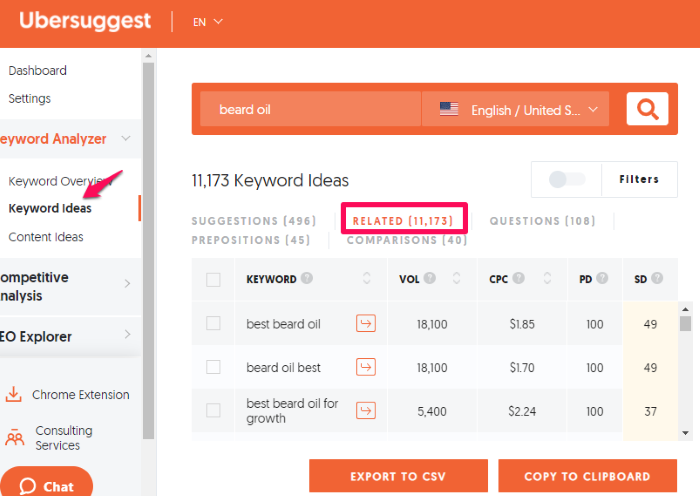
As you can see from the image above, people type in terms like best beard oil. Other terms include beard oil vs balm, what does beard oil do, and beard oil recipes.
If you write in-depth blog content about those phrases, you’ll appeal to a similar audience. Some of those keywords may not cause a sale right away, but what we’ve found over and over again is that if you write content related to your main subject, a lot of your blog readers will come back within a few weeks and purchase.
That’s how most people generate their sales from content marketing.
You don’t even have to write blog content, you can just create new landing pages targeting those new keywords.
Most people who sell beard oil probably don’t focus on catching those top of the funnel terms.
Google Ranking Step #2: Land and Expand
Everyone focuses on ranking for new terms. But there is an issue, it’s hard to rank for new terms.
Even though SEO has a huge ROI, it’s a strategy that requires patience.
Here is the thing: you can get results faster if you use the land and expand strategy.
Here’s how it works. Log into Google Search Console. Next, click on “performance” and you will see a list of terms that you currently rank for:
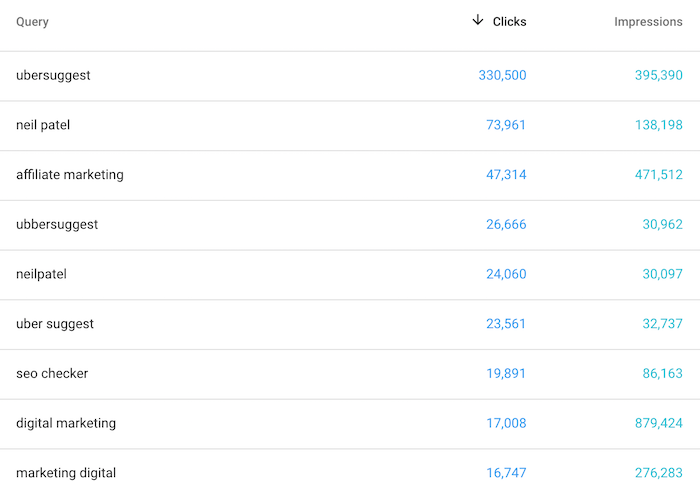
Then I want you to click on one of the most popular terms you already rank for and then click on pages.
You should see a report that shows you the URL that ranks for the term on Google. You need this URL because you will be modifying this page.
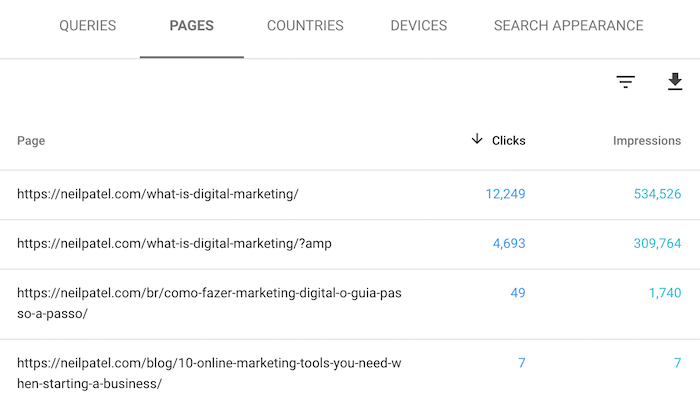
Now I want you to take that term and put it into Ubersuggest. Once the report loads, click on “Keyword Ideas” in the navigation. You’ll see a report that will look something like this:
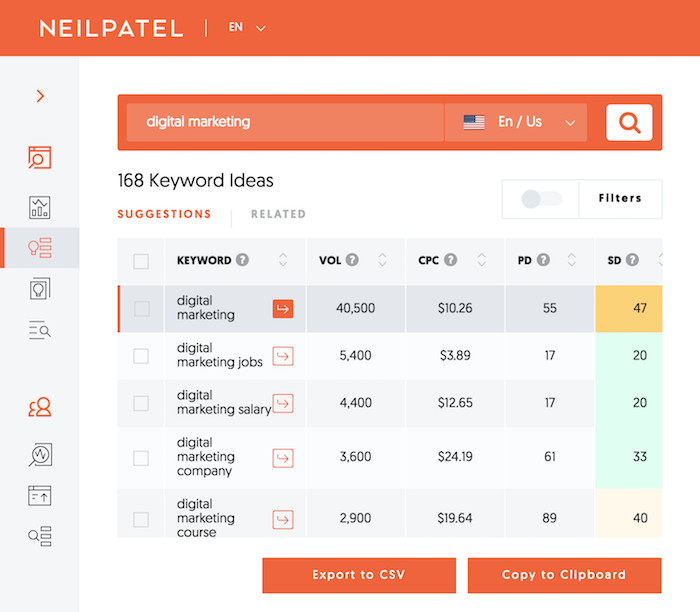
You’ll see a laundry list of long-tail phrases. Take the ones that are buyer-intent related and add them to the page that already ranks for the head term.
When adding the long tail phrases, make sure you adjust your content to be relevant to those keywords. And pick the ones that are highly related to your product or service. Just stuffing them into your page without adjusting the content is spammy and won’t provide a good user experience to searchers.
What you will find is that because you are already ranking for the head term, typically you will shoot to page one within 30 to 60 days for the long-tail variation by adjusting your content. It’s a quick win!
But the key to this strategy is to pick the right longtail keywords. Don’t just look at traffic numbers, focus on terms that you know will cause a sale or a lead.
Google Ranking Step #3: Build a Brand
Google has been placing more emphasis on brands. In other words, if you have a strong brand, you’ll rank faster.
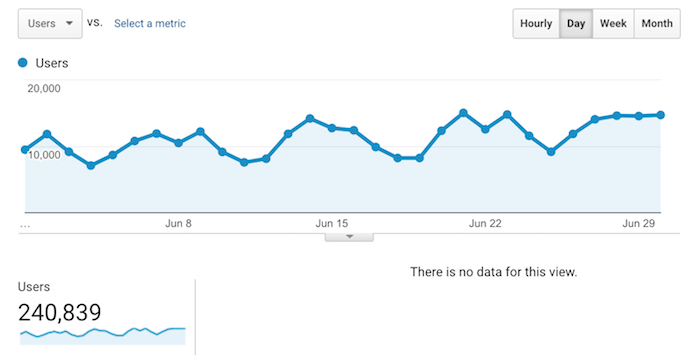
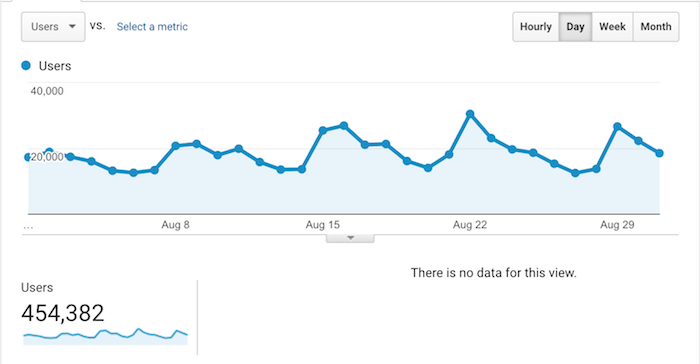
When I really started focusing on brand building, my traffic went from 240,839 in June 2016:
To 454,382 in August 2016:
As the Ex-CEO of Google said:
Brands are the solution, not the problem. Brands are how you sort out the cesspool.
In other words, if you want to succeed on Google in the long run, you have to build a brand. As your brand grows, your search traffic will as well.
The way to monitor your brand growth is Google Trends. Type in your brand name into Google Trends as well as a few of your competitors to see how you are stacking up.
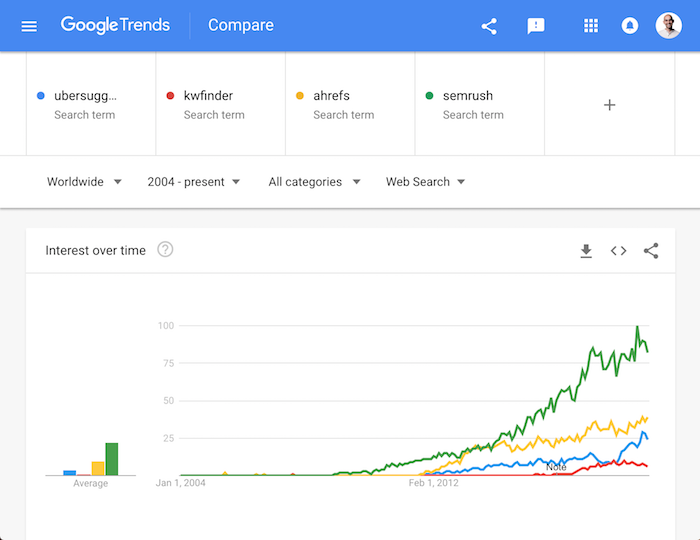
Sadly, there isn’t a quick hack to skyrocket your brand. There is, however, a formula that works for both personal and corporate brands.
What is the formula?
You do something bold!
Sure people can tell you to blog, speak at conferences, run ads; but none of that helps you build a brand that has a loyal following because everyone else is already doing the same things (or trying at least).
What your competition isn’t doing is being bold. If you want a brand like Tony Robbins or Apple, bold is the way to go.
So how do you do something that is bold?
Well, let’s first start with a personal brand (although I recommend that you build a corporate one instead).
Do the Opposite
When it comes to building a personal brand, you’ll have to take the opposite approach of most people in your space. Whatever is working for them won’t work for you.
No one cares for the copycat, especially when they are satisfied with the original solution.
In other words, if you do exactly what your competitor is doing no one will care to follow you.
Let me give you examples of how to do the opposite of your competition:
Genuinely help people:
A lot of people blog and participate on social media, but how many people take the time to respond to their community? As far as I can tell, less than 1%. Just look at me. For years, I’ve responded to comments on my blog, Facebook, and even YouTube.
Most people don’t take the time; doing the opposite has helped me build a connection. And if you are wondering why I do this it’s because when I started out I had no money and people helped me. I’m just trying to do the same.
Writing 10x content:
When I got into blogging, everyone was doing it. So I had to find a way to separate myself. I did this by writing in-depth guides–not those 5,000-word blog posts,
I am talking about 30,000-word guides. On top of that, I spent money on the design so they would look beautiful.
Creating video content:
When I got into the digital marketing community, there were already large conferences that had thousands of attendees. I thought speaking at all of them would help my brand, and they did to some extent, but I was just another speaker.
Very few people in my space were creating video content. So now instead of giving speeches at conferences, I give them on YouTube, Facebook, and LinkedIn.
I reach more people without having to travel and the content lives on forever (and is available for free to everyone!).
That’s how I stood out from my competition and built a personal brand. Then I did it for years because brands aren’t built overnight.
If you aren’t sure on how to do the opposite of your competition when it comes to your personal brand leave a comment and I’ll try and give you some ideas.
Now let’s go into building a brand for your company. It all comes down to one thing:
Be Bold
No matter what you are selling online you have competition. It doesn’t matter if you are a B2B or a B2C business, you have competition, which means it is going to be hard for your brand to stand out.
So, how do you differentiate yourself?
You do so by being bold.
Let me give you an example. In the United States, there are tons of options for cell phone carriers. So how do you stand out when everyone offers the same phone and competitive pricing?
Well, T-Mobile separated itself by offering free Netflix, unlimited data, and free-roaming.
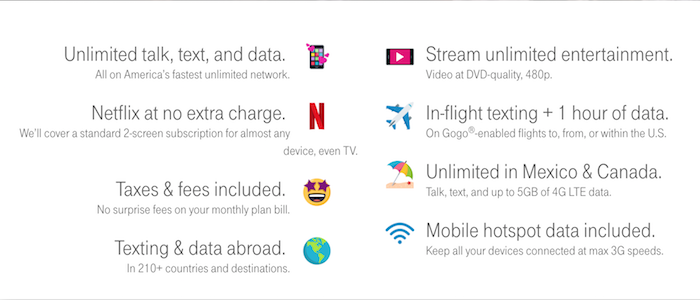
And you don’t have to be a big company to do something bold.
When Zappos started selling shoes they decided to do a few things differently. First, they offered a refund policy that lasted 1 year. Just think about that–if you return a shoe to them 12 months later, the chances are it’s out of style and they won’t be able to resell it.
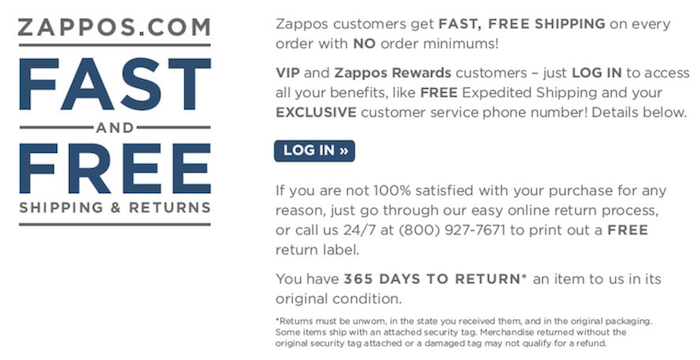
Then they decided to randomly upgrade their shipping. So instead of ground shipping, they would randomly upgrade you to two-day or next-day air.
Amazon crushed their competition the moment they rolled out their Prime program. When it first came out, you would get free 2-day shipping on all Prime products for just $99 a year. What a ridiculously amazing offer.
Now that’s being bold!
Being bold doesn’t have to break your bank account. You don’t have to do something like Amazon and T-Mobile; it can be as simple as providing amazing customer service when you are in an industry that’s known for terrible support.
If you are unsure of how you can be bold with your business, leave a comment and I will try and give you some ideas. Make sure you provide an overview of your business so I can give you halfway decent ideas. 😉
Of course, being bold won’t build your brand overnight (it takes years) but you should see growth each quarter. If you aren’t, that means you aren’t being bold enough.
Google Ranking Step #4: Build a Better Mousetrap
A mousetrap? Why would you want to build a mousetrap?
Link building is still important. Sure, Google is looking at many other factors now, but link building still helps with rankings.
But it is harder to build links than it used to be back in the day. Everyone is blogging… heck, there are over 440 million blogs and over a billion if you count Tumblr, Medium, and WordPress.com.
Yes, that means there are more sites to hit up and ask for a link but everyone is doing that.
So how do you build links when everyone is getting those spammy emails asking for a link, such as the one below?
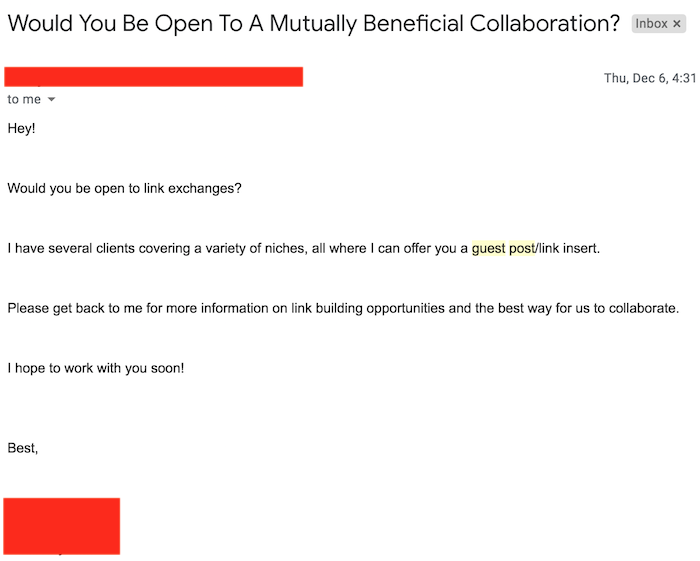
You have to build a better mousetrap. Something so amazing that everyone wants to link to it without you asking.
It used to be detailed guides but seeing 10,000-word guides that have fancy designs are more common these days than when I started creating them.
They still work, especially when it comes to brand building, but they just aren’t as effective when it comes to link building.
Same with infographics, they used to get tons of social shares and links (they still do to some extent), but they aren’t as effective as they used to be.
So what kind of mousetrap do you need to build? You could start off with something that people are used to paying for.
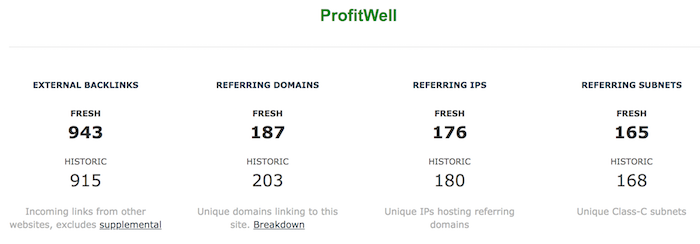
For example, the consulting firm Price Intelligently released a free analytics software called ProfitWell.
With very little marketing, they were able to generate 943 backlinks from 187 domains.
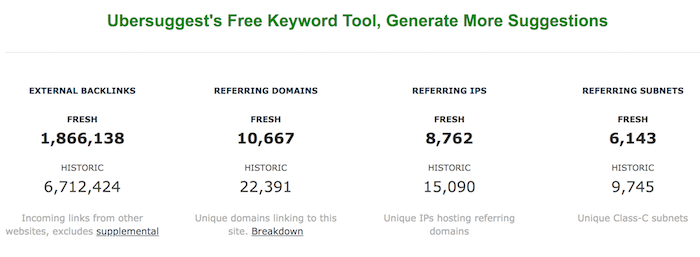
I also did this with Ubersuggest.
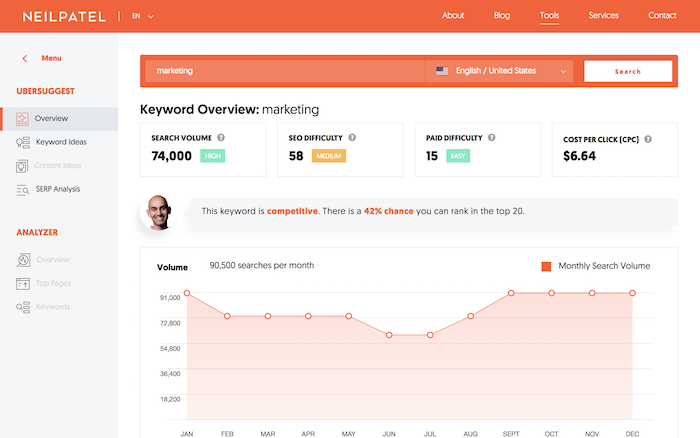
I put in more effort into marketing, so I was able to generate 10,667 unique backlinks.
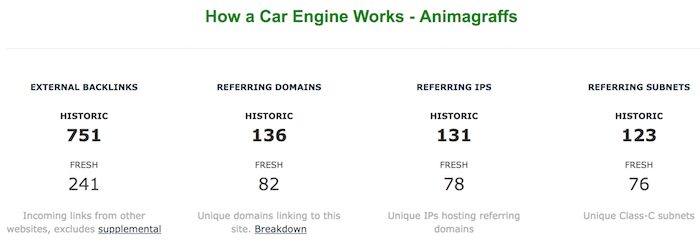
A great example in the consumer space (this would do wonders for e-commerce sites as well) is animated infographics. Everyone has seen infographics, so Aminagraffs decided to make their infographics animated, which caused them to go viral.
Here’s part of their infographic that breaks down how a car motor works.
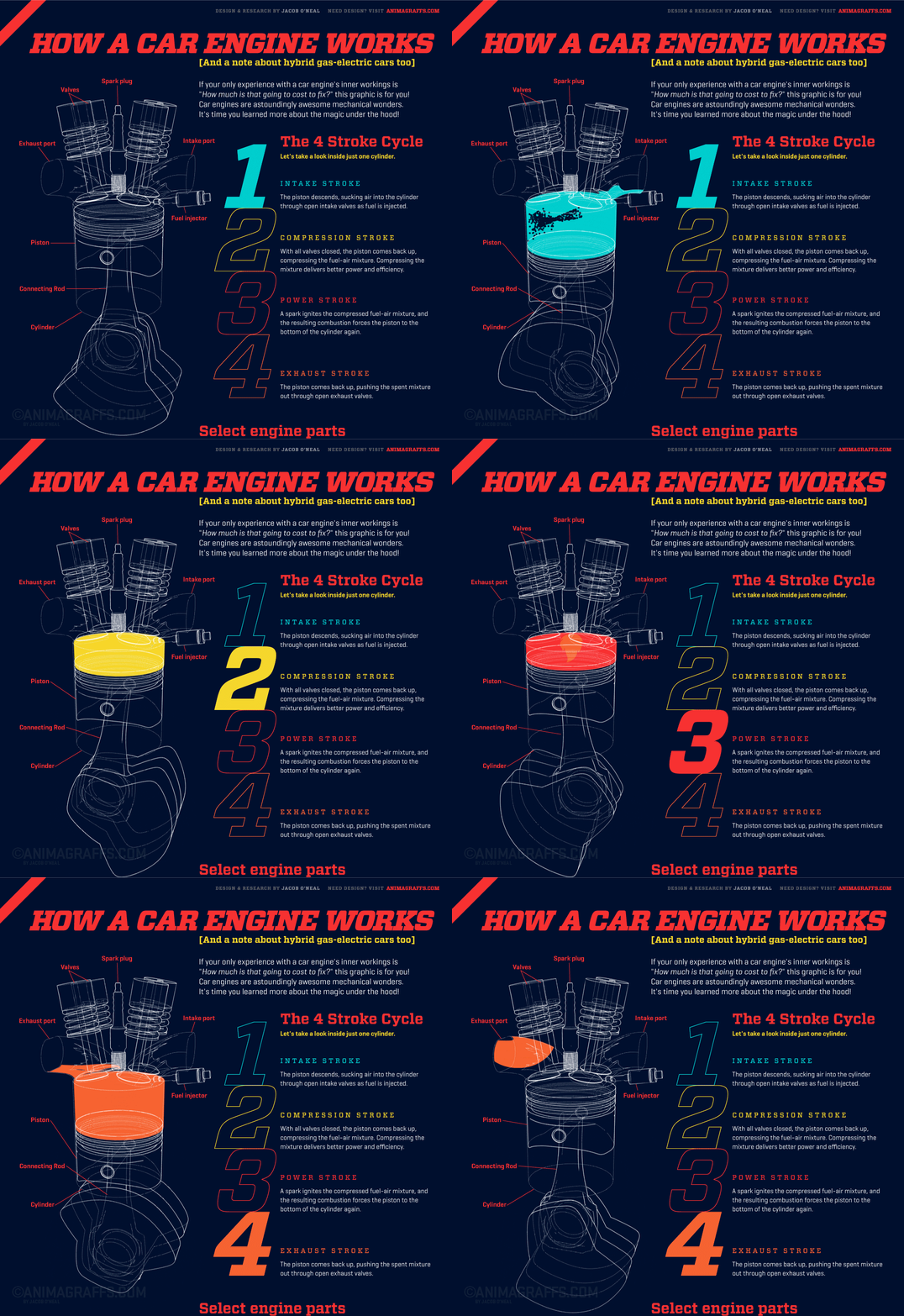
Best of all, the Amimagraphs founder didn’t do any marketing; the graphic just spread. Even with no marketing, it generated 751 backlinks from 136 domains and over 200,000 visitors.
If you want to use old-school link building tactics, you can, they just won’t help you as much in 2021. So, get creative and build a better mousetrap.
When you build a good mousetrap, you may be worried about cost. But there is a different way to think about it:
How much would you be spending on marketing to get the same results?
People make fun of me for what I am doing with Ubersuggest and think it is silly that I can “lose” $150,000 or so a month. But if I had to buy that traffic, it would cost me much more than $150,000. Even though my mousetrap is expensive, it is still cheaper than paid ads.
You don’t have to go as far as me. Doing what Animagraffs is affordable. I paid them $750 to create an animated infographic for me. I’m not sure what they charge these days, but I bet you can find someone on the web who will do it for a few hundred bucks.
Conclusion
Instead of thinking of SEO in the traditional sense, I want you to shift your strategy.
SEO is only going to get harder, Google is going to continually change their algorithm in ways you may not like. But one thing is for certain: the traditional way of doing SEO will get you results, just not in the timeframe you want.
So, follow the four steps above. They are unconventional, but the industry is so competitive and saturated that you have no choice but to think outside of the box.
So what other unique strategies are you going to leverage in 2021?
The post How to Dominate Google in 2021 appeared first on Neil Patel.
Source: feedproxy.google.com

How to Choose The Right Link Building Agency
Are there any good link building companies out there? They do exist. They’re just hard to find. And be extra careful with all this.
Even if you publish the best content on any given content, Google might not rank it.
In fact, they usually don’t.
It takes a lot more than just content to get Google traffic these days.
So what’s required to win?
Sooner or later, you’re going to need high quality links to your content.
There are lots of grey-area folks in this space. What’s the right way to do it? Are there any good link building companies out there?
They do exist. They’re just hard to find.
And be extra careful with all this. Not only does Google forbid paying for links, but the only legitimate long-term strategy is also to build links authentically. The right link building companies will help you do this.
Before going any further, always start with your goals.
Know Your Goals and Desired Outcomes
Take a step back and ask yourself: Why do I need to build links to my website?
If you’re like most business people, you’re looking to hire a link-building agency because you heard links drive higher rankings and traffic to your site.
Well, there are even more benefits if you build quality links to your site.
Emphasis on ‘quality.’
And it’s because the way links work is pretty straightforward: Other sites trust your site for something, and they link to it. Google uses those signals, or ‘vote of confidence,’ to consider your website an authoritative resource.
Your rewards?
- Authority
- Higher ranking over your competitors for similar keywords or search phrases More qualified traffic
- Leads and sales
- Brand mentions across the internet
These rewards explain why some businesses spend between $10,000 – $50,000 per month on link-building alone.
Yet, the competition for quality links has gotten tough.
Google cracked down on most of the link strategies. And even if you find something that works today, Google gets better at finding inauthentic links every year.
The last thing you want to build a bunch of links that Google starts ignoring in 12 months.
So, before you spray money on a link-building agency, be sure to choose one with experience building quality backlinks.
To get quality backlinks, there are only a few strategies I know you can get them:
- Linkable content marketing
- Blogger outreach
- Guest posting
- Curated, in-content backlinks Strategic link placements
Your SEO strategy and business goals determine what link-building strategies and agency you’ll need.
Let me explain with a few examples.
Examples of Link Building Strategies:
Example #1: Blogger Outreach for Outdated Content
Imagine for a second your main competitor’s site ranks No.1 organically for the keyword, “best female fitness apps,” while yours languishes on Google’s 19th page.
And you realize this competitor ranks high because authoritative domains are linking to an old piece of content by them, which cited an outdated study related to women’s fitness.
Authority, as they say, breeds authority.
So, to displace your competitor or, at least, improve your position on the SERPs, you’ll also need to get backlinks from authoritative domains.
Two options I trust you can leverage for this are:
- Create a refreshed version of the content sending links to your competitor. Then, reach out to the domains linking to them to replace links to your competitor with yours.
- Conduct a newer version of the fitness study making authoritative sites link to your competitor. Then, create a content piece discussing your findings and promote it to get links.
Either way, the link-building strategy you’ll need in this scenario is called linkable content marketing.
And that’s because content marketing and backlinks go together perfectly. You can’t really do one without the other.
To get links using this strategy, you’ll need an agency with vast and proven experience in content marketing.
Example #2: Outreach to Add Links to Brand Mentions
Let’s stay with the “best female fitness app” example.
Imagine that you went ahead to conduct a new study on women’s fitness.
After this, you produced an excellent content piece that breaks down your findings.
Some months later, your study and content go viral, and many bloggers start mentioning it in their articles.
Those mentions usually include links straight to your research.
But not always.
To seize this opportunity and build backlinks, you’ll need to reach out to those bloggers and ask for a link.
In this case, you’ll use a link-building strategy called blogger outreach.
Did you notice something in both examples I just shared?
You need something worth linking to—something of high quality, to give other websites the confidence to send backlinks to your site.
And these link-worthy assets are better if they’re in the form of content.
The better your content, the easier it is to get these authentic links that are perfectly legitimate.
Why does any of this matter?
Why not just hire some agency to build links for you?
There’s a lot of shady stuff in the link building space. If you don’t have a specific idea for the type of links you want, you’re going to get a link spammer to build a ton of bad links, charge you a ton, and then walk away. If you do enough of that, Google can penalize your site. It can take years to reverse that kind of thing.
Since link building has so much risk, you want to be in the weeds with any link building agency that you work with. It’s the only way to ensure that they don’t damage your domain.
Here are some other things to look for in a great link building agency.
4 Characteristics that Make a Great Link Building Agency
Great companies have attributes that define them in general. Great link-building agencies are no exception.
But what characteristics should one look out for, which makes a link-building agency great?
There are six significant ones I can bet my money on.
1. Content Services
I prefer to keep content and link building closely aligned.
Simply buying a ton of links to a landing page hasn’t worked in Google for ages.
To get good, authentic links, you need good, authentic content.
Many sites don’t have that content. Even if they’ve produced great content in the past, they might not have content that’s linkable enough. Research, stats, studies, and resources all do really well.
If you don’t have that type of content, you’ll need an agency that can spot that gap and get the content produced for you.
2. Firm Link Building Restrictions
Any good link building agency will be deeply familiar with black hat SEO and the dodgy stuff some people do. And they never venture into these areas. It’s just too risky.
The good agencies know precisely where to draw the line.
They believe in building long-term links that Google values.
So they’ve set firm boundaries with their team and their clients on what they won’t do.
Ask them what links they won’t build. And which strategies they don’t use.
It should be a long list.
3. Monthly Link Reviews
Any legitimate link building agency will give you a list of every link that they’ve built.
This is your opportunity to review those links and make sure they’re 100% legitimate.
If an agency attempts to hide the links or drags their feet at all, work with someone else.
When you start working with a new agency, be sure to check all of the links in their first batch. You want to be completely sure that every link looks good. Anyone can check link quality, you don’t need to be an SEO expert.
Look for links on quality pages. Is it a good blog post? Is it a quality site? Does the link make sense?
If anything looks off to you, it’ll also look bad to Google.
4. Great Expectation Setting
The simple fact of link building is that results are never guaranteed. Google doesn’t give out rankings for participation. If you want that #1 slot, you need to outperform everyone else.
No one wins by doing a defined list of requirements, they win by doing more than their competitors.
If you have tough competition, you could be facing an uphill battle the whole way.
Great agencies know how hard some rankings can be. And they don’t overpromise.
Stay away from anyone that promises #1 rankings. And if an agency promises rankings within-firm timelines or makes really specific forecasts, consider these red flags.
How to Work with a Link-Building Agency
What’s it like working with a link-building agency?
It’s easiest to describe what a link building isn’t:
- Go to the agency’s website.
- Pick a link order like you’re on Amazon
- Go to checkout and purchase your links
- Wait for your links to arrive
Tons of companies offer that sort of thing.
And it’s almost always doomed to fail.
Working with agencies like that will only get you low-quality links. The agency is pursuing a volume game, they can’t give you the attention that you really need.
Look for a real agency that will help get you authentic links.
That process feels more link a real agency:
1. Get your team aligned
Like working with most agencies, you can set them up to succeed or fail.
No agency can perform miracles on its own.
Agencies get results by working closely with their team and using their internal resources when it makes sense.
It’s usually a good idea to get your team aligned before reaching out to an agency in the first place. Then there won’t be any roadblocks once you get started.
- Does your content team have the bandwidth to work on link-focused content?
- Will your tech team be able to make any site improvements if needed?
- Have you done a recent SEO audit to clean up any weak sections of your site?
- Does the agency “champion” on your team have enough authority to get changes live when needed?
Once your team is ready to go, reach out to an agency that seems promising.
2. Discovery session
Authentic link building strategies are usually custom-tailored to each site and business.
Most link building agencies will want to jump on a call with you, get a sense of your market and goals, and ask tons of questions to make sure they’re a good fit.
Expect to get on a discovery call with them.
And if you have a massive website, there might be several discovery calls.
Once you fill out the agency’s contact form, you can expect to get these done within a week or so.
3. Research & strategic recommendations
The really amazing link building agencies will leverage their expertise to research your company, target audience, competitors, and industry.
They won’t blindly offer to start building links.
After all, winning Google is about outplaying your competitors.
If you don’t know the competition, you’ll have a really hard time beating them.
So great agencies figure out that competition. They get a sense of how much work it takes to get good rankings in your space.
You should see a bunch of deep research on your site and competitors at this point.
That’s how they come up with a set of strategic recommendations for you.
4. A contract with project deliverables
Assuming their recommendations look good, you can move to the proposal stage.
Expect long-term proposals.
Link building takes forever to work, especially if you’re doing it the legit way.
First, you need to get a campaign or content built, then you launch it, then you wait for organic links to come in, then you wait for those links to have an impact.
None of this happens quickly.
And link building agencies know this. They only want to work with folks that are truly on board for the long-term.
5. Client onboarding
Yes, the top link-building agencies have an onboarding process unique to each client’s project, so expect one.
Going through this process is crucial as it sets the stage for working together.
It also clarifies what you’ll need to do to make the partnership successful. Follow up with your team and ensure the agency is getting what they need.
That’s the only way to give the project any chance of success.
How to Find the Right Link Building Agency for You
A link-building agency that’s right for you is one that understands your needs and how getting backlinks would impact your business and SEO strategy in general.
By now, I trust you already know this.
First, avoid any agency promising you backlinks at the push of a button. Most times, such are black hat SEO ninjas with spammy PBN (private blog networks).
And what can get from these kinds?
Spammy links!
Those ill-tactics may have quick wins—they had in the past, but give it some time and Google will penalize you and shrink your rankings.
It’s best to choose reputably, trusted, and experienced quality link-building companies who won’t cut corners and daint their image and brands.
Below are the best link building companies that come highly recommended.
The 5 Top Link Building Agencies
1. Neil Patel Digital – Best For Linkable Content Marketing
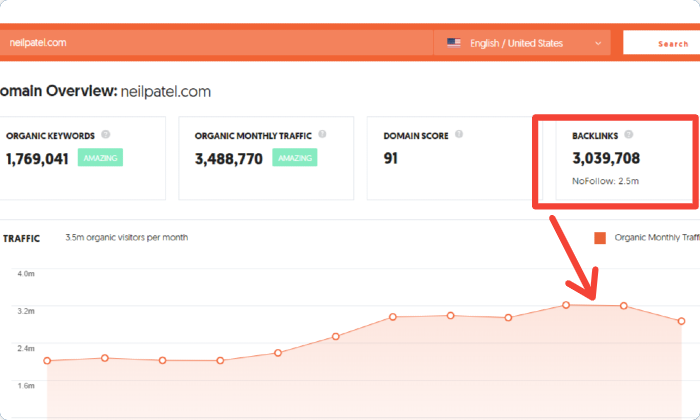
I’ve built millions of backlinks to my personal blog using by using my linkable content strategy:
That’s over 3 million backlinks which generate more than 3.4 million monthly organic visits.
By working with Neil Patel Digital, you get access to that same playbook for your own site. Contact us and my team will get in touch with you.
2. FATJOE – Best for Blogger Outreach
FATJOE is a trusted blogger outreach service even other agencies turn to for backlinks:
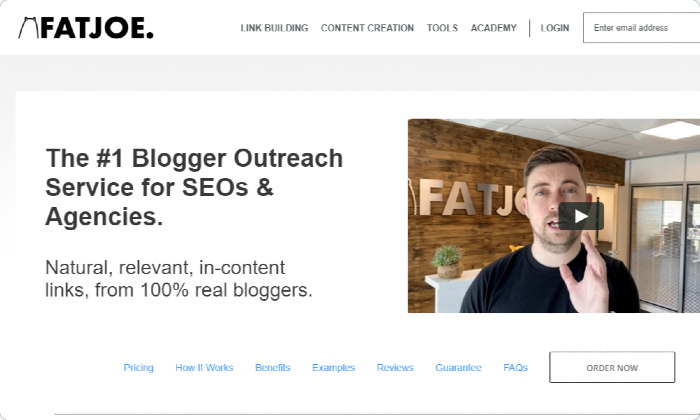
Founded by experienced SEO practitioner, Joe Taylor, FATJOE’s blogger outreach service has generated backlinks for over 5,000 customers globally.
This is a great option if you already have amazing content and only need some extra muscle from an outreach strategy.
3. Page One Power – Best for Strategic Link Placements
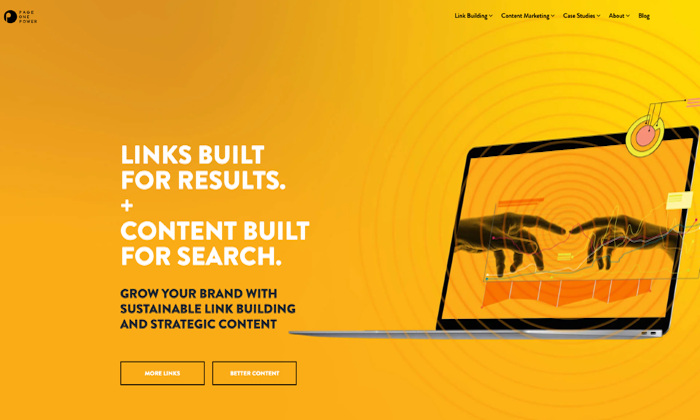
Page One Power has built a reputation as the trusted link-building agency for getting strategic link placements on higher domain (DA60+) websites.
They do this through a combination of linkable assets and a high-level outreach strategy.
This agency’s ten years of experience speaks for itself. They build about 15,000 strategic backlinks each year and and have 982 active partners:
4. The HOTH – Best for Guest Posting
If you need to generate some backlinks on your own, guest posting on other people’s sites is the way to go.
But what if you didn’t have the time to do this?
The HOTH can help:
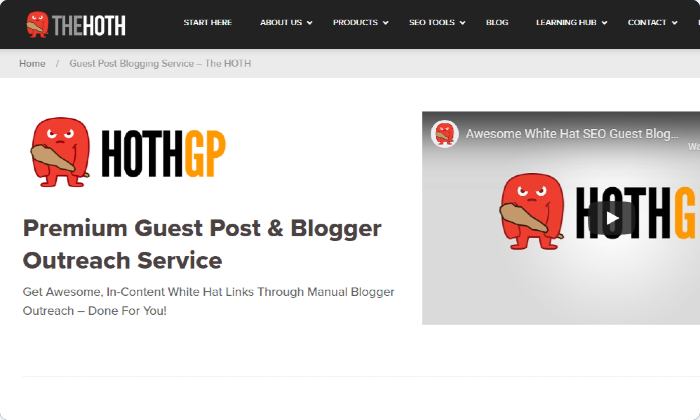
The HOTH’s guest posting is a productized service you can turn to and get links from sites with domain authority between DA10 and DA50.
5. RhinoRank – Best for Curated Link-building
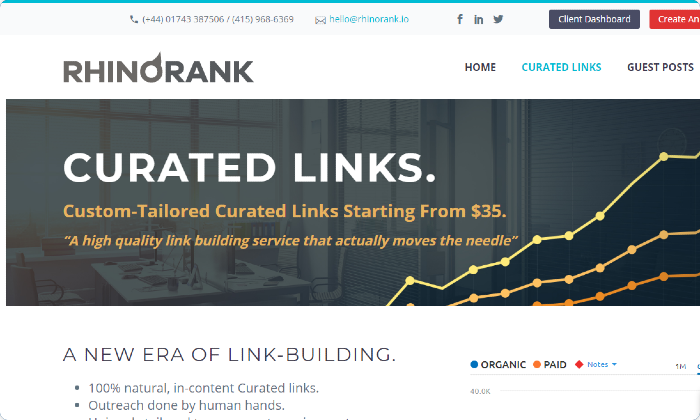
RhinoRank is excellent for getting links from websites that have mentioned your company or product in content pieces published on their sites without linking to you.
The name of this link acquisition strategy is curated link-building.
RhinoRank will do all the hard work, reach out to several webmasters with relevant brand mentions, and secure backlinks for your site.
Conclusion: Look Beyond Backlinks
Yes, sites need links to rank in Google. Especially for competitive terms.
You could try to brute force your way through this and work with a link building agency.
Or you could roll out a whole marketing strategy that builds your domain authority, your brand gets you a ton of leads and builds links naturally over time.
That’s how I prefer to do it.
Instead of just looking for a link building agency, consider a top-tier online marketing agency that can implement the entire program for you.
That’s what we do at Neil Patel Digital.
The post How to Choose The Right Link Building Agency appeared first on Neil Patel.
Source: neilpatel.com

How to Build Links Using Google Alerts
Link building is hard. But did you know that Google makes it easier for you?
Seriously… they do make it easier because they provide you with free tools.
No, I’m not talking about the ones you already use like Google Search Console and Google Analytics…
They actually have tons of other tools. Some you may have heard of, but I bet you don’t use them.
And today I am going to show you how you can build links using Google Alerts.
What is Google Alerts?
As the saying goes, if it isn’t on Google, it doesn’t exist.
Google is the most popular search engine in the world. Their database contains hundreds of billions of web pages and is over 100,000,000 gigabytes in size.
Because of their massive size, they are able to crawl web pages more frequently than any SEO tool including my own, Ubersuggest.
This is precisely why you want to start using Google Alerts to build links.
So, what is Google Alerts?
As I mentioned above, they have a bigger database of web pages than any other link building or SEO tool.
So, you’ll want to use their database to find easy link opportunities and ideally without wasting time digging through billions or even thousands of web pages.
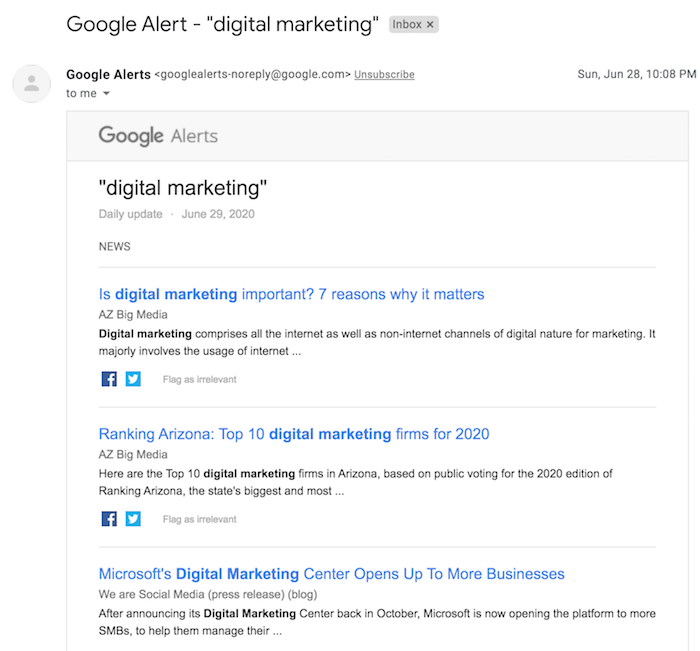
Google Alerts allows you to create notifications on any subject, topic, or keyword.
So, when a new web page talks about anything that could be an easy link opportunity, you’ll get notified in an email.
Just like this one…
Steps to Get Backlinks by Using Google Alerts
So, let’s set it all up step by step so you can get some backlinks.
How to set up Google Alerts
First, I want you to go here.
You’ll see a screen that looks like this (make sure you sign in at the top right).
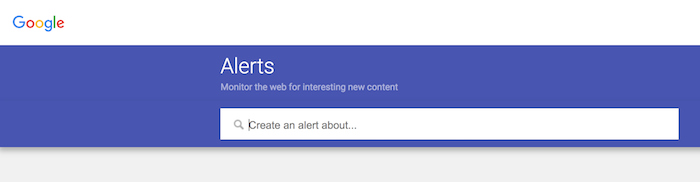
I want you to type in your domain name without the www or the https part.
In my case, I would type in: neilpatel.com
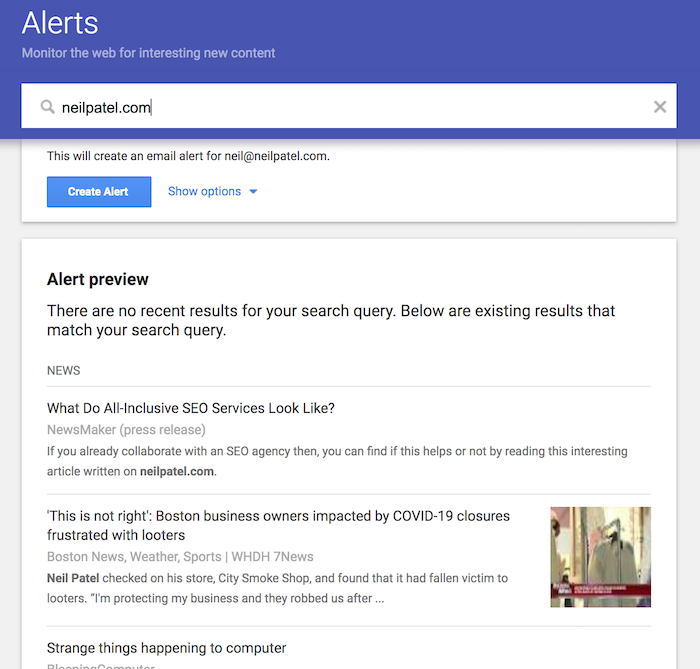
You may see an alert preview like the one above, but if you have a newer site you probably won’t see any results, which is fine.
Then I want you to click on the “Show Options” link next to the “Create Alert” button.
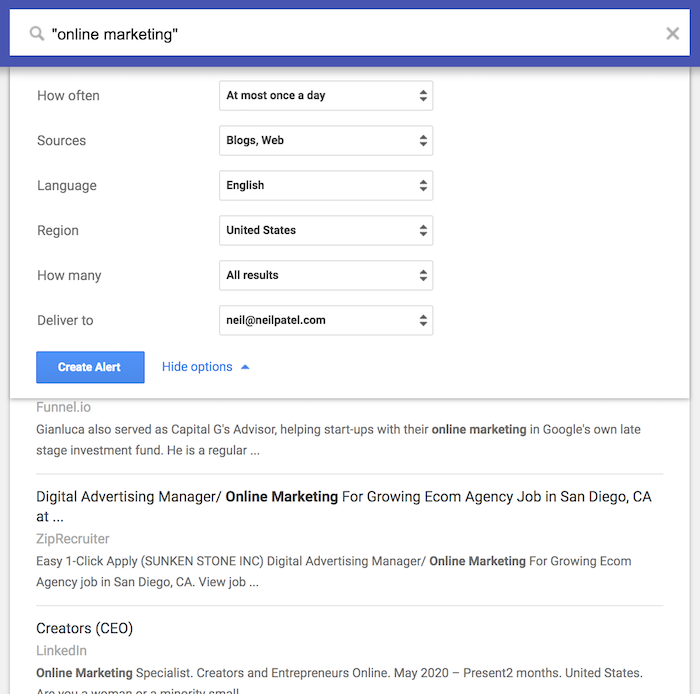
Your settings should match mine:
How often – at most once a daySources – Blogs, Web (select those 2 options, you don’t want news as an option as it tends to create more irrelevant results and we’ve found that it is harder to get news sites to link back to you)
- Language – English (or the language you are targeting)
- Region – Any region (or you can select the country you are targeting although I recommend picking “any region”)
- How many – all results
- Deliver to – should be your email.
And then click “Create Alert.”
Up to once a day, you’ll get an email with a list of pages that mentions your website or domain.
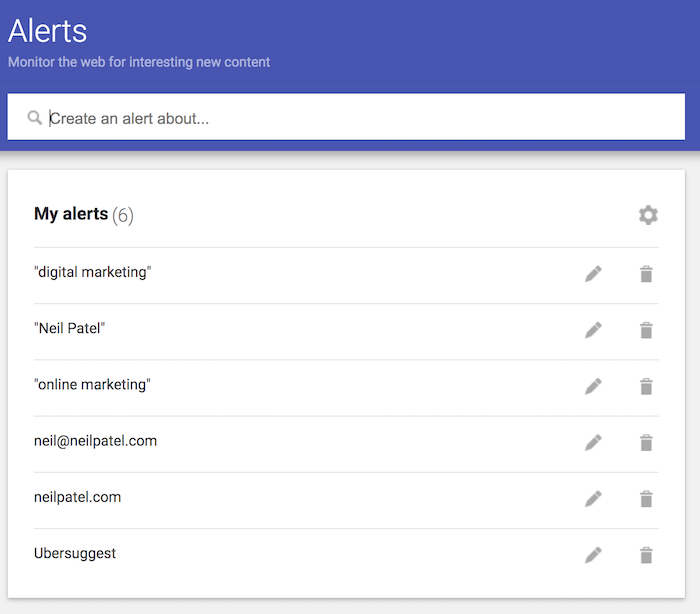
I want you to repeat the process and create an alert for the following items:
- Your domain – you should have just done this.
- Brand name – in my case I would create an alert for “Neil Patel.”
- Product names – if you are selling any services or products you can create an alert around that. In my case, I would create an alert for “Ubersuggest.”
- Industry terms – create alerts for anything related to your industry. When people are talking about your space, it is an easy link opportunity. In my case, I would create alerts for the terms: digital marketing, online marketing, and SEO.
- Your email address – create an alert anytime someone gives out your email. Again, another easy link opportunity.
Here’s what mine looks like:
Precautions to Take While Using Google Alerts
You’ll also notice for all of my two-word phrases (I have quotation marks around them.)
For example, I would not create an alert for: Neil Patel
But, I would create an alert for: “Neil Patel”
The reason being is that alerts for two-word phrases without quotes aren’t as relevant. For example, here are some alerts from the term: online marketing.
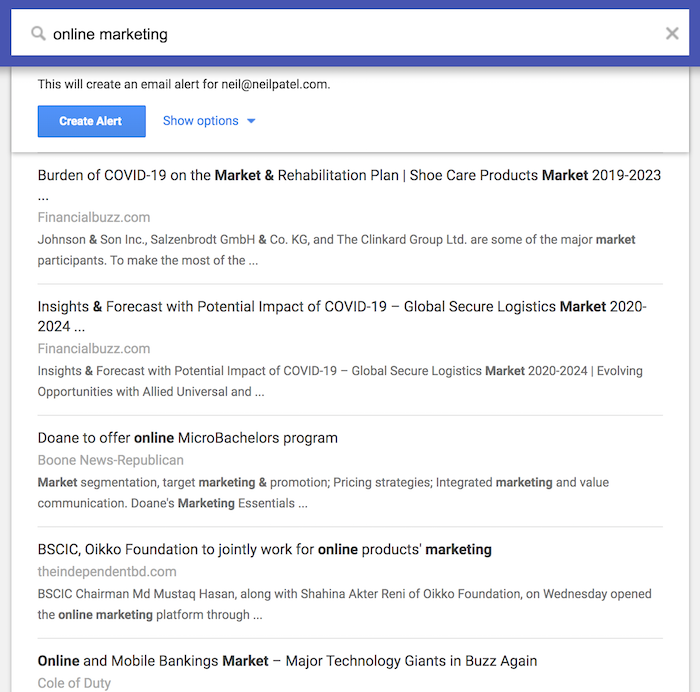
When I use quotes, here are the results.
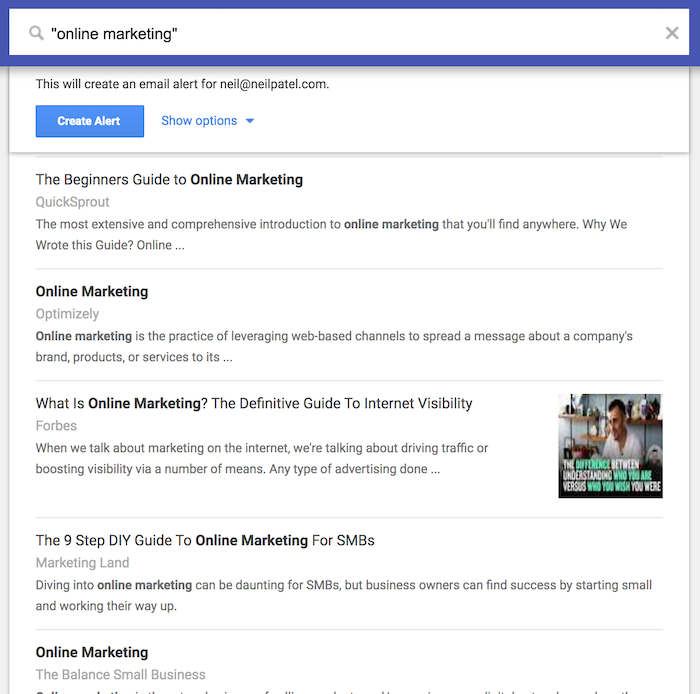
See the difference?
How to Secure Your Backlinks
Getting links
Now that you have alerts set up, it is time to get links.
Keep in mind that when you get an alert email, someone could have already linked to you.
So, not every alert will be a link-building opportunity, but many will be.
Typically, more than half will be opportunities.
Depending on the alert type, some will be easier than others. So, let’s go over how to convert each opportunity into a link.
Your domain
You’ll find that a good portion of the mentions of your domain will contain a link back to your site.
For those, you don’t have to do anything as you’ve already got a link. 🙂
Send An Email
For the ones that aren’t linking to you, I want you to send the following email to the webmaster…
Subject: Did you make a mistake?
Hey [insert first name],
First off, I just wanted to say thanks for mentioning [insert your domain] in this article [insert a link to the URL that mentions your domain].
I know you are busy so I will just cut to the chase.
Would you mind hotlinking my domain to my website?
I know it doesn’t seem like a big deal, but that extra traffic really helps small companies like mine.
Cheers,
[insert your name]PS: Let me know if I can do anything for you.
Brand name
When it comes to brand names, it is a 50/50 shot. Roughly half the people will link to you when they mention your brand and the other half won’t.
For the ones that didn’t, send them this email:
Subject: You forgot to do this
Hey [insert first name],
I’m flattered.
Thank you for mentioning [insert your brand name] in your article on [insert the title of their article].
[insert the URL of their article]You really made my day with that.
Again, thank you!
I feel bad doing this because you already mentioned us, but it would mean the world to me if you also linked our name to our site.
Would you mind doing that?
Sorry to bug you.
[insert your name]PS: Let me know if I can do anything for you.
Product names
With product names, usually, 70% to 80% of the websites will be linking back to you and the rest not.
For the ones that don’t, send them an email similar to this:
Subject: Did you mean to do this?
Hey [insert their first name],
I just wanted to take a minute to tell you how much I appreciate that you mentioned [insert your brand name] here [insert the URL of the webpage that mentions your product].
Seriously, thank you!
Now, I feel bad doing this, but would you mind hotlinking [insert your product name] to this page on our website where people can find the product [insert the URL on your site that covers the product]?
Sorry to bug you.
And again, thank you for mentioning us. It really means a lot.
[insert your name]PS: Let me know if I can do anything for you.
Your email address
Now this one is rare as most people won’t be publishing your email address.
And when they do, they usually aren’t linking to you.
If you try to get them to link the email address, you will find it hard.
But what’s easier is to get them to remove your email address and link to your contact page instead.
Here’s the email template I use for this.
Subject: Privacy issue
Hey [insert their first name],
I noticed you mentioned our email address, [insert your email address], on this page [insert the page they mentioned your email on].
Would you mind mentioning and linking to our contact page instead [insert your contact page URL]?
For privacy reasons, I would rather have people get in touch with us through that page instead of our email.
Thanks for your time.
[insert your name]You also notice that in this template I didn’t include the PS at the bottom.
The PS typically helps boost your success ratio, but when it comes to this email, you want to be a bit more firm as it is related to your privacy.
You ideally want the link and fewer people sharing your email because then you’ll have to deal with a ton of spam messages.
Industry terms
In almost all cases, alerts that contain industry terms won’t be linking to you.
And this group will also be the largest number of results you get with each alert email.
You’ll have to go through each alert and look at the context of the web page.
If they are talking about something that you have already covered on your website and did more in-depth than they have, there is a good chance you can convince them to link to you.
For example, if there is an article about SEO and they mention how you need to build links, but they don’t go into how to build links, I would email the site owner pointing to this article as it breaks down how to build links.
Here is the type of email I would send:
Subject: Some feedback for you
Hey [insert their first name],
Love your article on [insert the topic of their article] [insert the URL of their article].
I just have one piece of feedback for you (hope you don’t get offended), but you mention [insert the subject they mention that you go more in-depth on within your own site], but you didn’t go too in-depth on it.
I think if you adjusted that it would provide a lot more value to your readers.
Or if you don’t have the time to, I already have an article on it here [insert the URL on your site where you go in-depth on that topic] that you could just link to.
Let me know your thoughts.
[insert your name]PS: Let me know if I can do anything for you.
How do I get in touch?
Now that you know what kind of emails to send depending on the alert you receive, you’ll have to, of course, get in touch with the site owner.
So how do you find their email address?
Well, the simplest way is to go to their contact page and see if their email is there or if they have a contact form.
You can also check out their terms of service or privacy policy.
Another option is to use tools like Hunter.
Just type in a domain name into Hunter and you’ll see a list of people you can contact.
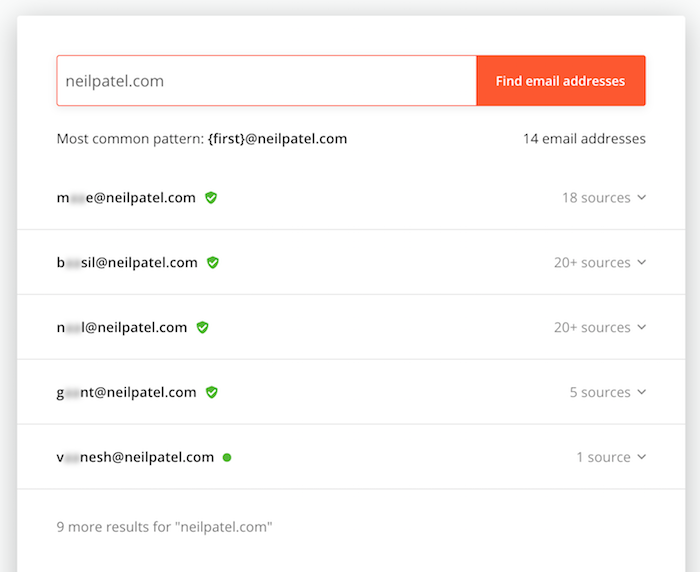
Their free plan allows 50 requests per month, which should be enough to get you started.
Conclusion
Google Alerts is an easy way to build links so I would start with that.
What’s beautiful about it is that you’ll get notified of opportunities.
This will save you a lot of time.
And if you find yourself with a bit of extra time, I recommend one more strategy to build links.
Go here and put in your competition’s URL.
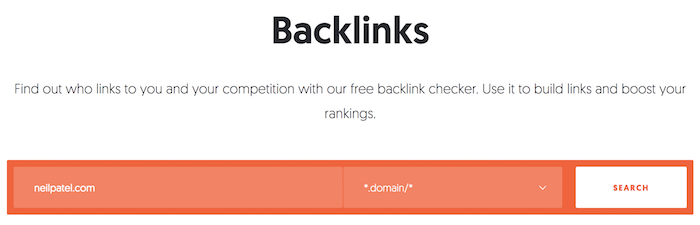
Once you hit “search” you’ll see a report that looks something like this:
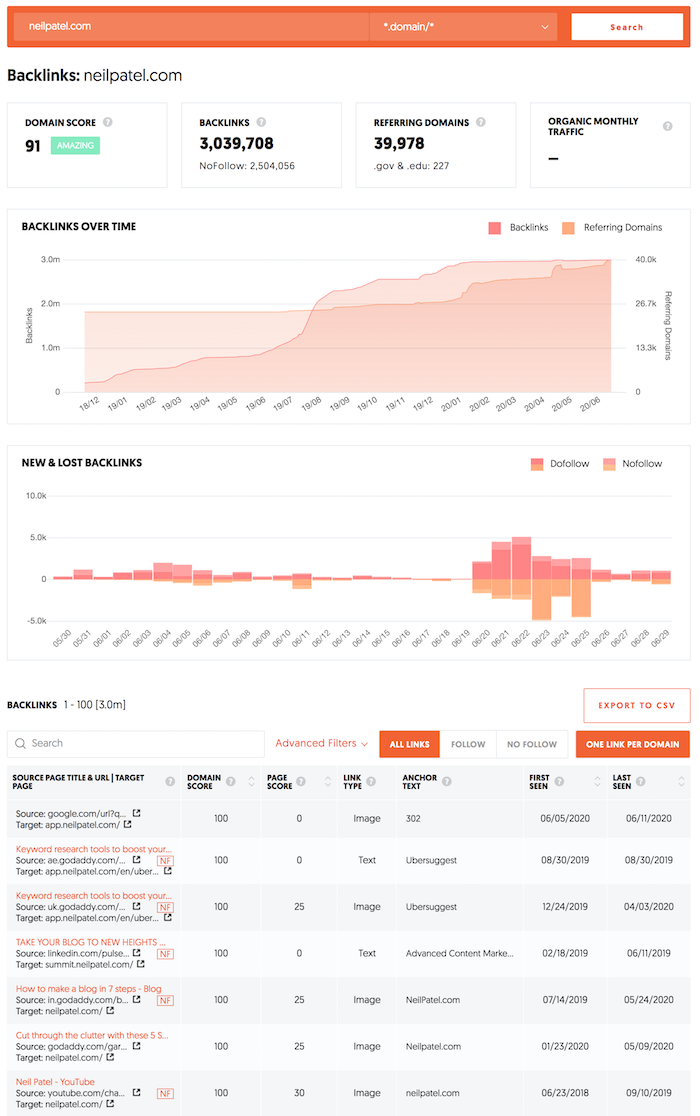
These are all of the websites linking to your competition. What’s interesting about this list is that it is sorted.
The results at the top have more authority, in which they typically boost SEO rankings more than the ones at the bottom of the list.
You’ll want to go through the list, click on each site, and see if it makes sense to reach out to that website and ask them to link to you.
Typically, if you have similar content to your competition that is more thorough, it’s possible to convince someone to link to you. You’ll have to send them emails like the one below…
Hey [insert their first name],
Question for you…
How do you think it makes you look to your readers when you link to another site that doesn’t really help them?
It kind of makes you look bad and maybe even lose a little bit of trust with your readers, right?
In this article [insert the URL on their site], you link out to [insert the competition’s URL].
The article you are linking to doesn’t cover [insert the areas the competition missed].
I actually have an article [insert your article URL] that covers [insert what you cover that the competition doesn’t and why it benefits readers more].
If you aren’t interested in linking to us no worries. I just know that you care about your readers and you want to do the best for them.
Cheers,
[insert your name]PS: Let me know if I can do anything for you.
If you follow the steps above, you’ll start building links.
It isn’t that hard and you can do it. You just have to be willing to put in the time and not get discouraged if you send out a handful of emails and no one links back to you.
Just think of your email as a sales pitch and it may not be perfect the first time… so you may have to modify and adjust it.
If you have any questions on the steps or are confused about anything, just leave a comment below.
The post How to Build Links Using Google Alerts appeared first on Neil Patel.
Source: neilpatel.com

We Analyzed 100,000 Unnatural Links and This Is What We’ve Learned
Everybody talks about unnatural links and their impact on the SEO world. While some things are well known, when it comes to search engine optimization and spammy links, there is still a lot of obscurity on the subject.

To shed some light on this matter, we’ve run an in-depth analysis based on more than 100k inbound links.
Some of the findings are really surprising, while others bring a clear confirmation to some really popular assumptions.
The unnatural links have eaten the SERPs alive all these years and the “good” links keep fighting their way back.
Lots of websites suffered and ended in dreadful situations regarding penalties because of SEO spammers who called themselves “SEO experts” and promised to offer high rankings in Google by building awful links or business owners who followed old tactics.
Either way, the damage remains.

The current research contains lots of insights on the unnatural link matter, aggregating information on metrics such as unnatural and suspect link percentage, link issues, commercial and brand anchor text percentage, webpage type, and link positioning, dofollow, and nofollow links, average domain influence, search visibility, etc.
We recommend you to read everything thoroughly; yet, if you think that you don’t have time to read everything now, you can jump to the main takeaways.
1. Almost a Quarter of the Analyzed Websites Have Over 50% Unnatural Links
After analyzing the data we saw that most of the websites (39.9% of all websites) have up to 10% unnatural links.
Is not bad, but it’s a small percentage if we were to think about it.
Up to 30% of unnatural links represent more than half of the links (a total of 63.3%).
An even worse situation is if we look at the percentage of websites (20.7%) that have over 50% unnatural links.
For a better understanding of the charts, you need to know that we divided the websites based on the percentage of their unnatural links into 4 categories:
- comprising up to 10% unnatural links of all links;
- comprising between 10-30% unnatural links of all links;
- comprising 30-50% unnatural links of all links;
- comprising over 50% unnatural links of all links.
If we compare this chart with the next one, where we’ve summed up unnatural and suspect links together, we can see the differences between the pie charts.
The number of websites that have over 50% unnatural and suspect links is almost a quarter or the total amount of websites – 24.8%.
And the number of websites with up to 10% unnatural and suspect links is smaller than the first chart – 31.4%.
But overall the situation looks worse.
The cognitiveSEO tool triggers a penalized flag when a website has more than 30% of its backlink profile containing unnatural links.
And when we look at our situation, we see that there is a significant amount of links with over 30% of unnatural links.
By now you might be thinking of how we classified or what we considered to be an unnatural link.
For the links classification, we used the cognitiveSEO classification metrics.
cognitiveSEO’s Unnatural Link Detection classifies links based on their unnaturalness as follows:
Unnatural link:
links considered unnatural by Google.
The tool uses over 50 rules to classify unnatural links.
Suspect links:
links that could be unnatural but need a manual double-check investigation.
Context can change a lot in terms of the naturalness of a link and this is why some links cannot be algorithmically classified but need manual curation.
OK links:
Links that seem to have no issue.
Below you can see a print screen taken from the Unnatural Link Detection tool.

2. 35% of All Unnatural Links Have Low Influence
Our research is based on the analysis of almost 8,000 websites that have thousands of unnatural links.
We looked at the influence carried by those links and analyzed the main unnatural issues.
For each website, we had a list of issues.
We calculated the frequency of the issues and you can see in the chart below the top link issues for websites with unnatural links.
A low influence link is one of the most widespread link issues.
A low influence link is a low-quality link, which can have low influence because of lots of reasons, in addition to web-directory links, suspect anchor text, or suspect pattern links.
There is no secret that low influence links or links coming from web directories are most of the time spammy links; yet, what is surprising here is that these issues are still encountered today, as they were 10 years ago.
And, for a quick reminder, here are the link schemes which violate Google’s Webmaster Guidelines:
- buying and selling links or any other links generated through monetary payments;
- excessive link exchanges;
- guest blogging with keyword rich and over-optimized anchor text links;
- automatic link building using automated software;
- blogrolls, footer links, and any other widely distributed links on a website;
- web directories;
- advertorials or paid articles with links;
- hidden or low-quality links embedded in widgets;
any sort of links that still intends to manipulate PageRank; - forum comments with optimized links.
3. More Commercial Anchor Texts Correlate with Higher Unnatural Links
According to the graphic below, we can see that most of the commercial anchor texts are found within websites that have a high percentage (over 50%) of unnatural links.
For you to make an idea of how we tackle anchor texts, let us explain a bit how we defined brand and commercial keywords.
The brand anchor text contains the name of the business or domain name.
Commercial keywords (or money keywords) are all of those keywords relevant for transactional searches, keywords that match queries to real buyers.
In our case, for instance, cognitiveSEO would be a brand keyword while the best SEO tool would be a commercial keyword.
One thing is clear:
The commercial anchor texts have a higher distribution for websites with unnatural links.
So it was a surprise to see so many brand anchor texts for the unnatural links.
We analyzed the brand anchor texts for the unnatural links to see why there are so many.
And we realized that is actually a connection with the top link issues discussed above.
Most of the unnatural links with a brand anchor text are coming from web directories.
Below you can see an example of such kind.
You can see that the link is on the website and the domain name, but the website looks really spammy and we all know that Google doesn’t like web directories or any listing websites.
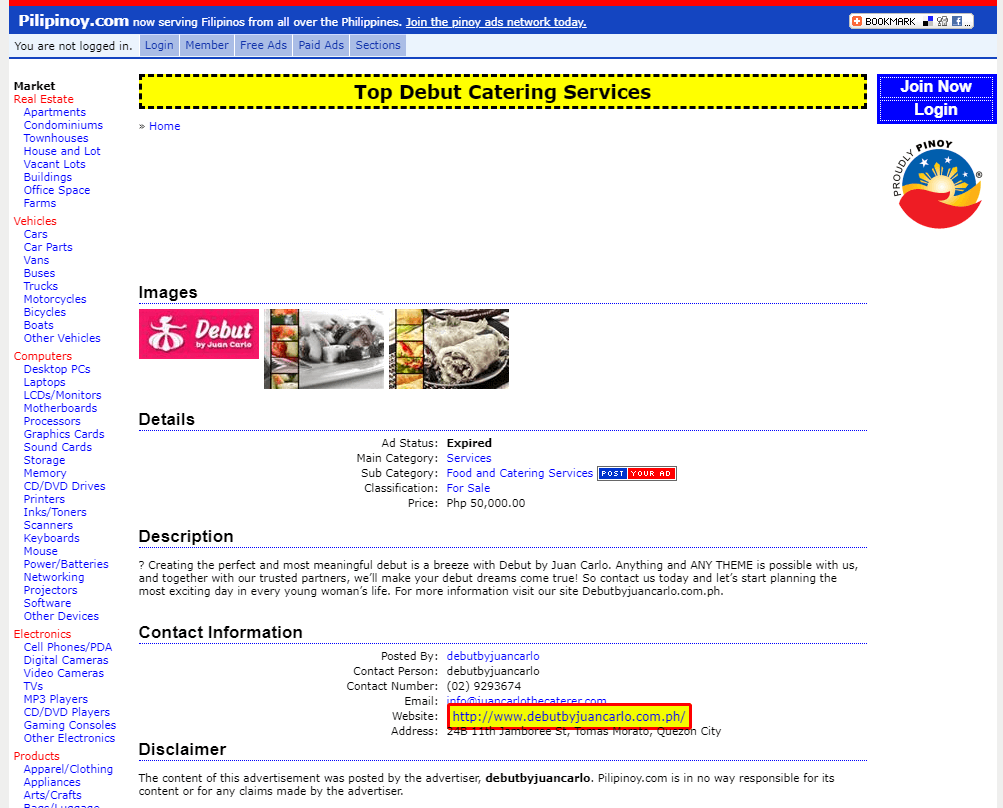
For determining the link building strategy we analyzed the Webpage Type, Link Positioning, Webpage Category. Webpage Type is a metric that profiles backlinks by their structural type.
This means you can see exactly the type of page it’s linking to, whether it’s a Blog, a Forum, an Ecommerce site, or maybe a News site.
The Link Positioning metric classifies each analyzed link by its type (Blogroll, Blog Post, in Content Link, etc) and the Webpage Category identifies the contextual relevance between the site and its inBound Links.
The top 5 webpage categories for websites that have unnatural links are:
- Generic
- Business
- Home
- Tech
- Health
4. Almost Half of the Unnatural Links Are Coming From Web Directories
According to our study, it looks that web directories are the main source for spammy backlinks, followed by generic websites, blogs, forums, and ecommerce.
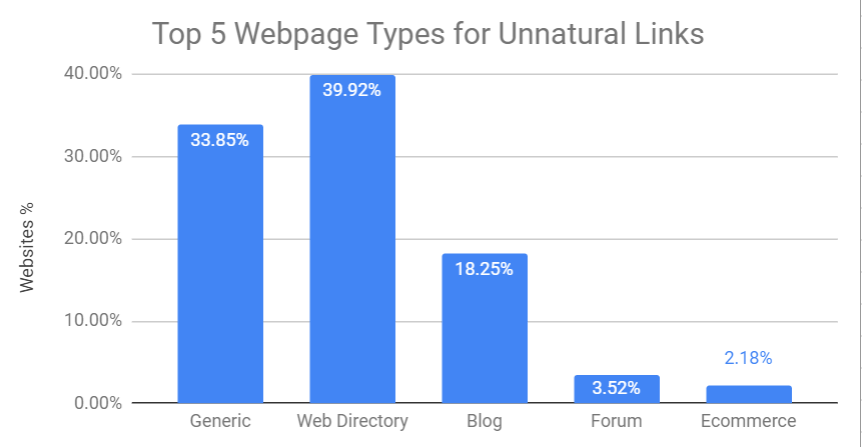
Web directories were a big hit in the glorious old days of black hat SEO.
They have been with us since the beginning of black hat SEO.
If you look at the print screen below, you can see how web directory searches changed over the years.
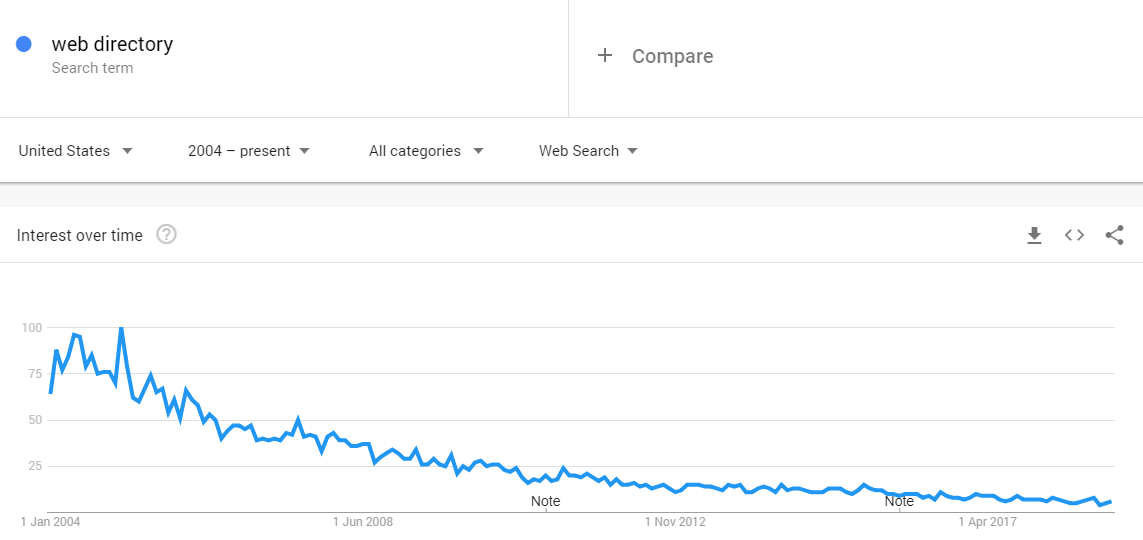
It started big, then it went down and the popularity dropped, but some people are still using them.
Web Directories don’t have a good image anymore in the SEO world.
Matt Cutts said that the Google team looks at the value of the directory and how much work is put into it.
If it’s not substantially a lot of work and, primarily, it looks to be more-less a link scheme, then paid directories are held to the same standards as paid links.
5. 40% of All Unnatural Links are Placed in Short Paragraph of Texts
Since our main source of links is web directories, it turns out that the top two link positionings are related to that.
During our study, we saw that most of the unnatural links are placed in short paragraphs or text and in groups of links.
40% of the websites had unnatural links in short paragraphs of text and 39% of websites in groups of links.
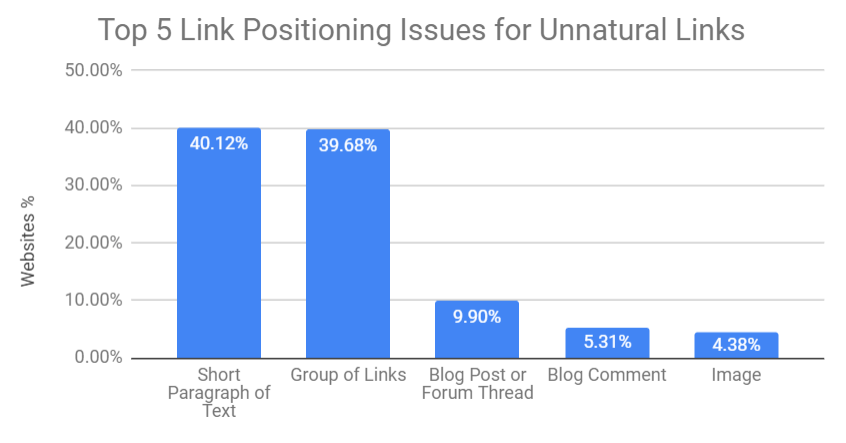
The study shows that links placed in short paragraphs of text and in groups of links are the top link positioning schemes used by spammers.
6. Websites with Highly Unnatural Backlink Profiles Have over 70% Nofollow Links
Besides the information we discussed above, regarding the link strategy, we were also interested in finding out the link equity or link juice transferred and the type of value assigned to the rel attribute – dofollow and nofollow.
We know that “dofollow” is not an attribute in itself but we are going to use it here to make a distinction between links.
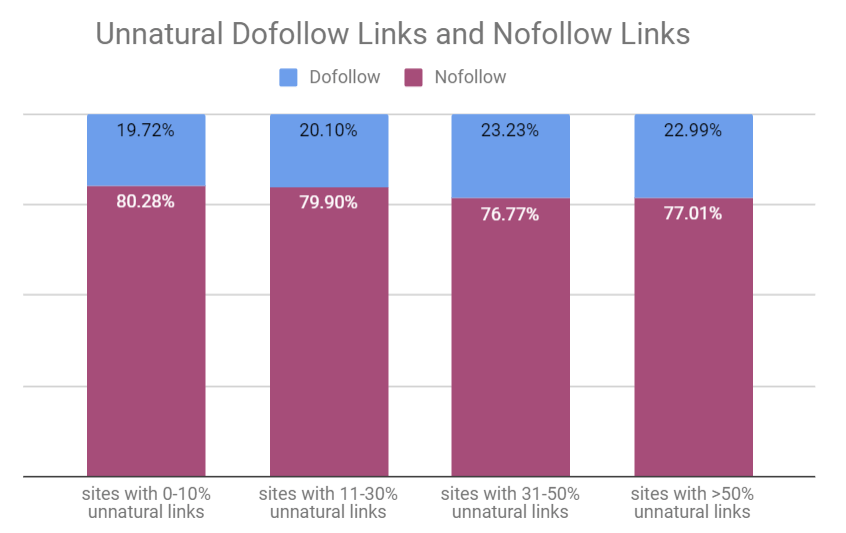
As you can see in the chart, all the websites with unnatural links have a high number of nofollow links. And out of the total links, less than a quarter are dofollow.
We’ve been fed with the belief that dofollow links might be mostly for unnatural links, but it seems that that’s not necessarily the case.
We admit that the data discovered reflects only findings on a set of links, but still, the results we’ve discovered here are quite interesting.
Since most of the unnatural links are nofollow, as you can see in the chart above, we started to believe that the question “Should I disavow nofollow links?” has new directions.
The nofollow links saga continues, after long and heated debates among online marketers and SEOs.
Judging by our findings here, we can say that disavowing nofollow links is not a matter of choice anymore.
You should think about removing or disavowing links that look spammy and have a high risk for your backlink profile even if they are nofollow.
They can impact the whole quality of your backlink profile.
If they are nofollow, that doesn’t mean they are risk-free.
Since dofollow links were known for being unnatural in a high percentage, it became a standard as far as natural links go.
But if we look at the results of our study, more and more major publishers start to switch to nofollow.
This can definitely influence other spammer practitioners to do this as well.
And Google’s John Mueller said to disavow bad links, no matter if they are dofollow or nofollow.
Disavowing or cleaning up bad links to your site may help Google’s algorithm trust other links to your site.
The nofollow drama started to be more complicated since lots of publishers abuse the practice, so that good nofollow links and spammy nofollow links got mixed.
We had an entire talk about the impact of nofollow links on SEO where you can find if they are still worth having.
7. Lower Domain Influence Score Shows Higher Unnaturalness
In our study, we checked the Domain Influence for the unnatural links to see the average value.
It turns out that the higher the unnatural backlink profile is, the lower the Domain Influence goes.
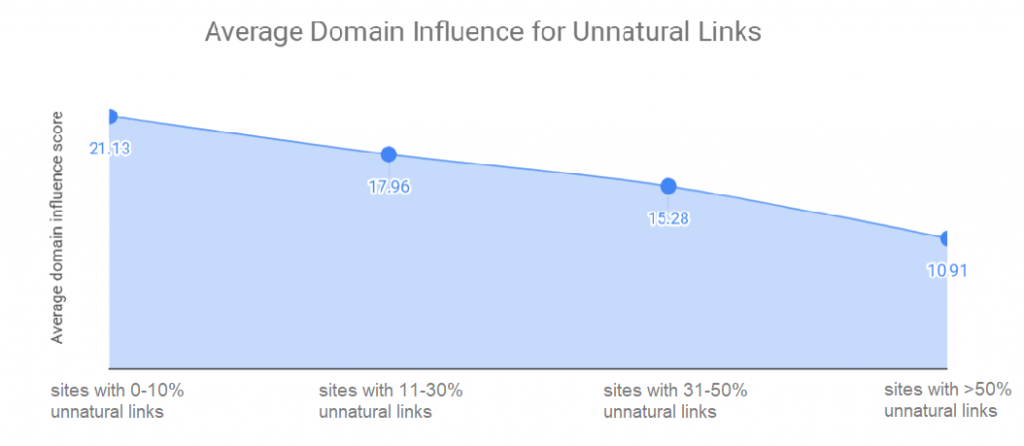
The Domain Influence is a similar metric that includes the domain authority, a crowd-sourced metric measured from 0 to 100.
8. A High Unnatural Backlink Profile Usually Leads to a Decrease in Search Visibility
A direct correlation between the unnatural link and the search visibility wasn’t done in the present study, yet, judging by other researches we made it seems that the highest the unnatural backlinks profile, the highest the chance to get fluctuations on the search engines, and no visibility on the long run.
We’ve written several researches on this matter, and in almost all cases, a high number of unnatural links caused a major drop in search visibility.
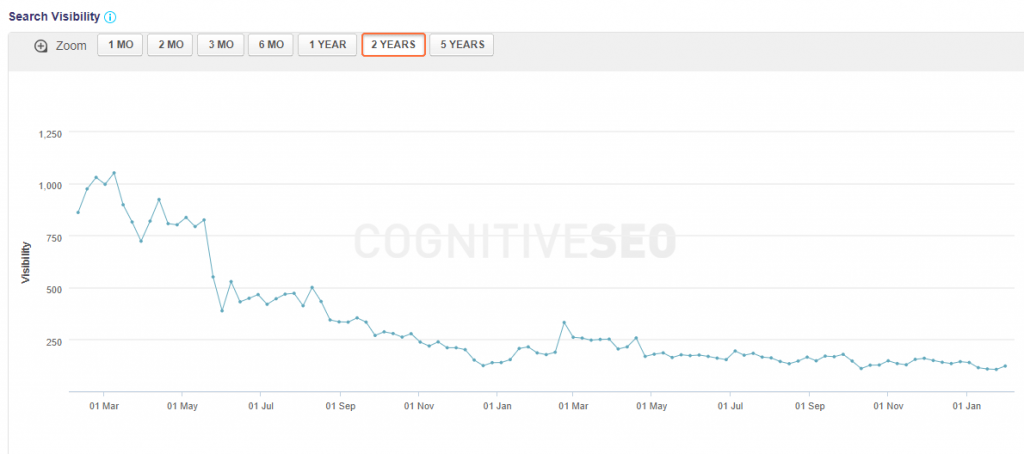
To make sure that your rankings will be safe, we deeply recommend you to:
- Regularly monitor your backlink profile
- Disavow your unnatural links
- Monitor new links that could trigger penalties
- Know your anchor text ratio
And if you’re looking for a tool that can do all that and even more, the cognitiveSEO toolset is always here for you.
9. How We Did the Research
We extracted and worked on more than 100k links coming from almost 8,000 randomly chosen and anonymized websites from different categories, mainly from health, ecommerce, finance, travel, business technology, entertainment, adult.
Here are some data we looked for:
- the percentage of unnatural links, suspect links, and OK links;
- most uncommon unnatural link issues;
- the percentage of brand and commercial anchor text;
- webpage type, link positioning, and web category for unnatural links only;
- nofollow and dofollow links for the whole backlinks profile;
- nofollow and dofollow links for the unnatural links only;
- high and good Domain Influence for the whole backlink profile and for the unnatural links only;
- the average Domain Influence for the whole backlinks profile and for the unnatural links only.
And for each metric analyzed and discussed in the present article we classified the unnatural backlink profile into 4 categories:
- with 0-10% unnatural links out of the total links;
- 11-30 % unnatural links out of the total links;
- 31-50% unnatural links out of the total links;
- over 50% unnatural links out of the total links.
Top 10 Takeaways
We had some pretty interesting SEO facts discovered in our study. We debunked some SEO myths and got new leads and strategies to put in place for future investigations.
Below you can see our top 10 takeaways.
- Almost all websites have some unnatural links, with a third of all of them have over 50% spammy links.
- Obviously or not, most of the unnatural links have no influence, and a third of all analyzed websites have low or no influence links.
- Web directories are on the top list of unnatural tactics and (probably) black hat SEO strategies.
- Most of the unnatural links are placed mostly on short paragraphs of texts and groups of lists.
- Commercial anchor texts are not necessarily the trigger to unnaturalness.
- Most of the unnatural links had the rel=”nofollow” tag, contrary to popular beliefs that nofollow links are “safe”.
- Mostly dofollow links seem to be natural, non-spammy & relevant links.
- We might need to change our approach regarding disavowing nofollow links.
- Unnatural links highly affect websites’ Google visibility.
- Unnatural links are correlated with a lower Domain Influence score.
The post We Analyzed 100,000 Unnatural Links and This Is What We’ve Learned appeared first on SEO Blog | cognitiveSEO Blog on SEO Tactics & Strategies.
Source: cognitiveseo.com

How to Identify and Remove Bad Backlinks That Kill Your Rankings
Since the last Penguin 4.0 (Real-time) update, lots of things have changed in terms of quality backlinks. Bad backlinks have remained the same, though, even if they were created some time ago with no intent to harm a website, or there was an arranged negative SEO attack or maybe a spammy link-building campaign, with the purpose to rank high & fast.
We’ve tackled this matter before, yet, we felt the need of updating this topic for 2018.
Toxic links have a higher effect on a website now than they ever had before. They can eat your whole website alive and stick it down, in the last pages of SERP.
How, you might ask? Well, Google Penalties caused by unnatural links coming from:
- Link Networks
- Footer Links
- Blogrolls & Other Blocks of Links
- Site-Wide Links
- Blog Comments
- Forum Profile Links & Signatures
- Web Directory Links
- Article Directory Links
- Anchor Text Distribution
To be prepared for the long ride and have a clean website, you should know that it requires two easy steps for a correct backlinks assessment.
First, identify toxic backlinks and then remove bad backlinks. Some of the most known types of low-quality links are presented below.
We thought on them through a guide to help you easily identify the unnatural links (link networks and low-quality links) that, maybe, caused the drop in your rankings. After that, you are served with tips and recommendations to clean your website of those links.
The SEO world has evolved so much in the past few years, which means the quality guidelines have become more strict.
Links started to become somehow a problem, because of the amount of spam on the web. After reading this post, you will be able to identify low-quality links that hurt your rankings.
How to Remove Bad Backlinks
The steps for a clean website are simple. First, you need to identify the most damaging referring domains that are linking to your website, following the black hat links filtering explained below, and then remove and disavow the unnatural links.
Here are 4 steps to remove bad backlinks for your website:
- Identify your bad links (you’ll find how exactly from this article).
- Search for the contact information of the website you have the link on.
- Contact the webmaster asking him to remove the link. If you don’t get a response within 2 weeks, go to the next step.
- Disavow the links and upload the file to Google.
Disavowing all the bad links doesn’t have to be a chore. In the cognitiveSEO, you have to use the Unnatural Detection which is a helpful buddy.
It will save you tons of time, energy, and money. Below you can see a screenshot from the tool.

You have to click on the unnatural link bar chart and a new window will all the spammy links will pop up instantly:
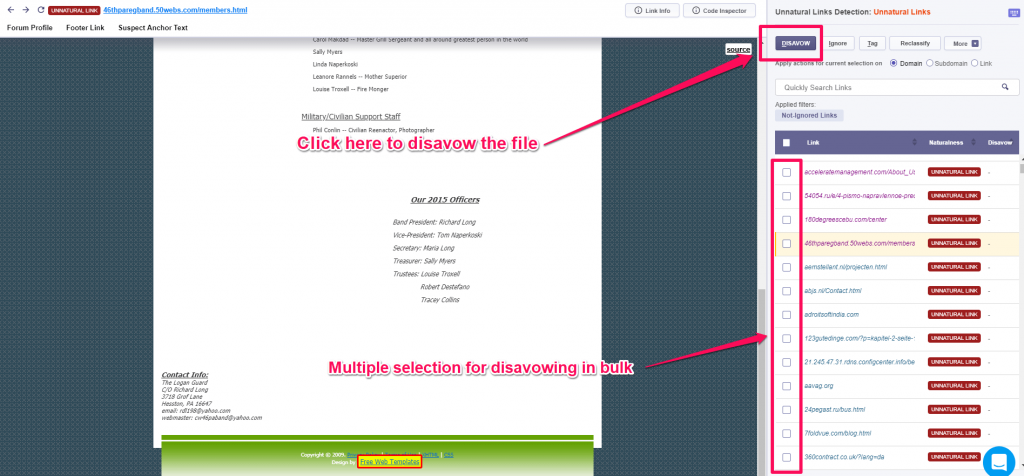
You have to select the links that are bad and disavow them. Either you do that individually or perform bulk actions.
All those disavowed links will be gathered in a file format agreed by Google, which you can download and send it from the tool directly to Google.
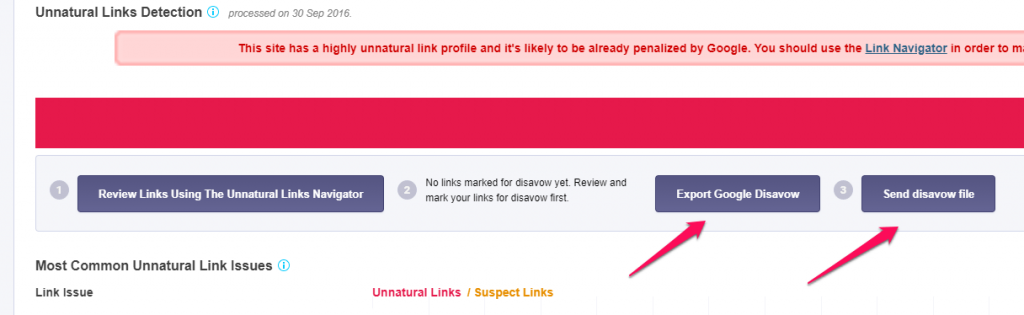
The disavowing process applies to all categories of links explained below.
1. Link Networks
Over 90% of the Link Networks are easy to spot, both by the human eye and by the Google algorithm.
Most Link Networks have the following common patterns:
- Architected from blogs and forums, because they are easy to automate and replicate.
- Links try to look as natural as possible by being put inside the content of a blog post or forum thread.
- The owner of a link network rarely makes the effort to generate links back to each of the generated blog posts. This means that each and every post has a probability of having 0 or a small number of backlinks pointing to them.
- Each site from the link network links out to at least 2 common money sites.
To find the links coming to your website from link networks you need to filter down the backlinks by blog posts and forum thread links, that are positioned in content and have a low metric (link influence, domain influence) and a low number of incoming links to the actual backlink.
The hardest part is to filter large lists of links by the tag in Content and type of link (blog post, forum page, etc).
You can either do it by hand or use a tool that has the ability to make these classifications.
Health Plan to Quickly Identify Backlinks Coming from Link Networks
By using cognitiveSEO, and applying a couple of filters, you can easily find those links exactly.
Order descending by Link influence to see the lowest quality pages first. Browse a bit through the links and use the link preview feature to quickly preview those pages.
In our case we found 316 low-quality links coming from different pages on various link networks. (17% of their entire backlink profile)
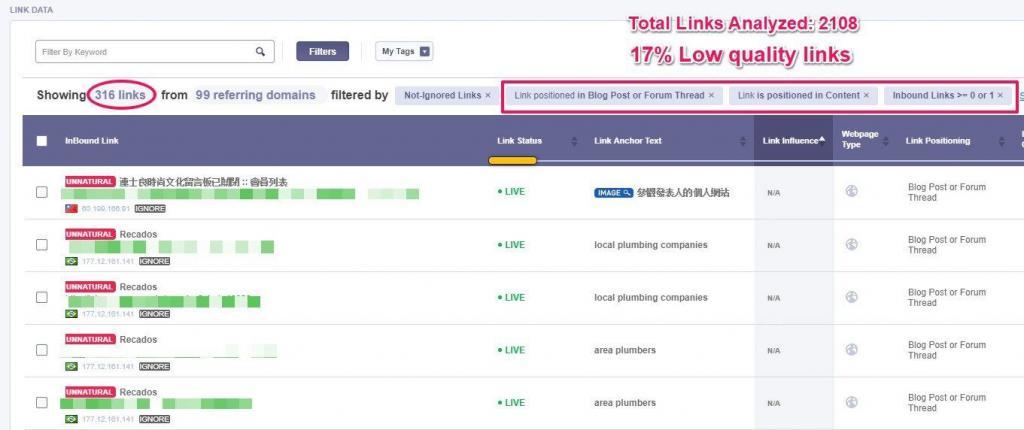
To remove bad links, such as link networks, you should know something first.
Any of the following types of links can be both natural or artificial. The difference is how they were acquired in terms of link velocity and link distribution over the entire backlink profile of a site.
To identify if your backlink profile is unnatural, you should always compare your site to your competitors and check for major discrepancies between the backlink profiles of those sites.
I usually compare my site with the top 5 leaders in the industry and then compare my site with 5 other sites that are trying to break into the niche.
There are always things that come up when doing such an in-depth analysis.
You should compare metric distributions, such as link and/or domain influence, link and/or domain trust flow, link and/or domain citation flow. These are only the basic comparisons that you can make.
The more advanced ones are when you start to compare links classified by webpage type, link type, in content versus not in content links, link position and so on.
2. Footer Links
Footer links were totally legit 6 years ago, but they started to make a lot of mess because of websites who abused of this technique.
That’s one of the reasons why Google placed site-wide links into the link schemes list. Those links can distort your analysis and do not present any value from an SEO point of view.
Imagine if you have one link from one domain compared with 100 links from the same domain.
First of all, the value of that single-domain link is higher than each individual link coming from the same domain.
There was a question on the same issue on the Google Webmaster help forum:
Are sitewide backlinks considered good or bad by Google? Or do they just count as 1 link from the whole domain?
Matt Cutts answered very clearly:
| From an algorithmic point of view, at some point, it becomes asymptotically diminishing returns. And it doesn’t help you anymore. | |
 |
MATT CUTTS |
| Former head of the webspam team at Google | |
If they see a link from a domain they will count it as one, and if they see multiple links from the same domain, they might still count them as one.
From the manual point of view, you will receive a penalty, because Google doesn’t trust those links and performs manual actions quite often.
In case you have a high number of footer links, you will definitely raise a red flag to Google. Usually, footer links are acquired from sites that:
- sell links;
- are involved in link exchange schemes;
- have widgets or plugins installed (usually for SERP manipulation);
- “powered by” links ( ex: WordPress);
- partners of your business;
- clients that link back to you.
If you find only a few links compared to your entire backlink profile then there is no real problem here. If instead, you get a long list of links, you might have a problem.
There are situations when Google missed to flag footer links. One example is for Godaddy, where they have almost 90% of their links coming from footer links.
We checked their site with the cognitiveSEO tool after they were exposed by Yoast explaining GoDaddy’s spammy link-building techniques.
Every website created using a WordPress editor through GoDaddy has a footer text with a link such as “Powered by Do Daddy”.
The thing is that they are still following this practice, but now you have the option to remove that text by yourself.
Health Plan to Quickly Identify Footer Links
The cognitiveSEO.com allows you to select all the links that appear in blocks of links in the footer of the linking pages.
For this site, we extracted 625 low-quality footer links (10% of their entire backlink profile).
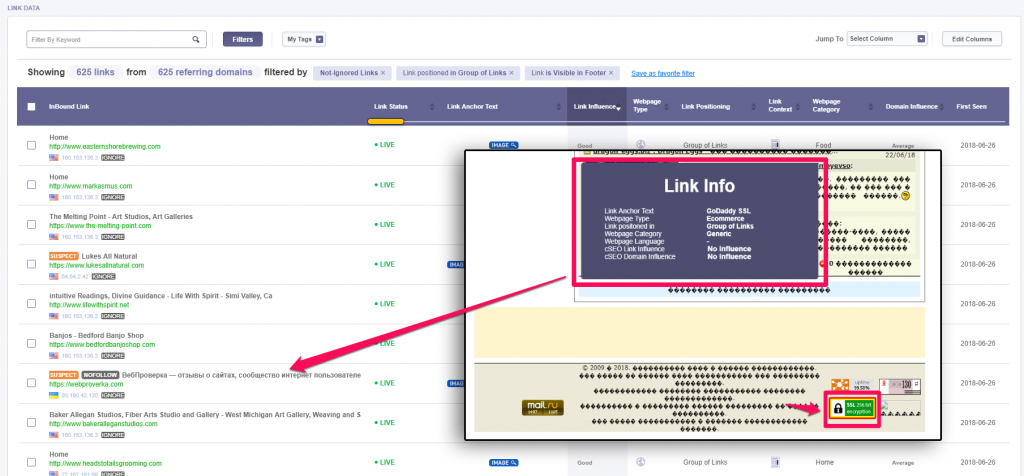
There are options when you can easily spot the links that came from footer sections or groups of links.
In the cognitiveSEO tool, you have a deep-link analysis where you can spot the inconsistency. Take, for example, the screenshot below:
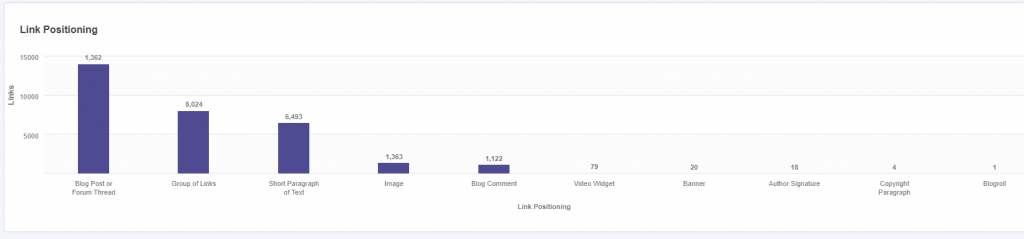
On the site used for this example (www.addictinggames.com) we saw they had lots of links coming from Blog Posts or Forum Threads, which might not be bad (depending on the intent).
But the alarming situation starts when you look at the number of links coming from groups of links: 8,024, which is a lot.
All those links must be reviewed individually and disavowed quickly otherwise, I hear the penalization alarm.
After a quick research in Site Explorer, we saw that the site suffered a massive drop in rankings because they were penalized. Since then, they haven’t been able to regain their search visibility.
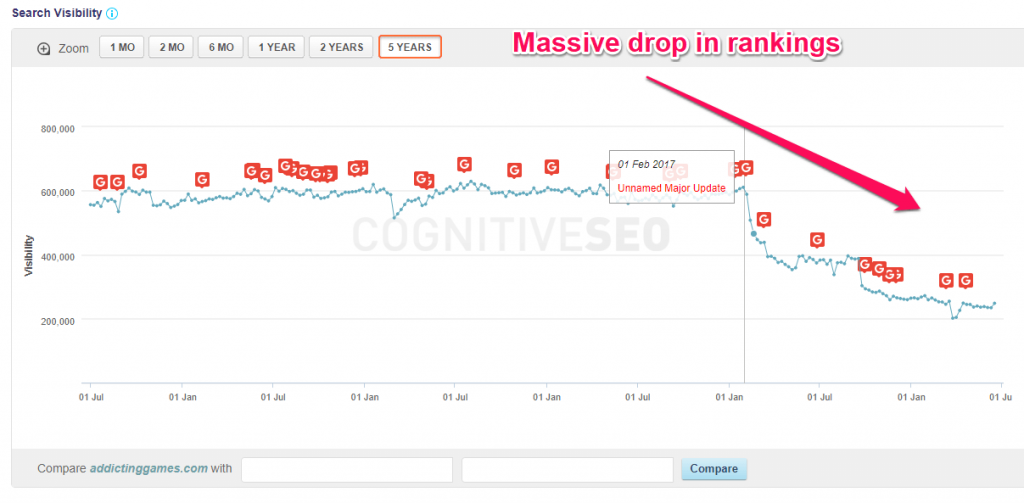
3. Blogrolls & Other Blocks of Links
Blogrolls were abused so much, that they tend to be very carefully analyzed by the Google algorithm nowadays.
This category includes both blogroll links and groups of links that do not fit into the blogroll pattern.
Here is an example of a website that used to abuse search engines and is not a blogroll. The domain uses widgets that are installed on various websites where webmasters get to place their links.
Too many links that fit these patterns might be viewed as unnatural by the Google algorithm and you might get penalized for them. Some of those links can fall into the sitewide link category.
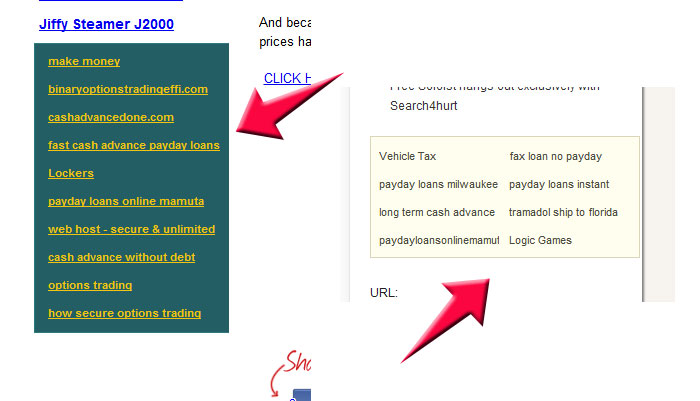
Make sure you don’t have advanced link widget networks listed as site-wides, as they might get flagged faster.
Like all of the other types of links presented in this guide, it all comes down to how they were integrated into your link profile.
Health Plan to Quickly Identify Blogroll and Groups of Links
A couple of filters away, you will get another list of low-quality backlinks that might hurt your rankings. In our case, we got other 424 low-quality links.
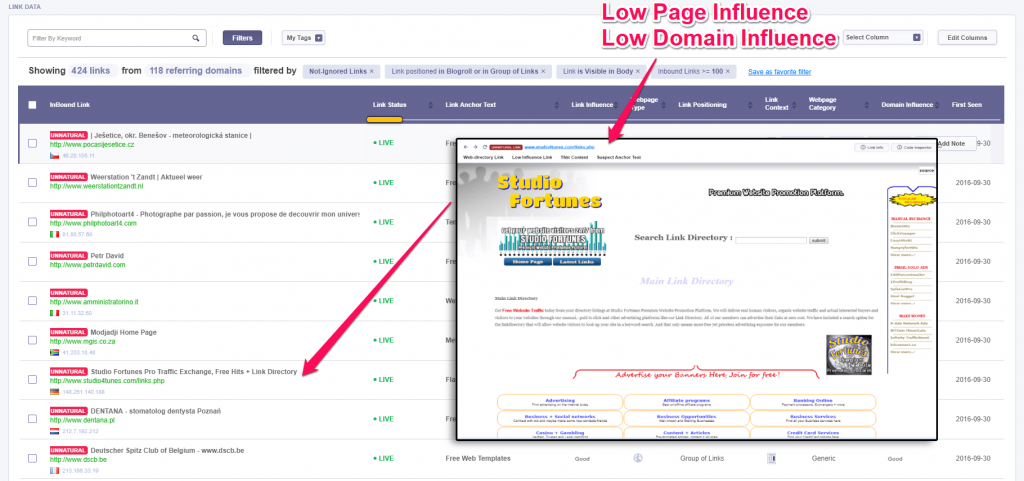
We analyzed that specific backlink in Site Explorer to see some metrics.
We discovered that the page and domain had low influence carrying lots of links (47,365) coming from only 45 referring domains. That is a clear sign of unnatural links.
The problem was the website had lots of other unnatural issues and their backlinks profile was filled with spammy links. 88% of their whole links are unnatural.
If you find yourself in a similar situation, all the unnatural links must be disavowed, and then you should immediately submit the disavow file to Google to cut the connection with that spammy links that can dreadfully bury your website.
4. Site-Wide Links
Site-wide links will definitely hurt your rankings.
Site-wide links are another example of toxic backlinks. They are old news on the Google landscape. Site-wides are devalued and can hurt your rankings so easily. If your domain does not have the necessary authority and receives a couple of site-wides from some low-quality sites, your site will get penalized by Google.
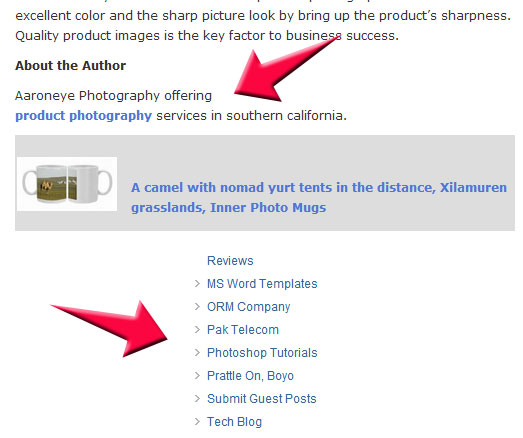
The idea behind the site-wide links is quite simple.
It is more important to have more root domains link to your domain than to have many links coming from fewer root domains that link to your domain.
There are site-wide links that will not hurt your rankings, and it all depends on the site the site-wide is put on.
If that site is considered an authority and that site-wide link is not correlated with other factors such as high link velocity, then that site-wide could help you.
Health Plan to Quickly Identify Site-Wide Links
Luckily, it’s quite easy to discover these types of links with cognitiveSEO as it’s a Sitewide Chart, dedicated to this matter.
You will get a chart with the distribution of sitewide links. If it is a high number, click on the pie and check those links individually.
In our case, we got 21% of the whole backlink profile coming from sitewide links.
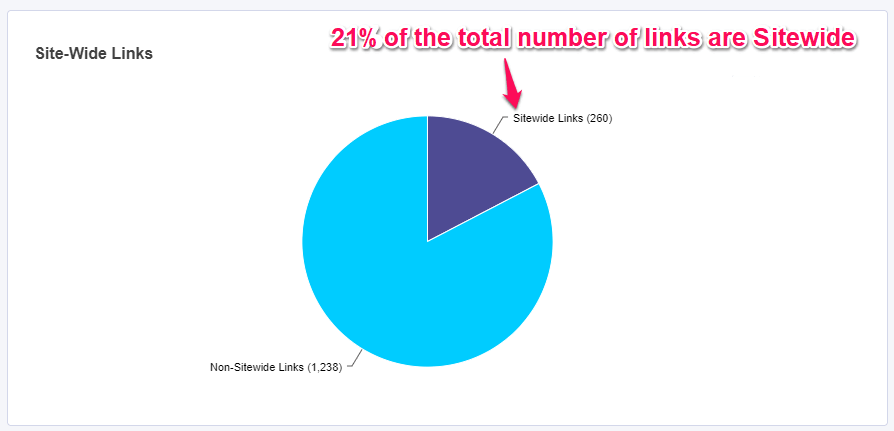
The website has lots of sitewide links that carry almost no value. Below you can see an example of a backlink for that website:
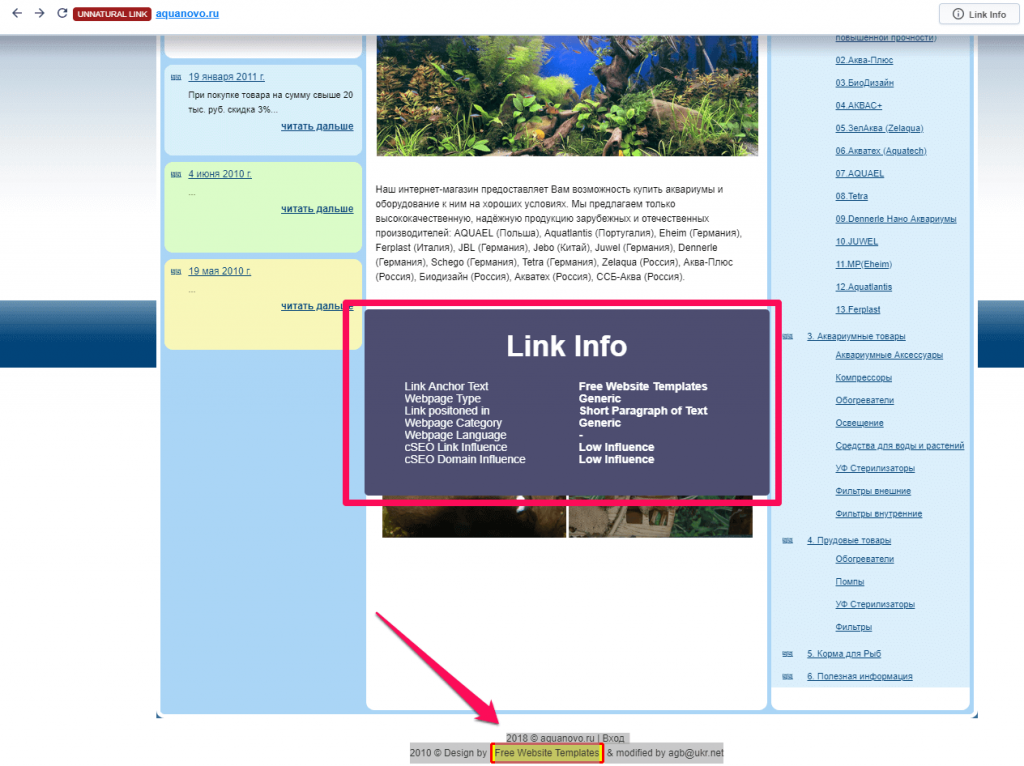
There are multiple problems with this link. Besides the fact it is sitewide, it is also hidden, written in white font. I had to highlight it to see the full text.
Note: A site-wide link is considered to be a link that is automatically replicated across a large number of pages from the same site. Do not misclassify a site-wide as 10 different links coming from 10 different articles on Techcrunch for example. Those are not considered site-wides. Our software has a built-in algorithm that matches different patterns and concludes whether a link is a TRUE SITE-WIDE or not.
5. Blog Comments
Blog comment spam evolved on the back of the search engines.
Comment spam is a form of spamdexing (keyword stuffing) and it has been around since the beginning of the internet.
There are several tools that help spammers post comments automatically with the final aim to reach higher rankings in the search engines.
That is why most of the comments are marked as nofollow by the blogging platforms so that Google will not index them.
Even so, spam commenting is a huge phenomenon and everyone that owns a blog knows how much comment spam they receive.
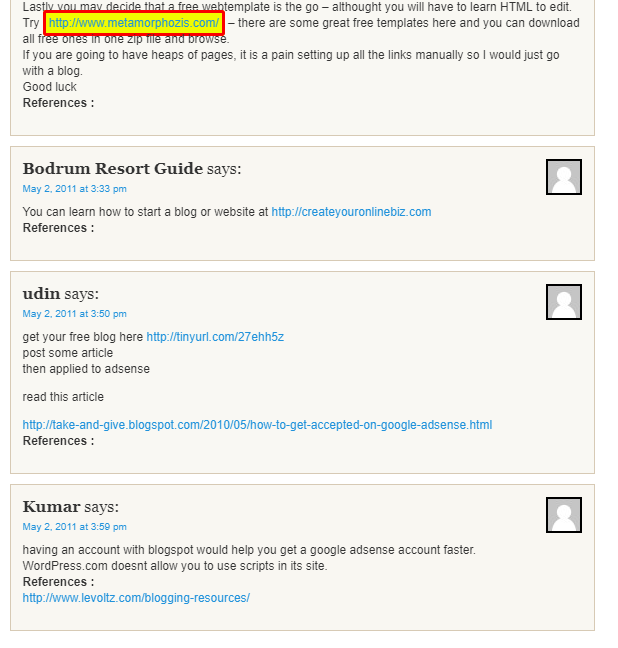
Health Plan to Quickly Identify Blog Comment Links
You can easily find both nofollow and dofollow links that are coming from blog comments.
For a quick review of the whole list of links that come from blog comments, you can go straight to the Link Positioning chart and click on the Blog Comment bar.
We found a website that focused on building links through this technique:
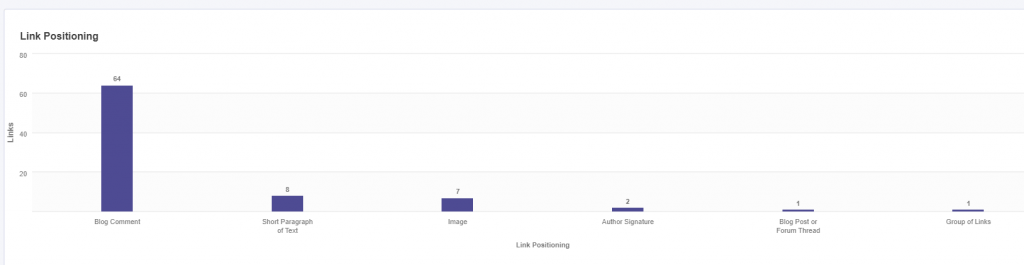
We looked through their links and found out the website took advantage of this black-hat technique and left spammy blog comments on websites that weren’t even related to their website.
Not to mention it used an anchor text that has a spammy appearance, considering the circumstances.
The website is a free library of e-books and resources and the website they’re linking to is about website development. Not quite related, I might add.
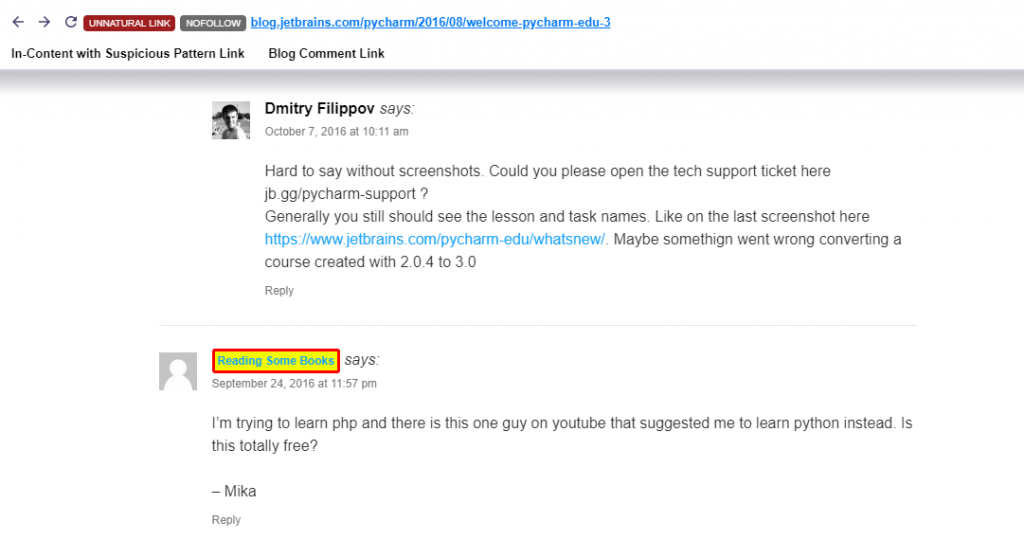
6. Forum Profile Links & Signatures
Forums are abused the same way blogs are.
Having people discuss on your site in forums is the most natural thing that can happen to a site. It means your site generated some buzz in its niche.
But, if you are doing link building using fake forum profiles, signatures, and posting content and links automatically on forums, this will appear in your backlink profile and could hurt your ranking when Google will flag it.
These kinds of patterns can be easily identified by Google. Below is an example of an unnatural link that comes from a forum.
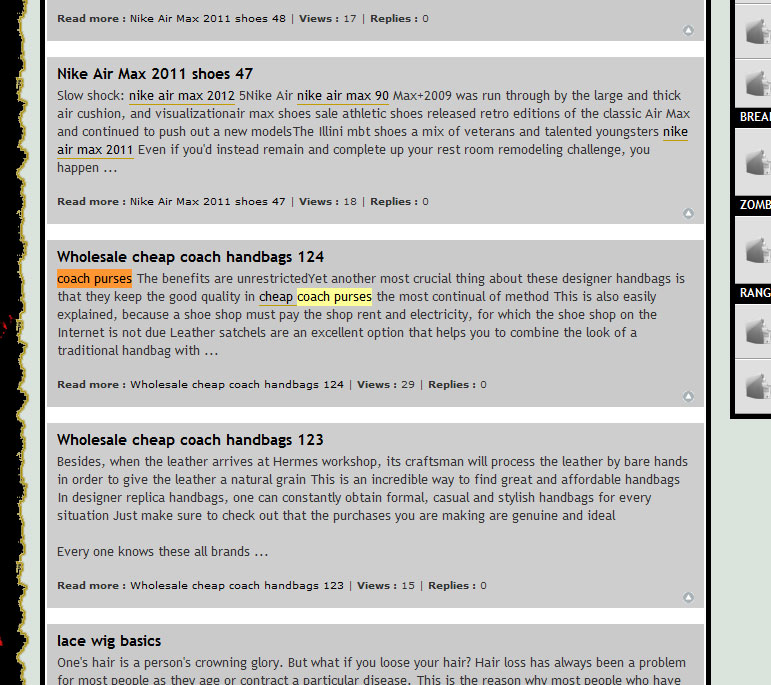
Health Plan to Quickly Identify Forum Links
Again, cognitiveSEO makes it easy to identify links coming from forum threads. If you want to check signatures and profiles, you should search for Link Position » Short Paragraph of Text, Group of Links. You’ll get a list of links as you can see in the next screenshot.
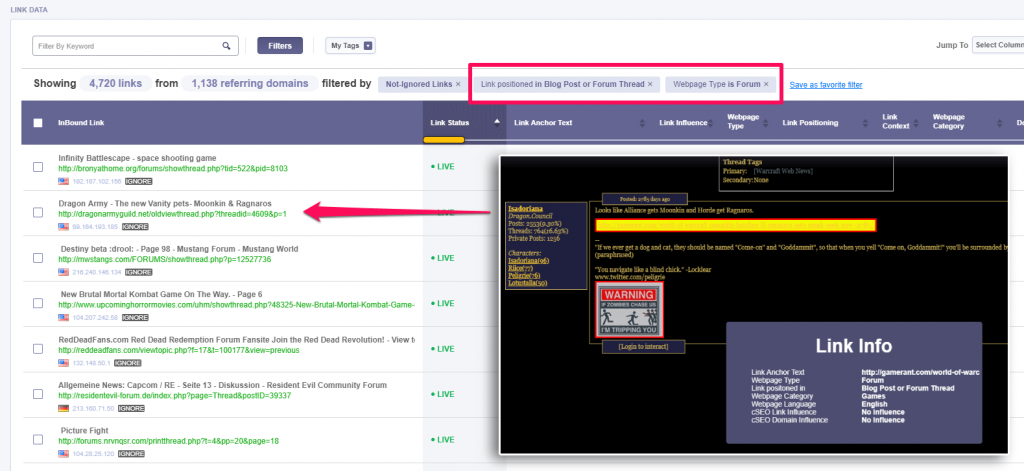
In our example, you can find a preview page with some link info. The link has no influence and nor does the domain.
In case you want a quick analysis, you go straight to the Link Positioning chart and review the links from the Blog Post or Forum Thread.
The website we analyzed had a lot of links coming from this source. 15% of the whole backlink profile is coming from blog posts or forum threads.
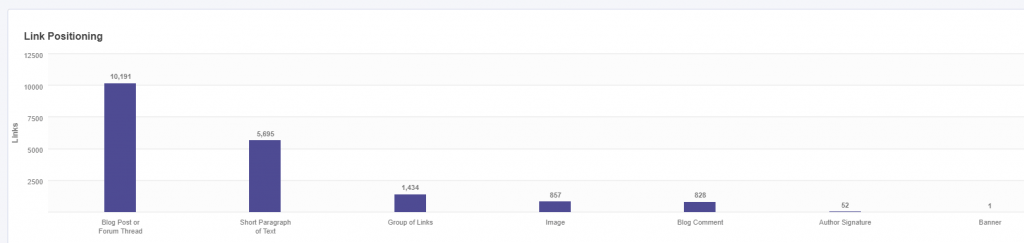
7. Web Directory Links
Forget Web Directory submission services that promise hundreds of directory registrations.
Having too many links coming from web directories is not always a good sign. This might raise a flag to the Google algorithm.
You do not need hundreds of directories to be listed on, only a few quality ones that are well known in your niche.
If you have a high percentage of links coming from directory submissions (manually or automatically), that were created some time ago or are freshly added (it doesn’t matter), you will raise the link velocity flag, and get penalized.
An example of web directory links you can see in the next screenshot. Basically, it is a list with a short description of brands, with a title and a link.
Health Plan to Quickly Identify Web Directory Links
If you get a long list and it represents a big percentage of your inbound link profile (similar to the next screenshot), then this might signal a problem that you need to investigate even further.
The cognitiveSEO is monitoring backlinks and evaluates the unnaturalness of the whole website by offering percentages for the unnatural links, suspect links, and ok links, letting you know if you are in danger.
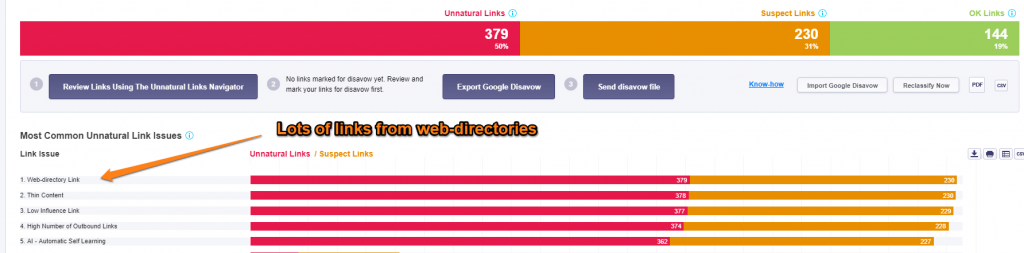
In case your website has lots of unnatural links and red areas (like the one above) you should use the disavow tool and cut the connection to your website from all the spammy links.
Out of curiosity we looked through the unnatural links and found lots and lots of links that came from spammy directories, filled with hundreds of outbound links, just like the one below.
There you could see that the page had lots of other issues, such as low influence links, thin content, a high number of outbound links, and so on.
You should remove the link immediately.
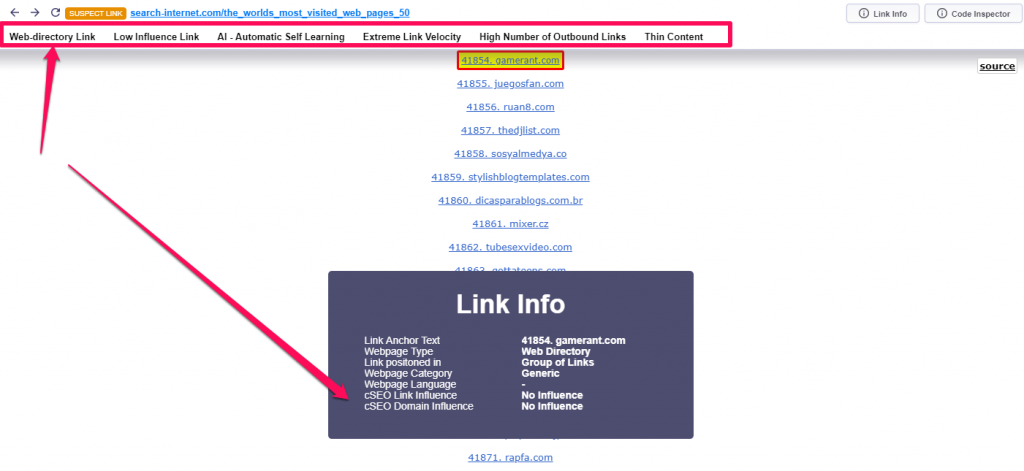
8. Article Directory Links
Avoid cheap content!
This is the best advice you could get. Having too many links from article directories is a sign that something unnatural is going on.
Article directories and the sites they linked the most, were already hit by Panda in the last few years.
Below is one way to find your article directory links so that you can further investigate them.
Article directories, if not created following qualitative guidelines, can be potentially harmful.
Health Plan to Quickly Identify Article Directory Links
Below you can see a print screen for the article directory links identify with our tool.
We got 49% unnatural link profile out of their total unnatural links (23,594). Their total unnatural link profile is 87%.
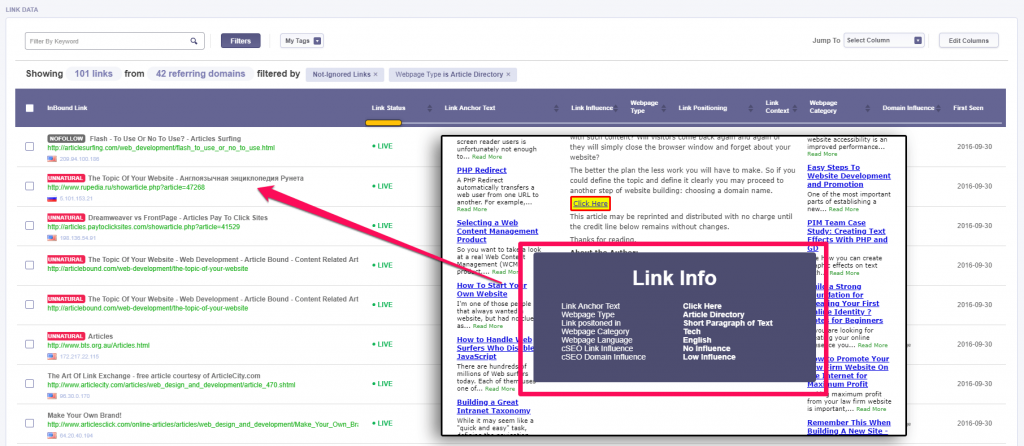
The website received multiple hits from Google algorithm updates. This was easy to spot in their search visibility. In the last 5 years, they were hit by lots of penalizations from Google.
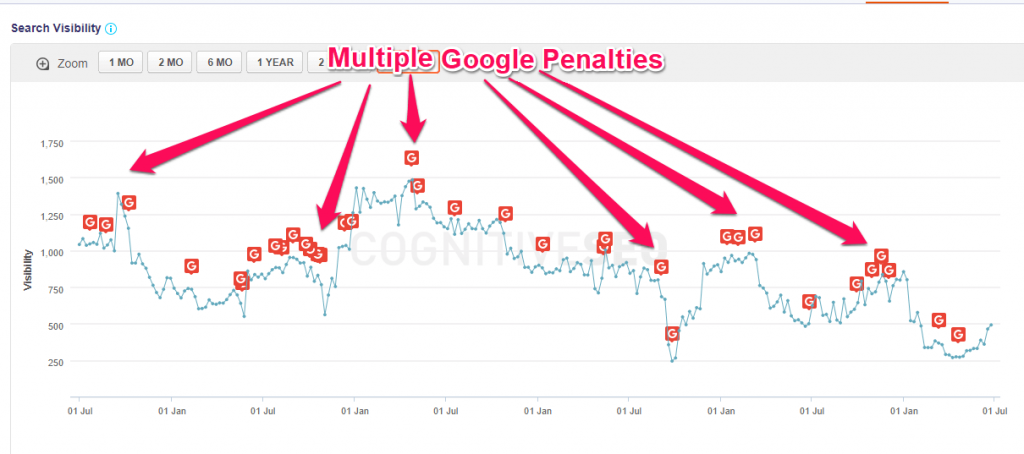
In cases like these, it is very important to disavow all the spammy links in bulk and clean the website. In 2018, a website shouldn’t have such toxic links.
Try to monitor your backlinks to never find yourself in this situation.
9. Anchor Text Distribution
Over optimized anchor text does not look natural at all!
Anchor text is either:
- brand keywords (domain name keywords or the actual brand name);
- money keywords;
- navigational keywords (click here, website, source, and so on).
In cognitiveSEO, you can easily classify and review your anchor texts.
You’ll get an analysis as you can see below. The natural distribution of anchor text would look like this.
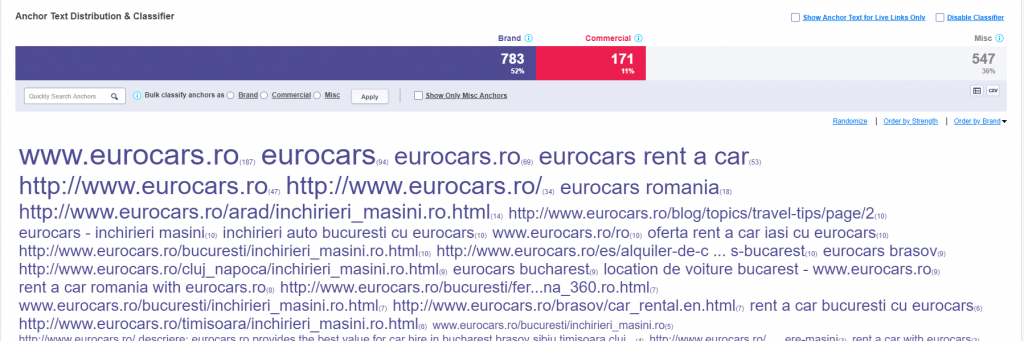
An artificial anchor text distribution looks like this:
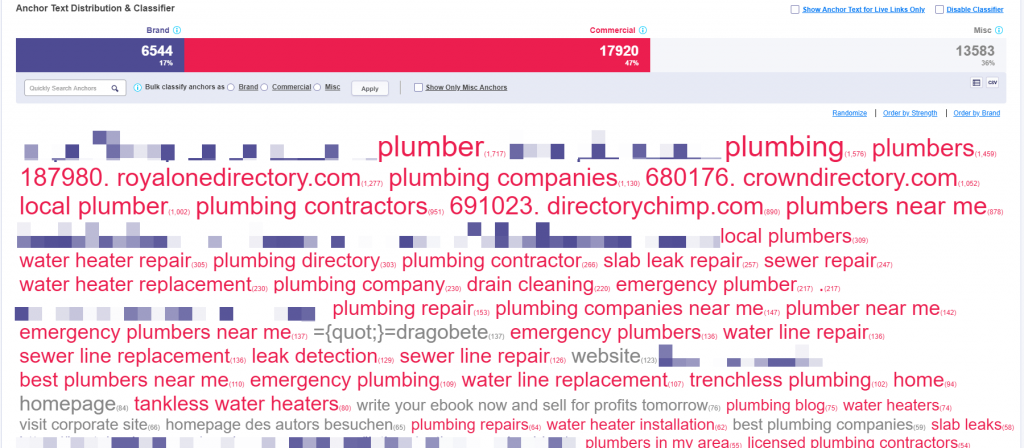
If your anchor text is over-optimized, you are likely to be hit by Google because most of the time commercial anchor texts carry unnatural links.
Consider a natural anchor text strategy, collaborate with other brands and influencers.
Create valuable content and offer qualitative services to get recommendations and good links.
Conclusion
I hope all the SEO tips and the step-by-step guide will help you identify the potentially toxic links that generated problems with the Google penalties.
Use the cognitiveSEO tool to investigate your link data and get a comprehensive link audit.
The tool shows all the data in one place, and monitors backlinks side by side with your competition.
Don’t build links that can harm your website, even if they used to work. Now, they don’t anymore.
Use these tactics to identify bad links and remove them before Google takes action and penalizes your site.
The sad part is that the black hat is bad for everyone, and it is hurting the internet. Be good, create quality and Google will love you.
The post How to Identify and Remove Bad Backlinks That Kill Your Rankings appeared first on SEO Blog | cognitiveSEO Blog on SEO Tactics & Strategies.
Source: cognitiveseo.com

12 Lessons I’ve Learned from 100+ Link Building Campaigns – Wins & Fails
One of the first things that beginner SEOs get in contact with is link building, often far before they even hear about content quality or even basic things like proper keyword research or title optimization.
Link building is the most controversial topic in SEO and I believe that we should encourage people not to focus too much on links alone. And in years of doing link-building campaigns, I’ve learned a thing or two.
So here: 12 lessons I’ve learned from dozens of link-building campaigns I’ve been working on.
- BlackHat Spam Link Building Tools Don’t Work
- Building Free Links Manually Takes Ages & Comes With a Lot of Disappointment
- Bought Links and PBNs are Too Expensive & Too risky
- Forum Posts & Blog Commenting ARE Useful for SEO
- Nofollow Links DO Help You Rank Better
- Google Can’t Penalize Everyone & Won’t Penalize You for What You Did 5 Years Ago
- Focusing on Link Building Alone is Just NOT Worth It Overall
- Guest Posts are Useful… But…
- Links With Branded Anchors Work Best
- Internal Linking is An Awesome Way to Include Commercial Anchor Texts
- Unlinked Brand Mentions Can Pay Off Really Well
- You CAN Rank a Website High by Earning Links
1. BlackHat Spam Link Building Tools Don’t Work
If you’re an experienced SEO, you’re probably not very impressed with this first point. But there’s a big reason why it’s first on this list. I’ll ask you a question:
When you first started building links, what was the very first thing you tried?
If you’re an honest man, you’ll probably say that some sort of blackhat link building.
As I said, new SEOs often learn about link building first, far before they hear about anything else. Don’t believe me?
Well, with all the (often contradicting) information overload on the internet, people turn to forums to get answers cleared out because they can read the opinions of a dozen different people at once, or even ask questions directly themselves.
Just take a look at one example from a forum:
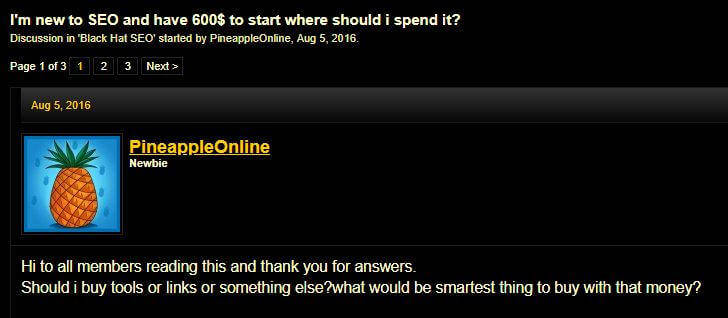
Now you might be saying “Yes, but that’s a BlackHat SEO forum. I know it.” Well, that’s true, but take a look at how he says he’s new to SEO and has $600 to spend, yet he already knows about tools and link buying.
So it’s pretty clear that this beginner already knows something about SEO, just not the right stuff. Why?
Because BlackHat SEO looks appealing. You apparently get quick results for very little work. Coming up with cool content ideas is hard and time-consuming. Writing them even harder.
In reality, BlackHat SEO tools are expensive and have a huge learning curve. You’re better off building something solid and safe from the start.
How am I so sure? Well, because I’ve been there. I wanted to make my life easy. I purchased ScrapeBox, GSA Search Engine Ranker, Captcha Breaker, and other software, in an attempt to ease my job.
I spent weeks if not months to learn the software, time in which I had other expenses that I wasn’t aware of at first, such as proxies.
In the end, I realized that most links the tools were building were crap ones because most websites didn’t only have captchas (which Captcha Breaker could occasionally pass) but were also moderators approved.
The results? Not impressive. Low to medium results with pretty much a lot of money, effort, and stress put in. By low to medium results I mean not on page 1.
All this happened because I missed one key point. The user. I was so caught in the link building that I completely ignored other things.
If I did any OnPage SEO, I constantly thought of ways to include more keywords on a page without looking TOO obvious, but never actually thought about the end-user for a bit.
And I haven’t even mentioned penalties yet. I haven’t really experienced penalties personally (yet again I didn’t quite stick with blackhat methods for long) but many of our cognitiveSEO users and clients that I personally consult know very well the dangers of blackhat link building.
The real results started kicking in when I finally thought about how to make my website and content genuinely useful for the users.
Sure, there are a lot of advanced tactics, technical optimizations, and marketing schemes you can perform, but at the core, user experience is king.
There are also ISP (Internet Service Providers) issues. If you start spamming the web, they will eventually phone you to ask you if everything’s alright. You’ll have to lie, obviously, because it’s against their ToS and probably even illegal in some places.
A Black Hat Link Building Story
I interviewed a guy once and he told me about how he used to make around $1000 – $2000 per month by spamming the web. That sounds good, but he ended up with very little profit.

At first, he was only spamming with one computer and a dozen of proxies, averaging about $75 to $100 per month. So he then thought “Hey, why don’t I scale this up?”.
Well… scaling up was a big investment. He ended up buying around 20 computers and also spent a lot of money on the energy bill and the internet service package. The total spending was close to $10000.
In about 3-4 months, Google started catching up with his scheme and penalized his websites. He started everything all over again, trying to stay under the radar, but each time, Google caught him.
It took less and less for Google to catch up. At first 2-3 months, then 1-2 months until he abandoned everything.
With only 2-3 months of full earnings, he ended up banking less than he spend on the whole setup.
He could of course profit by selling the setup, which is a lot more time-consuming than purchasing it. In the end, he ended up having nothing solid and realized it isn’t worth it.
2. Building Free Links Manually Takes Ages & Comes With a Lot of Disappointment
Clients ask about links almost all the time. “They heard that it helps with rankings, so they want as many as possible.” People usually ask for SEO consultancy offers and how many links per month they contain. it seems that in order to have an “SEO package” offer, you need to have some links there.
However, coming back to reality, it just isn’t possible to promise someone a number of links per month, unless you have a predefined set of websites you link out from, which makes everything less relevant and riskier.
Not only that but you also put everyone at risk, because similar link patterns attract more attention and can impact the whole network.
This means that if Google hits one site for link spam, it might hit every site with a similar link pattern.
This is also the case with buying links, not only with building them. BlackHat tactics affect everyone, not only the performer.
I’ve been able to outrank and pull out my middle finger to websites that had dozens of very expensive links purchased and probably PBNs, all with almost no link building at all.
I also did manual ‘link building’ here and there, but we’ll talk about it later in the article. I’ll explain why I’ve put link building between brackets, so keep reading.
To be honest, building links manually is just like using a BlackHat link-building tool, but 100000 times slower and infinitely more frustrating, because there’s no filter for the failure (like the software), which now goes directly into your soul.
You, doing manual link building.
A friend of mine was recently assigned to build some manual links at his workplace. After about one week, he sent me this message: “I feel like I’m doing this for nothing.”
3. Bought Links and PBNs are Too Expensive & Too risky
After finding out that manual link building literally makes you cry blood, I decided to purchase some links.
Here and there, you could get an occasional $10 per link, on a random worthless Blogspot.
For the real links, on news websites, for example, we were talking about $400 to $1000 per link. Many would also ask for monthly payments of $50 to $200 to keep a link online.
Of course, these prices apply to the markets I am familiar with; in other niches, links are probably a lot more expensive.
PBNs can probably be more efficient, however, the risks are high and you also need to spend a lot of time creating them and making sure Google won’t catch them.
A Private Blog Network’s primary cost is content, which you could be very well creating on your main site.
Here’s a glimpse of how much it would cost you to build a PBN if you want to avoid doing the work yourself. Although these guys probably know what they’re doing, the risks are still there.
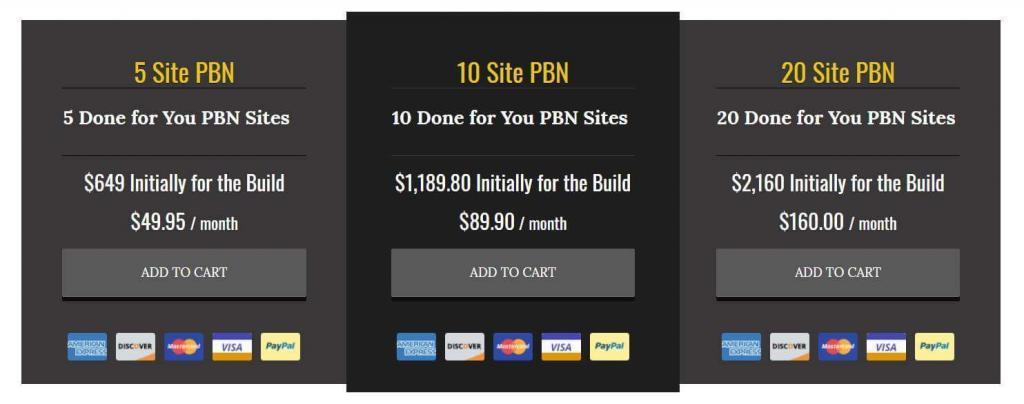
As long as you have multiple quality websites that you take care of, I don’t see the problem with interlinking them.
However, you have to take into account the fact that Google might see it as a PBN and penalize it.
I’d focus on one website first and when it really goes well and competition is already behind, I’d expand with another one.
It’s just that… sometimes, dofollow links ‘for SEO’ are more expensive than a regular advertising post on a high authority, high traffic, well-established website.
I consider the latter to be more effective. If you find a great advertorial opportunity/deal to get your product or website featured, then by all means go for it.
But it’s a better idea if the link has a nofollow tag and if the promotion is clearly specified in the article.
4. Forum Posts & Blog Commenting ARE Useful for SEO
Wait! Isn’t this a BlackHat Tactic? I know, this might sound counterintuitive. But the answer si no, it isn’t a BlackHat tactic.
Forums are communities in which people share opinions, ideas and they are also a great resource. Blog comments are the way readers and content creators interact with each other.
In order to get links, you need to build connections. If you build connections then you’re doing forum posting and blog commenting the right way. Connections help you get more link opportunities. You get to know one webmaster, then they introduce you to another, and so on.
But that’s not the only way to build connections. You can also go to meetings. Meetings and events are probably the most efficient marketing strategy you can spend time on.
You can build more connections, land more leads, and secure more clients in one single event or meeting than you can in months of online efforts.
Sometimes, it’s not easy to find an event in your niche, but they definitely are adjacent niches where you can go. You just have to think outside the box.
Alcohol brands, for example, promote a lot at music festivals. If you make shoes, you don’t have to find a shoemaker meeting.
Just go to a fashion meetup, or maybe a sports one, depending on your products.

Me (on the right) networking at an E-commerce Summit 2018
You might often meet bloggers in similar or adjacent niches and you can collaborate with them. You can also connect with them online, on their blogs.
The chances of you getting your comments approved now are much higher. Most of the forum and blog comment links are nofollow anyway, but that’s not a problem, because nofollow links actually help you rank better.
I have proof, keep reading.
If you have a small/medium website or a blog, don’t dismiss comments and forum posts completely.
5. Nofollow Links DO Help You Rank Better
We all want dofollow links. Not just for SEO, but even for our own sake. A nofollow sounds sort of like mentioning someone, but talking badly of him.
In reality, nofollow links aren’t bad. They can still help you rank better. If you want proof, check out this article about nofollow links.
Countless times has it been proven to me that nofollow links help you rank higher.
If you do purchase an advertorial with a link, not only will you theoretically be legal by using a nofollow link, but you’ll tell Google “Hey, I’m following the rules. Are we cool?”.
Try it and you’ll see for yourself. Just don’t bother building useless nofollow links from spam or random posts on random blogs and forums.
Use proper advertising on relevant websites with good traffic and an adequate audience. That’s the best way to go for.
It’s funny, I’ve even found another “X link building mistakes” article which states that building nofollow links is in fact a mistake.
A mistake is having an unnatural link profile and a 100% dofollow link profile is definitely unnatural.
The problem with dofollow links is that Google wants them to come naturally, without any monetary incentives.
So Google decided to create the nofollow tag to be added to sponsored links. Obviously, nobody cared about that and Google had to bring in penalties.
So every time you buy dofollow links, you’re exposing yourself to the risk of penalty. Google penalizes sites both ways, so publishers started avoiding giving dofollow links altogether.
John Mueller confirmed that adding a nofollow tag to any kind of paid or incentivized link will remove the risk of a Google Penalty.
Nofollow links are fine.
— John ☆.o(≧▽≦)o.☆ (@JohnMu) January 15, 2018
Now I’m just making assumptions, but I don’t find it hard for Google to realize a MyBusiness review is fake, if some account with high activity in local stores from Texas reviews a restaurant from North Dakota, without ever visiting it.
The same goes with buying links. We’re all using Gmail, and even if we don’t, we’ve probably logged in a Google account in some way, through our browser.
It wouldn’t be hard for Google to figure out connections between webmasters.
I know, it sounds paranoid, but since they have patents on listening to what you say through your microphone to serve you personalized ads… I don’t know what isn’t possible.
6. Google Can’t Penalize Everyone & Won’t Penalize You for What You Did 5 Years Ago
At first, when looking at a very competitive niche and seeing a ton of BlackHat links, you might be thinking that it works and that’s the way to go.
That’s not the point. Google doesn’t rank the website with the most links, it ranks the best website.
What John is saying is that most unnatural links are actually ignored. So if a site does have unnatural links, it doesn’t mean it isn’t still the best result out there. Google tries to satisfy the user, not the other websites. If the user isn’t satisfied, it stops coming on Google.
For example, let’s suppose that Adidas and Nike do a lot of BlackHat SEO, but some Chinese ghost brands like Abibas and Nikae do WhiteHat SEO.
Should Google rank those when people search for “best sport shoes brands”?
And if all websites that rank for a keyword were to be penalized… who would be ranking? Nobody?
If your competitors are ranking above you but they have a lot of spammy links, you might want to read this article about how to outrun them.
You have to take into account that Google gives a lot more damns about the user experience than it gives about links. If you build 100 links and Google boosts you up, it won’t be long until it drops you back forever if your website sucks.
If your competition is full of spammy links or purchased links, you’re at an advantage. Google is always looking for the perfect candidate to put it on spot #1.
Focus on doing something better or just as good as them. Only after that think of ways to promote your website and obtain backlinks.
Also, if you start doing SEO for a new client, unless the client is obviously penalized, focus on earning new links instead of getting rid of old ones.
7. Focusing on Link Building Alone is Just NOT Worth It Overall
Now… Don’t get me wrong. Links are useful. You should try to get them, as much as possible. You should be always looking for new link opportunities.
So if someone tells you “Hey, cool content man, I’ll write about it and link to you.” don’t go and tell them “No thanks, man. I don’t do link building.”
That would be… dumb. It’s just that people get it wrong and instead of acquiring links the right way, they sell their souls to the devil for links.
Quality links are a byproduct of good marketing, the one thing you should be chasing instead of links alone.
Even here, at cognitiveSEO, we’ve focused more on content creation and promotion over the past 2 years.
The results were visibly better than anything we’ve tried in the past when building links was the cool kid. Our traffic went up and so did the interactions with our content.
By writing quality content we were even able to land a couple of guest posts every year, without even asking for them. People would simply read our content and ask us if we can write for them.
That’s a great way to get a link back to one of your articles or even products. Now imagine our success rate if we actually chased guest posts. However…
8. Guest Posts are Useful… But…
You see, when you do guest posts, the best possible outcome for you is to write something really good. If you write low-quality guest posts, you get low-quality results with them. Nobody will read them and the host will probably never work with you again.
If you write a successful post, that ranks high and actually drives traffic to the hosts’ website and even gets people to link to it, then you’re prone to write again there soon.
Isn’t it awesome to have a writer that can bring traffic to your website? I hope you see where this is going.
Wouldn’t you rather have a good writer that brings targeted traffic… on your own website, instead of someone else’s website?
A couple of guest posts here and there on really authoritative websites in your niche are useful, of course, and you should go for it.
But I’d rather spend some money on an advertorial on a website that won’t accept guest posts but could actually bring me real traffic. It’s a lot less work and probably a lot more profitable.
Often times the links you get from guest posts aren’t even dofollow.
That’s not necessarily a bad thing, but the best outcome would be if those links actually drove targeted traffic to your website, instead of just staying there only for Google.
It’s not even guaranteed that Google will take it into consideration.
Spend more time creating quality content on your website instead of creating quality content on other people’s websites.
9. Links With Branded Anchors Work Best
When you analyze a website, you should always perform an SEO competitor analysis as well.
Most of the time, the #1 competitor has a higher percentage of branded anchor texts, averaging at about 60-70%.
Here’s one competitive analysis from the cognitiveSEO Tool:
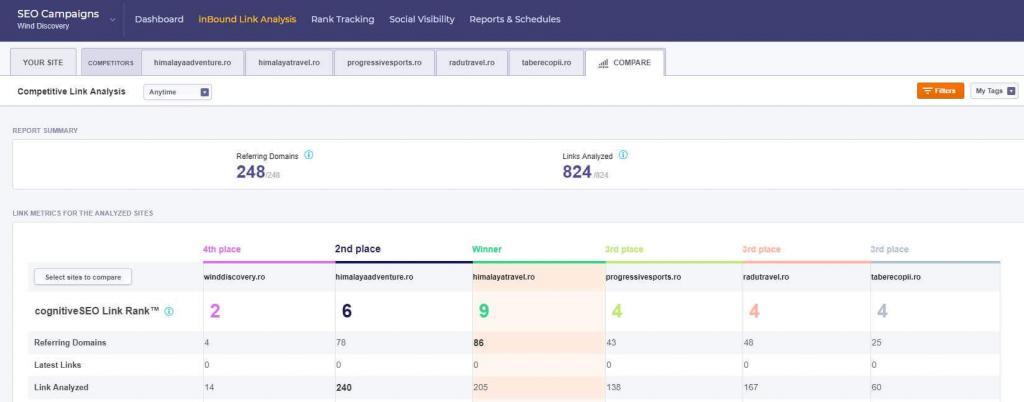
If we take a look at the anchor text distribution or the top competitor (the one with a score 9), we’ll see that it mostly has branded anchor texts.
They know it works, so they do it. This is valid regardless of the naturalness of the link profile.
Even if the links are natural or unnatural, sites with more branded anchor texts tend to outperform the ones with only commercial anchor texts.
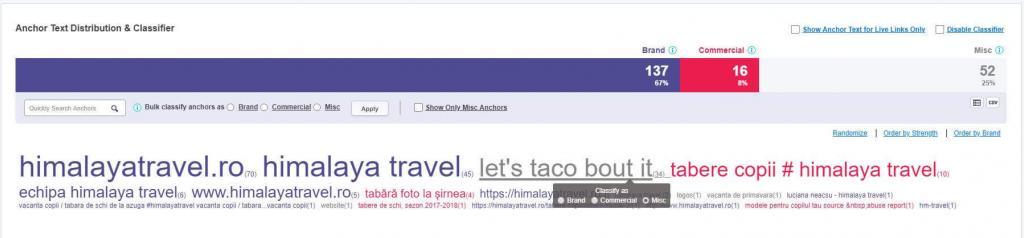
Branded anchor texts are great because they help grow the overall authority of your website. This means that when you’ll have new posts, they will rank better on their own, without needing to get any links to them.
However, it’s always a good idea to also have some commercial keywords there as well. This will let Google better understand what the page is about.
But it’s just so more much natural for people to link to a website using it’s brand rather than a very specific keyword. Just think about it. If you were to link to a new product, how would you rather do it?
Example:
Go to shoes.com if you want to purchase these awesome running shoes.
You can find these awesome running shoes on shoes.com.
Using commercial anchor texts just feels so… forced. It’s so obvious even for a common reader to realize that the keyword is put there on purpose.
Many times, editors and webmasters even naturally use miscellaneous anchor texts like ‘official website’ or ‘click here.’
Example:
To get these awesome shoes from Nike you can click here.
However, you don’t even need to build commercial anchor texts externally, because you can do it on your own website, which takes us to our next lesson…
10. Internal Linking is An Awesome Way to Include Commercial Anchor Texts
If you can’t get any commercial anchor text backlinks without emptying your wallet, then you can use your own website to create keyword-right anchor texts through internal linking.
The only issue here is content. If you don’t have any, you won’t be able to interlink. If you have a very popular article about a very common question in your niche that you’ve answered, you can use that article to pass its authority to a page you want to rank, such as a product category one.
Lacking internal structure is a massive waste of opportunity, because it’s something you have complete control over. It’s easy to do, but as anything else in SEO, overdoing it is risky. Read our guide about internal linking if you want to learn how to do it the right way.
11. Unlinked Brand Mentions Can Pay Off Really Well
If you want to get some relatively easy links, then look for people that have mentioned you, but haven’t linked to you.
A great and easy way to find these unlinked brand mentions is to use … BrandMentions. Pretty straightforward, isn’t it? The tool does a great job at identifying these and also at filtering them.
Before you reach out to the webmasters asking them to quickly link to your website, remember that building a connection is more important. It’s a good idea to thank them first and then suggest or ask for a link.
This only really works well if you’re an already established brand, but also for local businesses and events. You can also use the tool to monitor when any other keywords (such as your product category) show up on the web.
12. You CAN Rank a Website High by Earning Links
I’ve ranked plenty of websites without any link building, just by creating great content consistently and promoting it properly.
I’m not saying that these websites didn’t have links at all, I’m just saying I wasn’t building or buying them. The came naturally from genuine connections and proposals and quality content.
Instead of link building, you can take the link earning approach. The concept is simple. Do stuff that deserves and attracts natural links
Easy to say, right?
Well, it’s not that hard to do either, actually. Here are just some ideas, besides the general rule of thumb of creating high quality content.
- debating a long time controversial topic
- engaging audiences in real-time through live blogging/vlogging
- interview interesting people in your industry
However, for this to work, you have to remember that building connection is the best thing you can do.
Although network marketing can be annoying, the truth is that we all are network marketers, one way or another.
Conclusion
These 5 years of experience taught me enough to know that I can spend my time better somewhere else. I’ve learned a lot more things, but I’ve tried to cover the most important ones. Maybe I’ll expand the list someday.
As a closing note, content creation and link earning > spam & link building. You can try both paths to figure it out yourself, or you can just avoid the pain by taking my advice. In the end, you’re the one to decide.
Building content isn’t only helpful for SEO, but also from a marketing perspective. If you don’t become a publisher, you’ll keep paying publishers to feature your products.
Most of the publishers out there are usually review and affiliate websites because that’s what people look for before they buy.
Of course, if you’re a maker, you can’t review yourself or your competitors. But you can win their trust by answering questions. And trust, in business, is priceless. It cannot be bought. Only earned.
What have you learned about link building in your SEO adventures? Share it with us in the comments and let’s chat about it!
The post 12 Lessons I’ve Learned from 100+ Link Building Campaigns – Wins & Fails appeared first on SEO Blog | cognitiveSEO Blog on SEO Tactics & Strategies.
Source: cognitiveseo.com