
Tag Archives for " leads "

Struggling With Customer Acquisition?: Fix This One Alignment Issue
You are struggling to hit your acquisition targets—the marketing team is bringing in lots of hot leads but the sales team is struggling to convert them. Yet your marketing team is an award-winning one and your sales team is world cup worthy.
Where is the problem with your customer acquisition strategy? And what can be done about it?
Let’s dig a little deeper to understand what is making your team of A-players struggle to hit your acquisition goals?
Why Does Your Customer Acquisition Strategy Seem Broken?
There are many reasons why your customer acquisition strategy may not be working. But deep down, it’s due to one thing: the misalignment between your sales and marketing team.
Here’s how it translates into the organization.
Gap 1: Your sales and marketing teams are working on different funnels
In most companies, the marketing and sales teams work separately. Too often, marketers know too little about the customers and their dealings with the sales team.
SDRs work on cold emails and cold call random people, and marketers run campaigns to their target persona. As a result, each of these departments ends up creating an acquisition funnel based on the persona they have identified as their ideal customer profile.

This strategy is still used by many companies, even by some industry leaders, and it enables them to fuel their year-over-year growth.
Now, I bet you’re wondering what the problem is since this strategy seems to work.

Well, a study by the International Data Corporation revealed that B2B companies’ inability to align marketing and sales teams around the right workflows and technologies costs them about 10% or more of revenue per year.
In fact, when your sales and marketing departments function as standalone departments, efforts are put into tasks that are not very productive. For example, one study found that 50% of sales time is wasted on unproductive prospecting—either chasing unqualified leads or trying to convert leads that aren’t yet warmed up.
Another consequence of sales and marketing teams working with different funnels is a lack of understanding of the Ideal Customer Profile to target. For example, a lead that the marketing team deems qualified may be seen as unqualified by the sales team. A study by ReachForce showed that sales reps ignore 50% of marketing leads.

Other studies have shown that 60-70% of B2B content created is never used. In most instances, this is because the topic is irrelevant to the buyer’s audience.
As you take it a step ahead, you realize that if the marketing team and the sales team worked together, it would have been easier for them to determine what content the marketing team should produce for lead nurturing and how to use it to warm leads.
Gap 2: Your sales and marketing teams are chasing different results
How can you achieve a shared goal if each team measures its success in different ways?
For clarity purposes, let’s assume you have a SaaS, and your annual goal is to grow sign-ups by 45+ percent.
Now imagine that the sales teams measured their success based on new free trial accounts, closed deals, and upsells. Meanwhile, marketing teams measured their success on lead quantity, quality, and brand awareness.
In this particular case, saying that you will fall short of your annual goal is just an understatement.
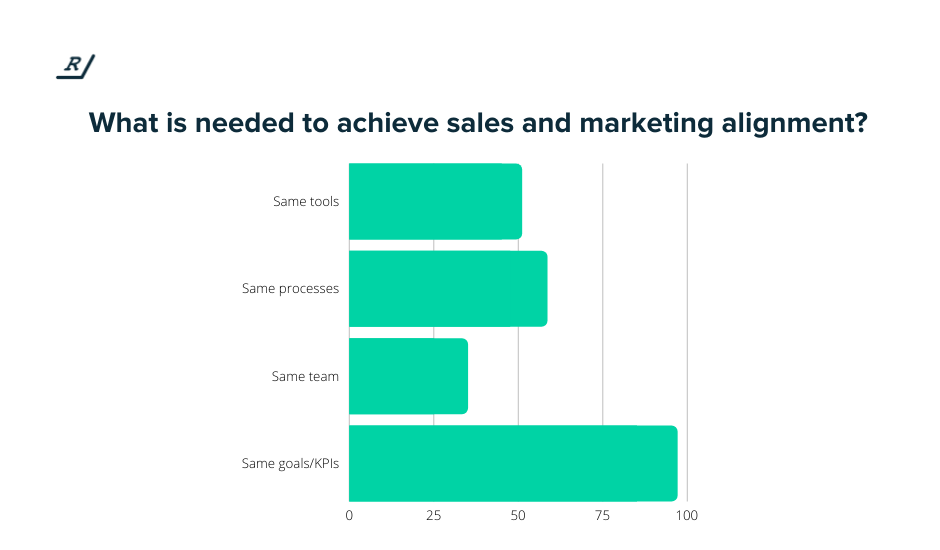
If there was alignment between the two teams, they would have agreed on what a quality lead means for the company and what is the average number of leads marketing needs to bring in before sales convert X amount of users.
If, for example, the metric shows that the sales team needs 15 leads to close 5 deals and that each of these leads should be SaaS companies with teams of 50 to 300, the marketing team will know where to focus their efforts and what to do in order to reach the common goal.
Similarly, the sales team will know better how not to fall short of the 5 out of 15 deals closed.
Why Aligning Sales and Marketing Is The Only Way to Fix Your Customer Acquisition Strategy
So with the gaps identified, it has become increasingly clear that the solution to bridging the gap is to align your sales and marketing teams.
Here are some reasons why.
It helps keep business to customer communications consistent
It happens more often than you think—the sales team calls the product one thing, but the marketing team uses another term to describe the same product.
For example, the sales team calls it a “Chatbot,” while the marketing team calls it a “Conversational Marketing Platform.”
Here is another example. The marketing team talks about “Collaborative Growth Platform”, while the sales team talks about “CRM”.
Admittedly, this can be confusing for potential and even existing customers, and it’s a living example of mismatched messaging.
Not surprisingly, it can cost you your first good impression and, as a result, a prospect may be less likely to trust you.
In fact, 21% of B2B marketers cite “giving the prospect a bad first impression of our company” as one of the most damaging factors resulting from misaligned marketing and sales.
That’s why one of the biggest benefits of aligning sales and marketing teams is consistent messaging.
The messaging used by your marketing team can now warm up prospects and set them up for the sales team to further reinforce those same messages. If the marketing message strikes a chord, the sales team can use it to close more business.
Failing this, you may end up with a siloed message, which can lead to a very confusing and inconsistent journey for your prospect.
21% of B2B marketers cite “giving the prospect a bad first impression of our company” as one of the most damaging factors resulting from misaligned marketing and sales.Click To Tweet
If your prospects think they’re getting one thing based on what marketing is saying when the sales team is selling them something completely different, it will definitely hurt your bottom line.
So it’s important to make sure your message is consistent and relevant to your entire customer journey.
It creates a single customer journey
We discussed earlier that the foundation of the sales-marketing relationship is the conversion funnel.
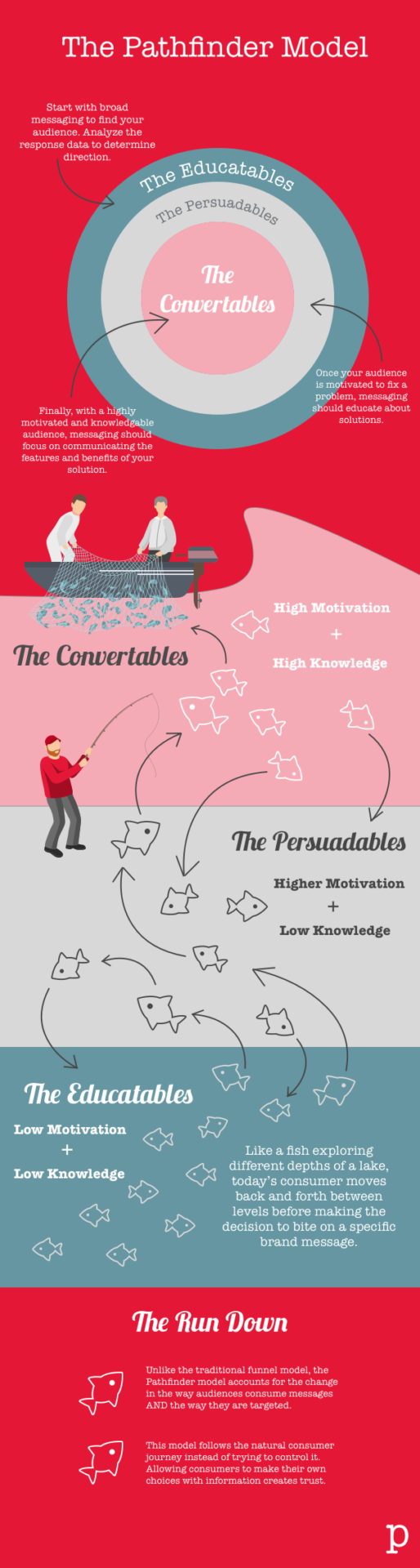
So when it comes to getting everyone on the same page, the best place to start is to get them to agree on the structure of the entire customer journey.
By doing so, you save your prospects from having a single branded customer experience instead of separate siloed experiences.

As a result, everything is tied together as an experience—from the awareness stage at the top of the customer journey funnel to the brand loyalty stage.
It fosters a “marketing first” approach
Each department plays its own tune when your sales and marketing teams are misaligned. In such scenarios, prospects are less likely to respond positively to a cold outreach if they’ve never heard of you, and that can harm your reputation and your chances of closing the deal later on.
If both teams are aligned, it encourages a “marketing first” approach—meaning that marketers find prospects who have a specific problem and create content to help them solve that problem.
It all starts with the marketing team warming up and nurturing new leads by creating informational content about the product and selling the features and benefits by creating transactional content to fuel conversion.
Then, when the potential customer prepares to make a decision, the sales team can take it from where the marketing left and close the deal.
It leads to a better way of assessing results
By aligning your sales and marketing teams with a common goal and the same KPIs, you have a great chance to see the synergy behind their work and analyze how your organization is stacking up in both sales and marketing.
In addition, you will be able to detect the shortcomings of your customer acquisition funnel and adjust not only certain parts but the whole funnel.
The post Struggling With Customer Acquisition?: Fix This One Alignment Issue appeared first on Content Marketing Consulting and Social Media Strategy.
Source: convinceandconvert.com

How to Create Ultimate Guides to Drive Leads, Traffic, and Conversions
Ultimate guides are everywhere. You’ve probably read your fair share, and maybe you’ve even written a couple.
They can be a great way to get traffic, build links, and increase your authority, but they’re far from easy to create.
The issue most people run into is the sheer amount of content out there nowadays.
How do you create an ultimate guide if there are already tons of posts on your chosen subject?
In this post, we’ll look at the steps to creating the ultimate guide on just about anything.

Disclosure: This content is reader-supported, which means if you click on some of our links that we may earn a commission.
What Is an Ultimate Guide?
What turns a lengthy blog post into an ultimate guide?
Well, there are a few things that almost every in-depth guide has in common:
- It goes very deep into a pretty broad topic.
- It contains several chapters that look at the topic from a variety of angles.
- An industry expert or researcher writes it.
Apart from that, what you put in your ultimate guide and how you design it is up to you.
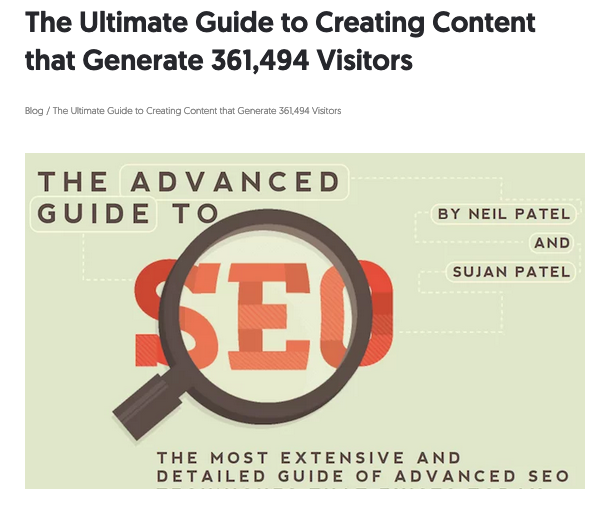
Why You Should Create an Ultimate Guide
If you didn’t know how powerful ultimate guides are already, here’s why you should start creating them right now.
Rank for Many Keywords
The length, depth, and authority that go into ultimate guides make them a fantastic weapon in your SEO arsenal.
The fact that they are so detailed means they should rank for a huge number of keywords.
Including internal links to your other blog posts boosts their rankings, too.

Get Backlinks
A big, in-depth resource like an ultimate guide can be a fantastic source of links.
Not only can you use it to go out there and request a backlink as part of your link-building process, but other sites naturally start linking to an authoritative resource, too.
So much so that your ultimate guide can continue to attract links for years to come.
Build Your Authority
There are few pieces of marketing collateral better at positioning your brand as an authority in your industry than an ultimate guide.
This is your opportunity to showcase how much you know about your subject to the world and go above and beyond what has previously been written about your topic.

How to Pick Topics for Your Ultimate Guide
Picking a topic can be a huge stumbling block for many aspiring writers.
Don’t get bogged down overthinking it, though. Here’s how you can find the perfect topic quickly.
Choose a Topic You Know About
This first point is obvious, but it needs to be said.
You need to know your topic inside and out if you want to write an excellent guide.
That doesn’t mean you can’t use a freelance writer to help you out, but you should give them a thorough brief and create the outline of the guide yourself.

Choose a Topic With High Search Traffic
Not every guide needs to be written with the express purpose of ranking in Google, but it can seriously help drive traffic and generate customers.
That’s why I recommend you enter your topic ideas into a tool like Ubersuggest to see the keyword volumes of the main topic and the volumes of every other related keyword.
Don’t just pick the topic that has the main keyword with the highest search volume, however.
You may find another topic has so many more related keywords that it could actually generate more traffic overall.
Choose a Topic That’s Trending
Ultimate guides are successful when they’re written about trending topics.
When people are excited about a topic, they want to consume all the information they can find about it.
Your guide should be a part of that, too.
That’s not the only reason you want to focus on what’s trending, though.
The newer your post is, the better it might do in search results if someone is searching by posts made within the last week, month, and so on.
How to Create an Ultimate Guide

With your topic picked, it’s time to get to work creating your guide.
Here’s how I recommend you go about it.
1. Consume as Much Content as You Can
Even if you’re an expert in your field, you’ll still want to read blog posts on your topic before you start writing.
Doing so will help you understand the level of content currently out there, the common threads writers pull, and the things you need to mention.
Pay attention to the results that Google serves up, too.
You’ll find that specific formats are more popular than others, and you’ll want to try to mirror these when it comes to writing your content.
2. Identify What’s Missing
While you’re reading other people’s content, make a note of everything that’s missing from the posts.
If you’re writing a how-to post, be sure to go through the steps yourself after reading posts by others.
Then, jot down things you notice during the process that others might have missed or not explained thoroughly.
It also might help to sit down with someone who is unfamiliar with your topic and see what questions they come up with.
3. Do Research
You can write an ultimate guide off the back of your expertise alone—but you can make it stand head and shoulders above everyone else’s content if you conduct your research.
For some, this is a case of canvassing their colleagues and contacts for their opinion on a certain topic.
Others might want to commit to more detailed research and partner with a market research company that’ll carry out a study on their behalf.
The more effort you put into the research, the more valuable and link-worthy your ultimate guide will become.
4. Put It All Together
To create your ultimate guide, simply combine the basics plus the additional details you found were missing from other posts and your research.
This way, people coming across your guide as the first piece of content they have read about a topic will get all of the basic information, and people who have read many other guides will be wowed by all of the missing pieces that you included.
5. Promote, Promote, Promote
An ultimate guide is no good if no one reads it.
Considering the amount of time and energy you have spent on your ultimate guide, you owe it to yourself and your readers to promote it well. Do so by:
Sharing it on all of your social networks:
Twitter, Facebook, and LinkedIn are the best.
Promote it on your personal and business accounts, if possible.
Sharing it in groups on social networks:
LinkedIn, for example, has some great groups on particular topics.
Facebook has some as well, although many are full of spammers who are just there for their promotions.
This will expand your guide’s exposure from just your network to all of the members of the groups you select.
Emailing your list:
If you have a mailing list, let them know about your latest and greatest piece of content.
Repurposing your content:
If you can turn your ultimate guide into an infographic, video, slide presentation, or PDF document, you can spread it on even more networks.
4 Tips to Create an Awesome Ultimate Guide
If you want to take your ultimate guide to the next level, bear in mind these four tips when writing.
1. Write Clearly and Format Appropriately
You don’t have to be Hemingway to write a great ultimate guide, but take a lesson from Ernest regarding clarity.
Short, clear, punchy sentences win out here, especially when writing thousands of words on your topic.
Long, convoluted paragraphs may help you get your message across, but they’ll only cause the reader’s mind to wander.
Formatting will also help in this regard.
Clearly labeled titles and subheadings will make your guide much more digestible.
Short paragraphs will, too.
Don’t forget that most of your audience will be reading your advice on a screen, so consider how they might skim it for the information they’re looking for.
2. Include Images and Screenshots
One thing I sometimes find missing from other ultimate guides is good screenshots.
Take yours using your account of the topic as opposed to generic stock photos.
This will make it easier for others to follow along and visualize the process.

3. Use Real-Life Examples
Once you have the basics and missing pieces down for your ultimate guide, look for some good examples of your tips in action.
If you’re talking about creating great timeline cover photos, then include some examples from pages in different industries.
If you’re talking about using Pinterest to drive traffic, then link to top Pinterest users who are doing things right.
Think about your target audience and find examples that they can easily relate to so they feel they must follow your advice to be successful.
4. Don’t Break Up Your Hard Work
There is a lot of advice out there suggesting you should take long posts and break them up into a series, so you can get people to come back to your website over and over again.
However, I find that if someone hits a piece of content that says 101 Tips on ___, and the post only includes steps 1–20 with the promise of more to come, they move on to find everything they’re looking for elsewhere.
People want to consume information now, not wait for it. When they read the words ultimate guide, they’re going to expect to get everything in one chunk, so unless you are planning to write 5,000+ words on a topic, keep it in one piece.
Examples of Great Ultimate Guides
There are a lot of great ultimate guides out there, but here are some of my all-time favorites.
The Ultimate Guide to Startup Marketing
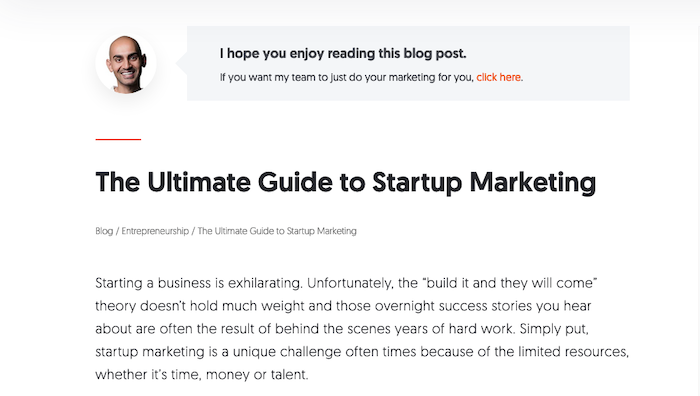
If you’re looking to grow your startup, I’m pretty sure you’ll get a huge amount of value out of my ultimate guide on the topic.
How to Design a Logo: The Ultimate Guide
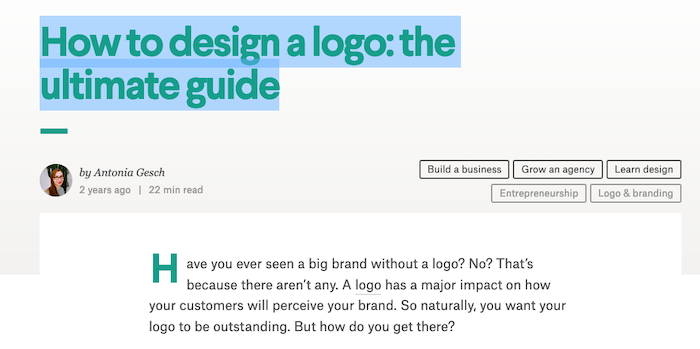
With 12 chapters and virtually every angle covered, there’s no reason to read another guide before creating your logo.
The Ultimate Guide to Cart Abandonment
If you’ve ever wondered why shoppers are leaving your website at checkout, this mammoth guide by VWO will answer all your questions.
The Ultimate Guide to Writing & Illustrating Your First Children’s Book

Ultimate guides don’t have to be about marketing, as this guide by Eevi Jones proves.
How to Pick a Career

While Tim Urban hasn’t called this an ultimate guide, you’re unlikely to find a more thoughtful or detailed blog post on picking a career anywhere online.
Further Resources on Ultimate Guides
This blog post isn’t exhaustive by any means. If you want to dive deep into creating high-quality long-form content, then check out these five resources:
How to Create an Ebook From Start to Finish by HubSpot
The Ultimate Guide Template by Copyhackers
Your Ultimate Guide on How to Write an Ultimate Guide (Infographic) by Express Writers
The Ultimate Guide to Creating a True ‘Ultimate Guide’ by Search Engine Journal
The Ultimate Guide To Content Promotion by Marketing Insider Group
How to Create Specs for an Ultimate Guide
You don’t have to write your ultimate guide yourself.
If you’re hiring a freelance writer to write your guide for you, here’s how you can create a spec they can follow with ease.
Give an overview.
A top-level overview can help a writer quickly get to grips with the topic and goals of the ultimate guide.
Create a clear structure.
Take the initiative and write an outline that includes all of the major points you want the writer to talk about.
This makes sure all of the gaps you identified in other pieces of content get covered.
Include keyword research.
If improved rankings are one of your main goals, then highlight the keywords you’re aiming to rank for.
Note or record your expertise.
Where appropriate, make notes for the writer to help guide them.
Alternatively, you can record yourself talking about the topic.
Provide additional resources.
Highlight a handful of top-quality resources your writer can turn to for inspiration.
Set a deadline
Expect an ultimate guide to take a fair bit longer to write than a standard blog post.
Ultimate Guide Frequently Asked Questions
How long should my ultimate guide be?
There isn’t a defined length for an ultimate guide, but most are at least 3,000 words in length.
How do I distribute my ultimate guide to my target audience?
You can use social media and email to get your ultimate guide in front of your target audience.
Should I create more than one ultimate guide for my website?
Absolutely. Ultimate guides offer a lot of value in terms of SEO and building your authority, so you should write as many as you can.
At what part of the funnel are ultimate guides most useful?
Ultimate guides can be used at any part of your funnel, but they’ll be most useful towards the top.
They are great at attracting users into your funnel and converting them to email subscribers.
Conclusion
Ultimate guides are an incredibly valuable marketing resource.
I’ve used them to generate huge levels of traffic, build my reputation as an authority in the industry, and improve my site’s SEO.
Follow the advice I’ve given above, and you’ll be on your way to achieving your content goals while sharing valuable insights about your chosen topic.
Have you created an ultimate guide on your website or blog?
What other tips would you add to making your ultimate guide a success?
Source: feedproxy.google.com

How to Use AI to Bolster Your Customer Journey
Wouldn’t it be awesome if you could skyrocket your lead-to-sales conversions to new heights?
Most business owners struggle with this.
Data shows that a whopping 79% of leads never convert to sales.
This highlights how challenging it can be to move leads through the customer funnel journey.
The good news is, Artificial Intelligence (AI) can supercharge your customer funnel journey to help you get more sales.
AI will efficiently weed out your low-quality leads and eliminate repetitive, time-consuming tasks, allowing you to focus on higher-quality and converting ones seamlessly.

AI will help your brand grow by preventing your leads from falling through the cracks at each stage of the customer funnel, which increases your sales-ready prospects for conversion.
Read on to learn more about how you can use AI to bolster your customer funnel journey.
Customer Funnel Journey: What is it?
A customer funnel’s structure and components can vary depending on the company or industry, among other factors.

The standard customer journey funnel stages can include:
Awareness.
This stage focuses on raising awareness for your brand and sharing information about your value with your target audiences.
Interest.
Here, your leads learn more about your business, products, and services.
You can introduce your positioning and capture leads by encouraging signups to your email newsletters (among others).
Consideration.
In this step, engage your leads actively by delivering personalized messages that reinforce your brand’s benefits.
Provide specific information to overcome objections and qualify your leads.
Evaluation.
Your prospects start showing interest in your products and services at this phase, deciding whether to buy from you or other brands.
Highlight why prospects should choose you over your competitors to make them stick.
Conversion.
After your leads convert to customers, market your onboarding materials, deliver messages celebrating their decision, and assess satisfaction levels.
This stage is also a great time to run your upselling and cross-selling strategies.
The customer funnel can show you how your leads interact with your brand and where they fall off.
This helps you refine and improve your strategies to keep your leads moving through each stage until they ultimately become paying customers.
A well-defined customer funnel journey helps you optimize your lead capture, engagement, nurturing, qualifying, and converting efforts.
It also informs your strategies to help you create immersive and memorable experiences across devices, channels, platforms, etc. that make your leads stick and convince them to become loyal clients.
The importance of using AI in the customer funnel journey
It’s time-consuming and labor-intensive to establish an effective customer funnel journey.
However, AI can do the heavy lifting for your sales and marketing teams through automated methods, such as autonomously identifying more qualified leads quickly.
This reduces the strain on your resources and your teams avoid needlessly chasing less-qualified leads.
AI can serve as your company’s sales and marketing virtual assistant by handling repetitive and tedious tasks.
This frees up your teams so they can focus on more meaningful, higher-level, and revenue-generating work.

The technology can also reduce human error and work 24/7, optimizing your lead engagement, nurturing, and qualifying efforts.
Through machine learning technology, you can “train” your AI to respond to conversations and events the way you would.
Your AI can learn from lead interactions and data, and the more input it accumulates, the more it can optimize its functions and responses on its own.
Ways to leverage AI in each stage of the customer funnel journey
Below are several ways AI-based technology can boost your customer funnel journey.
Streamline your lead generation efforts
The customer funnel journey typically begins with raising brand awareness, and this is where a lot of manual work is done.
For instance, you’ll need to build and design campaigns to tailor them to potential customers who haven’t heard of your products and services before.
This includes creating content such as blog posts, articles, lead magnets (ebooks and whitepapers), and website content (among others) to raise brand awareness and capture leads.
However, the content creation process can take a huge amount of time and resources — unless you use an AI-powered platform that can automate your content creation process.
This is where Broca comes in handy.

Broca provides a deep learning AI platform that generates content for your marketing and sales needs in a flash, saving you from the resource-draining aspects of building content.
If you’re creating content for all your campaigns, Broca delivers by instantly generating the content, from ideation to distribution, for your website and marketing channels.
First, provide a campaign brief (in a few sentences) describing your campaign and where you want to direct your traffic, such as your blog post or landing page.
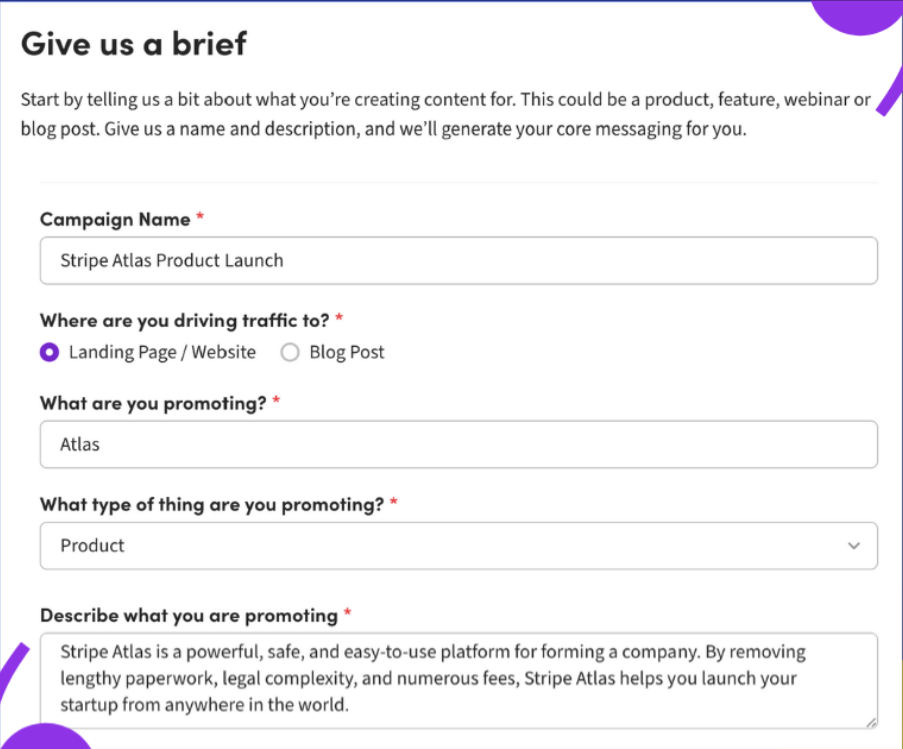
Image source: usebroca.com.
The platform then creates core messaging based on your campaign brief, giving you three key benefits of your brand, an enticing value proposition, and a killer headline.
You can validate and modify all these with your team before proceeding.
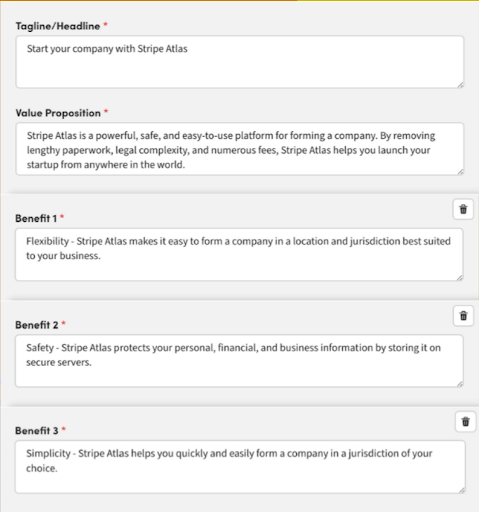
Image source: usebroca.com.
Finally, Broca creates promotional content out of your core messaging, providing you with brand-aligned and ready-to-distribute emails, ad copies, and social media posts.
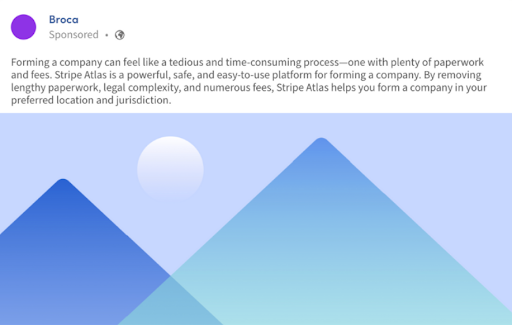
Image source: usebroca.com.
The platform creates your marketing and sales content across channels, which helps ensure your content and messaging remain consistent throughout the customer funnel journey.
Broca also streamlines creating Google ads by analyzing your current ads and generating new suggestions, putting your ad channels on autopilot.
A robust AI-based content-generating platform is a game-changer in your content creation for lead generation.
It significantly cuts down on the time-intensive, tedious, and usually complex process of creating effective content by doing the heavy lifting aspects of the process.
With AI under your tool belt, you and your teams don’t break a sweat but still get high-quality, consistent content at a scale that generates significant leads.
Automate your lead nurturing and qualifying processes
To get your leads to interact with your brand and guide them to the next stage of the customer funnel journey, you’ll need to nurture and qualify them.
However, the lead nurturing and qualifying process can take up plenty of time and energy that your sales team can optimize better to implement strategies to close deals.
The solution?
Delegate your lead nurturing and qualifying initiatives to a reliable virtual sales assistant.
If you want to take things a step further, use an AI-powered sales assistant.
One such solution is Exceed.ai.

Exceed.ai is a powerful virtual sales assistant with conversational AI that works alongside your sales and marketing teams to nurture and qualify your leads.
It helps you move your leads along the customer funnel journey until they are sales-ready.
Exceed’s AI-driven platform uses a conversational bot and machine learning technology to provide your leads with highly personalized and contextual interactions.
It uses AI to deliver human-like responses and follow-ups via chat and email, automating your lead engagement, nurturing, and qualifying processes.
First, it engages your leads through your web or chat-like forms through personable interactions.
Here’s an example of Exceed’s AI-generated email, in this case, from their own email marketing operation. (It’s always a good sign when a company uses its own product and Exceed does all of its lead nurturing via their AI assistant.)
The virtual assistant then assists your leads by answering questions, dealing with objections, and responding to their requests while simultaneously gathering data for your Customer Relationship Management (CRM).
Next, it implements automated nurturing and uses intelligent follow-ups to move your leads through the customer journey funnel stages.
The VA acts as a virtual Sales Development Representative (SDR) by validating your leads based on the previous and current conversations and your Sequence or Playbook (more on this later).
Finally, after the VA qualifies your lead, it hands over your sales-ready prospects to your human sales representatives for closing.
It can automatically book a schedule for your leads based on your sales reps’ appointment availability that you and your team configure within the Exceed.ai platform.
The AI-based virtual assistant handles the entire process, from engaging your leads to handing them off to your sales reps.
This saves your team tons of time and energy while ensuring you generate, nurture, and qualify your leads effectively.
Another key Exceed.ai feature is Sequences.
Sequences serve as your playbooks or campaigns with pre-built, customizable chat and email templates.
Each sequence for every campaign includes guided templates for many use cases, such as getting your lead’s attention, engaging them with a product intro, and handover chats or emails.
Customize the template or build one from scratch to set the automated responses your Virtual Assistant sends out for every sequence in your campaign.
All these features streamline your lead interactions as they move along the customer funnel journey.
With AI-led lead nurturing, your sales and marketing teams spend minimum effort and time on your lead nurturing and qualifying processes.
They can divert their resources to closing sales instead, boosting your business’ sales performance.
Improve customer conversations when closing sales
Not all prospects end up converting even when they made it as far as one-click or a conversation with your sales reps away from becoming a closed deal.
This makes it crucial to ensure your sales reps can skillfully and effectively steer the conversation so your prospects successfully convert into customers.
Here the Cogito, an AI software enters the scene.

It uses real-time emotional intelligence software and incorporates machine learning with AI. It can analyze voice calls between your reps and prospects (or customers).
The software is primarily designed to augment your call center and sales agents with an AI coaching system.
For instance, if your reps speak too fast during a customer call, Cogito sends a prompt alerting them to talk slower and pace how they speak.
Cogito’s technology combines speech analytics and conventional sentiment with proprietary voice insights, which can help your sales reps spot opportunities on the fly during prospect and customer conversations.
Cogito’s AI coaching software detects and measures the customer’s sentiment by:
- Using AI informed by behavioral science and machine learning to uncover over 200 voice signals, revealing how speakers feel.
- Uncovering trends, patterns, and problems through data compiled in many conversations over time.
It can be almost impossible to detect by humans alone.
Cogito also provides an automatically generated experience score that alerts your agents of the customer’s sentiment in real-time, helping them adjust their speaking style accordingly.
Enhance customer loyalty and retention
It can take less of your resources to retain existing customers than convert new leads, making the loyalty stage a critical phase of your customer funnel journey.
AI can help you retain and establish loyal customers through machine learning technology that automatically displays highly personalized right before and after-sales offers.
For instance, AI-based Ecommerce website software integrations can help you build, upsell and cross-sell strategies automatically.

Point of Sale
This can enhance your customer’s shopping experience further seamlessly while increasing your average revenue per buyer.
These tools can use machine learning and algorithms to deliver relevant and automated cart recommendations without requiring you to pre-set or configure anything.
In a nutshell, using an AI-driven platform that can seamlessly provide supplementary and interesting product offers tailored to each shopper boosts their customer experience.
This leads to a memorable experience with your brand, encouraging repeat business, nurturing trust, and in turn, increasing customer loyalty.
Start optimizing your customer funnel journey

AI-based software are powerful tools that can significantly reduce and streamline your busy-work tasks, enhancing the process and experience for your teams and your customers.
The right AI-driven platforms can help ensure your leads avoid slipping through the cracks as they move through each stage of the customer funnel journey.
These tools can help optimize your strategies to effectively convert your leads into paying and loyal customers.
While investing in tools with AI capabilities might not be cheap to start, the benefits can far outweigh the costs, and you will end up with seamless and efficient lead conversion processes in the long run.
The post How to Use AI to Bolster Your Customer Journey appeared first on Content Marketing Consulting and Social Media Strategy.
Source: convinceandconvert.com

Lead Conversion Statistics All B2B Marketers Need to Know
B2B marketing is complex with a myriad of tactics, technologies, and data solutions to choose from to promote your business and sell your products and services.
As complex as modern B2B marketing is, it is also as simple as:
- How do I attract people to my products and services?
How do I convert those people to purchase?
Ascend2, in partnership with Verse, surveyed 277 marketing professionals to learn more about the state of lead conversion.
If you find that lead conversion is difficult, you are not alone.
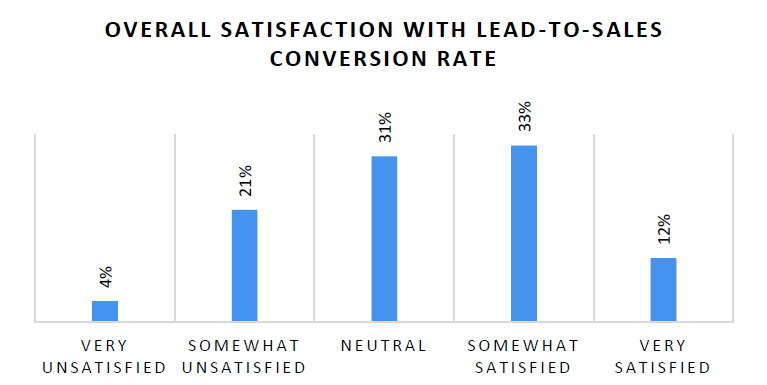
The State of Lead Conversion in Marketing and Sales found that only 12% of marketing professionals are very satisfied with their lead conversion abilities.
Companies continue to struggle with establishing contact, qualifying, and effectively following up with the leads they spend so much time and money to generate.
Lead conversion is challenging, but the inability to improve lead conversion rates has several significant, negative downstream impacts:
- wasted marketing budget,
- wasted sales team time,
- And significant lost revenue opportunity.
“Verse calls this the lead conversion gap, and we believe closing it is the next frontier for marketing and sales,” said David Tal, Verse co-founder, and co-CEO.
The Lead Conversion Report provides valuable insight to help companies understand the lead conversion gap and provides insight and tips on how to close the gap.
Noteworthy Lead Conversion Statistics & Findings Based-on It
Here are a few noteworthy lead conversion statistics from the research study, The State of Lead Conversion in Marketing and Sales.
Finding #1: Companies Need More Lead Qualification Data
Lead conversion is hard. Identifying the challenges with lead conversion allows you to develop a plan to overcome those challenges.
Gathering and organizing relevant data, then leveraging it to better communicate with your leads is essential to increasing lead conversion rates.
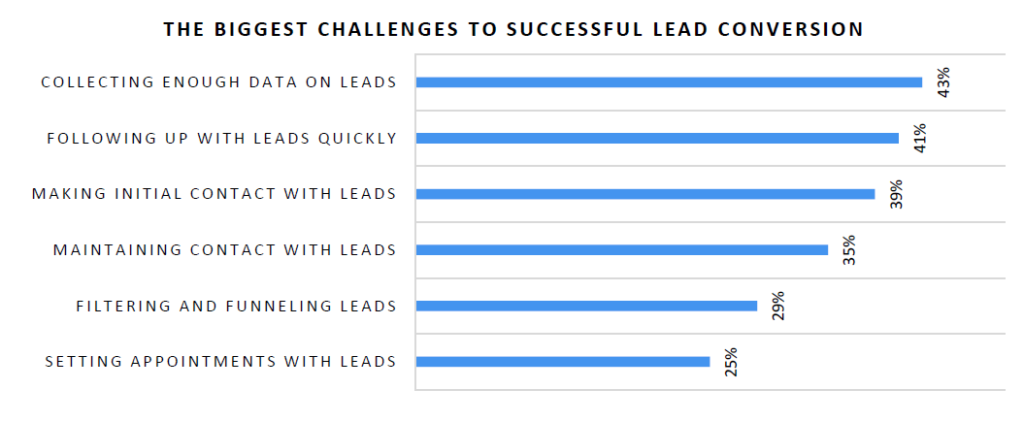
43% of those surveyed report that collecting enough data on leads is the greatest barrier to successful lead conversion.
Following up with leads quickly, before they lose interest, and making initial contact with leads also rank at the top of this list of challenges for 41% and 39% of marketing and sales professionals, respectively.
Finding #2: Companies Struggle to Establish Fast Initial Contact with Leads
Research shows that the 24/7 speed of response to a lead inquiry is critical for improving conversion.
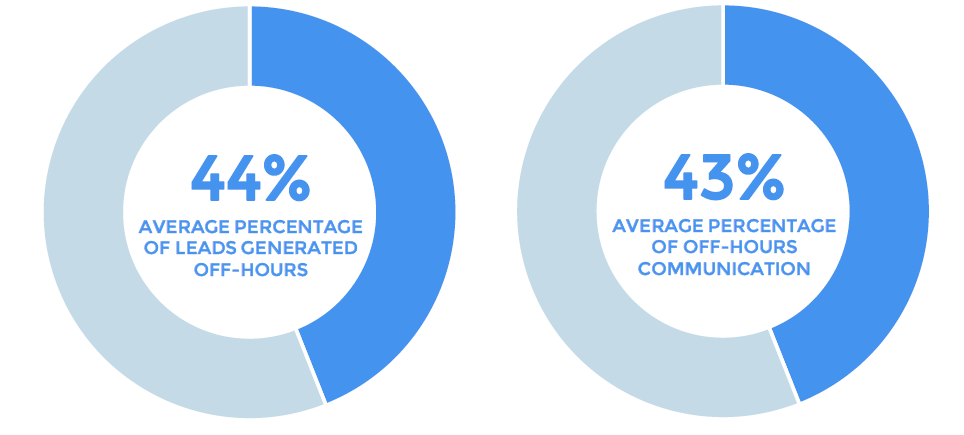
41% of companies feel following up with leads quickly is a challenge, especially given that a significant number of leads come in after regular business hours.
There are three reasons Inside Sales cited why speed-to-lead is so vital:
- Presence detection – if a lead puts their information in on a website or fills out some sort of online inquiry form, the lead is likely still next to their phone or computer. Contacting a lead immediately provides the best odds by far for getting a lead to engage quickly.
- Top-of-mind-awareness – this concept of calling or contacting a lead immediately equates to staying on their mind. The average callback time is nearly 48 hours after a lead submits an inquiry — if you can’t outperform that significantly, the consumer will likely have forgotten about your business. (InsideSales.Com)
- The “Wow” effect – people seem to be impressed rather than concerned when a company follows up within minutes of inquiring! This “wow” factor creates a response from consumers that establishes immediate trust. Prospects likely correlate the promptness of response and assume that their business was prioritized and valued.
The speed-to-lead mission is non-negotiable for sales teams to capitalize on their leads.
According to LeadSimple, you’re 21X more likely to convert a lead if you respond within the first 5 minutes versus 30 minutes.
Finding #3: Communication Capabilities Matter
The vast majority of marketing and sales teams are utilizing more manual and time-consuming methods of attempting contact with inbound leads.
Over two-thirds of those surveyed say email (37%) and phone calls (36%) are the communication channels used most often to follow up with inbound leads.
Only 6% of those surveyed take advantage of text/SMS to follow up with leads.
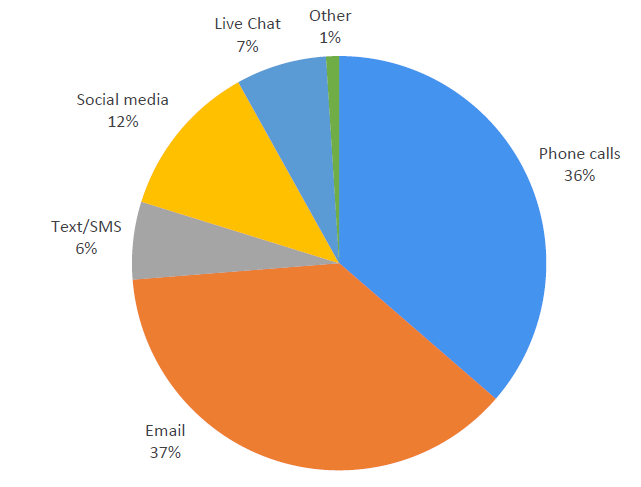
A Closer Look: Do you use text to follow-up with leads?
89% of consumers prefer to communicate with businesses via SMS. With an opportunity as clearly defined as this, now may be the time to re-examine your communication strategy and ask the question, are phone and email still the best option?
Finding #4: The State of Marketing Automation
Nearly half (44%) of those surveyed have email marketing automation and 39% use a Customer Relationship Management (CRM) tool.
Interestingly, only 25% of marketing and sales professionals have automation software specific to lead conversion.
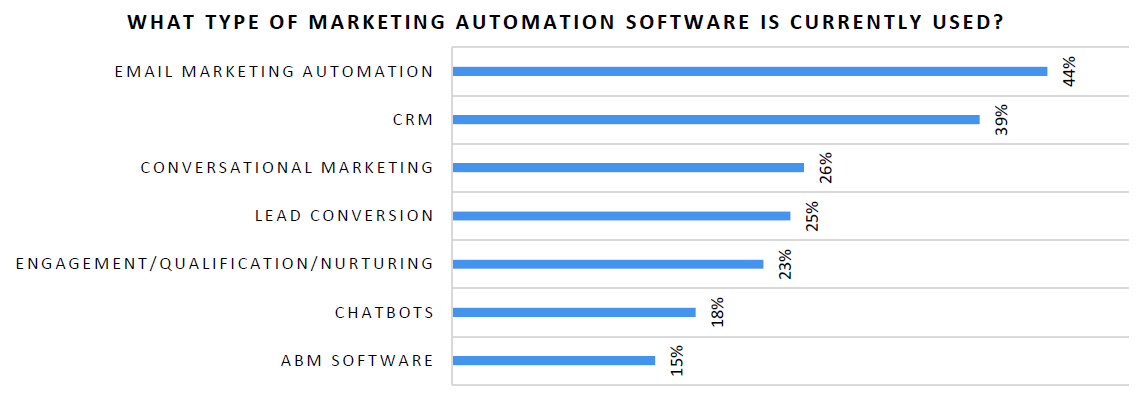
Did you know?
There are 8,000+ MarTech solutions and the number continues to grow.
There is plenty of technology available but expensive and complex tech stacks aren’t cutting it, especially at the bottom of the funnel.
Smart integration between systems is critical to success.
For example, software that integrates with any CRM solution, meaning you do not have to invest tons of time and money creating and maintaining additional software for the sake of a contact center.
This simple solution is one more step to closing the lead conversion gap.

Join the Course Now.
Bonus Finding: Sequencing Matters
According to 43% of marketing and sales professionals, the first attempt to contact a lead is made by phone call, followed by email for 40%.
By the third follow-up attempt, those surveyed begin to utilize text (21%) and live chat (11%) more frequently.
The most common follow-up sequence is: ❶ Phone → ❷ Email → ❸ Phone
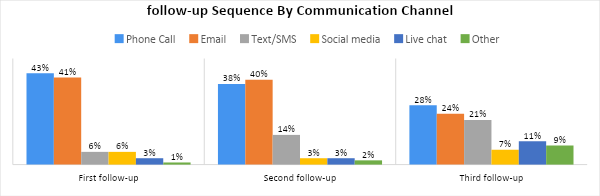
Lead Conversion Follow Up Sequence by Channel
While phone calls remain the communication channel of choice, 87% of people don’t answer phone calls from numbers they don’t know.
And according to Gartner, SMS/text is much more effective than email – 98% of text messages are read, compared to just 22% of emails.
Final Thoughts
How are you closing the lead conversion gap?
Please leave a comment and share what is working for you. How are you improving data, sequencing your follow-up, securing and speeding up the first contact, and using technology to optimize the process?
Help the community by sharing what works for you.
You can download the entire The State of Lead Conversion in Marketing and Sales for more data, tips, and strategies to close the lead conversion gap.
The post Lead Conversion Statistics All B2B Marketers Need to Know appeared first on Content Marketing Consulting and Social Media Strategy.
Source: convinceandconvert.com

How to Properly Leverage Lead Scoring to Make More Money
I’m going to introduce you to the world of lead scoring and help you understand what it takes to build an effective lead scoring model for your business.
The biggest brands in the world understand one simple truth: Not all leads are created equal.
Having the ability to find and convert high-quality leads is what keeps these brands successful.
The best and brightest aren’t just focused on volume; they want to sell to the best possible prospects.
Today, we’re taking a page out of their book and focusing on the quality of leads.
Whether you’re running a corporate startup marketing campaign or moving your local business into the digital age, you can’t afford to waste time and money on weak leads.
That’s why I’m going to introduce you to the world of lead scoring and help you understand what it takes to build an effective lead scoring model for your business.
What is Lead Scoring?
Before we dive deep into the metrics and methods you’ll use, let’s establish a baseline definition of lead scoring.
At its core, lead scoring functions are a tool for marketers looking to qualify their leads accurately.
Lead scores are used to determine how likely a particular prospect is to convert based on specific characteristics.
Why do lead scores matter?
As I mentioned earlier, not all leads are the same.
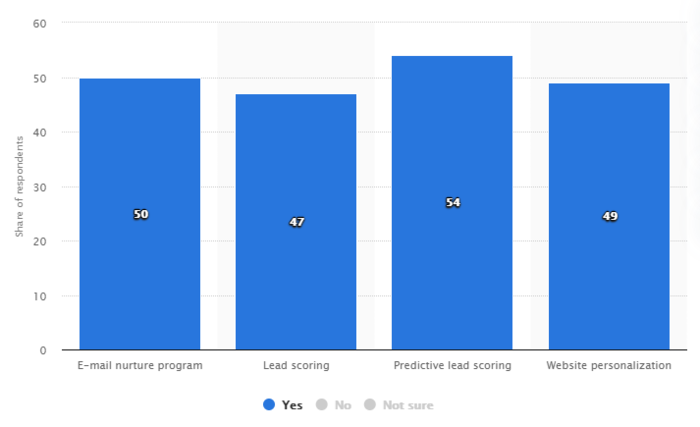
Forty-seven percent of B2B marketers found lead scoring to be effective, with 54 percent pointing to predictive lead scoring effectiveness.
The chances of converting a cold call lead are drastically lower than those of a referral lead.
Using lead scoring, you’re able to arm yourself with a system that tracks and calculates lead scores.
What Are the Pros of Using Lead Scoring?
Now that you understand what lead scoring is, let’s talk about why it’s beneficial to your bottom line.
Less Wasted Time and Money
A business that uses lead scoring learns how to allocate its resources efficiently.
Spending thousands of dollars and hundreds of hours on a marketing campaign that delivers average returns and unclear data is not something most businesses can afford.
Accurate Buyer Personas
Lead scoring is especially useful for businesses selling high-value products and services.
The more complex the decision, the longer your average conversion time from prospect to customer.
By evaluating their behavior throughout the buyer’s journey, you’re able to identify the prospects most likely to convert.
Using that information, you can update your buyer personas and start crafting marketing campaigns focusing on prospects typically converted.
Strengthen Your Prospect Relationships
The deeper your understanding of a buyer’s journey, the more likely it is that you’ll be able to point them toward a conversion.
Imagine for a second that Business XYZ already has a fantastic click-through-rate using paid ads.
Ten percent of impressions lead to a click. That’s great news!
There’s just one problem: Its conversion rate is terrible.
For whatever reason, it can’t consistently attract buyers.
By using lead scoring, Business XYZ can determine what pages and experiences scare away potential customers.
More importantly, it’s able to change and improve those experiences, strengthening its marketing funnel’s weaker elements.
This behavior doesn’t just earn more conversions.
It also helps prospects feel more secure about their purchase and develops the business’ reputation as a customer support specialist.
It becomes known as a business that takes care of its customers at every stage.
By developing a deeper understanding of your customers using lead scoring, you’re able to create unparalleled user experiences.
Simplify the Lead Evaluation Process
Manually, the ability to optimize your marketing and sales efforts with lead scoring identifies and converts the right prospects much easier.
Of course, if you’re looking at automated solutions, you’ll be able to qualify leads using predetermined guidelines quickly.
Metrics for Scoring Your Leads
The actual process of scoring your leads can be a bit intimidating, even if you’re an experienced marketer. To keep this guide accessible, I’ll focus on four key metric classifications to rely on.
Demographics
One of the most basic marketing concepts is the buyer persona, a representation of your ideal customer.
To build this buyer persona and begin determining the appropriate metrics for your lead scoring efforts, you need to begin with their demographic.
Personal information like age is a common starting point, but you’ll likely want to focus on professional information and capacity too.
Ask these questions:
- What characteristics does your ideal customer have?
- How do these characteristics empower them to make a purchase?
- How can you create experiences that appeal to these customers?
If you’re selling a high-value B2B product or service, it’s unlikely that students are your ideal target audience. However, if your lead identifies as an industry professional, they’re much more likely to convert.
Lead scoring helps you organize this information, test your theories and assumptions, and identify the factors contributing to a conversion.
Point of Origin
Break down the buyer’s journey and start with their first point of contact.
If you have a sales background, this process should feel familiar.
When determining which metrics to use, identify the lead’s point of origin.
Look to see where your leads are generated.
Are they on your site because of organic search, or did they click on an ad?
Did they visit your site on mobile or desktop?
As you track the sources of these leads, you’ll find that certain lead channels produce leads that are more likely to convert than others.
You’ll also notice certain combinations have unique conversion rates.
For example, a lead that reached your landing page through a post on social media should have a lower score than an organic search lead that’s visited the pricing section three times.
Different points of origin are given different scores, making it easy to determine both the marketing channel’s overall value and the lead’s individual quality.
Focusing on the source also keeps your sales team informed.
By preparing your sales team with contextual information on the prospect, they can accurately determine the prospect’s knowledge of the business and product or service.
Behavior
A prospect’s point of origin is an important building block when determining their conversion potential, but it’s just the tip of the iceberg.
Analyzing prospect behavior and actions can help you identify the paths that lead to a genuine sale.
Most lead scoring systems use a points system, attributing specific values to particular behaviors.
The beauty of this approach is that you’re able to stress-test your assumptions about your business and determine how impactful a particular behavior is.
For reference, an action is a decision a particular lead makes once they’ve started interacting with your business. These can include:
- visiting a landing page
- subscribing to a newsletter
- requesting a price quote
- signing up for a product demo
- reading blog articles
- asking questions via online chat
If email signup is a massive predictor of conversion, give that a high score and you’re able to focus all of your attention and marketing efforts on prospects that sign up for your newsletter.
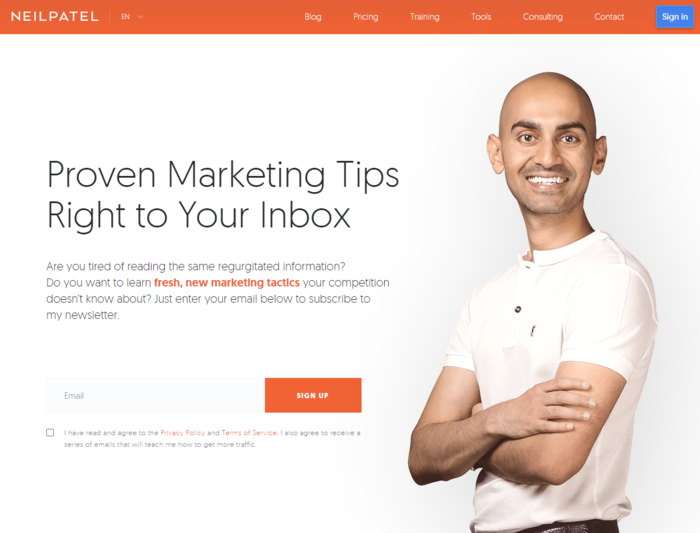
If you’re right, your conversion rate rises, and you can continue to optimize.
If you’re wrong, your conversion rate doesn’t rise to meet your goals, you take a closer look at your data and restructure your score allocation.
Either way, your business walks away with a win.
Engagement
Engagement and actions are two separate categories.
Actions track the individual decisions prospects make, like reading a blog post or signing up for a newsletter.
Engagement tracks the timing of those decisions, identifying how much time they spend on a blog post or email.
A general rule of thumb is that the longer a prospect spends consuming your content and interacting with your business, the more likely they are to make a purchase.
Of course, you’ll likely want to set a maximum achievable range to avoid ruining your data.
For example, if a prospect leaves their computer on overnight, that could harm your lead scoring efforts.
Methods for Scoring Your Leads
The methodology for scoring your leads can be broken down into two sections:
- Lead scoring strategy.
- Common practices.
Lead Scoring Strategy
Establishing a clear, baseline process for lead scoring can help your business from a mechanical perspective.
Determine Metrics to Score
Let’s start with the baseline process.
You’ll begin by determining the metrics and variables you want to score.
While it’s easy to focus on highly converting metrics, you also need to determine which metrics convert poorly.
This can help you better understand your market and customers.
Calculate Values
Next, calculate both the value of the metrics and the value of your leads.
Common Practices:
There are two common approaches to calculating the value of a metric:
Conversion rate: This is simple enough to calculate. Divide the number of conversions by the number of leads attained and multiple by 100.
Lead yield: This approach is a bit different.
- It’s a measurement of the total revenue made from conversions.
- Take your revenue and divide it by the number of leads generated.
- This gives you the average value of a particular conversion.
To be clear, there’s no right answer. The method you use depends entirely on your overall business goals and pricing structure.
Making calculations based on conversion rate might be a great idea for B2B SaaS businesses with long lifetime-value customers.
B2C businesses and companies that offer fixed-price products are more likely to find lead yield useful.
After all, the higher the value of an individual sale, the more valuable that lead was.
Compare Values
Now you can compare the value of a particular group of conversions to the average value of all your conversions.
This lets you qualify the performance of a particular metric and determine its importance.
Assign Scores
Based on the performance of a particular metric in relation to the average customer, you can assign that metric a score.
Most organizations use a scale from 1-10, but that’s a personal preference.
You could use a 1-100 scale for increased precision; it’s entirely up to you.
However, be sure to create a rubric or key to keep your scoring system consistent.
Evaluate Leads
You’ve established some metrics and some scores at this point, so let’s start evaluating individual leads.
Here’s an example: Imagine you’ve ranked the accounting industry as a 10-point attribute, a C-level executive as a 5-point job title, and corporate enterprises as 10-point company size.
A lead matching each of those metrics has a total score of 25.
You can now compare that score against your average customer and other leads to determine your leads’ priority. Simple enough, right?
Lead Scoring Tips
Incorporating useful tips and tricks can help you elevate the quality of your lead scoring efforts. Consider a couple of key concepts:
Values metrics accordingly:
For starters, not all metric categories should be valued equally.
A demographic metric doesn’t carry the same weight as a behavior metric.
Signing up for a consultation is a much stronger indicator of interest than a job title is.
Values can be cumulative:
It’s also worth keeping in mind that some of these values are cumulative.
Meaning that while a prospect’s job title is only counted once, all of their actions are considered when calculating the lead score.
Tracking the Success of Lead Scoring
As your lead scoring efforts develop, you’ll notice an increase in both the sheer volume of leads and the complexity of your lead scoring system.
As you interpret your results and look to improve, you’ll encounter two hurdles:
- optimizing for scale,
- optimizing for effectiveness.
Optimizing for scale has some simple solutions.
If you’re on a budget, lead scoring manually with spreadsheets and formulas is perfectly reasonable.
However, if you’re willing to pay for the best, some fantastic tools are available to automate this entire process for you.
The right tool can identify patterns in your data that you may have missed.
This is where predictive lead scoring comes into play.
These algorithms can predict which prospects are qualified and worth engaging with.
They may not be cheap, but if your business is serious about elevating your lead quality, automated tools can be a powerful addition to your toolkit.
To optimize for effectiveness, the most important thing you can do is to make the ongoing evaluation of your lead scoring model a vital, regular occurrence.
Continue to improve on the defined mechanisms and make meaningful changes to your scoring model when needed.
Like any marketing campaign, this technique can always be improved upon.
Conclusion
Every business on the planet wants qualified leads. With less wasted time and more conversions, what’s not to like?
The problem is that with so many different lead generators and traffic sources, identifying the key components of a strong prospect can be challenging.
Lead scoring exists as a tool to clarify and optimize the lead generation process in a logical way, so any small business owner can start implementing it today.
With the right lead scoring model in place, your business can increase both the quality of your leads and your users’ experiences.
Which metrics do you think matter the most in lead scoring? Let me know in the comments below!
The post How to Properly Leverage Lead Scoring to Make More Money appeared first on Neil Patel.
Source: neilpatel.com

How SiteGeek Saved and Then Doubled Their Business and Started Landing More Qualified Leads and 10X Bigger Clients (Plus 3 Proven Tips to Help You Grow Your Own Business)
At DigitalMarketer, we get to work with a lot of incredible businesses, and our absolute favorite thing is seeing a great company find even greater success with the training and strategies we teach.
And it’s not just because we love celebrating our customers’ success (though we really do love shouting them all out!).
It’s also that we want to see what exactly it was that pushed the needle, landed those clients, and took their sales to the next level.
Because our second favorite thing is passing on those successful tricks and strategies to the next struggling marketer.
It’s a never-ending cycle of marketing gold, see?
One such success story comes from SiteGeek, an award-winning digital marketing training consultancy.
By implementing the strategies and processes from the DigitalMarketer Certified Partner Program, SiteGeek started to rake in more, better-qualified leads and landed bigger, higher-ticket clients.
This meant they were able to save and then double the size of their business!
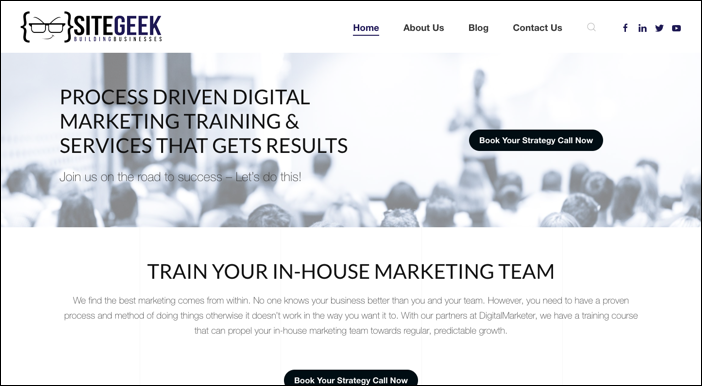
We wanted to share this story, and then in case you are struggling to find your own success, we’ve broken down 3 strategies you can try for yourself.
We know they worked for SiteGeek, so they will probably work for you!
Struggling to Find High Ground
When Steve Hooper, the Founder of SiteGeek, first joined the DigitalMarketer Certified Partner Program, he was struggling.
His company was in deep water because of a catastrophic accounting error, and while he had a steady stream of customers, he wasn’t happy with the direction his company was headed.
Steve was relying heavily on word of mouth and referrals from years of SEO and networking to get customers.
And the clients he did get were usually low budget, often with less than $500 total to spend.
It was a constant, daily grind of building websites and doing minor consulting work, and Steve felt more like he was up the creek in a leaky boat with teaspoons for paddles, when he should have felt like an elite-level white water rafting expert, navigating the sharp rocks and rough currents of the marketing world.
And then he found DigitalMarketer.
Or more like, DigitalMarketer found him.
One evening, while scrolling through Facebook, Steve happened upon a video from Ryan Deiss (the man, the myth, the legend), whom he recognized from a conference several years prior.

And before he knew it, Steve was joining on as a new partner in the Certified Partner program, looking for structure and direction, as well as ways to grow his business and hone his process.
The Ah-Ha Moment
Joining the CP Program gave Steve access to a wealth of marketing tools and tactics that he could not only use to help his clients but could also use to better his own marketing efforts.
What’s the biggest problem most marketing agencies face? Hint: it’s not bad marketing. They can create some of the best marketing for their clients, but they often don’t have the time or energy to market their own business.
Steve dove right in and started to implement programs like the Double Your Sales sessions (a legacy DM product), which took his conversions to a rate he’d never seen in his previous one-on-one or email conversations with potential clients.
The one-page product sheets, Agency Growth toolkits, and video training all gave Steve the structure and direction he needed in his own marketing, and soon he was able to do it in a quarter of the time—which meant he could spend more time working on his clients’ businesses.
It wasn’t all sunshine and daisies.
Anyone who’s ever taken great training or learned a new strategy can understand that it’s not as simple as just snapping your fingers.
With so much new material to work with, Steve found himself struggling to see how some of it fit into his business model.
But after mastering the foundations laid out in the CP Program (like the Customer Value Journey we will cover later), he began to see how it all fit together.
This Side of Success
With all these new tools and tactics, Steve is seeing his company rise to new heights.
He has fewer, better clients with budgets upwards of $5000/month.
More than 10X what they were before. And he is able to hire more team members to work with those clients.
He is seeing a return on ad spend that has doubled because his funnels work better than ever, and he has even launched a podcast, Digital Marketing Confessions, where he talks with marketing experts about what’s working (and not working) in digital marketing right now.
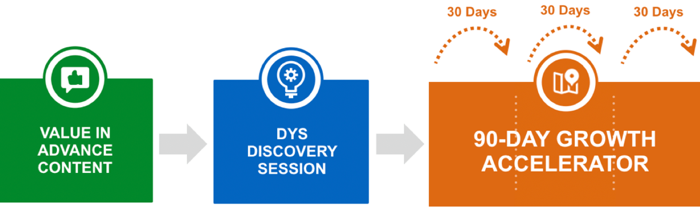
SiteGeek has doubled in size, and since Steve is currently going through the 90-Day Accelerator, he expects to see even more growth in the coming months and years.
When Steve was looking into becoming a Certified Partner, he was trying really hard to discover new ways of doing things and a true path for himself and his business.
The training he found in the program allowed for exactly that, and he dug deep and pushed himself to do the work that got results.
But what were those specific things that got results, you ask?
There were 3 specific tactics that Steve found to make the most impact in his business, and in his success as a CP.
3 Tactics to Help You Grow Your Own Business As SiteGeek Did
When we talked to Steve about what really made the biggest difference, he said that honing his Customer Value Journey, providing value in advance, and leaning on the CP community were the most important strategies.
So we’ve broken those ideas down a bit more, that way you can use them yourself. We’re providing you the value in advance  .
.
The Customer Value Journey
We talk about this framework a lot. Like, A LOT a lot.
But if you’re new to the game, the Customer Value Journey is a marketing framework that breaks down the different stages your customer will go through in their relationship with your business, from just becoming aware of you to shouting your name from the rooftops telling everyone to be your customer.
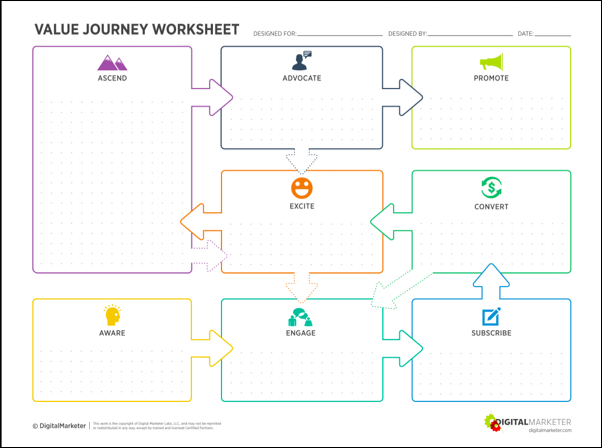
This should be one of the most important foundations of your business and your marketing.
You should know exactly what content, emails, or ads your customers are seeing depending on where they are in the value journey.
And different stages should have different content.
After all, if someone just learned about your company, you don’t want to immediately ask them to buy your highest-priced item or service.
You want to make sure your customers are flowing through this in the right order and hitting every step.
And when you map out how your funnels align with the CVJ, you might just find that you are missing steps or getting ahead of yourself.
So map out your own customer’s journey through your business and you’ll be better prepared to guide new potential customers who could have gotten lost without this map.
Provide Value in Advance
A lot of business owners (and marketers in general) are leery of giving away too much information or content before they get a contract signed and a check in the mail.
After all, what’s stopping potential customers from taking what you give them for free and then going to someone else, or even trying to do it themselves?
Nothing. Absolutely nothing.
But Steve learned (and we have always taught) that when you provide value to your customers before you ever ask for a dime, most times they don’t just cut and run.
Usually, they stick around and see what else you have to offer.
When you give value, you are getting something worth way more than money in return (and we all know that money is worth a LOT).
You are getting trust. By showing your customers just how much you know, and giving away some of your expertise for free, you are proving that you are the expert they should turn to when they are ready to break out the checkbook.
Because remember, marketing is hard.
There’s a reason that marketing agencies stay in business. If you do give away a strategy for free, most people are going to see what it takes to implement and turn right around and ask you to do it for them.
So always start your sales conversation by providing value in advance.
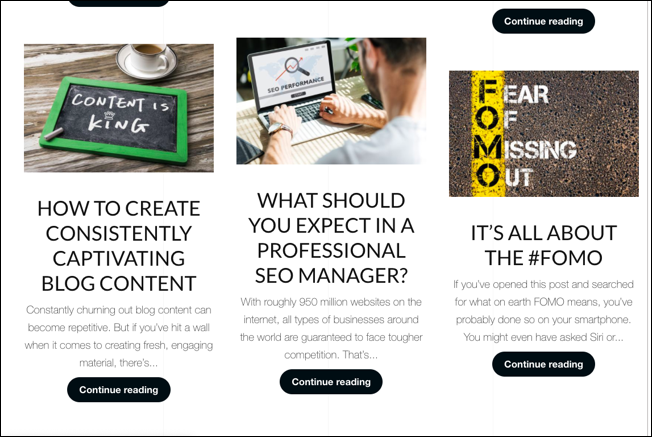
Maybe this means you fill your blog with tactical content (like you can see SiteGeek did below), or maybe you set up a sales presentation that is full of useful strategies before you ever bring up contracts.

Whatever is best for your business, when you start with value, you’re guaranteed to see a return.
Lean on Your Community
This was the tip that came up again and again. Steve’s favorite thing in the CP program, and his biggest piece of advice to anyone joining the program, was to really take advantage of the community.
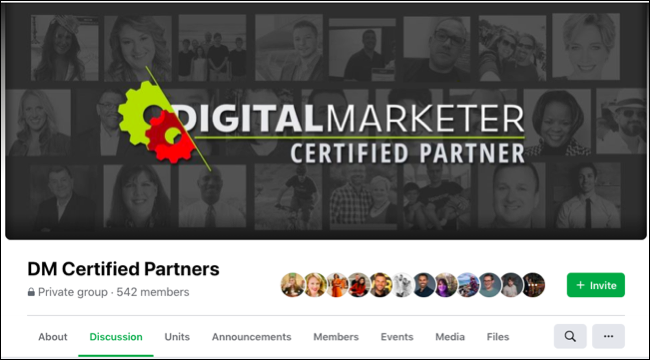
In the case of the CP Program, we have a Facebook Group where all our CPs can talk about their businesses and help each other out with any sticking points.
This community is often what keeps our partners in the program for years and years.
But you don’t have to be in this specific community to benefit from this tactic.
Whether you are in this CP group, the DM Engage group, a different online marketing group, or just part of a brunch crew with other business owners, the community can make or break your success as a business.
When you are a part of a community of people in similar situations or with similar problems, you can not only get advice about your particular issues, but you can help other people with theirs.
You can build up your authority in the industry and find new networking opportunities (just make sure you aren’t that person trying to hark your product in the Facebook group if it’s not allowed).
A community is usually a safe place to discuss roadblocks and the best place to bounce ideas off people who really know their stuff, and may have gone through a similar thing.
Remember, you don’t have to go it alone. Take your community with you.
And no matter what stage your business is or what you hope you improve, these 3 tactics will give you a step up.
So if you want to double your business, just follow the advice above.
After all, we know they work!
The post How SiteGeek Saved and Then Doubled Their Business and Started Landing More Qualified Leads and 10X Bigger Clients (Plus 3 Proven Tips to Help You Grow Your Own Business) appeared first on DigitalMarketer.
Source: digitalmarketer.com

Why I Spent $500,000 Buying a Blog That Generates No Revenue

(If you are wondering, the image of me above was taken when I used to work at KISSmetrics with Hiten Shah… I used to have hair)
In early January 2017, I purchased the KISSmetrics website for $500,000.
If you go to the site, you’ll notice that it forwards here to NeilPatel.com (which I will get into later in the post).
The $500,000 didn’t get me the company, KISSmetrics, or any of the revenue streams.
The parent company, Space Pencil, is continually improving and developing the product.
And on top of that, there are restrictions.
I can’t just pop up a competing company or any company on the KISSmetrics site.
So why did they sell me the domain?
And why would I pay $500,000 for it?
I can’t fully answer why they sold it, but I do know a lot of their customers came from word of mouth, conferences, paid ads, and other forms of marketing that didn’t include SEO or content marketing.
For that reason, the domain probably wasn’t as valuable to them as it was to me.
And of course, who wouldn’t want extra cash?
I’m assuming they are very calculated because they are an analytics company, so they probably ran the numbers on how much revenue the inbound traffic was generating them and came to the conclusion that the $500,000 price tag seemed worth it.
Now, before I get into why I spent $500,000 on the domain, let me first break down my thought process as I am buying out a lot of properties in the marketing space (more to be announced in the future).
Why am I buying sites that aren’t generating revenue?
This wasn’t the first or the last site that I’ll buy in the space.
I recently blogged about how I bought Ubersuggest. And it wasn’t generating a single dollar in revenue.
Well technically, there were ads on the site, but I quickly killed those off.
And eventually, I ported it over to NeilPatel.com.
When I am looking at sites to buy, I am only looking for 1 thing… traffic.
And of course, the quality (and relevancy) of that traffic.
See, I already have a revenue stream, which is my ad agency, Neil Patel Digital.
So, my goal is to find as many sites that have a similar traffic profile to NeilPatel.com and leverage them to drive my agency more leads.
How do you know you won’t lose money?
I don’t!
This approach doesn’t guarantee I’ll make more money.
I look at the business as tons of tiny experiments.
You don’t build a huge business through one simple marketing strategy or tactic.
You have to combine a lot of little things to get your desired outcome.
And sometimes you’ll make mistakes along the way that will cost you money, which is fine.
You have to keep one thing in mind… without testing, you won’t be big.
With my ad agency, we tend to mainly have U.S. clients.
Yes, we serve other regions as well… for example, we have an ad agency in Brazil.
But I myself mainly focus on driving traffic to the U.S. ad agency, and the other teams just replicate as I don’t speak Portuguese, German, or any of the required languages for the other regions we are in.
So, when I buy companies, I look for traffic that is ideally in the U.S.
Sure, the ad agency can work with companies in Australia, Canada, and even the United Kingdom, but it’s tough.
There’s a huge difference in currency between Australia and the U.S. and the same goes for Canada.
And with the U.K. there is a 5 to 8-hour time zone difference, which makes it a bit more difficult to communicate with clients.
That’s why when I buy a site, I’m ideally looking for U.S. traffic.
When I bought Ubersuggest it had very little U.S. traffic.
Indonesia and India were the two most popular regions.
But I bought it because I knew I could build a much better tool and over time grow the U.S. traffic by doing a few email blasts, getting on Product Hunt, and by creating some press.
And I have…

As you can see from the screenshot above, U.S. is the most popular region followed by India and Brazil.
Over time it shouldn’t be too difficult to 3 or even 4x that number as long as I release more features.
Now, my costs on Ubersuggest have gotten into the 6 figures per month, and I am not generating any income from it.
There is no guarantee that it will generate any revenue, but I have a pretty effective sales funnel, which I will share later in the post.
Because of that sales funnel my risk with Ubersuggest is pretty low.
As long as I can grow the traffic enough, I should be able to monetize.
What about KISSmetrics?
As for KISSmetrics, I mainly bought the domain for the blog traffic.
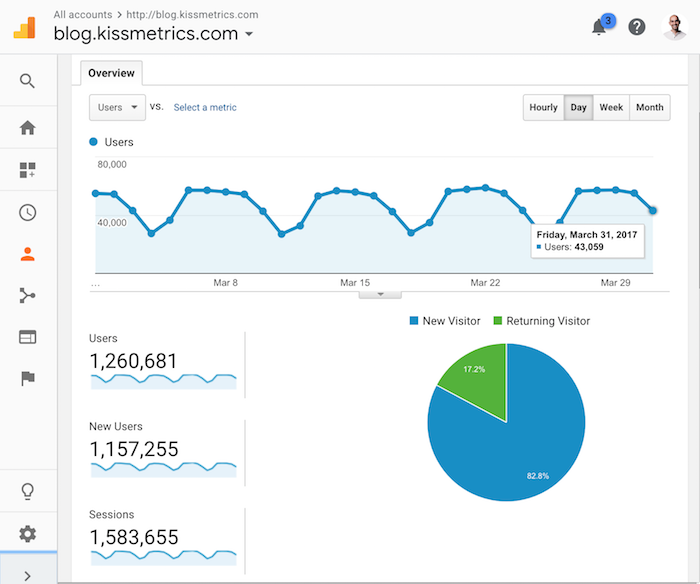
During its peak it was generating 1,260,681 unique visitors per month:
By the time I bought the blog, traffic had dropped to 805,042 unique visitors per month:
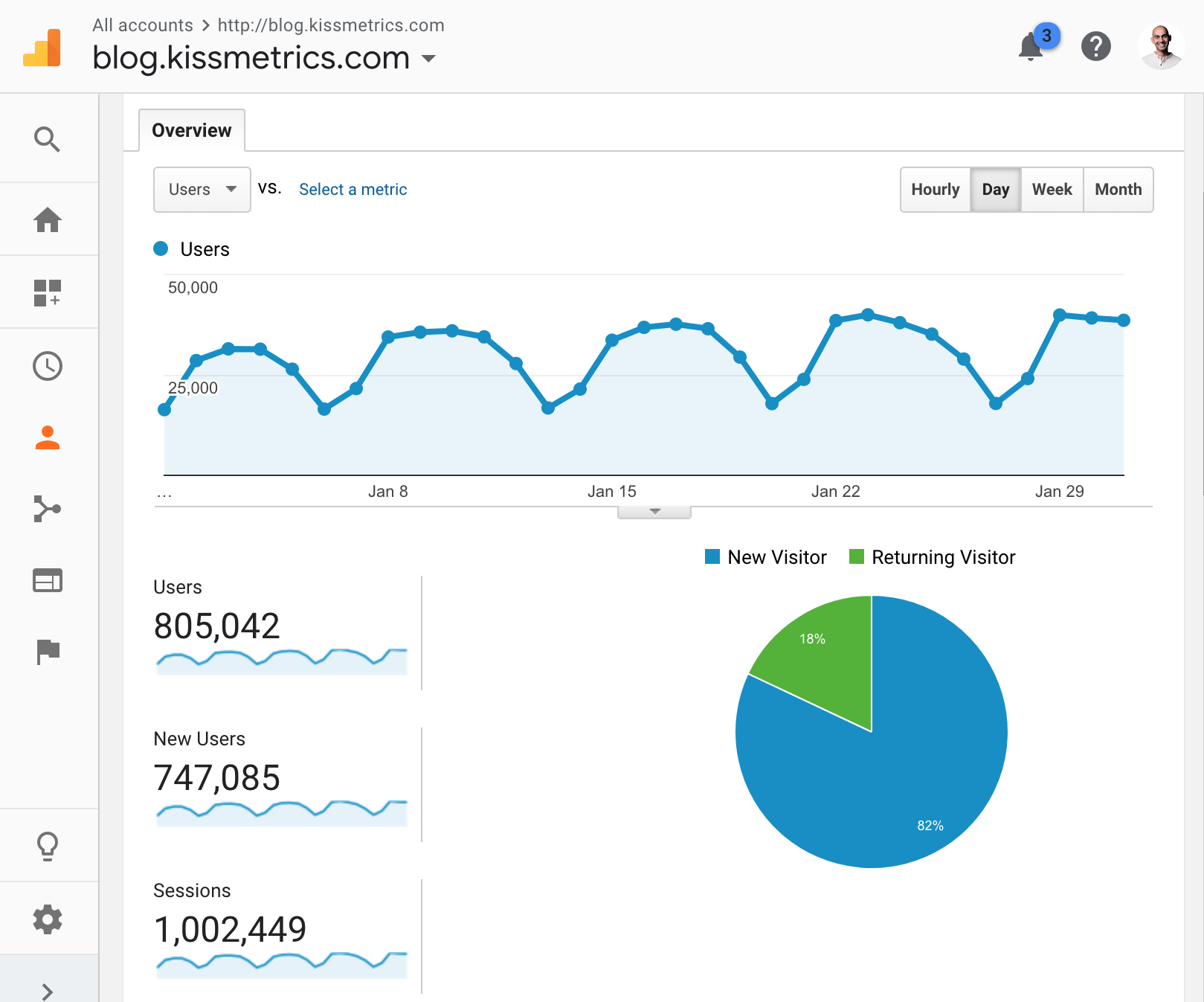
That’s a 36% drop in traffic. Ouch!
And then to make matters worse, I decided that I wanted to cut the traffic even more.
There were so many articles on KISSmetrics that were outdated and irrelevant, so I had no choice but to cut them.
For example, there were articles about Vine (which Twitter purchased and killed), Google Website Optimizer (no longer exists), Mob Wars (a Facebook game that no longer exists)… and the list goes on and on.
In addition to that, I knew that I could never monetize irrelevant traffic.
Yes, more traffic is good, but only as long as it is relevant.
I instantly cut the KISSmetrics blog in half by “deleting” over 1,024 blog posts.
Now, I didn’t just delete them, I made sure I added 301 redirects to the most relevant pages here on NeilPatel.com.
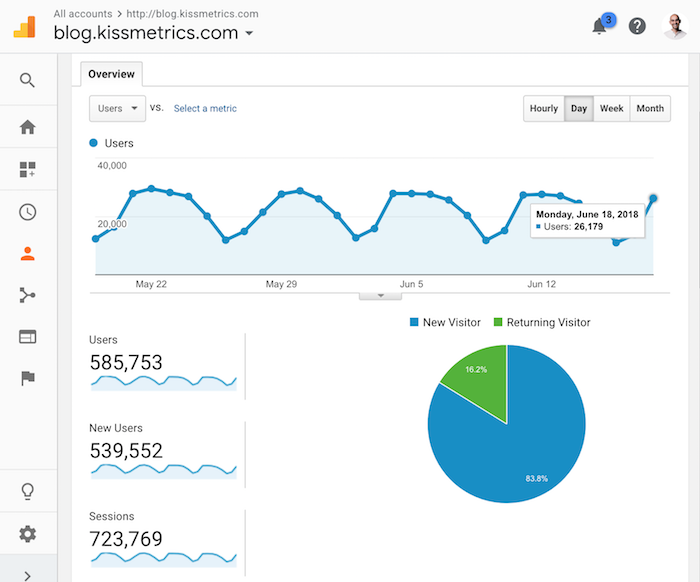
Once I did that, my traffic dropped again. I was now sitting at 585,783 unique visitors a month.
It sucks, but it had to be done.
The last thing I wanted to do was spend time and money maintaining old blog posts that would never drive a dollar in revenue.
I knew that if someone was going to come to my blog to research Vine, there was little to no chance that the person would convert into a 6-figure consulting contract.
After I pruned and cropped the KISSmetrics blog, I naturally followed the same path of Ubersuggest and merged it into NeilPatel.com.
The merge
The KISSmetrics merge was a bit more complicated than Ubersuggest.
With Ubersuggest, I didn’t have a keyword research tool on NeilPatel.com, so all I had to do was a slap on a new design, add a feature or two, and port it over.
With KISSmetrics, a lot of the content was similar to NeilPatel.com.
For the ones that were similar, I kept the NeilPatel.com version considering this blog generates more traffic than the KISSmetrics one.
As for all of the content that was unique and different, I ended up moving it over and applying 301 redirects.
If I decided to skip the pruning and cropping stage that I described above, the KISSmetrics blog would have had more traffic.
And when I merged it in with NeilPatel.com I would have done even better.
But in marketing, you can’t focus on vanity metrics like how many more unique visitors you are getting per month.
You need to keep your eye on the prize.
And for me, that’s leads.
The more leads I generate for my ad agency, the more likely I’ll increase my revenue.
Here’s my lead count for the weeks prior to the KISSmetrics merge:
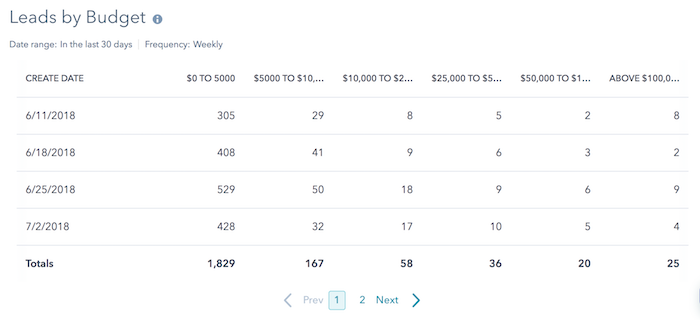
When looking at the table above, keep in mind it shows leads from the U.S. only.
The KISSmetrics blog was merged on the 25th.
When you add up all of the numbers from the previous week, there were 469 leads in total, of which 61 were marketing qualified leads.
That means there were 61 leads that the sales reps were able to contact as the vast majority of leads are companies that are too small for us to service.
When you look at the week of the 25th, there were a total of 621 leads. 92 where marketing qualified leads.
Just from that one acquisition, I was able to grow my marketing qualified leads by 50.8%. 🙂
I know what you are thinking though.
The week after the 25th (7/2) the leads tanked again.
Well, you have to keep in mind that the table only shows leads from the U.S. and during that week there was a national holiday, the 4th of July.
So, leads were expected to be, low.
But still, even with the holiday, we generated 496 leads, 68 of which were marketing qualified.
We still generated more marketing qualified leads than when we didn’t have the KISSmetrics traffic.
The early results show that this is going to work out (or so I hope).
If you ever want to consider buying up sites that aren’t generating revenue, you need to know your numbers like the back of your hand.
My sales funnel
Some of you are probably wondering how I promote my agency from this site.
As I mentioned earlier, I will share my funnel and stats with you.
The way I monetize the traffic is by collecting leads (and my sales reps turn those leads into customers).
On the homepage, you will see a URL box.
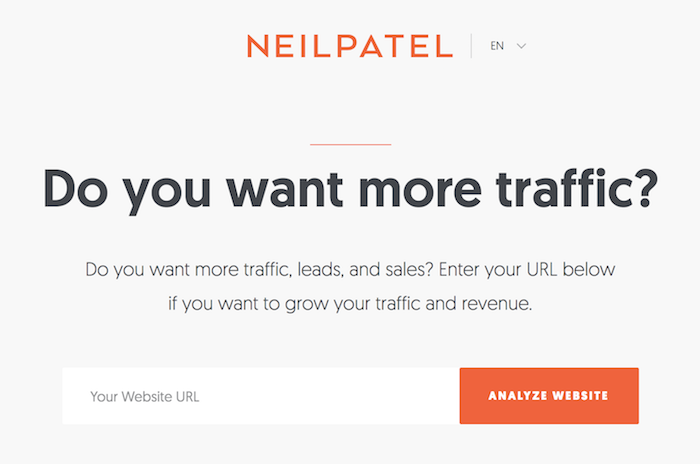
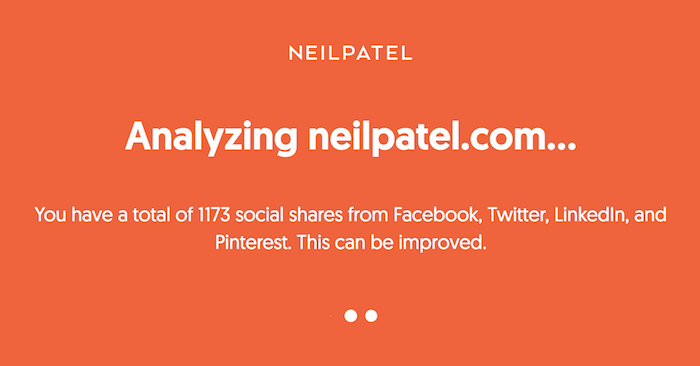
Once you enter a URL, we do a quick analysis (it’s not 100% accurate all of the time).
And then we show you how many technical SEO errors you have and collect your information (this is how you become a lead).
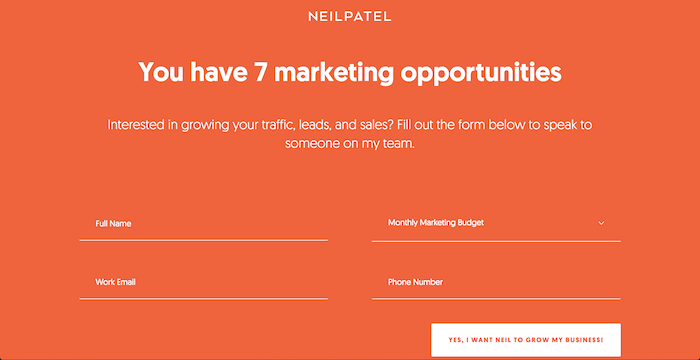
And assuming we think you are a good fit, you see a screen that allows you to schedule a call (less than 18% of the leads see this).
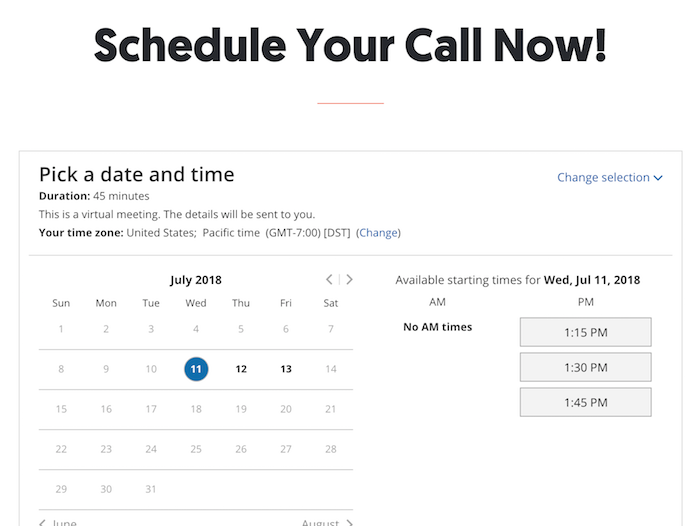
From there, someone on my team will do a discovery call with you.
Assuming things go well, a few of us internally review everything to double check we can really help, we then create projections and a presentation before pitching you for your money (in exchange for services of course).
That’s the funnel on NeilPatel.com in a nutshell… It’s pretty fine-tuned as well.
For example, when someone books a call we send them text reminders using Twilio to show up to the call as we know this increases the odds of you getting on the phone.
We even do subtle things like asking for your “work email” on the lead form.
We know that 9 out of 10 leads that give us a Gmail, Hotmail, AOL, or any other non-work email are typically not qualified.
And it doesn’t stop there… there are lead forms all over NeilPatel.com for this same funnel.
If you are reading a blog post like this, you’ll see a bar at the top that looks something like:

Or if you are about to exit, you will see an exit popup that looks like:
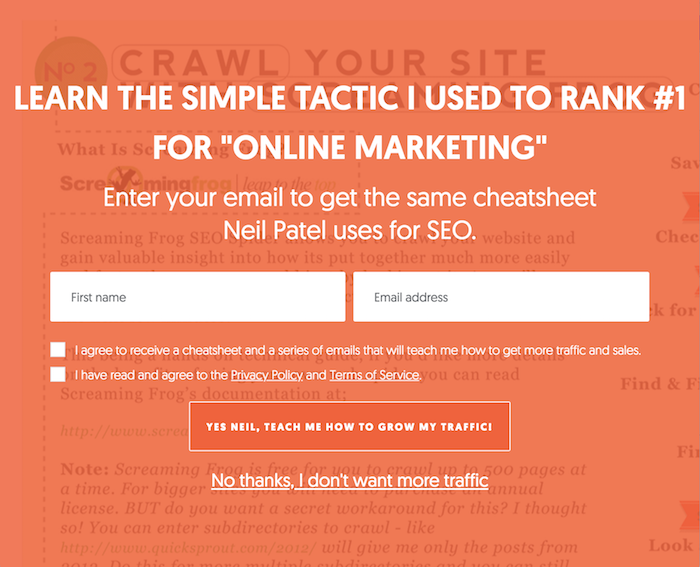
You’ll even see a thank you page that promotes my ad agency once you opt-in:
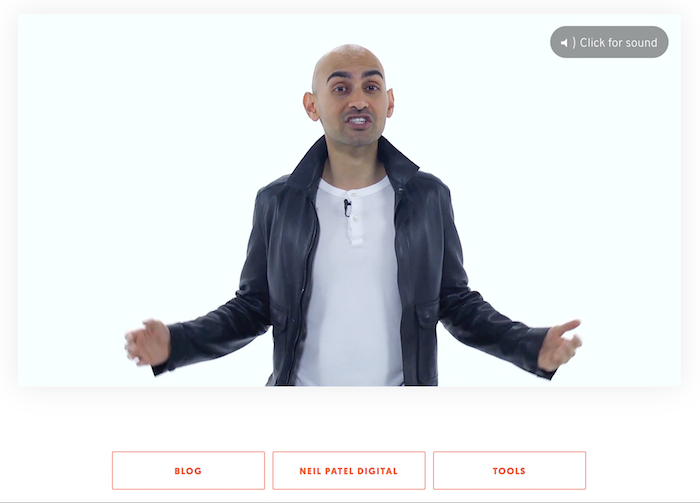
And if I don’t convince you to reach out to us for marketing help right then and there, you’ll also receive an email or two from me about my ad agency.
As you can see, I’ve fine-tuned my site for conversions.
So much so, that every 1,000 unique visitors from the U.S. turns into 4.4 leads.
And although that may not seem high, keep in mind that my goal isn’t to get as many leads as possible.
I’m optimizing for quality over quantity as I don’t want to waste the time of my sales team.
For example, I had 2 reps that had a closing ratio of 50% last month.
That means for every 2 deals they pitched, 1 would sign up for a 6-figure contract, which is an extremely high closing ratio.
Hence, I am trying to focus on quality so everyone in sales can get to 50% as it makes the business more efficient and profitable.
The last thing you want to do is pay a sales rep tons of money to talk to 50 people to only find 1 qualified lead.
That hurts both you and your sales reps.
Conclusion
The strategy I am using to buy websites may seem risky, but I know my numbers like the back of my hand.
From an outsider’s perspective, it may seem crazy, but to me, it is super logical.
And the reason I buy sites for their traffic is that I already have a working business model.
So, buying sites based on their traffic is much cheaper than buying sites for their revenue.
In addition to that, my return on investment is much larger.
For example, if I wanted to buy KISSmetrics (the whole business), I would have to spend millions and millions of dollars.
I’m looking for deals, it’s how you grow faster without having to raise venture capital.
When you use this strategy, there is no guarantee you will make a return on your investment, but if you spend time understanding the numbers you can reduce your risk.
I knew that going into this KISSmetrics deal that I will generate at least an extra $500,000 in profit from this one acquisition.
Realistically it should be much more than that as the additional leads seem to be of the same quality, and the numbers are penciling out for it to add well into the millions in revenue per year.
But before you pull the trigger and buy up a few sites in your space, there are a few things you need to keep in mind:
Don’t buy sites that rely on 1 traffic source – you don’t want to buy sites that only have Facebook traffic.
Or even Google traffic. Ideally, any site you buy should have multiple traffic sources (other than paid ads) as it will reduce your risk in case they lose their traffic from a specific channel.
Buy old sites – sites that are less than 3 years old are risky.
Their numbers fluctuate more than older sites.
Spend time understanding the audience – run surveys, dive deep into Google Analytics… do whatever you can to ensure that the site you are buying has an audience that is similar to your current business.
Be patient and look for deals – I hit up hundreds of sites every month.
Some people hate my emails and won’t give me the time of day.
That’s ok. I’m a big believer and continually pushing forward until I find the right deal.
I won’t spend money just because I am getting antsy.
Get creative – a lot of people think their site is worth more than it really is.
Try to explain to them what is really worth using data.
I also structure deals in unique ways, such as I gave KISSmetrics up to 6 months before they had to transition to a new domain (and to some extent they are still allowed to use the existing domain for their client login area).
You can even work out payment plans, seller-based financing, or equity deals… you just have to think outside the box.
So, what do you think about my acquisition strategy? Are you going to try it out?
The post Why I Spent $500,000 Buying a Blog That Generates No Revenue appeared first on Neil Patel.
Source: feedproxy.google.com

Want to Double Sales? Pull One of These 4 Levers
Let’s just get right to it…
Here is the formula for doubling sales…
L x C x M x f = GP
Where…
L = leads
C = customers
M = margin
f = frequency of purchase
It looks like this…
Leads x Customers x Margin x Frequency = Growth Potential
Doubling any of the variables above (leads, customers, margin, frequency of purchase) will double your sales.
Double them all and you will 16X your business.
- Can you double them all? Doubtful.
- Can you double one of them?
- Two of them?
- Even 3 of them? Absolutely.
In other words, there are 4 levers you have available to grow your business…
- Increase the number of leads
- Increase the number of customers
- Increase the margin
- Increase the frequency of purchase
Let’s look at each “growth lever” in turn…
How to Double the Number of Leads
Want more leads?
You either need…
- A Lead Magnet
- More Lead Magnets
- Better Lead Magnets
A Lead Magnet looks like this…

If you click on that “Download Now” button you will be asked for your email address to receive the content.
Here’s another Lead Magnet…

A Lead Magnet is simply an irresistible bribe offering a specific chunk of value to a prospect in exchange for their contact information.
The key word in the above definition is SPECIFIC.
In nearly every case (assuming you are getting traffic to your Lead Magnet) the reason a Lead Magnet is not performing well is because it doesn’t solve a specific problem.
This is a terrible Lead Magnet…
But this one isn’t much better…

In both cases, there is no specificity.
Our testing shows that a Lead Magnet that solves a specific problem can convert over 60% of the traffic to a Lead Magnet offer into a lead.
Take another look at the two Lead Magnet examples above and study the use of specificity…
If you want to double your leads—start with your Lead Magnet.
Start with SPECIFICITY.
How to Double the Number of Customers
Let me be clear…
This section is NOT about doubling profit—it’s about double the number of customers you are acquiring.
Big difference.
Acquiring customers is NOT the same thing as acquiring profit. In fact, in some cases acquiring customers will cause negative cash flow.
In other words, while acquiring customers can lead to profitability—customer acquisition is NOT about profitability.
It’s about activating BUYERS.
To do that, we use something called a Tripwire Offer.
Here’s one from us…
And here’s one from VistaPrint…
And here’s another from GoDaddy…
We’re not going to get rich selling $9.95 books. VistaPrint doesn’t expect their $9.99 for 500 business cards offer to meet payroll. And GoDaddy shareholders don’t expect $.99 domains to keep the lights on.
We’re simply acquiring BUYERS.
Notice the price point on these offers:
- $9.95 for a book
- $9.99 for 500 business cards
- $.99 for a domain name
We’re not exactly asking for a blood oath here—these are high-value, low barrier-to-entry offers intended that are designed to acquire customers.
If you want to double your number of customers—create a solid Tripwire offer.
But don’t expect that offer to make you more profitable. For that, you’ll need to work on your margin…
(NOTE: Want to Learn 6 ways to Double Your Business? You can do so in this free 6-week course.)

How to Double Your Margin
Of course, DigitalMarketer doesn’t only sell books.
And VistaPrint and GoDaddy have more than just business cards and domains to sell.
In fact, VistaPrint has a number of ways they can increase the value of that $9.99 transaction.
First, I can add a backside to my business cards for as little as $2.99…
From here I can…
- Add to my quantity (Up to $139.99)
- Upgrade to a “brilliant finish” (Additional $29.24)
- Get better paper stock (Additional $11.24)
- Buy one of those fancy business card holders (Up to $8.99)
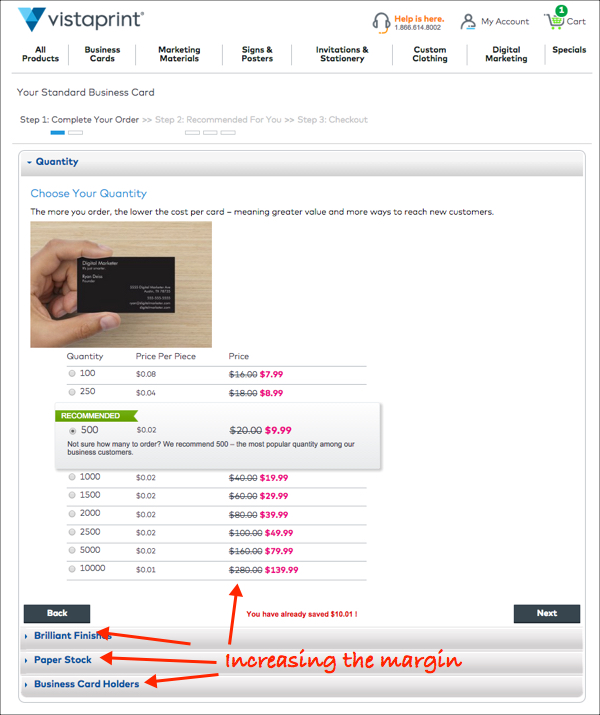
Actually, before it’s all said and done I can buy…
- Pens
- Car Door Magnets
- Letterhead
- Hats
- Business Card Magnets
- Mousepads
- T-shirts
- and on and on…
Every offer is relevant. Every offer is consistent with my original intent to get promotional materials for my business.
Every offer is intended to increase margin.
What’s going to happen if I start down the registration process for a $.99 domain from GoDaddy?
First, they’ll offer to bundle the .net, .org, and .info version of the domain with the .com…

Smart.
Then, they start upselling private registration, hosting, website design, and email…
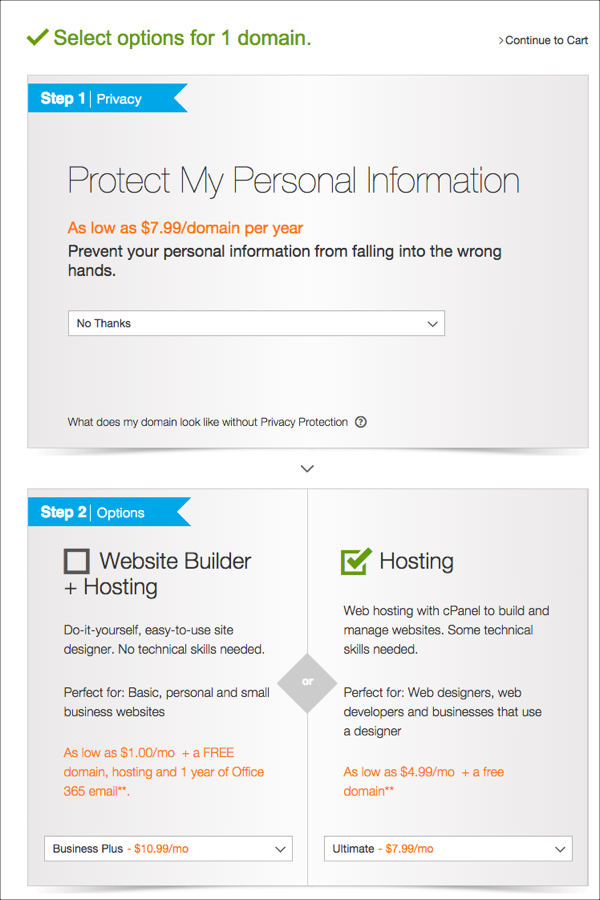
And it doesn’t stop there.
They’ll offer multi-year registration, search engine optimization, and social media services.
As for DigitalMarketer, we follow the purchase of my $9.95 book about email marketing with a content series designed to sell our $1,997 flagship email marketing training called The Machine.
Do you think making $1997 sales to customers that originally purchased a $9.95 offer increases our profit margin?
You bet it does.
And the additional offers made by VistaPrint and GoDaddy (and every other business that understands how to increase margin) are where the real money is made.
These upsell, cross-sells, bundles, etc. are what makes the cost of customer acquisition worth it.
Looking to double your margin?
Ask this simple question: “What else can I sell to the customers I am acquiring?”
How to Double the Frequency of Purchase
Ok, time for the last piece of the formula: Purchase Frequency.
What if you could get customers to buy twice as often? Sales would double.
To do that, you need constant, strategic communication.
We call it The Return Path.
The fact is that most sales don’t occur on the first visit, so without follow-up in place—you’re leaving an enormous amount of sales on the table.
These are all forms of The Return Path…
- Exit Offers: A popup offer that appears when a prospect attempts to exit a page
- Ad Retargeting: Digital ads that show to prospects based on their prior behavior (Translation: Those ads that follow you around the web after your visit a web page)
- Automated Email Follow-Up: A strategic email marketing plan that brings leads and buyers back to offers and content again and again
This last tactic, email follow-up, is the most effective way to double purchase frequency.
Every email you send should have one of five purposes…
- Indoctrinate: Teach them who you are
- Engage: Get them to buy
- Ascend: Get them to buy more
- Segment: Learn what they want to buy next
- Reengage/Win Back: Reactivate disinterested subscribers
Email follow-up is so critical that we’ve created an entire article on building an email marketing machine here.
If you want to double purchase frequency—you need a Return Path.
Are you seeing the power of these “Growth Levers?”
Good news: I have created a FREE 6-part “Double Your Sales” course for those that want more detail, more examples, and more explanation.
In the FREE “Double Your Sales” course you’ll learn…
* Lesson 1: Discover the 4 unique “Growth Levers” that can increase the sales and profits of a business
* Lesson 2: How to perfectly position your offer so it gives your prospects EXACTLY what they want
* Lesson 3: Increasing Your Leads… the 3 vital elements of any lead magnet
* Lesson 4: Increasing Your Conversions… learn the most under-utilized business asset that can literally double… even TRIPLE your conversion rates overnight
* Lesson 5: Increasing Your Profits… learn 5 of the 3-word phrase that will increase your average profit per customer
* Lesson 6: How to set up an “Invisible Selling Machine” in your business to increase your sales frequency…
Register for the “Double Your Sales” course by clicking on the image below…
Have a question?
Ask the DM team and 12,220 other members in the DM Engage Facebook Group!
Not a DM Lab Member? Learn more here.
The post Want to Double Sales? Pull One of These 4 Levers appeared first on DigitalMarketer.
Source: digitalmarketer.com