
Today’s leading minds talk AI with host Byron Reese
About this Episode
Sponsored by Dell and Intel, Episode 52 of Voices in AI, features host Byron Reese and Rao Kambhampati discussing creativity, military AI, jobs, and more.
Subbarao Kambhampati is a professor at ASU with teaching and research interests in Artificial Intelligence.
Serving as the president of AAAI, the Association for the Advancement of Artificial Intelligence.
Visit www.VoicesinAI.com to listen to this one-hour podcast or read the full transcript.

Transcript Excerpt
Byron Reese: This is Voices in AI, brought to you by GigaOm. I’m Byron Reese. Today my guest is Rao Kambhampati.
He has spent the last quarter-century at Arizona State University, where he researches AI. In fact, he’s been involved in artificial intelligence research for thirty years.
He’s also the President of the AAAI, the Association for the Advancement of Artificial Intelligence.
He holds a Ph.D.in computer science from the University of Maryland, College Park.
Welcome to the show, Rao.
Rao Kambhampati: Thank you, thank you for having me.

Q: 1
I always like to start with the same basic question, which is, what is artificial intelligence?
And so far, no two people have given me the same answer.
So you’ve been in this for a long time, so what is artificial intelligence?
Well, I guess the textbook definition is, artificial intelligence is the quest to make machines show behavior, that when shown by humans would be considered a sign of intelligence.
intelligent behavior, of course, that right away begs the question, what is intelligence?
And you know, one of the reasons we don’t agree on the definitions of AI is partly because we all have very different notions of what intelligence is.
This much is for sure; intelligence is quite multi-faceted.
You know we have the perceptual intelligence—the ability to see the world, you know the ability to manipulate the world physically—and then we have social, emotional intelligence, and of course, you have cognitive intelligence.
And pretty much any of these aspects of intelligent behavior, when a computer can show those, we would consider that it is showing artificial intelligence.
So that’s basically the practical definition I use.

Q: 2
But to say, “while there are different kinds of intelligence, therefore, you can’t define it,” is akin to saying there are different kinds of cars, therefore, we can’t define what a car is.
I mean that’s very unsatisfying. I mean, isn’t there, this word ‘intelligent’ has to mean something?
I guess there are very formal definitions.
For example, you can essentially consider an artificial agent, working in some sort of environment, and the real question is, how does it improve the long-term reward that it gets from the environment, while it’s behaving in that environment?
And whatever it does to increase its long-term reward is seen, essentially as—I mean the more reward it’s able to get in the environment, the more important it is.
I think that is the sort of definition that we use in introductory AI sorts of courses, and we talk about these notions of rational agency, and how rational agents try to optimize their long-term reward.
But that sort of gets into more technical definitions. So when I talk to people, especially outside of computer science, I appeal to their intuitions of what intelligence is, and to the extent, we have disagreements there, that sort of seeps into the definitions of AI.

Listen to this one-hour episode or read the full transcript at www.VoicesinAI.com
Byron explores issues around artificial intelligence and conscious computers in his new book The Fourth Age: Smart Robots, Conscious Computers, and the Future of Humanity.
Source: gigaom.com

Today’s leading minds talk AI with host Byron Reese
In this episode, Byron and Steve discuss the present and future impact of AI on businesses.
Today’s leading minds talk AI with host Byron Reese

Welcome
Byron Reese: This is Voices in AI, brought to you by GigaOm, and I’m Byron Reese. Today, our guest is Steve Pratt.
He is the Chief Executive Officer over at Noodle AI, the enterprise artificial intelligence company. Prior to Noodle, he was responsible for all Watson implementations worldwide, for IBM Global Business Services.
He was also the founder and CEO of Infosys Consulting, a Senior Partner at Deloitte Consulting, and a Technology and Strategy Consultant at Booz Allen Hamilton.
Consulting Magazine has twice selected him as one of the top 25 consultants in the world. He has a Bachelor’s and a Master’s in Electrical Engineering from Northwestern University and George Washington University. Welcome to the show, Steve.
Steve Pratt: Thank you. Great to be here, Byron.
Q: 1
Let’s start with the basics. What is artificial intelligence, and why is it artificial?
Artificial intelligence is basically any form of learning algorithm; is the way we think of things.
We actually think there’s a raging religious debate [about] the differences between artificial intelligence and machine learning, and data science, and cognitive computing, and all of that.
But we like to get down to basics, and basically say that they are algorithms that learn from data, and improve over time, and are probabilistic in nature.
Basically, it’s anything that learns from data and improves over time.

Q: 2
So, kind of by definition, the way that you’re thinking of it is it models the future, solely based on the past. Correct?
Yes. Generally, it models the future and sometimes makes recommendations, or it will sometimes just explain things more clearly. It typically uses four categories of data.
There are both internal data and external data and both structured and unstructured data. So, you can think of it kind of as a quadrant.
We think the best AI algorithms incorporate all four datasets because especially in the enterprise, where we’re focused, most of the business value is in the structured data.
But usually, unstructured data can add a lot of predictive capabilities, and a lot of signals, to come up with better predictions and recommendations.

Q: 3
How about the unstructured stuff? Talk about that for a minute. How close do you think we are?
When do you think we’ll have real, true unstructured learning, that you can kind of just point at something and say, “I’m going to Barbados. You figure it all out, computer.”
I think we have versions of that right now. I am an anti-fan of things like chatbots. I think that chatbots are very, very difficult to do, technically.
They don’t work very well. They’re generally very expensive to build. Humans just love to mess around with chatbots.
I would say in the scoring of business value and something that’s affordable and is easy to do, that chatbots are in the worst quadrant there.
I think there is a vast array of other things that actually add business value to companies, but if you want to build an intelligent agent using natural language processing, you can do some very basic things.
But I wouldn’t start there.

Q: 4
Let me try my question slightly differently, then. Right now, the way we use machine learning is we say, “We have this problem that we want to solve.
How do you do X?” And we have this data that we believe we can tease the answer out of. We ask the machine to analyze the data, and figure out how to do that.
It seems the inherent limitations of that, though, it’s kind of all sequential in nature. There’s no element of transferred learning in that, where I grow exponentially what I’m able to do.
I just can do: “Yes. Another thing. Yes. Another. Yes. Another.” So, do you think this strict definition of machine learning, as you’re thinking of AI that way, is that a path to general intelligence?
Or is general intelligence like “No, that’s something way different than what we’re trying to do. We’re just trying to drive a car, without hitting somebody?”
General intelligence, I think, is way off in the future. I think we’re going to have to come up with some tremendous breakthroughs to get there.
I think you can duct-tape together a lot of narrow intelligence, and sort of approximate general intelligence, but there are some fundamental skills that computers just can’t do right now.
For instance, if I give a human the question, “Will the guinea pig population in Peru be relevant to predicting demand for tires in the U.S?” A human would say, “No, that’s silly.
Of course not.” A computer would not know that. A computer would actually have to go through all of the calculations, and we don’t have an answer to that question, yet.
So, I think generalized intelligence is a way off, but I think there are some tremendously exciting things that are happening right now, that are making the world a better place, in narrow intelligence.

Q: 5
Absolutely. I do want to spend the bulk of our time there, in that world. But just to explore what you were saying, because there’s a lot of stuff to mine, in what you just said.
That example you gave about the guinea pigs is sort of a common-sense problem, right? In how it’s referred. “Am I heavier than the statue of liberty?”
How do you think humans are so good at that stuff? How is it that if I said, “Hey, what would an Oscar statue look like, smeared with peanut butter?”
You can conjure that up, even though you’ve never even thought of that before, or seen it covered, or seen anything covered with peanut butter.
Why are we so good at that kind of stuff, and machines seem amazingly ill-equipped at it?
I think humans have constant access to an incredibly diverse array of datasets. Through time, they have figured out patterns from all of those diverse datasets.
So, we are constantly absorbing new datasets. In machines, it’s a very deliberate and narrow process right now.
When you’re growing up, you’re just seeing all kinds of things. And as we go through our life, we develop these – you could think of them as regressions and classifications in our brains, for those vast arrays of datasets.
As of right now, machine learning and AI are given very specific datasets, crunch the data, and then make a conclusion. So, it’s somewhere in there. We’re not exactly sure, yet.
Q: 6
All right, the last question on general intelligence, and we’ll come back to the here and now. When I ask people about it, the range of answers I get is 5 to 500 years.
I won’t pin you down to a time, but it sounds like you’re “Yeah, it’s way off.” Yet, people who say that often usually say, “We don’t know how to do it, and it’s going to be a long time before we get it.”
But there’s always the implicit confidence that we can do it, that it is a possible thing. We don’t know how to do it. We don’t know how we’re intelligent.
We don’t know the mechanism by which we are conscious, or the mechanism by which we have a mind, or how the brain fundamentally functions, and all of that.
But we have a basic belief that it’s all mechanistic, so we’re going to eventually be able to build it. Do you believe that, or is it possible that general intelligence is impossible?
No. I don’t think it’s impossible, but we just don’t know how to do it, yet. I think transfer learning, there’s a clue in there, somewhere.
I think you’re going to need a lot more memory, and a lot more processing power, to have a lot more datasets in general intelligence.
But I think it’s way off. I think there will be stage gates, and there will be clues of when it’s starting to happen.
That’s when you can take an algorithm that’s trained for one thing, and have it – if you can take Alpha Go, and then the next day, it’s pretty good at Chess.
And the next day, it’s really good at Parcheesi, and the next day, it’s really good at solving mazes, then we’re on the track. But that’s a long way off.

Q: 7
Let’s talk about this narrow AI world. Let’s specifically talk about the enterprise. Somebody listening today is at, let’s say a company of 200 people, and they do something.
They make something, they ship it, they have an accounting department, and all of that. Should they be thinking about artificial intelligence now?
And if so, how? How should they think about applying it to their business?
A company that small, it’s actually really tough, because artificial intelligence really comes into play when it’s beyond the complexity that a human can fit in their mind.

Q: 8
Okay. Let’s up it to 20,000 people.
20,000? Okay, perfect. 20,000 people – there are many, many places in the organization where they absolutely should be using learning algorithms to improve their decision-making.
Specifically, we have 5 applications that focus on the supply side of the company; that’s in:
- materials,
- production,
- distribution,
- logistics,
- and inventory.
And then, on the supply side, we have 5 areas also:
- customer,
- product,
- price,
- promotion,
- and sales force.
All of those things are incredibly complex, and they are highly interactive.
Within each application area, we basically have applications that almost treat it like a game, although it’s much more complicated than a game, even though games like Go are very complex.
Each of our applications does, really, 4 things:
- it senses,
- it proposes,
- it predicts,
- and then it scores.
So, basically, it senses the current environment, it proposes a set of actions that you could take, it predicts the outcome of each of those actions – like the moves on a Chessboard – and then it scores it.
It says, “Did it improve?” There are two levels of that, two levels of sophistication. One is “Did it improve locally? Did it improve your production environment, or your logistics environment, or your materials environment?”
And then, there is one that is more complex, which says “If you look at that across the enterprise, did it improve across the enterprise?”
These are very, very complex mathematical challenges.
The difference is dramatic, from the way decisions are made today, which is basically people getting in meetings with imperfect data on spreadsheets and PowerPoint slides, and having arguments.

Q: 9
So, pick a department, and just walk me through a hypothetical or real use case where you have seen the technology applied, and have measurable results.
Sure. I can take the work we’re doing at XOJET, which is the largest private aviation company in the U.S. If you want to charter a jet, XOJET is the leading company to do that.
The way they were doing pricing before we got there was basically old, static rules that they had developed several years earlier. That’s how they were doing pricing.
What we did is we worked with them to take into account where all of their jets currently were, where all of their competitors’ jets are, what the demand was going to be, based on a lot of internal and external data; like what events were happening in what locations, what was the weather forecast, what [were] the economic conditions, what were historic prices and results?
And then, basically came up with all of the different pricing options they could come up with, and then basically made a recommendation on what the price should be. As soon as they put in our application, which was in Q4 of 2016, the EBITDA of the company, which is basically the net margin – not quite, but – went up 5%, to the company.
The next thing we did for them was to develop an application that looked at the balance in their fleet, which is: “Do you have the right jets in the right place, at the right time?”
This takes into account having to look at the next day. Where is the demand going to be the next day?
So, you make sure you don’t have too many jets in low-demand locations or not enough jets in high-demand locations.
We actually adjusted the prices, to create an economic incentive to drive the jets to the right place at the right time.
We also, again, looked at the competitive position, which is through Federal Aviation Administration data.
You can track the tail numbers of all of their jets, and all of the competitor jets, so you could calculate competitive position.
Then, based on that algorithm, the length of haul, which is the number of hours flown per jet, went up 11%.
This was really dramatic, and dramatically reduced the number of “deadheads” they were flying, which is the amount of empty jets they were flying to reposition their jets.
I think that’s a great success story. There’s tremendous leadership at that company, very innovative, and I think that’s really transformed their business.

Q: 10
That’s kind of a classic load-balancing problem, right? I’ve got all of these things, and I want to kind of distribute it and make sure I have plenty of what I need, where.
That sounds like a pretty general problem. You could apply it to package delivery or taxicab distribution, or any number of other things.
How generalizable is any given solution, like from that, to other industries?
That’s a great question. There are a lot of components that, that are generalizable. In fact, we’ve done that.
We have componentized the code and the thinking, and can rapidly reproduce applications for another client, based on that. There’s a lot of stuff that’s very specific to the client, and of course, the end application is trained on the client’s data.
So, it’s not applicable to anybody else. The models are specifically trained on the client data. We’re doing other projects in airline pricing, but the end result is very different because the circumstances are different.
But you hit on a key question, which is “Are things generalizable?” One of the other approaches we’re taking is around transferred learning, especially when you’re using deep learning technologies.
You can think of it as the top layers of a neural net can be trained on sort of general pricing techniques, and just the deeper layers are trained on pricing specific to that company.
That’s one of the other generalization techniques. Because AI problems in the enterprise generally have sparser datasets than if you’re trying to separate cat pictures from dog pictures.
So, data sparsity is a constant challenge. I think transfer learning is one of the key strategies to avoid that.

Q: 11
You mentioned in passing, looking at things like games. I’ve often thought that was kind of a good litmus test for figuring out where to apply the technology, because games have points, and they have winners, and they have turns, and they have losers.
They have structure to them. If that case study you just gave us was a game, what was the point in that? Was it a dollar of profit?
Because you were like “Well, the plane could be, or it could fly here, where it might have a better chance to get somebody. But that’s got this cost.
It wears out the plane, so the plane has to be depreciated accordingly.” What is the game it’s playing? How do you win the game it’s playing?
That’s a really great question. For XOJET, we actually created a tree of metrics, but at the top of the tree is something called fleet contribution, which is “What’s the profit generated per period of time, for the entire fleet?”
Then, you can decompose that down to how many jets are flying, the length of haul, and the yield, which is the amount of dollars per hour flown.
There’s also, obviously, a customer relationship component to it. You want to make sure that you get really good customers, and that you can serve them well.
But there are very big differences between games and real-life business. Games have a finite number of moves.
The rules are well-defined. There’s generally, if you look at Deep Blue or Alpha Go, or Arthur Samuels, or even the Labradas. All of these were two-player games.
In the enterprise, you have typically tens, sometimes hundreds of players in the game, with undefined sets of moves. So, in the one sense, it’s a lot more complicated.
The idea is, how do you reduce it, so it is game-like? That’s a very good question.
Q: 12
So, do you find that most people come to you with a defined business problem, and they’re not really even thinking about “I want some of this AI stuff?
I just want my planes to be where they need to be.” What does that look like in the organization that brings people to you, or brings people to considering an artificial intelligence solution to a problem?
Typically, clients will see our success in one area, and then want to talk to us. For instance, we have a really great relationship with a steel company in Arkansas, called Big River Steel.
Big River Steel, we’re building the world’s first learning steel mill with them. Which will learn from their sensors, and be able to just do all kinds of predictions and recommendations.
It goes through that sense, propose, predict and score. It goes through that. So, when people heard that story, we got a lot of calls from steel mills.
Now, we’re kind of deluged with calls from steel mills all over the world, saying, “How did you do that, and how do we get some of it?”
Typically, people hear about us because of AI. We’re a product company, with applications, so we generally don’t go in from a consulting point of view, and say “Hey, what’s your business problem?”
We will generally go in and say, “Here are the ten areas where we have expertise and technology to improve business operations,” and then we’ll qualify a company if it applies or not.
One other thing is that AI follows the scientific methods, so it’s all about hypothesis, test, hypothesis, test. So it is possible that an AI application that works for one company will not work for another company.
Sometimes, it’s the datasets. Sometimes, it’s just a different circumstance. So, I would encourage companies to be launching lots of hypotheses, using AI.

Q: 13
Your website has a statement quite prominently, “AI is not magic. It’s data.” While I wouldn’t dispute it, I’m curious.
What were you hearing from people that caused you to… or maybe hypothetically, – you may not have been in on it – but what do you think is the source of that statement?
I think there’s a tremendous amount of hype and B.S. right now out there about AI. People anthropomorphize AI. You see robots with scary eyes, or you see crystal balls, or you see things that – it’s all magic.
So, we’re trying to be explainers in chief, and to kind of de-mystify this, and basically say it’s just data and math, and supercomputers, and business expertise. It’s all of those four things, coming together.
We just happen to be at the right place in history, where there are breakthroughs in those areas. If you look at computing power, I would single that out as the thing that’s made a huge difference.
In April of last year, NVIDIA released the DGX-1, which is their AI supercomputer. We have one of those in our data center, that in our platform we affectionately call “the beast,” which has a petaflop of computing power.
If you put that into perspective, that the fastest supercomputer in the world in the year 2000, was the ASCI Red, which had one teraflop of computing power. There was only one in the world, and no company in the world had access to that.
Now, with the supercomputing that’s out there, the beast has 1,000 times more computing power than the ASCI Red did. So, I think that’s a tremendous breakthrough. It’s not magic. It’s just good technology.
The math behind artificial intelligence still relies largely on mathematical breakthroughs that happened in the ‘50s and ‘60s. And of course, Thomas Bayes, who was a philosopher in the 1700s, with Bayes’ Theorem,
There’s been a lot of good work recently around different variations on neural nets. We’re particularly interested in long- and short-term memory, and convolutional neural nets.
But a lot of this is, a lot of the math has been around for a while. In fact, it’s why I don’t think we’re going to hit general intelligence any time soon.
Because it is true that we have had exponential growth in computing power, exponential growth in data. But it’s been a very linear growth in mathematics, right?
If we start seeing AI algorithms coming up with breakthroughs in mathematics, that we simply don’t understand, then I think the antennas can go up.

Q: 14
So, if you have your DGX-1, at a petaflop, and in five years, you get something that’s an exaflop – it’s 1,000 times faster than that – could you actually put that to use?
Or is it at some point, the jet company only has so much data? There are only so many different ways to crunch it.
We don’t really need more – we have, at the moment, all of the processor power we need. Is that the case? Or would you still pay dearly to get a massively faster machine?
We could always use more computing power. Even with the DGX-1. For instance, we’re working with a distribution company where we’re generating 500,000 models a day for them, crunching on massive amounts of data.
If you have massive datasets for your processing, it takes a while. I can tell you, life is a lot better. I mean, in the ‘90s, we were working on a neural net for the Coast Guard; to try to determine which ships off of the west coast were bad guys.
It was very simple neural nets. You would hit return, and it would usually crash. It would run for days and days and days and days, be very, very expensive, and it just didn’t work.
Even if it came up with an answer, the ships were already gone. So, we could always use more computing power. I think right now, a limitation is more on the data side of it, and related to the fact that they shouldn’t be throwing out data that they’re throwing out.
For instance, like customer relationship management systems. Typically, when you have an update to a customer, that it overwrites the old data. That is really, really important data.
I think coming up with a proper data strategy, and understanding the value of data, is really, really important.
Q: 15
What do you think, on this theme of AI is not magic, it’s data; when you go into an organization, and you’re discussing their business problems with them, what do you think are some of the misconceptions you hear about AI, in general?
You said it’s overhyped, and glowing-eyed robots and all of that. From an enterprise standpoint, what is it that you think people are often getting wrong?
I think there’s a couple of fundamental things that people are getting wrong. One is I think there is a tremendous over-reliance and over-focus on unstructured data, that people are falling in love with natural language processing, and thinking that that’s artificial intelligence.
While it is true that NLP can help with judging things like consumer sentiment or customer feedback, or trend analysis on social media, generally those are pretty weak signals. I would say, don’t follow the shiny object.
I think the reason people see that, is the success of Siri and Alexa, and people see that as AI. It is true that those are learning algorithms, and those are effective in certain circumstances.
I think they’re much less effective when you start getting into dialogue. Doing dialogue management with humans is extraordinarily difficult. Training the corpus of those systems is very, very difficult.
So, I would say stay away from chatbots and focus mostly on structured data, rather than unstructured data. I think that’s a really big one.
I also think that focusing on the supply side of a company is actually a much more fruitful area than focusing on the demand side, other than sales forecasting.
The reason I say that is that the interactions between inbound materials and production, and distribution, are more easily modeled and can actually make a much bigger difference.
It’s much harder to model things like the effect of a promotion on demand, although it’s possible to do a lot better than they’re doing now.
Or, things like customer loyalty; like the effect of general advertising on customer loyalty. I think those are probably two of the big areas.

Q: 16
When you see large companies being kind of serious about machine learning initiatives, how are they structuring those in the organization?
Is there an AI department, or is it in IT? Who kind of “owns” it? How are its resources allocated?
Are there a set of best practices, that you’ve gleaned from it?
Yes. I would say there are different levels of maturity. Obviously, the vast majority of companies have no organization around this, and it is individuals taking initiatives, and experimenting by themselves.
IT in general has not taken a leadership role in this area. I think, fundamentally, that’s because IT departments are poorly designed. Like the CIO job needs to be two jobs.
There needs to be a Chief Infrastructure Officer and Chief Innovation Officer. One of those jobs is to make sure that the networks are working, the data center is working, and people have computers.
The other job is, “How are advances in technologies helping companies?” There are some companies that have Chief Data Officers.
I think that’s also caused a problem, because they’re focusing more on big data, and less on what do you actually do with those data?
I think the most advanced companies – I would say, first of all, it’s interesting because it’s following the same trajectory as information technology organizations follow, in companies. First, it’s kind of anarchy.
Then, there’s the centralized group. Then, it goes to a distributed group. Then, it goes to a federated group, federated meaning there’s a central authority that basically sets standards and direction.
But each individual business unit has its representatives.
So, I think we’re going to go through a whole bunch of gyrations in companies until we end up where most technology organizations are today, which is; there is a centralized IT function, but each business unit also has IT, people, in it.
I think that’s where we’re going.

Q: 17
And then, the last question along these lines: Do you feel that either:
A) machine learning is doing such remarkable things, and it’s only going to gain speed, and grow from here, or
B) machine learning is over-hyped to a degree that there are unrealistic expectations, and when disappointment sets in, you’re going to get a little mini AI winter again.
Which one of those has more truth?
Certainly, there is a lot of hype about it. But I think if you look at the reality of how many companies have actually implemented learning algorithms; AI, ML, data science, across the operations of their company, we’re at the very, very beginning.
If you look at it as a sigmoid, or an s-curve, we’re just approaching the first inflection point. I don’t know of any company that has fully deployed AI across all parts of its operations.
I think ultimately, executives in the 21stcentury will have many, many learning algorithms to support them, making complex business decisions.
I think the company that clearly has exhibited the strongest commitment to this, and is furthest along, is Amazon.
If you wonder how Amazon can deliver something to your door in one hour, it’s because there are probably 100 learning algorithms that made that happen, like where should the distribution center be?
What should be in the distribution center? Which customers are likely to order what? How many drivers do we need?
What’s the route the driver should take? All of those things are powered by learning algorithms.
And you see the difference, you feel the difference, in a company that has deployed learning algorithms.
I also think if you look back, from a societal point of view, that if we’re going to have ten billion people on the planet, we had better get a lot more efficient at the consumption of natural resources.
We had better get a lot more efficient at production.
I think that means moving away from static business rules that were written years ago, that are only marginally relevant to learning algorithms that are constantly optimizing.
And then, we’ll have a chance to get rid of what Hackett Group says is an extra trillion dollars of working capital, basically inventory, sitting in companies.
And we’ll be able to serve customers better.

Q: 18
You seem like a measured person, not prone to wild exaggeration. So, let me run a question by you. If you had asked people in 1995 if you had said this, “Hey, you know what?
If you take a bunch of computers, just PCs, like everybody has, and you connected them together, and you got them to communicate with hypertext protocol of some kind, that’s going to create trillions and trillions and trillions and trillions and trillions of dollars of wealth.”
“It’s going to create Amazon and Google and Uber and eBay and Etsy and Baidu and Alibaba, and millions of jobs that nobody could have ever imagined.
And thousands of companies. All of that, just because we’re snapping together a bunch of computers in a way that lets them talk to each other.”
That would have seemed preposterous. So, I ask you the question; is artificial intelligence, even in the form that you believe is very real, and what you were just talking about, is it an order of magnitude bigger than that?
Or is it that big, again? Or is it like “Oh, no? Just snapping together, a bunch of computers, pales to what we are about to do.”
How would you put your anticipated return on this technology, compared to the asymmetrical impact that this seemingly very simple thing had on the world?
I don’t know. It’s really hard to say. I know it’s going to be huge. Right? It is fundamentally going to make companies much more efficient. It’s going to allow them to serve their customers better.
It’s going to help them develop better products. It’s going to feel a lot like Amazon, today, is going to be the baseline of tomorrow. And there’s going to be a lot of companies that – I mean, we run into a lot of companies right now that just simply resist it.
They’re going to go away. The shareholders will not tolerate companies that are not performing up to competitive standards.
The competitive standards are going to accelerate dramatically, so you’re going to have companies that can do more with less, and it’s going to fundamentally transform business. You’ll be able to anticipate customer needs.
You’ll be able to say, “Where should the products be? What kind of products should they be? What’s the right product for the right customer? What’s the right price? What’s the right inventory level?
How do we make sure that we don’t have warehouses full of billions and billions of dollars worth of inventory?”
It’s very exciting. I think the business, and I’m generally really bad at guessing years, but I know it’s happening now, and I know we’re at the beginning.
I know it’s accelerating. If you forced me to guess, I would say, “10 years from now, Amazon of today will be the baseline.” It might even be shorter than that.
If you’re not deploying hundreds of algorithms across your company, that is constantly optimizing your operations, then you’re going to be trailing behind everybody, and you might be out of business.

Q: 19
And yet my hypothetical 200-person company shouldn’t do anything today. When is the technology going to be accessible enough that it’s sort of in everything?
It’s in their copier, and it’s in their routing software. When is it going to filter down, so that it really permeates kind of everything in business?
The 200-person company will use AI, but it will be in things like I think database design will change fundamentally.
There is some exciting research right now, actually using predictive algorithms to fundamentally redesign database structures so that you’re not actually searching the entire database; you’re just searching most likely things first.
Companies will use AI-enabled databases, they’ll use AI in navigation, they’ll use AI in route optimization. They’ll do things like that.
But when it comes down to it, for it to be a good candidate for AI, in helping make complex decisions, the answer needs to be non-obvious.
Generally with a 200-person company, having run a company that went from 2 people to 20 people, to 200 people, to 2,000 people, to 20,000 people, I’ve seen all of the stages.
A 200-person company, you can kind of brute force. You know everybody. You’ve just crossed Dunbar’s number, so you kind of know everything that’s going on, and you have a good feel for things.
But like you said, I think applying it in using other peoples’ technologies that are driven by AI, for the things that I talked about, will probably apply to a 200-person company.

Q: 20
With your jet company, you did a project, and EBITDA went up 5%, and that was a big win.
That was just one business problem you were working on. You weren’t working on where they buy jet fuel, or where they print. Nothing like that.
So presumably, over the long haul, the technology could be applied in that organization, in a number of different ways.
If we have a $70 trillion economy in the world, what percent is – 5% is easy – what percentage improvement do you think we’re looking at?
Like just growing that economy dramatically, just by the efficiencies that machine learning can provide?
Wow. The way to do that is to look at an individual company, and then sort of extrapolating. I would say an individual company could if you look at the value of companies.
That’s the way I look at it, like shareholder value, which is made up of revenue, margins, and capital efficiency. I think that revenue growth could take off, could probably double, from what it is.
The growth could double from what it is now. And the margins will have a dramatic impact.
I think you could, if you look at all of the different things you could do within the company, and you had fully deployed learning algorithms, and gotten away from making decisions on yardsticks and averages, you could, a typical company, I’ll say double your margins.
But the home run is in capital efficiency, which not too many people pay attention to, and is one of the key drivers of return on invested capital, which is the driver of general value.
This is where you can reduce things by 30%, things like that, and get rid of warehouses of stuff.
That allows you to be a lot more innovative because then you don’t have obsolescence. You don’t have to push products that don’t work. You can develop more innovative products.
There are a lot of good benefits. Then, you start compounding that year over year, and pretty soon, you’ve made a big difference.
Q: 21
Right, because doubling margins alone doubles the value of all of the companies, right?
It would if you projected it out over time. Yes. All else being equal.

Q: 22
Which it seldom is. It’s funny, you mentioned Amazon earlier.
I just assumed they had a truck with a bunch of stuff on it, that kept circling my house because it’s like every time I want something, they’re just there, knocking on the door.
I thought it was just me!
Yeah. Amazon Prime now came out, was it last year? In the Bay Area?
My daughter ordered a pint of ice cream and a tiara. An hour later, a guy is standing at the front door with a pint of ice cream and a tiara. It’s like wow!
Q: 23
What a brave new world, that has such wonders in it!
Exactly!
Q: 24
As we’re closing up on time here, there are a number of people that are concerned about this technology. Not in the killer robot scenario.
They’re concerned about automation; they’re concerned about – you know it all. Would you say that all of this technology and all of this growth, and all of that, is good for workers and jobs?
Or it’s bad, or it’s disruptive in the short term, not in the long term? How do you size that up for somebody who is concerned about their job?
First of all, moving sort of big picture to small picture, first of all, this is necessary for society, unless we stop having babies.
We need to do this, because we have finite resources, and we need to figure out how to do more with less. I think the impact on jobs will be profound. I think it will make a lot of jobs a lot better. In AI, we say it’s augmented, amplify and automate.
Right now, like the things we’re doing at XOJET really help make the people in revenue management a lot more powerful, and I think, enjoy their jobs a lot more, and doing a lot less routine research and grunt work.
So, they actually become more powerful, it’s like they have superpowers.
I think that there will also be a lot of automation. There are some tasks that AI will just automate and just do, without human interaction.
A lot of decisions, in fact, most decisions, are better if they’re made with an algorithm and a human, to bring out the best of both. I do think there’s going to be a lot of dislocation.
I think it’s going to be very similar to what happened in the automotive industry, and you’re going to have pockets of dislocation that are going to cause issues.
Obviously, the one that’s talked about the most is the driverless car.
If you look at all of the truck drivers, I think probably within a decade, that most cross-country trucks, there’s going to be some person sitting in their house, in their pajamas, with nine screens in front of them, and they’re going to be driving nine trucks simultaneously, just monitoring them.
And that’s the number one job of adult males in the U.S. So, we’re going to have a lot of displacement. I think we need to take that very seriously and get ahead of it, as opposed to chasing it, this time.
But I think overall, this is also going to create a lot more jobs because it’s going to make more successful companies. Successful companies hire people and expand, and I think there are going to be better jobs.

Q: 25
You’re saying it all eventually comes out in the wash; that we’re going to have more, better jobs, and a bigger economy, and that’s broadly good for everyone.
But there are going to be bumps in the road, along the way. Is that what I’m getting from you?
Yes. I think it will actually be a net positive. I think it will be a net significant positive. But it is a little bit of, as economists would say, “creative destruction.”
As you go from agricultural to industrial, to knowledge workers, toward sort of an analytics-driven economy, there are always massive disruptions.
I think one of the things that we really need to focus on is education, and also on trade schools.
There is going to be a lot larger need for plumbers and carpenters and those kinds of things.
Also, if I were to recommend what someone should study in school, I would say study mathematics. That’s going to be the core of the breakthroughs, in the future.

Q: 26
That’s interesting. Mark Cuban was asked that question, also. He says the first trillionaires are going to be in AI.
And he said philosophy. Because in the end, what you’re going to need are what the people know how to do.
Only people can impute value, and only people can do all of that.
Wow! I would also say behavioral economics; understanding what humans are good at doing, and what humans are not good at doing.
We’re big fans of Kahneman and Tversky, and more recently, Thaler.
When it comes down to how humans make decisions, and understanding what skills humans have, and what skills algorithms have, it’s very important to understand that, and to optimize that over time.

Q: 27
All right. That sounds like a good place to leave it. I want to thank you so much for a wide-ranging show, with a lot of practical stuff, and a lot of excitement about the future. Thanks for being on the show.
My pleasure. I enjoyed it. Thanks, Byron.
Byron explores issues around artificial intelligence and conscious computers in his new book The Fourth Age: Smart Robots, Conscious Computers, and the Future of Humanity.
Source: gigaom.com

Today’s leading minds talk AI with host Byron Reese
In this episode, Byron and Ira discuss transfer learning and AI ethics.
Today’s leading minds talk AI with host Byron Reese

Welcome
Byron Reese: This is Voices in AI, brought to you by GigaOm, and I’m Byron Reese. Today our guest is Ira Cohen, he is the co-founder and chief data scientist at Anodot, which has created an AI-based anomaly detection system.
Before that, he was chief data scientist over at HP. He has a BS in electrical engineering and computer engineering, as well as an MS and a Ph.D. in the same disciplines from The University of Illinois.
Welcome to the show, Ira.
Ira Cohen: Thank you very much for having me.
Q: 1
So I’d love to start with the simple question, what is artificial intelligence?
Well, there is the definition of artificial intelligence of machines being able to perform cognitive tasks, that we as humans can do very easily.
What I like to think about in artificial intelligence, is machines taking on tasks for us that do require intelligence, but leave us time to do more thinking and more imagination, in the real world.
So autonomous cars, I would love to have one, that requires artificial intelligence, and I hate driving, I hate the fact that I have to drive for 30 minutes to an hour every day, and waste a lot of time, my cognitive time, thinking about the road.
So when I think about AI, I think about how it improves my life to give me more time to think about even higher-level things.
Q: 2
Well, let me ask the question a different way, what is intelligence?
That’s a very philosophical question, yes, so it has a lot of layers in it.
So, when I think about intelligence for humans, it’s the ability to imagine something new, so imagine, have a problem and imagine a solution and think about how it will look like without actually having to build it yet, and then going in and implementing it. That’s what I think about [as] intelligence…
Q: 3
But a computer can’t do that, right?
That’s right, so when I think about artificial intelligence, personally at least, I don’t think that, at least in our lifetime, computers will be able to solve those kinds of problems, but, there is a lower level of intelligence of understanding the context of where you are and being able to take actions on it, and that’s where I think that machines can do a good task.
So understanding a context of the environment and taking immediate actions based on that, that are not new, but are already… people know how to do them, and therefore we can code them into machines to do them.
Q: 4
I’m only going to ask you one more question along these lines and then we’ll move on, but you keep using the word “understand.” Can a computer understand anything?
So, yeah, the word understanding is another hard word to say. I think it can understand, well, at least it can recognize concepts.
Understanding maybe requires a higher level of thinking, but understanding context and being able to take an action on it, is what I think understanding is.
So if I see a kid going into the road while I’m driving, I understand that this is a kid, I understand that I need to hit the brake, and I think machines can do these types of understanding tasks.
Q: 5
Fair enough, so, if someone said what is the state of the art like, they said, where are we at with this, because it’s in the news all the time and people read about it all the time, so where are we at?
So, I think we’re at the point where machines can now recognize a lot of images and audio or various types of data, recognize with sensors, recognize that there are objects, recognize that there are words being spoken, and identify them.
That’s really where we’re at today, we’re not… we’re getting to the point where they’re starting to also act on these recognition tasks, but most of the research, most of what AI is today, is the recognition tasks. That’s the first step.
Q: 6
And so let’s just talk about one of those. Give me something, some kind of recognition that you’ve worked on and have deep knowledge of, teaching a computer how to do…
All right, so, when I did my PhD, I worked on affective computing, so, part of the PhD was to have machines recognize emotions from facial expressions. So, it’s not really recognizing emotion, it’s recognizing a facial expression and what it may express.
So there are 6 universal facial expressions that we as humans exhibit, so, smiling is associated with happiness, there is surprise, anger, disgust, and those are actually universal.
So, the task that I worked on was to build classifiers, that given an image or a sequence of a video of a person, a person’s face, would recognize whether they’re happy or sad or disgusted or surprised or afraid…
Q: 7
So how do you do that? Like do you start with biology and you say “well how do people do it?”
Or do you start by saying “it doesn’t really matter how people are doing it, I’m just going to brute force, show enough labeled data, that it can figure it out, that it just learns without ever having a deep understanding of it?”
All right so this was in the early 2000s, and we didn’t have deep learning yet, so we had neural networks, but we weren’t able to train them with huge amounts of data. There wasn’t a huge amount of data, so the brute force approach was not the way to go.
What I actually worked on is based on research by a psychologist, that actually mapped facial movements to known expressions, and therefore to known emotions.
So it started out in the 70s, by people in the psychology field, [such as] Charles Akemann, in San Francisco, who mapped out actual… he created a map of facial movements into facial expressions, and so that was the basis of what are the type of features I need to extract from video and then feed that to a classifier, and then you go through the regular process of machine learning of collecting a lot of data, but the data is transformed, so these videos were transformed into known features of facial movements, and then, you can feed that into a classifier that learns in a supervised way.
So I think a lot of the tasks around intelligence are that way. It’s being changed a little bit by deep learning, which supposedly takes away the need to know the features are a priori and do the feature engineering for the machinery task…
Q: 8
Why do you say “supposedly”?
Because it’s not completely true. You still have to do, even in speech, even in images, you still have to do some transformations of the raw data, it’s not just taking it as is, and it will work magically and do everything for you.
There is some… you do have to, for example in speech, you do have to do various transformations of the speech into all sorts of short term Fourier transform or other types of transformations, without which, the methods afterward will not produce results.
Q: 9
So, if I look at a photo of a cat, that somebody’s posted online or a dog, that’s in surprise, you know, it’s kind of comical, the look of surprise, say, but a human can recognize that in something as simple as a stick figure…
What are we doing there do you think? Is that a kind of transferred learning, or how is it that you can show me an alien and I would say, “Ah, he’s happy…”What do you think we’re doing there…?
Yeah, we’re doing transferred learning.
Those are real examples of us taking one concept that we were trained on from the day we were born, with our visual cortex and also then in the brain, because our brain is designed to identify emotions, just out of the need to survive, and then when we see something else, we try to map it onto a concept that we already know, and then if something happens that is different from what we expected, then we start training to that new concept.
So if we see an alien smiling, and all of a sudden when he smiles, he shoots at you, you would quickly understand that smiling for an alien, is not associated with happiness, but you will start off by thinking, “this could be happy”.
Q: 10
Yeah, I think that I remember reading that, hours after birth, children who haven’t even been trained on it, can recognize the difference between a happy and sad face.
I think they got sticks and put drawings on them and try to see the baby’s reactions. It may even be even something deeper than something we learn, something that’s encoded in our DNA.
Yeah, and that may be true because we need to survive.
Q: 11
So why do you think we’re so good at it and machines aren’t, right, like, machines are terrible right now at transfer learning.
We don’t really know how it works do we, because we can’t really code that abstraction that a human gets, so…
I think that from what I see first, it’s being changed. I see work coming out of Google AI labs that is starting to show how they are able to train single models, very large models, that are able to do some transfer learning on some tasks, and, so it is starting to change.
So machines have a very different… they don’t have to survive – they don’t have this notion of danger and surviving, and I think until we are able to somehow encode that in them, we would always have to, ourselves, code the new concepts or understand how to code for them, how to learn new concepts using transfer learning…
Q: 12
You know the roboticist Rodney Brooks, talks about “the juice”, he talks about how, if you put an animal in a box, it feels trapped, it just tries and tries to get out and it clearly has a deep desire to get out, but you but in a robot to do it, the robot doesn’t have what he calls “the juice,” and he, of course, doesn’t think it’s anything spiritual or metaphysical or anything like that.
But what do you think that is? What do you think is the juice? Because that’s what you just alluded to, machines don’t have to survive, so what do you think that is?
So I think he’s right, they don’t have the juice. Actually in my lab, during my PhD, we had some students working on teaching robots to move around, and actually, the way they did it was rewards and punishments.
So they would get… they actually coded—just like you have in reinforcement learning—if you hit a wall, you get a negative reward. If the robot moved and did something he wasn’t supposed to, the PhD student would yell at them, and that would be encoded into a negative reward, and if he did something right, they had actions that gave them positive rewards.
Now it was all kind of fun and games, but potentially if you do this for long enough, with enough feedback, the robot would learn what to do and what not to do, the main thing that’s different is that it still lives in the small world of where they were, in the lab or in the hallways of our labs. It didn’t have the intelligence to then take it and transfer it to somewhere else…
Q: 13
But the computer can never… I mean the inherent limitations are there and that the computer can never be afraid, be ashamed, be motivated, be happy…
Yes. It doesn’t have the long-term reward or the urge to survive, I guess.

Q: 14
You may be familiar with this, but I’d like to set it up anyway. There was a robot in Japan, it was released in a mall, and it was basically being taught how to get around and if it ran into a person, if it came up to a person, it would politely ask the person to move, and if the person didn’t, it would just zoom around them.
And what happened was children would just kind of mess with it, maybe jump in front of it when it tried to go around them again and again and again, but the more kids there were, the more likely they were to get brutal.
They would hit it with things, they would yell at it and all of that, and the programmers ended up having to program it, that if it had a bunch of short people around it, like children, it needed to find a tall person, an adult, and zip towards it, but the distressing thing about it is when they later asked those children who had done that, they said, “Did you cause the robot distress?” 75% of them said yes, and then they asked if it behaved human-like or machine-like, and only 15% said machine-like, and so they thought that they were actually causing distress and it was behaving like a humanoid.
What do you think that says? Does that concern you in any way?
Personally, it doesn’t, because I know that, as long as machines don’t have a real effect on them, then, we might be transferring what we think stress is onto a machine that doesn’t really feel that stress… it’s really about codes…
Q: 15
I guess the concern is that if you get in the habit of treating something that you regard as being in distress if you get into the habit of treating it callously, this is what Weizenbaum said, he thought that it would have a dampening effect on human empathy, which would not be good…
Let me ask you this, what do you think about embodying artificial intelligence? Because you think about the different devices: Amazon has theirs, it’s right next to me, so I can’t say its name, but it’s a person’s name…
Apple has Siri, Microsoft has Cortana… But Google just has the google system, it doesn’t have a name.
Do you think there’s anything about that… why do you think it is? Why would we want to name it or not name it, why would we decide not to name it?
Do you think we’re going to want to interact with these devices as if they’re other people? Or are we always going to want them to be obviously mechanistic?
My personal feeling is that we want them to be mechanistic, they’re there not to exist on their own accord, and reproduce and create a new world.
They’re there to help us, that’s the way I think AI should be, to help us in our tasks.
Therefore when you start humanizing it, then you’re going to either have the danger of mistreating it, treating it like basically slaves, or you’re going to give it other attributes that are not what they are, thinking that they are human, and then going the other route, and they’re there to help us, just like robots, or just like the industrial revolution brought machines that help humans manufacture things better…
So they’re there to help us, I mean we’re creating them, not as beings, but rather as machines that help us improve humanity, and if we start humanizing them and then, either mistreating them as you mentioned with the Japanese example, then it’s going to get muddled and strange things can happen…
Q: 16
But isn’t that really what is going to happen? Your PhD alone, which is how do you spot emotions?
Presumably would be used in a robot, so it could spot your emotions, and then presumably it would be programmed to empathize with you, like “don’t be worried, it’s okay, don’t be worried,” and then to the degree, it has empathy with you, you have an emotional attachment to it, don’t you go down that path?
It might, but I think we can stop it. So the reason to identify the emotion is that it’s going to help me do something, so, for example, our research project was around creating assistance for kids to learn, so in order to help the kid learn better, we need to empathize with the state of mind of the child, so it can help them learn better.
So that was the goal of the task, and I think as long as we encapsulate it in well-defined goals that help humans, then, we won’t have the danger of creating… the other way around. Now, of course maybe in 20 years, what I’m saying now will be completely wrong and we will have a new world where we do have a world of robots that we have to think about how do we protect them from us. But I think we’re not there yet, I think it’s a bit science fiction, this one.
Q: 17
So I’m still referring back to your earlier “supposedly” comment about neural nets, what do you think are other misconceptions that you run across about artificial intelligence?
What do you think are, like your own pet peeves, like “that’s not true, or that’s not how it works?” Does anything come to mind?
People think, because of the hype, that it does a lot more than it really does.
We know that it’s really good at classification tasks, it’s not yet very good at anything that’s not classification, unsupervised tasks, it’s not being able to learn new concepts all by itself, you really have to code it, and it’s really hard.
You need a lot of good people that know the art of applying neural nets to different problems. It doesn’t happen just magically, the way people think.
Q: 18
I mean you’re of course aware of high profile people: Elon Musk, Stephen Hawking, Bill Gates, and so forth who [have been] worried about what a general intelligence would do, they use terms like “existential threat” and all that, and they also, not to put words in their mouth, believe that it will happen sooner rather than later…
Because you get Andrew Ng, who says, “worry about the overpopulation of Mars,” maybe in a couple of hundred years you have to give it some thought, but you don’t really right now…So where do you think their concern comes from?
So, I’m not really sure and I don’t want to put any words in their mouth either, but, I mean the way I see it, we’re still far off from it being an existential threat.
The main concern is you might have people who will try to abuse AI, to actually fool other people, that I think is the biggest danger, I mean, I don’t know if you saw the South Park episode last week, they had their first episode where Cartman actually bought an Alexa and started talking to his Alexa, and I hope your Alexa doesn’t start working now….
So it basically activated a lot of Alexas around the country, so he was adding stuff to the shopping cart, really disgusting stuff, he was setting alarm clocks, he was doing all sorts of things, and I think the danger of the AI today is really getting abused by other people, for bad purposes, in this case, it was just funny…
But you can have cases where people will control autonomous cars, other people’s autonomous cars by putting pictures by the side of the road and causing them to swerve or stop or do things they’re not supposed to, or building AI that will attack other types of AI machines.
So I think the danger comes from the misuse of the technology, just like any other technology that came out into the world… And we have to… I think that’s where the worry comes from and making sure that we put some sort of ethical code of how to do that…
Q: 19
What would that look like? I mean that’s a vexing problem…
Yes, I don’t know, I don’t have the answer to that…
So there are a number of countries, maybe as many as twenty, that are working on weaponizing, building AI-based weapons systems, that can make autonomous kill decisions. Does that worry you?
Because that sounds like where you’re going with this… if they put a plastic deer on the side of the road and make the car swerve, that’s one thing, but if you literally make a killer robot that goes around killing people, that’s a whole different thing.
Does that concern you, or would you call that legitimate use of the technology…?
I mean this kind of use will happen, I think it will happen no matter what, it’s already happening with drones that are not completely autonomous, but they will be autonomous probably in the future.
I think that I don’t know how it can be… this kind of progress can be stopped, the question is, I mean, the danger I think is, do these robots start having their own decision-making and intelligence that decides, just like in the movies, to attack all humankind and not just the side they’re fighting on…
Because technology in [the] military is something that… I don’t know how it can be stopped, because it’s driven by humans…
Our need is to wage war against each other… The real danger is, do they turn on us?
And if there is real intelligence in artificial intelligence, and real understanding and need to survive as a being, that’s where it becomes really scary…
Q: 20
So it sounds like you don’t necessarily think we’re anywhere near close to an AGI, and I’m going to ask you how far away you think we are… I want to set the question up as saying that, there are people who think we’re 5-10 years away from general intelligence and then there are people who think we’re 500 years [away].
Oren Etzioni was on the show, and he said he would give anyone 1000:1 odds that we wouldn’t have it in 5 years, so if you want to send him $10 he’ll put $10,000 against that. So why do you think there’s such a gap, and where are you in that continuum?
Well, because the methods we’re using are still so… as smart as they got, they’re still doing rudimentary tasks. They’re still recognizing images—the agents that are doing automated things for us, they’re still doing very rudimentary tasks. General intelligence requires a lot more than that, that requires a lot more understanding of context.
I mean the example of Alexa last week, that’s a perfect example of not understanding context, for us as humans, we would never react to something on TV like that and add something to our shopping cart, just because Cartman said it, where even the very, very smart Alexa with amazing speech understanding, and taking actions based on that, it still doesn’t understand the context of the world, so I think prophecy is for fools, but I think it’s at least 20 years out…
Q: 21
You know, we often look at artificial intelligence and its progress based on games where it beats the best player, that goes back to [Garry] Kasparov in 97, you have of course Jeopardy, you have Alpha Go, you had… an AI beat some world rated poker players, what do you think…And those are all kind of… they create a stir, you want to reflect on it, what do you think is the next thing like that, that one day, snap your fingers and all of a sudden an AI just did… what?
Okay, I haven’t thought about that… All these games, what makes them unique is that they are a very closed world; the world of the game, is finite and the rules are very clear, even if there’s a lot of probability going on, the rules are very clear, and if you think in the real world—and this may be going back to the questions why it will take time—for artificial intelligence to really be general intelligence, the real world is almost infinite in possibilities and the way things can go, and even for us, it’s really hard.
Now trying to think of a game that machines would beat us next in. I wonder if we were able to build robots that can do lots of sports, I think they could beat us easily in a lot of games because if you take any sports game like football or basketball, they require intelligence, they require a lot of thinking, very fast thinking and pathfinding by the players, and if we were able to build the body of the robot that can do the motions just like humans, I think they can easily beat us at all these games.
Q: 22
Do you, as a practitioner… I’m intrigued by it, on the topic of general intelligence, intrigued by the idea that human DNA isn’t really that much code, and if you look at how much code that we are different than say a chimp, it’s very small, I mean it’s a few megabytes.
That would be, how we are programmatically different, and yet, that little bit of code, makes us have general intelligence and a chimp not.
Does that persuade you or suggest to you that general intelligence is a simple thing, that we just haven’t discovered, or do you think that general intelligence is a hack of a hundred thousand different… like it’s going to be a long slog and then we finally get it together…?
So, I think [it’s] the latter, just because of the way you see human progress, and it’s not just about one person’s intelligence. I think what makes us unique is the ability to combine the intelligence of a lot of different people to solve tasks, and that’s another thing that makes us very different.
So you do have some people that are geniuses that can solve really really hard tasks by themselves, but if you look at human progress, it’s always been around combined intelligence of getting one person’s contribution, then another person’s contribution, and thinking about how it comes together to solve that, and sometimes you have breakthroughs that come from an individual, but more often than not, it’s the combined intelligence that creates the drive forward, and that’s the part that I think is hard to put into a computer…
Q: 23
You know there are people that have, amazing savant-like abilities. I remember reading about a man named [George] Dantzig, and he was a graduate student in statistics, and his professor put two famous unsolvable/unsolved problems on the blackboard, and Dantzig arrived late that day.
He saw them and just assumed that they were the homework, so he copied them down and went home, and later he said he thought they were a little harder than normal, but he solved them both and turned them in… and that like really happened.
It’s not one of that urban legend kind of things, you have people who can read the left and right page of a book at the same exact time, you have… you just have people that are these extraordinary edge cases of human ability, does that suggest that our intellects are actually far more robust than they are? Does that suggest anything to you as an artificial intelligence guy?
Right, so coming from the probability space, it just means that our intelligence has a wide distribution, and there are always exceptions in the tails, right?
And these kinds of people are in the tails, and often when they are discovered, they can create monumental breakthroughs in our understanding of the world, and that’s what makes us so unique.
You have a lot of people in the center of the distribution, that is still contributing a lot, and making advances to the world and to our understanding of it, and not just understanding, but actually creating new things.
So I’m not a genius, most people are not geniuses, but we still create new things and are able to advance things, and then, every once in a while you get these tails of a distribution intelligence, that could solve the really hard problems that nobody else can solve, and that’s a… so the combination of all that actually makes us push things forward in the world, and I think that kind of combined intelligence, I think that artificial intelligence is way, way off.
It’s not anywhere near, because we don’t understand how it works, I think it would be hard for us to even code that into machines. That’s one of the reasons I think AI, the way people are afraid of it, it’s still way off…
Q: 24
But by that analysis, that sounds like, to circle that back, there will be somebody that comes along that has some big breakthrough in general intelligence, and ta-da, it turns out all along it was, you know, bubble sort or….
I don’t think it’s that simple, that’s the thing, and solving a statistical problem that’s really, really tough, it’s not like… I don’t think it’s a well-defined enough problem, that some will take a genius just to understand…
“Oh, it’s that neuron going right to left,” and that’s it… so I don’t think it’s that simple… there might be breakthroughs in mathematics, that help you understand the computation better, maybe quantum computers that will help you do the faster computation, so you can train much, much faster than machines so they can do the task much better, but, it’s not about understanding the concept of what makes a genius. I think that’s more complicated, but maybe it’s my limited way of thinking, maybe I’m not intelligent enough with it…
Q: 25
So to stay on that point for a minute… it’s interesting and I think perhaps, telling, that we don’t really understand how human intelligence works, like if you knew that.. like we don’t know how a thought is encoded in the brain… like if I said…Ira, what color was your first bicycle, can you answer that question?
I don’t remember… probably blue…
Q: 26
Let’s assume for a minute that you did remember. It makes my example bad, but there’s no bicycle location in your brain that stored the first “bicycle”… like an icon, or database lookup…like nobody knows how that happens… not only how it’s encoded, but how it’s retrieved…
And then, you were talking earlier about synthesis and how we use it all together, we don’t know any of that… Does that suggest to you that, on the other end, maybe we can’t make a general intelligence… or at the very least, we cannot make a general intelligence until we understand how it is that people are intelligent…?
That may be, but yeah. First of all, even if we made it, if we don’t understand it, then how would we know that we made it?
Circling back to that… I think the way we… it’s just like the kids, they were thinking that they were causing stress to the robot because they were giving it… they thought they understood the stress and the effect of it, and they were transferring it onto the robot.
So maybe when we create something very intelligent that looks to be like us, we would think we created intelligence, but we wouldn’t know that for sure until we know what is… general intelligence really is…
Q: 27
So do you believe that general intelligence is an evolutionary invention that will come along if, in 20 years, 50 years, 1,000 years… whatever it is, that it is something that will come along out of the techniques we use today from the early AI, like, are we building really, really, really primitive general intelligence, or do you have a feeling that a real AGI is going to be a whole different kind of approach in technology?
I think it’s going to be a whole different approach. I think what we’re building today are just machines that do tasks that we humans do, in a much, much better way, and just like we built machines in the industrial revolution that did what people did with their hands, but did it in a much faster way, and better way… that’s the way I see what we’re doing today…
And maybe I’m wrong, maybe I’m totally wrong, and we’re giving them a lot more general intelligence than we’re thinking, but the way I see it, it’s driven by economic powers, it’s driven by the need of companies to advance, and take away tasks that cost too much money to do by humans, or are too slow to do by humans…
And, revolutionizing that way, and I’m not sure that we’re really giving them general intelligence yet, still, we’re giving them ways to solve specific tasks that we want them to solve, and not something very very general that can just live by itself, and create new things by itself.
Q: 28
Let’s take up this thread, that you just touched on, about, we build them to do jobs we don’t want to do, and you analogize it to the Industrial Revolution… so as you know, just to set the problem up, there are 3 different narratives about the effect this technology, combined with robotics, or we’ll call it automation, in general, are going to have on jobs.
And the three scenarios are: one is that, it’s going to destroy an enormous number of quotes, low-skill jobs, and that, they will, by definition, be fewer low skilled jobs, and more and more people competing for them and you will have this permanent class of unemployable… it’s like the Great Depression in the US, just forever.
And then you have people who say, no, it’s different than that, what it really is, is, they’re going to be able to do everything we can do, they’re going to have escape… Once a machine can learn a new task faster than a person, they’ll take every job, even the creative ones, they’ll take everything.
And the third one says no, for 250 years we’ve had 5-10% of unemployment, its never really gotten out of that range other than the anomalous depression, and in that time we had electricity, we had mechanization, we had steam power, we had the assembly line… we had all these things come along that sure looked like job eaters, but what people did is they used the new technology to increase their own productivity and drive their own wages higher, and that’s the story of progress, that we have experienced…So which of those three theories, or maybe a fourth one, do you think is the correct narrative?
I think the third theory is probably the more correct narrative. It just gives us more time to use our imagination and be more productive at doing more things, improve things, so, all of a sudden we’ll have time to think about going and conquering the stars, and living in the stars, or improving our lives here in various ways…
The only thing that scares me is the speed of it, if it happens too quickly, too fast… So, we’re humans, it takes, as a human race, some time to adapt. If the change happens so fast and people lose their jobs too quickly, before they’re able to retrain for the new economy, the new way of [work], the fact that some positions will not be available anymore, that’s the real danger and I think if it happens too fast around the world, then, there could be a backlash.
I think what will happen is that the progress will stop because some backlash will happen in the form of wars, or all sorts of uprisings, because, in the end, people need to live, people need to eat, and if they don’t have that, they don’t have anything to live for, they’re going to rise up, they’re not just going to disappear and die by themselves.
So, that’s the real danger, if the change happens too rapidly, you can have a depression that will actually cause the progress to slow down, and I hope we don’t reach that because I would not want us, as a world, to reach that stage where we have to slow down, with all the weapons we have today, this could actually be catastrophic too…
Q: 29
What do you mean by that last sentence?
So I mean we have nuclear weapons…
Q: 30
Oh, I see, I see, I see.
We have actual weapons that can, not just… could actually annihilate us completely…
Q: 31
You know, I hear you Like…what would “too fast” be? First of all, we had that when the Industrial Revolution came along… you had the Luddite movement, when Ludd broke two spinning wheels you had the thresher riots [or Swing riots] in England in the 1820s, when the automated threat, you had the… the first day the London Times was printed using steam power instead of people.
They were going to go find the guy who invented that and strings him up, you had a deep-rooted fear of labor-changing technology, that’s a whole current that constantly runs, but what would too fast look like?
The electrification of the industry just happened lightning-fast, we went from generating 5% of our power from steam to 85% in just22 years…Give me a “too fast” scenario. Are you thinking about the truck drivers, or… tell me how it could “be too fast,” because you seem to be very cautious, like, “man, these technologies are hard and they take a long time and there’s a lot of work and a lot of slog,” and then, so what would too fast look like to you?
If it’s less than a generation, let’s say in 5 years, really, all taxi drivers and truck drivers lose their job because everything becomes automated, that seems to be too fast. If it happens in 20 years, that’s probably enough time to adjust, and I think… the transition is starting, it will start in the next 5 years, but it will still take some time for it to really take hold, because if people lose those jobs today, and you have thousands or hundreds of thousands, or even millions of people doing that, what are they going to do?
Q: 32
Well, presumably, I mean, classic economics says that, if that happened, the cost of taking a cab goes way down, right? And if that happens, that frees up money that I no longer have to spend on an expensive cab, and therefore I spend that money elsewhere, which generates demand for more jobs, but, is the 5-year scenario… it may be a technical possibility, like we may “technically” do it, if we don’t have a legislative hurdle.
I read this article in India, which said they’re not going to allow self-driving cars in India because that would put people out of work, then you have the retrofit problem, then every city’s going to want to regulate it and say well, you can have a self-driving car, but it needs to have a person behind the wheel just in case. I mean like you would say, look, we’ve been able to fly airplanes without a pilot for decades, yet no airline in the world would touch that, in this plane, we have no pilot… even though that’s probably a better way to do it…So, do you really think we can have all the taxi drivers gone in 5 years?
No, and exactly for that reason, even if our technology really allows it. First of all, I don’t think it will totally allow it, because for it to really take hold you have to have a majority of cars on the road to be autonomous. Just yesterday I was in San Francisco, and I heard a guy say he was driving behind one of those self-driving cars in San Francisco, and he got stuck behind it, because it wouldn’t take a left turn when it was green, and it just forever wouldn’t take a left turn that humans would… The reason why it wouldn’t take a left turn was there were other cars that are human-driven on the road, and it was coded to be very, very careful about it, and he was 15 minutes late to our meeting just because of that self-driving car…
Now, so I think there will be a long transition partly because legislation will regulate it, and slow it down a bit, which is a good thing. You don’t want to change too fast, too quickly without making sure that it really works well in the world, and as long as there is a mixture of humans driving and machines driving, the machines will be a little bit “lame,” because they will be coded to be a lot more careful than us, and we’re impatient, so, that will slow things down which is a good thing, I think making a change too fast can lead to all sorts of economic problems as well…
Q: 33
You know in Europe they had… I could be wrong on this, I think it was first passed in France, but I think it was being considered by the entire EU, and it’s the right to know why the AI decided what it did. If an AI made the decision to deny you a loan, or what have you, you have the right to know why it did that… I had a simple question which was, is that possible? Could Google ever say, I’m number four for this search and my competitor’s number three, why am I number four and they’re number three? Is Google big and complicated enough, and you don’t have to talk specifically about Google, but, are systems big and complicated enough that we don’t know… there are so many thousands of factors that go into this thing, that many people never even look at, it’s just a whole lot of training…
Right, so in principle, the methods could tell you why they made that decision. I mean, even if there are thousands of factors, you can go through all of them and have not just the output of their recognition, but also highlight what were the attributes that caused it to decide it’s one thing or another. So from the technology point of view, it’s possible, from the practical point of view, I think for a lot of problems, you don’t, you won’t really care. I mean, if it recognized that there’s a cat in the image, and you know it’s right, you won’t care why it’s recognized that cat. I guess for some problems where the system made a decision that you don’t necessarily know why it made the decision, or you have to take action based on that recognition, you would want to know. So if I predicted for you that your revenue is going to increase by 20% in the next week, you would probably want that system to tell you, why do you think that’s happened, because there isn’t a clear reason for it that you would imagine yourself, but, if the system told you there is a face in this image, and you just look at the image, and you can see that there’s a face in that image, then you won’t have a problem with it, so I think it really depends on the problem that you’re trying to solve…
Q: 34
We talked about games earlier and you pointed out that they were closed environments and that’s really a place with explicit rules, a place that an AI can excel, and I’ll add to that, there’s a clear cut idea of what winning looks like, and what a point is. I think somebody on the show said, “Who’s winning this conversation right now?”
There’s no way to do that, so my question to you is, if you walk around an enterprise and you say “where can I apply artificial intelligence to my business?” would you look for things that looked like games?
Like, okay, HR you have all these successful employees that get high performance ratings, and then you have all these people you had to fire because they didn’t, and then you get all these resumes in.
Which ones more look like the good people as opposed to the bad people? Are there lots of things like that in life that look like games… or is the whole game thing really a distraction from solving real-world problems, nothing really is a game in the real world…
Yeah, I think it’d be wrong to look at it as a game because of the rules… first, there is no real clear notion of winning.
What you want is progress, you have goals that you want to progress towards, you want, for example, in business, you want your company to grow.
That could be your goal, or you want the profits to grow, you want your revenue to grow, so you make these goals because that’s how you want things to progress and then you can look at all the factors that help it grow.
The world of how to “make it grow” is very large, there are so many factors, so if I look at my employees, there might be a low-performing employee in one aspect of my business, but maybe that employee brings to the team, you know, a lot of humor that causes them to be productive, and I can’t measure that.
Those kinds of things are really, really hard to measure and, so looking at it from a very analytic point of view of just a “game,” would probably miss a lot of important factors.
Q: 35
So tell me about the company you co-founded, Anodot, because you make an anomaly detection system using AIs.
So first of all, explain what that is and what that looks like, but how did you approach that problem?
If it’s not a game, instead of… you looked at it this way…
So, what are anomalies? Anomalies are anything that’s unexpected, so our approach was: you’re a business and you’re collecting lots and lots and lots of data related to your business.
In the end, you want to know what’s going on with the business, that’s the reason you collect a lot of data.
Now, when today, people have a lot of different tools that help them kind of slice and dice the data, ask questions about what’s happening there, so you can make informed decisions about the future or react to things that are happening right now, that could affect your business.
The problem with that, is that basically… why isn’t it AI?
It’s not AI because you’re basically asking a question and letting the computers compute something for you and giving you an answer; whereas anomalies, by nature, are things that happen that are unexpected, so you don’t necessarily know to ask the question in advance, and unexpected things could happen.
In businesses, for example, you see a certain revenue for a product you’re selling going down in a certain city, why’s that happening?
If you don’t look at it, and if you don’t ask the question in advance, you’re not even aware that that is happening… so, the great thing about AI, and machine learning algorithms, is they can process a lot of data, and if you can encode into a machine, an algorithm that identifies what are anomalies, you can find them in very, very large scale, and that helps the companies actually detect that things are going wrong, or detect the opportunities that they have, that they might miss otherwise.
Where the endgame is very simple, to help you improve your business constantly and maintain it and avoid the risks of doing business, so, it’s not a “game,” it’s actually bringing immediate value to a company, highlighting, putting light on the data that they really need to look at with respect to their business, and the great thing about machine-learning algorithms, [is] they can process all of this data much better than we could, because what do humans do?
We graph them, we visualize the data in various ways, you know, we create queries from databases about questions that we think might be relevant, but we can’t really process all the data, all the time in an economical way.
You would have to hire armies of people to do that, and machines are very good at that, so, that’s why we built Anodot…
Q: 36
Give me an example, like tell me a use case or a real-world example of something that Anodot, well that you were able to spot that a person might not have been able to…?
So, we have various customers that are in the e-commerce business, and if you’re in e-commerce and you’re selling a lot of different products, various things could go wrong or opportunities might be missed.
For example, if I’m selling coats, and I’m selling a thousand other products, I’m selling coats, and now in a certain area of the country, there is an anomalous weather condition that became cold, all of a sudden I’ll see, I won’t be able to see it because it’s hiding in my data, but people will start buying… in that state will start buying more coats.
Now it’s not like if… if somebody actually looked at it, they would probably be able to spot it, but because there is so much data, so many things, so many moving parts, nobody actually notices it.
Now our AI system finds…“Oh, there is an anomalous weather condition and there is an uptick in selling that coat, you better do something to seize that opportunity to sell more coats,” so either you have to send more inventory to that region to make sure that if somebody really wants a coat, you’re not out of stock.
If you’re out of stock, you’re losing revenue, potential revenue, or you can even offer discounts for that region because you want to bring more people to your e-commerce site, rather than the competition, so, that’s one example…
Q: 37
And I assume it’s also used in security or fraud and whatnot, or are you really focused on an e-commerce-use case?
So we built a fairly generic platform that can handle a wide variety of use cases.
We don’t focus on security as-is, but we do have customers that, in part of their data, we’re able to detect all sorts of security-related breaches, like bot activity happening on a site or fraud rings—not the individual fraud of an individual person doing a transaction—but, it’s a lot of the time, frauds are not just one credit card, but somebody actually doing it over time, and then you can create or you can identify those fraud rings.
Most of our use cases have been around more business-related data, either in ecommerce, ad tech companies, online services.
And so online services, anybody that is really data-dependent to run their business, and very data-driven in running their business, and most businesses are transforming into that, even the old-fashioned businesses are transforming into that because that data has a competitive advantage, and being able to process that data to find all the anomalies, gives you an even larger competitive advantage.
Q: 38
So, last question: You made a comment earlier about freeing up people so we can focus on living in the stars.
People who say that are generally science fiction fans I’ve noticed.
If that is true, what view of the future, as expressed in science fiction, do you think is compelling or interesting or could happen?
That’s a great question.
I think that that, what’s compelling to me about the future, really, is not whether we live in the stars or not in the stars, but really about having to free up our time to think about stars, to think about the next big things that progress humanity to the next levels, to be able to explore new dimensions and solve new problems, that…
Q: 39
Seek out new life and new civilizations…
Could be, and it could be in the stars, it could be on Earth, it could be just having more time, having more time on your hands, gives you more time to think about “What’s next?”
When you’re busy surviving, then you don’t have any time to think about art, and think about music, and advancing it, or think about the stars, or think about the oceans, so, that’s the way I see AI and technology helping us—really freeing up our time to do more, and to use our collective intelligence and individual intelligence to imagine places that we haven’t thought about before…
Or we don’t have time to think about before because we’re busy doing the mundane tasks. That’s really for me, what it’s all about…
Q: 40
Well, that is a great place to end it, Ira.
I want to thank you for taking the time and going on that journey with me of talking about all these different topics.
It’s such an exciting time we live in and your reflections on them are fascinating, so thank you again…
Thank you very much, bye-bye.
Byron explores issues around artificial intelligence and conscious computers in his new book The Fourth Age: Smart Robots, Conscious Computers, and the Future of Humanity.
Source: gigaom.com

The following is an excerpt from GigaOm publisher Byron Reese’s new book, The Fourth Age: Smart Robots, Conscious Computers, and the Future of Humanity. You can purchase the book here.
The Fourth Age explores the implications of automation and AI on humanity, and has been described by Ethernet inventor and 3Com founder Bob Metcalfe as framing “the deepest questions of our time in clear language that invites the reader to make their own choices.
Using 100,000 years of human history as his guide, he explores the issues around artificial general intelligence, robots, consciousness, automation, the end of work, abundance, and immortality.”

One of those deep questions of our time:
When the topic of automation and AI comes up, one of the chief concerns is always technology’s potential impact on jobs. Many fear that with the introduction of wide-scale automation, there will be no more jobs left for humans.
But is it really that dire? In this excerpt from The Fourth Age, Byron Reese considers if the addition of automation and AI will really do away with jobs, or if it will open up a world of new jobs for humans.
In 1940, only about 25 percent of women in the United States participated in the workforce. Just forty years later, that percentage was up to 50 percent. In that span of time, thirty-three million women entered the workforce. Where did those jobs come from?
Of course, at the beginning of that period, many of these positions were wartime jobs, but women continued to pour into the labor force even after peace broke out.
If you had been an economist in 1940 and you were told that thirty-three million women would be out looking for jobs by 1980, wouldn’t you have predicted much higher unemployment and much lower wages, as many more people would be competing for the “same pool of jobs”?
As a thought experiment, imagine that in 1940 General Motors invented a robot with true artificial intelligence and that the company manufactured thirty-three million of them over forty years. Wouldn’t there have been panic in the streets about the robots taking all the jobs?
But of course, unemployment never went up outside of the range of the normal economic ebb and flow. So what happened?
Were thirty-three million men put out of work with the introduction of this large pool of labor?
Did real wages fall as there was a race to the bottom to fight for the available work?
No. Employment and wages held steady.

An Imagination
Or imagine that in 2000, a great technological breakthrough happened and a company, Robot Inc., built an amazing AI robot that was as mentally and physically capable as a US worker.
On the strength of its breakthrough, Robot Inc. raised venture capital and built ten million of these robots and housed them in a giant robot city in the Midwest.
You could hire the robots for a fraction of what it would cost to employ a US worker. Since 2000, all ten million of these robots have been hired by US firms to save costs.
Now, what effect would this have on the US economy? Well, we don’t have to speculate, because the setup is identical to the practice of outsourcing jobs to other countries where wages are lower but educational levels are high.
Jobs
Ten million, in fact, is the lowest estimate of the number of jobs relocated offshore since 2000. And yet the unemployment rate in 2000 was 4.1 percent and in 2017 it is 4.9 percent.
Real wages didn’t decline over that period. Why didn’t these ten million “robots” tank wages and increase unemployment? Let’s explore that question.
For the past two hundred years, the United States has had more or less full employment. Aside from the Great Depression, unemployment has moved between 3 and 10 percent that entire time.
The number hasn’t really trended upward or downward over time. The US unemployment rate in 1850 was 3 percent; in 1900 it was 6.1 percent, and in 1950 it was 5.3 percent.
Now picture a giant scale, one of those old-timey ones that Justice is always depicted holding: on one side of the scale you have all the industries that get eliminated or reduced by technology. The candlemakers, the stable boys, the telegraph operators.
On the other side of the scale, you have all the new industries. The Web designers, the geneticists, the pet psychologists, the social media managers.
Why don’t those two sides of the scale ever get way out of sync?
If the number of jobs available is a thing that ebbs and flows on its own due to technological breakthroughs and offshoring and other independent factors, then why haven’t we ever had periods when there were millions and millions of more jobs than there were people to fill them?
Or why haven’t we had periods when there were millions and millions of fewer jobs than people to fill them?
In other words, how does the unemployment rate stay in such a narrow band?
When it has moved to either end, it was generally because of macro factors of the economy, not an invention of something that suddenly created or destroyed five million jobs.
Shouldn’t the invention of the handheld calculator have put a whole bunch of people out of work?
Or the invention of the assembly line, for that matter?
Shouldn’t that have capsized the job market?

Technology Breakthroughs
A simple thought experiment explains why unemployment stays relatively fixed: Let’s say tomorrow there are five big technological breakthroughs, each of which eliminates some jobs and saves you, the consumer, some money. They are:
- A new nanotech spray comes to market that only costs a few cents and eliminates ever needing to dry-clean your clothes. This saves the average American household $550 a year. All dry cleaners are put out of business.
- A crowdfunded start-up releases a device that plugs into a normal wall outlet and converts food scraps into electricity. “Scraptricity” becomes everyone’s new favorite green energy craze, saving the average family $100 a year off their electric bill. Layoffs in the traditional energy sector soon follow.
- A Detroit start-up releases an AI computer controller for automakers that increases the fuel efficiency of cars by 10 percent. This saves the average American family $200 of the $2,000 they spend annually on gas. Job losses occur at gas stations and refineries.
- A top-secret start-up releases a smartphone attachment you breathe into. It can tell the difference between colds and flu, as well as viral and bacterial infections. Plus, it can identify strep throat. Hugely successful, this attachment saves the average American family one doctor visit a year, which, given their co-pay, saves them $75. Job losses occur at walk-in clinics around the country.
- Finally, high-quality AA and AAA batteries are released that can recharge themselves by being left in the sun for an hour. Hailed as an ecological breakthrough, the batteries instantly displace the disposable battery market. The average American family saves $75 a year that they would have spent on throwaway batteries. Job losses occur at battery factories around the world.
That is what tech disruption looks like. We have seen thousands of such events happen in just the last few years. We buy fewer DVDs and spend that money on digital streaming.
The number of digital cameras we are buying is falling by double digits every year, but we spend that money on smartphones instead. The amount being spent on ads in printed phone directories is falling by $1 billion a year in the United States.
Businesses are spending that money elsewhere. We purchase fewer fax machines, newspapers, GPS devices, wristwatches, wall clocks, dictionaries, encyclopedias. When we travel, we spend less on postcards.
We buy fewer photo albums and less stationary. We mail less mail and write fewer checks. When is the last time you dropped a quarter in payphone or dialed directory assistance or paid for a long-distance phone call?
In our hypothetical case above, if you add up what our technological breakthroughs save our hypothetical family, it is $1,000 a year. But in that scenario, what happens to all those dry cleaners, coal workers, gas station operators, nurses, and battery makers?
Well, sadly, they lost their jobs and must look for new work. What will fund the new jobs for these folks? Where will the money come from to pay them? Well, what do you think the average American family does with the $1,000 a year they now have?
Simple:
They spend it. They hire yoga instructors, have new flower beds put in, take up windsurfing, and purchase puppies, causing job growth in all those industries. Think of the power of $1,000 a year multiplied by the hundred million households in the United States.
That is $100,000,000,000 (a hundred billion dollars) of new spending into the economy every year. Assuming a $50,000 wage, that is enough money to fund the yearly salaries of two million full-time people, including our newly unemployed dry cleaners and battery bakers.
Changing careers is a rough transition for them, to be sure, and one that society could collectively do a much better job facilitating, but the story generally ends well for them.
This is how free economies work, and why we have never run out of jobs due to automation. There are not a fixed number of jobs that automation steals one by one, resulting in progressively more unemployment. That simply isn’t how the economy works. There are as many jobs in the world as there are buyers and sellers of labor.
Additionally, most technological advances don’t eliminate entire jobs all at once, per se, but certain parts of jobs. And they create new jobs in entirely unexpected ways.
ATM
When ATMs came out, most people assumed they would eliminate the need for bank tellers. Everyone knew what the letters ATM stood for, after all. But what really happened?
Well, of course, you would always need some tellers to deal with customers wanting more than to make a deposit or get cash. So instead of a branch having four tellers and no machines, they could have two tellers and two ATMs.
Then, seeing that branches were now cheaper to operate, banks realized they could open more of them as a competitive advantage, and guess what?
They needed to hire more tellers. That’s why there are more human bank tellers employed today than at any other time in history. But there are now also ATM manufacturing jobs, ATM repair jobs, and ATM refilling jobs.
Who would have thought that when you made a robot bank teller, you would need more human ones?
The problem, as stated earlier, is that the “job loss” side of the equation is the easiest to see. Watching every dry cleaner on the planet get shuttered would look like a tragedy. And to the people involved, it would be one.
But, from a larger point of view, it wouldn’t be one at all. Who thinks it is a bad idea to have clothes that don’t get dirty?
If clothes had always resisted dirt, who would lobby to pass a law that requires that all clothes could get dirty so that we could create all the dry cleaning jobs?
Batteries that die and cars that run inefficiently and unnecessary trips to the doctor and wasted energy are all negative things, even if they make jobs.
If you don’t think so, then we should repeal littering laws and encourage people to throw trash out their car windows to make new highway cleanup jobs.
So this is why we have never run out of jobs, and why unemployment stays relatively constant. Every time technology saves us money, we spend the money elsewhere!
But is it possible that the future will be different? Some argue that there are new economic forces at play.

Imagine a Story
It goes like this: “Imagine a world with two companies: Robotco and Humanco. Robotco makes, in a factory with no employees, a popular consumer gadget that sells for $100.
Meanwhile, Humanco makes a different gadget that also costs $100, but it is made in a factory full of people.
“What happens if Robotco’s gadget becomes wildly successful? Robotco sees its corporate profits shoot through the roof. Meanwhile, Humanco flounders, because no one is buying its product. It is forced to lay off its human staff.
Now, these humans don’t have any money to buy anything while Robotco sits on an ever-growing mountain of cash. The situation devolves until everyone is unemployed and Robotco has all the money in the world.”
Some say this is happening in the United States right now. Corporate profits are high and those profits are distributed to the rich, while wages are stagnant.
The big new companies of today, like Facebook and Google, have huge earnings and few employees, unlike the big companies of old, like durable goods manufacturers, which typically needed large workforces.
There is undoubtedly some truth in this view of the world. Gains in productivity created by technology don’t necessarily make it into the pockets of the increasingly productive worker.
Instead, they are often returned to shareholders. There are ways to mitigate this flow of capital, which we will address in the chapter about income inequality, but this should not be seen as a fatal flaw of technology or our economy, but rather something that needs addressing head-on by society at large.
Further, Robotco’s immense profits probably don’t just sit in some Scrooge McDuck kind of vault in which the executives have pillow fights using pillows stuffed with hundred-dollar bills.
Instead, they are put to productive use and are in turn loaned out to people to start businesses and build houses, creating more jobs. An economy with no corporate profits and everything paid out in wages is as dysfunctional as the reverse case we just explored.
To read more of GigaOm publisher Byron Reese’s new book, The Fourth Age: Smart Robots, Conscious Computers, and the Future of Humanity, you can purchase it here.
Source: gigaom.com

The following is an excerpt from GigaOm publisher Byron Reese’s new book, The Fourth Age: Smart Robots, Conscious Computers, and the Future of Humanity. You can purchase the book here.
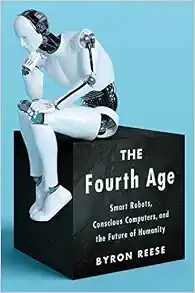
The Fourth Age explores the implications of automation and AI on humanity, and has been described by Ethernet inventor and 3Com founder Bob Metcalfe as framing “the deepest questions of our time in clear language that invites the reader to make their own choices.
Using 100,000 years of human history as his guide, he explores the issues around artificial general intelligence, robots, consciousness, automation, the end of work, abundance, and immortality.”
One of those deep questions of our time:
The technology’s potential impact on jobs
When the topic of automation and AI comes up, one of the chief concerns is always technology’s potential impact on jobs. There is a common assumption that it will be low-skilled jobs that are first automated, but is that really how automation will change the job market?
In this excerpt from The Fourth Age, Byron Reese explores which sorts of jobs are most vulnerable to automation.
The assumptions that low-skilled workers will be the first to go and that there won’t be enough jobs for them undoubtedly have some truth to them, but they require some qualification.
Generally speaking, when scoring jobs for how likely they are to be replaced by automation, the lower the wage a job pays, the higher the chance it will be automated. The inference usually drawn from this phenomenon is that a low-wage job is a low-skill job.

Myth: a low-wage job is a low-skill job
This is not always the case. From a robot’s point of view, which of these jobs requires more skill: a waiter or a highly trained radiologist who interprets CT scans? A waiter, hands down. It requires hundreds of skills, from spotting rancid meat to cleaning up baby vomit.
But because we take all those things for granted, we don’t think they are all that hard. To a robot, the radiologist’s job, by comparison, is a cakewalk. It is just data in, probabilities out.
This phenomenon is so well documented that it has a name, the Moravec paradox. Hans Moravec was among those who noted that it is easier to do hard, brainy things with computers than “easy” things.
It is easier to get a computer to beat a grandmaster at chess than it is to get one to tell the difference between a photo of a dog and a cat.
Skill availability
Waiters’ jobs pay less than radiologists’ jobs not because they require fewer skills, but because the skills needed to be a waiter are widely available, whereas comparatively few people have the uncommon ability to interpret CT scans.
What this means is that the effects of automation are not going to be overwhelmingly borne by low-wage earners. Order takers at fast-food places may be replaced by machines, but the people who clean up the restaurant at night won’t be.
The jobs that automation affects will be spread throughout the wage spectrum.
Build Top & Destroy Bottom
All that being said, there is a widespread concern that automation is destroying jobs at the “bottom” and creating new jobs at the “top.”
Automation, this logic goes, maybe making new jobs at the top like geneticists but is destroying jobs at the bottom like warehouse workers.
Doesn’t this situation lead to a giant impoverished underclass locked out of gainful employment?
Often, the analysis you hear goes along these lines: “The new jobs are too complex for less-skilled workers.

For instance, if a new robot replaces a warehouse worker, tomorrow the world will need one less warehouse worker. Even if the world also happened to need an additional geneticist, what are you doing to do?
Will the warehouse worker have the time, money, and aptitude to train for the geneticist’s job?”
No. The warehouse worker doesn’t become the geneticist. What actually happens is this: A college biology professor becomes the new geneticist; a high-school biology teacher takes the college job; a substitute elementary teacher takes the high school job; the unemployed warehouse worker becomes a substitute teacher.
This is the story of progress. When a new job is created at the top, everyone gets a promotion. The question is not “Can a warehouse worker become a geneticist” but “Can everyone do a job a little harder than the one they currently do?”
If the answer to that is yes, which I emphatically believe, then we want all new jobs to be created at the top, so that everyone gets a chance to move up a rung on the ladder of success.
To read more of GigaOm publisher Byron Reese’s new book, The Fourth Age: Smart Robots, Conscious Computers, and the Future of Humanity, you can purchase it here.
Source: gigaom.com

The following is an excerpt from GigaOm publisher Byron Reese’s new book, The Fourth Age: Smart Robots, Conscious Computers, and the Future of Humanity. You can purchase the book here.
The Fourth Age explores the implications of automation and AI on humanity, and has been described by Ethernet inventor and 3Com founder Bob Metcalfe as framing “the deepest questions of our time in clear language that invites the reader to make their own choices.
Using 100,000 years of human history as his guide, he explores the issues around artificial general intelligence, robots, consciousness, automation, the end of work, abundance, and immortality.”
One of those deep questions of our time:
When the topic of automation and AI comes up, one of the chief concerns is always technology’s potential impact on jobs. Many fear that with the introduction of wide-scale automation, there will be no more jobs left for humans. But is it really that dire? I
n this excerpt from The Fourth Age, Byron Reese explores the prospect of massive job loss due to automation.
Technological Unemployment:
The “jobs will be destroyed too quickly” argument is an old one as well. In 1930, the economist John Maynard Keynes voiced it by saying, “We are being an afflicted with a new disease . . . technological unemployment.

This means unemployment due to our discovery of means of economising the use of labour outrunning the pace at which we can find new uses for labour.”
In 1978, New Scientist repeated the concern:
The relationship between technology and employment opportunities most commonly considered and discussed is, of course, the tendency for technology to be labour-saving and thus eliminate employment opportunities—if not actual jobs.
In 1995, the refrain was still the name. David F. Noble wrote in Progress without People:
Computer-aided manufacturing, robotics, computer inventories, automated switchboards and tellers, telecommunication technologies—all have been used to displace and replace people, to enable employers to reduce labour costs, contract-out, relocate operations.
But is it true now? Will new technology destroy the current jobs too quickly?
A number of studies have tried to answer this question directly. One of the very finest and certainly the most quoted was published in 2013 by Carl Benedikt Frey and Michael A. Osborne, both of Oxford University.
The report, titled The Future of Employment, is seventy-two pages long, but what has been referenced most frequently in the media is a single ten-word phrase: “about 47 per cent of total US employment is at risk.”
Hey, who needs more than that? It made for juicy and salacious headlines, to be sure. It seemed as if every news source screamed a variant of “Half of US Jobs Will Be Taken by Computers in Twenty Years.”
MEN WALK ON MOON Report
If we really are going to lose half our jobs in twenty years, well, then the New York Times should dust off the giant type it used back in 1969 when it printed “MEN WALK ON MOON” and report the story on the front page with equal emphasis.

But that is not actually what Frey and Osborne wrote. Toward the end of the report, they provide a four-hundred-word description of some of the limitations of the study’s methodology.
They state that “we make no attempt to estimate how many jobs will actually be automated. The actual extent and pace of computerisation will depend on several additional factors which were left unaccounted for.”
So what’s with the 47 per cent figure? What they said is that some tasks within 47 per cent of jobs will be automated. Well, there is nothing terribly shocking about that at all. Pretty much every job there is has had tasks within it automated. But the job remains. It is just different.
For instance, Frey and Osborne give the following jobs a 65 per cent or better chance of being computerized: social science research assistants, atmospheric and space scientists, and pharmacy aides. So what does this mean?
Social science professors will no longer have research assistants? Of course, they will. They will just do different things because much of what they do today will be automated. There won’t be any more space scientists? Pharmacists will no longer have anyone helping them?
Frey and Osborne say that the tasks of a barber have an 80 per cent chance of being taken over by AI or robots. In their category of jobs with a 90 per cent or higher chance of certain tasks being computerized are tour guides and carpenters’ helpers.
Job Morphing
The disconnect is clear: some of what a carpenter’s helper does will get automated, but the carpenter helper job won’t vanish; it will morph, as almost everyone else’s job will, from architect to zoologist. Sure, your iPhone can be a tour guide, but that won’t make tour guides vanish.
Anyone who took the time to read past the introduction to The Future of Employment saw this. And to be clear, Frey and Osborne were very up-front. They stated, in scholar-speak, the following:
We do not capture any within-occupation variation resulting from the computerisation of tasks that simply free up time for human labour to perform other tasks.
In response to the Frey and Osborne paper, the Organization for Economic Cooperation and Development (OECD), an intergovernmental economic organization made up of nations committed to free markets and democracy, released a report in 2016 that directly counters it. I
n this report, entitled The Risk of Automation for Jobs in OECD Countries, the authors apply a “whole job” methodology and come up with the per cent of jobs potentially lost to computerization as 9 per cent. That is a pretty normal churn for the economy.
At the end of 2015, McKinsey & Company published a report entitled Four Fundamentals of Workplace Automation that came to similar conclusions as to the OECD. But again, it had a number too provocative for the media to resist sensationalizing.
The report said, “The bottom line is that 45 per cent of work activities could be automated using already demonstrated technology,” which was predictably reported as variants of “45% of Jobs to Be Eliminated with Existing Technology.”
Often overlooked was the fuller explanation of the report’s conclusion:
Our results to date suggest, first and foremost, that a focus on occupations is misleading. Very few occupations will be automated in their entirety in the near or medium term. Rather, certain activities are more likely to be automated, requiring entire business processes to be transformed, and jobs performed by people to be redefined, much like the bank teller’s job was redefined with the advent of ATMs.
The “47 per cent [or 45 per cent] of jobs will vanish” interpretation doesn’t even come close to passing the sniff test. Humans, even ones with little or no professional training, have incredible skills we hardly ever think about.
Let’s look closely at two of the jobs at the very top of Frey and Osborne’s list: short-order cook and waiter. Both have a 94 per cent chance of being computerized.
Robot at Pizza Shop Scenario
Imagine you own a pizza restaurant that employs one cook and one waiter. A fast-talking door-to-door robot salesman manages to sell you two robots: one designed to make pizzas and one designed to take orders and deliver pizzas to tables.
All you have to do is preload the food containers with the appropriate ingredients, and head off to Bermuda. The robot waiter, who understands twenty languages, takes orders with amazing accuracy, and flawlessly handles special requests like “I want half this, half that” and “light on the sauce.”

The orders are sent to the pizza robot, who makes the pizza with speed and consistency.
Let’s check in on these two robots on their first day of work and see how things are going:
- A patron spills his drink. The robots haven’t been taught to clean up spills, since this is a surprisingly complicated task. The programmers knew this could happen, but the permutations of what could be spilled and where were too hard to deal with. They promised to include it in a future release, and in the meantime, to program the robot to show the customers where the cleaning supplies are kept.
- A little dog, one of those yip-yips, comes yipping in and the waiter robot trips and falls down. Having no mechanism to right itself, it invokes the “I have fallen and cannot get up” protocol, which repeats that phrase over and over with an escalating tone of desperation until someone helps it up. When asked about this problem, the programmers reply, snappishly, that “it’s on the list.”
Maggots get in the shredded cheese. Maggoty pizza is served to the patrons. All the robot is trained to do with customers unhappy with their orders is to remake their pizzas. More maggots. The robots don’t even know what maggots are.
- A well-meaning pair of Boy Scouts pop in to ask if the pipe jutting out of the roof should be emitting smoke. They say they hadn’t noticed it before. Should it be? How would the robot know?
- A not-well-meaning pair of boys come in and order a “pizza with no crust” to see if the robots would try to make it and ruin the oven. After that, they order a pizza with double crust and another one with twenty times the normal amount of sauce. Given that they are both wearing Richard Nixon masks, the usual protocol of taking photographs of troublesome patrons doesn’t work and results only in a franchise-wide ban of Richard Nixon at affiliated restaurants.
- A patron begins choking on a pepperoni. Thinking he must be trying to order something, the robot keeps asking him to restate his request. The patron ends up dying right there at his table. After seeing no motion from him for half an hour, the robot repeatedly runs its “Sleeping Patron” protocol, which involves poking the customer and saying, “Excuse me, sir, please wake up” repeatedly.
- The fire marshal shows up, seeing the odd smoke from the pipe in the roof, which he hadn’t noticed before. Upon discovering maggot-infested pizza and a dead patron being repeatedly poked by a robot, he shuts the whole place down. Meanwhile, you haven’t even boarded your flight to Bermuda.
This scenario is, of course, just the beginning. The range of things the robot waiter and cook can’t do is enough to provide sitcom material for ten seasons, with a couple of Christmas specials thrown in.

The point is that those who think so-called low-skilled humans are easy targets for robot replacement haven’t fully realized what a magnificently versatile thing any human being is and how our most advanced electronics are little more than glorified toaster ovens.
While it is clear that we will see ever-faster technological advances, it is unlikely that they will be different enough in nature to buck our two-hundred-year run of plenty of jobs and rising wages.
In one sense, no technology really compares to mechanization, electricity, or steam engines in impact on labour. And those were a huge win for both workers and the overall economy, even though they were incredibly disruptive.
To read more of GigaOm publisher Byron Reese’s new book, The Fourth Age: Smart Robots, Conscious Computers, and the Future of Humanity, you can purchase it here.
Source: gigaom.com
