
Today’s leading minds talk AI with host Byron Reese
About this Episode
Episode 75 of Voices in AI features host Byron Reese and Kevin Kelly discuss the brain, the mind, what it takes to make AI, and Kevin’s thoughts on its inevitability.
Kevin has written books such as ‘The New Rules for a New Economy, ‘What Technology Wants’, and ‘The Inevitable’. Kevin also started Wired Magazine, an internet and print magazine of tech and culture.
Visit www.VoicesinAI.com to listen to this one-hour podcast or read the full transcript.
Transcript Excerpt
Byron Reese: This is Voices in AI, brought to you by GigaOm, and I’m Byron Reese.
Today I am so excited we have as our guest, Kevin Kelly.
You know when I was writing the biography for Kevin, I didn’t even know where to start or where to end.
He’s perhaps best known for a quarter of a century ago, starting Wired magazine, but that is just one of many many things on an amazing career [path].
He has written a number of books, The New Rules for a New Economy, What Technology Wants, and most recently, The Inevitable, where he talks about the immediate future.
I’m super excited to have him on the show, welcome Kevin.
Kevin Kelly: It’s a real delight to be here, thanks for inviting me.

So what is inevitable?
There’s a hard version and a soft version, and I kind of adhere to the soft version.
The hard version is kind of a total deterministic world in which if we rewound the tape of life, it all unfolds exactly as it has, and we still have Facebook and Twitter, and we have the same president and so forth.
The soft version is to say that there are biases in the world, in biology as well as its extension into technology and that these biases tend to shape some of the large forms that we see in the world, still leaving the particulars, the specifics, the species to be completely, inherently, unpredictable and stochastic and random.
So that would say that things like you’re going to find on any planet that has water, you’ll find fish, it has life and in water, you’ll find fish, or will things, if you rewound the tape of life you’d probably get flying animals again and again, but you’ll never, but I mean, a specific bird, a robin is not inevitable.
And the same thing with technology. Any planet that discovers electricity and mixed wires will have telephones.
So telephones are inevitable, but the iPhone is not. And the internet’s inevitable, but Google’s not.
AI’s inevitable, but the particular variety of character, the specific species of AI is not.
That’s what I mean by inevitable—that there are these biases that are built by the very nature of chemistry and physics, that will bend things in certain directions.

And what are some examples of those that you discuss in your book?
So, technology’s basically an extension of the same forces that drive life, and a kind of accelerated evolution is what technology is.
So if you ask the question about what are the larger forces in evolution, we have this movement towards complexity.
We have a movement towards diversity; we have a movement towards specialization; we have a movement towards mutualism.
Those also are happening in technology, which means that all things being equal, technology will tend to become more and more complex.
The idea that there’s any kind of simplification going on in technology is completely erroneous, there isn’t.
It’s not that the iPhone is any simpler.

There’s a simple interface.
It’s like you have an egg, it’s a very simple interface but inside it’s very complex.
The inside of an iPhone continues to get more and more complicated, so there is a drive that, all things being equal, technology will be more complex and then next year it will be more and more specialized.
So, the history of technology in photography was there was one camera, one kind of camera.
Then there was a special kind of camera you could do for high speed; maybe there’s another kind of camera that could do underwater; maybe there was a kind that could do infrared; and then eventually we would do a high speed, underwater, infrared camera.
So, all these things become more and more specialized and that’s also going to be true about AI, we will have more and more specialized varieties of AI.

So let’s talk a little bit about [AI].
Normally the question I launch this with—and I heard your discourse on it—is: What is intelligence?
And in what sense is AI artificial?
Yes. So the big hairy challenge for that question is, we humans collectively as a species at this point in time, have no idea what intelligence really is.
We think we know when we see it, but we don’t really, and as we try to make artificial synthetic versions of it, we are, again and again, coming up to the realization that we don’t really know how it works and what it is.
Their best guess right now is that there are many different subtypes of cognition that collectively interact with each other and are codependent on each other, form the total output of our minds and of course other animal minds, and so.
I think the best way to think of this is we have a ‘zoo’ of different types of cognition, different types of solving things, of learning, of being smart, and that collection varies a little bit by person-to-person and a lot between different animals in the natural world and so…

That collection is still being mapped, and we know that there’s something like symbolic reasoning.
We know that there’s a kind of deductive logic, that there’s something about spatial navigation as a kind of intelligence.
We know that there’s mathematical type thinking; we know that there’s emotional intelligence; we know that there’s perception; and so far, all the AI that we have been ‘wowed’ by in the last 5 years is really all a synthesis of only one of those types of cognition, which is perception.
So all the deep learning neural net stuff that we’re doing is really just varieties of perception of perceiving patterns, and whether there’s audio patterns or image patterns, that’s really as far as we’ve gotten.
But there are all these other types, and in fact, we don’t even know what all the varieties of types [are].

We don’t know how we think, and I think one of the consequences of AI, trying to make AI, is that AI is going to be the microscope that we need to look into our minds to figure out how they work.
So it’s not just that we’re creating artificial minds, it’s the fact that that creation—that process—is the scope that we’re going to use to discover what our minds are made of.
Listen to this one-hour episode or read the full transcript at www.VoicesinAI.com
Byron explores issues around artificial intelligence and conscious computers in his new book The Fourth Age: Smart Robots, Conscious Computers, and the Future of Humanity.
Source: gigaom.com

Today’s leading minds talk AI with host Byron Reese
About this Episode
Episode 69 of Voices in AI features host Byron Reese and Dr. Raj Minhas talk about AI, AGI, and machine learning.
They also delve into explainability and other quandaries AI is presenting. Raj Minhas has a Ph.D. and MS in Electrical and Computer Engineering from the University of Toronto, with his BE from Delhi University.
Raj is also the Vice President and Director of the Interactive and Analytics Laboratory at PARC.
Visit www.VoicesinAI.com to listen to this one-hour podcast or read the full transcript.

Transcript Excerpt
Byron Reese: This is Voices in AI, brought to you by GigaOm, I’m Byron Reese. Today I’m excited that our guest is Raj Minhas, who is Vice President and the Director of Interactive and Analytics Laboratory at PARC, which we used to call Xerox PARC. Raj earned his Ph.D. and MS in Electrical and Computer Engineering from the University of Toronto, and his BE from Delhi University. He has eight patents and six patent-pending applications. Welcome to the show, Raj!
Raj Minhas: Thank you for having me.
I like to start off, just asking a really simple question, or what seems like a very simple question: what is artificial intelligence?
Okay, I’ll try to give you two answers.
One is a flip response, which is if you tell me what is intelligence, I’ll tell you what is artificial intelligence, but that’s not very useful, so I’ll try to give you my functional definition.
I think of artificial intelligence as the ability to automate cognitive tasks that we humans do, so that includes the ability to process information, make decisions based on that, learn from that information, at a high level.
That functional definition is useful enough for me.
Well, I’ll engage on each of those, if you’ll just permit me. I think even given a definition of intelligence that everyone agreed on, which doesn’t exist, artificial is still ambiguous. Do you think of it as artificial in the sense that artificial turf really isn’t grass, so it’s not really intelligence, it just looks like intelligence? Or, is it simply artificial because we made it, but it really is intelligent?
It’s the latter.
So if we can agree on what intelligence is, then artificial intelligence to me would be the classical definition of artificial intelligence, which is re-creating that outside the human body.
So re-creating that by ourselves, it may not be re-created in the way it is created in our minds, in the way humans or other animals do it, but, it’s re-created in that it achieves the same purpose, it’s able to reason in the same way, it’s able to perceive the world, it’s able to do problem-solving in that way.
So without getting necessarily bogged down by what is the mechanism by which we have intelligence, and does that mechanism need to be the same; artificial intelligence to me would be re-creating that – the ability of that.
Fair enough, so I’ll just ask you one more question along these lines. So, using your ability to automate cognitive tasks, let me give you four or five things, and you tell me if they’re AI. AlphaGo?
Yes.
And then a step down from that, a calculator?
Sure, a primitive form of AI.
A step down from that: an abacus?
Abacus, sure, but it involves humans in the operation of it, but maybe it’s on that boundary where it’s partially automated, but yes.
What about an assembly line?
Sure, so I think…
And then I would say my last one which is a cat food dish that refills itself when it’s empty? And if you say yes to that…
All of those things to me are intelligent, but some of those are very rudimentary, and not, so, for example, you look at animals.
On one end of the scale are humans, they can do a variety of tasks that other animals cannot, and on the other end of the spectrum, you may have very simple organisms, single-celled or mammals, they may do things that I would find intelligent, they may be simply responding to stimuli, and that intelligence may be very much encoded.
They may not have the ability to learn, so they may not have all aspects of intelligence, but I think this is where it gets really hard to say what is intelligence.
Which is my flip response.
If you say: what is intelligence?
I can say I’m trying to automate that by artificial intelligence, so, if you were to include in your definition of intelligence, which I do, that ability to do math implies intelligence, then by automating that with an abacus is a way of artificially doing that, right?
You have been doing it in your head using whatever mechanism is in there, you’re trying to do that artificially.
So it is a very hard question that seems so simple, but, at some point, in order to be logically consistent, you have to say yes, if that’s what I mean, that’s what I mean, even though the examples can get very trivial.
Well, I guess then, and this really is the last question along those lines: what, if everything falls under your definition, then what’s different now? What’s changed? I mean a word that means everything means nothing, right?
That is part of the problem, but I think what is becoming more and more different is, the kinds of things you’re able to do, right?
So we are able to reason now artificially in ways that we were not able to before.
Even if you take the narrower definition that people tend to use which is around machine learning, they’re able to use that to perceive the world in ways in which we were not able to before, and so, what is changing is that ability to do more and more of those things, without relying on a person necessarily at the point of doing them.
We still rely on people to build those systems to teach them how to do those things, but we are able to automate a lot of that.
Obviously artificial intelligence to me is more than machine learning where you show something a lot of data and it learns just for a function because it includes the ability to reason about things, to be able to say, “I want to create a system that does X, and how do I do it?”
So can you reason about models, and come to some way of putting them together and composing them to achieve that task?
Listen to this one-hour episode or read the full transcript at www.VoicesinAI.com
Source: Voices in AI – Episode 69: A Conversation with Raj Minhas – Gigaom

Today’s leading minds talk AI with host Byron Reese
About this Episode
Episode 73 of Voices in AI features host Byron Reese and Konstantinos Karachalios discuss what it means to be human, how technology has changed us in the far and recent past, and how AI could shape our future.
Konstantinos holds a Ph.D. in Engineering and Physics from the University of Stuttgart, as well as being the managing director at the IEEE standards association.
Visit www.VoicesinAI.com to listen to this one-hour podcast or read the full transcript.

Transcript Excerpt
Byron Reese: This is Voices in AI, brought to you by GigaOm, and I’m Byron Reese. Today our guest is Konstantinos Karachalios. He is the Managing Director at the IEEE Standards Association, and he holds a Ph.D. in Engineering and Physics from the University of Stuttgart. Welcome to the show.
Konstantinos Krachalios: Thank you for inviting me.
So we were just chatting before the show about ‘what does artificial intelligence mean to you?’ You asked me that and it’s interesting because that’s usually my first question: What is artificial intelligence, why is it artificial, and feel free to talk about what intelligence is.
Yes, and first of all we see really a kind of mega-wave around the ‘so-called’ artificial intelligence—it started two years ago.
There seems to be a hype around it, and it would be good to distinguish what is marketing, what is real, and what is propaganda—what are dreams what are nightmares, and so on.
I’m a systems engineer, so I prefer to take a systems approach, and I prefer to talk about, let’s say, ‘intelligent systems,’ which can be autonomous or not, and so on.
The big question is a compromise because the big question is: ‘what is intelligence?’ because nobody knows what is intelligence, and the definitions vary very widely.

I myself try to understand what is human intelligence at least, or what are some expressions of human intelligence, and I gave a certain answer to this question when I was invited in front of the House of the Lord’s testimony.
Just to make it brief, I’m not a supporter of the hype around artificial intelligence, also I’m not even supporting the term itself.
I find it obfuscates more than it reveals, and so I think we need to re-frame this dialogue, and it takes also away from human agency.
So, I can make a critique of this and also I have a certain proposal.
Well, start with your critique If you think the term is either meaningless or bad, why? What are you proposing as an alternative way of thinking?
Very briefly because we can talk really for one or two hours about this: My critique is that the whole of this terminology is associated also with a perception of humans and of our intelligence, which is quite mechanical.
That means there is a whole school of thinking, there are many supporters there, who believe that humans are just better data processing machines.
Well let’s explore that because I think that is the crux of the issue, so you believe that humans are not machines?
Apparently not. It’s not only we’re not machines, I think because evidently, we’re not machines, but we’re biological, and machines are perhaps mechanical although now the boundary has blurred because of biological machines and so on.
You certainly know the thought experiment that says, if you take what a neuron does and build an artificial one and then you put enough of them together, you could eventually build something that functions like the brain. Then wouldn’t it have a mind and wouldn’t it be intelligent, and isn’t that what the human brain initiative in Europe is trying to do?
This is weird, all this you have said starts with a reductionist assumption about the human—that our brain is just a very good computer.
It ignores really the sources of our intelligence, which are really not all in our brain.
Our intelligence has really several other sources.
We cannot reduce it to just the synapses in the neurons and so on, and of course, nobody can prove this or another thing.
I just want to make clear here that the reductionist assumption about humanity is also a religious approach to humanity, but a reductionist religion.
And the problem is that people who support this, believe it is scientific, and, I do not accept it.
This is really a religion, and a reductionist one and this has consequences about how we treat humans, and this is serious.
So if we continue propagating a language that reduces humanity, it will have political and social consequences, and I think we should resist this and I think the best way to express this is an essay by Joichi Ito with the title which says “Resist Reduction.”
And I would really suggest that people read this essay because it explains a lot that I’m not able to explain here because of time.
So you’re maintaining that if you adopt this, what you’re calling a “religious view,” a “reductionist view” of humanity, that in a way that can go to undermine human rights and the fact that there is something different about humans that is beyond purely humanistic.
For instance, I was in an AI conference of a UN organization that brought all other UN organizations with technology together.
It was two years ago, and there they were celebrating a humanoid, which was pretending to be a human.
The people were celebrating this and somebody there asked this question to the inventor of this thing: “What do you intend to do with this?”
And this person spoke publicly for five minutes and could not answer the question and then he said, “You know, I think we’re doing it because if we don’t do it, others were going to do it, it is better we are the first.”

I find this a very cynical approach, a very dangerous one, and nihilistic.
These people with this mentality, we celebrate them as heroes. I think this is too much.
We should stop doing this anymore, we should resist this mentality and this ideology.
I believe we make machines a citizen, you treat your citizens like machines, then we’re not going very far as humanity.
I think this is a very dangerous path.
Listen to this one-hour episode or read the full transcript at www.VoicesinAI.com
Byron explores issues around artificial intelligence and conscious computers in his new book The Fourth Age: Smart Robots, Conscious Computers, and the Future of Humanity.
Source: gigaom.com

Recently GigaOm publisher and CEO, Byron Reese, sat down for a chat with Seedcamp’s Carlos Espinal on their podcast ‘This Much I Know.’ It’s an illuminating 80-minute conversation about the future of technology, the future of humanity, Star Trek, and much, much more.
You can listen to the podcast at Seedcamp or Soundcloud, or read the full transcript here.
QA:1
Carlos Espinal: Hi everyone, welcome to ‘This Much I Know,’ the Seedcamp podcast with me, your host Carlos Espinal bringing you the inside story from founders, investors, and leading tech voices.
Tune in to hear from the people who built businesses and products scaled globally, failed fantastically, and learned massively.
Welcome, everyone!
On today’s podcast, we have Byron Reese, the author of a new book called The Fourth Age: Smart Robots, Conscious Computers, and the Future of Humanity.
Not only is Byron an author, but he’s also the CEO of publisher GigaOm, and he’s also been a founder of several high-tech companies, but I won’t steal his thunder by saying every great thing he’s done.
I want to hear from the man himself. So welcome, Byron.
Byron Reese: Thank you so much for having me. I’m so glad to be here.
QA:2
Excellent. Well, I think I mentioned this before: one of the key things that we like to do in this podcast is getting to the origins of the person; in this case, the origins of the author.
Where did you start your career and what did you study in college?
I grew up on a farm in east Texas, a small farm. And when I left high school I went to Rice University, which is in Houston. And I studied Economics and Business, a pretty standard general thing to study. When I graduated, I realized that it seemed to me that like every generation had… something that was ‘it’ at that time, the Zeitgeist of that time, and I knew I wanted to get into technology. I’d always been a tinkerer, I built my first computer, blah, blah, blah, all of that normal kind of nerdy stuff that I did.
But I knew I wanted to get into technology. So, I ended up moving out to the Bay Area and that was in the early 90s, and I worked for a technology company and that one was successful, and we sold it and it was good. And I worked for another technology company, got an idea and spun out a company, and raised the financing for that. And we sold that company. And then I started another one and after 7 hard years, we sold that one to a company and it went public and so forth. So, from my mother’s perspective, I can’t seem to hold a job; but from another view, it’s kind of like the thing of our time instead. We’re in this industry that changes so rapidly. There are more opportunities, which always come along and I find that whole feeling intoxicating.
QA:3
That’s great. That’s a very illustrious career with that many companies having been built and sold. And now you’re running GigaOm.
Do you want to share a little bit for people who may not be as familiar with GigaOm and what it is and what you do?
Certainly. And I hasten to add that I’ve been fortunate that I’ve never had a failure in any of my companies, but they’ve always had harder times. They’ve always had these great periods of like, ‘Boy, I don’t know how we’re going to pull this through,’ and they always end up [okay]. I think tenacity is a great trait in the startup world because they’re all very hard. And I don’t feel like I figured it all out or anything. Everyone is a struggle.
GigaOm is a technology research company. So, if you’re familiar with companies like Forrester or Gartner or those kinds of companies, what we are is a company that tries to help enterprises, help businesses deal with all of the rapidly changing technology that happens. So, you can imagine if you’re a CIO of a large company and there are so many technologies, and it all moves so quickly and how does anybody keep up with all of that? And so, what we have are a bunch of analysts who are each subject matter experts in some area, and we produce reports that try to orient somebody in this world we’re in and say ‘These kinds of solutions work here, and these work there’ and so forth.
And that’s GigaOm’s mission. It’s a big, big challenge because you can never rest. Big new companies I find almost every day that I’ve never even heard of and I think, ‘How did I miss this?’ and you have to dive into that, and so it’s a relentless, nonstop effort to stay current on these technologies.
QA:4
On that note, one of the things that describe you on your LinkedIn page is the word ‘futurist.’
Do you want to walk us through what that means in the context of a label and how does the futurist really look at industries and how they change?
Well, it’s a lower case ‘f’ futurist, so anybody who seriously thinks about how the future might unfold, is to one degree or another, a futurist. I think what makes it into a discipline is to try to understand how change itself happens, how does technology drives changes, and to do that, you almost by definition, have to be a historian as well. And so, I think to be a futurist is to be deliberate and reflective on how it is that we came from where we were, in savagery and low tech and all of that, to this world we are in today and can you in fact look forward.
The interesting thing about the future is it always progresses very neatly and linearly until it doesn’t until something comes along so profound that it changes it. And that’s why you hear all of these things about one prediction in the 19th Century was that, by some year in the future, London would be unnavigable because of all the horse manure or the number of horses that would be needed to support the population, and that maybe would have happened, except you had the car, and like that. So, everything’s a straight-line, until one day it isn’t. And I think the challenge of the futurist is to figure out ‘When does it [move in] a line and when is it a hockey stick?’
QA:5
So, on that definition of line versus hockey stick, your background as having been CEO of various companies, a couple of which were media-centric, what is it that drew you to artificial intelligence specifically to futurize on?
Well, that is a fantastic question. Artificial intelligence is, first of all, a technology that people widely differ on its impact, and that’s usually like a marker that something may be going on there.
There are people who think it’s just oversold hype.
It’s just data mining, big data renamed.
It’s just the tool for raising money better.
Then there are people who say this is going to be the end of humanity, as we know it.
And philosophically the idea that a machine can think, maybe, is a fantastically interesting one, because we know that when you can teach a machine to do something, you can usually double and double and double and double and double its ability to do that over time.
And if you could ever get it to reason, and then it could double and double and double and double, well that could potentially be very interesting.
Humans only evolve, computers are able to evolve kind of at the speed of light, they get better and humans evolve at the speed of life. It takes generations. And so, if a machine can think, a question famously posed by Alan Turing, if a machine could think then that could potentially be a game-changer. Likewise, I have a similar fascination for robots because it’s a machine that can act, that can move and can interact physically in the world. And I got to thinking what would happen, what is it a human in a world where machines can think better and act better, then what are we? What is uniquely human at that point?
And so, when you start asking those kinds of questions about technology, that gets very interesting. You can take something like air conditioning and you can say, wow, air conditioning. Think of the impact that had. It meant that in the evening’s people wouldn’t… in warm areas, people don’t go out on their front porch anymore. They close the house up and air condition it, and therefore they have less interaction with their neighbors. And you can take some technology as simple as that and say that had all these ripples throughout the world.
The discovery of the new world ended the Italian Renaissance effectively because it changed the focus of Europe in a whole different direction. So, when those sorts of things had those kinds of ripples through history, you can only imagine what if the machine could think like that’s a big deal. Twenty-five years ago, we made the first browser, the Mosaic browser, and if you had an enormous amount of foresight and somebody said to you, in 25 years, 2 billion people are going to be using this, what do your think’s going to happen?
If you had an enormous amount of foresight, you might’ve said, well, the Yellow Pages are going to have it rough and the newspapers are, and travel agents are, and stockbrokers are going to have a hard time, and you would have been right about everything, but nobody would have guessed there would be Google, or eBay, or Etsy, or Airbnb, or Amazon, or $25 trillion worth of a million new companies. And all that was, was computers being able to talk to each other. Imagine if they could think. That is a big question.
QA:6
You’re right and I think that there is…I was joking and I said ‘Tinder’ in the background just because that’s a social transformation. Not even like a utility, but rather the social expectation of where certain things happen that was brought about that. So, you’re right… and we’re going to get into some of those [new platforms] as we review your book. In order to do that, let’s go through the table of contents. So, for those of you that don’t have the book yet, because hopefully, you will after this chat, the book is broken up into five parts and in some ways, these parts are arguably chronological in their stage of development.
The first one I would label as the historical, and it’s broken out into the fourth ages that we’ve had as humans, the first age being language and fire, the second one being agriculture and cities, the third one being writing and wheels, and the fourth one being the one that we’re currently in, which is robots and AI. And we’re left with three questions, which are: what is the composition of the universe, what are we, and what is yourself? And those are big, deep philosophical ones that will manifest themselves in the book a little bit later as we get into consciousness.
Part two of the book is about narrow AI and robots. Arguably I would say this is where we are today, and Seedcamp as an investor in AI companies has broadly invested in narrow AI through different companies. And this is I think the cutting edge of AI, as far as we understand it. Part three in the book covers artificial general intelligence, which is everything we’ve always wanted to see, where science fiction represents quite well, everything from that movie AI, with the little robot boy, to Bicentennial Man with Robin Williams, and sort of the ethical implications of that.
Then part four of the book is computer consciousness, which is a huge debate, because as Byron articulates in the book, there’s a whole debate on what is consciousness and there’s a distinction between a monist and a dualist and how they experience consciousness and how they define it. And hopefully, Byron will walk us through that in more detail. And lastly, the road from here, it is the future, as far as we can see it in the futurist portion of the book, I mean part three, four and five are all futurist portions of the book, but this one is where I think, Byron, you go to the ‘nth’ degree possible with a few exceptions. So maybe we can kick off with your commentary on why you have broken up the book into these five parts.
Well you’re right that they’re chronological, and you may have noticed each one opens with what you could call a parable, and the parables themselves are chronological as well. The first one is about Prometheus and it’s about technology, and about how the technology changed and all the rest. And like you said, that’s where you want to kind of lay the groundwork of the last 100,000 years and that’s why it’s named something like ‘the road to here,’ it’s like how we got to where we are today.
And then I think there are three big questions that everywhere I go I hear one variant of them or another. The first one is around narrow AI and like you said, it’s a real technology that’s going to impact us, what’s it going to do with jobs, what’s this going to do in warfare, what will it do with income? All of these things we are certainly going to deal with. And then we’re unfortunate with the term ‘artificial intelligence,’ because it can mean many different things, but one is that it can be narrow AI, it can be a Nest thermometer that can adjust the temperature, but it can also be Commander Data of Star Trek. It can be C-3PO out of Star Wars. It can be something as versatile as a human and fortunately those two things share the same name, but they’re different technologies, so it has to kind of be drawn out on its own, and to say, “Is this very different thing that shares the same name likely? possible? What are its implications and whatnot?”
Interestingly, of the people who believe we’re going to build [an AGI] very immensely and when, some say as soon as five years, and some say as long away as five hundred. And that’s very telling that these people had such wide viewpoints on when we’ll get it. And then to people who believe we’re going to build one, the question then becomes, ‘well is it alive? Can it feel pain? Does it experience the world? And therefore, by that basis does it have rights?’ And if it does, does that mean you can no longer order it to plunge your toilet when it gets stopped up, because all you’ve made is a sentient being that you can control, and is that possible?
And why is it that we don’t even know this? The only real thing any of us know is our own consciousness and we don’t even know where that comes about. And then finally the book starts 100,000 years ago. I wanted to look 100,000 years out or something like that. I wanted to start thinking about, no matter how these other issues shake out, what is the long trajectory of the human race? Like how did we get here and what does that tell us about where we’re going? Is human history a story of things getting better or things getting worse, and how do they get better or worse and all of the rest. So that was a structure that I made for the book before I wrote a single word.
QA:7
Yeah, and it makes sense. Maybe for the sake of not stealing the thunder of those that want to read it, we’ll skip a few of those, but before we go straight into questions about the book itself, maybe you can explain who you want this book to be read by. Who is the customer?
There are two customers for the book. The first is people who are in the orbit of technology one way or the other like it’s their job or their day-to-day, and these questions are things they deal with and think about constantly. The value of the book, the value prop of the book is that it never actually tells you what I think on any of these issues. Now, let me clarify that ever so slightly because the book isn’t just another guy with another opinion telling you what I think is going to happen. That isn’t what I was writing it for at all.
What I was really intrigued by is how people have so many different views on what’s going to happen. Like with the jobs question, which I’m sure we’ll come to. Are we going to have universal unemployment or are we going to have too few humans? These are very different outcomes all by very technical-minded informed people. So, what I’ve written or tried to write is a guidebook that says I will help you get to the bottom of all the assumptions underlying these opinions and do so in a way that you can take your own values, your own beliefs, and project them onto these issues and have a lot of clarity. So, it’s a book about how to get organized and understand why the debate exists about these things.
And then the second group are people who, just see headlines every now and then where Elon Musk says, “Hey, I hope we’re not just the boot loaders for the AI, but it seems to be the case,” or “There’s very little chance we’re going to survive this.” And Stephen Hawking would say, “This may be the last invention we’re permitted to make.” Bill Gates says he’s worried about AI as well. And the people who see these headlines, they’re bound to think, “Wow, if Bill Gates and Elon Musk and Stephen Hawking are worried about this, then I guess I should be worried as well.” Just on the basis of that, there’s a lot of fear and angst about these technologies.
The book actually isn’t about technology. It’s about how much you believe and what that means for your beliefs about technology. And so, I think after reading the book, you may still be afraid of AI, you may not, but you will be able to say, ‘I know that why Elon Musk, or whoever thinks what they think. It isn’t that they know something I don’t know, they don’t have some special knowledge I don’t have, it’s that they believe something. They believe something very specific about what people are, what the brain is. They have a certain view of the world as completely mechanistic and all these other things.’ You may agree with them, you may not, but I tried to get at all of the assumptions that live underneath those headlines you see. And so why would Stephen Hawking say that, why would he? Well, there are certain assumptions that you would have to believe to come to that same conclusion.
QA:8
Do you believe that’s the main reason that very intelligent people will disagree on with respect to how optimistic they are about what artificial intelligence will do? You mentioned Elon Musk who is pretty pessimistic about what AI might do, whereas there are others like Mark Zuckerberg from Facebook, who is pretty optimistic, comparatively speaking. Do you think it’s this different account of what we are, that’s explaining the difference?
Absolutely. The basic rules that govern the universe and what our self is, what is that voice you hear in your head?
QA:9
The three big questions.
Exactly. I think the answer to all these questions boil down to those three questions, which as I pointed out, are very old questions. They go back as far as we have writing, and presumably therefore they go back before that, way beyond that.
QA:10
So we’ll try to answer some of those questions and maybe I can prod you. I know that you’ve mentioned in the past that you’re not necessarily expressing your specific views, you’re just laying out the groundwork for people to have a debate, but maybe we can tease some of your opinions.
I make no effort to hide them. I have beliefs about all those questions as well, and I’m happy to share them, but the reason they don’t have a place in the book is: it doesn’t matter whether I think I’m a machine or not. Who cares whether I think I’m a machine? The reader already has an opinion of whether a human being is a machine. The fact that I’m just one more person who says ‘yay’ or ‘nay,’ that doesn’t have any bearing on the book.
QA:11
True. Although, in all fairness, you are a highly qualified person to give an opinion.
I know, but to your point, if Elon Musk says one thing and Mark Zuckerberg says another, and they’re diametrically opposed, they are both eminently qualified to have an opinion and so these people who are eminently qualified to have opinions have no consensus, and that means something.
QA:12
That does mean something. So, one thing I would like to comment about the general spirit of your book, is that I generally felt like the book was built from a position of optimism. Even towards the very end of the book, towards the 100,000 years in the future, there was always this underlying tone of, we will be better off because of this entire revolution, no matter how it plays out versus not. And I think that maybe I can tease out of you that fact that you are telegraphing your view on ‘what are we?’ Effectively, are we a benevolent race in a benevolent existence, or are we something that’s more destructive in nature? So, I don’t know if you would agree with that statement about the spirit of the book or whether…
Absolutely. I am unequivocally, undeniably optimistic about the future, for a very simple reason, which is, there was a time in the past, maybe 70,000 years ago, that humans were down to something like maybe 1000 breeding pairs. We were an endangered species and we were one epidemic, one famine, one away from total annihilation and somehow, we got past that. And then 10,000 years ago, we got agriculture and we learned to regularly produce food, but it took us 90 percent of our people for 10,000 years to make our food.
But then we learned a trick and the trick is technology because what technology does is it multiplies what you are able to do. And what we saw is that all of a sudden, it didn’t take 90 percent, 80 percent, 70, 60, all the way down, in the West to 2 percent. And furthermore, we learned all of these other tricks we could do with technology. It’s almost magic that what it does is it multiplies human ability. And we know of no upward limit of what technology can do and therefore, there is no end to how it can multiply what we can do.
And so, one has to ask the question, “Are we on balance going to use that for good or ill?” And the answer obviously is for good. I know maybe it doesn’t seem obvious if you caught the news this morning, but the simple fact of the matter is by any standard you choose today, life is better than it was in the past, by that same standard anywhere in the world. And so, we have an unending story of 10,000 years of human progress.
And what has marred humanity for the longest time is the concept of scarcity. There was never enough good stuff for everybody, not enough food, not enough medicine, not enough education, not enough leisure, and technology lets us overcome scarcity. And so, I think if you keep that at the core, that on balance, there have been more people who wanted to build than destroy, we know that, because we have been building for 10,000 years. That on balance, on the net, we use technology for good on the net, always, without fail.
QA:13
I’d be interested to know the limits to your optimism there. Is your optimism probabilistic? Do you assign, say a 90 percent chance to the idea that technology and AI will be on balance, good for humans? Or do you think it’s pretty precarious, there’s maybe a 10 percent chance, 20 percent chance that that might be a point where if we fail to institute the right sort of arrangements, it might be bad? How would you sort of describe your optimism in that sense?
I find it hard to find historic cases where technology came along that magnified what people were able to do and that was bad for us. If in fact, artificial intelligence makes everybody effectively smarter, it’s really hard to spin that into a bad thing. If you think that’s a bad thing, then one would advocate that maybe it would be great if tomorrow everybody woke up with 10 fewer IQ points. I can’t construct that in my mind.
And what artificial intelligence is, is it’s a collective memory of the planet. We take data from all these people’s life experiences and we learn from that data, and so to somehow say that’s going to end up badly, is to say ignorance is better than knowledge. It’s to say that, yeah, now that we have a collective memory of the planet, things are going to get worse. If you believe that, then it would be great if everybody forgot everything they know tomorrow. And so, to me, the antithetical position that somehow making everybody smarter, remembering our mistakes better, all of these other things can somehow lead to a bad result…I think is…I shall politely say, unproven in the extreme.
You see, I believe that people are inherently…we have evolved to be by default, extremely cautious. Somebody said it’s much better to mistake a rock for a bear and to run away from it, than it is to mistake a bear for rock and just stand there. So, we are a skittish people and our skittishness has served us well. But what happens is it means anytime you’re born with some bias, some cognitive bias, and we’re born I think with one of fear, it does one well to be aware of that and to say, “I know I’m born this way. I know that for 10,000 years things have gotten better, but tomorrow they might just be worse.” We come by that honestly, it served us well in the past, but that doesn’t mean it’s not wrong.
QA:14
All right, well if we take that and use that as a sort of a veneer for the rest of the conversation, let’s move into the narrow AI portion of your book. We can go into the whole variance of whether robots are going to take all of our jobs, some of our jobs, or none of our jobs and we can kind of explore that.
I know that you’ve covered that in other interviews, and one of the things that maybe we also should cover is how we train our AI systems in this narrow era. How we can inadvertently create issues for ourselves by having old data sets that represent social norms that have changed and therefore skew things in the wrong way, and inherently create momentum for machines to believe and make wrong conclusions of us, even though we as humans might be able to derive that out of contextual relevance at some point, but is no longer. Maybe you can just kick off that whole section with commentary on that.
So, that is certainly a real problem. You see when you take a data set and let’s say the data is 100 percent accurate and you come up with some conclusion about it, it takes on a halo of, ‘well that’s just the facts, that’s just how things are, that’s just the truth.’ And in a sense, it is just the truth, and AI is only going to come to conclusions based on like you said, the data that it’s trained on. You see, the interesting thing about artificial intelligence is it has a philosophical assumption behind it, and it is that the future is like the past, and for many things that is true. A cat tomorrow looks like a cat today and so you can take a bunch of cats from yesterday, or a week ago, or a month or a year and you can train it and it’s going to be correct. A cell phone tomorrow doesn’t look like a cell phone ten years ago though, and so if you took a bunch of photos of cell phones from 10 years ago, trained an AI, it’s going to be fabulously wrong. And so, you hit the nail on the head.
The onus is on us to make sure that whatever we are teaching is a truth that will be true tomorrow, and that is a real concern. There is no machine that can kind of ‘sanity check’ that for you, that you tell the machine, “This is the truth, now, tell me about tomorrow,” but people have to get very good at that. Luckily there’s a lot of awareness around this issue, like people who assemble large datasets, are aware of data has a ‘best-by date that varies widely. For how to play a game of chess, it’s hundreds of years. That hasn’t changed. If it’s what a cell phone looks like, it’s a year. So the trick is to just be very cognizant of the data you’re using.
I find the people who are in this industry are very reflective about these kinds of things, and this gives me a lot of encouragement. There have been times in the past where people associated with new technology had a keen sense that it was something very serious, like the Manhattan project in the United States in World War II, or the computers that were built in the United Kingdom in that same period. They realized they were doing something of import, and they were very reflective about it, even in that time. And I find that to be the case with people in AI today.
QA:15
I think that generally speaking, a lot of the companies that we’ve invested in this sector and in this stage of effectively narrow-based AI, as you said, are going through and thinking through it. But what’s interesting is that I’ve noticed that there is a limit to what we can teach as metadata to data for machine learning algorithms to learn and evolve by themselves. So, the age-old argument is that you can’t build artificial general intelligence. You have to grow it. You have to nurture it. And it’s done over time. And part of the challenge of nurturing or growing something is knowing what pieces of input to give it.
Now, if you use children as the best approximation of what we do, there’s a lot of built-in features, including curiosity and a desire to self-preserve and all these things that then enable the acquisition of metadata, which then justifies and rewrites existing data as either valid or invalid, to use your cell phone example. How do you see us being able to tackle that when we’re inherently flawed in our ability to add metadata to existing data? Are we going to effectively never be able to make it to artificial general intelligence because of our inability to add that add color to data so that it isn’t effectively a very tarnished and limited utility?
Well, yes, it could very easily be the case, and by the way, that’s an extreme minority view among people in AI. I will just say that upfront. I’m not representing a majority of people in AI, but I think that could very well be the case. Let me just dive into that a little bit about how people know what we know. How is it that we are generally intelligent, have general intelligence? If I asked, “Does it hurt your thumb when you hit it with a hammer?” You would say “yes,” and then I would say, “Have you ever done it?” “Yes.” And then I would say, “Well, when?” And you likely can’t remember, and so you’re right, we have data that we take somehow learning from, and we store it and we don’t know how we store it. There’s no place in your brain which is ‘hitting your thumb with a hammer hurts,’ and then if I somehow could cut that out, you no longer know that. It doesn’t exist. We don’t know how we’d do that.
Then we do something really clever. We know how to take data we know in one area and apply it to another area. I could draw a picture of a completely made-up alien that is weird beyond imagination. And I could show that picture to you and then I could give you a bunch of photographs and say find that alien in these. And if the alien is upside down or underwater or covered in peanut butter, or half behind a tree or whatever, you’re like, “There it is. There it is. There it is. There it is.” We don’t know how we do that. So, we don’t know how to make computers do it.
And then if you think about it if I were to ask you to imagine a trout swimming in a river, and imagine the same trout in a jar of formaldehyde and in a laboratory. “Do they weigh the same?” You would say, “yeah.” “Do they smell the same?” “Uh, no.” “Are they the same color?” “Probably not.” “Are they the same temperature?” “Definitely not.” And even though you have no experience with any of that, you instinctively know how to apply it. These are things that people do very naturally, and we don’t know how to make machines do them.
If you were to think of a question to ask a computer like, “Dr. Smith is having lunch at his favorite restaurant when he receives a phone call. Looking worried, he runs out the door neglecting to pay his bill. Are the owners liable to call the police?” You would say a human would say no. Clearly, he’s a doctor. It’s his favorite restaurant, he must eat there a lot, he must’ve gotten an emergency call. He ran out the door forgetting to pay. We’ll just ask him to pay the next night he comes in. The amount of knowledge you had to have, just to answer that question is complex in the extreme.
I can’t even find a chatbot that can answer [the question:] “What’s bigger, a nickel or the sun?” And so to try to answer a question that requires this nuance and all of this inference and understanding and all of that, I do not believe we know how to build that now. That would be, I believe, a statement within the consensus. I don’t believe we know how to build it, and even if you were to say, “Well, if you had enough data and enough computers, you could figure that out.” It may just literally be impossible, like every instantiation of every possibility. We don’t know how we do it. It’s a great mystery and it’s even hotly debated [around] even if we knew how we do it, could we build a machine to do it? I don’t even know that that’s the case.
QA:16
I think that’s part of the thing that baffles me in your book. I’m jumping a little bit around here in your book now. You do talk about consciousness and you talk about sentience and how we know what we know, who we are, what we are. You talk about the dot on pets and how they identify themselves as themselves, and with any engineering problem, sometimes you can conceive of a solution before actually the method by which to get there is accomplished. You can conceive the idea of flying. You just don’t know what combination of anything that you are copying from birds or copying from leaves, or whatever, will function in getting to that goal: flying.
The problem with this one is that from an engineering point of view, this idea of having another human or another human-like entity that not only has consciousness but has free will and sentience as far as we can perceive it, [doesn’t recognize that] there’s a lot of things that you described in your chapter on consciousness that we don’t even know how to qualify. Which is a huge catalyst in being able to create the metadata that structures data in a way that then gives the illusion and perception of consciousness. Maybe this is where you give me your personal opinion… do you think we’ll ever be able to create an answer to that engineering question, such that technology can be built around it? Because otherwise we might just be stuck on the formulation of the problem.
The logic that says we can build it is very straightforward and seemingly ironclad. The logic goes like this. If we figure out how a neuron works, we can build one. Either physically build one or model it on a computer. And if you can model that neuron in a computer, then you learn how it talks to other neurons and then you model 100 billion of them in the computer, and all of a sudden you have a human mind. So that that says, we don’t have to know it, we just have to understand the physics. So, the position just says whatever a neuron does, it behaves the laws of physics and if we can understand how those laws are interacting, then we will be able to build it. Case closed. There’s no question at all that it cannot be done.
So I would say that’s the majority viewpoint. The other viewpoint says, “Well wait a minute, we have this brain that we don’t understand how it works. And then we have this mind, and a mind is a concept everybody uses and if you want a definition, it’s kind of everything your brain can do that an organ doesn’t seem like it would be able to. You have a sense of humor; your liver may not have a sense of humor. You have emotions, your stomach may not have emotions, and so forth.” So somehow, we have a mind that we don’t know how it comes about. And then to your point, we are conscious and what that means is we experience the world. I feel warmth, [whereas] a computer measures temperature. Those are very different things and we not only don’t know how it is that we are conscious, but we also don’t even know how to ask the question in a scientific method, nor what the answer looks like.
And so, I would say my position to be perfectly clear is, we have brains we don’t understand, minds we don’t understand and consciousness we don’t understand. And therefore, I am unconvinced that we can ever build something like this. And so I see no evidence that we can build it because the only example that we have is something that we don’t understand. I don’t think you have to appeal to spiritualism or anything like that, to come to that conclusion, although many people would disagree with me.
QA:17
Yeah, it’s interesting. I think one thing underlying the pessimistic view is this belief that while we may not have the technology now or have an idea of how we’re going to get there, the kinetic sort of an AI explosion—that’s what I think Nick Bostrom, the philosopher has called it—may be pretty rapid in the sense that once there is material success in developing these AI models, that will encourage researchers to sort of pile on and therefore they bring in more people to produce those models and then secondly if there are advancements in self-improving AI models. So there’s a belief that it may be pretty quick that we get super intelligence that underlies this pessimism and the belief that we sort of has to act now. What would be your thoughts on that?
Oh, well I don’t agree. I think that’s the “Is that a bear or a rock?” kind of thing. The only evidence we really have for that scenario is movies, and they’re very compelling and I’m not conspiratorial, and they’re entertaining. But what happens is you see that enough, and you do something that has a name, it’s called ‘reasoning from fictional evidence’ and that’s what we do. Where you say, “Well, that could happen, and when you see it again, and yeah, that could happen. That really could again.” Again, and again and again.
To put it in perspective, when I say we don’t understand how the brain works, let me be really clear about that. Your brain has 100 billion neurons, roughly the same number of stars in the Milky Way. You might say, “Well, we don’t understand it because there’s so many.” This is not true. There’s a worm called the nematode worm. He’s about as long as his hair is thick, and his brain has 302 neurons. These are the most successful creatures on the planet, by the way. Seventy percent of all animals are nematode worms and have 302 neurons. That’s it. [This is about] the number of pieces of cereal in a bowl of cereal. So, for 20 years a group of people in something called the ‘open worm project’ had been trying to model those 302 neurons in a computer to get it to display some of the complex behavior that a nematode worm does. And not only have they not done it, but there’s also even a debate among them whether it is even possible to do that. So that’s the reality of the situation. We haven’t even gotten to the mind.
Again, how is it that we’re creative? And we haven’t even gotten to, how is it that we experience the world? We’re just talking about how does a brain work, if it only has 302 neurons, a bunch of smart people, 20 years working on it, may not even be possible. So somehow to spin a narrative that, well, yeah, that all may be true, but what if there was a breakthrough and then it sped upon itself and sped up and then it got smarter and then it got so smart it had 100 IQ, then a thousand, then a million, then 100 million. And then it doesn’t even see us anymore. That’s as speculative as any other kind of scenario you want to come up with. It’s so removed from the facts on the ground that you can’t rebut it because it is not based on any evidence that you can rebuke.
QA:18
You know, the fun thing about chatting with you, Byron, is that the temptation is to sort of jump into all these theories and which ones are your favorites. So because I have the microphone, I will. Let me just jump into one. Best science fiction theory that you like. I think we’ve touched on a few of these things, but what is the best-unified theory of everything, from science fiction that you feel like, ‘you know what, this might just explain it all?
Star Trek.
QA:19
Okay. Which variant of it? Because there’s not…
Oh, I would take either….I’ll take ‘The Next Generation.’ So, what is that narrative? We use technology to overcome scarcity. We have bumps all along the way. We are insatiably curious, and we go out to explore the stars as Captain Picard told the guy he thought out from the 20th Century. He said the challenge in our time is to better yourself, is to discover who you are. And what we found interestingly with the Internet, and sure, you can list all the nefarious uses you want. What we found is the minute you make blogs, 100 million people want to tell you what they think. The minute you make YouTube, millions of people want to upload video; the minute you make iTunes, music flourishes.
I think in my father’s generation, they didn’t write anything after they left college. We wake up in the morning, and we write all day long. You send emails constantly and so what we have found is that it isn’t that there were just a few people, and as the Italian Renaissance, there were only a few people who wanted to paint or cared to paint. It was like everybody probably did. Only there wasn’t enough of the good stuff, and so only either you had extreme talent or extreme wealth and then you got to paint.
Well, in the future, in the Star Trek variant of it, we’ve eliminated scarcity through technology, and everybody is empowered, every Dante to write their Inferno, every Marie Curie to discover radium, and all of the rest. And so that vision of the future, you know, Gene Roddenberry said in the future there will be no hunger and there will be no greed and all the children would know how to read. That variant of the future is the one that’s most consistent with the past. That’s the one you can say, “Yeah, somebody in the 1400s looking at our life today, that would look like Star Trek to them. These people like to push up a button and the temperature in the room gets cooler, and they have leisure time. They have hobbies.” That would’ve seemed like science fiction.
QA:20
I think there’s a couple of things that I want to tackle with the Star Trek analogy to get us sort of warmed up on this and I think Kyran’s waiting here at the top to ask some of them, but I think the most obvious one to ask, if we use that as a parable of the future, is about Lieutenant Commander Data. Lieutenant Commander Data is one of the characters starring in The Next Generation and is the closest attempt to artificial general intelligence, and yet he’s crippled from fully comprehending the human condition because he’s got an emotion chip that has to be turned off because when it’s turned on, he goes nuts; and his brother is also nuts because he was overly emotional. And then he ends up representing every negative quality of humanity. So to some extent, not only have I just show off my knowledge of the Star Trek era…
Lore wasn’t over overly emotional. He got the chip that was meant for Data and it wasn’t designed for him. That was his backstory.
QA:21
Oh, that’s right. I stand corrected, but maybe you can explore that. In that future, walk us through why you think Gene had that level of limitation for Data, and whether or not that’s an implication of ultimately the limits of what we can expect from robots.
Well, obviously that story is about…that whole setup is just not hard science. Right? That whole setup is like you said, it’s embodying us and it’s the Pinocchio Story of Data wanting to be a boy and all of the rest. So, it’s just storytelling as far as I’m concerned. You know, it’s convenient that he has a positronic brain, and having removed part of his scalp, you just see all this light coursing through, but that’s not something that science is behind, like Warp 10 or something, the tri-quarter. You know Uhura in the original series, she had a Bluetooth device in her ear all the time, right?
QA:22
Yeah, but I guess with the Data metaphor, I guess what I’m asking is: the limitations that prevented Data from being able to do some of the things that humans do, and therefore ultimately come around the full circle into being a fully independent, conscious, free-willed, sentient being, were entire because of some human elements he was lacking. I guess the question and you brought it up in your book is, whether or not we need those human elements to really drive that final conversion of a machine to some sort of entity that we can respect as an equivalent peer to us.
Yeah. Data is a tricky one because he could not feel pain, so you would say he’s not sentient. And to be clear, sentient means, it’s often misused, to mean ‘smart.’ That’s sapient. Sentient means you can experience pain. He didn’t, but as you said, at some point in the show, he experienced emotional pain through that chip, and therefore he is sentient. They had a whole episode about, “Does Data have a soul?” And you’re right, I think there are things that humans do that it’s hard to…unless you start with the assumption everything in a human being is mechanistic, in physics and that you’re a bag of chemicals with electrical impulses going through you.
If you start with that, then everything has to be mechanical, but most people don’t see themselves that way, I have found, and so if there is something else, some emergent or something else that’s going on, then yeah, I believe that has to be wrapped up in our intelligence. That being said, everybody, I think has had this experience of when you’re driving along and you kind of space [out] and then you kind of ‘come to’ and you’re like, “Holy cow, I’m three miles along. I don’t remember driving there.” Yet you behaved very intelligently. You navigated traffic and did all of that, but you weren’t kind of conscious. You weren’t experiencing the world at least that much. That may be the limit of what we can do, that a person during that three minutes when you’re kind of spaced because that person also didn’t write a new poem or do anything creative. They just merely mechanically went through the motions of driving. That may be the limit. That may be that last little bit that makes us human.
QA:23
The Star Trek view has two pieces to it. It has a technological optimism, which I don’t contest. I think I’m aligned with you and agree with that. There’s also an economic or a social optimism there and that’s also about how that technology is owned, who owns the means of production, who owns the replicators. When it comes to that, how precarious do you think the Star Trek Universe is in the sense that if the replicators are only in the hand of a certain group of people if they’re so expensive that only a few people learn them, or only a few people own the robots, then it’s no longer such an optimistic scenario that we have. I’d just be interested in hearing your views there.
You’re right, that the replicator is a little bit convenient…I don’t want to say it’s a cheat, but it’s a convenient way to get around scarcity and they never really go into, well, how is it that anybody could go to the library and replicate whatever they wanted. Like how did they get that? I understand those arguments. We have [a world where] the ability of a person using technology to affect a lot of lives goes up and that’s why we have more billionaires. We have more self-made billionaires now; a higher percentage of billionaires are self-made now than ever before. You know, Google and Facebook together made 12 billionaires. The ability to make a billion dollars gets easier and easier, at least for some people (not me) because technology allows them to multiply and affect more lives and you’re right. So that does tend to make more super, super, super-rich people. But, I think the income inequality debate is a little…maybe needs a slight bit of focus.
To my mind, it doesn’t matter all that much how many super-rich people there are. The question is how many poor people are there? How many people have a good life? How many people can have medical care and can, you know, if I could get everybody to that state, but I had to make a bunch of super-rich people, it’s like, absolutely, we’ll take that? So I think, income inequality by itself is a distraction.
I think the question is how do you raise the lot of everybody else and what we know about technology is that it gets better over time and the prices fall over time. And that goes on ad infinitum. Who could have afforded an iPhone 20 years ago? Nobody. Who could have afforded the cell phone 30 years ago? Rich people. Who could have afforded any of this stuff all these years ago? Nobody but the very rich, and yet now because they get rich, all the prices of all that continue to fall and everybody else benefits from it.
I don’t deny there are all kinds of issues. You have your Hepatitis C vaccine, which costs $100,000 and there are a lot of people who need it and only a few people are going to [get it]. There are all kinds of things like that, but I would just take some degree of comfort that if history has taught us anything, is that the price of anything related to technology falls over time. You probably have 100 computers in your house. You certainly have dozens of them, and who from 1960 would have ever thought that? Yet here they are here. Here we are in that future.
So, I think you almost have to be conspiratorial to say, yeah, we’re going to get these great new technologies, and only a few people are going to control them and they’re just going to use them to increase their wealth ad infinitum. And everybody else is just going to get the short end of the stick. Again, I think that’s playing on fear. I think that’s playing on all of that, because if you just say, “What are the facts on the ground? Are we better off than we were 50 years ago, 100 years ago, 200 years ago?” I think you can only say “yes.”
QA:24
Those are all very good points and I’m actually tempted to jump around a little bit in your book and maybe revisit a couple of ideas from the narrow AI section, but maybe what we can do is we can merge the question about robot proofing jobs with some of the stuff that you’ve talked about in the last part, which is the road from here.
One of the things that you mentioned before is a general idea that the world is getting better, no matter what. These things that we just discussed iPhones and computers being more and more accessible is an example of it. You talked about the section of ‘murderous meerkats’ where you know, even things like crime are things that are improving over time, and therefore there is no real reason for us to fear the future. But at the same time, I’m curious as to whether or not you think that there is a decline in certain elements of society, which we aren’t factoring into the dataset of positivity.
For example, do we feel that there is a decline in the social values that have developed in the current era, in this sort of decline of social values, things like helping each other out, things like looking out for the collective versus the individual, has come and gone, and we’re now starting to see the manifestations of that through some of the social media and how it represents itself? And I just wanted to get your ideas down the road from here and whether or not you would revisit them if somebody were to tell you and show you some sociologists’ research regarding the decline of social values, and how that might affect the kinds of jobs humans will have in the future versus robots.
So I’m an optimist about the future. I’m clear about that. Everything is hard. It’s like me talking about my companies. Everything’s a struggle to get from here to there. I’m not going to try to spin every single thing. I think these technologies have real implications on people’s privacy and they’re going to affect warfare and there are all these things that are real problems that we’re really going to have to have to think about. The idea that somehow these technologies make us less empathetic, I don’t agree with. And you can just run through a list of examples like everybody kind of has a cause now. Everybody has some charity or thing that they support. Volunteerism, Go-Fund-Me’s are up…People can do something as simple as post a problem they have online and some stranger who will get nothing in return is going to give them a big, long answer.
People toil on a free encyclopedia and they toil in anonymity. They get no credit whatsoever. We had the ‘open-source movement. Nobody saw that. Nobody said, “Yeah, programmers are going to work really hard and write really good stuff and give it away.” Nobody said we’re going to have Creative Commons where people are going to create things that are digital and they’re going to give them away. Nobody said, “Oh yeah, people are going to upload videos on YouTube and just let other people watch them for free.” Everywhere you look, technology empowers us and our benevolence.
To take the other view is like a “Kids these days!” shaking your cane, “Get off my grass!” kind of view that things are bad now. They’re getting worse. This is what people have said for as long as people have been reflecting on age. And so, I don’t buy any of that. In terms of specifically about jobs, I’ve tried hard to figure out what the half-life of a job is. And I think every 40 years, every 50 years, half of all the jobs vanish. Because what does technology do? It makes great new high-paying jobs, like a geneticist. And it destroys low-paying tedious jobs, like an order taker at a fast-food restaurant.
And what people sometimes say is, “You really think that order taker is going to become a geneticist? They’re not trained for these new jobs.” And the answer is, “Well, no.” What’ll happen is a college professor will become a geneticist and a high school biology teacher gets the college job and the substitute teacher gets hired at the high school job, all the way down. The question isn’t, “Can that person who lost their job to automation get one of these great new jobs?” The question is, “Can everybody on the planet do a job a little harder than the job they have today?” And if the answer to that is yes, then what happens is, every time technology creates great new jobs, everybody down the line gets a promotion. And that is 250 years of why have we had in the West full employment because employment other than during the depression has always been 5 to 10 percent… for 250 years.
Why have we had full employment for 250 years and rising wages? Even when something like the assembly line came out, or something like we replaced all the animal power with steam, you never had bumps in unemployment because people just used those technologies to do more. So yes, in 40 or 50 years, half the jobs are going to be gone, that’s just how the economy works. The good news is though when I think back to my K-12 education, and I think if I knew the whole future, what would I have taken then that would help me today. And I can only think of one thing that I really just missed out on. And can you guess by the way?
QA:25
Computer education?
No, because anything they taught me would no longer be useful. Typing. I should’ve taken typing. Who would have thought that that would be like the skill I need every day the most? But I didn’t know that. So you have to say, “Wow, like everything you have, everything that I do in my job today is not stuff I learned in school.” What we all do now is you hear a new term or concept and you google it and you click on that and you go to Wikipedia and you follow the link, and then it’s 3:00 AM in the morning and you wake up the next morning, and you know something about it. And that’s what every single one of us does, what every single one of us has always done, what every single one of us will continue to do. And that’s how the workforce morphs. It isn’t that we’re facing this kind of cataclysmic disconnect between our education system and our job market. It’s that people are going to learn to do the new things, as they learned to be web designers, and they learned every other thing that they didn’t learn in school.
QA:26
Yeah, we’d love to dive into the economic arguments in a second, but just to bring it back to your point that technology is always empowering. I’m going to play devil’s advocate here and mention someone we had on the podcast about a year ago. Tristan Harris, who’s the leader of an initiative called ‘Time Well Spent’, and his arguments were that the effects of technology can be nefarious. Two days ago, there was a New York Times article, referring to a research paper on statistical analysis and anti-refugee violence in Germany, and one of the biggest correlating factors was time spent on social media, suggesting that it isn’t always like beneficial or benign for humans. Just to play devil’s advocate here, what is your take on that?
So, is your point that social media causes people to be violent, or is the interpretation people prone to violence also are prone to using social media?
QA:27
Maybe one variant of that, and Kyran can provide his own, is that the good is getting better with technology and the bad is getting worst with technology. You just hope that one doesn’t detonate something that is irreversible.
Well, I will not uniformly defend every application of technology to every single situation. I could rattle off all the nefarious uses of the Internet, right? I mean bilking people, you know them all, you don’t need me to list it. The question isn’t, “Do any of those things happen?” The question is, “On balance, are more people using the Internet for good, than evil?” And we know the answer is ‘good.’
It has to be because if we were more evil than good as a species, we never would have survived this way. We’re highly communal. We’ve only survived because we like to support each other, forget about all the wars, granted, all of the problems, all the social strife, all of that. But in the end, you’re left with the question, “How did we make progress to begin with?” And we made progress because there are more people who are working for progress than there are…who are carrying torches and doing all the rest. It just is simple.
QA:28
I guess I’m not qualified to make this statement, but I’m going to go ahead and do it anyway. Humans have those attributes because we’re inherently social animals, and as a consequence, we’re driven to survive and forego being right at times, because we value the social structure more than we do our own selves; and we value the success of the social structure more than ourselves, and there’s always going to be deviations from that, but on average it then answers and shows and represents itself in the way that you have articulated it.
And that’s a theory that I have, but one of the things that if you accept that theory, well you can let me know or not, but let’s, for the sake of the question, let’s just assume that it’s correct, then how do you impart that onto a collection of artificial intelligence such that they mirror that? And as we start delegating more and more to that collective artificial intelligence, can we rely on them to have that same drive when they’re no longer as socially dependent on each other, the way that humans are for reproduction and defense and emotional validation?
That could well be the case, yes. I mean, we have to make sure that we program them to reflect an ethical code, and that’s an inherently very hard thing to do because people aren’t great at articulating them and even when they articulate them, they’re full of all these provisos and exceptions and everybody’s is different. But luckily, there are certain broad concepts that almost everybody agrees with. That life is better than death, and that building is better than destroying, and there are these very high-level concepts that we will need to take great pains in how we build our AIs, and this is an old debate, even in AI.
There was a man named Weizenbaum, who made a chatbot in the sixties. It was simple. You would say, “I’m having a bad day today,” and it would say, “Why are you having a bad day?” “I’m having a bad day because of my mother.” “Why are you having a bad day because of your mother?” Back and forth. Super simple. Everybody knew it was a chatbot, and yet he saw people getting emotionally attached to it, and he kind of turned on it and he said, “In the end, we never want computers.”
When the computer says ‘I understand,’ it’s just a lie, that there is no ‘I,’ and there is no understanding. And he came to believe we should never let computers do those kinds of things. They should never be…recipients of our emotions. We should never make them caregivers and all of these other things because, in the end, they don’t have any moral capacity at all. They have no empathy. They have faked empathy, they have simulated empathy, and so I think there is something to that, that there will just simply be jobs we’re not going to want them to do because, in the end, they’re going to require a person I think.
You see, any job a computer could do; a robot could do. If you make a person do that job, there’s a word for that. That’s dehumanizing. If a machine can, in theory, do a job, if you make a person do it, that’s dehumanizing. You’re not using anything about them that makes them a human beings, you’re using them as a stand-in for a machine, and those are the jobs machines should do.
But then there are all the other jobs that only people can do, and that’s what I think people should do. I think they’re going to be a lot of things like that, that we are going to be uncomfortable with and we still don’t have any idea. Like, when you’re on a chatbot, you need to be told it’s a chatbot. Should robotic voices on the phone actually sound somewhat robotic, so you know that’s not a person? You think about R2-D2 or C-3PO, just think if their names were Jack and Larry. That’s a subtle difference in how we regard them that we don’t know how we’re going to do that, but you’re entirely right. Machines don’t have any empathy and they can only fake it, and there are real questions if that’s good or not.
QA:29
Well, that’s a great way of looking at it, and one of the things that have been really great during this chat is understanding the origin of some of these views and how you end up at this positive outcome at the end of the day on average. And the book does a really good job of leaving the reader with that thought in mind but arms them to have these kinds of engaging conversations. So thanks for sharing the book with us and thanks for providing your opinion on different elements of the book.
However, you know, it’d be great to get some thoughts about things that you feel that inspired you or that you left out of the book. For example, which movies have most affected you in the vein of this particular book. What are your thoughts on a TV show like Westworld and how that illustrates the development of the mind of artificial intelligence in the show? Maybe just share a little bit about how your thoughts have evolved.
Certainly, and I would also like to add, I do think there’s one way it can all go south. I think there is one pessimistic future and I think that will come about if people stop believing in a better tomorrow. I think pessimism is what will get us all killed. The reason we’ve had optimism, be so successful, is there’ve been a number of people who get up and say, “Somebody needs to invent the blank. Somebody needs to find a cure for this, somebody needs to do it. I will do it.” And you have enough people who believe in one form or another, in a better tomorrow.
There’s a mentality of, don’t polish brass on a sinking ship. And that’s where you just say, “Well what’s the point? Why bother? Why bother?” And if enough people said “Why to bother?” then we are going to have to build that world. We’re going to have to build that better world. And just like I said earlier with my companies, it’s going to be hard. Everybody’s got to work hard at it. And so, it’s not a gift, it’s not free. We’ve clawed our way from savagery to civilization and we’ve got to keep clawing. But the interesting thing is, finally I think there is enough of the good stuff for everybody and you’re right, there are big distribution problems about that, and there are a lot of people who aren’t getting any of the good stuff, and those are all real things we’re going to have to deal with.
When it comes to movies and TV, I have to see them all because everybody asks me about them on shows. So I have to go see them. And I used to loathe going to all the pessimistic movies that have far and away dominated…In fact, I even get to think of, you know, Black Mirror, it’s like I started writing out story ideas for a show in my head, I call ‘White Mirror.’ Who’s telling those stories about how everything can be good in the future? That doesn’t mean they’re bereft of drama. It just means that it’s a different setting to explore these issues.
I used to be so annoyed at having to go to all of these movies. I would go to see some movie like Elysium and then be like, yeah, they’re the 99 percent, yeah, they’re poor and beaten down. Yeah, they’re covered in dirt. And now, yeah, the 1 percent, I bet they live in someplace high up in the sky, pretty and clean. Yeah, there that is. And then, you know, you see Metropolis, the most expensive movie ever made, adjusted for inflation, from almost a century ago. And yeah, there is the 99 percent. They’re dirty, they’re covered in dirt, everybody forgets to bathe in the future. I wonder where the…oh yeah, the one percent, yeah, they live in that tower up there. Oh, everything up there is white and clean. Wow. Isn’t that something? And I have to sit through these things.
And then I read a quote by Frank Herbert, and he said sometimes the purpose of science fiction is to keep the future from happening. And I said, okay, these are cautionary tales. These are warnings, and now I view them all like that. And so, I think there are a lot of cautionary tales out there and very few things that we can…like Star Trek. You heard me answer that so quickly because there aren’t a lot of positive views about the future that is in science fiction. It just doesn’t seem to be as rich of ground to tells stories and even in that world, you had to have the Ferengi, and you had to have the Klingons and you had to have the Romulans and so forth.
So, I’ve watched them all and you know, I enjoy Westworld, like the next person. But I also realized those are people playing those androids and that nobody can build a machine that does any of that. And so it’s fiction. It’s not speculative in my mind. It’s pure fiction. It’s what they are and that doesn’t mean they’re any less enjoyable… When I ask people on my AI podcast what science fiction influenced you, they all, almost all say Star Trek. That was a show that inspired people, and so I really gravitate towards things that inspire me and inspire me in a vision of a better tomorrow.
QA:30
For me, if I had to answer that question, I would say The Matrix. And I think that it brings up a lot of philosophical questions and even questions about reality. And it’s dystopian in some ways I guess, but in some ways, it illustrates how we got there and how we can get out of it. And it has a utopian conclusion I guess because it’s ultimately in the form of liberation. But it is an interesting point you make.
And it actually makes me reflect back on all the movies that I’ve seen, and it actually also brings up another question which is whether or not it’s just representative of the times. Because if you look at art and if you look at literature over the years, in many ways they are inspired by what’s going on during that era. And you can see bouts of optimism, post-the resolution of some conflict. And then you can see the brewing of social upheaval, which then ends up with some sort of a conflict, and you see that all across the decades and it is interesting. And I guess that brings up moral responsibility for us not to generate the most intense set of innovations around artificial intelligence, in a point where maybe society is quite split at the moment. We might inject unfortunate conclusions into AI systems just because of the state of where we are in our geopolitical evolution.
Yeah. I call my airline of choice once a week to do something, and it asked me to state my member number, which unfortunately has an A, an H, and an 8 in it. And it never gets it right. So that’s what people are trying to do with AI today, is it’s just like make a lot of really tedious stuff less tedious and use caller ID by the way. I always call from the same number, but that’s a different subject.
And so most of the problems that we try to solve with it are relatively mundane, and most of them are about how do we stop disease, and how do we… all of these very worthwhile things. It’s not a scary technology. It studies the past, looks for patterns in data, projects into the future. That’s it. And anything around that that tries to make it terrifying, I think is sensationalism. I think the responsibility is to tell the story about AI like that, without the fear, and emphasizing the positivity of all the good that can come out of this technology.
QA:31
What do you think we’ll look upon 50 years from now and think, “Wow, why were we doing that?” How do you get away with that, the way that we look back today on slavery and think, “Why the hell did that happen?”
Well, I will give an answer to that. And it’s not my own personal ax to grind. To be clear, I live in Austin, Texas. We have barbecue joints here in abundance, but I believe that we will learn to grow meat in a laboratory and it will be not only environmentally, massively better, but it will taste better, and be cheaper and healthier and everything. And so I think we’re going to grow all of our meat and maybe even all of our vegetables, by the way. Why do you need sunlight and rain and all of that? But put that aside for a minute, I think we’re going to grow all of our meat in the future and I don’t know if you grow it from a cell, if it’s still veganism to eat it. Maybe it is, I don’t know, like strictly speaking, but I think once the best steak you’ve ever had in your life is 99 cents, everybody’s just going to have that.
And then we’ll look back at how we treat animals with a sense of collective shame of that, because the question is, “Can they feel?” In the United States, up until the mid-90s, veterinarians were taught that animals couldn’t feel pain and so they didn’t anesthetize them. They also operated on babies at the same time because they couldn’t feel pain. Now I think people care whether the chicken that they’re eating was raised humanely. And so, I think that expansion of empathy to animals, who now I think most people believe they do feel pain, they do experience sadness or something that must feel like that, and the fact that we essentially keep them in abhorrent conditions and all of that.
And again, I’m not grinding my own axe here. This isn’t something that…I don’t think it’s going to come up with people, like overnight changing. I think what’s gonna happen is there’ll be an alternative. The alternative will be so much better, but then everybody would use it and look back and think, how in the world did we do that?
QA:32
No, I agree with that. As a matter of fact, we’ve invested in a company that’s trying to solve that problem, and I’m going to post in the show notes just because they’re in stealth right now, but by the time this interview goes to print, hopefully, we’ll be able to talk about them. But yes, I agree with you entirely, and we put our money behind it. So, looking forward to that being one of the issues to be solved. Now another question is, what’s something that you used to strongly believe in, that now you think you were fundamentally misguided about?
Oh, that happens all the time. I didn’t write this book to start off by saying, “I will write a book that doesn’t really say what I think, it’ll just be this framework.” I wrote a book to try to figure out what I think because I would hear all of these proclamations about these technologies and what they could do. And so, I think I used to be way more in the AGI camp, that this is something we’re going to build and we’re going to have those things, like on Westworld. This was before Westworld though. And I used to be much more in that until I wrote the book, which changed me and I can’t say I disbelieve it, that would be the wrong way to say it, but I see no evidence for it. I think I used to buy that narrative a lot more and I didn’t realize it was less a technological opinion and more a metaphysical opinion. And so, like working through all of that and just understanding all of the biases and all of the debate. It’s very humbling because these are big issues and what I wanted to do as I said, is make a book that helps other people work through them.
QA:33
Well, it is a great book. I’ve really enjoyed reading it. Thank you very much for writing it. Congratulations! You’re also the longest podcast we’ve ever recorded, but it’s a subject that is very dear to me, and one that is endlessly fascinating, and we could continue on, but we’re going to be respectful of your time, so thank you for joining us and for your thoughts.
Well, thank you. Anytime you want me back, I would love to continue the conversation.
Well, until next time guys. Bye. Thanks for listening. If you enjoyed the podcast, don’t forget to subscribe on iTunes and SoundCloud and leave us a review with your thoughts on our show.
Source: gigaom.com

Today’s leading minds talk AI with host Byron Reese
About this Episode
Sponsored by Dell and Intel, Episode 51 of Voices in AI podcast features host Byron Reese and Tim O’Reilly discussing autonomous vehicles, capitalism, the Internet, and the economy.
Tim is the founder of O’Reilly Media. He popularized the terms open source and Web 2.0.
Visit www.VoicesinAI.com to listen to this one-hour podcast or read the full transcript.

Transcript Excerpt
Byron Reese: This is Voices in AI brought to you by GigaOm, I’m Byron Reese. Today our guest is Tim O’Reilly.
He is, of course, the founder and CEO of O’Reilly Media, Inc. In addition to his role at O’Reilly, he is a partner at an early-stage venture firm, O’Reilly AlphaTech Ventures, and he is on the board of Maker Media, which was spun out from O’Reilly back in 2012.
He’s on the board of Code for America, PeerJ, Civis Analytics, and POPVOX. He is the person who popularized the terms “open source” and “web 2.0.”
He holds an undergraduate degree from Harvard in the classics. Welcome to the show, Tim.
Tim O’Reilly: Hi, thanks very much, I’m glad to be on it. I should add one other thing to my bio, which is that I’m also the author of a forthcoming book about technology and the economy, called WTF: What’s The Future, and Why It’s Up to Us, which in a lot of ways, it’s a memoir of what I’ve learned from studying computer platforms over the last 30 years, and reflections on the lessons of technology platforms for the broader economy, and the choices that we have to make as a society.

Well, I’ll start there. What is the future then? If you know, I want to know that right away.
Well, the point is not that there is one future. There are many possible futures, and we actually have a great role.
There’s a very scary narrative in which technology is seen as an inevitability. For example, “technology wants to eliminate jobs, that’s what it’s for.”
And I go through, for example, looking at algorithms, at Google, at Facebook, and the like and say, “Okay, what you really learn when you study it is, all of these algorithms have a fitness function that they’re being managed towards,” and this doesn’t actually change in the world of AI.
AI is simply new techniques that are still trying to go towards human goals. The thing we have to be afraid of is not AI becoming independent and going after its own goals.
It’s what I refer to as “the Mickey and the broomsticks problem,” which is, we’re creating these machines, we’re turning them loose, and we’re telling them to do the wrong things.
They do exactly what we tell them to do, but we haven’t thought through the consequences and a lot of what’s happening in the world today is the result of bad instructions to the machines that we have built.
In a lot of ways, our financial markets are a lot like Google and Facebook, they are increasingly automated, but they also have a fitness function.
If you look at Google; their fitness function on both the search and the advertising side is relevant. You look at Facebook; loosely it could be described as engagement.
We have increasingly, for the last 40 years, been managing our economy around, “make money for the stock market,” and we’ve seen, as a result, the hollowing out of the economy.
And to apply this very concretely to AI, I’ll bring up a conversation I had with an AI pioneer recently, where he told me he was investing in a company that would get rid of 30% of call center jobs, was his estimate.
And I said, “Have you used a call center?
Were you happy with the service?
Why are you talking about using AI to get rid of these jobs, rather than to make the service better?”
You know I wrote a piece—actually I wrote it after the book, so it’s not in the book—[that’s] analysis of Amazon.
In the same 3 years which they added 45,000 robots to their factories, they’ve added hundreds of thousands of human workers.
The reason is that they’re saying “Oh, our master design pattern isn’t ‘cut costs and reap greater profits,’ it’s ‘keep upping the ante, keep doing more.’”
I actually started off the article by talking about my broken tea kettle and how I got a new one the same day, so I could have my tea the next morning, with no interruption.
And it used to be that Amazon would give you free 2-day shipping, and then it was free 1-day shipping, and then in many cases, it’s free same-day shipping, and, this is why they have this incredible fanatical customer focus, and they’re using the technology to actually do more.
My case has been, that if we actually shift from the fitness function being efficiency and shareholder value through driving increases profits to instead actually creating value in society—which is something that we can quite easily do—we’re going to have a very different economy and a very, very different political conversation than we’re having right now.
Listen to this one-hour episode or read the full transcript at www.VoicesinAI.com
Byron explores issues around artificial intelligence and conscious computers in his new book The Fourth Age: Smart Robots, Conscious Computers, and the Future of Humanity.
Source: gigaom.com

Today’s leading minds talk AI with host Byron Reese
In this episode, Byron and Steve discuss the present and future impact of AI on businesses.
Today’s leading minds talk AI with host Byron Reese

Welcome
Byron Reese: This is Voices in AI, brought to you by GigaOm, and I’m Byron Reese. Today, our guest is Steve Pratt.
He is the Chief Executive Officer over at Noodle AI, the enterprise artificial intelligence company. Prior to Noodle, he was responsible for all Watson implementations worldwide, for IBM Global Business Services.
He was also the founder and CEO of Infosys Consulting, a Senior Partner at Deloitte Consulting, and a Technology and Strategy Consultant at Booz Allen Hamilton.
Consulting Magazine has twice selected him as one of the top 25 consultants in the world. He has a Bachelor’s and a Master’s in Electrical Engineering from Northwestern University and George Washington University. Welcome to the show, Steve.
Steve Pratt: Thank you. Great to be here, Byron.
Q: 1
Let’s start with the basics. What is artificial intelligence, and why is it artificial?
Artificial intelligence is basically any form of learning algorithm; is the way we think of things.
We actually think there’s a raging religious debate [about] the differences between artificial intelligence and machine learning, and data science, and cognitive computing, and all of that.
But we like to get down to basics, and basically say that they are algorithms that learn from data, and improve over time, and are probabilistic in nature.
Basically, it’s anything that learns from data and improves over time.
Q: 2
So, kind of by definition, the way that you’re thinking of it is it models the future, solely based on the past. Correct?
Yes. Generally, it models the future and sometimes makes recommendations, or it will sometimes just explain things more clearly. It typically uses four categories of data.
There are both internal data and external data and both structured and unstructured data. So, you can think of it kind of as a quadrant.
We think the best AI algorithms incorporate all four datasets because especially in the enterprise, where we’re focused, most of the business value is in the structured data.
But usually, unstructured data can add a lot of predictive capabilities, and a lot of signals, to come up with better predictions and recommendations.
Q: 3
How about the unstructured stuff? Talk about that for a minute. How close do you think we are?
When do you think we’ll have real, true unstructured learning, that you can kind of just point at something and say, “I’m going to Barbados. You figure it all out, computer.”
I think we have versions of that right now. I am an anti-fan of things like chatbots. I think that chatbots are very, very difficult to do, technically.
They don’t work very well. They’re generally very expensive to build. Humans just love to mess around with chatbots.
I would say in the scoring of business value and something that’s affordable and is easy to do, that chatbots are in the worst quadrant there.
I think there is a vast array of other things that actually add business value to companies, but if you want to build an intelligent agent using natural language processing, you can do some very basic things.
But I wouldn’t start there.

Q: 4
Let me try my question slightly differently, then. Right now, the way we use machine learning is we say, “We have this problem that we want to solve.
How do you do X?” And we have this data that we believe we can tease the answer out of. We ask the machine to analyze the data, and figure out how to do that.
It seems the inherent limitations of that, though, it’s kind of all sequential in nature. There’s no element of transferred learning in that, where I grow exponentially what I’m able to do.
I just can do: “Yes. Another thing. Yes. Another. Yes. Another.” So, do you think this strict definition of machine learning, as you’re thinking of AI that way, is that a path to general intelligence?
Or is general intelligence like “No, that’s something way different than what we’re trying to do. We’re just trying to drive a car, without hitting somebody?”
General intelligence, I think, is way off in the future. I think we’re going to have to come up with some tremendous breakthroughs to get there.
I think you can duct-tape together a lot of narrow intelligence, and sort of approximate general intelligence, but there are some fundamental skills that computers just can’t do right now.
For instance, if I give a human the question, “Will the guinea pig population in Peru be relevant to predicting demand for tires in the U.S?” A human would say, “No, that’s silly.
Of course not.” A computer would not know that. A computer would actually have to go through all of the calculations, and we don’t have an answer to that question, yet.
So, I think generalized intelligence is a way off, but I think there are some tremendously exciting things that are happening right now, that are making the world a better place, in narrow intelligence.

Q: 5
Absolutely. I do want to spend the bulk of our time there, in that world. But just to explore what you were saying, because there’s a lot of stuff to mine, in what you just said.
That example you gave about the guinea pigs is sort of a common-sense problem, right? In how it’s referred. “Am I heavier than the statue of liberty?”
How do you think humans are so good at that stuff? How is it that if I said, “Hey, what would an Oscar statue look like, smeared with peanut butter?”
You can conjure that up, even though you’ve never even thought of that before, or seen it covered, or seen anything covered with peanut butter.
Why are we so good at that kind of stuff, and machines seem amazingly ill-equipped at it?
I think humans have constant access to an incredibly diverse array of datasets. Through time, they have figured out patterns from all of those diverse datasets.
So, we are constantly absorbing new datasets. In machines, it’s a very deliberate and narrow process right now.
When you’re growing up, you’re just seeing all kinds of things. And as we go through our life, we develop these – you could think of them as regressions and classifications in our brains, for those vast arrays of datasets.
As of right now, machine learning and AI are given very specific datasets, crunch the data, and then make a conclusion. So, it’s somewhere in there. We’re not exactly sure, yet.

Q: 6
All right, the last question on general intelligence, and we’ll come back to the here and now. When I ask people about it, the range of answers I get is 5 to 500 years.
I won’t pin you down to a time, but it sounds like you’re “Yeah, it’s way off.” Yet, people who say that often usually say, “We don’t know how to do it, and it’s going to be a long time before we get it.”
But there’s always the implicit confidence that we can do it, that it is a possible thing. We don’t know how to do it. We don’t know how we’re intelligent.
We don’t know the mechanism by which we are conscious, or the mechanism by which we have a mind, or how the brain fundamentally functions, and all of that.
But we have a basic belief that it’s all mechanistic, so we’re going to eventually be able to build it. Do you believe that, or is it possible that general intelligence is impossible?
No. I don’t think it’s impossible, but we just don’t know how to do it, yet. I think transfer learning, there’s a clue in there, somewhere.
I think you’re going to need a lot more memory, and a lot more processing power, to have a lot more datasets in general intelligence.
But I think it’s way off. I think there will be stage gates, and there will be clues of when it’s starting to happen.
That’s when you can take an algorithm that’s trained for one thing, and have it – if you can take Alpha Go, and then the next day, it’s pretty good at Chess.
And the next day, it’s really good at Parcheesi, and the next day, it’s really good at solving mazes, then we’re on the track. But that’s a long way off.

Q: 7
Let’s talk about this narrow AI world. Let’s specifically talk about the enterprise. Somebody listening today is at, let’s say a company of 200 people, and they do something.
They make something, they ship it, they have an accounting department, and all of that. Should they be thinking about artificial intelligence now?
And if so, how? How should they think about applying it to their business?
A company that small, it’s actually really tough, because artificial intelligence really comes into play when it’s beyond the complexity that a human can fit in their mind.
Q: 8
Okay. Let’s up it to 20,000 people.
20,000? Okay, perfect. 20,000 people – there are many, many places in the organization where they absolutely should be using learning algorithms to improve their decision-making.
Specifically, we have 5 applications that focus on the supply side of the company; that’s in:
- materials,
- production,
- distribution,
- logistics,
- and inventory.
And then, on the supply side, we have 5 areas also:
- customer,
- product,
- price,
- promotion,
- and sales force.
All of those things are incredibly complex, and they are highly interactive.
Within each application area, we basically have applications that almost treat it like a game, although it’s much more complicated than a game, even though games like Go are very complex.
Each of our applications does, really, 4 things:
- it senses,
- it proposes,
- it predicts,
- and then it scores.
So, basically, it senses the current environment, it proposes a set of actions that you could take, it predicts the outcome of each of those actions – like the moves on a Chessboard – and then it scores it.
It says, “Did it improve?” There are two levels of that, two levels of sophistication. One is “Did it improve locally? Did it improve your production environment, or your logistics environment, or your materials environment?”
And then, there is one that is more complex, which says “If you look at that across the enterprise, did it improve across the enterprise?”
These are very, very complex mathematical challenges.
The difference is dramatic, from the way decisions are made today, which is basically people getting in meetings with imperfect data on spreadsheets and PowerPoint slides, and having arguments.

Q: 9
So, pick a department, and just walk me through a hypothetical or real use case where you have seen the technology applied, and have measurable results.
Sure. I can take the work we’re doing at XOJET, which is the largest private aviation company in the U.S. If you want to charter a jet, XOJET is the leading company to do that.
The way they were doing pricing before we got there was basically old, static rules that they had developed several years earlier. That’s how they were doing pricing.
What we did is we worked with them to take into account where all of their jets currently were, where all of their competitors’ jets are, what the demand was going to be, based on a lot of internal and external data; like what events were happening in what locations, what was the weather forecast, what [were] the economic conditions, what were historic prices and results?
And then, basically came up with all of the different pricing options they could come up with, and then basically made a recommendation on what the price should be. As soon as they put in our application, which was in Q4 of 2016, the EBITDA of the company, which is basically the net margin – not quite, but – went up 5%, to the company.
The next thing we did for them was to develop an application that looked at the balance in their fleet, which is: “Do you have the right jets in the right place, at the right time?”
This takes into account having to look at the next day. Where is the demand going to be the next day?
So, you make sure you don’t have too many jets in low-demand locations or not enough jets in high-demand locations.
We actually adjusted the prices, to create an economic incentive to drive the jets to the right place at the right time.
We also, again, looked at the competitive position, which is through Federal Aviation Administration data.
You can track the tail numbers of all of their jets, and all of the competitor jets, so you could calculate competitive position.
Then, based on that algorithm, the length of haul, which is the number of hours flown per jet, went up 11%.
This was really dramatic, and dramatically reduced the number of “deadheads” they were flying, which is the amount of empty jets they were flying to reposition their jets.
I think that’s a great success story. There’s tremendous leadership at that company, very innovative, and I think that’s really transformed their business.

Q: 10
That’s kind of a classic load-balancing problem, right? I’ve got all of these things, and I want to kind of distribute it and make sure I have plenty of what I need, where.
That sounds like a pretty general problem. You could apply it to package delivery or taxicab distribution, or any number of other things.
How generalizable is any given solution, like from that, to other industries?
That’s a great question. There are a lot of components that, that are generalizable. In fact, we’ve done that.
We have componentized the code and the thinking, and can rapidly reproduce applications for another client, based on that. There’s a lot of stuff that’s very specific to the client, and of course, the end application is trained on the client’s data.
So, it’s not applicable to anybody else. The models are specifically trained on the client data. We’re doing other projects in airline pricing, but the end result is very different because the circumstances are different.
But you hit on a key question, which is “Are things generalizable?” One of the other approaches we’re taking is around transferred learning, especially when you’re using deep learning technologies.
You can think of it as the top layers of a neural net can be trained on sort of general pricing techniques, and just the deeper layers are trained on pricing specific to that company.
That’s one of the other generalization techniques. Because AI problems in the enterprise generally have sparser datasets than if you’re trying to separate cat pictures from dog pictures.
So, data sparsity is a constant challenge. I think transfer learning is one of the key strategies to avoid that.

Q: 11
You mentioned in passing, looking at things like games. I’ve often thought that was kind of a good litmus test for figuring out where to apply the technology, because games have points, and they have winners, and they have turns, and they have losers.
They have structure to them. If that case study you just gave us was a game, what was the point in that? Was it a dollar of profit?
Because you were like “Well, the plane could be, or it could fly here, where it might have a better chance to get somebody. But that’s got this cost.
It wears out the plane, so the plane has to be depreciated accordingly.” What is the game it’s playing? How do you win the game it’s playing?
That’s a really great question. For XOJET, we actually created a tree of metrics, but at the top of the tree is something called fleet contribution, which is “What’s the profit generated per period of time, for the entire fleet?”
Then, you can decompose that down to how many jets are flying, the length of haul, and the yield, which is the amount of dollars per hour flown.
There’s also, obviously, a customer relationship component to it. You want to make sure that you get really good customers, and that you can serve them well.
But there are very big differences between games and real-life business. Games have a finite number of moves.
The rules are well-defined. There’s generally, if you look at Deep Blue or Alpha Go, or Arthur Samuels, or even the Labradas. All of these were two-player games.
In the enterprise, you have typically tens, sometimes hundreds of players in the game, with undefined sets of moves. So, in the one sense, it’s a lot more complicated.
The idea is, how do you reduce it, so it is game-like? That’s a very good question.
Q: 12
So, do you find that most people come to you with a defined business problem, and they’re not really even thinking about “I want some of this AI stuff?
I just want my planes to be where they need to be.” What does that look like in the organization that brings people to you, or brings people to considering an artificial intelligence solution to a problem?
Typically, clients will see our success in one area, and then want to talk to us. For instance, we have a really great relationship with a steel company in Arkansas, called Big River Steel.
Big River Steel, we’re building the world’s first learning steel mill with them. Which will learn from their sensors, and be able to just do all kinds of predictions and recommendations.
It goes through that sense, propose, predict and score. It goes through that. So, when people heard that story, we got a lot of calls from steel mills.
Now, we’re kind of deluged with calls from steel mills all over the world, saying, “How did you do that, and how do we get some of it?”
Typically, people hear about us because of AI. We’re a product company, with applications, so we generally don’t go in from a consulting point of view, and say “Hey, what’s your business problem?”
We will generally go in and say, “Here are the ten areas where we have expertise and technology to improve business operations,” and then we’ll qualify a company if it applies or not.
One other thing is that AI follows the scientific methods, so it’s all about hypothesis, test, hypothesis, test. So it is possible that an AI application that works for one company will not work for another company.
Sometimes, it’s the datasets. Sometimes, it’s just a different circumstance. So, I would encourage companies to be launching lots of hypotheses, using AI.

Q: 13
Your website has a statement quite prominently, “AI is not magic. It’s data.” While I wouldn’t dispute it, I’m curious.
What were you hearing from people that caused you to… or maybe hypothetically, – you may not have been in on it – but what do you think is the source of that statement?
I think there’s a tremendous amount of hype and B.S. right now out there about AI. People anthropomorphize AI. You see robots with scary eyes, or you see crystal balls, or you see things that – it’s all magic.
So, we’re trying to be explainers in chief, and to kind of de-mystify this, and basically say it’s just data and math, and supercomputers, and business expertise. It’s all of those four things, coming together.
We just happen to be at the right place in history, where there are breakthroughs in those areas. If you look at computing power, I would single that out as the thing that’s made a huge difference.
In April of last year, NVIDIA released the DGX-1, which is their AI supercomputer. We have one of those in our data center, that in our platform we affectionately call “the beast,” which has a petaflop of computing power.
If you put that into perspective, that the fastest supercomputer in the world in the year 2000, was the ASCI Red, which had one teraflop of computing power. There was only one in the world, and no company in the world had access to that.
Now, with the supercomputing that’s out there, the beast has 1,000 times more computing power than the ASCI Red did. So, I think that’s a tremendous breakthrough. It’s not magic. It’s just good technology.
The math behind artificial intelligence still relies largely on mathematical breakthroughs that happened in the ‘50s and ‘60s. And of course, Thomas Bayes, who was a philosopher in the 1700s, with Bayes’ Theorem,
There’s been a lot of good work recently around different variations on neural nets. We’re particularly interested in long- and short-term memory, and convolutional neural nets.
But a lot of this is, a lot of the math has been around for a while. In fact, it’s why I don’t think we’re going to hit general intelligence any time soon.
Because it is true that we have had exponential growth in computing power, exponential growth in data. But it’s been a very linear growth in mathematics, right?
If we start seeing AI algorithms coming up with breakthroughs in mathematics, that we simply don’t understand, then I think the antennas can go up.

Q: 14
So, if you have your DGX-1, at a petaflop, and in five years, you get something that’s an exaflop – it’s 1,000 times faster than that – could you actually put that to use?
Or is it at some point, the jet company only has so much data? There are only so many different ways to crunch it.
We don’t really need more – we have, at the moment, all of the processor power we need. Is that the case? Or would you still pay dearly to get a massively faster machine?
We could always use more computing power. Even with the DGX-1. For instance, we’re working with a distribution company where we’re generating 500,000 models a day for them, crunching on massive amounts of data.
If you have massive datasets for your processing, it takes a while. I can tell you, life is a lot better. I mean, in the ‘90s, we were working on a neural net for the Coast Guard; to try to determine which ships off of the west coast were bad guys.
It was very simple neural nets. You would hit return, and it would usually crash. It would run for days and days and days and days, be very, very expensive, and it just didn’t work.
Even if it came up with an answer, the ships were already gone. So, we could always use more computing power. I think right now, a limitation is more on the data side of it, and related to the fact that they shouldn’t be throwing out data that they’re throwing out.
For instance, like customer relationship management systems. Typically, when you have an update to a customer, that it overwrites the old data. That is really, really important data.
I think coming up with a proper data strategy, and understanding the value of data, is really, really important.
Q: 15
What do you think, on this theme of AI is not magic, it’s data; when you go into an organization, and you’re discussing their business problems with them, what do you think are some of the misconceptions you hear about AI, in general?
You said it’s overhyped, and glowing-eyed robots and all of that. From an enterprise standpoint, what is it that you think people are often getting wrong?
I think there’s a couple of fundamental things that people are getting wrong. One is I think there is a tremendous over-reliance and over-focus on unstructured data, that people are falling in love with natural language processing, and thinking that that’s artificial intelligence.
While it is true that NLP can help with judging things like consumer sentiment or customer feedback, or trend analysis on social media, generally those are pretty weak signals. I would say, don’t follow the shiny object.
I think the reason people see that, is the success of Siri and Alexa, and people see that as AI. It is true that those are learning algorithms, and those are effective in certain circumstances.
I think they’re much less effective when you start getting into dialogue. Doing dialogue management with humans is extraordinarily difficult. Training the corpus of those systems is very, very difficult.
So, I would say stay away from chatbots and focus mostly on structured data, rather than unstructured data. I think that’s a really big one.
I also think that focusing on the supply side of a company is actually a much more fruitful area than focusing on the demand side, other than sales forecasting.
The reason I say that is that the interactions between inbound materials and production, and distribution, are more easily modeled and can actually make a much bigger difference.
It’s much harder to model things like the effect of a promotion on demand, although it’s possible to do a lot better than they’re doing now.
Or, things like customer loyalty; like the effect of general advertising on customer loyalty. I think those are probably two of the big areas.

Q: 16
When you see large companies being kind of serious about machine learning initiatives, how are they structuring those in the organization?
Is there an AI department, or is it in IT? Who kind of “owns” it? How are its resources allocated?
Are there a set of best practices, that you’ve gleaned from it?
Yes. I would say there are different levels of maturity. Obviously, the vast majority of companies have no organization around this, and it is individuals taking initiatives, and experimenting by themselves.
IT in general has not taken a leadership role in this area. I think, fundamentally, that’s because IT departments are poorly designed. Like the CIO job needs to be two jobs.
There needs to be a Chief Infrastructure Officer and Chief Innovation Officer. One of those jobs is to make sure that the networks are working, the data center is working, and people have computers.
The other job is, “How are advances in technologies helping companies?” There are some companies that have Chief Data Officers.
I think that’s also caused a problem, because they’re focusing more on big data, and less on what do you actually do with those data?
I think the most advanced companies – I would say, first of all, it’s interesting because it’s following the same trajectory as information technology organizations follow, in companies. First, it’s kind of anarchy.
Then, there’s the centralized group. Then, it goes to a distributed group. Then, it goes to a federated group, federated meaning there’s a central authority that basically sets standards and direction.
But each individual business unit has its representatives.
So, I think we’re going to go through a whole bunch of gyrations in companies until we end up where most technology organizations are today, which is; there is a centralized IT function, but each business unit also has IT, people, in it.
I think that’s where we’re going.

Q: 17
And then, the last question along these lines: Do you feel that either:
A) machine learning is doing such remarkable things, and it’s only going to gain speed, and grow from here, or
B) machine learning is over-hyped to a degree that there are unrealistic expectations, and when disappointment sets in, you’re going to get a little mini AI winter again.
Which one of those has more truth?
Certainly, there is a lot of hype about it. But I think if you look at the reality of how many companies have actually implemented learning algorithms; AI, ML, data science, across the operations of their company, we’re at the very, very beginning.
If you look at it as a sigmoid, or an s-curve, we’re just approaching the first inflection point. I don’t know of any company that has fully deployed AI across all parts of its operations.
I think ultimately, executives in the 21stcentury will have many, many learning algorithms to support them, making complex business decisions.
I think the company that clearly has exhibited the strongest commitment to this, and is furthest along, is Amazon.
If you wonder how Amazon can deliver something to your door in one hour, it’s because there are probably 100 learning algorithms that made that happen, like where should the distribution center be?
What should be in the distribution center? Which customers are likely to order what? How many drivers do we need?
What’s the route the driver should take? All of those things are powered by learning algorithms.
And you see the difference, you feel the difference, in a company that has deployed learning algorithms.
I also think if you look back, from a societal point of view, that if we’re going to have ten billion people on the planet, we had better get a lot more efficient at the consumption of natural resources.
We had better get a lot more efficient at production.
I think that means moving away from static business rules that were written years ago, that are only marginally relevant to learning algorithms that are constantly optimizing.
And then, we’ll have a chance to get rid of what Hackett Group says is an extra trillion dollars of working capital, basically inventory, sitting in companies.
And we’ll be able to serve customers better.

Q: 18
You seem like a measured person, not prone to wild exaggeration. So, let me run a question by you. If you had asked people in 1995 if you had said this, “Hey, you know what?
If you take a bunch of computers, just PCs, like everybody has, and you connected them together, and you got them to communicate with hypertext protocol of some kind, that’s going to create trillions and trillions and trillions and trillions and trillions of dollars of wealth.”
“It’s going to create Amazon and Google and Uber and eBay and Etsy and Baidu and Alibaba, and millions of jobs that nobody could have ever imagined.
And thousands of companies. All of that, just because we’re snapping together a bunch of computers in a way that lets them talk to each other.”
That would have seemed preposterous. So, I ask you the question; is artificial intelligence, even in the form that you believe is very real, and what you were just talking about, is it an order of magnitude bigger than that?
Or is it that big, again? Or is it like “Oh, no? Just snapping together, a bunch of computers, pales to what we are about to do.”
How would you put your anticipated return on this technology, compared to the asymmetrical impact that this seemingly very simple thing had on the world?
I don’t know. It’s really hard to say. I know it’s going to be huge. Right? It is fundamentally going to make companies much more efficient. It’s going to allow them to serve their customers better.
It’s going to help them develop better products. It’s going to feel a lot like Amazon, today, is going to be the baseline of tomorrow. And there’s going to be a lot of companies that – I mean, we run into a lot of companies right now that just simply resist it.
They’re going to go away. The shareholders will not tolerate companies that are not performing up to competitive standards.
The competitive standards are going to accelerate dramatically, so you’re going to have companies that can do more with less, and it’s going to fundamentally transform business. You’ll be able to anticipate customer needs.
You’ll be able to say, “Where should the products be? What kind of products should they be? What’s the right product for the right customer? What’s the right price? What’s the right inventory level?
How do we make sure that we don’t have warehouses full of billions and billions of dollars worth of inventory?”
It’s very exciting. I think the business, and I’m generally really bad at guessing years, but I know it’s happening now, and I know we’re at the beginning.
I know it’s accelerating. If you forced me to guess, I would say, “10 years from now, Amazon of today will be the baseline.” It might even be shorter than that.
If you’re not deploying hundreds of algorithms across your company, that is constantly optimizing your operations, then you’re going to be trailing behind everybody, and you might be out of business.

Q: 19
And yet my hypothetical 200-person company shouldn’t do anything today. When is the technology going to be accessible enough that it’s sort of in everything?
It’s in their copier, and it’s in their routing software. When is it going to filter down, so that it really permeates kind of everything in business?
The 200-person company will use AI, but it will be in things like I think database design will change fundamentally.
There is some exciting research right now, actually using predictive algorithms to fundamentally redesign database structures so that you’re not actually searching the entire database; you’re just searching most likely things first.
Companies will use AI-enabled databases, they’ll use AI in navigation, they’ll use AI in route optimization. They’ll do things like that.
But when it comes down to it, for it to be a good candidate for AI, in helping make complex decisions, the answer needs to be non-obvious.
Generally with a 200-person company, having run a company that went from 2 people to 20 people, to 200 people, to 2,000 people, to 20,000 people, I’ve seen all of the stages.
A 200-person company, you can kind of brute force. You know everybody. You’ve just crossed Dunbar’s number, so you kind of know everything that’s going on, and you have a good feel for things.
But like you said, I think applying it in using other peoples’ technologies that are driven by AI, for the things that I talked about, will probably apply to a 200-person company.

Q: 20
With your jet company, you did a project, and EBITDA went up 5%, and that was a big win.
That was just one business problem you were working on. You weren’t working on where they buy jet fuel, or where they print. Nothing like that.
So presumably, over the long haul, the technology could be applied in that organization, in a number of different ways.
If we have a $70 trillion economy in the world, what percent is – 5% is easy – what percentage improvement do you think we’re looking at?
Like just growing that economy dramatically, just by the efficiencies that machine learning can provide?
Wow. The way to do that is to look at an individual company, and then sort of extrapolating. I would say an individual company could if you look at the value of companies.
That’s the way I look at it, like shareholder value, which is made up of revenue, margins, and capital efficiency. I think that revenue growth could take off, could probably double, from what it is.
The growth could double from what it is now. And the margins will have a dramatic impact.
I think you could, if you look at all of the different things you could do within the company, and you had fully deployed learning algorithms, and gotten away from making decisions on yardsticks and averages, you could, a typical company, I’ll say double your margins.
But the home run is in capital efficiency, which not too many people pay attention to, and is one of the key drivers of return on invested capital, which is the driver of general value.
This is where you can reduce things by 30%, things like that, and get rid of warehouses of stuff.
That allows you to be a lot more innovative because then you don’t have obsolescence. You don’t have to push products that don’t work. You can develop more innovative products.
There are a lot of good benefits. Then, you start compounding that year over year, and pretty soon, you’ve made a big difference.
Q: 21
Right, because doubling margins alone doubles the value of all of the companies, right?
It would if you projected it out over time. Yes. All else being equal.

Q: 22
Which it seldom is. It’s funny, you mentioned Amazon earlier.
I just assumed they had a truck with a bunch of stuff on it, that kept circling my house because it’s like every time I want something, they’re just there, knocking on the door.
I thought it was just me!
Yeah. Amazon Prime now came out, was it last year? In the Bay Area?
My daughter ordered a pint of ice cream and a tiara. An hour later, a guy is standing at the front door with a pint of ice cream and a tiara. It’s like wow!
Q: 23
What a brave new world, that has such wonders in it!
Exactly!
Q: 24
As we’re closing up on time here, there are a number of people that are concerned about this technology. Not in the killer robot scenario.
They’re concerned about automation; they’re concerned about – you know it all. Would you say that all of this technology and all of this growth, and all of that, is good for workers and jobs?
Or it’s bad, or it’s disruptive in the short term, not in the long term? How do you size that up for somebody who is concerned about their job?
First of all, moving sort of big picture to small picture, first of all, this is necessary for society, unless we stop having babies.
We need to do this, because we have finite resources, and we need to figure out how to do more with less. I think the impact on jobs will be profound. I think it will make a lot of jobs a lot better. In AI, we say it’s augmented, amplify and automate.
Right now, like the things we’re doing at XOJET really help make the people in revenue management a lot more powerful, and I think, enjoy their jobs a lot more, and doing a lot less routine research and grunt work.
So, they actually become more powerful, it’s like they have superpowers.
I think that there will also be a lot of automation. There are some tasks that AI will just automate and just do, without human interaction.
A lot of decisions, in fact, most decisions, are better if they’re made with an algorithm and a human, to bring out the best of both. I do think there’s going to be a lot of dislocation.
I think it’s going to be very similar to what happened in the automotive industry, and you’re going to have pockets of dislocation that are going to cause issues.
Obviously, the one that’s talked about the most is the driverless car.
If you look at all of the truck drivers, I think probably within a decade, that most cross-country trucks, there’s going to be some person sitting in their house, in their pajamas, with nine screens in front of them, and they’re going to be driving nine trucks simultaneously, just monitoring them.
And that’s the number one job of adult males in the U.S. So, we’re going to have a lot of displacement. I think we need to take that very seriously and get ahead of it, as opposed to chasing it, this time.
But I think overall, this is also going to create a lot more jobs because it’s going to make more successful companies. Successful companies hire people and expand, and I think there are going to be better jobs.

Q: 25
You’re saying it all eventually comes out in the wash; that we’re going to have more, better jobs, and a bigger economy, and that’s broadly good for everyone.
But there are going to be bumps in the road, along the way. Is that what I’m getting from you?
Yes. I think it will actually be a net positive. I think it will be a net significant positive. But it is a little bit of, as economists would say, “creative destruction.”
As you go from agricultural to industrial, to knowledge workers, toward sort of an analytics-driven economy, there are always massive disruptions.
I think one of the things that we really need to focus on is education, and also on trade schools.
There is going to be a lot larger need for plumbers and carpenters and those kinds of things.
Also, if I were to recommend what someone should study in school, I would say study mathematics. That’s going to be the core of the breakthroughs, in the future.

Q: 26
That’s interesting. Mark Cuban was asked that question, also. He says the first trillionaires are going to be in AI.
And he said philosophy. Because in the end, what you’re going to need are what the people know how to do.
Only people can impute value, and only people can do all of that.
Wow! I would also say behavioral economics; understanding what humans are good at doing, and what humans are not good at doing.
We’re big fans of Kahneman and Tversky, and more recently, Thaler.
When it comes down to how humans make decisions, and understanding what skills humans have, and what skills algorithms have, it’s very important to understand that, and to optimize that over time.

Q: 27
All right. That sounds like a good place to leave it. I want to thank you so much for a wide-ranging show, with a lot of practical stuff, and a lot of excitement about the future. Thanks for being on the show.
My pleasure. I enjoyed it. Thanks, Byron.
Byron explores issues around artificial intelligence and conscious computers in his new book The Fourth Age: Smart Robots, Conscious Computers, and the Future of Humanity.
Source: gigaom.com

Today’s leading minds talk AI with host Byron Reese
In this episode, Byron and Ira discuss transfer learning and AI ethics.
Today’s leading minds talk AI with host Byron Reese

Welcome
Byron Reese: This is Voices in AI, brought to you by GigaOm, and I’m Byron Reese. Today our guest is Ira Cohen, he is the co-founder and chief data scientist at Anodot, which has created an AI-based anomaly detection system.
Before that, he was chief data scientist over at HP. He has a BS in electrical engineering and computer engineering, as well as an MS and a Ph.D. in the same disciplines from The University of Illinois.
Welcome to the show, Ira.
Ira Cohen: Thank you very much for having me.
Q: 1
So I’d love to start with the simple question, what is artificial intelligence?
Well, there is the definition of artificial intelligence of machines being able to perform cognitive tasks, that we as humans can do very easily.
What I like to think about in artificial intelligence, is machines taking on tasks for us that do require intelligence, but leave us time to do more thinking and more imagination, in the real world.
So autonomous cars, I would love to have one, that requires artificial intelligence, and I hate driving, I hate the fact that I have to drive for 30 minutes to an hour every day, and waste a lot of time, my cognitive time, thinking about the road.
So when I think about AI, I think about how it improves my life to give me more time to think about even higher-level things.
Q: 2
Well, let me ask the question a different way, what is intelligence?
That’s a very philosophical question, yes, so it has a lot of layers in it.
So, when I think about intelligence for humans, it’s the ability to imagine something new, so imagine, have a problem and imagine a solution and think about how it will look like without actually having to build it yet, and then going in and implementing it. That’s what I think about [as] intelligence…
Q: 3
But a computer can’t do that, right?
That’s right, so when I think about artificial intelligence, personally at least, I don’t think that, at least in our lifetime, computers will be able to solve those kinds of problems, but, there is a lower level of intelligence of understanding the context of where you are and being able to take actions on it, and that’s where I think that machines can do a good task.
So understanding a context of the environment and taking immediate actions based on that, that are not new, but are already… people know how to do them, and therefore we can code them into machines to do them.
Q: 4
I’m only going to ask you one more question along these lines and then we’ll move on, but you keep using the word “understand.” Can a computer understand anything?
So, yeah, the word understanding is another hard word to say. I think it can understand, well, at least it can recognize concepts.
Understanding maybe requires a higher level of thinking, but understanding context and being able to take an action on it, is what I think understanding is.
So if I see a kid going into the road while I’m driving, I understand that this is a kid, I understand that I need to hit the brake, and I think machines can do these types of understanding tasks.
Q: 5
Fair enough, so, if someone said what is the state of the art like, they said, where are we at with this, because it’s in the news all the time and people read about it all the time, so where are we at?
So, I think we’re at the point where machines can now recognize a lot of images and audio or various types of data, recognize with sensors, recognize that there are objects, recognize that there are words being spoken, and identify them.
That’s really where we’re at today, we’re not… we’re getting to the point where they’re starting to also act on these recognition tasks, but most of the research, most of what AI is today, is the recognition tasks. That’s the first step.
Q: 6
And so let’s just talk about one of those. Give me something, some kind of recognition that you’ve worked on and have deep knowledge of, teaching a computer how to do…
All right, so, when I did my PhD, I worked on affective computing, so, part of the PhD was to have machines recognize emotions from facial expressions. So, it’s not really recognizing emotion, it’s recognizing a facial expression and what it may express.
So there are 6 universal facial expressions that we as humans exhibit, so, smiling is associated with happiness, there is surprise, anger, disgust, and those are actually universal.
So, the task that I worked on was to build classifiers, that given an image or a sequence of a video of a person, a person’s face, would recognize whether they’re happy or sad or disgusted or surprised or afraid…
Q: 7
So how do you do that? Like do you start with biology and you say “well how do people do it?”
Or do you start by saying “it doesn’t really matter how people are doing it, I’m just going to brute force, show enough labeled data, that it can figure it out, that it just learns without ever having a deep understanding of it?”
All right so this was in the early 2000s, and we didn’t have deep learning yet, so we had neural networks, but we weren’t able to train them with huge amounts of data. There wasn’t a huge amount of data, so the brute force approach was not the way to go.
What I actually worked on is based on research by a psychologist, that actually mapped facial movements to known expressions, and therefore to known emotions.
So it started out in the 70s, by people in the psychology field, [such as] Charles Akemann, in San Francisco, who mapped out actual… he created a map of facial movements into facial expressions, and so that was the basis of what are the type of features I need to extract from video and then feed that to a classifier, and then you go through the regular process of machine learning of collecting a lot of data, but the data is transformed, so these videos were transformed into known features of facial movements, and then, you can feed that into a classifier that learns in a supervised way.
So I think a lot of the tasks around intelligence are that way. It’s being changed a little bit by deep learning, which supposedly takes away the need to know the features are a priori and do the feature engineering for the machinery task…
Q: 8
Why do you say “supposedly”?
Because it’s not completely true. You still have to do, even in speech, even in images, you still have to do some transformations of the raw data, it’s not just taking it as is, and it will work magically and do everything for you.
There is some… you do have to, for example in speech, you do have to do various transformations of the speech into all sorts of short term Fourier transform or other types of transformations, without which, the methods afterward will not produce results.
Q: 9
So, if I look at a photo of a cat, that somebody’s posted online or a dog, that’s in surprise, you know, it’s kind of comical, the look of surprise, say, but a human can recognize that in something as simple as a stick figure…
What are we doing there do you think? Is that a kind of transferred learning, or how is it that you can show me an alien and I would say, “Ah, he’s happy…”What do you think we’re doing there…?
Yeah, we’re doing transferred learning.
Those are real examples of us taking one concept that we were trained on from the day we were born, with our visual cortex and also then in the brain, because our brain is designed to identify emotions, just out of the need to survive, and then when we see something else, we try to map it onto a concept that we already know, and then if something happens that is different from what we expected, then we start training to that new concept.
So if we see an alien smiling, and all of a sudden when he smiles, he shoots at you, you would quickly understand that smiling for an alien, is not associated with happiness, but you will start off by thinking, “this could be happy”.
Q: 10
Yeah, I think that I remember reading that, hours after birth, children who haven’t even been trained on it, can recognize the difference between a happy and sad face.
I think they got sticks and put drawings on them and try to see the baby’s reactions. It may even be even something deeper than something we learn, something that’s encoded in our DNA.
Yeah, and that may be true because we need to survive.
Q: 11
So why do you think we’re so good at it and machines aren’t, right, like, machines are terrible right now at transfer learning.
We don’t really know how it works do we, because we can’t really code that abstraction that a human gets, so…
I think that from what I see first, it’s being changed. I see work coming out of Google AI labs that is starting to show how they are able to train single models, very large models, that are able to do some transfer learning on some tasks, and, so it is starting to change.
So machines have a very different… they don’t have to survive – they don’t have this notion of danger and surviving, and I think until we are able to somehow encode that in them, we would always have to, ourselves, code the new concepts or understand how to code for them, how to learn new concepts using transfer learning…
Q: 12
You know the roboticist Rodney Brooks, talks about “the juice”, he talks about how, if you put an animal in a box, it feels trapped, it just tries and tries to get out and it clearly has a deep desire to get out, but you but in a robot to do it, the robot doesn’t have what he calls “the juice,” and he, of course, doesn’t think it’s anything spiritual or metaphysical or anything like that.
But what do you think that is? What do you think is the juice? Because that’s what you just alluded to, machines don’t have to survive, so what do you think that is?
So I think he’s right, they don’t have the juice. Actually in my lab, during my PhD, we had some students working on teaching robots to move around, and actually, the way they did it was rewards and punishments.
So they would get… they actually coded—just like you have in reinforcement learning—if you hit a wall, you get a negative reward. If the robot moved and did something he wasn’t supposed to, the PhD student would yell at them, and that would be encoded into a negative reward, and if he did something right, they had actions that gave them positive rewards.
Now it was all kind of fun and games, but potentially if you do this for long enough, with enough feedback, the robot would learn what to do and what not to do, the main thing that’s different is that it still lives in the small world of where they were, in the lab or in the hallways of our labs. It didn’t have the intelligence to then take it and transfer it to somewhere else…
Q: 13
But the computer can never… I mean the inherent limitations are there and that the computer can never be afraid, be ashamed, be motivated, be happy…
Yes. It doesn’t have the long-term reward or the urge to survive, I guess.

Q: 14
You may be familiar with this, but I’d like to set it up anyway. There was a robot in Japan, it was released in a mall, and it was basically being taught how to get around and if it ran into a person, if it came up to a person, it would politely ask the person to move, and if the person didn’t, it would just zoom around them.
And what happened was children would just kind of mess with it, maybe jump in front of it when it tried to go around them again and again and again, but the more kids there were, the more likely they were to get brutal.
They would hit it with things, they would yell at it and all of that, and the programmers ended up having to program it, that if it had a bunch of short people around it, like children, it needed to find a tall person, an adult, and zip towards it, but the distressing thing about it is when they later asked those children who had done that, they said, “Did you cause the robot distress?” 75% of them said yes, and then they asked if it behaved human-like or machine-like, and only 15% said machine-like, and so they thought that they were actually causing distress and it was behaving like a humanoid.
What do you think that says? Does that concern you in any way?
Personally, it doesn’t, because I know that, as long as machines don’t have a real effect on them, then, we might be transferring what we think stress is onto a machine that doesn’t really feel that stress… it’s really about codes…
Q: 15
I guess the concern is that if you get in the habit of treating something that you regard as being in distress if you get into the habit of treating it callously, this is what Weizenbaum said, he thought that it would have a dampening effect on human empathy, which would not be good…
Let me ask you this, what do you think about embodying artificial intelligence? Because you think about the different devices: Amazon has theirs, it’s right next to me, so I can’t say its name, but it’s a person’s name…
Apple has Siri, Microsoft has Cortana… But Google just has the google system, it doesn’t have a name.
Do you think there’s anything about that… why do you think it is? Why would we want to name it or not name it, why would we decide not to name it?
Do you think we’re going to want to interact with these devices as if they’re other people? Or are we always going to want them to be obviously mechanistic?
My personal feeling is that we want them to be mechanistic, they’re there not to exist on their own accord, and reproduce and create a new world.
They’re there to help us, that’s the way I think AI should be, to help us in our tasks.
Therefore when you start humanizing it, then you’re going to either have the danger of mistreating it, treating it like basically slaves, or you’re going to give it other attributes that are not what they are, thinking that they are human, and then going the other route, and they’re there to help us, just like robots, or just like the industrial revolution brought machines that help humans manufacture things better…
So they’re there to help us, I mean we’re creating them, not as beings, but rather as machines that help us improve humanity, and if we start humanizing them and then, either mistreating them as you mentioned with the Japanese example, then it’s going to get muddled and strange things can happen…
Q: 16
But isn’t that really what is going to happen? Your PhD alone, which is how do you spot emotions?
Presumably would be used in a robot, so it could spot your emotions, and then presumably it would be programmed to empathize with you, like “don’t be worried, it’s okay, don’t be worried,” and then to the degree, it has empathy with you, you have an emotional attachment to it, don’t you go down that path?
It might, but I think we can stop it. So the reason to identify the emotion is that it’s going to help me do something, so, for example, our research project was around creating assistance for kids to learn, so in order to help the kid learn better, we need to empathize with the state of mind of the child, so it can help them learn better.
So that was the goal of the task, and I think as long as we encapsulate it in well-defined goals that help humans, then, we won’t have the danger of creating… the other way around. Now, of course maybe in 20 years, what I’m saying now will be completely wrong and we will have a new world where we do have a world of robots that we have to think about how do we protect them from us. But I think we’re not there yet, I think it’s a bit science fiction, this one.
Q: 17
So I’m still referring back to your earlier “supposedly” comment about neural nets, what do you think are other misconceptions that you run across about artificial intelligence?
What do you think are, like your own pet peeves, like “that’s not true, or that’s not how it works?” Does anything come to mind?
People think, because of the hype, that it does a lot more than it really does.
We know that it’s really good at classification tasks, it’s not yet very good at anything that’s not classification, unsupervised tasks, it’s not being able to learn new concepts all by itself, you really have to code it, and it’s really hard.
You need a lot of good people that know the art of applying neural nets to different problems. It doesn’t happen just magically, the way people think.
Q: 18
I mean you’re of course aware of high profile people: Elon Musk, Stephen Hawking, Bill Gates, and so forth who [have been] worried about what a general intelligence would do, they use terms like “existential threat” and all that, and they also, not to put words in their mouth, believe that it will happen sooner rather than later…
Because you get Andrew Ng, who says, “worry about the overpopulation of Mars,” maybe in a couple of hundred years you have to give it some thought, but you don’t really right now…So where do you think their concern comes from?
So, I’m not really sure and I don’t want to put any words in their mouth either, but, I mean the way I see it, we’re still far off from it being an existential threat.
The main concern is you might have people who will try to abuse AI, to actually fool other people, that I think is the biggest danger, I mean, I don’t know if you saw the South Park episode last week, they had their first episode where Cartman actually bought an Alexa and started talking to his Alexa, and I hope your Alexa doesn’t start working now….
So it basically activated a lot of Alexas around the country, so he was adding stuff to the shopping cart, really disgusting stuff, he was setting alarm clocks, he was doing all sorts of things, and I think the danger of the AI today is really getting abused by other people, for bad purposes, in this case, it was just funny…
But you can have cases where people will control autonomous cars, other people’s autonomous cars by putting pictures by the side of the road and causing them to swerve or stop or do things they’re not supposed to, or building AI that will attack other types of AI machines.
So I think the danger comes from the misuse of the technology, just like any other technology that came out into the world… And we have to… I think that’s where the worry comes from and making sure that we put some sort of ethical code of how to do that…
Q: 19
What would that look like? I mean that’s a vexing problem…
Yes, I don’t know, I don’t have the answer to that…
So there are a number of countries, maybe as many as twenty, that are working on weaponizing, building AI-based weapons systems, that can make autonomous kill decisions. Does that worry you?
Because that sounds like where you’re going with this… if they put a plastic deer on the side of the road and make the car swerve, that’s one thing, but if you literally make a killer robot that goes around killing people, that’s a whole different thing.
Does that concern you, or would you call that legitimate use of the technology…?
I mean this kind of use will happen, I think it will happen no matter what, it’s already happening with drones that are not completely autonomous, but they will be autonomous probably in the future.
I think that I don’t know how it can be… this kind of progress can be stopped, the question is, I mean, the danger I think is, do these robots start having their own decision-making and intelligence that decides, just like in the movies, to attack all humankind and not just the side they’re fighting on…
Because technology in [the] military is something that… I don’t know how it can be stopped, because it’s driven by humans…
Our need is to wage war against each other… The real danger is, do they turn on us?
And if there is real intelligence in artificial intelligence, and real understanding and need to survive as a being, that’s where it becomes really scary…
Q: 20
So it sounds like you don’t necessarily think we’re anywhere near close to an AGI, and I’m going to ask you how far away you think we are… I want to set the question up as saying that, there are people who think we’re 5-10 years away from general intelligence and then there are people who think we’re 500 years [away].
Oren Etzioni was on the show, and he said he would give anyone 1000:1 odds that we wouldn’t have it in 5 years, so if you want to send him $10 he’ll put $10,000 against that. So why do you think there’s such a gap, and where are you in that continuum?
Well, because the methods we’re using are still so… as smart as they got, they’re still doing rudimentary tasks. They’re still recognizing images—the agents that are doing automated things for us, they’re still doing very rudimentary tasks. General intelligence requires a lot more than that, that requires a lot more understanding of context.
I mean the example of Alexa last week, that’s a perfect example of not understanding context, for us as humans, we would never react to something on TV like that and add something to our shopping cart, just because Cartman said it, where even the very, very smart Alexa with amazing speech understanding, and taking actions based on that, it still doesn’t understand the context of the world, so I think prophecy is for fools, but I think it’s at least 20 years out…
Q: 21
You know, we often look at artificial intelligence and its progress based on games where it beats the best player, that goes back to [Garry] Kasparov in 97, you have of course Jeopardy, you have Alpha Go, you had… an AI beat some world rated poker players, what do you think…And those are all kind of… they create a stir, you want to reflect on it, what do you think is the next thing like that, that one day, snap your fingers and all of a sudden an AI just did… what?
Okay, I haven’t thought about that… All these games, what makes them unique is that they are a very closed world; the world of the game, is finite and the rules are very clear, even if there’s a lot of probability going on, the rules are very clear, and if you think in the real world—and this may be going back to the questions why it will take time—for artificial intelligence to really be general intelligence, the real world is almost infinite in possibilities and the way things can go, and even for us, it’s really hard.
Now trying to think of a game that machines would beat us next in. I wonder if we were able to build robots that can do lots of sports, I think they could beat us easily in a lot of games because if you take any sports game like football or basketball, they require intelligence, they require a lot of thinking, very fast thinking and pathfinding by the players, and if we were able to build the body of the robot that can do the motions just like humans, I think they can easily beat us at all these games.
Q: 22
Do you, as a practitioner… I’m intrigued by it, on the topic of general intelligence, intrigued by the idea that human DNA isn’t really that much code, and if you look at how much code that we are different than say a chimp, it’s very small, I mean it’s a few megabytes.
That would be, how we are programmatically different, and yet, that little bit of code, makes us have general intelligence and a chimp not.
Does that persuade you or suggest to you that general intelligence is a simple thing, that we just haven’t discovered, or do you think that general intelligence is a hack of a hundred thousand different… like it’s going to be a long slog and then we finally get it together…?
So, I think [it’s] the latter, just because of the way you see human progress, and it’s not just about one person’s intelligence. I think what makes us unique is the ability to combine the intelligence of a lot of different people to solve tasks, and that’s another thing that makes us very different.
So you do have some people that are geniuses that can solve really really hard tasks by themselves, but if you look at human progress, it’s always been around combined intelligence of getting one person’s contribution, then another person’s contribution, and thinking about how it comes together to solve that, and sometimes you have breakthroughs that come from an individual, but more often than not, it’s the combined intelligence that creates the drive forward, and that’s the part that I think is hard to put into a computer…
Q: 23
You know there are people that have, amazing savant-like abilities. I remember reading about a man named [George] Dantzig, and he was a graduate student in statistics, and his professor put two famous unsolvable/unsolved problems on the blackboard, and Dantzig arrived late that day.
He saw them and just assumed that they were the homework, so he copied them down and went home, and later he said he thought they were a little harder than normal, but he solved them both and turned them in… and that like really happened.
It’s not one of that urban legend kind of things, you have people who can read the left and right page of a book at the same exact time, you have… you just have people that are these extraordinary edge cases of human ability, does that suggest that our intellects are actually far more robust than they are? Does that suggest anything to you as an artificial intelligence guy?
Right, so coming from the probability space, it just means that our intelligence has a wide distribution, and there are always exceptions in the tails, right?
And these kinds of people are in the tails, and often when they are discovered, they can create monumental breakthroughs in our understanding of the world, and that’s what makes us so unique.
You have a lot of people in the center of the distribution, that is still contributing a lot, and making advances to the world and to our understanding of it, and not just understanding, but actually creating new things.
So I’m not a genius, most people are not geniuses, but we still create new things and are able to advance things, and then, every once in a while you get these tails of a distribution intelligence, that could solve the really hard problems that nobody else can solve, and that’s a… so the combination of all that actually makes us push things forward in the world, and I think that kind of combined intelligence, I think that artificial intelligence is way, way off.
It’s not anywhere near, because we don’t understand how it works, I think it would be hard for us to even code that into machines. That’s one of the reasons I think AI, the way people are afraid of it, it’s still way off…
Q: 24
But by that analysis, that sounds like, to circle that back, there will be somebody that comes along that has some big breakthrough in general intelligence, and ta-da, it turns out all along it was, you know, bubble sort or….
I don’t think it’s that simple, that’s the thing, and solving a statistical problem that’s really, really tough, it’s not like… I don’t think it’s a well-defined enough problem, that some will take a genius just to understand…
“Oh, it’s that neuron going right to left,” and that’s it… so I don’t think it’s that simple… there might be breakthroughs in mathematics, that help you understand the computation better, maybe quantum computers that will help you do the faster computation, so you can train much, much faster than machines so they can do the task much better, but, it’s not about understanding the concept of what makes a genius. I think that’s more complicated, but maybe it’s my limited way of thinking, maybe I’m not intelligent enough with it…
Q: 25
So to stay on that point for a minute… it’s interesting and I think perhaps, telling, that we don’t really understand how human intelligence works, like if you knew that.. like we don’t know how a thought is encoded in the brain… like if I said…Ira, what color was your first bicycle, can you answer that question?
I don’t remember… probably blue…
Q: 26
Let’s assume for a minute that you did remember. It makes my example bad, but there’s no bicycle location in your brain that stored the first “bicycle”… like an icon, or database lookup…like nobody knows how that happens… not only how it’s encoded, but how it’s retrieved…
And then, you were talking earlier about synthesis and how we use it all together, we don’t know any of that… Does that suggest to you that, on the other end, maybe we can’t make a general intelligence… or at the very least, we cannot make a general intelligence until we understand how it is that people are intelligent…?
That may be, but yeah. First of all, even if we made it, if we don’t understand it, then how would we know that we made it?
Circling back to that… I think the way we… it’s just like the kids, they were thinking that they were causing stress to the robot because they were giving it… they thought they understood the stress and the effect of it, and they were transferring it onto the robot.
So maybe when we create something very intelligent that looks to be like us, we would think we created intelligence, but we wouldn’t know that for sure until we know what is… general intelligence really is…
Q: 27
So do you believe that general intelligence is an evolutionary invention that will come along if, in 20 years, 50 years, 1,000 years… whatever it is, that it is something that will come along out of the techniques we use today from the early AI, like, are we building really, really, really primitive general intelligence, or do you have a feeling that a real AGI is going to be a whole different kind of approach in technology?
I think it’s going to be a whole different approach. I think what we’re building today are just machines that do tasks that we humans do, in a much, much better way, and just like we built machines in the industrial revolution that did what people did with their hands, but did it in a much faster way, and better way… that’s the way I see what we’re doing today…
And maybe I’m wrong, maybe I’m totally wrong, and we’re giving them a lot more general intelligence than we’re thinking, but the way I see it, it’s driven by economic powers, it’s driven by the need of companies to advance, and take away tasks that cost too much money to do by humans, or are too slow to do by humans…
And, revolutionizing that way, and I’m not sure that we’re really giving them general intelligence yet, still, we’re giving them ways to solve specific tasks that we want them to solve, and not something very very general that can just live by itself, and create new things by itself.
Q: 28
Let’s take up this thread, that you just touched on, about, we build them to do jobs we don’t want to do, and you analogize it to the Industrial Revolution… so as you know, just to set the problem up, there are 3 different narratives about the effect this technology, combined with robotics, or we’ll call it automation, in general, are going to have on jobs.
And the three scenarios are: one is that, it’s going to destroy an enormous number of quotes, low-skill jobs, and that, they will, by definition, be fewer low skilled jobs, and more and more people competing for them and you will have this permanent class of unemployable… it’s like the Great Depression in the US, just forever.
And then you have people who say, no, it’s different than that, what it really is, is, they’re going to be able to do everything we can do, they’re going to have escape… Once a machine can learn a new task faster than a person, they’ll take every job, even the creative ones, they’ll take everything.
And the third one says no, for 250 years we’ve had 5-10% of unemployment, its never really gotten out of that range other than the anomalous depression, and in that time we had electricity, we had mechanization, we had steam power, we had the assembly line… we had all these things come along that sure looked like job eaters, but what people did is they used the new technology to increase their own productivity and drive their own wages higher, and that’s the story of progress, that we have experienced…So which of those three theories, or maybe a fourth one, do you think is the correct narrative?
I think the third theory is probably the more correct narrative. It just gives us more time to use our imagination and be more productive at doing more things, improve things, so, all of a sudden we’ll have time to think about going and conquering the stars, and living in the stars, or improving our lives here in various ways…
The only thing that scares me is the speed of it, if it happens too quickly, too fast… So, we’re humans, it takes, as a human race, some time to adapt. If the change happens so fast and people lose their jobs too quickly, before they’re able to retrain for the new economy, the new way of [work], the fact that some positions will not be available anymore, that’s the real danger and I think if it happens too fast around the world, then, there could be a backlash.
I think what will happen is that the progress will stop because some backlash will happen in the form of wars, or all sorts of uprisings, because, in the end, people need to live, people need to eat, and if they don’t have that, they don’t have anything to live for, they’re going to rise up, they’re not just going to disappear and die by themselves.
So, that’s the real danger, if the change happens too rapidly, you can have a depression that will actually cause the progress to slow down, and I hope we don’t reach that because I would not want us, as a world, to reach that stage where we have to slow down, with all the weapons we have today, this could actually be catastrophic too…
Q: 29
What do you mean by that last sentence?
So I mean we have nuclear weapons…
Q: 30
Oh, I see, I see, I see.
We have actual weapons that can, not just… could actually annihilate us completely…
Q: 31
You know, I hear you Like…what would “too fast” be? First of all, we had that when the Industrial Revolution came along… you had the Luddite movement, when Ludd broke two spinning wheels you had the thresher riots [or Swing riots] in England in the 1820s, when the automated threat, you had the… the first day the London Times was printed using steam power instead of people.
They were going to go find the guy who invented that and strings him up, you had a deep-rooted fear of labor-changing technology, that’s a whole current that constantly runs, but what would too fast look like?
The electrification of the industry just happened lightning-fast, we went from generating 5% of our power from steam to 85% in just22 years…Give me a “too fast” scenario. Are you thinking about the truck drivers, or… tell me how it could “be too fast,” because you seem to be very cautious, like, “man, these technologies are hard and they take a long time and there’s a lot of work and a lot of slog,” and then, so what would too fast look like to you?
If it’s less than a generation, let’s say in 5 years, really, all taxi drivers and truck drivers lose their job because everything becomes automated, that seems to be too fast. If it happens in 20 years, that’s probably enough time to adjust, and I think… the transition is starting, it will start in the next 5 years, but it will still take some time for it to really take hold, because if people lose those jobs today, and you have thousands or hundreds of thousands, or even millions of people doing that, what are they going to do?
Q: 32
Well, presumably, I mean, classic economics says that, if that happened, the cost of taking a cab goes way down, right? And if that happens, that frees up money that I no longer have to spend on an expensive cab, and therefore I spend that money elsewhere, which generates demand for more jobs, but, is the 5-year scenario… it may be a technical possibility, like we may “technically” do it, if we don’t have a legislative hurdle.
I read this article in India, which said they’re not going to allow self-driving cars in India because that would put people out of work, then you have the retrofit problem, then every city’s going to want to regulate it and say well, you can have a self-driving car, but it needs to have a person behind the wheel just in case. I mean like you would say, look, we’ve been able to fly airplanes without a pilot for decades, yet no airline in the world would touch that, in this plane, we have no pilot… even though that’s probably a better way to do it…So, do you really think we can have all the taxi drivers gone in 5 years?
No, and exactly for that reason, even if our technology really allows it. First of all, I don’t think it will totally allow it, because for it to really take hold you have to have a majority of cars on the road to be autonomous. Just yesterday I was in San Francisco, and I heard a guy say he was driving behind one of those self-driving cars in San Francisco, and he got stuck behind it, because it wouldn’t take a left turn when it was green, and it just forever wouldn’t take a left turn that humans would… The reason why it wouldn’t take a left turn was there were other cars that are human-driven on the road, and it was coded to be very, very careful about it, and he was 15 minutes late to our meeting just because of that self-driving car…
Now, so I think there will be a long transition partly because legislation will regulate it, and slow it down a bit, which is a good thing. You don’t want to change too fast, too quickly without making sure that it really works well in the world, and as long as there is a mixture of humans driving and machines driving, the machines will be a little bit “lame,” because they will be coded to be a lot more careful than us, and we’re impatient, so, that will slow things down which is a good thing, I think making a change too fast can lead to all sorts of economic problems as well…
Q: 33
You know in Europe they had… I could be wrong on this, I think it was first passed in France, but I think it was being considered by the entire EU, and it’s the right to know why the AI decided what it did. If an AI made the decision to deny you a loan, or what have you, you have the right to know why it did that… I had a simple question which was, is that possible? Could Google ever say, I’m number four for this search and my competitor’s number three, why am I number four and they’re number three? Is Google big and complicated enough, and you don’t have to talk specifically about Google, but, are systems big and complicated enough that we don’t know… there are so many thousands of factors that go into this thing, that many people never even look at, it’s just a whole lot of training…
Right, so in principle, the methods could tell you why they made that decision. I mean, even if there are thousands of factors, you can go through all of them and have not just the output of their recognition, but also highlight what were the attributes that caused it to decide it’s one thing or another. So from the technology point of view, it’s possible, from the practical point of view, I think for a lot of problems, you don’t, you won’t really care. I mean, if it recognized that there’s a cat in the image, and you know it’s right, you won’t care why it’s recognized that cat. I guess for some problems where the system made a decision that you don’t necessarily know why it made the decision, or you have to take action based on that recognition, you would want to know. So if I predicted for you that your revenue is going to increase by 20% in the next week, you would probably want that system to tell you, why do you think that’s happened, because there isn’t a clear reason for it that you would imagine yourself, but, if the system told you there is a face in this image, and you just look at the image, and you can see that there’s a face in that image, then you won’t have a problem with it, so I think it really depends on the problem that you’re trying to solve…
Q: 34
We talked about games earlier and you pointed out that they were closed environments and that’s really a place with explicit rules, a place that an AI can excel, and I’ll add to that, there’s a clear cut idea of what winning looks like, and what a point is. I think somebody on the show said, “Who’s winning this conversation right now?”
There’s no way to do that, so my question to you is, if you walk around an enterprise and you say “where can I apply artificial intelligence to my business?” would you look for things that looked like games?
Like, okay, HR you have all these successful employees that get high performance ratings, and then you have all these people you had to fire because they didn’t, and then you get all these resumes in.
Which ones more look like the good people as opposed to the bad people? Are there lots of things like that in life that look like games… or is the whole game thing really a distraction from solving real-world problems, nothing really is a game in the real world…
Yeah, I think it’d be wrong to look at it as a game because of the rules… first, there is no real clear notion of winning.
What you want is progress, you have goals that you want to progress towards, you want, for example, in business, you want your company to grow.
That could be your goal, or you want the profits to grow, you want your revenue to grow, so you make these goals because that’s how you want things to progress and then you can look at all the factors that help it grow.
The world of how to “make it grow” is very large, there are so many factors, so if I look at my employees, there might be a low-performing employee in one aspect of my business, but maybe that employee brings to the team, you know, a lot of humor that causes them to be productive, and I can’t measure that.
Those kinds of things are really, really hard to measure and, so looking at it from a very analytic point of view of just a “game,” would probably miss a lot of important factors.
Q: 35
So tell me about the company you co-founded, Anodot, because you make an anomaly detection system using AIs.
So first of all, explain what that is and what that looks like, but how did you approach that problem?
If it’s not a game, instead of… you looked at it this way…
So, what are anomalies? Anomalies are anything that’s unexpected, so our approach was: you’re a business and you’re collecting lots and lots and lots of data related to your business.
In the end, you want to know what’s going on with the business, that’s the reason you collect a lot of data.
Now, when today, people have a lot of different tools that help them kind of slice and dice the data, ask questions about what’s happening there, so you can make informed decisions about the future or react to things that are happening right now, that could affect your business.
The problem with that, is that basically… why isn’t it AI?
It’s not AI because you’re basically asking a question and letting the computers compute something for you and giving you an answer; whereas anomalies, by nature, are things that happen that are unexpected, so you don’t necessarily know to ask the question in advance, and unexpected things could happen.
In businesses, for example, you see a certain revenue for a product you’re selling going down in a certain city, why’s that happening?
If you don’t look at it, and if you don’t ask the question in advance, you’re not even aware that that is happening… so, the great thing about AI, and machine learning algorithms, is they can process a lot of data, and if you can encode into a machine, an algorithm that identifies what are anomalies, you can find them in very, very large scale, and that helps the companies actually detect that things are going wrong, or detect the opportunities that they have, that they might miss otherwise.
Where the endgame is very simple, to help you improve your business constantly and maintain it and avoid the risks of doing business, so, it’s not a “game,” it’s actually bringing immediate value to a company, highlighting, putting light on the data that they really need to look at with respect to their business, and the great thing about machine-learning algorithms, [is] they can process all of this data much better than we could, because what do humans do?
We graph them, we visualize the data in various ways, you know, we create queries from databases about questions that we think might be relevant, but we can’t really process all the data, all the time in an economical way.
You would have to hire armies of people to do that, and machines are very good at that, so, that’s why we built Anodot…
Q: 36
Give me an example, like tell me a use case or a real-world example of something that Anodot, well that you were able to spot that a person might not have been able to…?
So, we have various customers that are in the e-commerce business, and if you’re in e-commerce and you’re selling a lot of different products, various things could go wrong or opportunities might be missed.
For example, if I’m selling coats, and I’m selling a thousand other products, I’m selling coats, and now in a certain area of the country, there is an anomalous weather condition that became cold, all of a sudden I’ll see, I won’t be able to see it because it’s hiding in my data, but people will start buying… in that state will start buying more coats.
Now it’s not like if… if somebody actually looked at it, they would probably be able to spot it, but because there is so much data, so many things, so many moving parts, nobody actually notices it.
Now our AI system finds…“Oh, there is an anomalous weather condition and there is an uptick in selling that coat, you better do something to seize that opportunity to sell more coats,” so either you have to send more inventory to that region to make sure that if somebody really wants a coat, you’re not out of stock.
If you’re out of stock, you’re losing revenue, potential revenue, or you can even offer discounts for that region because you want to bring more people to your e-commerce site, rather than the competition, so, that’s one example…
Q: 37
And I assume it’s also used in security or fraud and whatnot, or are you really focused on an e-commerce-use case?
So we built a fairly generic platform that can handle a wide variety of use cases.
We don’t focus on security as-is, but we do have customers that, in part of their data, we’re able to detect all sorts of security-related breaches, like bot activity happening on a site or fraud rings—not the individual fraud of an individual person doing a transaction—but, it’s a lot of the time, frauds are not just one credit card, but somebody actually doing it over time, and then you can create or you can identify those fraud rings.
Most of our use cases have been around more business-related data, either in ecommerce, ad tech companies, online services.
And so online services, anybody that is really data-dependent to run their business, and very data-driven in running their business, and most businesses are transforming into that, even the old-fashioned businesses are transforming into that because that data has a competitive advantage, and being able to process that data to find all the anomalies, gives you an even larger competitive advantage.
Q: 38
So, last question: You made a comment earlier about freeing up people so we can focus on living in the stars.
People who say that are generally science fiction fans I’ve noticed.
If that is true, what view of the future, as expressed in science fiction, do you think is compelling or interesting or could happen?
That’s a great question.
I think that that, what’s compelling to me about the future, really, is not whether we live in the stars or not in the stars, but really about having to free up our time to think about stars, to think about the next big things that progress humanity to the next levels, to be able to explore new dimensions and solve new problems, that…
Q: 39
Seek out new life and new civilizations…
Could be, and it could be in the stars, it could be on Earth, it could be just having more time, having more time on your hands, gives you more time to think about “What’s next?”
When you’re busy surviving, then you don’t have any time to think about art, and think about music, and advancing it, or think about the stars, or think about the oceans, so, that’s the way I see AI and technology helping us—really freeing up our time to do more, and to use our collective intelligence and individual intelligence to imagine places that we haven’t thought about before…
Or we don’t have time to think about before because we’re busy doing the mundane tasks. That’s really for me, what it’s all about…
Q: 40
Well, that is a great place to end it, Ira.
I want to thank you for taking the time and going on that journey with me of talking about all these different topics.
It’s such an exciting time we live in and your reflections on them are fascinating, so thank you again…
Thank you very much, bye-bye.
Byron explores issues around artificial intelligence and conscious computers in his new book The Fourth Age: Smart Robots, Conscious Computers, and the Future of Humanity.
Source: gigaom.com

Q-A: 1
Byron Reese: Synthetic reality, is that a term that you use internally, and is that something we’re going to hear more about as a class or concept? Or is that just useful in your line of work?
Jay Iorio: That’s sort of a term that I use internally in my own mind, it doesn’t really come from anywhere.
I’m trying to think of a term that includes all of the illusory technologies: virtual reality, augmented reality, everything along the Milgram spectrum and the technologies that also contribute to that.
So that it doesn’t just become a playback mechanism; that in fact, it becomes a part of the interaction with the physical space and with other people and so forth.
So I would say that specifically what I’m talking about is AR (augmented reality) in the context of a sensor network, in the context of what we’re calling the internet of things (IoT) so that the street becomes aware, it becomes aware that you’re there.
It knows your history, knows what you bought. It knows, because of biometric devices, for example, it knows your blood sugar. It’s monitoring your gait, it’s inferring a lot about… from the data that it’s picking up in you, from you in real time.
Integrating that with the physical world, so that the augmented reality becomes the display for this highly intelligent system, this adaptive system. You and I could walk down the same street in Austin for example and see very different things.
Not even getting into it… “I don’t like that style of architecture,” it’s going to occlude that from my vision or changed into mid-century modern or something. But content, the traditional streams that we’re used to now, the electronic streams and so forth could be integrated into the built environment.
So that in a sense it looks like your personalized desktop, it still looks like Fourth Street, but it’s your Fourth Street and this would be a fairly powerful AI system that was continually feeding you information that it thought you wanted, correcting for it and so forth.
It could dim street signage; it could change things. It could do the hospital thing of following blue for “To Obstetrics.” You know it could give you guidance or the more conventional uses for AR if you can call them conventional.
But, I think where it really comes alive is that it starts to anticipate, like a lot of online systems are starting to do today. But I think we’re seeing just the foothills of a mountain range. They’re trying to predict your commercial behavior.
They’re trying to predict what you like. They’re trying to learn more about you and that can… everybody focuses on the possible negatives of that and the invasiveness but there are also enormous positives to it and there are ways that you know we can guide that development.
I think the street becomes in a sense a personal valet. The city becomes a response instead of an inert collection of buildings. It becomes a part of your body, in a sense an extension of your body.
If it knows your blood sugar is a certain way, it will dim the lights for the doughnut shop, or well you know, you could take it to an extreme where in a sense it becomes an illusion that’s based on reality. But it’s such an enhanced illusion that in a sense it’s almost approaching virtual reality.
Q-A: 2
So that’s all like kind of science fiction sounding stuff right from where we are today. Where I call my airline and say my frequent flyer number and it doesn’t get it right. What time frame are you talking about to have that experience of the world?
Well, I mean we know it isn’t going to happen on one Monday morning. So we’re already seeing pieces of it the way…
Q-A: 3
No. But, to get that fulfilled vision of the environment that I am in is all around me. Everything I see and touch and feel is somehow enlivened by this technology.
I think the first step is going to be the mainstreaming of full vision AR.
Q-A: 4
Let’s start with that step, what does that mean? Full vision AR?
I would say that a big step forward from the existing ones. You take the meta visor for example or the hollow lens, something like that. I think that’s probably the latest we’ve got right now and it’s not bad.
But, I think there are discoveries in the pipeline that are really reducing it to this, and it could be contact lenses, ultimately it could be implanted.
Q-A: 5
When you say this, you mean your glasses?
My glasses, yes I’m sorry.

Virtual Try on glasses
Q-A: 6
That’s all right and you’re talking about the new ones that are coming out from… Are you referring to any specific product?
Well, I know that, I think it’s Intel.
Q-A: 7
Do you think that’s going to be projected on your eye? You’re going to see it as in the lens or -?
That I don’t know. I’m going to leave that to the engineers you know that I think that it could well be…
Q-A: 8
So someday you get a pair of glasses or head contacts that convey that information to you through a means we don’t have down yet, and you think that that’s going to be the first step, that you’ll have the blank slate as it were?
The first step I think will be to take what we currently do on our smartphones and extend it to that realm. So basically the selling point is that it’s hands-free. It’s full-time, it’s always there. It will get rid of this 2018 gesture.
I think that will… the phone is sort of an interim step. It wasn’t intended as an interim step. It wasn’t intended to be used the way it’s being used now. You know this is everybody’s computer at this point and I don’t think anybody thought that 10 years ago.
Q-A: 9
I wonder if people still do that thing with their thumb and pinky when they’re you know when they’re doing the phone thing because it like doesn’t make any sense.
Like when will the banana be displaced as the comedic substitute for the telephone? I guess it would become something, anyway keep going.
It’s true. It’s like the fact that you can’t hang upon it.
Q-A: 10
I know, I remember in the second Spidermanmovie with Tobey Maguire, there’s a scene where the villain’s talking to somebody and hangs up. And he hears a dial tone and immediately it was just jarring to me, like you know you don’t hear when, somebody hangs up their cellphone. There is no dial tone.
That’s right yeah.
Q-A: 11
It’s like they had to have some audio indicator that there was no longer a person on the other end because otherwise, you’re like “hello, hello?”
The drama has been removed from the phone.
Q-A: 12
I know, so keep going. The first step is it takes over what our phones do.
I think so and I know people who work in AR and a few artists who actually do, be public spectacles with AR. And you know the problem is you have to hold your phone up, but the real problem is discovery; you have to know that it’s there in the first place.
And I think that AR explodes when you no longer have to discover it when it’s just there and then the further step of when it’s feeding you. It isn’t giving us all the same stuff.
It knows that you like modern art and so it’s feeding you that, the public art becomes much more harmonious with what you like and so forth.
Q-A: 13
Do you have shared experiences then anymore?
It’s a good question.
Q-A: 14
And, is that not an isolating technology? When we go for a walk down the street and I see Art Deco and you see something else?
It is ironic that this ultra-connectivity technology, this web of technologies could… It’s most easily used to do exactly what you’re saying which is to give us exactly what we want.
And that is the ethical issue that I’m most focused on which is the needs of people, we want what we want. We want to be comfortable. We want certain things; we want to get what we want.
The commercial marketplace wants to give it to us and live only to those impulses. I think we’ll end up with what you’re talking about.
Which is a lot of sort of gated communities, a more insular way of looking at life so that you’re getting everything you like, but you don’t really understand other people.
You’re not experiencing the real city as you walk down the street. You’re experiencing an illusion that’s coming largely from your own mind and behavior.
So one of the issues I’d really like to address, not necessarily today, won’t be solved today, but over the long term what I’m looking at is: how you introduce randomness, serendipity, happy accidents, the kinds of things that in a very structured world like the one I’m describing, that stuff tends to either be filtered out or predictable.
Q-A: 15
Presumably, the algorithms would be good enough that it says: “I’m going to find what we both have in common and then we can have a shared experience that we both [like], and it may not be your favorite or my favorite, but the music, the song that’s playing is at least something we both like.”
That’s right. I mean what I’m afraid of losing in that environment, is, I live in in Los Angeles. I used to live in New York City, I like big cities.
I like the craziness of them, I like the fact that every day you’re going to experience something that you never have predicted and you might not have wanted, I’ll hear musicians playing a genre that if anybody asked me the day before… it’s “I really don’t like that stuff, it’s not for me.”
And then I find myself stopping and listening and then as a musician, I find myself being influenced by a genre I never… This to me is the beauty of the cities, that you ride in a subway as unpleasant as it can be.
You’re constantly confronting the full humanity and I think there’s something very humanizing about that. It makes you more open-minded, makes you realize that not everybody believes the way you do.
And you know, you even see a primitive version of it on Facebook, for example, where the illusion is created to an extent that the world is much more like you than it really is.
That you’re confronting all the whole fake news idea. But basically the idea that you’re being presented with content that that makes you feel good about what you already believe.
And I’m disturbed by that. I think that’s very destructive.
Q-A: 16
I have a policy that I don’t read any book I agree with. I’m serious because it’s like I spend that time and then I get to the end I’m like yeah, that’s just what I thought.
So I literally only read things that…so I’m an optimist about the future, so I only read pessimistic views and so forth.
So, let me ask you a question. Let’s say we get some form of AI that is… we won’t even say whether it’s an AGI or whether it’s conscious or anything like that. But, it gets Siri or some equivalent technology.
It’s so good that it laughs at your jokes and tells you things and you converse with it and all of that, and you regard it as a friend. Maybe it manifests in a robot that’s vaguely humanoid, I don’t know.
And let’s say that those become your best friends, and then you know then you find one that’s your spouse and then you just deal with those all day and you never deal with another person.
Because those people never let you down and always like… why is that bad?
I mean at the human level you say doesn’t sound… but why is that bad?
Why not just live that life around people that make you feel good about yourself and tell jokes you like?
And you had all the stuff in common, why deal with other people?
Well, we do that to an extent already, and even before any of these electronic tools we found communities and you always want to hang out with people that you know you have a similar worldview, where you get each other’s jokes and so forth.
So you’re not constantly arguing about basic assumptions. But there’s a difference I think between in the analog world, knowing that I’m living and hanging out with a community of people, like-minded people.
You know, we’re all in the ballpark but being aware that right across that highway are people who don’t share any of our assumptions.
And we really look at the world quite differently. So is it a good thing or a bad thing to be aware of them and to have to interact with them? I think, with no evidence, but I think it’s a good thing to interact with people you disagree with.

Q-A: 17
Well, that’s people’s gut reaction, but try, and I heard your caveat with no evidence, but try to justify it.
If you don’t encounter things you don’t like, it’s like a muscle that doesn’t encounter resistance. It never develops.
It requires friction, I think, for humans because I think that’s the way we’ve evolved is that we evolved in a very complex diverse society and we have to find our way through that and our identity I think is constructed.
We construct our identity based largely on how we see ourselves in the midst of that. So it might not be bad, it might just lead to humans who are less able to handle diverse opinions, new ideas, and inventions.
They might be less tolerant of eccentricity, of artists, of people who by nature, inventors and artists, people who break the mold.
If you’re so accustomed to the world being exactly as you like, it might be very difficult for you to accept a revolutionary concept or a work of art that’s startling and offensive maybe at first.
But you grow by accepting those things and incorporating them into your identity. So I would say that it’s good to throw a lot of stuff at people and let them sort it out.
Q-A: 18
Say here, you get these two robots to choose from: you know this one is exactly like what you want, this one however has body odor and tells offensive jokes that that just really offend you at every level and you really should pick that one.
Well it’s sort of the movie Herford example, you know this is your perfect companion, and because she was intelligent, she evolved to grow to him and so forth just like a human would.
I’m not saying necessarily surround yourself with the obnoxious or what you find uncomfortable. On the other hand, don’t surround yourself necessarily with everybody who agrees with you all the time.
It leads to intellectual inflexibility and cultural inflexibility.
Q-A: 19
Do you think human evolution has ended now because the strong don’t necessarily survive any better than the weak, and the intelligent don’t necessarily reproduce more or have higher survival rates than the less [intelligent]?
Is human evolution over and the only betterment we’re going to have now is through machines?
I don’t think so. I think that humans as organisms continue to evolve. I think that the strongest is not the physically strongest, because any tiger could knock a weightlifter out.
I mean compared to other species, we’re very weak. I would say if you interpret strength for humans as having the characteristics of harmonizing society, cooperativeness, collaboration and so forth,
I would see those as the human strengths and I would see those as having as very refined evolutions of our temperaments. Human strength is not individual despite our mythology.
Yes, inventors come up with ideas, yes, artists come up with ideas and so forth. And those tend to happen individually, but the real changes tend to happen with a lot of people collaborating, some of whom don’t even know they’re collaborating but they’re participating in a movement.
So I would say that the highest point of human evolution is something like empathy, understanding of people who are very different and so forth, that’s human strength.
And I would say that is something that’s what allows us to survive, not our physical strength. We don’t really have any physical strength to speak of.
Q-A: 20
So your contention is that ethical, I mean that empathetic, people with empathy will reproduce more than people without it over the long run?
I don’t think though, there are too many issues with reproduction. I don’t think that will be the case, but the numbers don’t necessarily dictate the influence that has on society.
Q-A: 21
So let’s get back to our narrative. We have our cellphone [that] has migrated to a hands-free device that we can effortlessly interact with, and you assume that people want to do that based on how they’re willing… it is true that taking the elevator up here I noticed everybody whipped out their phone.
It’s like “What am I going to do for the next thirty-four stories of elevator time? I’ve got to pass this time some way.”
And so your contention is that there is a latent desire for that because people want to have it on 24/7?
I think so. I think that if I had to come up with a one-gut justification for this, it would be, and I know this is not visual, but I’m making the gesture of playing with your phone with two thumbs.
That is the fact that I think it’s an obsession with me. I go into a crowd in an airport a hotel and I count the people who are using phones and the ones who aren’t, and it’s always over 50% of people who are like this.
Especially if you consider it, count the laptops. So there’s a need, it could be an obsession, it could be… who knows where it’s coming from.
But there is definitely a need to look at this thing all day and who wouldn’t rather strap it to their head and have it be full fidelity and high definition and overlays that don’t look cartoonish, that actually look like they’re fixed and integrated with the environment and so forth.
And be able to do all the things you can do on your phone. You get your mail, your messages, you take photographs and whatever.

Q-A: 22
I have been to North Korea several times and there is no internet. There is no cell phone reception, there is nothing.
And I find that the most isolating aspect of it all… like you know I cuddle up to like the warmth of this thing that’s… it’s almost like, I don’t know, I feel untethered and adrift when I don’t have it.
And I wonder did it awaken something in me because I wouldn’t have felt that way when I was younger because I didn’t have the device?
Or did it change me, did it somehow weaken me, that now I need it?
Or did it awaken this latent desire to want to be connected to a world of information?
What do you think?
I think we might have a lot of latent desires that technology hasn’t given us an avenue for and this is one of them. When I was a kid, there was no such thing as email so being without it… so what?
You wouldn’t even have been able to explain to me what this phone does. You know, I mean you’d have to explain the internet. You have to explain all the protocols, it’s an amazing amount of history that we’ve got in our pockets.
So we didn’t know in the 15th Century, would people have been doing this? Yeah. I think they would have. I think it’s human. I think that you’ve got a little device here that is magical. It carries… it’s your portal to the world.
It’s a computer that you can carry on you. It makes me wonder what other technologies could evolve that show that we have other desires that aren’t being met or that we could become addicted to. I mean, it’s not the right word, but habituated to, it becomes essential.
Q-A: 23
Why would you make that distinction between habituation versus addiction?
Well, because I think of addiction as a drug, but it’s really the same thing yeah it is…
Q-A: 24
Because I have withdrawal symptoms if I’m cut off from it.
That’s true and in fact, we’ve seen in the last year that some Facebook original designers have started to come clean and talk about how that is deliberately, addictively designed.
That’s not surprising in a way, it’s, I mean from Facebook’s standpoint you want to keep people using it and that’s where the information about people comes from and so forth.
So it’s understandable, but you know we have become addicted to something that is actually very useful. I guess that’s my reluctance to use the word addiction. I think of addiction as something bad, but you could be addicted to something good too I suppose.
Q-A: 24
So we have our device and now we transport into the future, and you said the street is aware and I assume you mean that colloquially not literally the street is not conscious.
The street couldn’t really be conscious but the sense, the sensors and the interaction between the sensors and the databases and that there’s a whole web of intelligence I guess you could call it, that will create the illusion that in a sense, I think that the city is responding.
That building changed because of something I bought. My health changed and so that facade looks different, the artwork looks different.
It’s something now to make me feel more relaxed because it knows I’m very nervous and it knows that I have a heart condition or the opposite, or what have you.
The city could become your doctor for most things. It’s constantly diagnosing you. It’s looking at your heart rate continuously, you know an automated vehicle could show up on the sidewalk when you think you’re having indigestion, and it realizes that you’re having a heart attack, so it takes you immediately to the hospital.
And starts treating you as soon as it comes in contact with you. I mean the healthcare benefits are just staggering over the next generation.
Q-A: 25
So you’re an ethicist and you think about the ethics of all of this stuff?
I’m an amateur ethicist.
Q-A: 26
Fair enough. I don’t know how you go pro… Regardless, tell me some ethical considerations that we may not have thought about, or we had that you want to weigh in on, so what sorts of questions are outstanding?
I’m going to avoid AI by itself because that becomes, well in a way I can’t avoid AI because this whole thing is basically run on machine learning.
I would say that the biggest ethical concern I have at this point is that this amazing collection of technologies not be used to de-nature the human experience. Not to make it seem as though life is simpler than it is.
There are no people I dislike. There are no people with political views I disagree with. There are no genres of music or movies that I don’t like. I’m not exposed to any of that and it makes me happy.
That I find to be a very dangerous thing. It leads to the fabric coming apart I think. So that’s one of my concerns.
The commercial motivation of a lot of the AI, Facebook and Google and so forth, is potentially problematic because there are other values in society that are more conducive to holding the fabric together, appreciating other people’s experiences and points of view and so forth. You know that are not…
Q-A: 27
Fair enough. So let’s take the first one of those two, that somehow is bubbling… goes to a whole new dimension where it isn’t just “Here are suggested stories for you.”
But people and all experiences contrary to your current preferences are off-limits, and you say that pulls the fabric apart because it dissolves the community.
I don’t have any reason at all to empathize with you because you had absolutely nothing in common with me. Is that how you’re seeing it?
Something like that. Everybody I know disagrees with you, so how could you possibly be right? Do you know?
As opposed to: there are lots of people with a range of points of view and they very idiosyncratically… and sometimes they’re full of contradictions and so forth.
And I think to become a full member of the community, you have to sort of appreciate the messiness of people.
And a lot of these technologies are naturally inclined, I think, to shave off the messiness and to make it seem like it’s a lot more, you know…
Q-A: 28
So run both scenarios. Run the worst case and then tell me why that’s not going to happen?
The worst-case would be if it were used, I think if a system like this were used in a society where there was no tradition of democratic values.
I think that’s very dangerous because then your primary motivation becomes efficiency and that’s not a very good way to organize society, I don’t think. Society is inherently inefficient and the freer people are, the less efficient it is.
Efficiency is never really the goal of a democratic republic. But an authoritarian State with these technologies could create an extremely obedient population that would govern itself in a sense.
They would not need to be censored, they would not need to be told that this was inappropriate or so they would know better.
They would know that. They would behave. And that might lead to industrial efficiency but it doesn’t lead to human freedom or any kind of society that I think any of us would feel comfortable living in.
I think that’s a natural tendency especially in certain countries where it’s basically a way to enhance authority. That’s one scenario and that could happen here.
That’s a very portable model that doesn’t necessarily apply to China or the Gulf States or other states they might be thinking of it. It could apply to Western Europe, it could apply to North America.
The temptation is going to be high to assert authority through a system like this I think.
On the other hand, it can be incredibly liberating for people, first from a health care standpoint. It basically puts you in your doctors’ hands all the time.
You’re constantly being watched and assuming that this does it in a secure fashion that people are comfortable with. If recreation, entertainment, being exposed to different locations in a physically utterly believable way: travel, education, just one field after another.
There’s hardly a field that isn’t revolutionized by this kind of thing. And very positively it really takes the resources and it expands them very open to people. Everybody becomes empowered in a certain way, but I think that takes guidance in the development of these systems.
And those are the kinds of questions I’m trying to raise with software developers, for example, of people working on these technologies.
Think of how you can push towards the second scenario instead of the first scenario, and it’s a difficult thing, and it might actually go contrary to some of them, you know the commercial needs of developing AI and mixed reality and so forth.
So it’s not easy and there’s no obvious answer. It could go in a lot of different directions.
Q-A: 29
It’s interesting because as I sit here I think about it: There’s a whole different mindset that says “the great thing about these technologies is they let you find your tribe. You are not alone.
There are people like you and these technologies will let you find and have community with those like you whether they’re/it’s spread all over the world.
They may be older and they may be this and then maybe that, and you will find your place.”
But you are describing tribalism in a really kind of dystopian sense like where would you…?
That’s a really good point, it’s one of the paradoxes of these technologies, that they’re very liberatory but they’re potentially restrictive.
And the tribal mentality I mean that’s a fantastic thing about… well the Internet itself is the ability basically to form communities without respect to geography as you say, age, & any demographic considerations and that’s fantastic, that’s unprecedented.
It’s a matter of degree, I think. You know I’m heavily involved with people who are interested in the various things I’m interested in and so forth. But just as you try to read books that you disagree with, I try to find people that I disagree with.
I try to emphasize that these tribes are not the world for me, even if I want to make them that. There is an incredibly diverse population out there and once you wrap your head around that, I think if you end up actually dealing with your tribe in a more intelligent way.
Do you know what I mean there? That the more you see of human diversity the better it is, even when you’re in a group that’s heavily circumscribed by interest or one factor or another. So there are tribal utopias and tribal dystopias.
I think it’s almost a sliding scale. But I think what changes the utopian to a dystopia is that you realize that this isn’t the sum total. You don’t become satisfied by living in a world that’s just like you – as tempting as that is.

Q-A: 30
I wonder though if there is such a world. If I’m really into banks shaped like pigs, and I find the Bank shaped like Pig society and I connect with 19 other people. They’re not going to agree with me about anything else.
And so there aren’t all bubbles just one or two dimensional and people are so rich and multi-dimensional that there’s really no way to completely… I mean you can isolate yourself from people who have vastly different economic situations than you who live in abject poverty in another part of the world, but that already happens.
So how is this any different than I live in a neighborhood and everybody in my neighborhood is, to your point, in some way very similar to me. They’ve all chosen to live there and afford a house of that kind and so forth.
But on the other hand, not at all like me. And so how are you saying technology says “oh no, you’re finding your own clones. And when you find your own clones you’ll completely cut off the rest of the world.”
That’s a good point. I think in the physical world we actually do that; you know the people in your neighborhood for example.
You have a lot in common as you say, you also have a lot that you disagree with, but if you’re digitally creating communities it might be one of those things where you’re focusing on the similarities to the point where you really want a homogeneous community.
It gives you more tools to eliminate the pieces you don’t want. I’m not saying that that’s necessarily going to happen, but you look at Facebook, which is very primitive compared to what we’re talking about. It’s still on a screen.
It’s still basically text-based. You know it’s really, we think of it as current, but when you’re talking about this stuff, it’s not really. It’s an old-fashioned system in a way and even that, even with text, which is very abstract, it still manages to convince people to focus strictly on the things they have in common.
It pulls you away, I mean you know the effects that it has on public discussion of politics, for example, people are looking for it. Again what you said about reading books that you don’t agree with, you’re looking to confirm and when you confirm, suddenly you’re right.
It isn’t just my opinion, it becomes more difficult to compromise with people. So you know we see it happening in that world and yes, within groups on Facebook or in digital groups, you’ll find differences.
But they tend to get very narrowcast. You know this is a worldview, kind of, that is shared by the group.
So it makes it easier to craft a group, but that same impulse is going to be there and maybe one of the solutions is to belong to a lot of different groups so that they overlap and don’t narrowcast your identity in a sense.
Don’t think that, “well I’m this and this and therefore these [are] the only people I deal with.” Because believe me with this and this, you’re going to find a lot of people that disagree with you, it’s just – people are complicated.
So anything that we can do to encourage that, what would be the word, “heterogenization” I guess. That sort of throwing surprises in there. Surprises I think are good for people especially intellectual surprises.
Q-A: 31
One in every 10 of your friends on Facebook should be randomly assigned to you.
You know I’ve never heard that but some, something like that or something. I mean often we get that with relatives.
Q-A: 32
Yeah, that crazy Uncle Eddie, who comes to the cook-out… So let’s talk about your second concern the commercial factors and you’ve alluded to, your concern that the incentives are, with Facebook, to make the technology sticky.
But I think you probably mean something much more philosophical or broader or maybe not. Tell me the dystopian narrative of how the forces of free enterprise make a dystopia using these technologies?
Well, it’s another one of those paradoxes is that the marketplace that exists is, to a large extent responsible for these technologies that are being developed. At the same time, the motivation of the individual companies,
I mean take Google and Facebook for example, and their motivation is to gather data about us and sell it to advertisers. There are other models that would be possible, but that’s the one that the marketplace naturally leads to.
I mean if I were running Google I’d be doing the same thing, it’s almost unavoidable. So it’s useful to know what information is being gathered for what purposes, how it’s integrated with other information for what purposes and so on.
I think that the commercial motivation is to give people what they want and it’s very hard to sell castor oil to people. You know you’re going to say, “well this product you should buy because this app you’re not going to like it but it’s good for you,” nobody’ going to buy that.
So there has to be, you know, some built-in incentive too. I think really what we have to do is replicate the real world more fully.
So thirty years from now, when a virtual environment becomes indistinguishable from a physical world, a lot of these problems might disappear because you kind of embrace the values of a diverse civilization and you imprint that.
I don’t think that’s what the companies are doing right now. I think they’re saying, “well we need to gather data because this is… the accumulation of data is really our business model.”
So that’s a fundamental conflict I think in a utopian vision of these technologies is that I would argue to the corporations that are doing this, that ultimately there’s greater profitability and greater adoption and less pushback.
If you do the right thing, leaving that undefined for the moment, but if you don’t necessarily… without exploitation, you get a lot more buying into this system.
You get people who really throw themselves into it with more security, for example, less hack-ability. So yeah there is and I’m not picking on a market system, because any governmental system, any economic system is going to bring its own slant to how they do things.
Q-A: 33
Do you think that life can, because you just said something, I’m still back at “when these systems become indistinguishable from reality?” And it seems implicit in that some machine learning does a very simple thing.
It studies the past and assumes the static world and the future is going to be like the past and it looks for patterns in the past and it projects those into the future. Do you think everything about our existence came [from] human creativity?
You know I look at a Banksy piece of graffiti and I think, “Could a machine learning system have studied anything in the past and produced that?” So if not, everything can be learned that way. Can a world be built that is therefore indistinguishable from this world?
I think large parts of it can be made indistinguishable. I mean certainly this environment that this conference downstairs, you know South by Southwest, could be made virtual and it could be just as immersive as it is now.
The problem comes with the invention, with people who with artisans, inventors, creators, people who don’t do what was done yesterday, people who break the pattern. And I’m wondering about a future form of AI that is able to do that.
I don’t know how it would. I think a lot of that is biologically rooted, I think there is an urge in a person to create that’s very hard, and creation involves doing something that hasn’t been done before, not completely divorced from reality.
It has to be familiar, but it has to be, it has to break certain rules of the past. Major changes, all of these inventions really involve a deviation from what happened last week. So that’s a piece, the creative piece that is still I think in the realm of humans.
Q-A: 33
Let me pose another question to you. This is something I’m mulling about as we speak, and I would love to get your thoughts on it.
So I often have a narrative that goes like this: If you want to teach a computer to tell the difference between the dog and cat, you need X-million images labeled dog and X-million labeled cat and it does it all.
And then I say, you know the interesting thing is, people can be trained on a sample size of one. So if I take that stuffed animal which you’ve never seen before and I said okay find it in these twenty photos.
And sometimes it’s upside-down. Sometimes it’s covered in peanut butter. Sometimes it’s underwater or sometimes it’s frozen in a block of ice. You’re like: “it’s there, it’s there” and we call that transfer learning.
We don’t know how we do it. We don’t know how to teach computers to do it. So but then people say “aha” here’s the part I want your thoughts on: “You have a lifetime of experience of seeing things that are smeared with substances and perhaps frozen in glass and all of that.”
And that seems to be the answer, and then I say, “Ha-ha, you don’t have to show a five-year-old a million cats. You can show a five-year-old three cats and they can pick cats out, and they don’t have a lifetime of experiencing things like cats.”
But then they see the Manx, it doesn’t have a tail, and they say “oh it’s a cat without a tail,” like they know that. And that’s a little kid who hasn’t lived a life of absorbing all of this thing.
So the two-part question as they say part one is how do you think that child gets trained on such a small amount of data, and second, could the answer be it’s the same way that birds in isolation know how to build a nest?
Somehow that is encoded in us in a way that we don’t even understand how that would happen?
My answer to both of them is, I don’t know. And that’s really interesting speculation on that, the birds. Part B, why do children, why can children do that?
I don’t know. There are certain things that the human brain, the human mind does that I don’t know how you would code.
Q-A: 34
Are you saying I don’t know how you would code it or I don’t know if that can be coded?
I don’t know if it can be coded.
Q-A: 35
Interesting, so you might be one of those people who says general intelligence may not be possible.
I go both ways on that one. I think there are certain things that we do, metaphor, analogy, seeing relationships, intuition, certain very human ways of thinking, I don’t know how much of that can be systematized.
Q-A: 36
So the counter-argument, the one I hear all the time is you are a machine, your brain is a machine, your brain is subject to the laws of physics that can therefore be modeled in a machine and therefore it can do everything human can do. I mean that’s the logic is that…
Yeah, I have trouble, I understand the point of that, I think it’s reductive. I think that a machine is something that humans create and we didn’t create this, a machine we understand.
This we didn’t. This grew. This evolved. This is full of mysteries and un-examinable pieces. We don’t know why we come up with what we come up with. What motivates an inventor to come up with something?
Well, okay he has an idea, but there’s more than that. Is he proving that high school teacher wrong? Is he showing his dad, “yes I can do this?” There are all kinds of personal things that they might not even know they’re motivated by, that are, that requires being alive.
- If there’s no sexuality if there’s no desire if there’s no irrationality, how can you be fully human?
- And if you want general intelligence on that level, do you have to program a simulation of that in there?
- Does it have to believe that it’s alive? Does it have to believe that it’s mortal? Does human life have the same… if we live to 200, how valuable would human life be? Isn’t the preciousness of it, that it’s finite? It is all too short that it follows an arc.
- Does a machine have to have that same physiological basis?
- How much of this is rooted in our existence as creatures?
- Does it have to think it is?
- Does it have to be really human and alive in order to do the kinds of things that we think of as quintessentially human, like great music or invent smartphones or build cities?
It isn’t just that you know you can do it and you know how to do it, you have to want to do it, and it has to consume your life. Are you willing to do that? Well why a machine would do that where’s this motivation coming from? I only have five years to live… you know what I mean, how can a machine know that? I want to attract a certain person to me. Does a machine want to do that? It has no need for that, no understanding…? So a lot of this stuff is very squishy human stuff that is evolved. And I think that if you’re going to get general intelligence you might have to grow it. Because if you have something that’s alive, it has a sense of self in a way. It has a sense of survival. It knows it’s going to die in a certain way.

Q-A: 37
Well interestingly, life is an incredibly low bar, and I think the only reason you can say computer viruses aren’t alive, is because… and it’s interesting because life doesn’t have a consensus definition.
Death doesn’t have one. Intelligence doesn’t have one. Creativity doesn’t have one, which either means to me that we don’t know what they are, or the term itself is meaningless. I don’t know which of those.
But life is a really low bar because… the reason we don’t say computer viruses are not alive is simply that they’re non-biological and right now most definitions require biology.
But a virus we generally regard to be alive, a bacterium we do, and yet those don’t have any of those. You’re talking about something more than being alive, right, you’re talking about consciousness?
Consciousness, although well, consciousness let’s say in silicon as opposed to consciousness in some wet petri dish that’s actually grown tissue, for example.
Let’s say you have the same kind of general intelligence imbued in both of those. I think the one that’s alive is going to get you closer to a replication of the physical world that we know.
Q-A: 38
Do you think humans are unique in our level of consciousness?
On this planet? I think that’s impossible to know. I can’t put myself in the head of a macaque. You know I don’t know. I suspect that every living creature has a sense of itself, in the sense that…

A tree?
Yeah, a tree can’t move but it will turn to face the Sun, it will respond to the environment. An animal definitely will avoid the threat, fire.
Q-A: 39
We derive the notion of human rights and enact laws against animal abuse because we feel that they are entities, that they can feel, that they have a self.
If you say a tree has that, have you not undermined the basis by which you say humans have human rights?
No, I would say that a plant, I know this is going to sound arbitrary. A plant is probably in a different category.
I would say that, in fact, I would say a lizard is probably in a different category you know. I hate to be species-ist but you know I think that we’re talking about higher mammals pretty much. And as inferred from their behavior: complex, social structures and so forth. Trees don’t do that.
Q-A: 40
Isn’t it fascinating that up until the ‘90s the conventional wisdom among veterinarians was that animals don’t feel pain?
Really?

Sure and they operated open-heart surgeries on babies in the 90s without anesthesia because they said they can’t feel pain either.
And the theory goes that if you take a Paramecium and you poke it with something, it moves away and you don’t infer it has a nervous system and it felt that.
And yet and so they say that’s all the dog that gets cut has, and that’s up until the 1990s, that was a standard of belief that animals didn’t feel pain.
You could I mean if you were willing to accept that logic you could also accept human surgery without you know I mean there’s no clear line there.
Q-A: 41
No, I’m not advocating that position…
I know you’re not.

It’s interesting to think that the problem… I think it was a position argued in part from convenience by people who use animals or raise animals and so forth. Because if they can’t feel pain then they don’t, you know…
Yeah, then who cares. We know dogs feel pain. Can they create sophisticated societies? No.
Q-A: 42
I use the very example in a book I have coming up shortly about this time my dog was running and jumped over this water faucet and tore her leg open. And she yelped and yelped and I said I wrote you know nobody could convince me my dog did not feel pain.
But you noticed the way I described it that she seemed to feel pain because I do have no way of knowing. That’s the oldest philosophical question on the books is you don’t know what anybody else feels or they exist or anything.
It’s intractable, and the reason it interests me is that I’m deeply interested in whether computers can become conscious and more interested in how we would know if they were.
So I would like that to be my last question for you. How would you know if a computer was conscious?
If I had to pin it down to one thing?
Q-A: 43
Well no. The computer says, “I am the world’s first conscious computer.” What do you say to it?
I would say “make me laugh.” You know let’s say do something that’s human and irrational.
Q-A: 44
Yeah, the net plays a recording of flatulence…
Okay, but that’s…
Q-A: 45
But you did it, you did it. It made you laugh.
Well, the description of the machine doing that made me laugh. But if the machine actually did that I’d say, “that’s not funny.”
It has to do something. Write a song. Do something that hasn’t been done before. If you’re just basing it on what happened last week, then I can be tricked and to believe that.
Q-A: 46
So you know they had these programs that write beatnik poetry. You know the dog sat on the step, bark, bark, eleven is an odd number indeed.
You know write stuff like that, and they would say “well nobody’s ever written that poem before” and you’re like well there is a reason for that.
They feed Bach into it and use machine learning to make Bach-ish. I think you can’t trick a musician, but the musicians are like “that’s kind of like Bach.”
And so neither of those come anywhere near close to passing your bar I assume, and yet…
They didn’t invent it. That would be if the robot came up and played like Jimi Hendrix. I’d say that’s pretty good, but if he came up with that in 1967, that’s a whole different thing.

You know it’s interesting because we are recording this on the anniversary of the tournament between Alpha Go and Lee Sedol. And there was a move, move 37 in game 3 that people say was a creative move.
It was a move that no human would have seen to make. Even Alpha Go said… Lee described it as people started talking about Alpha Go’s creativity on that day and subsequent to that they have systems that train themselves.
So there’s no training on human games and there was one that trained itself to play chess, and what it’s doing are things no chess player would do.
In one game it won, it sacrificed a queen and then a bishop in two consecutive minutes and won the game to secure a position. It hid a queen way back in one corner and people describe it as alien chess because it’s the first thing that wasn’t trained on this huge corpus of chess games we have. So is that getting near it?
It’s getting near it, that’s doing what a really creative person does which is to take the basic elements and not impose any of the preconceptions on top of it, sort of look at it fresh.
Q-A: 47
The question I ask is, is that creativity? Or is that something that looks like creativity, or is there a difference between those two statements? That would be my last question for you.
That’s a hard one to say. You can imitate creativity by creating Bach-like music. Chess I’m not sure falls into the same category or a sophisticated game, Go or something.
Because there is a certain set of possibilities, whereas in the arts, for example, or in invention there really isn’t. I mean, there are physical restrictions, but aside from that, it can go anywhere, and although it seems like I’m splitting hairs basically…
Q-A: 48
These are hard. The challenge with languages that we’ve never had to – we’ve always been able to have a kind of colloquial understanding of all these concepts.
Because we never had to say, “well how would you know if a computer could think?” How would you know that?
Because the words just aren’t equipped for it, the language therefore I think limits our ability to imagine it.
But what a fascinating hour it has been. I could go on for another hour but I won’t subject you to that. Thank you so much for this.
It’s my pleasure.
Source: gigaom.com

Today’s leading minds talk AI with host Byron Reese
In this episode, Byron and Peter discuss AI use in consumer and retail businesses.
Today’s leading minds talk AI with host Byron Reese
Byron Reese: This is Voices in AI, brought to you by GigaOm. I’m Byron Reese, and today, our guest is Peter Cahill. He is the CEO over at Voysis. He holds an undergraduate degree in computer science from the Dublin Institute of Technology and a PhD in the field of computer science text-to-speech from University College, Dublin. Welcome to the show, Peter.
Peter Cahill: Thanks. Looking forward to it.
Q: 1
Well, I always like to start with the question, what is artificial intelligence?
It’s a tough question. I think as time passes, it’s getting increasingly more difficult to define it. I think some years ago, people would use ‘artificial intelligence’ and essentially pattern matching as kind of meant the same thing. I think in more recent years, as technologies have progressed, sizes of data sets are many times bigger, computer power is obviously a whole lot better as well, as are technologies developing that, I think these days, it can be really hard to draw that line. Some time ago, maybe a year ago, I think, I was chairing a panel on speech synthesis. One of the questions I had for the panelists, in general, was, in theory, could computers ever speak in a more human way, or in a way better than humans? We’ve seen many of these.
Over time, we’ve seen that computers can do computer vision better than people. Computers can do speech recognition better than people, and it’s always in a certain context and on a certain data set. But still, we’re starting to see computers outperforming people in various cases. I asked this question to the panel, could computers speak better than people? I think one of the panelists, as far as I recall, said that he believed they could, and what would be realized would be that, if a computer could not just sound perfectly human but also could be more convincing than your average person would be, then the computer would speak better than the person. I think on the back of that, to ask what’s the artificial part of artificial intelligence, it does seem that, as time passes and these technologies continue to progress, that really having a good definition on that just becomes increasingly difficult. I’m afraid I don’t have a good definition for you for it. But I think eventually people will just start referring to it as intelligence.
Q: 2
You know, it’s interesting. When Turing put out the Turing test, he was trying to answer the question, “Can a machine think?” Everybody knows what the Turing test is, can you tell whether you’re talking to a person or a computer? He said something interesting. He said that “if the computer can ever get you to pick it 30% or 40% of the time, you have to say it’s thinking.” Do you have to ask why wasn’t that 50-50? Of course, the question he was asking is not whether or not a computer could think better than a person, but whether they can think at all. But the interesting question is what you just touched on, which is if the computer ever gets picked 51% of the time, then the conclusion is what you just alluded to. It’s better at seeming human than we are. So, do you think in the context of artificial intelligence – and I don’t want to belabor it. But do you think it’s artificial like artificial turf isn’t grass? Is it really intelligent, or is it able to fake it so well that it seems intelligent? Or, do you find anything meaningful in that distinction?
I think there is a chance, as our understanding of how the human brain works and develops, in addition to what people currently call artificial intelligence – as that develops, eventually there may be some overlap. I think even myself and a lot of others don’t really like the term “artificial neural networks,” or neural networks, because they’re quite different to the human brain, even though they may be inspired by how the human brain works. But I wouldn’t be surprised if eventually, we ended up at a point of understanding how the human brain works, to the extent that it no longer seems as magically intelligent as it does to us today. I think probably what we will see happening is, as machines get better and better at artificial intelligence, that it may become almost like if something seems too natural or too good, then people would assume maybe that it came from a machine and not a person. Probably a really good example is if you consider video games today, that we have this artificial intelligence in video games, which is really not intelligent at all. For example, if you take a random first-person shooter type of game, where the artificial intelligence is trying to seem very – they make lots of mistakes, they move very slowly. If you really tried to power a modern video game with real state-of-the-art artificial intelligence, the human player wouldn’t stand a chance, just because the AI would be so accurate and so much faster and so much more strategic in what it was doing. I think we’ll see stuff like that across the spectrum of AI, where machines can be really, really good at what they’re doing and, as time passes, they’ll just continuously get better, whereas people are always starting from scratch.
Q: 3
So, working up the chain from the brain – which you said we may get to a point where we understand it well enough that our intelligence looks like artificial intelligence if I’m understanding you correctly. There’s a notion above it, which is the mind, and then consciousness. But just talking about the mind for a minute, the mind, there’s all this stuff your brain can do that doesn’t seem like something an organ should be able to do. You have a sense of humor, but your liver does not have a sense of humor. Where does that come from? What do you think? Where do you think these amazing abilities of the brain – and I’m not even talking about consciousness. I’m just talking about things we can do. Where do you think they come from, and do you have even a gut instinct? Are they emergent? What are they?
Yes, obviously it would just be a guess, really. But I would think that, if we end up with AIs that are as complex or even more complex and more capable than the human brain, then we’re going to probably see various artifacts on the side of that, which may resemble these types of things you’re talking about right now. I think maybe to some extent, right now, people draw this distinction between AI and intelligence because the human brain still has so many unknowns about it. It appears to be almost magical in that way, whereas AI is very well-understood, exactly what it’s doing and why. Even if, say, models are too big to really be able to understand exactly why they’re making certain decisions, their algorithms are very well understood.
Q: 4
Let me ask a different question. You know, a lot of people I have on the show – there’s a lot of disagreement about how soon we’re going to get a general intelligence. So, let me just ask a really straightforward question, which is some people think we’re going to get a general intelligence soon – 5/10/15 years. Some people think an AGI is as far out as 500 years. Do you have an opinion on that?
Yes, I think as soon as we can put a time on it, it’ll happen incredibly quickly. Right now, today’s technologies are not sufficient to be generally intelligent. But what we’ve seen even in general in AI in recent years is, as now, pretty much every company out there is trying to develop their AI strategy, building out AI teams or working with a lot of other companies that work in AI. I think the number of people working in AI as a field has increased dramatically, and that will cause progress to happen far quicker than it would have otherwise happened.
Q: 5
So, let me ask a different variant of the question which is, do you think we’re on an evolutionary path to build… is the technology evolving where it gets a little better, a little better, a little better, and then one day it’s an AGI? Or like the guest I had on the show yesterday said, “No, what we’re doing today isn’t really anything like an AGI. That’s a whole different piece of technology. We haven’t even started working on that yet?”
Yes, I’d say that’s correct. But the leap – it’s not going to be an iteration of what we currently have. But it may just be a very small piece of technology that we don’t currently have, when combined with everything that we do currently have makes it possible.
Q: 6
Let’s talk about that. People who think that we’re going to get an AGI relatively soon often think that there is a master algorithm, that there is a generalized unsupervised learner we can build. We can just point it at the internet and it’s going to know all there is to know. Then other people say, “No, intelligence is a kludge. Our brains are only intelligent because we do a thousand different things and they’re all cognitive biased. All this messy spaghetti code is all we really are.” Do you have an opinion on that?
I think currently there are no algorithms out there that even suggest it could be generally intelligent. I think as it is, even if there was one minor breakthrough in that space, it would have a very dramatic knock-on effect in the world. Then people would start believing it was only a number of years away. As it is right now, if it happened in 5 years, I honestly would not be surprised. If it happened in 15, I wouldn’t be surprised, or if it happened in 50. Right now, we’re at least one major breakthrough away from that happening. But that could happen at any point.
Q: 7
Could it never happen?
In theory, yes. But in practice, I would guess that it will.
One argument that says that it may be, just like you’re suggesting, a straightforward one breakthrough away. It says that the human genome, which is the formula for building a general intelligence – and it does a whole lot other stuff – is, say, 700MB. But the part that is different than, say, a chimp, is just one percent of that, 7MB-ish. The logical leap is that there might just be a small little thing that’s a small amount of code because even in that 7MB, a bunch of it’s not expressing proteins and all of that. It might just be something really simple. But do you think that that is anything more than an analogy? Is that actually a proof point?
I would expect it to be something along that line. Even today, I think you could take the vast majority of deep learning algorithms and you could represent them all in less than an MB of data. Many of these algorithms are fairly straightforward formulas when they’re implemented in the right way. They do what we currently call deep learning or whatever. I don’t think we’re that many major leaps away from having artificial general intelligence. Right now, we’re just missing the first step on that path, and once something does emerge, there’s going to be thousands, tens of thousands of people all around the globe who will start working on it immediately, so we’ll see a very quick rate of progress as a result, in addition to it just learning by itself, anyway.
Q: 8
Okay, so just a couple more questions along these lines and then we’ll get back to the here and now. There’s a group of people – and you know all the names – high profile individuals who say that such a thing is a scary prospect, an existential threat, summoning the demon, the last invention. You know all of it. Then you get the other people, Andrew Ng, where it’s worrying about overpopulation on Mars, Zuckerberg who says flat out it’s not a threat. Two questions. Where are you on the fear spectrum, and two, why do you think these people – all very intelligent people – have such wildly different opinions about whether this is a good or bad thing?
I think eventually it will get to a point where it has to become – or at least certain applications of it will have to become a threat or dangerous in some way. There’s nothing on the horizon that – that’s really, again, the path of general intelligence, which nobody has right now. I think eventually it will go that way, as many technologies do. No one really knows how to manage it or handle it. There have been calls by some people to regulate AI in some way, but realistically, AI is a technology. It’s not an industry, and it’s not a product. You can regulate an industry, but it’s very hard to regulate technology, especially when it’s outside of your own country’s borders. Other countries don’t need to regulate it, and so there’s a very good chance, if it’s going to be developed, it’s probably going to be developed by many countries, not just one, especially within a few years of each other. I’m not, to be sure, even if everybody unanimously agreed, that in 100 years’ time, it was going to become a threat. I’m not too sure that it could be stopped even already because there are so many people working on it across different countries all over the world. There’s no regulation in any single country that could stop it. Even right now, regulation isn’t required. The technologies don’t even exist to do it, to begin with.
Q: 9
Let’s talk about you for a minute. Can you bring us up to date? How did Voysis come about? How did you decide to enter into this field? Why did you specialize in text-to-speech? Can you just talk a little bit about your journey?
Sure. I started working in text-to-speech in 2002, so 15 years ago. I think at the time, what really attracted me to it was that it was a very difficult problem. Many people had worked on it for decades, especially back then. Computer voices sounded incredibly robotic, and then even when I looked into it in more detail, what made it even more interesting is many machine learning problems tend to be kind of classification problems, where they didn’t put a large amount of data, and then output a small amount of data in the output. For example, if you’re doing image classification today, the size of data you have in images and is far greater than the final results you get out of the model, which may just tell you this is a picture of a car or something like this. We didn’t put huge amounts of data in output, something that’s very small.
Text-to-speech is the extreme opposite of that, where the amount of input is just a few characters. From that, the system has to generate this human-sounding waveform. In the case of the human-sounding waveform, if even a small amount of that data is slightly off, the human ear will notice it very, very easily, because we’re completely used to listening to human voices, and we’re not used to listening to distorted signals generated by machines. I guess it’s the opposite of the traditional machine learning problem, where it’s kind of being creative, given a very small amount of data and it needs to create a whole lot more. That’s kind of where I started off originally, working on my PhD. After it, I became faculty at the university I was in, and made faculty for several years.
Then eventually, I resigned as faculty to start Voysis, where I think at the time, I had always said I’d like to open a company at some point. I think at that time in particular, we saw the likes of Google, Apple, Microsoft and so on – all of them went on an acquisition spree, and they acquired many of the smaller companies that had this technology, regardless of what country they were from. I think the knock-on side effect of that was that there were pretty much no independent providers anymore. Even what then companies were going to use these platforms for was very consumer-facing applications like we have today, with Google Home and Amazon Echo. But for other businesses out there who want to have a voice interface in their products, where their users can speak directly to their product and interact with them, pretty much the companies who could have provided that, were all acquired by these big platform companies.
That’s really what motivated me to start Voysis. Since then, we’ve built out Voysis as a complete voice AI platform, which normally when we say that, what we mean is that all of the technologies to power these systems – the speech recognition, the text-to-speech, the natural language understanding, the dialogue management and so on – all of the technologies were built in-house, here in Voysis. What we do is we partner with companies and select partners that we feel are both ready for voice, and consumers within that space that will benefit greatly from having a voice interface. When we build our products, we tend to find articles where we do a lot of user studies on how do consumers want to interact with these devices and build out the whole user experience to deliver really high-quality voice interactions, integrated directly into third-party business products.
Q: 10
Looking at your website, I noticed you have linguists, you have a wide range of specialists in your company, and then watching your demo stuff, it just seems to me that what you’re trying to do, or what the field breaks down into are four things. I think you just ran through them. One of them is emulating human speech. One of them is simply recognizing the word that I’m saying. The third one is understanding those words, and then the fourth one is managing the dialogue of what pronouns are standing for what thing and all of that. Did I miss any of it?
No, I’d say that’s it in a nutshell, although in practice, we don’t really draw a line between recognizing words and understanding. In the case of the Voysis platform, what we do is audio would go in, and after it’s passed through several models, the understanding components come out. We never transcribe it into text first, because it’s an approach that I think many companies are moving away from. If you transcribe it into text first, you tend to accumulate errors from speech recognition. When you try to understand it, there are errors in the transcription and you can never really recover from it.
Q: 11
Got you. But just as the underlying technology, I would love to just look at each one of them in isolation. Let’s do that second one first, which is just understanding what I am saying. I call my airline of choice, and I say my frequent flier number, which unfortunately has an A, an H, and an 8 in it.
Yes.
AAHH88 – you know, that’s not it, and it never gets it. I shouldn’t say that, but if everything’s really quiet, it eventually gets it. Why is it so bad?
There are probably multiple things at play there. If you’re talking to them over a phone line, phone signals are generally quite distorted and it makes it much more difficult for speech recognition to work well. But there’s also a very good chance that the speech recognition engine they’re using behind that was a general speech recognition engine built for any random use case, as opposed to one that was designed to work on telephone calls, maybe even with some knowledge of the use cases around where it was going to be used.
Q: 12
Because it only needs to recognize 36 things, right? 26 letters and ten numbers.
Sure, but that speech recognition engine may not have been built to recognize some things, which is probably why it struggles with it. Historically, most companies – not Voysis, but many others – tend to build a single speech recognition engine that they try to use in many different situations, and that’s generally where accuracy tends to really suffer. Because if you don’t build a system with any context on exactly how it’s going to be used, it’s a much more difficult task to do 100 things well than it is to do one. That’s essentially the Achilles’ heel of it.
Q: 13
I guess also, unlike dialogue, it doesn’t get any clues about what the next letter or number should be from anything prior to it, right?
There is that, but I think in that case, if you’re just listing letters and numbers, there’s not that many of them. That should work quite well, I think.
In the sentence, “The cat ran up the…,” there’s a finite number of things the cat can run-up. What I don’t get, as an aside, is I call from the same number every time. You would think they would have mastered caller ID by now. Let’s talk a little bit about understanding. Any time I come across a Turing test, like a Chatbot, I always ask the same question, which is, “What’s larger: a nickel or the sun?” I haven’t found any system that can answer that question. Why is that?
Generally, the modern technologies that are used for chat bots, I think it’s still relatively immature in comparison to the technologies behind speech recognition and text-to-speech and so on. Chatbots really only work well when they’re custom-designed and custom-built for a particular use case. If you ask them general questions like that, it won’t align closely to what they were trained on or built on. As a result of that, you’ll get random answers, essentially, from it, or it’ll struggle to work. I think the chat bot-type technology is still very immature because it requires a deeper understanding and deeper intelligence. Whereas if you designed a chatbot, say, for e-commerce in particular, and if people ask it e-commerce-related queries, modern technologies can handle that extremely well. But once you go outside of the domain it was designed for, it will really struggle, because these technologies are not at that level yet, where they could handle switching like that.
Q: 14
When they do contests to try to evaluate things that might someday pass the Turing test, they’re always highly constrained. Like you’re saying, they always say you can’t ask about all of these different things. Do you believe that to get a system that I could ask it any kind of question I want and it will answer it, does that require a general intelligence or not? Are we going to be able to kludge that up just with existing techniques on enough data?
I think the problem isn’t really about data. Its modern techniques aren’t good enough to handle any kind of completely random query a user might say to it. Data helps in certain ways, as do newer technologies that are emerging. That is kind of a general intelligence you’re talking about, where it can understand language, regardless of the use case or context.
Q: 15
You don’t think we are in the process of building that now, to hearken back to the earlier part of our conversation, and that we shouldn’t hold our breath for anything like Jarvis, anything like C3PO, anything like that anytime, maybe for decades?
I would say that I’ve seen nothing that would suggest to me that that’s going to happen any time in the next few years. Normally I do keep up on literature and academic journals and so on. I still review many of them, and there’s nothing on the horizon that I’ve seen that would suggest that. I do think modern technologies are still improving in a more iterative way, where you wouldn’t say something completely random to it. But they’re becoming less rigid. If you think of a way you may interact with a Google Home or Echo or Siri, currently it’s in a very prescribed way, where you need to know what words you can say to it in what order, to make it do what you want it to do. Technologies are getting better at being a bit fuzzier about that, so people can talk to them in a more natural way. But still, they’re still being designed around certain use cases as opposed to being completely general and being able to handle any kind of request.
Q: 16
Talk to me about dialogue management, that whole thing. Where are we with that? Once you understand the words that the person has said, is that a relatively easy problem to solve, or is that also another one that’s particularly tricky?
I think dialogue is probably the most tricky problem there is right now. What makes dialogue really, really difficult is context. You can collect a very large data set of how people interact with the system, but in all cases, the context could go back several turns. Somebody could have said something ten commands ago or ten sentences ago that’s now become relevant again. I think that general context around dialogue is what makes it quite difficult, whereas for example, with speech recognition, people would generally just consider all sentences are independent. That way, it’s very easy, even if you’re collecting data, it’s very easy to collect the large data set where people are saying loads of sentences. Whereas in the case of dialogue, if you need to have full context prescribed in your data set, everything that happened before, everything that happened after, it just means the task of even collecting data is far more difficult.
Understanding the data is far more difficult. Technologies are developing on that front. I think reinforcement learning, which you’re probably familiar with, looks really promising there. It seems to be developing at a fairly quick pace in that use case. But I think the real key with dialogue and making dialogue systems work well will be people need to talk to them in a more natural way than they currently do, whereas many companies’ current approach to dialogue is about collecting data, train the system, deploy it. For dialogue to work well, I think you need to have dialogue systems that can learn on the fly. As people interact with them, the dialogue systems will learn how to be a better dialogue system, and then maybe after enough interactions, which may initially be bad interactions, but after enough of them, the system will learn and do a much better job.
I think modern technologies can do that. We tend not to see many of them/systems deployed publicly, so again, if you speak to your Amazon Echo or something, it’s really built around having independent instructions that are not really connected to something you said a few sentences ago. You couldn’t have a chat with it. You can just give it a command and tell it what to do. But it doesn’t really come back and interact with you in any meaningful way.
Q: 17
I’ve had a couple of guests on the show from China, who have both said variants of the same thing, which is in China because you have a much bigger character set to deal with, they’ve had to do voice recognition earlier and put a lot more energy into it. Therefore, they’re ahead in it, compared to other languages. First of all, is that your experience? Are there languages that we do better at it than others? Second, how generalizable is the technology across multiple languages? Like, once you master it in Russian, can you apply that to another language easily?
There are a few approaches to this. I think the barrier for languages generally tends to be about acquiring good data. Acquiring loads of data is very easy, but you need to have good data. If you’re building a speech recognition system, where you’re expecting people to speak to it via cellphones, you want to record a data set of people speaking in a very similar way, as they would in a deployed application, but speaking through cellphones.
Generally doing that, that’s generally a big manual process that many companies do, where they record maybe tens of thousands of people, maybe more, saying commands through various different cellphone models and they’ll collect all the data, then train off that. That’s generally the barrier. The technologies themselves that are used in the Chinese systems – in Voysis, we do some stuff with Chinese as well. We are quite familiar with it, and the core technologies are all the same.
For speech synthesis, Chinese is a little bit different because it’s a tonal language. The larger character set as well brings in some of its own challenges, as well as in Chinese, they don’t have space characters between words. When you get a string of Chinese text, the first thing you need to figure out is: what are the words here? Where do you insert the spaces? For speech recognition, the technology stack is essentially the same.
Q: 18
We acquired language 100,000 years ago. Just talking about English, you know the whole path and how it got to where it is. What are things about English that make it uniquely difficult? Is it homophones? Is it…?
I think the biggest challenge with English is that the written form of English and how it’s pronounced aren’t really as well connected as many native speakers think they are. Whereas for many languages, if you see how a word is spelled, it’s very easy to predict how it’s going to be pronounced, whereas in English, that’s not really the case at all. There’s quite a lot of words that come from influences of different languages, be it from French or wherever else. I think as it is in English today, even calculating how to pronounce words remains still quite a big academic problem. People try to fight it with large data sets, where how every word is pronounced is still kind of specified manually, when the system’s being built. Whereas for many other languages, including Chinese, once you have the written form, you can generally quite easily calculate how would that be pronounced.
Q: 19
Then, talk to me about the fourth leg on this table, which is voice emulation. You had said that there’s kind of an uncanny valley effect, that if it’s just a little bit off, it sounds wrong.
Yes, these systems generate audio and they do it where their intention is that the audio will contain a speech signal and nothing else. But in practice, they’re generating audio. Any errors in that generation may result in random noises in the audio, glitches, or other things. It may be distortions, maybe it’ll mispronounce a word, wherein certain cases, changing a single sound in a word can change the meaning of a sentence very dramatically.
Also, for them to do a good job, they really need to understand the meaning of the words they’re saying, whereas if you’re just pronouncing words on their own without any understanding of the meaning, it will result in a speech signal that could sound very humanlike. But at the same time, native speakers will notice that something sounds just a bit off about it. It’s not delivered in a very natural way.
Q: 20
How do you solve that problem long-term? What are the best practices?
Currently, the best way to approach it is if you’ve got a good understanding of where that system is going to be used – again, not a one size fits all system, but you know maybe in a certain case, you want to be able to generate computer voices that will say things similar to what a store assistant may say. Generally, in that case, it makes a lot of sense to record a data set of things a store assistant would say, maybe even record a store assistant while they’re working so you can see what kind of prose it is they use.
Then from that, you build your AI with the knowledge of this is how a human in this situation would speak to someone, whereas traditionally, even now, for many of the computer voices we hear today, many of them are kind of close to being pre-recorded where they would have tens of thousands of audio clips recorded in advance, and they’re kind of stitching the words together. But even when they record the audio, they’re recording it with the use case in mind. If it’s a voice on a GPS system, like a sat nav, the audio it speaks to you with, that was trained off audio recordings of people reading sat nav-type instructions. But in that case, it can sound quite natural and it can sound quite good.
Q: 21
With those four technologies, the ability to recognize words, to understand them, to manage the dialogue, and to emulate voice, let’s say we get really good at all of them. Let’s say we get really good at them. I can think of probably three cases off the top of my head, or three ways that can be terribly misused. I’m sure you can think of more. But if we can go through each of them, I would appreciate getting your thoughts on them. The first is of course privacy. When you think about all the cellphone traffic in the world, most of us are lucky because there’s so much data that nobody can listen to all the conversations. Now, somebody can listen to all the conversations, understand them, interpret them, and so forth. I assume you agree that that is a potential misuse. What are your thoughts on it?
Yes, absolutely. I mean, I think even going back 20, 30 years, government agencies did tend to fund a lot of the university research in speech recognition. I assume use cases like that may have been what they had in mind. I think it also touches on this point of many cases where AI adds real value is that it can just scale far more than people, where you could have an AI that can transcribe all the content of all calls that are happening right now. Again, I imagine in certain parts of the world, that type of system is probably in place. I guess I don’t think there’s much that we can really do about it. It’s kind of inevitable, I think. At some point, it’s going to just become normal, if it isn’t already.
Q: 22
Then the second one is, I came across the site where you could type in dialogue and you could pick – in this particular case, it could be said in Hillary Clinton’s voice, or Donald Trump’s voice. You knew it wasn’t them, clearly. But it was kind of interesting because all you have to do is say there’s Moore’s law and it’ll be twice as good, twice as good, twice as good, twice as good. Then all of a sudden, hearing isn’t believing anymore. The whole fake news aspect of it, what do you think about that?
Yes, to really do that well, current technologies can’t do that well. There are only two companies in the world that have that capability, as far as I know. One of them is Google, and the other is Voysis. It uses a technology called WaveNet. I’m not sure if you’re familiar with it already, but if you search for it and you come across some great examples of it, it will sound very, very convincingly human, particularly if you’re just reading a sentence. If you need to read long amounts of text, then you hit this odd moment I mentioned earlier, where it sounds like the system doesn’t really understand what it’s saying.
But it will sound very convincingly human and far better than the samples you were referring to, of the Hillary Clinton voices and so on. That technology does exist today, and naturally, there are security concerns with that type of technology. Obviously, if it fell into the wrong hands, people could make phone calls with the identity of somebody else, which could obviously have a dramatic impact on various things, be it at the corporate level or government level. Again, I think this is a side effect of AI in general, that we’re going to see machines being better or as good as people at doing various tasks.
Q: 23
Do you think that’s also inevitable?
I think it’s already there.
When my Dad calls me and asks me my PIN number or whatever, I’ll be like, “I don’t know, what did you get me for my ninth birthday?” Let me ask of you, if somebody gave you a piece of audio that they recorded and said, “Can you figure out if this is a human or a computer,” could you figure it out? Or, could you imagine a tool that, no matter how good it gets, could still tell that it was not real audio, not a human?
I was having a chat with some professors about this exact question about two weeks ago. Everyone at the table unanimously agreed that that’s not possible, in our opinion. I know there’s a very big voice biometric industry right now, but I don’t really believe that computers can generate signals that will successfully bypass human systems.
I’m just going to let that sink in for a minute.
Do a Google search for WaveNet, if you’re not familiar with it. You’ll see some audio samples from both Google and Voysis, and the Voysis audio samples do sound very convincingly human. They can be used to mimic people’s voices as well.
Q: 24
Well, the interesting thing is, if you ask it about an image, we can do a pretty good job of… you take a photograph, and can you tell if this was generated entirely by a machine or if it’s actually photographed? There are all kinds of nuance in it and gradients. There are so many clues internal to it. Are you saying that there isn’t an equivalent richness to speech, you just don’t have as many dimensions of light and color and shadow and all of that, or are you saying no, even with video and images?
I mean, image is a lot easier than video. I would think, if you got one of the stronger AI teams in the world today and asked them to build a system that would produce convincing images in that sense, certainly there are several teams out there that could do it. Video tends to be a lot more difficult, just because of the complexity of it, where the video is essentially hundreds or thousands of images. I’d say the challenge or the barrier there is probably more computer power than any technologies, the lack of technology, for example.
My third question, my third area of concern is a topic I bring up a lot on the show, which is Weizenbaum and ELIZA. Back in the 60s, Weizenbaum made this program called ELIZA that was a really simple chatbot. You would tell it you were having problems, and it would ask you very rudimentary questions. Weizenbaum saw these people get emotionally attached to it, and he pulled the plug on it. He said, “Yeah, that’s wrong. That’s just wrong.” He said, “When the computer says, ‘I understand,’ it’s just a lie because there’s no ‘I’ and there’s nothing that understands anything.” Do you think it’s a concern, that when you can understand perfectly, you can engage in complex dialogue the way you’re talking about, and it can sound exactly like a human, that Weizenbaum’s worst fears have kind of come about? We haven’t really ennobled the machines, because it’s just still a lie. Do you have any concerns about that or not?
The way I look at it is I think when the day comes where, when these systems can speak and understand and interact with people in many languages in a very human and natural way, it will improve the lives of billions of people on the globe. Some people, particularly people who don’t need the technologies, may say they’d rather not use it or may not like speaking to a piece of plastic, essentially, as if it’s a person. But right now, for many people in the world, access to information is still a huge problem, much more so if you look in many developing countries.
I think even in India, they have over 1,100 languages. Even if certain people go to a doctor, they may not speak the language that the doctor speaks. There are many communication problems globally. These technologies will dramatically improve the lives of so many people. People who don’t want to speak to these devices, as if they’re human, don’t have to. I think there are probably more benefits than cons, on that front.
Q: 25
Well, just taking a minute with that, obviously, I’m not talking anything about, “Oh, we don’t want people in India to understand other…,” nothing like that. If you look at science fiction, you have three levels.
You have C3PO, and he just talked like a person. It was just Anthony Daniels talking. Then you get Star Trek, with Commander Data. It’s Brent Spiner, but he deliberately acted in a way where Data didn’t use contractions.
He didn’t have emotion in his voice, but it was still human. Then you think of something like innumerable examples, like Buck Rogers in the 25thCentury, Twiggy, and it was clearly a mechanical voice.
All three of them would solve your use case of understanding. The question is twofold. Do you have a feeling on which one of those, long-term, people will want? Will people want to always know they’re speaking to a machine?
Yes, I think so. In my opinion, people want communication to be frictionless or effortless. It shouldn’t feel that you need to concentrate hard on what’s the machine trying to say to me. Did it understand me or not? These types of things. If you have a machine that speaks in a very natural and almost humanlike way, I think many people would like it to have some artifact there that makes them aware that it’s actually a machine.
Q: 26
Where does that leave you with the technology that you’re building, that you said is trying to get that last one percent to sound like a human? What’s the use case for that? What’s the commercial demand for it?
I think right now, you have many of the computer voices we hear from various products that are out there are incredibly robotic. Those take quite a lot of effort to listen to them, especially if you try to listen to something like an audiobook. They tend to be very monotonous and almost it’s tiring to listen to them. That’s really what this technology addresses. It’s not that it has to be deployed in a way where it sounds convincingly human. It just can be deployed that way. If people have a preference to listen to it in a way where it has something in the signal where – it shouldn’t be tiring to listen to. They can do that. There’s no technology barrier to doing that, even today.
Q: 27
I mentioned the uncanny valley earlier, which is you don’t want your drawings of people to look just one notch below perfect, otherwise, they look grotesque, that you definitely want to dial them down several notches. Is there an equivalent in audio in your mind that, if it’s just a little bit too close – or do you think it ought to go as far as it can, if that’s what people want right now, or that it should get to 95% and stop if that’s more what people want right now?
I think the way machines will speak will always be different. But it doesn’t mean they shouldn’t sound natural. For example, when you and I talk, there’s plenty of times with, say, fillers like, “mmm,” “uh,” these different noises that also make our speech natural, whereas, for machines, there’s no need for them to do that. They can control even the speaking rate and various things that would make them not be speaking naturally in the human sense.
But they could still be speaking in a way that’s very easy for anyone to follow, very easy to understand, engaging. They don’t need to always sound – like today, many of these systems, especially the older generation ones, many of them do sound incredibly robotic. They’re tiring to listen to, or it takes quite a lot of effort. People listen to them when they have no other choice, really, whereas, with the new wave of technology with WaveNet, it’s enabling these systems just to sound just much nicer to listen to.
Q: 28
If you take something like a soliloquy from Shakespeare, something like, “Friends, Romans, countrymen, lend me your ears. I have come to bury Caesar, not to praise him. The evil that men do lives after them the good is oft interred with their bones.” When I say that as a human, I’m emphasizing words. I’m stretching words out. I’m making other words fast, I’m inserting pauses. Is that what you’re talking about? Do you think you’ll get to a point where you could feed it that passage and it would do an equivalent reading, and not even worrying about if the tonal quality’s perfect? But, could it do all of that other stuff I just did?
Forbes published an article with some audio samples from our WaveNet system that did exactly that, although it was reading Black Beauty, just reading maybe the first 20, 30 sentences of Black Beauty. These systems can sound quite natural, but the system that did that, which did sound very natural, it was trained off the audio of somebody reading audiobooks. It wasn’t a general system that could be used for different cases. I think current systems still need the training data to be quite close to the application. Otherwise, the level of naturalism diminishes very, very quickly.
Q: 29
How do you do that? I mean, I know we can’t understand it, especially in the context of this. But how do you do it? Is it word pairs that you’re looking for, or are words classified by their definition, whether they’re angry words? How does it work?
So, in practice, I think we’ve found out, within a certain domain – if you take audiobooks, for example, the way a single person would read a book, there are various patterns around how they express certain things. The system itself needs to consider more than the sentence. It can’t just be reading individual sentences, which again is what many of these modern systems do. It needs to really think in terms of paragraphs or in terms of the overall context with which it’s working within it. Certainly predicting pauses or breath-type sounds, these systems will do that quite naturally as-is.
I think in the case of books, it’s probably more about timing than anything else. The pitch is, I think, probably easier in books than it is in certain bits of pitch, at least easier in books than they are in other domains, I think. If you haven’t heard of it, I’d highly recommend you to have a listen to the sample we published, or Forbes published, of our WaveNet system. It is reading a book, so it is really the exact use case you’re talking about here. We got great feedback from people, saying how eerily human it sounded, I think was the term Forbes used.
Q: 30
I assume eerily in the sense that the technology is eerie, not that it sounded eerie.
Yes.
There are audio clips of J. R. R. Tolkien reading from his writings. I think there’s Hemingway reading some part of what he wrote.
I think it would be great to hear Hemingway read The Old Man and the Sea.
How much is Hemingway reading something he wrote would you need to make a convincing Hemingway reading The Old Man and the Sea?
Is it a minute?
Is it an hour?
Oh, it’s a lot more. To do it really well with current technologies, you need a lot more data. The one we published used 10 hours of one person reading, which I think was maybe a bit over two audiobooks.
Q: 31
So, if somebody had an unabridged recording of The Fellowship of the Ring, then The Two Towers, and they died, you could make a passable Return of the King?
Oh, absolutely yes. I think that data requirement will just go down over time, but currently, 10 hours is the entry-level, I think.
Q: 32
Legally speaking, who owns that? Right now, what would be the state of the art, either in Ireland where you are, or anywhere you know of?
It’s a good question. I think voice talents constantly encounter this, wherein many ways, even if you pay a voice talent to record an audiobook, for example, the audio recordings do contain that person’s identity, to some extent. I think it’s very hard to classify who actually owns audio in that sense when the audio is the other person speaking and it does contain their identity, just like if someone takes a photo of you or I. We can probably have some kind of entitlement of claiming ownership over it, if it is a photo of us, regardless of whatever payments were made. There’s some legal grey area, but that’s not got to do with AI technologies. That’s even for if you’re recording a radio commercial. It’s a legal grey area, too, as to how much of the audio recordings can you own, when it’s clearly someone’s identity? You can’t really own someone’s identity.
Q: 33
Right. I guess the question at law, which somebody will have to decide at some point, is if you pay somebody for a recording and then you own that recording, presumably, you own all of the derivative things you – I mean, like you said, it’s a grey area. We don’t know, and I’m sure regulators in case law will eventually sort it out.
I wouldn’t be surprised if we ended up in a world where maybe celebrities could do endorsements of audio clips for radio or for various other things, where the audio is completely generated by a machine, where the celebrity didn’t need to go to a recording studio for a day to record that audio. I think that day is not that long away.
Q: 34
You know, it’s a world with lots of questions. I was just reading about this company that takes old syndicated TV shows and figures out ways to insert modern product placement in them. Then they can go sell that. Isn’t that something? All of a sudden – this isn’t a real example, but you could have Lucy drinking a Red Bull in I Love Lucy, or something like that, right? It’s all ones and zeroes, at some level. I gave three areas this technology could be misused that just came to me. There’s the fake news, there’s an invasion of privacy, and there’s this dehumanizing Weizenbaum ELIZA aspect. What did I miss?
I think the general concern I’ve heard in academic circles always tends to be about privacy. You kind of covered that one. Nothing springs to mind.
Q: 35
Talk to us a minute. You have a platform that people can use. What I’ve noticed you emphasizing over and over is the platform needs to be trained to a purpose. If you’re a tennis shoe company, it needs to be taught with tennis shoe content, about tennis shoe-related issues. They’re all highly verticalized, or they have to be customized. I assume that’s the case. If so, what does that process look like and then, where are you on your product trajectory? What are you going to do next? How are you going to wow us in a year, when you come back on the show?
Yes, on the website we’re talking about this new product that we launched two weeks ago now, in New York, called Voysis Commerce. The way it really works is we’ve built out the whole commerce use case, through user studies and building up an understanding of what the consumers actually want to say to a retailer or a brand while they’re looking at their website or mobile app. We build out that use case in a way where today, any retailer or brand can just take their product catalog, which is the names of their products, whatever descriptions they have from the product pages on the products and they upload it to us.
Then, fully automatically, in a matter of hours, a voice AI is created, which knows what products they sell. It’s learned from the natural language descriptions on the product pages, about how their products are described. When a user comes along and says, “I want red tennis shoes with certain features on them,” the user can just say that using completely natural language and get relevant search results.
Then I think where it gets really interesting is when the user does get relevant searches on the screen in front of them, they can do a refinement query. They can just do maybe a follow-up query where they’re adding more details about what they’re looking for. Maybe they do their initial search for tennis shoes or whatever they’re looking for. When they see the search results on the screen, then they can say, “Actually, I only want to spend about $50. What have you got around that price?”
Again, the search results will be updated and they can continuously just provide more and more details, maybe change their mind on certain details. They could say, “What if I was to increase my budget by $50? What would the products be then?” They can just interact with it in this far more powerful way than what people are used to, with keyword-based search.
I think one of the side effects then, for the retailers, is that they get a much better understanding of what their customers are actually looking for, what their customers want. Currently, many retailers in e-commerce brands are doing a lot of data analytics. But really, what they’re analyzing is what keywords have people searched into a box or what buttons have they clicked on, whereas natural language obviously is not constrained. They can get a lot of value out of understanding their customers better and, in turn, provide a much better experience to the customers as well.
Q: 36
Fantastic. I’m going to assume I really am speaking to the real Peter Cahill, that it’s not somebody else at the company using the mimic thing, and this will be in the next Forbes article.
That’s a good idea. We should do that at some point.
Q: 37
Somebody can do all these for you. If people want to keep up with you personally and what your company is doing, can you just run down that?
Yes. Both the company and I are quite active on Twitter, so it’s @Voysis on Twitter, or @PeterCahill, on Twitter. Obviously, if anyone ever wants to drop me a mail, please do. You can reach me at [email protected].
Q: 38
Voysis is V-O-Y-S-I-S?
Yes.
Q: 39
All right, Peter, I want to thank you so much for taking the time to chat with us about this very fascinating topic.
Yes, thank you. I enjoyed it.
Byron explores issues around artificial intelligence and conscious computers in his new book The Fourth Age: Smart Robots, Conscious Computers, and the Future of Humanity.
Source: gigaom.com
The following is an excerpt from GigaOm publisher Byron Reese’s new book, The Fourth Age: Smart Robots, Conscious Computers, and the Future of Humanity. You can purchase the book here.
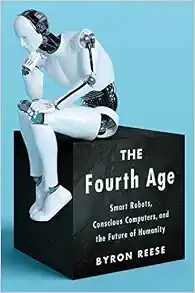
The Fourth Age explores the implications of automation and AI on humanity, and has been described by Ethernet inventor and 3Com founder Bob Metcalfe as framing “the deepest questions of our time in clear language that invites the reader to make their own choices.
Using 100,000 years of human history as his guide, he explores the issues around artificial general intelligence, robots, consciousness, automation, the end of work, abundance, and immortality.”
One of those deep questions of our time:
Is artificial general intelligence, or AGI, even possible?
Most people working in the field of AI are convinced that an AGI is possible, though they disagree about when it will happen.
In this excerpt from The Fourth Age, Byron Reese considers it an open question and explores if it is possible.
The Case for AGI
Those who believe we can build an AGI operate from a single core assumption.
While granting that no one understands how the brain works, they firmly believe that it is a machine, and therefore our mind must be a machine as well.
Thus, ever more powerful computers eventually will duplicate the capabilities of the brain and yield intelligence. As Stephen Hawking explains:
I believe there is no deep difference between what can be achieved by a biological brain and what can be achieved by a computer. It, therefore, follows that computers can, in theory, emulate human intelligence—and exceed it.
As this quote indicates, Hawking would answer our foundational question about the composition of the universe as a monist, and therefore someone who believes that AGI is certainly possible.
If nothing happens in the universe outside the laws of physics, then whatever makes us intelligent must obey the laws of physics. And if that is the case, we can eventually build something that does the same thing.
He would presumably answer the foundational question of “What are we?” with “machines,” thus again believing that AGI is clearly possible. Can a machine be intelligent? Of course! You are just such a machine.
Consider this thought experiment: What if we built a mechanical neuron that worked exactly like the organic kind.
And what if we then duplicated all the other parts of the brain mechanically as well. This isn’t a stretch, given that we can make other artificial organs.
Then, if you had a scanner of incredible power, it could make a synthetic copy of your brain right down to the atomic level. How in the world can you argue that won’t have your intelligence?
The only way, the argument goes, you get away from AGI being possible is by invoking some mystical, magical feature of the brain that we have no proof exists.
In fact, we have a mountain of evidence that it doesn’t. Every day we learn more and more about the brain, and not once have the scientists returned and said, “Guess what!
We discovered a magical part of the brain that defies all laws of physics, and which therefore requires us to throw out all the science we have based on that physics for the last four hundred years.”
No, one by one, the inner workings of the brain are revealed. And yes, the brain is a fantastic organ, but there is nothing magical about it. It is just another device.
Since the beginning of the computer age, people have come up with lists of things that computers will supposedly never be able to do. One by one, computers have done them.
And even if there were some magical part of the brain (which there isn’t), there would be no reason to assume that it is the mechanism by which we are intelligent.
Even if you proved that this magical part is the secret sauce in our intelligence (which it isn’t), there would be no reason to assume we can’t find another way to achieve intelligence.
Thus, this argument concludes, of course, we can build an AGI. Only mystics and spiritualists would say otherwise.
The Case against AGI
Let’s now explore the other side.
A brain, as was noted earlier, contains a hundred billion neurons with a hundred trillion connections among them.
But just as music is the space between the notes, you exist not in those neurons, but in the space between them. Somehow, your intelligence emerges from these connections.
We don’t know how the mind comes into being, but we do know that computers don’t operate anything at all like a mind, or even a brain for that matter.
They simply do what they have been programmed to do. The words they output mean nothing to them. They have no idea if they are talking about coffee beans or cholera.
They know nothing, they think nothing, they are as dead as fried chicken.
A computer can do only one simple thing: manipulate abstract symbols in memory. So what is incumbent on the “for” camp is to explain how such a device, no matter how fast it can operate, could, in fact, “think.”
We casually use language about computers as if they are creatures like us. We say things like, “When the computer sees someone repeatedly type in the wrong password, it understands what this means and interprets it as an attempted security breach.”
But the computer does not actually “see” anything. Even with a camera mounted on top, it does not see. It may detect something, just like a lawn system uses a sensor to detect when the lawn is dry. Further, it does not understand anything. It may compute something, but it has no understanding.
We use language that treats computers as alive colloquially, but we should keep in mind it is not really true. It is important now to make the distinction because with AGI we are talking about machines going from computing something to understanding something.
Joseph Weizenbaum, an early thinker about AI, built a simple computer program in 1966, ELIZA, which was a natural language program that roughly mirrored what a psychologist might say.
You make a statement like “I am sad” and ELIZA would ask, “What do you think made you sad?” Then you might say, “I am sad because no one seems to like me.”
ELIZA might respond “Why do you think that no one seems to like you?” And so on. This approach will be familiar to anyone who has spent much time with a four-year-old who continually and recursively asks why, why, why to every statement.
When Weizenbaum saw that people were actually pouring out their hearts to ELIZA, even though they knew it was a computer program, he turned against it. He said that in effect, when the computer says “I understand,” it tells a lie. There is no “I” and there is no understanding.
His conclusion is not simply linguistic hairsplitting. The entire question of AGI hinges on this point of understanding something.
To get at the heart of this argument, consider the thought experiment offered up in 1980 by the American philosopher John Searle. It is called the Chinese room argument. Here it is in the broad form:
There is a giant room, sealed off, with one person in it. Let’s call him the Librarian. The Librarian doesn’t know any Chinese. However, the room is filled with thousands of books that allow him to look up any question in Chinese and produce an answer in Chinese.
Someone outside the room, a Chinese speaker, writes a question in Chinese and slides it under the door. The Librarian picks up the piece of paper and retrieves a volume we will call book 1.
He finds the first symbol in book 1, and written next to that symbol is the instruction “Look up the next symbol in book 1138.”
He looks up the next symbol in book 1138. Next to that symbol, he is given the instruction to retrieve book 24,601 and look up the next symbol. This goes on and on.
When he finally makes it to a final symbol on the piece of paper, the final book directs him to copy a series of symbols down. He copies the cryptic symbols and passes them under the door.
The Chinese speaker outside picks up the paper and reads the answer to his question. He finds the answer to be clever, witty, profound, and insightful. In fact, it is positively brilliant.
Again, the Librarian does not speak any Chinese. He has no idea what the question was or what the answer said. He simply went from book to book as the books directed and copied what they directed him to copy.
Now, here is the question: Does the Librarian understand Chinese?
Searle uses this analogy to show that no matter how complex a computer program is, it is doing nothing more than going from book to book. There is no understanding of any kind.
And it is quite hard to imagine how there can be true intelligence without any understanding whatsoever.
He states plainly, “In the literal sense, the programmed computer understands what the car and the adding machine understand, namely, exactly nothing.”
Some try to get around the argument by saying that the entire system understands Chinese. While this seems plausible at first, it doesn’t really get us very far.
Say the Librarian memorized the contents of every book, and further could come up with the response from these books so quickly that as soon as you could write a question down, he could write the answer.
But still, the Librarian has no idea what the characters he is writing mean. He doesn’t know if he is writing about dishwater or doorbells. So again, does the Librarian understand Chinese?
So that is the basic argument against the possibility of AGI. First, computers simply manipulate ones and zeros in memory.
No matter how fast you do that, that doesn’t somehow conjure up intelligence. Second, the computer just follows a program that was written for it, just like the Chinese Room.
So no matter how impressive it looks, it doesn’t really understand anything. It is just a party trick.
It should be noted that many people in the AI field would most likely scratch their heads at the reasoning of the case against AGI and find it all quite frustrating.
They would say that of course, a brain is a machine—what else could it be? Sure, computers can only manipulate abstract symbols, but the brain is just a bunch of neurons that send electrical and chemical signals to each other.
Who would have guessed that would have given us intelligence? It is true that brains and computers are made of different stuff, but there is no reason to assume they can’t do the same exact things.
The only reason, they would say, that we think brains are not machines is because we are uncomfortable thinking we are only machines.
They would also be quick to offer rebuttals of the Chinese room argument. There are several, but the one most pertinent to our purposes is what I call the “quacks like a duck” argument.
If it walks like a duck, swims like a duck, and quacks like a duck, I am going to assume it is a duck. It doesn’t really matter if in your opinion there is no understanding, for if you can ask it questions in Chinese and it responds with good answers in Chinese, then it understands Chinese.
If the room can act as it understands, then it understands. End of story. This was in fact Turing’s central thesis in his 1950 paper on the question of whether computers can think.
He states, “May, not machines carry out something which ought to be described as thinking but which is very different from what a human does?”
Turing would have seen no problem at all in saying the Chinese room can think. Of course, it can. It is obvious. The idea that it can answer questions in Chinese but doesn’t understand Chinese is self-contradictory.
To read more of GigaOm publisher Byron Reese’s new book, The Fourth Age: Smart Robots, Conscious Computers, and the Future of Humanity, you can purchase it here.
Source: gigaom.com

