
Tag Archives for " email open rate "

How to Guarantee That No One Will Open Your Email
Good subject lines are unique to each brand, but there are some universal no-nos when it comes to writing them.
A subject line will often determine whether your email is opened and given a chance, or put into the digital trash can to become “junk mail.”
Not many brands want their newsletters and email campaigns to become junk mail, right?
And good news for you, we know of quite a few gutters to avoid on your journey to email marketing success.

10 Guaranteed Reason as to Why None Will Open Your Email
Here are ten things you should avoid, or in other words, ten guaranteed reasons as to why no one will open your email.
Reason #1: Your Email Subject Lines Aren’t Exclusive Enough.
We all know that being inclusive is usually a great thing, however, inclusivity doesn’t always work best when it comes to subject lines.
People like to feel special.
Try words and terms like an invitation, limited time, deadline, or VIP could enhance your open rate.

Reason #2: Your Subject Line is Never Negative.
Yes, you read this one right.
Sometimes having a positive subject line all the time might not work.
Did you know that negative subject titles could have higher open rates?
One marketer named Derek Halpern used a negative subject line to increase his open rate by 35%.
Use phrases like the worst, completely wrong and impossible.
Did you notice that the title of this article is a negative title? And here you are.

Reason #3: You’re Always Too Loud.
Sometimes being loud can be a good thing. A bright graphic, a powerful song.
But when it comes to subject lines, being loud is a no-no.
You don’t want to have your viewer feel like they are being YELLED or SCREAMED at.
Doing so could even scare them away. And your email could end up unread and in the trash.

Reason #4: Your Subject Line Won’t Shut Up.
Subject lines should be kept as short as possible.
Twenty-seven percent of emails are opened from mobile devices.
And some mobile email tools will cut subject lines off at twenty-five characters.
It’s not too great if the title is cut off for a fourth of your audience.
Simple mistakes like this could result in unopened, unread, possibly trashed emails.

Reason #5: Your Great Subject Lines Lead to Not So Great Content.
Now, I know that we are talking about subject lines here, but hear me out.
Great titles need to be backed up by great content or else the open rate will drop over time.
It’s quite similar to books.
You may find a book with the best title out there, open it up, the writing and storyline are awful?
You’ll probably find yourself a new book.

Reason #6: You Hate Bullet Points.
Some people get lazy when it comes to learning new things.
It takes up a lot of their time and energy which most people don’t have.
Why read five pages of information when it could be shrunk down into five bullet points?
This article?
We are keeping it short.
We don’t want to bore you.
Do the same with your emails.
Your viewers will be grateful, trust me.
And they might keep coming back for more.
Reason #7: Your Reader Doesn’t Trust You.
You want to build trust with your audience.
If they like what they see, you will find that they keep coming back for more.
Your audience will open your emails if they believe they will find valuable or useful information.
If you don’t build trust and they don’t trust you, to the spam folder you’ll go.
Try to keep your content themed and consistent so the reader can trust that they’ll know what they’re getting every time they open it up.

Reason #8: No Sense of Value.
Sure, your subject line and content could be fantastic, but if there isn’t a tangible payoff for your viewer, they will lose interest.
You need to be giving them something real. Whether it’s a knowledge they can apply immediately, or a great deal for something they really want or need, they need to be gaining something from your emails in order for them to return.
No value will result in more unopened emails.
Reason #9: Wrong audience.
Sending out emails to the wrong audience will also result in unopened emails.
Make sure that the audience that you have developed over time is the right fit for your brand.

Reason #10: No “from” field.
Do the best to your ability to make these emails personal.
If your emails are being sent from “the company,” “information” or “sales,” it will be too impersonal for your audience.
As I said, it’s sometimes the small details that bring the big picture together.
You want to improve your reputation.
Build a unique relationship with your audience, make sure that your content is of value to them in some shape or form.
Even adding in some bits of humor couldn’t hurt, right?
You don’t want to be boring. Boring emails are rarely opened.
Avoid and correct all of these mistakes, and you should be on the right path towards success.
The post How to Guarantee That No One Will Open Your Email appeared first on DigitalMarketer.
Source: digitalmarketer.com

4 Reasons Your Email Open Rate Is Decreasing
Hitting send on an email you’ve spent days perfecting is a great feeling, but that marketer’s high comes crumbling down after you see your open rate is lower than usual. 

What happened?
First, it’s important to know this happens to almost every marketer.
At some point, you’re going to see lower than usual open rates and you’re going to wonder what went wrong.
Second, it’s necessary to come at this with an open mind ready to fix a few problems instead of thinking there’s only ONE problem.
This is especially true if you’ve been seeing lower than usual open rates for a few days, weeks, or months.
Why Email Open Rate Decreasing?
Let’s take a look at 4 different elements of your email that may be causing your email open rate to decrease, and how you can fix them so you can get back to the open rates you used to see.
#1: Your Email Is Too Big

If you’ve been successfully sending emails and seeing a great open rate, but since sending one particular email your open rate has tanked—this could be a very easy problem to fix.
Emails sent to Gmail addresses get “clipped” when they’re bigger than 102KB.
Considering Gmail has 1.5 billion users, this is a worthy problem to focus on fixing.
When an email is clipped, a Gmail user can’t see the entire email like they can a <102KB email.
They have to click on “View Entire Message” to load the email in their browser.
Here’s what a Gmail user sees when an email gets clipped:

Unless a Gmail user clicks on the “View Entire Message” link, this DOES NOT count as an email open.
From experience, we can tell you that Gmail users don’t favor clicking on that blue hyperlink.
They prefer to have their entire email accessible as soon as they open it.
To avoid having your emails clipped, make sure they’re less than 102KB large by:
- Sending yourself previews that you view in Gmail to make sure the entire message loads without the [Message clipped] notification
- Using an HTML sizing tool to see how large your email is
There are a few reasons your email may be too large.
By removing individual blocks from your email (text, images, spacers, etc.) you can reduce the size of your email.
For example, if you have 3 separate text blocks right after each other and your email is getting clipped, try to figure out how you can put all of that text into one block.
If your email open rate bounced right back to where it used to be—GREAT!
This tells you that the only reason your open rate decreased was that your subscribers were avoiding clicking on that “View Entire Message” link. Easy fix. 
If your email open rate is still really low, keep reading to see how else you can push your open rate back up.
#2: You’re Using Too Many Spam Words
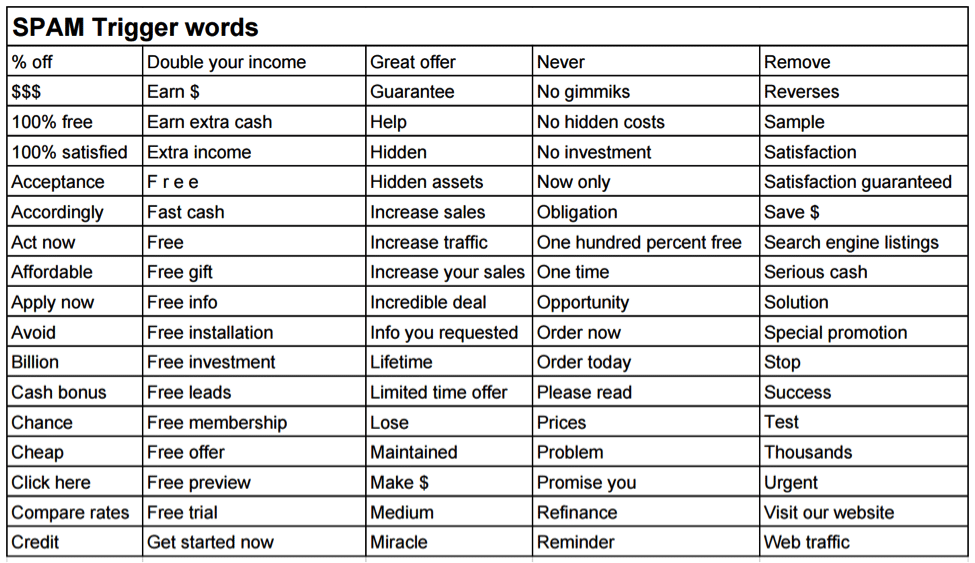
This is a really easy problem to run into without realizing it.
If your email campaign has too many spam words in it, email providers (like Gmail, Yahoo, Hey, etc.) are going to toss your email right into your subscriber’s junk folder.
It’s their job to protect their users from spam emails that promise them millions of dollars from a king far, far away.
To protect their users, they mark hundreds of words and phrases as spam.
Here are just a few of the words you may be using that you don’t realize are creating spam red flags:
- Affordable
- Apply now
- Bonus
- Click here
- Free access
- Money
- Promise
- Unlimited
- Win
- Urgent
- Purchase
- Open
- Increase sales
- Increase traffic
- Take action
- Trial
- Order now
Some email hosting platforms like ActiveCampaign will run your email content through a spam test before you hit send so you know your email passes the test.
Removing as many of these spam words as possible from your emails will keep your email out of the junk folder and in the inbox.
If your email fits like a swaddled newborn within 102KB and you’ve taken out anything that could be considered spam—but you’re STILL seeing a decreased open rate, let’s test out a few more options starting with your subject lines.

#3: Your Subject Lines Aren’t Doing Their Job

Your subject lines really have one, single job: get someone to open your email.
Optimized at 41 characters or 7 words, they make Tweets look like full-on essays. And considering how small they are, they have to pack a punch to do their job.
At DigitalMarketer, we’re alwayyyyys testing out new subject line strategies to see what’s working well and what’s not.
Testing 5 Email Subject Lines
We’ve figured out there are 5 email subject lines that tend to do really well:
#1: The Dead-On Offer Subject Line
These subject lines focus entirely on what you’re offering, and nothing else.
Example: Email Marketing Announcement: Enrollment is Back Open (21.56% open rate)
#2: Curiosity/Blind Subject Line
Subject lines that make people curious about what’s inside your email OR totally unsure of what’s going on and wanting to know more tend to do really well.
Curiosity Example: Netflix’s Huge Homepage Fail
Blind Example: Cut Off (one of the best performing subject lines in our promotional emails in 2019)
#3: Self Interest Subject Line
Your subscribers love to know what’s in it for THEM if they open up your email.
Example: Up to 85% OFF Our Best Copywriting Strategies
#4: Urgency Subject Line
A subject line that stresses urgency makes subscribers interested in your offer motivated to open your email so they don’t miss out on a good deal.
Example: LAST CHANCE: DigitalMarketer Lab goes off the Market in 3…2…1…
#5: Story/Relevance Subject Line
These subject lines bring the reader into a story they’re curious about, just make sure you’re delivering on the story you promised to tell.
Example: Here’s the REAL Reason Amazon is Buying Whole Foods
Use your email platform’s A/B testing tool to see which subject lines are able to improve your open rate.
You can set your A/B test to automatically switch to the best performing subject line after a set number of hours so you don’t have to worry about defaulting to the best performing subject line a few hours after hitting send.
If your subject lines are spot on and you’re still seeing a lower than usual open rate, it’s time to take a look at your content.
#4: Your Subscribers Aren’t Excited to Read Your Email Anymore
We know, it hurts to hear your subscribers aren’t loving your content but at the end of the day—who is the content for?
Them.
What does that mean?
It’s time to figure out what makes them get that little surge of excitement every time they hear a ping and see your business’s name.
Your subscribers may not be loving your content for a few reasons.
The best way to figure out what went wrong is to ask them.
Using a survey platform you can ASK them what they want to read from you.
In your survey, make sure to ask specific questions and to give an option for them to write their own suggestions.
For example, if we were surveying our audience we’d ask them if they wanted to read more content on:
- Digital marketing trends
- Google SEO updates
- Facebook algorithm updates
- Case studies on successful digital marketing strategies
- Influencer marketing strategies
Then, we’d ask them, “Is there anything else you want us to cover?” and we’d give them the option to type in their answers.
Another way to ensure your subscribers are going to want to read what you send them is to segment subscribers as they come into your list.
Instead of having a huge master list of every subscriber that you send every email to, segment your list based on how they came into it.
For example, if subscribers are coming into your list for a specific lead magnet or offer, create a segment for them.
Then, you can make sure the emails they get from you are relevant to that lead magnet or offer.
This is a win-win because you’re going to know exactly what content they’re interested in and they’re going to get read emails they’re actually interested in.
Now that you’ve gone through your email size, spam word usage, subject lines, and content—do you still have a lower than usual open rate?

If you do, here are a few more email elements to take a look at to get that open rate back up to where it was:
- Deliverability
- Sender reputation and score
- The frequency that you’re sending emails
- Tracking
A decreased open rate doesn’t mean you have to give up on your list.
It just means that something is wrong, and you need to go into research mode to figure out what it is and how to fix it.
You’ll get back to getting excited to hit that send button, knowing your subscribers are BEYOND excited to see your name pop up in their inbox.
The post 4 Reasons Your Email Open Rate Is Decreasing appeared first on DigitalMarketer.
Source: digitalmarketer.com