
Tag Archives for " email marketing "

Essential SMS and Email Tips: 5 Strategies You Can Implement Now [Free Webinar on February 15th]
How important are SMS and email for a company’s success in 2022? Very.
78 percent of marketers say email is an important part of a company’s success.
And texting is quickly becoming another way for businesses to succeed. In fact, a 2021 survey found the majority of marketers reported increased revenue from SMS efforts.
If you are looking for new and innovative ways to engage your customers, adapting custom email and SMS strategies might be the solution you need to grow subscriber lists and improve the customer experience.
Join us on Tuesday, February 15th at 8 am PST for a FREE webinar on 5 No-Brainer SMS and Email Marketing Strategies You Should Implement Today!
Why Having an SMS and Email Strategy is Important?
By 2024, an estimated 4.5 billion people will use email. When done correctly, email marketing can increase traffic to your website, conversions, and revenue.
What do we mean by “correctly?” We mean following trends, using the latest tools, and relying on data to optimize your emails for opens and conversions.
SMS is also becoming a more effective communication channel. Texts can be used for marketing, to increase revenue, or even to offer quick customer service. In fact, close to 60 percent of consumers check their text messages within 1-5 minutes so they are a great way to get people’s attention.
The click-through rate of SMS is also very high at 19.3 percent, better than email which has a CTR of 4.2 percent, or Facebook ads, which have a 0.05 percent CTR.
You may be wondering how can you get such a high click-through rate with SMS as well, turning those opens into conversions and revenue? Attend our webinar to find out!
Who Will Benefit from Attending the Webinar?
Marketers who want to learn insider tips so they can expand their email and SMS skills.Small business owners who want help launching or improving their email and SMS efforts.Blog writers who want to grow their subscriber list.Anyone who wants to improve their SMS or email click-through and conversion rates.
What Businesses Do Will Benefit from New Email and SMS Tips?
Marketers, small businesses, e-commerce companies, and B2B organizations alike will all benefit from this webinar. Need proof?
- 81 percent of B2B marketers say email is the most important part of their content marketing efforts.
- Eight out of ten B2C customers open their welcome emails.
- And, finally, a survey by Campaign Monitor found 64 percent of small businesses use email to reach their customers.
SMS is becoming just as important for all these business models. How it is used ranges from appointment confirmations to sales promotions, to customer service, and everything in between. In case you need more convincing:
About 33 percent of marketers expect to prioritize mobile loyalty programs over the next year.85 percent of customers say they prefer receiving text messages over a phone call or email.64 percent of consumers think that companies who text value their time and are more progressive.
The email and SMS strategies covered in this webinar can be applied to any business model.
What You’ll Learn in This Webinar
In this webinar, we’ll first go over some of the top email and SMS trends we see coming in 2022. We will explain what each of them means as well as the impact they can have on you and your business.
Next, we’ll provide five detailed email and SMS tips. For each tip, we’ll discuss why we think it could be a game-changer for your business in 2022 and also provide some examples of how each can be used.
Finally, we’ll walk you through some step-by-step processes you can take to implement each tip and start seeing results right away.
By following the tips you will learn in this webinar, you’ll be in a prime position to grow your subscriber list, create a cohesive email and SMS strategy, and get more conversions from each communication you send. We look forward to seeing you on February 15th!
Source: neilpatel.com

How to Win Customers’ Hearts and Pockets with These 7 Email Strategies [Free Webinar]
Are you frustrated with email marketing? Does it seem like everyone simply hits send on a single email and rakes in the big bucks?
Or maybe you have heard how for every $1 spent, email marketing generates $38 and that it has the broadest reach of all the platforms.
Yet you have a non-existent list that barely even opens your emails, let alone buys one of your offers.
On September 20 at 8 am PST, I’m hosting a free webinar that exposes my team’s strategies to create successful email campaigns that entice people to click “add to cart.”
Along with my co-hosts Vignesh Kumar, VP of Email Marketing at NP Accel (the SMB division of NP Digital), and Colin Cornwell, VP of Growth Marketing at NP Digital, we’ll break down how you can write better subject lines, create simple yet effective email workflows, and boost your conversion rates.
It’s free. Register here.
What Will You Learn?
My blog has racked up dozens of accolades for entrepreneurship and attracts millions of views every month.
I took what I’ve learned from its success and applied it to my marketing agency, NP Digital. Over the years, we’ve worked with companies worldwide and helped them hit their digital marketing goals.
The result?
My team and I have spent hours analyzing what works (and what doesn’t) and distilling our knowledge into unique email marketing strategies that work for everyone.
Whether you have yet to send out your first email blast, or you’ve been trying to perfect your strategy for years, this is the webinar for you.
Here are some of the things we will teach you:
- How to Write Emails That Convert: Learn how to craft an email that delivers value to your list, converts subscribers, and keeps them coming back for more.
- Tried and Tested Email Marketing Tactics: Discover the rinse-and-repeat email marketing strategies my team and I have used to grow NP Digital into one of the Top 100 Most Brilliant Companies.
- Creating a Winning Email Marketing Strategy: By the end of the webinar, you’ll have a clear idea of how to put our tactics into an email marketing strategy that works for your business.
And these are only some of the things you’ll learn during this free webinar.
Conclusion
Email may be one of the oldest forms of online communication, but it still packs a punch.
Not only is it one of the cheapest ways to engage with potential customers, but it has an unbeatable reach and drives conversions.
All you need to reap email marketing results is a firm understanding of which strategies work and which ones you need to ditch.
That’s exactly what my team and I will show you how to do.
Register for the webinar, and I’ll see you on September 20 at 8 am PST.
PS: If you want my team to implement these hacks and manage your email marketing for your business, go here.
Source: feedproxy.google.com

How to Increase Your Website Traffic Without SEO
SEO can be a brilliant strategy to increase your website traffic but it isn’t always enough.
Imagine you rely on SEO for all your traffic. What happens when the Google algorithm changes? You risk losing potential customers!
Disclosure: This content is reader-supported, which means if you click on some of our links that we may earn a commission.
That’s why diversifying your methods of increasing web traffic can offer better results.
If you have multiple traffic sources, changing algorithms won’t completely halt your business.
You will have a toolkit full of optimization strategies to keep your business running.
Diversifying your web traffic can also be helpful in cases where there’s little scope for search engine optimization (for example, podcasts).
In this post, we’re going to look at effective strategies to grow your website traffic without SEO so you’re never left stranded by algorithm changes again.
We’ll also look at practical tips you can start using right now, so you can get back in the game if your traffic has been low for a while.

Why Should You Try to Grow Traffic Without SEO?
You can generate substantial traffic from SEO alone, but not all traffic is equal. High-quality traffic (that includes users more likely to convert) offers better ROI, so you need to prioritize it.
Plus, if you aren’t an SEO expert, you may want to focus on other strategies to grow your website traffic efficiently.
This doesn’t mean you completely ignore SEO. All websites, irrespective of their niche, must follow the best SEO practices to avoid being penalized by Google and to ensure the site gets indexed.
Top Strategies to Increase Website Traffic Without SEO
The strategies we’ll discuss below can be a helpful addition to a pre-existing SEO plan.
1. Content Marketing
If you have been reading about digital marketing for a while, you must have heard the term “content marketing.”
In simple words, it’s a way to organically advertise your brand through high-quality content.
Content marketing strategies often include blog posts, podcast episodes, infographics,
YouTube videos, downloadable PDFs, etc.
For instance, Toggl, a time tracking software company frequently uploads informative blog posts and research data about productivity, work-life, and career.
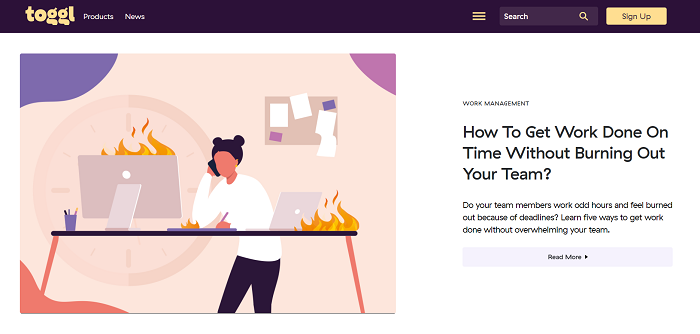
This attracts users interested in time management, productivity, and wellbeing in the workplace.
When they read Toggl’s blog, they eventually discover Toggl’s time tracking app, among its other productivity tools.
Some of these users convert, helping Toggl increase their website traffic and ROI.
Content marketing isn’t limited to blog posts.
If you connect better through audio, you can try launching a podcast or host a webinar.
Nowadays, most social media apps let you post a variety of content formats including photos, audio clips, long-form text, and videos.
You can experiment with one or more of these formats to see what works best for your audience.
2. Paid Ads
Content marketing is beneficial but it can take a lot of money, especially if you’re paying established writers to create original, well-researched posts for you.
Most of these projects also take weeks or months to show results, which isn’t a practical timeline for many businesses.
If you want quicker results with a budget you can control, why not try paid ads?
Seven in ten Americans use social media today.
That’s more than two-thirds of the population.
Think about the possibilities!
Paid ads can instantly generate hundreds, if not thousands, of clicks to your website.
Plus, with new advertising and social media platforms appearing and innovating regularly, getting your ads in front of the right people is becoming easier than ever.
For example, Facebook offers detailed customer personas and multiple targeting options so you can put your business in front of your target customers without wasting a lot of money on mass advertising.
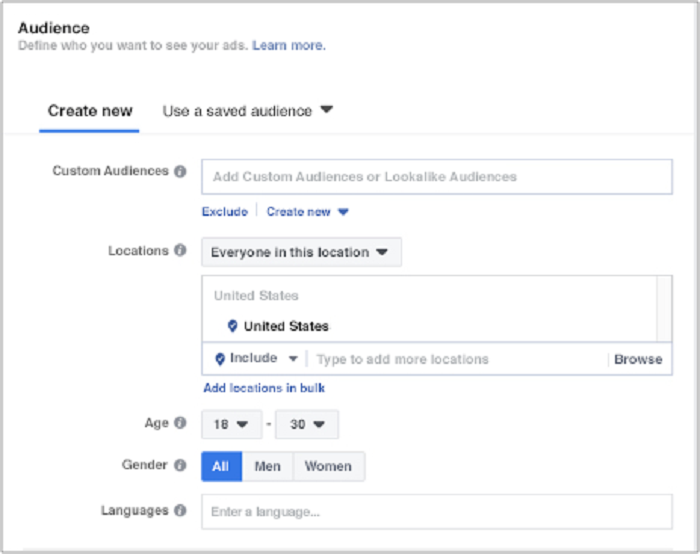
However, you don’t have to stick to the largest platforms for effective advertising.
In fact, advertising on lesser-known platforms whose audience aligns with your products can be more effective in the long run.
For example, if your ideal customer includes teens who enjoy memes and weird stories, you’d have much better results by advertising on Reddit, rather than Facebook or YouTube.
Another option is dating apps.
If your brand is focused on relationships or if you’re targeting young singles, advertising on dating apps like Tinder can help you find your target customers faster.

If you’re worried paid ads will take a lot of money, remember, you don’t need to spend $1,000 on your first day.
Test the waters with $5-$10 a day and see what happens.
Do that for a week, just to learn how different media platforms work.
3. Social Media Strategies
One of the best ways to increase your website traffic is to meet your customers where they like to hang out.
Like we discussed earlier, almost everyone is using social media today.
Ramping up your social media marketing efforts can help you reach new users, develop brand awareness and increase website traffic.
How to gain website traffic through social media?
When it comes to social media, you can’t just barge into “conversations” and ask people to buy something from you or to visit your website.
Think about how you’d present your brand in real life when you meet an individual for the first time.
Would you immediately talk sales in their face?
How about providing details about your product/service without introducing yourself first?
Remember, users, visit their preferred social media platforms for entertainment, not for being sold to.
To make sure your efforts are well-received, you need to provide value first and develop positive relationships with your potential “followers.”
You can do this by sharing informative posts like How-Tos, or posting fun photos of your employees, like this post from Casper.

I wrote a detailed guide to increasing social media followers and boosting engagement.
Here’s a summary of the top options to help you grow your website traffic.
- Join relevant Facebook groups
- Share helpful articles/videos in these groups
- Post updates about your company’s latest products host contests and giveaways
- Leave thoughtful comments on user-generated content
4. Link Building Strategies
When marketing teams talk about SEO, link building frequently comes to mind.
When reputable websites link to your content, the algorithm favors your website and increases its rank on the search page.
Sounds helpful, but that’s not all.
Did you know link building can help you increase web traffic without relying on SEO?
Link building for brand awareness is a process where you focus your strategies on expanding your reach, putting your content in front of new users, and generating conversations around your brand.
This is more than just a casual backlink in a blog post.
Link building for brand awareness takes more planning and resources, but the investment is worth the high-quality leads you’ll get.
Here are some tips for developing effective link building strategies to increase website traffic:
- Engage with your audience: Create interesting, shareable posts and encourage your followers to respond and share your content.
- Work with PRs: Recruit efficient PRs to help generate brand awareness and distribute your story to your desired audience.
- Guest blog intentionally: Choose unique publications that align with your readers’ key interests and post guest blogs on their page.
5. Interact With Other Blogs
Guest blogging is an effective traffic-driving strategy aimed at leveraging somebody else’s audience to widen your brand’s reach.

Think about it: Somebody in your niche has a large, engaged following.
Imagine if you could put your content in front of them.
How much traffic could you drive to your website!
Why would someone publish your work?
Probably because you’re good at what you do.
Everyone is looking for high-quality content.
If you can provide a well-researched, helpful post for free, people are often open to publishing it on their website.
After all, it’s benefiting their audience at zero cost.
Why would you give precious content away for free?
It’ll help you gain access to hundreds, if not thousands of new users, many of whom could become long-term customers.
It’s a win-win situation, but you have to be careful how you approach it.
Start by searching for blogs and media publications that publish content relevant to your business.
For example, if you run a recruiting company, publish content on business blogs read by people interested in the latest recruiting practices.
If you want to find blogs in your industry that are accepting guest posts, use the following search queries to see more specific results:
- name of your niche + “write for us”
- name of your niche + “submit guest post”
- name of your niche + “sites that accept guest posts”
- write guest article + ‘name of your niche” + blog
Solvid provides a comprehensive list of places accepting guest blogs:
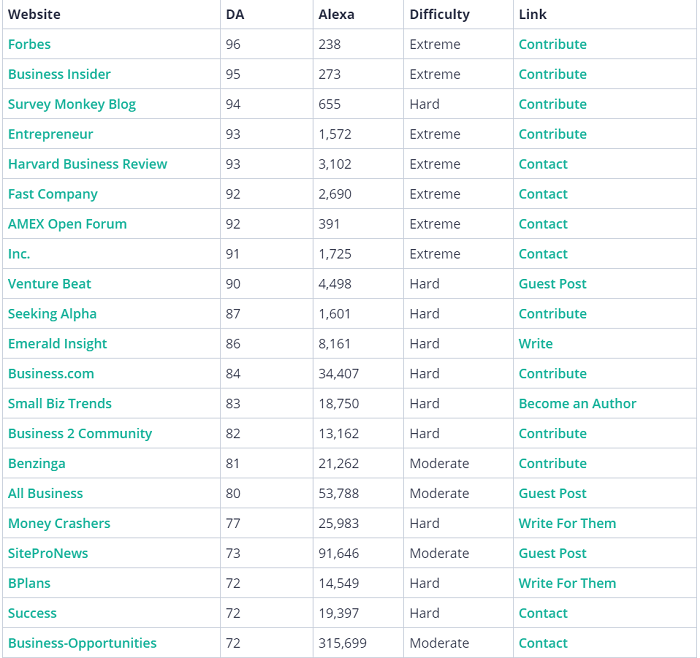
In addition, research online biographies of specific companies and bloggers.
More often than not, their web profiles contain a handy list of sites where they’ve been invited to guest post.
That’s a plethora of most fitting guest blog opportunities presented to you on a silver platter.
Then, send a request.
Most websites will have publication guidelines you can follow.
Follow these instructions carefully to increase your chances of publication.
There’s also the option of using blog comments as a way to generate traffic to your site.
In the past, I have managed to generate $25,000 as a result of 249 comments.

How exactly do you go about using comments to generate traffic?
When leaving a comment, make sure you are adding something worthwhile to the discussion.
There is no use in leaving comments like “Awesome post!” or “Nice website!”
If someone posts a question, make sure you take the time to answer thoughtfully.
This showcases your expertise in the given niche and will encourage someone reading to click on your name and be taken through to your site.
If you read an article on a subject you don’t know very well, it would be imprudent to voice your own thoughts as fact.
In this situation, you should simply ask questions.
Then the website owner would be able to elaborate more on complex topics or complicated sections.
If you’re knowledgeable about a subject, feel free to contribute (e.g., suggest something, recommend a solution, answer a question).
If you’re a novice, it’s best to ask questions.
Powerful questions can bring you website traffic by encouraging blog readers to check you out.
Avoid embedding links in your comments.
It comes off as a wretched attempt to plant your flag on someone’s lawn.
It’s okay to use your website’s link in the URL field when entering your name and email address, but your comment needs to add to the conversation or challenge an idea without lazy attempts at driving traffic to your blog.
Refrain from using the name of your business as your “commenting name.”
Use your actual full name instead.
Using a random or fake name is a missed opportunity to build strong branding because your brand actually starts with your name.
In fact, failing to use your full name will reduce your chances of the website owner approving your comment.
6. Email Marketing
If you read a few posts on digital marketing, email marketing would be mentioned in most of them.
That’s because it’s still one of the most efficient ways to increase website traffic.
One study suggests email generates $36 for every $1 spent, offering a shocking 3,600 percent ROI.
What more could you ask for?
Email marketing lets you reach potential customers directly.
It’s an ideal platform for building long-term relationships for improved customer loyalty.
You can post questions, ask for feedback, introduce soft sales, and persuade customers for the “big buy.”
Here are some tips for effective email marketing to increase website traffic:
- Be real: Share stories, post-behind-the-scenes content, and solicit original user-generated content.
- Offer value: Just like content marketing needs a high value to convert readers, emails and newsletters must provide value before they make an ask.
- Include all your links: Make it easy to read and share your post. Include links to your social media profiles, latest blog posts, and sales page in every email you send.
7. Provide Excellent Customer Service and Ask Customers to Review Your Brand
Ramping up your social media marketing efforts to increase website traffic is useless if you offer poor customer service.
According to a survey, 42 percent of customers said they bought more after pleasant customer service experiences.
Think about it: Users make complaints on social media, you offer a prompt and polite response.
What happens?
The person starts respecting your brand.
Even when users complain privately via email, it’s important to offer the best possible service so they come back for more.
How can you offer great customer service?
- reply promptly
- offer as many suggestions for customer problems as possible apologize when you make a mistake and offer coupons/refunds
If you consistently provide great customer service, you can request users to review your brand.
Platforms like Trustpilot and Yelp can be great for building positive reviews.
Many users consult these websites before making a purchase decision, so having a solid profile can help improve your reputation.
Increase Website Traffic Without SEO Frequently Asked Questions
FAQ: 1
Is it possible to increase website traffic without SEO?
Yes. You can use a combination of social media marketing strategies and content marketing techniques to increase website traffic without SEO.
FAQ: 2
Are there ways to increase website traffic for free?
Guest blogging, posting on social media, and requesting user-generated content are some of the most effective ways to increase website traffic for free.
FAQ: 3
Can I increase website traffic through marketing without an agency?
You can use techniques like guest blogging and content marketing to engage audiences without relying on any agency.
FAQ: 4
What’s the best strategy to increase website traffic quickly?
Working on improving your social media strategies can help you connect with new users, develop brand awareness and drive organic traffic relatively fast.
Increase Website Traffic Without SEO Conclusion
You shouldn’t only rely on search engines to increase website traffic.
Algorithm changes and SEO techniques become outdated quickly.
The strategies we discussed today can help you create a comprehensive digital marketing plan to increase website traffic effectively.

Whether you use one of these tactics in isolation, or you use all of them together, they can transform the way you attract customers.
Which traffic-driving strategy will you try today?
Source: neilpatel.com

You Don’t Have an Email Marketing Strategy: Here’s How to Make One
Email Marketing is a pillar of digital marketing.
Not only is it one of the oldest forms of digital marketing, it has also proven to be the most effective in terms of converting views into revenue.
As a marketing professional and/or successful business owner, you probably know this.
Even so, do you really appreciate how valuable email marketing can be for your business?
With appreciation comes dedication and a commitment to the time, money, and development necessary to create a strategy that not only delivers results but also seamlessly integrates with your overall marketing plan.
I’ll give you an incentive to develop your own email marketing strategy.
I’ll tell you a story of how a free email newsletter turned into $27 million.
It’s the story of The Hustle.

The $27 Million Email Newsletter
If you’re not currently a subscriber to The Hustle (and if you’re not you should be), you’ll find it to be interesting, entertaining, informative, and addicting (almost as much as your morning coffee).
It’s an informative daily email that contains up-to-date information on a variety of industries and topics.
The design of each email can be described as “snappy;” you’ll get a quick view of interesting news events, scandals, statistics, trends, and business happenings in a concise format that is both direct and effective.
Better yet, all of it is complemented by a hip, attention-grabbing GIF that showcases the theme and feel of the day’s topic.
Combine the stylish layout, consistent delivery, interesting content, and dependable format of The Hustle and you have an email strategy that can entertain 1.5 million people.
In February 2021 the marketing software company Hubspot acquired The Hustle for a reported $27 million (according to Axios).
The Hustle proved that it’s possible to organically grow an email list that isn’t just valued by over 1.5 million subscribers, but also the likes of a company worth $22.6 billion.
Just in case you’re wondering how long the process of growing and selling a successful email-based business like The Hustle took, it was less than six years.
The newsletter first came out in 2016 with the business content model you see today.
If you’ve been email marketing for a while, this should give you some indication of how effective/ineffective your efforts have been.

Do You Have an Email Marketing Strategy?
I’m guessing that you don’t have a strategy, and if you do, it’s vague and was probably set up quite a while ago. Worse, it may not align, or even connect to, your overall marketing strategy.
If you’re unsure of whether or not you actually have an email marketing strategy that’s both defined and connected to your other marketing efforts, just answer these questions:
- My current campaign message for this month/quarter/year is __________.
- My current email marketing campaign connects to my PPC/Social Media/SEO/Content Marketing campaigns in the following ways: __________.
- My most effective 30/60/90 day campaign in terms of ROI was __________.
- I know (by heart) my current average Open Rate, Click-Through Rate, Conversion Rate, Unsubscribe Rate, Bounce Rate, List Growth Rate, Share Rate, Revenue per Email, and Revenue per Subscriber. They are __________.
How did you do?
If you could answer more than one of these questions in a meaningful way, you’re further along than many business owners.
Even in that scenario, there can always be room for improvement, and that’s what we’ll try to establish here.

The Real Reason You Don’t Have an Email Marketing Strategy
You don’t have an email marketing strategy because you don’t think you need one.
For most businesses, email marketing is a support function of another “primary” marketing method.
It’s a limited part of a funnel, a follow-up method for an incomplete checkout cart, or a quick blast to promote your 24-hour Friday Lightning Sale.
Email marketing is over-simplified as a purely promotional tool (as in something that you only use for discount sales to past customers or newsletter subscribers), but the purpose can be much more extensive than that.
Ideally, it should be used for Branding, Traffic, Engagement, Direct Sales, Referrals, Reactivation, Retention, and Acquisition.
Promotional emails should be only one of three types of emails you send, the others being transactional and relational.
Further, the process of your customer journey in regards to email marketing should ideally follow eight steps:
- Awareness,
- Subscription,
- Engagement,
- Conversion,
- Excitement,
- Ascension,
- Advocation,
- Promotion.
All of these aspects are well and good, and you’ll find exactly how to execute an email marketing strategy through amazing online email marketing certifications like this one (sorry/not sorry for the unapologetic, shameless plug), but that’s not what this article is about.

What we’re here to discuss is your email marketing strategy and how using the example of The Hustle can revolutionize your email marketing forever.
The Five-Step Process of Creating an Email Marketing Strategy for the 2020s
The Hustle is a poster child for email marketing.
Not only do they consistently deliver a well-executed email marketing strategy, but they have also proven that an email-first approach is a viable alternative to more traditional marketing methods.
This five-step process is based on The Hustle’s ongoing example.
If you’d like a practical guide to executing the strategy with instructions and how-tos on every aspect, Click Here.
STEP 1: Decide Where Email Marketing Ranks in Your Overall Marketing Strategy
Before you do anything, you need to decide how much time and effort you’re going to dedicate to email marketing in general. If you’d like to know where it stands in The Hustle’s opinion, just check out their homepage:
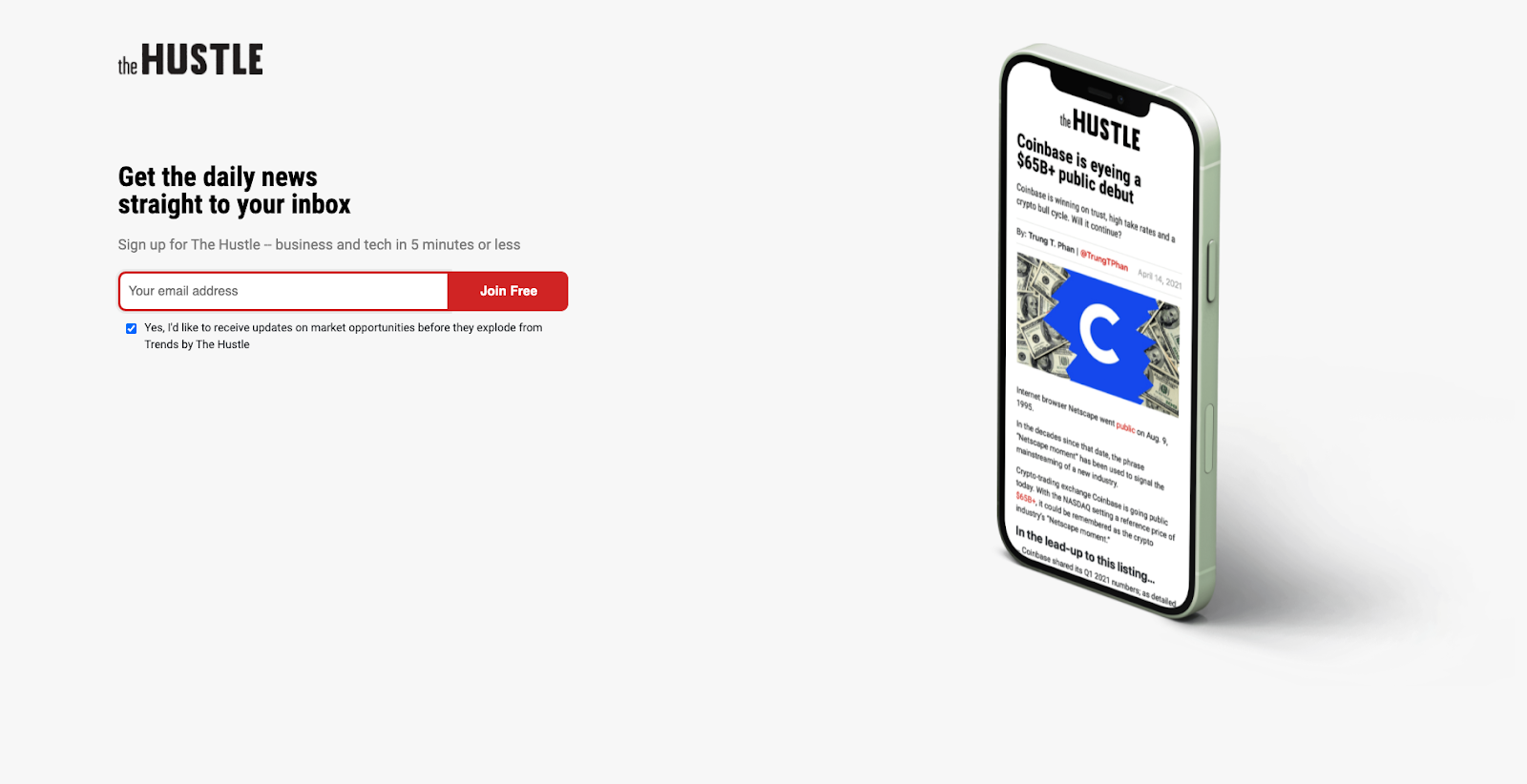
The answer, of course, is front and center. The homepage of The Hustle clearly indicates their intention with a newsletter CTA simply and immediately stated.
The directness is reinforced by a large amount of white space, a mobile platform mock-up of the newsletter itself, a statement regarding their subscriber base (“Trusted by 1.5M_ readers…”), and a carousel of reviews by happy readers.
They don’t even have navigation at the header or footer for goodness sake!
If you ranked the marketing methodologies of The Hustle on a 1 to 10 scale of importance, email marketing would be a 10.
- Where does it rank in your overall marketing strategy?
- To figure out where email marketing fits in your marketing priorities, just answer these questions:
- What marketing methods do you use?
- Give each of your marketing methods a rating from 1 to 10 (1 being the lowest importance and 10 being the highest)?
- How much time and money is spent on each method on a monthly basis?
- Do your ranking and resource spend on email marketing reflect your commitment to the method?
STEP 2: Set a Long Term Email Marketing Objective
Many business owners and marketing professionals tend to focus on short-term metrics when it comes to email marketing objectives.
You want “x” amount of new subscribers. You want “x” percentage of click-throughs.
You want “x” conversion rate.
These are all short-term goals and are necessary for ongoing operations, but they can’t contribute to the development of a new email marketing strategy; they can only determine whether it’s working or not.
Your long-term marketing objective needs to be broad, captivating, and inspiring for both your company and your audience.
You can get the essence of The Hustle’s objective by looking at the first line on their About page:

Here at The Hustle, we tell people (like you) what they need to know.
While the statement is broad and vague, it sets the tone for an email marketing strategy.
Let’s break down the statement into its component parts:
- Here at The Hustle – All-encompassing statement for the brand
- we tell people – Clear action phrase simply stating what they do
- (like you) – Qualifier and uplifter for the reader
- what they need to know. – Intriguing authority-building statement
If you boiled down all aspects of an email marketing strategy into a single statement, what would it be?
Here are some examples to get you started:
- Education Technology Company Newsletter: Keeping families informed of vital education developments.
- Ecommerce Apparel Company Newsletter: We’re your daily “add to cart” wishlist source.
- Local Restaurant Newsletter: We make you excited for lunch before breakfast.
STEP 3: Decide What Elements Your Primary Email Template Will Contain
While you may have a variety of templates for specific email marketing functions, you should still build an overarching outline for your biggest list. For most companies, that will be your general newsletter.
Once you establish this, you can pull or add elements for email segmentation while still keeping a consistent feel.
If you look at The Hustle, their layout contains five primary section types:
- THE BIG IDEA
- SNIPPETS
- ADDITIONAL TOPIC (1 OR MORE)
- “OF THE DAY” (Meme of the Day, Jacket of the Day, Stat of the Day, etc.)
- SHARE THE HUSTLE
Having a consistent layout allows your readers to predict what information they can look forward to and where it will be located.
Your goal should be to create the McDonalds of email marketing… no matter how the viewer consumes the information, they’ll know what to expect.
To get started, try to limit your sections to no more than five.
You need to create sections that are broad enough to accommodate infinite topics while being specific enough to be engaging and interesting.
List out every section you have or could have in a standard email campaign and categorize them into five groups.
This should give you a basis for the sections you should be using.
STEP 4: Determine Your Overarching Design Theme
Many people tend to lump design and layout into the same category, but it’s a mistake in terms of strategy.
The design, which you can also call the voice, style, tone, feel, etc., needs to reflect your overall marketing strategy, rather than an individual email campaign.
If your brand is quirky, fun, and irreverent, then your email design shouldn’t be minimalistic, somber, and religiously themed.
If your long-term email marketing objective is, “We provide business owners with secrets big media CAN’T tell you.” then your header topic should never match today’s headlines from MSNBC, CNN, or FOX with a bubbly stock image of a smiling model.
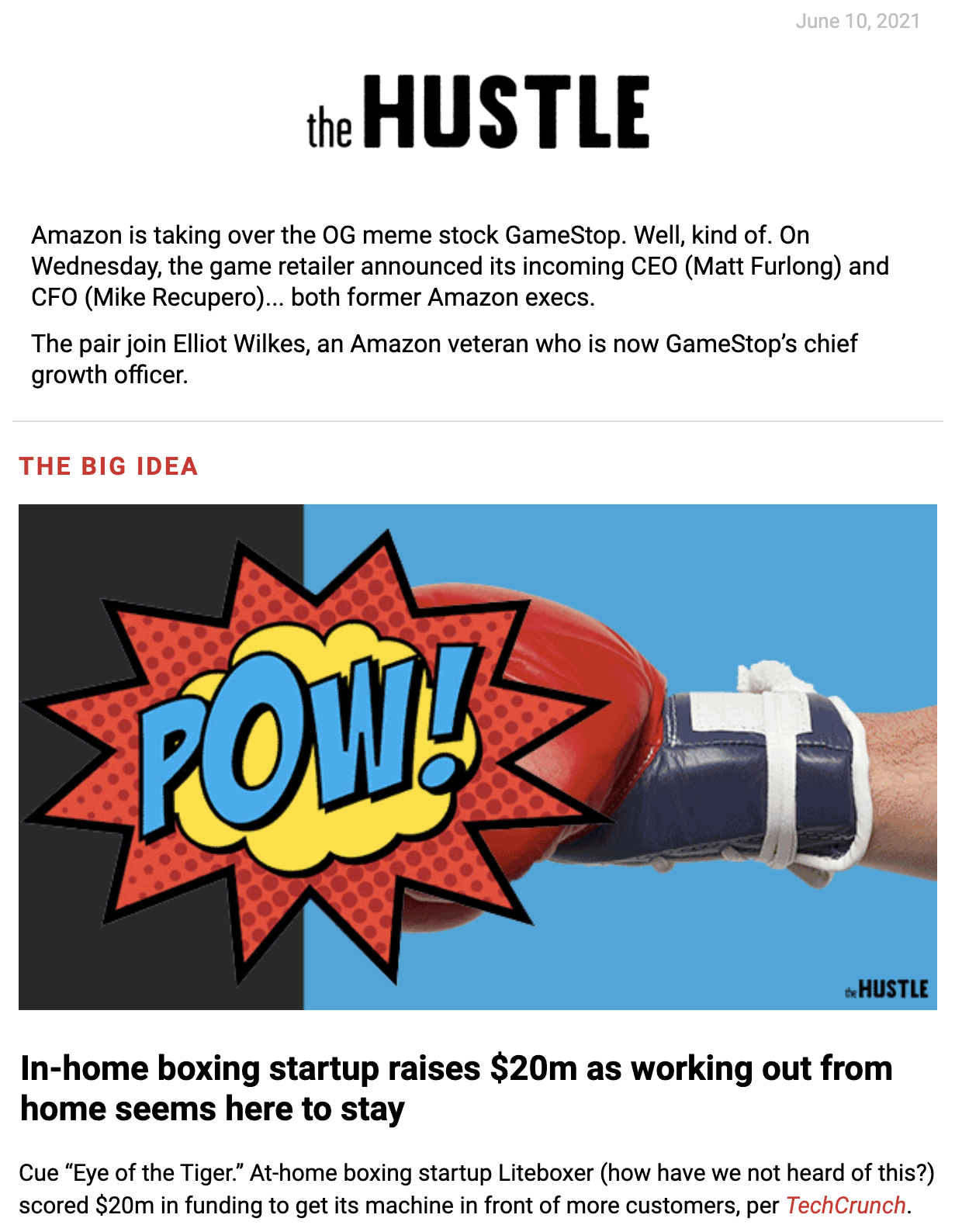
In the case of The Hustle, as evidenced by the screenshot from a recent campaign above, the design combines a casual, cheeky, direct voice with “punchy” (pun intended) graphics that feature bright colors, funny scenarios, and attention-grabbing animations.
Your viewer should be able to establish your overall design theme within seconds of opening each email.
If there is any ambiguity in this regard, then you’ve failed to clearly define your design.
Here are a few questions you should be able to answer.
- What three words encapsulate your overarching email marketing design?
- If you had to sum up your entire strategy in one picture or graphic, what would it be?
- If your standard email campaign was a character from a movie, who or what would it be?
STEP 5: Commit to a Set Execution Period
Just like any plan, your email marketing strategy will need some time to implement, test, and refine.
To do all that, it needs a minimum amount of time.
Setting a time objective will force you to take the task seriously while also giving you the right mindset needed to execute the process fully.
Again, referring back to the history of The Hustle, Sam Parr started with a list of 300 subscribers in 2015 and relaunched the newsletter in April of 2016, then grew to over 1.5 million subscribers by mid-2021 (about 5 years).
That’s an average annual growth rate of almost 300,000 subscribers.
While this is an exceptional expansion rate, it didn’t happen overnight and the current subscriber list, while very impressive, isn’t an inconceivable amount of people.
If your company fully committed to an email marketing strategy, what could 10k, 100k, 1M subscribers do for you?
Even a fraction of that could have a profound impact on your business.
With that in mind, we recommend committing to a minimum of 90 days to execute a new strategy.
In our Email Mastery Certification, we outline exactly what implementation will entail, and we recommend you start there.
The post You Don’t Have an Email Marketing Strategy: Here’s How to Make One appeared first on DigitalMarketer.
Source: digitalmarketer.com

How to Guarantee That No One Will Open Your Email
Good subject lines are unique to each brand, but there are some universal no-nos when it comes to writing them.
A subject line will often determine whether your email is opened and given a chance, or put into the digital trash can to become “junk mail.”
Not many brands want their newsletters and email campaigns to become junk mail, right?
And good news for you, we know of quite a few gutters to avoid on your journey to email marketing success.

10 Guaranteed Reason as to Why None Will Open Your Email
Here are ten things you should avoid, or in other words, ten guaranteed reasons as to why no one will open your email.
Reason #1: Your Email Subject Lines Aren’t Exclusive Enough.
We all know that being inclusive is usually a great thing, however, inclusivity doesn’t always work best when it comes to subject lines.
People like to feel special.
Try words and terms like an invitation, limited time, deadline, or VIP could enhance your open rate.

Reason #2: Your Subject Line is Never Negative.
Yes, you read this one right.
Sometimes having a positive subject line all the time might not work.
Did you know that negative subject titles could have higher open rates?
One marketer named Derek Halpern used a negative subject line to increase his open rate by 35%.
Use phrases like the worst, completely wrong and impossible.
Did you notice that the title of this article is a negative title? And here you are.

Reason #3: You’re Always Too Loud.
Sometimes being loud can be a good thing. A bright graphic, a powerful song.
But when it comes to subject lines, being loud is a no-no.
You don’t want to have your viewer feel like they are being YELLED or SCREAMED at.
Doing so could even scare them away. And your email could end up unread and in the trash.

Reason #4: Your Subject Line Won’t Shut Up.
Subject lines should be kept as short as possible.
Twenty-seven percent of emails are opened from mobile devices.
And some mobile email tools will cut subject lines off at twenty-five characters.
It’s not too great if the title is cut off for a fourth of your audience.
Simple mistakes like this could result in unopened, unread, possibly trashed emails.

Reason #5: Your Great Subject Lines Lead to Not So Great Content.
Now, I know that we are talking about subject lines here, but hear me out.
Great titles need to be backed up by great content or else the open rate will drop over time.
It’s quite similar to books.
You may find a book with the best title out there, open it up, the writing and storyline are awful?
You’ll probably find yourself a new book.

Reason #6: You Hate Bullet Points.
Some people get lazy when it comes to learning new things.
It takes up a lot of their time and energy which most people don’t have.
Why read five pages of information when it could be shrunk down into five bullet points?
This article?
We are keeping it short.
We don’t want to bore you.
Do the same with your emails.
Your viewers will be grateful, trust me.
And they might keep coming back for more.
Reason #7: Your Reader Doesn’t Trust You.
You want to build trust with your audience.
If they like what they see, you will find that they keep coming back for more.
Your audience will open your emails if they believe they will find valuable or useful information.
If you don’t build trust and they don’t trust you, to the spam folder you’ll go.
Try to keep your content themed and consistent so the reader can trust that they’ll know what they’re getting every time they open it up.

Reason #8: No Sense of Value.
Sure, your subject line and content could be fantastic, but if there isn’t a tangible payoff for your viewer, they will lose interest.
You need to be giving them something real. Whether it’s a knowledge they can apply immediately, or a great deal for something they really want or need, they need to be gaining something from your emails in order for them to return.
No value will result in more unopened emails.
Reason #9: Wrong audience.
Sending out emails to the wrong audience will also result in unopened emails.
Make sure that the audience that you have developed over time is the right fit for your brand.

Reason #10: No “from” field.
Do the best to your ability to make these emails personal.
If your emails are being sent from “the company,” “information” or “sales,” it will be too impersonal for your audience.
As I said, it’s sometimes the small details that bring the big picture together.
You want to improve your reputation.
Build a unique relationship with your audience, make sure that your content is of value to them in some shape or form.
Even adding in some bits of humor couldn’t hurt, right?
You don’t want to be boring. Boring emails are rarely opened.
Avoid and correct all of these mistakes, and you should be on the right path towards success.
The post How to Guarantee That No One Will Open Your Email appeared first on DigitalMarketer.
Source: digitalmarketer.com

4 Myths of Email Marketing That Are Still False
Just like letter-writing campaigns are essentially extinct, people assume that email marketing is a thing of the past. That is a myth. In actuality, email marketing is very much a thing of the present and, if utilized properly, can be making your business thousands.
4 Myths of Email Marketing
Let’s dispel 4 other marketing myths.
MYTH 1: Email Marketing Doesn’t Work Anymore
It’s simple.
Email marketing works.
There’s no need for us to try and prove it; the numbers speak for themselves.
- Email marketing yields an average of 4,300% return on investment on average. (Direct Marketing Association)
- 58% of people check their email before they go on social media, the news, or the internet. (Optimonster)
- Segmented campaigns can lead to a 760% increase in revenue. (Campaign Monitor)
Convinced?
We sure are.

MYTH 2: Sending Emails Annoys Your Audience
If your client signs up for emails, it means they want them!
In fact, be sure to send your emails often enough so that they don’t forget why they were interested in your business or newsletter in the first place.
If you feel like your customers are getting annoyed with you (maybe your unsubscribe rates are spiking, or your open rates are down) then you could try cutting back on the amount you send… but the volume of emails is likely not the root cause of the issue.
We would not recommend sending emails any less than once a month at a bare minimum.

MYTH 3: There is Only One “Best Time” to Send Campaigns
It’s common practice to send business-related emails during business hours.
But some people try to boil down the timing too, say, 2:07 pm on the third Tuesday of each month.
It doesn’t have to be that specific.
Here are the stats:
- Tuesdays, Wednesdays, and Thursdays are the most effective days of the week.
- Thursday is technically the best day, but the difference is marginal.
- The best time of day can depend on the metric you are focusing on; 8:00 am produces the highest open rate, while click-throughs were higher at 5:00 pm.
Our advice is to collect your own data and base your timing on your unique results.
Your business is special; don’t take shortcuts and assume what works for someone else will work for you.
Remember, you want your emails to stand out in your clients’ crowded inboxes.
Switching up the timing—within reason—might actually help with that.

MYTH 4: You Need a Gigantic Master List
Before we talk about the myth, let’s talk about the truth.
Are big email lists good?
Yes, of course, and growing your master list should certainly be a goal.
But do you need to postpone email campaigns until you have 1,000+ emails?
No! Should you just add random emails or buy lists? Please don’t do that.
The myth here is that the size of your master list is the be-all-end-all.
In reality, the quality of 1) your campaigns and 2) the emails on your list are way more important than the raw quantity of inboxes you end up in.

At the End
Here’s what we’re really saying:
- Use email marketing.
- Don’t hesitate to actually send emails.
- Sending them on days that aren’t Tuesday is okay.
- Say what you need to say in your subject line.
- And don’t wait to accumulate masses of emails before you begin email marketing.
- Now that you can differentiate between marketing myth and marketing.
- You can learn more about the ins and outs of email marketing by checking out the rest of our series here.
The post 4 Myths of Email Marketing That Are Still False appeared first on DigitalMarketer.
Source: digitalmarketer.com

How Marketers Are Optimizing Their Email Marketing, According to Research
When most marketers consider how to optimize their email program, they think about how to write compelling copy and calls-to-action (CTAs). Yes, copy and CTAs are important. But there is more that marketers need to consider as they work to optimize their email program.
Email marketing has been evolving for decades and still remains one of the most actionable touchpoints along the customer journey today.
But how are marketers optimizing their email strategy to keep audiences engaged despite flooding inboxes?
To help answer this question, Ascend2 and various research partners fielded the Email Marketing Optimization Survey, and a total of 298 marketing professionals participated.
Here are a few noteworthy insights from the Asend2 research study:
What Is Email Optimization?
Email optimization is all the activities that can be measured that improve the email relationship with your audience and increase conversion rates and ROI.
Maybe the best way to look at email optimization is to look at the most difficult challenges that marketers encounter when trying to optimize their email campaigns.
The importance of keeping email subscribers engaged with relevant and valuable content cannot be understated, as it topped the list of challenges.
That same relevant and valuable content, when aligned with best practices in email data privacy, will help you overcome the second challenge on the list, reducing SPAM complaints.
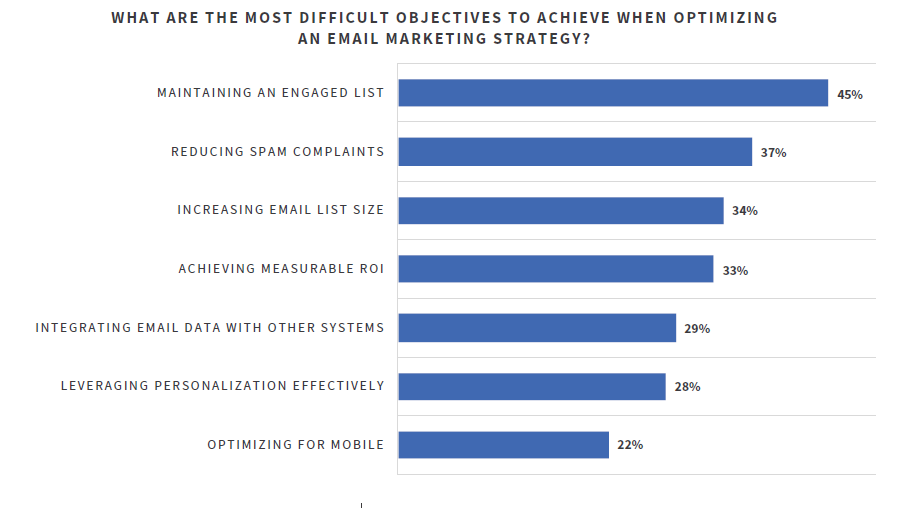
Maintaining an engaged email list is the #1 most difficult objective for email optimization, according to marketers.

Get the Fundamentals Right First
Email optimization starts before an email is sent.
Pre-deployment email testing is critical to delivering high-quality, engaging campaigns.
Design, deliverability, subject lines, subscriber verification, accessibility, sender reputation/SPAM score, HTML validation, and device/email client display are all important items to optimize before you hit send.
The best email copy and call-to-action (CTA) is guaranteed to produce a 0% conversion rate to the people that don’t receive it.
Also, if the design hinders a reader from reading the email, that will dramatically reduce your conversion rate.

Design is the most important attribute to test for email marketing optimization, according to marketers.
Take the time to set up a process and have the tools in place to review your emails before they are sent to get immediate positive results from your email optimization program.
Focus for Improvement
It is safe to say that if you want to improve any marketing campaign, it starts with the quality of your data.
For email, quality data allows marketers to deliver more personalization and targeted content to subscribers.
Quality data allows you to segment your list and, as a result, you can write more specific copy and targeted CTAs.
Also, your automation campaigns become more targeted, and even the types of content that you deliver are based on data and not random.
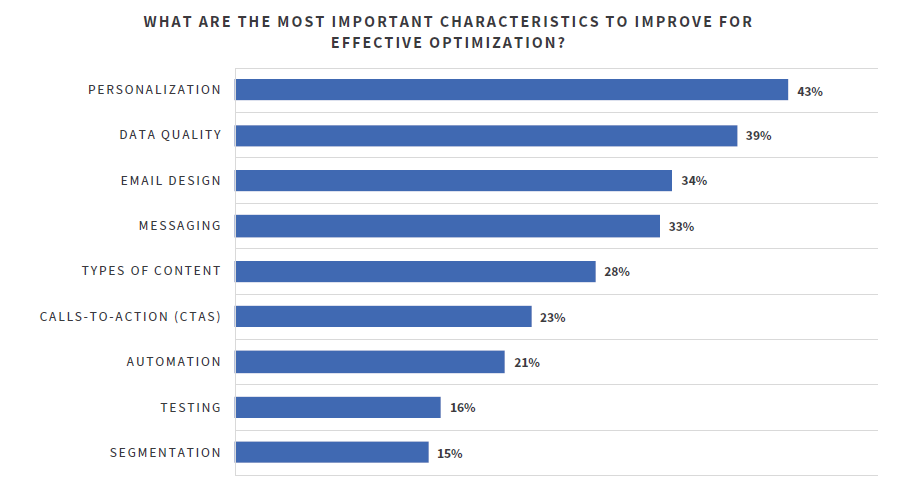
Personalization is the most important characteristic to improve for effective email optimization.
How to Handle Email Inactivity
So you’ve optimized your email campaigns, and some subscribers are still not engaging with you (how dare they!).
How long should a subscriber be inactive before removing them from an email marketing list?
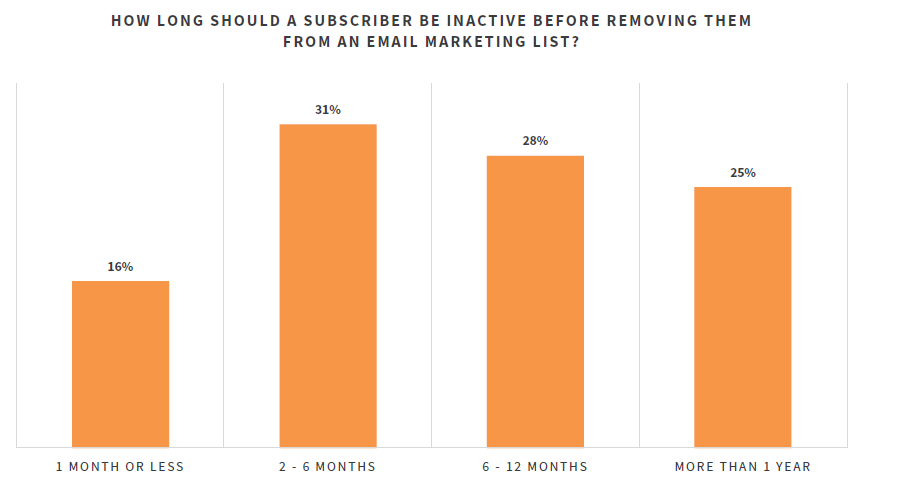
Subscribers who have been inactive for 2-6 months should be removed from email lists, according to 31% of marketers.
If you are doing all the best practices with data quality, pre-launch fundamentals, copy, CTAs, personalization, segmentation, and testing, and subscribers are not engaging with you, it’s important to set up a regular process to remove them from your list.
Remember, the goal is not your list size, so when subscribers tell you that they are not interested in you sending them emails by inactivity, believe them.

You can download the entire Email Marketing Optimization Survey Summary Report for more data, tips, and strategies to keep audiences engaged despite flooded inboxes.
The post How Marketers Are Optimizing Their Email Marketing, According to Research appeared first on Content Marketing Consulting and Social Media Strategy.
Source: convinceandconvert.com

The 5 Features You Should Be Using In Your Email Marketing App
Maybe you’re already using email marketing apps, but you aren’t getting the most from your sends. In this article, we’ll show five top features that you should use in your email marketing app to increase open and conversion rates.
After you sign up for an email marketing app, you might feel like you’re starting with a blank slate. Even if you have a lengthy email list, it’s hard to know how to reach and connect with your subscribers.
Maybe you’re already using email marketing apps, but you aren’t getting the most from your sends. In this article, we’ll show five top features that you should use in your email marketing app to increase open and conversion rates.
Why Send Email At All?
In a social-first world, it’s natural to ask: why send an email at all? It might feel like an antiquated platform, relegated to communication with family and far-flung friends.
In reality, savvy digital marketers know that email is a can’t-miss platform. It’s far more than a transactional channel to send purchase receipts and confirmations.
Here are just three of the reasons that you need email marketing as part of your toolbelt:
You own the list.
If you market on a platform like Facebook, you already know that you have to pay to market. Even if they follow and like your page, you’re on the hook to boost your posts.
Email marketing is an equal opportunity, and you’re able to market to your list freely.
Email gets seen.
According to Campaign Monitor, the overall open rate for email is 18%. It’s impressive to consider that nearly one-in-five recipients will see your marketing message – far better than blasting off social posts without promotion.
It feels friendly.
Never forget: email is a two-way communication tool. The reply button is only a click away and might be the start of a conversation that leads to a sale.
Must-Use Features in Email Marketing App
With the help of an email marketing app, you can take advantage of all of these benefits. Let’s look at five must-use features and apps that help you implement them.
Must-Use Feature 1: Segmentation
No matter what type of email list you’ve built, here’s one thing I know for sure: the audience is diverse. They have varying consumer preferences. They’re likely at different stages of the sales funnel.
Yet, so often, marketers treat the entire email list as if they’re flat people with the same preferences. This is a surefire way to reduce your open and conversion rates.
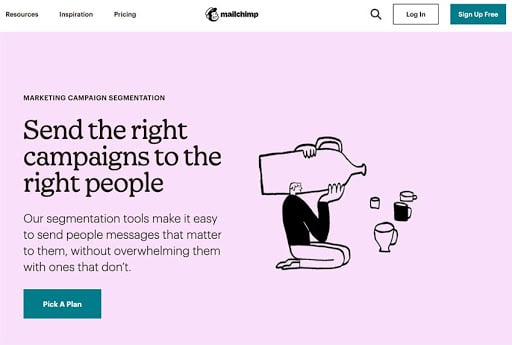
Mailchimp’s segmentation options make it easy to not only manage and tag your list with helpful data but to send targeted messages to cohorts.
The solution? Segmentation! Divide your list into useful groups, then target your emails based on what you know about the segments.
Segment your audience on factors like age, average speed, cart contents, and more.
You can even imagine sending fun emails based on the recipients’ location. (Think: “Our customers’ favorite floral arrangements in Tennessee!”)
You’ll need to spend time thinking about how to capture this information to effectively segment. Maybe you get it during sign-up or conduct a survey later to add the data after the fact. Once you’ve got these data points, segmentation is easy in most apps.
Must-Use Feature 2: Autoresponders
Don’t think of your email app as a “send-only” tool that requires you to log in, type a message, and press send. The magic of modern marketing is automating your communications, and that includes using autoresponders.
Here are five ideas for autoresponders, sparked by Neil Patel, that you can implement to automate your email workflow:
- Celebrations: who doesn’t love getting an email on their birthday? Taking a moment to send a discount or acknowledge a user’s big day can spark a sale.
- Reminders: with the right email software, you don’t have to “babysit” your promotions and remind customers. Set up an autoresponder to create urgency and remind your audience of a limited-time promotion.
- Follow-up: it’s a great idea to rekindle communication after a transaction. Maybe you use this to ask for a review or remind a member what your business does. Either way, it’s an automated way to keep the conversation going.
- Web triggers: you can send emails based on actions that users take. For example, if a user fills out a form, fire off an email that helps you move them to the next step in your sales funnel.
- Onboarding: we’ve all received simple sign-up confirmations, sure. A more powerful autoresponder to onboard your user is to send them suggestions on your top blog posts to check out, or other cornerstone content that they’re sure to check out.
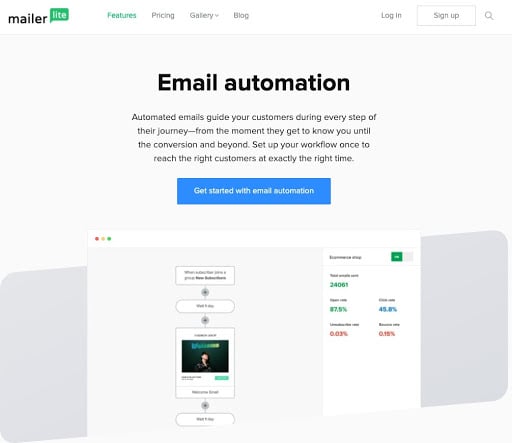
MailerLite is a powerful email automation tool that gives you a drag-and-drop tool to setup:
One of Andy Crestodina Orbit Media’s favorite email tricks is to use a “thank-you” autoresponder. It’s a simple way to show your gratitude with no extra work.
Using an autoresponder is the best of both worlds: it saves you time, and it increases engagement with your list. Set up a few targeted replies to help you connect with your list, even if you’re away from your keyboard.
Must-Use Feature 3: Analytics and Reporting
There’s a great saying in business: “if you can’t measure it, you can’t manage it.” It’s a data-driven worldview that posits that understanding your audience improves your marketing.
The best email marketing tools give you data. That might mean tracking open rate, click-through rate, or more. Start tracking those trends so that your future campaigns optimize for what techniques work.
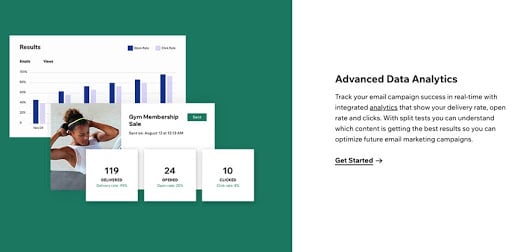
Use data analytics to help you continually improve your email efforts.
Wix’s email marketing services present all the key metrics you need to understand the success of your campaigns.
Open rates and click-through rates are two metrics you can track and monitor overtime in these apps so that your success increases over time. Track data, test what works, and keep iterating on your email strategy.
In addition, EmailAnalytics can provide you a comprehensive dashboard and tracking tools that allow you to monitor team productivity, engagement rates, best times to submit emails and overall insight into what works and what doesn’t.
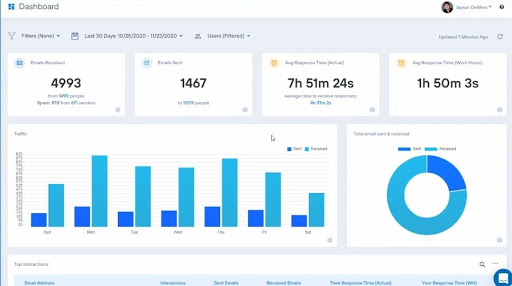
Continually optimize your campaigns with built-in analytics and reporting.
Don’t leave your email marketing efforts to guesswork and tribal knowledge. Instead, use the analytics and reporting built into your tool so that you can continually optimize your campaigns.
Must-Use Feature 4: Split Testing (A/B Testing)
Have you ever experienced email anxiety when emailing your audience?
Symptoms include staring entirely too long at the subject line, rewriting the content over and over, and ultimately never sending the message!
This occurs when you want to send the perfect email to your list. It’s totally natural, but here’s the problem: it’s based entirely on gut and intuition. Those two “metrics” rarely lead to results.
The solution is to split-test several versions of an email. Instead of erasing, re-writing, and deliberating, let the data speak for itself. When you split-test an email, you create several versions with limited changes between each version.
Your email app will send out a limited set of emails with each version of your campaign.
After testing the open and click-through rates, most email apps will automatically choose the optimized version and send it onto the rest of your list. That leads to higher open rates across your list.
When you split test an email campaign, you let the data speak for itself.
It removes the friction of sending and gives you confidence that you made the most of your mail. Make sure to use this feature so that your campaigns are optimized for your audience.
Must-Use Feature 5: Abandoned Cart
If you’re running an eCommerce shop, you don’t want to miss out on abandoned cart emails. It’s a form of an autoresponder message that helps you make more sales.
How many times have you put a product in your cart, only to close the tab and move onto another seller? This is a clear indicator that abandoned cart emails work as a way to bring a buyer back to your site to potentially complete a sale.
Abandoned cart emails tie into selling platforms like Shopify or Wix to help keep a sales lead in play. It’s a friendly reminder that can lead to a sale that you would otherwise miss. Use this feature to make the most of your email marketing.
Start Getting the Most From Email Marketing Today
The five techniques that you saw in this tutorial are tried-and-true options to improve your email marketing efforts. They help take your list and create more click-throughs and conversions. Try out these features to get the most from your email marketing platform.
The post The 5 Features You Should Be Using In Your Email Marketing App appeared first on Content Marketing Consulting and Social Media Strategy.
Source: convinceandconvert.com

How to Choose The Right Email Marketing Agency
Nothing converts like email. Email beats all other marketing channels and can generate $37 for every $1 you invest. Even though email marketing can generate a ton of revenue, it’s still not easy.

You need to know which email tools are best, how to use them so you don’t end up in spam folders, and how to create emails that convert.
Even for fully-staffed marketing teams, it can be overwhelming.
Email marketing agencies are perfect for overcoming these challenges.
They know how to use the tools and run fully-scaled email campaigns. They can also distill your brand and offer into great campaigns that generate revenue.
Today, I’ll walk you through how to choose an email marketing agency that’ll help you unlock all the business value email holds.
Good?
Well, let’s start from the basics.
Know Your Goals and Desired Outcomes
Before you jump straight to the top email marketing companies and pick one to work with, it’s a good idea to pause first.
Why?
You’ll get much better results.
Famous email agencies, like the ones I’ll recommend, usually have a track record of overseeing successful email marketing strategies and campaigns.
However, it’s never a one-size-fits-all situation.
Some agencies only excel when working on specific projects or campaigns. Others drive better results when working with specific kinds of businesses.
Knowing your goals and desired outcomes with email marketing gives you the right lens to evaluate different agencies and know which one is best for your needs.
Not to mention, it’ll help your agency get started a lot faster. The clearer the goal, the better the outcome.
Let’s take a look at some examples.
Example #1: Build and grow your email list
Without an email list, you can’t do email marketing.
And if you have a small list of, say, 33 email addresses, you’ll never get the full benefits of email marketing either.
The first step is to build your email list.
You’ll achieve this by choosing an agency with experience executing list-building campaigns to get your first 100, 1,000, or 10,000 email subscribers.
Take yourself, for example.
You won’t give a company your email address for nothing, right?
Absolutely not! We all get enough spam as it is.
Similarly, most people would only subscribe to your email list in exchange for something valuable.
In the digital marketing world, this could be an ebook, a checklist, or other forms of relevant content promoted to the audience whose emails you’re targeting. Consider choosing an email marketing agency with experience creating and promoting amazing content. The better the content, the faster your list will grow.
Example #2: Increase your email open and click-through rates
Low open and click-through rates will destroy your list.
If your open and click-through rates are low, you’ll run into a cascading series of problems:
- Your audience isn’t seeing your offers. That’s less revenue.
- Email service providers like Gmail, Outlook, and Yahoo will notice your low performance. Then they’ll flag you as spam or stop delivering your email altogether.
- Now your open and click rates get even worse.
- Even if you improve your campaigns later, they won’t deliver nearly the same results.
- Improving your email reputation is REALLY hard.
Instead of risking this email cycle of doom, it’s a good idea to partner with an agency that knows what they’re doing.
They can look for early signs that something’s wrong, course-correct early, and keep your email reputation safe.
In this case, look for an email marketing agency that is exceptional at developing strategies and tactics to help increase your open and click-through rates.
The two examples above were to show that your goals and desired outcome with email marketing go a long way in determining what agency to choose.
They were also to demonstrate that no agency is a one-size-fits-all for all email marketing problems.
Set your goals first, then look for an agency that specializes in those goals.
6 Characteristics That Make a Great Email Marketing Agency
There are hundreds of email agencies out there. Maybe thousands.
And if you visit the websites of these agencies, every single one claims to be the best.
But what characteristics make an email marketing company great? And how can you vet and choose an agency to work with?
1. Great Content Creation
Think of all the emails you receive from other companies.
Do you know why you can’t wait to open and engage with some, but would ignore, delete, or unsubscribe from others right off the bat?
In most cases, it’s because you don’t value the content of those emails.
Amazing content keeps people opening and reading. Then when you send an offer, they’re willing to consider it.
Great content is the core of any serious email strategy.
Check to see if they focus on a process for crafting engaging email content. The best ones always do.
2. An Impressive Client Portfolio
Excellent email marketing agencies didn’t achieve that status overnight.
They worked with dozens or hundreds of brands to execute successful email campaigns.
Because of this, they should have plenty of top-tier brands in their portfolio. And case studies that show you exactly what was done.
Not all of this can be shared publicly. But when you’re exploring options with agencies, ask for examples during your initial calls. The agency should have plenty of examples to point to. If they struggle to come up with some, look elsewhere.
It’s a great way to quickly vet agencies of all types.
3. Thought Leadership
Exceptional email marketing agencies are always on top of email trends. It’s constantly evolving and you don’t want to work with someone that’s using tactics from 5 years ago.
An easy way to check for this is the agency’s blog, YouTube channel, or their own email list. Within 20-30 minutes of consuming their content, you should learn a ton. And it should all be cutting edge.
That’s a good sign they’ll be able to apply those same tactics to your email campaigns.
4. Deep Expertise with Email Tools
Great agencies will have used them all.
If you ask them which tools are best, you’ll quickly learn:
- Which are the most popular
- Strengths and weaknesses of each
- The handful of tools to avoid
But don’t worry about which tool they recommend. Pay attention to their depth of knowledge when speaking with them. They’ll probably start by recommending a single tool. Then as soon as you ask any follow up questions, they should have plenty of qualifications, nuance, and detail to their answers.
You should get the feeling that the agency knows this stuff cold. If not, find someone that does.
5. Has Specific Rules to Avoid Spam
If you’ve been hit hard by spam flags, you might need an agency that specializes exclusively on reviving domains with negative email reputations.
Most of us don’t need to go that far.
But you absolutely want to work with an agency that knows how to stay out of the spam box.
Also ask new agencies about how they stay out of spam, their processes to keep things clean, and early warnings that they like to look for.
You should be blown away by the thoroughness of their answers.
If not, keep looking.
6. A Great Company Culture
By choosing an email marketing agency to work with, you’re entering a business relationship with another business entity.
So, before you proceed, check that their company culture fits with yours.
Without a good fit on culture, you’re going to get email campaigns that don’t jive with your brand. You could anger your audience and turn them away. Or play things too safe and leave money on the table.
There’s no right answer on culture, just make sure their culture and yours fit well.
Ask for samples of recent campaigns that they’ve done. They’re likely to do similar work for you.
How to Work With an Email Marketing Agency
Working with an exceptional email marketing agency isn’t like dashing into a grocery store, filling your cart, and dashing out in a few minutes.
There are steps you’ll need to take that ensure your partnership with one leads to business growth via email marketing.
1. Align your in-house team
Most email marketing agencies won’t work in isolation but as an extension of your in-house digital marketing team.
Hence, to ensure a smooth partnership between you and them, you should:
- Have meetings with stakeholders in your company to align relevant teams on the need to work with an email agency.
- Communicate how the agency’s work would impact your business and why it is necessary.
- As needed, appoint employees to work directly with the email marketing agency.
Doing this ensures team alignment between the agency and your company. Also, it keeps the agency in sync with your values, company culture, and the goals for choosing to work with them.
2. Discovery session
As you first go out to contact an email marketing agency, they won’t jump straight into sending you a proposal or contract.
The best email marketing agencies act like doctors who only prescribe after they diagnose.
And to start diagnosing your challenges and goals with email marketing, expect to fill an inquiry form, followed by a discovery session.
3. Research & strategic recommendations
Before making a specific proposal, any good email marketing agency will do an extensive round of research on your current campaigns. This will include things like:
- Signing up for your lists and looking at your current campaigns
- Mapping out your signup flows
- Checking landing pages and signup offers
- Looking through social profiles and email funnels from other channels
Once they have a complete picture of where you are today, they’ll be able to put a proposal together.
4. A working contract with project deliverables
A typical work duration with an email marketing agency spans several months.
To take on that kind of scope, agencies usually prefer to send a formal proposal and contract for you to sign.
Take your time and this stage and go through the proposal in detail. You should feel great about every piece. If you have any concerns, work through them now. It’s really easy to change scope, budget, or goals now.
Once you feel good about it, get the contract signed.
5. Onboarding
Expect an onboarding process customized for your team after you sign the contract.
During this step, the agency will usually ask for all your internal document and tool access. Expert to send them invites for your Google Analytics and email tools. Also, put together every piece of internal documentation that you have on your email campaigns. The more info they have, the better.
From here, the agency will get started on the work and should have regular check-in calls along the way.
How to Find The Right Email Marketing Agency For You
To choose an email marketing agency that’s right for your needs, the steps I recommend are:
- Be sure about your business goals and desired outcomes from email marketing.
- Consider agencies with the characteristics above.
- Choose an agency with expertise in the area you need help with.
- And where possible, also prioritize those that have worked with reputable brands.
- Finally, know that email is part of your digital, and by extension, content marketing strategy. Hence, it’s best to choose a company with bandwidth for those.
To help, we reviewed hundreds of agencies and found these to be the best.
The 5 Top Email Marketing Agencies
#1 Neil Patel Digital – Best For Email Content
Every time you send an email, people unsubscribe.
That hurts the long-term prospects of your email list.
Since every email has a real cost and makes your list smaller, it’s best to make them count.
The best way to do this is with great content. Your unsubscribes will be lower, your list will be more engaged, and you’ll generate more revenue in the long-run.
Content, including email content, is one of the core areas of expertise at my agency, Neil Patel Digital.
#2. InboxArmy – Best for Full-service Email Management
InboxArmy comes highly recommended, as a full-service email marketing and management company.
This agency’s services include email strategy development, template design, email automation, and others.
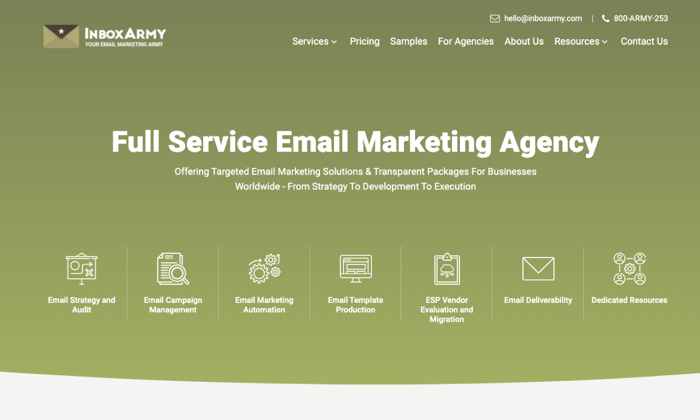
InboxArmyserves companies such as Airbnb, LandCentral, and Jockey. If you’re looking for serious email pros for your B2C company, I’d reach out to them.
#3 Fix My Churn – Best for SaaS Onboarding Emails and churn
Fix My Churn works with SaaS companies.
User onboarding emails are a very unique skill set. The content, CTAs, sending logic, and tools are completely different. If you want to improve your SaaS emails, you really need experts in this area.
Fix My Churn applies top-level SaaS copywriting skills to create email onboarding and churn-eliminating sequences to turn free and trial users into happy, long-term customers.
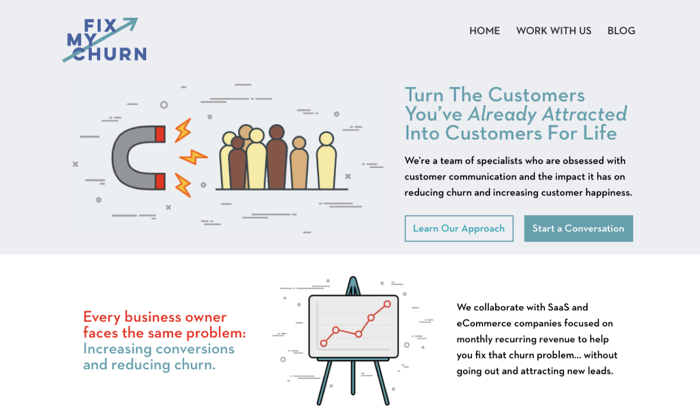
Led by its Founder and SaaS email expert, Val Geisler, Fix My Churn has earned a reputation as an email marketing agency for SaaS companies like Buffer, Aweber, Podia, InVision, and others.
I’d also consider them if you have any type of subscription offer.
#4 Action Rocket – Best for Enterprise Email
Action Rocket needs no introduction as an email marketing agency for enterprise companies.
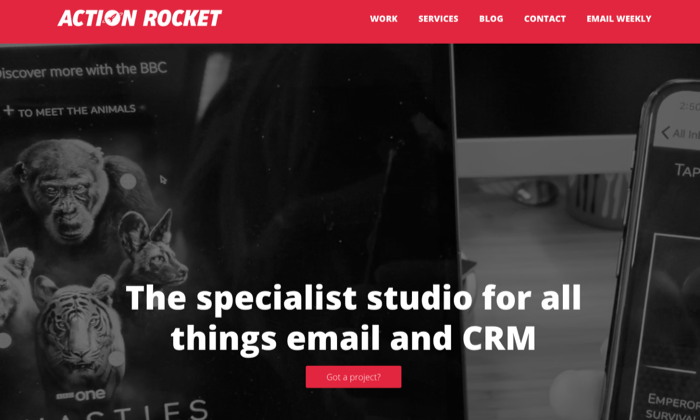
This agency even works with leading email software companies like Campaign Monitor, MailChimp, Litmus, and others to shape the email marketing space.
Using its vast years of experience, Action Rocket strategizes and develops custom email and CRM programs for enterprise companies, including Marks & Spencer, the BBC, and others.
If you want serious muscle behind your email strategy, reach out to them.
#5 SmartMail – Best for Ecommerce Email
SmarMail is our recommended email marketing agency for ecommerce businesses.
Every business model has its own unique challenges with email and ecommerce is no exception.
You need cart abandonment emails, promotional emails, lifecycle emails for repurchases, and receipts with guaranteed email deliverability.
This agency excels at helping online stores acquire, convert, and retain customers by strategizing and launching email marketing campaigns based on automated triggers across buyers’ lifetime cycle:
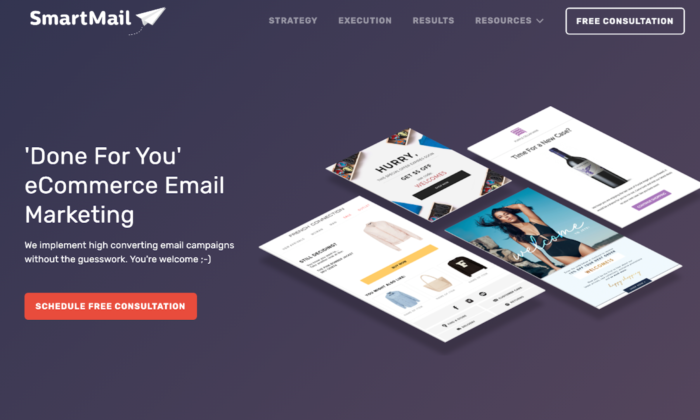
SmartMail has an excellent track record, helping ecommerce companies generate about $187 million in revenues. Their clients include French Connection, Skechers, and others.
Get Email Right to Drive Growth
Email marketing isn’t going anytime soon. It is here to stay.
And it generates a ton of cash. Choosing the right agency will get you that growth a lot sooner.
Set your goals, then start looking for the right agency for you.
Even if you plan on doing email in-house, the right agency can get everything set up correctly from the beginning. That will save your team a ton of time and prevent disastrous mistakes like getting all your emails stuck in the spam folder.
The post How to Choose The Right Email Marketing Agency appeared first on Neil Patel.
Source: neilpatel.com

Best Email Marketing Services
What if I told you there was a single marketing channel through which companies are finding a 3,800% ROI? That’s earning $38 for every dollar spent. This magic marketing channel is called email.
Disclosure: This content is reader-supported, which means if you click on some of our links that we may earn a commission.
Yes, just good old email. And that insane average return on investment is one of many email marketing statistics that have held true for years now.
The biggest surprise to me is how many companies aren’t taking advantage of email marketing.
I hear it’s too much work to design newsletters, manage a growing number of contacts, personalize messages, and keep the campaign moving forward.
There’s this perception that email is a time-sink, but it doesn’t align with the statistics.
If it were really too labor-intensive to run an efficient email marketing campaign, the average ROI wouldn’t even be 1/1000 of what it is, year after year.
The key is finding the right email marketing service. Don’t wait to start building better campaigns in less time.
The Top 5 Options For Email Marketing Services
- Constant Contact – Best for e-commerce
- Zoho Campaigns – Best for simple campaigns
- Sendinblue – Best ease-of-use Marketo
- Engage – Best for segmentation and personalization
- Pardot – Best for B2B marketing
How to Choose The Best Email Marketing Service For You
Email marketing services are packed with features to help you save time at every step of a campaign.
Every step.
My favorite products get you minutes back on every task. Professional templates, drag-and-drop email editors, list management tools—they make all the hard parts easy.
On top of that, many of the most time-consuming campaign processes can be automated with an email marketing service.
The minutes you save turn into hours quickly, especially if you’re churning campaigns on a large scale.
More effective campaigns. Less effort. That’s the goal.
Let’s walk through the core features available with email marketing services so that you understand which product is going to deliver you the best results for you.
Ease-of-use
Unless your marketing teams double as developers, it’s essential to find a tool that anyone on your team can use.
As you browse, pay attention to the templates and pre-set workflows offered by each email marketing service. Are you excited to use these or do you intend to create your own custom templates? Some email marketing services lose their reputed ease-of-use once you step outside their pre-defined pathways.
It’s a definite plus if your solution comes with visual design tools to build emails and workflows. A simple-to-learn editor can be used right away by the people who need it. They don’t need training, and aren’t stuck waiting on someone who’s comfortable with the editor.
The best email marketing services also provide support, documentation, and walkthroughs to educate users and ensure that their product is truly self-service.
If reviews indicate that customer support is sluggish, or that answers are hard to find, that’s a red flag.
Integration and Implementation
An important question to ask: How easily is your email marketing service going to mesh with your existing stack?
Solutions that integrate with products you use are going to speed deployment and encounter fewer issues moving forward. This is especially true of your existing CRM and any other customer data sources.
Some products, like Sendinblue, come with their own CRM as part of the package, which can be nice for companies that aren’t looking to purchase multiple products in service of their email campaign.
Email Deliverability
The emails you send need to reach your recipient’s inbox. End of story.
Without a high deliverability rate—I would be worried about anything below 95%—your email campaigns are dead in the water.
All good email marketing services ensure high deliverability in two ways.
On the backend, they authenticate emails with DKIM, SPF, and SenderID, while also working with internet service providers to make sure that customer IP addresses aren’t blocked.
Plus, quality platforms will provide ready-made email templates that are both visually appealing and compliant with privacy and anti-spam laws.
On the user side, email marketing services help you craft compelling subject lines and content that encourages customers to actually open your message. They also provide tools for managing subscribers so you can keep a clean list and avoid the spam folder.
Email Automation and Customer Journeys
One of the biggest defining (or limiting) features of an email marketing service is the level of sophistication your workflows can manage.
Entry-level tools can help you automate welcome series of emails for new subscribers, and other similarly straight-forward processes.
If you want to start adding conditional or logical triggers that branch the customer journey into more personalized paths, you are going to need a more substantial tool.
You are also going to need to know a lot about your audience. Products that have really good list segmentation features will pick up tons of information on your customers, which in turn makes your automation more accurately targeted.
Segmentation really drives your ability to automate personalized emails, for example. You can set workflow triggers that respond to customer engagement, shopping habits, and other tendencies to ensure that customers are only receiving messages they’re likely to care about.
Subscriber Management
Quality email marketing services come with a lot of tools to manage the subscribers on their list. They will help you:
- Import lists: Seamlessly integrate contact lists from CRMs and other databases.
- Keep a clean list: Identify and remove inactive subscribers and spam traps that reduce deliverability
- Generate leads: Create new contacts with pop-ups, landing pages, and other multi-channel tools that start an ongoing conversation.
- Segment your list: Automatically group subscribers based on many criteria, including everything from what time zone they live into how they signed up, and everything in between.
- Campaign Performance Tracking
- Email marketing strategies must be agile.
Every service reviewed in this article comes with the ability to track traditional KPIs like:
- Bounce rate
- Click-through rate
- Conversion rate
- Deliverability
- Forward/share rate
- List growth rate
- Open rates
- Unsubscribe rate
By keeping tabs on these metrics, companies can tweak their campaigns accordingly.
Many email marketing services offer A/B testing, which allows you to test different versions of emails or subject lines to see what performs better.
Look for that, because it’s super helpful for adjusting campaigns in the right direction over time.
More advanced email marketing services will help you tie traditional metrics to revenue, letting you see ROI per email sent and other business-critical metrics.
They’ll also let you see how content is performing with features like click heatmaps, which show where your customers are spending the most time.
You’ll probably have to spend more for those features, but they can provide crucial information that pays for itself.
Marketing automation software, like Pardot, provides multi-touch attribution models that let you visualize each touchpoint in the entire customer lifecycle. Marketing attribution drives business growth and informs your future campaigns by spotlighting the key elements of each customer relationship.
The Different Types of Email Marketing Services
Most products in this category want to provide email marketing services for companies of all sizes, so they offer a range of plans from a budget-friendly package to enterprise-grade service tiers.
Email Autoresponders
Exemplary products: Zoho Campaigns, Sendinblue (Free & Lite)
On the lightweight side of the spectrum, you’ll find services that augment your email marketing campaigns with easy-to-use tools for automation, email editing, and subscriber management.
You’ll see these products billed as email autoresponders or email automation.
They don’t change what you do so much as they help you do it better, faster, and at scale.
Because they are so simple, the best email autoresponders are incredibly intuitive, inexpensive, and can start delivering results almost immediately.
Email Marketing Platforms
Exemplary products: Constant Contact, Sendinblue (Premium & Enterprise)
Email marketing platforms are a one-stop-shop meant to help you build, track, manage, and optimize campaigns.
They are going to capture, store, and segment your customer data much better than a standalone email autoresponder. And with a richer picture of your audience, you can build much more complex email workflows.
You can get really granular when it comes to personalized customer journeys, for example. In Constant Contact, you can automate emails with shoppable product recommendations based on a person’s buying habits.
Doesn’t that sound great?
What’s really nice is that these products are very easy to use and deploy. Campaign performance tracking features are built right in and provide a ton of visibility and control instantly. Some will integrate with tools like Google Analytics to get actionable data.
You can see what’s working, what’s not, and make changes on the fly.
Marketing Automation Software
Exemplary products: Salesforce Pardot, Marketo Engage
Marketing automation software includes email marketing services as part of a broader suite that accounts for every channel of communication.
Organizations can expand their reach across email, SMS, social, SEO, websites, webinars, and paid media. Information from across all these channels is centralized in intuitive dashboards that drive real-time, evidence-based campaign decisions.
With marketing automation software, you can build out multi-branch email campaigns and customer journeys, tracking progress across every stage.
These products tend to be quite a bit more expensive, and understandably so. If you are looking to run simply to moderately complex email campaigns, you’re fine with an email marketing platform.
On the other hand, if you start to run into problems at scale or email workflows can’t handle your needs, it may be time to consolidate your processes with a marketing automation solution.
Examples of Email Marketing Services Software/Platforms
#1 – Constant Contact — Best for Ecommerce
Constant Contact offers some of the best email marketing services alongside top-notch solutions for ecommerce, event hosting, website building, and multi-channel marketing.
They average a 97% deliverability rate. This is only possible because the mature platform blends powerful behind-the-scenes functionality—like blocklists, proactive monitoring, and multiple forms of authentication—with an intuitive UI that helps teams craft effective messages that don’t bounce.
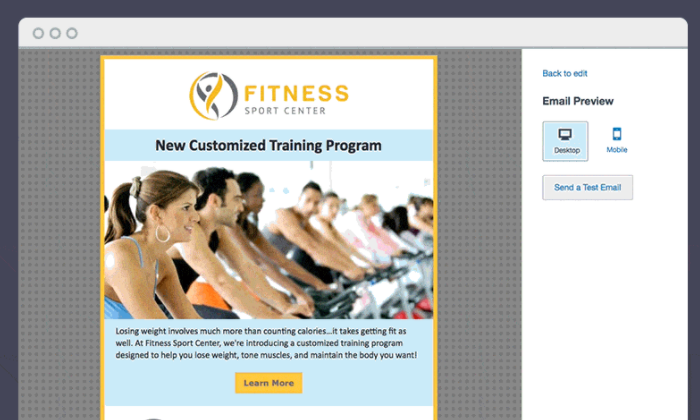
You can get Constant Contact up and running very quickly, and it will eliminate much of the legwork associated with email marketing.
Automate product recommendations, for example, by sending shoppable emails based on the items a customer has in their cart, the weather, or the tendencies of like-minded shoppers.
Trying to accomplish this task without an email marketing service would be extremely time-consuming. With Constant Contact, the process can be automated by just about anyone.
Some of the other reasons millions of people use constant contact include:
- Unlimited email sends
- Custom and branded templates
- Campaign performance tracking
- Subject line A/B testing
- Drag-and-drop email editorRich ecommerce capabilities
- Subscriber management, segmentationRSVP, survey, and poll
Constant Contact helps with lead generation, too, via landing pages, customizable pop-up forms, and free hosting for a mobile-responsive website. This includes a blog, where you can leverage your email content as posts for SEO.
There are three pricing tiers for Constant Contact email marketing services and the amount you pay is based on the number of contacts. The plans are:
- Email: Starting at $20/month
- Email Plus: Starting at $45/month
- Pro: Starting at $195/month
Constant Contact Email and Email Plus are two of the most popular email marketing services available today.
Constant Contact Pro uses AI-driven marketing automation to provide personalized product recommendations, smart subject lines, behavioral segmentation capabilities, and more advanced workflows.
I would consider a Pro subscription if you are thinking about marketing automation, but aren’t ready to pull the trigger on a heavyweight product like Pardot or Marketo.
#2 – Zoho Campaigns — Best for Simple Campaigns
Zoho Campaigns is a lightweight, cost-effective email marketing service that comes with all the must-have features.
In Zoho Campaigns, everything has been trimmed (but not watered down), so you can still accomplish 80-90% of what you can do with an email marketing service that costs three to four times as much.
The ease-of-use is on par with agile project management software like Trello. Not only can non-technical users navigate Zoho Campaigns, but they can also master their domain.
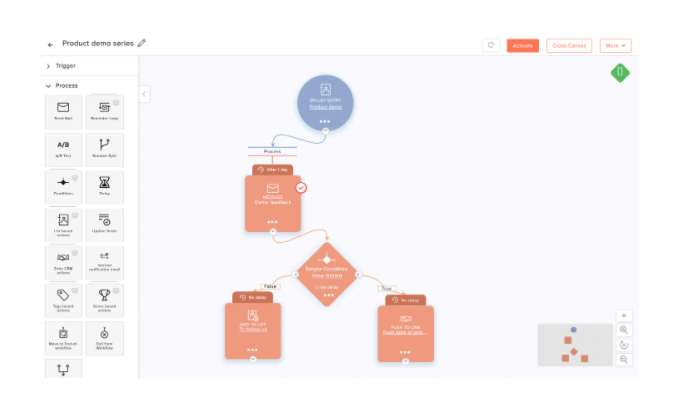
Intuitively control the following features:
- Drag-and-drop email editor and template builder
- Email autoresponders
- Email automation
- Merge tags
- Subscriber management
- A/B testing
- Team collaboration
- Real-time analytics
Keep in mind that Zoho Campaigns also has integrations with popular CRM, ecommerce, and contact management products.
Tying these data sources can help you better target and personalize your email campaigns, yet Zoho Campaigns will remain fairly easy to use.
Integrating Google Analytics, for example, can enrich the amount of customer data you pick up on each interaction, providing data visualizations to help you make sense of relationships over time.
Pricing is straightforward for Zoho Campaigns:
- Email-based Plan: starting at $2/month
- Subscriber-based Plan: starting at $4/month
- Pay-as-you-go Plan: starting at $6/month
The Subscriber-based Plan is my favorite because it includes email automation, which doesn’t come with the Email-based or Pay-as-you-go Plans. At $263/month for 100k contacts with the Subscriber-based Plan, the automation will pay for itself many times over.
You can also try the Zoho Campaigns free-forever version. It’s limited to 2,000 subscribers, but you get a lot of the marketing and content management features, as well as the chance to see if you like the interface.
#3 – Sendinblue — Best Ease-of-Use
Sendinblue is a unified CRM, chat, Facebook, SMS, and email marketing platform. It’s loaded with features that are super easy to learn.
In other words, lots of tools with very little training.
Unlike other options on this list, every Sendinblue subscription (including Free and Lite) comes with a sales CRM, marketing automation, real-time reporting, advanced segmentation features, and more.
How’s that for out-of-the-box function? But wait. There’s more.
With popups, landing pages, and chatbots, you can build out your contact list with minimal effort, turning website visitors and Facebook passersby into your next lead.
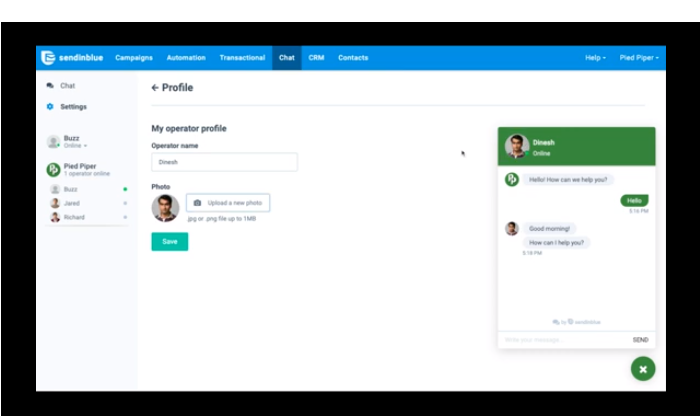
And once people are on your list, Sendinblue gives you a ton of great tools to nurture leads, build out customer journeys, and communicate effectively every step of the way. The key features include:
- Unlimited contacts with any plan
- Mobile-friendly visual email editor
- Retargeting ads
- Campaign performance trackingA/B TestingCustomizable signup formsTransactional emails
- Email API, SMTP relay, and other core API features
- Advanced email automation
Sendinblue offers a free forever version, and paid plans at several pricing tiers:
Lite: Starting at $25/monthPremium: Starting at $65/monthEnterprise: Contact sales
The amount you pay is based on your tier and the number of emails you send each month. You can store as many contacts as you want without affecting the price, which is not true with most other platforms.
Notably, Sendinblue’s pay-as-you-go plan includes the same great features as whatever tier you choose, except the phone support. This is also something you won’t find in other options, like Zoho Campaigns.
There is no prior knowledge or technical skill necessary to start using Sendinblue, and their free forever plan is one of the best available.
#4 – Marketo Engage — Best for Segmentation and Personalization
Marketo Engage, from Adobe, is a full-service marketing automation solution ready to support your strategy across any channel.
Centralize and analyze customer data in an intuitive environment that allows for email campaigns with fine-grained segmentation and dynamic personalization.
You can customize intricate workflows with behavioral triggers that wouldn’t be possible on other platforms because they can’t capture as much information as Marketo does.
Every feature is full-bodied. A/B/n testing, for example, lets you pilot multiple versions of the same site or email rather than just binary A/B testing, which is where many other products stop.
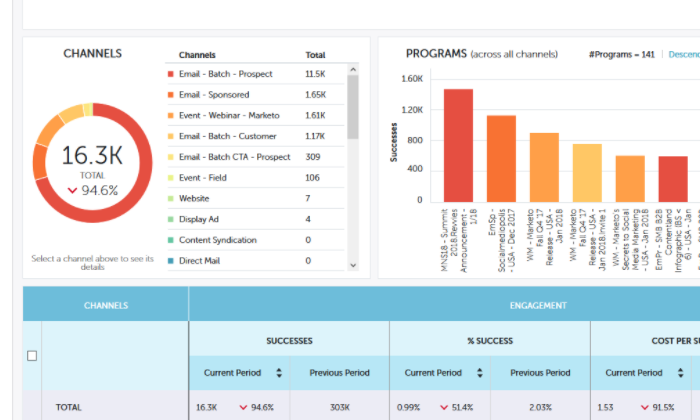
There’s also Adobe Sensei, which uses AI and machine learning to personalize content. Sensei analyzes the performance of all your assets, learns which content works best for whom, and updates emails accordingly.
Other great features that come with using Marketo for email marketing include:
- Drag-and-drop workflow builder
- Lead and account scoring
- Deep engagement and performance analytics
- Attribution and ROI dashboard
- Customer lifecycle management
- One-click campaign cloning
- Champion/Challenger testing
- A/B/n testing
You’ll have to contact Marketo to get a price. It’s going to have a higher total cost of ownership than a dedicated email marketing service, but if you want superior segmentation and personalization, this can get a lot more done.
#5 – Pardot — Best For B2B Marketing Automation
Pardot is the marketing automation platform from Salesforce that’s built specifically for B2B marketing.
Do you need to hear more, or are you already sold? It’s as good and as deep as you think it is.
Pardot has 2,000+ integrations, a rich feature set, and a surprisingly intuitive UI. To be honest, the platform is a few steps ahead of its competitors in the dedicated email marketing space.
It’s going to take some time and effort to build out the backend, but once everything is set up, Pardot gives you unrivaled visibility into your campaigns.
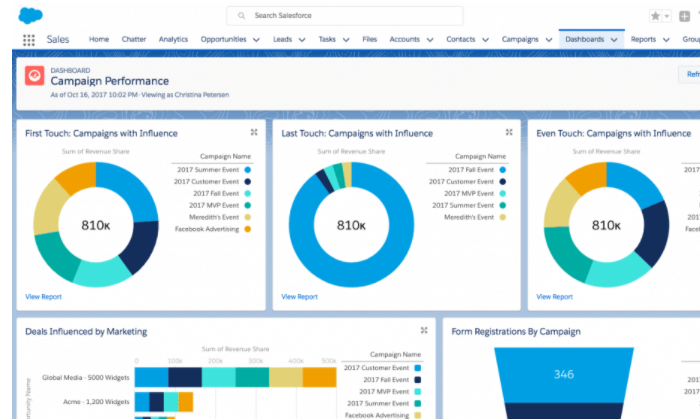
If you feel like the sophistication of workflows is lacking with your current setup or your analytics and data visualization tools aren’t giving you the insight into campaigns that you need, Pardot is the ticket.
Some of the advanced email marketing features include:
- B2B Marketing Analytics
- Engagement history dashboards
- Merge fields
- Visual lead nurturing designer
- Social profilingROI reporting
- Multi-touch attribution models
- Developer sandbox
Pardot is not a cheap option, but it is money well spent in service of a high-growth campaign.
There are four pricing tiers:
Growth: starting at $1,250/monthPlus: starting at $2,500/monthAdvanced: starting at $4,000/monthPremium: starting at $15,000/month
Other marketing automation solutions, like Marketo, are going to be in this neighborhood price-wise. There are certain email marketing platforms you can get for a fraction of the cost, but they’re not going to give you anywhere close to the oversight and customization Pardot affords.
Summary
If you are just starting out, I would try out one of the best email autoresponders to get a feel for which email marketing features are going to be most important to you.
Zoho Campaigns is another really great starting point. These tools are easy to use and many have free forever options.
For companies that need more visibility into their campaigns but don’t want to struggle with a new platform, Sendinblue will be great. It’s also not prohibitively expensive, even at the premium tier.
Constant Contact is another great option in the SMB price range, especially for ecommerce. It comes with some of the functionality you find with marketing automation software, but there’s no loss to its ease of use.
If you need the marketing automation and business intelligence functionality of Pardot or Marketo, budget it in. After a certain point, dedicated email marketing services aren’t going to handle the automated journeys you have in mind.
If Pardot and Marketo give you sticker shock, but you still want true marketing automation, check out Freshmarketer, or one of the other best marketing automation software solutions.
The post-Best Email Marketing Services appeared first on Neil Patel.
Source: feedproxy.google.com