
Tag Archives for " customer journey "

How to Use AI to Bolster Your Customer Journey
Wouldn’t it be awesome if you could skyrocket your lead-to-sales conversions to new heights?
Most business owners struggle with this.
Data shows that a whopping 79% of leads never convert to sales.
This highlights how challenging it can be to move leads through the customer funnel journey.
The good news is, Artificial Intelligence (AI) can supercharge your customer funnel journey to help you get more sales.
AI will efficiently weed out your low-quality leads and eliminate repetitive, time-consuming tasks, allowing you to focus on higher-quality and converting ones seamlessly.
AI will help your brand grow by preventing your leads from falling through the cracks at each stage of the customer funnel, which increases your sales-ready prospects for conversion.
Read on to learn more about how you can use AI to bolster your customer funnel journey.
Customer Funnel Journey: What is it?
A customer funnel’s structure and components can vary depending on the company or industry, among other factors.

The standard customer journey funnel stages can include:
Awareness.
This stage focuses on raising awareness for your brand and sharing information about your value with your target audiences.
Interest.
Here, your leads learn more about your business, products, and services.
You can introduce your positioning and capture leads by encouraging signups to your email newsletters (among others).
Consideration.
In this step, engage your leads actively by delivering personalized messages that reinforce your brand’s benefits.
Provide specific information to overcome objections and qualify your leads.
Evaluation.
Your prospects start showing interest in your products and services at this phase, deciding whether to buy from you or other brands.
Highlight why prospects should choose you over your competitors to make them stick.
Conversion.
After your leads convert to customers, market your onboarding materials, deliver messages celebrating their decision, and assess satisfaction levels.
This stage is also a great time to run your upselling and cross-selling strategies.
The customer funnel can show you how your leads interact with your brand and where they fall off.
This helps you refine and improve your strategies to keep your leads moving through each stage until they ultimately become paying customers.
A well-defined customer funnel journey helps you optimize your lead capture, engagement, nurturing, qualifying, and converting efforts.
It also informs your strategies to help you create immersive and memorable experiences across devices, channels, platforms, etc. that make your leads stick and convince them to become loyal clients.
The importance of using AI in the customer funnel journey
It’s time-consuming and labor-intensive to establish an effective customer funnel journey.
However, AI can do the heavy lifting for your sales and marketing teams through automated methods, such as autonomously identifying more qualified leads quickly.
This reduces the strain on your resources and your teams avoid needlessly chasing less-qualified leads.
AI can serve as your company’s sales and marketing virtual assistant by handling repetitive and tedious tasks.
This frees up your teams so they can focus on more meaningful, higher-level, and revenue-generating work.

The technology can also reduce human error and work 24/7, optimizing your lead engagement, nurturing, and qualifying efforts.
Through machine learning technology, you can “train” your AI to respond to conversations and events the way you would.
Your AI can learn from lead interactions and data, and the more input it accumulates, the more it can optimize its functions and responses on its own.
Ways to leverage AI in each stage of the customer funnel journey
Below are several ways AI-based technology can boost your customer funnel journey.
Streamline your lead generation efforts
The customer funnel journey typically begins with raising brand awareness, and this is where a lot of manual work is done.
For instance, you’ll need to build and design campaigns to tailor them to potential customers who haven’t heard of your products and services before.
This includes creating content such as blog posts, articles, lead magnets (ebooks and whitepapers), and website content (among others) to raise brand awareness and capture leads.
However, the content creation process can take a huge amount of time and resources — unless you use an AI-powered platform that can automate your content creation process.
This is where Broca comes in handy.

Broca provides a deep learning AI platform that generates content for your marketing and sales needs in a flash, saving you from the resource-draining aspects of building content.
If you’re creating content for all your campaigns, Broca delivers by instantly generating the content, from ideation to distribution, for your website and marketing channels.
First, provide a campaign brief (in a few sentences) describing your campaign and where you want to direct your traffic, such as your blog post or landing page.
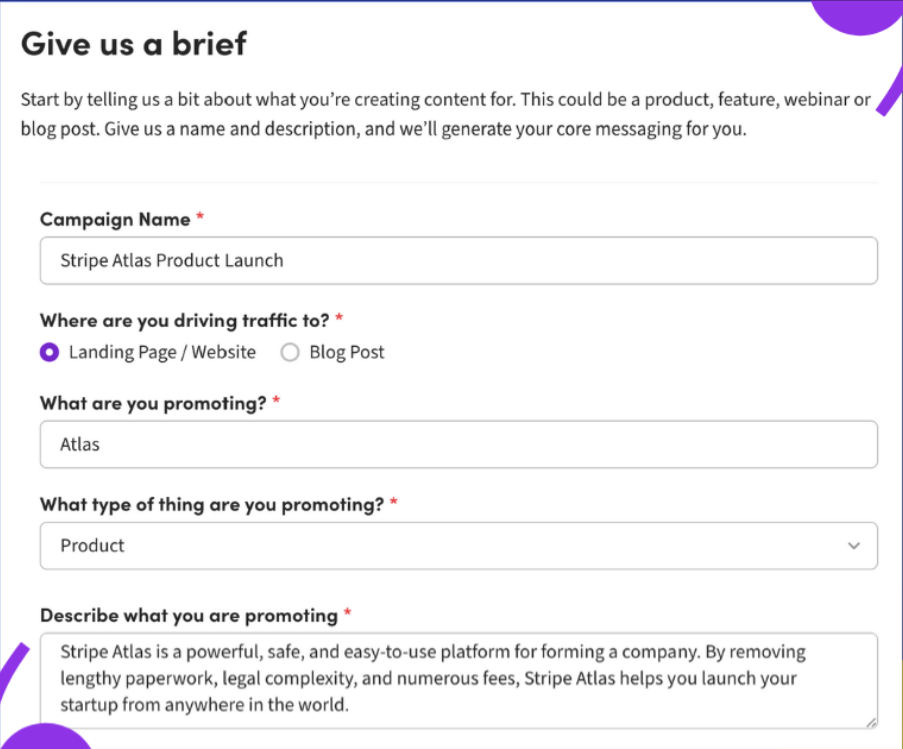
Image source: usebroca.com.
The platform then creates core messaging based on your campaign brief, giving you three key benefits of your brand, an enticing value proposition, and a killer headline.
You can validate and modify all these with your team before proceeding.
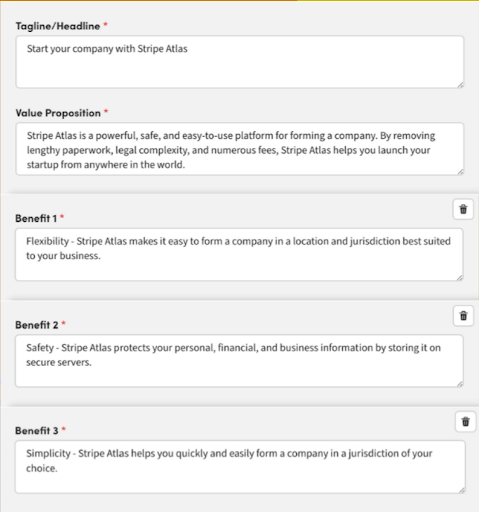
Image source: usebroca.com.
Finally, Broca creates promotional content out of your core messaging, providing you with brand-aligned and ready-to-distribute emails, ad copies, and social media posts.
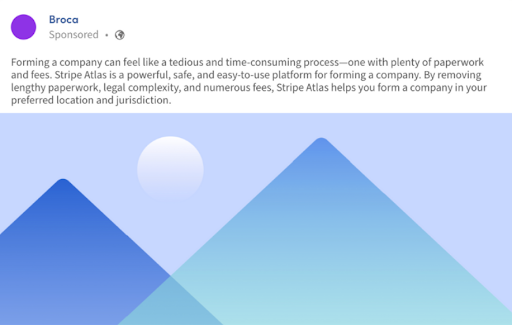
Image source: usebroca.com.
The platform creates your marketing and sales content across channels, which helps ensure your content and messaging remain consistent throughout the customer funnel journey.
Broca also streamlines creating Google ads by analyzing your current ads and generating new suggestions, putting your ad channels on autopilot.
A robust AI-based content-generating platform is a game-changer in your content creation for lead generation.
It significantly cuts down on the time-intensive, tedious, and usually complex process of creating effective content by doing the heavy lifting aspects of the process.
With AI under your tool belt, you and your teams don’t break a sweat but still get high-quality, consistent content at a scale that generates significant leads.
Automate your lead nurturing and qualifying processes
To get your leads to interact with your brand and guide them to the next stage of the customer funnel journey, you’ll need to nurture and qualify them.
However, the lead nurturing and qualifying process can take up plenty of time and energy that your sales team can optimize better to implement strategies to close deals.
The solution?
Delegate your lead nurturing and qualifying initiatives to a reliable virtual sales assistant.
If you want to take things a step further, use an AI-powered sales assistant.
One such solution is Exceed.ai.

Exceed.ai is a powerful virtual sales assistant with conversational AI that works alongside your sales and marketing teams to nurture and qualify your leads.
It helps you move your leads along the customer funnel journey until they are sales-ready.
Exceed’s AI-driven platform uses a conversational bot and machine learning technology to provide your leads with highly personalized and contextual interactions.
It uses AI to deliver human-like responses and follow-ups via chat and email, automating your lead engagement, nurturing, and qualifying processes.
First, it engages your leads through your web or chat-like forms through personable interactions.
Here’s an example of Exceed’s AI-generated email, in this case, from their own email marketing operation. (It’s always a good sign when a company uses its own product and Exceed does all of its lead nurturing via their AI assistant.)
The virtual assistant then assists your leads by answering questions, dealing with objections, and responding to their requests while simultaneously gathering data for your Customer Relationship Management (CRM).
Next, it implements automated nurturing and uses intelligent follow-ups to move your leads through the customer journey funnel stages.
The VA acts as a virtual Sales Development Representative (SDR) by validating your leads based on the previous and current conversations and your Sequence or Playbook (more on this later).
Finally, after the VA qualifies your lead, it hands over your sales-ready prospects to your human sales representatives for closing.
It can automatically book a schedule for your leads based on your sales reps’ appointment availability that you and your team configure within the Exceed.ai platform.
The AI-based virtual assistant handles the entire process, from engaging your leads to handing them off to your sales reps.
This saves your team tons of time and energy while ensuring you generate, nurture, and qualify your leads effectively.
Another key Exceed.ai feature is Sequences.
Sequences serve as your playbooks or campaigns with pre-built, customizable chat and email templates.
Each sequence for every campaign includes guided templates for many use cases, such as getting your lead’s attention, engaging them with a product intro, and handover chats or emails.
Customize the template or build one from scratch to set the automated responses your Virtual Assistant sends out for every sequence in your campaign.
All these features streamline your lead interactions as they move along the customer funnel journey.
With AI-led lead nurturing, your sales and marketing teams spend minimum effort and time on your lead nurturing and qualifying processes.
They can divert their resources to closing sales instead, boosting your business’ sales performance.
Improve customer conversations when closing sales
Not all prospects end up converting even when they made it as far as one-click or a conversation with your sales reps away from becoming a closed deal.
This makes it crucial to ensure your sales reps can skillfully and effectively steer the conversation so your prospects successfully convert into customers.
Here the Cogito, an AI software enters the scene.

It uses real-time emotional intelligence software and incorporates machine learning with AI. It can analyze voice calls between your reps and prospects (or customers).
The software is primarily designed to augment your call center and sales agents with an AI coaching system.
For instance, if your reps speak too fast during a customer call, Cogito sends a prompt alerting them to talk slower and pace how they speak.
Cogito’s technology combines speech analytics and conventional sentiment with proprietary voice insights, which can help your sales reps spot opportunities on the fly during prospect and customer conversations.
Cogito’s AI coaching software detects and measures the customer’s sentiment by:
- Using AI informed by behavioral science and machine learning to uncover over 200 voice signals, revealing how speakers feel.
- Uncovering trends, patterns, and problems through data compiled in many conversations over time.
It can be almost impossible to detect by humans alone.
Cogito also provides an automatically generated experience score that alerts your agents of the customer’s sentiment in real-time, helping them adjust their speaking style accordingly.
Enhance customer loyalty and retention
It can take less of your resources to retain existing customers than convert new leads, making the loyalty stage a critical phase of your customer funnel journey.
AI can help you retain and establish loyal customers through machine learning technology that automatically displays highly personalized right before and after-sales offers.
For instance, AI-based Ecommerce website software integrations can help you build, upsell and cross-sell strategies automatically.

Point of Sale
This can enhance your customer’s shopping experience further seamlessly while increasing your average revenue per buyer.
These tools can use machine learning and algorithms to deliver relevant and automated cart recommendations without requiring you to pre-set or configure anything.
In a nutshell, using an AI-driven platform that can seamlessly provide supplementary and interesting product offers tailored to each shopper boosts their customer experience.
This leads to a memorable experience with your brand, encouraging repeat business, nurturing trust, and in turn, increasing customer loyalty.
Start optimizing your customer funnel journey

AI-based software are powerful tools that can significantly reduce and streamline your busy-work tasks, enhancing the process and experience for your teams and your customers.
The right AI-driven platforms can help ensure your leads avoid slipping through the cracks as they move through each stage of the customer funnel journey.
These tools can help optimize your strategies to effectively convert your leads into paying and loyal customers.
While investing in tools with AI capabilities might not be cheap to start, the benefits can far outweigh the costs, and you will end up with seamless and efficient lead conversion processes in the long run.
The post How to Use AI to Bolster Your Customer Journey appeared first on Content Marketing Consulting and Social Media Strategy.
Source: convinceandconvert.com

How to Use Customer Journey Mapping for PPC Campaigns
However, when you combine PPC with customer journey mapping, you effectively guide your potential customers through all the phases to make a sale.

Source: https://www.youtube.com/watch?v=xNH7hKn0V8M
People might think PPC is all about having a huge budget to play with, but I’m here to tell you that’s not entirely true.
Yes, your PPC campaigns can be expensive if you haven’t mapped out your ads to the buyer’s journey.
However, when you combine PPC with customer journey mapping, you effectively guide your potential customers through all the phases to make a sale.
It helps you tighten your funnel and prevent leaks along the way, which can translate to more sales and less money spent on ineffective PPC ads.
By the end of this post, you’ll know how to align your PPC campaigns to your customer journey map and which KPIs to look for to measure your success.
What Is Customer Journey Mapping?
A customer journey map is a visualization of every step a prospect takes to complete your business’s desired action.
With PPC campaigns, the action is sales.
You want the right person to click through and convert into a paying customer.
To have high conversion rates, you need to understand the entire journey a customer goes through before clicking the “Add to Cart” button.
By combining customer journey mapping with your PPC campaigns, you can identify the actions, motivations, pain points, and areas of friction for each prospect and use that to figure out what messages would make them convert.
Why You Should Create a Customer Journey Map for Your PPC Campaigns
Before we jump into why you should combine PPC campaigns and customer journey mapping, let’s take a couple of steps back.
What exactly are PPC ads, and how can they help your business?
Pay-per-click (aka PPC) ads are an online advertising model.
Advertisers bid on specific keywords and only pay when a user clicks through.
Here are a few of the different types of PPC ads:
- Search result
- display
- social media
- video
- retargeting
Why should you use customer journey mapping for your paid ads?
Well, think of it this way:
When someone hops onto Google and starts typing a phrase, they’re somewhere on the customer journey spectrum.
They might be right at the beginning, where they’ve identified a problem (the awareness stage), or they could be aware of solutions to their problem and are on the hunt to make a purchase (the decision stage).
By curating PPC campaigns to a prospect’s journey, you can identify key touchpoints with your brand and the goals each person wants to achieve at every stage.
With this in your arsenal, you can make sure your ads speak to the buyer’s journey holistically and encourage prospects to make a purchase.
When you take the time to go through this process, it gives you a wealth of information to create stronger PPC campaigns.
You’ve created an entire ecosystem to guide the customer through the buying process and make sure they feel safe doing business with you.
To sum it up, combining your PPC ads with customer journey mapping can help you:
Gain valuable insights:
- Customer journey mapping tells you what a prospect expects from you at each stage.
- This, in turn, helps you meet a prospect’s needs and nurture them to the final stage.
Understand touchpoints:
- The buyer’s journey isn’t linear.
- A prospect might need multiple interactions with your brand before making a decision.
- By connecting these touchpoints to your PPC campaigns, you can keep them engaged, educate them to make a decision, and avoid losing the sale.
Stronger PPC campaigns:
- By using all the data you have on your prospects and customers, you can predict behaviors.
- By anticipating what someone needs from you, you can optimize your conversion process and waste less money on PPC ads.
How to Create a Customer Journey Map for Your PPC Campaigns
It’s tough to see site visitor numbers go up and sales stay the same.
However, keep in mind that what those visitors are saying isn’t a hard “no,” but rather a “not right now.”
When you use customer journey mapping with your PPC campaigns, you can learn more about what a person needs to hear from you to eventually get them to say yes.

To do that, you need a marketing funnel for each part of the customer journey.
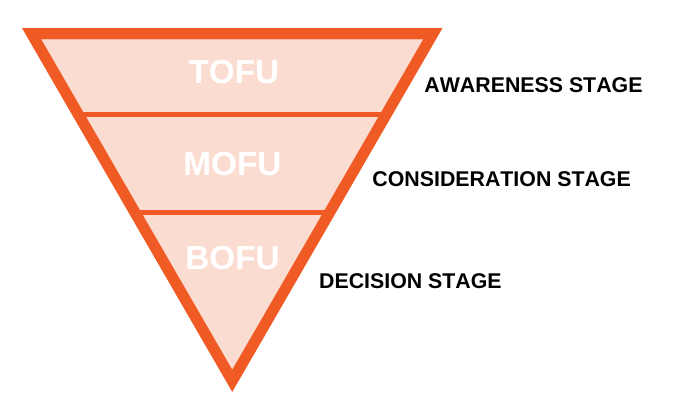
What strategies should you be applying at each stage with your PPC campaigns?
Let’s break it down.
Top of Funnel (TOFU) PPC Campaigns
The top of the funnel is the stage of awareness.
Your future customers are not aware of you yet, and your number one goal is to create brand awareness and educate prospects.
How do you make people aware of your brand with PPC?
Here are a few ways:
Display ads:
Use display ads to give away free value.
You want to give potential customers quick wins with blog posts, whitepapers, or e-books.
For your targeting methods, use keyword contextual targeting.
It matches keyword-targeted ads to sites within the Google Display Network.
You can also use topic targeting to make sure your ad appears on relevant websites, apps, and videos.
YouTube ads:
Having over 2 billion users, YouTube is one of the best places to grow your brand awareness.

Here’s how to grow your business using YouTube ads with a complete breakdown of the different ad formats and their success rates.
Social media ads:
Depending on where your audience hangs out, ads on Facebook, Instagram, or Pinterest can help with brand awareness.
Facebook offers the most robust targeting, allowing you to reach people interested in specific topics or accounts similar to people already engaging with your brand.
Google Ads:
Someone in the awareness stage won’t use branded keywords.
Instead, they’ll use broad words and phrases related to their problem.
For example, “Which TV is best” or “hiking backpack.”
Using different keywords at each stage of the sales funnel can help optimize your PPC campaigns.
The key performance for your PPC campaign in the awareness stage is brand recognition.
You’re not going to convert a visitor into a customer yet.
This campaign is an investment to move the user down the funnel and eventually close the sale.
You want to focus on metrics like:
- bounce rate
- time spent on site
- reach
- impressions
- CPM (cost per 1,000 impressions)
Middle of Funnel (MOFU) PPC Campaigns
Once someone enters the middle of the funnel, the person is interested in making a purchase.
These buyers are now aware of their problems and are actively looking for a solution.
Your PPC ads become more specific as the search for a solution narrows.
Google Ads:
Ensure you’re creating PPC ads for people actively searching for your product or service.
For example, if a customer is looking to buy a TV, their searches will contain more qualifying terms such as “plasma TV,” “4k TV,” or “best 4k TV for gaming.”
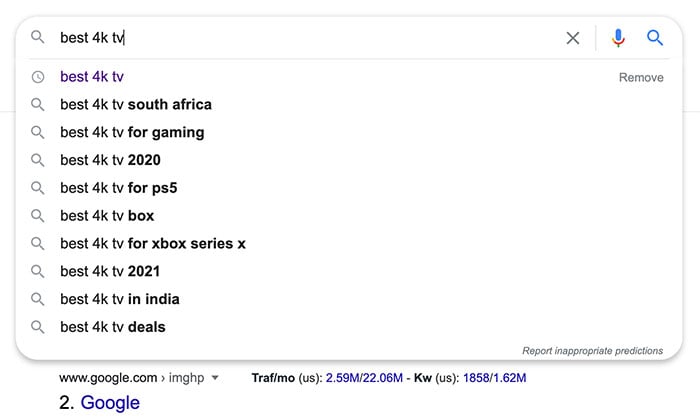
Remarketing:
Remarketing is a powerful component of PPC marketing.
You can use it to serve ads to blog readers, users who have spent X amount of time on your site, or people who have downloaded your TV comparison guide.
YouTube:
YouTube has a video ad sequence campaign you can use to generate awareness around your business. You can set it up as a campaign subtype under “product and brand consideration” goals in Google Ads.
It allows you to create a custom sequence or use a sequence template.
The key performance metric for your PPC campaign in the consideration stage is to get people to understand your product and want to buy it.
To do this, give them all the information to make an informed decision and move them to the next stage.
You want to focus on metrics like:
- clicks
- CPC (cost per click)
- views
- new user conversions
- new user conversion rate
Bottom of Funnel (BOFU) PPC Campaigns
BOFU is the decision phase of the customer journey.
Your prospect has identified a problem, done the research, and is ready to make an informed purchase.
At this stage, your PPC traffic is hot.
Users know who you are and are prepared to convert.
Your PPC ads will start to get more niche and revolve around high-intent keywords.
Consider the following strategies for BOFU:
Target your brand name:
If the customer is searching for your name, congrats! All your hard work in TOFU and MOFU has paid off.
They’re aware of your brand and what you offer.
The search phrases you want to target are specific and include your brand name like “buy LG 4k TV.”
Focus on high-intent search ads:
In the BOFU stage, make sure your PPC ad keywords are targeting high-intent search terms like “buy,” “what’s the price of,” competitor names, and location-specific terms.
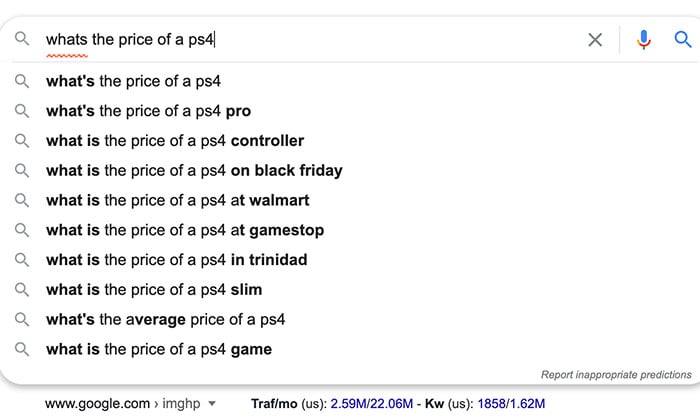
Utilize remarketing:
Set up PPC remarketing campaigns for customers who have viewed a product or abandoned their cart.
You can also offer a deal to lure them back to your site and complete the purchase.
The key performance metric for your PPC campaign in the decision stage is conversions.
This is when people are ready to buy, and you should focus on revenue metrics like sales and return on ad spend (ROAS).
Tips for Integrating Your Customer Journey Mapping Into Your PPC Campaigns
Now that you know all about customer journey mapping and how to use it in your PPC campaigns, here are some things to keep in mind:
Spend time crafting your buyer personas:
The more you understand your customers, the better you can map their journey and tweak your PPC campaigns.
Write better ad copy:
Do something that will grab their attention and stop the user mid-scroll.
You want to make them feel like you’re reading their minds and ultimately push them deeper into your funnel.
Dedicate time to keyword research:
Using the right keywords is the difference between a successful PPC campaign and a flop.
You want to make sure you’ve mapped out your keywords to the different phases, and you’re encouraging the user to make a purchase.
Build your remarketing lists:
Don’t put off fine-tuning your remarketing.
When you combine this essential part of PPC with customer journey mapping, it’s integral to make sure you’re guiding the user down your funnel.
You can create remarketing audiences with Google Analytics and use them for your ads.
Test, analyze, and tweak:
You can only find leaks in your funnel and fix them by constantly testing and monitoring your results.
Tweak your ad messaging, look at your conversion path analytics, and adjust your strategy until you have a winning formula for your PPC campaigns.

Learn How to do successful PPC Ads.
Conclusion
To sum it up, combining your PPC campaigns and the buyer’s journey is all about serving the right message to the right person at the right time.
You want to make sure you’re providing the correct content and information whether someone enters your funnel at the top, middle, or bottom.
Once you’ve created this flow in your PPC campaigns, you’ll see more flow in your business, as well as predictability, results, and less money wasted on a leaky funnel.
What’s your biggest struggle when it comes to mapping out your PPC campaigns with your customer journey?
The post How to Use Customer Journey Mapping for PPC Campaigns appeared first on Neil Patel.
Source: feedproxy.google.com

How 2 Questions Helped This Marketing Agency Make $100,000 in 90 Days
Using the Customer Value Journey and 2 essential questions, Reneé was able to maneuver through the end of 2020 with a strategy we’re excited to share with you.

In March of 2020, Reneé Boudakian, co-founder and owner of Rubicon Marketing and DM Certified Partner, found herself in the same situation you did.
Wondering if her business would be able to ride out this unpredicted storm.
It turns out that her business was not only able to survive, but it became a better version of itself. In 90 days, Reneé was able to secure $100,000 from offers that didn’t even exist at the start of 2020.
Yes—you read that right. The offers she launched to have a 6-figure quarter weren’t even part of her business pre-pandemic.
Using the Customer Value Journey and 2 essential questions, Reneé was able to maneuver through the end of 2020 with a strategy we’re excited to share with you.
Before Reneé put the Customer Value Journey to work, her agency’s offer was to implement and build out individual Infusionsoft campaigns on spec in monthly retainers.
This was solving a challenge of her customer avatars, but not the whole problem. As Reneé teaches in her Certified Partner Training, she was giving her clients legos instead of helping them build their entire castle.
This led to the insight needed to weather COVID-19 and the new changes it was bringing to agencies.
Using 2 simple questions and the Customer Value Journey, Reneé was able to create a brand new offers that either show her clients how to achieve their goals, do the work to reach those goals for them, or work alongside them to show them how it was done.
Here’s a look inside Rubicon Marketing’s big pivot that ended up bringing their agency 6-figures in 3 months.
Question #1: Do we have something that we are already good at or already selling?
The first question Rubicon Marketing asked themselves was what they were already good at or already selling.
In their case, they were great at implementing and building out those Infusionsoft campaigns.
The problem was that this was a single lego in a huge stack needed to build that castle.
Rubicon pulled up the past client calls from their BEST clients and listened to hear if there was anything they were missing.
As Reneé covers in her training, the key is focusing on your BEST clients.
These are the clients who pay you the most, are easiest to work with, and always get results.
Quickly, they realized that clients were overwhelmed, frustrated, intimidated, emotional, and exhausted.
Each client was experiencing the chaos of trying to do it all (landing pages, email campaigns, TikToks, Clubhouse)—and the failure of not being able to keep up.
That was Rubicon’s light bulb moment.
Their clients weren’t asking what a landing page was, how an email campaign worked, what TikTok was, or where the Clubhouse was.
They were trying to implement high-converting landing pages and email funnels and create engaging TikTok and Clubhouse content.
They had entered “The Chasm.” The Chasm is the part of the Technology Adaptation Cycle where people adopt the technology.
This means that you’re not convincing people as to why this tech exists—they already know and understand.

Rubicon knew this was a huge opportunity for their agency.
“The volume of opportunity to serve the people who are adopting new changes was huge,” says Reneé. “Our avatar is willing to change but doesn’t know, how? This is where we can provide the greatest transformation.”
The Customer Value Journey was their missing link. Here’s how Reneé breaks that down.
Every business has 5 core functions:
- Lead generation
- Lead nurture
- Conversion
- Delivery
- Retention, resell, upsell
And, every business has 3 distinct phases where each of these core functions fit:
- Marketing (lead generation)
- Sales (lead nurture and conversion)
- Fulfillment (deliver and retention, resell, upsell)
Rubicon looked at the Customer Value Journey through these phases, with the core functions, to nail down where each stage of the CVJ fits into the 3 business phases:
- Marketing: Awareness, Engagement, Subscribe
- Sales: Convert, Excite
- Fulfillment: Ascend, Advocate, Promote

For each of these business phases, Rubicon built out the automation that would help clients be able to achieve their goals.
They call this their Automation Architecture and it uses automation tools specific to marketing, sales, and fulfillment.
This was the transformation clients were looking for. They didn’t need to be convinced that email funnels worked—they were ready to adopt the technology that would help them have an email funnel that worked FOR THEM.
Rubicon created 2 new done-for-you offers:
- A paid planning session where they show clients how to create their Automation Architecture based on the Customer Value Journey
- Building and implementing the Automation Architecture for the clients
Just by answering that first question, they were able to increase their average project size and increase their revenue. But, there was still a bit more work to do.
Question #2: Are we missing any opportunities with our existing clients?
After figuring out what it was that Rubicon could absolutely nail for their clients, they started to look into what upsells, cross-sells, or add-ons they could also offer.
By knowing their customer avatar, they realized there were two different desires:
- Some people wanted to market themselves because they’re low or pre-revenue
- Other people want to have someone help them with their marketing (not do it ALL for them)
You know what’s going to happen next…Rubicon created offers for each of these customer avatars.
For the people who wanted to market themselves, they created a subscription-based membership site as a Do-It-Yourself Model.
For those who wanted to work alongside Rubicon, they offered Zoom calls where clients could leverage the Rubicon team’s expertise in a Done-With-Model.
You already know the ending to this story: Rubicon was able to bring in $100,000 in just 90 days. But, that’s not where this ends.
Rubicon didn’t stop there and instead focused on figuring out what the transformation they were giving their clients actually was. It wasn’t the Automation Architecture of being able to talk with expert marketers. It was something deeper that made them buy.
In her Certified Partner Training, Reneé explains, “We know that customers will evaluate our services by weighing the perceived value against the asking price.”
Using Maslow’s Hierarchy of Needs, Rubicon was able to figure out what experience they were really giving their clients.

As you serve needs higher on Maslow’s pyramid client loyalty increases.
Rubicon changed their message with the goal of providing transformation for customers as high up the pyramid as possible.
For example, their messaging about their services now talk about how they help clients avoid anxiety, focus on what they truly enjoy, and the other esteem and self-actualization experiences they provide.
Using Maslow’s Hierarchy of Needs, Rubicon is able to achieve the 3 things every business wants:
- Better customer loyalty (increased CLTV)Great consumer willingness to try the brand
- Sustained revenue growth
We know that’s what you’re looking for from your agency too. Now that you’ve seen how Rubicon was able to make $100,000 in 90 days with two questions and the CVJ, let’s take a look at what you can do to get the same results.
How to Create This Growth for Your Agency
The first step to seeing the same results that Rubicon was able to create is to walk yourself through the same exercise.
Ask yourself the same questions that Reneé and the Rubicon team reflected on.
Question #1: Do you have something that you are already good at or already selling?
Chances are the answer to this is yes. If you’ve built your agency and you have clients—you have something that you’re offering that they’re interested in.
But, are you offering your clients the castle or a single lego?
Rubicon listening back to their past recorded client calls was a brilliant move.
It was the catalyst showing them that even though their clients liked what they were offering, they were leaving opportunities on the table.
That’s when Rubicon was able to build out two more Done-For-You services that were already market-tested, approved, and ready for purchase.
Question #2: Are we missing any opportunities with our existing clients?
The answer here is also yes—and we say that with love. If you know your agency could be doing better, you have room to optimize.
A lot of the time, optimizing means that you’re creating new offers, upsells, add-ons, etc. to help your clients in a new way.
Rubicon figured out that their clients fell into 3 buckets:
- they wanted to do their own marketing,
- they wanted Rubicon to handle everything,
- they wanted to work together with Rubicon on their marketing.
That meant there were 3 offers that could be created to serve each of these clients.
Now, let’s add in the icing on the cake that Rubicon absolutely nailed.
Making your agency stand out from the others.
Start to get really familiar with Maslow’s Hierarchy of Needs to figure out what needs you’re filling for your clients.
Sure—helping them make more money is the end goal, but what does that actually mean for them.
- Does more money help them elevate their social status?
- Do they need more money to be able to have freedom?
- Are they looking for money as a way to help them be the most they can be?
We were thrilled to have Reneé join our Certified Partner Training Day and show other agency owners how they can reach 6-figures in a few months.
Using the strategy you just read in this article, we know you can pull it off too.
Run your team through these questions and figure out how you can add offerings that your clients are already asking for.
The post How 2 Questions Helped This Marketing Agency Make $100,000 in 90 Days appeared first on DigitalMarketer.
Source: digitalmarketer.com

What is an Email Funnel?
As a consumer—it would be nearly impossible to count the number of email funnels that have hit your inbox.
We can safely say, it’s been a lot.
Businesses love email funnels because they swiftly move new subscribers toward their first purchase.

Let’s take a look at the Customer Value Journey to get an idea of where your prospects are when they become subscribers.
The Customer Value Journey is the journey a prospect takes from finding out a business exists (Stage 1: Awareness) to become such a raving fan of it they’re actively promoting the business like a salesperson only they pay you (Stage 8: Promote). 
When we talk about email funnels, we’re talking about the shift of a prospect choosing to become a subscriber (Stage 3: Subscribe) to buying your first offer (Stage 4: Convert).
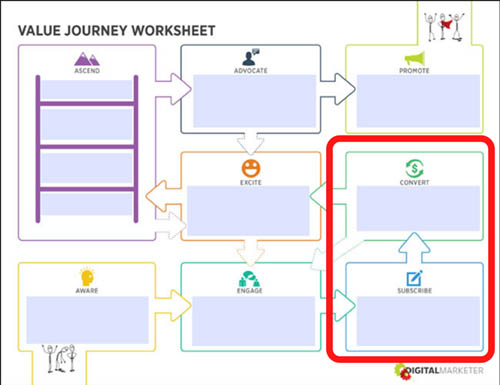

Email funnels are a big deal in the marketing world because they work… really, really well.
People are still tuned into their inboxes, check out these statistics from OptinMonster:
- 99% of email users check their email every day
- 85% of the people you send an email to will receive your email
- More than 75% of teenagers still use email
Yep, you don’t need to figure out how to renegade on TikTok anytime soon; emails can reach every demographic you’re interested in.
How Email Funnels Work
Email funnels turn subscribers into customers by using specific strategies that sell products or services.
We’ll get into those strategies in a minute, but first, take a look at the return businesses are seeing on their email funnels:
- For every $1 spent, email has an average ROI of $38
- Segmented campaigns can reach a 760% increase in revenue
- Compared to Facebook or Twitter, email is 40 times more effective at acquiring new customers
The number of emails you use in your funnel is going to depend on what you’re selling, but generally, you’ll use a minimum of 4 and a maximum of 7.
If your subscriber hasn’t converted by your seventh email about this offer—then you don’t want to keep bombarding them with it.
When you’re putting together your email funnel, you’re going to be highly focused on the copy you use.
There are 4 emotional triggers to use in your email funnels:
- Gain: What does the subscriber gain by buying the product/service?
- Logic: Why does buying the product/service make total sense for them?
- Fear: What happens if they don’t buy the product/service?
- Scarcity: How long do they have to choose to buy this specific product/service?
Each email is going to follow a similar template:
- Introduction: Give a warm introduction to what you’re about to talk about (you wouldn’t walk up to somebody and start talking without at least saying a few introductory words first)
- Body: Use gain, logic, fear, and/or scarcity to show them why this offers matters to them NOW
- Close: Craft a clear call to action
- P.S. (Not always used): Add in extra gain, logic, fear, or scarcity
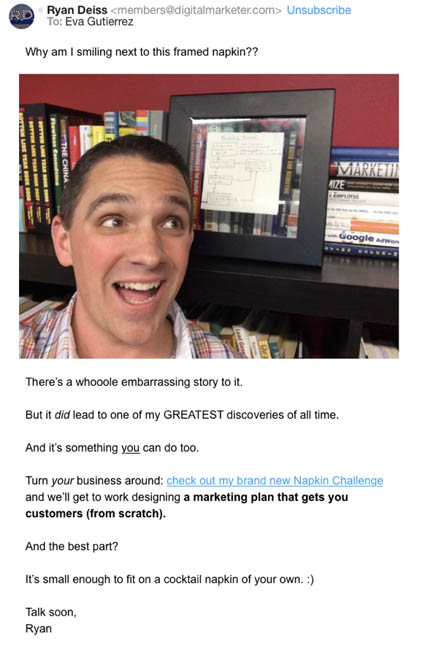
Here’s an example of an email funnel we ran for our Napkin Challenge.
The first email uses logic and curiosity to drive the subscriber to want to create a marketing plan that gets them, customers.
Subject Line: The napkin that cleaned up a $248k mess
Preview Text: A how-to guide for fixing a BIG problem

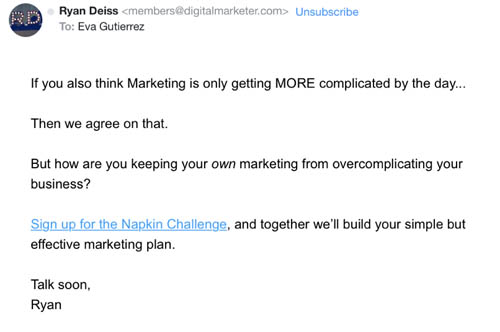
Touching on the fear business owners have over the complication of marketing these days, our second email was quick and to the point.
Subject Line: Why is this so complicated?
Preview Text: Maybe marketing isn’t the problem.

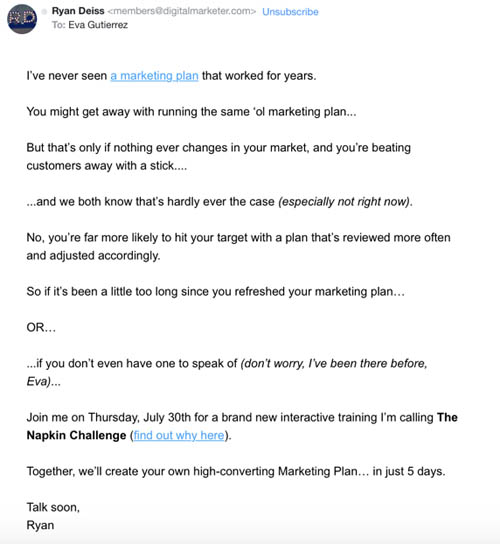
And then our third email used everything we know about the pain points of our avatars (thanks to the Customer Avatar Worksheet) to show them what they would gain from taking part in The Napkin Challenge.
Subject Line: time to hit the reset button
Preview Text: There’s no “do-over” button, just “do better”

If you want to look at more email funnels, take a look at your inbox.
Now that you’re familiar with what an email funnel is, you’ll realize that you’ve gotten a lot of these emails in the past.
Some may have worked well (you bought the product) and others not so well (either the funnel was off, or you weren’t their target avatar).
Email funnels are a BIG part of marketing strategies because they’re the platform that moves subscribers from Stage 3 of the Customer Value Journey to Stage 4, the stage where they become first-time customers of your business.
And that’s a big deal for every business. 
The post What is an Email Funnel? appeared first on DigitalMarketer.
Source: digitalmarketer.com