
Tag Archives for " #coronavirus "

How to Grow Your Local Business During Uncertain Times
No doubt this is a hard time to grow a local business. Coronavirus has likely forced you to make big changes to the way you operate. It’s almost certainly hit your bottom line too.

However, it’s still absolutely possible to grow your local business at a time like this. You just have to be smart about it. In this article, I’ll talk you through how to do that. First, though, here’s a bit of detail on why this is such a challenging time for businesses like yours.
The Effects of the COVID-19 Pandemic on Local Businesses
You’re probably sick of reading and hearing the word “unprecedented.” I know I am. Unfortunately, it’s just the best word to describe the current climate for local businesses.
By the end of March, 32 states had locked down in response to the pandemic. Two in five small businesses across the US had temporarily closed by this point, with nearly all of those closures due to COVID-19.
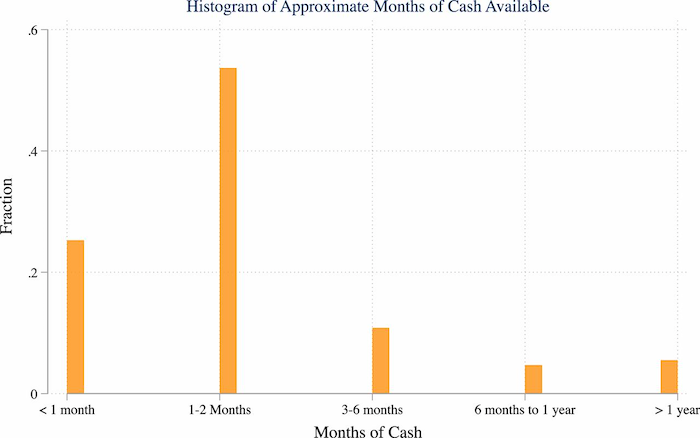
Closing your doors has big financial implications. It is concerning that the vast majority of local businesses aren’t in a position to handle even short-term pressure on their earnings, with around four-fifths only having up to two months of cash available to pay their expenses.
Because of this, it’s hardly surprising that the number of active business owners in the US plummeted by 3.3 million (or 22%) in the two months from February to April alone. That’s the largest drop on record, and it affected practically every industry.
Luckily, if you have access to the right strategies (like local promotions) and tools (such as messaging services like Podium), you may still be able to grow your business even in these uncertain times.
Six Strategies to Grow Your Business During the Age of Coronavirus
The pandemic might have affected your business growth in any number of ways. Maybe you’ve been forced to shutter your store(s) for a certain amount of time. Maybe your customers are buying less at the moment. Or maybe the industry you’re in means you’ve barely even got a “product” to sell, like cinemas and travel companies.
Whatever the case, if you’re going to grow your local business in the current climate, you need to adapt. Here are tips on how to do it:
1. Use the Right Tools
I know what you’re thinking: “I’m already worried about cash flow, now this guy’s telling me to invest in a bunch of tools!” Well, what if I told you that by choosing the right tools (some of which are free, by the way), you massively increase your chances of growing your local business?
You likely know that there are thousands of tools designed to drive small business growth, but I’ve focused on the areas where you can really shift the dial:
Issue: Customer Messaging
There are so many benefits to improving your communications with existing and potential customers.
You can generate more reviews, which act as a trust factor and make your business more credible. You can collect payments faster and with less hassle. You can issue more timely (and more effective) reminders, reducing the chances of no-shows.

To solve your customer messaging you can use a tool like Podium. Here’s how I use it:
Set up one inbox to rule them all:
What’s the biggest barrier to better communications? Trying to keep track of all your different platforms. Customers could be messaging you via Facebook, Twitter, phone, and your website (and maybe a bunch of others, too). Podium brings all those communications together in one place, ensuring you never miss a message.
Connect remotely with website visitors:
Ever wish you could get closer to the people on your website? Find out what stops them from buying or converting there and then? With Podium, you can. Add live chat to your site and every time they ask a question, they’ll automatically move to a text conversation, so you’re no longer tied to your computer (and nor are they).
Enable on-the-go customer service:
You likely don’t have a dedicated customer service team. In fact, you might be your whole customer service team. So what happens when you’re not at your desk or in the store? Stuff gets missed! Podium allows you to text quick responses when you’re out and about, so you never leave anyone hanging.
Chat face-to-face: Texting is great.
But sometimes it’s just not the best way to respond to a customer or prospect. Maybe they’ve got a complex question or require a nuanced response that’s hard to tap out on your phone’s keypad.

Podium offers video chat software that makes connecting remotely with customers as easy as sending a text.
Send your customers a link and you can be video chatting in seconds, making it super simple to show details, answer questions, and share your screen.
Create tailored promotions:
Say you own a coffee shop. You run a loyalty program and you’ve captured your best customers’ email addresses and phone numbers. Wouldn’t it be great if you could quickly send those customers targeted promotions? Maybe offer them a deal on a new single-origin coffee you’ve just started stocking? You can do that as well.
Provide to-the-minute advice and updates:
There are a lot of variables in the world right now. Customers might want to know how busy you are at a certain time, or what measures you’ve put in place during the pandemic. Or they might have product-specific questions.
A customer messaging platform makes it easier for you to respond in real-time.
Oh and an easy way to get started is to just sign up for a free Podium account.
Issue: Scheduling Meetings
No one likes scheduling meetings at the best of times. Throw coronavirus into the mix and it becomes even more of a challenge. Should it be in-person or remote? Which platform should we use? What date and time work best?

Meeting Scheduler Tools are designed to handle the legwork for you. One of the best is Arrangr, which reserves tentative meeting times, automatically frees up untaken slots, and can even suggest the ideal location for all parties.
Another great option is Calendly. Integrating directly with your Google or Office 365 calendar, it gives you a personalized URL that allows customers to see your availability and schedule their preferred meeting time. Best of all, there’s a basic free plan available.
Issue: Email Automation
You can’t grow a local business at a time like this without doing some marketing.
Unfortunately, you likely don’t have time to build and execute complex campaigns.
That’s why you need email automation software! One of the most popular tools, Mailchimp, helps you send effective email marketing communications at scale. In fact, Mailchimp claims to boost open rates by 93% and click rates by 174% compared to the average bulk email.
Customer Relationship Management
Your customer relationships have never been more valuable than they are right now, so you need to manage them effectively. To do that, you need to invest in a customer relationship management (CRM) tool.
There are a bunch of CRMs aimed at local businesses, but HubSpot Sales Hub is one of the most popular. It’s loaded with sales engagement tools, pricing functionality to help you deliver complex quotes, and analytics software to measure what’s working (and what isn’t).
2. Improve Your Digital Marketing Strategy
In more “normal” times, you might not put a lot of thought into your marketing. Maybe you just write the occasional social post or send a couple of email promotions a month.
During times of uncertainty, that just won’t cut it. People have a lot on their minds right now, so that one baseball gif you tweeted isn’t going to have much impact.
You need a proper digital marketing strategy.

Let me give you an example: you sell business supplies to other local businesses.
Because you’re small and local, your big differentiator is your flexibility and bespoke approach. You can source whatever product your customer needs, your delivery times are rapid, and you’re easy to reach. That’s the sort of stuff you talk about in your marketing emails.
Well, wouldn’t it be good if you made that the foundation for a whole campaign?
Maybe you create a bunch of case studies and testimonials that show your unique selling point, (USPs), in action. You build a mailing list of local firms you’d love to do business with and drip-feed your content to those prospects.
Because you’ve built a whole strategy, you know the best times to reach those prospects, the platforms they use, and the sort of messaging that resonates with them.
That approach helps you strike up a conversation, which ultimately means you may close more deals.
3. Make Your Google My Business Profile Shine
Want people to see your name when they search on Google for businesses like yours? If you’re reading this article, I’m guessing you do, and that means you need a (good) Google My Business profile.
Setting up a free profile makes it more likely that your business shows up in relevant searches, along with useful information like:
- The type of service you offer
- Your opening times
- Your address
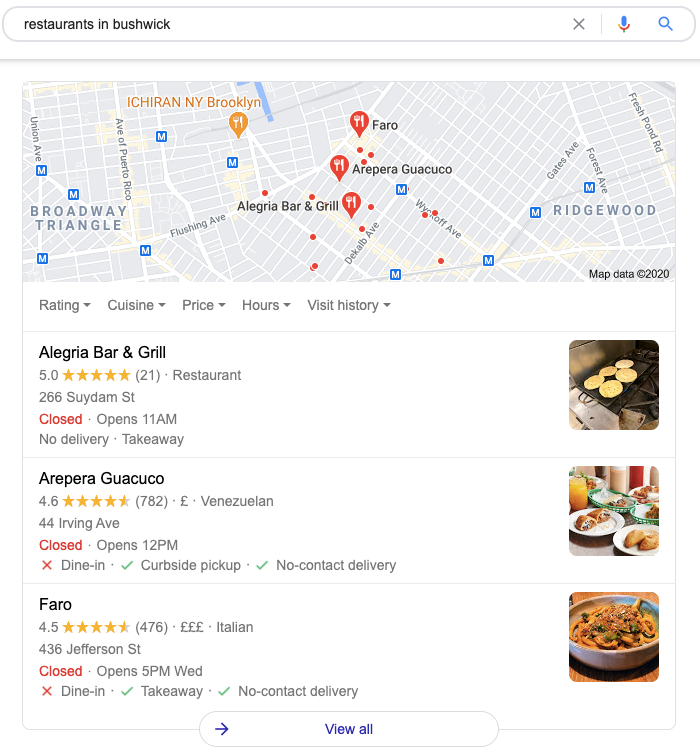
Once you’ve set it up, optimize your Google My Business profile by:
- Ensuring your information is accurate and comprehensive
- Sharing business updates, like new opening hours or product launches
- Asking customers for Google reviews (and responding to them)
On that last point, I know it can be hard persuading customers to review your business. They’re busy. They don’t want to spend their valuable time seeking out your Google My Business profile or Facebook Business Page.
Podium makes it a lot easier, helping you provide social proof that demonstrates your brand can be trusted. Text customers asking them for a review and they’ll be linked straight to your Facebook, Google, and Tripadvisor pages, so there’s hardly any clicks (and hardly any work) for them.
That’s why Podium has powered more than 15 million business reviews for its users.
4. Create and Execute a Local Paid Marketing Strategy
Sometimes it takes money to make money. If you’re serious about growing your local business right now, you’ll want to consider investing in some sort of paid activity.
Google Ads can be super effective for smaller firms, especially web-based businesses targeting online traffic and/or conversions. Local keyword phrases like “lawyers near me,” or “realtor in Denver,” are typically a lot less competitive than broader, non-geographic terms like “realtor.”
That means you could get a lot of visibility and clicks with a relatively small outlay.
In addition to Google Ads, consider advertising on social platforms like Facebook and LinkedIn. Social ads are less intention-based than paid search because your audience isn’t actively looking for the thing you’re advertising.
However, ads on social media often cost less than Google Ads. For instance, if you’re a law firm, you’re paying on average $10.96 per click on Google Ads, but on Facebook, that figure drops to just $1.32.
5. Use Analytics to Track and Improve Site Performance
When times are hard, you need to squeeze every last dollar from your potential customers. Analytics software (like Google Analytics) can help you do that by allowing you to identify trends, plan new strategies, and measure the results of your current efforts.
Let’s say you’re a mechanic. You’ve just added a page to your site to promote a special offer on new tires. A month later, you click into Google Analytics and see that a bunch of people have landed on that page, but your conversion rate is low.
You compare it to other, similar pages on your site. They’re performing much better. Now you know there’s a problem, such as:
- Your current offer is priced too high
- Your new page isn’t engaging or persuasive enough
- You don’t make it easy enough for customers to convert, so they leave
- You don’t provide enough detail about the offer
By comparing against better-performing pages, you can tweak your approach and improve results.
6. Conduct Local Community Promotions
Now isn’t a good time to invite hundreds of people to a big party. But there are definitely opportunities for community engagement. You just need to get a little creative.
Say you’ve opened a new store in a location you haven’t served before. Maybe you target properties within a certain zip code, or on certain streets, with a special offer that encourages customers to visit your store.
Perhaps in the age of social distancing, you’ve introduced a new takeout service. Why not give customers in your area 10% off their first promotion, or combine it with a loyalty scheme? Tailor your offer to what your customers want right now, then promote it on Facebook, in the local press, via email marketing, or through direct mail.
7. Optimize Your Social Media Accounts
There are dozens of social platforms out there, but when it comes to growing a local business, you want to focus on those that give you the best reach, like:
FacebookTwitterInstagramLinkedInPinterestYouTubeTumblr
Finding the right platform will depend on the type of business you run. On a basic level, if you’re B2B, LinkedIn’s likely your best channel. Otherwise, almost everyone is on Facebook, but if your product is highly visual you might see more success on Instagram, Pinterest, or YouTube.
Whichever platform(s) you choose, you need to identify some tactics that ultimately help you sell more, like:
- Showcasing and/or auctioning your products on Facebook
- LiveStarting conversations with new prospects in LinkedIn Groups
- Setting up Instagram Shopping so people can browse your products in photos and videos while in-app
Conclusion
Growing a local business is never easy, and it’s certainly a whole lot harder right now.
However, if you’ve set up your own business, you’re likely comfortable with hustling for results. You’re naturally entrepreneurial and you’re driven to make this work.
Combine that attitude with the right growth strategies, and execute them effectively, and there’s no reason why you can’t come out of the pandemic in a stronger position.
What plans have you put in place to grow your business? How’s it going for you so far?
The post How to Grow Your Local Business During Uncertain Times appeared first on Neil Patel.
Source: feedproxy.google.com

11 Social Media Changes to Make in a Coronavirus World
Coronavirus has changed just about everything, but you still need to connect to your customers, prospects, partners, and team members.
And now more than ever, social media may be the best way to do so.
But you cannot just continue with your regular social media strategy, content, and cadence.
- What works is different.
- What people want is different.
You must consider these 11 changes to your social media to continue – possibly even accelerate – your social media success during the pandemic.
The strategy team here at Convince & Convert has been working closely with our world-class clients to develop these approaches.
We shared this advice on the 11 changes to your social media strategy during Coronavirus on a live webinar.
Access the video – including our answers to more than SEVENTY audience questions – below.
Feel free to distribute widely.
We want to help as many people as possible.
On that point, we have developed four new consulting packages.
They are faster than how we usually work and more affordable.
If you are interested in a no-obligation call with one of our strategists, please fill out the form below.
The packages are:
- Social Media Strategy and Tactics Quick Wins
- Content Marketing Quick Wins
- Digital Marketing Quick Wins (website + email + content + social)
- Virtual events/webinars production and training (we do dozens of webinars each year for large companies)
Also, if you are in higher education, you might be better served by our webinar on marketing and communications shifts among colleges and universities.
11 Social Media Changes to Make in a Coronavirus World
1. Change Your Bios
If your operations have been impacted in a meaningful way, your social media bios should reflect that reality.
For example, even though all Best Buy locations in the United States are now pickup only, their Twitter bio doesn’t reference that information:
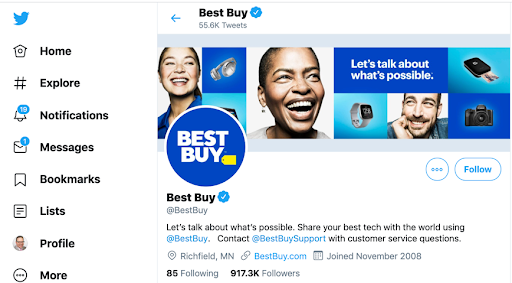
Although all Best Buy locations in the United States are now pickup only, their Twitter bio doesn’t reference that information.
Also, if you have key updates for your audiences, a good place to keep them front and center are pinned posts on Twitter and Facebook, and Highlights on Instagram.
2. Listen, Harder
In times like these, everywhere you exist in digital is a potential customer service channel.
You simply must expand your efforts to find, engage, and answer customers everywhere online.
In fact, in our webinar, more than half of the 500 attendees said that customer communication via social media had increased since the Coronavirus outbreak.
3. Only Post with a Purpose
This is not the time for frivolous posts that are sent because they are “due” per the social media editorial calendar.
That doesn’t mean you can’t be lighthearted, or even funny.
It does mean, however, that you must carefully consider WHY you are posting on social media.
- For whom is this post intended?
- How does it entertain, inform, educate, or benefit that audience?
- What specific behavior change or thinking change are we trying to effectuate with this post?
I love what Cardinal Spirits is doing in this regard.
Located in Bloomington, Indiana where I live, it’s a small distillery run by some very smart friends.
Each day, they post on their Instagram exactly what they need in carryout sales to support their new mission, which is to make as much hand sanitizer as possible.
And then, when they reach that goal for the day (they’ve made it almost every day) they immediately add a new post that says “We’ve reached our goal for today.
Please go support a different local business.” Spectacular.
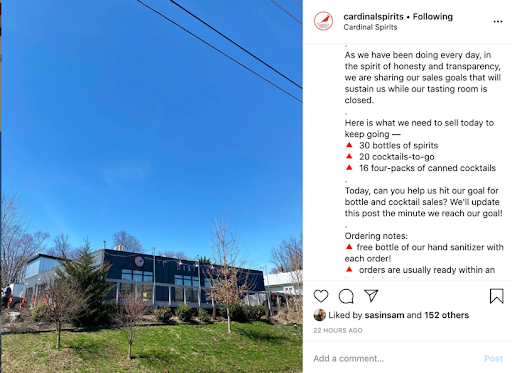
Each day, Cardinal Spirits posts on their Instagram exactly what they need in carryout sales to support their new mission, which is to make as much hand sanitizer as possible. Amazing!
4. Make it About People, not Logos
This was true before coronavirus, but it’s especially true right now:
We care about and trust people more than we care about and trust companies or organizations.
Every business and every organization is comprised of exceptional PEOPLE and now is the time to showcase that.
Use humans in as much of your social media as you possibly can right now.
It’s the one problem I have with the Cardinal Spirits post above: I’d rather it show their team (although they do so in their IG Stories).
And even better, spotlight your customers!
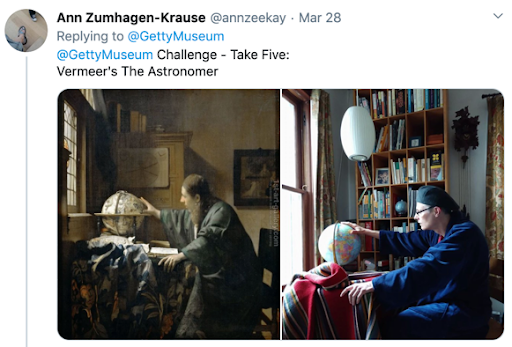
This effort from the Getty Museum is brilliant.
They asked their fans to find three household items and use them to recreate famous artworks.
They received thousands of submissions, many of them AWESOME!

5. Expand Influencer Marketing

On a related note, influencers and influencer marketing can be more effective than ever before.
In times of uncertainty, we rely upon people we trust and believe in, which is why a recent study showed a 75% uptick in clicks on Instagram posts that included #ad in the first two weeks of March.
If you have an influencer marketing program already, don’t be afraid to activate it right now.
If you don’t have a program, this is a great time to set one up. (we actually do this for our clients)
6. Make Sure Your Visuals are in Context
Social distancing has changed our perceptions (and reality) about a great many things.
It’s easy to rely upon your repository of brand imagery for social media, but in doing so you may unwittingly be sending a message that’s not wholly appropriate.
I love the differences in how Schwinn Bicycles spotlights their products.
These posts are just a week or so apart, but you can see how they’ve adapted the visuals for a coronavirus world.
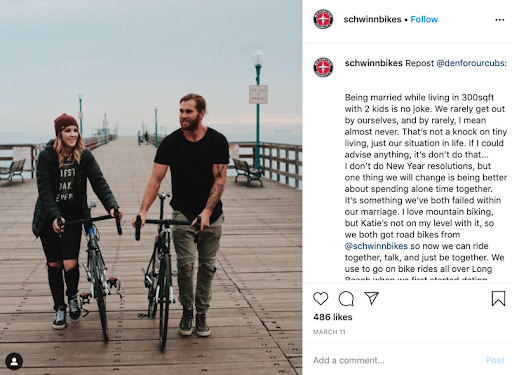
Classic imagery

Social-distancing era imagery
7. Try New Formats and Publishing Times
You know how you’ve experimented and optimized over and over to figure out what social media content formats and publishing windows work best for you?
Well…..you can unfortunately cast that aside.
While social media usage in society overall is way up during the pandemic, people’s life routines are massively altered.
No commutes.
No treadmill.
Having to oversee your kids’ Zoom homework during the day.
It’s all a tangled ball of yarn.
Consequently, we’re already seeing big shifts in WHAT works, and WHEN it works.
Amongst our group of large clients (not a statistically valid sample, but directional), we’re seeing a huge increase in engagement rate for video posts, but an even larger increase for posts that include no photo, video, or link of any kind.
Further, for our financial services clients – as just one example – the “best” time to post before coronavirus became the world’s most unwelcome guest was 10 am.
Now? 10 pm.
In fact, we’re seeing a pretty strong pattern toward mid to late evening posts being disproportionately successful during pandemics, as people catch up on social media after dinner and maybe after the cherubs go to bed.
Again, this is not data you should use to modify your own program.
But you absolutely must dig deep right now to figure out how your own social media success equation has changed.
8. Recalculate Your Paid Social Media Assumptions
The story is much the same with paid social media advertising.
Data from SocialBakers shows that cost per click and CPM for social ads is falling, as more and more advertisers stop their campaigns.
At the same time, overall click-through rates for social ads are falling too, meaning that less expensive ads (yay) may not be working as well (boo).
And simultaneously, we are seeing clients in particular industries have incredible success with paid social media ads, more so than in those good ole pre-pandemic days.
In summary, just like with your organic social media, whatever math you’ve been using to figure out your ad spend and likely results is most likely borderline irrelevant right now.
You’ve got to retest all of your data and projections accordingly.
9. Elongate Your Sales Funnel
Maybe people don’t want to (or cannot) buy from you right now.
But that doesn’t mean they don’t want inspiration and education.
Try to become the Pinterest of your industry.
How can you spotlight previous customers and how they use your products and services?
How can you help your customers and prospects think about what and how they are going to do with you when they are allowed to do so?
For travel organizations, for example, this is a perfect opportunity to let people dream and stay motivated for the future.
But for all categories, helping customers create “wish lists” during quarantine can be a terrific social media content approach.
Our client, David Weekley Homes, is doing this with their series of home trends, by region.
This one is about kitchen trends, etc. in new homes in Austin.
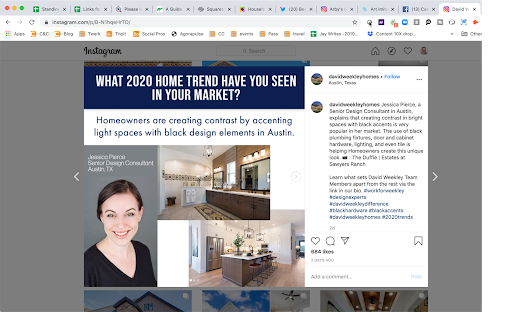
David Weekley Homes is helping customers create “wish lists” during quarantine with their series of home trends, by region.
This one is about kitchen trends, etc. in new homes in Austin.
10. Repurpose Your Winners
You already have winning social media content. Maybe it was from last month. Or last year. Maybe it’s a big piece of content like a report or video series.
One of the best ways to succeed with social right now is to deconstruct, repackage, and republish those winners (assuming the content is still valid, and contextually appropriate).
We have a whole guide on this you may want to download (no cost).
t’s called:
8 Ways to Extract More Value From the Content You Already Own
11. Focus on Helping, not Selling
Several clients have asked us if they should “stop selling” right now.
And while our answer varies a bit by industry, in general, we’d tell you this:
Helping Beats Selling
I wrote a best-selling book about this principle. Youtility says that the best way to sell is to provide as much value as you possibly can – for free – and that as a consequence of your munificence, a percentage of the people you assist will become customers eventually.
It’s never been more true.
Overt sales campaigns may be tough sledding right now.
But if you can help your prospects, they’ll remember and reward you.
And if that’s the basis of your social media – to help – then if you sell a little along the way, you’re in great shape.
As my friend Rory Vaden from BrandBuilders Group says: “there’s no need to be nervous if your heart is on service.”
Wrapping Up:
In some ways, it may be harder than ever to be responsible for social media in your company or organization. But it may also never be a more vital job. You can continue to communicate and inspire and education and assist your audiences. You just need to make some changes to do so. We wish you great success in that journey and hope it’s truly a short-term scenario.
Meanwhile, do watch the webinar replay. The 70+ questions we answered from the live audience is worth your time.
Also a reminder that we are helping people like you and organizations like yours put these new social media and digital marketing best practices into place. If we can help you, please do fill out the form below for a no-obligation strategy call.
The post 11 Social Media Changes to Make in a Coronavirus World appeared first on Content Marketing Consulting and Social Media Strategy.
Source: convinceandconvert.com