
Tag Archives for " copywriting "

4 Questions To Make Sure You’re Creating Consistent Copy Across All Platforms
Marketing is like being a well-paid juggler—you’ve got social media in one hand, marketing in another, and somewhere above you is your content strategy.
And that’s just to name a few of the marketing channels you’ve got on your plate. With all of these platforms, it can start to get really hard to keep your copy consistent.

We all know how important copy is—it’s the thing that defines your brand and moves prospects through the Customer Value Journey.
But what happens if someone reads your copy on social media, opts-in for your offer, and is met with totally different copy? 
Leads won’t be able to get past the “trust factor” that’s essential for them to trust you enough to buy a service or product from your business.
Just like any other relationship in our lives, the customer-to-business relationship requires consistency.
5 questions to make sure you’re creating consistent copy across the platforms
Here are 5 questions to make sure you’re creating consistent copy across all of your platforms.
Question #1: Does this copy abide by my brand guidelines?
Your brand guidelines are the blueprint of your brand.
They’re going to help you figure out what’s a “Yay!” and what’s a “Nay…” in your copy.
Brand guidelines are going to be a huuuuge (serious emphasis on the huge here) help to keeping your copy on brand, especially if you have a larger team.

Think of them as the SOP for writing your copy and content.
If your copy doesn’t check every mark that it needs to on your brand guidelines then it’s going to create inconsistency across your platforms and funnels.
Use this checklist to make your life easier—if the copy can check every brand guideline on that list, green light it!
If not… ask yourself—what needs to be changed?
Question #2: Would my customers expect this from me?
Your copy is your brand voice. After engaging with your business on social media, through your articles, or your emails your prospects are going to be used to hearing a specific voice from you (ahem, think of your brand guidelines).

They want to keep hearing that voice…not unexpectedly read or hear a new brand voice.
If your brand voice is always fun and playful, but you come out of nowhere with a call to action that’s formal and professional, your prospects are going to be confused—and a confused person never buys.
In a confused state, your lead is feeling hesitant.
By reading or hearing a copy that they would expect from you, your leads are in a confident state—and a confident state does buy.
Question #3: Would my customers recognize me if I took away my branding?
Let’s take away your brand colors, fonts, and images…can your customers still see you?
This might be tough for some brands, but it’ll help you make sure your branding is consistent from socials to products.
If the only thing holding your branding together is your color palette and fonts—there’s a big problem. While this stuff is all icing on the marketing cake, your copy is the actual cake. 

If your copy is so on point that without any other clues about your brand your followers, subscribers, and customers can tell it’s you, you’ve nailed it.
You’ve made a delicious cake that people want to bite into…and you’ve added the icing on top that makes people even more excited to grab their fork.
Question #4: Does this fit in with my other copy?
Every brand has a different way of asking their followers to engage with their content, their website visitors to subscribe to their newsletter, or their subscribers to click on the offer.

Each time you write copy for a new offer you want to look at it in the context of the copy you’ve written for your other offers.
Is your new copy so far off that your customers are going to feel like they don’t know you as well as they thought they did?
A new copy should fit in well with the other copies that are already Live right now.
This isn’t to say that you can’t A/B test your copy and do something totally left-field—as long as it’s still coming from the same field.
Think of this in the context of your brand colors…if you usually brand with a medium-color green but you want to highlight something with a lighter green, that makes sense.
Your leads and customers aren’t going to be totally off-put.
But, if you decide to scratch the green and go with yellow…they’re going to be asking—is this *insert your company name’s* website?
Use these questions to make sure your copy is consistent from the first touchpoint all the way through to the day your customer buys your highest ticket offer.
This consistency is what your relationship is built on—so make it a strong foundation.

The post 4 Questions To Make Sure You’re Creating Consistent Copy Across All Platforms appeared first on DigitalMarketer.
Source: digitalmarketer.com

How to Use the Customer Avatar Worksheet to Nail Your Copy
Copy is one of the most important parts of your marketing strategy—but it’s also one of the most intimidating.
And with good reason.
Writing copy can be REALLY hard.
How should you know what to say in your email campaign that’s going to make someone decide to finally buy your product?
We have a solution for you.
The type of solution that’s going to spell out exactly what to say when you want a reader to become a subscriber or a subscriber to become a customer.
Excited? So are we!
We’re going to show you how to write copy specifically based on your customer avatar.
If you haven’t heard of it, we have a Customer Avatar Worksheet that helps you figure out exactly who your customers are.
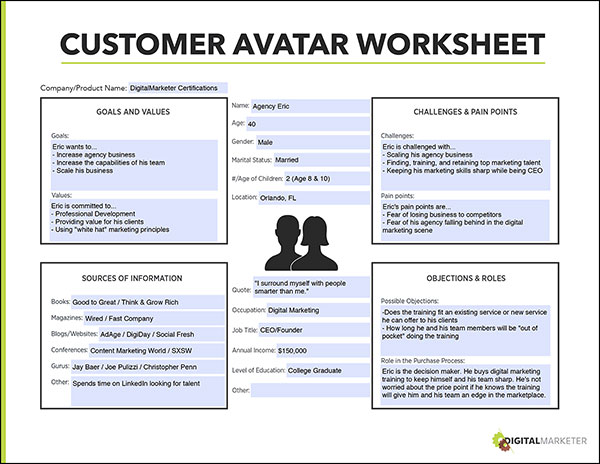
This worksheet talks about their pain points, challenges, goals, values, and buying power.
It even talks about what podcasts they listen to, what YouTube channels they’re watching, and what books are on their bookshelf.
We get so specific that by the end of it you’re going to be able to tell us the name, age, and marital status of your ideal customer.
Why do you need to know THIS MUCH about your customers?
Because that’s how you figure out what you need to say to them to show you have the solution (aka product) they are looking for.
Let’s get into it!
Use Your Customers’ Pain Points and Challenges to Remind Them of What Happens if They Don’t Solve Their Problem
Every customer is just a person with a problem looking for a solution.
That solution is your product and your copy is going to convey how well your product solves their problem.
A lot of the time, businesses have great products—they just don’t know how to show their customer avatar the value of those products.
That’s where this copy comes in.
Your customer avatar’s problem is causing them pain points and challenges.
For example, at DigitalMarketer, we teach you how to be a great marketer.
Our customer avatar’s pain point is that they’re struggling with their marketing efforts for their small business.
Their challenge is that they don’t know where or how to improve.
We have courses and workshops to teach them how to become really, really good marketers.
That means that our copy is going to talk about how tough it is to market and not see the conversion and traffic you were hoping for (pain point), and not know how to improve (challenge).
Copy that converts talks about the pain point and challenges a customer is struggling through without your solution.
Let’s look at another example that you’ve probably seen a few hundred times in your life—a weight loss program.
Customers of this program have the pain point that they want to lose weight and the challenge of not being able to stick to workout routines long enough to see a payoff.
You’ve seen the copy on magazines or website ads saying, “Lose 20 pounds in one month and only workout ONCE a week!”
While we’ve been inundated by these types of advertisements for workouts, there’s a reason—they worked.
Why?
Because the copy pointed out the customer’s pain point (being 20 pounds overweight) and their challenge (not being able to stick to workout routines… working out only once a week is totally doable!).
See what’s going on here?

Talk About Their Goals and Values to Show Them the After State They’ll Experience Once They Have Your Solution
Your customers have goals that are bigger than just your product’s solution.
For example, our business owner customers have a big goal of making more money for their company—marketing is just the turbo boost they’ll use to reach that goal.
These goals go hand-in-hand with their values.
For example, our business owner customers also value the experience of owning a successful company and the freedom that gives them.
This makes writing copy that motivates them to buy our products much easier.

We can show them how our courses and workshops will help them make more money, help them attain that successful company vision, and feel like they’ve reached the ultimate entrepreneurial dream: freedom.
Every customer has goals and values.
For example, an ecommerce trendy clothing company for women has customers who have a goal of being fashionable.
Their customers value how they look and the feeling that it gives them.
This ecommerce company can use its copy to talk about how owning certain products will help them achieve their goals and in turn, live their values.
Show Your Customers How Well You Know Them by Talking About the Books, Podcasts, Gurus, Etc. That They Look Up to
Who are you more likely to buy a product from, your best friend or a stranger on the street?
If you said best friend, you’re with the majority. If you said stranger on the street, you’re the ultimate “Yes Woman/Man.” 
When you’re writing your copy, you want to talk about your customer’s pain points, challenges, goals, and values. You also want to show them how well you know them.
By referencing books that have impacted their lives, podcast episodes that were just published in your industry, or something that a guru that everyone looks up to is doing—you’re showing them how well you know them.
You move past marketing to…” Wow, these people really get me.”
For example, a financial business blog could mention the Robinhood Snacks Daily podcast.
They know their ideal reader is probably listening to this financial podcast every morning, so by referencing this specific podcast their readers are going to know that this blog gets them.
Or, let’s say that one of the biggest movers and shakers of your industry just published a book.
You’d want to reference that book in your copy, showing how “in the know” your business is.
And just like that, you move from a stranger on the street to (virtual) best friend.
Tell Them How to Get Your Solution Based Off on Their Buying Power
Every customer has different levels of buying power.
For example, the ecommerce trendy clothing company’s customers have total buying power.
Their customers are the ones that is going to put their credit card information in and hit the purchase button.
But not every customer has the same level of power.
For example, a marketer who wants to attend our annual Traffic & Conversion Summit might need to have their boss greenlight the purchase.
In that case, you want your copy to show that you know they’ll need help with getting their boss to buy the ticket for you.
To do this, we create an email template that marketers can use to send their bosses and show them why it would be valuable for them to come to the Traffic & Conversion Summit.
In our drip email campaign, we’ll make sure to link out to that email template in our copy so that our customers know that we’re not leaving them high and dry wishing for a ticket.
We’ve got them covered.
And that’s how you can use the Customer Avatar Worksheet to nail your copy by writing exactly what your customers need to hear.
Download the Customer Avatar Worksheet for free below so you can start writing conversion-driving copy.
The post How to Use the Customer Avatar Worksheet to Nail Your Copy appeared first on DigitalMarketer.
Source: digitalmarketer.com