
Tag Archives for " conversion rate "

12 Best Landing Page Examples
Would you rather have a beautiful website or a website your customers love?
From a business perspective, you shouldn’t go for either.
Your answer must be 100% I want a high-converting website.
Because if people buy, then they both like it and you can safely and predictably scale your business.
Disclosure: This content is reader-supported, which means if you click on some of our links that we may earn a commission.
Many people get in the trap of creating designs they like while their perfect client avatar is so much different than what they would imagine.
And that can be easily noticed when you click on ads you see on social media.
You might like the ad itself but most times the landing page on the other side is not what you want to see.
The connection between your traffic and your landing page is called an accurate message to market fit.
You want your message to perfectly fit your market so you can start with a winning funnel that’s only bound to go up from there.
Because if you mess up there, you would be optimizing and tweaking little components that will barely get you to break even.
But if you nail your message you would be getting customers left and right without even knowing why or how they came to you.
It’s your most powerful weapon and most businesses do it completely wrong.
So to help you out and guarantee your immediate success, we’ll be going over the best 12 landing page examples that you should use to scale your business.
We’ll go over each one’s strengths and weaknesses while making sure you find one that fits your exact business.
After this post, you’ll be able to come up with high-converting landing pages like magic.
But before we do that, we must go over…
What Makes a Great Landing Page?
In general, a great landing page includes:
- a strong heading that includes your main keyword
- a subheading that clarifies the heading
- a copy that explains the offer
- an image, video, or illustration that supports the offer
- a form or CTA button where the user can convert
You might also include social proof or trust symbols, such as reviews, testimonials, or logos of your past customers.
The exact design, however, will depend on your goals, your business, and your industry.
Let me ask you a couple of questions that will guide you in the right direction.
What do you want to accomplish with your landing page?
Your most common options are:
- Getting people to opt-in in exchange for free value on a subject.
- Directly selling a low-ticket product like a book or a mini-course.
- Free Trial offer for a monthly service or software,
- Free + Shipping offer where you count on upsells to make a profit.
You’ve got to know exactly what offer you want to present on your landing page before creating it.
Of course, there are other offers you can make but the idea here is to clarify what is the one that you want to use for your business.
If you’re not sure, there are multiple examples further down the post.
Are you committed to this project or are you just trying out an offer?
Building a high-converting landing page is not an overnight hustle.
You might find yourself optimizing a non-profitable landing page for months before it starts generating real returns.
If you’re not ready for that, then I recommend you quit before you even start.
Yes, you can get a lucky shot and hit a homerun from your first try, but don’t count on it.
Be ready for the long game so you catch the long-term gains that are so much sweeter than the momentary satisfaction.
What’s your budget?
Before you begin designing your high-converting landing page, you need to prepare a solid budget.
You can’t expect everything to go smoothly throughout the process.
Problems are going to occur and most times the easiest and fastest way to solve them is to pay someone who is an expert in the field.
That can be a developer, a funnel designer/builder, an Ad specialist, or a CRO consultant.
Either way, you should be ready to pay someone to do it right so you don’t face the same problems over and over.
In marketing and life, there’s a rule of thumb that suggests you should finish your work and then let someone else judge it.
Obviously, for landing pages, the way is to run some ads and see if the traffic converts.
If it does, you raise your ad budget and try to scale.
If it doesn’t convert initially then you should let a professional take a look at it.
Even if you already hired someone to build it for you, don’t expect him to help you here.
Yes, they can optimize your page but you’ve got to keep in mind that people have an emotional attachment to their work.
That’s why you need a third party to help you out.
When it comes to optimizing a landing page for conversions, you must consider the idea of hiring an agency.
Big marketing agencies nowadays have had hundreds if not thousands of clients who had been in your exact situation.
That’s why hiring a marketing agency to help you increase your conversion is the best bet.
Talking about CRO (conversion rate optimization) there’s no better choice than NP Digital.
It is simply the best marketing agency for both SEO and CRO.
If you’re at the stage where you want to optimize your existing landing page but you don’t know exactly how to do it, then book a quick call with a professional where you’ll unravel the secret conversion optimization methods your business needs.
Now, let’s look at some landing page examples.
The Best 12 Landing Page Examples
These are the 12 Best Landing Page Examples we could find.
We’ll be judging them for conversions, offer, design, and customer experience.
1. Get Response
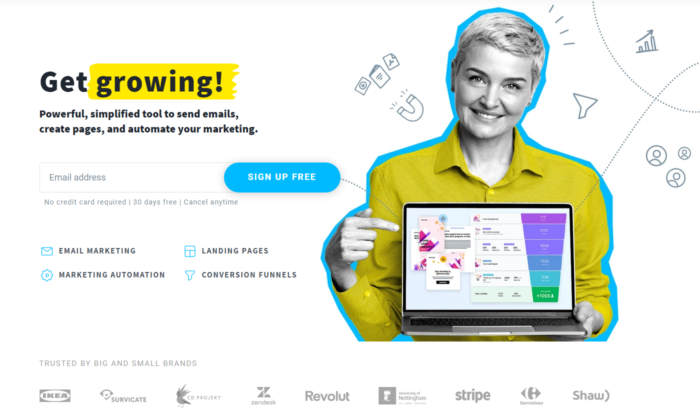
Get Response is a simple yet interactive landing page example.
You can see the Get Response team is bold as they’re the only software in the industry that uses an interactive headline.
The yellow sign you see on the image below changes between the words growing, leads, and sales.
That makes it for a great attention-grabbing headline that just makes you read on.
Also, they use a friendly, positive face which is something we don’t see very often in business that is not centered around a personal brand.
That of course is not a bad thing. It automatically builds trust and makes it easier for people to sign up for their software.
2. Slack
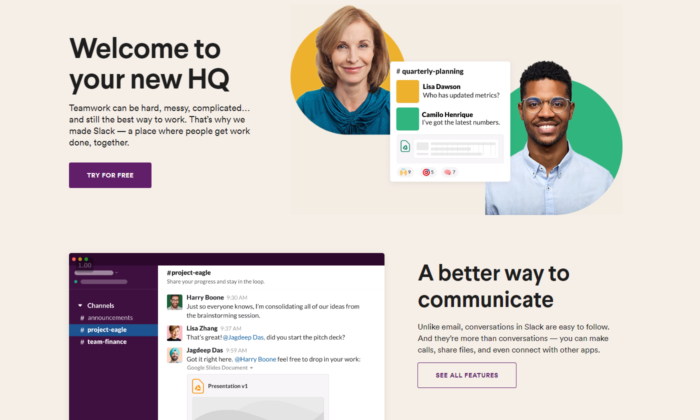
Slack is always on the top of its game when it comes to landing pages.
They are constantly optimizing for conversions and that’s the best way to find your winning landing page.
Their current one is extremely interactive, has a big eye-popping headline, and also shows how easy it is to use the software with a quick five-second gif.
Straight from the get-go, you can see they value customer satisfaction and if you’re still not sure, scrolling down will lead to non-stop credibility and results that prove their authority in the marketplace.
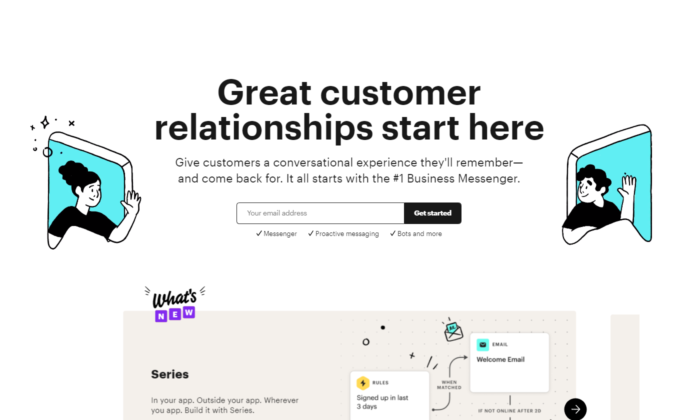
3. Intercom
Intercom’s main objective on this landing page is to get you to sign up for their email list.
Keeping it to email is a great way to increase your opt-in rate.
A big, positive headline that puts you in the right state of mind to act now.
The images they use perfectly represent the headline’s main unique selling proposition.
You can see an overall friendly environment and you just have to opt-in if you got to this page.
4. Lyft
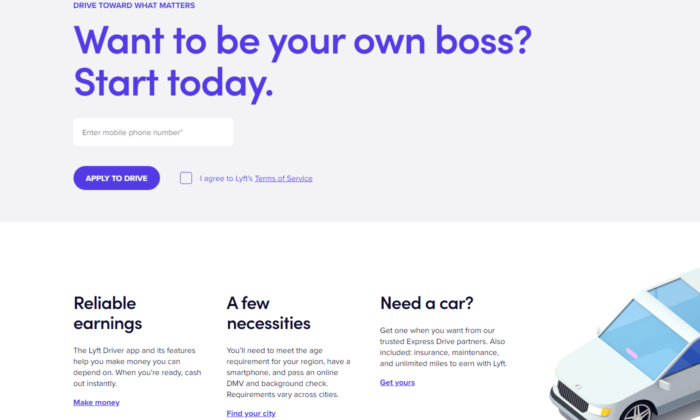
Lyft has been growing in the past years, and its website, landing page, and overall online funnel is a driving force.
They focus on attracting new drivers that want to control their own life.
Promising your workers’ freedom while working for you is the best way to snap the best candidates from your competitors.
Lyft has used multiple landing pages in the past, but their current one shows real professionalism.
Once again, we see a giant, attention-grabbing headline. This time with a question to anticipate curiosity and thought process in their prospects.
Check out the button “APPLY TO DRIVE”. It implies that it’s not 100 percent sure you’ll be able to get the position.
Making it so your clients have to compete to get a hold of your attention makes it so they try harder in the job itself.
5. Zoho
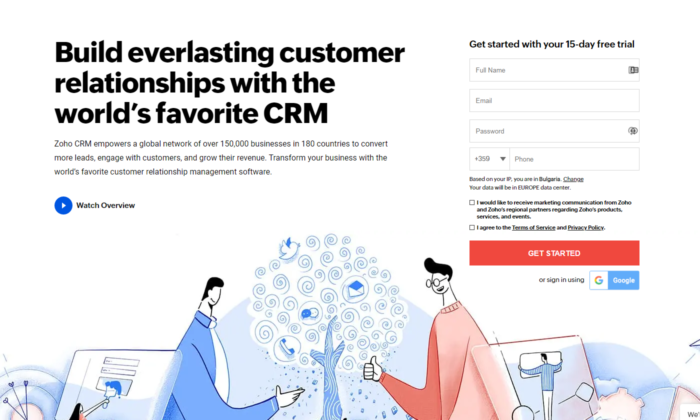
Zoho’s landing page is a great example of a more complicated but still extremely powerful messaging.
They use more text than the average software in the industry but that’s not necessarily bad.
For their specific case, they need to convert the prospect to begin a free trial which automatically builds tension in a prospect because he knows it will come a time he’d have to pay.
Converting someone to pay is way harder than just getting their email.
That’s why using more text in their messaging makes it for a powerful copywriting punch that maximizes free-trial registrations.
6. Squarespace
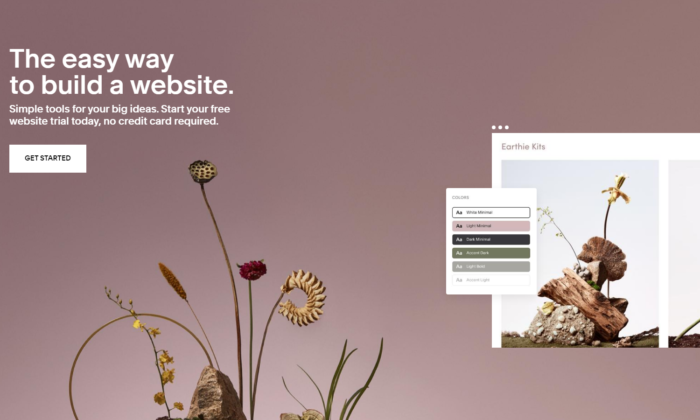
Squarespace tops the list for the least amount of text in their landing page design.
You might think that copy is not enough to convert someone.
However, once you see that they’re a website builder, you can see how the design and the quick and powerful messaging are all you need to sign-up.
They know their prospects mainly struggle with complicated codes and want to show a safe space where they can relax and drag and drop their winning website design.
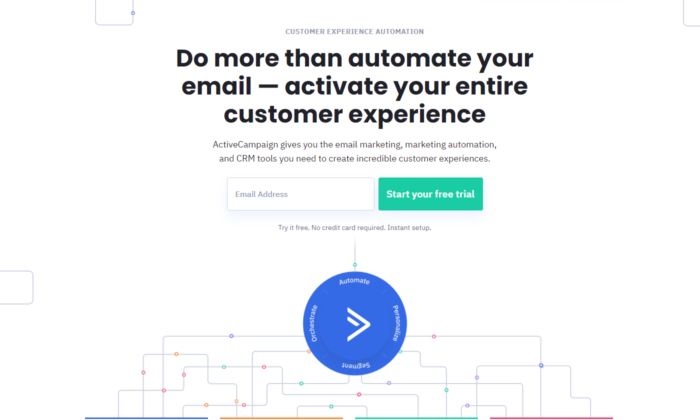
7. ActiveCampaign
ActiveCampaign solely focuses on showing you how their software brings the best customer experience possible.
If you’re a business owner, you both want to be treated well and want to help your customers in tough times.
Their headline hits two birds with one stone and, once again, there’s no useless text or design.
Everything leads to the big green button and you starting your free trial.
8. Hubspot
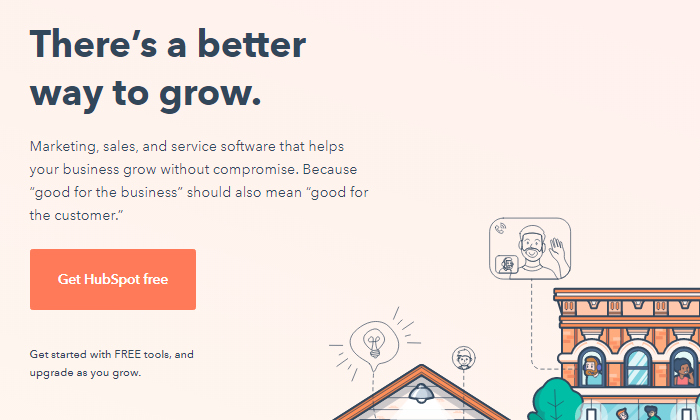
Hubspot is one more CRM that tops out the list today.
Just like ActiveCampaign, they show you that using their software will both help you and your customers feel better throughout the process.
Knowing that their ideal customer’s main objection is that learning a whole new CRM from scratch might be hard, tedious, and maybe even impossible, helps them narrow their message straight to the point.
9. Shopify Plus
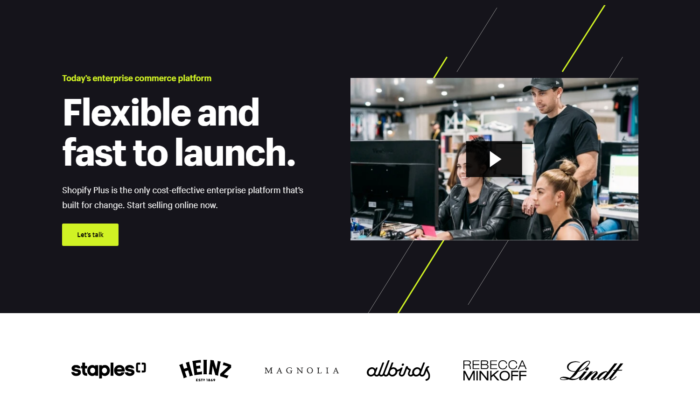
Shopify is one of the most well-known platforms in today’s online space and they know it.
As they’ve grown, they’ve been able to test out multiple landing page designs to find one that converts.
And Shopify Plus’s landing page shows for it.
Their main goal is to book a consultation call with their prospects, which takes more than just a couple of words.
They have the budget to shoot professional videos for all of their products and services which helps transfer valuable information to their prospects in the fastest possible way — video marketing.
Down below you see powerful credibility and if you take the time to watch the video, you’re most likely going to book a call with them.
Videos are a deadly weapon in the right business’s hands and Shopify proves that here and pretty much with anything they do.
10. Webflow
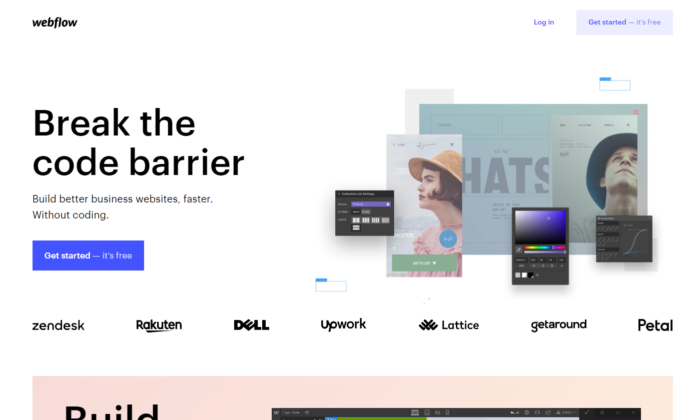
Webflow shows the insights of the software immediately when you land on their landing page.
You can see instant credibility from big websites that have used their services and also you can begin for free.
That breaks any tension the prospect might have.
On top of that, you can see that their software is similar to Photoshop.
So if you’ve ever used Adobe’s products, you immediately know this work will be a piece of cake for you.
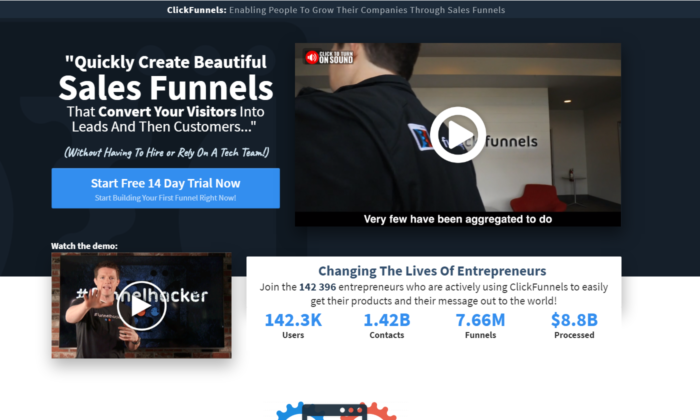
11. ClickFunnels
ClickFunnels uses its software to convert you for a free trial.
Even if you’re skeptical, you can play around with the funnel pages and buttons to see the responsiveness of their tool.
You can see that they use more text than the average website/funnel builder.
Once again they’re trying to convert people to start a 14-day free trial which is not an easy task.
They also use powerful videos that sell directly to their ideal customers.
The best part is the analytics they’ve added to their landing page.
It’s a bold and powerful move if done correctly.
The way these analytics are crafted makes it so they are constantly being updated and it’s not just 100K+ users as you might see on other platforms.
ClickFunnels values its customer’s success stories and is always there to record each result.
It’s one of the harder landing page designs to pull off but if you do it, your conversions will skyrocket.
12. Conversion Lab
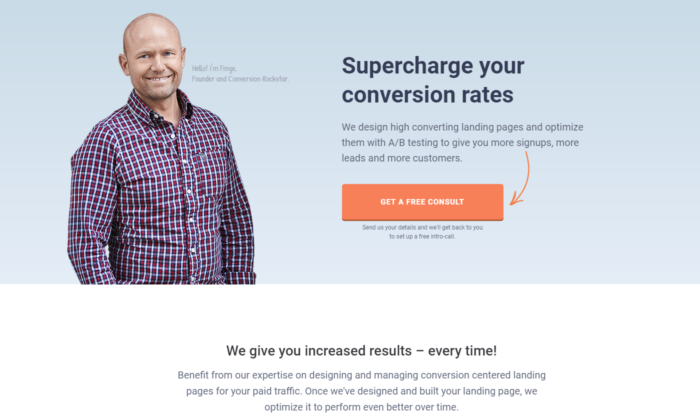
Conversion Lab has been using this landing page design for years now.
We’ve noticed they split test different button CTAs, like book a call, get a free consult, and many more.
Keeping their Founder on the main page of the website builds a long-term relationship many businesses nowadays miss out on.
They clearly state their services through their persuasive headline and, even if you’re not ready to book a consultation, a pop-up will appear collecting your email.
Email follow-up is a great way to ensure that a high percentage of prospects that land on your website will end up booking a call with you.
Landing Page Examples: Frequently Asked Questions
What is a landing page and how does it work?
A landing page is a specially designed page intended to encourage users to complete a specific task (i.e., convert.)
They work by highlighting key points, using social proof or case studies to build trust, and providing a CTA to encourage conversion.
What should a landing page include?
While the exact format may vary, landing pages should include:
- a headline that includes the main keyword
- subheading that clarifies the heading
- a description of the offer image, video, or illustration CTA button or form (optional) trust elements such as customer logos, reviews, or testimonials
Who needs a landing page?
Any business with a website should have a landing page of some sort to encourage users to take an action, such as book a demo, call for a quote, sign up for an email list, etc.
Do I need to A/B test my landing pages?
Absolutely. A/B testing should be an ongoing process to increase your landing page performance.
Landing Page Example Conclusion
These examples can serve as an inspiration to create a high-converting landing page.
To get the most out of your landing page, be sure to:
- Find what your best customers struggle the most with and then directly destroy this objection with a short and punchy headline.
- Use credibility and videos if possible.
- Know your goals — Is it to get their email, phone, ook a call, start a free/paid trial, or something else?
- Use clear and follow Call to Actions.
Finally: always, always, always optimize your landing pages.
You can NOT be perfect from day one.
Every business on this list tests their pages dozens if not hundreds of times before finding the winning landing page.
Even then, they still optimize.
Have you tried building a landing page before?
How’d it go — did it convert well and what were your biggest breakthroughs?
Source: feedproxy.google.com

62.41% of All Google Searches Generate 0 Clicks
According to data that we pulled from Ubersuggest, 62.41% of all searches globally get 0 clicks. Literally 0 clicks. But here’s where it gets interesting…

SEO is all about ranking high on Google.
The higher your rank the more clicks you get to your website.
But what if Google starts sending fewer clicks to websites over time, what should you do?
Well, just look at the graph below. It breaks down the last 4 years of click on Google.
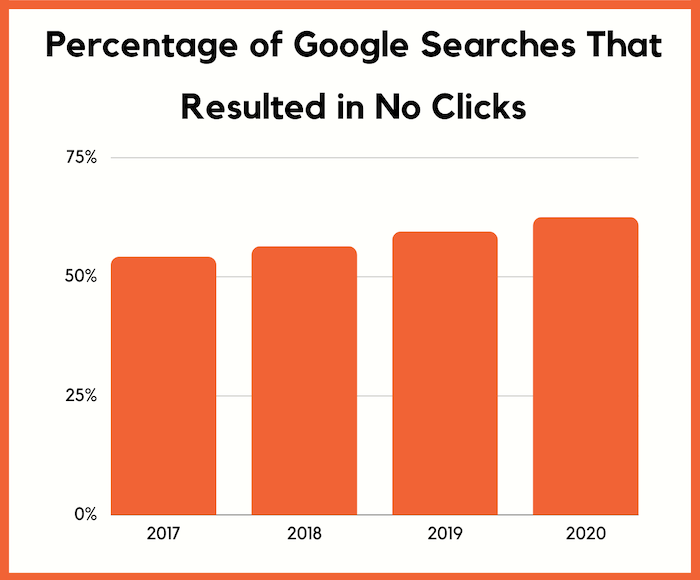
According to data that we pulled from Ubersuggest, 62.41% of all searches globally get 0 clicks.
Literally 0 clicks.
But here’s where it gets interesting…
Expect fewer clicks over time
Over time the number of people that clicked on no result has increased.
It went from 54.11% in 2017 to 62.41% in 2020.
Now keep in mind we don’t have data on every single Google search, as only Google would have that.
But we buy data from a few different providers and we have data on hundreds of millions of searches each year.
So directionally the data is accurate.
Here’s where it gets interesting.
According to Comscore, 50% of the searches are voice searches.
The data providers we get our Ubersuggest data from don’t have access to voice search data yet.
So, you can assume the number of “no clicks” is actually greater than what’s presented above.
Nonetheless, you should expect it to get worse over time as the graph is showing.
Now, why is this?
Well, it’s because Google is answering your questions when you search.
For example, if you type in, “Las Vegas weather”, you’ll see a listing like this:
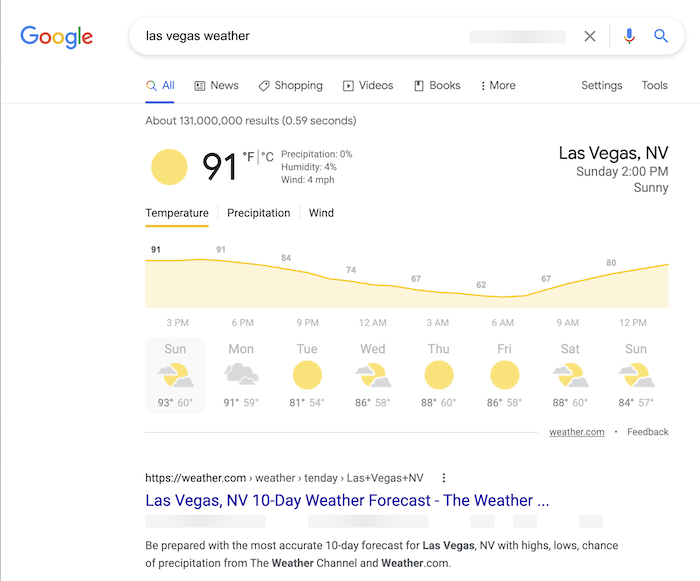
Google’s pulling the data from weather.com, but there really isn’t a need for you to click on over to weather.com.
And as a user, this provides me with a better user experience, so I like it. But if I was a website like weather.com I probably wouldn’t as it decreases my traffic, which decreases my ad revenue.
Expect Google to continually do this more over time as it tends to create a better user experience.
Is it fair that Google does this?
Before I dive more into the data and give you ways to increase your SEO traffic, even though Google is taking away some of your clicks… I want you to keep this in mind.
A lot of marketers and business owners don’t like this, and they complain that what Google is doing isn’t fair.
But hey, it’s up to you if you want Google to even crawl your site.
If you don’t like it, you can always block Google from your site.
I personally don’t have an issue.
Just imagine life with Google, it would suck.
And as a searcher, I don’t want to search for the weather and have to click on a few links to get my answer, I just want to know the weather right now in the least number of clicks.
I recommend that you focus on what you can control versus worries about what you can’t, such as Google’s future plans or random algorithm updates.
So, what can you do?
I want you to look at this as two separate problems.
The first is how can you get more clicks when people are clicking less.
And the second is how can you get more conversions from the clicks you are getting to make up for the loss in traffic.
Typically, with clicks, the main thing that impacts it is your meta tags.
You know your title and meta description.
Here’s what I am talking about… when you perform a search on Google, this is what it looks like:
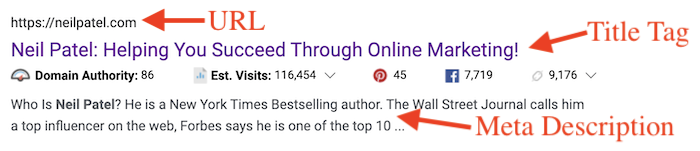
Here are 10 ways to adjust them to help you get more clicks (some of the data came from Clickflow, others from Ubersuggest):
- Questions have a 14.1% higher CTR – For example, your title tag could be, “What is SEO?”.
- 8.6% higher CTRs for 15 to 40 characters title tags – I would recommend that you keep yours closer to the 40 character mark so you can include more keywords.
- 45% increase in CTR when the exact query is in URL – make sure your main keyword is in your URL. It doesn’t have to be in your domain name, just the URL. So if I was trying to rank for the term “SEO” my URL maybe https://neilpatel.com/what-is-seo/.
- Power words increase CTR by 13.9% – some power words examples are: effortless, incredible, best, or amazing.
- 7.3% higher CTR for titles that contained emotions versus ones that didn’t have emotion – an example of an emotional headline is, “Learn how to stand up to your boss (without getting fired)”. You can find more examples of emotional headlines here.
- 5.8% higher CTR if you have a meta description – if you don’t manually create one for each page, Google will just pull one for you.
- Titles with years generate 4.9% higher CTR – a great example of this is “how to start a blog in 2021”. You would want to update year every year to make sure you don’t have an old date in your title tag or it can hurt your clicks.
- Evoking curiosity increased CTR by 5.9% – my favorite example of this is, “The 7 Benefits of Green Tea (#6 Will Shock You)”.
- Titles that resembled education had 10.4% more clicks – think how-to titles. People love learning how to do things step-by-step.
- You’re more likely to be successful if you look at the paid ads – Google uses the quality score to determine where ads should be placed. If an ad gets no clicks Google doesn’t make money. By look at the paid ads, you can get ideas of copy that is appealing for any keyword you are trying to rank for.
Don’t forget to optimize for conversions
As I mentioned above, the second thing you need to optimize for is conversions.
When you do get clicks, you’ll want to drive as many sales as possible.
Here are some articles I wrote that you should read.
They will teach you how to boost your conversions.
- 19 A/B Tests You Should Run on Your Website
- How to Craft and Measure Profitable Funnel Conversions from Scratch
- How to Use the Psychology of Color to Increase Website Conversions
- How to Leverage Storytelling to Increase Your Conversions
- How to Create an Engaging Value Proposition
- 12 Best Landing Page Examples
- How to Increase Conversions by Analyzing Bounce Rate Analytics
- 9 Steps to Creating a Landing Page That Reads Your Prospects’ Minds
Don’t forget about mobile
When optimizing your site, don’t just think about the desktop version of your site either.
It’s even more important to go through this process for your mobile traffic.
According to our Ubersuggest data, 61% of all searches are mobile.
And based on our data providers, the no-click data for mobile is even worse.
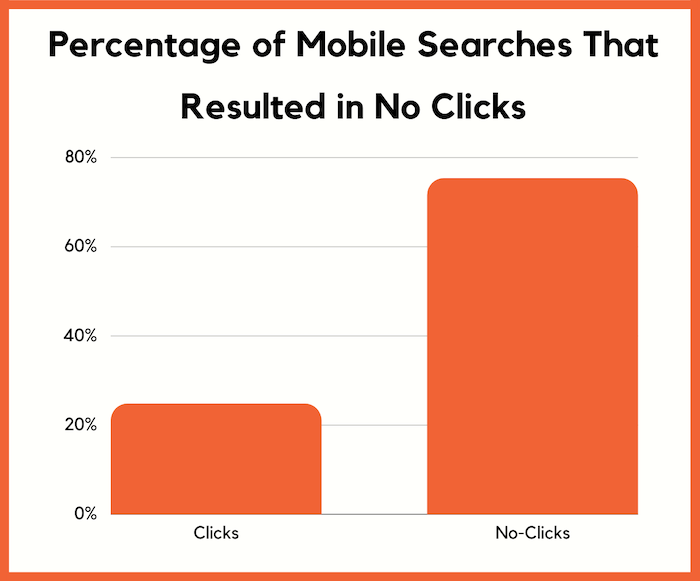
Typically, when it comes to optimizing your meta tags, you don’t have to worry as much as you are going to use the same meta tags for both the mobile and desktop versions of your site as most sites are responsive.
But when it comes to conversion optimization, you’ll want to create a different mobile experience, which you can easily do through a responsive design.
Conclusion
Don’t focus on the fact that Google is driving fewer clicks to websites.
Focus on what you can control and make the best out of the situation.
If I were you, I would do 3 things.
- Optimize your meta tags as I described above.
- Optimize your conversion rate so you can generate more revenue.
- Start creating question-based content because it drives 34.17% of the SEO traffic to popular blogs.
So what do you think of the data I shared above?
Source: feedproxy.google.com

How SiteGeek Saved and Then Doubled Their Business and Started Landing More Qualified Leads and 10X Bigger Clients (Plus 3 Proven Tips to Help You Grow Your Own Business)
At DigitalMarketer, we get to work with a lot of incredible businesses, and our absolute favorite thing is seeing a great company find even greater success with the training and strategies we teach.
And it’s not just because we love celebrating our customers’ success (though we really do love shouting them all out!).
It’s also that we want to see what exactly it was that pushed the needle, landed those clients, and took their sales to the next level.
Because our second favorite thing is passing on those successful tricks and strategies to the next struggling marketer.
It’s a never-ending cycle of marketing gold, see?
One such success story comes from SiteGeek, an award-winning digital marketing training consultancy.
By implementing the strategies and processes from the DigitalMarketer Certified Partner Program, SiteGeek started to rake in more, better-qualified leads and landed bigger, higher-ticket clients.
This meant they were able to save and then double the size of their business!
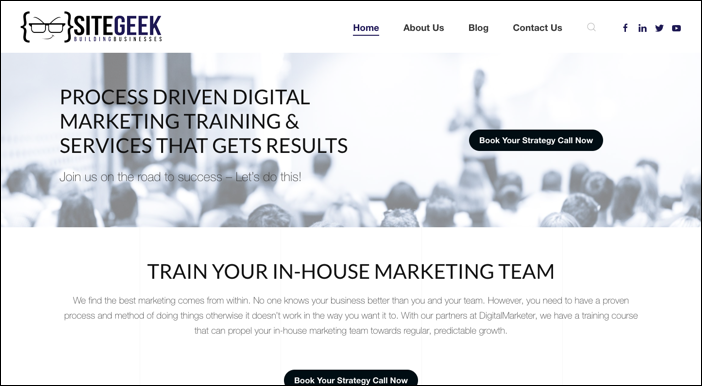
We wanted to share this story, and then in case you are struggling to find your own success, we’ve broken down 3 strategies you can try for yourself.
We know they worked for SiteGeek, so they will probably work for you!
Struggling to Find High Ground
When Steve Hooper, the Founder of SiteGeek, first joined the DigitalMarketer Certified Partner Program, he was struggling.
His company was in deep water because of a catastrophic accounting error, and while he had a steady stream of customers, he wasn’t happy with the direction his company was headed.
Steve was relying heavily on word of mouth and referrals from years of SEO and networking to get customers.
And the clients he did get were usually low budget, often with less than $500 total to spend.
It was a constant, daily grind of building websites and doing minor consulting work, and Steve felt more like he was up the creek in a leaky boat with teaspoons for paddles, when he should have felt like an elite-level white water rafting expert, navigating the sharp rocks and rough currents of the marketing world.
And then he found DigitalMarketer.
Or more like, DigitalMarketer found him.
One evening, while scrolling through Facebook, Steve happened upon a video from Ryan Deiss (the man, the myth, the legend), whom he recognized from a conference several years prior.
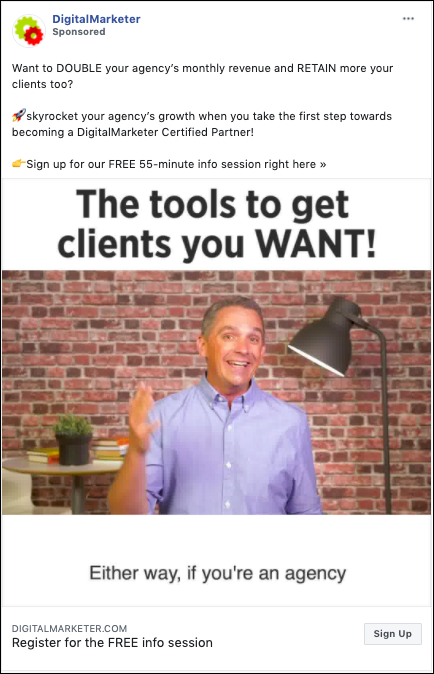
And before he knew it, Steve was joining on as a new partner in the Certified Partner program, looking for structure and direction, as well as ways to grow his business and hone his process.
The Ah-Ha Moment
Joining the CP Program gave Steve access to a wealth of marketing tools and tactics that he could not only use to help his clients but could also use to better his own marketing efforts.
What’s the biggest problem most marketing agencies face? Hint: it’s not bad marketing. They can create some of the best marketing for their clients, but they often don’t have the time or energy to market their own business.
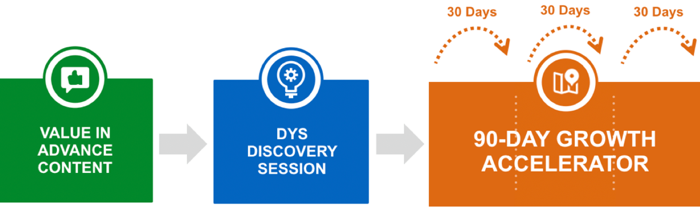
Steve dove right in and started to implement programs like the Double Your Sales sessions (a legacy DM product), which took his conversions to a rate he’d never seen in his previous one-on-one or email conversations with potential clients.
The one-page product sheets, Agency Growth toolkits, and video training all gave Steve the structure and direction he needed in his own marketing, and soon he was able to do it in a quarter of the time—which meant he could spend more time working on his clients’ businesses.
It wasn’t all sunshine and daisies.
Anyone who’s ever taken great training or learned a new strategy can understand that it’s not as simple as just snapping your fingers.
With so much new material to work with, Steve found himself struggling to see how some of it fit into his business model.
But after mastering the foundations laid out in the CP Program (like the Customer Value Journey we will cover later), he began to see how it all fit together.
This Side of Success
With all these new tools and tactics, Steve is seeing his company rise to new heights.
He has fewer, better clients with budgets upwards of $5000/month.
More than 10X what they were before. And he is able to hire more team members to work with those clients.
He is seeing a return on ad spend that has doubled because his funnels work better than ever, and he has even launched a podcast, Digital Marketing Confessions, where he talks with marketing experts about what’s working (and not working) in digital marketing right now.
SiteGeek has doubled in size, and since Steve is currently going through the 90-Day Accelerator, he expects to see even more growth in the coming months and years.
When Steve was looking into becoming a Certified Partner, he was trying really hard to discover new ways of doing things and a true path for himself and his business.
The training he found in the program allowed for exactly that, and he dug deep and pushed himself to do the work that got results.
But what were those specific things that got results, you ask?
There were 3 specific tactics that Steve found to make the most impact in his business, and in his success as a CP.
3 Tactics to Help You Grow Your Own Business As SiteGeek Did
When we talked to Steve about what really made the biggest difference, he said that honing his Customer Value Journey, providing value in advance, and leaning on the CP community were the most important strategies.
So we’ve broken those ideas down a bit more, that way you can use them yourself. We’re providing you the value in advance  .
.
The Customer Value Journey
We talk about this framework a lot. Like, A LOT a lot.
But if you’re new to the game, the Customer Value Journey is a marketing framework that breaks down the different stages your customer will go through in their relationship with your business, from just becoming aware of you to shouting your name from the rooftops telling everyone to be your customer.
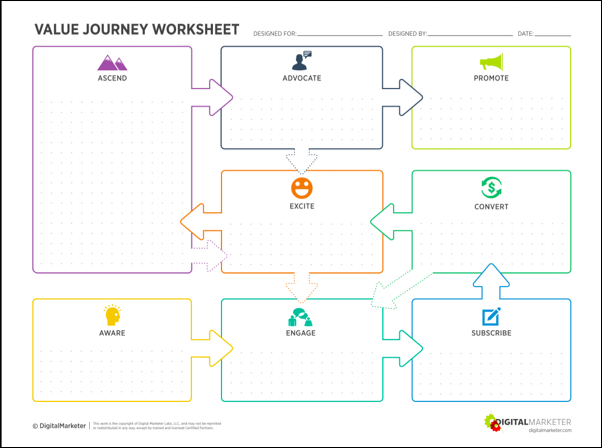
This should be one of the most important foundations of your business and your marketing.
You should know exactly what content, emails, or ads your customers are seeing depending on where they are in the value journey.
And different stages should have different content.
After all, if someone just learned about your company, you don’t want to immediately ask them to buy your highest-priced item or service.
You want to make sure your customers are flowing through this in the right order and hitting every step.
And when you map out how your funnels align with the CVJ, you might just find that you are missing steps or getting ahead of yourself.
So map out your own customer’s journey through your business and you’ll be better prepared to guide new potential customers who could have gotten lost without this map.
Provide Value in Advance
A lot of business owners (and marketers in general) are leery of giving away too much information or content before they get a contract signed and a check in the mail.
After all, what’s stopping potential customers from taking what you give them for free and then going to someone else, or even trying to do it themselves?
Nothing. Absolutely nothing.
But Steve learned (and we have always taught) that when you provide value to your customers before you ever ask for a dime, most times they don’t just cut and run.
Usually, they stick around and see what else you have to offer.
When you give value, you are getting something worth way more than money in return (and we all know that money is worth a LOT).
You are getting trust. By showing your customers just how much you know, and giving away some of your expertise for free, you are proving that you are the expert they should turn to when they are ready to break out the checkbook.
Because remember, marketing is hard.
There’s a reason that marketing agencies stay in business. If you do give away a strategy for free, most people are going to see what it takes to implement and turn right around and ask you to do it for them.
So always start your sales conversation by providing value in advance.
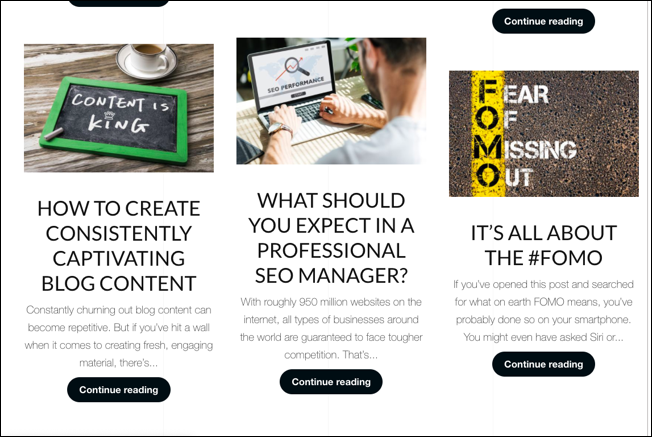
Maybe this means you fill your blog with tactical content (like you can see SiteGeek did below), or maybe you set up a sales presentation that is full of useful strategies before you ever bring up contracts.

Whatever is best for your business, when you start with value, you’re guaranteed to see a return.
Lean on Your Community
This was the tip that came up again and again. Steve’s favorite thing in the CP program, and his biggest piece of advice to anyone joining the program, was to really take advantage of the community.
In the case of the CP Program, we have a Facebook Group where all our CPs can talk about their businesses and help each other out with any sticking points.
This community is often what keeps our partners in the program for years and years.
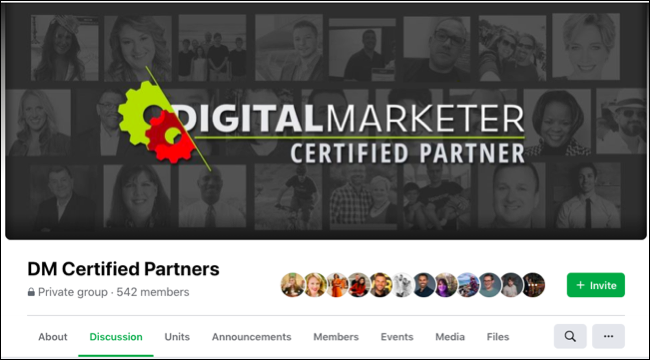
But you don’t have to be in this specific community to benefit from this tactic.
Whether you are in this CP group, the DM Engage group, a different online marketing group, or just part of a brunch crew with other business owners, the community can make or break your success as a business.
When you are a part of a community of people in similar situations or with similar problems, you can not only get advice about your particular issues, but you can help other people with theirs.
You can build up your authority in the industry and find new networking opportunities (just make sure you aren’t that person trying to hark your product in the Facebook group if it’s not allowed).
A community is usually a safe place to discuss roadblocks and the best place to bounce ideas off people who really know their stuff, and may have gone through a similar thing.
Remember, you don’t have to go it alone. Take your community with you.
And no matter what stage your business is or what you hope you improve, these 3 tactics will give you a step up.
So if you want to double your business, just follow the advice above.
After all, we know they work!
The post How SiteGeek Saved and Then Doubled Their Business and Started Landing More Qualified Leads and 10X Bigger Clients (Plus 3 Proven Tips to Help You Grow Your Own Business) appeared first on DigitalMarketer.
Source: digitalmarketer.com