
Tag Archives for " content marketing "

How to Align Your SEO and Sales Teams
Have you figured out your marketing strategy for 2022 yet?
Here’s a great idea for you: Embrace collaborative marketing. Aligning your different teams is likely to open up many new opportunities for your business.
According to the recent research by Convince and Convert and Ascend2, 50% of marketers claim that integrating marketing and sales teams has proved to be very successful at achieving strategic goals.

This is huge.
Here’s how to align two of your most isolated teams: Sales and SEO.
Foster Content Marketing Collaboration
All marketing is driven by content and that includes SEO and sales. For both teams, content is fundamental. Without content, there are no rankings or sales:
- Google relies on content to identify if a page is relevant to a search query and if it satisfies a searcher’s intent. Relevancy and search intent are two key ranking signals.
- In sales, content is the most important driving force behind buyers’ journey. Content can directly impact purchasing decisions, as many studies confirm.
According to Forbes, more than 60% of B2B buyers say they are able to make their purchase decision exclusively based on digital content, without talking to sales reps or going through demos.
So why is there such a huge disconnect between SEO and sales content? Why do these two content strategies often exist separately without informing or helping each other?
“Content is King” has long been a marketing buzz phrase, especially in the B2B industry. However content is only King if it enables sales.

Too often there’s a discrepancy between those producing content and organizational teams who are trying to leverage it.
The resulting problem is two-fold:
- Sales reps lack the right content they can use to effectively engage with prospects
- SEO content creators lack sales reps’ insight which would enable them to create content that addresses the real struggles of their target audience.
Ways to Integrate SEO and Sales
Content can be the driving source for removing your organizational silos and encouraging cross-team collaboration.

How can SEO and content marketing teams collaborate on creating an integrated content strategy?
- Encourage the two teams to brainstorm on content ideas together
- Let the customer support and sales teams keep a shareable record of questions your actual customers are asking them. Any of those can and should be content ideas for the SEO team to research in terms of demand (search volume) and difficulty.
- Foster creativity from both of the teams: What are their thoughts on content promotion opportunities.
- Do they have any viral content ideas?
- Let both the teams explore further opportunities. For example, let your SEO team figure out ways to reuse sales enablement content for ESP purposes. Many of those sales demos can be used as public content that can target all kinds of long-tail ranking opportunities.
Help Them Understand Your Customers Better
When you work on traffic numbers all day, it is too easy to forget that there are real people behind those numbers.
Both SEO and sales team have unique access to valuable insights on who is your business’s target customer and how to serve them better:
- Sales teams talk to your current and future customers on a daily basis. They know their struggles and what they are looking to solve. Sharing this information with the SEO team will empower your SEO strategy with more data your competitors have no access to.
- Your SEO team knows exactly what your customers are searching for and which questions they are asking. They know the demand behind each search term and they can report on how your competitors are targeting each search query.
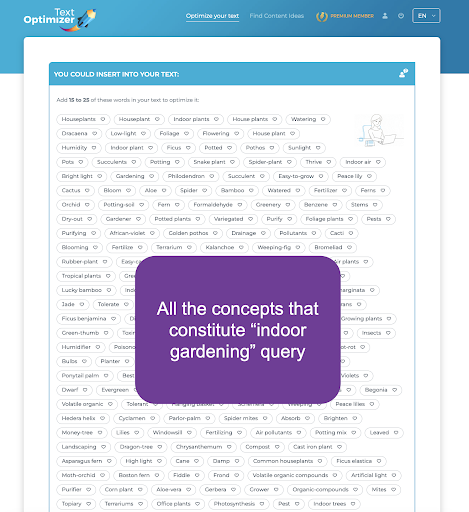
Text Optimizer allows you to better understand concepts behind any search query and help you find the ways to meet your customers’ needs easier:
Share Your Web Analytics Insights
Let the SEO team share their web analytics insights: What are the effective paths that bring those leads through the site down the conversion funnel? What works best in terms of engaging your site visitors and turning them into leads?
All of that information will help your sales team focus on what works best and nail their lead generation and onboarding strategy.
Encourage your SEO team to create custom analytics dashboards and hold regular meetings to give. This will give your sales team access to web analytics data they can understand.
Google Analytics is the first option that comes to mind. But there are also web traffic statistics solutions offered by your hosting provider, as well as many Google Analytics alternatives.
Whatagraph is an easy way to create custom reports that are delivered weekly and are very easy to understand even for a non-technical person:
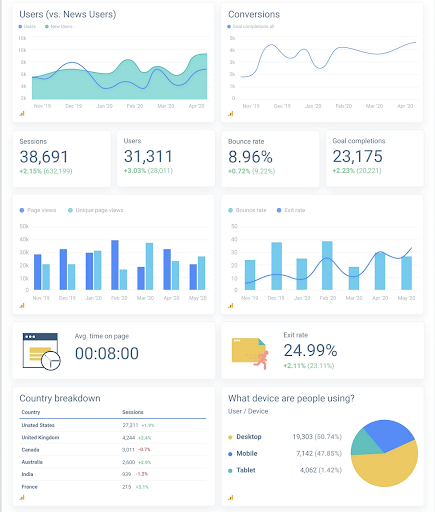
You can also integrate your web analytics into your website dashboard using these templates to let your whole company access it at any time.
Open up More Business Opportunities
The cross-team collaboration will likely discover more unexpected opportunities for you and your business. For example, letting your sales team access your SEO data may help them identify industry gaps and define your product’s unique value proposition.
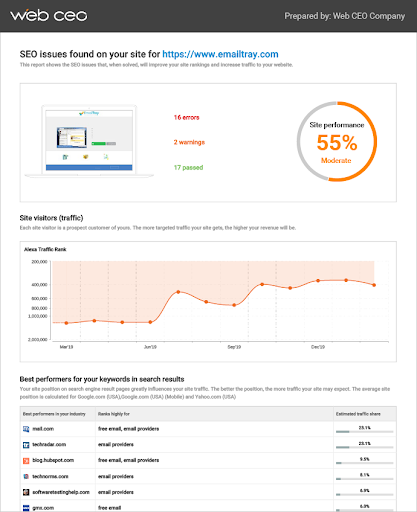
You can also discover new product or service opportunities. For example, this SEO lead generation tool can help you expand your services pretty easily.
Widgets like this help integrate SEO into the sales process in the most efficient way.
Conclusion
The power of cross-team collaboration is almost limitless. SEO and Sales collaboration can give you that competitive advantage your business needs. By combining numbers with actual sales experience, you can empower both teams.

The concept of unified communications has become even more important for business survival after COVID hit and many teams moved to work from home.

Finding more ways to let your (remote) teams keep in touch and collaborate is more important than ever.
Hopefully, the above ideas would come useful!
The post How to Align Your SEO and Sales Teams appeared first on Content Marketing Consulting and Social Media Strategy.
Source: convinceandconvert.com

Examples of Sites with Great Content & What You Can Learn From Them
Sites with great content are the types of things you know when you see them. You don’t even know why you love them. You just do. Creating it can be a different story. It’s easy to get lost in the trappings of a great site and lose focus on what makes it great.

No matter what your brand is about and what you’re trying to sell or convert, you can create a site with great content. You just need to break down what makes those sites great in the first place and use the same approach for whatever your topic is.
How Important Is Good Content?
You know when you’re drawn to specific websites. You spend more time there. You always read their newest blogs and click through on their social posts or in their newsletters. You look forward to consuming the content, and you spend lots of time on the website absorbing it all.
Content refers to everything you create on your website for the visitors’ consumption, including written pieces, videos, images, and more. Content covers everything from blog posts to product descriptions to case studies.
Basically, if it’s on your site, it’s content.
Because people engage more with sites with great content, they spend more time on the website, which improves your SEO. Further, people who love your content are more likely to share with others and convert customers.
What Makes Good Content?
Search engines have gotten smart, and people have grown accustomed to truly well-created, resource-rich content. As a result, you can no longer get away with following specific sneaky techniques to game the SEO system or trick people into visiting your website.
Good content answers the questions people search for on search engines and provides educational, entertaining, insightful, and empowering information.
Best practices for more in-depth written content include pieces running about 2,000 to 3,000 words and easily skimmed.
Good content is consistent, as well. People remain more engaged with your brand if you are regularly putting out high-quality content for them to consume.
Examples of Sites With Great Content
We’ve put together a list of websites whose content stands out for a particular reason. Let’s explore what makes sites’ content great and why.
1. Tell Engaging Stories: charity: water
We, humans, love stories. You can leverage this proclivity by telling stories in your content.
The best stories appeal to people’s emotions. It’s easy to assume your brand doesn’t have stories to tell—but you do. Think about what your brand brings to the table. What do you do? Who do you help?
Check out charity: water for an example. They provide water resources to people who need them, but their writing focuses on reaching those who can get water at the turn of a faucet handle. By telling stories of those who don’t have that luxury, they can reach the best help audiences.
Stories can change the narrative.

Case studies are excellent for telling stories. Think about your most loyal and happy customers or clients. What did you do for them? Tell the story. You can keep specifics and identifiers out of the story. Even a vague story is better than no story.
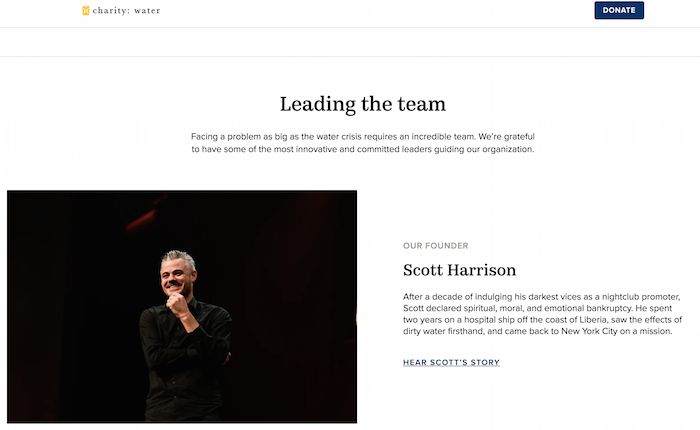
You can also tell your own story. Help people understand what you do and why. charity: water does this on the About Us page.
2. Stay Current and Break Industry News: thredUP
Sites with great content update regularly, and Google notices. Websites that update more often are seen as current and relevant, and therefore usually rank higher than websites that grow stale.
As a result, posting current, even breaking, the news is a great way to do this. But not every brand can be a news site that’s rolling out the latest headlines constantly. So how can you stay current without going into a newsroom? Check out thredUP.

thredUP is a secondhand clothing brand, but their blog is a treasure trove of information about sustainability, clothing trends, and more. They see a bigger picture in their content. In fact, they have set themselves up as an expert to turn to for news.
Any brand can do this. What are your customers interested in? Set up Google alerts and create blogs and posts that react to the latest news in your field. Get ahead of the game and write articles exploring and expounding on trends to set your brand up as the expert.
3. Use Subject Matter Experts (Industry Insiders): Etsy
As you build content, don’t be afraid to pull in other voices. Subject matter experts can help you appeal to a broader audience and dive deeper into topics your audience cares about. They can also lend credibility to your brand, which matters for your SEO.
Google uses the EAT acronym to describe and rank quality standards in human analysis. EAT stands for expertise, authoritativeness, and trustworthiness. Bringing in subject matter experts can bring those qualities to your content.
For example, check out Etsy’s blog. They pull in industry leaders and changemakers all the time.

You can also interview experts. And you aren’t restricted to written work—you can host these on YouTube, Instagram, or Facebook. You could even start a podcast.
4. Make Sure Your Copy Sounds Human: Bissell
Human copy is personal and conversational, not necessarily casual, but approachable. It brings emotion without being salesy or pushy. It’s clear and straightforward.
For a more human touch, check out the Bissell blog and website. They take what could be a dry, boring topic and make it approachable and personal.
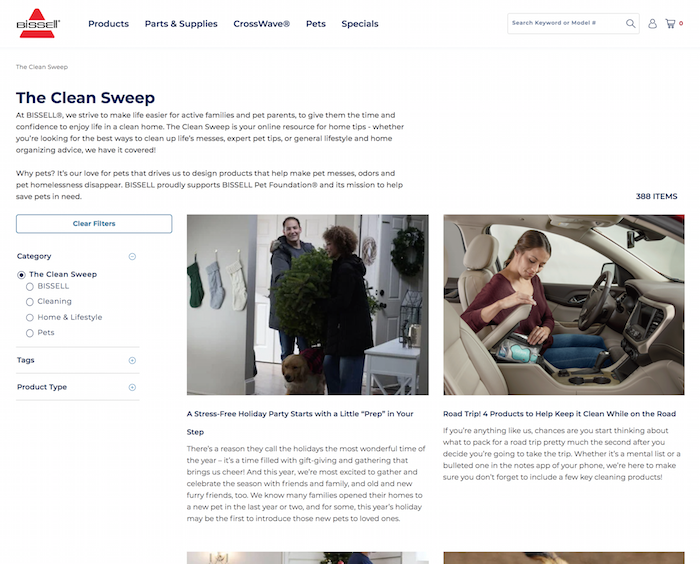
If you have trouble with this style of writing, give yourself a break. Be authentic and write as naturally as you talk. You can use a voice-to-text app to help you translate genuine conversation into writing.
5. Offer Interactive Content: QVC
One of the best ways to remain human and build engagement with your audience is to use your website to interact with people.
Interactive content can start with allowing your audience to offer you feedback and respond to your content. This can be in the form of comment boxes after your blogs or social media posts.
You can also add audio and video elements to your post to engage your viewers.
QVC leverages this type of content to keep its audience invested and coming back for more.
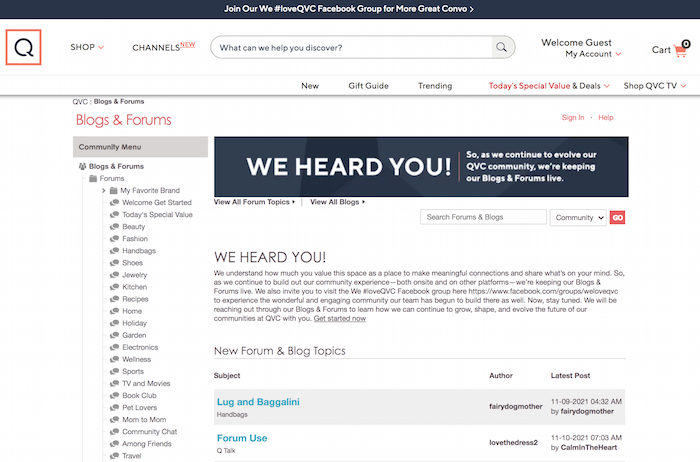
During live shows and events, they invite their viewers to interact on forums and social media groups. As a result, they become more than customers. They feel part of the QVC community.
6. Incorporate Different Media Types: BarkBox
Sites with excellent content pull in lots of different types of media. This might include a video on a blog post, a slide deck, a downloadable, lots of images, photos, videos, audio, and more.
Using different elements can bring your stories to life while helping you get your message out in many ways people can absorb it.
If you need some inspiration, check out BarkBox’s blog.
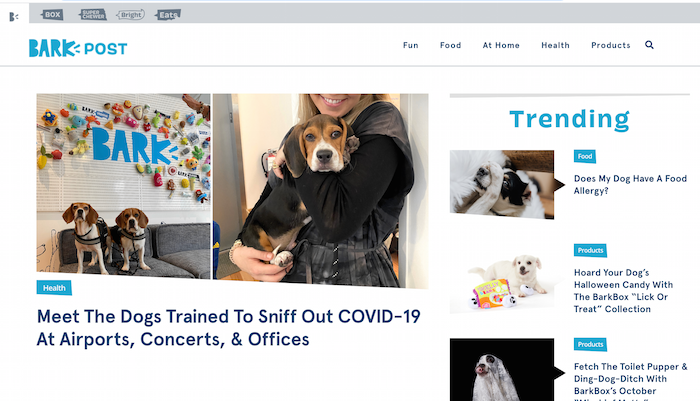
7. Answer Users’ Most FAQs: NeilPatel.com
Strive to answer frequently asked questions your customers have. Sites with effective answers to frequent questions can get picked up for featured snippets in search results on Google.
You can do this by asking and answering questions in your content. Make sure those are prominent and easy to scroll. Style is up to you: You can incorporate questions into headers and subheaders or use lists or bullet points.
Not to toot our own horn, but we think we’re pretty good at this! Check out our method below:
Frequently Asked Questions About Good Content
What is an example of great content marketing?
Great content marketing makes visitors want to return and consume more. Sites with the strongest content provide current information, interactive elements, and answers to questions.
How is website content strategy different from social media content strategy?
Website content strategy focuses on what will be posted on the site itself. In contrast, social media content strategy focuses on how and what information will be posted to social media sites. The way things are presented on your site and social media will likely be quite different.
What are the different types of content?
Many different types of content can be used on your website, including audio, visual, interactive, and written content. Using a variety of content can enliven your message and entice a growing audience.
Is short or long content better?
In general, longer written content ranks better for SEO. However, even long-form content should be broken down into digestible paragraphs with headings and bullet points, answering frequently asked questions along the way. Video and audio content varies based on subject and audience.
Conclusion for Sites with Great Content
The internet is full of sites with great content. You probably know of plenty of examples that draw you back for more.
As you put together your digital marketing strategy for your brand or e-commerce shop, think about the elements that make those websites great.
What’s your favorite type of online content?
Source: neilpatel.com

How to Increase Your Website Traffic Without SEO
SEO can be a brilliant strategy to increase your website traffic but it isn’t always enough.
Imagine you rely on SEO for all your traffic. What happens when the Google algorithm changes? You risk losing potential customers!
Disclosure: This content is reader-supported, which means if you click on some of our links that we may earn a commission.
That’s why diversifying your methods of increasing web traffic can offer better results.
If you have multiple traffic sources, changing algorithms won’t completely halt your business.
You will have a toolkit full of optimization strategies to keep your business running.
Diversifying your web traffic can also be helpful in cases where there’s little scope for search engine optimization (for example, podcasts).
In this post, we’re going to look at effective strategies to grow your website traffic without SEO so you’re never left stranded by algorithm changes again.
We’ll also look at practical tips you can start using right now, so you can get back in the game if your traffic has been low for a while.

Why Should You Try to Grow Traffic Without SEO?
You can generate substantial traffic from SEO alone, but not all traffic is equal. High-quality traffic (that includes users more likely to convert) offers better ROI, so you need to prioritize it.
Plus, if you aren’t an SEO expert, you may want to focus on other strategies to grow your website traffic efficiently.
This doesn’t mean you completely ignore SEO. All websites, irrespective of their niche, must follow the best SEO practices to avoid being penalized by Google and to ensure the site gets indexed.
Top Strategies to Increase Website Traffic Without SEO
The strategies we’ll discuss below can be a helpful addition to a pre-existing SEO plan.
1. Content Marketing
If you have been reading about digital marketing for a while, you must have heard the term “content marketing.”
In simple words, it’s a way to organically advertise your brand through high-quality content.
Content marketing strategies often include blog posts, podcast episodes, infographics,
YouTube videos, downloadable PDFs, etc.
For instance, Toggl, a time tracking software company frequently uploads informative blog posts and research data about productivity, work-life, and career.

This attracts users interested in time management, productivity, and wellbeing in the workplace.
When they read Toggl’s blog, they eventually discover Toggl’s time tracking app, among its other productivity tools.
Some of these users convert, helping Toggl increase their website traffic and ROI.
Content marketing isn’t limited to blog posts.
If you connect better through audio, you can try launching a podcast or host a webinar.
Nowadays, most social media apps let you post a variety of content formats including photos, audio clips, long-form text, and videos.
You can experiment with one or more of these formats to see what works best for your audience.
2. Paid Ads
Content marketing is beneficial but it can take a lot of money, especially if you’re paying established writers to create original, well-researched posts for you.
Most of these projects also take weeks or months to show results, which isn’t a practical timeline for many businesses.
If you want quicker results with a budget you can control, why not try paid ads?
Seven in ten Americans use social media today.
That’s more than two-thirds of the population.
Think about the possibilities!
Paid ads can instantly generate hundreds, if not thousands, of clicks to your website.
Plus, with new advertising and social media platforms appearing and innovating regularly, getting your ads in front of the right people is becoming easier than ever.
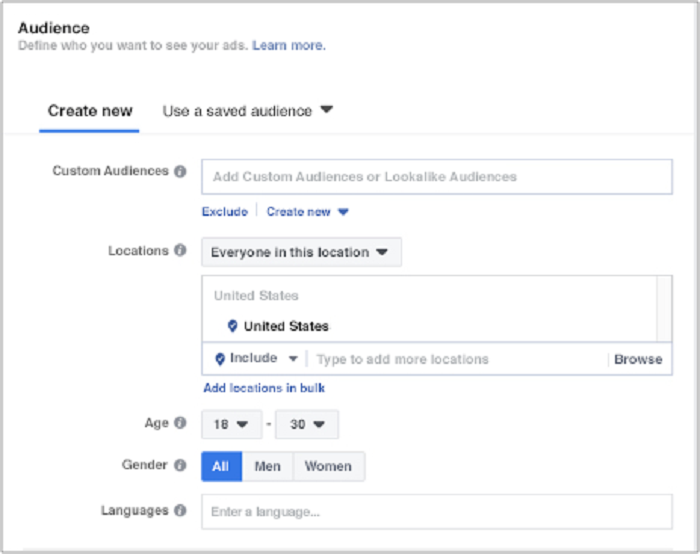
For example, Facebook offers detailed customer personas and multiple targeting options so you can put your business in front of your target customers without wasting a lot of money on mass advertising.
However, you don’t have to stick to the largest platforms for effective advertising.
In fact, advertising on lesser-known platforms whose audience aligns with your products can be more effective in the long run.
For example, if your ideal customer includes teens who enjoy memes and weird stories, you’d have much better results by advertising on Reddit, rather than Facebook or YouTube.
Another option is dating apps.
If your brand is focused on relationships or if you’re targeting young singles, advertising on dating apps like Tinder can help you find your target customers faster.

If you’re worried paid ads will take a lot of money, remember, you don’t need to spend $1,000 on your first day.
Test the waters with $5-$10 a day and see what happens.
Do that for a week, just to learn how different media platforms work.
3. Social Media Strategies
One of the best ways to increase your website traffic is to meet your customers where they like to hang out.
Like we discussed earlier, almost everyone is using social media today.
Ramping up your social media marketing efforts can help you reach new users, develop brand awareness and increase website traffic.
How to gain website traffic through social media?
When it comes to social media, you can’t just barge into “conversations” and ask people to buy something from you or to visit your website.
Think about how you’d present your brand in real life when you meet an individual for the first time.
Would you immediately talk sales in their face?
How about providing details about your product/service without introducing yourself first?
Remember, users, visit their preferred social media platforms for entertainment, not for being sold to.
To make sure your efforts are well-received, you need to provide value first and develop positive relationships with your potential “followers.”
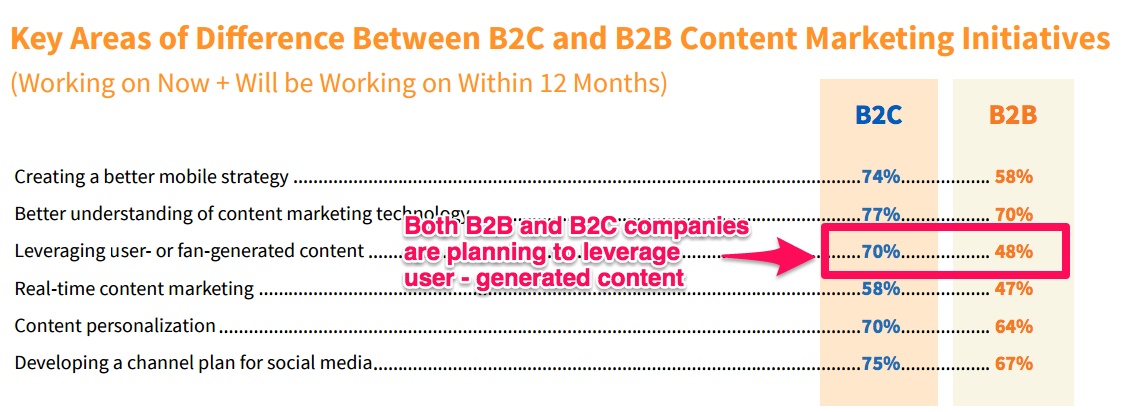
You can do this by sharing informative posts like How-Tos, or posting fun photos of your employees, like this post from Casper.

I wrote a detailed guide to increasing social media followers and boosting engagement.
Here’s a summary of the top options to help you grow your website traffic.
- Join relevant Facebook groups
- Share helpful articles/videos in these groups
- Post updates about your company’s latest products host contests and giveaways
- Leave thoughtful comments on user-generated content
4. Link Building Strategies
When marketing teams talk about SEO, link building frequently comes to mind.
When reputable websites link to your content, the algorithm favors your website and increases its rank on the search page.
Sounds helpful, but that’s not all.
Did you know link building can help you increase web traffic without relying on SEO?
Link building for brand awareness is a process where you focus your strategies on expanding your reach, putting your content in front of new users, and generating conversations around your brand.
This is more than just a casual backlink in a blog post.
Link building for brand awareness takes more planning and resources, but the investment is worth the high-quality leads you’ll get.
Here are some tips for developing effective link building strategies to increase website traffic:
- Engage with your audience: Create interesting, shareable posts and encourage your followers to respond and share your content.
- Work with PRs: Recruit efficient PRs to help generate brand awareness and distribute your story to your desired audience.
- Guest blog intentionally: Choose unique publications that align with your readers’ key interests and post guest blogs on their page.
5. Interact With Other Blogs
Guest blogging is an effective traffic-driving strategy aimed at leveraging somebody else’s audience to widen your brand’s reach.

Think about it: Somebody in your niche has a large, engaged following.
Imagine if you could put your content in front of them.
How much traffic could you drive to your website!
Why would someone publish your work?
Probably because you’re good at what you do.
Everyone is looking for high-quality content.
If you can provide a well-researched, helpful post for free, people are often open to publishing it on their website.
After all, it’s benefiting their audience at zero cost.
Why would you give precious content away for free?
It’ll help you gain access to hundreds, if not thousands of new users, many of whom could become long-term customers.
It’s a win-win situation, but you have to be careful how you approach it.
Start by searching for blogs and media publications that publish content relevant to your business.
For example, if you run a recruiting company, publish content on business blogs read by people interested in the latest recruiting practices.
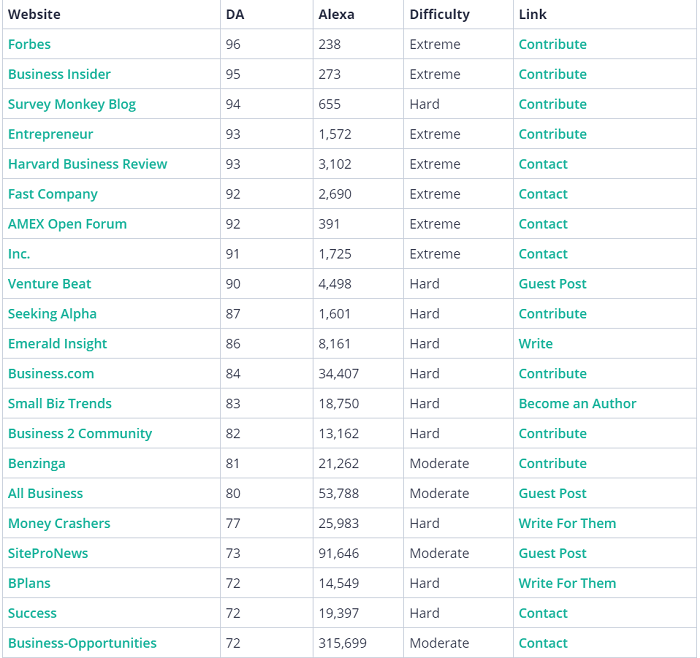
If you want to find blogs in your industry that are accepting guest posts, use the following search queries to see more specific results:
- name of your niche + “write for us”
- name of your niche + “submit guest post”
- name of your niche + “sites that accept guest posts”
- write guest article + ‘name of your niche” + blog
Solvid provides a comprehensive list of places accepting guest blogs:
In addition, research online biographies of specific companies and bloggers.
More often than not, their web profiles contain a handy list of sites where they’ve been invited to guest post.
That’s a plethora of most fitting guest blog opportunities presented to you on a silver platter.
Then, send a request.
Most websites will have publication guidelines you can follow.
Follow these instructions carefully to increase your chances of publication.
There’s also the option of using blog comments as a way to generate traffic to your site.
In the past, I have managed to generate $25,000 as a result of 249 comments.

How exactly do you go about using comments to generate traffic?
When leaving a comment, make sure you are adding something worthwhile to the discussion.
There is no use in leaving comments like “Awesome post!” or “Nice website!”
If someone posts a question, make sure you take the time to answer thoughtfully.
This showcases your expertise in the given niche and will encourage someone reading to click on your name and be taken through to your site.
If you read an article on a subject you don’t know very well, it would be imprudent to voice your own thoughts as fact.
In this situation, you should simply ask questions.
Then the website owner would be able to elaborate more on complex topics or complicated sections.
If you’re knowledgeable about a subject, feel free to contribute (e.g., suggest something, recommend a solution, answer a question).
If you’re a novice, it’s best to ask questions.
Powerful questions can bring you website traffic by encouraging blog readers to check you out.
Avoid embedding links in your comments.
It comes off as a wretched attempt to plant your flag on someone’s lawn.
It’s okay to use your website’s link in the URL field when entering your name and email address, but your comment needs to add to the conversation or challenge an idea without lazy attempts at driving traffic to your blog.
Refrain from using the name of your business as your “commenting name.”
Use your actual full name instead.
Using a random or fake name is a missed opportunity to build strong branding because your brand actually starts with your name.
In fact, failing to use your full name will reduce your chances of the website owner approving your comment.
6. Email Marketing
If you read a few posts on digital marketing, email marketing would be mentioned in most of them.
That’s because it’s still one of the most efficient ways to increase website traffic.
One study suggests email generates $36 for every $1 spent, offering a shocking 3,600 percent ROI.
What more could you ask for?

Email marketing lets you reach potential customers directly.
It’s an ideal platform for building long-term relationships for improved customer loyalty.
You can post questions, ask for feedback, introduce soft sales, and persuade customers for the “big buy.”
Here are some tips for effective email marketing to increase website traffic:
- Be real: Share stories, post-behind-the-scenes content, and solicit original user-generated content.
- Offer value: Just like content marketing needs a high value to convert readers, emails and newsletters must provide value before they make an ask.
- Include all your links: Make it easy to read and share your post. Include links to your social media profiles, latest blog posts, and sales page in every email you send.
7. Provide Excellent Customer Service and Ask Customers to Review Your Brand
Ramping up your social media marketing efforts to increase website traffic is useless if you offer poor customer service.

According to a survey, 42 percent of customers said they bought more after pleasant customer service experiences.
Think about it: Users make complaints on social media, you offer a prompt and polite response.
What happens?
The person starts respecting your brand.
Even when users complain privately via email, it’s important to offer the best possible service so they come back for more.
How can you offer great customer service?
- reply promptly
- offer as many suggestions for customer problems as possible apologize when you make a mistake and offer coupons/refunds
If you consistently provide great customer service, you can request users to review your brand.
Platforms like Trustpilot and Yelp can be great for building positive reviews.
Many users consult these websites before making a purchase decision, so having a solid profile can help improve your reputation.
Increase Website Traffic Without SEO Frequently Asked Questions
FAQ: 1
Is it possible to increase website traffic without SEO?
Yes. You can use a combination of social media marketing strategies and content marketing techniques to increase website traffic without SEO.
FAQ: 2
Are there ways to increase website traffic for free?
Guest blogging, posting on social media, and requesting user-generated content are some of the most effective ways to increase website traffic for free.
FAQ: 3
Can I increase website traffic through marketing without an agency?
You can use techniques like guest blogging and content marketing to engage audiences without relying on any agency.
FAQ: 4
What’s the best strategy to increase website traffic quickly?
Working on improving your social media strategies can help you connect with new users, develop brand awareness and drive organic traffic relatively fast.
Increase Website Traffic Without SEO Conclusion
You shouldn’t only rely on search engines to increase website traffic.
Algorithm changes and SEO techniques become outdated quickly.
The strategies we discussed today can help you create a comprehensive digital marketing plan to increase website traffic effectively.

Whether you use one of these tactics in isolation, or you use all of them together, they can transform the way you attract customers.
Which traffic-driving strategy will you try today?
Source: neilpatel.com

How to Create an Editorial Calendar That Will Streamline Your Content Strategy
According to Bill Gates, “Content is King.” That was true in 1996, and it continues to be true today.
As consumers become savvier, content continues to play a vital role in educating and converting consumers.
However, not all marketers understand how to implement a content strategy correctly.
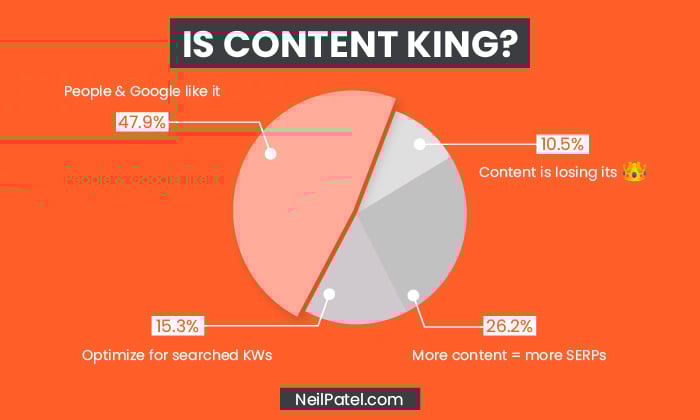
When you don’t start with the basics, you could be making content production more complicated than necessary.
To be successful, your content plan must be actionable, and you need to publish content consistently.
That’s where an editorial calendar comes in.
We’re going to cover the basics, including how to create and manage your editorial calendar, and how it can help your content strategy grow.
4 Reasons to Use an Editorial Calendar
An editorial calendar enables content publishers to plan, create, publish, and promote their content in an organized manner.
Many bloggers and businesses use editorial or content calendars to streamline content production.
In many ways, an editorial calendar is a lifesaver for creatives and business owners.
Whether you’re a blogger, freelance writer, business owner, or creative director at a marketing firm, an editorial content calendar can help you stay on track and keep you sane—while ensuring a consistent flow of content.
Others use an editorial calendar to improve focus because an organized approach can also limit writer’s block and keep content evergreen.
There are other ways you can benefit from an editorial content calendar, including:

1. Better Organization and Delegation
With an editorial calendar, you can see articles that need writing at a glance.
From there, you can delegate the articles to your writing team, ready for them to get to work.
No more scrambling to send writers topics at the last minute or wondering if you’ll even get around to writing this month.
With a calendar, it’s all right in front of you.
Ultimately, this level of organization saves time, keeps the content coming, and ensures every member of your content creation team knows what they’re doing.
2. Improved Planning
The better you plan your articles, the better the writing tends to be.
When you know what you want to write, you don’t waste time with last-minute research or trying to find the sources you need to support your article.
In fact, some consider planning to be more important than the content production itself.
Planning content is essential for:
- Creating the kind of content most suited to your audience.
- Writing the in-depth content your audience wants—and needs Publishing exactly when and where your customers hang out.
3. Helps Achieve Your Goals

Your editorial calendar is part of your content strategy.
Ideally, you’ve developed your content strategy around the goals you’re trying to achieve with your product, your blog, or your company overall.
An editorial content calendar assists in goal achievement by:
- Allowing you to meet critical milestones.
- Helping with promotional activities.
- Reaching new leads and making fresh conversions.
- Getting more newsletter sign-ups.Building awareness of your brand.
Whatever your goals are for your business, your editorial calendar has a vital role in allowing you to achieve them.
4. Sticking to Deadlines
According to Mark Twain, “deadlines are the greatest source of inspiration.”
However, that doesn’t mean you want to do a rush job.
To avoid rushing content creation, every team member needs to be clear on their deadlines to keep reaching your goals and your audience engaged.
Further, keeping up with these deadlines is especially important when you’re publishing new content that’s a part of your business strategy.
For example, if you are publishing blogs to support a new launch or annual sale.

How to Create an Editorial Calendar
Don’t let the thought of creating an editorial calendar stress you out—I promise it’s not that complicated once you create a plan.
This next section takes you through how to create an effective calendar, step-by-step.
This is just an outline, so feel free to adjust these steps to meet the needs of your business.
1. Determine Which Tools to Use
Your first step is deciding which tools to use.
This varies from team to team, and content managers may need a combination of tools for best results.
If you want free options for getting started, Google Docs, Excel, or Trello are popular choices.
For paid tools, there are several worth considering, including:
- Airtable
- Asana
- Monday
- BrightPod
Airtable, Asana, and HubSpot offer free content calendar templates to get you started, and there are plenty of others available, too.
Whichever tool you use, make sure it meets everyone’s needs.
As Buffer’s editorial director, Ash Read, told HubSpot:
“[your] editorial calendar should be a resource for your whole team, not just content creators.”
2. Create a Content Backlog
Next, you need to create a content backlog.
This is just a list of content ideas for easy viewing and lets you track your ideas for posts.
You could use Google Sheets or Excel for this, or one of the free templates mentioned, like Asana.
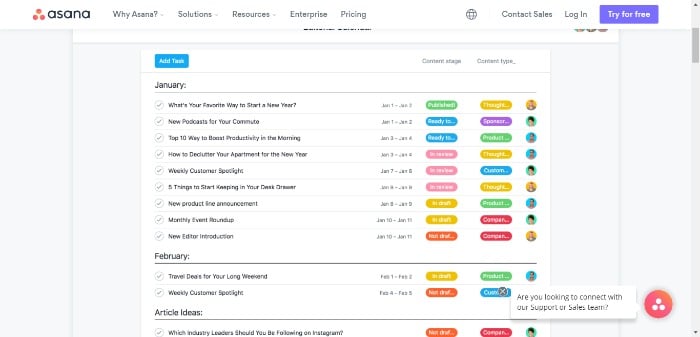
Whichever you go with, your chosen tool should allow you to create a clear, organized list.
Just remember, it’s OK to stray from your list.
Not every idea will end up as an entire post, and sometimes changing your content strategy is essential for keeping up with new trends or thinking of a new angle.
Create your sheet, then start adding a few headings like:
- title
- assigned author
- project status
- publication date
Other headings you could use are:
- Special dates and anniversaries.
- Themes and distribution channels.
- Trending topics/new launches relevant to your niche.
- Seasonal content and key sales dates.
For instance, Black Friday, where you may want to ramp up content production.
3. Develop Your Content Strategy
Don’t overthink your content strategy.
There’s a simple way of making sure your content strategy covers all the bases, and as long as you keep these parts in mind, you won’t go wrong.
First, outline steps such as how much content you want to produce a month, what topics you want to cover, and your ideal customers.
Then add strategic steps, such as managing your existing content and goal tracking.
These might include:
Define your goals:
For example, growing your mailing list or attracting new customers.
Understand your customers:
Which social media sites do your audience use?
Which content types do they prefer/respond to?
What are their pain points, and how can your products/services solve them?
Analyze your competition:
You can use a tool like Ubersuggest, which has a free and paid version to see which keywords competitors are targeting.
Positioning:
What makes your business unique, and how do you stand out in your marketplace?
You could do this in a few ways, like specializing in a targeted niche or telling your brand’s story.
Ask yourself how the content you’re creating can achieve this.
Estimate your budget:
How much is your content strategy going to cost you, and how can you maximize your ROI?
Measure your KPIs so you know your content is getting results:

For example, if you’re aiming to build brand awareness, an increase in shares and views will show you’re heading in the right direction.
4. Schedule the First Month
Many of us produce content at the last minute or create it whenever we have spare time.
If you’re looking for a less stressful (and more effective) approach, schedule your content in advance.
A month is usually enough, but you could schedule up to six weeks.
You can use Google Calendar for this.
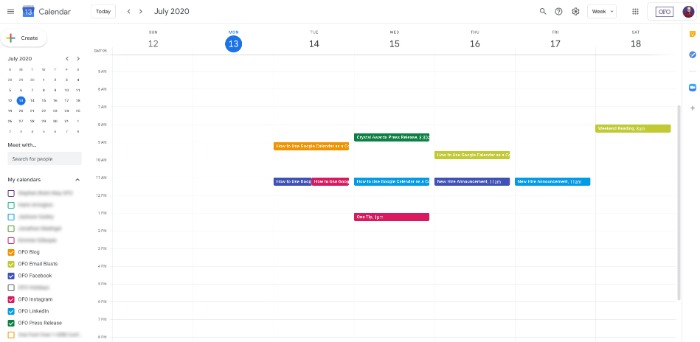
Add each step of your process, and make sure to give yourself plenty of time.
So, you might create a due date on the first Monday to write your outlines, then schedule one article a week to be written, two days for editing, set a publish date, then schedule it into your social media sharing calendar.
The process will vary based on how much content you produce and how many people are on your team, but I strongly recommend breaking each piece of content into more manageable steps.
5. Move Articles Into Production
When you’re in the full swing of producing content, it’s easy to let pieces slip through the cracks, especially if you have multiple people working on the project.
Creating a Trello account can keep you on track.
The first step in using your Trello account for content production is to decide what stages each article will need to go through.
What you need is up to you, but here are some suggestions for your Trello cards:
- assign to writer
- writing in progress ready for edits
- ready for uploading and scheduling
Alternatively, you could make it more complex and add additional steps like:
- final edits
- SEO audits
- published
Then your Trello cards might look something like this:

6. Build Your Content Queue
If you’re just starting with an editorial calendar, you need to get a few articles ready for publication.
Choose a schedule that suits you, but a forward-looking schedule of 4-6 weeks works well for most teams.
That sounds like a lot of work, but you can approach the task in two ways.
First, you could spend a few weeks writing content until you have a volume of work to publish.
However, this method isn’t suitable for everyone, unless you’ve got a team of writers to help you.
Another way is to spend a few months creating extra content every day, which is doable for most content producers.

7. Continually Optimize Your Process
So far, we’ve covered how to get your content production off the ground.
However, you can’t set it and forget it.
Over time, you might find there are bottlenecks in your processes or that certain tools don’t fit your needs.
Make sure to check in with your team regularly to ensure the editorial process you’ve created is working for everyone.
Common areas to review include:
- your schedule and the tools you’re using
- the volume of content you’re storing
- the time between stages the metrics you track
Over time, you’ll get a better understanding of whether the tools you’re working at are suitable for your team and whether the amount of articles you’re publishing is helping your business grow.
FAQs About Editorial Calendars
Why do I need an editorial calendar?
An organized approach to content production reduces time and helps you publish better quality content.
From ideation and writing to publishing and promotion, an editorial calendar helps streamline every part of the process.
Do I need paid tools to create an editorial calendar?
Not unless you want to. Free tools like Trello and Google Docs are fine, but there are also paid options like Asana available.
What headings should I include on an editorial calendar?
Not everyone’s calendar looks the same, but most marketers include titles, publication dates, and the article writer’s name.
Once you’ve added in the most obvious headings, write in the titles that work for your specific needs.
What’s the difference between an editorial calendar and a content calendar?
These terms are often used interchangeably.
However, an editorial calendar generally outlines each step of the process, while a content calendar usually covers one aspect—such as when posts are published or shared to social media.
Summary of Editorial Calendar Guide
An editorial content calendar is a must-have for any content marketer or small business looking to make the most of content production.
It helps you stay focused on your goals and produce high-quality content consistently.

Although it sounds like a lot of work, setting up a calendar isn’t difficult and allows you to seamlessly produce evergreen content while making the most of seasonal trends.
How do you use an editorial calendar?
Tell us below.
Source: neilpatel.com

B2B Content Marketing Measurement Tips for 2021 (Statistics & Research)
“If a tree falls in a forest and no one is around to hear it, does it make a sound?” is a philosophical thought that can be adapted to B2B content marketing as well.

“If I create great B2B content but can’t measure it, did it make an impact?” is the question marketers ask regularly.
What is the impact?
Am I capturing all the impact?
How can I optimize performance?
Measuring the impact of content marketing allows B2B marketers to optimize campaigns for better engagement and more effectively attribute ROI.
But what are the strategies, tactics, and trends behind measuring content marketing performance for B2B marketers?
To help answer these questions on measuring B2B content performance, Ascend2 and KoMarketing Associates fielded the Measuring Content Marketing Performance Survey between February 17 – 25, 2021. 193 B2B marketing professionals participated in the survey.
The research looks at what B2B marketers are doing to measure content marketing performance.
The survey findings are available in the research report, Measuring Content Marketing Performance: A B2B Marketer’s Perspective.
The key findings from the research on measuring B2B content marketing performance.
Here are key findings from the research on measuring B2B content marketing performance.
1. Determining ROI is the top challenge for B2B marketers when it comes to measuring content marketing performance.
Measuring return-on-investment (ROI) of content marketing is critical to optimizing a strategy, but nearly half (46%) of B2B marketing professionals consider determining ROI to be a top challenge when it comes to measuring content marketing performance.
44% of B2B marketers also face a lack of budget and resources necessary to effectively measure strategic success.

Determining ROI, the lack of budget/resources and insufficient data are the top 3 challenges of measuring content marketing performance.
Why is it so difficult to determine ROI?
The math is simple: revenue generated by content, divided by cost (production cost + distribution cost).
But for B2B marketers, how do you calculate the revenue generated?
Do you assign a revenue number for every lead generated?
Do you look at overall sales revenue?
How much did your content marketing impact a sale?
How do you value activities like email clicks, shares, page views, average time on page, etc.?
How do you track the metrics you need and convert them to a dollar amount that can do into an ROI calculation?
Here’s how to overcome the challenge of determining ROI:
- Outline a strategy of what metrics you need to track
- Figure out what technology you need to track those metrics
- Pul pull together the data into an easy-to-use analytical tool
- Decide how you will assign value/revenue to your metrics
- Track your costs.
Start simple and build as you learn from the data you collect.
2. 66% of B2B marketers find it difficult to measure the performance of a content marketing strategy.
Two-thirds (66%) of B2B marketers find it difficult to measure the performance of a content marketing strategy compared to one-third (34%) who find it to be either moderately or extremely easy.
57% describe this difficulty as moderate, while another quarter (25%) of those surveyed report that gauging the effectiveness of content marketing is moderately easy.
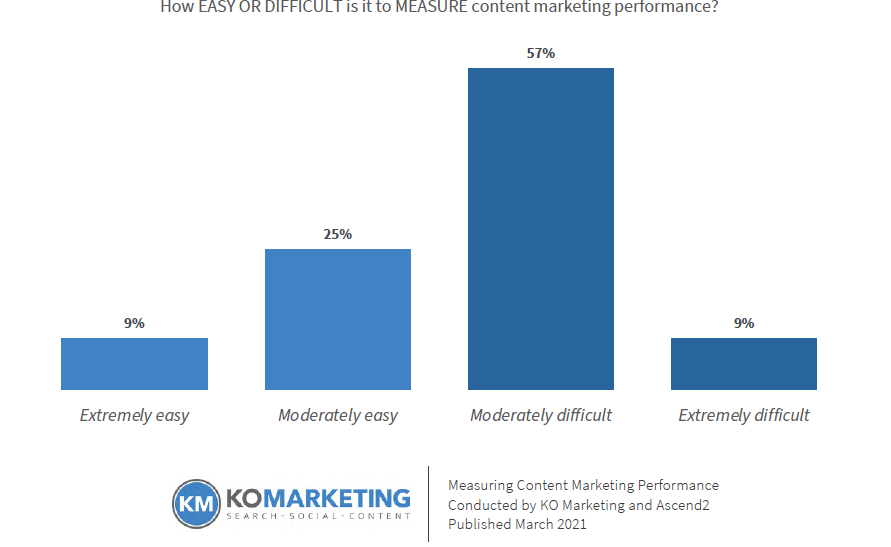
57% of B2B marketers find it moderately difficult to measure content marketing performance.
Don’t give up on your need to measure content marketing performance.
Content marketing is an investment that impacts your business strategy, branding management, audience engagement, and thought leadership.
We can all find cases on how content marketing made a significant impact on a major deal, reduced selling costs, or expanded your brand influence.
It may be difficult, but it is important to find consistent ways to measure and show the impact on your leadership team.
2. 37% of B2B marketers are using 3-5 tools for measuring content marketing performance.
Content marketing typically involves utilizing a wide range of channels across an overall marketing strategy.
One in five (21%) of B2B marketers report using six or more tools to measure content marketing performance.
Another 37% of those surveyed say they use between three and five tools, and 29% are measuring performance with two tools or less.
Marketing leaders need to embrace technology.
A strong stack of technology gives you more information about your audience, your clients (individuals or companies), and the impact of your campaigns.
Technology also allows you to be more efficient, organized, and agile as you track performance and report performance to the team.
4. Analytics tools, CRM systems, and marketing automation solutions are the most important tools for measuring content marketing performance.
Which types of tools are B2B marketers finding to be most effective for measuring content marketing performance?
Over half (53%) of those surveyed put analytics tools at the top of the list.
Customer Relationship Management (CRM) systems and marketing automation technologies are also critical to overall success according to 38% and 34% of B2B marketers, respectively.
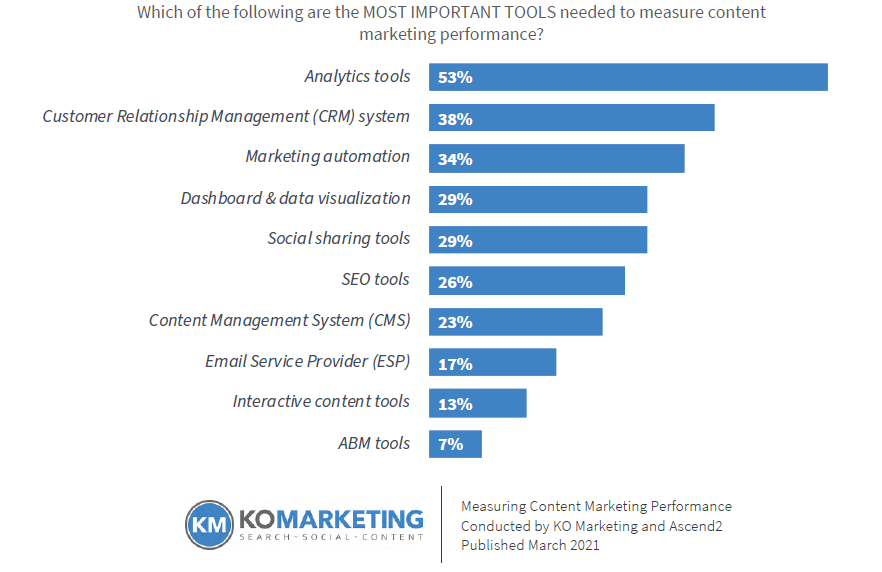
Analytics tools, CRM systems, and marketing automation solutions are the most important tools for measuring content marketing performance, according to B2B marketers.
Content marketing is data-driven.
Start with a solid setup of your Google Analytics.
Focus on four key areas:
- traffic,
- navigation,
- organic search,
- and conversions.
5. Conversion rate is the most important content marketing measurement metric, according to 50% of B2B marketers.
About half of B2B marketers agree that conversion rate (50%) and website traffic (46%) are among the most important metrics to consider when measuring the overall performance of a content marketing strategy.
Engagement on social media channels is also ranked high on the list of important metrics for 39% of those surveyed.
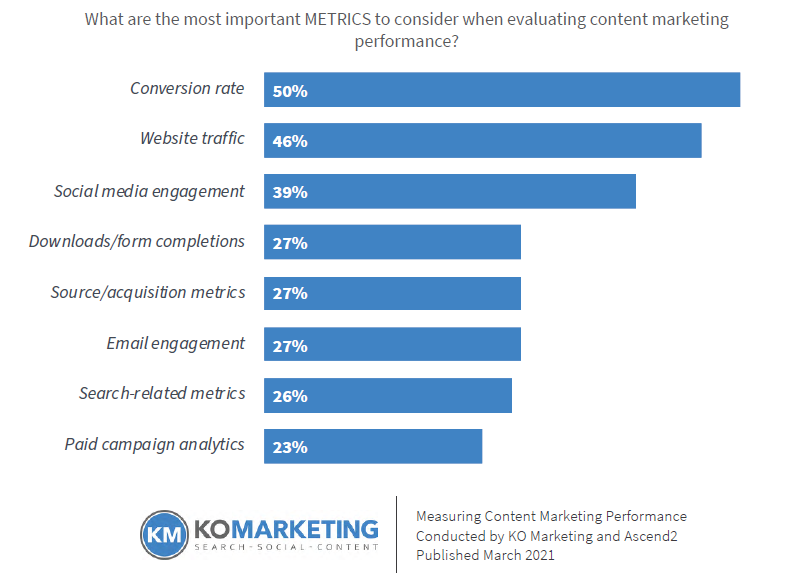
Conversion rate, website traffic, and social media engagement are the top 3 most important metrics, according to B2B marketers.
Don’t guess about the performance of your content marketing; instead, identify the data that matters most to your success.
Track and analyze performance to identify trends and adjust your strategy based on your findings.
Marketing optimization is never complete; it is an ongoing process.
Final Thoughts
Content marketing is essential to successful B2B marketing, so measuring performance is a priority.
Download Measuring Content Marketing Performance: A B2B Marketer’s Perspective for research-based strategies, tactics, and trends for B2B content marketing in the year ahead.
The post B2B Content Marketing Measurement Tips for 2021 (Statistics & Research) appeared first on Content Marketing Consulting and Social Media Strategy.
Source: convinceandconvert.com

Your Whole Website is Part of Your Content Marketing Strategy
It’s almost inevitable. We sign on a new client who is looking to create an amazing content strategy.
We have a kickoff call and they tell us, “Yeah, we just launched a new website and now we’re ready to really dive into our content marketing strategy.”
My heart sinks.
They just launched a new site, and now they are thinking of a content strategy.
It’s like going fishing.
The content strategy of new thought leadership is the bait, but then the hooks and poles that are the rest of the website are afterthoughts.
For so long, we’ve focused on blog and video content as being the pillars of content marketing.
The thing is, they’re not.
Your website — the information architecture that makes up your entire navigation and user flows — is essential to your content marketing success.

If the navigational systems on your website don’t make sense and are not optimized for search, you could risk losing out on potential traffic and conversions.
Without hooks and fishing poles, you’re not going to catch any fish, no matter how many you feed with your bait.
Discover the strategy behind information architecture, and how you can optimize your site for more user engagement and inbound traffic.
Your Content Strategy Starts with Your IA
Before you can write and publish any content on your site, you first need to understand the type of content that will entice your target audience – and how you’ll organize it.
That’s where your information architecture (IA) comes into play.
This is simply how your site’s visitors will find the content they need and complete actions (conversions) on your site.
Your IA controls the ways your content is:
- Organized within the navigation bar
- Labeled in breadcrumbs and other links
- Navigated from various other pages
- Searched for by users

“When we set up our new site, we knew that we wanted it to be optimized for search and conversions from the beginning,” says Nick Phillips, co-founder of Kids Art Box, a subscription box service, “The key to doing this was to start with a solid information architecture.”
Is IA the same as UX?
Information architecture and user experience are similar in that they are both tools to create a positive experience for visitors to your site.
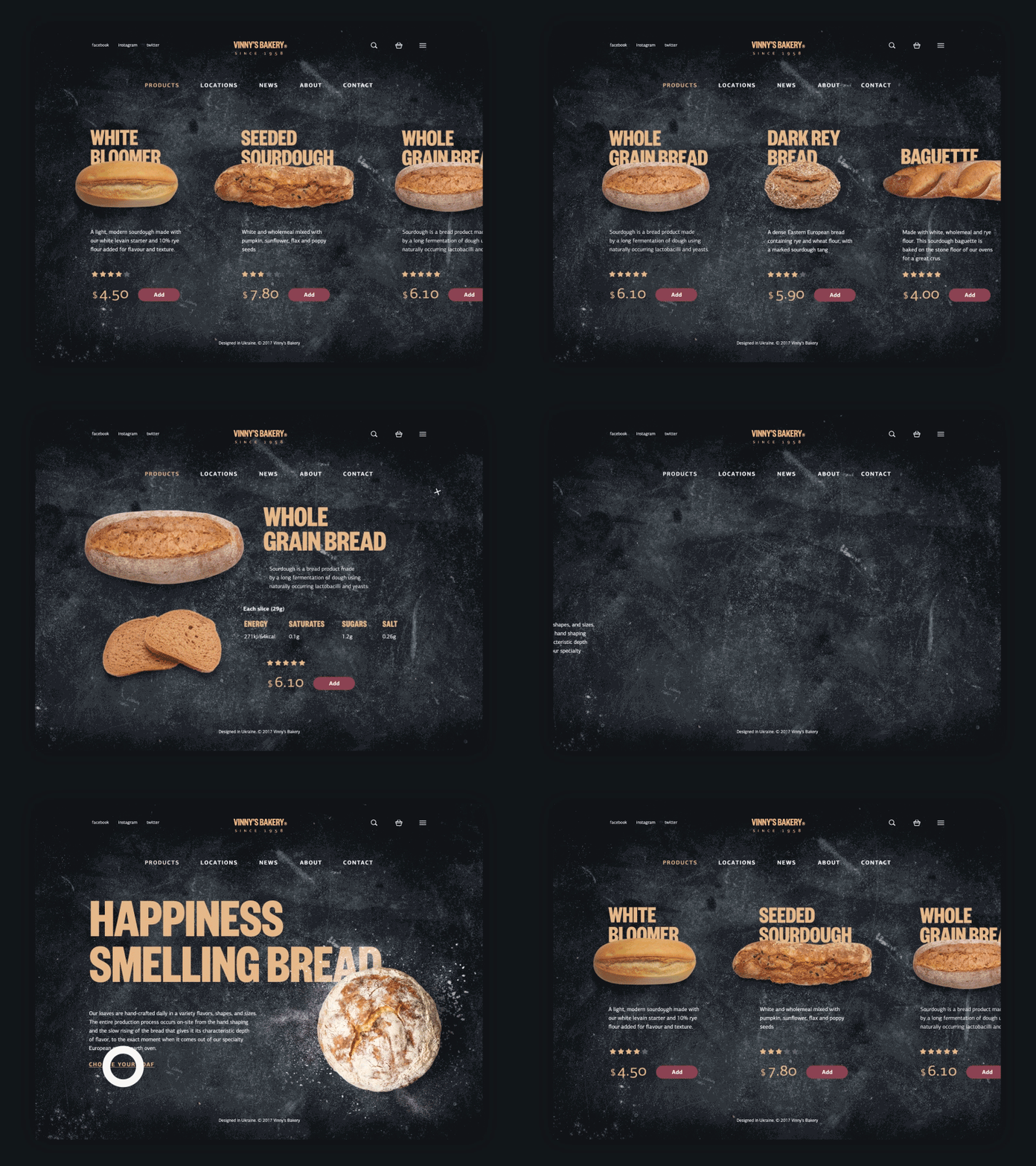
However, IA needs to be established before a UX designer can start creating pages.
Content strategists generate a website’s IA into sitemaps.
Then, a UX designer can utilize that plan during their website creation process.
As a team, marketers and web designers can build an enjoyable and easy-to-use architecture for their users.
The goal is to make it as easy as possible to navigate through your site.
Businesses everywhere can benefit from strategizing their site’s information architecture.
If users visit your site and can’t find the information they’re looking for, they’ll most likely leave and find their solution with one of your competitors.
This can impact the bounce rate on your site, leave a negative experience with the user in how they see your brand, and most importantly, result in a lost opportunity for a new customer.
How the Sales Funnel Should Fuel Your Site Structure
Understanding the sales funnel and how potential customers move through that process is crucial to designing the information architecture on your site.
Your IA represents the solutions you have to offer customers, which Google and users will consider pretty far down the funnel.

When users visit the main pages on your site (such as product or services pages), their intent is most likely to make some kind of buying action – whether it’s to actually buy something online or to fill out a lead form.
These pages will often have high conversion rates. However, you must focus your content on the right type of keywords – those that are closer to the buying stage rather than the thought leadership stage. You need the right hooks.
Your actual blog and owned media content will mostly be focused on thought leadership topics.
It will provide people who are higher up in the funnel with useful information they can use to narrow what they’re looking for.
To come up with blog ideas, consider topics that are specific to your niche, something that a repeat customer would like to know.
This can include tips on how to use the products you sell or news that is specific to your industry.
Marrying this thought leadership with the actual pages on your site and understanding how they interact can help you identify the paths of least resistance.
Figure out where your visitors are in the sales funnel and provide content that matches their intent.
When you have this in mind, you can present calls to action and other navigation to hook them and guide them through the journey.
Your goal is to discover what it takes for someone high up in the funnel to read a blog post, stop by more pages, and then be encouraged to say, “Yeah, I’m ready to buy.”
“Tightly knitting together new thought leadership with existing, optimized product/services pages are essential to the success of a content marketing strategy,” says Melissa Dreyer, Director of Marketing at STANLEY Access Technologies,

“Without these two components working together, you could end up with a lot of traffic, but not a lot of conversions.”
Tips for Presenting an Organized Site
Information architecture may seem complicated, but it’s easier to put together than you think.
You just have to consider what makes the most sense when organizing the pages on your site.

Consider these tips to help you start building your site’s IA:
- Keep it simple. You want the process of navigating your site to be easy and straightforward. Don’t add unnecessary distractions that keep your users from finding the button you want them to click, the form you want them to fill, or most importantly, the answer to their query.
- Simplicity goes for the navigation bar, too. Keep your navbar simple and not overcrowded. A good rule of thumb is to keep the main navigation under seven items. Your page groupings should make sense and relate to one another, like service offerings or information about the company.
- Be strategic about internal linking. Invite your site visitors to learn more or take a step toward a conversion by presenting them with links to click through to product and service pages or your Contact Us page. These hooks can take people from “just browsing” to consideration pretty quickly.
- Research your industry. Take a look at your competitors to find out what the industry standards are for presenting and organizing your content.
Phillips states, “Our site started from ground zero, and in just a few months we’re already ranking in the top 10 for a number of competitive keywords we thought would take a year or more to rank for.
The research and effort put into the IA paid off very quickly.”
Please, Please Start Your Content Strategy with Your IA
To make your business more visible online and more successful with customers, you must begin with a strong marketing strategy.
When you put careful thought into your content strategy – starting with your information architecture – you can not only make an impact by delivering real value to your industry, but you can also catch a lot of new business – which was always the point, right?
The post Your Whole Website is Part of Your Content Marketing Strategy appeared first on Content Marketing Consulting and Social Media Strategy.
Source: convinceandconvert.com

Content Marketing Services | The Complete List for a Successful Digital Strategy
As your online business grows, it becomes obvious how important content marketing is for your business. And even if you’re the one working on your business strategy or you hire an agency to help you out, one thing is clear: you need to know the full list of content marketing services your company needs.

Before saying that you don’t need to bother with this because you will hire a specialized digital agency to take care of all this, take this scenario:
You get a great offer from the freelance or agency, saying that they will take care of everything content related to you.
That sounds appealing, yet, how can you hire them if you don’t know what they are supposed to deliver?
Once you know what a complete list of content marketing services looks like, you’ll be able to set expectations, measure the efforts of the company you hired, and better understand the results.
Top Content Marketing Services
So, here are the top content marketing services business owners should be aware of:
- Content Marketing Strategy
- Use Keyword Research Tools
- Check the Top-of-mind Keywords
- Look for Seed Keywords
- Prioritize the Keywords You Want to Rank For
- Select Top Keywords
- Content Creation
- Content Distribution
- Link Building
- Social Media
- Community & Relations
- Constant Content Update
- Content Analytics Reporting
- Organic Search Traffic
- Keyword Rankings
- Social Shares
- Backlink Volume
Content Marketing Strategy
A good content marketing strategy should respond to the question of why.
Why do you want to create content? For whom? Why will your content be different from what already exists?
Content marketing strategy means more than a content strategy.
This last one is focused more on content creation, which we are going to talk about later.
First thing first, you need to clarify what do you want to achieve with content marketing:
- Increased traffic?
- More leads?
- Educate customers?
- Increase online presence?
If you’ve been watching the trends lately, you’ve seen articles piling up about content marketing and how it’s changing the SEO game forever.
It seems that Google is dead set on providing visitors with pages that have the most relevant content to their search and the trend of creating quality content to be more relevant to your target audience seems to become more of a need than a game played only by the cool kids.
More and more SEO professionals are boarding this train and it’s no longer to be believed a hype and a way to reinvent the so-called “dead SEO”.
Once you got the “why” question responded, you can go to the next step within any content marketing strategy, keyword research.
You don’t want to write just for the sake of writing, right?
You want to create good content that will reach your audience.
But to do so, you need to know what topics to tackle and what keywords you can create content for.
So, check out the next steps, which are foundation stones for all the other content marketing services.
Use Keyword Research Tools
Finding keywords shouldn’t be hard, yet it’s not a walk in the park either.
In the modern SEO landscape, a keyword research tool is not just a passing trend but a must.
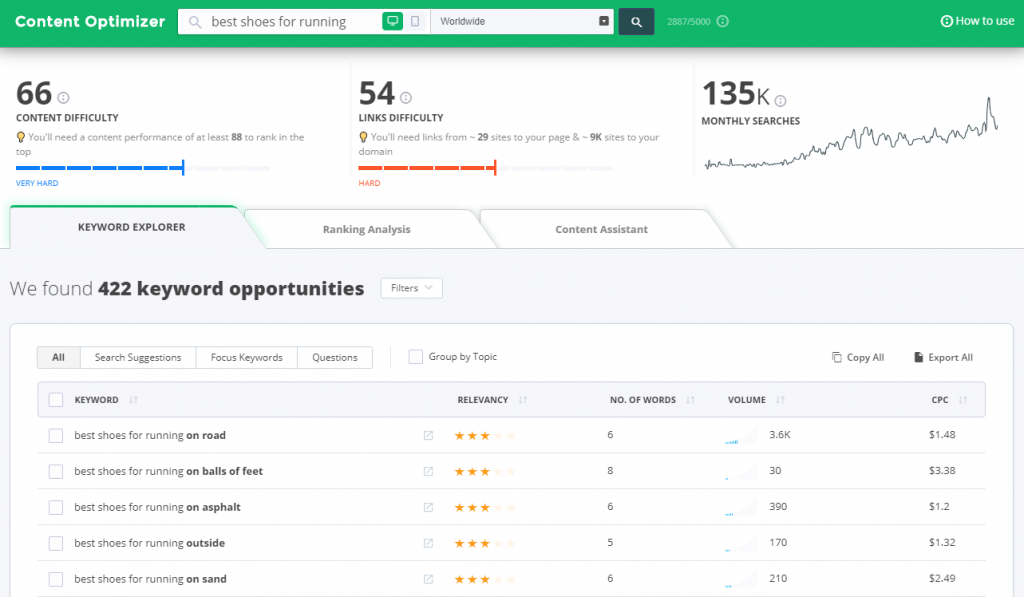
The Keyword Tool and Content Optimizer is an awesome helper on this matter.
It’s like your best buddy you can call in the middle of the night to get you out of trouble.
You can find new topic ideas and keywords related to the one you are targeting.
You’ll be able to make an idea of how difficult it is to rank for those particular keywords.
It also shows you how relevant other keywords are compared to the current ones.
When you perform the market research, it’s best if the keywords you’re trying to rank for have a high search volume and a low difficulty.
High search volume means the phrase is popular and many people are typing it in their browsers.
Low content and links difficulty means that it is fairly easy to rank on that keyword without many links or highly competitive content.
Combining these three metrics will result in profitable phrases that are easy to rank for.
Why any analysis should start with keyword research?
Because if you don’t know the keywords you want to target, you can’t possibly know your true SEO competition.
This step will also determine what level of difficulty you wish to perform the analysis at.
For example, let’s assume that we’re performing online marketing in the shoe business and wish to open a web store.
Depending on our budget, we can either start targeting very high search volume keywords or lower search volume keywords.
Keep it realistic.
It either takes money or time to get there. In fact, it takes time in both cases given you’re working with organic search.
Without a strategy, content is just stuff, and the world has enough stuff.ARJUN BASU Award-nominated author
The trick with ranking is not to force it.
When everybody’s trying to rank for the same keywords, there’s not much room for long-term development.
This is where you can improve and find keywords semantically related to your niche, but not necessarily used by your competitors.
Check the Top-of-mind Keywords
Top-of-mind keywords are phrases that pop up in your head right away when you think about a niche.
It’s like a brainstorming process.
They are also frequently called seed keywords.
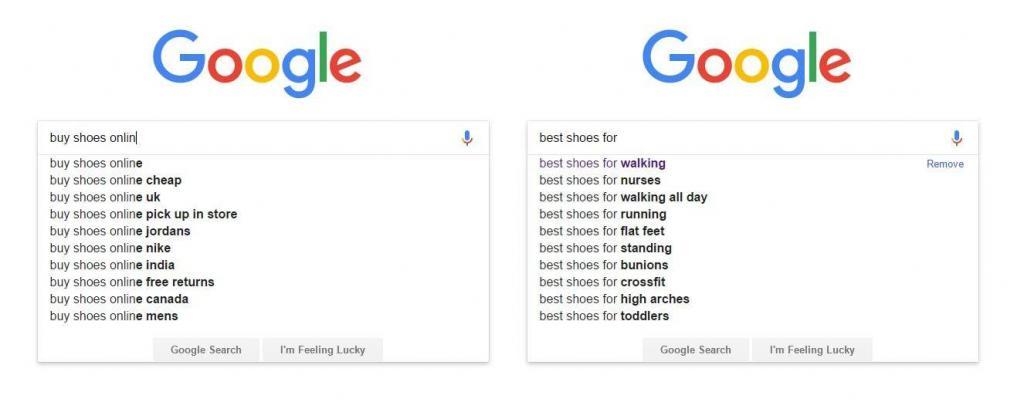
You can use the Google search engine to get real-time suggestions.
Simply go on Google and start typing your keywords, and new ideas will appear right under the search bar.
A highly competitive keyword would be, in this case, “buy shoes online”.
Phrases with the word “buy” in them are called buyer’s keywords or transactional keywords.
They are usually the most competitive, as we know from the phrase itself that people are already set to buy the product.
Ranking for those keywords practically guarantees that some sales will indeed be made.
Where sales are guaranteed, big players come.
A lower competition keyword can be “best shoes for …”.
More niched phrases tend to be less competitive.
One reason might be the fact that they are untapped, meaning that not many people actually discovered them.
They are called longtail keywords.
Review and comparison sites often try to rank here.
People are still inclined to buy, but for the moment, they might just be looking to compare products or find ideas.
Look for Seed Keywords to the Keyword Explorer or Google Keyword Planner to Get New Ideas
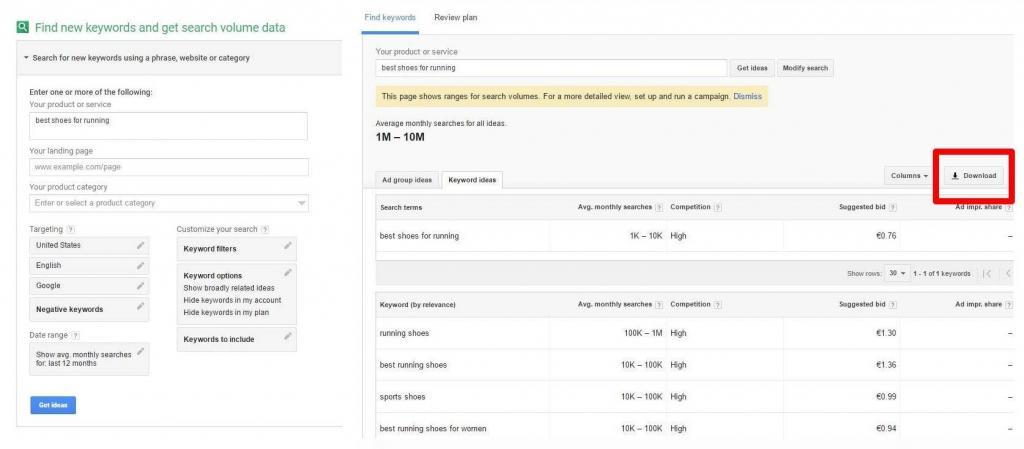
Use the seed keywords you acquired from the previous step to generate a list of keywords.
You can go classic and use the Google Keyword Planner, though data is limited if you don’t have a paying PPC management account.
You can try multiple keywords here, export the data as CSV, sort the keywords, and add some to your list.
cognitiveSEO’s Keyword Tool can give you tons of keyword opportunities.
It works like a content marketing agency that will work on most of your marketing plans, your pieces of content…you got the idea of your whole marketing effort in general.
You can check out for questions people are looking for an answer on Google.
You can filter the keywords ideas by volume, relevancy and so on, so you can find the best keyword opportunities for you.
Prioritize the Keywords You Want to Rank For
Now comes the more difficult part.
For which of those keywords can you realistically rank in top Google search?
After you’ve determined a list of keywords you’ll go after, you have to take a look at two things:
- Content Performance and
- Domain Performance.
You can use the Ranking Analysis section of the Content Optimizer Tool.
Let’s take as an example the keyword this article is talking about: content marketing services.
You can easily see a lot of important metrics, just one click away:
- how many links would this article need to be competitive?
- what is the monthly search for this keyword and how’s the searching trend for it?
- who is ranking in the top 10 and how do their content look like?
- how old/fresh is the content already ranking?
- what focus keywords did my competitor use within their content?

While Content Performance is something that we have control over and will improve in a future step, backlinks aren’t something we have that much control over.
So, you want to see websites with a few referring domains as possible as compared to your site (which you can check with the Site Explorer).
Of course, if you see a lower content score and/or word count, those are also good indicators that it will be easier to create content for or improve existing content.
Select Top Keywords Based on Relevancy and Search Volume
For the purpose of this analysis example, we’ll just stick to these keywords: “buy shoes online” and “best shoes for”.
One is broader and the other is narrower, but both are attractive in terms of relevance and search volume.
Let’s assume that we start from the bottom (narrower keywords), but leave room for expansion in the future (broader keywords).
From these two keywords, we can observe that the broader ones tend to return root domains as results, while the narrower ones return pages from websites.
This is a good indication of what our homepage should be targeting, and what we should target with pages.

The final list should include keywords around your general niche and some current or possible (future) sub-niches.
You can group them into separate sheets.
This way you’ll be able to select top competitors from multiple sub-niches easier.
The more keywords you’re willing to analyze, the better you’ll understand what you’re dealing with in the long run.
You can use the Google Search Console to easily determine the keyword you’re already ranking for. (the below screenshot is taken in June 2020).
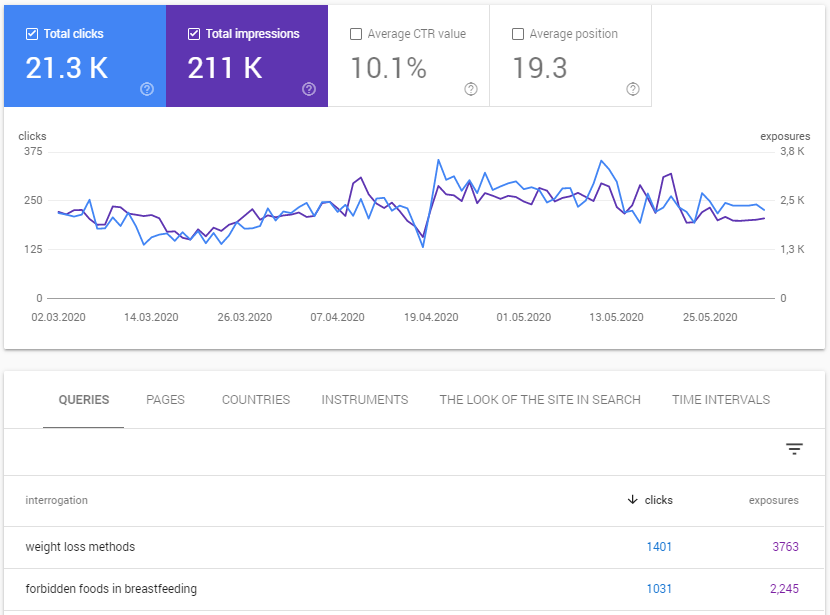
- Can you improve this existing content?
- Or should you target new keywords?
These are questions you should ask yourself when putting together your SEO content marketing strategy.
Content Creation
No worries, compared to the previous section, content creation will feel like a breeze among the content marketing services list.
First, consider that it’s always best to consider landing page optimization for a single main keyword and a single search intent per page.
You can sometimes combine very similar keywords, but try as much as possible to stick to one main keyword and one search intent. Feel free to find out more about search intent here.
A great way to do this is to write content about questions that are very often asked in your industry, or case studies.
For example, this article about meta descriptions affects SEO or not has been linked to multiple times by other SEO blogs trying to make a quick point without getting into too much detail.
Write content that stands out and is share-worthy.
While doing so, also make sure to:
- Have great Titles, Headlines and Descriptions.
- Optimize your titles with keywords for SEO, but also keep them catchy for Social Media.
- Use the Open Graph property to set different titles for SEO and Social Media.
Longform content tends to perform better in organic search results.
Yet, look at what type of content your competitor have.
Is it long, short?
What type of content is Google serving within its first page for the type of content you want to rank?
You keep on hearing: write content having readers, but also SEO in mind. But what does this really mean?
We can spend a lot of time debating that, or we can use a tool that will help us write that exact type of content.
As time is so precious these days, I’ll choose the second option.
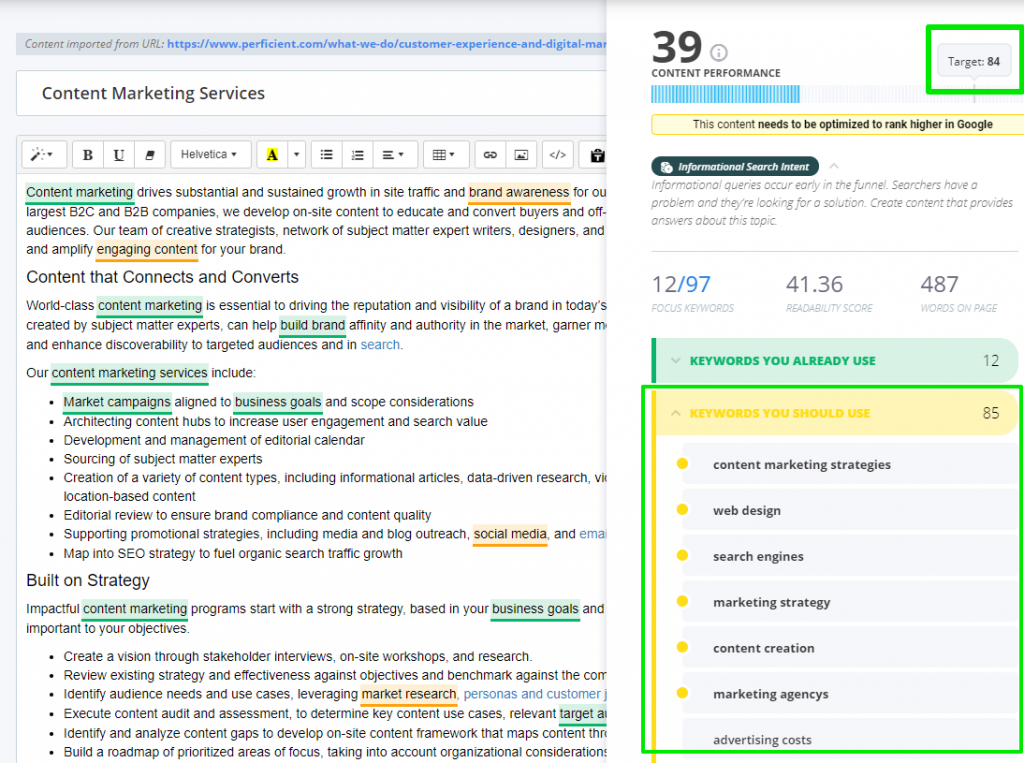
Open the Content Assistant section from the cognitiveSEO’s content optimizer and hit Start Optimizing.
Once you do so, you’ll get everything you need there:
- the keywords you should use in your content
- the content score you should reach
- keywords ideas to use in your content
- the focus keywords that might help your content with ranking
- the keywords you shouldn’t use that much to avoid stuffing
Basically, you’ll get all the resources you need to write content that is relevant for your users first of all, but also SEO oriented.
The idea is to think of the recommended keywords as subtopics or areas of interest that you should cover in your content.
When people search for something, you already know they are interested in it. That’s why SEM has such a high conversion rate and people spend time reading in-depth articles.
Regardless of the tools you’d be using, keep in mind that the best tool you have at your disposal is your own knowledge.
You should keep in mind that writing naturally is the best way to go.
I know: writing original content regularly might not be easy.
Moreover optimized content.
Even if you’re a marketing expert that wants to improve brand awareness, an account manager or search engine optimization, writing with SEO in mind is never easy.
There are no perfect marketing guides that will drive results in no time.
And copywriting implies extra marketing costs, video content creation costs, maybe website design, content promotion and so on.
Yet, when creating your monthly reporting, you’ll check the return on investment and you’ll see that those marketing efforts did pay off.
That monthly content and those business goals you struggle with, those SEO audits, all bring great results.
Content Distribution
The journey shouldn’t stop when the article goes live.
On the contrary, you should carry on with the process of boosting your content.
You need to understand that content distribution isn’t a single technique or a one-time thing.
It incorporates an umbrella of multiple unique techniques you need to follow in order to get better results.
We all had that moment when we gave our soul into a post and made it so shiny, with thorough research, relevant visuals but nobody read it.
And then you start wondering what went wrong.
What in the name of God happened?
Or why did it happen to you?
And the questions could go on.
But there is something that you missed. And that “something” could be content distribution and amplification.
Content distribution is a powerful method to reach a wider audience.
Amplifying your content should be mandatory if you want people to know about it and increase your website traffic.
You can look at the distribution process as a way of strengthening the signals of your post. And here are some channels to do so:
Link Building
If in the past, the traditional ways of building links meant to meaninglessly spread out all over the internet, without thinking of relevance and essence, through the help of web directories, blogrolls, keyword stuffing and others, now we need to think of our target audience.
Things have changed now, but links are still an important ranking signal and they are very helpful when trying to rank high in the search engines.
It’s a harsh reality but link generating through content marketing will surely become harder and harder.
Yet, harder doesn’t mean impossible.
Use blog posts, videos, infographics, eBooks and so on. Create resources that are valuable and that will earn links.
Also, don’t forget about internal linking.
If you’re looking for an SEO move that can quickly boost the position of your website, then internal linking is the move you want to make.
A proper internal linking strategy can really boost your ranking power because it does two things:
- #1: It helps search engines understand the structure of your website, how different pages interact with one another and which pages are truly important within the structure of your website.
- #2: It helps users navigate the website and it keeps users on the website by providing relevant content through links that can be followed. This ultimately sends search engines another signal that your website is great because it provides a good user experience.
If you’re interested in some valuable link building lessons, wrote from experience, check out this article.
Social Media
I know it and you know it.
The internet has become so fed up with marketing strategies, that people become immune to content in its mediocre form.
Influencers from all marketing channels are no longer impressed so easily, and in order to put your brand “in their mouth,” you need to do some wheel greasing.
So that’s why super important to create content that it’s worth sharing; content that “has something to say”, that brings added value.
Invest in social media marketing as much as you can.
Get dedicated account managers or marketing manager if possible.
There are many social content marketing companies that are offering good services, just make sure to get the right one to grow your business.
There a lot of tips and tricks on how to perform better on social media.
You can consult blogs like BrandMentions‘ one for this.
Promote your content as much as possible but on the right social media channels for your niche.
Use paid media and social media advertising (like Twitter or Facebook advertising) if needed.
Make use of partner programs, press releases, custom content, go for influencer marketing if needed.
Yet, it is highly important to make yourself visible on social media.
Even if this implies some graphic design activities or video production to steal your potential customers’ attention.
Social media management is as important as writing optimized pieces of content when it comes to building your brand.
Community & Relations
When I think of content marketing, a line from the movie Jerry Maguire comes to mind – Help me, help you!
We’ve seen common outreach methods of content marketing like guest blogging being abused in the past because people misunderstood the idea behind it.
Generating links through content marketing is not about trying to beg for them, it’s about creating relationships with other businesses and people that reside in the online medium.
You can no longer strive for the number one spot in Google’s eyes if you can’t create new pals that are willing to talk about you and share your content or vice versa.
“Link begging” your way out of a situation will do you more harm than good so we don’t recommend that.
There’s one way out of it and that’s creating content that others might find interesting enough to share with their audience.
Organic Links are a “hard to get” commodity these days and you’ll be happy to find and keep connections with influencers that like and distribute the content that you create.
In order to help yourself, you need to attend to the needs and interests of others first!
When you can’t create engaging content on your side of the street, try going to the place where the discussion is currently happening.
It may sound like a cheesy tactic but I assure you it’s not a laughing matter.
You may include comments in your content marketing strategy as you can generate links and help the community at the same time, in real-time.
Comments are a great way to:
- create meaningful content
- connect and engage with your target audience
- create links pointing to your site in a natural manner.
Comments can prove to be a blade with two edges and you need to treat it with care.
Try and find the most important forums in your niche and where the discussions are taking place.
Look at what people are asking and what questions they have.
As long as you stay on topic and your comments are not only meant for link building, then you won’t have anything to worry about.
Above are just a few content distribution ideas.
For even more ideas for amplification, check out this article.
Constant Content Update
What if I were to tell you there’s another way, besides tapping into that creative juice barrel?
Nobody expects you to create original and engaging content all the time.
You just can’t create quality content on an assembly line and everybody knows that, and no, you shouldn’t resort to gimmick techniques to win your target audience’s attention.
What you can do is recycle outdated content that may still be of interest to your target audience.
Some content has been generously created in the past and widely distributed, but that doesn’t mean you cannot use that already developed interest to your advantage.
Those infographics that were widely distributed and shared, which created a lot of discussions over the internet can be refurbished using the same layout and the same structure but with fresher and more relevant data.
You can also improve old content by adding more information and thus more value for the viewer.
While this might be appealing for those looking for a shortcut method of generating the content, it should be part of a balanced diet.
It seems easily exploitable, but if done improperly, you might end up feeding your site with low-quality content.
We’ve done an interesting experiment some time ago:
We’ve updated 40 blog posts with fresh, updated information.
The result?
70% SEO visibility increase.
So, it could be a tactic that could work for you too.
You can check out the case study here.
Content Analytics Reporting
You know the saying. No job is done until the paperwork is done.
In our case, not literally paper, but reporting the results.
This is an equally important part of the content marketing services list.
So, you’ve created a content marketing strategy; you’ve written awesome content or updated the existing one, you’ve highly distributed.
Now, what’s to do?
Check out the result!
But what should you check?
Measuring content marketing and SEO efforts is often easier said than done.
Yet, here are some metrics you should definitely look at.
Organic Search Traffic
Organic search traffic refers to website visits that originated from search engine results and not through ads.
Organic search traffic is a highly effective indicator of overall success.
When a website’s content includes keywords that frequently match what users are searching for, that website is likely to appear in a larger number of search engine results pages (SERPs) than competing websites.
Using Google Analytics, open the Acquisition menu.
From there, select All Traffic, then select Channels.
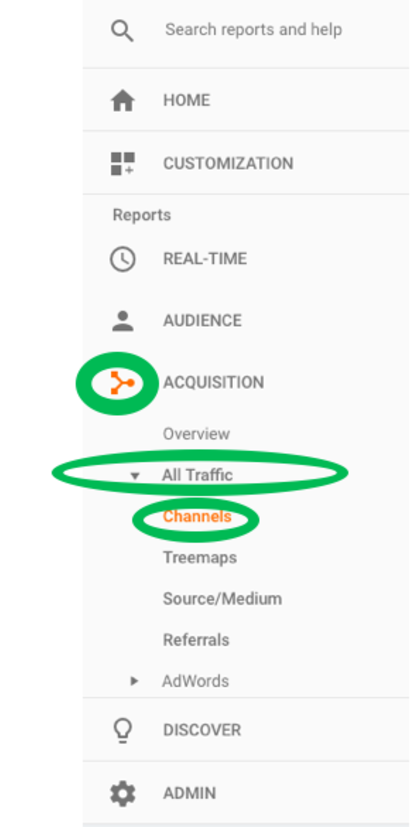
You’ll now be presented with a view of a website’s sources of traffic, which are sorted by channel.
Select the Organic Search channel for a useful report that displays a site’s organic traffic stats.
This report is a versatile one. It gives SEO practitioners the ability to uncover critical information such as:
- Which landing pages are the most effective at attracting traffic
- Which keywords are delivering the highest amounts of traffic
- Which of the search engines are directing the highest amount of organic traffic to a website
- What pages are frequently the biggest exit pages (or the last page a visitor views before leaving the website)
- And many other vital stats
Keyword Rankings
Keyword Ranking is how well or how poorly your content ranks in SERPs for a given search term.
Google Analytics isn’t as helpful as some SEO practitioners would like it to be as far as tracking keyword rankings.
Its keyword tab (within the campaign tab) often displays the phrase “not provided.”
Instead of Google analytics, consider the rank tracker provided by cognitiveSEO.
One of its advantages is that it allows you to track keywords at a universal level as well as at a local level.
It also allows you to analyze the keyword performance of competitors.
So, add your keywords you created content for within the Rank Tracker and constantly check out the evolution.
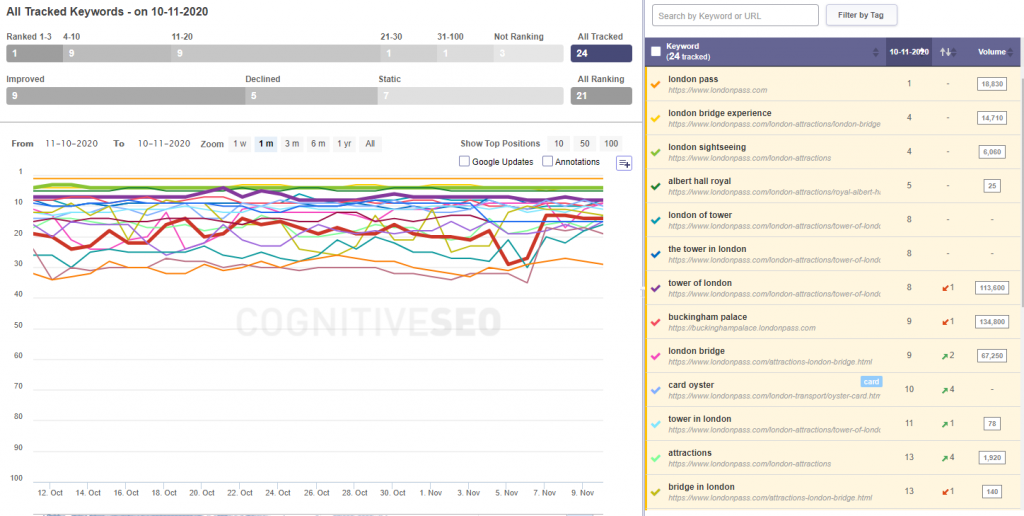
Social Shares
Social shares can be defined simply as the sharing of your content by social media users.
While it’s generally thought that Google does not take social signals and shares into consideration when ranking SERP results, social shares are still very important to your SEO efforts.
Tracking your social shares is beneficial because of the important impact social media plays in content marketing strategies.
As more people share your content with their followers, the higher the chances that more people will view it and ultimately migrate over to your website.
More visits to your website mean a boost in organic search ranking.
Backlink Volume
Useful for measuring the authority and popularity of your website, backlinks (often referred to as inbound links) are links to your website that originate from someone else’s website.
Backlinks to your site can also originate from other pages on your own site.
Measuring this performance indicator will go a long way in helping you rank higher.
By tracking it, you’ll always know where you stand with what some in the SEO industry view as the most important ranking factor used by Google.
When you know whether you’re succeeding with your backlinks, you know how much you need to improve by.
Using Google Analytics, open the Acquisition menu. From there, select All Traffic, then select Referrals.
You can now look at your referral traffic, which is Google’s way of saying “backlinks.”
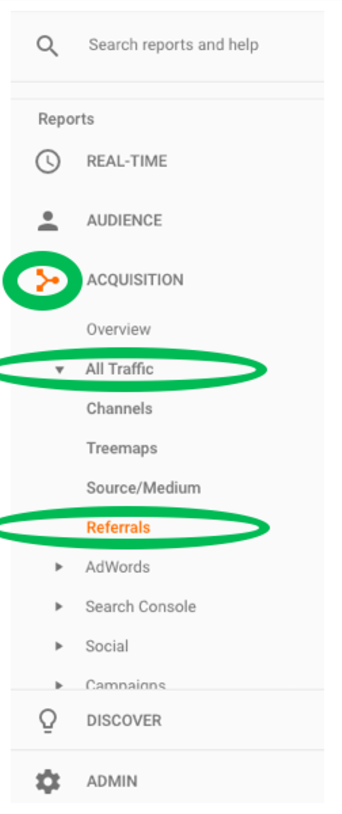
Also, for a comprehensive backlink analysis tool, cognitiveSEO aggregates backlink data from trusted link databases and analyze the links on demand for each of their clients.
I know, there is a lot of information from the digital marketing area to deal with.
But even if you’re one of the ones who’ll be implementing all the content marketing services above, even if you’re hiring a marketing agency, it’s important to know what’s all about.
If you or your marketing team are out of breath after reading this post (or worse yet, discouraged,) don’t be overwhelmed!
Take heart, force a smile, and accept the fact that victory never comes easy.
I know, lots of things are involved:
- technical SEO,
- marketing budget,
- web design,
- content calendars or advertising costs.
But it does pay off in the attempt of building a brand that is strong and competitive.
Success and competitiveness are for those who are willing to work harder and get their hands dirtier.
The bottom line here is that you can do this, and it will be worth it.
The post Content Marketing Services | The Complete List for a Successful Digital Strategy appeared first on SEO Blog | cognitiveSEO Blog on SEO Tactics & Strategies.
Source: cognitiveseo.com

8 B2C Content Marketing Statistics and Trends for 2021
As we dive headlong into 2021, let’s take a look at a few B2C key content marketing statistics and trends that will help us plan for the year ahead.
When we build strategies for our clients at Convince & Convert, we usually help them plan for the next 12-24 months.
However, in this incredibly unusual pandemic period, it feels like we are often changing gears every six months to keep abreast of current considerations and market conditions.
I’m sure you feel it too: the only certainty is change.
Yet, there are absolutely things we can learn from the changes and shifts within our industry.
And we can use those lessons to prepare ourselves for what may come.
That is why I’m so grateful that our friends at Content Marketing Institute and MarketingProfs produce their long-running annual report,
The most recent of which–B2C Content Marketing Benchmarks, Budgets, and Trends: Insights for 2021–allows us to look at both this moment in time and the historical trends.
If you’re a B2B marketer, be sure to read my takeaways from their B2B report.
Full disclosure: I often speak at CMI and MarketingProfs events, and MarketingProfs is a former client of my company Media Volery. However, all opinions in this piece are mine.
B2C key content marketing statistics and trends
As we dive headlong into 2021, let’s take a look at a few B2C key content marketing statistics and trends that will help us plan for the year ahead.
1. More than 80% of B2C content marketers saw budgets stay the same or increase in the second half of 2020.
It may be counterintuitive, but a majority of B2C content marketers saw their budgets stay stable or even increase over the last year.
My assumption would be that because content marketing tends to be used more often in the case of higher ticket goods and services, those consumers may have been less economically impacted by the pandemic.
Indeed, they may have had more disposable income to spend in 2020 with less travel and activities available.

In 2021, while I believe that many B2C brands may be able to spend similar budgets, I urge you to be thoughtful and flexible about how and where you spend that budget.
Instead of events, you may spend that money on influencer campaigns.
Instead of experiential marketing, you may focus on the fundamentals of email marketing.
Things can still change on a dime; having flexibility, rather than discreet line items, will make the process smoother.
2. Content marketing teams are stable; most teams stayed the same size or even grew.
As with budgets, we saw that on the B2C side, the majority of content marketing teams stayed the same size, and more than a quarter (27%) increased in size over the last year.
This stability indicates that content marketing practices, on average, are mature and valued enough within their organizations that they’re continuing to see growth.
Thinking through the roles and skills that would be most useful for your team in 2021 should be a key part of your budget and planning considerations.
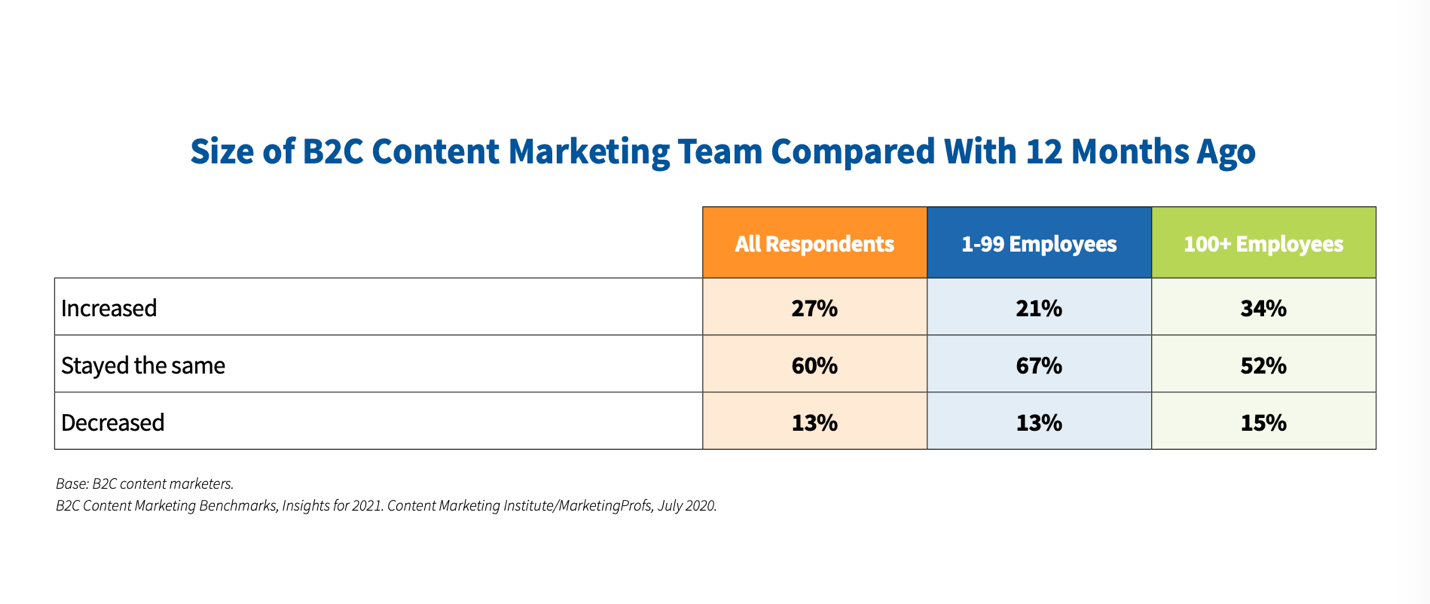
3. 49% of B2C organizations outsource at least some content marketing activities.
In the previous point, I note that while most organizations have kept their teams the same size, 40% have made some changes.
This may relate to the fact that organizations are split nearly in half in terms of outsourcing marketing activities.
Furthermore, smaller companies are a little more likely not to outsource, perhaps choosing to hire for part-time or full-time roles.
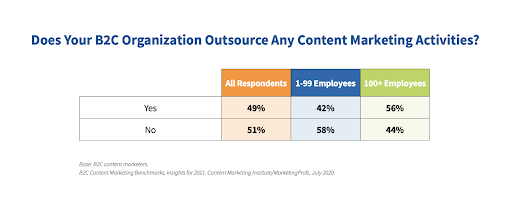
What we see with our own clients is that, while adding headcount can help with bandwidth issues, those roles aren’t always the most efficient at solving the challenges within the organization.
Outsourcing areas where you need a higher level of expertise, such as graphic design for specific channels or event production, can help your team to focus on their core competencies.
Next, what do those organizations that outsource focus their energies on?
4. Of the activities organizations outsource, 75% outsource content creation.
It’s no surprise, but as with other years, we see that time and bandwidth is the main challenge that organizations are solving for.
What we see working with both major B2B and B2C brands is that content creation is a popular area to outsource because of its time intensity, but the best content leverages the expertise and relationships of the organization.
That’s what builds trust and provides the most long-term value through content marketing–not capturing unqualified leads through chasing keywords.
Therefore, outsourcing smarter–through subject matter experts and influencers whom your target audience trusts–can be a powerful way to increase the value of your content marketing.
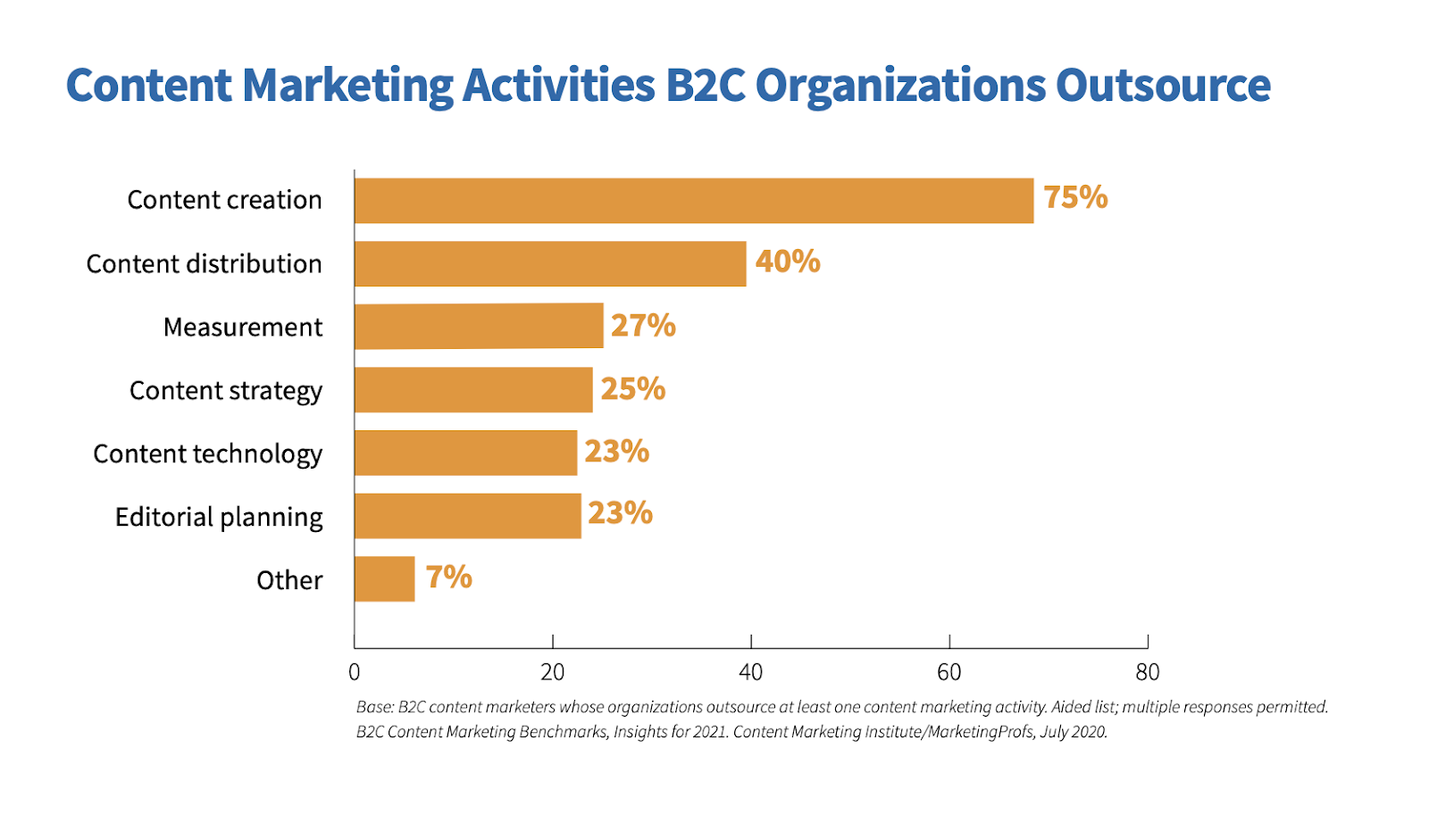
5. What’s changed during the pandemic? A majority of organizations changed their targeting/messaging strategy and/or editorial calendar, yet only 34% reexamined their customer journeys.
It’s understandable that organizations would shift targeting/messaging strategies in the short term, but as we enter the second year of this new way of living, adjusting the models of our customer journeys is vital.

We must understand the new realities that our core customers face, and we must acknowledge that some of our customers may have entirely new considerations.
Think about people who used to shop in business districts who now work from home, or about parents who used to have childcare and now have less time between raising their children and work. How can you stay relevant to them while also respecting their time, bandwidth, and priorities?
Taking the time now to re-survey your audiences, do focus groups of your top customers, and remap your customer journeys will allow you to be more thoughtful about what touchpoints your customers need.
6. How have content types changed in the last year? More video, live-streaming, and virtual events compared to the year before.
According to the report, “Virtual events/webinars/online courses increased to 39% from 27% […] Livestreaming content increased to 35% from 13%.”
The media that we’re using to communicate with our audiences have shifted based on the new reality of social distancing, but my prediction would be that there’s more to come.
Many of these shifts will become permanent and/or highly impact our audiences’ expectations of how content is made available to them.

If you’re not already investing in video and virtual event capabilities within your organization, if you’re not training your teams to think about how IGTV or YouTube Live could be incorporated into the experiences you offer your audience from a content marketing perspective, you need to get on that train ASAP.
This isn’t just about the long slide into more video content; it’s about the fact that our audiences need more safe methods to connect with others in their communities.
That’s why platforms like Clubhouse are gaining traction: the human interaction and connection that’s available through them.
7. The dominant social media channels are still dominant in B2C.
According to the report, organic social media use is similar to last year’s report, with two exceptions:
- Instagram increased to 81% from 74%.
- YouTube increased to 72% from 62%.
This information isn’t really a surprise given my previous point about human connection, but the data set doesn’t consider collaboration/participation-centric channels like TikTok (which has recently rolled out self-serve advertising aimed at small businesses) or Clubhouse, which may become a sleeper hit among B2C communities.
Will those channels become important within your industry over the next year or two?
This is the time to experiment and identify where the opportunities may lie.
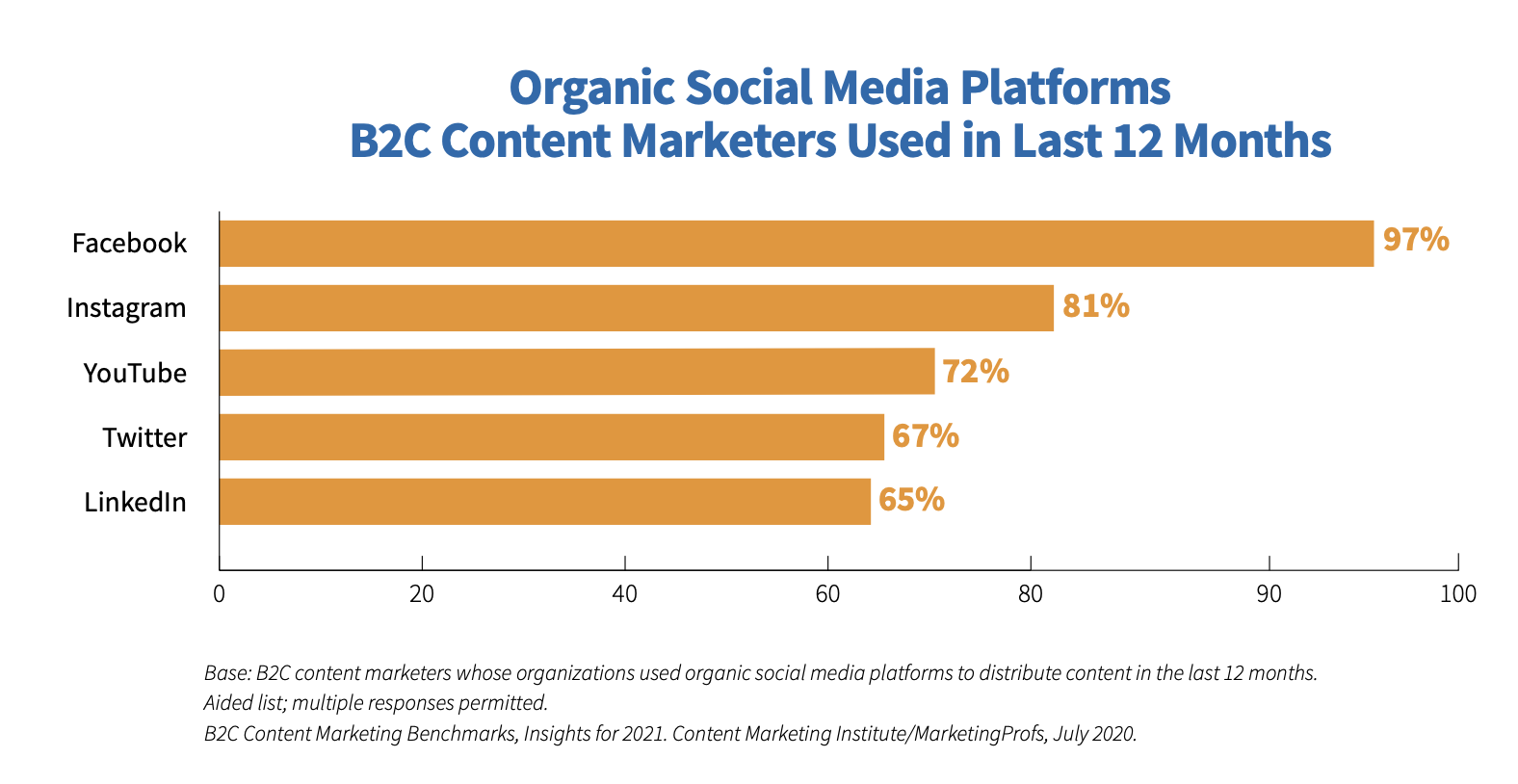
8. Surprisingly, the percent of B2C marketers using paid distribution channels for content marketing went down as compared to the previous year’s report.
I’ve said it previously, and I’ll say it again: paid distribution channels are more necessary than ever to get our content in front of audiences. It’s the nature of the beast, as companies like Google, Facebook, and their competitors more aggressively compete for ad dollars.
Yet, the report says, “72% of B2C marketers used paid channels to distribute content in the last 12 months, compared with 85% the previous year.”
What then explains the downward shift in ad dollars among survey respondents?
My guess is that because of the narrow wording of this question, budgets may have been shifted from promoting content to direct sales-oriented promotions.
However, we know those purchase decisions are often supported by content marketing assets and efforts.
Therefore, this shift in the budget could be hindering not helping purchase decisions.
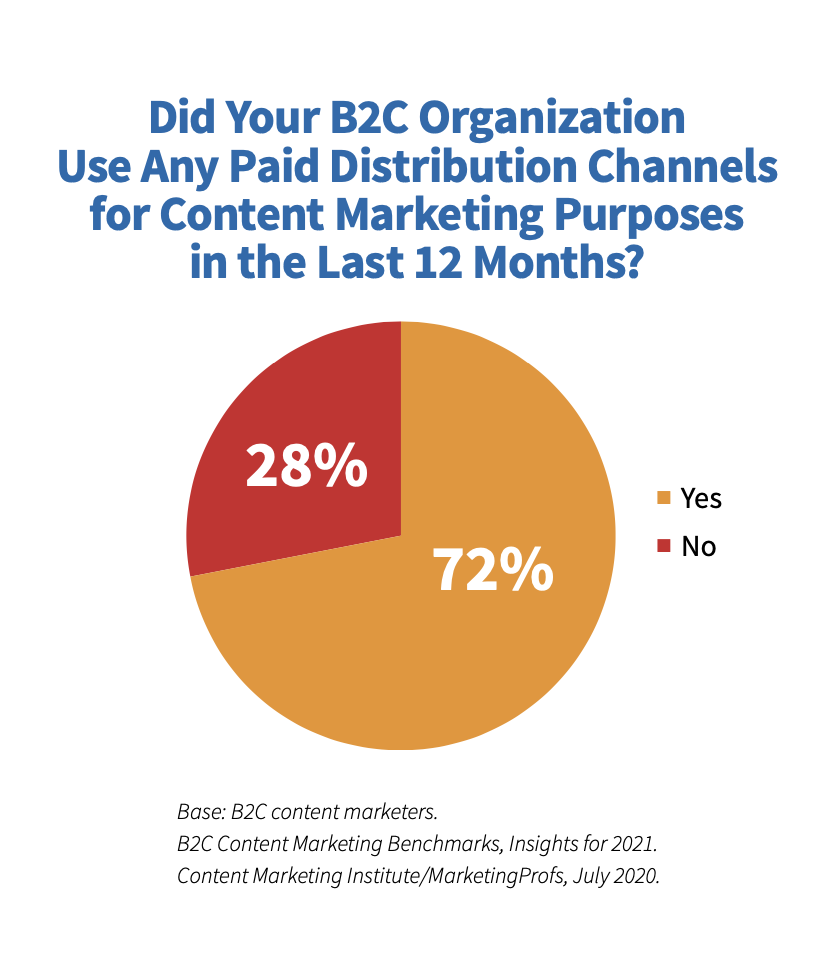
That’s why my earlier point about understanding the shifting customer journeys is more important than ever.
Convince & Convert president Jay Baer has spoken at length about the ways in which we need to rewire your business during this time, and it continues to be true.
Based on these observations on how the last year has impacted the practice of content marketing, keep in mind these three guiding principles to move forward in 2021:
- Your audience’s lives are drastically different and, therefore, their behaviors and considerations are too. Be sure you have a shifted your fundamental understanding of what they need.
- It’s not just about what content you create but how it allows your audience to engage. Your audience is looking for content that allows them to feel more connected during these isolating times.
- Make sure you’re nimble and flexible about where and how you use your content marketing budget, considering the needs of your audience. What’s worked previously cannot be a guide for the coming year or two.
The post 8 B2C Content Marketing Statistics and Trends for 2021 appeared first on Content Marketing Consulting and Social Media Strategy.
Source: convinceandconvert.com

Top 10 Marketing Articles of 2020 (and What We Can Learn from Them)
Let’s revisit our top-10 most-visited marketing articles published, or extensively updated and republished, in 2020.

2020.
What a year.
Before we close this chapter, let’s revisit our top-10 most-visited marketing articles published, or extensively updated and republished, in 2020, including lessons learned that you can apply to your own content marketing strategy.
Top 10 Marketing Articles of 2020
1. How to Create a Webinar from Scratch in 10 Simple Steps

No surprise here, but our number 1 most popular post of 2020 is an update of an evergreen post on webinar creation.
In mid-March, as the world shifted to remote everything, I dug up this post and gave it a reboot, with new tips, images, and other details.
It went from an okay performer to the most popular post of the year.
Key Lesson:
Updating and repurposing old content can give your website a bigger boost than publishing a brand-new post.
2. How to Communicate with Your Customers During the COVID-19 Crisis

During the start of the pandemic, I was hesitant to cover COVID-19 on the blog because we aren’t a news site (never will be either), and most of our content focuses on the marketing strategy that tends to be evergreen.
I didn’t want to be stuck with a glut of outdated content.
But once it became clear that coronavirus was the new normal, I published this post from contributor Ann Smarty, and it was a huge success in terms of organic traffic, becoming our #1 most popular piece of content directly mentioning the pandemic.
Key Lesson:
As the world shifts, so must your content strategy. Covering news-worthy topics can result in a serious amount of organic traffic too.
3. Podcast Statistics for 2020 – Charts and Data

Jay started writing these podcast statistics posts based on research reports way back in 2015. Every year, as new reports are published, he writes a new version of the post.
This year, I tested leaving the 2019 version live after we published the 2020 version. I wanted to see if both articles would rank organically for “podcast statistics” because 2019 statistics are still interesting for certain people.
I monitored the results for roughly 4 months, and the 2020 version never overtook the 2019 version in the SERPs, so I finally set up a 301 redirect and, as of today, this post is position #3 for “podcast statistics” (this changes all the time).
Key Lesson:
Rewriting content on an annual basis can deliver a steady stream of organic traffic.
4. 101 Content Ideas to Add to Your Editorial Calendar

Here’s another great example of how updating and republishing content can improve your rankings and give your content new life.
This post, originally written by Nathan Ellering in 2015, was getting some decent organic traffic and ranked around position 10 for “content ideas” and related phrases.
But it was woefully out-of-date (it mentioned Google Plus) and not a great first impression of the Convince & Convert brand.
I asked C&C strategist and content extraordinaire Anna Hrach if she could update and add a fresh spin. She narrowed it down to 101 ideas (it was originally 105) and added new, fresh examples.
I made Anna a co-author, and organic traffic increased significantly. The post also performed well in our weekly newsletter, with the highest number of clicks in all of 2020.
Key Lesson:
Make sure your existing content delivers a great first impression. If your content ranks but is stale, it’s time for a refresh.
5. 11 Social Media Changes to Make in a Coronavirus World

Once it became clear that COVID-19 wasn’t going to end anytime soon, our fearless leader Jay Baer immediately sprang into action and assembled a panel-discussion webinar on Social Media During Coronavirus with C&C social media strategists Zontee Hou and Lauren Teague.
Not only did this webinar generate over 1,500 registrants and exceed our Zoom webinar limit, but it was an easy, excellent starting point for written content.
Shortly after the webinar, Jay turned the same content from the webinar into this blog post, becoming our 5th most visited new post of the year.
Key Lesson:
The fastest way to create new written content is by turning your video or webinar content into a written asset. We call this content atomization, and it is a no-brainer.
6. How to Create a Successful Virtual Event for Your Company

The first piece of pandemic-related content Jay created was a page on his speaking website, 7 Virtual Event Success Factors.
I knew this would be interesting to our Convince & Convert audience, so once I got our post on “How to Create a Webinar” republished, I did keyword research, made some updates, and published an updated version of the article for this blog on March 23.
It ranks well and still receives considerable traffic. It also performed in our weekly newsletter.
Key Lesson:
You don’t need to always re-invent the wheel. Updating existing content for different audiences can help you achieve quick wins.
7. 18 Marketing Tactics to Try in 2020

Before COVID-19 was a thing, contributor Brandon Anderson pitched this article to me based on research he did in his company’s content tool, Ceralytics.
Admittedly, the topic of “marketing tactics” wasn’t exciting to me at the time, but he was convinced it would perform well, and he was right!
He used Certalytics to find a topic that people are searching for but there isn’t a lot of content on it, and it worked.
Key Lesson:
Make sure your content creation is backed by keyword research.
8. 5 Things Social Media Managers Must Do In the Age of Coronavirus

This is the post that inspired the webinar that inspired Jay’s post on social media changes in the age of Coronavirus (whew). Published on March 18, Lauren Teague wrote this based on advice she gave to her clients on what to do in mid-March.
Key Lesson:
Write what you know. Talk about what’s happening in your business. If it’s relevant to your current clients, it will be relevant to your prospects and future clients, as well.
9. Ten Content Marketing Statistics for 2020

People love data. They love facts. And they just love statistics. If you’re in martech content marketing, you know there’s a big competition over who can own all the marketing-related statistics searches.
And this post owns some of them.
Key Lesson:
Take another company’s research and add your own spin and angle. They’ll love the publicity, and you’ll love how much easier it is than creating a report from scratch.
10. Top 20 Best Content Marketing Examples for 2020
The only thing marketers love more than statistics are examples.
We created this post to showcase our client work and other work we love. It ranks number 2 for “best content marketing examples”, and I think it would have been higher on the list if we published it earlier in the year (we published this post in October).
We also turned it into a nifty PDF download.
Key Lesson:
Everyone loves examples (not just marketers), AND they’re a great way to highlight your partners and clients.
Our site has been around forever (in digital marketing years), so a significant portion of our organic traffic is from content that is 1-10 years old. But this post focuses on new and republished content that performed in 2020.
The post Top 10 Marketing Articles of 2020 (and What We Can Learn from Them) appeared first on Content Marketing Consulting and Social Media Strategy.
Source: convinceandconvert.com

B2B Content Marketing Research for 2021: Key Takeaways and Trends
Here are seven key takeaways from this B2B content marketing research report that I believe is important to keep in mind as you plan for 2021 and even 2022.

At Convince & Convert, one of my roles as head of the strategy is to make sure that everything we recommend to our clients is grounded in sound research and a firm understanding of what is happening right now with our clients and their industries.
To that end, we are constantly reading and summarizing reports for our own team.
One of my favorite annual reports is from our friends at the Content Marketing Institute and MarketingProfs, their annual B2B Content Marketing Benchmarks, Budgets, and Trends report.
This year, it’s more important than ever because the ground has shifted under all of our feet, and understanding the world we face during Covid and into 2021 is absolutely vital.
(Full disclosure: I’ve often worked with CMI and MarketingProfs as a speaker, and MarketingProfs is a former client of my company Media Volery, but I’d write about this report anyway because it’s essential information.)
Key Takeaways from the B2B Content Marketing Research Report
Here are seven key takeaways from this B2B content marketing research report that I believe is important to keep in mind as you plan for 2021 and even 2022.
1. Everyone is adapting to this major upheaval.
It’s no surprise that, of those with content marketing strategies, seven in 10 B2B marketers surveyed said they have experienced a major or moderate impact on their content marketing strategies.

As B2B marketers, we have to keep in mind that our customers’ customers are also adapting, so this is a critical time to change our tactics and help our customers adapt to the new reality that their end customers are facing.
If you can provide value to your customers in the B2B space at this time and guide them in how to get more out of their marketing and sales dollars, they’ll not only be grateful, but they’ll be more likely to stick around.
2. There will likely be a lasting ripple effect as B2B marketers adapt.
Of the marketers who have made adjustments, 66% said they have had to make both short- and long-term adjustments.
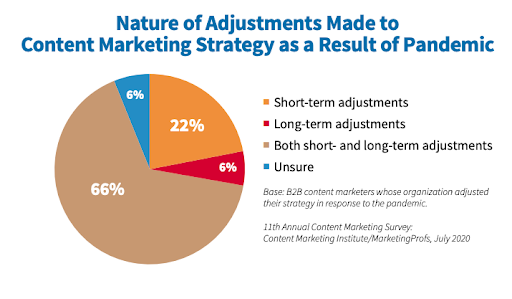
For B2B content marketers, it’s important to lean into the uncertainty that our customers are experiencing. Acknowledge their fear and confusion by providing resources to speak to their challenges.
Produce content that helps them plan short term and/or breaks down their thinking into quarters, so it’s digestible.
3. Are B2B marketers missing the opportunity to target changing motivations?
According to the study, the majority of content marketing changes that B2B organizations made in response to the pandemic related to changes in “targeting/messaging strategy”, the “editorial calendar,” and “content distribution/promotion strategy”—all focused on the operations of content marketing.
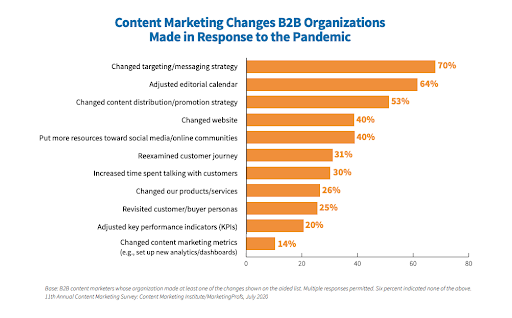
Interestingly, only a quarter of those surveyed indicated that they revisited customer/buyer personas, and less than a third (31%) said they reexamined their customer journeys.
In my opinion, this could be a major missed opportunity, considering that many businesses have shifted how they buy and what they prioritize during this time.
In fact, our own Jay Baer says, “This is the greatest opportunity you will ever have in your business life-time to create new customers.”
Understanding your audience during these times, their journey, and their mindsets will be critical to success. If your competitors aren’t investing there, now is the time for you to get this right.
4. Youtility is essential, now more than ever.
Of those who reported “extremely” or “very successful” content marketing during the last 12 months, 83% of them attributed this success to “the value our content provides.”
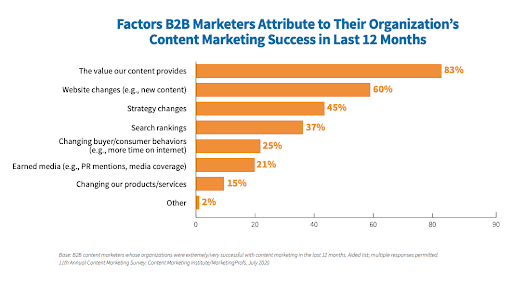
Jay Baer published his seminal book on “marketing so helpful that people would pay for it,” Youtility in 2013, but its lessons are even more important in this current environment because of everything we’ve talked about above.
Your existing customers are more willing to make a change than ever, but so are your prospective customers. So this means that you must build trust with them, so they’ll want to work with you at the end of the day.
5. Paid is here to stay.
According to the report, “72% of B2B marketers said their organization used paid content distribution channels (vs. 84% last year) in the last 12 months. However, the percentage of those using each paid channel increased over last year.”
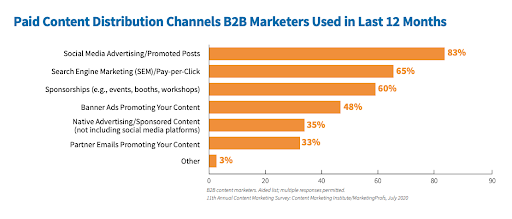
What we believe is that as in-person events go by the wayside, more B2B companies will need to invest in influencer work. In the last seven months, we’ve seen an uptick in companies that want to work with us on their B2B influencer strategies and programs.
6. Outsourcing and partnerships are vital for content marketers.
A whopping 86% of B2B marketers who outsource at least one activity say they outsource (some form of) content creation, far and away from the largest percentage. The next item is content distribution at 30%.
However, the real challenge is “finding partners with adequate topic expertise.” As you can see from this chart, 69% say that their challenge is finding partners with adequate topic expertise.
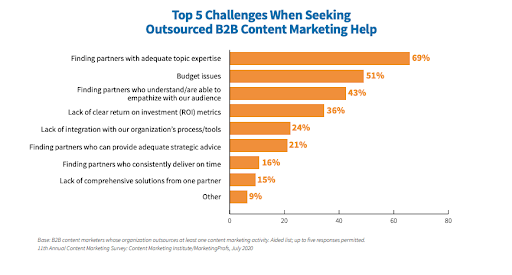
This is another reason to work with B2B influencers—because oftentimes, they can be topical experts.
We’ve recently worked with SharpSpring, a sales and marketing platform that includes CRM and automation capabilities, to launch their Agency Acceleration Series, which features a variety of experts who influence and are trusted by agency owners.
It’s a good example of a program that both showcases expertise and provides a ton of Youtility.
7. Mastering atomization is going to be key.
As you can see from the chart, companies are willing to spend on content creation and website enhancements, but not so much on staffing/human resources.
Plus, as we’ve seen from the previous chart, we know that “topic expertise” and “budget” are the top issues. So what should we make of the disconnect?

As always, firms are trying to do more with less. That’s not a surprise. But it does mean that creating a content atomization pipeline is a pressing need.
By doing so, we’re taking one piece of content and breaking it into many more pieces of content that can get eyeballs in a variety of places.
Doing more with the content we’re creating will help maximize not only our content but also help make our budgets more efficient.
Beyond Benchmarks to Actions
I hope you’ll take the time to review the B2B Content Marketing Benchmarks, Budgets, and Trends report in full.
It is because there are a ton of other interesting numbers in there, but beyond getting an understanding of how your current approach compares to other content marketers, use this report (and other reports like it).
It will help you to identify the places where you have the opportunity to take a step back, pivot, and invest time or energy in the areas that will make the biggest differences to your business and to your customers.
We must shake ourselves out of the status quo and make our B2B brands as useful to our customers as possible if we are going to be around for the next annual report.
The post B2B Content Marketing Research for 2021: Key Takeaways and Trends appeared first on Content Marketing Consulting and Social Media Strategy.
Source: convinceandconvert.com