
Tag Archives for " content marketing strategy "

Your Whole Website is Part of Your Content Marketing Strategy
It’s almost inevitable. We sign on a new client who is looking to create an amazing content strategy.
We have a kickoff call and they tell us, “Yeah, we just launched a new website and now we’re ready to really dive into our content marketing strategy.”
My heart sinks.
They just launched a new site, and now they are thinking of a content strategy.
It’s like going fishing.
The content strategy of new thought leadership is the bait, but then the hooks and poles that are the rest of the website are afterthoughts.
For so long, we’ve focused on blog and video content as being the pillars of content marketing.
The thing is, they’re not.
Your website — the information architecture that makes up your entire navigation and user flows — is essential to your content marketing success.

If the navigational systems on your website don’t make sense and are not optimized for search, you could risk losing out on potential traffic and conversions.
Without hooks and fishing poles, you’re not going to catch any fish, no matter how many you feed with your bait.
Discover the strategy behind information architecture, and how you can optimize your site for more user engagement and inbound traffic.
Your Content Strategy Starts with Your IA
Before you can write and publish any content on your site, you first need to understand the type of content that will entice your target audience – and how you’ll organize it.
That’s where your information architecture (IA) comes into play.
This is simply how your site’s visitors will find the content they need and complete actions (conversions) on your site.
Your IA controls the ways your content is:
- Organized within the navigation bar
- Labeled in breadcrumbs and other links
- Navigated from various other pages
- Searched for by users

“When we set up our new site, we knew that we wanted it to be optimized for search and conversions from the beginning,” says Nick Phillips, co-founder of Kids Art Box, a subscription box service, “The key to doing this was to start with a solid information architecture.”
Is IA the same as UX?
Information architecture and user experience are similar in that they are both tools to create a positive experience for visitors to your site.
However, IA needs to be established before a UX designer can start creating pages.
Content strategists generate a website’s IA into sitemaps.
Then, a UX designer can utilize that plan during their website creation process.
As a team, marketers and web designers can build an enjoyable and easy-to-use architecture for their users.
The goal is to make it as easy as possible to navigate through your site.
Businesses everywhere can benefit from strategizing their site’s information architecture.
If users visit your site and can’t find the information they’re looking for, they’ll most likely leave and find their solution with one of your competitors.
This can impact the bounce rate on your site, leave a negative experience with the user in how they see your brand, and most importantly, result in a lost opportunity for a new customer.
How the Sales Funnel Should Fuel Your Site Structure
Understanding the sales funnel and how potential customers move through that process is crucial to designing the information architecture on your site.
Your IA represents the solutions you have to offer customers, which Google and users will consider pretty far down the funnel.

When users visit the main pages on your site (such as product or services pages), their intent is most likely to make some kind of buying action – whether it’s to actually buy something online or to fill out a lead form.
These pages will often have high conversion rates. However, you must focus your content on the right type of keywords – those that are closer to the buying stage rather than the thought leadership stage. You need the right hooks.
Your actual blog and owned media content will mostly be focused on thought leadership topics.
It will provide people who are higher up in the funnel with useful information they can use to narrow what they’re looking for.
To come up with blog ideas, consider topics that are specific to your niche, something that a repeat customer would like to know.
This can include tips on how to use the products you sell or news that is specific to your industry.
Marrying this thought leadership with the actual pages on your site and understanding how they interact can help you identify the paths of least resistance.
Figure out where your visitors are in the sales funnel and provide content that matches their intent.
When you have this in mind, you can present calls to action and other navigation to hook them and guide them through the journey.
Your goal is to discover what it takes for someone high up in the funnel to read a blog post, stop by more pages, and then be encouraged to say, “Yeah, I’m ready to buy.”
“Tightly knitting together new thought leadership with existing, optimized product/services pages are essential to the success of a content marketing strategy,” says Melissa Dreyer, Director of Marketing at STANLEY Access Technologies,

“Without these two components working together, you could end up with a lot of traffic, but not a lot of conversions.”
Tips for Presenting an Organized Site
Information architecture may seem complicated, but it’s easier to put together than you think.
You just have to consider what makes the most sense when organizing the pages on your site.

Consider these tips to help you start building your site’s IA:
- Keep it simple. You want the process of navigating your site to be easy and straightforward. Don’t add unnecessary distractions that keep your users from finding the button you want them to click, the form you want them to fill, or most importantly, the answer to their query.
- Simplicity goes for the navigation bar, too. Keep your navbar simple and not overcrowded. A good rule of thumb is to keep the main navigation under seven items. Your page groupings should make sense and relate to one another, like service offerings or information about the company.
- Be strategic about internal linking. Invite your site visitors to learn more or take a step toward a conversion by presenting them with links to click through to product and service pages or your Contact Us page. These hooks can take people from “just browsing” to consideration pretty quickly.
- Research your industry. Take a look at your competitors to find out what the industry standards are for presenting and organizing your content.
Phillips states, “Our site started from ground zero, and in just a few months we’re already ranking in the top 10 for a number of competitive keywords we thought would take a year or more to rank for.
The research and effort put into the IA paid off very quickly.”
Please, Please Start Your Content Strategy with Your IA
To make your business more visible online and more successful with customers, you must begin with a strong marketing strategy.
When you put careful thought into your content strategy – starting with your information architecture – you can not only make an impact by delivering real value to your industry, but you can also catch a lot of new business – which was always the point, right?
The post Your Whole Website is Part of Your Content Marketing Strategy appeared first on Content Marketing Consulting and Social Media Strategy.
Source: convinceandconvert.com

B2B Content Marketing Research for 2021: Key Takeaways and Trends
Here are seven key takeaways from this B2B content marketing research report that I believe is important to keep in mind as you plan for 2021 and even 2022.

At Convince & Convert, one of my roles as head of the strategy is to make sure that everything we recommend to our clients is grounded in sound research and a firm understanding of what is happening right now with our clients and their industries.
To that end, we are constantly reading and summarizing reports for our own team.
One of my favorite annual reports is from our friends at the Content Marketing Institute and MarketingProfs, their annual B2B Content Marketing Benchmarks, Budgets, and Trends report.
This year, it’s more important than ever because the ground has shifted under all of our feet, and understanding the world we face during Covid and into 2021 is absolutely vital.
(Full disclosure: I’ve often worked with CMI and MarketingProfs as a speaker, and MarketingProfs is a former client of my company Media Volery, but I’d write about this report anyway because it’s essential information.)
Key Takeaways from the B2B Content Marketing Research Report
Here are seven key takeaways from this B2B content marketing research report that I believe is important to keep in mind as you plan for 2021 and even 2022.
1. Everyone is adapting to this major upheaval.
It’s no surprise that, of those with content marketing strategies, seven in 10 B2B marketers surveyed said they have experienced a major or moderate impact on their content marketing strategies.

As B2B marketers, we have to keep in mind that our customers’ customers are also adapting, so this is a critical time to change our tactics and help our customers adapt to the new reality that their end customers are facing.
If you can provide value to your customers in the B2B space at this time and guide them in how to get more out of their marketing and sales dollars, they’ll not only be grateful, but they’ll be more likely to stick around.
2. There will likely be a lasting ripple effect as B2B marketers adapt.
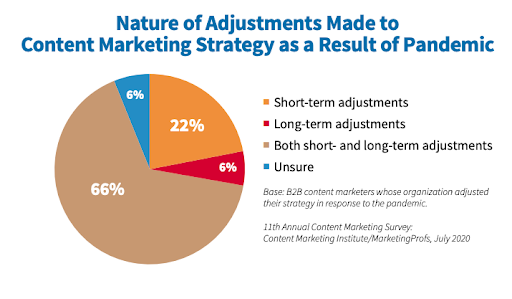
Of the marketers who have made adjustments, 66% said they have had to make both short- and long-term adjustments.
For B2B content marketers, it’s important to lean into the uncertainty that our customers are experiencing. Acknowledge their fear and confusion by providing resources to speak to their challenges.
Produce content that helps them plan short term and/or breaks down their thinking into quarters, so it’s digestible.
3. Are B2B marketers missing the opportunity to target changing motivations?
According to the study, the majority of content marketing changes that B2B organizations made in response to the pandemic related to changes in “targeting/messaging strategy”, the “editorial calendar,” and “content distribution/promotion strategy”—all focused on the operations of content marketing.
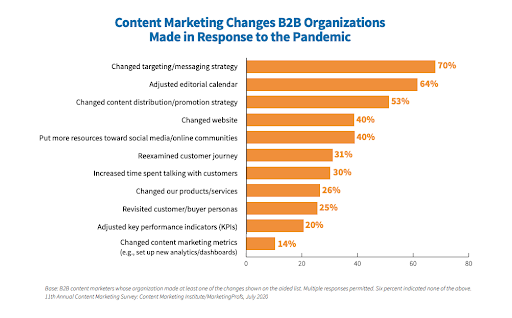
Interestingly, only a quarter of those surveyed indicated that they revisited customer/buyer personas, and less than a third (31%) said they reexamined their customer journeys.
In my opinion, this could be a major missed opportunity, considering that many businesses have shifted how they buy and what they prioritize during this time.
In fact, our own Jay Baer says, “This is the greatest opportunity you will ever have in your business life-time to create new customers.”
Understanding your audience during these times, their journey, and their mindsets will be critical to success. If your competitors aren’t investing there, now is the time for you to get this right.
4. Youtility is essential, now more than ever.
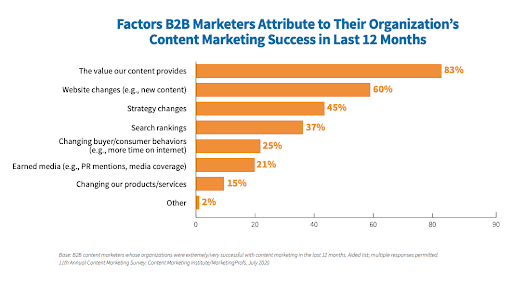
Of those who reported “extremely” or “very successful” content marketing during the last 12 months, 83% of them attributed this success to “the value our content provides.”
Jay Baer published his seminal book on “marketing so helpful that people would pay for it,” Youtility in 2013, but its lessons are even more important in this current environment because of everything we’ve talked about above.
Your existing customers are more willing to make a change than ever, but so are your prospective customers. So this means that you must build trust with them, so they’ll want to work with you at the end of the day.
5. Paid is here to stay.
According to the report, “72% of B2B marketers said their organization used paid content distribution channels (vs. 84% last year) in the last 12 months. However, the percentage of those using each paid channel increased over last year.”
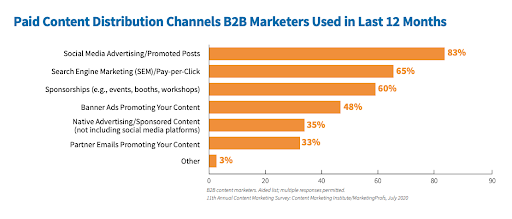
What we believe is that as in-person events go by the wayside, more B2B companies will need to invest in influencer work. In the last seven months, we’ve seen an uptick in companies that want to work with us on their B2B influencer strategies and programs.
6. Outsourcing and partnerships are vital for content marketers.
A whopping 86% of B2B marketers who outsource at least one activity say they outsource (some form of) content creation, far and away from the largest percentage. The next item is content distribution at 30%.
However, the real challenge is “finding partners with adequate topic expertise.” As you can see from this chart, 69% say that their challenge is finding partners with adequate topic expertise.
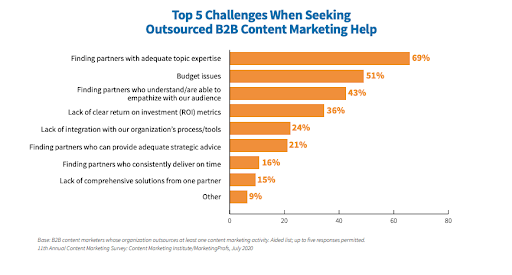
This is another reason to work with B2B influencers—because oftentimes, they can be topical experts.
We’ve recently worked with SharpSpring, a sales and marketing platform that includes CRM and automation capabilities, to launch their Agency Acceleration Series, which features a variety of experts who influence and are trusted by agency owners.
It’s a good example of a program that both showcases expertise and provides a ton of Youtility.
7. Mastering atomization is going to be key.
As you can see from the chart, companies are willing to spend on content creation and website enhancements, but not so much on staffing/human resources.
Plus, as we’ve seen from the previous chart, we know that “topic expertise” and “budget” are the top issues. So what should we make of the disconnect?

As always, firms are trying to do more with less. That’s not a surprise. But it does mean that creating a content atomization pipeline is a pressing need.
By doing so, we’re taking one piece of content and breaking it into many more pieces of content that can get eyeballs in a variety of places.
Doing more with the content we’re creating will help maximize not only our content but also help make our budgets more efficient.
Beyond Benchmarks to Actions
I hope you’ll take the time to review the B2B Content Marketing Benchmarks, Budgets, and Trends report in full.
It is because there are a ton of other interesting numbers in there, but beyond getting an understanding of how your current approach compares to other content marketers, use this report (and other reports like it).
It will help you to identify the places where you have the opportunity to take a step back, pivot, and invest time or energy in the areas that will make the biggest differences to your business and to your customers.
We must shake ourselves out of the status quo and make our B2B brands as useful to our customers as possible if we are going to be around for the next annual report.
The post B2B Content Marketing Research for 2021: Key Takeaways and Trends appeared first on Content Marketing Consulting and Social Media Strategy.
Source: convinceandconvert.com

5 Ways to Market Your Podcast (And Get More Subscribers)
It’s pretty clear right now that podcasts aren’t going anywhere, anytime soon.
With Spotify willing to spend a rumored $100 million to secure the infamous Joe Rogan Experience, they’re betting BIG (seriously… huge) on podcasts sticking around. 

The good news is you don’t need millions of downloads like Rogan to create a successful podcast.
You can have tens, hundreds, or thousands of listeners and be able to create sustainable lead generation for your business or partner with the right sponsors for who you know you can land conversions.
But, where do you start?
If you have a podcast already and you’re wondering how you can get more subscribers, or your brand new and you need to start from zero—we’ll show you how to market your podcast so you can reach more listeners.
5 Ways to Market Your Podcast
Here are 5 ways to market your podcast and get more subscribers.
#1: Interview people with engaged audiences
This is a strategy you’re probably familiar with.
There’s a reason so many podcasts are built on the interview-style model.
Interviewing somebody with an audience puts your content in front of new faces.
It’s one of the most popular ways to grow your subscribers.
The key to collaborating with influencers in your industry is to make sure they have an engaged audience.
If someone has 10,000 Instagram followers that they can share their interview with, and you see that their posts are averaging 500-1,000 like each—this is a really good person to collaborate with.
They have a super-engaged audience (5–10%) which shows the potential for a high conversion rate too.
When they tell their followers about their interview with you, they’re going to be interested in listening… which means they’ll pop over to your podcast.
Let’s make something clear though—you’re not just interviewing people because of their audience.
You want to bring people on your show who make sense based on the topics you talk about.
If someone has a tiny following (or no following) but they’re going to give your audience golden nugget after golden nugget of awesome information… bring them on!
But just be aware that you’ll have to do the promotions for that episode, but we’ll talk about how to do that below.
#2: Create timely episodes
Did Elon Musk just tweet something crazy (again)?
Let’s say your podcast is based on interviewing entrepreneurs, this is a great time to record an episode talking about what Elon tweeted and what your thoughts and your guest’s thoughts are on it.

Creating timely podcast episodes makes people want to listen to that content now.
You won’t get saved in their “Listen to Later” folder, which we all know can become a black hole.
People will want to listen to that content right away so they can stay up to speed on what’s going on.
There’s a lot of potential for creating podcast episodes that are timely, here are some marketing examples that you can steal:
- Algorithm changes
- Facebook news
- Amazon news
- New Facebook tools
- New industry trends
- Strategies working right now
To stay on top of what’s happening in your industry, go to the top player’s Twitter profiles and opt-in to get notifications when they tweet something new.
When somebody tweets something that you know is going to be big news, get a podcast scheduled so you can talk about it.
#3: Make video snippets to share on social media
Think of these video snippets like the appetizer before your podcast dinner.
You want people to get a taste of how good the food is going to be—and start to get super excited for dinner to be served.
In this case, dinner is your podcast episode and the appetizers are the video snippets you’ll tease it with.
Using video snippets to market your podcast doesn’t require an awesome podcast hosting setup.
You just need a decent amount of light and a camera (you can even use your iPhone) to record the video.
If you’re having Zoom interviews, you can record your screen.
Then take snippets from that episode and post them on Instagram, Facebook, Twitter, LinkedIn…wherever you are growing your audience.
Here’s what each snippet should have:
- Title above video
- Captions on the video
- A 1–2-minute conversation that ends in a complete thought
A quick explanation on that last part “the complete thought”: Don’t end this video with a cliffhanger that makes people feel like they watched your content and didn’t get what was promised.
Make sure to deliver on the promise made in the headline.
Here’s an example from Gary Vee on what this video snippet could look like:

#4: Make sharable content based on your episodes
Marketing your podcast doesn’t have to only be your job—you can get your subscribers to help.
Whether that’s making memes that they think are funny and want to share, inspiration quotes, educational video snippets, etc.
You can post these to your Instagram stories, feed, Twitter feed, or LinkedIn to create FOMO around the content of your episode.
You can make memes on Imgflip or just write content above an image or video.
Here’s an example of how Morning Brew created a meme based on the content in their business newsletter (this got 1 million impressions…plus, check out the view count):

#5: Promote episodes regularly on social media
Just because an episode is a few months old doesn’t mean you can’t keep talking about it.
Using social media, you can continue the conversation you had on your podcast episode for the indefinite future.
For example, you can pop on to Instagram stories and talk about something that was mentioned in the podcast. Then you can say,
“I went way more in-depth on why Mars really isn’t Elon’s soul dog and how to figure out what yours is on Episode 8 of my podcast.
I’ll put a link to that episode in my bio if you want to listen to the episode and find out what YOUR soul dog is.”
And of course, you’ll be promoting your new episodes each time they come out.
Here are a few ways to get people excited to listen:
- Tease content before the episode comes out (you can use your video snippet)
- Show behind the scenes of you recording the podcast
- Talk about upcoming guests instead of just announcing you interviewed them (similar to BTS)
- Ask listeners to give you fun facts or ask for shout outs
Marketing your podcast is just like marketing a service or product—you need to put it in front of the right audience.
We know your podcast is awesome and people want to listen to it.
Now it’s time to execute the strategies that will get you more subscribers.

The post 5 Ways to Market Your Podcast (And Get More Subscribers) appeared first on DigitalMarketer.
Source: digitalmarketer.com

How to Start Your Content Cluster Strategy
When you think of content clustering—what’s the first thing that pops into your mind?
Yeah… we didn’t think about internal links and pillar posts either  .
.

What is content cluster strategy?
Clustering sounds like it’s better left to chocolate and nuts, but it’s actually a content marketing strategy that can garner better rankings and conversions.
Content clustering uses pillar posts to drive conversions.
We learned the ins and outs of content clustering from Aja Frost, the Senior Content Strategist on HubSpot’s SEO team.

Thanks to Aja, we’ve been able to use content clustering to boost our own conversions, making us confident that this is a strategy you should know about.
For each pillar post in your cluster strategy, you’ll create several cluster posts that link to it.
This creates a cluster of content on a specific topic and all links to the bigger, pillar post.
The pillar post holds the weight of the team and is designed to be so awe-strikingly amazing that it boosts your conversions.

The cluster posts are there to get more views on that pillar post and drive up its ranking in Google.
Let’s look at an example we can all get behind—puppies.
An animal rescue could create a pillar post on “Everything You Need to Know About Adopting a Dog.”
Then, they could create cluster posts on,
“What to Buy When Adopting a Dog,”
“Where to Adopt a Dog,”
“How to Adopt a Dog,”
“What Kind of Dog to Adopt.”
(For this example, we’re going to assume these are all high-ranking keywords.)
Each of those cluster posts is going to link to the larger pillar post of “Everything You Need to Know About Adopting a Dog.”
That pillar post is going to have calls to action, like showing images of dogs that the shelter has for adoption—because who can resist puppies?!
That’s how you create a content cluster that drives conversions through your pillar post.
If this sounds like a good idea for your marketing strategy, here are the 5 steps to starting your own content cluster.
5 Steps to Create Content Cluster
#1: Choose your pillar post topics
Your content cluster strategy starts with pillar posts that you’ll create content around.
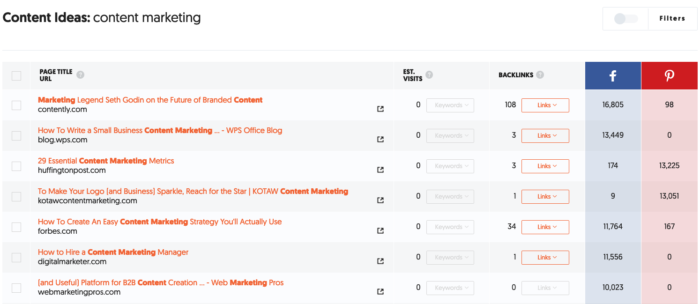
For example, a pillar post could be about content marketing, and then you’ll publish content that supports that pillar post. (For example, an article on content clusters  .)
.)
To figure out what your pillar topics should be, you want to look at the keywords that work best for your business.
You want terms that are searched often and directly correlate to your products.
For example, if you’re an interior design decorator you’d consider keywords like
- “interior design for kitchens”,
- “decor for bathrooms,
- And “designing outdoor spaces”.
These keywords would be your pillar posts and then you’d create your cluster content around it.
#2: Figure out your cluster post topics

Once you know what your pillar post topics are, you’re going to figure out what content can cluster around each post.
For example, our interior designer can create content clusters like “decor for small kitchens” and “marble accented kitchens” around their pillar post for the keywords “interior design for kitchens”.
Each of these clusters can point to the pillar post as a comprehensive post on everything someone needs to know about interior design for kitchens.
At DigitalMarketer our pillar post Everything You Need To Know Content Marketing has content clusters like:
- What is Content Marketing?
- 6 Easy Content Marketing Tips That Will Save You At Least an Hour This Week
- How To Figure Out What Content Your Customer Avatar Wants
For each of your pillar posts, you want to create at least 3 related articles that point back to it.
#3: Write your pillar post
Now comes the fun part!
Put pen to paper (or outsource) writing your pillar post.

Since your content clusters are going to point to this post through internal linking, you want to make sure that it’s seriously valuable content and a great representation of what your business has to offer through their products.
For example, we want our “Everything You Need to Know About Content Marketing” post to be exactly that—everything you need to know.
We don’t want to sell you short by not coming through on the promise of our headline or by writing a subpar article.
Your pillar post is going to drive the conversions, so you want to make it one of your best posts.
Since pillar posts tend to be longer than your cluster posts, make sure that you’re structuring them so they’re easy to read.
Use headers (H1, H2, H3, and H4), bold and italics, bullet points, images, emojis, and anything else that will help break up all of the text into something that’s easier to read.
Feel free to reference our content marketing pillar post for an idea of how to do this.
#4: Write the cluster posts that surround it

With your first pillar post done, you can start writing the posts that will cluster around it.
These don’t have to be as long as the pillar post and are generally more niched. You can still use the same structuring strategies (headers, bold, italics bullet points, etc.) to make sure these posts are interesting and engaging to read.
You’ll want at least three cluster posts and you need to make sure they all have internal links to your pillar post for that topic.
For example, for our “Everything You Need to Know About Content Marketing” post, we want to hyperlink the word “content” or “content marketing” 1–3 times in our cluster posts.
You can still hyperlink to other posts (and even cluster posts for other topics) in your cluster post, but you want to make sure the link to the pillar post is there—that’s kind of the whole point .
And just like that, you have your very own content cluster.
We can’t take credit for this strategy and have to thank Aja Frost at HubSpot for showing us the content marketing strategy that gets rankings and conversions these days.

The post How to Start Your Content Cluster Strategy appeared first on DigitalMarketer.
Source: digitalmarketer.com