
Tag Archives for " case study "

8 Tips For Creating a More Effective Case Study – With Examples
Case studies go beyond simple testimonials by providing real-life examples of how your brand satisfied your customer’s needs and helped them accomplish their goals.

An in-depth case study helps you highlight your successes in a way that will help your ideal potential customer become your next customer. They help you show rather than tell prospective customers how you can help them reach their goals.
But, creating a solid case study can be a challenge. Today, I’ll provide actionable tips to help you write a case study, provide background information, and identify key metrics that will help your case study drive conversions.
Write About Someone Your Ideal Customer Can Relate To
Do you know who your ideal customer is? If it’s someone in the education industry, then make your case studies about your university customers. If it’s someone in the automobile industry, then make your case studies about auto parts and accessories manufacturers.
The goal is to ensure that your case study will show prospective customers that you are:
Comfortable in their industry. Understand their industry’s specific needs. Know how to give their industry targeted results.
Think about it on a smaller level, such as when you’re reading a how-to blog post. Most of these posts are geared toward average readers.
But when you come across a post designed specifically for your needs (such as online marketing for the healthcare industry), you are more likely to understand and apply the information.
The same goes with case studies – people who read about results in their industry will feel like the same approach will work for them.
Tell the Story from Start to Finish
Storytelling is a powerful marketing strategy. A great case study will allow someone to really get to know the customer in the case study including:
Who is the sample customer and what do they do? What were the customer’s goals? What were the customer’s needs? How did you satisfy those needs and help the customer meet their goals?
But don’t stop a month or two out. Follow up with the customer in the case study and update your case study a few months down the road to show how your solutions continue to provide long term benefits.
This gives readers the opportunity to see that your goal is not only to help with immediate needs but also to ensure long term results.
Make Your Case Study Easy to Read
No one likes to read one huge chunk of text, no matter how interesting and informative it might be. Case studies, like blog posts, should be scannable and easy to read.
Be sure to use good content formatting elements as you would with articles, blog posts, and copywriting on your website, including:
HeadersImagesBulleted listsBolded & italicized text
In addition to providing great SEO value for your case studies page, these formatting elements will help your readers (especially those that like to skim) find the most important parts of your case study and get a great impression about what your business could do for them.
Consider adding multi-media elements in addition to written content, such as videos, PDFs, and images to mix it up and make the content more engaging.
Include Real Numbers
Have you ever read case studies where a business states they “doubled traffic” for the customer in their case study and wondered if that meant they went from 100 to 200 visits or 10,000 to 20,000 visits?
Avoid using broad statements by using clear, direct numbers. This makes your case study more believable and helps build trust in your brand.
You want your case study to be as precise as possible. Instead of saying you doubled their traffic, provide specific, accurate numbers and (if possible) real proof in the form of charts, graphs, or analytics data.
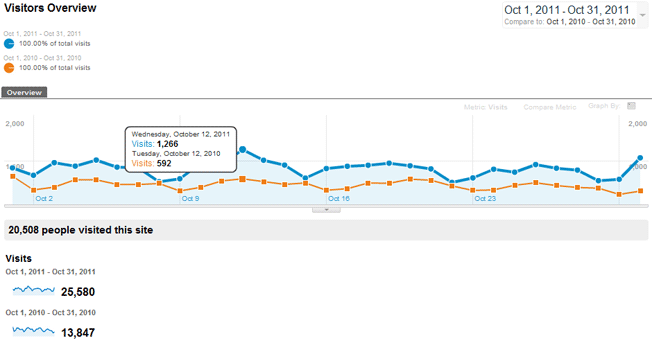
Remember that not everyone is as familiar with analytics technology as you are, so highlight the most important pieces of data and provide context as to why it matters.
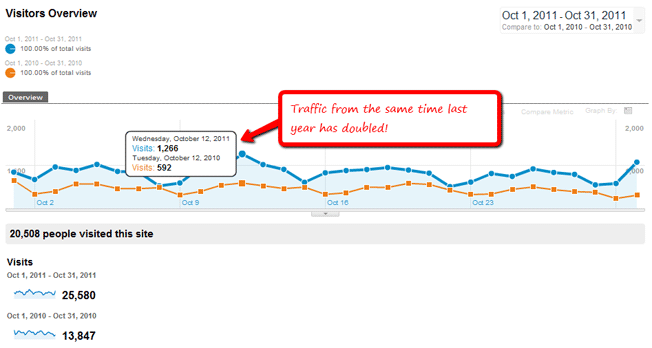
This way, the reader can see where the customer began and where the customer ended up with your help.
Plus having the picture proof can help the reader envision exactly what you might do for them, making your case study that much more powerful.
Talk About Specific Strategies in Your Case Study
So you doubled a website’s traffic or sales, right? How did you do it? This is where you sell your products or services simply by saying which ones you used and how they led to the desired result.
Don’t just say “our online marketing services led to these results.” Instead, say something like, ” A three-month social media campaign focusing on Facebook & YouTube and five-month of link building campaign led to an increase in rankings, plus brand exposure led to these results.”
Don’t worry about giving away your secrets — the goal is to establish your brand as an industry leader and you need to show you know your stuff.
Try Different Content Formats
Case studies do not have to be fit into a story form every time. Try different types of case studies, such as an interview format where you have your clients answer the same questions mentioned earlier about what they do, their needs, their goals, and how you met them.
Quoting your customer in their own words will make the case study even more relatable to your ideal customer than you telling the story.
Infographics, webinars, and even podcasts can also be used to highlight case studies. Don’t get stuck in the same old text-only format — get creative and see what type of content your users respond to.
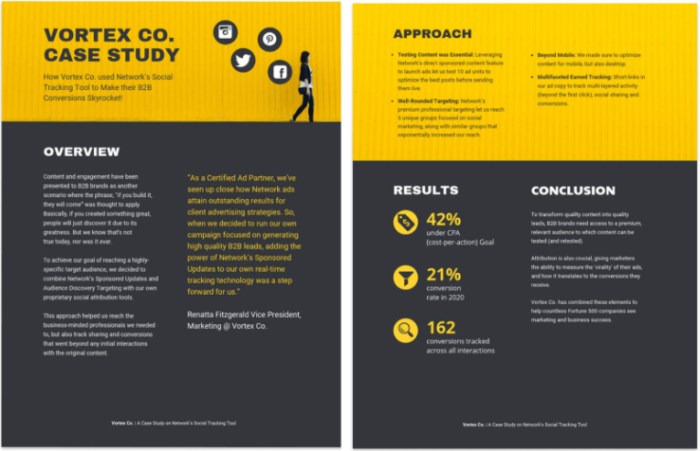
Here’s a case study example from Venngage that uses a brochure-style case study to highlight how Vortex was able to grow conversion. (Notice the results section that highlights specific gains.)
Appeal to Different Types of Learners
While some people enjoy reading, others may prefer audio, video, or visual representation of your case study. So consider taking your text-based case studies and re-purposing the content as:
- A podcast
- A YouTube video
- An engaging infographic (such as the one below)
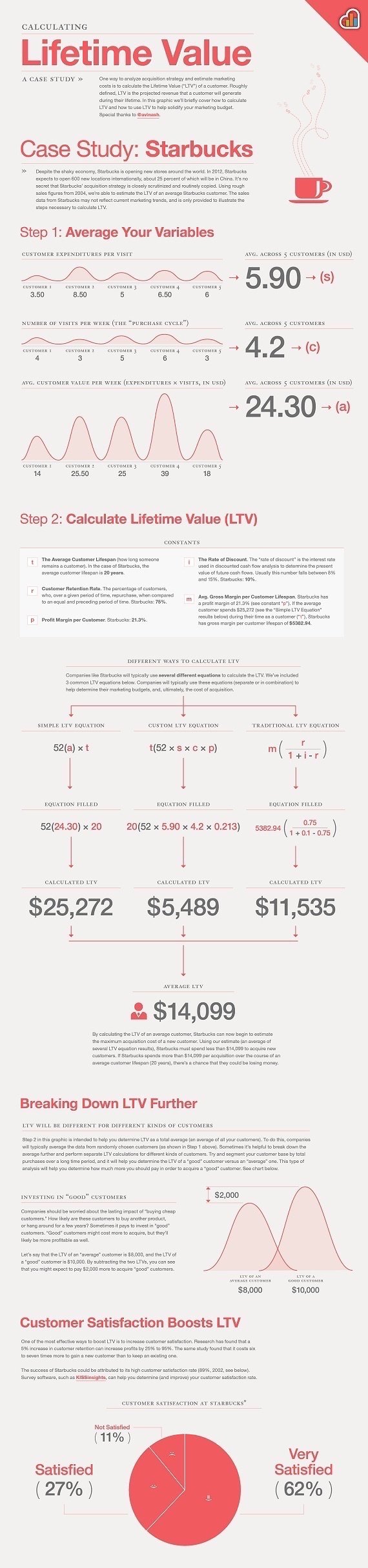
The bonus with YouTube videos and infographics is that they are easy to share. This means that your case study may go further than just your own site, leading to more of your potential customers finding out how they could benefit from your products or services.
Case studies can also be embedded in other types of content — such as an ebook, how-to blog post, or resource guide.
Make Your Case Studies Easy to Find
What’s the point of having great case studies if no one will ever read them? Be sure that your case studies are organized and easy to find.
Examples of Case Studies
Here’re a few examples of good case studies that are easy to find — and therefore, much more powerful.
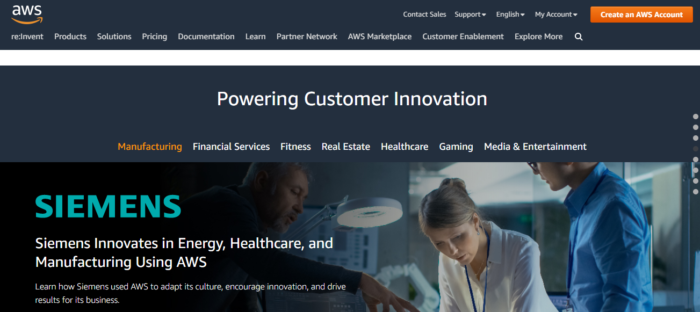
Amazon Web Services
AWS provides case studies right on their homepage. They also make it easy to look for an industry specific case study in manufacturing, financial services, fitness, and more.
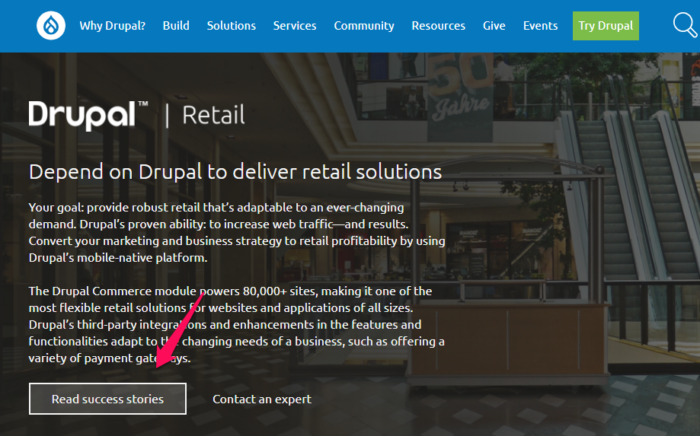
Drupal
Drupal provides case studies right in their hero image. Users considering using their solution don’t have to look far at all to see how other brands are finding success with Drupal.
Conclusion
A great case study starts with case study research. Ask your customers to fill out a short form that highlights how you helped them reach their goals — be sure to ask for specific results.
Explain how the case study will help them by increasing brand awareness and link opportunities. Remember, a highly effective case study helps both you and your client build trust and reach a wider audience.
Has any case-study best practice tips or examples of case studies you have enjoyed? Please share them in the comments!
The post 8 Tips For Creating a More Effective Case Study – With Examples appeared first on Neil Patel.
Source: feedproxy.google.com

Subconscious Selling: Your Customers Won’t Buy Without These 3 Elements
Your customers are social, plugged-in, and savvy.
Selling to them (even with high-impact direct response) isn’t easy. Which is why today, I’m giving you some contrary advice…
Stop focusing on features and benefits. Stop hyping up your copy. Instead, sell your product on a subconscious level, and you’ll have customers drooling with desire before they know what hit them.
Keep reading and I’ll give you 3 ways to do just that. Plug these essential elements into your marketing to drive customer sales naturally and easily.
1. Social Proof
Think benefits sell? Think again. To sell your product, you need to build trust. Seth Godin says it well:
Without trust, marketers know that there are no sales. Trust means the prospect believes not only that the product being sold will actually solve his problems, but that if for some reason it doesn’t, the company will make good on its reputation of performance.
Today’s consumers assume marketers are trying to take advantage of them, so it’s important to establish credibility in all your marketing. But here’s the thing: You don’t actually have to prove you’re trustworthy if you can show that other people already trust you.
This concept, called social proof, was made popular by Robert Cialdini in his book, Influence. In it, he explains that we “view a behavior as more correct in a given situation to the degree that we see others performing it.”
To see how powerful this concept is, we have to take a quick dive into biology.
In 1992, scientist Giacomo Rizzolatti noticed that monkeys’ brains would fire not only when they performed an action, but when they saw someone else perform that action too. He later discovered the same tendency in humans.
Sell your product on a subconscious level, and you’ll have customers drooling with desire before they know what hit them.
This phenomenon, dubbed “mirror neurons,” explains why you laugh when everyone else in a meeting laughs (even if you didn’t hear the joke), and why you wince when someone falls or hold your breath when your kids are learning to swim underwater. It also explains why, when you see an actor dressed in the newest fashion, you want to wear something similar.
When you see them getting second glances, your brain starts firing as if you were getting those looks. And your subconscious brain tells you that you’ll be just as sexy and successful if you wear the same type of clothes.
As Martin Lindstrom says in his book Buy-ology, “It’s as though you’ve just bought an image, an attitude, or both.”
What This Means for Marketers
Social proof isn’t just smart marketing, it’s a mandate if you want more customer sales. And it’s as easy as showing other people enjoying or benefiting from your products. While there’s no limit to the number of ways you can do this, 3 come immediately to mind.
a. Case Studies
Share stories of real people using and enjoying your product. How you tell the story doesn’t matter: use written case studies, videos, and interviews. What’s important is that you show how your product or services are helping people reach their goals.
The secret to powerful case studies is this: site real numbers and specific details. Notice the headline in this case study for LinkedSelling. It doesn’t site “massive growth” or “impressive returns.” It spells out “400% ROI.”

b. Endorsements & Testimonials
Make it a regular practice to ask customers for a testimonial. Then use them liberally to sell your product.
Ideally, you’ll collect enough to create a “Reviews” page. This one, from Boom! by Cindy Joseph, starts off with text reviews…

…followed by a collage of images showing how well the product works on real women:

When you get a testimonial from someone with celebrity status—either because their name or the company they work for is easily recognizable—by all means, feature it. On Single Grain, this testimonial by the Director of Marketing for Amazon Alexa carries weight because we believe anyone who works for Amazon knows their stuff.

As you can see, when other people show confidence in you—especially if it’s someone well-respected by your community—it’s easier for others to trust you too. That makes it easy to push people off the fence and increase customer sales.
c. Customer Logos
Another way to communicate trust is to pull back the curtains a bit and let prospects see who else uses your product. When they see brands they respect on the list, you gain instant credibility.
For example, this impressive list shows you how many big brands trust Single Grain.

Notice the link to “view case studies” prominently displayed below the graphic. This makes it easy for prospects to get even more details about how Single Grain works.
PRO TIP: Any time you can add specifics to your marketing, you boost your credibility. So turn all general statements into specifics by adding precise numbers, brand names, and facts.
2. Scarcity
Cialdini calls this “The Rule of the Few.” He says:
The idea of potential loss plays a large role in human decision making. In fact, people seem to be more motivated by the thought of losing something than by the thought of gaining something of equal value.
As soon as you hear something is off-limits, you want it.
It’s true. As soon as you hear something is off-limits, you want it. If a book is going out of print, you want to buy it. And if a product is only available until midnight tonight—even if you don’t need it right away—you’re inclined to buy it… just in case.
That’s how scarcity drives customer sales. It makes you aware that you might miss out if you don’t take action.
What This Means for Marketers
Consider Black Friday offers that promote just 100 electronics at 75% off or an 80% discount only till 10 am The fact that the offer is limited drives people to stand in line for hours before the store opens or to physically wrestle with one another for the prize.
How can you do this in your digital marketing? Check out this email from DigitalMarketer’s Founder and CEO, Ryan Deiss:

Ryan is a master at leveraging scarcity in his marketing. Look at how he piles it on in this email:
- There’s a “special link” that gives you a discount. “Special” makes you believe it’s not available to everyone, which creates a feeling of exclusivity.
- The discount is only available through Monday at midnight. So there’s a time limit pushing you to respond now.
- Seats sell out every year. If you don’t act quickly, you could miss your chance to attend.
- And if you don’t honestly believe the event will sell out, you might be motivated by the “best seats” reference. Again, a bit of exclusivity makes you feel you might miss something if you don’t click through and buy your ticket.
Scarcity can be achieved through limited inventory, a deadline, or making something only available on certain dates or times. You can use it in emails to make people click through, in your sales pages to make people take action, and as a value-add offer before or after purchase.
PRO TIP: Any time you can reduce or reverse risk, you’ll improve response rates. Absorb as much of the risk as possible with a strong guarantee, lengthy trial period, or ridiculously low price.
3. Sensory Language
Deep in your brain’s temporal lobe is an almond-shaped cluster of neurons that some experts call your lizard brain. Known as the amygdala, this primitive part of your brain is both pre-verbal and pre-logical. So it can trigger action before you have time to think about it.
Neuromarketers also call it a “buying brain,” because pushing its buttons leads to a Buy Now response that’s almost instinctive. Here’s how Dr. A. K. Pradeep says it in his book The Buying Brain:
The basic lesson is that human brains process much of their sensory input subconsciously.
Our senses are taking in about 11 million bits of information every second.
Our thinking brains—that part of thinking in which we are aware of thinking—can only process, at best, 40 bits of information per second.
The subconscious level of the brain is where elements that are essential to marketing success such as initial product interest, purchase, intent, and brand loyalty are formed, and where they reside.
In other words, spark desire by connecting with people’s primitive brains, and you can generate a buying response without manipulating anyone. People want to buy without knowing why.
The result? More customer sales.
What This Means for Marketers
Research shows that mirror neurons (that’s the monkey-see-monkey-do thing we talked about a few minutes ago) can be stimulated by reading as well as observing. For example, read this:
Yawn.
Just reading the word makes you want to yawn.
That’s especially good news because you can’t pump smells and velvety softness over the internet. But you can stimulate the subconscious with sensory words.
Engaging the buying brain is as simple as tickling the five senses in your writing. Sight is easy (pictures). But you can also evoke scents, touch, sounds, and taste. Let me show you what I mean in this example from Lawrence Bernstein.

“Like the windows in a store” creates a mental image. (I visualize a big display window with mannequins in high-fashion dresses.)
“Created on the fly” gives you a sense of speed or motion.
Circled words—melt, explosive, verbal dynamite—are sensory. You can see, feel, or hear them.
He could also have said something like this:
- “Pepper your writing with these irresistible words and your prospects will feel compelled to buy.” (Taste)
- “Build a rock-solid foundation for your sales pitches by using words that hit hard as nails.” (Touch)
Now notice how naturally these words fit into the copy. Sensory writing is nothing more than good writing. It reads naturally and isn’t likely to be perceived as hype or manipulation. But it excites people’s primitive brains and makes them more likely to respond.
PRO TIP: After you’ve written your sales page, go through it to find places where sensory language could be added naturally. In particular, replace being verbs (is, was, are) with active verbs and make sure you help people see themselves using your product.
Selling to the Subconscious
Your customers may love to buy, but they don’t want to be sold.
Your customers may love to buy, but they don’t want to be sold. Your job, then, is to sell your product to the subconscious brain, so you trigger desire before they know what hit them.
Fortunately, it’s easy if you sprinkle your sales copy with social proof and sensory language, then mix in an element of scarcity.
Before you know it, you’ll have people drooling over your products without ever knowing why.
(NOTE: Want more clicks from Facebook, Twitter, and your own blog? Copy and paste these 72 proven headline formulas and get more clicks to your content now. Plus, get 3 simple hacks to optimize any headline in 12 seconds or less. Learn more now.)

The post Subconscious Selling: Your Customers Won’t Buy Without These 3 Elements appeared first on DigitalMarketer.
Source: digitalmarketer.com