
Tag Archives for " business "

The Riches Are Not in The Niches
In marketing, everyone says you need to pick a niche.
And mainly because people believe the following things…
- It is easier to market when you pick a niche (fewer competitors)
- Easier to make money (fewer competitors)
- You can get traction faster from a monetary standpoint (fewer competitors)
In other words, you make money faster because there are fewer competitors, but that isn’t really true.
Unless you are looking to create a “lifestyle” business, the riches are not in the niches.
And I wouldn’t recommend going after a niche.

VCs don’t fund “niches”
By no means am I trying to say you should raise venture capital or even need to?
But ask yourself this… what major venture, or venture fund at all, funds niches?
Sequoia, Andreessen, Accel, Tiger, Softbank, and all major funds don’t fund niches.

Companies that raised money a long time ago from VCs such as Google, Facebook, Airbnb, Apple… and the list goes on and on… are all examples of companies that go after big markets.
And that’s what VCs want… the elusive “unicorn”. A company that hit over a billion-dollar valuation, which doesn’t happen when you go after a small market (aka. a niche)
Even the funds that specialize… let’s say fintech venture funds aren’t going after niches. Fintech is a massive category and isn’t really a niche.
In other words, they don’t go after “niches”. Why?
Well, let me tell you a quick story that will explain why…
Years ago, I was speaking at a conference in Seattle. It was more so a panel.
It was me and Rich Barton.
If you don’t know who Rich Barton is, just think of Expedia, Glassdoor, and Zillow. He is the founder of all 3 of them.
Someone from the audience asked him… “what type of companies do you invest in”.
His response was simple… “big markets”.
He didn’t mention niches. He said entrepreneurs should go after big markets because it is roughly the same amount of work to create a business in a small niche as it is in a big market. So why limit your upside?
And then to make the message even more clear, he gave us all a baseball analogy. When you go up to the plate and swing it takes the same amount of effort to swing a single, double, triple, or home run. So might as well swing for a home run each and every time.
It takes the same amount of work…
If you are going to create a business, it takes the same amount of work to create a business in a small niche as it would go after a big total addressable market.
And believe it or not, it’s actually easier to generate more revenue when you are in a big market, versus going after a niche.
A great example of this is my latest company, NP Digital. It was the 21st fastest-growing company in the United States according to Inc Magazine.

My other businesses were not on the fastest-growing companies list in the past.
You could say some of it is luck or the right timing. But that isn’t the main reason it is on the list.
You could say great execution, but I worked just as hard on my previous businesses.
And you could say I have more experience now and I do… but I also had a lot of experience when I started the business before this one.
The big difference on why this business is growing so fast is because it is in a big market… advertising.
That’s it! Seriously, that is the big difference between this business and others. My previous businesses were in “niches” or smaller markets.
This one is in a bigger market. Which makes it easier to generate revenue.
For every excuse, there is a counterpoint
I was at a conference the other day and a few people talked to me about going after a “niche” which encouraged me to write this blog post.

They used the same logic that I mentioned at the beginning of this post in which:
“It’s easier if you create a business in a niche”.
Well, let me break down a few things for you…
- Marketing in a niche isn’t easier – sure you can get your SEO rankings faster, but the keyword volume isn’t that high. So, getting to the top won’t add revenue fast enough. Plus, you won’t have as much traffic to run conversion optimization experiments which makes it more difficult to optimize your site.
- It’s not easier to grow your revenue – I’ve found that it is harder to make money in a niche. There are fewer people to sell to, which makes it harder to scale up and grow.
- It’s harder to become efficient in a niche – from a financial margin perspective, when you have low revenue in many cases it is hard to have high-profit margins. But as you scale you can make things more efficient and have a better profit margin.
Conclusion
If you want to go after a niche, you can and there isn’t anything that is wrong with it. But your upside will be limited.
Sure, you can have a great lifestyle business and if that makes you happy, by all means, go and do it.
If you want more, then you are going to have to create a business in a larger market.
So, this brings me to the real question, is your business or the company you work for in a “niche”? If so what’s your game plan?
Source: neilpatel.com

How to Use Facebook Business Suite
Are you struggling to keep up with your Instagram and Facebook marketing?
DMs and comments falling through the cracks?
Do the multiple tabs for all your accounts and features like the Ad Manager drive you nuts?
Then you’re going to fall head over heels with Facebook Business Suite.
It’s the platform’s newest creation, designed to iron out the time-sucking road bumps in social media management and make it easier for businesses to manage their Instagram and Facebook profiles.
Below, I’m breaking down everything you need to know about Facebook Business Suite. We’ll unpack what it is, everything you can do with the tool, how it can benefit your business and a quick walkthrough on how to set up your account.
What Is Facebook Business Suite and How Does It Work?
Facebook Business Suite streamlines your Facebook and Instagram accounts into one easy-to-use dashboard.
Through the platform, you can manage all accounts you own or administrate with various tools to make controlling your business’s social media presence much easier.
The best part? It’s free and available on mobile and desktop.
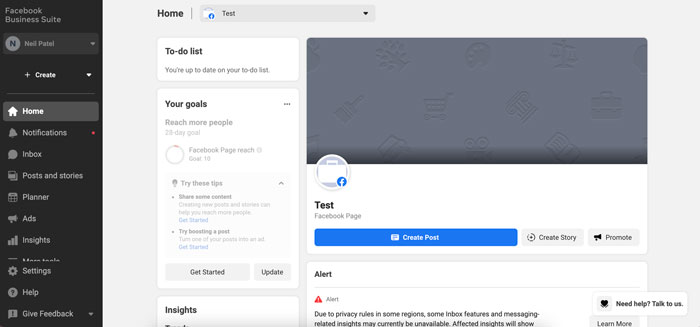
All you need to do is link up your accounts, and you’ll instantly have access to an overview dashboard of your Facebook Pages and Instagram accounts.
You’ll be able to:
- a to-do list of notifications to manage
- check insights on your performance and audience growth
- create or see recent posts or stories
- create or manage recent ads
- see content calendar
- view content inspiration
- communicate with an inbox for Facebook and Instagram DMs and comments
- access the Commerce Managercheck Business Suite updates
That’s only the tip of the iceberg.
There’s an entire “more tools” section with 12 other features to play around with, including:
- appointments
- ad manager
- events manager
- instant forms
- media library
How to Use Facebook Business Suite
Before you can start streamlining your social media management with Facebook Business Suite, you’ll need to follow a simple setup process.
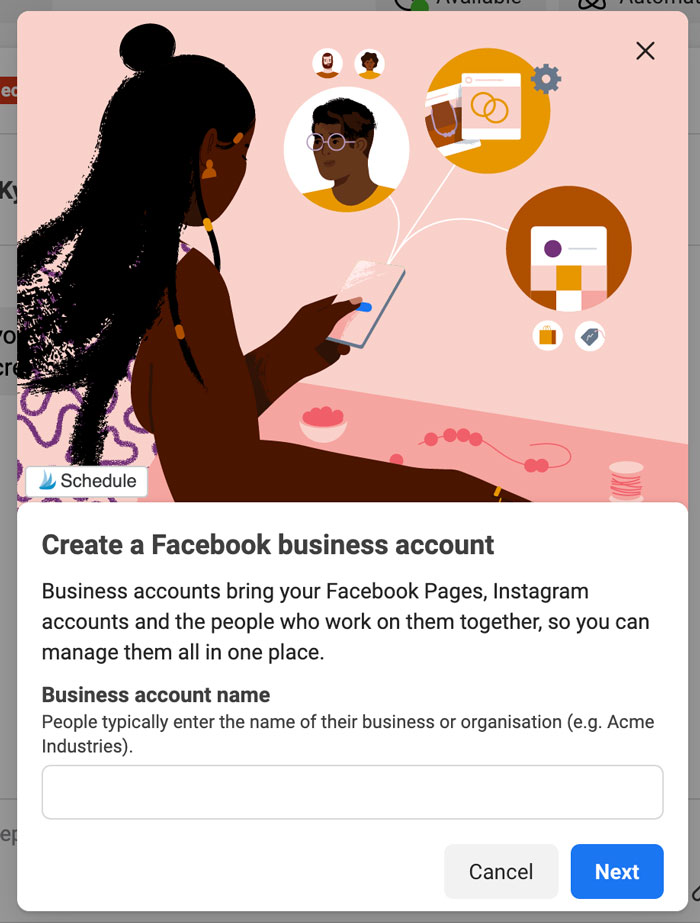
Step 1: Create a Facebook Business Account
Go to https://business.facebook.com/ and select “Create a Facebook Business Account.” Enter your business account name and select “Next” when you’re done.
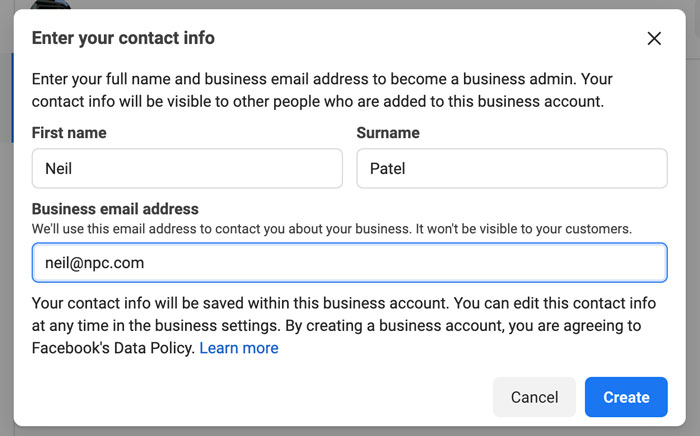
Step 2: Fill in Your Contact Information
Enter your full name and business email address. This information won’t be shared with your followers. Facebook will only use it to contact you.
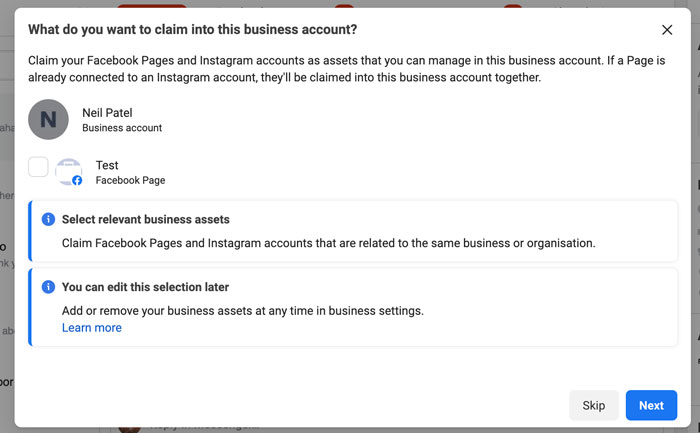
Step 3: Select Your Facebook and Instagram Accounts
The Facebook and Instagram accounts you own are available for you to claim. If you’re managing an account someone else owns, you won’t be able to select it.
In order to select an Instagram account, it needs to be converted to a business or creator account. If you try to select a personal account, Facebook will ask you to switch before continuing the setup process.
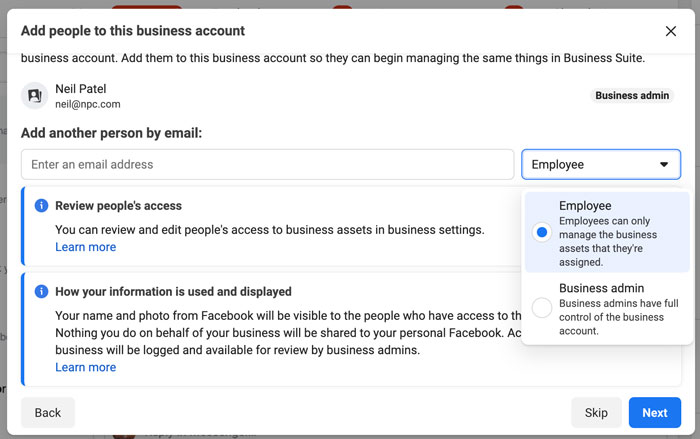
Step 4: Add People to Your Business Account
Here, you can select your page admins. Enter their email address and assign each contact as an employee (limited access) or business admin (full access).
If you’re running your accounts solo, you can skip this step.
Step 5: Review Your Business Account
When you’re happy with your selection and who has access to your Business Suite, click on “Confirm.” Facebook will then take you to your dashboard overview, and you can start using all the tools inside the platform.
Tools to Use in Facebook Business Suite
Curious about the tools inside Facebook Business Suite? Let’s take a deep dive and look at what you can do with the platform and how it can benefit your business.
Monitor Your Inbox
Are comments one of your biggest time suckers? Do you constantly find yourself hopping between apps on your phone or getting inundated with notifications on your desktop?
With the inbox tool in Business Suite, you can see all your Instagram and Facebook comments in one place.
Pop the kettle on, make some coffee, block out 30-minutes in your calendar and respond to everything at once.
- What about direct messages (DMs)? You’ll find that here too.
- Got the Facebook chat plugin on your website? You can manage all your messages here as well.
- Sick of replying to the same question every single day? Business Suite lets you create automated replies for your frequently asked questions.
How’s that for efficiency?
Explore Insights
There are tons of free and paid tools that show you Facebook and Instagram analytics, but few compare the platform’s built-in option.
With Business Suite, you can see your latest statistics for all your accounts.
Gone are the days of toggling between the different apps or going in and out of individual posts.
On the Insights dashboard, you can see an overview of how your content is performing over a specific time period, and sort your posts by:
- reach
- likes and reactions
- comments
- shares
- results
- cost per result
- link clicks
- recent content
One of the most interesting features of Insights is the Audience section. It breaks down your current audience for both platforms, and you can see at a glance:
- age and gender
- towns and cities
- stop countries
There’s also a potential audience tab. It details your estimated audience size if you run an ad, as well as the top pages liked by your potential audience.
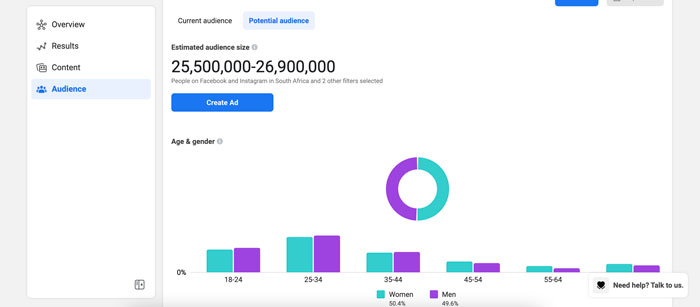
Not liking what you’re seeing? You can create a custom audience by clicking on the “filter” button and refining the results based on:
- location
- age
- gender
- interests
- language
Create Posts and Stories
Are you using post-creation apps like Later or Planoly? Business Suite sets itself up as a rival by giving you the ability to create your posts and stories in one place and schedule each one out.
That’s not all.
If you go to the Planner section on your dashboard, you’ll see a calendar view of your past and upcoming posts.
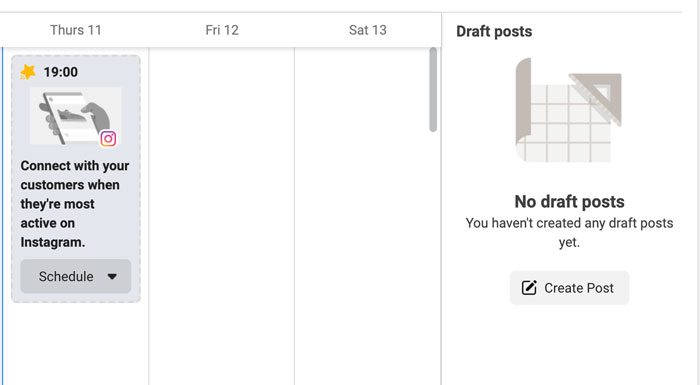
Facebook also recommends a timeslot of when your audience is most online. Click on it, and you can start creating a new post or story.
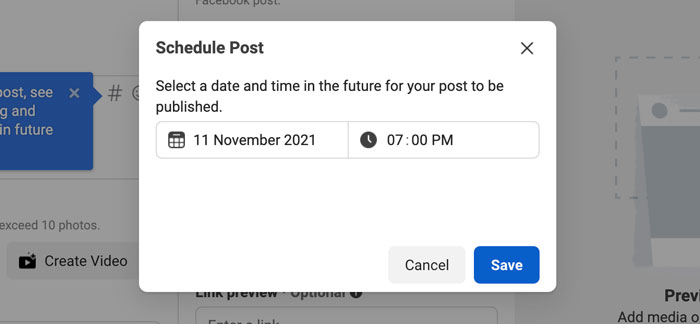
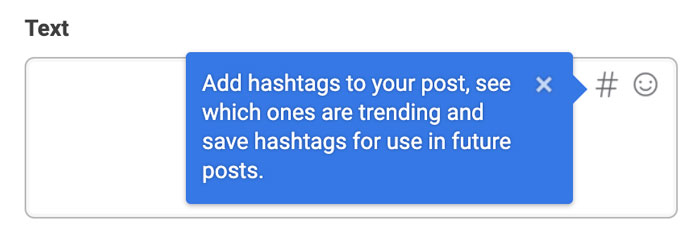
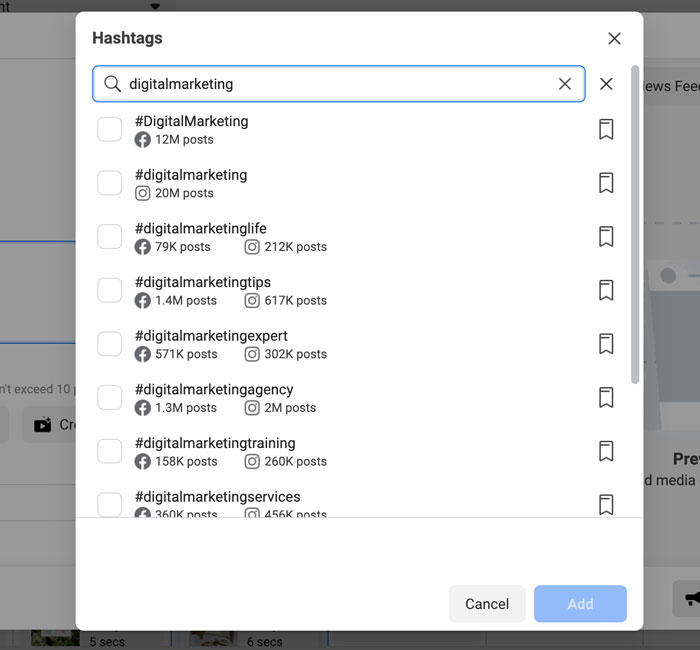
One of my favorite features in the “New Post” box is the hashtag tool. It shows you which hashtags are trending, the number of posts using a tag, and lets you save your favorites for later.
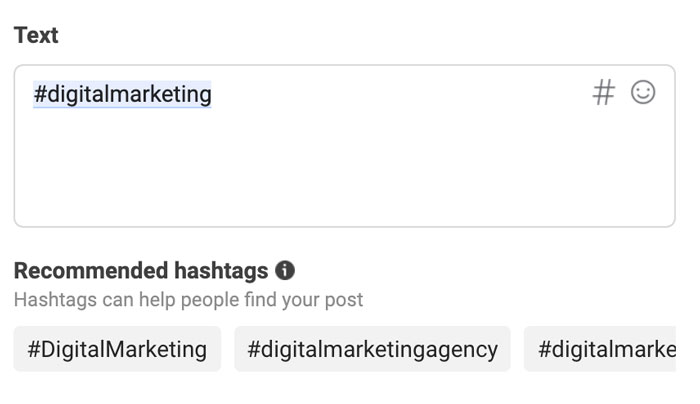
Plus, it shows you hashtag results for each platform and gives you recommendations based on what you’ve already selected.
While in create mode, you can put together your Instagram and Facebook posts at the same time. Switch between the different tabs, and you can see exactly how your post will look on the two platforms.
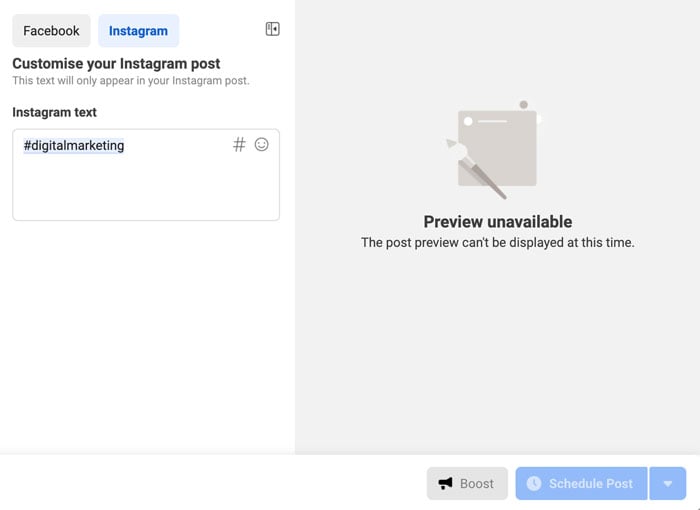
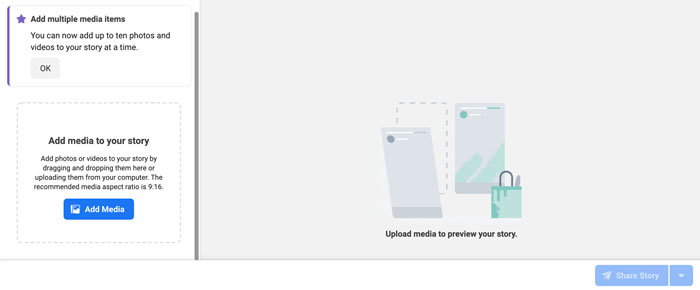
For Stories, it works the same. Upload up to 10 photos or videos at once and schedule each one out when you’re done.
Create Ads
Don’t want to have another tab open for Facebook Ad Manager? You can keep track of your ad performance and create ads from the Business Suite.
It’s another time-saver and allows you to see how you’re tracking towards goals.
On the dashboard, you can see:
- reach
- post engagement
- link clicks
- page likes
Switch between the different filter views to see your results over the last 90, 60, 30, and 7 days.
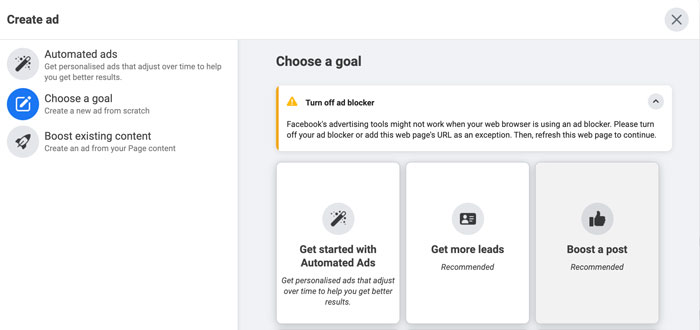
Click on the blue “Create Ad” button in the top right-hand corner to create an ad. A pop-up will load and take you through a step-by-step process for setting up a creative that converts.
First, you’ll select your ad goal. You can choose from:
- automated ads
- get more leads
- boost a post
- boost an Instagram post
- promote a page
- get more website visitors
- get more messages
Next, start designing your ad creative. You’ll see a live preview as you adjust your text and media.
Turn on automatic adjustments if you want Facebook to tweak your ad for each viewer. For example, the platform might adjust the brightness or show the original aspect ratio if it thinks the ad will perform better.
Scroll down to select your audience or create a new one, placements, and set your campaign budget and duration.
When you’re done, click on “Promote Now” for your ad to go into review.
Create Appointments for Your Business
Remember those extra options I spoke about earlier?
One of the most important features of an online business is the appointments scheduler.
If you’re running a service-based business, take advantage of Facebook’s capabilities and empower your audience to book directly through the platform.
When people don’t need to log onto another site to complete the process, you’re removing an extra step and making it that much easier to close a sale.
The result? A boost in your bottom line!
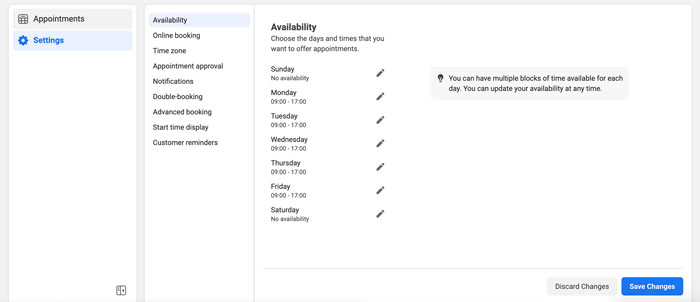
Inside Business Suite, you can manage your appointments, view requests, and adjust the settings to suit your schedule.
Generate Leads With Instant Forms
Does your business rely heavily on lead gen? Start using Facebook’s Instant Forms.
What are Instant Forms? Think of it as a mini CRM system. When you create an ad and set your objective to find leads, you can create custom forms users can fill out without leaving the platform.
Again, you’re removing the obstacle of trying to get them to go from one website to another. Thus, improving your chances of someone filling out the form and requesting a callback.
With Business Suite, you can manage your forms and set up the CRM system.
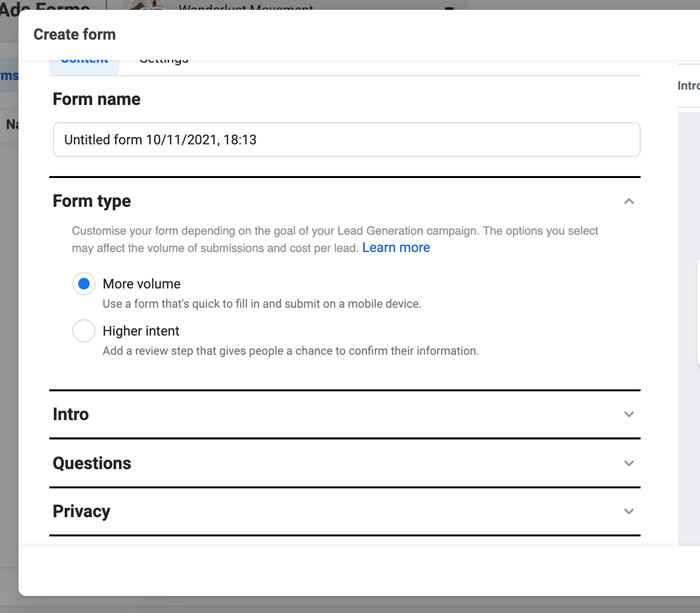
When you create a form, Facebook offers different options depending on your lead generation goal.
For example, you can create a “more volume” form (a quick option) or a “higher intent” (adds an extra step for users to review their information before submitting).
Frequently Asked Questions About Facebook Business Suite
What’s the difference between Facebook Business Suite and Business Manager?
The difference between Business Suite and Business Manager is the features. While Business Suite has all the same features as Business Manager, it has many other capabilities that make it the more robust option for social media management.
What is Facebook Business Suite used for?
The Facebook Business Suite is used for managing your Facebook Pages and Instagram accounts in one dashboard. You can reply to comments, create posts, schedule stories, run ads, and more.
How do you qualify for Facebook Business Suite?
You need to have a Facebook page. If you have an Instagram account, you’ll need to convert it to a business account if you want to sync it to your Business Suite.
Is Business Suite on Facebook free?
Yes, Facebook Business Suite is free to set up and use. All you need is a Facebook account and a Facebook Page to get started on the platform.
Facebook Business Suite: Conclusion
Facebook Business Suite is perfect for creators, personal brands, and businesses to streamline their social media management across Facebook and Instagram.
It gives you everything you need to monitor your growth, stay on top of comments and DMs from your audience, schedule your content, create ads, and so much more.
If you’re only using these two platforms to run your business and you’re using other social media management tools, it’s worthwhile to take a peek inside Business Suite. You might find it’s a more robust tool, and you can nip another business expense from your monthly budget.
What are your thoughts on Facebook Business Suite? Are you going to make the switch and use it to manage your Facebook and Instagram accounts?
Source: neilpatel.com

Best Online Reputation Management
Building a solid online reputation can take years. A few negative reviews (even fake ones) can threaten your good name in heartbeat. What do you do?
If you’re already managing a lot, your best bet is outsourcing it to an ORM, or an online reputation manager.
There’s a lot to know. Handling negative reviews on Yelp, Google, and Glassdoor is a lot of work. Each platform has different rules and procedures. Responding to a public relations crisis requires yet another skill set.
It can be far more cost-effective to have a professional resolve the issue quickly.

Disclosure: This content is reader-supported, which means if you click on some of our links that we may earn a commission.
Best Online Reputation Management Companies
To help you put your best foot forward, I’ve compiled a list of the very best online reputation management companies. Along with in-depth reviews of each option, I’ve included a short buyer’s guide to help you approach your decision.
#1 – Podium Review — The Best for Instantly Generating Positive Reviews
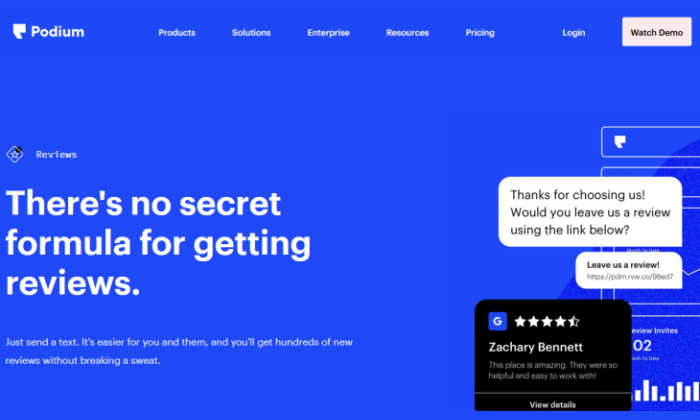
Reputation management can be proactive or reactive. A lot of people think of this service as cleaning up bad reviews or navigating bad press. But a proactive approach focuses on generating high-quality customer reviews to keep your reputation sterling.
Podium is the best tool for doing that because it is foremost a messaging platform that gets happy customers to leave Google and Facebook reviews through texting.
See, getting five-star feedback every time is a matter of striking while the iron is hot. With Podium, you can capitalize on positive customer interactions instantly, ending the conversation with a simple message and link.
As I said, Podium is foremost a messaging platform. Within it, you manage customer messages across several platforms—like Facebook messages and SMS—in one convenient interface. Podium throws in a free, textable business number for each of its clients.
That’s why the software is so effective at seizing upon opportunities to scoop up good reviews. You can respond to customers across all the major channels, so your team is always prompt to help. Then, they can finish with an invitation to review your company, complete with a short, safe link that will take the customer to any of your review pages.
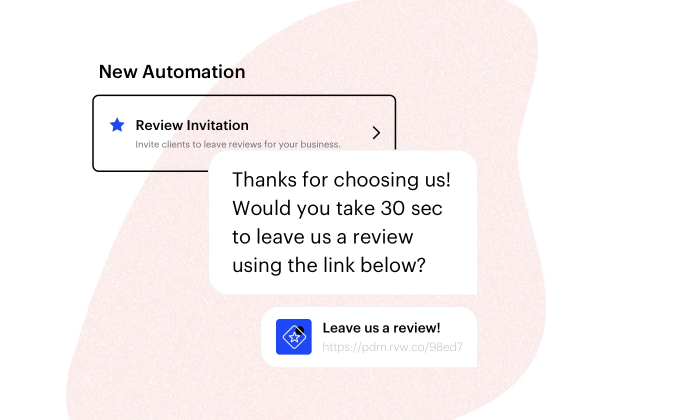
Podium automates this process for you, which is important because your team isn’t always going to have a free minute between customers to send an invitation to review. It also makes it easier on the customer, so they only need to take a few seconds to leave a review and improve your reputation.
So, maybe you’re interacting on Facebook Messenger, but you can point folks to review you on Angi (formerly Angie’s List) or Capterra.
You can also use the software to set up a live chat widget on your websites to add another convenient channel for customer messaging.
Podium’s paid plan allows you to generate and send customer surveys. Identify pain points and get some insights about what’s making your customers happy.
Podium Starter is the way to try this platform out for free. It comes with the following essential features:
ReviewsWebchatUnified messaging dashboardTextable business number
Podium doesn’t have any set paid packages, but you can easily request a quote to get an idea of the cost and full feature set.
Don’t waste any more time chasing down customer reviews. Wield Podium and improve your reputation and overall messaging capabilities today.
#2 – Go Fish Digital Review — The Best for Managing Reviews
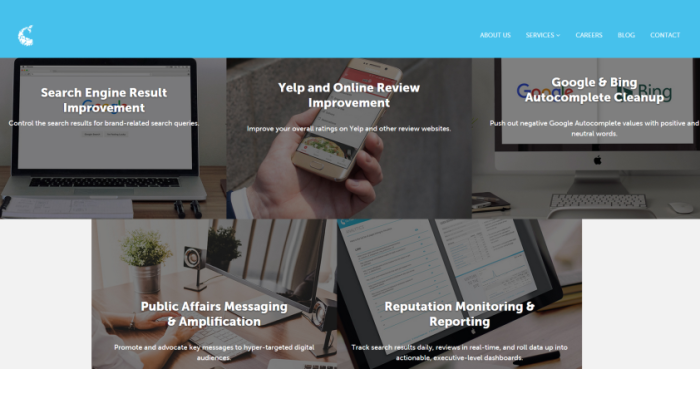
I’ve listed Go Fish Digital as the best agency for managing reviews, and while that’s true, Go Fish Digital also wows with the option of full-service reputation management used by the likes of Geico, Ford, and Airbnb.
With Go Fish, you can gain a thorough insight into your customers’ reviews and comments online.
They work closely with huge review sites like Yelp to manage negative reviews by advocating for review removal on your behalf through their agency tools. They also work to get your best Yelp reviews to the top for more visibility.
They’re exhaustive in their brand monitoring abilities and monitor all corners of the internet like Wikipedia and Reddit threads to create a plan of action in your favor.
Go Fish’s review management works by pushing positive content to higher visibility with SEO, adjusting copy in public places where you’re mentioned, cleaning up Google autocomplete, and even promoting positive information about your business wherever your target audience is.
As they create results, they keep you up to date with a relevant score you can see on their dashboard.
To be clear, Go Fish is a reputable ORM that does not post false reviews for you. Still, their Yelp review management service is one of their strong suits.
Some of their best review management features are:
- Managing negative Google reviews
- Negative auto-complete cleanup often generated from those reviews
- A dashboard that keeps you updated on your brand’s daily search results
- Crafting a strategy for your business to encourage the best reviews possible
- Creating and delivering a strong case on your behalf for negative review removal to the Yelp team
For pricing, you’ll have to contact them directly to get a quote.
As with most ORMs, their prices change depending on the size of your business and the specific services you’re looking for.
Get in touch with Go Fish to get an initial quote.
#3 – Reputation Rhino Review — The Best for Individuals and Small businesses
If you’re wondering who exactly needs reputation management, Reputation Rhino’s answer is ‘everyone.’ That’s why it’s the best ORM for solopreneurs and small businesses.
Reputation Rhino is a leading online reputation manager based in New York with clients like Disney, Microsoft, and Nestle. They offer a number of reputation solutions for almost any scenario imaginable, including ones that cater impressively to an individual and their personal brand.
It doesn’t matter if you’re a doctor, university, hotel, or contractor, Reputation Rhino helps you with Glassdoor, Yelp, and YouTube review removals, social media management, and even an SEO strategy to put the best parts of your brand (or yourself) front and center.
Do you have terrible images that need to get removed from Google? They can do that. Do you need to fight against libel and personal defamation? Their team of public relations specialists can do that, too. These are services an individual or small business may not know how to do or not have time to take care of.
Their best ORM services for individuals include:
- A personalized strategy to defend against smear campaigns
- Suppressing negative online search results
- Adding an extra layer of protection to your personal privacy
- Eliminating news articles, forum comments, and negative content
As an individual or SMB, you might be nervous about investing money into an ORM. To help, Reputation Rhino offers a 30-day money-back guarantee that can ease your worries about whether they’ll deliver. If you need a more personal approach to reputation management, Reputation Rhino is happy to work with you individually.
Their pricing starts at $1,000. But you’ll have to contact them for a personalized package.
Get started with Reputation Rhino and request more information.
#4 – Reputation Resolutions Review — The Best for Crisis Management
Unlike other ORMs out there, Reputation Resolutions is the go-to agency for crisis management that can start working on your behalf in 24-72 hours.
A combination of their speedy response, a team of attorneys, a wide array of solutions, and a seasoned professional team makes them the best ORM for enterprise-level reputation and crisis management.
Maybe your business is an established corporation, but there’s been a sudden increase of negative reviews, you’re dealing with a handful of loud, angry customers online, or there is negative propaganda about you in the media. Ouch. Reputation Resolutions provide everything you need to turn a crisis around.
Here’s a quick rundown of their top-tier crisis management features:
- Cyber forensic investigation
- News article removal
- Court record removal
- Thorough and ongoing reputation monitoring
- Private information removal
- Unwanted image removal
If you’re a smaller or mid-sized business looking for a management agency to simply take care of negative reviews, Reputation Solutions isn’t the agency for you.
Alternatively, if you’re an established, well-known business in need of comprehensive PR management, attorneys, or copyright infringement services, then look no further than what Reputation Solutions can offer you.
To get a pricing quote, email or call them for a free consultation, and they will learn more about you and tailor their services to your specific needs.
#5 – Big Leap Review — The Best for SEO And Content Management
Big Leap’s ORM services are designed around one thing: content management. Their award-winning content marketing strategy centers around burying the negative and growing the positive.
This is fantastic news for you if you’re looking for an ORM that cares deeply about gaining customer trust through a long-term strategy.
If your marketing strategy is mainly through content, you’re not as concerned about a sudden PR crisis, or Yelp reviews are mostly irrelevant to your sales success, then Big Leap’s trust-building approach can help you create results.
They begin by scouring the internet for every mention of your business. They do social media and search audits, along with a competitive analysis, to give them the bigger picture of where your reputation lies.
Then they create a positive content strategy tailored specifically for you through brand-strengthening content and social media campaigns. As they execute their content strategy, Big Leap regularly reports back to you with updated results.
Some of their best ORM content management features include:
- Brand name monitoring
- Content strategy, creation, and promotion
- Site optimization
- Constant workflow updates on content strategy execution
Big Leap doesn’t list their prices publicly, but you can request a quote on their site.
#6 – NetReputation Review — The Best for Improving Reputation with Content Development
Some companies have damage control as their foremost priority with reputation management. Others are starting as unknowns that want to become more recognizable brand names.
In either case, one of the most potent solutions is building out your content and web properties, which is what NetReputation excels at.
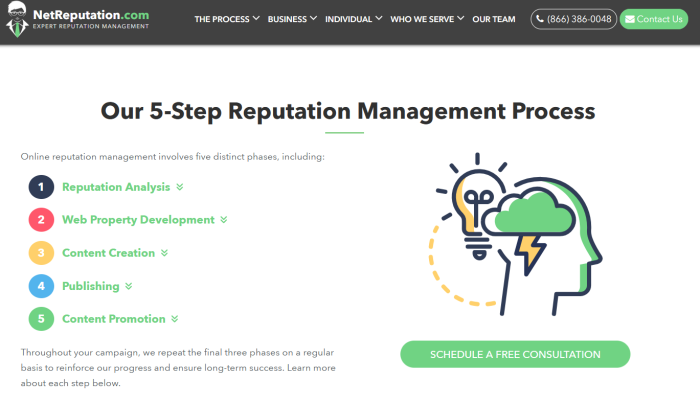
Their five-step process creates an end-to-end strategy for building up your reputation.
Start with NetReputation’s thorough analysis of your content, websites, social media profiles and pages, search results, reviews, and more. Then, let them guide you through creating better web properties and content and promoting them both.
And while that’s a great offering, you may have heard similar promises before. “Content is king” and all. But, NetReputation shows their work along the way, so you can have full confidence you’re not just screaming into the void.
Indeed, you can rest assured that you not only have full visibility into your reputation-improving content campaigns—NetReputation builds it with you and lends their expertise to plan strategy and allocate efforts with Swiss watch precision.
Here are just a few aspects they can integrate into your company’s ORM strategy after their initial analysis:
- Social media profile creation and optimization
- Website and Schema development
- Wikipedia page creation, monitoring, and editing
- Blog posting and scheduling
- Content updates and optimization
- Cross-channel promotion
- Guest/expert posts
- Content removal
- General and local SEO strategy
They’ll keep you in the loop every step of the way. So if you want to deemphasize one effort in favor of another, they’ll listen and work with you to adjust plans and action items.
With content being produced to fit all the aspects listed above and more, you and NetReputation can improve digital sentiment about your brand across the board.
NetReputation goes deep into this process for every client. Get your free consultation today and see for yourself how far they’ll go to make your organization’s online reputation sterling.
#7 – InternetReputation.com Review — The Best for Eradicating Private Information
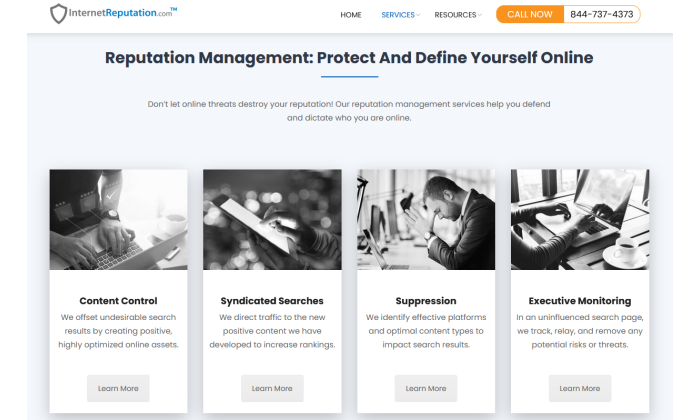
Reputation management for individuals is an emerging use case for reputation management platforms and one that is becoming more useful for a wider swath of people.
Within personal brand management is the need to carefully share enough about you to build your presence and reputation without divulging private information.
InternetReputation.com handles personal reputation management and privacy monitoring with aplomb.
Individuals, from entrepreneurs and business owners to budding public figures or influencers, can utilize their Reputation Station tool to monitor digital sentiment and online information about their personal brand.
It’s an insightful, centralized dashboard for gauging reputation, tracking ORM campaign progress, and ordering services to boost your standing. Tasks, assets, files, goals, metrics, and resources are all kept in one handy area to give you a 360-degree view of your reputation.
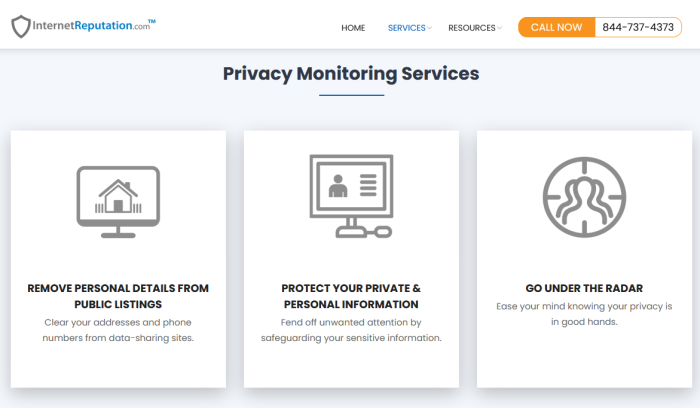
But privacy monitoring is where InternetReputation.com separates itself more from the rest of the ORM pack.
Have personal details online you don’t want to be on public listings? Remove addresses, phone numbers, full names, and more.
You get a customized, all-encompassing package from InternetReputation.com to help keep your private information away from everyone’s eyes. Their proprietary tool removes sensitive information from data sharing sites in a blink and makes sure it isn’t propagated any further.
Plus, you get access to Infosweep to append your privacy monitoring efforts with your reputation monitoring ones. Infosweep notifies you of new mentions and instances of your details becoming publicly visible online.
Altogether, this presents a wide-ranging tool for individuals looking for full visibility and improvements to their personal brands and reputations. Reach out to IntenetReputation.com for a quote for your bespoke ORM solution today.
What I Looked at to Find the Best Online Reputation Management
Unfortunately, there isn’t a singular “best” reputation manager that fits every business like a glove. If there was, then this guide wouldn’t be necessary.
Different ORMs cater to different services. This can mean some are better than others at crisis management, online monitoring, online review management, SEO-focused branded content strategy, or even supplying attorneys to advocate on your behalf.
First, are you building a new online reputation from scratch? Maybe you’re trying to improve a negative reputation? Or are you being proactive and investing in maintaining a good one?
You have to determine where you are on your reputation management journey. Then you can think about a few factors that can refine your search even more.
Business Size and Type
Your company size generally correlates with the size of your reputation. Obviously, the bigger and more varied your sales channels, the more work you’ll have managing how you look online.
Your business’s size can also dictate the amount you’ll want to invest in ORM services. Some questions to consider are: What is your estimated current business reach? What types of distribution channels do you sell through or publish content on? Are you a service-based business, an organization, or an e-commerce store?
When choosing the best ORM for you, these are some key questions to consider before moving forward. If your business isn’t a complex enterprise, you won’t need a costly ORM that specializes in litigation, video removal, or a team of expert attorneys.
Marketing Strategy
Your marketing strategy also determines the type of online reputation management you need.
Do you primarily sell via a content creation strategy? Do you sell on multiple e-commerce platforms? Is your business big enough that it sells through on-air advertising? Do you already have a strong social media presence that drives sales?
Go Fish is a great choice if you want to manage reviews, whereas Big Leap is going to be more effective for managing content. Which is more important for your business’s reputation?
Outlining how you primarily reach your customers will help you narrow down your search. If you don’t, it might affect how well your ORM can deliver results.
Long-Term Crisis Management
Think about the future of your business and its reputation. Sure, at some point you might need to put out a reputation fire that caught you by surprise ASAP. Or maybe you’re only getting started and want your name out there in the short-term in a positive light to drive more sales.
But do you have a long-term plan for managing reputation crises that will inevitably come up in the future?
This will determine which ORM can deliver on either your short-term or long-term goals. Each one is built differently to cater to your business goals, as we’ll see further in this guide.
Conclusion
You don’t have to suffer from a bad reputation that only seems to be out of your hands. There are plenty of agencies out there that can help lighten your reputation management load once you’ve reached out and established a relationship with them.
Here are all my top recommendations to get the help you need today:
- Podium – The best for instantly generating positive reviews
- Go Fish Digital – The best for managing reviews
- Reputation Rhino – The best for individuals and small businesses
- Reputation Resolutions – The best for crisis management
- Big Leap – The best for SEO and content management
- NetReputation – The best for improving reputation with content development
- InternetReputation.com – The best for eradicating private information
Online reputation management agencies can indeed offer a lot of the same services. But look closer to find what they specialize in. Hopefully, this in-depth guide helped shed light on which of the top ORMs can work for you.
Check out each agency on this list and get a quote from the one that fits you best to start managing your online reputation now.
Source: feedproxy.google.com

Is Your Business Ready for Holiday Season Ratings and Reviews?
With the holidays right around the corner, you should be gearing up for customer traffic overload. In years past, business owners have viewed this period as naturally prosperous with built-in demand for goods and services.
This year – 2021 – may prove to deliver more of the same retail mojo as years past.
But there is an important difference that could make it a uniquely challenging year for customer experience: supply chain and shipping uncertainties mean consumers might be disappointed that their purchases arrive late or are altogether unavailable.
These disappointments and frustrations are likely to end up finding their way onto your online reviews. This is the time to gear up and think offensively for holiday season ratings and reviews – more than ever.

Be Prepared for LOTS of Holiday Season Ratings & Reviews
Studies show that people spend more money each subsequent holiday season, meaning that more services and products are being bought now than ever before. Shoppers are also writing more ratings and reviews than ever before.
Combine these growing numbers with surging emotions (both positive and negative) that come with the holiday season, and you have a perfect storm for ratings and reviews.
They’re going to come fast and furious, especially right after the Christmas holiday. And if you work to turn this into an opportunity, you can put yourself ahead of the competition.
What to Do When Reviews Start Coming
Product launches are risky, and launching during the holiday season can be a recipe for disaster if you rush it. You may very well be slammed with negative reviews.
If this happens, and you feel your blood boiling or a need to contradict this naysayer, don’t.
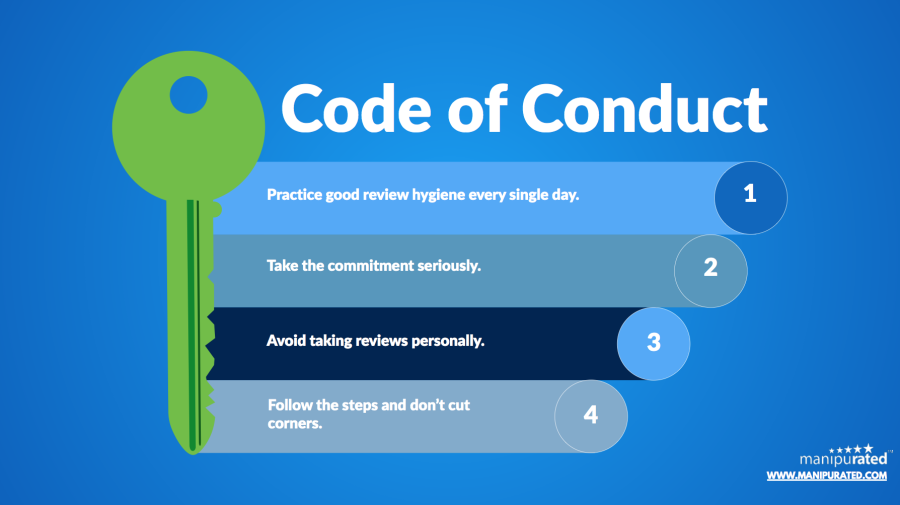
Taking a review personally or coming at it from a place of anger or frustration will yield you nothing. It might even hurt your reputation. The first step is to take a deep breath.
Then respond from an objective and understanding place. Based on my research in Manipurated, by responding to a complaint, you double your odds that a complainer becomes an advocate for your business.
You need to keep your fury in check, take the time to address the issue, and respond smartly.
Don’t forget to respond to good reviews, too. These customers can be your best clients, and a positive “Thank you” will not only make them happy, but it could also result in an additional sale.
Key Tips for Consistency
Let’s quickly review.
Staying on top of your holiday season ratings and reviews is a win-win proposition. When you get good reviews, you make reviewers happier.
And when you get bad reviews, you can either turn complainers into advocates, or you can show interested prospects that you care about your brand and your service.
Now that you understand the importance of responding to complaints, here’s how you can scale it.
1. Do It Yourself
Run Google Analytics and Incognito searches. See which rating-and-review sites people are using to discuss your brand. Or…
2. Pay For an App
Streamline the process using an app to manage rating-and-review sites, such as ReviewTrackers, BirdEye, and Yext. They typically include some form of an easy-to-use dashboard. Think of an RSS feed, but for rating-and-review sites instead.
These types of services are usually per location per month. The advantage is that they do nearly all of the heavy lifting for you.
Setting the Tone for the Next Quarter
So, you’ve managed the surplus of holiday season reviews and with a cool app and a clear head. If you’re not proud of yourself, you should be. That was a lot of hard work!
But it’s not time to relax yet.
Any negative reviews you received were most likely because a user was dissatisfied with your service. Whatever the case, cross-reference their complaints with those of other complainers.
If you start to see a consensus among your reviewers, perhaps it’s time to change something about your business.
Remember—there’s always next holiday season.
The post Is Your Business Ready for Holiday Season Ratings and Reviews? appeared first on Content Marketing Consulting and Social Media Strategy.
Source: convinceandconvert.com

How to Start a Business
Anyone can start up a business. No college degree, huge bank balance, or corporate experience is necessary. All you need is a great idea, the right systems, and the drive to see it through.
Since you’re already searching for ways to learn about how to start a business, odds are you already have an idea and the drive. What you need to know is how to start building your future empire.
In this article, I’m going to discuss the exact steps to start a business so that you can put the right systems in place.

Disclosure: This content is reader-supported, which means if you click on some of our links that we may earn a commission.
Your 2-Minute Cheat Sheet
I’ll walk through each step in much greater detail below. Here, I want to give you the bare-bones cheat sheet for how to start a business now.
First, refine your idea based on the needs and demands of your target customers, along with your preferences.
Next, you’ll create a business plan. This is a crucial part of the whole process, so you have to get this right.
After sketching out your business’s entire framework, do market research, and collect feedback from friends, mentors, and family.
Then you need to tackle the legal side of things. Get started early in case there are any snags. This includes deciding your business structure, registering your business, getting the necessary license and permits, and setting up bank accounts.
At this point, you have your idea and a plan to make it come to life. You can then use it to arrange for the required capital to launch your product or service. Follow this up by building your team and finding a location if you’re opening a physical store.
Finally, focus your efforts on generating more sales and growing your business, which is also what you’ll find yourself doing for most of your career.
That’s a few years of business distilled into a couple of paragraphs. Let’s take a closer look at each step. Of course, you should feel free to skip steps if you have already locked down the basics.
Step 1: Come Up With a Business Idea
Every business begins with an idea. If you already have one, congratulations! You can proceed to the next step. If not, you need to start brainstorming.
Here are a few tips to come up with a great business idea (I made a list of over 25 home-based businesses as well):

Think of ways to get ahead of the curve. Think of how your product or service can change the business landscape, especially with the constant technological advancements.
- Solve a problem you identify. After all, your customers would prefer more of a good thing and less of a bad thing.
- Try to bring a fresh perspective that helps you gain a competitive edge over your competitors.
- Think of ways to make your approach better, cheaper, and faster if your business idea isn’t new.
At this stage, you can also conduct surveys and collect perspectives by meeting people and asking for advice. Researching ideas online is another excellent way to come up with business ideas.
Step 2: Conduct Market Research
The whole point of conducting market research is to understand typical consumer behavior, pain points, and relevant market trends in your chosen niche. This is a sure way to determine how your potential startup might fit into the existing industry landscape.
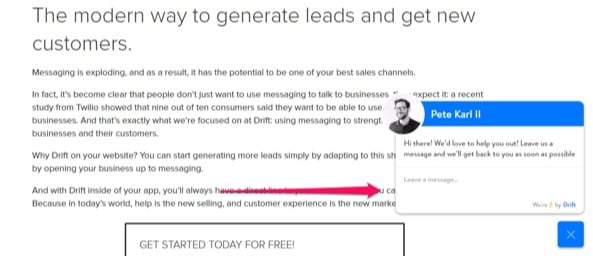
Try to find the answers to the following questions while doing market research:
- What product or service is currently in demand in your given market?
- What is the market size, or how many clients make up your target audience?
- How many competitors share a similar concept to your business idea?
- What is the price that customers are willing to pay for products and services in your market?
- What’s the typical consumer engagement in your market? Did your competitors move online during the pandemic? Can you replicate their sales process or do it better?
One of the best ways to gain genuine insights is to speak with consumers directly. Take surveys, make questionnaires, and do one-on-one interviews.
Another free resource you should absolutely use is Google. Say you are starting a business that sells shampoo to men. I’d search “shampoo for men”, “men’s hair care”, along with other terms and phrases in the space.
Then I’d take a hard look at the first page of results for each keyword.
What are the top websites (not paid ads) doing? Who are they speaking to? How do they position their products and services?
Asking simple questions like these can give you a ton of insight into the market. You can also plug keywords into tools like Ubersuggest to find out how many people are searching for these terms each month.
Researching your market is an ongoing process. What you find out today may change tomorrow.
I put this as ‘Step 2’ because you want to get started early, but you should be constantly trying to understand the trends in your space.
Step 3: Lock Down the Legal Stuff
I always make sure to get the legal stuff out of the way early. This way, I don’t have to worry about anybody else taking my big idea, ending up in a bad partnership, or getting sued because of misinformation.
Determine your business structure first, as it’ll dictate the legal and tax requirements you will have to meet. Your options include sole proprietorship, partnership, limited liability company (LLC), and corporation.
Enlist a tax professional’s services, as every structure has its own set of tax requirements, or use an online business formation service.
At this stage, you’ll also have to choose a business name and register your business. Find out whether your chosen name is available for registration in your state and within the digital space. You want availability as a:
- Business name in your state
- Domain name
- Social media platform usernames
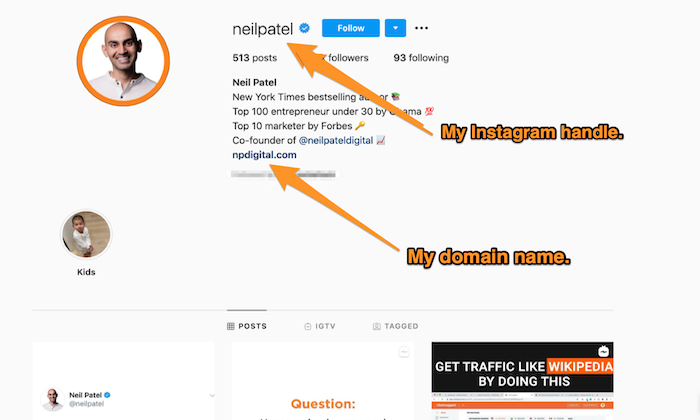
If a specific name isn’t available, you can always consider permutations of the name. Make sure your domain name and business name aren’t impinging on any registered trademarks.
There is a quick checklist of other things that you’ll need:
- Federal tax ID
- State tax ID
- Permits and licenses (as needed)
- Business bank accounts
- Trademarks, patents, and copyrights (as needed)
It’s best to consult a lawyer to cover everything you need. You can always work out things on your own, but sometimes it’s best to ask an expert.
Step 4: Write Your Business Plan
Many people question the purpose of creating a business plan. After all, if you already have a vision for your business, why write it down?
When you create a business plan, you describe every aspect of your business in a formal document. You put everything into words.

In the words of Benjamin Franklin, “There never was a good knife made of bad steel.”
It’s precisely why a business plan is such a crucial part of any business. It defines your thoughts and research and exactly what you need to do to make a business a success.
This helps put things into perspective and allows you to identify areas to streamline future processes.
Let me clarify: Your business plan doesn’t need to be 100 pages long. It only needs to be readable and include the main components. Such as:
- Pain points your business solves
- An elevator pitch about what your business does
- A list of your target audiences
- An idea list of how you’ll promote your business (your marketing strategy)
- The financial plan of how you’ll raise money to pay and how your business will make money
- Financial documents
Do a SWOT analysis (Strengths, Weaknesses, Opportunities, and Threats) of your business, too, to gain insights and identify ways to achieve your goals.
As the industry and market are always changing, you’ll find yourself revising your plan frequently. Periodic revisions and refinement of your business plan ensure that your business remains competitive in the long run.
Step 5: Raise Capital for Your Business
There are many ways you can get the resources to start your business. Below, I’ve discussed some of the best ways I found raising capital is easy and effective. You can choose one or more that work best for you.
Start at Home
Bootstrapping your business is a long process, but it gives you full control over your business. You can also leverage personal relationships by asking friends and family for a loan or to invest in your business.
Online Crowdfunding
There’s no disputing the power in numbers, especially when it comes to raising capital. Crowdfunding gives you direct access to small investments that can add up to something massive.
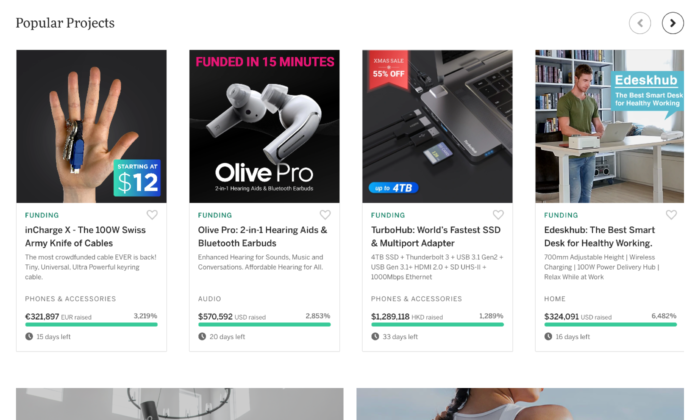
Check out Kickstarter or Indiegogo, or Google a list of the most popular crowdfunding websites. Crowdfunding is more for a physical product than a service.
Reach Out to Venture Capital Investors or Local Angel Investors
Venture capitalist investors look for proven teams that require a capital investment of $1 million or more, which is why you need some traction before approaching them.
If you feel you don’t have such traction right now, you can instead apply to online platforms like AngelList and Gust to find potential investors who would be interested in your project.
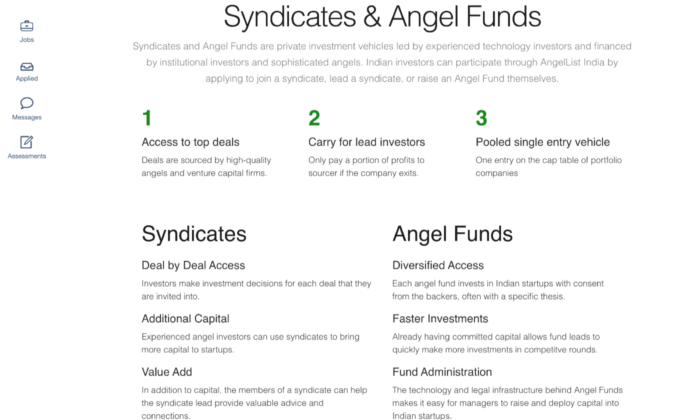
Apply for a Small Business Grant
Grants.gov is an online directory of more than 1000 federal grant programs that can supply you with the capital to kickstart your project. Although the process is long, you don’t have to give away any equity.
Get a Bank Loan or a Line of Credit
Applying for a bank loan is easy, but you should do so only if you really need a bank loan and if you’re eligible. You can head over to the Small Business Administration to look for loan opportunities.

Step 6: Develop Your Product or Service
Nothing feels better than seeing your idea come to life. The only problem is creating a product takes a village–if not a city.
You’ll have a different set of requirements based on your product or service. For instance, if you want to develop an app, you want someone with the technical know-how, whereas if you’re going to mass-produce an item, you’ll need a manufacturer.
Product simplicity and quality should be your top priority. Rather than creating the cheapest product, focus on developing something that catches someone’s attention. You can further streamline the process by keeping in mind the following tips:
- Avoid handing over product development to someone else or another firm, and if you do, make sure you supervise constantly.
- Implement regular checks and balances to reduce the level of risk involved. For example, if you decide to hire freelancers, hire multiple people so that you don’t put all your eggs in one basket.
- Enlist specialists instead of generalists. A jack-of-all-trades isn’t what you need right now.
- Always operate within your budget.
For service-focused entrepreneurs, the game is slightly different.
Your primary focus should be to have the necessary certificates and educational requirements. Search online job portals and freelance working platforms to find opportunities. Upwork and ProBlogger could be great places to start.
Step 7: Build a Reliable and Responsible Team
What’s the best way to scale your business and achieve all your organizational goals?
Have a good team.
One of the critical aspects of a growing business is delegating responsibilities to other people, whether a partner, employee or freelancer. Here are a few tips to help you find the right team members:
State Your Goals Clearly
When your team members understand your vision and their role in helping you achieve it, they’ll make fewer errors.
If you are just starting out, you’ll probably be interested in some of the really great free project management software out there. These aren’t free trials, and you’ll be able to make sure everyone is on the same page–no extra cost to you.
Establish and Follow Hiring Protocols
Welcoming people to your team involves several processes, ranging from screening people, carrying out interviews, and having proper forms. This will help you create a more competent team.
Create a Strong Company Culture
Great company culture is all about respecting and empowering employees through training and mentorship.
You don’t need futuristic decor or ping-pong tables (if you can afford that, that’s great!) but you do need a positive atmosphere where everybody feels welcomed and appreciated.
Step 8: Find a Business Location
One in four businesses that starts within the next 12 months will have a 100% remote workforce. But if you decide to open a brick-and-mortar retail business, you need to focus on getting the right location.
Here are a few things you should keep in mind:
- Demographics: Think about your customers and how they interact with your location. Does your target clientele frequent the potential location? Does your location reflect the image you’re trying to project?
- Foot Traffic: Monitor the foot traffic outside a potential location throughout the day. Do you see a couple of passers-by throughout the day? Or is it away from the public eye? Is there parking available?
- Business Community: The business community refers to the other businesses nearby that can bring you foot traffic. Is there a mall nearby? Are there restaurants where customers can go after shopping at your store?
- Competition: Contrary to popular belief, having competitors nearby isn’t always bad. Whatever your stand, you should be aware of whether or not you have competitors nearby before deciding on a location.
Research the history of the location as well. If other businesses have tried and failed in space, find out why.
And of course, always keep the cost in mind. Expenses like rent, cleaning services, insurance, and parking fees need to be considered.
Step 9: Work On Generating Sales
Start by listening to your potential customers to know their wants, needs, likes, and dislikes. Next, learn the art of asking for a commitment without being too pushy.
In other words, don’t force your customers into buying goods from you, or they won’t return.
Moreover, you have to prepare yourself for hearing “NO“ too. Sad, I know.
People listen to your elevator pitch despite having no intention to buy simply because they’re polite. If they don’t end up buying from you, don’t get disheartened.
Grow your customer base and put out advertisements to find an audience to fit your business.
At this point, you’ll also have to figure out the right sales funnel and strategy to generate leads and convert them into paying customers.
Sales and marketing are critical to building a successful business. Check out some of these free customer relationship management tools that help you stay organized as you grow your contact list.
Step 10: Expand Your Business
You must have a growth plan if you want to earn and scale your business. Luckily, there are about a million ways to grow your company.
I’d highly recommend utilizing the power of social media through an organic, influencer, and paid campaigns. Email marketing works equally well to create and nurture a dedicated customer base.
One of the key aspects of long-term growth is to have a dedicated customer base and reduce customer churn.
All the efforts you put into nurturing your existing customers can be useful in the long run when they act as your repeat customers, ensuring revenue in the long run.
Conclusion
We’ve covered everything you need to know to start a business. Now you can prepare for the exciting adventure in front of you.
Taking the first step can feel a bit scary, but don’t fear. Take the plunge and launch your business–it’s a lot of fun!
Of course, you’ll find challenges and roadblocks along the way, but as long as you remain dedicated and driven, you can learn from your mistakes and climb higher up the ladder.
Don’t wait any longer!
Source: neilpatel.com

How to Attract Customers with Buy Now, Pay Later Options
Buy Now, Pay Later (BNPL) is the grown-up, digital version of installment plans of the past. BNPL allows consumers to split large purchases into several monthly payments, interest-free. The industry is growing fast, with 37.7 percent of US consumers choosing the option as of July 2020.
Customers don’t just like BNPL; it also encourages them to manage their budget in a way that helps them pay for higher-priced items.
In fact, 44 percent of consumers say their use of BNPL is somewhat or very important to determine how much they spend.
The reason for the popularity is pretty straightforward. Buy Now, Pay Later offerings to allow consumers to split up large purchases over several months.
In times of economic uncertainty, it’s a relatively pain-free way for consumers to increase financial flexibility and access credit—–without paying interest or applying for a credit card.
BNPL helps online retailers attract customers and increase revenue, which is why business leaders are taking note. If you’re considering BNPL for your organization, here’s how to get started.
1. Select a Buy Now, Pay Later Provider You Trust
The first step is to select a BNPL provider. Several tools and apps offer this feature, including PayPal with their Pay in 4 option.
Each tool may offer similar features and integrations, but there are several differences to note.
PayPal’s offering integrates with the PayPal wallet, allowing users to easily manage payments.
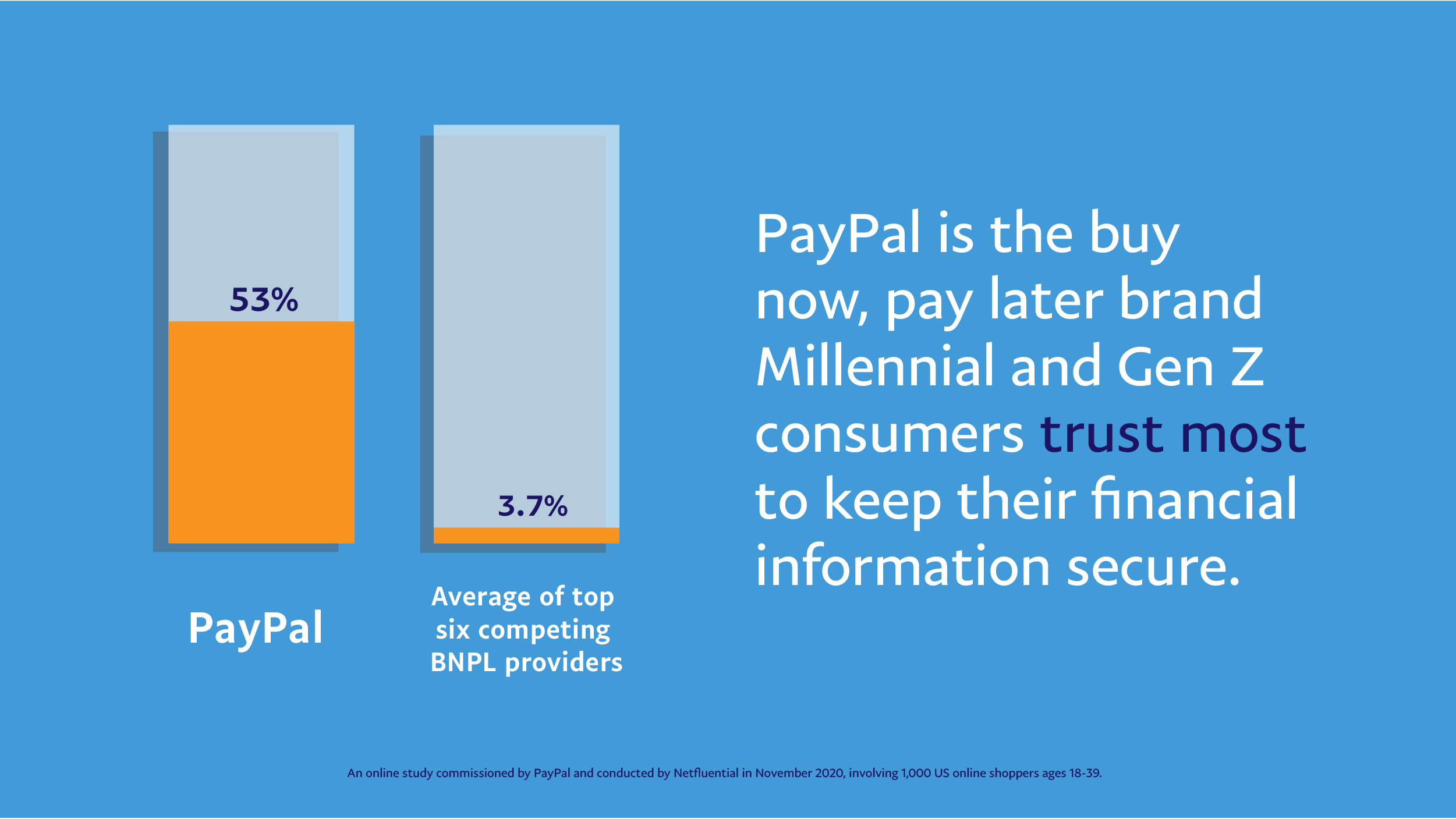
When comparing different BNPL options, you’ll want to consider platforms consumers trust. Familiar options like PayPal may increase consumer trust, which may increase sales.
For example, a recent IPSOS study found consumers are 54 percent more likely to purchase from online retailers that offer PayPal, and a recent Morning Consult survey found PayPal is the #2 trusted brand in the world.

2. Highlight Your BNPL Payment Option
BNPL allows consumers to make larger purchases they may not otherwise have had the funds to pay for in one go.
This can help drive sales, especially for online stores. However, to effectively encourage those conversions, businesses need to highlight the option early in the purchase cycle — before consumers decide an item is too costly and exit the funnel.

For example, CMOs could have their marketing team test messaging on their product pages or add a program logo and a short description next to the add to cart button.
To determine the best placement, locate where customers drop off and add BNPL language beforehand.
For example, if a large portion of traffic drops off from the product description page, consider adding BNPL information near the search bar or on the category or product page.
3. Include a Brief Description of Your BNPL Option On Your Checkout Page
As consumers add items to their shopping cart, the cost can quickly add up.
They may abandon their cart when they see the final amount — but the BNPL messaging alongside other trusted payment options may encourage them to complete the purchase.
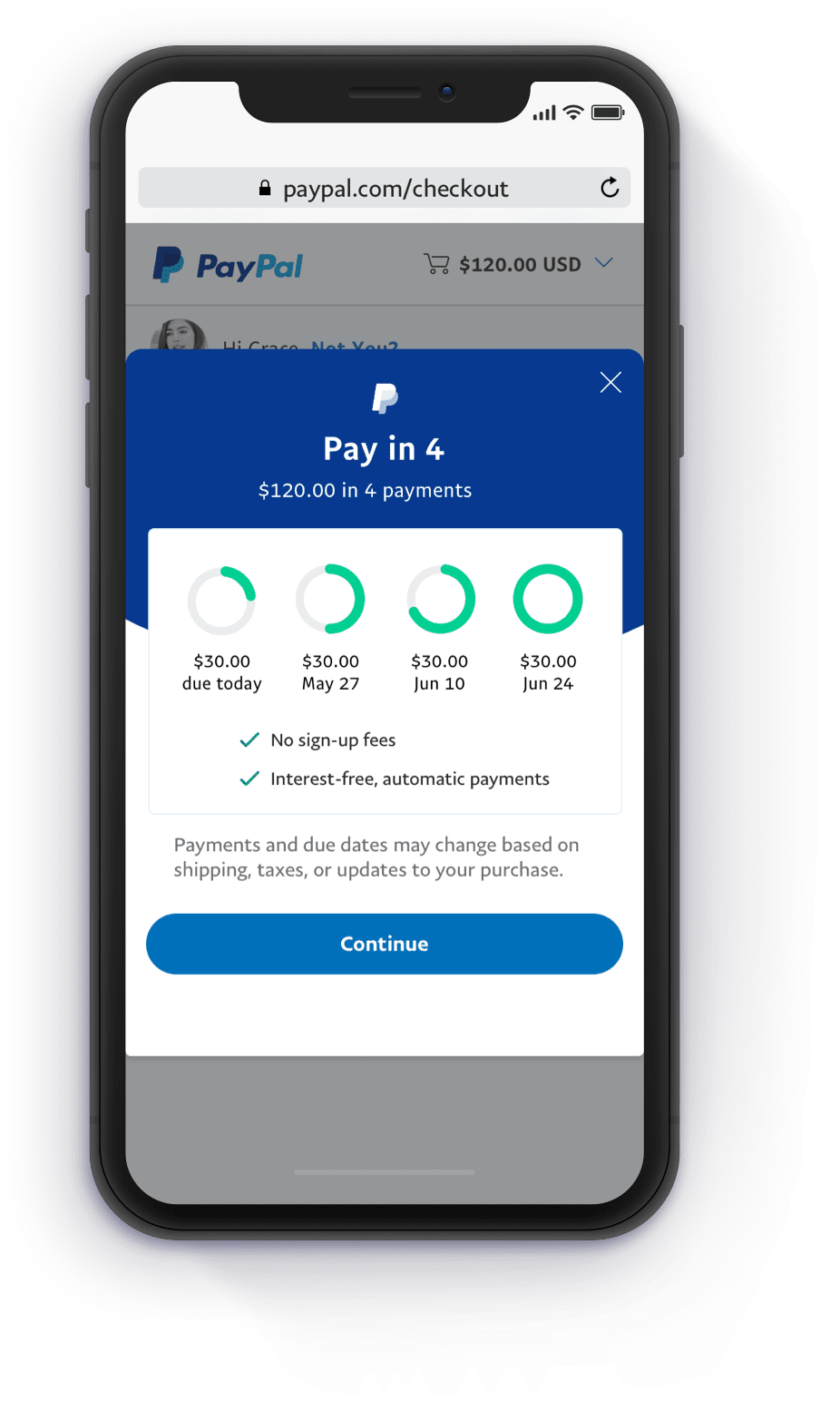
To make the BNPL option stand out, have design and UX teams test different placements, for example above and below other payment options.
Exit-intent popups mentioning the availability of BNPL may also encourage conversions.
Testing is the only way to know what format will drive your audience to convert.
4. Track the Success of Your BNPL Strategy and Make Adjustments as Needed
Like every other marketing and sales strategy, testing is integral to a successful BNPL strategy. Understanding what works — and what doesn’t— helps allow your marketing teams to pivot as needed.
For example, you might edit your direct marketing or change the design to test different copy alternatives, placement of BNPL mentions, and ad campaign targeting.
Note that BNPL isn’t just effective at helping drive sales. It may also drive higher average order values as users may be more willing to buy that extra shirt or try a new cologne when they can split up payments.
Based on an analysis of PayPal internal data from October 2020 through January 2021, the Pay in 4 average order value is 39% higher than standard PayPal transactions.
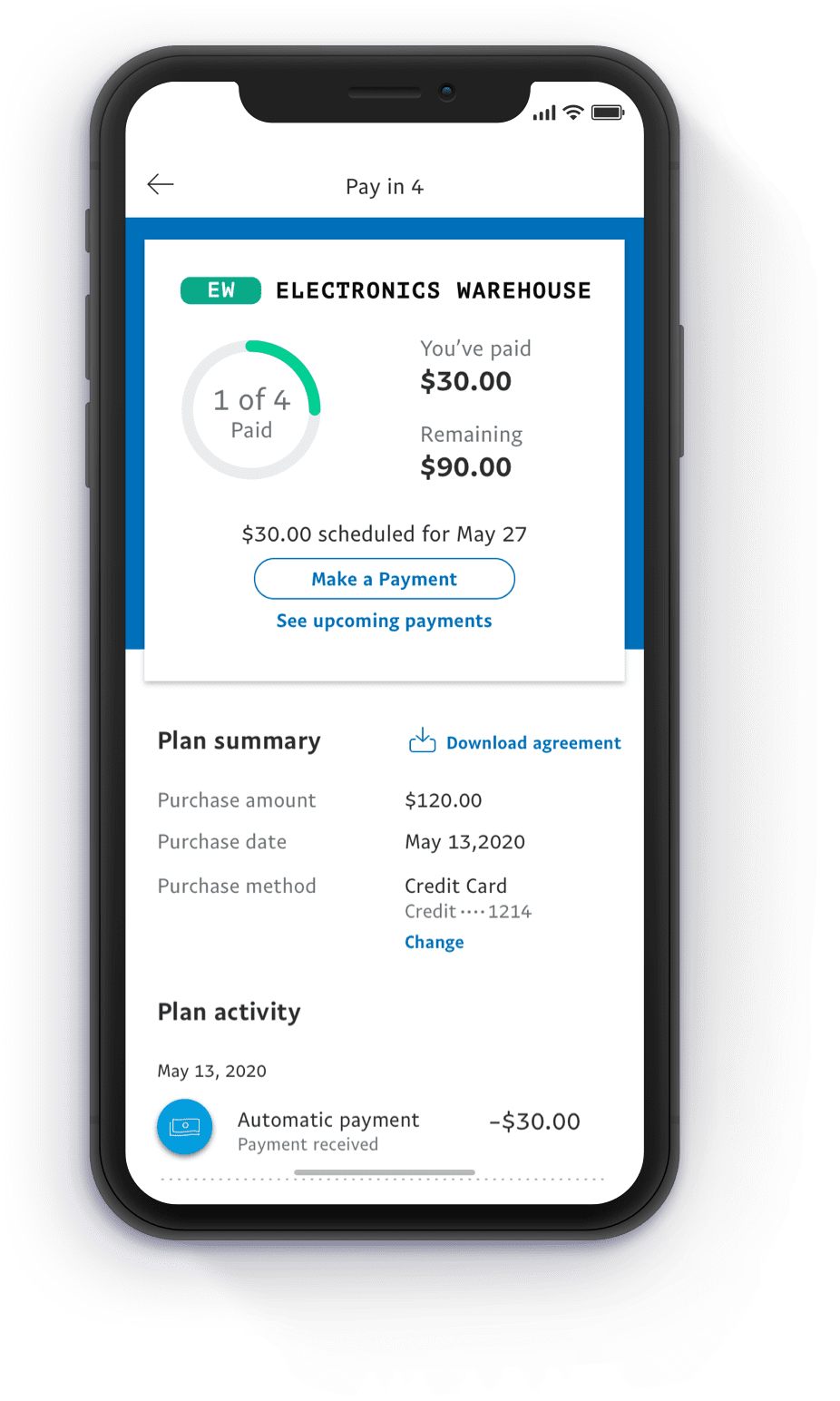
Here’s a few KPIs your team should track to gauge the success of your BNPL strategy:
- Overall conversion rates
- Total sales
- Cart abandonment rates
- Average order value
- Customer lifetime value
What do you do if BNPL isn’t generating the results you’d hoped for? Start by testing each step in the process.
Where are users finding out about the BNPL option? Should it be earlier in the process? What portion of your audience are you targeting?
Remember, BNPL is incredibly popular with younger users.
Buy Now, Pay Later Frequently Asked Questions
Buy now, pay later (often shortened to BNPL) is a financing option that allows consumers to split purchases into several, often interest-free, payments.
BNPL may encourage consumers to make purchases and often enables them to spend more.
Offering a trusted BNPL option can increase revenue, especially as more consumers use BNPL options.
What is PayPal’s Pay in 4?
Pay in 4 is PayPal’s buy now, pay later option that allows consumers to break purchases into four interest-free payments, one every two weeks, starting the day of purchase.
Pay in 4 can be used for eligible purchases between $30 to $1,500. Learn more here.
Buy Now, Pay Later Conclusion
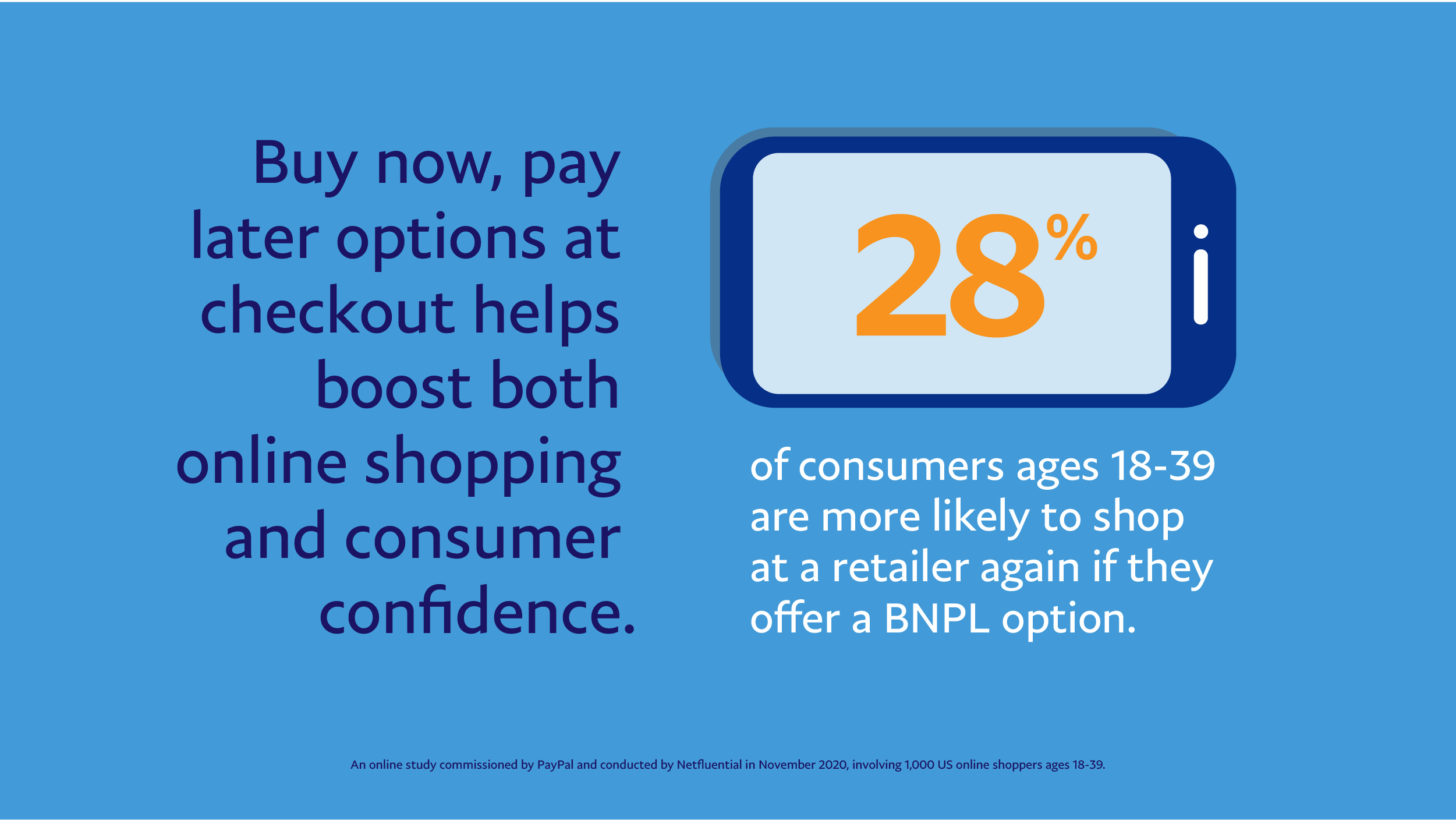
Did you know Millennials and GenZ consumers are 28 percent more likely to shop with merchants that offer a buy now pay later option?
Is your business shying away from offering this convenient new payment option?
Your competitors aren’t, and they may be reaping the benefits of increased loyalty and growing sales.
Learn more about how PayPal’s Pay in 4 can drive eCommerce growth here.
Source: feedproxy.google.com

3 Steps to Creating a Winning Instagram Marketing Strategy
Instagram remains a mystery to most business owners I know.
How are we supposed to keep creating great content that can be noticed and appreciated on a platform that is full of creativity and artistic ingenuity?
And should we even bother?
Those two are common questions business owners are asking when considering Instagram marketing.
While the answer to the first question is complicated (and I’ll elaborate on it below), the answer to the second question is “Instagram marketing is almost always a good idea.”

Disclosure: This content is reader-supported, which means if you click on some of our links that we may earn a commission.
Instagram is the sixth-most visited website, having reached 140 million U.S. users back in 2020.
With such a huge audience, Instagram is not a marketing platform that can be easily ignored.
But How to Create An Effective Instagram Marketing Strategy?
As always, it all starts with content.
1. Instagram Content Ideas for Businesses
Create a calendar of all upcoming (smaller) holidays and other notable days that can somehow relate to your business. It is also a good idea to publicize that calendar on your site. This will:
- Improve internal linking of the website (every seasonality-based post would link to related products)
- Allow you to feature products on the home page based on the upcoming holidays/days (even during slower seasons) which may fit the user intent better
- Let you schedule newsletters and time them based on the calendar
- Finally, allow you to publish timely social media updates (with relevant hashtags) even when there are no big holidays coming. These updates can be scheduled far ahead (and can be recurring from year to year).
You can also integrate your Instagram feed with your site with these plugins.
Planning your social media strategy around yearly holidays and observance days has lots of benefits, from making it easier to organize to achieve higher visibility and engagement.
Here are a few examples of days that can go into the calendar:
- National Rose Day
- Mother’s Day
- Employee Appreciation Day
Try DaysoftheYear.com to find all kinds of holidays and awareness days to target in Instagram content.
For each holiday, try running Text Optimizer to come up with interesting concepts to target in your content:
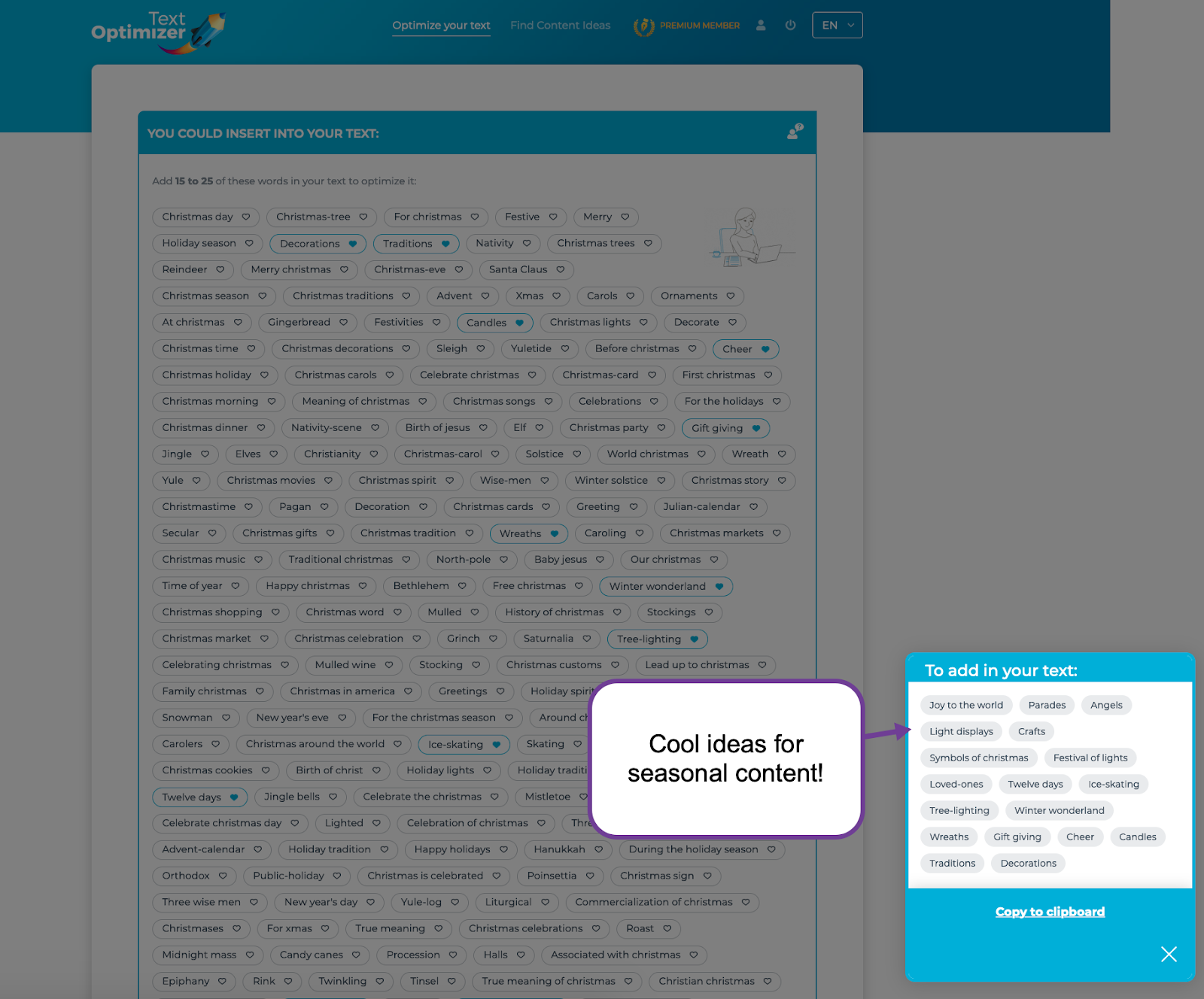
Another idea for regular Instagram updates is using weekly hashtags to get your updates discovered organically. Here’s a good list to target those.
2. Use Solid Instagram Tools
Instagram is one of those marketing channels that cannot be used without tools. The Instagram audience is spoiled: They see great content every day. It is tough to surprise them these days.
Great tools can make all the difference to your Instagram strategy.
Videoleap is an iPhone app that will help you create outstanding Instagram content.
The app gives you access to professional video editing tools that can be mastered without training.
The app comes with powerful video editing and enhancing features like layer-based editing, color corrections, video effects, and overlays, etc.

The app is free with a premium upgrade available. I would recommend using the free version first and then upgrade when you feel confident that you can handle the multitude of additional features and options.
If you are looking for a desktop tool, Fastreel is a valid and affordable option.
3. Focus on Consistency
Consistency is key in any digital marketing strategy, especially when it comes to social media. You need to gradually build trust and a community of people who look forward to your updates.
And that can only be achieved with consistency.
Still, you can get some decent traffic from Instagram if you create interesting updates and invite your followers to click the link in the bio for more info.
Don’t forget to monitor that traffic to be able to adjust your updates and CTAs to get more clicks and higher conversions.
Finteza can help you with that: The tool lets you narrow your data down to a particular traffic source and then evaluate your sales funnel based on the selected data point:
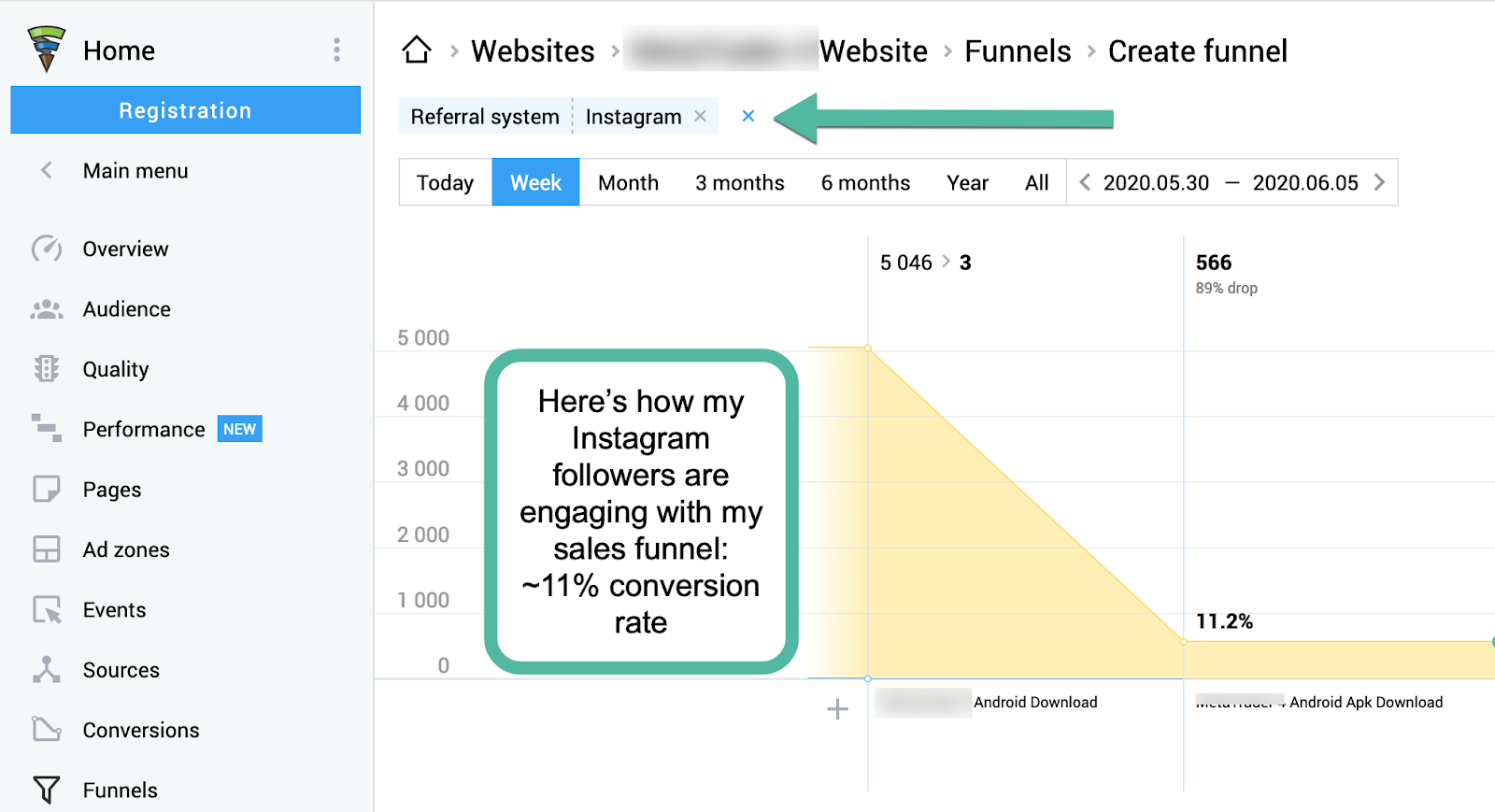
You can also change your bio’s link as often as you want. Try using different URL parameters to track your traffic from different campaigns.
Finteza allows users to easily set URL parameters using their free WordPress plugin.
Quick FAQs
Here’s a quick FAQ to help you create a consistent presence on Instagram:
FAQ: 1
How often should I publish content on Instagram?
Two posts a week is usually a good way to go. Don’t try to create daily updates because you will quickly run into burnout.
Planning and scheduling your Instagram content far ahead wIll also help you maintain consistency without too much pressure of always being there. Tools like Lately can help you with that.
FAQ: 2
How do I promote my business on Instagram?
Put your products in a visual context in a non-promotional way. Adding a CTA within your caption or even your photo is not a bad idea but just don’t overuse it.
You cannot build a dedicated following if you just keep selling your products to them. Here are a few easy-to-implement Instagram content ideas for businesses:
- Create updates of your team working or relaxing together. Behind-the-scenes content humanizes your brand and builds employee advocacy
- Turn text reviews and testimonials into visual quotes to publicize them on Instagram
- Re-use your lead magnets on Instagram. Instagram users love freebies!
- Create a micro-video showing your product being received or unpackaged
FAQ: 3
How to build traffic from Instagram?
Instagram doesn’t allow clickable links within updates. The only two sections where you can put your link are:
- Your Instagram bio
- Your Instagram stories (if you have more than 10,000 followers)
Conclusion
Instagram has become even more popular during the months of worldwide lockdowns.
According to Megaphone Marketing, people spent 70% more time on both Facebook and Instagram apps during the lockdown.
As we don’t really know how long the pandemic is still going to last, investing in your business’s social media presence is a smart marketing decision.
Instagram can be an effective marketing platform that will help you build brand trust and authenticity. It is also more doable than many business owners think it is. Good luck!
The post 3 Steps to Creating a Winning Instagram Marketing Strategy appeared first on Content Marketing Consulting and Social Media Strategy.
Source: convinceandconvert.com

How to Create a Wikipedia Page
Wikipedia is an ever-evolving, user-generated encyclopedia that allows users to add content, including pages, articles, and general knowledge. Topics span from pinball to Prometheus and everything in between.

Disclosure: This content is reader-supported, which means if you click on some of our links that we may earn a commission.
If you’re interested in creating a Wikipedia page for your business or marketing endeavors, you should know upfront that getting a page added to the encyclopedia is notoriously challenging.
With a slew of rules that determine what content can be added to the site and the sheer effort of writing a highly-researched page about your business, creating a Wikipedia page is no easy feat.
To help guide what content does end up on the platform, Wikipedia has five pillars to guide creators as they build content for the platform:
- Wikipedia is an encyclopedia.
- Wikipedia is written from a neutral perspective.
- Wikipedia is free, editable, usable, and distributable by all.
- Respect and civility must guide interactions among Wikipedia editors.
- The platform has no firm rules, only guidelines, and policies.
After a page is published, volunteer editors are deputized to edit and add to the page for the duration of its existence.
Although those guidelines may seem daunting, there are big benefits for marketers and business owners who manage to make the encyclopedia work in their favor.

The largest benefit of Wikipedia is its sheer size and reach.
The encyclopedia averages over 2.5 billion unique visitors per month, earning it the title of one of the most visited sites in the world.
In addition to the sheer magnitude of users, the platform offers other benefits to marketers and business owners:
- Earn traffic and drive backlinks to your site:
When you become an active contributor on Wikipedia and start optimizing content, you can identify pages that are relevant to your audience.
Search for relevant articles with broken links and those with missing citations, then use links to your site to update those pages.
When you add appropriate links in the right spot, you’ll score backlinks and drive traffic to your website.
- Guide to your services and offerings:
Given the structure of a Wikipedia page, you can provide readers with basic information like your brand story, location, and executive list.
You can also include numbered lists of your services and offerings that allow interested parties a top-of-funnel interaction with your products.
Through direct linking, you can then drive to the respective pages on your website.
- Build credibility:
While Wikipedia is not a valid source for scholarly research given its user-generated nature, there’s no denying that people flock to the platform for information.
By building a page for your organization on the site, you can further develop your credibility as an established company.
As we’ve discussed, publishing your page on Wikipedia can be a complex process.
However, the benefits far outweigh the challenges.
10 Steps on How to Create a Wikipedia Page
In this post, we break down the ten steps on how to create a Wikipedia page.
1. Create an Account
The first step in your journey to creating a Wikipedia page is registering an account on the platform.
While starting an account enables you to create pages, it has other benefits, including:
access a permanent user page where you can share a brief bio and a few photos access a talk page where you can interact with other users build your reputation as a Wikipedia author customize the ways your pages appear
To register an account, complete this form.
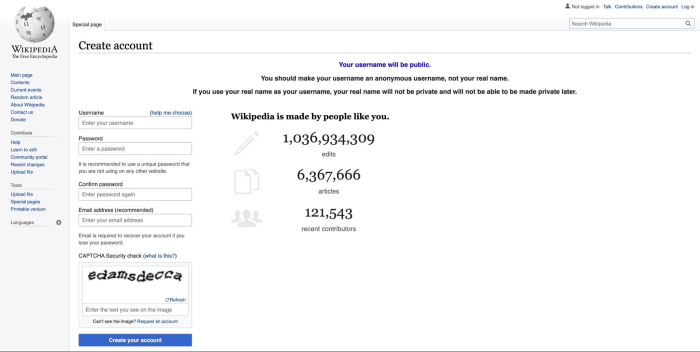
After you’ve completed this step, you’re on your way to your first Wikipedia page.
2. Contribute to Existing Accounts
While Wikipedia is home to exclusively user-generated content, to build credibility on the site, you should contribute to existing accounts and pages.
You can do this by editing existing entries regularly for clarity, factuality, and reliability.
To do so, you need to first create a user page.
As you engage more with improving content, you can boost your credibility on the site, increasing the likelihood that, when the time comes, your page will stand a fighting chance of getting published.
3. Verify a Page Doesn’t Already Exist
Perhaps you’re an expert on a particular niche topic that you’re certain no one has tackled in the expansive landscape that is Wikipedia.
Regardless of how unique you perceive your topic to be, you should still dig to determine whether someone has already staked their flag in your topic.
Use the search bar to explore any pages that may be related to your intended topic.
4. Check Your Topic’s Notability
Unique to Wikipedia, notability is testing editors use to determine whether a topic is substantial or relevant enough to need a unique article.
To earn this title of notable, the information on your page must use reliable, independent sources.
In general, a topic needs to meet two specific qualifications to be deemed worthy of a stand-alone page: general notability and subject-specific notability.
If your topic meets these two guidelines, you’re a step closer to actually getting your Wikipedia page published.
However, editors can still opt to merge related topics, eliminating the need for a stand-alone page.
5. Research Your Topic and Gather Resources
Before diving into writing your Wikipedia page, be sure to fully research your topic.
Whether you’re building a page for your business or developing an adjacent industry topic, be sure to include both internal and external sources to ensure that you are solidifying your reliability and notability in your draft.
6. Create an Outline
After you’ve gathered your research sources, build an outline for your page.
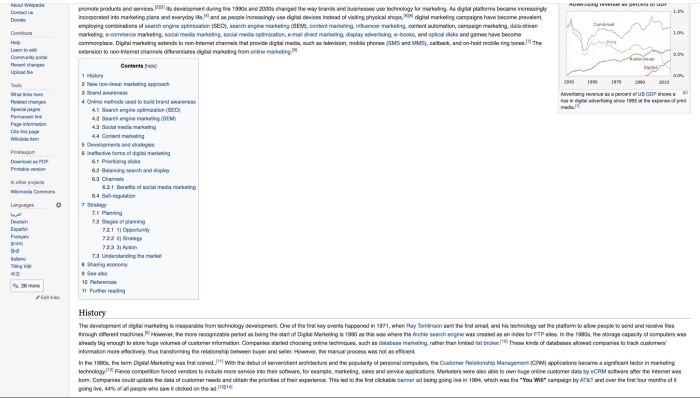
Here, break your information into digestible sections that can be indexed through the site’s table of contents that accompany every page.
7. Write a Draft of Your Wikipedia Page
Take your time as you write your Wikipedia page.
You want your content to be thorough, thoughtful, and helpful, providing searchers with what they want to know.
While Wikipedia pages can do a lot to benefit your marketing efforts, keep in mind that the true intent of the platform is encyclopedic and impartial.
8. Add Citations
Incorporating citations into your Wikipedia page is vital to your page’s success.
Citations are the vehicle that drives searchers to trust the information you share on your page.
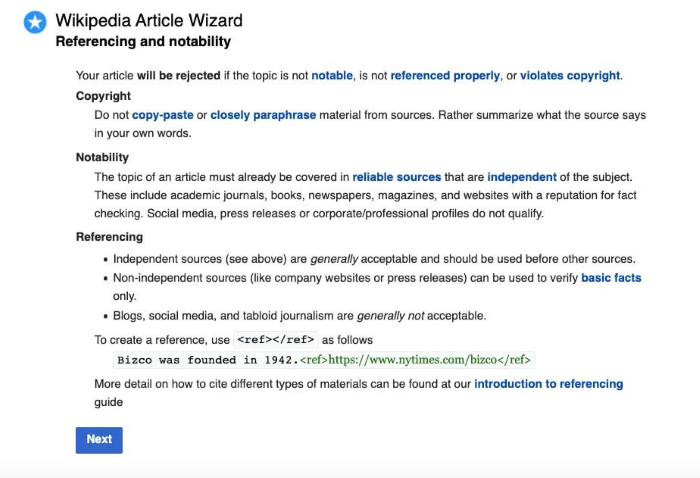
Before you start creating your page, Wikipedia shares the disclaimer that: “The topic of an article must already be covered in reliable sources that are independent of the subject.
These include journals, books, newspapers, magazines, and websites with a reputation for fact-checking.
Social media, press releases, or corporate/professional profiles do not qualify.”
We’ve talked a lot about credibility in this blog post—by using reliable citations, you can boost your overall credibility.
9. Submit Your Article for Review
After you’ve written and proofed your page, it’s time to submit your article to Wikipedia for review. This process can take anywhere from a few days to a few weeks to get the go-ahead from Wikipedia.
As we mentioned earlier, publishing on Wikipedia is notoriously challenging; you may have your page or article rejected a few times for finally gaining approval.
10. Continue Making Improvements
Once you’ve completed your page and gained approval, it’s not time to rest on your laurels.
As your page gains traction on Google, you must conduct regular updates to ensure it provides the most relevant information about your offerings.
Frequently Asked Questions About How to Create a Wikipedia Page
FAQ: 1
Should I Build a Wikipedia Page for My Business?
Yes, you should absolutely build a Wikipedia page for your business (or for a client’s business). When you build a page, you earn benefits that include a boost in both search and backlinks, increased credibility, and more traffic.
In addition to these benefits, you can anticipate more exposure for your business given the sheer number of users searching Wikipedia daily.
FAQ: 2
Is Creating a Wikipedia Article Challenging?
It can be, yes. Not only does your page have to adhere to a number of guidelines set by Wikipedia, but you also must write a comprehensive, research-driven article about your topic or business.
FAQ: 3
How Can I Know If My Wikipedia Page Will Be Published?
If you adhere to the guidelines established by Wikipedia and ensure your content is not duplicative, you have a good chance of getting your page published.
However, we will note that the creation of a Wikipedia page takes a lot of work.
Essentially, you are creating a well-researched document that details your organization’s history, mission, and offerings.
FAQ: 4
How Long Will My Wikipedia Article Be Under Review Before Publication?
While we wish there were a straightforward answer to this question, publication review time varies from page to page, spanning a couple of days to several weeks.
How to Create a Wikipedia Page: Conclusion
Whether you’re looking to increase traffic to your website, improve your search engine optimization, or simply build credibility, Wikipedia is a great outlet.
Through a number of strategies, marketers can make the user-generated encyclopedia work to their benefit, doing much more than simply providing information to interested parties.
As you begin to learn how to create a Wikipedia page, keep in mind that the process may be complicated.
For your page to be approved, you need reliable sources that stack up to imbue credibility in your page.
However, regardless of how long the process takes, the end product will be well worth it.
What strategies have you used for marketing on Wikipedia?
Source: neilpatel.com

30 Great Franchise Business Ideas
If you’re a new entrepreneur looking for profitable business ideas with minimal risks, a franchise business can be a great place to start.
A franchise business carries the success, credibility, and popular associations of established brands, reducing the need for extensive marketing and brand building for you as a franchise owner.
This can save you much time and money as you focus on making your business more profitable.

A franchise business model can also help you scale rapidly because you inherit the operation processes and framework from the licensing company.
Think about it this way: What would be easier?
Starting a company from scratch, working on branding, operations, funding, and marketing—or buying a license for a pre-established company?
In most cases, it’s the latter.
That’s why entrepreneurs are so eager to buy into franchise businesses.
What Is a Franchise Business?
A franchise business is a licensing model of business where a successful company allows you to run a version of its business using its logo, processes, and in-house resources.
Think of the many fast-food stores you see worldwide.
These “franchise” businesses exist in multiple locations, selling the same products under the same branding, which helps build loyal customers and instant brand recognition.
Some examples of worldwide franchises include McDonald’s, Domino’s Pizza, and Subway.

Great Franchise Business Idea Options
Option #1: Start a “Home Services” Franchise Business
Home service franchises offer services related to moving and housing.
These work best for regional companies as most people prefer using local home repair and renovation services to save time and money.
Painting Franchise Business
As more and more houses are built every year, the demand for painters keeps growing.
You can cash in on this growth by launching a painting franchise business.
Companies like CertaPro Painters let you start your own business under their name, so you can begin offering painting services using the CertaPro branding.

Repair Services Franchise Business
No matter where you live, there is always a need for repairing services.
If you’re looking for a steady business with minimal market shocks, start a repair service franchise.
This model is fairly stable because houses need recurring repairs—meaning you have the opportunity to develop long-term customers.
Some popular options include Paul Davis Restoration, Mr. Handyman, and 911 Restoration.

Moving Services Franchise Business
Another popular home service franchise business opportunity lies in the moving industry.
Beyond moving series, these franchises offer temporary storage and junk removal services.
You can find franchise business opportunities with companies like UNITS Moving & Portable Storage.
Although, it’s important to keep in mind that managing a moving business can be incredibly tricky because there’s a greater degree of responsibility involved.

House Cleaning Services Franchise Business
As the average citizen moves towards continuously busier lifestyles, the need for house cleaning services has grown significantly over the past few years.
You can benefit from this booming trend by launching a housecleaning franchise business with companies like Chem-Dry and Merry Maids.

Option #2: Start a “Retail Franchise” Business
When people think about shopping, retail is one of the first industries that come to mind.
Retail franchise businesses come in many shapes and sizes.
This way you can focus on an industry that truly matches your interests and skillset.
Fitness Franchise
The fitness industry, and especially sportswear, is thriving.
It’s one of the few sectors that saw huge growth throughout the pandemic, with people paying more attention to their health than ever before.
From training shoes to yoga accessories, people have an ongoing need for fitness products.
Starting a fitness franchise business with companies like Anytime Fitness and Planet Fitness can help you target these customers and scale your business.

Real Estate Franchise
Real estate is a tricky but lucrative market for aspiring entrepreneurs.
It has a steep learning curve but can help you build a profitable business with a generous cash flow—if done right.
Companies like HomeVestors of America are a great place to start a real estate franchise business.

Car Wash Franchise
Car wash franchises with strong branding can benefit from repeat-purchase loyalty, helping you attract new customers and build long-term relationships—keeping your business profitable.
Some great car wash franchise options include Prime Car Wash, Tommy’s Express, and Mr. Clean.

Sports Franchise
If you have a passion for sports, consider investing in a sporting business.
Companies like Soccer Shots offer great franchise opportunities with a mission-driven business model.
You can also focus on companies selling sporting goods, offering training spaces, sports club memberships, and other sport-adjacent activities.

Furniture Franchise
Similar to the growing popularity of housing services, furniture stores are seeing a surge in demand.
From selling individual furniture pieces to offering rental packages, franchises in the furniture industry offer a wide range of scaling opportunities.
You can work with franchises like Bloomin’ Minds and Slumberland Furniture.

Option #3: Start a “Food Franchise” Business
People love food, especially fast food. So if you’re looking for a hot-selling, customer-favorite franchise business, start a food franchise.
These are super popular, tend to do well economically, and carry great brand recognition across a wide geographic region.
Pizza Franchise Business
Popular food items like pizza have the potential to sell well, offering you a chance to build a profitable franchise business.
This is one of those categories where there’s tight competition, but great growth potential.
You have many options to choose from including Domino’s Pizza, Pizza Hut, and Papa John’s.

Coffee Franchise Business
Coffee is another hot-selling item, literally.
If you’re a fan of the beverage and have a desire to manage a consistent business, starting a coffee franchise can be a great option for you.
Consider working with companies like Dunkin’, Aroma Joe’s Coffee, and Scooter’s Coffee.
Ice Cream Franchise Business
If you’re looking to target the frozen foods market, consider starting an ice cream franchise business.
Brands like Baskin-Robbins have a huge customer base that you can leverage with a franchise business model.
You can also consider companies like Kona Ice which are smaller than the top industry names but offer great variety and opportunities for reaching new customers.

Burger Franchise
When we talk about franchise businesses, we often picture McDonald’s, which is still popular decades after its launch.
If you’re looking for that kind of growth, consistency, and brand power, choose a burger franchise.
You can also choose other companies like Wendy’s, Burger King or Carl’s Jr.

Noodle Franchise
Starting a noodle franchise business can offer a great breakfast and snacking option for local residents.
You, as a business owner, can build relationships, expand locations, and still remain consistent in your offerings.
You can work with companies like Nothing But Noodles and Noodles & Company to launch noodle franchise businesses.

Option #4: Start a “Professional Services” Franchise Business
If none of the options so far appeal to you and you want to take a more personalized approach, consider launching a professional services franchise business.
These offer the greatest potential for customization, adaption, and variation compared to other franchise business models.
With a professional service franchise business, you have a multitude of customer retention opportunities that can be quite profitable in the long run.
Shipping and Mailing Franchise
Nearly every company and residential community need a shipping and mailing service today.
This rising demand offers promising potential for franchise owners.
Established brands like The UPS Store can help you find your customers faster and retain them for decades to come.
Such franchise business models also offer a huge expansion potential as shipping and mailing companies continue to expand the geographical areas they serve.

Printing Franchise
Just like shipping and mailing companies are a cornerstone of work-life across several industries, printing businesses are also a key component of modern living.
The best part of starting a printing franchise business is that it’s easier to set up and manage.
It’s relatively low-maintenance, carries low risk, and has much potential to grow, making it an ideal option for new entrepreneurs.
Look for companies like Minuteman Press for launching a successful printing franchise.

Staffing Franchise
Another popular corporate franchise option is a staffing franchise business. Companies like Spherion and Express Employment Professionals help other companies fill their staff positions by connecting them to people looking for jobs.
These franchise business models can help you build positive relationships with major companies in your industry while making a decent profit.

Training Franchise
Along with staffing agencies, companies also need training providers to help upskill their staff.
Whether it’s quarterly seminars or yearly upskilling boot camps, working with companies like Sandler Training and Dale Carnegie can help you establish impactful thought leadership and corporate training franchise business model.
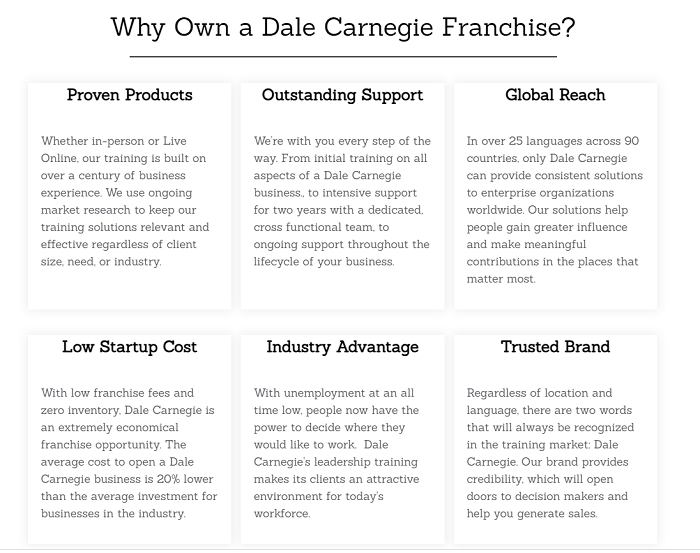
Design Franchise
From rebranding to interior decor, design teams are a key player in most major industries.
If you’re passionate about art, decoration and understand the fundamentals of marketing design, you can work with companies like Closets by Design and Decorating Den Interiors to launch a design franchise business.

Frequently Asked Questions About Starting Franchise Businesses
Here are some common questions new entrepreneurs ask when they’re planning to launch a franchise business.
FAQs
Do I own the rights to a franchise business name?
When you buy a franchise business, you’re only buying the license to use the company’s resources and not the rights to own or manage the company itself. This means, you can own and control the franchise but the original company still remains an independent entity.
Do I have to pay a royalty when I sell through the franchise?
The payment structure for each franchise business depends on the agreement you have with the owning company. For instance, a company may choose to accept royalties for every purchase in addition to a licensing fee. Companies can also work with a fixed-fee payment structure for each franchise location.
What is the difference between a franchise fee and a royalty fee?
While both the franchise fee and royalty fee are necessary to own a franchise, the two are not the same. The franchise fee is the cost of buying a license to use the owning company’s branding and resources. A royalty fee, on the other hand, is a revenue-based fee you pay based on your sales and profits.An easy way to remember this is to keep in mind that franchise fees are one-time payments for buying the trading license, while royalties are ongoing payments based on your revenue.
Can I sell a franchise?
If you’re not happy with your franchise business, you always have the option to sell it. Franchise exits are pretty common, especially in larger cities where multiple businesses are vying for consumer attention. However, it’s important to check your agreement before making any selling decisions. Your owning company may not allow you the rights to sell their franchise outside of their organization.
Franchise Businesses Conclusion
Starting a franchise business has many benefits to offer entrepreneurs at all levels.
New business owners may find it easier to run a pre-established business than starting a new brand from scratch.
Mid-level entrepreneurs can also use a franchise to pivot their career, especially if it’s an industry change.
Finally, senior entrepreneurs can hugely benefit from the brand recognition the owning company has built.
Most franchise brands have thousands of loyal customers who become a source of recurring revenue for the business.
If you’re able to leverage this reach for further growth, it can be easier to scale your franchise business rapidly.
Which franchise business idea best suits your needs? Which idea would you like to try first?
Source: feedproxy.google.com

How to Make ‘Buy Online, Pick Up in Store’ (BOPUS) Work for Your Digital Brand
The BOPUS (Buy Online, Pick Up In-Store) has been attracting hype for both retailers and customers, and this trend is expected to stay.

BOPUS lets retailers leverage omnichannel experiences to boost online and in-store profits when done well.
However, it requires synergy between online commerce channels and physical retail to succeed.
What are the advantages of the buy online, pick up in-store strategy, and how can retailers deliver?
Here are some tips to consider.
What Is Buy Online, Pick Up In-Store (BOPUS)?
BOPUS stands for Buy Online, Pick Up In-Store. It is sometimes also shortened to BOPIS.
True to its name, it gives shoppers the option to order items online and pick them up in-store.
Here’s how the process works:
- Customers place the order: Shoppers purchase goods online through the retailer’s mobile app or website. On the checkout landing page, customers can choose the date, time, and pickup location.
- Retailer prepares an order for pickup: Retail staff finds the items ordered and packs them. Once packages are ready for pickup, shoppers can receive a notification through SMS or email.
- Customer picks up the package: Customers can get their packages in-store or at a dedicated pickup location. Some retailers may offer curbside pickup options where consumers can drive to the storefront and get their orders while remaining inside their vehicles.
This style of shopping is gaining popularity because consumers prefer the speed and convenience of online shopping.

Here are some statistics that prove this model is becoming increasingly popular:
- 68 percent of U.S. consumers have leveraged BOPUS to make purchases.
- 50 percent of consumers have chosen retailers based on whether they offer the option to pick up orders in-store.
- 48 percent of consumers have used BOPUS because it offers free shipping, followed by speed (39 percent) and convenience (28 percent).
How Can BOPUS Benefit Your Brand?
As you can imagine, the buy online picks up in-store strategy can bring a lot of potential benefits to your business.
In this section, we’ll take a look at some of the popular advantages it offers.
1. BOPUS Increases Traffic
Once customers arrive in your store to pick up their goods, they’ll likely be tempted to visit in-store.
They may want to inspect a product they’re interested in prior to purchasing it or browse for other items in your store.
Top reasons why consumers prefer BOPUS include seeing a product before taking it home (77 percent), avoid shipping fees (65 percent), convenience (29 percent), and the ability to return the product instantly (23 percent).
BOPUS can also boost traffic to your online website or increase the number of downloads for your mobile app.
When consumers subscribe to your online channels, you have more opportunities to send promotional content or advertise deals through the mobile app.
If customers have an account on your website, you can get information about their browsing habits or purchase history, then use it to create personalized promos.
2. BOPUS Increases Sales
It can also boost sales by encouraging more people to buy in-store when they pick up their items.
Invesp reports 75 percent of shoppers who have previously used BOPUS are likely to make an additional purchase.

On top of this, 67 percent of BOPUS users purchase additional items in-store when picking up their orders.
This means retailers get another opportunity to upsell products and increase impulse purchases.
More importantly, the convenience means more customers will flock to retailers who offer it as an option.
3. BOPUS Provides a Better Customer Experience
BOPUS enables consumers to buy online, which means a more convenient shopping experience.
Rather than wait for the delivery in a week, they can pick up the items on the same day.
When they arrive in-store to collect their original orders, they can also inspect products that interest them or get inquiries answered by staff.
Retailers who can provide a streamlined shopping experience can also inform customers whether a particular product is in stock prior to visiting the store.
4. BOPUS Offers Free Shipping
With BOPUS, shoppers can enjoy free shipping.
They can save up on a few bucks and simultaneously enjoy the convenience of online shopping.
Customers also have the option to choose the date and time of pickup.
They can control when they can drop by the store or opt for same-day delivery if they urgently need an item.
5. BOPUS Enables Quick Returns
Sometimes customers may wish to quickly return a product because it did not meet their expectations.
With BOPUS, consumers can process exchanges and returns upon arriving in the store.
This is a lot better than shipping the orders back and waiting for the return to be processed.
6. Improve Inventory Management System
Buy online, pick up in-store encourages retailers to align their online and in-store inventory management system.
An order can also be fulfilled at the distribution center, enabling a faster shipping and fulfillment process.
When done right, it can even allow customers to confirm whether an item is in stock before arriving in the store to check out products.
Customers are notified when an item is ready for pickup.
This means they’re 100 percent guaranteed to receive their complete order when they arrive at the store unless stated otherwise.
How to Have a Successful Buy Online, Pick Up In-Store Business Model
What do retailers need to make BOPUS a reality in their business?
Here are the tips and tricks which you need to know.
1. Online Site or App for Placing Orders
Of course, retailers must have an online website or mobile app where customers can order products.
Ideally, it should accurately tell which items are in stock for the shoppers’ convenience.
Since plenty of customers buy through their mobile devices, they may prefer retailers who let them purchase via a mobile app.
With this channel, retailers can also send push notifications to let them know the order has been processed or is ready for pickup.
2. Physical Store or Pickup Location
BOPUS requires a physical store or pickup location where customers pick up their items.
Ideally, the area should be easily accessible, and it should accommodate higher foot traffic.
Retailers offering curbside pickup may need to reserve parking space for curbside customers.
They may also need to have clear signage so they know exactly where to pick up their items.
3. Real-time Inventory Capabilities
It can be frustrating when customers visit in-store or pick up their orders only to realize one of the items is out of stock.
Hence, retailers must have real-time inventory capabilities so customers can easily determine whether an item is in stock through the mobile app or website.
A robust retailer fulfillment system should also take into account order statuses and workflows.
If your business has multiple locations, opt for a system with multi-location inventory management capabilities.
This way, customers can determine item visibility and choose the most convenient location to shop for their desired products.
4. Train Staff
Whether customers order online or in-store, the staff must be trained on best practices for quality customer service.
Think about the problems that may occur when customers pick up their items and train staff to respond accordingly,
If customers receive damaged goods, then they should offer assistance for product returns.
Likewise, customers with product inquiries for in-store items should be able to talk to staff that can help them make informed decisions.
Support agents for the online channels should also be trained to ensure a consistent and seamless buying experience.
Since you often need to improve customer experience, retrain staff every six to 12 months.
5. Investment in Staff to Manage BOPUS
The buy online, pick up in-store model requires an initial investment to hire dedicated staff.
Their role encompasses the ability to identify online orders, pick them up in-store, and pack them in a neat package.
You may also need employees in charge of double-checking and fulfilling orders.
6. Market Buy Online, Pick Up In-Store
Investing in BOPUS won’t be worth it if customers don’t even know it exists.
As a result, invest in marketing campaigns and promotional materials to boost customer awareness.
Place signages in your retail outlets with instructions on how customers can use this option.
Consider creating social media posts and emails to announce the launch of BOPUS.
7. Leverage Augmented Reality Apps
Retailers who want to ensure a smoother online shopping experience can leverage augmented reality apps.
This will enable shoppers to test or view products before they make a purchase.
Take, for instance, the IKEA Place app, which lets customers preview how their furniture looks in their home prior to making a purchase.
With your smartphone, you can immediately see whether the sofas, cabinets, or armchairs you plan to buy will match your room’s aesthetic.

Not only can this decrease returns, but customers can get a realistic expectation of the items they’ll be purchasing from the store.
8. Boost Personalization
Shops that want to offer more personalization can also opt for Customize Online, Pick Up In-Store (COPUS).
The business model is very similar to the buy online, pick up in-store model, but the difference is customers can customize the items ordered online.
Yankee Candle gives consumers the opportunity to pick a fragrance, include a photo, and a personalized message for $5. This makes their products ideal for gift-giving.
Not all retailers are fit to offer personalized products and that’s completely OK.
Thanks to the latest advanced technologies, you can leverage customer data platforms to get real-time profiles of shoppers.
A profile may include their wish lists, purchase history, birthdays, or product recommendations.
With this information, staff and marketing teams can offer personalized recommendations and guide customers throughout their buying journey.
BOPUS Brand Examples
Which brands or small businesses are succeeding with this business model?
Here are some examples which could inspire your own.
TC Running
TC Running is a brand that offers running shoes and sportswear.
It has expanded its online store to enable customers to get orders shipped or opt for curbside pickup.
As a result, the brand’s sales skyrocketed by at least 110 percent every month since its launch.
Ackroyd’s Scottish Bakery
Located in Detroit, Ackroyd’s is a popular bakery offering savory pies, tea cakes, puddings, and meats.
In 2020, the business closed its retail stores in favor of curbside pickup orders and nationwide shipping.
According to their website, the shift to e-commerce and the buy online, pick up in-store model has given them the ability to expand their national reach and improve their production and inventory.
DressUp
Fashion brand DressUp utilized BOPUS by turning their retail shops into pickup locations.
Through the website, shoppers can choose their preferred pickup location.
The software will then check whether the items are in stock before the customer can purchase them on the checkout page.
In the Shipping section, customers who opt for BOPUS get the retail store Google Map location, contact details, and operating hours.
The clear set of instructions enable customers to pick up their orders without a hassle.
Precycle
Precycle is a package-free store offering organic produce and sustainable food.
For contactless delivery, they transitioned to a curbside pickup option.
According to their FAQ page, customers can place orders online and their stock availability is updated daily.
Upon making the purchase, they receive pickup instructions and click a link to view specific directions.
Conclusion
The buy online, pick up in-store business model enables e-commerce businesses and retailers to offer a seamless online shopping experience.
At the same time, customers may be encouraged to drop by the physical store to make additional purchases or check out products of interest.
Other notable perks of buy online, pick up in-store strategy include the option to save up on shipping.
In addition, shoppers can conveniently pick up their order on the same day or at their preferred time or date.
Though BOPUS can bring many benefits to your online shopping experience, you also need appropriate resources to launch it successfully.
You’ll need a physical pickup location, an online shopping experience, and a real-time inventory management system.
While it may take time to get your logistics together, the benefits you reap will be worth it in the end.
How will you utilize BOPUS for your digital brand?
Source: feedproxy.google.com