
Tag Archives for " brand "

Why You Should Still Be Using Personalized Marketing to Boost Your Brand
It’s getting harder than ever to connect with buyers and prospects on a personal level.
The good news? It is easier to build real, human connections with your audience if you know what data and strategies to use.
One of the most effective strategies to build a personal connection is personalized marketing.
What exactly is personalized marketing, and what are the benefits? (Hint: It’s more than adding “$FNAME” to your email marketing!)
Here is what marketers need to know about personalized marketing.
What Is Personalized Marketing?
Personalized marketing is a strategy that uses demographic and behavioral data to create individualized messages for current or prospective customers.
It’s incredibly popular, with research from Statista showing that 78 percent of marketers use personalized marketing in their email marketing alone. Most marketers use the strategy on multiple channels.
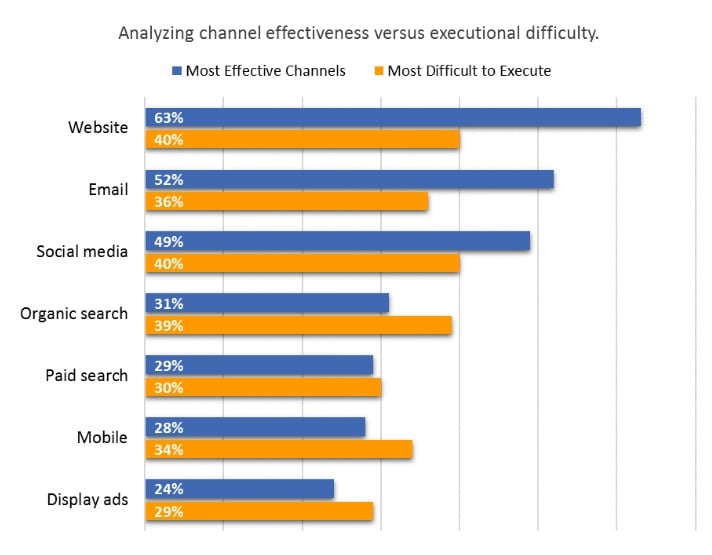
The point of personalized marketing is to understand your customers more and how they like to communicate so you can better engage them in the busy online world.
There are three main categories of personalization: behavioral, contextual, and demographic.
- Behavioral personalization analyzes customer interactions with your company, such as past purchases or website behavior.
- Contextual personalization considers where customers are in their journey.
- Demographic personalization examines demographics like age, gender, race/ethnicity, and household income level.
Companies have used personalized marketing for years to improve engagement rates, but factors like the growth of AI and data analytics are making it easier than ever for even smaller companies to get on board.
Personalized marketing is also one of the best ways to engage customers between channels and send more relevant marketing messages.
Different Types of Personalized Marketing
Before we dig into all the benefits of personalized marketing, it’s worth looking at the different types of personalization. Keep in mind that different approaches might be more effective based on your audience, industry, and business model.
There are four main types of personalized marketing. Let’s look at them one by one.
Segmentation
This is a technique marketers use to divide their list into smaller groups or segments.
Segmentation helps brands to understand their customers better and target their products accordingly.
You can implement email segmentation by analyzing the customer data and behavior over various channels to deliver the content and style most valuable to your buyers/prospects.
You can also use segmentation to identify where the customer is in their journey or to encourage sales.
An example of email segmentation in action is Sephora.
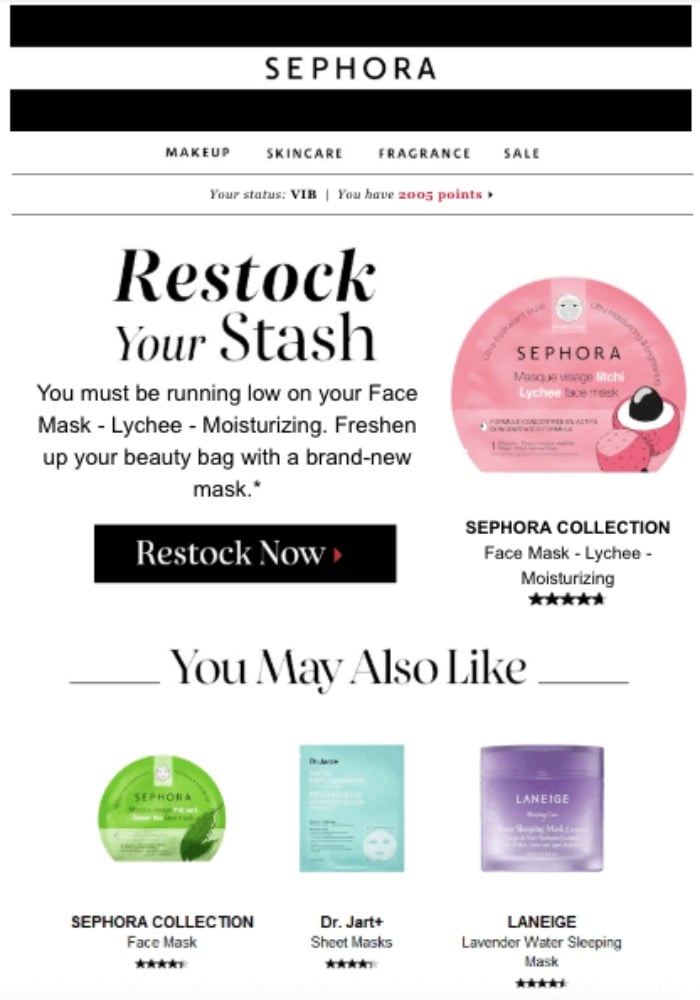
The beauty brand sends out segmented emails to remind customers to restock on items they’re likely running low on. Sephora’s approach nudges buyers into heading over to its site and getting the product.
Further, Sephora makes it almost effortless for customers to repurchase; they’ve just got to click on the message and it takes them right to the item.
Segmentation can also be used to deliver personalized content, lead magnets, paid ads, etc. Essentially, the goal is to separate your audience into segments and deliver more relevant messages.
Personalized Emails
A personalized marketing email is an email that aims to address the personal needs of a recipient the company has had some kind of previous interaction with.
Companies send personalized emails to buyers or to prospects who have shown an interest in certain products. Typically, these emails go further than addressing the customer by name. For example:
- they personalize subject lines
- companies send them to welcome new customers and acknowledge orders
- they target consumers who’ve abandoned carts
For further personalization, businesses can use their data and track consumers’ behavior to tailor the emails and increase the chances of a purchase.
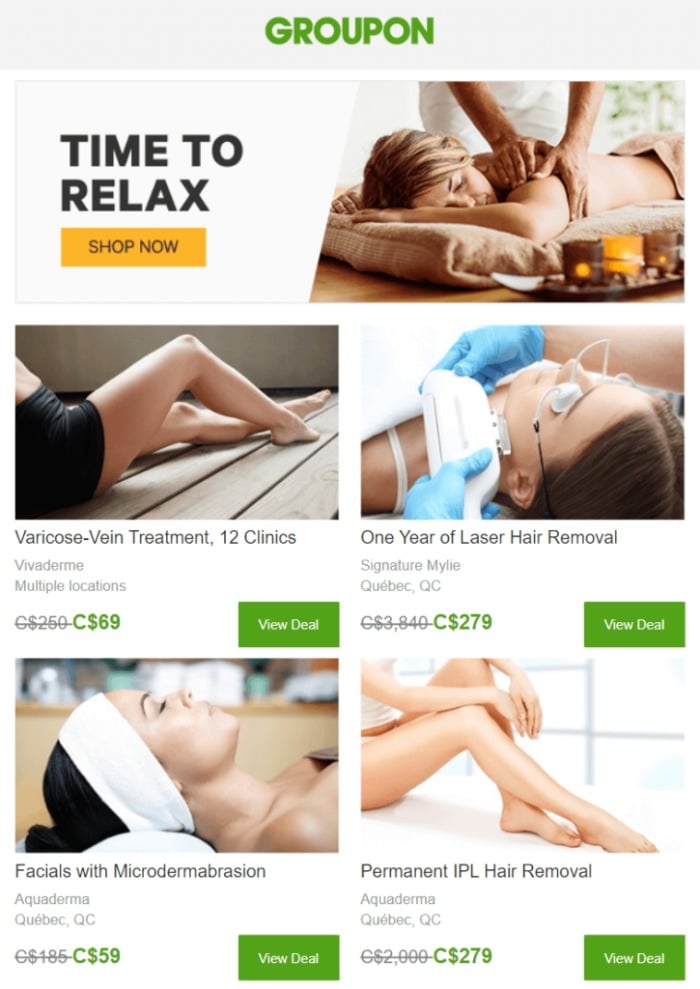
A popular use for such messaging is product recommendations, like this one from Groupon, which focuses on pampering experiences a customer may appreciate.
Dynamic Websites
Dynamic websites are a form of web design that relies on real-time data to provide a personalized experience.
Most often, businesses use them to create engaging customer experiences in a way that is more meaningful and personal to the individual.
An example is dynamically adjusting a webpage to display specific categories or products first.
Travel companies might also use dynamic websites to adjust their homepage to focus on the city a visitor has researched:
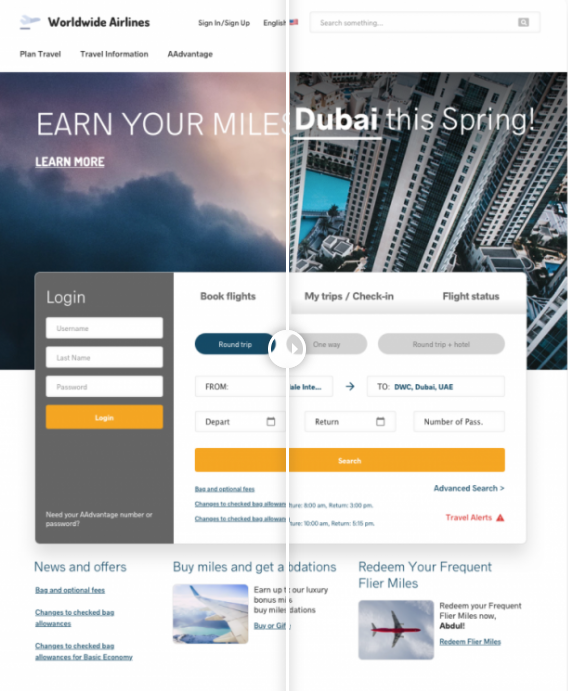
The homepage to the left is the site’s standard homepage, while the right side shows to a visitor who has researched flights to Dubai.
One-to-One Personalized Marketing
One-to-one personalized marketing is all about reaching out to a customer. It’s more than just sending emails to the same group of people: It’s about creating tailored content for each individual.
This approach takes personalized marketing to a new level and puts the focus on data, like:
- demographics
- geographical locations
- devices they’re using (Smartphone, laptop, etc.)
- past purchases
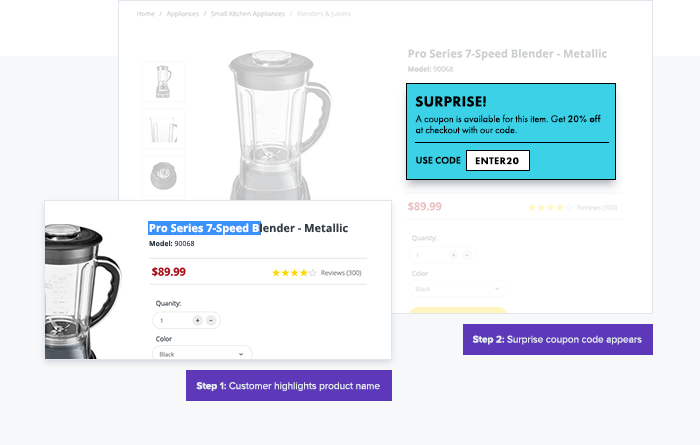
Businesses then use all this info to make specialized discounts like the one below or offer other incentives to get a prospect over the sales line.
Product Recommendations
We’ve all seen the emails or ads you get after you’ve purchased a product or used a service from a company.
For instance, when you buy or search for something on Amazon, you get messages like “more top picks for you,” “your browsing history,” or “keep shopping for.”
Like one-to-one personalized marketing, product recommendations use behavioral data, such as purchase and search history, to deliver personalized recommendations.

For example, a razor company might see you purchased a razor a few weeks ago and recommend a shaving cream.
What Are the Benefits of Personalized Marketing?
One of the main benefits of personalized marketing is that it is more affordable. Messages are more direct, which means you spend far less time (and money) targeting users that aren’t likely to convert.
However, that’s not the only benefit.
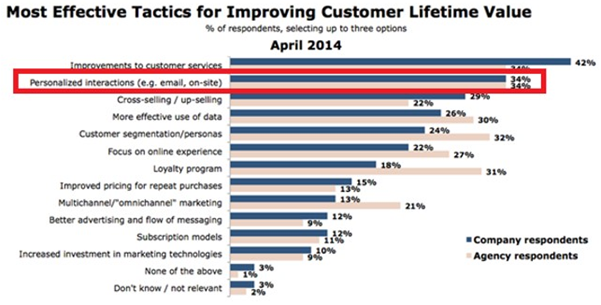
Customers Prefer Personalized Messages
According to a report by Smarter HQ, 90 percent of consumers are willing to share personal data for an easier or cheaper brand experience.
An Epsilon survey found 80 percent of consumers are more likely to do business with a company if it offers personalized experiences—and 90 percent say they find personalization appealing.
Buyers like brands to treat them as individuals and respond to their pain points. Personalized marketing does that, and tailored campaigns and follow-up emails make your customers feel valued and appreciated.
Better Understand Your Customers
You already know how to gather information like demographic data, search and purchase history, and social media activity.
However, AI and marketing automation technologies enable marketers to gain an even better understanding of who their customers are and what they need. For example, you might find that high-revenue customers prefer a specific channel, like email.
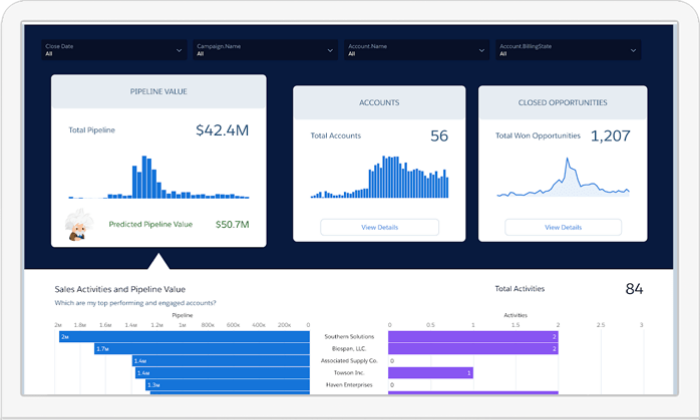
Digging into the data for personalization gives you more insights into who your customers are, what they want, and what will drive them to make a purchase.
That data can be used to improve other marketing strategies, inform rebranding, and much more.
Improve ROI of Marketing Efforts
Personalized marketing is a simple way to improve your overall marketing ROI by providing what the user wants.
In fact, personalized marketing can reduce acquisition costs by as much as 50 percent.
Here’s more proof: HubSpot found personalized CTAs perform 202 percent better than basic CTAs.
Additionally, it’s a way to build customer loyalty and brand recognition while reducing your acquisition costs.
Improving your ROI starts with your data to produce accurate customer profiles to create relevant content and offers for them.
A great example of this is McDonald’s.
The fast-food giant took things a step further than most by acquiring AI firm Dynamic Yield to personalize digital menus. Later, Mastercard purchased Dynamic Yield from McDonald’s to further improve their customer experience.

As Raj Seshadri, President of Data & Services, Mastercard, puts it:
The notion of going into a store or opening a webpage to find an experience perfectly tailored to you is no longer farfetched. It’s a reality that more brands are deploying and more consumers expect.
While most of us don’t have McDonald’s or Mastercard’s budget, you can still use personalized marketing to get results by relying on data from first-party tools that track users on your site or tools like HubSpot.
Increase Customer Engagement
Every company strives for more customer engagement, and personalized marketing helps you get there. It all begins with understanding your customer base in terms of demographic, psychographic, and behavioral data and tailoring efforts for each individual.
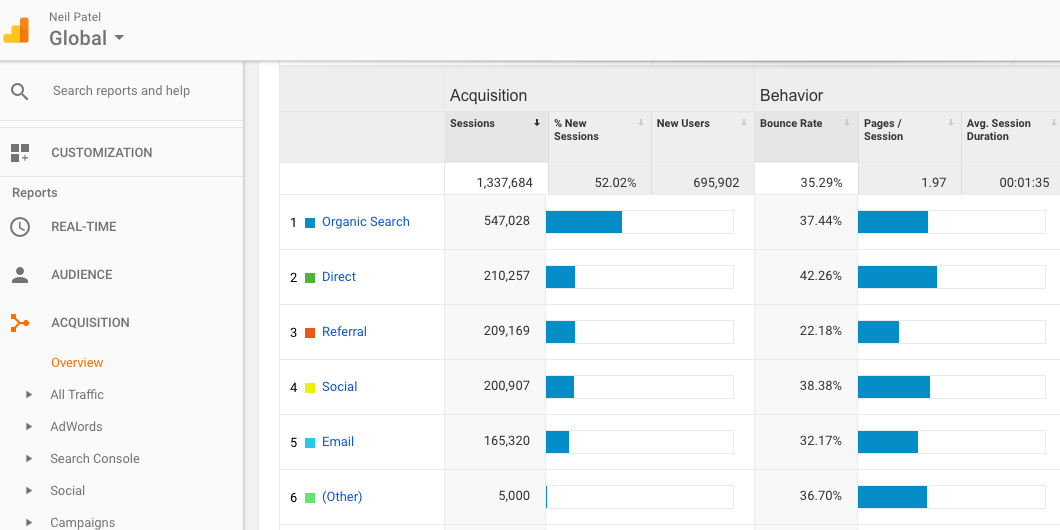
In practice, that means:
- knowing your customers’ expectations
- taking an omnichannel approach
- analyzing your data
That data can be used to speak directly to users on their preferred platforms about the topics important to them.
When you succeed at customer engagement, the rewards are priceless: Loyalty improves, revenues increase, and your business grows along with consumer trust.
Improve Customer Retention
Personalization makes it easier to identify your customers’ needs and provide them with solutions that will solve them—and that increases retention.
As a McKinsey report explains, when brands use customization correctly, they do more than just survive; they thrive.

Plus, 60 percent of customers say they’re likely to repeat if a brand offers personalized interactions.
With numerous personal touchpoints at each stage of the customer journey, sales increase, and customers stay loyal.
That’s a win for your customer and your brand.
Enhance Email Open Rates
Email open rates are the metric most email marketers focus on, and with good reason: if your list isn’t opening your emails, you’re not making any money.
There are many ways to improve your email open rates, such as:
- personalize your email content through segmentation adjust your content so it’s relevant to the readers
- send emails at the right time of the day
- adjust your CTAs to be more appealing
By using personalized marketing methods, you can increase your email open rates dramatically.
However, it’s more than ensuring you have your customer’s name in the subject line. It’s also about providing personalized discounts while creating headlines, snippets, and content that connects with them personally.
When you do this, customers feel like you understand them and what they want.
Personalized Marketing Frequently Asked Questions
What are examples of personalized marketing?
Personalized marketing examples include a dynamic website that adjusts content based on user behavior or product recommendations that are generated based on past purchases.
How do I get data to use for personalized marketing?
The most common way to get information for personalized marketing is through your existing customer data from social media platforms like Facebook and Twitter. Alternatively, you can use third-party tools like Google Analytics, Adobe Analytics, or Marketo to aggregate customer data from different sources.
What tools can I use to personalize my marketing?
Tools to help with marketing personalization include HubSpot, OptinMonster, and Evergage. Here’s a full list of tools to consider.
Why is personalized marketing important?
Personalized marketing is imperative because it improves customer engagement and generates higher conversion rates. It also provides a better customer experience and develops deeper relationships with your audience.
Conclusions: Personalized Marketing
Personalized marketing is a powerful tool for marketers and business owners. It has an increased ROI and leads to higher conversion rates.
A personalized marketing campaign also increases customer loyalty by creating that personal connection with them, which makes them feel valued and appreciated.
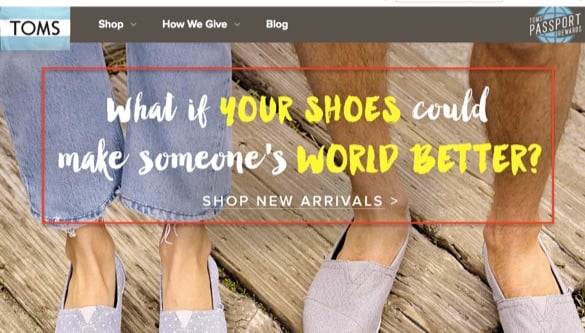
By focusing on what is most relevant to the individual, there is a higher chance of them making a purchase than by only sending an email packed with generic information that doesn’t apply.
Although personalized marketing may be time-consuming, it’s well worth the effort to grow your business.
Do you use personalized marketing? How has it transformed your business?
Source: neilpatel.com

9 Digital Marketing Tips for the Holidays
Black Friday, Cyber Monday, Super Saturday—the holiday season doesn’t lack shopping days. Add those to the traditional boost in consumer spending that occurs in the run-up to the holidays, and you have a recipe for a record sales quarter.
However, a bumper festive season doesn’t happen by accident. A comprehensive and thoughtfully crafted digital marketing strategy is necessary to make those sales rack up.
That’s why today, I will run through my top digital marketing tips for the holidays. By the end of this article, you’ll have an arsenal of strategies you can execute to make your physical or metaphorical cash register sing.
Why the Holidays Are the Best Time for Digital Marketing Success
Online shopping will be just as pivotal for consumers this festive season as last year. In 2020, online retail sales during the holiday period totaled $186 billion, and Cyber Monday was the biggest online shopping day in U.S. history. This year, the five days between Thanksgiving and Cyber Monday are projected to increase by 14 percent compared to 2020.

The sheer demand for online shopping makes the holiday period one of the best times to launch a new digital marketing strategy, but competition between brands also makes an effective strategy necessary.
It’s important to present a strong digital campaign given the potential propensity for consumers to seek out the kind of in-store events they missed out on in 2020. Research shows that while 70 percent of consumers report their shopping journey involves online touchpoints, only 14 percent of U.S. shoppers say they won’t shop in-store at all this season.
9 Digital Marketing Holiday Tips
OK, enough background information. Use these nine digital marketing holiday tips to guarantee a holly-jolly holiday season.
1. Start Early and Have a Plan
The best holiday digital marketing plans start months before the festive season. To put it another way: If you haven’t already started planning your strategy, start now.
By the time you’re reading this, most consumers will already have started shopping. It’s estimated that 31 percent of U.S. consumers will start their shopping in October or earlier, and 55 percent will start before Thanksgiving.
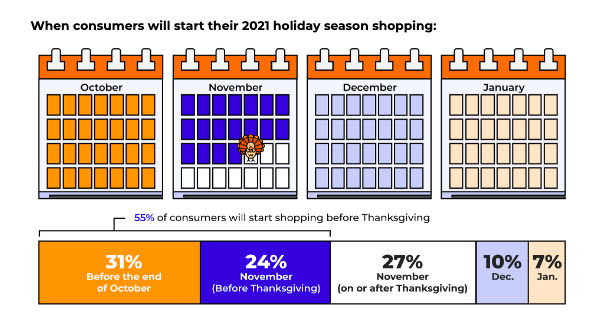
Whenever you start, making a plan is crucial. Try to wing it during the holiday season, and you’ll be outperformed by competitors who have had their campaigns set up and scheduled months in advance.
Planning your strategy doesn’t have to be complicated.
Start by outlining the goals you want to achieve and the tactics you plan on using. Next, list all the assets you need to design and the marketing funnels you need to build. Finally, create a realistic timeline backward from the day you want to launch.
Breaking your holiday digital marketing campaign up in this way will help show you exactly how much work needs to be done and how to make the best use of your time.
Most important of all, don’t freak out if you haven’t started planning yet. There’s still plenty of time to create a killer digital marketing plan. Focus on the shopping days that are still ahead of you and identify one or two effective strategies to put all of your efforts into.
2. Host a Contest
The holidays are a time for gift-giving, so what better way to get into the spirit of the season than by hosting a giveaway contest.

Not only is a contest a great way to give back to your consumers, but it’s also a fantastic way to drum up brand awareness, grow your social following, and build your email list. You can even use your contest to tease the holiday shopping deals and events you have coming up.
The great thing about hosting a contest online is that it’s quick, easy, and cheap to set up. You don’t even need to give away something extravagant to get people excited. A free product is all it takes to get your campaign going.
3. Use Paid Campaigns to Increase Awareness
While I’ll always believe SEO should have a prominent place in any marketing campaign, the time-sensitive nature of the holiday season makes PPC ads essential.
Run awareness-based campaigns on every major paid ad channel. I’d recommend Google, Facebook, and Instagram at a minimum, but feel free to advertise on any channel you think is appropriate for your audience.

Be thoughtful with your budget. Specifically, you’ll want to make sure you spread your budget across the entire holiday season. While it’s tempting to front-load your budget and catch shoppers as early as possible, consumers may not be ready to purchase at the start of November.
There are a couple of strategies you’ll need to implement to be sure of this.
First, account for higher costs the closer you get to Christmas. Since retailers know that consumers are much more likely to make purchases the later it gets in the season, CPCs become more expensive, too.
Second, get rid of any campaigns that aren’t performing by the end of November. That way, you can save your budget for campaigns that convert.
4. Use Promotions but Use Them Carefully
Promotions and discounts are something of a double-edged sword. On the one hand, they are a great way to drive traffic and increase conversion rates. At the same time, they have the potential to devalue your brand—especially at a time when rampant consumerism is so closely linked to environmental damage.
In response, many brands have been distancing themselves from heavy discounts and Black Friday deals. Outdoor retail brand REI is closing its doors for the sixth year in a row and paying staff to take the day off and spend time with their family. Clothing brand Allbirds is raising prices on Black Friday and Cyber Monday, then donating the additional money to Mother Nature and matching it with their contribution.
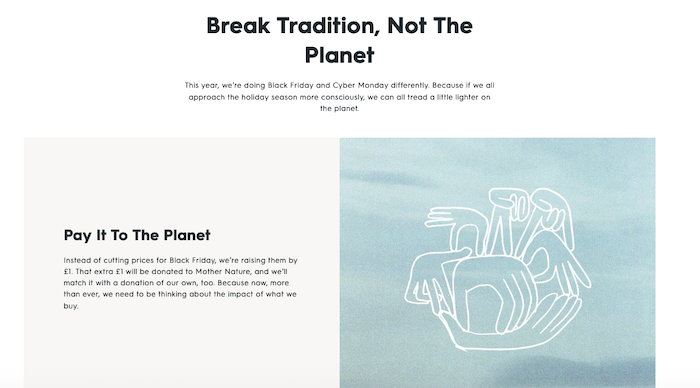
You don’t have to go that far, but you should use offers and discounts with caution.
Rather than trying to compete on price when consumers are looking for as much value as possible, why not deliver value in another way? Free shipping, gifts, and other rewards are a great way to retain brand value while offering the discounts holiday shoppers are eager for.
Another way to make discounts more meaningful is to limit them to existing customers. With this strategy, there’s no risk of devaluing your brand in the eyes of new customers, while rewarding existing customers for being loyal. What’s more, it’s much cheaper to retain a customer than acquire a new one, and a generous promotion may be enough to stop them from shopping with competitors over the holiday.
5. Create Holiday Gift Sets
If you’re looking for a way to increase conversions and boost your average order value (AOV), try bundling your products into holiday gift sets and selling them at a discount. Product bundles are particularly popular in the run-up to Christmas when shoppers are searching for the perfect gift.
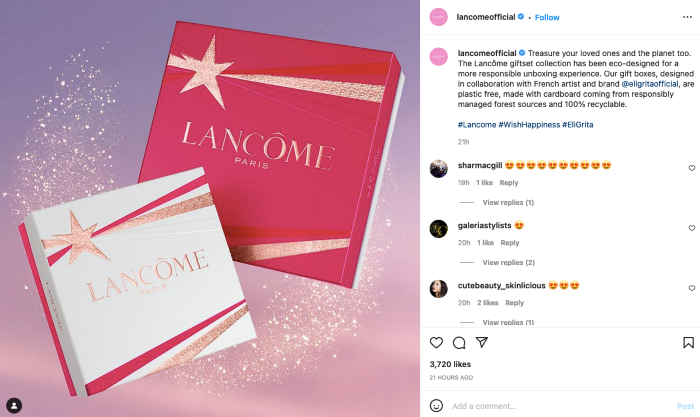
Bundling is particularly common with health and beauty products, but there’s no reason it shouldn’t work in other sectors, too. For example, a yoga e-commerce store could bundle a yoga mat, block, carrier bag, and pair of leggings. A pet store could bundle dog food, a bed, and a collar. Whatever you sell, there’s almost certainly potential to bundle several products together.
Don’t just guess which products will work well together. Harness the power of data and dive into your inventory analytics to see which products have been most popular and which are most frequently purchased together.
Of course, you don’t have to only include your best sellers. Bundling is a great way to sell less popular products that may not do so well on their own.
6. Create Laser-Targeted Email Campaigns
Email marketing generates on average $36 for every $1 spent, making it the highest returning marketing channel. It’s a no-brainer to include email in your digital marketing strategy.

Unfortunately, nearly every other brand includes it in their strategy, too.
That’s right; it’s not just you who gets bombarded with offers during the holidays. From November onwards, everyone’s inboxes start overflowing with Black Friday deals, special offers, and holiday greetings.
Not sending emails isn’t an option. If you don’t catch your audience’s attention, your competitors will. Your job is to make your emails stand out in a sea of sales messages.
Your secret weapons? Segmentation and personalization.
That’s not to say your subject line and email copy aren’t. You’ll have to nail those, too. You’ll also want to make sure emails are optimized for mobile.
There’s only so much you can optimize, however. When you send your email shouldn’t be one of them. There’s no shortage of statistics telling you the best time to send an email. The trouble is your competitors are reading the same articles, too, so forget best practices for a moment and stagger emails as much as possible throughout the day.
7. Be Socially Responsible
Customers are prioritizing corporate social responsibility more than ever. More than three-quarters of them are motivated to purchase from companies that work to make the world better, according to research by AFLAC.

That means practicing social responsibility—whether that’s donating a portion of your profits to charity, creating environmentally-friendly products, or something else entirely—isn’t just the ethical thing to do. It makes business sense, too.
If you’re new to corporate social responsibility, start by supporting causes that align with your brand. For instance, it makes sense for a pet store to support a dog shelter, or a gardening brand to support an environmental nonprofit.
In both cases, customers will want to support the charity and may go out of their way to shop with your brand over a competitor. It’s also just nice to give back to something you care about. Tis the season for giving, after all.
Whatever causes you to support, remember to be genuine. Your customers aren’t fools, and they’ll quickly be able to tell the difference between a company that is committed to being responsible and one that is greenwashing.
8. Try New Platforms
Ever been tempted to run a campaign on TikTok or Instagram Live? Don’t wait for the New Year to make a change; try a new marketing channel this holiday season.
While it can be reassuring to stick to the channels you know, there’s no guarantee they’ll be as effective as they always have been. The move away from Facebook’s suite of apps towards newer platforms, in particular, is well documented.

Launching a campaign on a new platform may seem daunting, but if you treat it like an experiment, then it doesn’t matter if you fail. Better still, there’s every possibility you’ll hit it out of the park and uncover a profitable platform you can advertise on for years to come.
9. Make a Plan for Long-Term Success
My last holiday marketing tip doesn’t technically involve the holidays at all. It’s about how to squeeze as much return as possible from all the money you invest into holiday marketing throughout the rest of the year.
If your brand awareness ads are successful, you’re going to have a lot of people visiting your site. Hopefully, most of them will make a purchase. If they don’t, you’ll want to find ways of targeting them throughout the rest of the year to make sure that initial ad spend wasn’t wasted.

One of the best ways to do this without getting visitors to sign up for a mailing list is through retargeting ads.
With retargeting ads on Google and Facebook’s ad network, you only serve ads to people who have previously visited your site. This is an incredibly cost-effective ad strategy and one of the best ways to keep your brand top of mind well into the New Year.
Digital Marketing Holiday Tips: Frequently Asked Questions
Why is holiday marketing important?
Consumer spending is high during the holidays, but so is competition between brands. A holiday marketing strategy can help your business boost sales and increase market share.
What makes a great holiday marketing strategy?
A great holiday marketing strategy is well-targeted, highly personalized, and focused on driving as many conversions as possible.
How can I increase sales during holidays?
A digital marketing strategy is one of the best and most cost-effective ways to increase sales during the holiday season.
Digital Marketing Holiday Tips Conclusion
The holiday season is rife with opportunity, and there’s no shortage of digital marketing strategies you can use to make 2021 your best season ever. It’s all about putting together a campaign that works for your brand.
Start by implementing one or two of the strategies I’ve listed above, then make sure you’re doing everything you can to improve your conversions. Finally, learn how you can keep your sales high after the holiday spike.
Which digital marketing tip are you going to use first?
Source: neilpatel.com

The Essential Guide to Brand Reputation Analysis
Much of your company’s growth depends on discussions that take place in rooms you are not in or don’t even know exist.
According to Gartner, nearly 52% of SMBs looking to buy software use user reviews to assess their options. Other studies found that customers read at least ten reviews before making a purchase, and 76% of software buyers trust online reviews as much as referrals.
The truth is before people buy from you, they process what others say about your brand to evaluate your credibility. That means there has never been a better time to start monitoring your brand reputation.
In this article, you’ll learn how to conduct a brand reputation analysis and mistakes to avoid.
First things first, why do you need to perform a brand reputation analysis?
Are you familiar with the adage in the IT industry that says, “Nobody ever got fired for buying IBM?” It implies that IBM is a safe choice because it is well-known.
Most importantly, that statement lies on the premise that IBM has a better reputation in the IT industry than most companies.
Companies today should constantly be seeking ways to assess and improve their reputation. Reputation analysis will come as a savior where your marketing and sales material fail you.
Here are two reasons you need to conduct a brand reputation analysis for your organization.

Conducting a reputation analysis gives your brand a competitive edge.
It’s all about knowing how the general audience feels about your brand. You can quickly analyze the leading companies in the market and sketch outgrowth perspectives for your brand.
The truth is before people buy from you, they process what others say about your brand to evaluate your credibility.Click To Tweet
Take Nike, for example. Most of their commercials are inspired by social issues or controversies. Yet, each of these campaigns generates significant results because Nike’s audience identifies with it. However, when Pepsi tried the same approach in collaborating with Kylie Jenner, it caused an unprecedented backlash.
The underlying message is clear: you have a competitive edge over your competitors when you constantly analyze your brand reputation. That is because such analysis tells you what your audience likes and dislikes.
Conducting a reputation analysis increases your income.
According to Prophet’s 2020 Brand Relevance Index, brands with excellent reputations have revenue growth that exceeds the average revenue growth of the S&P 500 by 230%. For the record, the S&P 500 includes the 500 largest companies listed on the United States stock exchanges and has a market cap of over 40 trillion.
The same study showed that the most reputable companies had EBIT (Earnings before interest and taxes) growth of 1.040% over the last ten years.
By objectively conducting your brand reputation analysis, you can reverse your trajectory whenever you notice a poor reputation score and reap the many benefits of having a good reputation.
Two Mistakes That Bias Your Brand Reputation Analysis
Analyzing your brand’s reputation is a good thing, but doing it without eliminating bias doesn’t help you at all. Here are some mistakes you should avoid if you want to keep your analysis data clean.
Putting metrics over strategy.
Throughout every organization, strategy is being hijacked by figures almost every day. You can associate Nike’s “Just do it” strategy to the number of sales it generated, Coca-Cola’s “Love story” to the number of recycled plastics, etc.
Strategy in itself is an abstract concept that only comes to life when associated with numbers.
But in the race to make the abstract tangible, many companies end up putting the cart before the horse–which always ends in a backlash.
Take Wells Fargo, for example. As part of their “cross-selling” campaign, their employees opened 3.5 million credit cards and deposit accounts without customers’ consent. Why did they do this? Well, because they wanted to execute the said strategy and “make it a success.”
In the end, the campaign that was supposed to have a cheerful ending turned into a nightmare because they prioritized metrics over strategy.
Not tying customer satisfaction to brand romance.
Most brands gauge their brand reputation with metrics like “number of people who like/dislike our brand.” While this is a good metric to start with, it is not necessarily accurate.
Just because I like your brand doesn’t mean I’m satisfied with your products and services. It’s a bit of a subtle nuance to make but think about it. You like Microsoft but are not happy with Windows Vista. Or you’re unhappy with the Tesla Cybertruck but still love Tesla.
Companies are focused on measuring surface-level sentiment when the underlying feeling is quite the opposite.
When a customer says, “I love Amazon, but their customer service sucks,” it doesn’t mean they love Amazon. In fact, not the way you think.
As such, when you conduct a survey and simply ask that SAME customer, “Do you like Amazon?” their answer will always be YES. It takes a few more profound questions to get them to the actual feeling, which is “I don’t really like Amazon.”
A step-by-step guide to nailing your brand reputation analysis
Brand reputation is not only about bad customer reviews and comments on the internet. To be as accurate as possible in your reputation analysis, you need to collect a set of quantifiable and non-quantifiable data.
Here’s how to leverage data to ace your brand reputation analysis.
Step 1: Identify primary sources where the talk happens
It’s great to know what people say about your brand when you are not in the room. It’s even better to know which rooms these people are talking to each other in. It matters because it stops you from meandering across many websites and gets you focused on those that matter for your brand.
Have you ever wondered why Lamborghini doesn’t do TV ads and prefers to advertise on Instagram or using video marketing? Simply because their target audience does not spend their time in front of the TV and an ad through this channel would have no effect.
Consequently, to analyze Lamborghini’s brand reputation, you can’t rely on metrics you’ve gotten from sample TV viewers.
Another example is Whatsapp and WeChat. The first one is popular in India and the second one in China. To have some accuracy in your reputation analysis, you need to address the geographies accordingly.
Step 2: Track your brand’s mentions over time.
Once you figure out where the people who influence your reputation are, one essential brand reputation metrics you should start tracking is Mention Over Time.
It helps you better understand your brand’s popularity over some time. It is usually expressed as a chart displaying whether mentions of your brand are constant, peaking, or decreasing.
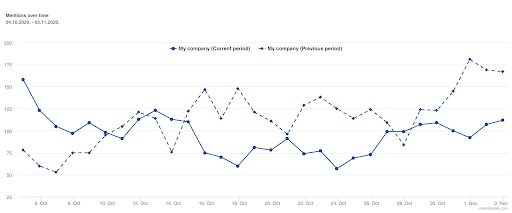
SOURCE: Mediatoolkit.com
If your mentions increase, you can check the underlying drivers and evaluate the data to see if they are positive or negative–and act accordingly.
Step 3: Conduct sentiment analysis
If the metrics you track for your brand analysis are only expressed in figures, you are missing a big deal. There may be much talk around your brand, but there’s no guarantee the talks are piling up a good reputation. There may be terrible reviews, people using irony and sarcasm.
A simple brand mention doesn’t give you an accurate picture of a person’s attitude towards your brand. That is why sentiment analysis is such an essential metric for brand reputation analysis. It sets a frame of reference for the data you obtain and helps you to understand it.
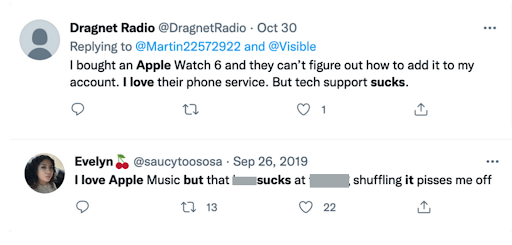
In the above two tweets, for example, the authors make it seem like they love Apple and its services. But the last words of their tweets reveal their real thoughts about the products–which is that they think it sucks. From a reputation analysis standpoint, these last words are more important than the sentences that precede them.
Step 4: Keep an eye out for your brand’s share of voice.
The share of voice (or SOV) is the most reliable metric used in PR and the first indicator of brand popularity. It is different from Mention Over Time in that it gives you an idea of where you stand in your industry and vis-à-vis the competition.
It helps you spot any talk waves regarding your brand and the underlying sentiment driving those conversations.
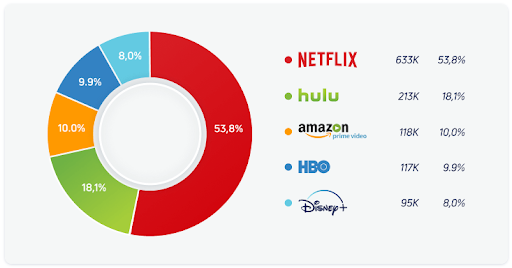
SOURCE: Awario.com
For instance, between 2008 and 2013, grocery giant Lidl suffered from brand perception issues that caused them too much damage. First, in 2008, the company was criticized too much for the way it observed its employees. Then in 2013, they were involved in a case of selling horse meat.
Not only has this scandal had an impact on Lidl but also on its competitors. Indeed, a study proved that 6 out of 10 people changed their shopping habits because of this scandal. In addition, some shoppers have stated that their trust in the food industry has dropped by a quarter.
To address these issues, Lidl launched the ‘Lidl Surprises‘ campaign, which is a strategy to boost their share of voice and brand perception.
According to Marketing Week, the campaign increased the brand’s share of voice from 5% to 19% in 2016 and 2017, leading to £2.7bn in incremental sales.
Lidl’s case is living proof of the importance of the share of voice in a reputation analysis.
Top 4 brand reputation analysis tools
If you’ve been following our rationale from the start, you can tell you can’t conduct a practical brand reputation analysis by yourself. You will need to use some tools to track, organize, and track the data.
“To manage your brand reputation, it’s essential to adopt tools and processes that adhere to your marketing strategy, not vice versa. It’s more beneficial to change your tools than trying and making your marketing strategy fit them.” -Chris Norris, Founder and Managing Editor of SleepStandards
The list is pretty extensive, but here are four brand reputation tools you can easily adapt to your marketing strategy.
Google Alert
Google Alert is a free and straightforward mention tracker designed by Google. All it takes is for you to set up a specific keyword you want to be alerted for and put your email address.
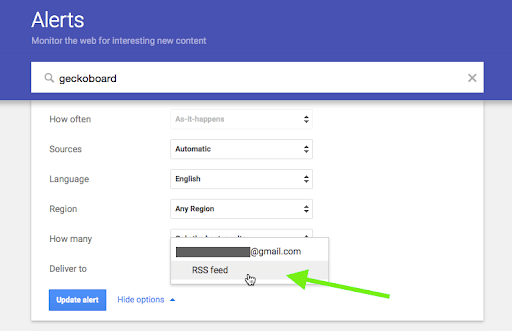
SOURCE: Geckoboard.com
Once you’ve done that, anytime Google picks up on a mention of the keyword, you will receive an alert notification through email that’ll redirect you to the place you were mentioned. So, it’s reliable and straightforward. However, it does not track social media platforms. You can try it here.
SocialMention
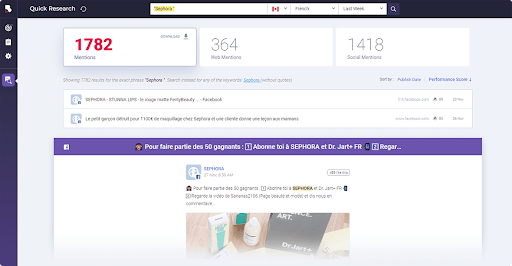
Technically speaking, SocialMention is an improvement on Google Alert. It is yet less powerful than advanced brand mention monitoring tools. It’s also free and straightforward to use.
SOURCE: brandmentions.com
You just need to put in the name you want to monitor online, and you’re done. The dashboard will present all of the mentions, along with some basic analytics. You can try it here.
Mediatoolkit
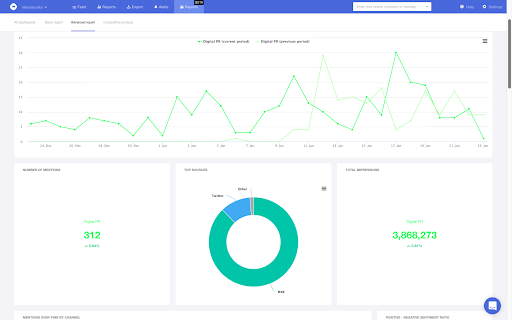
While Google Alert can boast about its reliability and simplicity, these characteristics are nothing new to Mediatoolkit, and it doesn’t even make up for its lack of features.
Source: Mediatoolkit.com
For a thorough and utter brand reputation analysis, you will need a tool you can rely on every step of the process, from data gathering to making sense of it.
Mediatoolkit offers a library of features that can help you achieve this efficiently. It tracks your mentions both on Google and social media platforms. Businesses across the globe trust Mediatoolkit because of its advanced features. You can try it here.
Brand24
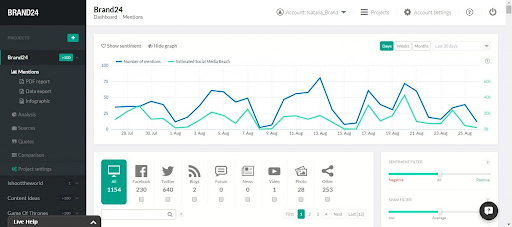
Buffer recently rated Brand24 as one of their favorite tools for tracking brand reputation. Brand24 is a media monitoring tool with solid marketing and analytical features.
source: Brand24.com
The tool gathers public brand mentions in real-time and covers everything from review sites, newsletters, blogs, podcasts, forums to social media networks.
It also packs great features such as sentiment analysis, social media reach, etc. Plus, it notifies you as you get mentioned so you can rapidly act on it–in real-time. You can try it here.
The post The Essential Guide to Brand Reputation Analysis appeared first on Content Marketing Consulting and Social Media Strategy.
Source: convinceandconvert.com

The Guide to Using UGC Marketing to Create Deeper Audience Connections
User-generated content, or UGC, is exactly what it sounds like: anything that people outside the professional marketing team are creating around or about your brand, product, or service.
UGC has been gaining significance in recent years as a powerful marketing tool for digital agencies and marketers. It is a way to create a sense of community between the brand and its target audiences.

Why should my brand consider using UGC for marketing?
UGC can help brands establish themselves as an authority in their field while also increasing their bottom line with increased revenue from new customers or repeat customers who are happy with the company.
It also helps differentiate the brand from its competitors because it creates an emotional connection with its customers by showing how they care about what they do and who they serve.
Online UGC takes the form of content, broadly. Specifically, that includes (and isn’t limited to):
- Social media posts
- Recommendations and reviews
- Photography and photo galleries
- Video
- Fan art
- Reddit threads
- TikTok challenges
- Blog posts
- Unboxing videos
- GIFs
- User testimonials
- Posts with branded hashtags
User-generated content is an excellent way for companies to create buzz about their brand. It can also be used by B2B brands in order to connect with potential customers.
More connections create a stronger relationship.

What are the benefits of leveraging UGC as a brand?
UGC is a powerful tool for marketing because it automatically creates greater trust amongst customers, can provide valuable insights into customer needs, and automatically generates fresh content on a consistent basis.
Build trust
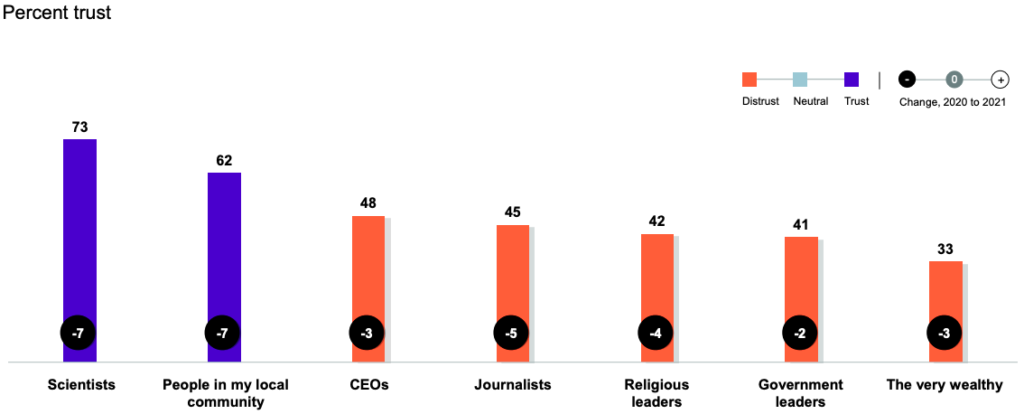
It’s well documented by research presented in Edelman’s Trust Barometer, that people trust humans like themselves the most — and they trust brands the least. Brands that can incorporate a mix of user-generated content into the marketing mix can build more trust with customers.
UGC lends an air of authenticity and even transparency. It builds trust because the brand is putting forth what your customers are saying about a brand, product, or service.
Discover customer insights
Brands that embrace the power of UGC in their marketing campaigns are able to create a more relevant and authentic relationship with their intended audience. UGC is about giving customers a voice that is their own, not influenced by the company or its employees.

Searching for and following UGC provides some of the best opportunities to engage with your customers and potential customers. When brand advocates feature your brand to their friends, family, and followers, they will usually have done this without being paid or incentivized to do so.
Without any gatekeepers, they are free to post both the good and (hopefully) constructive critiques about what they would do differently.
It’s easy to get wrapped up in criticisms or bad reviews. The best brands find a way to take this as feedback and learn from it, even if they don’t republish the content or take the opportunity to respond.
Generate fresh content
It shouldn’t come as a surprise that creators are everywhere. Many of them are really good at creating content in a variety of mediums. As mentioned above, there are several ways that content comes to life.
When a customer creates in a way that resonates with them, it will likely also resonate with another member of your audience.
There may be a temptation to slightly change UGC before it’s reposted. STOP. When using UGC that the creators have shared, refrain from editing their content in any way.
Use it as it was meant to be original. These unfiltered views into customers’ experiences with a brand are exactly what audiences need to see to build trust.
Is UGC useful in B2B?
UGC is absolutely useful in B2B, along with B2C and other entities. B2B marketers are also in the business of building trust and building brand advocates. Achieving this is a two-way street.
First, build trust with the audience by amplifying other people’s voices, their recommendations, their product videos, their testimonials, and case studies. For most B2B brands, we discover UGC in places where ratings, reviews, and demonstrations are content cornerstones.
Identifying the creators who are talking about your brand in these channels is a good way to a source who might be able to create more content for you.
Spend time searching on YouTube, Instagram, TikTok, and other video channels for creators who post reviews, explainers, and demonstrations featuring the brand, product, or service. You may be shocked to find just how many product demos and tutorials are online that are never made by the employees who created the actual product.
Discovering and amplifying reviews and demonstrative content allows B2B brands to leverage UGC for building trust with their audience. This creates more and deeper connections with the people who are likely some of the best customers.
At the same time, marketers are deepening the relationship with key customers by amplifying their experiences and using previously shared content.
If there is a good relationship forming with a customer or client who is creating UGC about the brand, product, or service, then B2B marketers should consider a step forward in formalizing content co-creator relationships to maximize the UGC opportunities.
Co-creating content empowers creators to use their vision and voice while allowing the brand a bit more input but in the overall direction. Remember that ultimately the customer is responsible for the end product.
In some of these relationships, co-created content looks similar to influencer marketing. However, there’s still space between full-on influencer marketing and leveraging what somebody was inspired or motivated to create.
How can we encourage UGC for my brand?
While brands can’t create their own user-generated content, they absolutely can encourage the creation, which we see all the time. During Northern Arizona University’s Giving Day 2020, the first 1,000 donors earned a pair of branded Lumberjacks socks.
The package included a small card that instructs the recipient exactly what to do to create a social media post while wearing the socks. The card listed what hashtag to use, the specific university account handle to tag in a post, a suggestion for photo styling, and of course the prompt to share online.

This approach to UGC isn’t new. For a decade or longer, we’ve used social media to ask and inspire audiences to share their experiences with brands. The difference today is that people often create content of what they deem shareable before they’re asked.
Even so, campaigns perform better when creators are guided by specific instructions, including hashtags and @mentions, what channels to post, and post types.
There are discovery platforms or tools for marketers to discover user-generated content across the web, even when a brand is not explicitly tagged or mentioned. Some tools allow marketers to contact the original creator and manage those relationships and permissions within the tool.
How do you get approval for using UGC?
By following a couple of clear-cut rules, brands can absolutely use and leverage user-generated content.
First, you have to find the content, which happens best when using active social listening programs. To find the user-generated content that people are posting on your behalf, marketers must use robust social listening.
A robust listening program goes beyond account tags and keyword searches queued up. Also look at hashtags and non-tagged mentions of your brand, including brand name, your product and service terms, and keywords.
Search across general social feeds and hashtags as well. Take it a step beyond brick-and-mortar or physical locations by using location-based aggregators to find content that is tagged with a location.
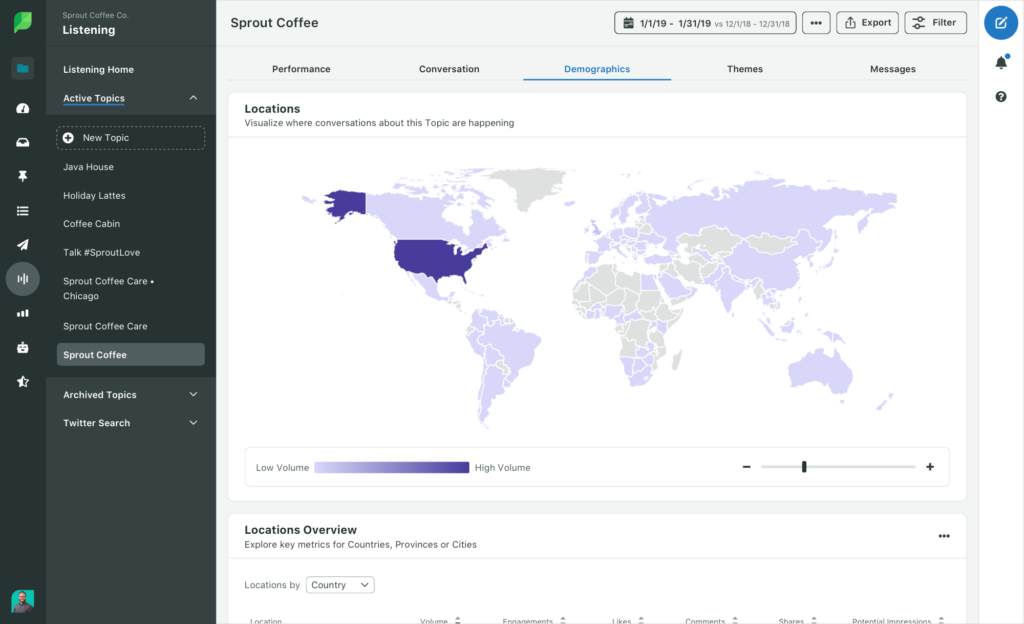
Credit: Sprout Social
User-generated content can come from consumers or from employees of the company. When it comes from consumers, permission needs to be granted before the material is shared on a company’s social media channels or used elsewhere on their website.
A lot of that happens just in direct messages, but some of that happens in the aggregate tools that you’re using as well.
One-to-one connections are how a brand moves someone from being an audience member into becoming a fan.
There are two types of copyright: exclusive rights and moral rights. If someone creates a photo or video expressly for you, like in the co-creation example, this is an example of needing exclusive rights to use the content. A case of moral rights is when a creator produces content as a hobby or as an independent creator, and grants permission to the brand to amplify.
In either case, get approval from the original creators of the content you want to share. Travel and tourism brands often use a hashtag in Instagram bios with a disclaimer that states by using this hashtag, the user allows others to share the content.
Otherwise, reach out to the original creator and secure permission from them to use the content in any marketing channels. To use any photography, video, or art, seek out the moral rights granted by the creator.
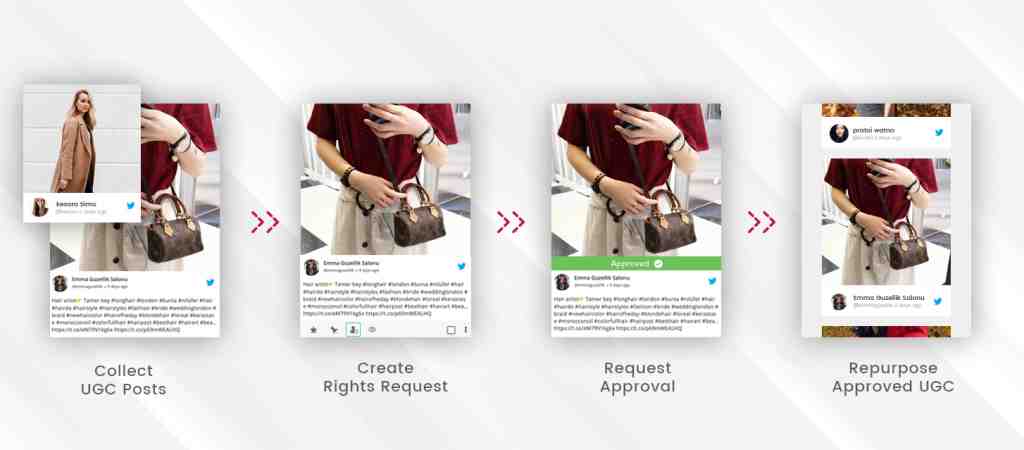
Credit: Tagboxx
Testimonials and reviews that are publicly posted on Google or Yelp, your Facebook page, or G2 Crowd can be reposted without explicit permission.
Even so, smart marketers will try to identify and get in contact with the customer. Doing so creates additional touchpoints with that customer.
Asking permission from the original creator to use their content creates goodwill between you and that creator. That establishes a more direct, one-to-one connection with a brand advocate.
Those one-to-one connections are how a brand moves someone from being an audience member into becoming a fan. Creating one-to-one connections is done easily, but it’s overlooked all the time by marketers.
Social media allows for us to create micro-connections simply, with just a push of a button, a heart on a reply, a simple DM.
The more one-to-one micro-connections that occur, the deeper the relationship and the more strings are connected between the brand and an audience member. More connections create a stronger relationship.
What is the best way to amplify user-generated content?
User-generated content is a way for companies to leverage the power of consumer word-of-mouth in order to promote their brand. UGC works really well, obviously, in social media, through sharing, retweeting, and reposting.
While not used as frequently in email newsletters, UGC can perform well in the right template. Create a content block for a fan shout-out or a UGC feature within the email and encourage others to use a branded hashtag when creating their own content.
Brands that have their own online community or group should incorporate UGC consistently. Doing so will inspire other customers and advocates to create their own content and share it with you. Increasing the cadence of UGC on the brand’s behalf provides more opportunities to amplify brand advocates.
The post The Guide to Using UGC Marketing to Create Deeper Audience Connections appeared first on Content Marketing Consulting and Social Media Strategy.
Source: convinceandconvert.com

How to Use Sales Demos to Strengthen Your Online Reputation
Digitalization has had a huge impact on everyone’s life. In most aspects it has influenced businesses in a good way: They can now go global, discover new marketing channels and broaden their customer base.
But there’s one negative to being online as well: A fragile reputation.
In a world where anyone can complain about any business failure in a public manner, any business is vulnerable. A reputation crisis is always around the corner.
And it is even more challenging in a B2B industry where buying journeys are longer and past failures are harder to erase. B2B customers are good at researching their options, comparing businesses, and making informed decisions. Any past reputation crisis may be standing in your way to success for years to come.
Were you looking for ways to solidify your B2B business online reputation? The solution may be in adjusting your sales demonstrations.

Why Are Sales Demos So Important for Online Reputation?
Let’s face it: When it comes to B2B, sales demos are often the only way to close a sale. It is the only way to demonstrate how your product is solving your prospects’ pain points and prove that your platform is worth investing in.

Product demos are central to any software sales process.
But what does it have to do with reputation?
- Product demos can turn a prospect into a customer, a customer into a believer and brand advocate, and who can better protect your reputation than your brand advocate?
- Professional product demos can rank for your brand name and set positive expectations about your brand. Using your product demo on your landing pages makes you look like a serious and reputable company.
- Making your demo easy to access (without the need to register an account, schedule a call, etc.) will shorten your customers’ buying journeys which means fewer people will compare you to competitors and research your reputation.
- Public demos will add some positive context to your brand and help you control its online sentiment. If done correctly, your sales demo lets you highlight your software’s most important features showing it in a most favorable way. The more demos you market, the more of the context contributes to the whole picture.
So How to Use Demos to Strengthen Your Online Reputation?
Publish Your Product Demos
This is easy: You may have a ton of recorded demos by now. It will likely be easy for you to find some you can publicize for others to see.
If you use Walnut, this process will even be easier.
The tool allows you to use their code-free platform to create various demos, instantly targeting different personas and use cases. This is a great way to create a ton of original content to make public and use on top of your sales funnel.
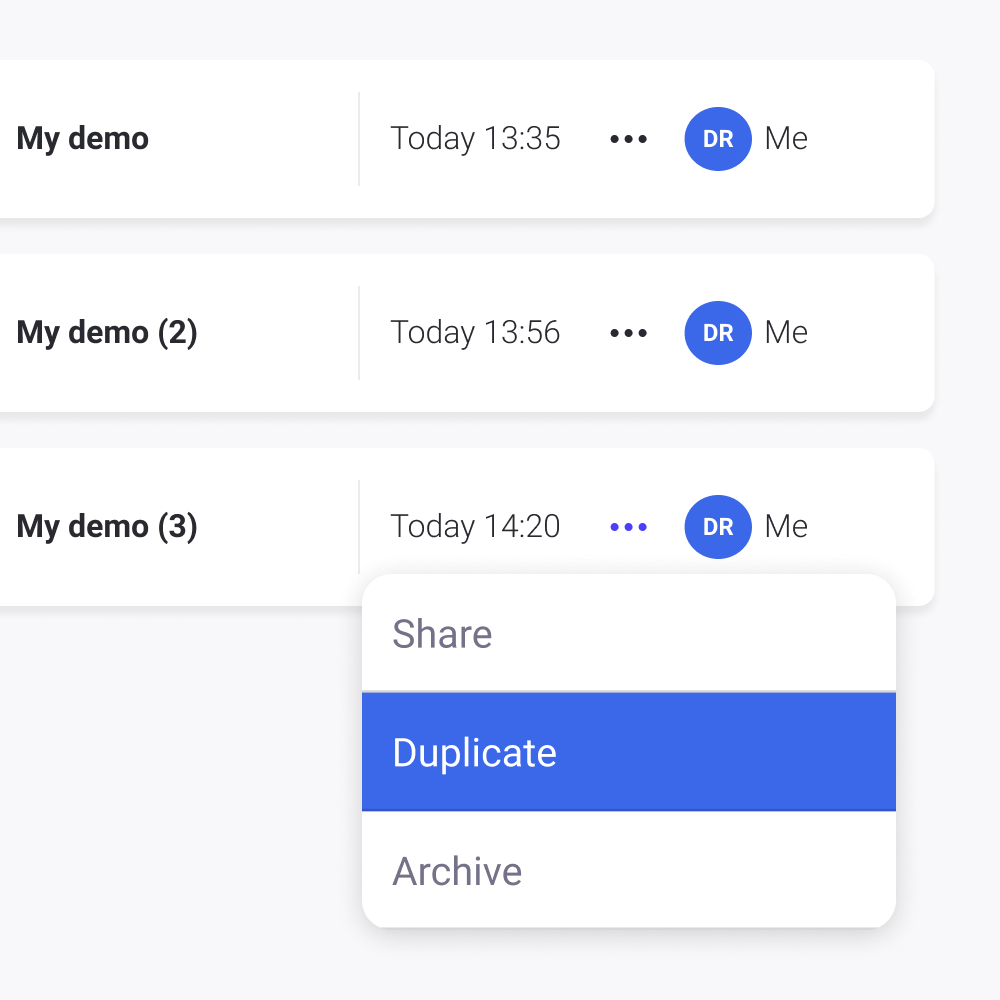
You can even embed your demos on various landing pages allowing your site visitors and prospects to use interactive features to try some features and get to know your product better.
Demonstrating your product demo on your website/landing pages makes you look like a serious and reputable company. This is especially helpful to smaller businesses, as you enable product-lead-Growth (PLG) with your prospects which in turn, makes you appear to be a bigger brand.
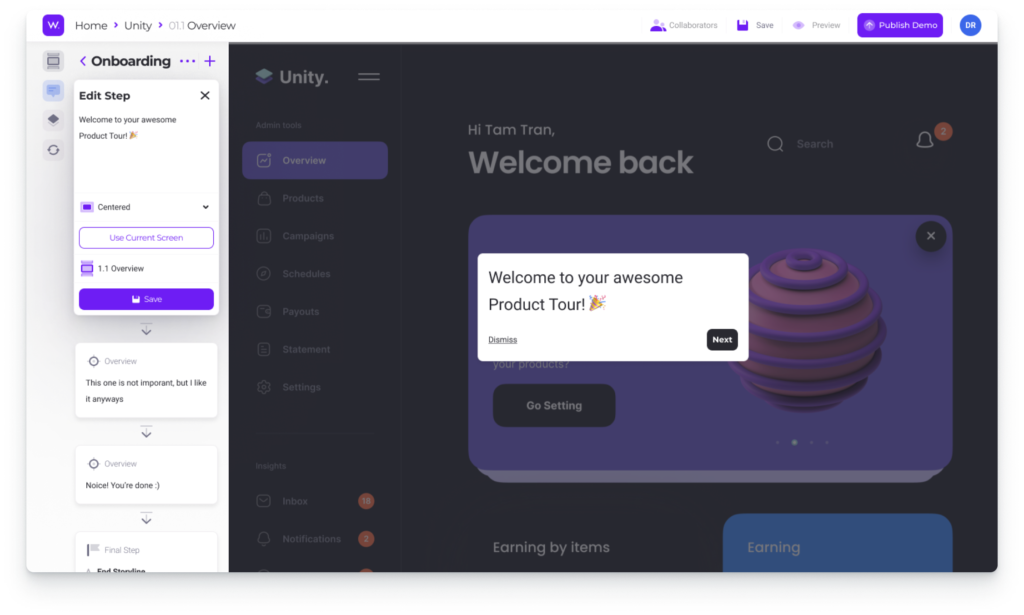
You can then use Walnut’s built-in analytics to understand which parts of your demo seemed to appeal better to your prospects. This gives you lots of insights to create better demos in the future.
Treat Your Demos as Content Assets
Using your demos for reputation management means turning them into top-of-the-funnel content assets. So instead of treating your demos as private assets, start looking at them as your branded digital media.
In other words, you want your demos to rank on Google and get shared around by your prospective customers.
- Research your (or your competitors’) branded keywords
- Break them into groups by search intent, personas, and decision-makers that may be using each keyword (CEO, marketing manager, IT manager, etc.)
- Create landing pages targeting those keyword groups and add your custom demos to each one. The idea is that anyone researching your brand and your products should be able to find answers on your site by watching your demo instead of having to go elsewhere
Obviously, it is a good idea to get your sales team involved in the process as they will likely offer a great deal of insight into your probable decision-makers and buyer personas behind each search query. Collaboration is key to success here.
Note: There’s a cool quiz by Nextiva allowing you to determine whether your company is prepared for collaborations and unified communication. Take it!
Monitor Each of Your Sales Funnels
Obviously, each of those landing pages will become your strong sales funnels, so you want to keep a close eye on those. Again, Walnut will give you lots of insights into how your site visitors are engaging with your demos.
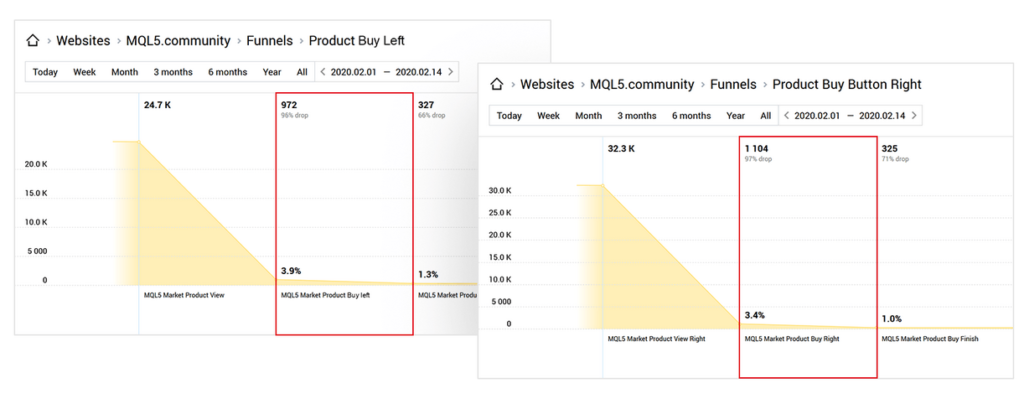
Additionally, you may also keep an eye on traffic channels and buying journeys that started on those landing pages. Finteza will help you build, monitor, and compare those individual conversion channels:
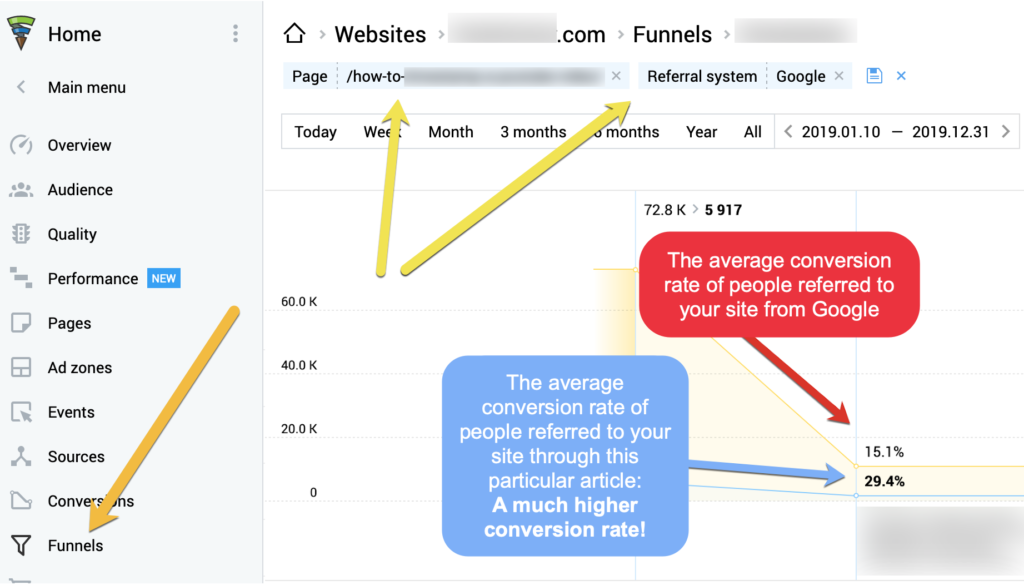
Obviously, Google Analytics can be used for that as well (especially in combination with Search Console that provides keyword data), but it will be somewhat harder to set up and figure out.
Conclusion
Innovating your sales demos comes with lots of benefits including a happier sales team and more sales. It may come as a surprise but sales demos can also boost your brand and solidify your reputation as a reliable niche solution. Good luck!
The post How to Use Sales Demos to Strengthen Your Online Reputation appeared first on Content Marketing Consulting and Social Media Strategy.
Source: convinceandconvert.com

Aligning Nano & Micro-Influencers with Your DEI Marketing
You’ve probably heard it a million times already, but authenticity and relatability are EVERYTHING. Social justice movements continue to surge on social media platforms and more people are speaking up about matters that align with their own values. It’s taking a lot more than just simple traditional marketing to speak to your audience.

According to the Consumer Culture Report by 5W Public Relations, 83% of people feel that it is crucial that the brands that they choose to support are in alignment with their values.
In this new world of social, more consumers are going to be testing these boundaries with businesses through DEI (Diversity, Equity, and Inclusion) marketing.
You’re going to need to prioritize building trust within your brand’s community. One of the most effective ways to tackle this is through nano & micro-influencers.
Nano & Micro-influencers for DEI Marketing

Listen, being the biggest and the most popular doesn’t matter as much as it used to. Studies find that 92% of customers trust a micro-influencer more than a traditional ad or an endorsement from celebrities.
Because these types of influencers are known to have smaller-scale platforms (typically under 100,000 followers), the demand to work with them is much less compared to macro-influencers (over 100,000 followers).
Nano & micro-influencers focus on a specific niche or area of interest and are generally recognized as industry experts or topic specialists. Most importantly, they normally agree to collaborate only if the product/brand meets their values and the needs of their audience.
After putting two and two together, let’s be real: More brands need to take more intentional actions towards implementing DEI efforts within their influencer marketing strategies and beyond.
Want your brand to make its mark on society? Here’s how you need to go about incorporating the power of nano & micro-influencers into your DEI initiatives.

Be Small & Focused
Like we discussed before, nano & micro-influencers have a niche. Their niche typically trusts them to speak about certain topics and gives their audience a sense of belonging. Look for influencers who would interest your ideal customer.
We have been tackling this for B2B especially, so take a look at how to locate B2B influences and afford them here.
Think about your audience and search for compatible nano/micro-influencers who look like they are already a part of your existing target. This will prove to be beneficial in terms of trust and building your brand’s credibility.

Microsoft, a technology brand, partnered with National Geographic for a unique B2B influencer marketing campaign this year. They leveraged some of the most famous adventure photographer macro and micro-influencers on Instagram for this. Each of the 30 photos featured the story of a woman adventurer or scientist.
“97% of influencers — said that their audiences react positively to the DEI-related content that they share, leading to steady or increased engagement on this content.”
Never Forget Authenticity
According to the Morning Consult study, 88% of people say it’s important for influencers to be authentic and genuinely care about their interests.
Nano & micro-influencers already have a story to tell. Figure out how they can tie in THEIR story with YOUR brand’s story to create a cohesive thought for your DEI promotional campaign.
Try to link up with influencers who are able to reflect their “real-self” successfully on social media. This will allow your brand to utilize this for better positioning in the minds of your customers.
Be Intentional About Making Strides Towards DEI
Before you go and reach out to a nano/micro-influencer, BE INTENTIONAL!
Don’t just throw out a campaign advocating for diversity, equity, or inclusion just because everyone else is doing it. DEI is not a trend.
DEI is not a trend. How will your brand take steps towards diversity, equity and inclusion?
Consumers and influencers want brands they love to show support towards things that they deeply value. It’s crucial that brands are consistently doing it regardless of what everyone else is doing. Nano/micro-influencers build a platform through advocating about things that matter to them. So if your brand is looking for a one-off opportunity, they’ll easily notice that and likely call you out on it.
If you want to take a more intentional direction with your DEI initiatives, then make your marketing more inclusive by diversifying your persona types.
Figure out EXACTLY who you’re looking for within this landscape. Besides looking at sectors of diversity such as gender, age, ethnicity, or disability status, look at how your desired influencer interacts with their audience, how they speak, and how they usually develop content for their following.
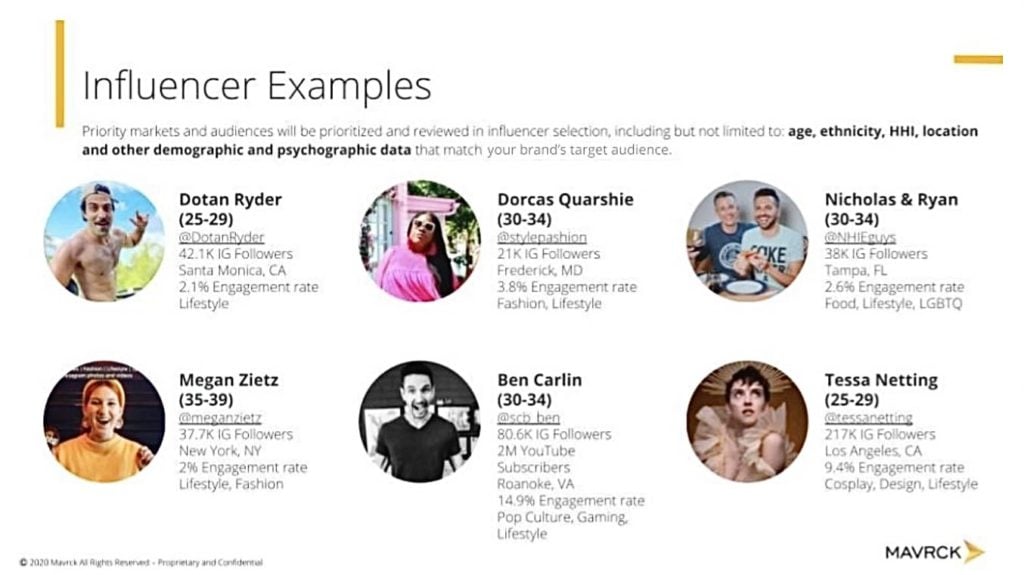
Example by MAVRCK of how to organize your list of nano/micro-influencers by their specific focuses.
2022 Goals: Grow Your DEI Efforts with Influencers
If you want to get the most out of your upcoming marketing strategies in 2022, it’ll be in your best interest to start focusing your efforts towards thoroughly understanding your brand values and how you can properly recruit people to represent them.
By doing this, you can start curating content that directly taps into the values of your audience while also growing your DEI efforts.
The post Aligning Nano & Micro-Influencers with Your DEI Marketing appeared first on Content Marketing Consulting and Social Media Strategy.
Source: convinceandconvert.com

How to Create a Lead Generation Minisite in 3 Steps – Tips & Tools
Do you have a long list of domains you never had time to create a website for?
Who doesn’t, right?
Here’s an idea for at least one or two of those: set up a lead generation website.

I have an SEO background, so in most cases, my advice would be: keep everything on your main site.
Don’t dilute the brand.
Why Do You Need a Separate Minisite for Your Brand?
Yet, there are several reasons why you may want to set up a separate minisite for your brand.
These reasons include:
For personal branding reasons.
Ok, I have my business and my main site, but what do I do with myname.com domains which I rightfully registered so no one else would?
Should I just keep it empty?
I don’t have time to maintain another site!
That’s when a one-page “portfolio” style website makes total sense.

When you need to take an extra position in SERPs.
This makes sense for brand-driven search results.
Google will usually grant you one — maximum of two — positions when people search for your name in combination with another term, but, obviously, you’d want to control more of those search engine result pages.
Let’s say people are searching for something like [your-name coupons], there will be lots of third-party (affiliate) sites that will potentially drive those customers away by showing your competitors or showing ads.
So grabbing a separate domain, like your-name-coupons.online and curating the most recent special deals of yours would give you more control of that search.

When you are launching a completely different project.
I am an SEO and suddenly decide to write a book on being a mom.
It is a good idea for me to register a domain (which would match my book title) to start collecting leads for my future book independently of my main business.
In all the above cases, getting those sites to rank and drive some organic visibility will be quite doable.
When it comes to personal brand or brand-driven queries, all it takes is to set up a minisite and link to it from your main site.
That being said, keeping all links and brand exposure consolidated around your main site is obviously smart, yet there are many cases when you need a separate entity.
On top of that, you are likely to be busy and cannot spare much time for your new site, so let’s keep things easy.

How to Set Up a Mini Lead Generation Site
Here’s how to set up a mini lead generation site:
1. Pick a Domain
This step is getting harder and harder now that it is becoming next to impossible to find an available .com domain that wouldn’t be all dashes.
I’ve got good news for you:
There are lots of options beyond .com domains, and all of them are equally effective.
There’s a cool tool that will help you pick a great domain and even help with branding.
Namify is what that tool is called, and it’s a time saver!
The tool allows you to find a cool brandable name in minutes. Unlike other domain name generators, it focuses on short names that create niche associations and are easy to remember.
You’ll love those ideas.
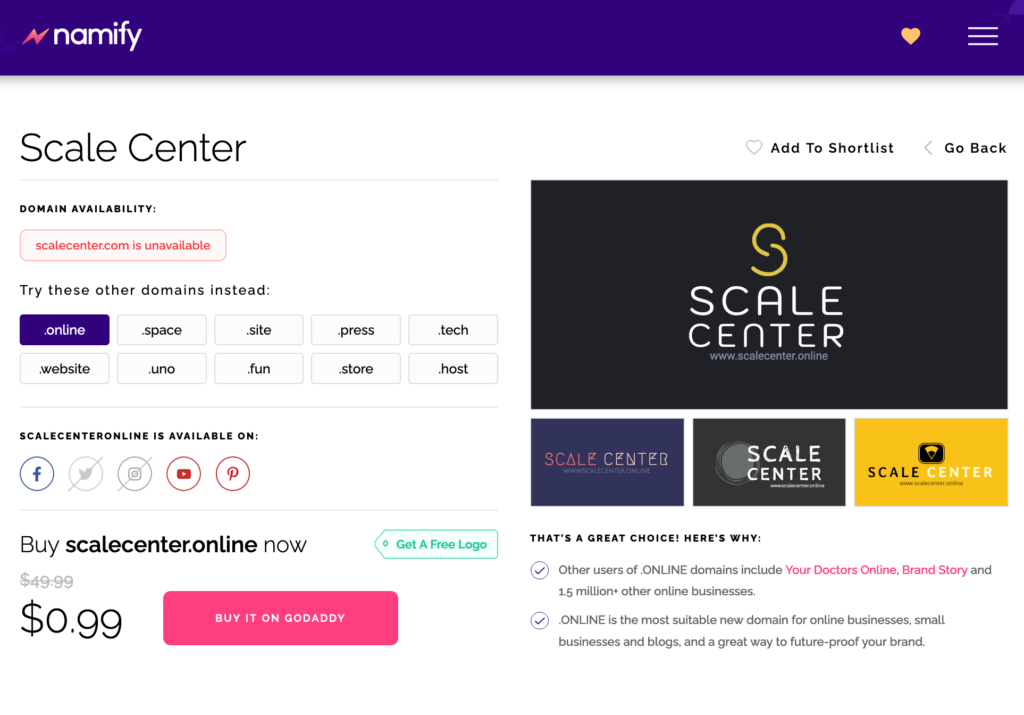
On top of that, Namify will draft your visual brand identity (logo and color scheme) for you to use right away:
2. Set Up Your Site
When dealing with a secondary asset (which is not your main site), the easier the setup, the better.
With that in mind, I suggest using WordPress, which makes it incredibly easy to create a website.
Here’s a detailed beginner-friendly guide on making a WordPress site.
All you need is to follow the steps.
And here’s a huge collection of one-page WordPress themes (both free and paid) which are easy to customize to match your chosen color scheme, logo, or your main brand.
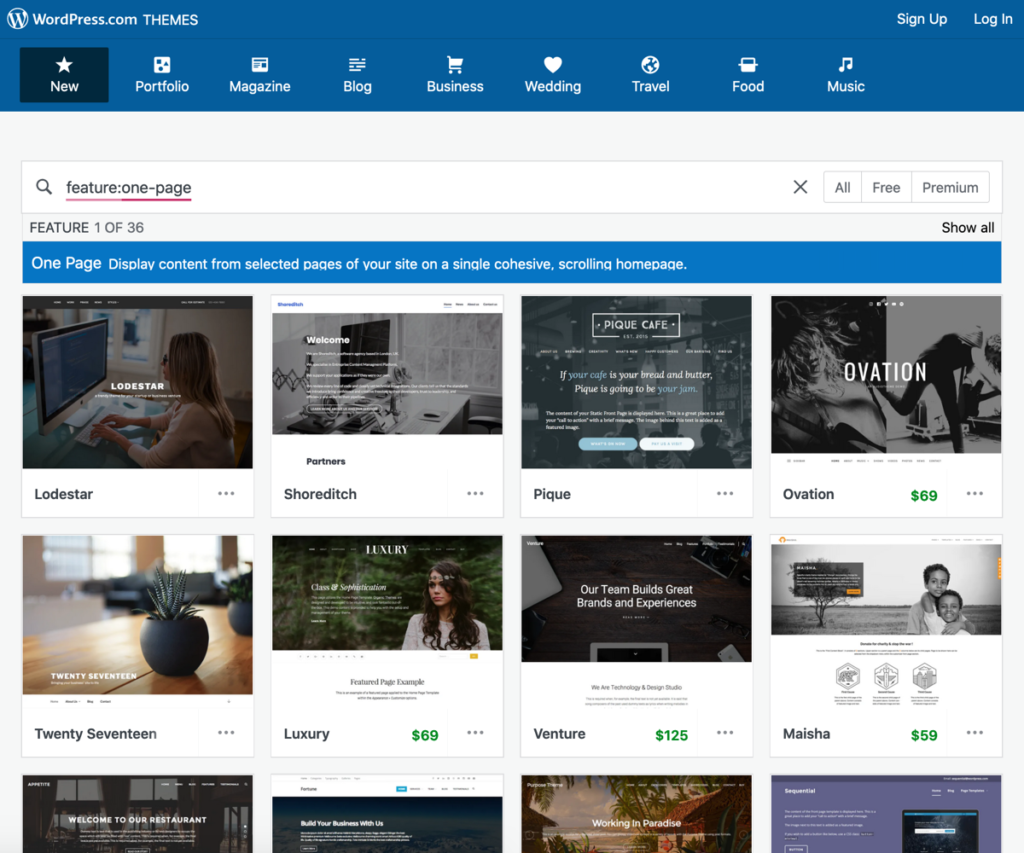
There are tons of one-page WordPress themes to choose from.
Once the basic setup is done, it is time to create your content.
To make it easier, try running Text Optimizer for your core search query — it basically writes content for you.
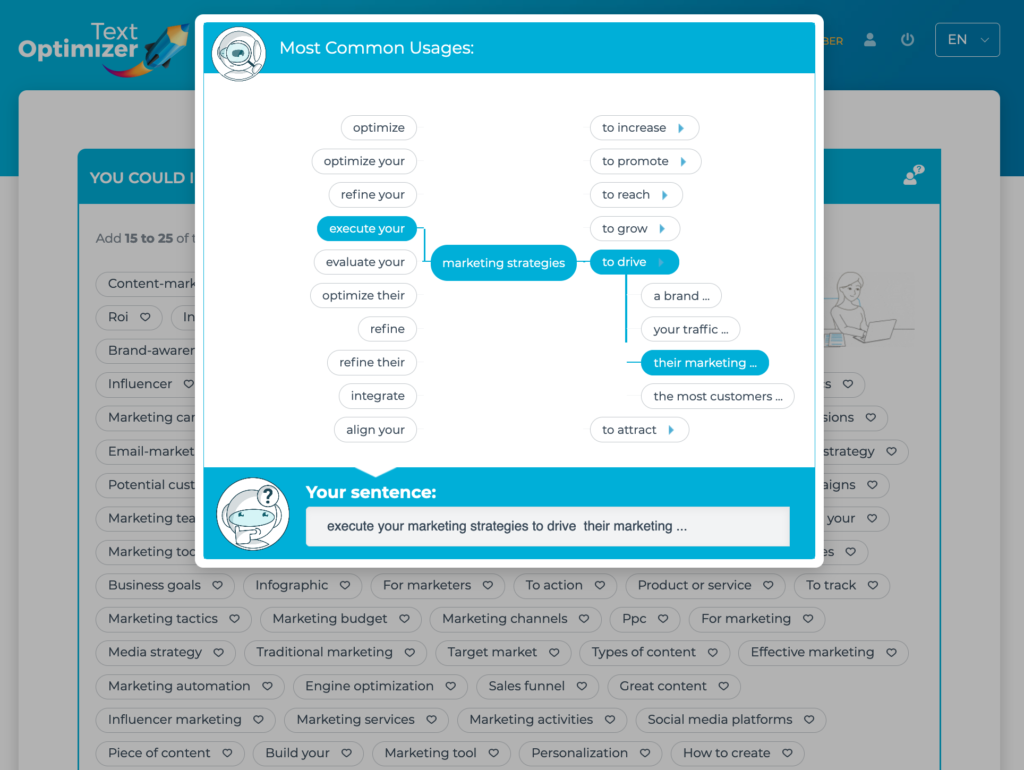
I use Text Optimizer to create the core structure of my page: the subheadings, introduction and key points to be covered.
After that, I write my text.
This has been the biggest writing productivity booster I’ve ever tried.
Since this is going to be a website focusing on collecting leads, using Text Optimizer is a great idea because it is also an intent optimization tool that makes sure your copy meets your site visitors’ expectations and hence increases the conversions.
3. Set up Your Lead Generation Funnel
Finally, setting up a clear lead generation funnel is something you will be focusing on.
Obviously, you will need to keep experimenting with your CTA wording and placement, here but here are a few ideas for you to get started:
3.1 Set up your lead generation forms
Setting up a lead generation form doesn’t require any technical skills these days.
Here are a few easy-to-use online form builders you can use to create a form to collect leads from your site visitors:
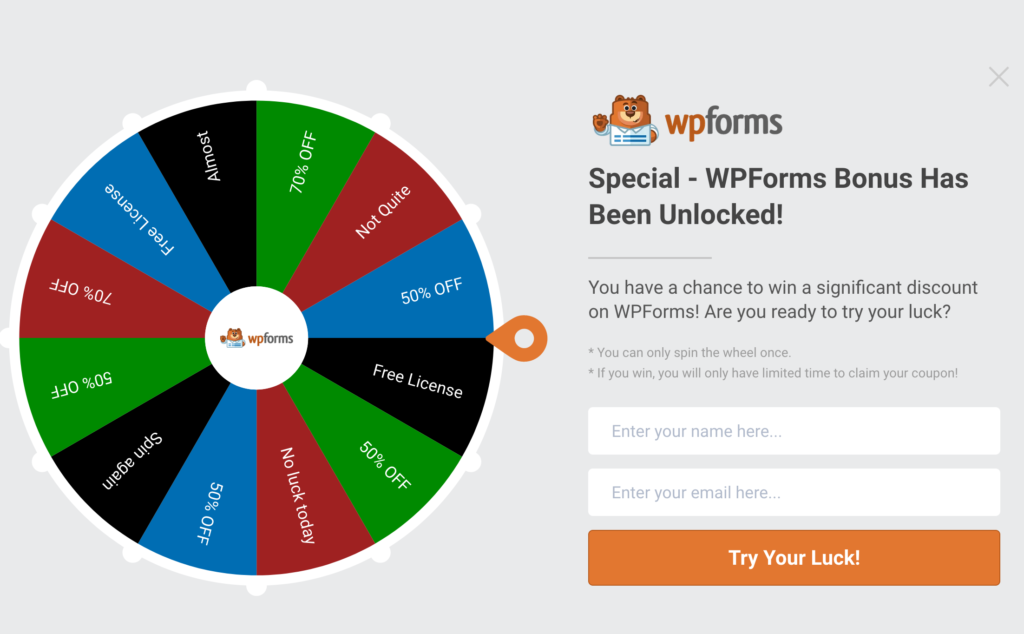
Don’t be afraid to gamify your lead generation web forms and make them fun!
3.2 Implement secondary engagement triggers
No matter how cool your web forms are going to be, the majority of your site visitors may feel wary of giving you their email addresses.
Some people may be in a hurry; others may not have enough trust in your brand.
Regardless of the reason, these people may be willing to convert a bit later.
So coming up with additional engagement triggers is helpful:
- Install Facebook pixel to be able to reach out to those visitors through Facebook ads
- Try using a smart chatbot or feedback widgets to get those people to talk to you without sharing their personal details. This may encourage them to follow your conversion funnel on a later basis.
- Use more traffic-driving conversion optimization tactics to engage more of your site visitors. Remember that certain conversion optimization tactics will also improve your rankings, so it is well worth the effort.
3.3 A/B test often
Again, this is going to be an ongoing process: When it comes to generating leads, there’s never “good enough.”
You need to experiment with new engagement triggers and change your forms on a regular basis.
This is where A/B testing to identify your better-working tactic is always a good idea.
I know lots of marketers who shy away from A/B testing because it is deemed too technical.
Finteza is a web analytics tool that makes A/B testing easy and available to anyone. Here’s how to run A/B tests using Finteza.
Conclusion
If setting up a minisite to claim your old but neglected domains have been on your mind for quite some time, I hope this guide will finally get you up and running.
I did my best to make it as easy to follow and implement as possible.
When it comes to lead generation, every bit helps, and who knows, maybe this site will drive some great leads.
The post How to Create a Lead Generation Minisite in 3 Steps – Tips & Tools appeared first on Content Marketing Consulting and Social Media Strategy.
Source: convinceandconvert.com

How to Get Better Content by Documenting Your Content Creation Process
When we talk about creating content, we have a tendency to talk a lot about creativity. Like, just because writers are right-brained thinkers or seen as “creative types,” all content created will be magically on brand and perform to our standards.

Except there’s just one problem: when there’s no direction provided and the content creation process isn’t documented, you’re really just hoping everyone understands which direction to go.
What actually happens?
Right or wrong, everyone will just go the direction they think they should go.
To avoid this common content creation trap, all you have to do is better document your content creation process, and we have several tips on how you can do just that.
How to Get Better Content by Documenting Your Content Creation Process?
1. Make the Process Clear, Simple, and Accessible
Take a look at your content creation process.
Can you explain it in just a few steps, or does it require elaborate flowcharts and long RACI matrices?
Unfortunately, If you can’t explain to your team of writers or content contributors how to easily jump into your processes, they won’t.
Instead of requiring others to conform to unnecessarily complex systems, take a look at your process and see what you can do to simplify or clarify the steps.
It’s not always the easiest or most enjoyable content task to tackle, but it is one that will only benefit everyone in the long run.
Once you clarify your process, make sure a well-written, reader-friendly guide is available in an easy-to-access place.
We’re huge fans of Google Docs, but you should also have the link available in your project management system, kickoff documents, and creative briefs.
Basically, share it everywhere anyone could ever need it.
2. Define Your Business Success Metrics and Content Objectives
Creating content for the sake of creating content is never a good idea.
You’ll just end up with a mountain of underperforming and expensive content.
Instead, clearly articulate what business goals you’re trying to achieve and how content objectives tie back to them.
Even just a super simple chart of business success metrics and content objectives can help give everyone an idea of why they’re creating content in the first place.
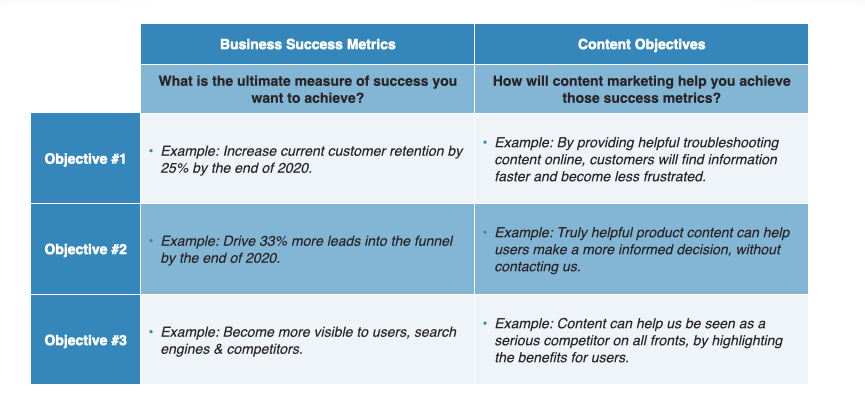
And just remember: clearly articulating what you want to achieve with your content efforts doesn’t mean that your content can’t still be Youtility-based, as seen in the examples above.
3. Use an Editorial Calendar
While you probably don’t want to release your nitty-gritty, detail-laden content calendar (which we just happen to have a helpful blog post and free template for), you can still give people an idea of what content you’re looking into an editorial calendar.
Editorial calendars are most often used by magazines to give a 50,000-foot view into upcoming themes and topics that will be covered.
Forbes has a fantastic example with their 2021 digital editorial calendar.
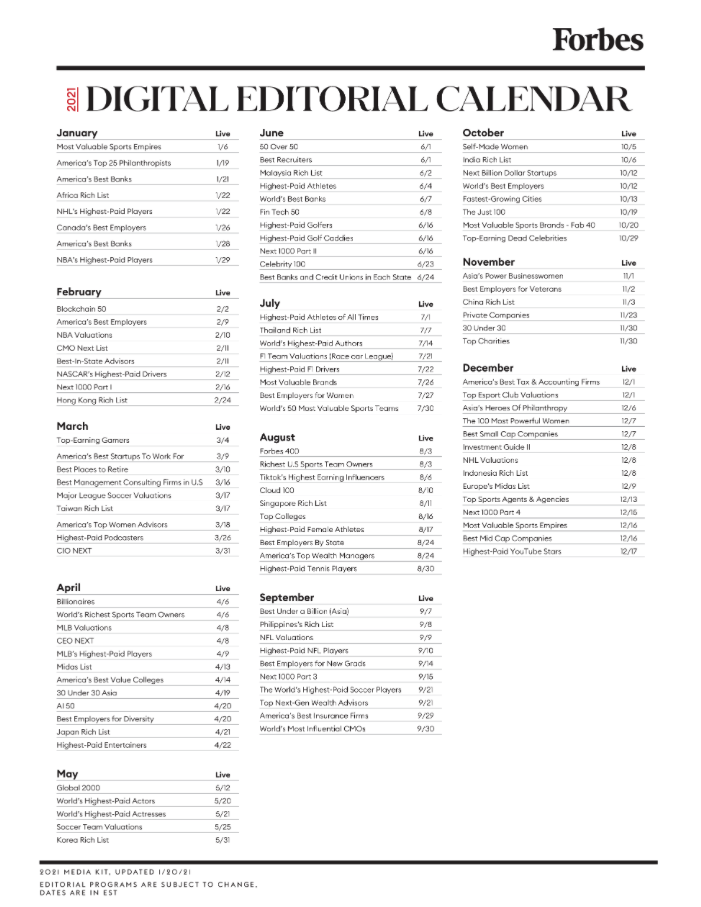
By clearly laying out the upcoming opportunities and tying them to specific dates, you will get far better content ideas and submissions because people will be able to select content pieces they actually want to write about.
This also helps relieve some of the burdens of assigning content.
4. Document Your Brand Guidelines
You may be seeing a pattern here.
Making resources about your organization’s content creation accessible (and easy to understand!) makes the process smoother for everyone.
Why?
Because some people have decided that the Oxford comma is the hill they want to die on.
Or maybe someone’s writing style is whimsical and breezy when your brand is direct and to the point.
Brand guidelines magically turn personal preference and style into moot points, because everyone now has a clear set of guidelines to follow if they want to contribute.
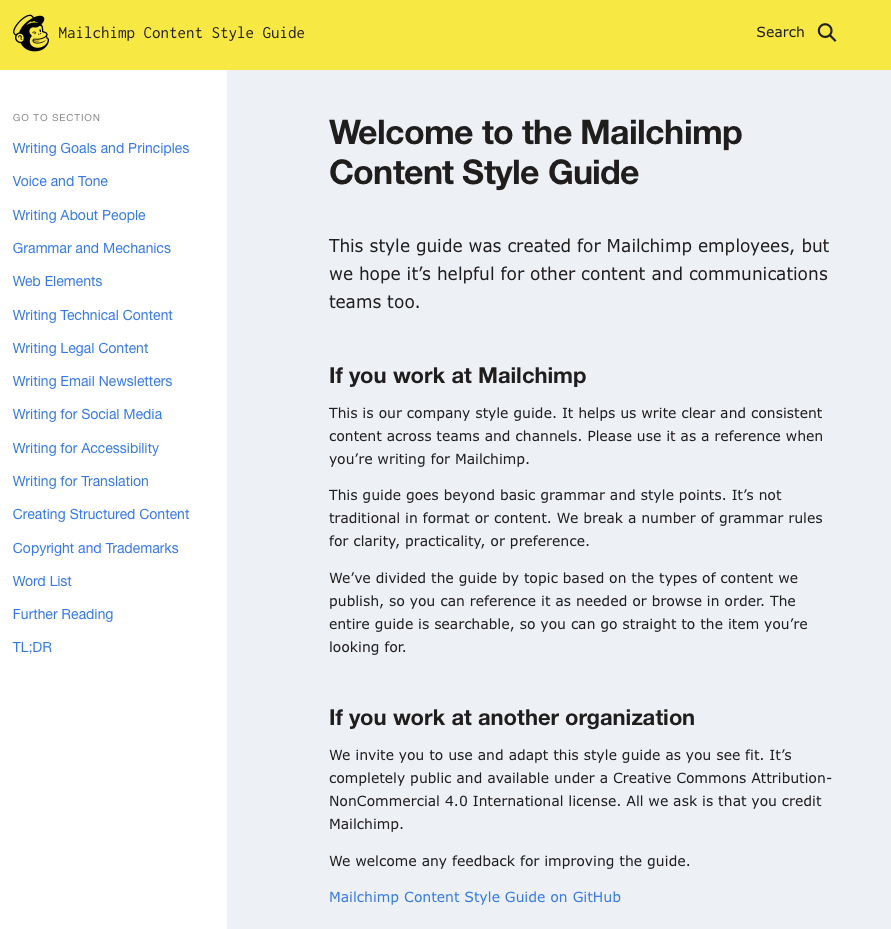
Ultimately, brand guidelines are about protecting your brand and making sure content meets the specific quality and style you need. Just be sure to make them clear and easy to understand.
5. Identify Content Focus Areas
Instead of giving content creators carte blanche to write about whatever they want, whenever they want, give them a few constraints by giving them your content focus areas.
You can do this by identifying major content pillars (aka content categories) that you want to cover, and then explaining exactly how those pillars come to life for your brand or organization.
For example, say you’re an engineering college at a large state university.
Your content pillars might look something like this:
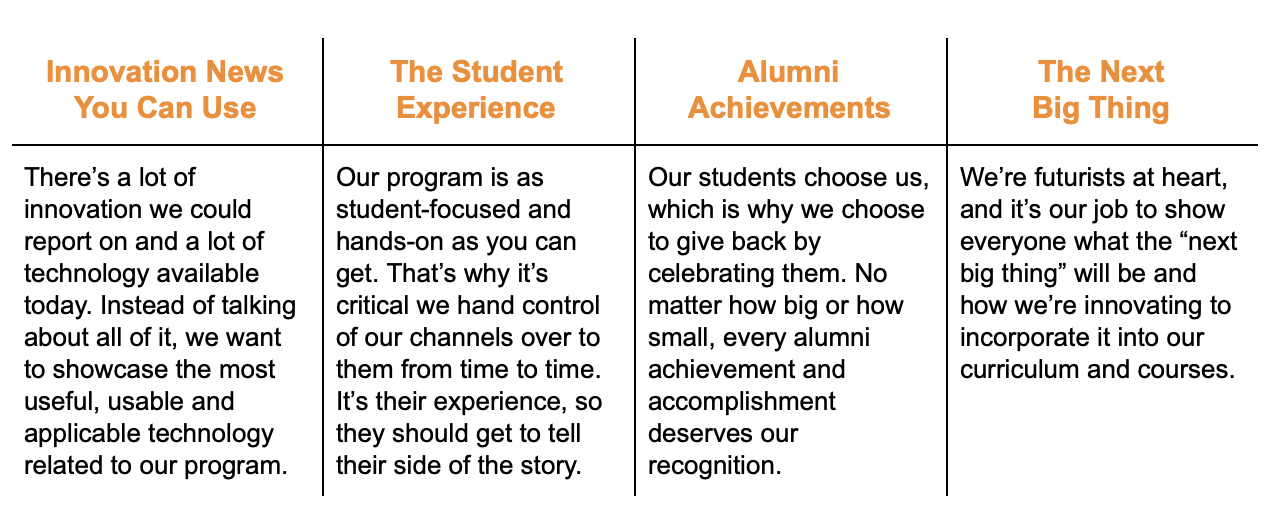
These pillars should have just enough detail to give everyone a clear understanding of what topics you’ll cover and how, but not be so narrowly defined that writers can’t ideate around the areas of focus.
6. Clearly Write Out Your Rejection or Objections
It’s time to expand our vocabulary.
But don’t worry, we’re not dictionary-crunching. Instead, let’s talk about adopting a single word often left out of the content process: No.

The best trick?
Your rejection doesn’t have to be spelled “n-o.”
It can be expressed in much more palatable ways, especially in written form:
- “Our calendar is full for the month, but let’s touch base again in a few weeks.”
- “Our analytics show this type of content works better when [insert fact here]. Can you revise your draft to include that approach?”
- “This content doesn’t align with our current content goals. Let’s brainstorm something that better supports our established content plan.”
It can be tough to say no, especially when content can seem subjective at times, but offer specific feedback that reinforces best practices and arms you to be an effective gatekeeper to control content.
And document that feedback, too.
7. Publicly Praise Success
It’s important to celebrate your team’s successes—and to do it publicly.
When people see great work rewarded, they are more motivated to follow suit.
Plus, it gives them an idea of what on-brand and on-target content really look like.
But don’t stop at a simple pat on the back.

Take the time to share some insight into what you believe caused that piece of content to go above and beyond.
This turns the moment into a learning opportunity for the entire team and reinforces best practices.
You can use a company-wide meeting or email to give a shout-out to the most popular blog posts for the month, or share it out on social media and tag the creator.
Either way, always give credit where credit is due. That’s one best practice that never goes out of style.
Better Document Your Process to Get Better Content
A robust content creation system can easily go haywire.
There are a ton of pieces that all have to come together, and they’re all constantly in motion.
But there is a lot you can do to reel your team back in from the edge of mayhem.

Whether you apply one of these documentation tips or all of them, you’re on your way back to an organized, well-oiled machine.
This post was originally written by Emily Wenstrom in 2017, and extensively updated by Anna Hrach, Digital Strategist here at Convince & Convert, in 2021.
The post How to Get Better Content by Documenting Your Content Creation Process appeared first on Content Marketing Consulting and Social Media Strategy.
Source: convinceandconvert.com

Top Social Media Listening Tools to Turn Followers into Customers and Brand Ambassadors
Social media listening has come a long way in the past decade. These days, every brand is using brand-name monitoring. Yet, few brands take full advantage of social media listening.
While it is great for improved customer support (for example: helping unhappy customers via social), there’s much more to social media monitoring. Today, you can:
- Find and connect to niche influencers (especially those active social media users with an engaged following who are currently interacting with your competitors). Social listening is one of the most effective steps to a successful influencer marketing campaign.
- Spot your competitors’ unhappy customers and win them over on your side.
- Turn your happy customers into brand ambassadors.
- Identify your product or service weak points so you can fix them.
- Understand your current customer base and target audience better.
- It can be a powerful lead generation tool for your business.
- Collect feedback on your product or content.
- Find engaging content ideas — discover your customers’ interests and struggles.
All in all, social media listening can provide you with a huge amount of insight, provided you are using the right tools.
5 Awesome Social Media Listening Tools
With that in mind, here are 5 awesome social media listening tools to consider for your martech stack:
1. SentiOne: AI-Powered Social Media Listening Tool
SentiOne is a dedicated social media listening platform that really gets the real power of social media monitoring and takes it to a new level.
The tool implements artificial intelligence to:
- Prioritize social media messages that need your (or your team’s) immediate attention and response
- Help your team to compose replies faster by suggesting possible messages which would work best for each mention
- Talk to your customers on your behalf through a smart chatbot

SentiOne can make your customer support team much more efficient and productive.
The cool thing about this platform is that it keeps a record of those interactions, so next time you have an encounter with the same customer, you will have all the background information.
SentiOne can make your customer support team much more efficient and productive, which is likely to result in many long-term benefits, like higher customer satisfaction and more positive mentions (from customers who get help immediately).
2. Agorapulse: Collaborating Social Media Management and Listening Tool
Agorapulse is a multi-purpose social media management tool that helps you create your social media editorial calendar by scheduling updates to multiple channels. It also comes with a powerful social listening feature that is perfect for cross-team collaboration.
Let’s face it: your brand mentions on social media are not created equal.
- Some of them are from customers who are currently in the buying process and need help immediately.
- Others are generic complaints that may not even require an immediate reply but need to be forwarded to product or site development teams.
- There are those mentions that can be turned into testimonials (to use on your site as social proof).
- There are social media messages that your outreach team may use to get some links to your site (similarly to how you’d use Google Alerts for those purposes).
How can one person handle this process if there are so many elements to it?
Well, it is quite doable if you treat social media listening as project management (which often involves many teams as well).
AgoraPulse enables your social media manager to assign different social media mentions to different teams or people. Once assigned, this team member will receive an email notification, as well as a reminder if the status of the assignment remains untouched.
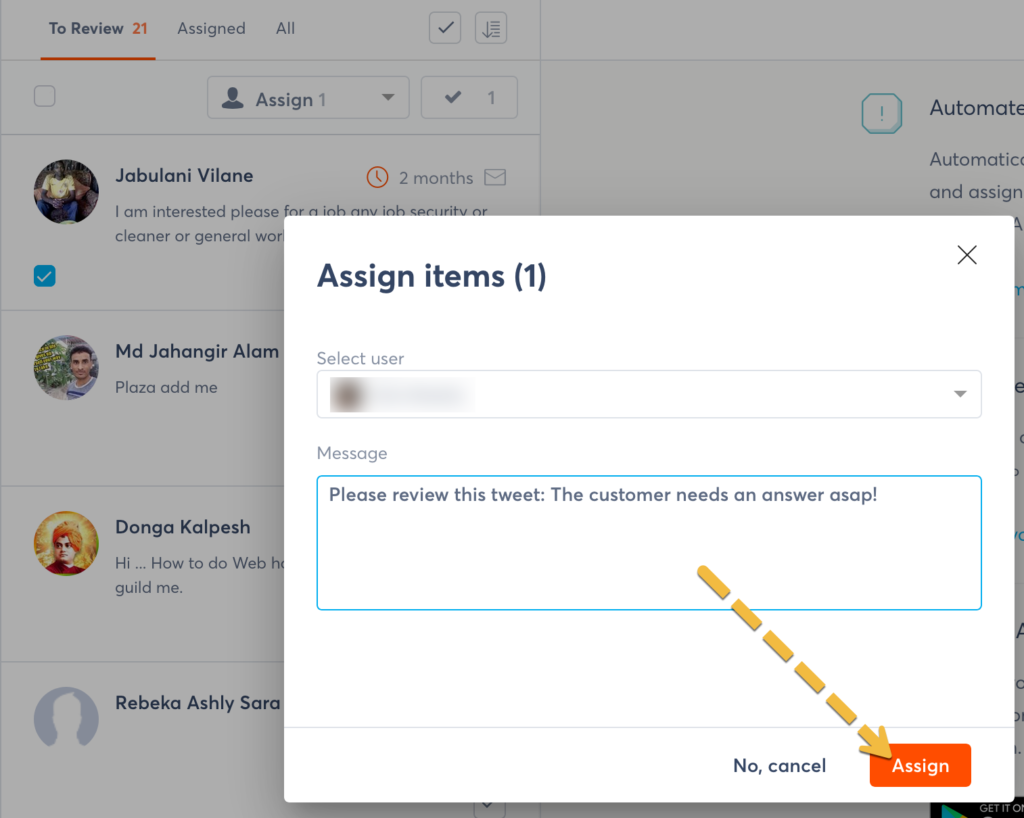
AgoraPulse enables your social media manager to assign different social media mentions to different teams or people.
This is a great way to make the most of social media listening.
3. Tweetdeck for Real-Time Interactions
Because of its real-time nature, Twitter is where customers expect to get an immediate response.
Tweetdeck is a Twitter management and monitoring tool that is free. It can also be used to manage multiple social media accounts (like your personal one, your business one, etc.)
I use Tweetdeck in combination with more advanced social media tools because it is so easy and fast to use that sometimes it’s just easier to quickly check Tweetdeck to see if there’s anything that needs your attention.
Tweetdeck integrates with Twitter lists, so it is perfect for quick interactions with niche influencers or your brand ambassadors throughout the day.

Check your list of engaged influencers to interact with their recent Tweets.
Here’s how I use Tweetdeck:
- I add people I want to regularly interact with to separate Twitter lists (those may be “Bloggers”, “Journalists”, “Brand ambassadors”, etc.)
- I create separate columns in my Tweetdeck to pull tweets from those lists
- When I have a minute or two, I open Tweetdeck and reply to recent tweets in those tweets.
This way, I keep interacting with my friends and niche influencers on a regular basis while keeping those interactions natural and meaningful.
4. Bonus: Keep an Eye on Your Social Media Traffic
There’s no perfect way to measure the effectiveness of your social media listening efforts. There are so many long-term goals (brand loyalty, trust, etc.) that are not easy to measure.
With time, what you to see in your analytics is the following:
- An increase in type-in traffic (those people that type your site address directly without searching your name)
- The gradual growth of your brand-driven search queries (those queries that contain your brand or product name)
- The steady growth of on-site conversions (as customers see you on social media responding and interacting, they will start trusting your brand and buying more from you).
You can track all (and more) of that by using Finteza, an independent web analytics suite with a strong focus on conversion optimization.
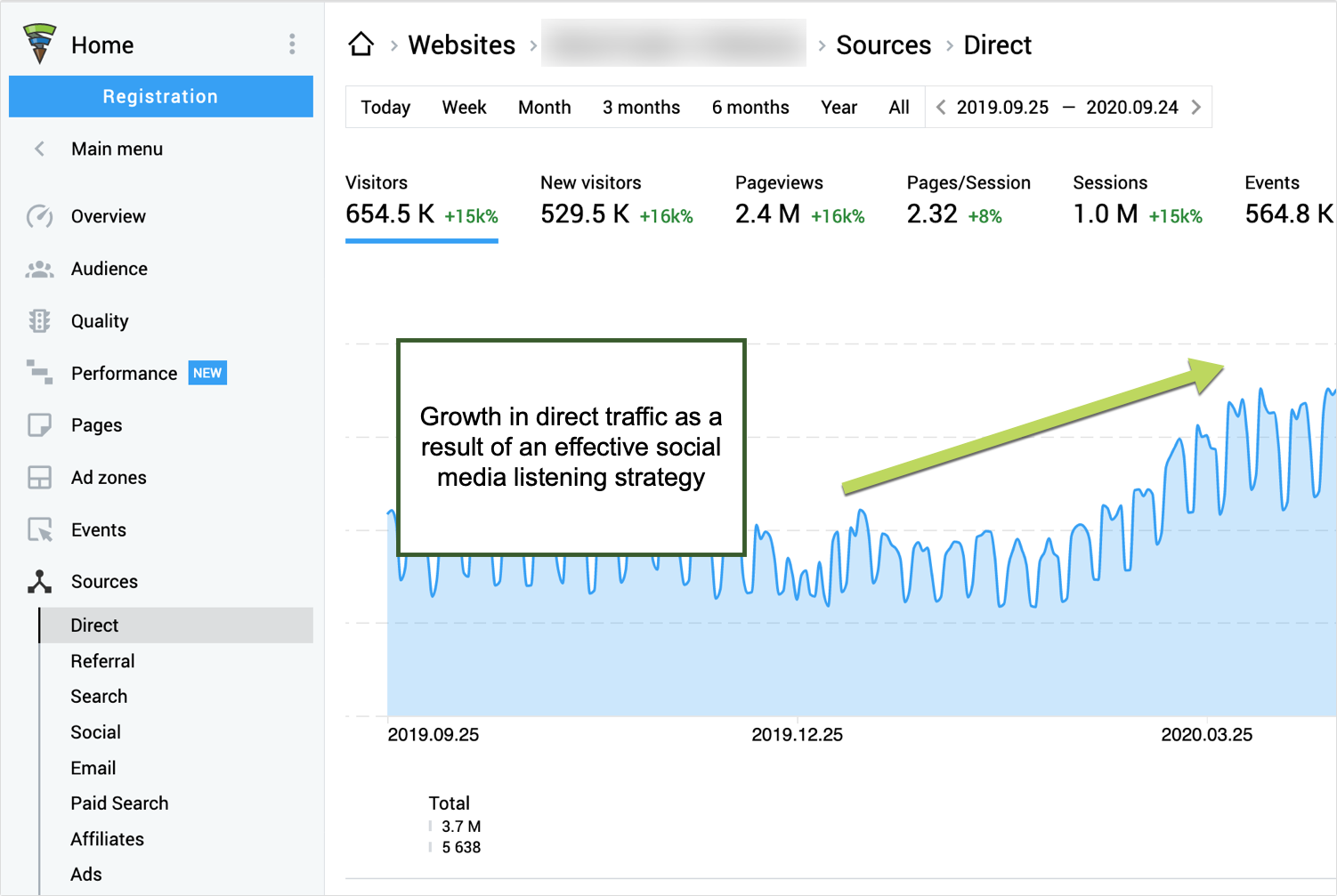
Conclusion
If you’re already doing some type of social media listening, invest a little more effort to achieve longer-term and more important goals. At the very least, it’s worth a try.
The post Top Social Media Listening Tools to Turn Followers into Customers and Brand Ambassadors appeared first on Content Marketing Consulting and Social Media Strategy.
Source: convinceandconvert.com

5 Ways to Boost Your Visual Marketing Results
Without high-quality visual content, there is no brand presence on some of the most powerful platforms, including Instagram and Pinterest. While you can promote links and text on those networks, non-visual content is likely to go unnoticed.

Marketers have long been talking about the power of visual content, both for attracting attention and for engaging your audience.
Yet, with the emergence of visual-only social media networks — like Instagram and Pinterest — visual marketing stopped being a nice-to-have and became a must-have.
Without high-quality visual content, there is no brand presence on some of the most powerful platforms, including Instagram and Pinterest. While you can promote links and text on those networks, non-visual content is likely to go unnoticed.
While the video is important, simply publishing videos is not going to be enough. Every other brand is doing that, and the consumer’s eye is pretty used to bright, flashy images by this point.
What you need is to stand out — which is getting more and more challenging in our era of the visual web.
Effective Visual Marketing Strategy:
So what can you do to embrace a more effective visual marketing strategy?
It’s all about ingenuity and experimentation, but here are a few ideas to get you started:
1. Turn your social media images into artwork
Make your social media images impossible to miss: it is as simple as that.
Well, it does sound simple, and it will obviously boost your content performance – but how exactly can we do that?
Luckily, there are tools for that, so it’s also quite doable.
Quickart by Lightricks is my most recent discovery and it was an instant hook. The app allows you to apply artistic patterns, filters, and effects to create memorable visual content that is impossible to miss:

Image source: theverge.com
My favorite thing about this specific app is that it is insanely easy to use. You don’t spend hours figuring out any super-advanced photo-editing instruments, like layers or mask tools, but the result is always unique and creative. Also, it is free.
2. Brand your images well
People are highly visual. Our brain relies on images and visualizations, which makes visual marketing so effective.
Our brain processes visuals 60,000 times faster than text and retains 80 percent of what we see versus just 20 percent of what we read.

Source: Scientific Reasons Visuals Increase Engagement
When we think, we tend to picture things. Our brain easily brings up colors and shapes, rather than text or numbers. We visualize associations and connections among different concepts and entities.
Through the creation of visual connotations, images make any information more memorable, and this is where the real power of visual marketing lies…
Visual content makes your brand more memorable and recognizable, which, in the long run, brings better click-through and higher conversions.
Branding your visuals is an important step – but one not to be taken lightly.
You do want people to recognize your brand just through your assets – and yet you cannot make your images all about you, as your audience will quickly lose interest.
That said:
- Use the recognizable color palette
- Place your brand in an interesting and creative context
- Make sure that each individual asset contributes to one unified narrative you want your brand to be associated with.
If you are looking for some examples of effective – yet not overwhelming or boring – branding, check out the Instagram account of Boxed Water.
They turn each picture into a story that tells the same narrative: “Life is good and nature is awesome so long as you save this planet”.

Visual Content Example from Boxed Water
However, avoid:
- Creating self-centered images
- Using too much of your logo (watermarks? Not a good idea for Instagram content, for example)
3. Repurpose your images everywhere
With your branding being consistent from asset to asset, bring your strategy to the next level: Attach all your channels with each individual asset.
This is a great way to create that “My brand is everywhere” illusion which ensures your audience remembers you well: Your customer sees your image on Facebook, clicks your link, sees the same (or similar) image on your site, and finally sees it again when searching Google (and that’s where they can no longer resist).
To build this #beeverywhere strategy, carefully use consistent images and visual elements everywhere.
For example, Leadpages features matching visual elements (visual identities) on their Instagram feed and their site:
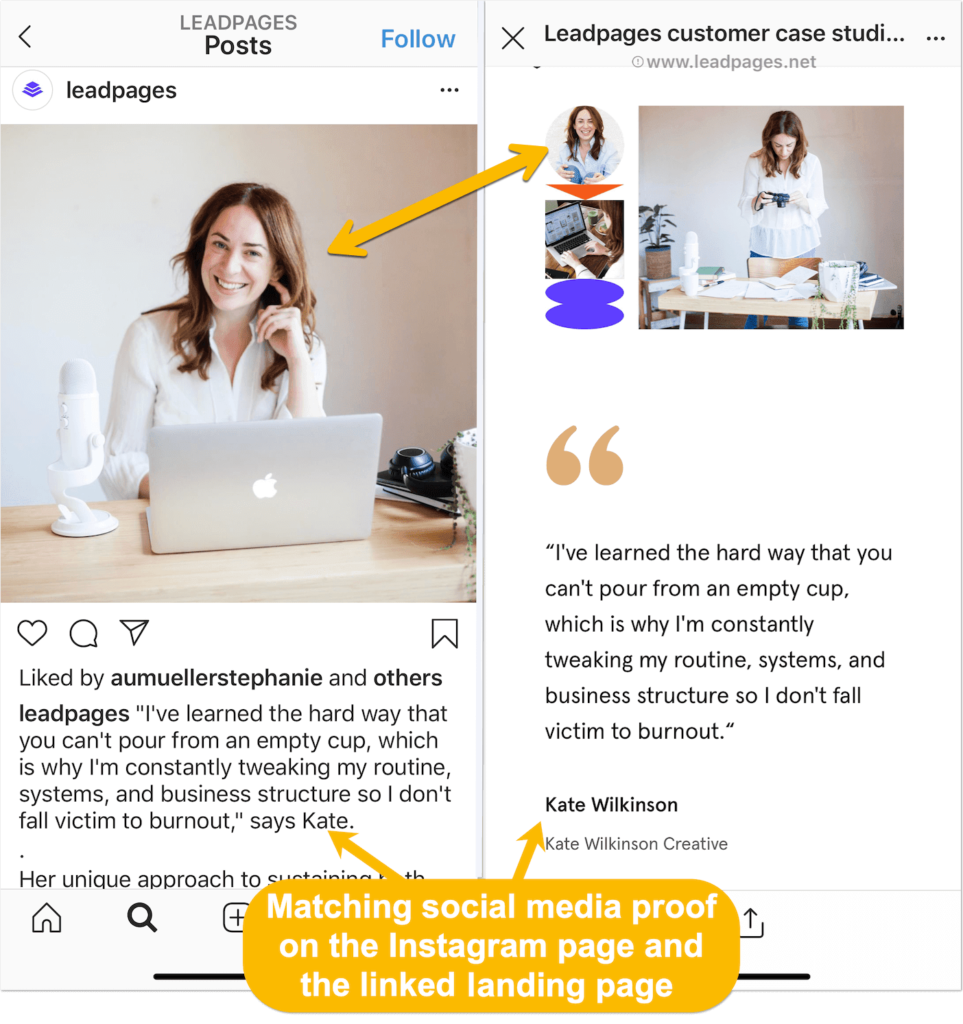
Leadpages features matching visual elements (visual identities) on their Instagram feed and their site.
And UPRIGHT uses the same visual elements in both their Instagram ad and the linked landing page:

This way, by using non-intrusive visual branding, both the brands instill confidence in their users landing on their site and create some sort of brand cross-channel recognizability.
To take this idea even further, searching Google for something relevant, we should be seeing the matching image or element which would instantly catch our attention and prevent me from going elsewhere:
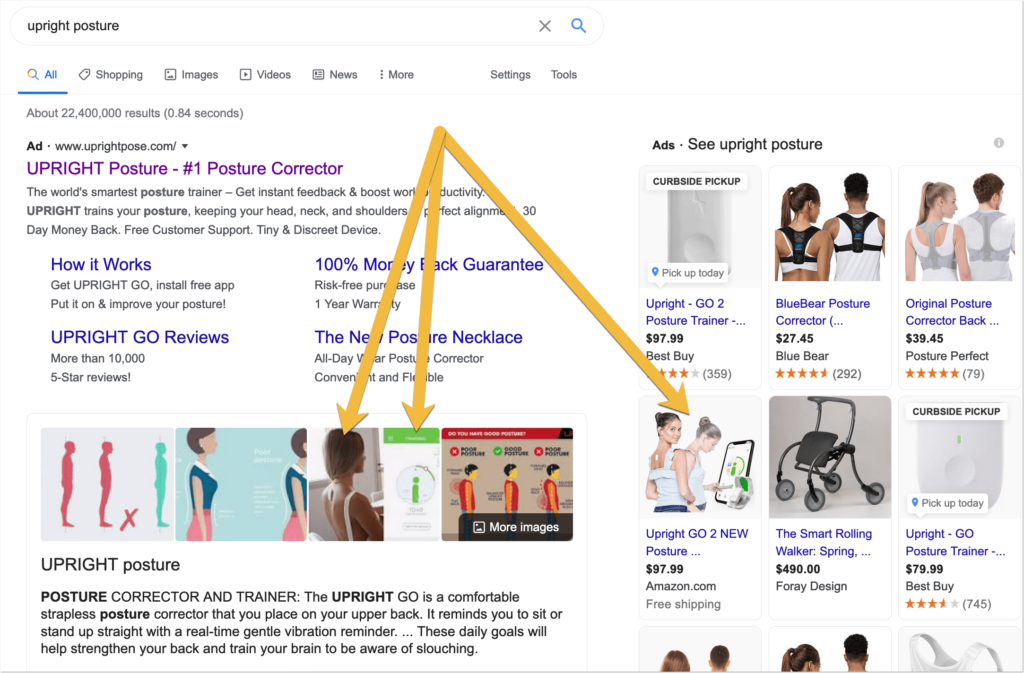
How can this cross-channel recognizability be achieved?
By using a consistent repurposing strategy, including:
- Reusing social media images on your site
- Using the same image (in different dimensions) across multiple channels
- Applying fundamental image SEO practices when publishing those visuals on your site and social media channels (this includes using optimized alt text, a variety of hashtags, and description (or immediate context).
There are lots of tools helping bloggers do this right.
This is where I always use Text Optimizer because the tool allows you to broaden the list of keywords your image is going to show up for.
The tool uses semantic analysis to identify related concepts and entities for you to use in the image description/caption, tags/hashtags, etc. when publishing each image anywhere.
For example, here are semantically-related concepts for [skyscraper]:
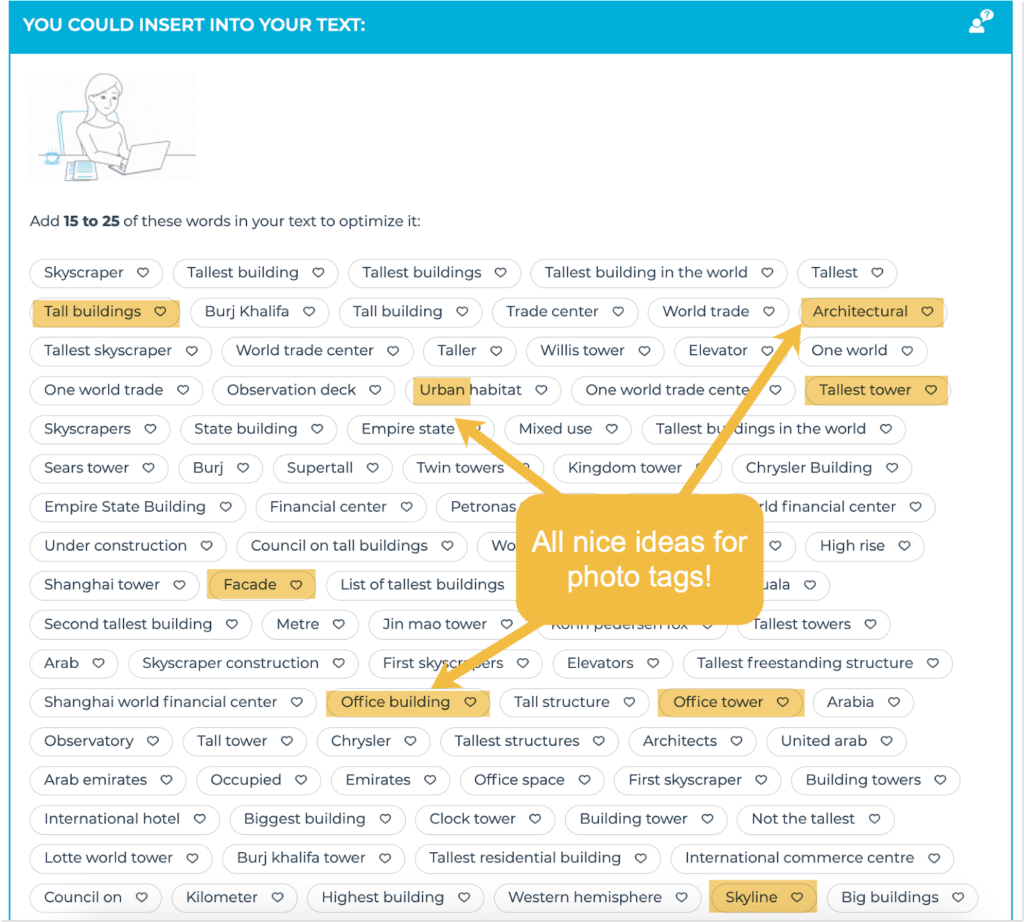
The tool also pushes you to diversify your tactics and avoid keyword stuffing by suggesting you use related and synonymous words in your copy.
Bonus: Embrace visual advertising
You do need all the above steps to do this one right: You need to create effective visuals, brand them in a non-intrusive way, market them across multiple channels, and then start investing in visual advertising.
Luckly, you have quite a few options, including:
- Instagram ads
- Pinterest ads
- Facebook ads
- TikTok ads
There are also emerging, more innovative options like Unsplash advertising that focuses on shifting brand perception and building brand associations rather than clicks and views.
Conclusion
Visual marketing can boost the performance of many – if not all – other promotional tactics you are currently implementing, including content marketing, traffic generation, SEO (or rather on-SERP marketing), etc.
The best part about visual marketing – in my opinion – is that you are never actually done. You always have to be innovating, trying new tools, discovering new tactics in order to stay ahead – or at least abreast of your niche.
The post 5 Ways to Boost Your Visual Marketing Results appeared first on Content Marketing Consulting and Social Media Strategy.
Source: convinceandconvert.com