
Tag Archives for " Brand Reputation "

How to Bolster Your Brand’s Reputation By Giving A Damn
At the risk of stressing something that marketing professionals well know, your product is only as good as your brand. But we need to take a moment and reflect on why this axiom is as important now as ever.
Just as the pandemic has upended our lives, it has upended our businesses. Businesses have been burdened by the same pandemic realities everyone is going through. They are trying to figure out how to not just survive but thrive amid the uncertainty.
Businesses need a partner, not just a product. And in an era of trust and transparency, they need a partner they can count on.
The values you stand for, delivering on what you promise, doing what’s right because you care are all critical to your brand’s reputation.
The Power of a Brand That Actually Really Cares
In short, you give a damn.
Doing anything less is a gamble. Research indicates that corporate reputation has a significant influence on price, perceived service quality, and brand preference.

You can lose customers to bad experiences and aggressive competitors. Your credibility can get dragged through the social media gauntlet. If you don’t actively work to bolster your brand’s reputation, you are exponentially at risk from negative PR.
Without a strong brand, you can’t recover as quickly, while customer loyalty and affinity can weather nearly any storm. Here are some ways to bolster your brand’s reputation. They aren’t particularly difficult. But they do require courage and commitment.
Be True To Your DNA (aka “Transparency and Genuineness Are Key”)
Be true to your core values in what you do and what you say. What do you stand for? And how do you demonstrate that each day?
Businesses want to work with businesses that are transparent and genuine. If a business outwardly projects itself one way — say a creative, outside-the-box trailblazer — yet inwardly operates much differently — a buttoned-up corporate plodder — your clients will pick up on the ruse.
When your external image accurately reflects your internal self, on the other hand, you build trust.
It is no surprise that Patagonia, a company with a global reputation for high-quality products and corporate and environmental responsibility, is atop the 2021 Axios Harris Poll 100 reputation rankings.
Even the words you use matter. Be bold and authentic in what you say because it signals what you really mean. At Ceros, one of our core values is, “We give a s***.”

At Ceros, we regularly go above and beyond just selling our product to providing creative inspiration throughout the process, from hands-on training to community support.
We have a team of people who can help a business with what it needs even when doing so requires going beyond “the contract.” We make this investment because we care.
We give a damn.
Being true to your DNA also proves invaluable when a public relations crisis erupts. Remember when Starbucks received widespread criticism in 2018 after two Black men were arrested on suspicion of trespassing after asking to use the bathroom? Starbucks didn’t press charges and later reached a financial settlement with the men.
But the coffeehouse chain that has consistently advocated corporate social responsibility didn’t stop there. The company apologized publicly, fired the employee who called the police, and announced it would close its U.S. stores for a day to give anti-bias training to 175,000 employees.
Starbucks practiced what it preached.

Don’t Be Lame (aka “Be a Trusted Business Partner, Not Just a Product or Service Provider”)
Businesses need an ally, not just a product or service provider. Think of the challenges they face: supply chain troubles, labor difficulties, the pace of technological change, the pandemic.
They need a business partner they can trust to help them navigate their needs and bring solutions to their problems. You need to deliver on exactly what you say you would, and if for some reason you can’t, you need to roll up your sleeves and help. Customer service is not a status page.
Your reputation also extends to your own business partners and how they do business. How they treat their own employees and think about the world can reflect back upon you.
Don’t Be Thanos (aka “Win The Battle For Hearts and Minds”)
Humanize your brand. Businesses have become too transactional in their relationships with customers. But customers are people, and people are emotional. Emotion influences their buying experience.
Show how your brand has a broader impact on society, whether it’s environmental, social, or other causes. Research indicates that corporate social responsibility can elevate a brand’s equity and reputation.

Take AIG, for example. The global insurer stresses the importance of diversity, philanthropy, and volunteerism and makes deep financial and other commitments to those causes. Earlier this year, it released it’s first Environmental, Social, and Governance Report to measure and manage its efforts in these endeavors. AIG isn’t just making promises. AIG is holding itself accountable, as well.
Become An Advocate For Someone Who Needs One
I once worked for a diagnostic company that made blood glucose testing strips at about a third of the cost of the popular brand-name version. The brand-name manufacturer, a multibillion-dollar company, filed a patent infringement case, which made national news.
During the case, we heard stories from people with diabetes who with our strips could afford to test themselves at recommended frequency levels to avoid complications and live a better life.

We knew we faced an uphill battle in this David versus Goliath legal dispute. And yes, we had a business interest in the outcome. But we became emotionally invested in the lives of the people who were going to be most affected. We unintentionally became advocates in a way that we had not been before. We were their collective voice.
Your reputation isn’t just about your business and how you solve problems for customers. It’s also about how you can represent the voices of other people who matter.
Who Are You Fighting For?
Your brand is a powerful yet fragile thing. It can boost profits, customer goodwill, company morale, and the communities we live in, or if too largely ignored, can begin your organization’s slow march toward irrelevancy. By being true to yourself, a valued business partner, and an advocate for others, you can help your brand stand out.
The post How to Bolster Your Brand’s Reputation By Giving A Damn appeared first on Content Marketing Consulting and Social Media Strategy.
Source: convinceandconvert.com

The Essential Guide to Brand Reputation Analysis
Much of your company’s growth depends on discussions that take place in rooms you are not in or don’t even know exist.
According to Gartner, nearly 52% of SMBs looking to buy software use user reviews to assess their options. Other studies found that customers read at least ten reviews before making a purchase, and 76% of software buyers trust online reviews as much as referrals.
The truth is before people buy from you, they process what others say about your brand to evaluate your credibility. That means there has never been a better time to start monitoring your brand reputation.
In this article, you’ll learn how to conduct a brand reputation analysis and mistakes to avoid.
First things first, why do you need to perform a brand reputation analysis?
Are you familiar with the adage in the IT industry that says, “Nobody ever got fired for buying IBM?” It implies that IBM is a safe choice because it is well-known.
Most importantly, that statement lies on the premise that IBM has a better reputation in the IT industry than most companies.
Companies today should constantly be seeking ways to assess and improve their reputation. Reputation analysis will come as a savior where your marketing and sales material fail you.
Here are two reasons you need to conduct a brand reputation analysis for your organization.

Conducting a reputation analysis gives your brand a competitive edge.
It’s all about knowing how the general audience feels about your brand. You can quickly analyze the leading companies in the market and sketch outgrowth perspectives for your brand.
The truth is before people buy from you, they process what others say about your brand to evaluate your credibility.Click To Tweet
Take Nike, for example. Most of their commercials are inspired by social issues or controversies. Yet, each of these campaigns generates significant results because Nike’s audience identifies with it. However, when Pepsi tried the same approach in collaborating with Kylie Jenner, it caused an unprecedented backlash.
The underlying message is clear: you have a competitive edge over your competitors when you constantly analyze your brand reputation. That is because such analysis tells you what your audience likes and dislikes.
Conducting a reputation analysis increases your income.
According to Prophet’s 2020 Brand Relevance Index, brands with excellent reputations have revenue growth that exceeds the average revenue growth of the S&P 500 by 230%. For the record, the S&P 500 includes the 500 largest companies listed on the United States stock exchanges and has a market cap of over 40 trillion.
The same study showed that the most reputable companies had EBIT (Earnings before interest and taxes) growth of 1.040% over the last ten years.
By objectively conducting your brand reputation analysis, you can reverse your trajectory whenever you notice a poor reputation score and reap the many benefits of having a good reputation.
Two Mistakes That Bias Your Brand Reputation Analysis
Analyzing your brand’s reputation is a good thing, but doing it without eliminating bias doesn’t help you at all. Here are some mistakes you should avoid if you want to keep your analysis data clean.
Putting metrics over strategy.
Throughout every organization, strategy is being hijacked by figures almost every day. You can associate Nike’s “Just do it” strategy to the number of sales it generated, Coca-Cola’s “Love story” to the number of recycled plastics, etc.
Strategy in itself is an abstract concept that only comes to life when associated with numbers.
But in the race to make the abstract tangible, many companies end up putting the cart before the horse–which always ends in a backlash.
Take Wells Fargo, for example. As part of their “cross-selling” campaign, their employees opened 3.5 million credit cards and deposit accounts without customers’ consent. Why did they do this? Well, because they wanted to execute the said strategy and “make it a success.”
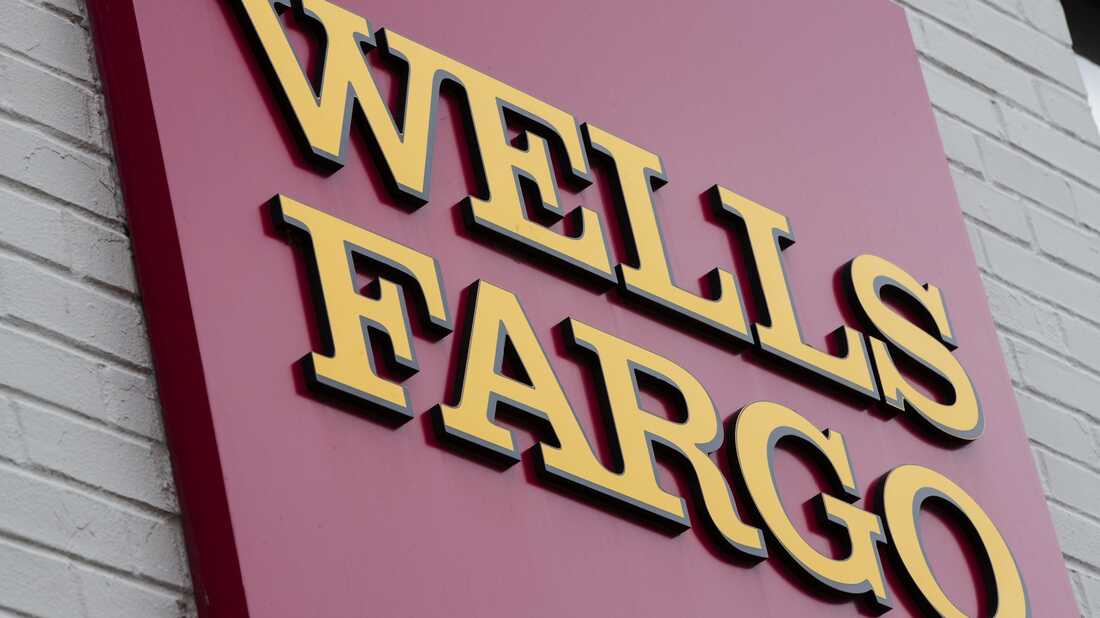
In the end, the campaign that was supposed to have a cheerful ending turned into a nightmare because they prioritized metrics over strategy.
Not tying customer satisfaction to brand romance.
Most brands gauge their brand reputation with metrics like “number of people who like/dislike our brand.” While this is a good metric to start with, it is not necessarily accurate.
Just because I like your brand doesn’t mean I’m satisfied with your products and services. It’s a bit of a subtle nuance to make but think about it. You like Microsoft but are not happy with Windows Vista. Or you’re unhappy with the Tesla Cybertruck but still love Tesla.
Companies are focused on measuring surface-level sentiment when the underlying feeling is quite the opposite.
When a customer says, “I love Amazon, but their customer service sucks,” it doesn’t mean they love Amazon. In fact, not the way you think.
As such, when you conduct a survey and simply ask that SAME customer, “Do you like Amazon?” their answer will always be YES. It takes a few more profound questions to get them to the actual feeling, which is “I don’t really like Amazon.”
A step-by-step guide to nailing your brand reputation analysis
Brand reputation is not only about bad customer reviews and comments on the internet. To be as accurate as possible in your reputation analysis, you need to collect a set of quantifiable and non-quantifiable data.
Here’s how to leverage data to ace your brand reputation analysis.
Step 1: Identify primary sources where the talk happens
It’s great to know what people say about your brand when you are not in the room. It’s even better to know which rooms these people are talking to each other in. It matters because it stops you from meandering across many websites and gets you focused on those that matter for your brand.
Have you ever wondered why Lamborghini doesn’t do TV ads and prefers to advertise on Instagram or using video marketing? Simply because their target audience does not spend their time in front of the TV and an ad through this channel would have no effect.
Consequently, to analyze Lamborghini’s brand reputation, you can’t rely on metrics you’ve gotten from sample TV viewers.
Another example is Whatsapp and WeChat. The first one is popular in India and the second one in China. To have some accuracy in your reputation analysis, you need to address the geographies accordingly.
Step 2: Track your brand’s mentions over time.
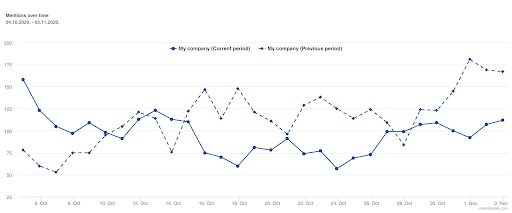
Once you figure out where the people who influence your reputation are, one essential brand reputation metrics you should start tracking is Mention Over Time.
It helps you better understand your brand’s popularity over some time. It is usually expressed as a chart displaying whether mentions of your brand are constant, peaking, or decreasing.
SOURCE: Mediatoolkit.com
If your mentions increase, you can check the underlying drivers and evaluate the data to see if they are positive or negative–and act accordingly.
Step 3: Conduct sentiment analysis
If the metrics you track for your brand analysis are only expressed in figures, you are missing a big deal. There may be much talk around your brand, but there’s no guarantee the talks are piling up a good reputation. There may be terrible reviews, people using irony and sarcasm.
A simple brand mention doesn’t give you an accurate picture of a person’s attitude towards your brand. That is why sentiment analysis is such an essential metric for brand reputation analysis. It sets a frame of reference for the data you obtain and helps you to understand it.
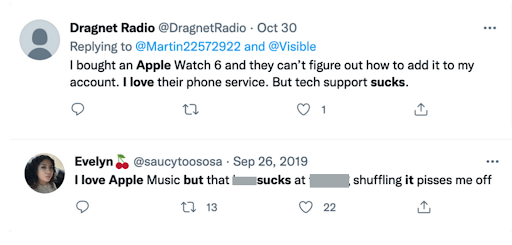
In the above two tweets, for example, the authors make it seem like they love Apple and its services. But the last words of their tweets reveal their real thoughts about the products–which is that they think it sucks. From a reputation analysis standpoint, these last words are more important than the sentences that precede them.
Step 4: Keep an eye out for your brand’s share of voice.
The share of voice (or SOV) is the most reliable metric used in PR and the first indicator of brand popularity. It is different from Mention Over Time in that it gives you an idea of where you stand in your industry and vis-à-vis the competition.
It helps you spot any talk waves regarding your brand and the underlying sentiment driving those conversations.
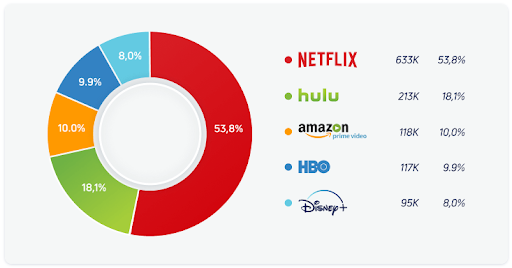
SOURCE: Awario.com
For instance, between 2008 and 2013, grocery giant Lidl suffered from brand perception issues that caused them too much damage. First, in 2008, the company was criticized too much for the way it observed its employees. Then in 2013, they were involved in a case of selling horse meat.
Not only has this scandal had an impact on Lidl but also on its competitors. Indeed, a study proved that 6 out of 10 people changed their shopping habits because of this scandal. In addition, some shoppers have stated that their trust in the food industry has dropped by a quarter.
To address these issues, Lidl launched the ‘Lidl Surprises‘ campaign, which is a strategy to boost their share of voice and brand perception.
According to Marketing Week, the campaign increased the brand’s share of voice from 5% to 19% in 2016 and 2017, leading to £2.7bn in incremental sales.
Lidl’s case is living proof of the importance of the share of voice in a reputation analysis.
Top 4 brand reputation analysis tools
If you’ve been following our rationale from the start, you can tell you can’t conduct a practical brand reputation analysis by yourself. You will need to use some tools to track, organize, and track the data.
“To manage your brand reputation, it’s essential to adopt tools and processes that adhere to your marketing strategy, not vice versa. It’s more beneficial to change your tools than trying and making your marketing strategy fit them.” -Chris Norris, Founder and Managing Editor of SleepStandards
The list is pretty extensive, but here are four brand reputation tools you can easily adapt to your marketing strategy.
Google Alert
Google Alert is a free and straightforward mention tracker designed by Google. All it takes is for you to set up a specific keyword you want to be alerted for and put your email address.
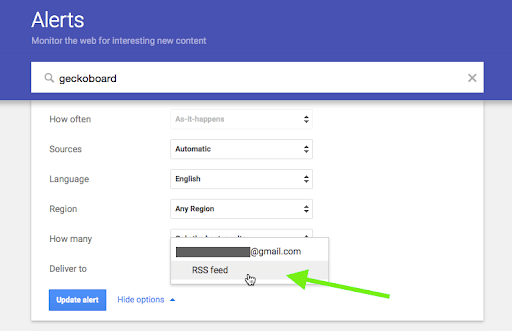
SOURCE: Geckoboard.com
Once you’ve done that, anytime Google picks up on a mention of the keyword, you will receive an alert notification through email that’ll redirect you to the place you were mentioned. So, it’s reliable and straightforward. However, it does not track social media platforms. You can try it here.
SocialMention
Technically speaking, SocialMention is an improvement on Google Alert. It is yet less powerful than advanced brand mention monitoring tools. It’s also free and straightforward to use.
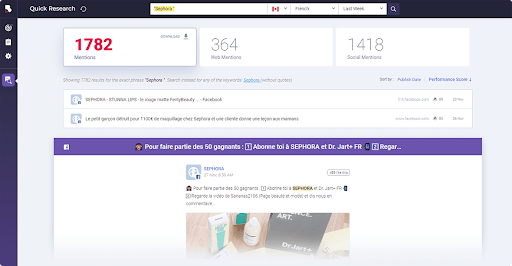
SOURCE: brandmentions.com
You just need to put in the name you want to monitor online, and you’re done. The dashboard will present all of the mentions, along with some basic analytics. You can try it here.
Mediatoolkit
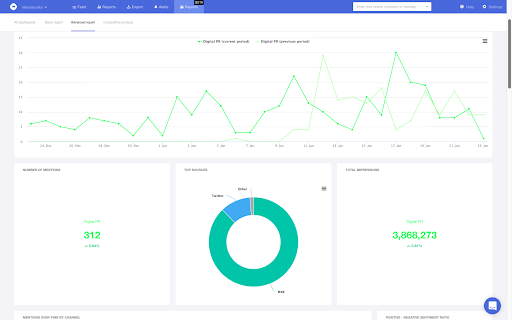
While Google Alert can boast about its reliability and simplicity, these characteristics are nothing new to Mediatoolkit, and it doesn’t even make up for its lack of features.
Source: Mediatoolkit.com
For a thorough and utter brand reputation analysis, you will need a tool you can rely on every step of the process, from data gathering to making sense of it.
Mediatoolkit offers a library of features that can help you achieve this efficiently. It tracks your mentions both on Google and social media platforms. Businesses across the globe trust Mediatoolkit because of its advanced features. You can try it here.
Brand24
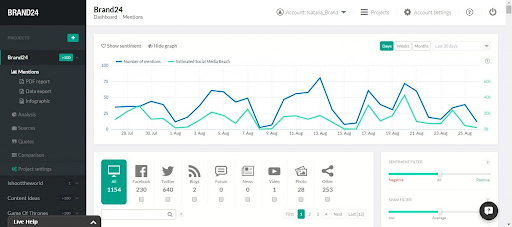
Buffer recently rated Brand24 as one of their favorite tools for tracking brand reputation. Brand24 is a media monitoring tool with solid marketing and analytical features.
source: Brand24.com
The tool gathers public brand mentions in real-time and covers everything from review sites, newsletters, blogs, podcasts, forums to social media networks.
It also packs great features such as sentiment analysis, social media reach, etc. Plus, it notifies you as you get mentioned so you can rapidly act on it–in real-time. You can try it here.
The post The Essential Guide to Brand Reputation Analysis appeared first on Content Marketing Consulting and Social Media Strategy.
Source: convinceandconvert.com