
Tag Archives for " blockchain technology "

How to Accept Bitcoin and Other Crypto Payments On Your Website
Should you accept Bitcoin and other crypto payments on your website?
With cryptocurrencies becoming more and more mainstream, this is a question lots of us are asking. Whether you choose to accept Bitcoin payments on your site is ultimately up to you, but if you choose to do so, it’s important you get the right setup.

Should You Accept Bitcoin on Your Site?
This is probably the biggest question you’ve first got to decide on. Once you’ve decided to accept crypto, the payment processing is fairly easy to set up, but first, you’ve got to decide if cryptocurrency is right for your business.
As big as crypto has become (Bitcoin has a market valuation of over $1 trillion), it’s still something that divides opinion. For every devout crypto fan, there’s an influential person talking it down. For all the positive talk you hear about it, the next minute you hear Jamie Dimon, chairman and CEO of JPMorgan, saying “I personally think Bitcoin is worthless.”
It’s confusing, and when you don’t fully understand the intricacies of how crypto works (which few of us do—and if your customers don’t use it, why bother?), choosing to accept crypto payments on your website can be a worrying decision.
Of course, everyone’s got their agenda, and when you’re making your decision, you should remember that. Do your own research and find out if accepting Bitcoin on your website is in your best interests.
The Benefits of Accepting Bitcoin on Your Site
Let’s draw this back to a subject I love: marketing. I’m always saying that marketing is about reaching the right people with the right message at the right time. When you do this, sales are likely to start flowing.

If lots of your customers are engaging with crypto, then why not make it a part of your message?
Accepting Bitcoin on your website plays into your brand identity, then in some people’s eyes, it’s going to show you’re an innovative, cutting-edge company that’s not afraid to embrace new technology.
Here’s where you need to think about your audience. The people who currently seem to embrace crypto are overwhelmingly males between 25 and 44-years-old.
If your key target demographics are over 60, then accepting Bitcoin might not be at the top of your agenda. However, if your target audience is passionate about crypto and it fits your brand identity, then you might be onto something. Especially if you are selling a high-ticket item.
Look at the big companies that are currently accepting Bitcoin: Microsoft, NameCheap, WholeFoods. You can see how crypto lends itself to their audiences, namely, young, alternative, and techy.
If you do decide to accept Bitcoin on your site, then financially it can be rewarding too. Crypto tends to have very low transaction fees compared with traditional payment methods. Most bitcoin transactions cost between zero and one percent, whereas the average credit card transaction fee is between 1.5 and 3.5 percent.
The Drawbacks of Accepting Bitcoin on Your Site
One of the obvious things that makes people question the value of accepting crypto on their sites is volatility. You don’t quite know what Bitcoin and other cryptocurrencies are going to do from one day to the next and this can be a worry for website owners.
In some cases, Bitcoin has been known to lose 25 percent of its value in less than a month, which on the face of it, isn’t what you need as a business owner.
The thing is, just because you accept Bitcoin payment doesn’t mean you have to hold Bitcoin. If you don’t want to be exposed to the volatility of cryptocurrencies, then you can immediately exchange Bitcoin into your chosen currency.
The next Bitcoin drawback is something you may not expect: curiosity.
Whether they love it or hate it; people love to talk about crypto. If you accept Bitcoin on your website, then you’re something of a pioneer, and this will stir lots of curiosity.

You may well find your customer service team isn’t inundated with questions about your products, but instead, fielding questions about cryptocurrencies. This is far from ideal, and it’s something you need to be prepared for if you do decide to accept crypto.
What You Need to Accept Bitcoin and Cryptocurrency on Your Website
Crypto is designed for the modern world, so it’s no surprise that it doesn’t take too much set up to start accepting Bitcoin on your website.
There are a few basics everyone will need and then you need to decide on the best way for your website to accept crypto payments.
The Basics
To hold crypto, you need a “wallet.” This is very similar to the “wallet” app you probably have on your iPhone, but it’s specific to crypto.
Your crypto wallet allows you to buy, sell, and hold many different types of cryptocurrency, for instance, Bitcoin, Ethereum, and Tether. You get a unique private key that helps to keep your currency safe and accessible, and it links with other apps to help make transactions seamless.
When someone buys something in crypto on your website, the money will eventually filter into your wallet and from there, you’re free to exchange it into the currency of your choice.
Good Communication
As with anything in this world, the key to introducing a new payment method is good communication.
If you’re going to take the step and accept Bitcoin on your website, then you’ve got to explain the value proposition to your audience. Make sure they’re aware of new changes and showcase how it benefits them.
This is an excellent opportunity to showcase your brand, so make sure you take it. If you communicate well, then you’ll find more people take up the option of paying in crypto, and it will also foster greater brand loyalty.
Platforms and Integrations
How you integrate your crypto payments will depend largely on the platform your site is hosted on. For the major platforms like Shopify, WooCommerce (WordPress), and Magenta, there will be different plugins you can use for a quick setup.
If you can’t find the plugin you want, then most Bitcoin payment tools offer alternatives such as payment buttons, custom integration, and invoices.
Different websites will require different solutions, but for the majority, the plugins do an excellent job. If you’re struggling to integrate these tools with your website, then don’t worry, though.
Crypto was created to enable financial transactions between two parties without the need for a middleman, so you can always invite customers to contact you directly for Bitcoin payment options.
What to Look for in a Crypto Payment Processor
When you accept Bitcoin payment on your website, you want maximum value for your customer and your business. With many different crypto payment processors to choose from, it’s important to evaluate your options and make sure you’re getting the best deal.
Here are some considerations when choosing your payment processor.
Transaction Fees
How much do you get charged for each transaction? Bitcoin transaction fees are generally very low compared to traditional payment fees, but you want to make sure you’re getting the right deal.
Payout Frequency
Is it important for your business that your money comes in quickly? If so, you will want to consider payout frequency. While some crypto payment processors payout daily, others can take three to five days before processing your payment. ACH payments are recommended for companies requiring faster business funds.
Supported Countries
Cryptocurrency is a delicate political issue. As we’ve seen with China’s crypto ban, not every country is open to the use of cryptocurrency.
With different rules throughout the world, it’s important to ensure you choose a payment processor that supports the countries you do business in.
Customer Support
Whenever we’re talking about tech, it’s always important to think about customer support. If you have problems with setup or the service goes down, then you want to be able to speak to someone immediately.
Make sure you’ve got the support you need.
Security
The security of your business and its customers is essential. Make sure the payment processor you choose takes security seriously, and stay up to date with your site maintenance. Make sure you’re installing new updates and making regular encrypted backups to your wallet.
5 Ways to Accept Bitcoin and Cryptocurrency on Your Website
There are many different Bitcoin payment processors, and other manual ways to accept Bitcoin on your website.
While I recommend you dig deeper into these companies and find the method that best suits your business, these are some of the easiest ways to start taking crypto payments on your site.
1. BitPay
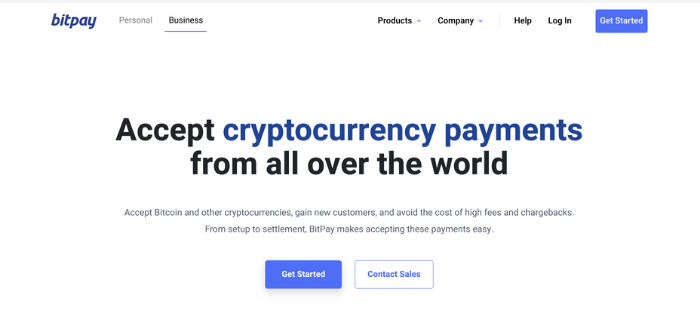
BitPay is one of the best options for websites that are looking to accept crypto payments.
It offers different ways for your customers to pay, with payment buttons, hosted checkouts, and embeddable invoices, as well as a host of plugins and integrations. All of these are easy to set up, meaning you can start accepting Bitcoin payments without lots of hassle.
BitPay also helps protect you from volatility through its Zero Price Volatility feature and daily bank deposits. For a 1 percent transaction fee, this is a pretty attractive offer.
2. Coinbase Commerce
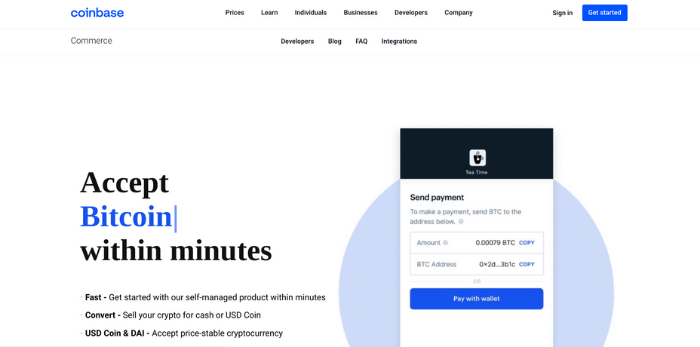
Coinbase makes it quick and easy for websites to start accepting Bitcoin payments. With a great app and excellent compatibility with most e-commerce platforms, you can start accepting crypto in an instant.
With quick exchange from crypto to your currency of choice, it’s a high-security option to protect you against currency fluctuations, and with flexible pricing options, it offers something for all businesses.
3. NOWPayments
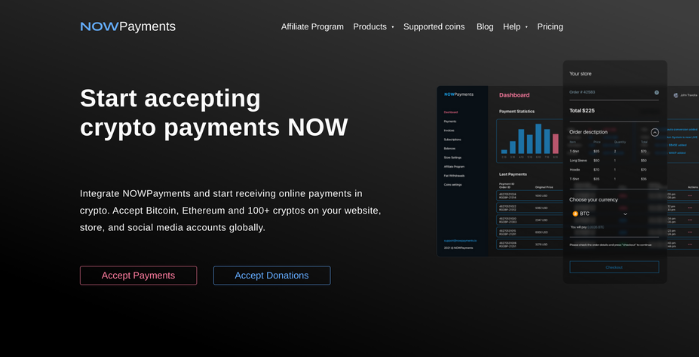
NowPayments is a low-fee, easy-to-implement processing option that’s extremely popular.
It allows you to accept over 100 cryptocurrencies and seamlessly exchange them into the currency of your choice. NowPayments has good compatibility with the major e-commerce platforms, offers some great plugins, and has an excellent point of sale solution.
With a maximum fee of 1 percent, it offers great value for money.
4. PayPal
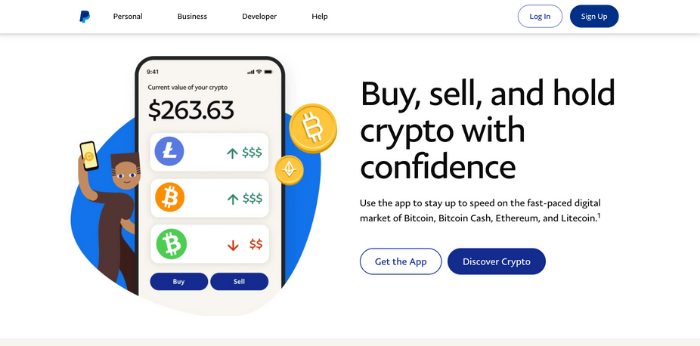
PayPal is one of the biggest online payment providers in the world and it’s recently stepped into the crypto sphere.
If you’re one of the 29 million merchants that accept PayPal transactions, then customers with US crypto holdings will automatically be able to purchase in their preferred cryptocurrency. At the point of sale, the crypto will be converted to your fiat currency (e.g., US Dollar) and you will be paid as normal.
While this doesn’t quite embrace crypto in the same way as the other options, it is an easy way to accept Bitcoin payments on your website.
5. Accept Bitcoin and Cryptocurrency Manually
Bitcoin and other cryptocurrencies were designed to make it easier for individuals to make payments to each other without the involvement of a third party. This makes it easy to simply speak with your buyer and organize your own payment.
This will happen in the customer’s wallet, where they simply facilitate a payment.
All they need is your “address” which is an alphanumerical string (you can also generate a QR code) that you’ll find in your wallet.
Once your customer has your “address,” then they can quickly send payment and complete the transaction.
Frequently Asked Questions About Accepting Bitcoin and Cryptocurrency on Your Website
Can I accept Bitcoin at my business?
If it’s legal to do so in your country, then your business can easily accept Bitcoin. All you need is a cryptocurrency wallet, and you can start accepting cryptocurrency right away.
How do I accept someone’s Bitcoin?
To receive Bitcoin from someone, all you need to do is give them your “address.” This alphanumerical code will allow someone to send Bitcoin straight to your wallet.
What are the advantages of accepting Bitcoin on my website?
Some advantages of accepting Bitcoin on your website are low transaction rates, more options for your customers, and brand loyalty.
What are the disadvantages of accepting Bitcoin on my website?
The disadvantages of accepting Bitcoin on your website are price volatility and the fact that it can be a distraction for your customers.
Conclusion: Accepting Bitcoin Payments on Your Website
Bitcoin and other cryptocurrencies are gradually becoming more mainstream and your website can capitalize on it—should the market allow.
While the world debates the merits of cryptocurrency, you can accept crypto payments on your website without exposing yourself to unnecessary risk.
With the right plugins, it’s easy to accept crypto payments and immediately convert them to your preferred currency. This means you don’t have to worry so much about volatility while still giving your customers a valuable service.
One of the great things about accepting Bitcoin on your site is that it can add to your brand image. If your target audience is interested in Bitcoin and other cryptocurrencies, then you should be too. Accepting Bitcoin on your website is an excellent way to do this.
Are you planning on accepting Bitcoin or another cryptocurrency?
Source: neilpatel.com

When Worlds Collide: Blockchain and Master Data Management
Master Data Management (MDM) is an approach to the management of golden records that have been around for over a decade only to find a growth spurt lately as some organizations are exceeding pain thresholds in the management of common data.

Blockchain has a slightly shorter history, coming aboard with bitcoin, but also is seeing its revolution these days as data gets distributed far and wide and trust has taken center stage in business relationships.
Volumes could be written about each on its own, and given that most organizations still have a way to go with each discipline, that might be appropriate.
However, good ideas wait for no one and today’s idea is MDM on Blockchain.

Thinking back over our MDM implementations over the years, it is easy to see the data distribution network becoming wider.
As a matter of fact, master data distribution is usually the most time-intensive and unwieldy part of an MDM implementation anymore.
The blockchain removes overhead, costs, and unreliability from authenticated peer-to-peer network partner transactions involving data exchange.
It can support one of the big challenges of MDM with governed, bi-directional synchronization of master data between the blockchain and enterprise MDM.

The single version of the truth
Another core MDM challenge is arriving at the “single version of the truth”.
It’s elusive even with MDM because everyone must tacitly agree to the process used to instantiate the data in the first place.
While many MDM practitioners go to great lengths to utilize the data rules from a data governance process, it is still a process subject to criticism.
The consensus that blockchain can achieve is a governance proxy for that elusive “single version of the truth” by achieving group consensus for trust as well as a full lineage of data.

The major challenges in MDM
Blockchain enables the major components and tackles the major challenges in MDM.
Blockchain provides a distributed database, as opposed to a centralized hub, that can store data that is certified, and for perpetuity.
By storing timestamped and linked blocks, the blockchain is unalterable and permanent.
Though not for low latency transactions yet, transactions involving master data, such as financial settlements, are ideal for blockchain and can be sped up by an order of magnitude since blockchain removes the grist in a normal process.
Blockchain uses pre-defined rules that act as gatekeepers of data quality and governs the way in which data is utilized.
Blockchains can be deployed publicly (like bitcoin) or internally (as an implementation of Hyperledger).
There could be a blockchain per subject area (like customer or product) in the implementation.

Hyperledger
MDM will begin by utilizing these internal blockchain networks, also known as Distributed Ledger Technology, though utilization of public blockchains is inevitable.
A shared master data ledger beyond company boundaries can, for example, contain common and agreed master data including public company information and common contract clauses with only counterparties able to see the content and destination of the communication.
Hyperledger is quickly becoming the standard for the open-source blockchain.
Hyperledger is hosted by The Linux Foundation. IBM, with the Hyperledger Fabric, is establishing the framework for blockchain in the enterprise.
Supporting master data management with a programmable interface for confidential transactions over a permissioned network is becoming a key inflection point for blockchain and Hyperledger.
Data management is about the right data at the right time and master data is fundamental to great data management, which is why centralized approaches like the discipline of master data management have taken center stage.
Characteristics of Blockchain
MDM can utilize the blockchain for distribution and governance and blockchain can clearly utilize the great master data produced by MDM.
Blockchain data needs data governance like any data. This data actually needs it more given its importance on the network.
MDM and blockchain are going to be intertwined now.
- It enables the key components of establishing and distributing the single version of the truth of data. Blockchain enables trusted governed data.
- It integrates this data across broad networks.
- It prevents duplication and provides data lineage.
- It will start in MDM in niches that demand these traits such as financial, insurance, and government data.
You can get to know the customer better with native fuzzy search and matching in the blockchain.
You can track provenance, ownership, relationship, and lineage of assets, do trade/channel finance, and post-trade reconciliation/settlement.
Blockchain is now a disruption vector for MDM.
MDM vendors need to be at least blockchain-aware today, creating the ability for blockchain integration in the near future, such as what IBM InfoSphere Master Data Management is doing this year.
Others will lose ground.
Source: gigaom.com