
Tag Archives for " artifical intelligence "

Voices in AI – Episode 74: A Conversation with Dr. Kai-Fu Lee
About this Episode
Episode 74 of Voices in AI features host Byron Reese and Dr. Kai-Fu Lee discussing the potential of AI to disrupt job markets, the comparison of AI research and implementation in the U.S. and China, as well as other facets of Dr. Lee’s book “AI Superpowers”.
Dr. Kai-Fu Lee, previously president of Google China, is now the CEO of Sinovation Ventures.
Visit www.VoicesinAI.com to listen to this one-hour podcast or read the full transcript.
Transcript Excerpt
Byron Reese: This is Voices in AI, brought to you by GigaOm. I’m Byron Reese. Today I am so excited… my guest is Dr. Kai-Fu Lee. He is, of course, an AI expert. He is the CEO of Sinovation Ventures. He is the former President of Google China. And he is the author of a fantastic new book called “AI Superpowers.” Welcome to the show, Dr. Lee.
Kai-Fu Lee: Thank you Byron.
I love to begin by saying, AI is one of those things that can mean so many things. And so, for the purpose of this conversation, what are we talking about when we talk about AI?
We’re talking about the advances in machine learning… in particular Deep Learning and related technologies as it applies to artificial narrow intelligence, with a lot of opportunities for implementation, application and value extraction.
We’re not talking about artificial general intelligence, which I think is still a long way out.
So, confining ourselves to narrow intelligence, if someone were to ask you worldwide, not even getting into all the political issues, what is the state of the art right now? How would you describe where we are as a planet with narrow artificial intelligence?
I think we’re at the point of readiness for application. I think the greatest opportunity is the application of what’s already known.
If we look around us, we see very few of the companies, enterprises and industries using AI when they all really should be.
Internet companies use AI a lot, but it’s really just beginning to enter financial, manufacturing, retail, hospitals, healthcare, schools, education and so on.
It should impact everything, and it has not.
So, I think what’s been invented and how it gets applied/implemented/monetized… value creation, that is a very clear 100% certain opportunity we should embrace.
Now, there can be more innovations, inventions, breakthroughs… but even without those, I think we’ve got so much on our hands that’s not yet been fully valued and implemented into industry.
Listen to this one-hour episode or read the full transcript at www.VoicesinAI.com
Byron explores issues around artificial intelligence and conscious computers in his new book The Fourth Age: Smart Robots, Conscious Computers, and the Future of Humanity.
Source: gigaom.com

Voices in AI – Episode 67: A Conversation with Amir Khosrowshahi
About this Episode
Episode 67 of Voices in AI features host Byron Reese and Amir Khosrowshahi talk about the explainability, privacy, and other implications of using AI for business.
Amir Khosrowshahi is VP and CTO at Intel. He holds a Bachelor’s Degree from Harvard in Physics and Math, a Master’s Degree from Harvard in Physics, and a Ph.D. in Computational Neuroscience from UC Berkeley.
Visit www.VoicesinAI.com to listen to this one-hour podcast or read the full transcript.

Transcript Excerpt
Byron Reese: This is Voices in AI brought to you by GigaOm.
I’m Byron Reese. Today I’m so excited that my guest is Amir Khosrowshahi. He is a VP and the CTO of AI products over at Intel.
He holds a Bachelor’s Degree from Harvard in Physics and Math, a Master’s Degree from Harvard in Physics, and a Ph.D. in Computational Neuroscience from UC Berkeley.
Welcome to the show, Amir.
Amir Khosrowshahi: Thank you, thanks for having me.
I can’t imagine someone better suited to talking about the kinds of things we talk about on this show, because you’ve got a Ph.D. in Computational Neuroscience, so, start off by just telling us what is Computational Neuroscience?
So neuroscience is a field, the study of the brain, and it is mostly a biologically minded field, and of course, there are aspects of the brain that are computational and there are aspects of the brain that are opening up the skull and peering inside and sticking needles into areas and doing all sorts of different kinds of experiments.

Computational neuroscience is a combination of these two threads, the thread that there [are] computer science statistics and machine learning and mathematical aspects to intelligence, and then there’s biology, where you are making an attempt to map equations from machine learning to what is actually going on in the brain.
I have a theory that I may not be qualified to have and you certainly are, and I would love to know your thoughts on it.
I think it’s very interesting that people are really good at getting trained with a sample size of one, like draw a made-up alien you’ve never seen before and then I can show you a series of photographs, and even if that alien’s upside down, underwater, behind a tree, whatever, you can spot it.
Further, I think it’s very interesting that people are so good at transfer learning, I could give you two objects like a trout swimming in a river, and that same trout in a jar of formaldehyde in a laboratory and I could ask you a series of questions: Do they weigh the same, are they the same color, do they smell the same, are they the same temperature?
And you would instantly know, and yet, likewise, if you were to ask me if hitting your thumb with a hammer hurts, and I would say “yes,” and then somebody would say, “Well, have you ever done it?”
And I’m like, “yeah,” and they would say, “when?” And it’s like, I don’t really remember, I know I have.
Somehow we take data and throw it out, and remember metadata, and yet the fact a hammer hurts your thumb is stored in some little part of your brain that you could cut it out and somehow forget that.
And so when I think of all of those things that seem so different than computers to me, I kind of have a sense that human intelligence doesn’t really tell us anything about how to build artificial intelligence. What do you say?
Okay, those are very deep questions, and actually, each one of those items is a separate thread in the field of machine learning and artificial intelligence.
There are lots of people working on things, so the first thing you mentioned I think, was one shot learning where you have, you see as something that’s novel.
From the first time you see it, you recognize it as something that’s singular and you retain that knowledge to then identify if it occurs again—such as for a child it would be like a chair, for you, it’s potentially an alien.
So, how do you learn from single examples?

That’s an open problem in machine learning and is very actively studied because you want to be able to have a parsimonious strategy for learning and the current ways that—it’s a good problem to have—the current ways that we’re doing learning in, for example, online services that sort photos and recognize objects and images.
It’s very computationally wasteful and it’s actually wasteful in the usage of data.
You have to see many examples of chairs to have an understanding of a chair, and it’s actually not clear if you actually have an understanding of a chair, because the models that we have today for chairs, do make mistakes.
When you peer into where the mistakes were made, it seems like there the machine learning model doesn’t actually have an understanding of a chair, it doesn’t have a semantic understanding of a scene or of grammar, or of languages that are translated, and we’re noticing these efficiencies and we’re trying to address them.

You mentioned some other things, such as how do you transfer knowledge from one domain to the next.
Humans are very good at generalizing.
We see an example of something in one context, and it’s amazing that you can extrapolate or transfer it to a completely different context.
That’s also something that we’re working on quite actively, and we have some initial success in that we can take a statistical model that was trained on one set of data, and then we can then apply it to another set of data by using that previous experience as a warm start, and then moving away from that old domain to the new domain.
This is also possible to do in continuous time.
Much of the things we experience in the real world—they’re not stationary, and that’s a statistics change with time.
We need to have models that can also change.
For a human it’s easy to do that, it’s very good at going from… it’s good at handling non-stationary statistics, so we need to build that into our models, be cognizant of it, we’re working on it. And then [for] other things you mentioned—that intuition is very difficult.
It’s potentially one of the most difficult things for us to translate from human intelligence to machines, and remembering things and having kind of a hazy idea of having done something bad to yourself with a hammer, that I’m not actually sure where that falls in into the various subdomains of machine learning.
Listen to this one-hour episode or read the full transcript at www.VoicesinAI.com
Byron explores issues around artificial intelligence and conscious computers in his new book The Fourth Age: Smart Robots, Conscious Computers, and the Future of Humanity.
Source: gigaom.com

Speed and Scale: Advanced Analytics with Machine Learning
Artificial Intelligence and Machine Learning (ML) can turn massive amounts of data into deep insights that drive revenue and decrease costs. But ML’s not an island – in fact, it’s carried out most successfully when paired with advanced analytics.

To facilitate the best analytics work, enterprises need the right platforms and tools to load data, prepare it, ensure high quality and integrate with corporate data governance processes.
How can you get all that working harmoniously, especially in the cloud?
It takes the right tools, strategy, and workflow, but it can be done.

Join us for this free 1-hour webinar, from GigaOm Research, to find out how.
The webinar features GigaOm analyst Andrew Brust, Deepsha Menghani, Product Marketing Manager at Microsoft, and Mark Balkenende, Director Technical Product Marketing at Talend.
In this 1-hour webinar, you will learn how:
- Data analytics, data quality, and data governance can be tightly intertwined with data science
- Technologies like Apache Spark can serve both your data engineering and machine learning needs
- Cloud services can be combined with open-source software and analytics ecosystem tools for maximum benefit

Register now to join GigaOm Research, Microsoft, and Talend for this free expert webinar.
Who Should Attend:
- CIOs
- CTOs
- Chief Data Officers
- Data Scientists
- Data Engineers
- Data Stewards
- Analytics professionals
Source: gigaom.com

Voices in AI – Episode 70: A Conversation with Jakob Uszkoreit
About this Episode
Episode 70 of Voices in AI features host Byron Reese and Jakob Uszkoreit discuss machine learning, deep learning, AGI, and what this could mean for the future of humanity.
Jakob has a master’s degree in Computer Science and Mathematics from Technische Universität Berlin.
Jakob has also worked at Google for the past 10 years currently in deep learning research with Google Brain.
Visit www.VoicesinAI.com to listen to this one-hour podcast or read the full transcript.

Transcript Excerpt
Byron Reese: This is Voices in AI, brought to you by GigaOm. I’m Byron Reese. Today our guest is Jakob Uszkoreit, he is a researcher at Google Brain, and that’s kind of all you have to say at this point. Welcome to the show, Jakob.
Q:1
Let’s start with my standard question which is: What is artificial intelligence, and what is intelligence if you want to start there, and why is it artificial?
Jakob Uszkoreit: Hi, thanks for having me.
Let’s start with artificial intelligence specifically.
I don’t think I’m necessarily the best person to answer the question of what intelligence is in general, but I think for artificial intelligence, there are possibly two different kinds of ideas that we might be referring to with that phrase.
One is kind of the scientific or the group of directions of scientific research, including things like machine learning, but also other related disciplines that people commonly refer to with the term ‘artificial intelligence.’

But I think there’s this other may be a more important use of the phrase that has become much more common in this age of the rise of AI if you want to call it that, and that is what society interprets that term to mean.
I think largely what society might think when they hear the term artificial intelligence, is actually automation, in a very general way, and maybe more specifically, automation where the process of automating [something] requires the machine or the machines doing so to make decisions that are highly dynamic in response to their environment and in our ideas or in our conceptualization of those processes, require something like human intelligence.
So, I really think it’s actually something that doesn’t necessarily, in the eyes of the public, have that much to do with intelligence, per se.
It’s more the idea of automating things that at least so far, only humans could do, and the hypothesized reason for that is that only humans possess this ephemeral thing of intelligence.

Q:2
Do you think it’s a problem that a cat food dish that refills itself when it’s empty, you could say has a rudimentary AI, and you can say Westworld is populated with AIs, and those things are so vastly different, and they’re not even really on a continuum, are they?
General intelligence isn’t just a better narrow intelligence, or is it?
So I think that’s a very interesting question.
Whether basically improving and slowly generalizing or expanding the capabilities of narrow bits of intelligence, will eventually get us there, and if I had to venture a guess, I would say that’s quite likely actually.
That said, I’m definitely not the right person to answer that.
I do think that guesses, that aspects of things are today still in the realms of philosophy and extremely hypothetical.

Q:3
But the one trick that we have gotten good at recently that’s given us things like AlphaZero, is machine learning, right?
And it is itself a very narrow thing.
It basically has one core assumption, which is the future is like the past.
And for many things, it is: what a dog looks like in the future, is what a dog looked like yesterday.
But, one has to ask the question, “How much of life is actually like that?”
Do you have an opinion on that?
Yeah, so I think that machine learning is actually evolving rapidly from the initial classic idea of basically trying to predict the future just in the past, and not just the past as a kind of encapsulated version of the past.
So, it’s basically a snapshot captured in this fixed static data set.
You expose machines to that, you allow it to learn from that, train on that, whatever you want to call it, and then you evaluate how the resulting model or machine or network does in the wild or on some evaluation tasks, and tests that you’ve prepared for it.
It’s evolving from that classic definition towards something that is quite a bit more dynamic, that is starting to incorporate learning in situ, learning kind of “on the job,” learning from very different kinds of supervision, where some of it might be encapsulated by data sets, but some might be given to the machine through somewhat more high-level interactions, maybe even through language.
There are at least a bunch of lines of research attempting that.
Also quite importantly, we’re starting slowly but surely to employ machine learning in ways where the machine’s actions actually have an impact on the world, from which the machine then keeps learning.
I think that that’s actually something [for which] all of these parts are necessary ingredients if we ever want to have narrow bits of intelligence, that maybe have a chance of getting more general.
Maybe then in the more distant future, might even be bolted together into somewhat more general artificial intelligence.
Listen to this one-hour episode or read the full transcript at www.VoicesinAI.com
Byron explores issues around artificial intelligence and conscious computers in his new book The Fourth Age: Smart Robots, Conscious Computers, and the Future of Humanity.
Source: gigaom.com

The Case For and Against AGI
The following is an excerpt from GigaOm publisher Byron Reese’s new book, The Fourth Age: Smart Robots, Conscious Computers, and the Future of Humanity. You can purchase the book here.
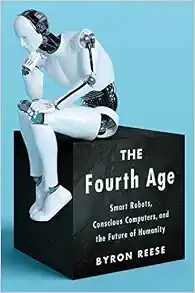
The Fourth Age explores the implications of automation and AI on humanity, and has been described by Ethernet inventor and 3Com founder Bob Metcalfe as framing “the deepest questions of our time in clear language that invites the reader to make their own choices.
Using 100,000 years of human history as his guide, he explores the issues around artificial general intelligence, robots, consciousness, automation, the end of work, abundance, and immortality.”
One of those deep questions of our time:
Is artificial general intelligence, or AGI, even possible?
Most people working in the field of AI are convinced that an AGI is possible, though they disagree about when it will happen.
In this excerpt from The Fourth Age, Byron Reese considers it an open question and explores if it is possible.
The Case for AGI

Those who believe we can build an AGI operate from a single core assumption.
While granting that no one understands how the brain works, they firmly believe that it is a machine, and therefore our mind must be a machine as well.
Thus, ever more powerful computers eventually will duplicate the capabilities of the brain and yield intelligence. As Stephen Hawking explains:
I believe there is no deep difference between what can be achieved by a biological brain and what can be achieved by a computer. It, therefore, follows that computers can, in theory, emulate human intelligence—and exceed it.
As this quote indicates, Hawking would answer our foundational question about the composition of the universe as a monist, and therefore someone who believes that AGI is certainly possible.
If nothing happens in the universe outside the laws of physics, then whatever makes us intelligent must obey the laws of physics. And if that is the case, we can eventually build something that does the same thing.
He would presumably answer the foundational question of “What are we?” with “machines,” thus again believing that AGI is clearly possible. Can a machine be intelligent? Of course! You are just such a machine.
Consider this thought experiment: What if we built a mechanical neuron that worked exactly like the organic kind.
And what if we then duplicated all the other parts of the brain mechanically as well. This isn’t a stretch, given that we can make other artificial organs.
Then, if you had a scanner of incredible power, it could make a synthetic copy of your brain right down to the atomic level. How in the world can you argue that won’t have your intelligence?
The only way, the argument goes, you get away from AGI being possible is by invoking some mystical, magical feature of the brain that we have no proof exists.
In fact, we have a mountain of evidence that it doesn’t. Every day we learn more and more about the brain, and not once have the scientists returned and said, “Guess what!
We discovered a magical part of the brain that defies all laws of physics, and which therefore requires us to throw out all the science we have based on that physics for the last four hundred years.”
No, one by one, the inner workings of the brain are revealed. And yes, the brain is a fantastic organ, but there is nothing magical about it. It is just another device.
Since the beginning of the computer age, people have come up with lists of things that computers will supposedly never be able to do. One by one, computers have done them.
And even if there were some magical part of the brain (which there isn’t), there would be no reason to assume that it is the mechanism by which we are intelligent.
Even if you proved that this magical part is the secret sauce in our intelligence (which it isn’t), there would be no reason to assume we can’t find another way to achieve intelligence.
Thus, this argument concludes, of course, we can build an AGI. Only mystics and spiritualists would say otherwise.
The Case against AGI
Let’s now explore the other side.

A brain, as was noted earlier, contains a hundred billion neurons with a hundred trillion connections among them.
But just as music is the space between the notes, you exist not in those neurons, but in the space between them. Somehow, your intelligence emerges from these connections.
We don’t know how the mind comes into being, but we do know that computers don’t operate anything at all like a mind, or even a brain for that matter.
They simply do what they have been programmed to do. The words they output mean nothing to them. They have no idea if they are talking about coffee beans or cholera.
They know nothing, they think nothing, they are as dead as fried chicken.
A computer can do only one simple thing: manipulate abstract symbols in memory. So what is incumbent on the “for” camp is to explain how such a device, no matter how fast it can operate, could, in fact, “think.”
We casually use language about computers as if they are creatures like us. We say things like, “When the computer sees someone repeatedly type in the wrong password, it understands what this means and interprets it as an attempted security breach.”
But the computer does not actually “see” anything. Even with a camera mounted on top, it does not see. It may detect something, just like a lawn system uses a sensor to detect when the lawn is dry. Further, it does not understand anything. It may compute something, but it has no understanding.
We use language that treats computers as alive colloquially, but we should keep in mind it is not really true. It is important now to make the distinction because with AGI we are talking about machines going from computing something to understanding something.
Joseph Weizenbaum, an early thinker about AI, built a simple computer program in 1966, ELIZA, which was a natural language program that roughly mirrored what a psychologist might say.
You make a statement like “I am sad” and ELIZA would ask, “What do you think made you sad?” Then you might say, “I am sad because no one seems to like me.”
ELIZA might respond “Why do you think that no one seems to like you?” And so on. This approach will be familiar to anyone who has spent much time with a four-year-old who continually and recursively asks why, why, why to every statement.
When Weizenbaum saw that people were actually pouring out their hearts to ELIZA, even though they knew it was a computer program, he turned against it. He said that in effect, when the computer says “I understand,” it tells a lie. There is no “I” and there is no understanding.
His conclusion is not simply linguistic hairsplitting. The entire question of AGI hinges on this point of understanding something.
To get at the heart of this argument, consider the thought experiment offered up in 1980 by the American philosopher John Searle. It is called the Chinese room argument. Here it is in the broad form:
There is a giant room, sealed off, with one person in it. Let’s call him the Librarian. The Librarian doesn’t know any Chinese. However, the room is filled with thousands of books that allow him to look up any question in Chinese and produce an answer in Chinese.
Someone outside the room, a Chinese speaker, writes a question in Chinese and slides it under the door. The Librarian picks up the piece of paper and retrieves a volume we will call book 1.
He finds the first symbol in book 1, and written next to that symbol is the instruction “Look up the next symbol in book 1138.”
He looks up the next symbol in book 1138. Next to that symbol, he is given the instruction to retrieve book 24,601 and look up the next symbol. This goes on and on.
When he finally makes it to a final symbol on the piece of paper, the final book directs him to copy a series of symbols down. He copies the cryptic symbols and passes them under the door.
The Chinese speaker outside picks up the paper and reads the answer to his question. He finds the answer to be clever, witty, profound, and insightful. In fact, it is positively brilliant.
Again, the Librarian does not speak any Chinese. He has no idea what the question was or what the answer said. He simply went from book to book as the books directed and copied what they directed him to copy.
Now, here is the question: Does the Librarian understand Chinese?
Searle uses this analogy to show that no matter how complex a computer program is, it is doing nothing more than going from book to book. There is no understanding of any kind.
And it is quite hard to imagine how there can be true intelligence without any understanding whatsoever.
He states plainly, “In the literal sense, the programmed computer understands what the car and the adding machine understand, namely, exactly nothing.”
Some try to get around the argument by saying that the entire system understands Chinese. While this seems plausible at first, it doesn’t really get us very far.
Say the Librarian memorized the contents of every book, and further could come up with the response from these books so quickly that as soon as you could write a question down, he could write the answer.
But still, the Librarian has no idea what the characters he is writing mean. He doesn’t know if he is writing about dishwater or doorbells. So again, does the Librarian understand Chinese?
So that is the basic argument against the possibility of AGI. First, computers simply manipulate ones and zeros in memory.
No matter how fast you do that, that doesn’t somehow conjure up intelligence. Second, the computer just follows a program that was written for it, just like the Chinese Room.
So no matter how impressive it looks, it doesn’t really understand anything. It is just a party trick.
It should be noted that many people in the AI field would most likely scratch their heads at the reasoning of the case against AGI and find it all quite frustrating.
They would say that of course, a brain is a machine—what else could it be? Sure, computers can only manipulate abstract symbols, but the brain is just a bunch of neurons that send electrical and chemical signals to each other.
Who would have guessed that would have given us intelligence? It is true that brains and computers are made of different stuff, but there is no reason to assume they can’t do the same exact things.
The only reason, they would say, that we think brains are not machines is because we are uncomfortable thinking we are only machines.
They would also be quick to offer rebuttals of the Chinese room argument. There are several, but the one most pertinent to our purposes is what I call the “quacks like a duck” argument.
If it walks like a duck, swims like a duck, and quacks like a duck, I am going to assume it is a duck. It doesn’t really matter if in your opinion there is no understanding, for if you can ask it questions in Chinese and it responds with good answers in Chinese, then it understands Chinese.
If the room can act as it understands, then it understands. End of story. This was in fact Turing’s central thesis in his 1950 paper on the question of whether computers can think.
He states, “May, not machines carry out something which ought to be described as thinking but which is very different from what a human does?”
Turing would have seen no problem at all in saying the Chinese room can think. Of course, it can. It is obvious. The idea that it can answer questions in Chinese but doesn’t understand Chinese is self-contradictory.
To read more of GigaOm publisher Byron Reese’s new book, The Fourth Age: Smart Robots, Conscious Computers, and the Future of Humanity, you can purchase it here.
Source: gigaom.com