
Tag Archives for " videos "

How to Use Video Marketing for Lead Generation
According to forecasts, 2022 is the year where online videos will make up more than 82% of all consumer internet traffic—putting platforms like YouTube, TikTok, Instagram at the center of any marketing strategy.
But how can you use video marketing to generate highly qualified leads or even hit a given marketing goal?
In this article, you will learn how to turn your video content into a lead-generating asset and make the most of it.
Turn Your Video Content Into a Lead-Generation Asset
Although 74% of B2B marketers believe that video converts better than any other type of content, many companies still struggle to harness the potential of video marketing.
In a study, Wistia found that only 22% of B2B brands use video content for lead generation purposes. So, one can assume that the other 78% are not doing it because they either have no idea how or are doing it the wrong way.
Actually, if you want to generate leads using video content, it makes sense to turn your videos into a lead-generating asset before expecting any results, especially if you are in the B2B space.
Think about it, while dancing cat videos can generate results in a B2C context, it won’t cut it if you’re selling products to businesses.
Here are two lead-generating assets you’ll need to leverage to get results:
- On-site knowledge base.
- Video course (Can be onsite, offsite, or both).
The first type of asset is gated, while the second type is not—especially since its purpose is to engage viewers.
A great example of an on-site knowledge base is the Hubspot Academy, home to much free gated content curated by Hubspot.

On the other hand, Yoast is a perfect example of a brand that leverages on-site and off-site video courses on its site and Udemy.
The Benefits of Your Lead-Generating Assets
The first benefit of planning your video marketing strategy around a lead-generating asset is that it allows you and your entire marketing team to have a 360-degree view of how to direct your video creation efforts.

The second benefit is that these assets can be used to fuel the top and middle of your sales cycle. As a result, your website will get more engagement and traffic from people who simply want to be informed or make informed purchase decisions.
The third benefit is that, when gated, your video content can help you collect email addresses—which can help you turn some visitors into leads and ultimately into customers.
Note that regardless of whether it is off-site or on-site, your lead-generating asset will still generate results. For example, if you host courses on Coursera or CXL, you can tap into the audience engaging with your courses on these platforms and win new leads.
Things To Consider When Creating Lead Generating Assets
VA video content that acts as a lead generation asset must contain several things to be effective.

It must be based on a popular search query.
As controversial as it may sound, leads are a byproduct of web traffic. Think about it, before you can convert a visitor into a lead, you need to have visitors first. That’s why it’s essential to choose a keyword that has a search intent—this way, your video can rank and generate traffic on its own.
It must be aligned with the products you sell.
According to a study, most of the 1,000 most frequently searched prompts on search engines are how-to questions. Meaning that your audience/viewership has a gazillion problems, and they expect you to help them find solutions. So make sure your videos cover problems your product solves and position yourself as the ideal solution.
It should not be too specific.
An Ipsos’ study on advertising found that both visual and written content wear out. This means that if you don’t diversify your video content, it will wear out—and lose engagement. You’ll want to add fresh videos regularly to re-engage your current viewers, which a super-specific topic won’t give you the flexibility to do.
It must be relatable.
Not only does your video content need to align with your overall brand values, but it also needs to be relatable from the viewers’ perspective. So instead of going heavy on brand awareness, try to double down on brand affinity. Think about it—just because someone knows your brand doesn’t necessarily mean they will buy your product.
Adobe is a perfect case study to illustrate the above criteria. They have a course on Photoshop on their website and Udemy. Each course requires the use of Photoshop, which is an Adobe product.
When you search for the Photoshop course, you will find that the course on Udemy ranks first and the one on adobe.com ranks second.
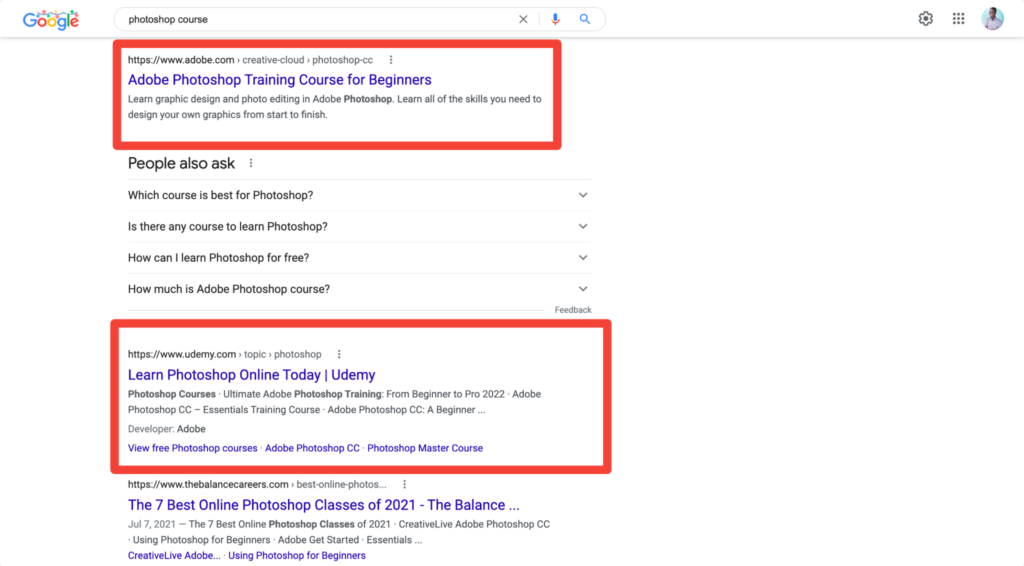
Plus, Photoshop is a vast topic, so Adobe can keep adding content as they create it.
Now that you know what makes a great lead-generating video content, here are some types of videos you can leverage to get optimal results.
Choose The Right Video Type to Fuel Your Marketing Strategy
Below are three types of videos you can leverage to generate more leads.
Influencer-backed videos
CXL and Fullfunnel.io are perfect examples of companies that put influencer-driven video content into action.
CXL partners with experts (influencers) to produce free and paid courses and often webinars.
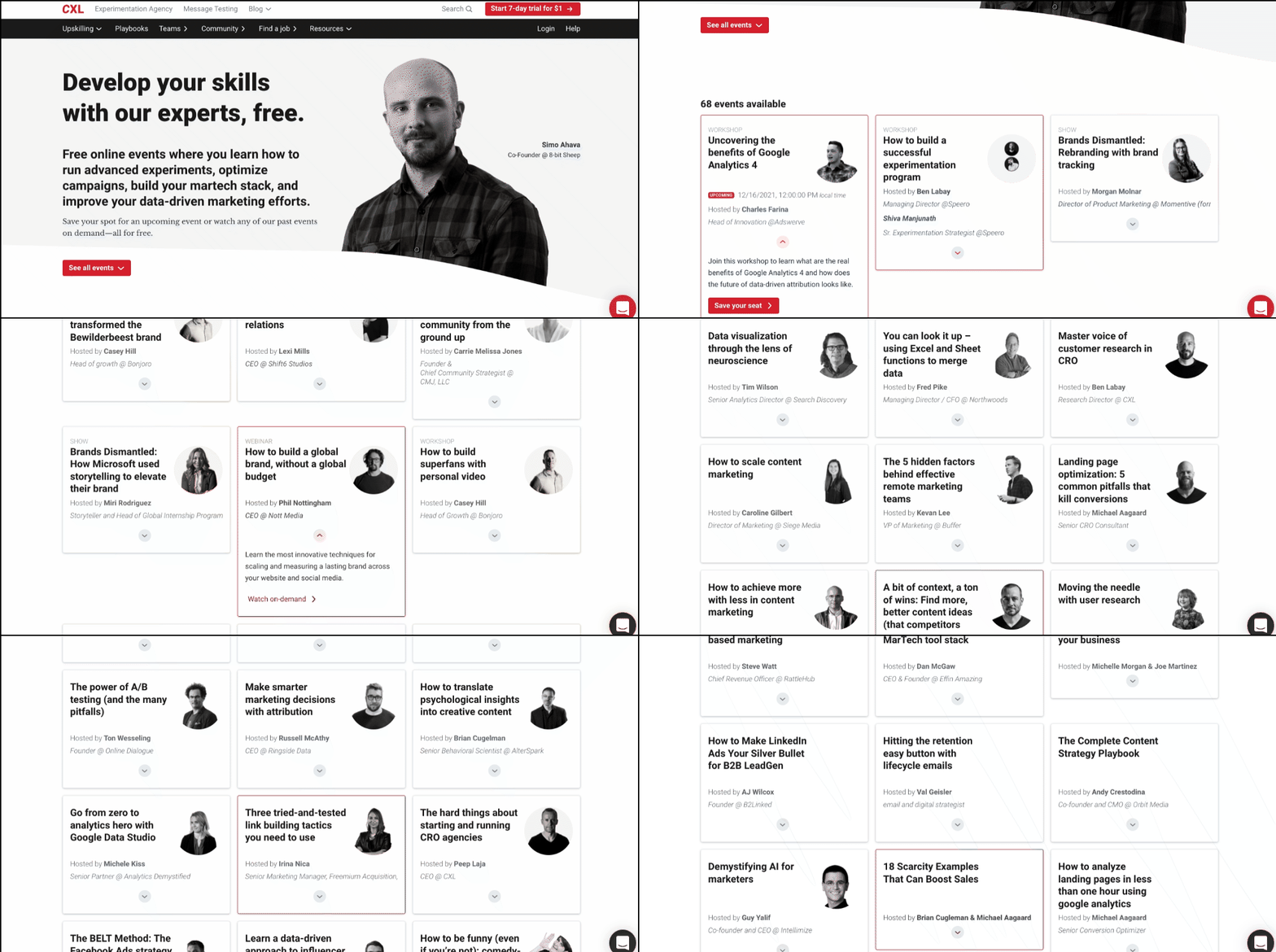
You don’t have to pay to watch these videos, but if you want to get a sneak peek or access these courses, you have to opt-in with your email addresses and names. CXL uses this video marketing strategy to fuel its courses’ subscribers base.
Andrei Zinkevich and Vladimir Blagojević from Fullfunnel.io use the same strategy except that their content is free to access and does not require opt-in.
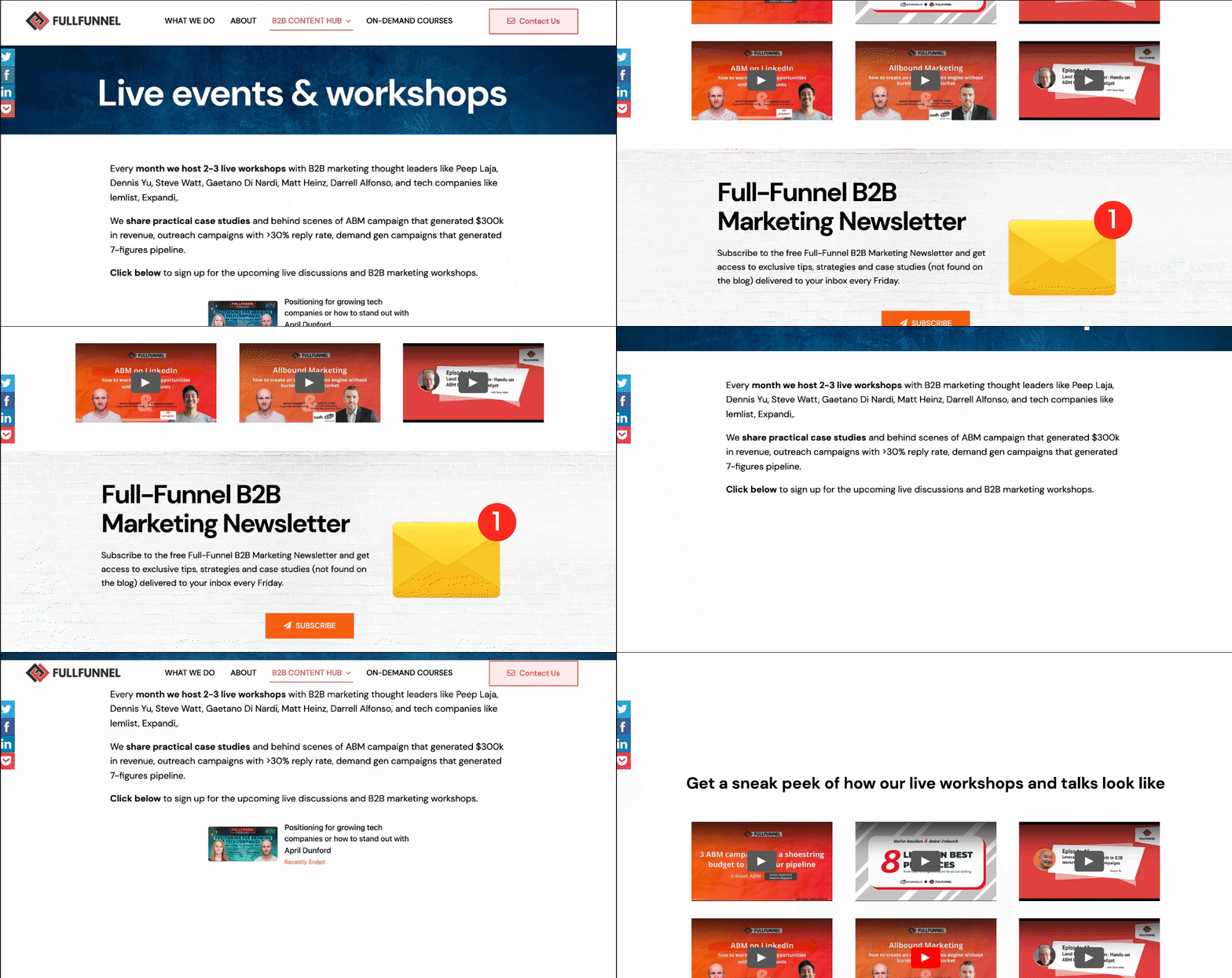
On the other hand, the end goal of their webinars is to build awareness, help viewers solve their problems, and position Fullfunnel.io’s services as the ideal solution to viewers’ problems. So far, this strategy has helped them grow the demand for their service.
The beauty of this type of video content is that it lets you tap into the fan base and authority of guest influencers to fill your lead pipeline before and after the video sessions. It’s the ideal way to educate, engage, and convert leads—all at the same time.
Demo videos
Whether you are selling a SaaS product or any other solution to B2B brands, chances are you are already leveraging demo videos.
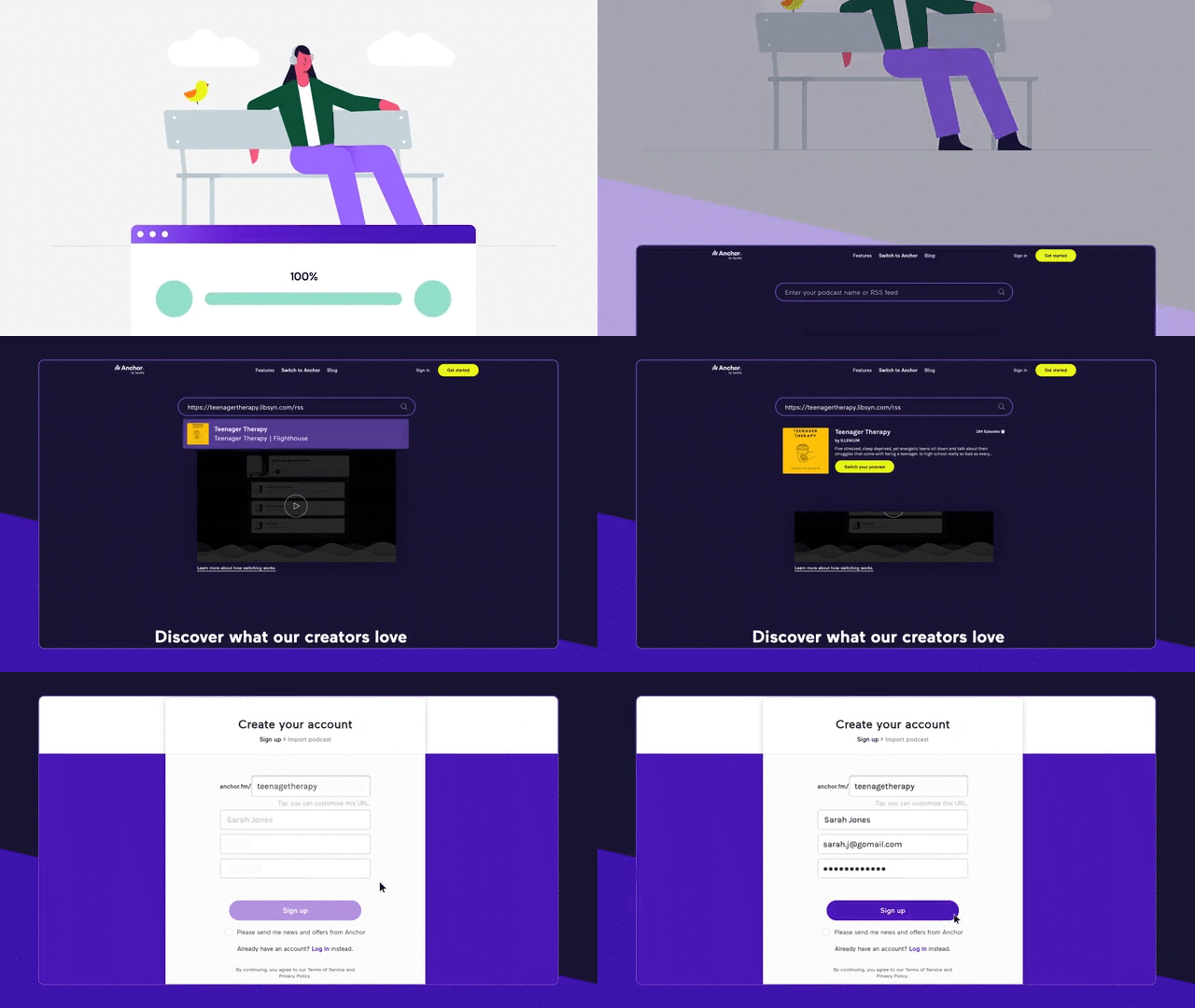
Demo videos, contrary to popular belief, make significant content assets. For example, Wistia uses demo videos to educate their audience and as a channel to make a query (place a form or even include a CTA at the end of the video). And Vidi uses them as a FAQ to clarify user questions and engage them even more.
Salesforce is another example of companies that leverage demo videos as lead-generating assets. Salesforce gates each of its product demos so that visitors have to exchange information before they can access the company’s resources.
Testimonial videos
Ninety-two percent of consumers trust a brand that someone has recommended to them, even if it’s a stranger. Couple that with the fact that people trust testimonial videos more than traditional text-based testimonials.

By inviting your established users to create video content (testimonial videos) to recount their experience using your product, your soon-to-be customers and prospects will have a more objective idea of the value proposition of your product.
Testimonial videos are also a type of user-generated content that allows companies to move prospects quickly through their sales cycle and accelerate the buying decision. In fact, these types of videos add credibility—it’s not just you saying what can be done; it’s actual users showing how they benefit from your product.
Repurpose Your Video Content to Suit All Your Marketing Channels
Creating and editing a video takes a lot of time, so there’s no reason to use it only once.
Here’s what Michael Pirone, co-founder of Vidico, has to say about it.
“You can leverage many distribution channels to get the word out about your videos and your product. Spend time getting to know your target audience and share your videos where they will have the most impact.”
Ways to make your videos work as a marketing flywheel
Here are three ways to make your videos work as a marketing flywheel.
1. Repurpose video on your blog.
A study showed that videos are 50 times more likely to appear on the first page of Google than text results. So by posting your videos on your blogs like Neil Patel and CoSchedule do, you’re more likely to rank and engage your audience.
2. Add a full transcript next to your video.
Doing transcripts for your videos has two benefits. The first is that transcripts attract search engines with relevant keywords, which in itself is a ranking factor.

The second is that transcripts provide an opportunity for backlinks and internal linking. Without text, there is none of that. The other advantage is that visitors who don’t want to watch the whole video can still browse the transcript.
You can also put your transcripts together and turn them into gated downloadable content.
3. Create short videos.
In this age of TikTok and Instagram, short-form video is KING. However, not every B2B brand has its audience on TikTok. In this case, you can share these videos on LinkedIn. A great example of this is Chris Walker of Refine Labs.

His short videos on Linkedin get thousands of views and serve as an awareness and nurturing campaign for Refine Labs.
The post How to Use Video Marketing for Lead Generation appeared first on Content Marketing Consulting and Social Media Strategy.
Source: convinceandconvert.com

The Secrets of Unboxing Videos
Social selling of consumer products often includes sharable “unboxing video experiences” posted by influential reviewers and fans. They range widely in production values, but the secret is not just in the video. The key is in the star of the show—the box itself.
—By John Parsons

Disclosure: This content is reader-supported, which means if you click on some of our links that we may earn a commission.
In 2011, Google popularized a concept dubbed the “Zero Moment of Truth” or ZMOT.
It is the consumer’s experience of research and discovery, primarily on the web, learning about a product before they first experience it, often on a store shelf—Procter & Gamble’s “First Moment of Truth.”
The ZMOT is at the heart of all social selling.
Of course, a brand’s web presence for a particular product must start with basic, easy-to-find feature descriptions, comparisons, pricing, use cases, and practical tips or how-tos.
But it cannot stop there. It must also include product reviews, ratings, and other media designed to inspire the consumer and capture their imagination.
Then, to complete the process, all this information must be readily shareable on social media.
No matter how good your web promotional material is, there’s nothing so powerful as having it shared between trusted friends.
Using the Right Medium
Increasingly, the preferred medium for this type of social influence is video.
For consumer products, these videos feature shots of a purchaser holding, talking about, and or actually using the product.
They can be elaborate commercials (think Super Bowl ads), or they can be strictly amateur productions.
The latter is typically impromptu footage—or made to look so—captured on smartphones and shared on social media.
Often, they are produced by popular reviewers and influencers—who may or may not be compensated by the brands they promote.
Their socially shared video creates an emotional affinity—an “ah-ha” moment—that hopefully drives product purchases.
The Unboxing Experience
However, not all social selling videos are about the product, per se.
An increasing percentage of shareable, ZMOT video features the box or package the product comes in.
Specifically, the video shows the reviewer or influencer sharing their experience from the viewpoint of someone opening the product for the first time.
The social selling “hook” is to convey the excitement of the first-time buyers when they open their newly purchased box.
There are many, many such videos on YouTube today, created by (probably) unpaid enthusiasts, especially for items like consumer electronics, cosmetics, and pop-culture memorabilia. (The last example comes with a language warning.)
Unboxing videos typically break the “shorter-is-better” rule for marketing videos, since they are designed to appeal to an already loyal fan base.
They can also range in production quality—from simple, first-person vlogs to reality television-like shows such as Arun Maini’s MrWhoseTheBoss channel.
(His over-the-top video, The $200,000 Smartphone Unboxing, contains many great examples of unboxing video techniques, including point-of-view shots of each step in the process.)
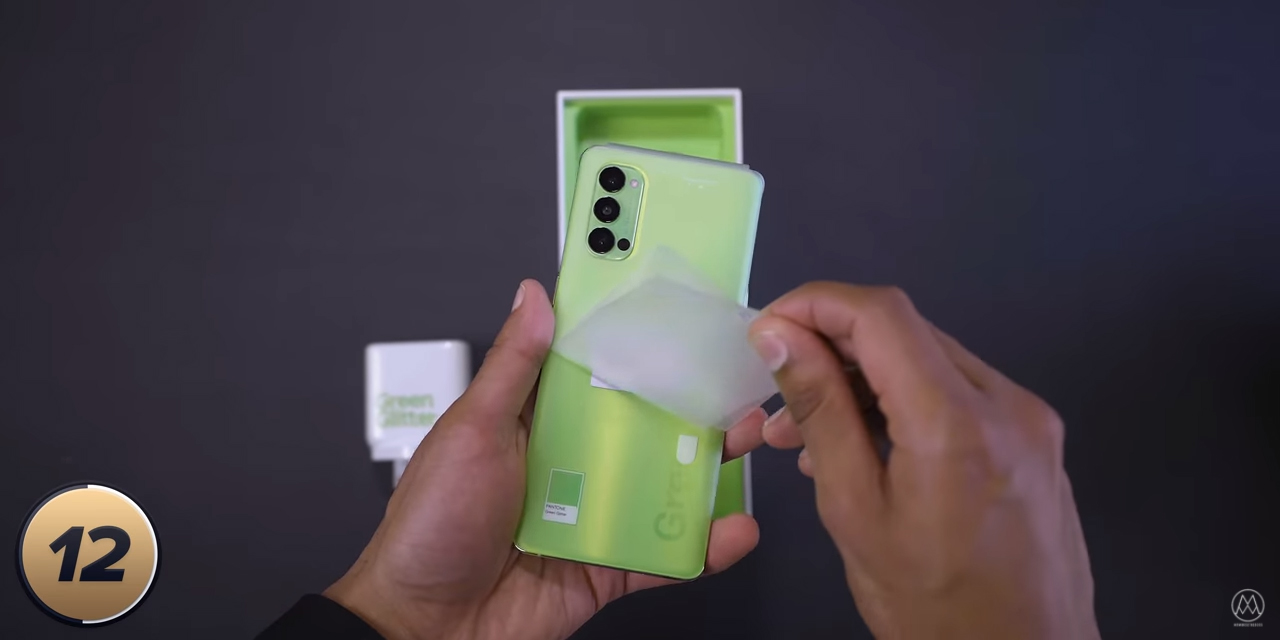
Even seemingly mundane aspects of product packaging (the protective plastic) can be filmed in a way that heightens the memorable, “you are there” experience, complete with enhanced sound. (From Arun Maini’s The $200,000 Smartphone Unboxing.)
The revenue model varies for videos of this kind.
On YouTube, the poster will often add links for purchasing the item, as well as the usual subscribe buttons and sponsor links.
Know the Rules before Entering the Fray
Although the popularity of unboxing videos is undeniable, marketing professionals should know the rules before entering the fray.
Production values are critical.
It takes real skill to make an unboxing video simple and easy to watch—especially when the narrative pushes the video’s run time over the usual length for marketing videos.
Strive for authenticity, not fancy camera work.
Production values are important but remember that the vast majority of good unboxing videos are produced with simple, single-camera shots.
Typically, this means alternating sequences of the narrator and point-of-view shots of the box being opened.
The storytelling must simulate the senses.
By its very nature, a physical package involves more of the senses than just vision and hearing—the only two that today’s video medium can handle.
So, the narration and the visuals must also convey, however subliminally, the tactile experience—and even the olfactory experience, if there is one—of a well-designed box.
Social sharing is the goal.
An unboxing video is not an elaborate tutorial or how-to.
To move viewers to share it with their followers and friends, the video must evoke the feelings of receiving a holiday or birthday gift—or at least the opening of an exciting new purchase.
Communicating those feelings is the essence of social selling.
The Real Star of the Show
An unboxing video can follow all the rules and still fail as a social selling tool if the product box is just an ordinary box.
Even the most die-hard fan of a particular product will likely not finish, much less share, a video of an uninspiring package design.
But too few marketing professionals fully appreciate what makes consumer product packaging appealing—both on the store shelf and in a video.
Product packaging is the single most complex branch of printed graphic communication.
It has to be practical—for both shipping and store display—as well as provide basic information (ingredients, parts, size, price, barcodes, safety information, the list is almost endless).
On top of that, a package must also attract a shopper’s attention, given the fact that the time spent making the decision to pick it up from the shelf is only about 2.6 seconds.
No pressure.
Other attributes of a product box communicate value—to the shopper in the store, to the customer who receives it in the mail and especially to the person opening it for the first time.
Its visual layout, use of color, and typography are also essential, albeit subliminal ways to increase its perceived value.
(In 2003, a University of Alabama study illustrated the powerful role of packaging in communicating brand meaning and strengthening the consumer-brand relationship.)
Even the weight and heft of the cardboard used for the box, as well as its texture and special printing and finishing effects, all send a subliminal message—one that cannot be literally conveyed in a video but must be described well.

Common printing and finishing techniques, such as raised metallic texturing or embossing, can be filmed in a way that evokes the tactile experience of a package. (From ASMR’s GlossyBox May 2021 Unboxing.)
The outer box is just the beginning.
Many consumer products (famously, Apple and Samsung smartphones) take special care to place individual components in their own, distinctive packaging within the main box so that each new piece becomes its own, memorable step in the experience.
In other words, when all aspects of the packaging are designed to be a pleasant process of discovery, then that process is ideally suited to be shared with others.
The Big Picture
The principles of social selling are not new. People have been telling their friends and family members about the great new thing they bought for as long as we’ve been buying and selling great new things.
The difference now is that we can amplify those stories via social media.
And, because moving pictures speak louder than words, the best medium for sharing our delight in opening a new, well-designed product box is a video that can be shared freely with online connections.
About the Author
John Parsons is a Seattle-based business and technology writer and co-author of the IntuIdeas Video Marketing Guide (https://intuideas.com/video-marketing-resources).
The post The Secrets of Unboxing Videos appeared first on Content Marketing Consulting and Social Media Strategy.
Source: convinceandconvert.com

4 Key Elements of Effective Social Media Videos
Video is all the rage today. It’s due to its effectiveness in driving reach and engagement. In fact, most social media platforms have started to give video content more visibility in feeds.
The introduction of Reels and IGTV on Instagram and Facebook Watch is a testament to the fact that the appeal for videos has only increased over the years.
About 85% of internet users in the US watched online videos in 2018, and a majority of internet users say that the trend of watching more online videos will continue, even after the COVID-19 outbreak ends.
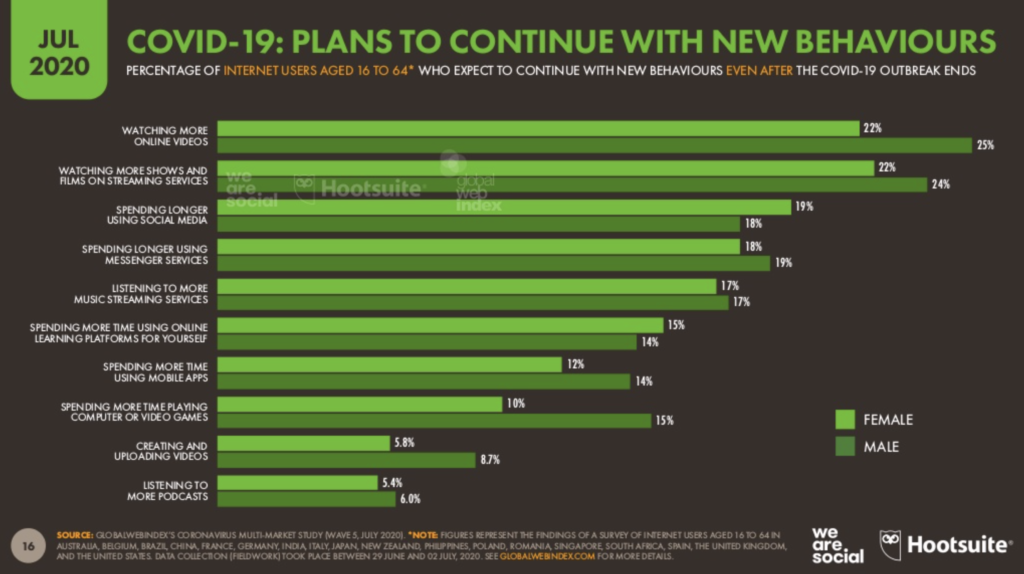
Image via We Are Social
With so much video content being uploaded by the minute — over 500 hours on YouTube in 2019 — it’s going to be difficult to stand out from the crowd.
As of May 2019, more than 500 hours of video were uploaded to YouTube every minute. This equates to approximately 30,000 hours of newly uploaded content per hour.
To do so, you need to create stellar videos.
How can you do so?
You need to understand the key elements of a social media video.
What are these key elements, you ask?
Let’s take a look at them.
Main Elements of a Social Media Video
Here are the main elements of a social media video that can help improve engagement.
1. The Social Platform
When you’re creating any video for social media, it’s important to know which platform you’re creating it for.
Why?
Because each social platform has different audiences, and what may appeal to users on one platform might not on another.
TikTok and Instagram are platforms where you’d typically have millennials or Gen Z. On the other hand, on Facebook and Twitter, you can find a wider user base.
So, it’s crucial to tailor your videos for each of these platforms.
Similarly, what may work on all of these platforms may not work on LinkedIn at all as it’s a professional social networking platform.
And that’s not all.
Each platform also has a different set of video formats that work the best on them.
Facebook vs. Instagram video formats
For instance, if you’re uploading a video to Facebook, you’d likely upload a landscape version of the video for Facebook Watch. On the other hand, if you’re creating one for Instagram, options like Reels, Stories, and IGTV prefer portrait modes.
Resizing your videos can be challenging. However, by using tools like Boosted, you can simplify this task as the tool will automatically size all the videos you create based on the dimensions that work best on the social platform of your choice.
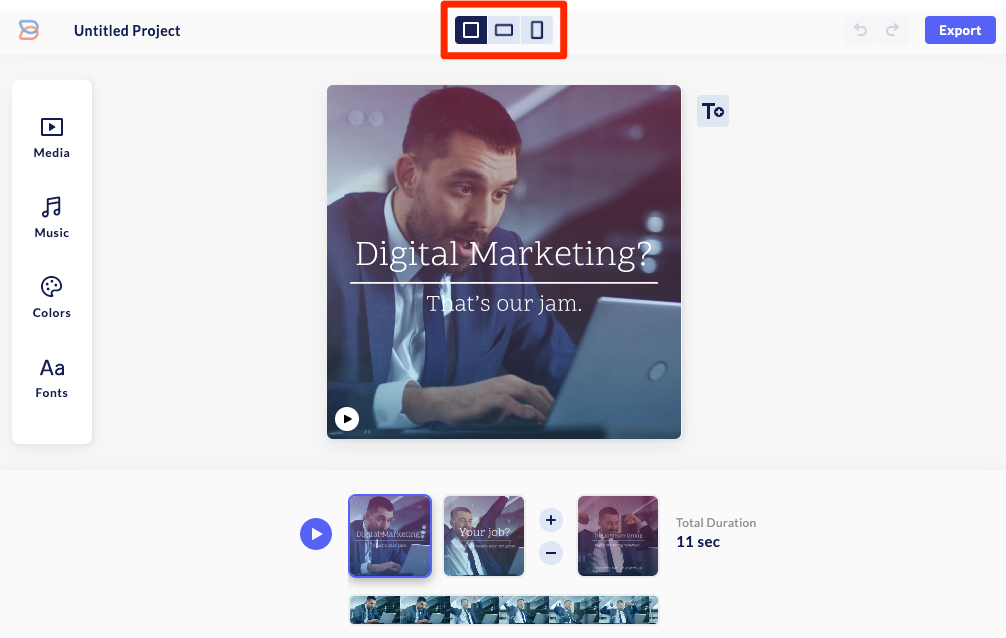
Boosted will automatically resize videos for different devices.
Pro Tip: It’s equally important that you upload your videos directly to the platform instead of sharing them from one platform to another.
2. Video Length
The length of the video is an important parameter that you need to be mindful of. While scrolling through feeds, users may not devote a lot of time to your video unless it catches their attention.
That’s why you need to ensure that the most impactful parts of your video are right at the beginning. The idea is to hook the user to your video so that they watch the rest of it.
But wait, there’s more.
The platforms that you upload your videos impact the video length as well. For instance, if you’re uploading a video to Instagram, you’ll be faced with multiple options.
How long should Instagram videos be?
If you’re posting a video on Instagram Stories, the maximum length per Story is 15 seconds. On the other hand, if you’re uploading it to Reels, the video needs to be 30 seconds long. However, IGTV videos can be as long as 60 minutes.
So, while developing your video, make sure that you know where you’re going to post it so that you can drive social engagement through it.
3. Video Graphics
The graphics that you use in your videos are equally important.
These visuals can help you captivate the attention of your audience. That’s why you need to do everything that you can to ensure that they appear exactly like you want them to.
With nearly 70% of YouTube watch time coming from mobile devices, it’s clear that you need to design your videos for mobile devices.
But how?
For starters, you should try to use simple video graphics that can be easily viewed on mobile devices. Also, you need to ensure that the various elements within your video are spaced well enough for the viewers to be able to distinguish them.
The same applies to video thumbnails. When you create them using a tool like Canva, make sure that you check how they will look on smaller screens.
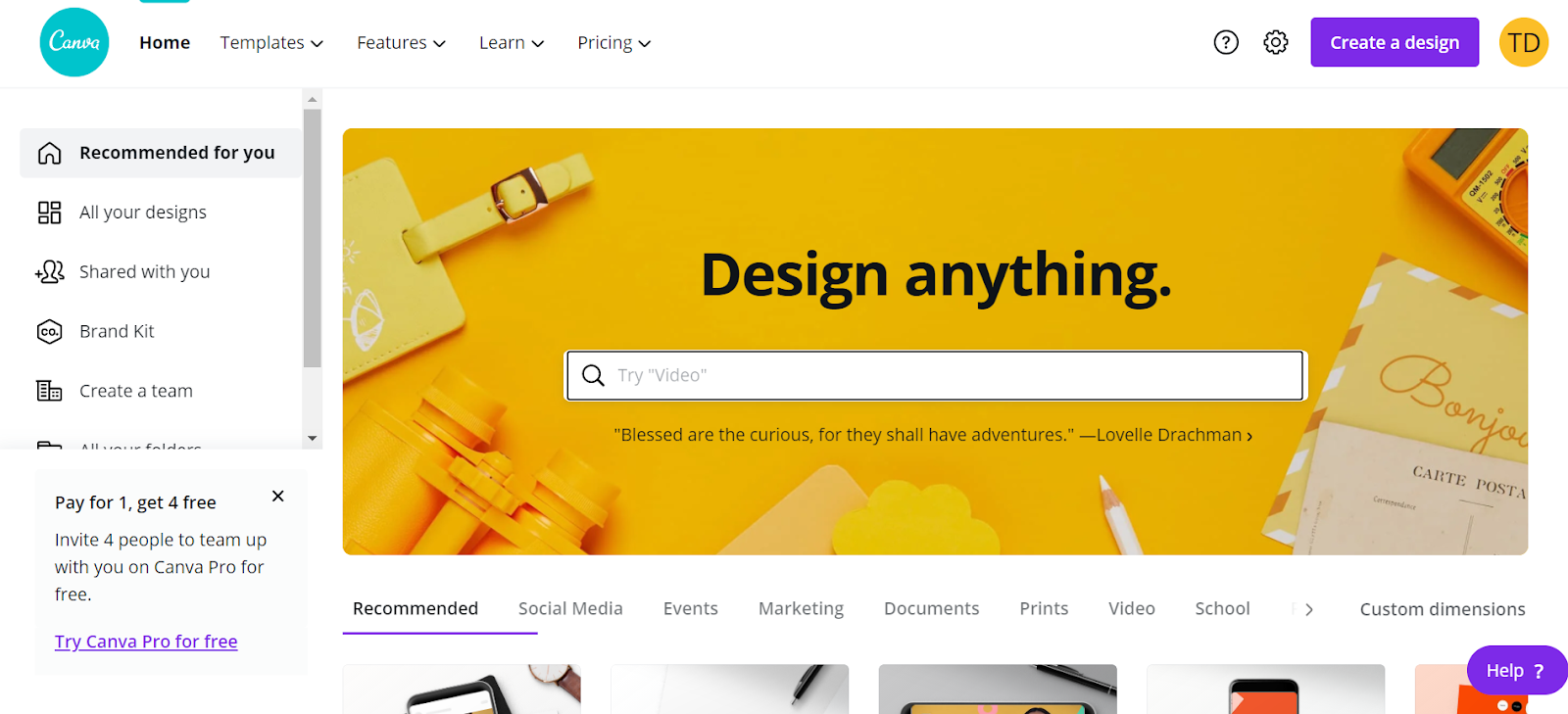
Create video thumbnails in Canva, and make sure they look good on all devices.
In addition, mobile devices may not always be connected to WiFi. Many users may be using data to browse the internet and watch videos.
However, while people are on the move, data speeds might fluctuate. As a result, they may not be able to stream videos at the speeds that they would typically get over WiFi.
If your video file size is large, it’s likely that the video may not load well. When this happens, your viewers may move on to the next post. After all, no one likes to wait a long time for videos to load.
How can you avoid this?
You can create videos that have smaller sizes. This will make it easier for the viewers to stream them.
To ensure that all of these things are taken into consideration while creating videos, ensure that your content marketing strategy outlines the steps needed to be taken for mobile devices.
4. Video Sound
As mentioned above, most people watch videos on mobile devices. And when they do, it’s highly likely that they will be on the move or in public places too. In such a situation, not everyone uses earphones to watch videos.
As a result, people tend to watch videos without sound. In fact, a survey found that 69% of consumers in the US watch videos on mobile devices without sound in public places.
But here’s the thing — 25% of them even watch them without sound when they’re in private places.
So, if you want your video to appeal to this huge chunk of your audience, you need to ensure that it gives the same effect without audio.
While you’re designing the video, try adding subtitles or text to get the message across without any sound.
Pro Tip: Before you upload the video, go through it without the audio. Try to see if it’s still equally engaging. If so, you can go ahead and upload it.
Final Thoughts
Creating social media videos can help increase your reach and drive engagement. However, to craft videos that can do so effectively, it’s critical to understand the key elements of these videos and use them to your advantage.
You need to design your videos based on the platform and also change the dimensions accordingly. Also, it’s equally important to decide on the video’s length as it’s dictated by the format in which you’re going to upload it.
What’s more?
The video graphics need to be designed for mobile devices, as most videos are watched using mobile devices.
Finally, a huge number of people watch videos without sound. So, you must ensure that the videos appear equally engaging without it too.
The post 4 Key Elements of Effective Social Media Videos appeared first on Content Marketing Consulting and Social Media Strategy.
Source: convinceandconvert.com

5 Ways to Boost Your Visual Marketing Results
Without high-quality visual content, there is no brand presence on some of the most powerful platforms, including Instagram and Pinterest. While you can promote links and text on those networks, non-visual content is likely to go unnoticed.

Marketers have long been talking about the power of visual content, both for attracting attention and for engaging your audience.
Yet, with the emergence of visual-only social media networks — like Instagram and Pinterest — visual marketing stopped being a nice-to-have and became a must-have.
Without high-quality visual content, there is no brand presence on some of the most powerful platforms, including Instagram and Pinterest. While you can promote links and text on those networks, non-visual content is likely to go unnoticed.
While the video is important, simply publishing videos is not going to be enough. Every other brand is doing that, and the consumer’s eye is pretty used to bright, flashy images by this point.
What you need is to stand out — which is getting more and more challenging in our era of the visual web.
Effective Visual Marketing Strategy:
So what can you do to embrace a more effective visual marketing strategy?
It’s all about ingenuity and experimentation, but here are a few ideas to get you started:
1. Turn your social media images into artwork
Make your social media images impossible to miss: it is as simple as that.
Well, it does sound simple, and it will obviously boost your content performance – but how exactly can we do that?
Luckily, there are tools for that, so it’s also quite doable.
Quickart by Lightricks is my most recent discovery and it was an instant hook. The app allows you to apply artistic patterns, filters, and effects to create memorable visual content that is impossible to miss:

Image source: theverge.com
My favorite thing about this specific app is that it is insanely easy to use. You don’t spend hours figuring out any super-advanced photo-editing instruments, like layers or mask tools, but the result is always unique and creative. Also, it is free.
2. Brand your images well
People are highly visual. Our brain relies on images and visualizations, which makes visual marketing so effective.
Our brain processes visuals 60,000 times faster than text and retains 80 percent of what we see versus just 20 percent of what we read.

Source: Scientific Reasons Visuals Increase Engagement
When we think, we tend to picture things. Our brain easily brings up colors and shapes, rather than text or numbers. We visualize associations and connections among different concepts and entities.
Through the creation of visual connotations, images make any information more memorable, and this is where the real power of visual marketing lies…
Visual content makes your brand more memorable and recognizable, which, in the long run, brings better click-through and higher conversions.
Branding your visuals is an important step – but one not to be taken lightly.
You do want people to recognize your brand just through your assets – and yet you cannot make your images all about you, as your audience will quickly lose interest.
That said:
- Use the recognizable color palette
- Place your brand in an interesting and creative context
- Make sure that each individual asset contributes to one unified narrative you want your brand to be associated with.
If you are looking for some examples of effective – yet not overwhelming or boring – branding, check out the Instagram account of Boxed Water.
They turn each picture into a story that tells the same narrative: “Life is good and nature is awesome so long as you save this planet”.

Visual Content Example from Boxed Water
However, avoid:
- Creating self-centered images
- Using too much of your logo (watermarks? Not a good idea for Instagram content, for example)
3. Repurpose your images everywhere
With your branding being consistent from asset to asset, bring your strategy to the next level: Attach all your channels with each individual asset.
This is a great way to create that “My brand is everywhere” illusion which ensures your audience remembers you well: Your customer sees your image on Facebook, clicks your link, sees the same (or similar) image on your site, and finally sees it again when searching Google (and that’s where they can no longer resist).
To build this #beeverywhere strategy, carefully use consistent images and visual elements everywhere.
For example, Leadpages features matching visual elements (visual identities) on their Instagram feed and their site:
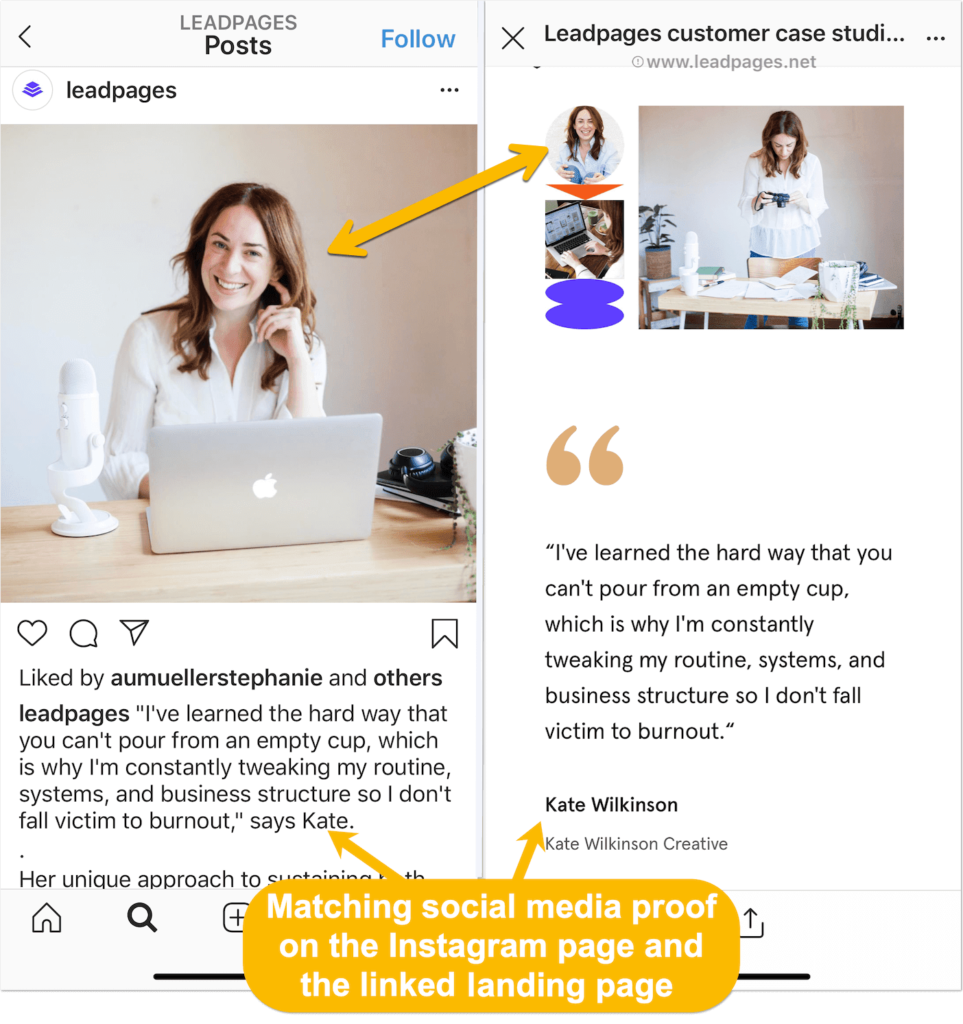
Leadpages features matching visual elements (visual identities) on their Instagram feed and their site.
And UPRIGHT uses the same visual elements in both their Instagram ad and the linked landing page:

This way, by using non-intrusive visual branding, both the brands instill confidence in their users landing on their site and create some sort of brand cross-channel recognizability.
To take this idea even further, searching Google for something relevant, we should be seeing the matching image or element which would instantly catch our attention and prevent me from going elsewhere:
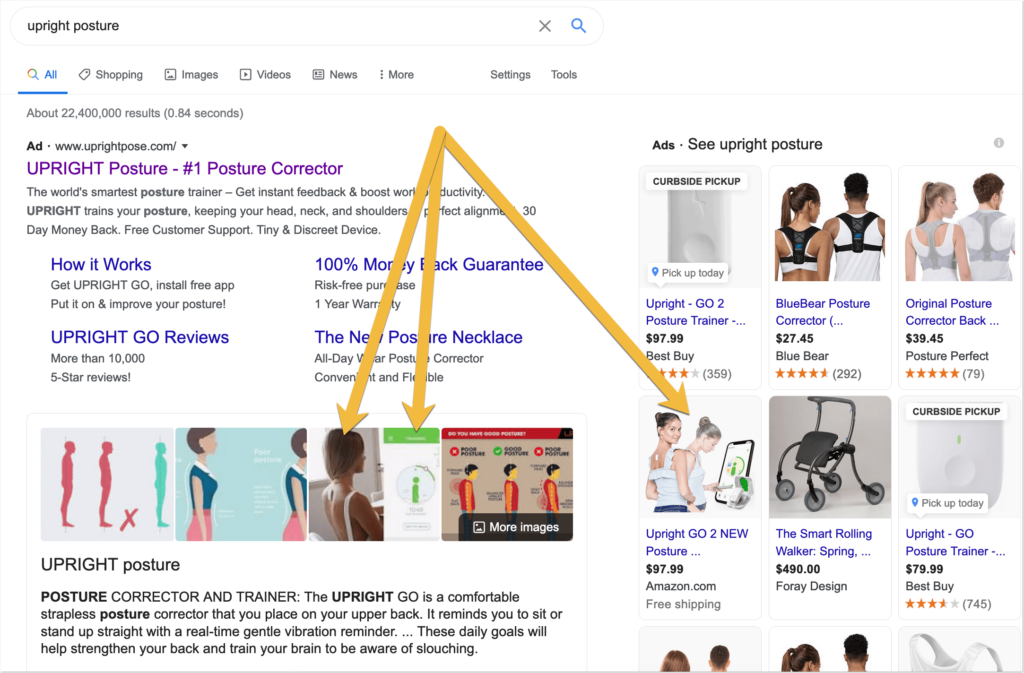
How can this cross-channel recognizability be achieved?
By using a consistent repurposing strategy, including:
- Reusing social media images on your site
- Using the same image (in different dimensions) across multiple channels
- Applying fundamental image SEO practices when publishing those visuals on your site and social media channels (this includes using optimized alt text, a variety of hashtags, and description (or immediate context).
There are lots of tools helping bloggers do this right.
This is where I always use Text Optimizer because the tool allows you to broaden the list of keywords your image is going to show up for.
The tool uses semantic analysis to identify related concepts and entities for you to use in the image description/caption, tags/hashtags, etc. when publishing each image anywhere.
For example, here are semantically-related concepts for [skyscraper]:
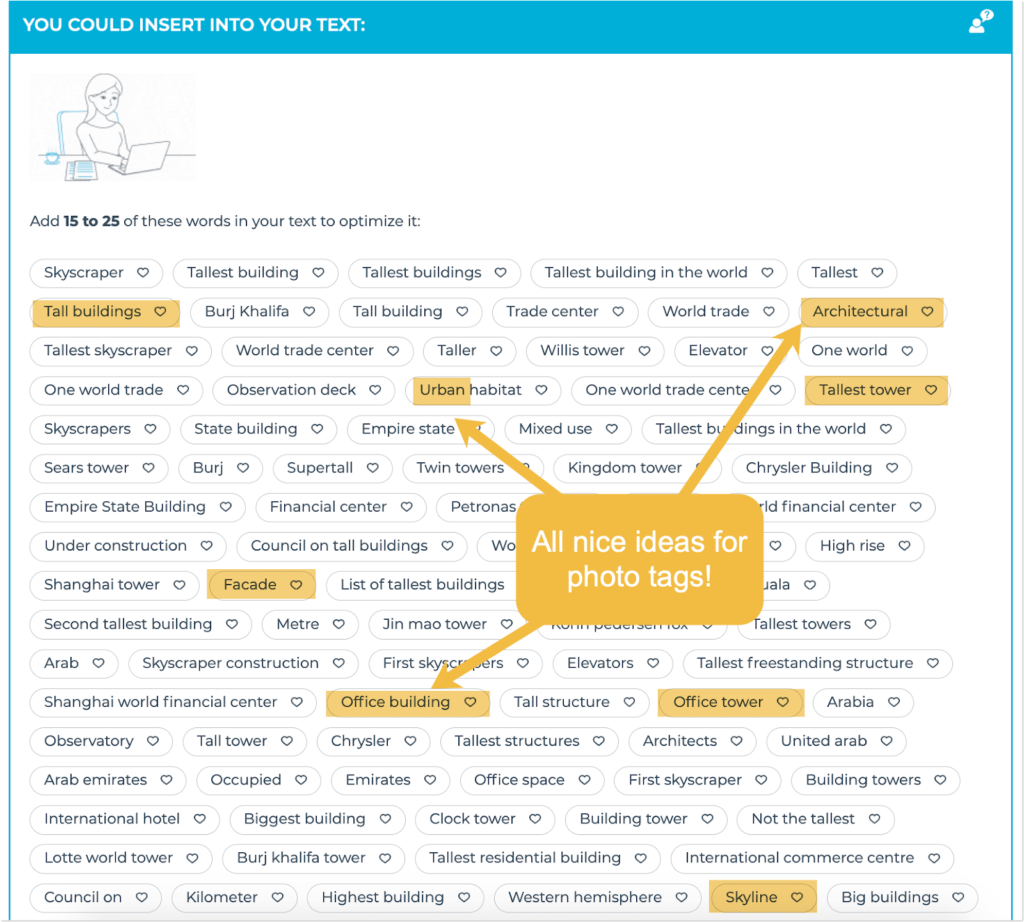
The tool also pushes you to diversify your tactics and avoid keyword stuffing by suggesting you use related and synonymous words in your copy.
Bonus: Embrace visual advertising
You do need all the above steps to do this one right: You need to create effective visuals, brand them in a non-intrusive way, market them across multiple channels, and then start investing in visual advertising.
Luckly, you have quite a few options, including:
- Instagram ads
- Pinterest ads
- Facebook ads
- TikTok ads
There are also emerging, more innovative options like Unsplash advertising that focuses on shifting brand perception and building brand associations rather than clicks and views.
Conclusion
Visual marketing can boost the performance of many – if not all – other promotional tactics you are currently implementing, including content marketing, traffic generation, SEO (or rather on-SERP marketing), etc.
The best part about visual marketing – in my opinion – is that you are never actually done. You always have to be innovating, trying new tools, discovering new tactics in order to stay ahead – or at least abreast of your niche.
The post 5 Ways to Boost Your Visual Marketing Results appeared first on Content Marketing Consulting and Social Media Strategy.
Source: convinceandconvert.com