
Tag Archives for " selling "

5 Ways To Grow Your Customer Relationships Through Social Selling
Social selling is a tool that almost anyone can add to their professional toolbox. While sales professionals have traditionally applied social selling, it can apply to anyone using relationships and relational marketing in their career. Social selling solves the problem of needing to fill a pipeline and connect with customers by building relationships.
For example, recruiters can use social selling practices to identify prospects, build relationships and grow trust with potential candidates before a job opportunity arises.
Social media doesn’t replace your existing selling or relational tools. Instead, it is a different tool that helps leverage the selling skills and the relationship-building skills that one has already fostered in their career.
5 Ways To Grow Your Customer Relationships Through Social Selling
To explain how social selling helps to grow customer relationships on a one-to-one basis, let’s look at these five ways to use it effectively:
1. Understand what Social Selling Is (and Isn’t)
Social selling is the art of using social media to find, understand, connect with, cultivate and nurture potential sales prospects.
There are four key steps in this process:
- Identify prospects online
- Enrich ideal contract profiles
- Showcase knowledge and expertise
- Build one-to-one relationships
While it seems obvious, it bears repeating:
Social Selling is not Social Media Marketing.
Though both happen on social media platforms, Marketing and Sales use different approaches to achieve very different outcomes.
Social media marketing supports driving attention and building affinity at a large scale, with multiple audiences in mind. Organic social media marketing supports the big picture and aims of an organization.
Contrast that with the messages delivered through social selling — messages dialed in for a specific audience through more personalized content. While the Marketing team is broadcasting from one to many, social selling is ideal for that one-to-one communication.
2. Grow Your Network
A key to understanding how best to use social selling is understanding who is really in your audience. When we pull back the curtain and reveal who’s really in our social media audiences, the results are always different than expected. Remember: Those who are paying attention to your channels are not necessarily who is the most active.
In social selling, we must dive into our respective audiences outside of the brand pages.
Think about your own LinkedIn connections and Twitter followers. They most likely include a mix of the following people:
- Prospects
- Co-workers and colleagues
- Industry peers and competition
- Adjacent peers and competition
- Peers from a group, event, or networking event
- Friends, family, and acquaintances
Who do we want in our audience? When social selling, prospects are in our direct line of sight. However, don’t rule out the importance of developing connections with adjacent peers and competitors or others in the peripherals of your network. This is especially true when seeking out who can connect you to a second-level connection.
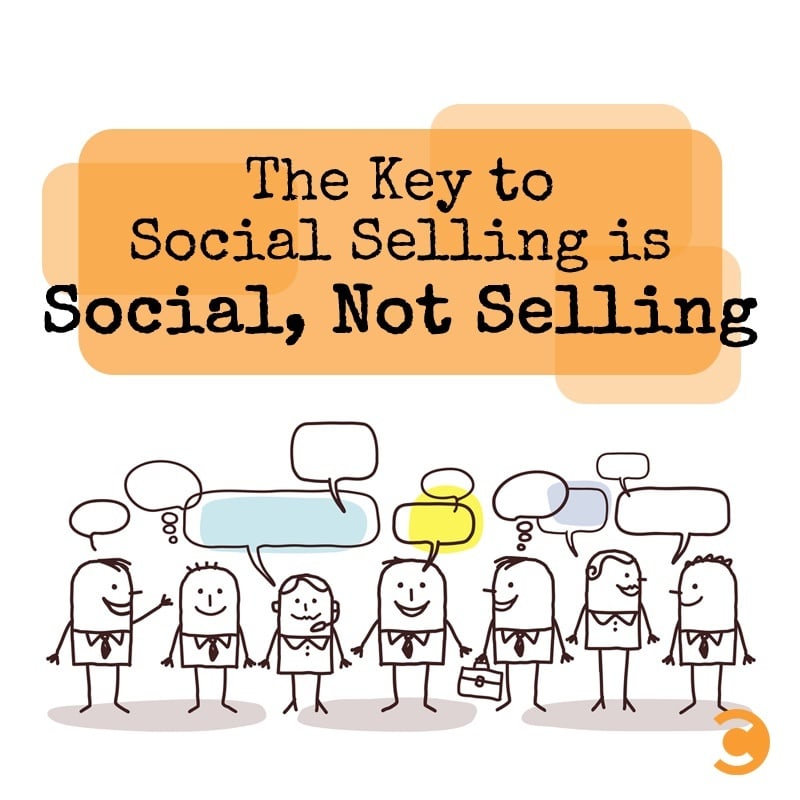
Build connections by adding value to their newsfeeds. At Convince & Convert, we are true believers that Youtility marketing pays off in dividends. When relationships are founded because we are helping, not selling, we become indispensable.
Transactions happening online take many forms — you may not get a direct sale, but an introduction or a recommendation from your network can lead to additional opportunities.
Focusing on helping people first, rather than only considering the next sale or deal, can build trust with our audience. Youtility is relevant in any form: Information, entertainment, and perspective. There are several ways to put Youtility into play.
When you’re relevant to gain someone’s attention, they permit you to earn their trust. Every salesperson knows that trust is the way to unlock that relationship and get closer to the desired outcome.
3. Be a Good Listener
We coined the term “Acceptable Eavesdropping” to describe the ideal way to listen to existing conversations happening online. Adapting social listening rules to how individuals can eavesdrop pays off in these ways:
- Follow prospects & peers and join the conversation they’re already having
- Comment and engage in content in a relatable way
- Join adjacent and industry groups of your target personas. Participate lightly and gain insights from the
- conversations, questions asked, and answers given.
- Follow relevant hashtags to find new prospects involved in similar conversations.
- Use Notifications and tools like Spoonbill.io to identify and react to profile changes.
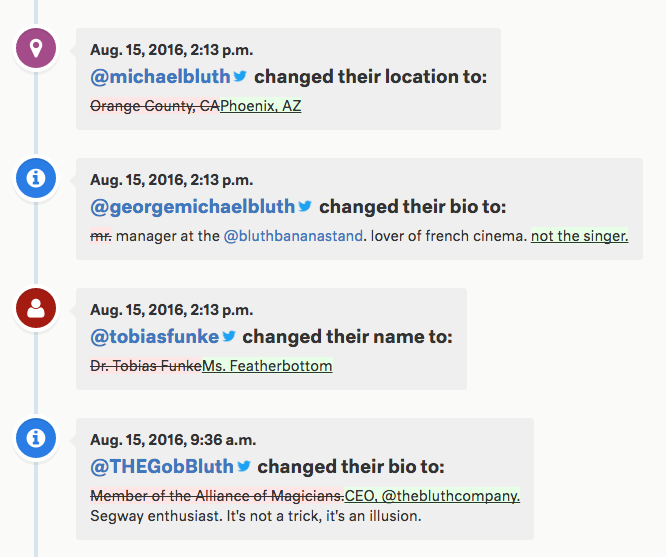
Credit: Spoonbill.io
Our actions online are generally public unless we expressly limit them. What is posted publicly is available for anybody to eavesdrop on if they know how to do it. From a social selling perspective, listening to existing conversations provides insights that help sellers fine-tune messaging and identify opportunities to contribute.
Comment on and engage with content and conversations, even if it’s not directly related to your sales effort. Applying a Youtility-first mindset, try to add value with any response or answer. Having an actual conversation builds trust and rapport.
Joining and participating in groups that attract your target personas or adjacent can lead to insights into how those individuals generally talk about their business challenges and needs.
One of the early steps I made this year while working on a startup idea was to join groups on Facebook and Reddit that help me identify and note the challenges of users that my idea will solve.
While I am not participating actively, being part of the group allows me to get familiar with this audience group’s challenges, complaints, and celebrations. Those insights are invaluable as I begin to build my product and demonstrate that I identify with the users’ needs from their point of view.
Wherever you choose to listen, do so to connect within your industry or specialty. Use that time to share information and expertise, ask for advice and build relationships. Select the social channels, groups, and hashtags that reflect the communities within your target audiences to get smarter about prospects and current customers.
4. Engage With Purpose
Listening should inform what content to create and share. All content should start from a place of understanding:
- 1) Who are you trying to reach?
- 2) What does that audience care about?
The Convince & Convert team says this all of the time, but it’s true: creating content your audience cares about is a surefire way to help them find you and stay with you.
But too often, employees are creating content that only they or their employer cares about. The effects just aren’t as appealing. We’ve all seen this as we’re scrolling through our newsfeeds, and we scroll right by what isn’t the most relevant or interesting content.
There needs to be a balanced approach between a company’s social marketing strategy and the employees taking ownership of their personal brand.
When directly engaging with your network, remember the golden rule of engagement– add value to your conversations. Do this by researching their industry and tailoring your content to their interests and needs. Be mindful of all information you share.
A good rule of thumb is to avoid using the word “I” in the first ten words of your post, caption, or comment. Engaging from a place of help means the conversation is not about you.

Stop defaulting to the “Like” (thumbs up) reaction. Using these other reactions will stand out among the different reactions, as others do not often use them.
If the post or article is noteworthy, consider sharing it and crediting the author. Send the author a direct message appreciating the post or tag them in your comments.
Use the Articles & Activities section to see what your contacts are commenting on. This will give you important insights into what they are interested in and allow you to open a conversation on a mutual piece of content you have engaged with. If your contact is not posting actively, this may help open a dialogue.
5. Measure the Effectiveness of Social Selling Efforts
Social media is a great way to generate leads, sure. But how can we measure the social selling steps of connecting with an audience, building credibility, and earning their trust? How do you know if your social selling plan is effective?
Here are a couple of ways to measure the effectiveness of social selling efforts.
Social Selling Index:
LinkedIn’s own Social Selling Index can be a barometer for individual progress. According to Linkedin, the SSI is a helpful measure of how a salesperson’s social selling skills and execution come together.
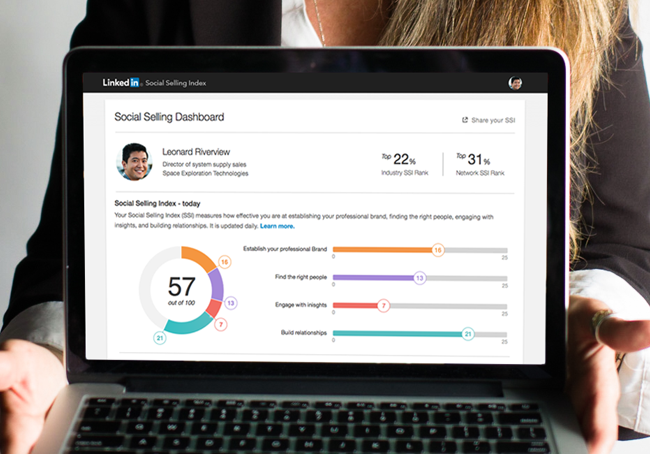
LinkedIn Social Selling Index
This self-report card allows for progress checks over time as a good base for identifying what steps taken are helping. It’s calculated by evaluating four distinct pillars:
- Establishing your professional brand
- Finding the right people
- Engaging with insights
- Building relationships
SSI scores update day to day, providing real-time feedback based on your activity and the health of your network over time. The score is based on a scale of zero to 100, with a maximum score for each pillar being 25.
Linkedin reports that social selling leaders create 45% more opportunities than those with a lower SSI as if we needed an incentive to boost scores. The more consistent you are using LinkedIn, the more significant the impact on your SSI score–but more importantly, the greater impact on your network overall.
Trackable Touchpoints
Making every touchpoint that we have with individuals trackable seems impossible. But in digital, we can get close with the right tools in place. Using data capturing and tracking technology makes it easier to qualify prospects and understand when they’re more ready and open for conversation.

Avoid duplicating Marketing’s role by trying to create campaigns on your own. Instead, it is more effective and more manageable to make individual touchpoints interactive.
Augment your emails and shared content to track when they are opened and viewed. Some of our favorite tools to do this include:
- Video tools that allow for viewability reporting, like Vidyard GoVideo
- Email enhancers like MixMax for automation and Sigstr for signatures
- Campaign URL builders and short URL providers
- SMS Messaging
Go Forth and Prosper
When applying social selling to building relationships with your social network, remember this: Doing it wrong is worse than not doing it at all. Take these ideas, and don’t hesitate to make subtle shifts in how you approach social media individually.

By focusing on the social more than the selling, success will follow.
Need an assist? The Convince & Convert Consulting team offers workshops on how teams can apply social selling to Sales, HR, and Professionals of all kinds.
The post 5 Ways To Grow Your Customer Relationships Through Social Selling appeared first on Content Marketing Consulting and Social Media Strategy.
Source: convinceandconvert.com

Subconscious Selling: Your Customers Won’t Buy Without These 3 Elements
Your customers are social, plugged-in, and savvy.
Selling to them (even with high-impact direct response) isn’t easy. Which is why today, I’m giving you some contrary advice…
Stop focusing on features and benefits. Stop hyping up your copy. Instead, sell your product on a subconscious level, and you’ll have customers drooling with desire before they know what hit them.
Keep reading and I’ll give you 3 ways to do just that. Plug these essential elements into your marketing to drive customer sales naturally and easily.
1. Social Proof
Think benefits sell? Think again. To sell your product, you need to build trust. Seth Godin says it well:
Without trust, marketers know that there are no sales. Trust means the prospect believes not only that the product being sold will actually solve his problems, but that if for some reason it doesn’t, the company will make good on its reputation of performance.
Today’s consumers assume marketers are trying to take advantage of them, so it’s important to establish credibility in all your marketing. But here’s the thing: You don’t actually have to prove you’re trustworthy if you can show that other people already trust you.
This concept, called social proof, was made popular by Robert Cialdini in his book, Influence. In it, he explains that we “view a behavior as more correct in a given situation to the degree that we see others performing it.”
To see how powerful this concept is, we have to take a quick dive into biology.
In 1992, scientist Giacomo Rizzolatti noticed that monkeys’ brains would fire not only when they performed an action, but when they saw someone else perform that action too. He later discovered the same tendency in humans.
Sell your product on a subconscious level, and you’ll have customers drooling with desire before they know what hit them.
This phenomenon, dubbed “mirror neurons,” explains why you laugh when everyone else in a meeting laughs (even if you didn’t hear the joke), and why you wince when someone falls or hold your breath when your kids are learning to swim underwater. It also explains why, when you see an actor dressed in the newest fashion, you want to wear something similar.
When you see them getting second glances, your brain starts firing as if you were getting those looks. And your subconscious brain tells you that you’ll be just as sexy and successful if you wear the same type of clothes.
As Martin Lindstrom says in his book Buy-ology, “It’s as though you’ve just bought an image, an attitude, or both.”
What This Means for Marketers
Social proof isn’t just smart marketing, it’s a mandate if you want more customer sales. And it’s as easy as showing other people enjoying or benefiting from your products. While there’s no limit to the number of ways you can do this, 3 come immediately to mind.
a. Case Studies
Share stories of real people using and enjoying your product. How you tell the story doesn’t matter: use written case studies, videos, and interviews. What’s important is that you show how your product or services are helping people reach their goals.
The secret to powerful case studies is this: site real numbers and specific details. Notice the headline in this case study for LinkedSelling. It doesn’t site “massive growth” or “impressive returns.” It spells out “400% ROI.”

b. Endorsements & Testimonials
Make it a regular practice to ask customers for a testimonial. Then use them liberally to sell your product.
Ideally, you’ll collect enough to create a “Reviews” page. This one, from Boom! by Cindy Joseph, starts off with text reviews…

…followed by a collage of images showing how well the product works on real women:

When you get a testimonial from someone with celebrity status—either because their name or the company they work for is easily recognizable—by all means, feature it. On Single Grain, this testimonial by the Director of Marketing for Amazon Alexa carries weight because we believe anyone who works for Amazon knows their stuff.

As you can see, when other people show confidence in you—especially if it’s someone well-respected by your community—it’s easier for others to trust you too. That makes it easy to push people off the fence and increase customer sales.
c. Customer Logos
Another way to communicate trust is to pull back the curtains a bit and let prospects see who else uses your product. When they see brands they respect on the list, you gain instant credibility.
For example, this impressive list shows you how many big brands trust Single Grain.

Notice the link to “view case studies” prominently displayed below the graphic. This makes it easy for prospects to get even more details about how Single Grain works.
PRO TIP: Any time you can add specifics to your marketing, you boost your credibility. So turn all general statements into specifics by adding precise numbers, brand names, and facts.
2. Scarcity
Cialdini calls this “The Rule of the Few.” He says:
The idea of potential loss plays a large role in human decision making. In fact, people seem to be more motivated by the thought of losing something than by the thought of gaining something of equal value.
As soon as you hear something is off-limits, you want it.
It’s true. As soon as you hear something is off-limits, you want it. If a book is going out of print, you want to buy it. And if a product is only available until midnight tonight—even if you don’t need it right away—you’re inclined to buy it… just in case.
That’s how scarcity drives customer sales. It makes you aware that you might miss out if you don’t take action.
What This Means for Marketers
Consider Black Friday offers that promote just 100 electronics at 75% off or an 80% discount only till 10 am The fact that the offer is limited drives people to stand in line for hours before the store opens or to physically wrestle with one another for the prize.
How can you do this in your digital marketing? Check out this email from DigitalMarketer’s Founder and CEO, Ryan Deiss:

Ryan is a master at leveraging scarcity in his marketing. Look at how he piles it on in this email:
- There’s a “special link” that gives you a discount. “Special” makes you believe it’s not available to everyone, which creates a feeling of exclusivity.
- The discount is only available through Monday at midnight. So there’s a time limit pushing you to respond now.
- Seats sell out every year. If you don’t act quickly, you could miss your chance to attend.
- And if you don’t honestly believe the event will sell out, you might be motivated by the “best seats” reference. Again, a bit of exclusivity makes you feel you might miss something if you don’t click through and buy your ticket.
Scarcity can be achieved through limited inventory, a deadline, or making something only available on certain dates or times. You can use it in emails to make people click through, in your sales pages to make people take action, and as a value-add offer before or after purchase.
PRO TIP: Any time you can reduce or reverse risk, you’ll improve response rates. Absorb as much of the risk as possible with a strong guarantee, lengthy trial period, or ridiculously low price.
3. Sensory Language
Deep in your brain’s temporal lobe is an almond-shaped cluster of neurons that some experts call your lizard brain. Known as the amygdala, this primitive part of your brain is both pre-verbal and pre-logical. So it can trigger action before you have time to think about it.
Neuromarketers also call it a “buying brain,” because pushing its buttons leads to a Buy Now response that’s almost instinctive. Here’s how Dr. A. K. Pradeep says it in his book The Buying Brain:
The basic lesson is that human brains process much of their sensory input subconsciously.
Our senses are taking in about 11 million bits of information every second.
Our thinking brains—that part of thinking in which we are aware of thinking—can only process, at best, 40 bits of information per second.
The subconscious level of the brain is where elements that are essential to marketing success such as initial product interest, purchase, intent, and brand loyalty are formed, and where they reside.
In other words, spark desire by connecting with people’s primitive brains, and you can generate a buying response without manipulating anyone. People want to buy without knowing why.
The result? More customer sales.
What This Means for Marketers
Research shows that mirror neurons (that’s the monkey-see-monkey-do thing we talked about a few minutes ago) can be stimulated by reading as well as observing. For example, read this:
Yawn.
Just reading the word makes you want to yawn.
That’s especially good news because you can’t pump smells and velvety softness over the internet. But you can stimulate the subconscious with sensory words.
Engaging the buying brain is as simple as tickling the five senses in your writing. Sight is easy (pictures). But you can also evoke scents, touch, sounds, and taste. Let me show you what I mean in this example from Lawrence Bernstein.

“Like the windows in a store” creates a mental image. (I visualize a big display window with mannequins in high-fashion dresses.)
“Created on the fly” gives you a sense of speed or motion.
Circled words—melt, explosive, verbal dynamite—are sensory. You can see, feel, or hear them.
He could also have said something like this:
- “Pepper your writing with these irresistible words and your prospects will feel compelled to buy.” (Taste)
- “Build a rock-solid foundation for your sales pitches by using words that hit hard as nails.” (Touch)
Now notice how naturally these words fit into the copy. Sensory writing is nothing more than good writing. It reads naturally and isn’t likely to be perceived as hype or manipulation. But it excites people’s primitive brains and makes them more likely to respond.
PRO TIP: After you’ve written your sales page, go through it to find places where sensory language could be added naturally. In particular, replace being verbs (is, was, are) with active verbs and make sure you help people see themselves using your product.
Selling to the Subconscious
Your customers may love to buy, but they don’t want to be sold.
Your customers may love to buy, but they don’t want to be sold. Your job, then, is to sell your product to the subconscious brain, so you trigger desire before they know what hit them.
Fortunately, it’s easy if you sprinkle your sales copy with social proof and sensory language, then mix in an element of scarcity.
Before you know it, you’ll have people drooling over your products without ever knowing why.
(NOTE: Want more clicks from Facebook, Twitter, and your own blog? Copy and paste these 72 proven headline formulas and get more clicks to your content now. Plus, get 3 simple hacks to optimize any headline in 12 seconds or less. Learn more now.)

The post Subconscious Selling: Your Customers Won’t Buy Without These 3 Elements appeared first on DigitalMarketer.
Source: digitalmarketer.com

Conversational Selling: The 5 Critical Questions That Will Help You Generate Sales Leads From The Traffic You’re Already Getting
I want to start this post with a quick question:
What is the highest-converting sales medium of all time?
I’ll give you a second to think about it.
(Cue the “Jeopardy” music…)
OK, time’s up!
The answer…is face-to-face selling.
And that makes sense, right?
After all, a real human salesperson—especially a GOOD one—has all kinds of advantages over mass medium channels like email, TV, and print.
For example, when face-to-face with a prospect, a real salesperson can see your reactions in real-time. Ask you questions. Address your objections as soon as you raise them.
And, perhaps most importantly, they can create a sense of connection with you and make you feel like you’re talking to someone who truly cares.
I call that conversational selling, and it’s quite simply the single most effective way to sell a product or service in history.
Engineer more high-converting sales conversations from the traffic and leads you’re already getting.
So why do I bring this up?
(Especially on a blog that’s dedicated to digital marketing?)
I’m glad you asked.
Because the truth is, the way we sell products and services online is changing.

One-to-many marketing methods (things like banner ads and email blasts) are becoming less and less effective every day. At the same time, 1-to-1 marketing methods (things like Messenger marketing) are becoming more and more common—and more effective.
And by using some of these tools, we can actually start to leverage the high-converting power of conversational selling…
ONLINE!
And in this post, I’m going to help you do just that by showing you how to engineer more high-converting sales conversations from the traffic and leads you’re already getting.
But before we dive into that, there’s something you need to know first.
How Do People Converse Online? (AKA What Tools Should You Use?)
OK, so we’ve established that conversational selling is the highest-converting sales medium of all time.
In the past, conversational selling meant either face-to-face selling or selling over the phone. But we’re not talking about face-to-face or phone conversations here.
Instead, you’re going to learn how to leverage conversational selling in digital marketing.
But how do you do that?
Today there are 3 big tools you can use to leverage conversational selling online:
- On-page chat
- Messenger chat
Later on, in this post, I’ll go over some of the specific tools I recommend for #2 and #3. But for now, I just want to talk about these tools in general.
And in order for this whole conversational selling thing to work, you can’t do what most people do—which is to use these 3 conversation channels interchangeably.
These are different tools and they have to be used in different ways to really generate sales with high-converting messages.
So, let’s dive into how you do that.
How to Start a Conversation Online (Strategically)
The first step in any conversation is—obviously—to start the conversation in the first place.
This is something you should spend some time thinking about. Because there’s a right way and a wrong way to do this, and the way you begin a conversation can have a big impact on that conversation’s outcome.
So, with that in mind, there are the 3 different ways to open your online conversations in a strategic way that tends to lead to more sales.
Conversation Starter 1: Page to Chat
When I say “page to chat,” I’m referring to those little chat windows that you see pop up in the lower-right corner of websites. Here’s an example:

Unfortunately, these chat boxes don’t really have much of a sales effect for the majority of companies who use them. And you want to know why?
Because they don’t do a good job of starting the right kind of conversation.
And to illustrate why that’s the case, I want you to go through a little exercise with me.
Pretend you walk into a department store and start browsing around in the clothing section.
And after a few minutes, a salesperson approaches you and says:
“Hi there, can I help you?”
We’ve all heard that question in a situation like this before. So, how do you usually respond?
Well, if you’re like most people then your response to that question will be:
“I’m just looking.”
Now, notice what happened there.
The salesperson asked you a question—they tried to start a conversation.
But the question they asked you was way too open-ended. There was no easy way for you to respond, so rather than make the effort to come up with a thoughtful response on the spot, you did what 99% of other people do: you politely refused their help.
Conversation attempt…denied.
And there’s an important lesson here for digital marketers.
If you don’t believe me, take another look at this chat window, and pay attention to the question they’re asking:
It’s the same basic question! “How can we help you today?”
Ask a binary question that leads the conversation in the right direction.
And I guarantee you it gets the same answer from the vast majority of people. That is to say…no answer at all.
People ignore this question on your website, just like they do in person.
Why? Because, once again, it’s too open-ended. It isn’t focused. There’s no quick and easy way for them to answer.
So, what should you do instead?
Rather than asking a difficult, open-ended question that could lead anywhere…
A smarter approach is to ask a binary question that leads the conversation in the right direction.
Here’s an example of what I’m talking about:

See how much easier that question is to answer? There’s really no thought involved. It’s super-quick and super-easy.
It also leads the conversation in the right direction!
Rather than bringing up an unrelated subject, the question leads very naturally to a conversation about agency/consultant marketing.
It’s just a better way to open a sales conversation.
So, that’s my first tip to help you open better sales conversations. Start by asking a binary question.
Now let’s move on to Tip #2, which is going to help cut down on the number of conversations with unqualified prospects.
And the way you do that is to throttle your conversations to filter out unqualified prospects.
When it comes to conversational selling, particularly with on-page chat boxes, more is not necessarily better.
See, most companies put their online chat widget everywhere: on every single page, including the homepage, for every single visitor.
That will lead to way too many conversations with way too many unqualified prospects.
Instead, I recommend throttling your page-to-chat conversations. Be more strategic about when and where you choose to display your on-page chat widget so that you’re starting higher-quality conversations with better-qualified leads.
And here are 4 ways you can do that:
Avoid the Homepage
Your homepage gets way too much general traffic.
When people come to your homepage, they aren’t ready to have a sales conversation. Instead, they’re just getting oriented to your site and trying to figure out where to go next. So, skip the homepage.
Trigger Chat on the Third Visit
People often aren’t ready to buy right away.
They need some time to learn more about your company and your product or service. So, don’t try to rush things—wait until they come back after a few visits and are ready to take the next step.
Trigger Chat on Bottom-of-Funnel Content Only
Separate your content into top-of-funnel (TOFU), middle-of-funnel (MOFU), and bottom-of-funnel (BOFU) content.

People viewing your TOFU content aren’t yet ready to buy; they’re still getting acquainted with your product or service.
Instead, trigger your chat boxes on BOFU content that indicates the visitor is close to making a buying decision.
Examples of BOFU content include individual product sales pages, trial or demo pages, pricing pages, and so on.
Another benefit of targeting bottom-of-funnel content is that the content can inform the conversation.
For instance, if our visitors here at DigitalMarketer are visiting BOFU content about Facebook advertising, we might open a different conversation than we would with someone visiting BOFU content about Google Analytics.
Trigger Chat on Pricing & “Thank You” Pages
Another way of targeting BOFU content is to trigger chat on the pages that people tend to visit just before and after converting.
Throttle your conversations to filter out unqualified prospects.
Anyone visiting your pricing page is clearly considering a purchase. And anyone who visits a “thank you” page has just signed up for something, such as your mailing list—which means they’re often open to a conversation about making a bigger commitment with your company.
So, to recap, page-to-chat is a great way to open sales conversations with the traffic that’s already coming to your website. And 2 tips you can follow to start better conversations with those people are:
- Start by asking a binary question that leads the conversation in the right direction.
- Throttle your conversations to filter out unqualified prospects.
Conversation Starter 2: Email to Chat
OK, now we’re going to jump to a new medium: email.
And to many of you, it might not seem like email is really a conversational marketing channel. After all, isn’t email the same channel you use to blast out promos and deliver automated campaigns that never really involve any back-and-forth?
Well, yes. It is. But email can also be a really powerful way of opening sales conversations…if you’re strategic about it.
Here’s a 3-step process you can use to generate high-quality sales conversations through email:
Step 1: Use High-Intent Gated Content
It might sound obvious, but the first step to using email to generate sales conversations…
…is to attract the right email subscribers in the first place.
And to do that, I recommend using high-intent gated content. In other words, you ideally want the content attracting people to your email list to inform the conversation. To give you an idea about what that person is interested in.
So, at DigitalMarketer, we would NOT want to use gated content like: “How to be a better marketer.”
That’s way too general. It doesn’t tell us anything about what that person wants, except that they want to be better at marketing. Very vague and nonspecific.
Here’s a much better example of high-intent gated content that has worked very well for us in the past:

See how much more specific that is?
We know that the only reason someone would register for this is if they want to build an in-house marketing team.
So, the content itself is attracting the right kind of people for the sales conversation we ultimately want to have. And the content informs that conversation, so we know exactly what to talk about when we email them.
Step 2: Send Emails That Ask For Replies (Not Clicks)
Most emails ask for a click. They want you to click through to a blog post, to a registration page, to a sales page.
But remember that email isn’t just a one-way communication channel! We can also send emails that ask for a REPLY.
(Shocker.)
And if you want to use email to start a sales conversation, that’s exactly what you need to do.
Here’s an example of a few emails that do that, including my all-time favorite, “the magic 9-word email”:

That 9-word email, in case you can’t read it, is:
“Are you still looking to grow your marketing team?”
And you can use this formula for just about anything. The formula is: “Are you still looking to,” and then add the desired end result you know the person is after.
- “Are you still looking to grow your marketing team?”
- “Are you still looking to lose 10 pounds before that wedding?”
- “Are you still looking to drive a golf ball 10 yards farther with every swing?”
The frame of “Are you still…” is a great way to open a conversation because it tells the person on the other side that you know exactly what it is that they want. (And you know this because of Step #1—because you used specific, high-intent gated content.)
And if you do both of those things, you’ll begin to open the right kind of conversations with people via email. And the final step is to…
Step 3: Actually Respond!
Now that the conversation is rolling, all you have to do is keep it going!
It sounds like a simple thing, but it’s actually becoming rare these days. Because so much email is purely automated, you’ll stand out from the pack by simply being a human being and responding to people.
Your prospects notice that. And they appreciate it.

You can also use these conversations to increase sales and even to sell different products!
For example, here’s an email we received back from a prospect. In this email, the person wasn’t a great fit for the service we were originally marketing…
But because we started a conversation and listened to them, we were able to sign them up for a different service instead—one that made more sense for them.

Tip: you can use email to open conversations in other channels, too.
Here’s another example of an email we sent asking for a reply. And in this email, we gave people 3 ways to respond:
- Reply to this email
- Give us a call
- Click a link to chat with us on Messenger

I was surprised at the results of this email.
The highest percentage of people (about 50%) chose to chat with us on Messenger. About 35-40% responded to the email, and 10-15% gave us a call.
So, remember that you don’t have to view these channels in isolation. Use them together and give people the freedom to contact you in the way that’s most comfortable for them.
Conversation Starter 3: Ad to Chat
The third and final way to open a conversation online is through an ad.
The first 2 conversation starters (page-to-chat and email-to-chat) were mostly about starting conversations with the traffic you’re already getting. The people who are already on your website, already subscribed to your email list.
But once you reach the point where you’ve maximized your sales conversations from the traffic you’re already getting, you’ll probably want to go out and start new conversations with even more highly qualified prospects.
And a great way to do this is with Facebook ads.
Facebook has 2 ad units that allow you to jump immediately into a conversation—the person doesn’t even have to visit your website at all.
And those 2 ad units are:
Lead Ads
Lead ads give you a really easy way to build your subscriber list and start conversations with people through email.
This is a really low-friction way to start more email conversations at scale.
To succeed with Lead Ads, you’ll want to offer some type of high-intent gated content (see Conversation Starter #2 above).
And when people click on the button in the ad, they’ll be prompted to enter their information:

Once they click “Submit,” they’ll be added to your email list and the conversation can begin. I recommend going back and following the strategy laid out for Conversation Starter #2.
This is a really low-friction way to start more email conversations at scale.
Facebook Messenger Ads
The other way to start a conversation straight from a Facebook ad is to use Facebook Messenger ads.
Facebook Messenger is one of the newest marketing channels, and it’s growing really fast.
And with these new ads, now you can create Facebook ads that lead to an immediate Messenger conversation:

In most cases, you won’t want this to trigger a live conversation right away. Instead, you’ll start by letting people interact with your chatbot first.
I’ll go into more detail on how we do this in just a minute.
The 5 Critical Questions that Lead to High-Converting Conversations
If you follow my advice above, then you’re going to succeed in starting a lot more conversations.
If you ask these 5 questions, it generally tends to result in a sale.
So…now what?
The next step is to keep the conversation going.
Now you don’t want to chat about just anything here; you want to lead the conversation in the direction of a sale. But at the same time, you want to make sure you do this in a way that feels natural, not forced, and helps build a relationship with the prospect.
At DigitalMarketer, we instruct our salespeople to do that by asking the following 5 critical questions. If you ask these 5 questions, it generally tends to result in a sale.
When used correctly, these questions will help you to have a “warm handoff”—an easy transition from conversational marketing to conversational selling.
Question 1: “Are you [insert market/avatar]?”
Most often, this question is asked by marketing as part of the conversation opener.
It’s a good way to start because it makes sure you’re talking to the right person. Someone who’s a good fit for your product or service.
You can also use this to subtly qualify your prospects. If you want to make sure you’re talking to a decision-maker in a business, your question might be:
“Are you a marketing manager looking for a better way to train your team?”
Question 2: “Tell me more about yourself/your business.”
That’s great! Tell me more. Do you specialize? What do you do?
In this question, you’re just digging a little deeper. Showing some genuine interest.
There’s no ulterior motive. You aren’t taking notes to segment these people for some kind of automated follow-up.
You’re just taking a minute to learn a little more about them and have a normal human conversation.
Question 3: “What brought you here today? What are your goals? What are you hoping to accomplish?”
Now we’re starting to steer the conversation toward your desired end, the sale. And the best way to do that is to ask what they’re hoping to achieve today.
Keep in mind, a lot of people won’t necessarily have a great answer ready for this question. So, if that’s the case, here’s what I recommend.
Take the biggest 3 benefits that your company can provide to your customers, and list those benefits out. Then ask the person which of those benefits they’re most interested in.
This gives them an easier way to answer this question and keep the conversation moving forward.
For example, when speaking to an agency prospect we might say:
“Here at DigitalMarketer we’re really good at helping agencies to (1) attract more clients, (2) scale and systematize their business, and (3) increase their retention and recurring revenue. Between those 3 things, is there 1 that really fits in with your goals?”
Question 4: “What do you know about [your product/company name]?”
Asking someone what they know about you is a great question that continues to help move the conversation forward. It’s also a way you can discover hidden objections so you can overcome them.
So, for example, if they say something positive like, “I’ve heard great things about your product…” Then you can transition pretty seamlessly into the sale.
But if they say something negative, that’s OK too! Because the fact that they’re there, having that conversation with you, suggests that they’re still open to being sold.
And now you have the opportunity to respond to that objection. If they mention that they’ve heard bad things about your customer service, you could reply with: “Yeah, we’ve had our growing pains in the past. Luckily, we’ve got that all sorted out now, and we’re in a great position to help you get more clients…”
When you’re asking this question, look for opportunities to refer back to those 3 big benefits from Question #3.
And once your prospect indicates that they want to achieve one of the big benefits that your product/service/company can provide—once you know what they want—the last thing you need to do is ask:
Question 5: “Do you want some help with that?”
This is the highest-converting close I’ve ever used.
It’s super simple. Really non-intimidating.
This is the highest-converting close I’ve ever used.
And if you’ve followed along with Questions 1-4 already, then making the sale at this point should be pretty easy!
They want a benefit. You know what that benefit is. You also know that your product or service can provide that benefit.
So, at this point it just makes sense.
And if their answer is “Yes,” then you’ve made the sale!
3 Conversational Selling Tips
Now that we’ve covered the process of how to engineer high-converting sales conversations, here are a few more tips to help make this process even more effective.
Tip 1: Try Out These Recommended Tools
Earlier in this post, I told you the 3 channels through which you can use conversational selling online:
- On-page chat
- Messenger chat
For Channel #1, email, there are a ton of options and I’m sure you’re already familiar with them. MailChimp, AWeber, ActiveCampaign, InfusionSoft, etc. Take your pick.
For Channel #2, on-page chat, some of the tools you might want to check out are:
- HubSpot Sales Live Chat. Hubspot does a great job with all their sales tools. And if you use other HubSpot tools, like their database, then you can do some nifty things—like having your chat box appear only to people who are not already customers.
- Drift. Drift calls itself “the world’s first and only conversational marketing and sales platform.” I don’t think you can call it the ONLY one anymore, but they were certainly one of the first (if not THE first) company to promote chat for selling.
- Intercom. This is another popular option. Intercom was originally envisioned more for answering questions and providing support, but you can also use it for conversational selling using some of the techniques you learned above.
And for Channel #3, Messenger chat, there’s really only 1 tool I recommend:
- ManyChat. Unlike the 3 tools above, which are strictly widgets that you add to your website, ManyChat integrates directly with Facebook Messenger. It supports both live chat and chatbots, so you have a lot of power and flexibility when setting up the conversational selling system explained in this post.
One great thing about ManyChat is that you can get started for free. So, there’s really no risk to giving this a try.
Tip 2: Check Out The Hubspot Academy
I originally presented this material on conversational selling in partnership with HubSpot.
And if you’re looking for more training to help improve your ability to drive new leads and sales with an inbound strategy, I’d recommend checking out HubSpot Academy.
They put out some great training that is sure to help you grow your business and/or take the next step forward in your career.
Tip 3: Leverage Chatbots
Lastly, I want to talk about chatbots for a minute.
You may be wondering if bots have a place in conversational selling, and if so, where they fit into the big picture.
And the short answer is that YES, chatbots can absolutely play a critical role in conversational selling online. But they can’t do everything.
In order to do this right, a human will need to take over the conversation eventually.
What you want to do is use your bot for filtering, not for closing the sale.
Then after your bot has filtered out all the unqualified leads and started a conversation with the good leads, it’s time to let a human take over.
So, if you look back at the 5 questions above:
- “Are you [insert market/avatar]?”
- “Tell me more about yourself/your business.”
- “What brought you here today?”
- “What do you know about us?”
- “Would you like some help with that?”
Question #4 is where your bot needs to hand over that conversation to a human.
Here’s a quick example of what this might look like in practice. This is how one of our bots opens a conversation—you’ll notice that this is Question #1:

After we get their answer, the bot moves on to Question #2—asking more about their business:

Then we can use the bot to get a general idea of what this person is looking for, by stating the big 3 benefits we can provide:

Now after the person answers that question, it’s time to transition this conversation to a human salesperson. This lead is potentially ready to buy.
Here’s an example of one way you can do that:

And there you have it: a simple example of humans and chatbots, working in harmony to open—and close—more sales conversations.
Remember: All Selling Is H2H
I want to wrap up this post by saying:
The future belongs to the companies that are willing to invest in real, one-on-one, human-to-human (H2H) interactions.
Remember that while we talk about selling with terms like B2B and B2C…all selling is really H2H. Human-to-human.
NOT the companies who automate every single step of the customer journey so they never have to talk to another customer again.
Remember that while we talk about selling with terms like B2B and B2C…all selling is really H2H. Human-to-human.
It’s a person on the other end you’re talking to. Not a lead, or a number, or a blip on your analytics dashboard. It’s a person.
And people are relational beings! We like to feel connected with each other. Understood by one another.
And when you treat your prospects like real people, they appreciate that. They feel it. And they enjoy it much, much more than the experience of being crammed down a one-size-fits-all marketing funnel.
So, keep that in mind when you’re thinking about how you’re going to market and sell your product or service in the future. And just remember that it’s never bad advice to be willing to invest in real human interactions.
(NOTE: Before you can start selling to your audience, you need to know who your ideal customer is, where they are, and what they will buy. Download our proven Customer Avatar Worksheet now and get clear on who you’re selling to.)

The post Conversational Selling: The 5 Critical Questions That Will Help You Generate Sales Leads From The Traffic You’re Already Getting appeared first on DigitalMarketer.
Source: digitalmarketer.com