
Tag Archives for " metrics "

How to Properly Leverage Lead Scoring to Make More Money
I’m going to introduce you to the world of lead scoring and help you understand what it takes to build an effective lead scoring model for your business.
The biggest brands in the world understand one simple truth: Not all leads are created equal.
Having the ability to find and convert high-quality leads is what keeps these brands successful.
The best and brightest aren’t just focused on volume; they want to sell to the best possible prospects.
Today, we’re taking a page out of their book and focusing on the quality of leads.
Whether you’re running a corporate startup marketing campaign or moving your local business into the digital age, you can’t afford to waste time and money on weak leads.
That’s why I’m going to introduce you to the world of lead scoring and help you understand what it takes to build an effective lead scoring model for your business.
What is Lead Scoring?
Before we dive deep into the metrics and methods you’ll use, let’s establish a baseline definition of lead scoring.
At its core, lead scoring functions are a tool for marketers looking to qualify their leads accurately.
Lead scores are used to determine how likely a particular prospect is to convert based on specific characteristics.
Why do lead scores matter?
As I mentioned earlier, not all leads are the same.
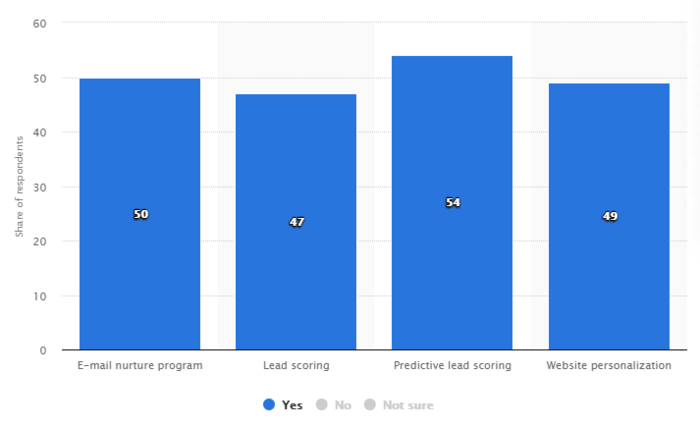
Forty-seven percent of B2B marketers found lead scoring to be effective, with 54 percent pointing to predictive lead scoring effectiveness.
The chances of converting a cold call lead are drastically lower than those of a referral lead.
Using lead scoring, you’re able to arm yourself with a system that tracks and calculates lead scores.
What Are the Pros of Using Lead Scoring?
Now that you understand what lead scoring is, let’s talk about why it’s beneficial to your bottom line.
Less Wasted Time and Money
A business that uses lead scoring learns how to allocate its resources efficiently.
Spending thousands of dollars and hundreds of hours on a marketing campaign that delivers average returns and unclear data is not something most businesses can afford.
Accurate Buyer Personas
Lead scoring is especially useful for businesses selling high-value products and services.
The more complex the decision, the longer your average conversion time from prospect to customer.
By evaluating their behavior throughout the buyer’s journey, you’re able to identify the prospects most likely to convert.
Using that information, you can update your buyer personas and start crafting marketing campaigns focusing on prospects typically converted.
Strengthen Your Prospect Relationships
The deeper your understanding of a buyer’s journey, the more likely it is that you’ll be able to point them toward a conversion.
Imagine for a second that Business XYZ already has a fantastic click-through-rate using paid ads.
Ten percent of impressions lead to a click. That’s great news!
There’s just one problem: Its conversion rate is terrible.
For whatever reason, it can’t consistently attract buyers.
By using lead scoring, Business XYZ can determine what pages and experiences scare away potential customers.
More importantly, it’s able to change and improve those experiences, strengthening its marketing funnel’s weaker elements.
This behavior doesn’t just earn more conversions.
It also helps prospects feel more secure about their purchase and develops the business’ reputation as a customer support specialist.
It becomes known as a business that takes care of its customers at every stage.
By developing a deeper understanding of your customers using lead scoring, you’re able to create unparalleled user experiences.
Simplify the Lead Evaluation Process
Manually, the ability to optimize your marketing and sales efforts with lead scoring identifies and converts the right prospects much easier.
Of course, if you’re looking at automated solutions, you’ll be able to qualify leads using predetermined guidelines quickly.
Metrics for Scoring Your Leads
The actual process of scoring your leads can be a bit intimidating, even if you’re an experienced marketer. To keep this guide accessible, I’ll focus on four key metric classifications to rely on.
Demographics
One of the most basic marketing concepts is the buyer persona, a representation of your ideal customer.
To build this buyer persona and begin determining the appropriate metrics for your lead scoring efforts, you need to begin with their demographic.
Personal information like age is a common starting point, but you’ll likely want to focus on professional information and capacity too.
Ask these questions:
- What characteristics does your ideal customer have?
- How do these characteristics empower them to make a purchase?
- How can you create experiences that appeal to these customers?
If you’re selling a high-value B2B product or service, it’s unlikely that students are your ideal target audience. However, if your lead identifies as an industry professional, they’re much more likely to convert.
Lead scoring helps you organize this information, test your theories and assumptions, and identify the factors contributing to a conversion.
Point of Origin
Break down the buyer’s journey and start with their first point of contact.
If you have a sales background, this process should feel familiar.
When determining which metrics to use, identify the lead’s point of origin.
Look to see where your leads are generated.
Are they on your site because of organic search, or did they click on an ad?
Did they visit your site on mobile or desktop?
As you track the sources of these leads, you’ll find that certain lead channels produce leads that are more likely to convert than others.
You’ll also notice certain combinations have unique conversion rates.
For example, a lead that reached your landing page through a post on social media should have a lower score than an organic search lead that’s visited the pricing section three times.
Different points of origin are given different scores, making it easy to determine both the marketing channel’s overall value and the lead’s individual quality.
Focusing on the source also keeps your sales team informed.
By preparing your sales team with contextual information on the prospect, they can accurately determine the prospect’s knowledge of the business and product or service.
Behavior
A prospect’s point of origin is an important building block when determining their conversion potential, but it’s just the tip of the iceberg.
Analyzing prospect behavior and actions can help you identify the paths that lead to a genuine sale.
Most lead scoring systems use a points system, attributing specific values to particular behaviors.
The beauty of this approach is that you’re able to stress-test your assumptions about your business and determine how impactful a particular behavior is.
For reference, an action is a decision a particular lead makes once they’ve started interacting with your business. These can include:
- visiting a landing page
- subscribing to a newsletter
- requesting a price quote
- signing up for a product demo
- reading blog articles
- asking questions via online chat
If email signup is a massive predictor of conversion, give that a high score and you’re able to focus all of your attention and marketing efforts on prospects that sign up for your newsletter.
If you’re right, your conversion rate rises, and you can continue to optimize.
If you’re wrong, your conversion rate doesn’t rise to meet your goals, you take a closer look at your data and restructure your score allocation.
Either way, your business walks away with a win.
Engagement
Engagement and actions are two separate categories.
Actions track the individual decisions prospects make, like reading a blog post or signing up for a newsletter.
Engagement tracks the timing of those decisions, identifying how much time they spend on a blog post or email.
A general rule of thumb is that the longer a prospect spends consuming your content and interacting with your business, the more likely they are to make a purchase.
Of course, you’ll likely want to set a maximum achievable range to avoid ruining your data.
For example, if a prospect leaves their computer on overnight, that could harm your lead scoring efforts.
Methods for Scoring Your Leads
The methodology for scoring your leads can be broken down into two sections:
- Lead scoring strategy.
- Common practices.
Lead Scoring Strategy
Establishing a clear, baseline process for lead scoring can help your business from a mechanical perspective.
Determine Metrics to Score
Let’s start with the baseline process.
You’ll begin by determining the metrics and variables you want to score.
While it’s easy to focus on highly converting metrics, you also need to determine which metrics convert poorly.
This can help you better understand your market and customers.
Calculate Values
Next, calculate both the value of the metrics and the value of your leads.
Common Practices:
There are two common approaches to calculating the value of a metric:
Conversion rate: This is simple enough to calculate. Divide the number of conversions by the number of leads attained and multiple by 100.
Lead yield: This approach is a bit different.
- It’s a measurement of the total revenue made from conversions.
- Take your revenue and divide it by the number of leads generated.
- This gives you the average value of a particular conversion.
To be clear, there’s no right answer. The method you use depends entirely on your overall business goals and pricing structure.
Making calculations based on conversion rate might be a great idea for B2B SaaS businesses with long lifetime-value customers.
B2C businesses and companies that offer fixed-price products are more likely to find lead yield useful.
After all, the higher the value of an individual sale, the more valuable that lead was.
Compare Values
Now you can compare the value of a particular group of conversions to the average value of all your conversions.
This lets you qualify the performance of a particular metric and determine its importance.
Assign Scores
Based on the performance of a particular metric in relation to the average customer, you can assign that metric a score.
Most organizations use a scale from 1-10, but that’s a personal preference.
You could use a 1-100 scale for increased precision; it’s entirely up to you.
However, be sure to create a rubric or key to keep your scoring system consistent.
Evaluate Leads
You’ve established some metrics and some scores at this point, so let’s start evaluating individual leads.
Here’s an example: Imagine you’ve ranked the accounting industry as a 10-point attribute, a C-level executive as a 5-point job title, and corporate enterprises as 10-point company size.
A lead matching each of those metrics has a total score of 25.
You can now compare that score against your average customer and other leads to determine your leads’ priority. Simple enough, right?
Lead Scoring Tips
Incorporating useful tips and tricks can help you elevate the quality of your lead scoring efforts. Consider a couple of key concepts:
Values metrics accordingly:
For starters, not all metric categories should be valued equally.
A demographic metric doesn’t carry the same weight as a behavior metric.
Signing up for a consultation is a much stronger indicator of interest than a job title is.
Values can be cumulative:
It’s also worth keeping in mind that some of these values are cumulative.
Meaning that while a prospect’s job title is only counted once, all of their actions are considered when calculating the lead score.
Tracking the Success of Lead Scoring
As your lead scoring efforts develop, you’ll notice an increase in both the sheer volume of leads and the complexity of your lead scoring system.
As you interpret your results and look to improve, you’ll encounter two hurdles:
- optimizing for scale,
- optimizing for effectiveness.
Optimizing for scale has some simple solutions.
If you’re on a budget, lead scoring manually with spreadsheets and formulas is perfectly reasonable.
However, if you’re willing to pay for the best, some fantastic tools are available to automate this entire process for you.
The right tool can identify patterns in your data that you may have missed.
This is where predictive lead scoring comes into play.
These algorithms can predict which prospects are qualified and worth engaging with.
They may not be cheap, but if your business is serious about elevating your lead quality, automated tools can be a powerful addition to your toolkit.
To optimize for effectiveness, the most important thing you can do is to make the ongoing evaluation of your lead scoring model a vital, regular occurrence.
Continue to improve on the defined mechanisms and make meaningful changes to your scoring model when needed.
Like any marketing campaign, this technique can always be improved upon.
Conclusion
Every business on the planet wants qualified leads. With less wasted time and more conversions, what’s not to like?
The problem is that with so many different lead generators and traffic sources, identifying the key components of a strong prospect can be challenging.
Lead scoring exists as a tool to clarify and optimize the lead generation process in a logical way, so any small business owner can start implementing it today.
With the right lead scoring model in place, your business can increase both the quality of your leads and your users’ experiences.
Which metrics do you think matter the most in lead scoring? Let me know in the comments below!
The post How to Properly Leverage Lead Scoring to Make More Money appeared first on Neil Patel.
Source: neilpatel.com

The Metrics that Matter for Your Business (And Where to Find Them)
There’s one thing that every business owner has in common: they want their business to succeed.
It doesn’t matter what industry they’re in, what product they sell, or what problem they solve. Every business owner wants to rise to the top…
…But how?
Most people know what success feels like… but what does success look like?
Contrary to popular belief, this doesn’t have to be super complicated to figure out. Because, although success could look slightly different depending on what you do, almost every business can track success with one thing: the right metrics.
It’s a methodology for tracking growth that Monique Morrison, Co-Founder of Jeronimo Digital Solutions and a DigitalMarketer ELITE Coach, uses for her clients every day. She spoke at her recent DigitalMarketer workshop about the power of metrics, and how to use them to project and achieve growth for your business.
Why High-Level Success Metrics Are Important
Using the right metrics to track how your business is doing is a surefire way to tell if you’re growing your business. They’re trackable, concrete, easy to understand, and they take the guesswork out of the process.
You can track where you are right now and how that compares to this time last month or last year. And, most importantly, you can use those numbers to project what success will look like a year later.
When we map out what went right and what went wrong with our business, looking to the past is great. But none of it matters unless we figure out how to take what we learned from the past and apply it to the future.
Tracking the right metrics gives you the milestones and checkpoints your need to hit by helping you evaluate exactly what you were able to do in the past.
Reliable ways to quantify success can’t be undervalued. In an evolving business world where you are always looking for an edge on your competition, it can often be better to look inside instead of outside.
Tracking your success metrics allows you to bring something concrete to the table when you are figuring out what worked really well and what didn’t work so well at all.
And the best part is you don’t have to spend a dime to track your own metrics. It only takes time and a little bit of effort.
What Metrics Matter
Truthfully, there are lots of metrics that could matter for your business.
But there are some general metrics that are helpful for every business to keep track of. But that also largely depends on if you’re a project/service-based business or an ecommerce/retail business.
Project and Service-Based business will need to track:
- Revenue month-by-month
- Sales count month-by-month
- Lead conversion rate
- No-show/cancellation rate
- Landing page conversion rate
- The average cost per click and click-through rate
Ecommerce and retail businesses will need to track:
- Revenue month-by-month
- Sales count month-by-month
- Unique visitors by month
- Average ad cost per click and click-through rate
These are the stats that matter the most for your business because they are the ones that will give you the bird’s-eye view of when things are going right. These metrics are very broad and account for a culmination of all of the work that you’re doing. This means they all translate to whether there is money trickling into your business’s bank account.
Let’s do a deep dive as to why these stats are important.
Revenue Month-by-Month
Revenue month-by-month is the metric that every business should be tracking, regardless of industry or niche, to measure and project growth. It’s literally the number that tells you how much money is flowing into your business, and one that you definitely already have your eye on. Without tacking it, you’re going to be underprepared to do even basic business analysis.
There is only one part of this metric that could use explanation: the timespan. Although some companies may elect to do a formal evaluation of their revenue on a yearly basis, a monthly evaluation is more effective.
That way you can see the way your revenue fluctuates with different promotions or marketing strategies, and then you can learn how to analyze and adapt those strategies in a timely manner.
If you try to track it on a weekly basis, you’re going to risk overreacting to inconsequential shifts. And the last thing you want to do is drive yourself insane.
Monthly tracking is the way to go. As for finding those numbers, you need to look no further than your books or your bank statements. If you have a designated accountant, ask them. It’s that simple, but it really is important.
Sales Count Month-by-Month
Similar to revenue, this is important for every business to track. Your sales count lets you see how many sales you’re making and the money you’re bringing in, but it also adds important context to your revenue number.
That’s because this metric is analyzing the number of sales, not the amount of money. It’ll allow you to look at your revenue and understand if you’re converting a bunch of small sales, or a few really high-dollar sales.
That will let you analyze the kind of audience you need to be targeting, letting you optimize your marketing plan.
You can also use it to find the customers giving you those high-dollar sales, so you can send them an exclusive deal as a little thank you.
To find this number, you can look in your ecommerce platforms or keep a manual count if you’re a brick and mortar business.
Average Ad Cost per Click And Click-Through Rate
Both of these metrics will let you gauge the effectiveness of your online advertisements. It tracks not only the amount of money you’re paying to have them seen, but also how often people actually click and interact with them.
It’s important because digital advertising is one of the cornerstones of any great marketing strategy and knowing how to optimize your ads is essential to achieving growth.
To find these numbers, look no further than the platforms that you’re advertising on. Facebook and Google, as well as any other platform that you may be on, will provide these statistics for you. All you have to know is what they mean.
Unique Visitors by Month
Tracking unique visitors is an important task for ecommerce businesses because their business is entirely online. It’s the same reason brick-and-mortar businesses like to keep track of how many people are coming in and out of the store. If you can’t get people through the (virtual) door, you’re never going to have a chance to sell anything.
Knowing your unique visitor count can also help you gauge the effectiveness of your advertising and SEO, as well as the persuasiveness of your landing and product pages. If people aren’t visiting your website, then you know there are probably changes that you can make to help generate more traffic and, in turn, more sales.
If your number of visitors is high but your sales are low, then you’ll know that your advertising and outreach aren’t the problems.
You can find this statistic on the dashboard of your website, as well as through Google Analytics and even some of your advertising platforms.
Lead Conversion Rate and No-Show/Cancellation Rate
Although these stats are different, they’re also one in the same—mainly because it’s easy to track them both at the same time.
For project and service-based industries, a large portion of your job is lead generation. Your goal is to create leads and then convert them into customers, and these statistics will help you determine exactly that. Are you turning leads into customers?
Of course, you want your lead conversion rate to be high and your cancellation rate to be somewhat low. But it’s important to keep track of both because it will paint the most complete picture.
By comparing them side by side, you’re going to be able to see the rate at which you convert. Then you can use that to project roughly how many new clients you can expect to get over any given period of time doing what you’re doing. Then you can have a baseline when you try new things to raise that lead conversion rate.
As for finding this data, you can find it in your Google Analytics or turn to your CRM software. Anywhere you track or organize potential clients, you can track how effective your lead generation (and closure) is.
Wrap-Up
Remember that these stats are important because they not only show what all you’ve been able to accomplish, but they also let you project what you’ll be able to accomplish in the future.
And having a good idea of where your business is going is one of the most powerful tools you can have.
Numbers don’t lie—that’s why metrics are your business’s best friend. They take all of the guessings out of growth and tell you exactly how well your business is doing. And as you can see from the metrics above, there are all sorts of numbers that tell you helpful things about your business.
Then you can use all those numbers to paint a completely honest picture of your business.
And once you have that, you can start to make changes that you need to achieve growth. Then, you can see if you were able to do it by simply comparing your current numbers to your previous numbers.
It really is that simple, but it’s also really that powerful. You can impact your business’s success in real-time, all by taking the time to figure out what success actually looks like. And although that includes money in your bank account, metrics show you that success goes so much further than that.
Track metrics and take control of your business. Trust me, you won’t regret it.
The post The Metrics that Matter for Your Business (And Where to Find Them) appeared first on DigitalMarketer.
Source: digitalmarketer.com