
Tag Archives for " media "

How to Pivot Digital Marketing
Digital marketing is like a pirouette. Those who get it right appear to twirl effortlessly, disrupting their market, dethroning incumbents, and becoming principals in their trade.

Megan Fairchild is a principal dancer with New York City Ballet who can pivot precisely on the point of her toe like a music box fairy.
To the layman, she makes it look effortless as she twirls delicately around on a pinpoint, flourishing her arms and hands.
But in fact, a pivot turn, or pirouette as ballet masters call them, is a series of steps so fluidly performed as to appear as a single, elegant motion.
Fairchild starts in the fourth position, making sure that she’s balanced and stable.
She bends her knees in a plié, pushes off, turns in an arabesque position, and finishes elegantly like a butterfly landing on a leaf.
Digital marketing is like a pirouette.
Those who get it right appear to twirl effortlessly, disrupting their market, dethroning incumbents, and becoming principals in their trade.
The Four Stages of a Digital Pivot
The four stages of a digital pivot are like the four steps of a pirouette.

But just as the young dancer who rushes onto stage eager to spin in her very first pair of toe shoes only to come tumbling down, most companies pull back the curtain on their website before it’s ready to convert visitors into prospects.
Just as the pivot turn is a series of individual steps performed in sequence, so is a digital pivot.
The steps build on each other.
A sequential approach to the digital pivot brings owned, shared, earned, and paid media together into something that is greater than the sum of its parts.
The fastest way to generate returns is by putting these four steps together, in this order:

These are the four steps of the digital pivot.
Step 1 – The Set-Up: Owned Media
Whoever controls the layout, controls the payout.
If you don’t control the user experience, you can’t control the customer experience.

The proximity of your online content to the transactions you seek to make directly impacts the probability of conversion.
If you can’t experiment with the layout of the page, you can’t optimize for conversions.
And you can’t change the layout of the page on Amazon, Yelp, or Linkedin.
That’s why in a digital pivot, web pages precede social media posts.
Get the content on your own website right first.
But obviously, you can’t calibrate content without a website because that’s where you convert leads and drive revenue.
On your own website, you can insert forms to collect lead information or transact e-commerce.
You can’t do that on someone else’s website. At least not without sharing your profits.
Step 2 – Pushing Off: Shared or Social Media
When you have conversations on social networks with online influencers, you do so in front of their followers, which widens your reach.
The important thing to understand is that on social media, reach is a factor of engagement.

Unless people like, comment, and share what you have to say, no one sees it.
So pushing off is about figuring out where your customers are most active online and who they trust so you can find your axis.
The fastest way to build an online following is by winning the respect of the existing influencers in your space.
An engaged community of followers is social proof that others endorse what you have to say.
Step 3 – Spinning: Earned Media
The spin is the most glorious stage of the pivot.
It’s where you puff out your chest, raise up your arms, and earn the admiration of your customers and industry.
The harder the website is to get published on, the more glorious the admiration.
When you pitch an editor to publish a guest post on their website, you should include links to articles you’ve written on your own website.
If you can’t demonstrate your ability to articulate ideas and construct cogent arguments on your own website, why should they believe you can do so on a much larger stage?
Rather than regurgitate what everyone else is saying, the idea is to take a thought leadership position on timely, important ideas.
The news media and popular blogs exist to publish new ways of thinking.
So it’s always easier for thought leaders to earn media coverage.
The objective is to establish yourself as a thought leader, rather than a thought repeater.

The path from nano to mega influencer online illustrated in fig. 1.1 moves through each of the four media marketing channels in this order.
Owned media is the set-up, shared media is pushing off, earned media is the turn-on pointe, and paid media is the landing.
Of all four steps, earned media offers the greatest leverage.
But unless your owned and shared media is in place, the likelihood of success is slim.
Step 4 – The Landing: Paid Media

Now that your owned, shared, and earned media programs are operational, and you’re driving revenue organically, you’re ready to land into advertising.
You’ve figured out how to attract and convert customers online, and you’ve optimized the path to purchase.
Depending on your line of business, the last stage of a pivot is the landing.
By now, you’ve proven your ability to generate leads and commerce.
You know what percentage of visitors convert into leads, what percentage of leads become customers, and how much the average customer spends.
Now, as long as you can generate more revenue than it costs to acquire a customer, you’re ready to scale through advertising.
You forecast revenues by multiplying your conversion rate by your traffic counts.
If you know that half of all leads request a proposal, and a quarter of all proposals result in a sale, you can figure out how much traffic you need to hit your numbers.

Paid media is the last step of the digital pivot because you don’t want to drive traffic until you’re prepared to profit from it.
There is, however, one exception.
Dancers practice pirouettes without actually turning.
They just balance for two counts and rehearse coming down gently as a sort of exercise.
If you don’t have the time to build traffic organically, you can use paid media to accelerate the testing process.
Seems like a lot of work, doesn’t it?
I’m not going to lie to you.
It is.
But so is outbound sales, so in many ways, digital marketing is about reallocating resources from outbound to inbound.
Considering the trajectory of nearly all business these days, do you really have any choice?
Edited excerpt from The Digital Pivot: Secrets of Online Marketing by Eric Schwartzman, a Los Angeles-based digital marketing consultant.
The post How to Pivot Digital Marketing appeared first on Content Marketing Consulting and Social Media Strategy.
Source: convinceandconvert.com

Social Media Trends You Need to Know in 2021
It’s that time of year again — time to review the social media trends we expect to shape the upcoming year. Let’s dive in now to our annual list of social media trends to watch in 2021, according to the Convince & Convert social media consulting team:
Companies Will Need to Address Social Media Team Burnout
“On one hand, many social teams have been elated to finally be seen as a vital part of their organizations because higher-ups have recognized just how valuable social media has been for communicating in real-time through COVID-19 and other major crises.
On the other hand, social teams are burning out with having to be always on with social customer care (which also includes being the target of a lot of misplaced vitriol) and also having to be the first to communicate through a lot of shifting situations and serious crises, in addition to dealing with all of the personal hardships that come with living through a pandemic.
Social media burnout has been a huge topic with a lot of Social Pros podcast guests over the last few months. I’ve also heard the concern from our clients in higher education.
In fact, according to Sprout Social, ‘88% of social marketers [in higher ed] say the pandemic has made their work much harder, and nearly half don’t have adequate support or resources to manage their mental health. Checks out.”

Anna Hrach, Strategist
Fee-based Fan Communities Will Grow
“Many businesses continue to suffer from a lack of organic reach in social media. Concurrently, consumers are increasingly gravitating toward smaller, more intimate topical communities (see the rise of Facebook Groups popularity as an example).
Simultaneously, 2020 saw a big move in the direct-to-consumer space, both in terms of e-commerce (as evidenced by Instagram shopping), and content (look at the explosive growth of OnlyFans and similar).
In 2021, we’ll see these trends converge, and brands will begin to adopt fee-based communities that give superfans exclusive access to content, exclusive products, and more.
This is the post-modern version of the Membership Club, and will give smart brands the ability to build advocacy and word-of-mouth among core customers who are willing to pay a small monthly fee to interact with one another, and the business.”

Jay Baer, Founder, Convince & Convert
Building Trust Through Content Delivered By and Featuring Humans
“Sure, for a long time, people have talked about the erosion of trust in brands, but never before have brands had to face it more head-on than 2020.
It should become the default that content is carried by human beings — whether that is influencers, your employees, or other subject-matter experts.
People don’t just need to trust because it feels good; people have to put their every action and every purchase through a filter of safety and economic impact.
It’s time to up-level content — not necessarily in production value, but in human connection. Is it harder? Yes. Is it the right thing to do? Yes.”

Mary Nice, Strategist
The Rise and Resurgence of Private Groups and Platforms
“As noise increases on social media, many are looking to customize their experiences by joining private groups and forums based on causes and personal interests.
There has been a rise in the number of Facebook Groups and membership, and Instagram is now seeing the use of its Threads or sharing Stories with specific friends.
Many people are also going to or returning to private and semi-private online forums for education, entertainment, networking, and mutual interest.”

Christin Kardos, Community Manager
Influencers Will Become Vital in B2B, not Just B2C
“According to the 11th Annual B2B Content Marketing Benchmarks, Budgets, and Trends report from CMI/MarketingProfs, 89% of B2B marketers use social media for content distribution, but only 24% used Media/Influencer relations.
It’s no surprise that in the last decade, social media has become an extremely fragmented and noisy place, and therefore, brands both in B2B and B2C will find that their dollars go further when they collaborate with individuals whom their audience trusts.
Whether these are macro-influencers or micro-influencers, co-creating content that comes from these trusted voices will help brands to break through the noise AND reach broader audiences.”

Zontee Hou, Co-lead, Consulting
Socially-conscious Values Extend to Imagery as Well
“Nearly 80% of people globally have said it isn’t enough to have people of various ethnicities, backgrounds, and appearances in advertising but that they expect companies to do a better job at capturing people’s true lifestyles and cultures, according to new research by Getty Images.
Searches have increased year-over-year for ‘diversity’ (up 133%), ‘culture’ (up 115%), ‘real people’ (up 115%) and ‘inclusion’ (up 126%).
From May to June alone, customer searches for diverse images increased by 200%, and searches for images around unity and equality increased by 500%, trends that are believed to be intensified due to anti-racism protests.
Side note: our client, AARP, partnered with Getty to create more authentic images of people 50+.”

Jenny Magic, Marketing Strategist
Social Media Is Part of Everyone’s Job
“Social media has been a core part of the business for more than a decade. Long gone are the days where ‘playing on that Facebook thing’ was only supposed to happen on lunch breaks.
In the age of coronavirus, social media has become more important than ever to business survival and success.
Your employees are your greatest social media assets. In fact, 45% of consumers are more likely to research a product or service when a brand’s employees post about that product or service.
Social media skill sets go beyond marketing and communications roles. They are less frequently required but especially needed, in customer service, HR, sales, and research.
Even in roles without direct ties to content, messaging, design, lead gen, sales, or service, we’re still asking employees to be good at social media to power our internal advocacy efforts.
Employee advocacy programs continue to be a top trend because their success to humanize a brand and amplify storytelling is undeniable at scale.
Businesses must provide social media policy guidelines and resources for their employees to master social media skills, as this technology is more akin to email than VR in today’s business world.”

Lauren Teague, Strategist
Use of User-generated Content Grows
“User-generated content has become an increasingly reliable social media marketing tactic. Brands and consumers find this type of content more authentic and trustworthy.
A majority of users trust UGC when it comes to influencing their buying decisions, and people want to see real-life experiences.
We will see a surge in UGC content this year through platforms such as TikTok and Instagram.”

Leanna Pham, Brand Marketing Intern
Questions About Any of These Social Media Trends? Ask a Convince & Convert Strategist!
Simply fill out the form below to request a no-cost consultation with a strategist on our team. We’d love to get to know you.
The post-Social Media Trends You Need to Know in 2021 appeared first on Content Marketing Consulting and Social Media Strategy.
Source: convinceandconvert.com

12 Marketing Tools We Are Thankful for This Year
At Convince & Convert, we are thankful to have so many awesome marketing tools at our disposal. Let’s dive in now to our list of 12 marketing tools we are thankful for this year.
Back in the early-ish days of marketing technology in 2011, there were about 150 martech solutions available.
But now, there are a seemingly endless number of marketing tools. In fact, according to Scott Brinker’s most recent Marketing Technology Supergraphic, there are around 8,000 martech solutions, up from about 7,000 in 2019. Incredible!
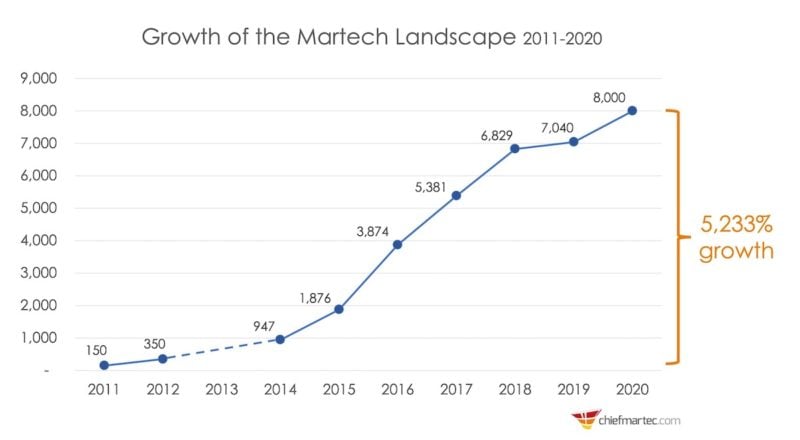
Image courtesy of ChiefMarTech.com
At Convince & Convert, we are thankful to have so many awesome marketing tools at our disposal and to work with so many amazing marketing technology companies (check out our content marketing creation services when you have a sec).
In the spirit of Thanksgiving, we asked our team to share some of their favorite marketing tools this year. This list is in no way conclusive — if it were, we would be writing a book and not a blog post. A few of the tools are from C&C clients (accessiBe and SharpSpring), most are tools we use daily, and all are tools we love!
Let’s dive in now to our list of 12 marketing tools we are thankful for this year, plus a few additional shoutouts for marketing solutions we love but just didn’t have the bandwidth to cover in this blog post.
List of 12 Marketing Tools We Are Thankful for This Year
#1: SparkToro
Audience intelligence platform
“This is a relatively new tool from Rand Fishkin and his associates that is an easy and illuminating way to find circles of influence online. I use it to find possible collaborators, websites to sponsors, podcasts to sponsor, and even search terms and hashtags of interest. It’s a flexible tool that should be part of every project and program.”
Jay Baer, Founder, Convince & Convert
#2: Miro
Visual collaboration software
“Miro is my favorite new tool for visualizing content like org charts, content workflows, brainstorming, user stories, whatever. It’s basically an online whiteboard for collaborating visually, which is so helpful now that the entire world is remote.”
Fun Fact: The Miro template library has hundreds of layouts just waiting for you to try them out!

Jenny Magic, Strategist
….and Anna Hrach loves Miro too!
“I’m with Jenny on this, and she was the one that brought it to my attention. I love Miro for visualizing information and content and remote/virtual collaboration. Plus, they have a ton of existing templates (over 150+) to work from that are all easily customizable.
The free version of Miro is also fantastic, so it’s easy to try out and see if the tool is a good fit for any organization. Miro also has over 70+ integrations, including Slack and Google Drive, so it fits into a lot of existing virtual workflows.”
Anna Hrach, Strategist
#3: accessiBe
Automated web accessibility
“Over my twenty-year career in digital, I have learned A LOT from web development teams and website requirement documents. What I love about the approach accessiBe has developed is there is virtually ZERO code changes needed to ensure your site is not only ADA compliant but also a positive experience for visitors.
The dashboard is simple to configure, allows for your branding to be matched, and adjusts to the needs of each site visitor without sweeping code changes. At an affordable price, this tool is a win for site visitors, a win for site developers, and a win for marketers. The legal team will likely find it a win as well!”
Fun Fact: accessiBe estimates that “the disabled population in almost every society is about 20% of the residents.” This has a huge impact on the function and services your website can (and should) be offering the entirety of your audience.
In addition, check out our recent technology tour of accessiBe, with special guest Rafi Glantz.

Kelly Santina, Director of Operations
#4: RivalIQ
Social media analytics
“It’s vital to be able to monitor your social media performance and compare it to your peers or competitors, so you can continue to learn, iterate, and improve performance. RivalIQ is one of our go-to tools to benchmark our clients’ competitors on social media.
Not only can we monitor growth rate, breakout posts, and look for boosted posts, we can also use RivalIQ’s ability to tag content to analyze the best performing types of content by medium and content.
RivalIQ also makes it easy to bring data from Facebook, Instagram, LinkedIn, and other platforms into one place to create attractive, easy to use dashboards to share with clients and internal teams.”
Fun Fact: Highly data-driven organizations are 3X more likely to report significant improvements in decision-making, according to PwC research.
Side note: Our founder Jay Baer is an investor in RivalIQ, but our team would still use the solution, even if he weren’t.
Zontee Hou, Director of Strategy
#5: ScreamingFrog
SEO spider tool and crawler software
“Despite the odd name, this SEO spider is a powerful and flexible site crawler, able to crawl both small and very large websites efficiently while allowing the user to analyze the results in real-time. It gathers key onsite data to allow SEOs to make informed assessments, both on your own internal site or a competitors’ site.
This is primarily used to identify SEO best-practices and shortcomings (there are always more than one would think), but also helps in content identification that may be difficult to find via main navigation options.
They offer a free version (limited to 500 URLs) and a paid license option.”

Anthony Helmstetter, Strategist
#6: Airtable
Cloud collaboration
‘” As the resident Airtable queen at C&C, I have both convinced and converted the consulting team of the power of Airtable. A cloud-based DIY software solution uses tools we’re familiar with, like databases, spreadsheet grids, and calendars, to create unique ways to get work done.
Airtable offers flexibility and an ecosystem for pulling together any project. In the past year, Airtable has super-powered the product with pro-level automation, apps, collaboration, and integrations.
At C&C, we use Airtable for a range of client and internal tasks and project management. My favorite use cases bring together audience journey maps, content gap analysis, and content marketing production into a single (massive) tool, as we did for clients like Oregon State Ecampus.
Tracking the team submissions for our ‘People We Love’ series is emotionally rewarding and brings our team closer together.
To get started, check out the numerous base templates Airtable gives away for free. Then go deeper into the Universe to see how others use this powerful tool to manage their professional and personal lives.”
Fun Fact: Over 15 million bases have been created on Airtable. And their content is also awesome.
Lauren Teague, Strategist
#7: SharpSpring
Marketing automation and CRM
“When I joined Convince & Convert, we were using a simple email solution to deploy blast-style emails. No lead scoring. No drip campaigns. No automation. No A/B testing.
As we ramped up our efforts, we quickly reached the limits of our previous solution (we were actually A/B testing emails by uploading our email list to Google Sheets and random sorting—not good!), we evaluated a few marketing automation solutions and finally selected SharpSpring.
Like all marketing technology transitions, there were a few bumps along the way, but within a few months, we got into a good rhythm and really ramped up our efforts.
The automation is really easy to set up, and unlike most of the solutions we evaluated, SharpSpring has a built-in CRM, which was key for us. We are a lean sales & marketing team, so we don’t have the resources to manage a standalone CRM.
We’re now 18 months into our initial setup, and we continue to grow and optimize our efforts. Plus, the support team is only an email, phone call, or chat away. Big fans!”

Megan Leap, Director of Content
#8: SEMrush
SEO and content marketing
“The other tool I love geeking out in is SEMrush. There’s nothing more exciting than seeing our rankings improve for key terms! The Keyword Magic Tool is ridiculously useful — especially the ‘Questions’ tab. I get a ton of inspiration for our content in SEMrush, and it’s helped us achieve big gains in our SEO.”
– Megan Leap
#9: Litmus
Email testing & analysis
“I first was introduced to Litmus over 12 years ago when the web developer I worked with used it to test and check the rendering of HTML on emails. Since then, I’ve signed up for it in every single digital marketing position I’ve had.
It’s easy to sell a solution to your boss when it makes your job easier, your marketing more effective and keeps your brand on-point. I even used it for browser testing, but Litmus has since retired that feature in order to focus on email. If you’re sending emails, you need to make sure they render correctly on all browsers and in all email clients.”
– Megan Leap
#10: AgoraPulse
Social media management
“AgoraPulse is our go-to tool for social listening and engagement. We use this tool daily to monitor brand/name mentions and to engage with our community. We use the browser-based dashboard during normal business hours and the mobile app when on the go.
Three standout features of AgoraPulse are its ability to gather comments and activity on Facebook and Instagram ads, its ability to monitor YouTube comments, and its insights on Instagram Stories.”
Christin Kardos, Community Manager
#11: CoSchedule
Content marketing management
“I probably use CoSchedule more than anyone on our team. We use it for planning social media content, sponsored content, podcasts, and more. There’s no better way to manage and plan multiple types of content across business units and virtual teams (both internal and external). I love it. It keeps me sane.”
Side note: Our founder, Jay Baer, is an investor in CoSchedule, but we’d still use it regardless.
– Christin Kardos, Community Manager
#12: BuzzSumo
“BuzzSumo offers a great place to start when thinking about content planning. It offers effective ways to stay on the pulse of what is trending in traditional media and in social. It also provides a great place to identify influencers and get new ideas for different topics within your planned content pillars.”
Mary Nice, Strategist
Notable Mentions
This wouldn’t be a “marketing tools we are thankful for” post without a few other shout outs. In no particular order, here are a few more martech solutions we love that you should check out too:
- Ceralytics (content intelligence platform)
- NetLine (B2B content syndication)
- Oracle Marketing Cloud (integrated digital marketing solutions)
- Cisco WebEx (video conferencing and online meetings)
- Podium (messaging tools for local business)
- Calabrio (workforce optimization)
- Cision (cloud-based communications/PR)
The post 12 Marketing Tools We Are Thankful for This Year appeared first on Content Marketing Consulting and Social Media Strategy.
Source: convinceandconvert.com

Top Social Media Listening Tools to Turn Followers into Customers and Brand Ambassadors
Social media listening has come a long way in the past decade. These days, every brand is using brand-name monitoring. Yet, few brands take full advantage of social media listening.
While it is great for improved customer support (for example: helping unhappy customers via social), there’s much more to social media monitoring. Today, you can:
- Find and connect to niche influencers (especially those active social media users with an engaged following who are currently interacting with your competitors). Social listening is one of the most effective steps to a successful influencer marketing campaign.
- Spot your competitors’ unhappy customers and win them over on your side.
- Turn your happy customers into brand ambassadors.
- Identify your product or service weak points so you can fix them.
- Understand your current customer base and target audience better.
- It can be a powerful lead generation tool for your business.
- Collect feedback on your product or content.
- Find engaging content ideas — discover your customers’ interests and struggles.
All in all, social media listening can provide you with a huge amount of insight, provided you are using the right tools.
5 Awesome Social Media Listening Tools
With that in mind, here are 5 awesome social media listening tools to consider for your martech stack:
1. SentiOne: AI-Powered Social Media Listening Tool
SentiOne is a dedicated social media listening platform that really gets the real power of social media monitoring and takes it to a new level.
The tool implements artificial intelligence to:
- Prioritize social media messages that need your (or your team’s) immediate attention and response
- Help your team to compose replies faster by suggesting possible messages which would work best for each mention
- Talk to your customers on your behalf through a smart chatbot

SentiOne can make your customer support team much more efficient and productive.
The cool thing about this platform is that it keeps a record of those interactions, so next time you have an encounter with the same customer, you will have all the background information.
SentiOne can make your customer support team much more efficient and productive, which is likely to result in many long-term benefits, like higher customer satisfaction and more positive mentions (from customers who get help immediately).
2. Agorapulse: Collaborating Social Media Management and Listening Tool
Agorapulse is a multi-purpose social media management tool that helps you create your social media editorial calendar by scheduling updates to multiple channels. It also comes with a powerful social listening feature that is perfect for cross-team collaboration.
Let’s face it: your brand mentions on social media are not created equal.
- Some of them are from customers who are currently in the buying process and need help immediately.
- Others are generic complaints that may not even require an immediate reply but need to be forwarded to product or site development teams.
- There are those mentions that can be turned into testimonials (to use on your site as social proof).
- There are social media messages that your outreach team may use to get some links to your site (similarly to how you’d use Google Alerts for those purposes).
How can one person handle this process if there are so many elements to it?
Well, it is quite doable if you treat social media listening as project management (which often involves many teams as well).
AgoraPulse enables your social media manager to assign different social media mentions to different teams or people. Once assigned, this team member will receive an email notification, as well as a reminder if the status of the assignment remains untouched.
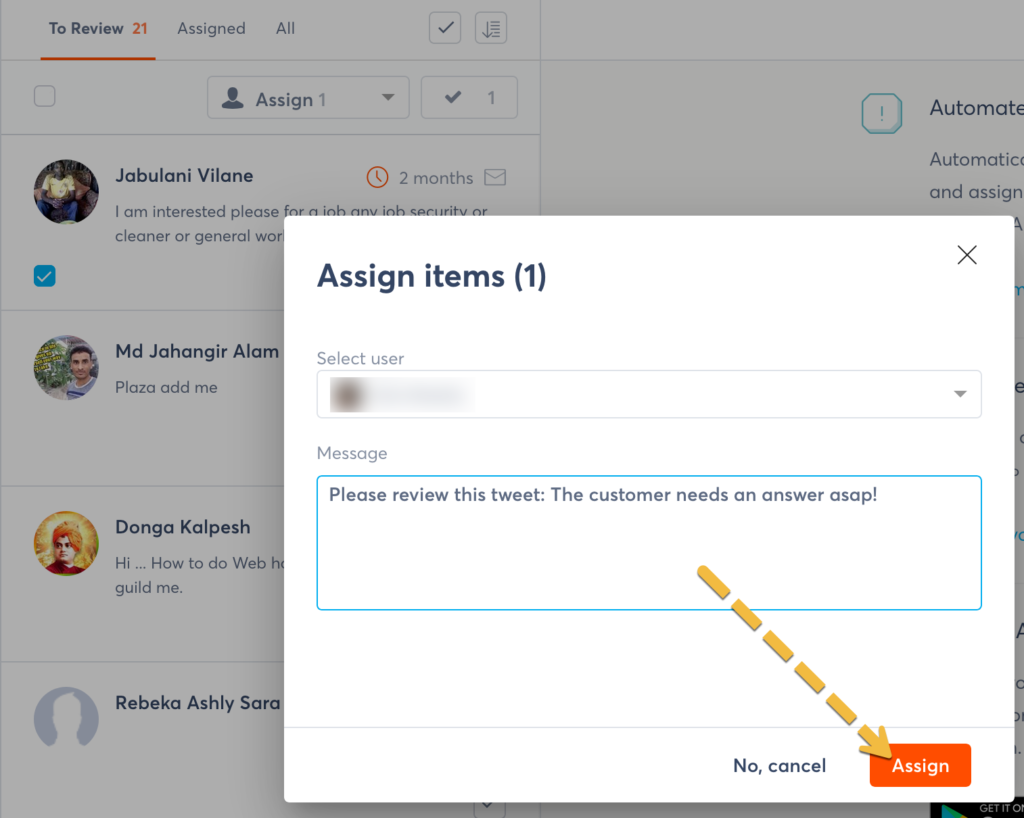
AgoraPulse enables your social media manager to assign different social media mentions to different teams or people.
This is a great way to make the most of social media listening.
3. Tweetdeck for Real-Time Interactions
Because of its real-time nature, Twitter is where customers expect to get an immediate response.
Tweetdeck is a Twitter management and monitoring tool that is free. It can also be used to manage multiple social media accounts (like your personal one, your business one, etc.)
I use Tweetdeck in combination with more advanced social media tools because it is so easy and fast to use that sometimes it’s just easier to quickly check Tweetdeck to see if there’s anything that needs your attention.
Tweetdeck integrates with Twitter lists, so it is perfect for quick interactions with niche influencers or your brand ambassadors throughout the day.

Check your list of engaged influencers to interact with their recent Tweets.
Here’s how I use Tweetdeck:
- I add people I want to regularly interact with to separate Twitter lists (those may be “Bloggers”, “Journalists”, “Brand ambassadors”, etc.)
- I create separate columns in my Tweetdeck to pull tweets from those lists
- When I have a minute or two, I open Tweetdeck and reply to recent tweets in those tweets.
This way, I keep interacting with my friends and niche influencers on a regular basis while keeping those interactions natural and meaningful.
4. Bonus: Keep an Eye on Your Social Media Traffic
There’s no perfect way to measure the effectiveness of your social media listening efforts. There are so many long-term goals (brand loyalty, trust, etc.) that are not easy to measure.
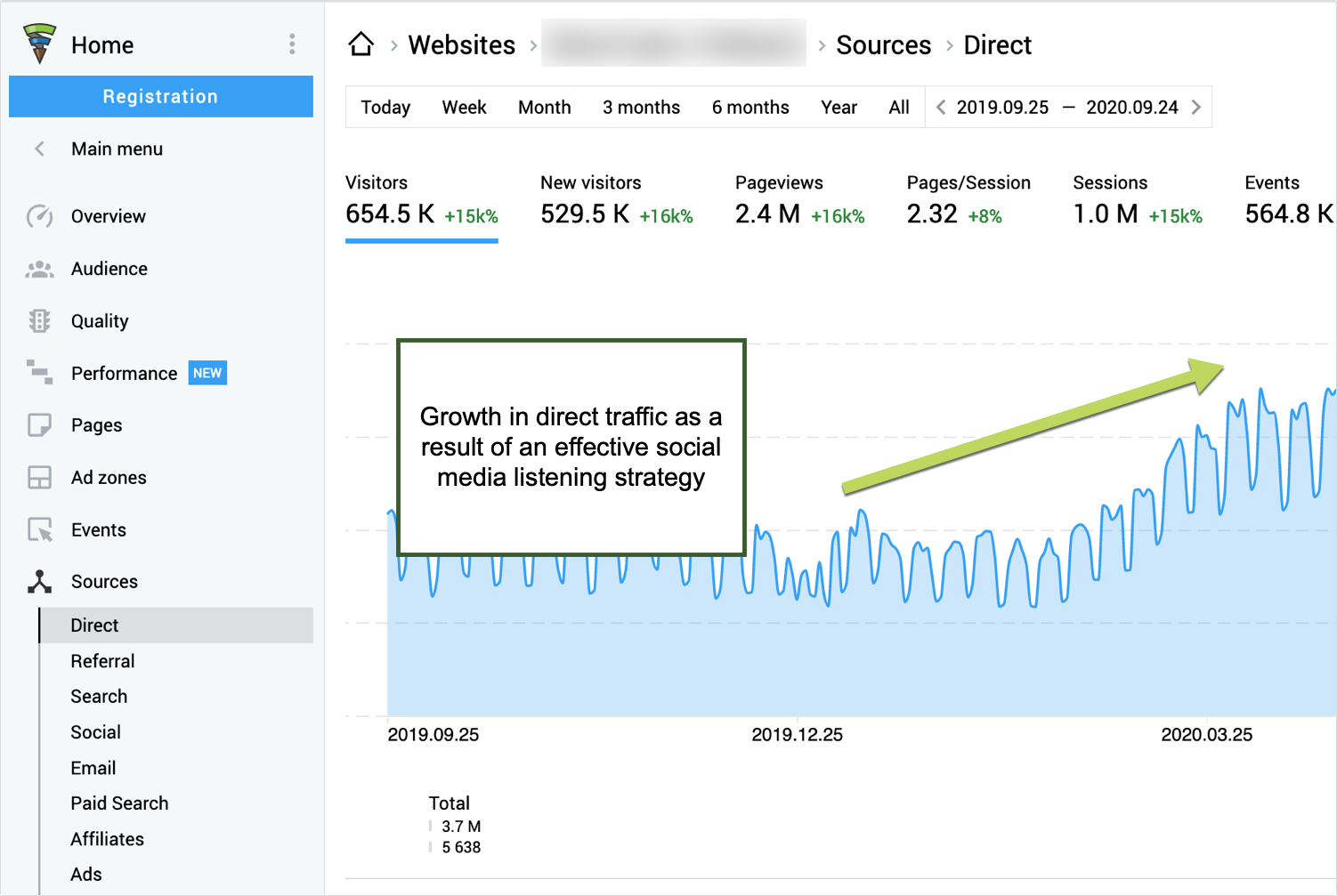
With time, what you to see in your analytics is the following:
- An increase in type-in traffic (those people that type your site address directly without searching your name)
- The gradual growth of your brand-driven search queries (those queries that contain your brand or product name)
- The steady growth of on-site conversions (as customers see you on social media responding and interacting, they will start trusting your brand and buying more from you).
You can track all (and more) of that by using Finteza, an independent web analytics suite with a strong focus on conversion optimization.
Conclusion
If you’re already doing some type of social media listening, invest a little more effort to achieve longer-term and more important goals. At the very least, it’s worth a try.
The post Top Social Media Listening Tools to Turn Followers into Customers and Brand Ambassadors appeared first on Content Marketing Consulting and Social Media Strategy.
Source: convinceandconvert.com

TikTok Statistics for 2020: Charts and Data
TikTok, the social media platform known for its brief, often dance-related videos, has taken the world by storm. People — younger demographics in particular — love the memorable clips that often feature familiar tunes and spontaneous dances.
The sheer popularity of the platform proves that a less-is-more approach resonates with the platform’s users.
Companies that find the most success on TikTok frequently get straight to the point while taking lighthearted approaches.
TikTok also has branded channels for verified businesses.
The platform could function for you similarly to how YouTube does by giving viewers a single hub for watching all the content your company wants to promote.
Plus, even if you’re not familiar with TikTok videos yet, the app’s built-in creation tools make it easy to hit the ground running. You can alter a video’s speed and use filters to maximize the impact, for example.
Expanding your marketing plans to include TikTok is not a foolproof approach, however.
A recent study from Check Point Research revealed several security concerns associated with the platform — including that hackers could manipulate content someone posts to the platform and show a user’s details.
Some organizations and nations view TikTok as a threat, too.
The U.S. Army forbade its personnel from putting the app on their work devices after deeming it a “cyberthreat,” while countries, including India and Indonesia, banned the app.
Even if national leaders only block it temporarily, such a decision could understandably thwart the plans of a marketing company that intended to gain ground in a particular destination.
As a marketer, you may be in a position that many of your fellow marketers likely face. They wonder: Is TikTok a worthwhile platform for our business to explore?
12 TikTok Statistics for Marketing
These 12 TikTok statistics for marketing will give you some food for thought, making it easier to gauge whether or not to depend on it as a mechanism for meeting your goals.
42% of 13-16-Year-Olds Use TikTok
A September 2019 poll from Morning Consult revealed that 42% of 13-16-year-olds are TikTok users — approximately the same amount of people in that age group who use Facebook or Twitter.
If you’re trying to gain momentum with young teens, that statistic strongly suggests you should include TikTok in your social media marketing mix.

Social Media Platforms Used by Gen Z and Millennials
Image source: eMarketer
42% of 13-16-year-olds use TikTokCLICK TO TWEET
74% of Marketers Do Not Plan to Invest in TikTok This Year
According to the 2020 Social Media Marketing Industry Report from Social Media Examiner, nearly three-quarters of marketers do not intend to use TikTok at all this year, but there are 16% who will ramp up their usage.
Also, 7% of marketers are planning to rely on TikTok the same amount as last year. Thus, the best approach may be to start small and scale up if the results warrant doing that.

Marketers who intend to invest in TikTok in 2020
Image Source: Social Media Examiner
74% of marketers do not plan to invest in TikTok this yearCLICK TO TWEET
TikTok Was the Second Most Downloaded App of 2019
Market penetration is likely one of the factors influencing your decision about a possible TikTok investment.
The good news is that data from SensorTower showed TikTok as the second most downloaded app of the year in 2019, suggesting plenty of people are interested in using the app.

Image Source: SensorTower
TikTok was the second most downloaded app of 2019CLICK TO TWEET
Users Spent More Than 68 Billion Hours on TikTok in 2019
The State of Mobile 2020 report from App Annie reported a 210% uptick — equal to more than 68 billion hours spent — on TikTok in 2019.
Thus, whether your focus is advertising on TikTok, content creation, or both, a positive trend is that people are eager to use TikTok and stay engaged with it for substantial periods.
People in More Than 150 Countries Can Download TikTok
According to Hootsuite, residents of more than 150 nations can use TikTok, and advertising on the platform could reach people who speak more than 75 languages.
Although some countries are initially resistant to the app, it bodes well for potential investment plans that TikTok is getting an increasingly commanding global reach.
This is especially useful for companies with international expansion aspirations.
TikTok Portrait Ads Offer up to Seven Times More Engagement
Internal research by Incipia found that portrait-oriented TikTok ads got seven times the engagement compared to landscape and square advertisements, demonstrating a compelling reason to carefully choose ad specifics.
Another thing to keep in mind as you explore whether to advertise on the platform is that other options — including rich messaging sent by e-commerce brands — are gaining momentum and may tie into your TikTok plans.
TikTok Got an Average Engagement Increase of More Than 27% Due to COVID-19
A company called Obviously, which specializes in social media influencer campaigns, measured an average increase of more than 27% between February and March 2020, attributed to more people trying to find entertainment and stay connected during the COVID-19 pandemic.
If the coronavirus stifled your marketing efforts, this statistic may be enough to make you see that TikTok investment could still pay off — no matter how long the crisis affects the world.
TikTok Has an Estimated 800 Million Monthly Active Users
Representatives from Wallaroo Media estimate that TikTok now has approximately 800 million people who actively use the application each month.
That’s crucial, because marketing campaigns can only succeed if TikTok sparks initial curiosity within your target audience, plus encourages them to use the app regularly.
This statistic confirms that TikTok has so far urged millions of users to take that action.
TikTok’s Adult Users Have Doubled Year Over Year
TikTok marketing statistics mentioned earlier in this roundup highlighted the popularity of the application among teens.
If you want to target grownups, however, research indicates that usage among adults doubled in overall year-over-year growth. You have a good chance of reaching a broader age group than you may have expected.

Adults Using TikTok in the United States
Image Source: MarketingCharts
315 Million First-Time Downloads in the First Quarter of 2020
Perhaps some people on your marketing team still feel uncertain about investing in TikTok because they think it’s a fad that will plunge in popularity before it gives you the desired return on investment (ROI).
You could point out that Statista measured the worldwide number of first-time downloads of the app from Q1 2017 through Q1 2020.
It found that the figure climbed significantly in the first quarter of 2020 — topping out at 315 million.

TikTok Quarterly Downloads
Image Source: Statista
Travel Videos Alone Earned More Than 1.7 Billion Views on TikTok
TikTok representatives learned that travel-related videos on the platform received more than 1.7 billion views, and more than 400,000 videos featured the #travel hashtag.
In response, the brand launched a campaign to encourage more users to share their favorite globetrotting moments.
Numerous tourism boards joined the initiative, and you may want to follow suit by offering TikTok travel content to keep people inspired and help them see new places from home.
The First Paid Ad to Hold the No. 1 Trending Hashtag on TikTok Received More Than 1 Billion Views
An aspect of advertising on TikTok that may appeal to you relates to the abundant opportunities to get people interested in what you sell by aligning your product with a challenge.
The cosmetics brand e.l.f. did that by creating the first TikTok paid ad featuring original music.
The results made the spot the first one of its kind to earn TikTok’s No. 1 trending hashtag, plus more than 1 billion people watched it while becoming interested in the #eyeslipsface challenge to win makeup.
TikTok Statistics to Guide Your Decision
This data about TikTok may make you feel differently about using the platform for marketing than you did before.
Perhaps the statistics covered here emphasized what you already suspected and made you determine there’s no time to waste in utilizing it.
Besides diving into the data covered here and thinking about how it applies to your overall work and future campaigns, don’t forget to take a more personalized approach in the decision-making process.
Do historical metrics indicate your audience responds well to short videos? Can you envision specific ways that your company could harness the power of TikTok to its advantage?
Pondering the possibilities will get you well-equipped to come to informed conclusions.
The post – TikTok Statistics for 2020: Charts and Data appeared first on Content Marketing Consulting and Social Media Strategy.
Source: convinceandconvert.com

What Is Content Curation in Social Media?
One question we often hear from our social media consulting clients is, “what is content curation in social media?” and “how can I do it the right way?”
Let’s dive right in with Convince & Convert strategist, Lauren Teague.

What Is Content Curation in Social Media?
Content curation in social media is the premise that you don’t actually have to write or produce all of the content that you publish.
Curating content is finding the content that your audience will find important or useful, and repositioning that in a way that serves both your organization and your audience.
To curate content that your audience will enjoy, start by looking through your email newsletters, searching social media, following relevant hashtags or other keywords, and signing up for Google Alerts for relevant terms.
Save that content for future use — use a swipe file or your social media management system.
Get it ready to add to your social media and content calendar in the future.

Why Should You Curate Content for Social Media?
One key benefit of sharing curated content, instead of only content you create, is that that curated content helps you keep up with the demands of social media algorithms and the frequency of content that you need.
For example, the half-life of any tweet is less than 20 minutes.
If your objective is to stay present in your audience’s Twitter feed or other feed, and your content expires within 20 minutes, then you need enough content to share every hour of the time that you want to be present in your audience’s feed.
It’s nearly impossible to create 12 or 24 pieces of content a day without taking advantage of content curation, such as retweeting content or republishing a link, a photo, a video— or another great piece of content that you found.

What Are the Keys to Successful Content Curation?
The content you curate must be useful and relevant to your audiences.
While it’s fun to curate cat memes, your audience may be horse owners, and cat means won’t really speak to them—that type of content is irrelevant.
Soon enough, they will tune you out, your content will be less engaging, and the algorithms will adjust how they’re showing content accordingly.
The content that you curate needs to be just as relevant and informative as any content that you would aim to publish.
In addition, you don’t want to simply link to someone else’s content.

You need to add context around why you are sharing it.
For example, if you’re writing content for an email newsletter, you can include an intro sentence or two that talks about why you included a certain link or why someone should click on it.
The same thing goes for social media.
If you’re curating and sharing, take the time to explain why it’s relevant and why it caught your interest or attention and.
Use 140 characters or the caption space to explain why.
That gives you a chance to put your own take or spin on the content — whether you agree or disagree with it.

What Is the Ideal Mix of Curated vs. Original Content?
The ideal mix of how much content you should produce originally vs. curate can vary.
Don’t be afraid to publish and share more curated content, especially when you’re focusing your efforts on creating longer pieces of rich, original content.
It will help keep your feed up-to-date if you can curate set-it-and-forget-it content.
It is reasonable for your social publishing schedule to be 80%, 70%, or 60% curated content vs. 20 or 30% of your own, especially if you do the things that we were just talking about, like including a sentence or two of your own thoughts about why you’re sharing, retweeting or reposting a piece of content.

It’s a great way to be visible, but not feel the stress of producing so much original content to keep up with the algorithms.
Conclusion
Curating content is a really great idea for social media, especially Twitter and Facebook, and of course, Pinterest is all about curation. As you move forward, you can bring content curation into your own website content and your email newsletters.
Remember, collect and share the best of what’s on the internet and always make sure it’s totally relevant to your audiences.
The post What Is Content Curation in Social Media? appeared first on Content Marketing Consulting and Social Media Strategy.
Source: convinceandconvert.com

9 Key Discoveries in 2020 Social Media Research
This is a republished post sharing the 9 key discoveries in 2020 as a result of social media research. Read on…

2020 social media research demonstrates that platforms like TikTok and WhatsApp are starting to make their mark on young audiences and are becoming the hottest social networks.
Recently, our friends at Edison Research and Triton Digital released their 2020 Infinite Dial report—the annual report on social media usage patterns among Americans.
Fun fact: the Infinite Dial report also happens to be the current longest ongoing survey of digital media consumer behavior. (See our 2019 social media research recap here.)

The report showcases the emerging shifts in users’ preferred platforms of choice, as well as what’s to be expected this year in terms of growth.
I highly recommend you grab the entire 2020 report, as the highlights covered here are just a small selection of interesting statistics and user behaviors included in The Infinite Dial 2020.
Here are the nine crucial 2020 social media research trends that this report uncovered, based on a survey of 1,502 Americans, ages 12 and up.
1. Social Media Usage Continues to Flatline
While the report shows social media usage has increased by 1% this year, the growth rate of social has stayed relatively consistent for Americans since 2016.
2. Instagram Is Approaching #1 Fast
While social media usage has stayed virtually unchanged, Instagram continues to see significant growth among users, falling just behind Facebook in popularity.

3. Instagram Is Taking the Lead for Younger Demographics
For ages 12-34, Instagram continues to hold the top spot (over Facebook) as the most frequently used platform.
Instagram continues to see increased growth with this demographic, while Facebook growth mostly remains static.

4. Live Video Game Streaming is Gaining Traction
Up from last year’s report findings, 9% of the total population 12 or older reports playing a live-streamed video game—an increase of 28% since 2019.
Due to the rise of streaming platforms like Twitch, it’s made live streaming more accessible to all.

It will be especially interesting to follow this statistic into next year, with an overall increase of live streaming platform-wide due to the coronavirus pandemic
5. TikTok Has Made Powerful First Impressions
TikTok is hot on the scene for users aged 12-34 and has already achieved considerable growth.
Among this audience, 29% report using TikTok and 4% state that it is their most-used social platform.
Though TikTok has a way to go before competing with the likes of Facebook and Instagram, it is certainly on the upswing.
6. WhatsApp Is Attracting More Users
Like TikTok, WhatsApp usage increased by 26% in users aged 12-34 over the past year.
Interestingly, WhatApp’s percentage of users among this demographic is now equal to that of Twitter.
7. Snapchat Is On the Decline
Compared to last year’s report, Snapchat usage and favorability have fallen significantly among all audience demographics.
This is most likely due to Instagram advancing its story functionality with a wide range of filters, stickers, and visual tools, while Snapchat has stayed relatively unchanged with its capabilities.

8. Facebook Continues to Rise Among Gen Xers
After two years of no user growth for 35-54-year-olds on Facebook, in 2020, usage by this demographic increased by 7%. This makes this age group the widest users of Facebook from any other American audience.
9. Younger Audiences Have Returned to Facebook
Though not a substantial difference from 2019, Facebook users aged 12-34 have increased by 3% in 2020. This is surprising because Facebook was losing users from this demographic the past few years.

These are nine key discoveries from this year’s Infinite Dial 2020 report. But there are many more to discover. Grab the full, 78-page report and give it a look-through.
—
The post 9 Key Discoveries in 2020 Social Media Research appeared first on Content Marketing Consulting and Social Media Strategy.
Source: convinceandconvert.com

Social Media Listening for Non-Profits: A How-To Guide
For non-profit organizations, every marketing task can be a serious challenge.
Many have limited budgets and small teams, but raising awareness about the causes and collecting donations takes a lot of work.
Getting people to see the organization and trust it enough to donate their time or hard-earned money also takes great effort.
In this post, I’ll explain how social media listening can help with all of that.

The existence of social media is a gift to nonprofits.
Surely, it’s a gift to anyone, but in particular to companies with small budgets.
We know that social media works well for nonprofits:
- 55% of people who engage with causes via social media are inspired to take further action,
- like donating money (68%),
- volunteering (53%),
- donating items (52%),
- or attending an event (43%).
Plus, social media exposure is “free.”
55% of people who engage with causes via social media are inspired to take further action, like donating money (68%), volunteering (53%), donating items (52%), or attending an event (43%).
Or at least it used to be “free.” With the algorithms evolving, less and less traffic is reaching business pages that don’t pay for social advertising.
This means less awareness, fewer donations, and fewer volunteers.
While the majority of nonprofits have dedicated pages on social networks and do some social media marketing, in the year 2020, this is not enough.
You have to either throw your money into social advertising or get creative.
Social listening is for the ones that choose to get creative.
It’s not an obvious solution, and it’s not widely popular among nonprofits.
But it can help achieve many goals that nonprofits usually have:
- Raising awareness of the organization and its cause
- Increasing donations and participation
- Building a loyal community
- Managing your reputation
So here comes the big question.
What Is Social Listening?

Tearful Eyes of a Victim
Social listening is the process of finding mentions of keywords on social networks, news, blogs, forums, and the web using a social listening tool (e.g., Awario, Brandwatch).
Social analytics, which usually follows social listening, is responsible for analyzing this data to give you the answers you need.
Keywords can be anything, such as“Syrian refugees”, “animal rights”, or “Save The Children”.
Questions that one needs answers to, can also be very different.
Usually, they are:
- How popular is our organization?
- Is our organization getting more or less popular? What does this depend on?
- Does our organization have a good reputation?
- How much do people talk about our cause?
- Is the talk about the cause increasing or decreasing? What does this depend on?
Where is the talk happening? Which geographical locations and where on the internet do people talk about the cause? - What else do they say when they talk about our cause? (e.g., do “climate change” and “recycling” go hand in hand in people’s conversations?)
- Who can help promote the cause?
And so on.
So let’s get to the how-to part and start with the first two goals.
Raise awareness and increase donations/participation
Why do these goals go together? Because the workflow is the same for both.
First, you find people that are already interested.
Then, you take what you can from them—either their money/time or their word.
This is how you do it:
1. Find out who already talks about your organization.

First, you need to know who is already there for you in order to know what kind of people to reach out to in the future.
You hopefully already have the stats on your regular donors and volunteers.
To add to that, find people online who’ve mentioned your organization and look at their analytics:
- what is their demographic?
- Which locations do they come from?
- Which social networks do they use?
While they might be the people who talk and not actually help you in any solid way, they are still important.
You simply need people to spread the word on social media.
The word may finally meet the ones who will provide help.
Also, the conversations signal that these people are interested in the topic — they might just not have enough resources to contribute right now.
But that might change, so you better put these people aside for future targeting.
2. Find people who talk about your cause.

To reach more social media users that could donate or help your cause, you’ve got to find people that are interested in your cause.
Luckily, with social listening, this is just as easy as finding mentions of your organization: you use the same tool to find people that talk about your cause by monitoring that cause.
Then, go through the data to discover who these people are where they hang out, and reach out to individuals, telling them about your organization and explaining how they can help.
These people are “hot leads” — you already know they are into the topic — all you need to do is convince them to act on it.
This sounds like it’s still a challenging task, yet it’s much easier than convincing “cold leads” — people who are usually approached on the street by non-profit employees.

Mentions feed for the keyword “animal rights”. Screenshot from Awario.
3. Find influencers and brand advocates.
In both groups of people described above, you’ll have influential authors: Twitter, Facebook, and Instagram users with millions of followers; Reddit anonymous authors, famous bloggers, and more.
Most social listening tools will show you\lists of people with a large following: some will have just over 5K and some will have millions of dedicated listeners.
The first group (the ones that talked about your brand) is a group of potential brand advocates.
They’ve talked about your organization once or twice — they can do more of the talking and help spread awareness.
In the second group, you’ll find your social media influencers.
They care about the cause, they talk about it, they probably advocate for some other nonprofits.
No harm in reaching out to them and asking whether they would also spread the word about your organization.

Instagram influencers for keyword “animal rights”. Screenshot from Awario.
4. Find relevant journalists and media outlets.
Social listening is a huge help when it comes to PR because social listening tools find media outlets and individual journalists who are already interested either in your organization or in your cause.
For PR, you should simply choose a social media listening tool that monitors news and blogs, narrow your search to only these resources (hence, excluding social networks and the rest of the web), and create alerts for your organization’s name, other nonprofits in your niche and your cause.
Once you have a list, you can reach out to the sources and journalists that have either already mentioned your organization or a similar one or that often talk about your cause.

Influential Media for the keyword “PETA”.
5. Build a loyal community
So far we’ve talked about finding different kinds of people on social media that are interested in your cause and potentially interested in participating and reaching out to them asking to mention your organization to their followers, or to donate their time/money/clothing, etc.
While these people might agree to it once, it would be better if they could contribute regularly and inspire their friends to do the same.
To do that, nonprofits should do their best to show that they don’t perceive the contributors as cash points.
And this is all about creating engagement.
Firstly, of course, you have to engage with people that are already your followers on social media.
You have to post content, ask questions, reply to comments — let your followers know that you’re interested in their feelings and opinions.
Ask why they chose to support your cause, what brought them to your organization.
Ask for their stories.
Secondly, join the conversations that you’ve found through social listening.
Talk not as a marketer, but as a friend.
Social media is a place for discussions, for ideas, for fun — no matter how serious the cause is.
Send vegan noods  #SocialDistancingPickUpLines
— PETA (@peta) March 19, 2020
Asking people for money always comes second.
First comes the engagement.
6. Keep an eye on your reputation
For nonprofits, there’s nothing quite as vital as reputation management.
All success depends on how much people trust the organization with their money.
And at the same time, plenty of nonprofits get accused of doing something wrong.
Their reputation goes up and down, and sometimes, the organization isn’t even aware of the causes and the changes happening.
With social listening, it’s possible to monitor the sentiment and the topics discussed by the organization in real-time.
Every time there’s a spike in negative mentions, a marketer or a social media manager will notice it, dig into the mentions that have caused the spike, and see what the negativity is about.
This gives the organization a chance to reply in time, explain the situation or solve a problem, and stop the escalating crisis.
Similarly, one can react to individual negative and positive questions, keeping an eye on the issues surrounding the nonprofit, and showing appreciation to the ones spreading the good word about it.

Dashboard for the keyword “animal rights”. Screenshot from Awario.
Tools Used for Social listening
There are plenty of social listening tools on the market.
I’ve picked three awesome social listening tools that offer discounts for nonprofits.
Awario

Awario is a social media listening and analytics tool that tracks mentions of any given keyword on all major social networks, as well as news, blogs, forums, and the web.
It has a Boolean search option, so no matter how challenging your organization’s name is, you can still find relevant mentions of it online.
The tool analyzes mentions’ growth, sentiment, reach, major topics that surround your keywords, locations & languages, sources, etc.
It also finds social media influencers and PR opportunities.
And you can engage with social media users straight from the app.
Pricing:
- $29/mo for the Starter plan,
- $89/mo for Pro,
- and $299/mo for Enterprise.
Saves 2 months with a yearly plan.
Non-profit discount: 50% off Pro and Enterprise. Apply here.
Mention

Mention is a social media and web monitoring tool.
It finds mentions of any keywords, analyzes them, and provides you with insights into mentions’ growth, sentiment, locations & languages, surrounding trends, etc.
Mention also has social media management features.
Pricing: Solo is $29/mo, Pro is $99/mo, and Enterprise is $450+/mo. All yearly plans save you 2 months.
Non-profit discount: 20% off yearly subscriptions.
Agorapulse

Agorapulse is a social media management and listening platform.
It has publishing and scheduling features; lets you assign roles to the members of your team; shows trends, sentiment, and other insights into your audience; identifies influencers.
Pricing:
- Medium is €99/mo,
- Large is €199/mo,
- X-Large is €299/mo,
- and Enterprise is €499/mo.
- Yearly plans save you 20%.
Non-profit discount: 25% off monthly and 15% off annual subscriptions.
Conclusion
Social media listening is a powerful method. With its help, you can find like-minded people wherever they are.
You can let the online public know how you’re making the world a better place.
And you can inspire people to do the same.
The post, Social Media Listening for Non-Profits: A How-To Guide appeared first on Content Marketing Consulting and Social Media Strategy.
Source: convinceandconvert.com

11 Social Media Changes to Make in a Coronavirus World
Coronavirus has changed just about everything, but you still need to connect to your customers, prospects, partners, and team members.
And now more than ever, social media may be the best way to do so.
But you cannot just continue with your regular social media strategy, content, and cadence.
- What works is different.
- What people want is different.
You must consider these 11 changes to your social media to continue – possibly even accelerate – your social media success during the pandemic.
The strategy team here at Convince & Convert has been working closely with our world-class clients to develop these approaches.
We shared this advice on the 11 changes to your social media strategy during Coronavirus on a live webinar.
Access the video – including our answers to more than SEVENTY audience questions – below.
Feel free to distribute widely.
We want to help as many people as possible.
On that point, we have developed four new consulting packages.
They are faster than how we usually work and more affordable.
If you are interested in a no-obligation call with one of our strategists, please fill out the form below.
The packages are:
- Social Media Strategy and Tactics Quick Wins
- Content Marketing Quick Wins
- Digital Marketing Quick Wins (website + email + content + social)
- Virtual events/webinars production and training (we do dozens of webinars each year for large companies)
Also, if you are in higher education, you might be better served by our webinar on marketing and communications shifts among colleges and universities.
11 Social Media Changes to Make in a Coronavirus World
1. Change Your Bios
If your operations have been impacted in a meaningful way, your social media bios should reflect that reality.
For example, even though all Best Buy locations in the United States are now pickup only, their Twitter bio doesn’t reference that information:
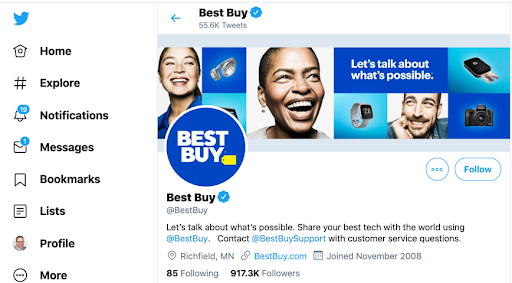
Although all Best Buy locations in the United States are now pickup only, their Twitter bio doesn’t reference that information.
Also, if you have key updates for your audiences, a good place to keep them front and center are pinned posts on Twitter and Facebook, and Highlights on Instagram.
2. Listen, Harder
In times like these, everywhere you exist in digital is a potential customer service channel.
You simply must expand your efforts to find, engage, and answer customers everywhere online.
In fact, in our webinar, more than half of the 500 attendees said that customer communication via social media had increased since the Coronavirus outbreak.
3. Only Post with a Purpose
This is not the time for frivolous posts that are sent because they are “due” per the social media editorial calendar.
That doesn’t mean you can’t be lighthearted, or even funny.
It does mean, however, that you must carefully consider WHY you are posting on social media.
- For whom is this post intended?
- How does it entertain, inform, educate, or benefit that audience?
- What specific behavior change or thinking change are we trying to effectuate with this post?
I love what Cardinal Spirits is doing in this regard.
Located in Bloomington, Indiana where I live, it’s a small distillery run by some very smart friends.
Each day, they post on their Instagram exactly what they need in carryout sales to support their new mission, which is to make as much hand sanitizer as possible.
And then, when they reach that goal for the day (they’ve made it almost every day) they immediately add a new post that says “We’ve reached our goal for today.
Please go support a different local business.” Spectacular.
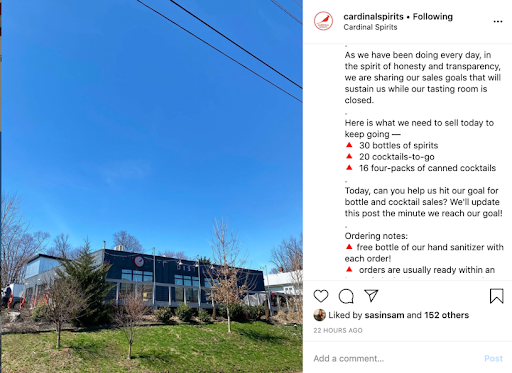
Each day, Cardinal Spirits posts on their Instagram exactly what they need in carryout sales to support their new mission, which is to make as much hand sanitizer as possible. Amazing!
4. Make it About People, not Logos
This was true before coronavirus, but it’s especially true right now:
We care about and trust people more than we care about and trust companies or organizations.
Every business and every organization is comprised of exceptional PEOPLE and now is the time to showcase that.
Use humans in as much of your social media as you possibly can right now.
It’s the one problem I have with the Cardinal Spirits post above: I’d rather it show their team (although they do so in their IG Stories).
And even better, spotlight your customers!
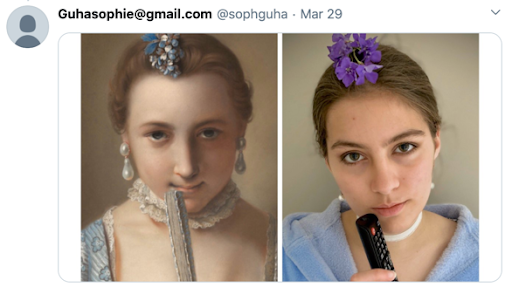
This effort from the Getty Museum is brilliant.
They asked their fans to find three household items and use them to recreate famous artworks.
They received thousands of submissions, many of them AWESOME!

5. Expand Influencer Marketing

On a related note, influencers and influencer marketing can be more effective than ever before.
In times of uncertainty, we rely upon people we trust and believe in, which is why a recent study showed a 75% uptick in clicks on Instagram posts that included #ad in the first two weeks of March.
If you have an influencer marketing program already, don’t be afraid to activate it right now.
If you don’t have a program, this is a great time to set one up. (we actually do this for our clients)
6. Make Sure Your Visuals are in Context
Social distancing has changed our perceptions (and reality) about a great many things.
It’s easy to rely upon your repository of brand imagery for social media, but in doing so you may unwittingly be sending a message that’s not wholly appropriate.
I love the differences in how Schwinn Bicycles spotlights their products.
These posts are just a week or so apart, but you can see how they’ve adapted the visuals for a coronavirus world.

Classic imagery

Social-distancing era imagery
7. Try New Formats and Publishing Times
You know how you’ve experimented and optimized over and over to figure out what social media content formats and publishing windows work best for you?
Well…..you can unfortunately cast that aside.
While social media usage in society overall is way up during the pandemic, people’s life routines are massively altered.
No commutes.
No treadmill.
Having to oversee your kids’ Zoom homework during the day.
It’s all a tangled ball of yarn.
Consequently, we’re already seeing big shifts in WHAT works, and WHEN it works.
Amongst our group of large clients (not a statistically valid sample, but directional), we’re seeing a huge increase in engagement rate for video posts, but an even larger increase for posts that include no photo, video, or link of any kind.
Further, for our financial services clients – as just one example – the “best” time to post before coronavirus became the world’s most unwelcome guest was 10 am.
Now? 10 pm.
In fact, we’re seeing a pretty strong pattern toward mid to late evening posts being disproportionately successful during pandemics, as people catch up on social media after dinner and maybe after the cherubs go to bed.
Again, this is not data you should use to modify your own program.
But you absolutely must dig deep right now to figure out how your own social media success equation has changed.
8. Recalculate Your Paid Social Media Assumptions
The story is much the same with paid social media advertising.
Data from SocialBakers shows that cost per click and CPM for social ads is falling, as more and more advertisers stop their campaigns.
At the same time, overall click-through rates for social ads are falling too, meaning that less expensive ads (yay) may not be working as well (boo).
And simultaneously, we are seeing clients in particular industries have incredible success with paid social media ads, more so than in those good ole pre-pandemic days.
In summary, just like with your organic social media, whatever math you’ve been using to figure out your ad spend and likely results is most likely borderline irrelevant right now.
You’ve got to retest all of your data and projections accordingly.
9. Elongate Your Sales Funnel
Maybe people don’t want to (or cannot) buy from you right now.
But that doesn’t mean they don’t want inspiration and education.
Try to become the Pinterest of your industry.
How can you spotlight previous customers and how they use your products and services?
How can you help your customers and prospects think about what and how they are going to do with you when they are allowed to do so?
For travel organizations, for example, this is a perfect opportunity to let people dream and stay motivated for the future.
But for all categories, helping customers create “wish lists” during quarantine can be a terrific social media content approach.
Our client, David Weekley Homes, is doing this with their series of home trends, by region.
This one is about kitchen trends, etc. in new homes in Austin.
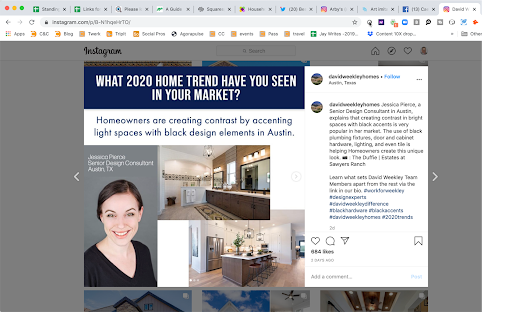
David Weekley Homes is helping customers create “wish lists” during quarantine with their series of home trends, by region.
This one is about kitchen trends, etc. in new homes in Austin.
10. Repurpose Your Winners
You already have winning social media content. Maybe it was from last month. Or last year. Maybe it’s a big piece of content like a report or video series.
One of the best ways to succeed with social right now is to deconstruct, repackage, and republish those winners (assuming the content is still valid, and contextually appropriate).
We have a whole guide on this you may want to download (no cost).
t’s called:
8 Ways to Extract More Value From the Content You Already Own
11. Focus on Helping, not Selling
Several clients have asked us if they should “stop selling” right now.
And while our answer varies a bit by industry, in general, we’d tell you this:
Helping Beats Selling
I wrote a best-selling book about this principle. Youtility says that the best way to sell is to provide as much value as you possibly can – for free – and that as a consequence of your munificence, a percentage of the people you assist will become customers eventually.
It’s never been more true.
Overt sales campaigns may be tough sledding right now.
But if you can help your prospects, they’ll remember and reward you.
And if that’s the basis of your social media – to help – then if you sell a little along the way, you’re in great shape.
As my friend Rory Vaden from BrandBuilders Group says: “there’s no need to be nervous if your heart is on service.”
Wrapping Up:
In some ways, it may be harder than ever to be responsible for social media in your company or organization. But it may also never be a more vital job. You can continue to communicate and inspire and education and assist your audiences. You just need to make some changes to do so. We wish you great success in that journey and hope it’s truly a short-term scenario.
Meanwhile, do watch the webinar replay. The 70+ questions we answered from the live audience is worth your time.
Also a reminder that we are helping people like you and organizations like yours put these new social media and digital marketing best practices into place. If we can help you, please do fill out the form below for a no-obligation strategy call.
The post 11 Social Media Changes to Make in a Coronavirus World appeared first on Content Marketing Consulting and Social Media Strategy.
Source: convinceandconvert.com

5 B2B Content Marketing Examples You Can Copy
B2B marketing can sometimes seem to play second fiddle to its more glamorous sister, B2C marketing.
When it comes to content marketing, campaigns built for consumer audiences are often more intuitive, more fun, or more colorful for the audiences and the marketers who implement them alike.
However, as I like to tell my graduate students, marketers get tired of their own marketing way faster than our audiences do.
When it comes to B2B marketing, your content marketing campaigns can be highly valuable, highly sought after, and highly relevant to your audiences.
These campaigns resonate most strongly when you are focused on your audiences’ goals, challenges, and mindsets.
5 B2B Content Marketing Examples
Here are five B2B content marketing examples from companies that understand their audiences well and use their content marketing to provide Youtility.
1. CES Tech Talk Podcast Distills Key Takeaways
B2B Content Lesson: Leverage Your Experts and Break Down the Facts Through a Podcast
CES is such a huge trade show that there is no way that attendees can absorb even a tenth of the content, information, and demos that are presented at the event.
How can the Consumer Technology Association, which puts on this massive annual event, create more value for its audiences, reinforce its reputation year-round, and extend its reach?

It produces robust content as part of its marketing approach, such as its Tech Talk Podcast.
Each episode of the podcast features industry experts going deep on one specific topic area, such as tech in healthcare, self-driving cars, or the future of innovation.
This series leverages the experts that the organization is already working with and builds upon the brand recognition of its marquee event to build an audience of loyal listeners.
This series works particularly well because it synthesizes the information around each topic area into what you need to know today, as Michael Barbaro of The New York Times says in his podcast, “The Daily.”
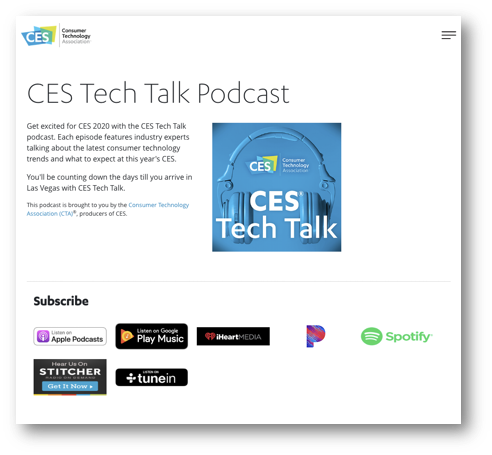
The CES Tech Talk Podcast is a great example of B2B content marketing.
2. Athena Health Teaches Business Skills Through Webinars
B2B Content Lesson: Help Solve Their Other Problems
I was recently asked by a client what kind of content they should be publishing for their audience that doesn’t give away the types of frameworks that they offer as part of their services.
While I actually believe you CAN give away some of your frameworks (see the next example), an effective type of content for B2B brands is acknowledging the kind that acknowledges that problem that your product or service solves isn’t the (only) one that’s keeping your client up at night.
For instance, Athena Health is a provider of a suite of services such as electronic health records (EHR) and medical billing.
But they offer webinars that help their clients deal with their most critical business challenges: to improve the ways in which they run their practices, recognizing that doctors don’t necessarily have MBAs and don’t always know how to grow their businesses effectively.
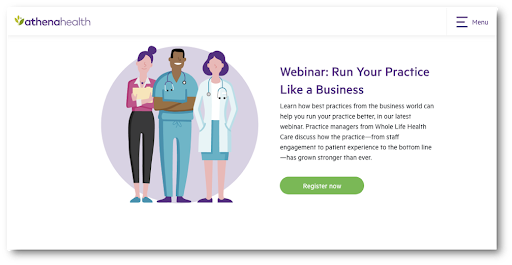
Webinars from AthenaHealth help their clients deal with their most critical business challenges — an excellent example of B2B content marketing.
3. Convince & Convert (This Very Blog) Gives Away Tools & Frameworks
B2B Content Lesson: Provide Your Recipe to Build Trust and Authority
If you’re a regular reader of this blog, you may have noticed that we actually give you quite a lot of tools and frameworks that we use with our clients.
That’s because we recognize that for B2B businesses like ours, there is a difference between the DIY segments and the segments that want you to help them take those frameworks and put them to good use for their organizations.
Therefore, we give away templates, like the one in this example, along with a video and blog post to explain to visitors how to use them.
It builds trust, and when those visitors (maybe like you!) are ready to take their digital marketing practices to the next step, we are already at the top of their list in terms of trust and authority.
Not only does it build trust, but it also helps us to build an audience—content like this has great value in search.
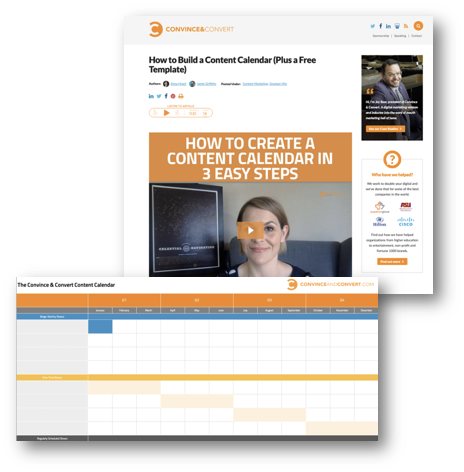
In this B2B content marketing example, we offer a downloadable template, along with a vide introduction.
Mailchimp Profiles Its Customers on Instagram
B2B Content Lesson: Showcase Your Community of Users
For many B2B companies, social proof takes the form of reviews or testimonials; however, as more and more B2B decision-makers turn to social media, creating content that reflects your community is vital. In fact, 51% of all B2B customers turn to social media to do initial research, according to Accenture.
51% of all B2B customers turn to social media to do initial research. Click To Tweet
Furthermore, the lines between social media and content marketing are blurring more than ever.
More often than not, the content that our teams are creating live on social media channels, rather than on our websites.
Therefore, looking at ways to create content within social media makes a ton of sense.
Mailchimp, for example, has used its Instagram account as a place to showcase the stories of what its customers are achieving every day, their creativity, and their stories to showcase the kinds of people who use Mailchimp to power their businesses.
It publishes micro profiles on each Instagram post.
It showcases their ethos, and it reassures potential users that they’ve found their tribe.
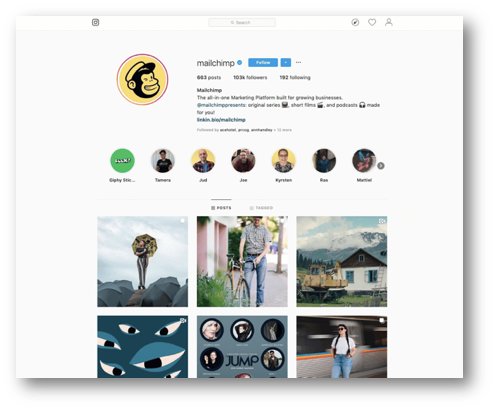
In this example of great B2B content, Mailchimp uses its Instagram account as a place to showcase the stories of what its customers are achieving every day, their creativity, and their stories to showcase the kinds of people who use Mailchimp to power their businesses.
CMI Facilitates Conversation Through Monthly Twitter Chats
B2B Content Lesson: Create Points of Interaction
If we’re talking about strong examples of B2B content marketing, what better place to turn that Content Marketing Institute itself?
CMI not only educates marketers but also connects them through events like Content Marketing World.
An ongoing example of its content marketing practice is its monthly #CMWorld Twitter chat, where guests are invited to answer pre-selected questions, posed by a moderator, while Twitter users participate in answering those same questions, asking each other questions, and picking the brains of the guest.
It’s like “Inside the Actors Studio” if the audience were up on stage participating too.
Not only does this approach create a strong network of devoted brand followers, but it (like our first example) helps the brand to leverage and extend its marquee brand.
In this case, Content Marketing World’s #cmworld hashtag gets to be used once a week, rather than for one week a year.
This keeps it front and center when it comes to marketing conversations (their key market).
The #CMIWorld Twitter chat is an ongoing example of CMI’s content marketing practice.
Remember: As you’re developing your B2B content marketing campaigns, keep in mind your target audiences’ goals, challenges, and mindsets.
If you are able to address those specific areas and make it easy for them to do so, your content will resonate and be effective.
The post 5 B2B Content Marketing Examples You Can Copy appeared first on Content Marketing Consulting and Social Media Strategy.
Source: convinceandconvert.com